EP1447908B1 - Power amplifier - Google Patents
Power amplifier Download PDFInfo
- Publication number
- EP1447908B1 EP1447908B1 EP02775506A EP02775506A EP1447908B1 EP 1447908 B1 EP1447908 B1 EP 1447908B1 EP 02775506 A EP02775506 A EP 02775506A EP 02775506 A EP02775506 A EP 02775506A EP 1447908 B1 EP1447908 B1 EP 1447908B1
- Authority
- EP
- European Patent Office
- Prior art keywords
- pulse
- signal
- output
- pulse modulation
- level
- Prior art date
- Legal status (The legal status is an assumption and is not a legal conclusion. Google has not performed a legal analysis and makes no representation as to the accuracy of the status listed.)
- Expired - Lifetime
Links
Images






Classifications
-
- H—ELECTRICITY
- H03—ELECTRONIC CIRCUITRY
- H03F—AMPLIFIERS
- H03F1/00—Details of amplifiers with only discharge tubes, only semiconductor devices or only unspecified devices as amplifying elements
- H03F1/26—Modifications of amplifiers to reduce influence of noise generated by amplifying elements
-
- H—ELECTRICITY
- H03—ELECTRONIC CIRCUITRY
- H03F—AMPLIFIERS
- H03F3/00—Amplifiers with only discharge tubes or only semiconductor devices as amplifying elements
- H03F3/20—Power amplifiers, e.g. Class B amplifiers, Class C amplifiers
- H03F3/21—Power amplifiers, e.g. Class B amplifiers, Class C amplifiers with semiconductor devices only
- H03F3/217—Class D power amplifiers; Switching amplifiers
-
- H—ELECTRICITY
- H03—ELECTRONIC CIRCUITRY
- H03F—AMPLIFIERS
- H03F3/00—Amplifiers with only discharge tubes or only semiconductor devices as amplifying elements
- H03F3/20—Power amplifiers, e.g. Class B amplifiers, Class C amplifiers
- H03F3/21—Power amplifiers, e.g. Class B amplifiers, Class C amplifiers with semiconductor devices only
- H03F3/217—Class D power amplifiers; Switching amplifiers
- H03F3/2173—Class D power amplifiers; Switching amplifiers of the bridge type
-
- H—ELECTRICITY
- H03—ELECTRONIC CIRCUITRY
- H03F—AMPLIFIERS
- H03F3/00—Amplifiers with only discharge tubes or only semiconductor devices as amplifying elements
- H03F3/30—Single-ended push-pull [SEPP] amplifiers; Phase-splitters therefor
- H03F3/3001—Single-ended push-pull [SEPP] amplifiers; Phase-splitters therefor with field-effect transistors
- H03F3/3022—CMOS common source output SEPP amplifiers
- H03F3/3023—CMOS common source output SEPP amplifiers with asymmetrical driving of the end stage
- H03F3/3027—CMOS common source output SEPP amplifiers with asymmetrical driving of the end stage using a common source driving stage, i.e. inverting stage
-
- H—ELECTRICITY
- H03—ELECTRONIC CIRCUITRY
- H03F—AMPLIFIERS
- H03F2200/00—Indexing scheme relating to amplifiers
- H03F2200/331—Sigma delta modulation being used in an amplifying circuit
Definitions
- the present invention relates to power amplifiers.
- Class-D amplifiers serve as audio power amplifiers.
- the class-D 7 amplifiers amplify electric power by switching, and are structured, for example, as shown in Fig. 10 .
- a digital audio signal Pin is sent through an input terminal Tin to PWM (pulse width modulation) modulation circuits 11 and 12, and the input signal Pin is converted to a pair of PWM signals PA and PB.
- PWM pulse width modulation
- the pulse widths of the PWM signals PA and PB are changed according to the level (the level of each sample of the original analog signal converted to the signal Pin) indicated by the input signal Pin.
- the pulse width of one PWM signal PA has a magnitude corresponding to the level indicated by the input signal Pin
- the pulse width of the other PWM signal PB has a magnitude corresponding to the two's complement of the level indicated by the input signal Pin.
- their rising edges are fixed to the start point of one cycle period (reference period) Tc of the PWM signals PA and PB, and their falling edges are shifted according to the level indicated by the input signal Pin.
- fs 48 kHz
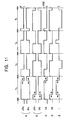
- Such a PWM signal PA is sent to a drive circuit 13, and a pair of drive voltages +PA and -PA which are the signal PA and a signal having the same level as the signal PA with the inverted polarities is formed as shown in Fig. 11A .
- These drive voltages +PA and -PA are sent to the gates of a pair of n-channel MOS-FETs (metal oxide semiconductor type field effect transistors) (Q11 and Q12).
- the FETs (Q11 and Q12) constitute a push-pull circuit 15.
- the drain of the FET (Q11) is connected to a power-supply terminal TPWR, the source of the FET (Q11) is connected to the drain of the FET (Q12), and the source of the FET (Q12) is connected to the ground.
- a stable DC voltage +VDD is supplied as a power-supply voltage.
- the voltage +VDD ranges, for example, from 20 V to 50 V.
- the source of the FET (Q11) and the drain of the FET (Q12) are connected to one end of a speaker 19 through a low-pass filter 17 formed of a coil and a capacitor.
- the PWM signal PB sent from the PWM modulation circuit 11 also passes through in the same way as the PWM signal PA. More specifically, the PWM signal PB is sent to a drive circuit 14, and a pair of drive voltages +PB and -PB which are the signal PB and a signal having the same level as the signal PB with the inverted polarities is formed as shown in Fig. 11B . These drive voltages +PB and -PB are sent to the gates of a pair of n-channel MOS-FETs (Q13 and Q14) constituting a push-pull circuit 16.
- the source of the FET (Q13) and the drain of the FET (Q14) are connected to the other end of the speaker 19 through a low-pass filter 18 formed of a coil and a capacitor.
- the periods when the current “i” flows is changed according to the periods when the original PWM signals PA and PB are at "H".
- the current "i” flows through the speaker 19
- the current "i” is integrated by the low-pass filters 17 and 18.
- the current "i” flowing through the speaker 19 is the analog current which corresponds to the level indicated by the input signal Pin and of which the electric power has been amplified. In other words, the electric-power-amplified output is sent to the speaker 19.
- the circuit shown in Fig. 10 functions as a power amplifier in this way.
- the FETs (Q11 to Q14) switch the power-supply voltage +VDD according to the input digital audio signal Pin to amplify the electric power. Therefore, a high efficiency and a large output are obtained.
- the carrier frequency Fc of the PWM signals PA and PB is, for example, 768 kHz as in the above case, and is included in the band of medium-wave broadcasting.
- An object of the present invention is to provide a power amplifier having a reduced level of such emission.
- a power amplifier comprising:
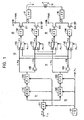
- Fig. 1 shows an example class-D power amplifier according to the present invention.
- a digital audio signal Pin is sent through an input terminal Tin to a ⁇ nodulation circuit 111.
- the ⁇ modulation circuit 111 constitutes a first PWM modulation circuit 11 together with a ROM (read only memory) 112 and a parallel-input-serial-output shift register 113, and constitutes a second PWM modulation circuit 12 together with a ROM 122 and a parallel-input-serial-output shift register 123.
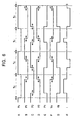
- the digital audio signal Pin is converted to PWM signals +PA and +PB, such as those shown in Fig. 2A and Fig. 2B , by the PWM modulation circuits 11 and 12.
- the pulse widths of the PWM signals +PA and +PB are changed according to the level indicated by the input signal Pin.
- the pulse width of one PWM signal +PA has a magnitude corresponding to the level indicated by the input signal Pin
- the pulse width of the other PWM signal +PB has a magnitude corresponding to the two's complement, for example, of the level indicated by the input signal Pin.
- their rising edges are fixed to the start point of one cycle period Tc of the PWM signals +PA and +PB, and their falling edges are shifted according to the level indicated by the audio signal Pin.
- fs 48 kHz
- the digital audio signal is sent to the ROM 112, and is converted to parallel digital data corresponding to the quantization level.
- the parallel digital data is sent to the shift register 113, and is converted to a serial signal, that is, the PWM signal +PA.
- the digital audio signal output from the ⁇ modulation circuit 111 is sent to the ROM 122, and is converted to parallel digital data corresponding to the two's complement of the level of the digital audio signal.
- the parallel digital data is sent to the shift register 123, and is converted to a serial signal, that is, the PWM signal +PB.
- a timing-signal generation circuit 121 generates various timing signals, and sends the timing signals to the circuits 111 to 113, 122, and 123.
- the PWM signals +PA and +PB are sent to drive circuits 13 and 14 to generate drive voltages P1 to P4. More specifically, the PWM signal +PA is sent to selector circuits 131 and 142; is also sent to an inverter 135 to generate a level-inverted PWM signal -PA, as shown in Fig. 2A ; and the PWM signal -PA is sent to selector circuits 132 and 141.
- the PWM signal +PB is sent to the selector circuits 141, and 132; is also sent to an inverter 145 to generate a level-inverted PWM signal -PB, as shown in Fig. 2B ; and the PWM signal -PB is sent to the selector circuits 142 and 131.
- Fig. 2A and Fig. 2B are the same as Fig. 11A and Fig. 11B .
- the timing-signal generation circuit 121 outputs a signal Pc having a level inverted every cycle period Tc as shown in Fig. 2C , and the signal Pc is sent to the selector circuits 131, 132, 141, and 142 as a switching control signal.
- These drive voltages P1, P2, P3, and P4 are shaped by flip-flop circuits 133, 134, 143, and 144, and the drive voltages P1 and P2 are sent to the gates of a pair of switching elements, such as n-channel MOS-FETs (Q11 and Q12).
- the FETs (Q11 and Q12) constitute a push-pull circuit 15.
- the drain of the FET (Q11) is connected to a power-supply terminal TPWR
- the source of the FET (Q11) is connected to the drain of the FET (Q12)
- the source of the FET (Q12) is connected to the ground.
- a stable DC voltage +VDD such as a DC voltage ranging from 20 V to 50V, is supplied as a power-supply voltage.
- the source of the FET (Q11) and the drain of the FET (Q12) are connected to one end of a speaker 19 through a low-pass filter 17 formed, for example, of a coil and a capacitor.
- the drive voltages P3 and P4 sent from the drive circuit 14 also pass through in the same way as the drive voltages P1 and P2. More specifically, the drive voltages P3 and P4 are sent to a pair of n-channel MOS-FETs (Q13 and Q14) constituting a push-pull circuit 16.
- the source of the FET (Q13) and the drain of the FET (Q14) are connected to the other end of the speaker 19 through a low-pass filter 18 formed of a coil and a capacitor.
- the periods when the current "i” flows is changed according to the periods when the original PWM signals +PA and +PB are at "H".
- the current "i” flows through the speaker 19
- the current "i” is integrated by the low-pass filters 17 and 18.
- the current "i” flowing through the speaker 19 is the analog current which corresponds to the level indicated by the digital audio signal Pin and of which the electric power has been amplified. Therefore, the circuit shown in Fig. 1 functions as a class-D power amplifier, and the electric-power-amplified output is sent to the speaker 19.
- the power amplifier shown in Fig. 1 amplifies electric power by switching.
- the PWM signals +PA and +PB rise and fall once per cycle period Tc
- the output voltages VA and VB rise or fall once per cycle period Tc
- the number of the rising edges and the falling edges of the output voltages VA and VB is half the number of the rising edges and the falling edges of the output voltages VA and VB (see Fig. 11C and Fig. 11D ) in the power amplifier shown in Fig. 10 . Therefore, extraneous emission caused by the changes of the output voltages VA and VB is reduced.
- the frequency of the output voltages VA and VB is half the frequency of the output voltages VA and VB in the power amplifier shown in Fig. 10 , even when the power amplifier according to the present embodiment is united with a receiver as in a car audio system, or is disposed close to a receiver, disturbance given to broadcasting receiving, caused by the emission is reduced. Since disturbance given to broadcasting receiving, caused by the emission is reduced in this way, a member used for shielding a receiver from the emission can be eliminated, and cost is reduced. In addition, the power amplifier can be disposed close to a receiver, space is saved.
- both drive voltages P1 and P2 are "L" at a period although instantaneously.
- the FETs (Q11 and Q12) are both ON in this period, and current passes through the FETs (Q11 and Q12).
- the frequency of the drive voltages P1 to P4 in the power amplifier shown in Fig. 1 is half the frequency in the power amplifier shown in Fig. 10 , the number of times current passes through the FETs (Q11 and Q12) or the FETs (Q13 and Q14) when both FETs (Q11 and Q12) or both FETs (Q13 and Q14) are turned on at the same time is halved.
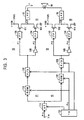
- the ROM 112 since a digital audio signal output from a ⁇ modulation circuit 111 has six bits per sampling, the ROM 112 has the address of seven bits A6 to A0, which is one-bit larger, as shown in Fig. 4 .
- the size of data at each address is 64 bits D63 to D0 corresponding to six bits per sampling.
- the digital audio signal Since a digital audio signal output from a ⁇ modulation circuit 111 has six bits per sampling, the digital audio signal has one of 63 values from -31 through 0 to +31, as shown at the left-hand column of Fig. 5 . Since the 63 values are expressed by two's complements, they are shown in binary at the middle column of Fig. 5 . When it is assumed that these binary numbers are natural binary numbers and converted to decimal numbers, they have values as shown at the right-hand column of Fig. 5 .
- the same values are stored at the addresses 0 to 63 in the ROM 122 as those at the addresses 63 to 0 in the ROM 112.
- the same values are stored at the addresses 64 to 127 in the ROM 122 as those at the addresses 127 to 64 in the ROM 112.
- the data stored at the addresses 0 to 63 in the ROM 112 and ROM 122 can be stored at the addresses 0 to 63 in the ROM 112 and ROM 122 shown in Fig. 1 .
- a digital audio signal output from the ⁇ modulation circuit 111 is sent to the lower six bits A5 to A0, and the signal Pc, which is inverted every sample period Tc, is sent from a timing-signal generation circuit 121 to the most significant bit A6.
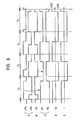
- the PWM signal P1 is sent to the gate of an FET (Q11) through a flip-flop circuit 133; and is also sent to an inverter 135, is inverted in level to generate a signal P2 as shown in Fig. 6D , and the signal P2 is sent to the gate of an FET (Q12) through a flip-flop circuit 134.
- the PWM signal P3 is sent to the gate of an FET (Q13) through a flip-flop circuit 143; and is also sent to an inverter 145, is inverted in level to generate a signal P4 as shown in Fig. 6E , and the signal P4 is sent to the gate of an FET (Q14) through a flip-flop circuit 144.
- a voltage VA generated at the connection point of the FETs (Q11 and Q12) and a voltage VB generated at the connection point of the FETs (Q13 and Q14) are the same as the voltages VA and VB shown in Fig. 2F and Fig. 2G , and current "i" shown in Fig. 6H flows through a speaker 19. As a result, an electric-power-amplified output is sent to the speaker 19.
- the power amplifier shown in Fig. 3 obtains the same advantages as the power amplifier shown in Fig. 1 , and in addition, can omit the selector circuits 131, 132, 141, and 142 shown in Fig. 1 .
- the output stage of each power amplifier is the BTL circuit.
- the output stage can be a single circuit.
- Fig. 7 shows one form of such a power amplifier.
- PWM signals +PA and +PB are output from PWM conversion circuits 11 and 12, as shown in Fig. 8A ; the PWM signal +PA is sent to a drive circuit 13; the PWM signal +PB is sent to an inverter 145, and a PWM signal -PB having an inverted level as shown in Fig. 8B is generated; and the PWM signal - PB is sent to the drive circuit 13.
- the drive circuit 13 outputs drive voltages P1 and P2, and the drive voltages P1 and P2 are sent to a push-pull circuit 15.
- the drive voltage P1 is obtained by taking the PWM signal +PA and the PWM signal -PB alternately and at intervals equal to the cycle period Tc
- the drive voltage P2 is obtained by inverting the level of the drive voltage P1.
- the push-pull circuit 15 uses positive and negative power supplies.
- the drain of an FET (Q11) is connected to a positive-power-supply terminal TPWR+, and the source of an FET (Q12) is connected to a negative-power-supply terminal TPWR-.
- a pair of positive and negative DC voltages +VDD and -VDD are supplied to the power-supply terminals TPWR+ and TPWR- as power-supply voltages.
- the output end of the push-pull circuit 15 is connected to one end of a speaker 19 through a low-pass filter 17, and the other end of the speaker 19 is grounded.
- the output voltage VA of the push-pull circuit 15 has a shape such as that shown in Fig. 8D corresponding to the drive voltages P1 and P2.
- current "i" having a polarity and magnitude corresponding to an input signal Pin flows through the speaker 19, and electric power is amplified.
- a power amplifier shown in Fig. 9 has a single circuit at an output stage in the same way as the power amplifier shown in Fig. 7 , and uses only a DC voltage +VDD as a power-supply voltage for a push-pull circuit 15. Therefore, in this case, for example, a DC-cut capacitor 21 is connected between the output end of the push-pull circuit 15 and a low-pass filter 17.
- the input signal Pin is a digital audio signal.
- the input signal Pin may be an analog audio signal.
- the PWM signals +PA, +PB, -PA, and -PB may be PNM (pulse number modulation) signals.
- the PWM conversion circuits 11 and 12 can be formed of an increment counter, a decrement counter, and a comparison circuit.
- the power amplifiers are used as audio amplifiers.
- the power amplifiers can also be used as amplifiers for driving electric-power units such as motors.
- the power amplifiers can also be used as variable power-supply circuits.
- the number of the rising edges and the falling edges of the output voltage(s) is half the number of the rising edges and the falling edges of the PWM signals which generate the output voltage(s), emission caused by the change of the output voltage is reduced.
- a power amplifier according to the present invention is united with a receiver as in a car audio system or the power amplifier is disposed close to a receiver, disturbance given to broadcasting receiving, caused by the emission is reduced.
- a member used for shielding a receiver from the emission can be eliminated, and cost is reduced.
- a receiver can be disposed closer to the power amplifier, space is also reduced.
- the number of the rising edges and the falling edges of the output voltage (s) is halved, the number of times current flows through a push-pull circuit or push-pull circuits used for generating the output voltage(s) are also halved. A loss in the power amplifier is reduced, and heat generated by devices is also suppressed. In addition, since the number of times the output switching element(s) perform switching is reduced, the deterioration of audio characteristics, caused by switching noise is also suppressed.
Landscapes
- Engineering & Computer Science (AREA)
- Power Engineering (AREA)
- Amplifiers (AREA)
- Electronic Switches (AREA)
Applications Claiming Priority (5)
| Application Number | Priority Date | Filing Date | Title |
|---|---|---|---|
| JP2001352922 | 2001-11-19 | ||
| JP2001352922 | 2001-11-19 | ||
| JP2002162437 | 2002-06-04 | ||
| JP2002162437A JP3894305B2 (ja) | 2001-11-19 | 2002-06-04 | パワーアンプ |
| PCT/JP2002/011597 WO2003044947A1 (fr) | 2001-11-19 | 2002-11-07 | Amplificateur de puissance |
Publications (3)
| Publication Number | Publication Date |
|---|---|
| EP1447908A1 EP1447908A1 (en) | 2004-08-18 |
| EP1447908A4 EP1447908A4 (en) | 2006-02-01 |
| EP1447908B1 true EP1447908B1 (en) | 2011-03-16 |
Family
ID=26624594
Family Applications (1)
| Application Number | Title | Priority Date | Filing Date |
|---|---|---|---|
| EP02775506A Expired - Lifetime EP1447908B1 (en) | 2001-11-19 | 2002-11-07 | Power amplifier |
Country Status (6)
| Country | Link |
|---|---|
| US (1) | US6917242B2 (enExample) |
| EP (1) | EP1447908B1 (enExample) |
| JP (1) | JP3894305B2 (enExample) |
| KR (1) | KR100976444B1 (enExample) |
| DE (1) | DE60239484D1 (enExample) |
| WO (1) | WO2003044947A1 (enExample) |
Families Citing this family (18)
| Publication number | Priority date | Publication date | Assignee | Title |
|---|---|---|---|---|
| JP3894294B2 (ja) * | 2001-11-19 | 2007-03-14 | ソニー株式会社 | パワーアンプ |
| WO2004010575A1 (ja) * | 2002-07-18 | 2004-01-29 | Sony Corporation | パワーアンプ装置 |
| US7061312B2 (en) * | 2003-03-21 | 2006-06-13 | D2Audio Corporation | Systems and methods for providing multi channel pulse width modulated audio with staggered outputs |
| US7929718B1 (en) | 2003-05-12 | 2011-04-19 | D2Audio Corporation | Systems and methods for switching and mixing signals in a multi-channel amplifier |
| JP4154601B2 (ja) * | 2003-10-23 | 2008-09-24 | ソニー株式会社 | 信号変換装置、出力アンプ装置、オーディオ装置および送受信システム |
| JP4587222B2 (ja) * | 2005-11-29 | 2010-11-24 | ローム株式会社 | D級アンプ及びこれを備えた音響機器 |
| CN101371434B (zh) * | 2006-01-24 | 2011-04-20 | D2音频有限公司 | 用于通过将超声波信号加到输入音频信号以改进数字放大器的性能的系统和方法 |
| JP4702296B2 (ja) * | 2006-01-30 | 2011-06-15 | ヤマハ株式会社 | 増幅器 |
| US8174316B2 (en) * | 2006-10-18 | 2012-05-08 | Apexone Microelectronics Ltd. | Switching amplifier |
| TWI354439B (en) * | 2007-06-04 | 2011-12-11 | Holtek Semiconductor Inc | Ac signal producer and method thereof |
| US8072283B2 (en) * | 2007-09-04 | 2011-12-06 | Telefonaktiebolaget L M Ericsson (Publ) | Signal modulation for switched mode power amplifiers |
| JP2009147552A (ja) * | 2007-12-12 | 2009-07-02 | Panasonic Corp | D級アンプ |
| JP5099699B2 (ja) * | 2008-05-16 | 2012-12-19 | 国立大学法人 名古屋工業大学 | パルス幅位置変調信号生成装置 |
| CN102150368A (zh) * | 2008-11-28 | 2011-08-10 | 三菱电机株式会社 | 互补型脉冲宽度调制电路、及数模转换装置 |
| US7986187B1 (en) | 2010-03-04 | 2011-07-26 | Bose Corporation | Versatile audio power amplifier |
| EP2608403A1 (en) * | 2011-12-21 | 2013-06-26 | Alcatel Lucent | A method for signal modulation using pulse width modulators |
| US9559642B2 (en) | 2015-01-02 | 2017-01-31 | Logitech Europe, S.A. | Audio delivery system having an improved efficiency and extended operation time between recharges or battery replacements |
| WO2019204999A1 (en) * | 2018-04-25 | 2019-10-31 | Huawei Technologies Co., Ltd. | Method and apparatus for control of optical phase shifters in an optical device |
Family Cites Families (10)
| Publication number | Priority date | Publication date | Assignee | Title |
|---|---|---|---|---|
| DE3677229D1 (de) * | 1986-12-01 | 1991-02-28 | Itt Ind Gmbh Deutsche | Stromumschalter. |
| US5398003A (en) * | 1994-03-30 | 1995-03-14 | Apple Computer, Inc. | Pulse width modulation speaker amplifier |
| US5617058A (en) * | 1995-11-13 | 1997-04-01 | Apogee Technology, Inc. | Digital signal processing for linearization of small input signals to a tri-state power switch |
| US6104248A (en) * | 1998-10-23 | 2000-08-15 | Carver; Robert W. | Audio amplifier with tracking power supply utilizing inductive power converters |
| NL1011002C2 (nl) * | 1999-01-12 | 2000-07-20 | Univ Eindhoven Tech | Versterkerschakeling. |
| JP2001185961A (ja) * | 1999-12-24 | 2001-07-06 | Alpine Electronics Inc | デジタルアンプ |
| JP4387601B2 (ja) * | 2000-02-01 | 2009-12-16 | アルパイン株式会社 | デジタルアンプ |
| KR20010105877A (ko) * | 2000-05-19 | 2001-11-29 | 배길훈 | 자동차용 브레이크 시스템의 솔레노이드 밸브 |
| JP2002158549A (ja) * | 2000-11-17 | 2002-05-31 | Sony Corp | デジタルパワーアンプ装置 |
| JP2002158544A (ja) * | 2000-11-17 | 2002-05-31 | Sony Corp | デジタルパワーアンプ |
-
2002
- 2002-06-04 JP JP2002162437A patent/JP3894305B2/ja not_active Expired - Fee Related
- 2002-11-07 WO PCT/JP2002/011597 patent/WO2003044947A1/ja not_active Ceased
- 2002-11-07 US US10/466,927 patent/US6917242B2/en not_active Expired - Lifetime
- 2002-11-07 EP EP02775506A patent/EP1447908B1/en not_active Expired - Lifetime
- 2002-11-07 DE DE60239484T patent/DE60239484D1/de not_active Expired - Lifetime
- 2002-11-07 KR KR1020037008938A patent/KR100976444B1/ko not_active Expired - Fee Related
Also Published As
| Publication number | Publication date |
|---|---|
| EP1447908A1 (en) | 2004-08-18 |
| KR20040058096A (ko) | 2004-07-03 |
| US6917242B2 (en) | 2005-07-12 |
| KR100976444B1 (ko) | 2010-08-18 |
| US20040263244A1 (en) | 2004-12-30 |
| WO2003044947A1 (fr) | 2003-05-30 |
| DE60239484D1 (de) | 2011-04-28 |
| JP2003218647A (ja) | 2003-07-31 |
| JP3894305B2 (ja) | 2007-03-22 |
| EP1447908A4 (en) | 2006-02-01 |
Similar Documents
| Publication | Publication Date | Title |
|---|---|---|
| EP1447908B1 (en) | Power amplifier | |
| JP4744686B2 (ja) | 演算増幅器 | |
| US6107886A (en) | High-efficiency power amplifier | |
| JP4210594B2 (ja) | 差動出力スイッチング増幅器においてヌルスペクトルを生成するための回路及びその方法 | |
| EP0962120B1 (en) | High-fidelity and high-efficiency analog amplifier combined with digital amplifier | |
| JP6682463B2 (ja) | D級アンプ | |
| EP0661809A1 (en) | A buffer stage for use with a current controlled oscillator | |
| CN102611398A (zh) | 具有开关式电荷泵单元的半导体集成电路及其操作方法 | |
| KR100952384B1 (ko) | 파워 앰프 | |
| US20080012634A1 (en) | Programmable gain amplifier | |
| US5963106A (en) | Double-sided pulse width modulator | |
| US20060017465A1 (en) | Buffer | |
| CN108649959B (zh) | 一种数字模拟转换器及数字功放子系统 | |
| JP2004046595A (ja) | 電源回路 | |
| JP2004056211A (ja) | 半導体装置およびd級増幅器 | |
| JP2012114610A (ja) | 電子回路 | |
| JP2006166391A (ja) | スイッチングアンプ及びスイッチングアンプの駆動方法 | |
| CN208433952U (zh) | 一种数字模拟转换器及数字功放子系统 | |
| JP2006211523A (ja) | デジタルスイッチング回路 | |
| KR100486276B1 (ko) | 입력되는 두 클럭의 인터폴레이팅에 의하여 지연량의차이를 조절할 수 있는 지연된 탭신호들을 발생하는 회로 | |
| JP3894293B2 (ja) | パワーアンプ装置 | |
| JPH07254824A (ja) | 増幅器 | |
| US20240267008A1 (en) | Audio amplifier and method of operating the same | |
| US20060284677A1 (en) | Switching amplifier and control method thereof | |
| JP2003091268A (ja) | 液晶駆動電源発生回路 |
Legal Events
| Date | Code | Title | Description |
|---|---|---|---|
| PUAI | Public reference made under article 153(3) epc to a published international application that has entered the european phase |
Free format text: ORIGINAL CODE: 0009012 |
|
| 17P | Request for examination filed |
Effective date: 20030704 |
|
| AK | Designated contracting states |
Kind code of ref document: A1 Designated state(s): AT BE BG CH CY CZ DE DK EE ES FI FR GB GR IE IT LI LU MC NL PT SE SK TR |
|
| A4 | Supplementary search report drawn up and despatched |
Effective date: 20051216 |
|
| 17Q | First examination report despatched |
Effective date: 20100422 |
|
| GRAP | Despatch of communication of intention to grant a patent |
Free format text: ORIGINAL CODE: EPIDOSNIGR1 |
|
| GRAS | Grant fee paid |
Free format text: ORIGINAL CODE: EPIDOSNIGR3 |
|
| GRAA | (expected) grant |
Free format text: ORIGINAL CODE: 0009210 |
|
| AK | Designated contracting states |
Kind code of ref document: B1 Designated state(s): DE FR GB |
|
| REG | Reference to a national code |
Ref country code: GB Ref legal event code: FG4D |
|
| REF | Corresponds to: |
Ref document number: 60239484 Country of ref document: DE Date of ref document: 20110428 Kind code of ref document: P |
|
| REG | Reference to a national code |
Ref country code: DE Ref legal event code: R096 Ref document number: 60239484 Country of ref document: DE Effective date: 20110428 |
|
| PLBE | No opposition filed within time limit |
Free format text: ORIGINAL CODE: 0009261 |
|
| STAA | Information on the status of an ep patent application or granted ep patent |
Free format text: STATUS: NO OPPOSITION FILED WITHIN TIME LIMIT |
|
| 26N | No opposition filed |
Effective date: 20111219 |
|
| REG | Reference to a national code |
Ref country code: DE Ref legal event code: R097 Ref document number: 60239484 Country of ref document: DE Effective date: 20111219 |
|
| REG | Reference to a national code |
Ref country code: GB Ref legal event code: 746 Effective date: 20120703 |
|
| REG | Reference to a national code |
Ref country code: DE Ref legal event code: R084 Ref document number: 60239484 Country of ref document: DE Effective date: 20120614 |
|
| REG | Reference to a national code |
Ref country code: FR Ref legal event code: PLFP Year of fee payment: 14 |
|
| REG | Reference to a national code |
Ref country code: FR Ref legal event code: PLFP Year of fee payment: 15 |
|
| REG | Reference to a national code |
Ref country code: FR Ref legal event code: PLFP Year of fee payment: 16 |
|
| PGFP | Annual fee paid to national office [announced via postgrant information from national office to epo] |
Ref country code: FR Payment date: 20191120 Year of fee payment: 18 |
|
| PGFP | Annual fee paid to national office [announced via postgrant information from national office to epo] |
Ref country code: GB Payment date: 20191120 Year of fee payment: 18 |
|
| PGFP | Annual fee paid to national office [announced via postgrant information from national office to epo] |
Ref country code: DE Payment date: 20201119 Year of fee payment: 19 |
|
| GBPC | Gb: european patent ceased through non-payment of renewal fee |
Effective date: 20201107 |
|
| PG25 | Lapsed in a contracting state [announced via postgrant information from national office to epo] |
Ref country code: FR Free format text: LAPSE BECAUSE OF NON-PAYMENT OF DUE FEES Effective date: 20201130 |
|
| PG25 | Lapsed in a contracting state [announced via postgrant information from national office to epo] |
Ref country code: GB Free format text: LAPSE BECAUSE OF NON-PAYMENT OF DUE FEES Effective date: 20201107 |
|
| REG | Reference to a national code |
Ref country code: DE Ref legal event code: R119 Ref document number: 60239484 Country of ref document: DE |
|
| PG25 | Lapsed in a contracting state [announced via postgrant information from national office to epo] |
Ref country code: DE Free format text: LAPSE BECAUSE OF NON-PAYMENT OF DUE FEES Effective date: 20220601 |