EP1443032B1 - Cutting tool insert and method for producing the same - Google Patents
Cutting tool insert and method for producing the same Download PDFInfo
- Publication number
- EP1443032B1 EP1443032B1 EP03001757A EP03001757A EP1443032B1 EP 1443032 B1 EP1443032 B1 EP 1443032B1 EP 03001757 A EP03001757 A EP 03001757A EP 03001757 A EP03001757 A EP 03001757A EP 1443032 B1 EP1443032 B1 EP 1443032B1
- Authority
- EP
- European Patent Office
- Prior art keywords
- less
- composite material
- alumina
- sintering
- workpiece
- Prior art date
- Legal status (The legal status is an assumption and is not a legal conclusion. Google has not performed a legal analysis and makes no representation as to the accuracy of the status listed.)
- Expired - Lifetime
Links
- 238000005520 cutting process Methods 0.000 title claims abstract description 44
- 238000004519 manufacturing process Methods 0.000 title description 5
- 238000005245 sintering Methods 0.000 claims abstract description 81
- 238000000034 method Methods 0.000 claims abstract description 69
- PNEYBMLMFCGWSK-UHFFFAOYSA-N aluminium oxide Inorganic materials [O-2].[O-2].[O-2].[Al+3].[Al+3] PNEYBMLMFCGWSK-UHFFFAOYSA-N 0.000 claims abstract description 46
- 239000000463 material Substances 0.000 claims abstract description 38
- 238000010438 heat treatment Methods 0.000 claims abstract description 25
- 239000002131 composite material Substances 0.000 claims abstract description 22
- HBMJWWWQQXIZIP-UHFFFAOYSA-N silicon carbide Chemical compound [Si+]#[C-] HBMJWWWQQXIZIP-UHFFFAOYSA-N 0.000 claims abstract description 15
- 229910010271 silicon carbide Inorganic materials 0.000 claims abstract description 8
- 238000002360 preparation method Methods 0.000 claims abstract description 5
- 238000003801 milling Methods 0.000 claims abstract description 4
- 238000002156 mixing Methods 0.000 claims abstract description 3
- 239000007858 starting material Substances 0.000 claims abstract description 3
- OKTJSMMVPCPJKN-UHFFFAOYSA-N Carbon Chemical compound [C] OKTJSMMVPCPJKN-UHFFFAOYSA-N 0.000 claims description 11
- 229910002804 graphite Inorganic materials 0.000 claims description 10
- 239000010439 graphite Substances 0.000 claims description 9
- CPLXHLVBOLITMK-UHFFFAOYSA-N Magnesium oxide Chemical compound [Mg]=O CPLXHLVBOLITMK-UHFFFAOYSA-N 0.000 claims description 8
- 239000002245 particle Substances 0.000 claims description 7
- 230000009969 flowable effect Effects 0.000 claims description 6
- 239000000395 magnesium oxide Substances 0.000 claims description 4
- RUDFQVOCFDJEEF-UHFFFAOYSA-N yttrium(III) oxide Inorganic materials [O-2].[O-2].[O-2].[Y+3].[Y+3] RUDFQVOCFDJEEF-UHFFFAOYSA-N 0.000 claims description 4
- 238000007731 hot pressing Methods 0.000 description 18
- 238000009826 distribution Methods 0.000 description 11
- 229910010293 ceramic material Inorganic materials 0.000 description 10
- 238000005259 measurement Methods 0.000 description 9
- 239000000203 mixture Substances 0.000 description 8
- 230000007547 defect Effects 0.000 description 7
- 239000008187 granular material Substances 0.000 description 7
- 238000012545 processing Methods 0.000 description 7
- 238000003825 pressing Methods 0.000 description 6
- 239000012612 commercial material Substances 0.000 description 5
- 239000011148 porous material Substances 0.000 description 5
- 239000000843 powder Substances 0.000 description 5
- 239000000654 additive Substances 0.000 description 4
- 229910045601 alloy Inorganic materials 0.000 description 4
- 239000000956 alloy Substances 0.000 description 4
- 239000002173 cutting fluid Substances 0.000 description 4
- 239000007789 gas Substances 0.000 description 4
- 229910000816 inconels 718 Inorganic materials 0.000 description 4
- 229910003460 diamond Inorganic materials 0.000 description 3
- 239000010432 diamond Substances 0.000 description 3
- 238000001513 hot isostatic pressing Methods 0.000 description 3
- 238000001878 scanning electron micrograph Methods 0.000 description 3
- 238000012360 testing method Methods 0.000 description 3
- 229920002266 Pluriol® Polymers 0.000 description 2
- 229910052581 Si3N4 Inorganic materials 0.000 description 2
- XUIMIQQOPSSXEZ-UHFFFAOYSA-N Silicon Chemical compound [Si] XUIMIQQOPSSXEZ-UHFFFAOYSA-N 0.000 description 2
- MCMNRKCIXSYSNV-UHFFFAOYSA-N ZrO2 Inorganic materials O=[Zr]=O MCMNRKCIXSYSNV-UHFFFAOYSA-N 0.000 description 2
- 229910052799 carbon Inorganic materials 0.000 description 2
- 230000006835 compression Effects 0.000 description 2
- 238000007906 compression Methods 0.000 description 2
- 239000000470 constituent Substances 0.000 description 2
- 238000001035 drying Methods 0.000 description 2
- 238000010191 image analysis Methods 0.000 description 2
- 238000007373 indentation Methods 0.000 description 2
- 229910052751 metal Inorganic materials 0.000 description 2
- 239000002184 metal Substances 0.000 description 2
- 238000001000 micrograph Methods 0.000 description 2
- 229910052710 silicon Inorganic materials 0.000 description 2
- 239000010703 silicon Substances 0.000 description 2
- HQVNEWCFYHHQES-UHFFFAOYSA-N silicon nitride Chemical compound N12[Si]34N5[Si]62N3[Si]51N64 HQVNEWCFYHHQES-UHFFFAOYSA-N 0.000 description 2
- 238000002490 spark plasma sintering Methods 0.000 description 2
- 238000001694 spray drying Methods 0.000 description 2
- IMROMDMJAWUWLK-UHFFFAOYSA-N Ethenol Chemical compound OC=C IMROMDMJAWUWLK-UHFFFAOYSA-N 0.000 description 1
- UFHFLCQGNIYNRP-UHFFFAOYSA-N Hydrogen Chemical compound [H][H] UFHFLCQGNIYNRP-UHFFFAOYSA-N 0.000 description 1
- 229920002858 MOWIOL ® 4-88 Polymers 0.000 description 1
- FYYHWMGAXLPEAU-UHFFFAOYSA-N Magnesium Chemical compound [Mg] FYYHWMGAXLPEAU-UHFFFAOYSA-N 0.000 description 1
- 229920002535 Polyethylene Glycol 1500 Polymers 0.000 description 1
- 229920002556 Polyethylene Glycol 300 Polymers 0.000 description 1
- 239000002253 acid Substances 0.000 description 1
- 239000011157 advanced composite material Substances 0.000 description 1
- 239000011668 ascorbic acid Substances 0.000 description 1
- 238000005452 bending Methods 0.000 description 1
- 239000000919 ceramic Substances 0.000 description 1
- 238000012512 characterization method Methods 0.000 description 1
- 239000011248 coating agent Substances 0.000 description 1
- 238000000576 coating method Methods 0.000 description 1
- 238000005094 computer simulation Methods 0.000 description 1
- 238000009770 conventional sintering Methods 0.000 description 1
- 238000000280 densification Methods 0.000 description 1
- 230000001627 detrimental effect Effects 0.000 description 1
- 230000000694 effects Effects 0.000 description 1
- 238000005538 encapsulation Methods 0.000 description 1
- 238000011049 filling Methods 0.000 description 1
- 239000011521 glass Substances 0.000 description 1
- 230000009422 growth inhibiting effect Effects 0.000 description 1
- 239000008240 homogeneous mixture Substances 0.000 description 1
- 229910052739 hydrogen Inorganic materials 0.000 description 1
- 239000001257 hydrogen Substances 0.000 description 1
- 230000005764 inhibitory process Effects 0.000 description 1
- 238000011835 investigation Methods 0.000 description 1
- 239000007788 liquid Substances 0.000 description 1
- 239000007791 liquid phase Substances 0.000 description 1
- 238000011068 loading method Methods 0.000 description 1
- 229910052749 magnesium Inorganic materials 0.000 description 1
- 239000011777 magnesium Substances 0.000 description 1
- VNWKTOKETHGBQD-UHFFFAOYSA-N methane Chemical compound C VNWKTOKETHGBQD-UHFFFAOYSA-N 0.000 description 1
- 229920003023 plastic Polymers 0.000 description 1
- 229920002451 polyvinyl alcohol Polymers 0.000 description 1
- 230000000063 preceeding effect Effects 0.000 description 1
- 238000001272 pressureless sintering Methods 0.000 description 1
- 239000011226 reinforced ceramic Substances 0.000 description 1
- 230000035939 shock Effects 0.000 description 1
- 239000002002 slurry Substances 0.000 description 1
- 239000007787 solid Substances 0.000 description 1
Images
Classifications
-
- B—PERFORMING OPERATIONS; TRANSPORTING
- B23—MACHINE TOOLS; METAL-WORKING NOT OTHERWISE PROVIDED FOR
- B23B—TURNING; BORING
- B23B27/00—Tools for turning or boring machines; Tools of a similar kind in general; Accessories therefor
- B23B27/14—Cutting tools of which the bits or tips or cutting inserts are of special material
- B23B27/148—Composition of the cutting inserts
-
- B—PERFORMING OPERATIONS; TRANSPORTING
- B22—CASTING; POWDER METALLURGY
- B22F—WORKING METALLIC POWDER; MANUFACTURE OF ARTICLES FROM METALLIC POWDER; MAKING METALLIC POWDER; APPARATUS OR DEVICES SPECIALLY ADAPTED FOR METALLIC POWDER
- B22F3/00—Manufacture of workpieces or articles from metallic powder characterised by the manner of compacting or sintering; Apparatus specially adapted therefor ; Presses and furnaces
- B22F3/12—Both compacting and sintering
-
- C—CHEMISTRY; METALLURGY
- C04—CEMENTS; CONCRETE; ARTIFICIAL STONE; CERAMICS; REFRACTORIES
- C04B—LIME, MAGNESIA; SLAG; CEMENTS; COMPOSITIONS THEREOF, e.g. MORTARS, CONCRETE OR LIKE BUILDING MATERIALS; ARTIFICIAL STONE; CERAMICS; REFRACTORIES; TREATMENT OF NATURAL STONE
- C04B35/00—Shaped ceramic products characterised by their composition; Ceramics compositions; Processing powders of inorganic compounds preparatory to the manufacturing of ceramic products
- C04B35/01—Shaped ceramic products characterised by their composition; Ceramics compositions; Processing powders of inorganic compounds preparatory to the manufacturing of ceramic products based on oxide ceramics
- C04B35/10—Shaped ceramic products characterised by their composition; Ceramics compositions; Processing powders of inorganic compounds preparatory to the manufacturing of ceramic products based on oxide ceramics based on aluminium oxide
- C04B35/111—Fine ceramics
- C04B35/117—Composites
-
- C—CHEMISTRY; METALLURGY
- C04—CEMENTS; CONCRETE; ARTIFICIAL STONE; CERAMICS; REFRACTORIES
- C04B—LIME, MAGNESIA; SLAG; CEMENTS; COMPOSITIONS THEREOF, e.g. MORTARS, CONCRETE OR LIKE BUILDING MATERIALS; ARTIFICIAL STONE; CERAMICS; REFRACTORIES; TREATMENT OF NATURAL STONE
- C04B35/00—Shaped ceramic products characterised by their composition; Ceramics compositions; Processing powders of inorganic compounds preparatory to the manufacturing of ceramic products
- C04B35/622—Forming processes; Processing powders of inorganic compounds preparatory to the manufacturing of ceramic products
- C04B35/626—Preparing or treating the powders individually or as batches ; preparing or treating macroscopic reinforcing agents for ceramic products, e.g. fibres; mechanical aspects section B
- C04B35/63—Preparing or treating the powders individually or as batches ; preparing or treating macroscopic reinforcing agents for ceramic products, e.g. fibres; mechanical aspects section B using additives specially adapted for forming the products, e.g.. binder binders
- C04B35/632—Organic additives
- C04B35/634—Polymers
- C04B35/63404—Polymers obtained by reactions only involving carbon-to-carbon unsaturated bonds
- C04B35/63416—Polyvinylalcohols [PVA]; Polyvinylacetates
-
- C—CHEMISTRY; METALLURGY
- C04—CEMENTS; CONCRETE; ARTIFICIAL STONE; CERAMICS; REFRACTORIES
- C04B—LIME, MAGNESIA; SLAG; CEMENTS; COMPOSITIONS THEREOF, e.g. MORTARS, CONCRETE OR LIKE BUILDING MATERIALS; ARTIFICIAL STONE; CERAMICS; REFRACTORIES; TREATMENT OF NATURAL STONE
- C04B35/00—Shaped ceramic products characterised by their composition; Ceramics compositions; Processing powders of inorganic compounds preparatory to the manufacturing of ceramic products
- C04B35/622—Forming processes; Processing powders of inorganic compounds preparatory to the manufacturing of ceramic products
- C04B35/64—Burning or sintering processes
-
- C—CHEMISTRY; METALLURGY
- C04—CEMENTS; CONCRETE; ARTIFICIAL STONE; CERAMICS; REFRACTORIES
- C04B—LIME, MAGNESIA; SLAG; CEMENTS; COMPOSITIONS THEREOF, e.g. MORTARS, CONCRETE OR LIKE BUILDING MATERIALS; ARTIFICIAL STONE; CERAMICS; REFRACTORIES; TREATMENT OF NATURAL STONE
- C04B35/00—Shaped ceramic products characterised by their composition; Ceramics compositions; Processing powders of inorganic compounds preparatory to the manufacturing of ceramic products
- C04B35/622—Forming processes; Processing powders of inorganic compounds preparatory to the manufacturing of ceramic products
- C04B35/64—Burning or sintering processes
- C04B35/645—Pressure sintering
-
- B—PERFORMING OPERATIONS; TRANSPORTING
- B23—MACHINE TOOLS; METAL-WORKING NOT OTHERWISE PROVIDED FOR
- B23B—TURNING; BORING
- B23B2228/00—Properties of materials of tools or workpieces, materials of tools or workpieces applied in a specific manner
- B23B2228/61—Materials comprising whiskers
-
- C—CHEMISTRY; METALLURGY
- C04—CEMENTS; CONCRETE; ARTIFICIAL STONE; CERAMICS; REFRACTORIES
- C04B—LIME, MAGNESIA; SLAG; CEMENTS; COMPOSITIONS THEREOF, e.g. MORTARS, CONCRETE OR LIKE BUILDING MATERIALS; ARTIFICIAL STONE; CERAMICS; REFRACTORIES; TREATMENT OF NATURAL STONE
- C04B2235/00—Aspects relating to ceramic starting mixtures or sintered ceramic products
- C04B2235/02—Composition of constituents of the starting material or of secondary phases of the final product
- C04B2235/30—Constituents and secondary phases not being of a fibrous nature
- C04B2235/32—Metal oxides, mixed metal oxides, or oxide-forming salts thereof, e.g. carbonates, nitrates, (oxy)hydroxides, chlorides
- C04B2235/3205—Alkaline earth oxides or oxide forming salts thereof, e.g. beryllium oxide
- C04B2235/3206—Magnesium oxides or oxide-forming salts thereof
-
- C—CHEMISTRY; METALLURGY
- C04—CEMENTS; CONCRETE; ARTIFICIAL STONE; CERAMICS; REFRACTORIES
- C04B—LIME, MAGNESIA; SLAG; CEMENTS; COMPOSITIONS THEREOF, e.g. MORTARS, CONCRETE OR LIKE BUILDING MATERIALS; ARTIFICIAL STONE; CERAMICS; REFRACTORIES; TREATMENT OF NATURAL STONE
- C04B2235/00—Aspects relating to ceramic starting mixtures or sintered ceramic products
- C04B2235/02—Composition of constituents of the starting material or of secondary phases of the final product
- C04B2235/30—Constituents and secondary phases not being of a fibrous nature
- C04B2235/32—Metal oxides, mixed metal oxides, or oxide-forming salts thereof, e.g. carbonates, nitrates, (oxy)hydroxides, chlorides
- C04B2235/3224—Rare earth oxide or oxide forming salts thereof, e.g. scandium oxide
- C04B2235/3225—Yttrium oxide or oxide-forming salts thereof
-
- C—CHEMISTRY; METALLURGY
- C04—CEMENTS; CONCRETE; ARTIFICIAL STONE; CERAMICS; REFRACTORIES
- C04B—LIME, MAGNESIA; SLAG; CEMENTS; COMPOSITIONS THEREOF, e.g. MORTARS, CONCRETE OR LIKE BUILDING MATERIALS; ARTIFICIAL STONE; CERAMICS; REFRACTORIES; TREATMENT OF NATURAL STONE
- C04B2235/00—Aspects relating to ceramic starting mixtures or sintered ceramic products
- C04B2235/02—Composition of constituents of the starting material or of secondary phases of the final product
- C04B2235/30—Constituents and secondary phases not being of a fibrous nature
- C04B2235/38—Non-oxide ceramic constituents or additives
- C04B2235/3817—Carbides
- C04B2235/3826—Silicon carbides
-
- C—CHEMISTRY; METALLURGY
- C04—CEMENTS; CONCRETE; ARTIFICIAL STONE; CERAMICS; REFRACTORIES
- C04B—LIME, MAGNESIA; SLAG; CEMENTS; COMPOSITIONS THEREOF, e.g. MORTARS, CONCRETE OR LIKE BUILDING MATERIALS; ARTIFICIAL STONE; CERAMICS; REFRACTORIES; TREATMENT OF NATURAL STONE
- C04B2235/00—Aspects relating to ceramic starting mixtures or sintered ceramic products
- C04B2235/02—Composition of constituents of the starting material or of secondary phases of the final product
- C04B2235/50—Constituents or additives of the starting mixture chosen for their shape or used because of their shape or their physical appearance
- C04B2235/52—Constituents or additives characterised by their shapes
- C04B2235/5276—Whiskers, spindles, needles or pins
-
- C—CHEMISTRY; METALLURGY
- C04—CEMENTS; CONCRETE; ARTIFICIAL STONE; CERAMICS; REFRACTORIES
- C04B—LIME, MAGNESIA; SLAG; CEMENTS; COMPOSITIONS THEREOF, e.g. MORTARS, CONCRETE OR LIKE BUILDING MATERIALS; ARTIFICIAL STONE; CERAMICS; REFRACTORIES; TREATMENT OF NATURAL STONE
- C04B2235/00—Aspects relating to ceramic starting mixtures or sintered ceramic products
- C04B2235/65—Aspects relating to heat treatments of ceramic bodies such as green ceramics or pre-sintered ceramics, e.g. burning, sintering or melting processes
- C04B2235/66—Specific sintering techniques, e.g. centrifugal sintering
- C04B2235/666—Applying a current during sintering, e.g. plasma sintering [SPS], electrical resistance heating or pulse electric current sintering [PECS]
-
- C—CHEMISTRY; METALLURGY
- C04—CEMENTS; CONCRETE; ARTIFICIAL STONE; CERAMICS; REFRACTORIES
- C04B—LIME, MAGNESIA; SLAG; CEMENTS; COMPOSITIONS THEREOF, e.g. MORTARS, CONCRETE OR LIKE BUILDING MATERIALS; ARTIFICIAL STONE; CERAMICS; REFRACTORIES; TREATMENT OF NATURAL STONE
- C04B2235/00—Aspects relating to ceramic starting mixtures or sintered ceramic products
- C04B2235/70—Aspects relating to sintered or melt-casted ceramic products
- C04B2235/74—Physical characteristics
- C04B2235/77—Density
-
- C—CHEMISTRY; METALLURGY
- C04—CEMENTS; CONCRETE; ARTIFICIAL STONE; CERAMICS; REFRACTORIES
- C04B—LIME, MAGNESIA; SLAG; CEMENTS; COMPOSITIONS THEREOF, e.g. MORTARS, CONCRETE OR LIKE BUILDING MATERIALS; ARTIFICIAL STONE; CERAMICS; REFRACTORIES; TREATMENT OF NATURAL STONE
- C04B2235/00—Aspects relating to ceramic starting mixtures or sintered ceramic products
- C04B2235/70—Aspects relating to sintered or melt-casted ceramic products
- C04B2235/74—Physical characteristics
- C04B2235/78—Grain sizes and shapes, product microstructures, e.g. acicular grains, equiaxed grains, platelet-structures
- C04B2235/785—Submicron sized grains, i.e. from 0,1 to 1 micron
-
- C—CHEMISTRY; METALLURGY
- C04—CEMENTS; CONCRETE; ARTIFICIAL STONE; CERAMICS; REFRACTORIES
- C04B—LIME, MAGNESIA; SLAG; CEMENTS; COMPOSITIONS THEREOF, e.g. MORTARS, CONCRETE OR LIKE BUILDING MATERIALS; ARTIFICIAL STONE; CERAMICS; REFRACTORIES; TREATMENT OF NATURAL STONE
- C04B2235/00—Aspects relating to ceramic starting mixtures or sintered ceramic products
- C04B2235/70—Aspects relating to sintered or melt-casted ceramic products
- C04B2235/74—Physical characteristics
- C04B2235/78—Grain sizes and shapes, product microstructures, e.g. acicular grains, equiaxed grains, platelet-structures
- C04B2235/786—Micrometer sized grains, i.e. from 1 to 100 micron
-
- C—CHEMISTRY; METALLURGY
- C04—CEMENTS; CONCRETE; ARTIFICIAL STONE; CERAMICS; REFRACTORIES
- C04B—LIME, MAGNESIA; SLAG; CEMENTS; COMPOSITIONS THEREOF, e.g. MORTARS, CONCRETE OR LIKE BUILDING MATERIALS; ARTIFICIAL STONE; CERAMICS; REFRACTORIES; TREATMENT OF NATURAL STONE
- C04B2235/00—Aspects relating to ceramic starting mixtures or sintered ceramic products
- C04B2235/70—Aspects relating to sintered or melt-casted ceramic products
- C04B2235/96—Properties of ceramic products, e.g. mechanical properties such as strength, toughness, wear resistance
Definitions
- the present invention relates to a cutting tool insert of an improved ceramic material, and a method for preparing the same.
- Ceramic materials for cutting tool applications include alumina, alumina-zirconia, alumina-TiC-TiN, silicon nitride, sialon, and SiC-whisker reinforced alumina.
- the cutting tool environment puts simultaneous high demands on the strength, toughness and thermal shock resistance in addition to the obvious demands for high wear resistance.
- the mechanical properties of ceramic materials are to a high extent influenced by internal and external defects, such as inclusions of foreign matter, pores, large grains and cracks.
- internal and external defects such as inclusions of foreign matter, pores, large grains and cracks.
- Ceramic materials for metal cutting tools are produced by milling of the constituents in a liquid and subsequent drying of the slurry. Spray drying is the preferred drying method for materials that do not require hot pressing. Spray drying produces granules with a size of 50-200 microns. The large granules give very good powder flow properties, which is essential for mass production of blanks with uniaxial cold pressing.
- defects in a sintered body can be related to the pore size and distribution in the green compact. This is especially important for materials that are sintered without pressure or with low pressure (gas pressure sintering), since large pores will not be eliminated.
- the granule characteristics, and especially their deformation behaviour, will be the primary parameters that determine the defect structure in the green state. Considerable increases in strength of the sintered material have been achieved by reducing the granule compression strength, since dense and hard granules will retain their shape even after compression.
- the grain size is essential to the mechanical properties of ceramic materials.
- a fine and uniform grain size provides for a high strength and a small variation of the strength.
- the grain size of ceramic materials is closely related to the sintering conditions.
- Alumina and alumina-zirconia materials are preferably produced by pressureless sintering in an appropriate atmosphere. In many cases, this is the preferred sintering technique for ceramic materials, since it is a relatively low-cost process and enables complex shaped parts to be produced.
- Silicon nitride and sialon materials are normally produced by gas pressure sintering, whereby a gas pressure of about 0.1-1 MPa is applied, once closed porosity is reached in the material. This enables higher densities to be reached at lower sintering temperatures, especially when using low amounts of sintering additives to form a liquid phase.
- Hot isostatic pressing is another sintering technique that is used for materials that cannot be consolidated without external pressure. Pressures of 1-10 MPa are normally used, but the method demands an encapsulation, for example in glass, to transmit the gas pressure. HIP can also be used to remove remaining porosity after conventional sintering or hot pressing to closed porosity, the advantages being that HIP, due to the high pressure, is performed at a lower temperature than the sintering temperature, why a more fine grained material is obtained.
- Hot pressing is the preferred method for materials difficult to be sintered, like silicon whisker reinforced alumina, and also for mixed ceramics, like alumina-TiC.
- the pressure of normally 25-35 MPa is uniaxially transferred to the material with graphite punches. Rather large cylindrical discs are obtained, which are then diamond saw cut to the required dimensions of the blanks.
- the diamond saw cutting is a rather expensive part of the blank production process, amounting to about 30 to 40% of the production costs per blank.
- US patent 4 543 345 describes a method for the production of silicon carbide whisker reinforced alumina with 5-60% by volume SiC-whiskers to a sintered density of greater than 99%.
- the process requires a pressure of 28-70 MPa, a temperature of 1600-1900°C, and a hold time at sintering temperature of 45 min to 2 hours. Pressures and sintering temperatures in the higher range are needed for higher whisker loadings.
- the combination of long sintering times and high sintering temperatures in this hot pressing sintering method leads to alumina grain growth in spite of the grain growth inhibiting effect of the silicon carbide whiskers. Large alumina grains will affect the performance in cutting tool applications, since the largest defect determines the strength of the material.
- SPS spark plasma sintering
- Another method uses a particulate solid as the pressure-transmitting medium, which is why such method is referred to as "pseudo-isostatic". Such method can be used to consolidate preforms of more complicated shape.
- US patent 5 348 694 describes a sintering method, wherein the preformed green blank is heated by electrical resistive heating of a granular pressure-transmitting medium, which is in contact with the preform inside a die chamber.
- the pressure-transmitting medium is electrically conductive, e.g. graphitic carbon granules.
- This electrical resistive heating method enables very high temperatures and rapid heating times, making it suitable for materials that require high sintering temperatures.
- the pressure that can be applied is limited by the strength of the material in the rams and die, which for high temperatures is normally graphite. The pressure is therefore usually not much higher than about 100 MPa.
- This object is solved by providing a method for the preparation of a cutting tool insert having a sintered alumina and silicon carbide whisker composite material body, comprising the steps of
- the method of the present invention will herein be referred to as "rapid sintering".
- the method combines the use of high sintering temperature, a high temperature rise up to the sintering temperature, and short holding times at the sintering temperature, and at the same time a high pressure.
- the method of the present invention having combined the aforementioned parameters, results in a whisker reinforced ceramic material for cutting tools with improved performance due to inhibition of defects due to grain growth.
- the method maintains a fine and uniform alumina grain size due to rapid heating the sintering temperature and due to a short holding time at this temperature, while maintaining full shrinkage and densification.
- the cutting tools produced according to the method of the present invention exhibit superior wear resistance and toughness behaviour over similar cutting tool materials having the same composition, but being produced by a different sintering method.
- the mean alumina grain size is 2.0 ⁇ m or less, preferably less than 1.5 ⁇ m, more preferred less than 1.0 ⁇ m, and most preferred less than 0.9 ⁇ m.
- the improved performance of the cutting tool insert of the present invention seems to be related to a low width of the alumina grain size distribution. Since the alumina grain size distribution in the material of the present invention does not follow an ideal Gaussian distribution, but is rather asymmetric, the grain size standard deviation is not a useful measure for the alumina grain size distribution.
- the alumina grain size distribution is therefore determined by the 80 th percentile (P80) of the width of the alumina grain sizes.
- P80 is the value of the alumina grain size (d), such that 80% of all alumina grain size measurements are less than that value.
- the alumina in the composite material has a 80 th percentile (P80) of less than 2.5 ⁇ m, preferrably less than 2.0 ⁇ m, more preferred less than 1.8 ⁇ m, most preferred less than 1.3 ⁇ m.
- P80 80 th percentile
- the rapid sintering method comprises the steps of heating up the workpiece to be sintered by applying electrical energy in the form of a DC current, that at least partially goes through said workpiece.
- said current may either be unpulsed or pulsed DC current.
- the method of the present invention includes the rapid sintering method, as it is described in US patent 5,348,694. Accordingly, the method of the present invention comprises the steps of providing a bed comprising a bed material of electrically conductive, flowable particles within a contained zone, placing the workpiece in the bed, applying a pressure to said bed, applying electrical energy to said electrically conductive, flowable particles within the bed in a sufficient amount to heat the bed to the desired sintering temperature for the workpiece within the desired heating rate.
- This method allows for a rapid heating up to the sintering temperature at a steep heating ramp at a desired pressure of up to 100 MPa. This method allows for high sintering temperatures compared to other known sintering methods with high heating rates.
- the method further allows at the same time for high sintering pressures to 100 MPa, depending on the strength of the graphite tools.
- the bed material of electrically conductive, flowable particles, useful in the method of the present invention comprises graphite, preferably spherical graphite or carbided graphitic material.
- Rapid sintering includes a high heating rate or steep heating ramp, respectively, high sintering temperatures, and short sintering times. All of these parameters have been found contribute to small alumina grain sizes, small P80 values and to superior tool performance, which seems to be the result of a combination of said small alumina grain sizes, small P80 values and one or more other parameters, which is/are resulting from the rapid sintering method.
- the sintering temperature is between 1800-2100°C, more preferably between 1900-2000°C.
- the heating rate is preferably from 20-40°C per minute, and most preferably about 25°C per minute.
- the holding time is from 5 to 30 minutes, more preferably from 10 to 20 minutes, and most preferably about 15 minutes.
- a useful pressure for the method of the invention lies within the range of 20-100 MPa.
- the pressure is from 30-100 MPa, most preferably from 40-100 MPa. In most cases a pressure of about 50 MPa is suitable.
- the composite material produced according to the method of the present invention comprises alumina plus silicon carbide whiskers in a total proportion of at least 90% by volume, more preferably in a total proportion of at least 95% by volume.
- the proportion of silicon carbide whiskers in said composite material is preferably 5-70% by volume, more preferably 15-50% by volume, and most preferred 20-45% by volume.
- the composite material produced according to the method of the present invention may additionally comprise a certain amount of sintering additives like magnesia or yttria.
- magnesia and/or yttria may each be comprised in the composite material in a proportion of 0.01-5% by weight, preferably in a proportion of 0.02-1 % by weight, most preferred in a proportion of 0.03-0.5% by weight.
- a mixture of 71% by volume alumina (Ceralox APA, ⁇ 0.3 ⁇ m grain size) and 29% by volume silicon carbide whiskers (Advanced Composite Materials Corp. SC-9, average diameter ⁇ 0.6 ⁇ m) were put together. 0.04% by weight each of magnesia (Magnesium Electron Ltd.) and yttria (A.C. Starck, grade standard) as sintering additives and 1.25% by weight PVA (Mowiol 4-88), 1.5% by weight PEG300 (Pluriol E-300), and 1.5% by weight PEG1500 (Pluriol E-1500) as pressing aids to enable uniaxial cold pressing were added, and the composition was wet-milled to obtain a homogeneous mixture.
- the mixture was freeze dried to obtain granules, cold pressed into a disc, and presintered at 600°C for one hour in air to remove the pressing aid. Subsequently the material was hot pressed for one hour at 1875°C and 25 MPa. The sintered disc was diamond saw cut into blanks, which were then ground to inserts with ISO-designation RNGN 120700 T01 020.
- the mixture was freeze dried to obtain granules, cold pressed into blanks, which were then presintered at 600°C for one hour in air to remove the pressing aid.
- the blanks were then coated with a thin BN-layer to prevent reaction with the graphite of the electrically heated powder bed. The same coating with a BN-layer had been applied to the above material in the hot pressing of discs.
- the blanks were then placed in a die chamber filled with electrically conductive graphitic carbon, whereby a porous graphitic carbon of spheroidal form (Superior Graphite Co., grade 9400) was used. Heating was done by passing an electrical current through the medium.
- the temperature was raised with 25°C per minute, and the sintering temperature was 1925°C, which was held for 15 minutes at a pressure of 50 MPa.
- Blank temperature was calculated as a function of time and location in the die, using a computer model. The blanks were then allowed to cool down in the furnace, and no additional heat treatment was performed. After sintering, the blanks were ground to inserts with ISO-designation RNGN 120700 T01 020.
- Cutting fluid yes Cutting speed: 250 m/min Feed: 0.15 and 0.25 mm/rev Depth of cut: 6 mm
- Table 1 Number of cycles to tool life Feed Sintering Method Number of Cycles Average Relative Exp. 1 Exp. 2 Exp. 3 Exp. 4 Exp. 5 0.15 mm/rev Hot pressing 5 4 3 4 4 4 100 Rapid Sint. 6 7 5 7 5 6 150 0.25 mm/rev Hot Pressing 3 3 2 3 4 3 100 Rapid Sint. 3 5 3 3 5 3.8 128
- Notch wear was measured after two cuts. Table 2: Notch wear (mm) after two cuts Sintering Method Notch wear (mm) Average Relative Exp. 1 Exp. 2 Exp. 3 Exp. 4 Exp. 5 Exp. 6 Hot Pressing 0.59 0.58 0.31 0.71 0.61 0.72 0.60 100 Rapid Sintering 0.43 0.21 0.27 0.58 0.46 0.66 0.45 75
- the samples produced according to the methods of example 1 were characterized in respect of physical and mechanical properties and microstructural characteristics.
- the measured mechanical properties were density, hardness, fracture toughness, and strength, which are indicated in table 3 below.
- Table 3 Mechanical Properties Sintering Method Density g/cm 3 Hardness HV10 GPa Fracture Toughness Mpam 1 ⁇ 2 * Strength MPa** Hot Pressing 3.73 2080 ⁇ 80 6.9 ⁇ 0.6 995 Rapid Sintering 3.73 2110 ⁇ 21 6.5 ⁇ 0.2 1050 * Indentation (HV10) fracture toughness ** Biaxial bending test, only two values
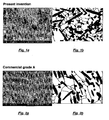
- a more detailed microstructural characterization on the samples according to example 1 above was made with the aid of automatic image analysis using an image of the grain structure produced by a scanning electrone microscope (SEM).
- SEM scanning electrone microscope
- Scanning electron micrographs in 8000 times magnification were then recorded (see figures 1a and 2a).
- the images were further processed using a computerized image analysis system by filling in the grain boundaries with black line colour by hand.
- the areas covered by silicon carbide whisker grains were also filled with black colour by hand. Since the whiskers are orientated preferably in the plain perpendicular to the hot pressing direction, they are easily identified due to their high aspect ratio. Further image processing in the image analyser generated a black and white picture, where only the alumina grain boundaries and the SiC-whisker grains were visible to facilitate the measurements (see figures 1b and 2b).
- Determination of the mean grain size was based on measurement of the individual area of each grain completely within the test area border. The measurement was repeated eight times for different fields to obtain an adequate number of measurements. The equipment was calibrated, so that area measurements were made in ⁇ m 2 . Between 450 and 1150 grains were measured for each variant, depending on the grain size, which is about 50-100 grains per microscopic field. The pixel density was 1280 x 960.
- the 80 th percentile (P80), which describes the width of the grain size distribution, is the value of of the alumina grain size d, such that 80% of the measurements are less than that value.
- the calculated values for mean diameter and 80 th percentile (P80) for the two materials of example 1 are indicated in the following table 4: Table 4: Alumina grain size and P80 Sintering Method Mean diameter (microns) P80 (microns) Hot Pressing 1,26 1,93 Rapid Sintering (15 min) 0,77 1,12
- Table 4 shows that the material produced by rapid sintering according to the present invention has smaller alumina mean diameter and smaller alumina grain size distribution, both essential for the cutting performance.
- An increase in either of the parameters which means an increase in the volume fraction of relatively coarse grains, reduces the cutting performance.
- the samples were prepared according to the inventive method of example 1, except for varying sintering times, i. e. the temperature increase was 25°C per minute, the sintering temperature was 1925°C (in case of 10 min holding time, the sintering temperature was slightly higher: 1950°C), and the pressure was 50 MPa for all variants.
- the sintering times were 10 min, 15 min, and 22 min. After sintering, the blanks were ground into inserts with ISO designation RNGN 120700 T01 020.
- Hardness, fracture toughness and density were also evaluated for the processing variants. The results are shown in table 7.
- Table 7 Sintering time (min) Sintering temp. (°C) Density (g/cm 3 ) Hardness (GPa) Fracture toughness (MPa m 1 ⁇ 2 *) 10 1950 3,72 2043 ⁇ 16 5,8 ⁇ 0,1 15 1925 3,73 2110 ⁇ 21 6,5 ⁇ 0,2 22 1925 3,70-3,73 2088 ⁇ 33 5,6 ⁇ 0,6 * Indentation (HV10) fracture toughness
- Notch wear of the processing variants of example 7 was measured in a facing operation in heat resistant alloy of the type Inconel 718. Two of the above mentioned commercial materials were used as references. Commercial grade A with a mean grain size typical for most investigated commercial grades and grade B with the smallest mean grain size of the measured commercial materials.
- Notch wear was measured after four cuts. Table 8: Notch wear (mm) after four cuts Grade Notch wear (mm; median) Relative Commercial grade A 0,84 311 Commercial grade B 0,59 219 Rapid sintering 10 min 0,61 226 Rapid sintering 15 min 0,27 100 Rapid sintering 22 min 0,77 285
- the notch wear resistance is sensitive to sintering time. The best notch wear resistance was achieved for the 15 min sintering time.
- the alumina grain size is one parameter governing the notch wear resistance, but cannot alone explain the results.
- the samples of the preceeding example 8 were also tested in a grooving operation in heat resistant alloy of the type Inconel 718. A groove was widened in two cuts by a total of about 30%. Tool life was reached when the largest dimension of a damage on the flank or rake face exceeded 1 mm.
Landscapes
- Chemical & Material Sciences (AREA)
- Engineering & Computer Science (AREA)
- Ceramic Engineering (AREA)
- Manufacturing & Machinery (AREA)
- Structural Engineering (AREA)
- Materials Engineering (AREA)
- Organic Chemistry (AREA)
- Inorganic Chemistry (AREA)
- Mechanical Engineering (AREA)
- Composite Materials (AREA)
- Chemical Kinetics & Catalysis (AREA)
- Cutting Tools, Boring Holders, And Turrets (AREA)
- Compositions Of Oxide Ceramics (AREA)
- Ceramic Products (AREA)
- Golf Clubs (AREA)
Priority Applications (8)
| Application Number | Priority Date | Filing Date | Title |
|---|---|---|---|
| AT03001757T ATE337282T1 (de) | 2003-01-28 | 2003-01-28 | Werkzeugeinsatz und zugehöriges herstellungsverfahren |
| DE60307777T DE60307777T2 (de) | 2003-01-28 | 2003-01-28 | Werkzeugeinsatz und zugehöriges Herstellungsverfahren |
| EP03001757A EP1443032B1 (en) | 2003-01-28 | 2003-01-28 | Cutting tool insert and method for producing the same |
| CNB2004100014072A CN100430340C (zh) | 2003-01-28 | 2004-01-07 | 刀具嵌入件及其制造方法 |
| KR1020040002045A KR101166405B1 (ko) | 2003-01-28 | 2004-01-12 | 절삭 공구 인서트 및 그 제조 방법 |
| US10/763,260 US7175798B2 (en) | 2003-01-28 | 2004-01-26 | Cutting tool insert and method for producing the same |
| JP2004019829A JP4624690B2 (ja) | 2003-01-28 | 2004-01-28 | 切削工具用インサート及びその製造方法 |
| US11/641,674 US7407523B2 (en) | 2003-01-28 | 2006-12-20 | Cutting tool insert and method for producing the same |
Applications Claiming Priority (1)
| Application Number | Priority Date | Filing Date | Title |
|---|---|---|---|
| EP03001757A EP1443032B1 (en) | 2003-01-28 | 2003-01-28 | Cutting tool insert and method for producing the same |
Publications (2)
| Publication Number | Publication Date |
|---|---|
| EP1443032A1 EP1443032A1 (en) | 2004-08-04 |
| EP1443032B1 true EP1443032B1 (en) | 2006-08-23 |
Family
ID=32605247
Family Applications (1)
| Application Number | Title | Priority Date | Filing Date |
|---|---|---|---|
| EP03001757A Expired - Lifetime EP1443032B1 (en) | 2003-01-28 | 2003-01-28 | Cutting tool insert and method for producing the same |
Country Status (7)
| Country | Link |
|---|---|
| US (2) | US7175798B2 (enExample) |
| EP (1) | EP1443032B1 (enExample) |
| JP (1) | JP4624690B2 (enExample) |
| KR (1) | KR101166405B1 (enExample) |
| CN (1) | CN100430340C (enExample) |
| AT (1) | ATE337282T1 (enExample) |
| DE (1) | DE60307777T2 (enExample) |
Families Citing this family (10)
| Publication number | Priority date | Publication date | Assignee | Title |
|---|---|---|---|---|
| SE526399C2 (sv) * | 2004-01-30 | 2005-09-06 | Sandvik Intellectual Property | Skärverktyg jämte del därtill med kopplingsytor med rillor samt tillverkningsförfarande för dessa |
| US7393559B2 (en) * | 2005-02-01 | 2008-07-01 | The Regents Of The University Of California | Methods for production of FGM net shaped body for various applications |
| US20070154713A1 (en) * | 2005-12-30 | 2007-07-05 | 3M Innovative Properties Company | Ceramic cutting tools and cutting tool inserts, and methods of making the same |
| US7607867B2 (en) * | 2006-12-15 | 2009-10-27 | Sandvik Intellectual Property Ab | Tooling insert with mating surface |
| DE102008037037A1 (de) * | 2008-08-08 | 2010-02-11 | Ceramtec-Etec Gmbh | Verfahren zur Herstellung einer transparenten polykristallinen Keramik |
| US8209887B2 (en) * | 2009-06-17 | 2012-07-03 | Syamal Kumar Ghosh | Wear resistant support structures for utility equipment |
| US20130221794A1 (en) * | 2012-02-28 | 2013-08-29 | Hamilton Sundstrand Corporation | Rotor end band |
| CN104520254B (zh) * | 2012-06-15 | 2017-09-01 | 圣戈本陶瓷及塑料股份有限公司 | 包括碳化硅的陶瓷本体及其形成方法 |
| KR101536462B1 (ko) * | 2013-12-23 | 2015-07-24 | 한국야금 주식회사 | 난삭재 및 주철가공 절삭공구용 피막 |
| CN117285333A (zh) * | 2023-08-22 | 2023-12-26 | 河南乐锐切削工具股份有限公司 | 氧化铝陶瓷数控刀具的制造工艺 |
Family Cites Families (18)
| Publication number | Priority date | Publication date | Assignee | Title |
|---|---|---|---|---|
| US4209474A (en) * | 1977-08-31 | 1980-06-24 | General Electric Company | Process for preparing semiconducting silicon carbide sintered body |
| US4543345A (en) * | 1984-02-09 | 1985-09-24 | The United States Of America As Represented By The Department Of Energy | Silicon carbide whisker reinforced ceramic composites and method for making same |
| US5348694A (en) * | 1988-12-20 | 1994-09-20 | Superior Graphite Co. | Method for electroconsolidation of a preformed particulate workpiece |
| JP3342882B2 (ja) * | 1990-12-14 | 2002-11-11 | スピリア グラファイト | 予備成形された加工片の圧密方法 |
| SE469075B (sv) * | 1991-01-21 | 1993-05-10 | Sandvik Ab | Whiskerfoerstaerkt oxidbaserat keramiskt skaer |
| SE9100675D0 (sv) * | 1991-03-06 | 1991-03-06 | Sandvik Ab | Ceramic whisker-reinforced cutting tool with pre-formed chipbreakers for machining |
| JPH04315507A (ja) * | 1991-04-12 | 1992-11-06 | Riken Corp | セラミック切削工具及びその製造方法 |
| SG43243A1 (en) * | 1991-12-03 | 1997-10-17 | Advanced Composite Materials | Pressureless sintering of whisker reinforced alumina composites |
| SE502052C2 (sv) * | 1993-01-15 | 1995-07-31 | Sandvik Ab | SiC-whiskers och partikel-förstärkt keramiskt skärmaterial |
| US5382405A (en) * | 1993-09-03 | 1995-01-17 | Inland Steel Company | Method of manufacturing a shaped article from a powdered precursor |
| JP2990655B2 (ja) * | 1996-05-21 | 1999-12-13 | 東京タングステン株式会社 | 複合炭化物粉末及びその製造方法 |
| SE513938C2 (sv) * | 1996-07-19 | 2000-11-27 | Sandvik Ab | Skärverktygsmaterial av kiselnitrid |
| JPH10194825A (ja) * | 1996-12-26 | 1998-07-28 | Central Glass Co Ltd | 切削工具用繊維強化セラミックス焼結体及びその製造方法 |
| WO1999023048A1 (de) * | 1997-10-31 | 1999-05-14 | Ceramtec Ag Innovative Ceramic Engineering | Plateletverstärkter sinterformkörper |
| SE511312C2 (sv) * | 1997-12-22 | 1999-09-06 | Sandvik Ab | Sätt att tillverka whiskerförstärkt keramik s |
| US6204213B1 (en) * | 1999-09-18 | 2001-03-20 | Kennametal Pc Inc. | Whisker reinforced ceramic cutting tool and composition thereof |
| US6417126B1 (en) * | 2000-02-24 | 2002-07-09 | C-Max Technology, Inc. | Ceramics and process for producing |
| US20050133963A1 (en) * | 2003-12-18 | 2005-06-23 | The Regents Of The University Of California, A California Corporation | Silicon carbide whisker-reinforced ceramics with low rate of grain size increase upon densification |
-
2003
- 2003-01-28 DE DE60307777T patent/DE60307777T2/de not_active Expired - Lifetime
- 2003-01-28 EP EP03001757A patent/EP1443032B1/en not_active Expired - Lifetime
- 2003-01-28 AT AT03001757T patent/ATE337282T1/de active
-
2004
- 2004-01-07 CN CNB2004100014072A patent/CN100430340C/zh not_active Expired - Fee Related
- 2004-01-12 KR KR1020040002045A patent/KR101166405B1/ko not_active Expired - Fee Related
- 2004-01-26 US US10/763,260 patent/US7175798B2/en not_active Expired - Lifetime
- 2004-01-28 JP JP2004019829A patent/JP4624690B2/ja not_active Expired - Fee Related
-
2006
- 2006-12-20 US US11/641,674 patent/US7407523B2/en not_active Expired - Fee Related
Also Published As
| Publication number | Publication date |
|---|---|
| DE60307777T2 (de) | 2007-08-23 |
| CN100430340C (zh) | 2008-11-05 |
| US7407523B2 (en) | 2008-08-05 |
| KR20040069263A (ko) | 2004-08-05 |
| CN1517322A (zh) | 2004-08-04 |
| JP2004338080A (ja) | 2004-12-02 |
| DE60307777D1 (de) | 2006-10-05 |
| ATE337282T1 (de) | 2006-09-15 |
| US20040180776A1 (en) | 2004-09-16 |
| JP4624690B2 (ja) | 2011-02-02 |
| US20070191210A1 (en) | 2007-08-16 |
| KR101166405B1 (ko) | 2012-07-23 |
| US7175798B2 (en) | 2007-02-13 |
| EP1443032A1 (en) | 2004-08-04 |
Similar Documents
| Publication | Publication Date | Title |
|---|---|---|
| RU2096513C1 (ru) | Способ получения спеченного изделия из твердого сплава | |
| US20030109371A1 (en) | Silicon carbide ceramic composition and method of making | |
| JPH0647505B2 (ja) | ホイスカー強化セラミツクス及びそれに対するクラツド/熱間静圧プレス成形法 | |
| EP1443032B1 (en) | Cutting tool insert and method for producing the same | |
| JP2011073905A (ja) | 快削性セラミックス及びその製造方法 | |
| JP2025106304A (ja) | 焼結多結晶立方晶窒化ホウ素材料 | |
| CA1334434C (en) | Boron treated hard metal | |
| IL127507A (en) | Whisker-reinforced ceramics | |
| KR100452173B1 (ko) | 공구용 질화규소 소결체 및 이의 제조방법 | |
| KR0176974B1 (ko) | 질화규소 소결체 공구 | |
| EP0311289A1 (en) | SiC-Al2O3 composite sintered bodies and method of producing the same | |
| US6680267B2 (en) | Silicon carbide ceramic composition and method of making | |
| GB2285267A (en) | Ceramic composition | |
| KR20220131542A (ko) | 다결정질 입방정 질화붕소 재료 | |
| JP7204558B2 (ja) | 窒化硼素質焼結体、インサートおよび切削工具 | |
| EP0441316B1 (en) | Silicon nitride based sintered material and process of manufacturing same | |
| Tashima et al. | Cutting performance of high purity alumina ceramic tools formed by a high-speed centrifugal compaction process | |
| JPH0364469B2 (enExample) | ||
| JP2735919B2 (ja) | 工具用焼結体及びその製造方法 | |
| JPH1034404A (ja) | 窒化ケイ素製切削工具 | |
| KR101140353B1 (ko) | 다공성 반응소결질화규소 소결체 및 그 제조 방법 | |
| JPH01230472A (ja) | 炭化けい素質焼結体及びその製造方法 | |
| JPH0873269A (ja) | セラミック焼結体およびその製造方法 | |
| JPH07257963A (ja) | 高靱性アルミナセラミックスおよびその製造方法 | |
| EP1967503A1 (en) | Sintered product of silicon nitride, cutting tool, cutting apparatus, and cutting method |
Legal Events
| Date | Code | Title | Description |
|---|---|---|---|
| PUAI | Public reference made under article 153(3) epc to a published international application that has entered the european phase |
Free format text: ORIGINAL CODE: 0009012 |
|
| AK | Designated contracting states |
Kind code of ref document: A1 Designated state(s): AT BE BG CH CY CZ DE DK EE ES FI FR GB GR HU IE IT LI LU MC NL PT SE SI SK TR |
|
| AX | Request for extension of the european patent |
Extension state: AL LT LV MK RO |
|
| 17P | Request for examination filed |
Effective date: 20041021 |
|
| 17Q | First examination report despatched |
Effective date: 20041118 |
|
| AKX | Designation fees paid |
Designated state(s): AT CH DE FR GB LI SE |
|
| RAP1 | Party data changed (applicant data changed or rights of an application transferred) |
Owner name: SANDVIK INTELLECTUAL PROPERTY HB |
|
| RAP1 | Party data changed (applicant data changed or rights of an application transferred) |
Owner name: SANDVIK INTELLECTUAL PROPERTY AB |
|
| GRAP | Despatch of communication of intention to grant a patent |
Free format text: ORIGINAL CODE: EPIDOSNIGR1 |
|
| GRAS | Grant fee paid |
Free format text: ORIGINAL CODE: EPIDOSNIGR3 |
|
| GRAA | (expected) grant |
Free format text: ORIGINAL CODE: 0009210 |
|
| AK | Designated contracting states |
Kind code of ref document: B1 Designated state(s): AT CH DE FR GB LI SE |
|
| REG | Reference to a national code |
Ref country code: GB Ref legal event code: FG4D |
|
| REG | Reference to a national code |
Ref country code: CH Ref legal event code: EP |
|
| REF | Corresponds to: |
Ref document number: 60307777 Country of ref document: DE Date of ref document: 20061005 Kind code of ref document: P |
|
| REG | Reference to a national code |
Ref country code: SE Ref legal event code: TRGR |
|
| REG | Reference to a national code |
Ref country code: CH Ref legal event code: NV Representative=s name: ISLER & PEDRAZZINI AG |
|
| ET | Fr: translation filed | ||
| PLBE | No opposition filed within time limit |
Free format text: ORIGINAL CODE: 0009261 |
|
| STAA | Information on the status of an ep patent application or granted ep patent |
Free format text: STATUS: NO OPPOSITION FILED WITHIN TIME LIMIT |
|
| 26N | No opposition filed |
Effective date: 20070524 |
|
| REG | Reference to a national code |
Ref country code: CH Ref legal event code: PCAR Free format text: ISLER & PEDRAZZINI AG;POSTFACH 1772;8027 ZUERICH (CH) |
|
| PGFP | Annual fee paid to national office [announced via postgrant information from national office to epo] |
Ref country code: CH Payment date: 20140114 Year of fee payment: 12 |
|
| PGFP | Annual fee paid to national office [announced via postgrant information from national office to epo] |
Ref country code: AT Payment date: 20131224 Year of fee payment: 12 |
|
| PGFP | Annual fee paid to national office [announced via postgrant information from national office to epo] |
Ref country code: SE Payment date: 20150113 Year of fee payment: 13 |
|
| REG | Reference to a national code |
Ref country code: CH Ref legal event code: PL |
|
| REG | Reference to a national code |
Ref country code: AT Ref legal event code: MM01 Ref document number: 337282 Country of ref document: AT Kind code of ref document: T Effective date: 20150128 |
|
| PG25 | Lapsed in a contracting state [announced via postgrant information from national office to epo] |
Ref country code: CH Free format text: LAPSE BECAUSE OF NON-PAYMENT OF DUE FEES Effective date: 20150131 Ref country code: LI Free format text: LAPSE BECAUSE OF NON-PAYMENT OF DUE FEES Effective date: 20150131 |
|
| PG25 | Lapsed in a contracting state [announced via postgrant information from national office to epo] |
Ref country code: AT Free format text: LAPSE BECAUSE OF NON-PAYMENT OF DUE FEES Effective date: 20150128 |
|
| REG | Reference to a national code |
Ref country code: FR Ref legal event code: PLFP Year of fee payment: 14 |
|
| PG25 | Lapsed in a contracting state [announced via postgrant information from national office to epo] |
Ref country code: SE Free format text: LAPSE BECAUSE OF NON-PAYMENT OF DUE FEES Effective date: 20160129 |
|
| REG | Reference to a national code |
Ref country code: FR Ref legal event code: PLFP Year of fee payment: 15 |
|
| REG | Reference to a national code |
Ref country code: FR Ref legal event code: PLFP Year of fee payment: 16 |
|
| PGFP | Annual fee paid to national office [announced via postgrant information from national office to epo] |
Ref country code: FR Payment date: 20171229 Year of fee payment: 16 |
|
| PGFP | Annual fee paid to national office [announced via postgrant information from national office to epo] |
Ref country code: DE Payment date: 20180117 Year of fee payment: 16 Ref country code: GB Payment date: 20180124 Year of fee payment: 16 |
|
| REG | Reference to a national code |
Ref country code: DE Ref legal event code: R119 Ref document number: 60307777 Country of ref document: DE |
|
| GBPC | Gb: european patent ceased through non-payment of renewal fee |
Effective date: 20190128 |
|
| PG25 | Lapsed in a contracting state [announced via postgrant information from national office to epo] |
Ref country code: DE Free format text: LAPSE BECAUSE OF NON-PAYMENT OF DUE FEES Effective date: 20190801 Ref country code: FR Free format text: LAPSE BECAUSE OF NON-PAYMENT OF DUE FEES Effective date: 20190131 |
|
| PG25 | Lapsed in a contracting state [announced via postgrant information from national office to epo] |
Ref country code: GB Free format text: LAPSE BECAUSE OF NON-PAYMENT OF DUE FEES Effective date: 20190128 |