EP1400604B1 - Automobilteil aus titan - Google Patents
Automobilteil aus titan Download PDFInfo
- Publication number
- EP1400604B1 EP1400604B1 EP03717543A EP03717543A EP1400604B1 EP 1400604 B1 EP1400604 B1 EP 1400604B1 EP 03717543 A EP03717543 A EP 03717543A EP 03717543 A EP03717543 A EP 03717543A EP 1400604 B1 EP1400604 B1 EP 1400604B1
- Authority
- EP
- European Patent Office
- Prior art keywords
- titanium
- test
- nitrogen
- strength
- oxygen
- Prior art date
- Legal status (The legal status is an assumption and is not a legal conclusion. Google has not performed a legal analysis and makes no representation as to the accuracy of the status listed.)
- Expired - Lifetime
Links
Images

Classifications
-
- C—CHEMISTRY; METALLURGY
- C22—METALLURGY; FERROUS OR NON-FERROUS ALLOYS; TREATMENT OF ALLOYS OR NON-FERROUS METALS
- C22C—ALLOYS
- C22C14/00—Alloys based on titanium
-
- B—PERFORMING OPERATIONS; TRANSPORTING
- B62—LAND VEHICLES FOR TRAVELLING OTHERWISE THAN ON RAILS
- B62K—CYCLES; CYCLE FRAMES; CYCLE STEERING DEVICES; RIDER-OPERATED TERMINAL CONTROLS SPECIALLY ADAPTED FOR CYCLES; CYCLE AXLE SUSPENSIONS; CYCLE SIDE-CARS, FORECARS, OR THE LIKE
- B62K19/00—Cycle frames
- B62K19/02—Cycle frames characterised by material or cross-section of frame members
- B62K19/04—Cycle frames characterised by material or cross-section of frame members the material being wholly or mainly metallic, e.g. of high elasticity
Definitions
- the present invention relates to an auto part comprised of titanium characterized by a light weight and high strength.
- an auto part comprised of a JIS Type 2 or Type 3 commercially pure titanium or a low alloy titanium comprised of one of these plus a small amount of Fe.
- Titanium materials may be classified into alloy titanium and commercially pure titanium.
- commercially pure titanium has the characteristics of being comparatively superior in workability as well as having a moderate degree of strength characteristics and superior corrosion resistance and being relatively easy to weld as well. It has been worked into various shapes such as medium thick plates, hot rolled and cold rolled strips, thin sheets cut from the same, welded pipes obtained by shaping and welding these thin sheets, large diameter round bars, square bars, bar and wire coils, medium and small diameter bars and wires cut from the same, and seamless pipes made by hot extrusion for use in the fields making use of their light weight, high strength, high corrosion resistance, and other characteristics such as aircraft, chemicals, marine structures, electric power, etc. where such characteristics are required. Further, recently, remarkable progress has been made in application to automobiles and other consumer products. Various titanium parts are now being made frequent use of in these fields.
- Such commercially pure titanium is classified into JIS Type 1 to Type 4 according to the added elements and strength characteristics.
- the material is limited to a maximum of 0.20 wt% of oxygen, a maximum of 0.05 wt% of nitrogen, and a maximum of 0.25 wt% of Fe.
- JIS Type 3 having a higher strength than JIS Type 2 is limited to a maximum of 0.30 wt% of oxygen, a maximum of 0.07 wt% of nitrogen, and a maximum of 0.30 wt% of Fe. (Note that in the following description, the amounts of chemical components are wt%.)
- JIS Type 2 and Type 3 commercially pure titaniums only contain at most 0.015% of nitrogen and at most 0.1% of Fe at the present time. With the exception of containing 0.07 to 0.3% of oxygen and unavoidable impurities, they are literally pure titanium.
- JIS Type 2 and JIS Type 3 commercially pure titaniums, as explained above, are formed into products of various sectional shapes and dimensions and are being used in a broad spectrum of fields.
- JIS Type 2 and JIS Type 3 commercially pure titaniums, as explained above, are formed into products of various sectional shapes and dimensions and are being used in a broad spectrum of fields.
- they When applying them to mufflers, exhaust pipes, motorcycle rear forks, frames, and other auto parts etc., they are worked into complicated shapes by bending, forging, flat rolling (cold rolling bar and wire of circular cross-sections into sheet shapes), pipe contraction, drawing, pipe expansion, punching, bore-expanding, and other cold working processes. Therefore, the ductility is consumed in the working and sometimes the ductility of the part after being worked becomes small partially.
- auto parts will probably be used under increasingly severe environments in the future, so parts with a large residual ductility have been strongly sought.
- This method is believed to be able to be applied even to titanium materials of a strength level corresponding to the lowest strength JIS Type 2 or Type 3, but if adding close to 1% of Fe as in this method, a large amount of the ⁇ -phase (bcc crystal structure) of a different crystal structure from the ⁇ -phase (hcp crystal structure) of the matrix is produced, the modulus of elasticity and heat expansion characteristics become different from the conventional case of containing only the ⁇ -phase as the main phase, and the problem arises that it is necessary to readjust the shape of the part or production process or method of working so as to secure compatibility with the surrounding parts.
- the present invention provides a titanium auto part comprised of a titanium material having a strength equal to the conventional JIS Type 2 and Type 3 and a phase structure enabling design of similar parts and processes as conventional JIS Type 2 and Type 3 titanium and having a high residual ductility after being worked.
- the inventors engaged in comprehensive studies on the relationship between the composition and properties of titanium materials of various chemical compositions, discovered a relationship of strength and ductility with components such as the oxygen equivalent value, Fe concentration, and nitrogen concentration, and perfected the present invention by limiting the range of chemical composition enabling provision of a titanium auto part having almost the same strength level and phase configuration as the conventional JIS Type 2 and Type 3 titanium material and having a higher residual ductility after working the product compared with the past.
- the present invention is based on this technical idea and has as its gist the following:
- the present invention was achieved based on the above two discoveries. Note that in the above discovery [2], if the amount of Fe added exceeds 0.6%, the effect disappears once, but if over 0.9%, the amount of the ⁇ -phase superior in the balance of strength and ductility increases, so an improvement appears in the relationship of strength and ductility due to the combined addition of Fe and nitrogen again. This effect, however, is effective for the high strength alloy such as described in Japanese National Publication (Tokuhyo) No. 8-833292 (International Publication No.
- the amount of Fe added was made 0.15 to 0.5%. At least 0.15% was added because to improve the ductility without reducing the strength by the combined addition with nitrogen or to improve the strength without reducing the ductility, it is necessary to add at least 0.15% of Fe as described in the above discovery [2].
- the amount of nitrogen added was made 0.015 to 0.04%.
- the reason is as follows. That is, if the amount of the nitrogen added is less than 0.015%, almost no improvement is recognized in the relationship between the strength and ductility due to the combined addition of Fe and nitrogen, and it is not possible to increase the ductility without reducing the strength or increase the strength without impairing the ductility. Therefore, in the present invention, the amount of nitrogen added was made at least 0.015%. Further, if the amount of the nitrogen added exceeds 0.04%, compounds of Ti and nitrogen are produced - resulting in a remarkable drop in ductility and the effect of improving the relationship between strength and ductility is erased. Therefore, the upper limit on the amount of nitrogen added was made 0.04%.
- [Fe], [N], and [O] show the content of Fe, the content of nitrogen, and the content of oxygen.
- the “oxygen equivalent value” is an indicator comprehensively showing the ability of oxygen, nitrogen, and Fe to increase the strength of titanium.
- Q was made a range of 0.11 to 0.28 because making the value of Q this range makes it possible to achieve a level of strength equal to that of the current JIS Type 2 and Type 3 covered by the present invention. That is, when Q is less than 0.11, the strength is too low and it is not possible to obtain a material having a strength of the general JIS Type 2 class actually being marketed, it is necessary to reduce the relative concentration of oxygen in the titanium, and it is necessary to use an expensive low oxygen sponge. Further, if Q is over 0.28, the strength becomes too high and the problem arises that cold working becomes more difficult compared with the JIS Type 3 class currently on the market.
- a titanium material comprised of the chemical composition limited as described above has a strength equal to that of the conventional JIS Type 2 to JIS Type 3 and has a ductility higher than these. Auto parts comprised of this titanium material has a higher residual ductility after cold working compared with even an auto part comprised of the conventional JIS Type 2 or Type 3 and can be used with greater confidence. Further, since the phase configuration enables part designs similar to those of the conventional JIS Type 2 and Type 3, there is no need to readjust the part shape etc. to secure compatibility with the surrounding parts and production by designs and production processes like in the past becomes possible.
- the range of the value of the oxygen equivalent value Q was made a range of 0.11 to 0.20.
- a greater ductility is required in the production process in a titanium auto part of the range of the present invention in the case of a soft material often subjected to more severe cold working. That is, if applying the present invention to a titanium auto part having a Q value in the range of 0.11 to 0.20 of the soft level of strength corresponding to JIS Type 2, the effect is particularly strongly manifested.
- the titanium spoken of in the present invention is substantially comprised of Ti other than the oxygen, nitrogen, Fe, and unavoidable impurities.
- the "unavoidable impurities” indicates the less than 0.05% of Ni or Cr, the less than 0.015% of carbon, the less than 100 ppm of hydrogen, etc. entering from the stock sponge titanium or scrap titanium used or from the surface in the middle of the production process.
- the compositions of the present invention are those belonging to JIS Type 2 or Type 3.
- commercially pure titanium of JIS Type 2 and Type 3 actually circulating on the market has a high Fe content of about 0.1% or so and a nitrogen content of a high 0.015% or so. While falling with the same JIS standard, the material is different.
- the above [3] limits the auto part to a muffler, exhaust pipe, motorcycle frame, motorcycle rear fork, or motorcycle front fork inner pipe.
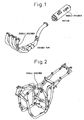
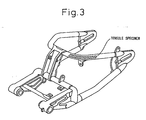
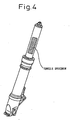
- These parts have the appearances shown in FIGS. 1 to 4.
- the material is used for the locations shown in FIG. 5 (muffler (A), exhaust pipe (B), frame (C), rear fork (D), or front fork inner pipe (E)).
- These parts perform the functions shown in Table 1.
- the body is made lighter in weight and the fuel economy and operability are improved.
- these parts are formed by cold working such as pressing (restriction, expansion, punch stretching), bending, pipe expansion, etc. They are auto parts where particularly good effects of the present invention can be expected.
- Titanium pipes (1 mm thickness, 48 mm diameter) of the compositions shown in Test Nos. 1 to 11 of Table 2 etc. are used to produce mufflers and evaluate the production characteristics by exactly the same method as JIS Type 2.
- Test strips of 10 mm width and 150 mm length are cut out in the longitudinal direction, and tensile tests are conducted at a gauge length of 50 mm to measure the tensile strength and elongation. The locations where the test pieces were taken are shown in FIG. 1.
- the test results are shown in Table 2.
- Test Nos. 5, 8, 9, and 11 of examples of the present invention all could be sufficiently worked into mufflers and had the same extent of strength and at least 2% higher residual elongation compared with conventional commercially pure titanium (comparative example) having the same oxygen equivalent values, having no Fe or nitrogen deliberately added, and containing only unavoidable amounts of Fe and nitrogen present in stock sponge titanium.
- Test No. 5 gives at least 2% higher residual elongation compared with Test No. 4 while Test Nos. 8, 9, and 11 give the same compared with Test No. 6, that is, the effect of the present invention is exhibited.
- Test Nos. 1 and 3 give extremely high residual elongations of at least 18%.
- Test No. 3 has an equal tensile strength and at least 2% higher residual elongation compared with conventional commercially pure titanium having the same oxygen equivalent value, having no Fe or nitrogen deliberately added, and containing only unavoidable amounts of Fe and nitrogen present in stock sponge titanium.
- both Test Nos. 1 and 3 only give insufficient strength levels far below the tensile strength of the most general use JIS Type 2 material of Test No. 4.
- the sponge titanium used also is higher in production costs due to use of a high purity material containing only a maximum of 0.05 wt% of oxygen.
- the effect of the present invention cannot be sufficiently exhibited. This is because the oxygen equivalent value Q was lower than the 0.11 of the lower limit in the present invention.
- Test Nos. 7 and 10 only give tensile strengths and residual elongations equal to those of conventional commercially pure titanium (Test No. 6) having the same oxygen equivalent value, having no Fe or nitrogen deliberately added, and containing only unavoidable amounts of Fe and nitrogen present in stock sponge titanium. The effect of the present invention is not sufficiently exhibited. This is because the amount of Fe added in the case of Test No. 7 or the amount of nitrogen added in the case of Test No. 10 was less than the lower limit of the present invention.
- Titanium pipes (2.0 mm thickness, 32 mm diameter) of the compositions shown in Test Nos. 12 to 22 of Table 3 etc. are used to produce motorcycle frames and evaluate the production characteristics by exactly the same method as JIS Type 2 or Type 3.
- Test strips of 10 mm width and 150 mm length are cut out in the longitudinal direction from the locations shown in FIG. 2, the ends of the test pieces are processed to gripping parts by bending, and tensile tests are conducted at a gauge length of 50 mm to measure the tensile strength and elongation. The test results are shown together in Table 3. Note that at the initial stage of the tensile test, the curved test pieces gradually deformed to become straight from the curved states and then were elongated and broke.
- Test Nos. 13, 14, 17, 19, and 20 of examples of the present invention all could be sufficiently worked into mufflers and had at least 2% higher residual elongation values compared with conventional commercially pure titanium (comparative example) having the same oxygen equivalent values and strength levels, having no Fe or nitrogen deliberately added, and containing only unavoidable amounts of Fe and nitrogen present in stock sponge titanium.
- Test Nos. 13 and 14 give the same extent of strength and at least 2% higher elongation compared with Test No. 12 (conventional JIS Type 2)
- Test No. 17 gives the same compared with Test No. 16 (conventional JIS Type 3)
- Test Nos. 19 and 20 give the same compared with Test No. 18 (conventional JIS Type 3). That is, the effect of the present invention is exhibited.
- Test No. 15 ends up cracking during work.
- the reason was as follows: That is, the amount of Fe added exceeded the upper limit of the present invention, so a large amount of ⁇ -phase (bcc crystal structure) different in crystal structure from the ⁇ -phase (hcp crystal structure) of the matrix was produced, and the modulus of elasticity and heat expansion characteristic became remarkably different from conventional pure titanium containing only the ⁇ -phase as the main phase.
- the parts were produced by the same design and production process as those of conventional pure titanium without adjusting the shape of the part or adjusting the shaping method for securing compatibility with the surrounding parts, cracking ended up occurring during working.
- Test No. 21 also ended cracking during working. This is because the amount of nitrogen added exceeded the upper limit of the present invention and therefore compounds of Ti and nitrogen were produced, the ductility was impaired, and the effect of the present invention could not be achieved.
- Test No. 22 also ended up cracking during working, but this was due to the Q exceeding 0.28 and therefore the strength becoming too high, the ductility relatively falling, and cold working becoming difficult compared with the JIS Type 3 class circulating on the usual market.
- Titanium pipes (1 mm thickness, 38 mm diameter) of the compositions shown in Test Nos. 23 to 24 of Table 4 etc. are used to produce exhaust pipes and evaluate the production characteristics by exactly the same method as JIS Type 2.
- Curved test strips of 10 mm width and 150 mm length are cut out in the longitudinal direction from the locations shown in FIG. 1, the ends of the test pieces are processed to gripping parts by bending, and tensile tests are conducted at a gauge length of 50 mm to measure the tensile strength and elongation. The test results are shown together in Table 4. Note that at the initial stage of the tensile test, the curved test pieces gradually deformed to become straight from the curved states and then were elongated and broke.
- Test No. 24 of an example of the present invention could be worked without causing cracking etc. by exactly the same method as the usual pure titanium JIS Type 2 (Test No. 23), had a level of strength equal to that of ordinary pure titanium (Test No. 23), but had a residual elongation exceeding it.
- Titanium pipes (1.5 mm thickness, 32 mm diameter) of the compositions shown in Test Nos. 25 to 26 of Table 4 etc. are used to produce motorcycle rear forks and evaluate the production characteristics by exactly the same method as JIS Type 3.
- Test strips of 10 mm width and 150 mm length are cut out in the longitudinal direction from the locations shown in FIG. 3, the ends of the test pieces are processed to gripping parts by bending, and tensile tests are conducted at a gauge length of 50 mm to measure the tensile strength and elongation. The test results are shown together in Table 4. Note that at the initial stage of the tensile test, the curved test pieces gradually deformed to become straight from the curved states and then were elongated and broke.
- Test No. 26 of an example of the present invention could be worked without causing cracking etc. by exactly the same method as the usual pure titanium JIS Type 3 (Test No. 25), had a level of strength equal to that of ordinary pure titanium (Test No. 25), but had a residual elongation exceeding it.
- Titanium pipes (3 mm thickness, 32 mm diameter) of the compositions shown in Test Nos. 27 to 28 of Table 4 etc. are used to produce motorcycle front fork inner pipes and evaluate the production characteristics by exactly the same method as JIS Type 3.
- Test strips of 10 mm width and 150 mm length are cut out in the longitudinal direction from the locations shown in FIG. 4, and tensile tests are conducted at a gauge length of 50 mm to measure the tensile strength and elongation. The test results are shown together in Table 4.
- Test No. 28 of an example of the present invention could be worked without causing cracking etc. by exactly the same method as the usual pure titanium JIS Type 3 (Test No. 27), had a level of strength equal to that of ordinary pure titanium (Test No. 27), but had a residual elongation exceeding it.
- Role Material working 1 A muffler Silencing of engine exhaust noise Pipes/plates/ bars/wires Pressing (drawing, bore-expanding/ stretch-expanding) Welding Pipe bending Welding 1 B, exhaust pipe Pipe connecting from engine to muffler 2 C, frame Frame of body of motorcycle Pipe/plates/ bars/wires Pressing (drawing, stretch-expanding) Welding 3 D, rear fork Rear wheel suspension 4 E, front fork inner pipe Part of front wheel suspension parts Pipes Pipe expansion Table 2 Test no.
- a titanium auto part comprised of a titanium material having a strength equal to the conventional JIS Type 2 and Type 3 and of a phase structure enabling production by the same parts and processes as a conventional JIS Type 2 and Type 3 titanium material and possible to obtain extremely advantageous effects industrially speaking.
Landscapes
- Engineering & Computer Science (AREA)
- Mechanical Engineering (AREA)
- Chemical & Material Sciences (AREA)
- Materials Engineering (AREA)
- Metallurgy (AREA)
- Organic Chemistry (AREA)
- Exhaust Silencers (AREA)
Claims (3)
- Titanfahrzeugteil, dadurch gekennzeichnet, daß es in Gewichtsprozent enthält:Fe: 0,15 bis 0,5 %,Stickstoff: 0,015 bis 0,04 %, Sauerstoff, undRest Titan und unvermeidbare Verunreinigungen, wobei
wenn der Fe-Anteil [Fe] ist, der Stickstoffanteil [N] ist, und der Sauerstoffanteil [O] ist, der Sauerstoffäquivalentwert Q = [O] + 2,77 [N] + 0,1 [Fe] gleich Q: 0,11 bis 0,28 % ist. - Titanfahrzeugteil nach Anspruch 1, dadurch gekennzeichnet, daß der Sauerstoffäquivalentwert Q gleich 0,11 bis 0,20 % ist.
- Titanfahrzeugteil nach Anspruch 1 oder 2, dadurch gekennzeichnet, daß das Fahrzeugteil ein Schalldämpfer, ein Abgasrohr, ein Motorradrahmen, eine Motorradhintergabel oder ein Motorradvordergabel-Innenrohr ist.
Applications Claiming Priority (3)
| Application Number | Priority Date | Filing Date | Title |
|---|---|---|---|
| JP2002109623 | 2002-04-11 | ||
| JP2002109623A JP4064143B2 (ja) | 2002-04-11 | 2002-04-11 | チタン製自動車部品 |
| PCT/JP2003/004509 WO2003085144A1 (fr) | 2002-04-11 | 2003-04-09 | Piece automobile en titane |
Publications (3)
| Publication Number | Publication Date |
|---|---|
| EP1400604A1 EP1400604A1 (de) | 2004-03-24 |
| EP1400604A4 EP1400604A4 (de) | 2006-04-05 |
| EP1400604B1 true EP1400604B1 (de) | 2007-02-07 |
Family
ID=28786593
Family Applications (1)
| Application Number | Title | Priority Date | Filing Date |
|---|---|---|---|
| EP03717543A Expired - Lifetime EP1400604B1 (de) | 2002-04-11 | 2003-04-09 | Automobilteil aus titan |
Country Status (5)
| Country | Link |
|---|---|
| US (1) | US20040170519A1 (de) |
| EP (1) | EP1400604B1 (de) |
| JP (1) | JP4064143B2 (de) |
| DE (2) | DE60311620T2 (de) |
| WO (1) | WO2003085144A1 (de) |
Families Citing this family (8)
| Publication number | Priority date | Publication date | Assignee | Title |
|---|---|---|---|---|
| EP1574589B1 (de) * | 2004-03-12 | 2012-12-12 | Kabushiki Kaisha Kobe Seiko Sho | Titanlegierung mit einer guten Oxidationsbeständigkeit bei hohen Temperaturen und Korrosionsbeständigkeit |
| JP4486530B2 (ja) * | 2004-03-19 | 2010-06-23 | 新日本製鐵株式会社 | 冷間加工性に優れる耐熱チタン合金板およびその製造方法 |
| US7874149B2 (en) * | 2005-08-17 | 2011-01-25 | Kawasaki Jukogyo Kabushiki Kaisha | Exhaust apparatus for vehicle, and motorcycle having the same |
| JP4585420B2 (ja) * | 2005-10-05 | 2010-11-24 | 新日本製鐵株式会社 | 耐熱性および耐酸化性に優れた保護膜被覆チタン板およびその製造方法ならびにそれを用いた自動車用排気装置 |
| WO2007043594A1 (ja) * | 2005-10-05 | 2007-04-19 | Nippon Steel Corporation | 耐高温酸化性および耐高温塩害性に優れた保護膜被覆チタン板およびこれを用いた自動車用排気装置ならびにそれらの製造方法 |
| JP2008106323A (ja) * | 2006-10-26 | 2008-05-08 | Sumitomo Metal Ind Ltd | チタン合金 |
| JP4666271B2 (ja) * | 2009-02-13 | 2011-04-06 | 住友金属工業株式会社 | チタン板 |
| ITMI20121114A1 (it) * | 2012-06-25 | 2013-12-26 | Maiorano And Maiorano Sons S R L | Metodo per la produzione di elementi di carrozzeria di automobile in titanio o sue leghe ed elementi di carrozzeria così ottenuti |
Family Cites Families (13)
| Publication number | Priority date | Publication date | Assignee | Title |
|---|---|---|---|---|
| US268A (en) * | 1837-07-11 | Articlesx | ||
| EP0199198A1 (de) * | 1985-04-12 | 1986-10-29 | Daido Tokushuko Kabushiki Kaisha | Titanlegierung mit guter Zerspanbarkeit |
| JPH01252747A (ja) * | 1987-12-23 | 1989-10-09 | Nippon Steel Corp | 延性の優れた高強度チタン材及びその製造方法 |
| DE69107758T2 (de) * | 1990-10-01 | 1995-10-12 | Sumitomo Metal Ind | Verfahren zur Verbesserung der Zerspanbarkeit von Titan und Titanlegierungen, und Titanlegierungen mit guter Zerspanbarkeit. |
| JPH05279773A (ja) * | 1991-03-25 | 1993-10-26 | Nippon Steel Corp | 均一微細組織の高強度チタン合金 |
| US5106136A (en) * | 1991-07-12 | 1992-04-21 | Crain William E | Motorcycle bumper system |
| US5290368A (en) * | 1992-02-28 | 1994-03-01 | Ingersoll-Rand Company | Process for producing crack-free nitride-hardened surface on titanium by laser beams |
| JPH07268516A (ja) * | 1994-03-31 | 1995-10-17 | Nippon Steel Corp | 吸気エンジンバルブに適した低強度チタン合金棒 |
| US5939146A (en) * | 1996-12-11 | 1999-08-17 | The Regents Of The University Of California | Method for thermal spraying of nanocrystalline coatings and materials for the same |
| JP2001213377A (ja) * | 2000-02-03 | 2001-08-07 | Honda Motor Co Ltd | 自動二輪車用フレーム |
| JP3967515B2 (ja) * | 2000-02-16 | 2007-08-29 | 株式会社神戸製鋼所 | マフラー用チタン合金材およびマフラー |
| JP3742558B2 (ja) * | 2000-12-19 | 2006-02-08 | 新日本製鐵株式会社 | 高延性で板面内材質異方性の小さい一方向圧延チタン板およびその製造方法 |
| JP3745638B2 (ja) * | 2001-04-02 | 2006-02-15 | 新日本製鐵株式会社 | 高延性で断面内材質異方性の小さい延伸加工チタン棒線およびその製造方法 |
-
2002
- 2002-04-11 JP JP2002109623A patent/JP4064143B2/ja not_active Expired - Fee Related
-
2003
- 2003-04-09 US US10/480,408 patent/US20040170519A1/en not_active Abandoned
- 2003-04-09 EP EP03717543A patent/EP1400604B1/de not_active Expired - Lifetime
- 2003-04-09 DE DE60311620T patent/DE60311620T2/de not_active Expired - Lifetime
- 2003-04-09 DE DE03717543T patent/DE03717543T1/de active Pending
- 2003-04-09 WO PCT/JP2003/004509 patent/WO2003085144A1/ja not_active Ceased
Also Published As
| Publication number | Publication date |
|---|---|
| JP2003301229A (ja) | 2003-10-24 |
| DE60311620D1 (de) | 2007-03-22 |
| JP4064143B2 (ja) | 2008-03-19 |
| EP1400604A1 (de) | 2004-03-24 |
| WO2003085144A1 (fr) | 2003-10-16 |
| DE60311620T2 (de) | 2007-11-22 |
| DE03717543T1 (de) | 2004-10-21 |
| US20040170519A1 (en) | 2004-09-02 |
| EP1400604A4 (de) | 2006-04-05 |
Similar Documents
| Publication | Publication Date | Title |
|---|---|---|
| EP1726670B1 (de) | Verwendung eines wärmebeständigen bleches aus titanlegierung mit hervorragender kaltumformbarkeit für einen auspuff eines fahrzeuges | |
| KR101454458B1 (ko) | 내산화성이 우수한 배기계 부품용 내열 티타늄 합금재, 내산화성이 우수한 배기계 부품용 내열 티타늄 합금판의 제조 방법 및 배기 장치 | |
| JP3742558B2 (ja) | 高延性で板面内材質異方性の小さい一方向圧延チタン板およびその製造方法 | |
| US6440583B1 (en) | Aluminum alloy for a welded construction and welded joint using the same | |
| JP3967515B2 (ja) | マフラー用チタン合金材およびマフラー | |
| JP4987609B2 (ja) | 冷間加工性に優れる排気装置部材用耐熱チタン合金およびその製造方法ならびに該合金を用いた排気装置部材 | |
| EP2083093A1 (de) | Kupferlegierung für nahtlose rohre | |
| EP1400604B1 (de) | Automobilteil aus titan | |
| JPS58210158A (ja) | 耐食性の優れた油井管用高強度合金 | |
| JP2023005308A (ja) | フェライト系ステンレス鋼板およびその製造方法 | |
| Kosaka et al. | Newly developed titanium alloy sheets for the exhaust systems of motorcycles and automobiles | |
| WO2011048971A1 (ja) | 高強度ボルト用鋼及び高強度ボルトの製造方法 | |
| JP5862314B2 (ja) | 耐酸化性に優れた排気系部品用チタン合金材および、その製造方法ならびに、その合金材を用いた排気装置 | |
| JPH03264652A (ja) | フェライト系ステンレス鋼板とその製造方法 | |
| JP2008115419A (ja) | 加工性に優れた排気系部品用α型チタン合金材およびその製造方法ならびに該合金を用いた排気装置部材 | |
| JP2819906B2 (ja) | 室温および高温強度に優れた工具用Ni基合金 | |
| JP3004784B2 (ja) | 高温用高靱性フェライト系ステンレス鋼 | |
| JP2656831B2 (ja) | 高強度ウエルドナットの製造方法 | |
| JPH06108187A (ja) | 窒素添加高強度チタン合金 | |
| JP3745638B2 (ja) | 高延性で断面内材質異方性の小さい延伸加工チタン棒線およびその製造方法 | |
| JP2936968B2 (ja) | 冷間加工性および溶接性に優れた高強度チタン合金 | |
| JP2797914B2 (ja) | 冷間加工性および溶接性に優れた高強度チタン合金 | |
| JP3194207B2 (ja) | 高Crフェライト系耐熱鋼用被覆アーク溶接棒 | |
| JP2005029882A (ja) | 耐溶接軟化性に優れた構造用高強度電縫鋼管の製造方法 | |
| JP3235168B2 (ja) | 自動車用高強度電縫鋼管の製造方法 |
Legal Events
| Date | Code | Title | Description |
|---|---|---|---|
| PUAI | Public reference made under article 153(3) epc to a published international application that has entered the european phase |
Free format text: ORIGINAL CODE: 0009012 |
|
| 17P | Request for examination filed |
Effective date: 20031208 |
|
| AK | Designated contracting states |
Kind code of ref document: A1 Designated state(s): AT BE BG CH CY CZ DE DK EE ES FI FR GB GR HU IE IT LI LU MC NL |
|
| RBV | Designated contracting states (corrected) |
Designated state(s): AT BE BG CH CY CZ DE DK EE ES FI FR GB GR HU IE IT LI LU MC NL PT RO SE SI SK TR |
|
| EL | Fr: translation of claims filed | ||
| DET | De: translation of patent claims | ||
| A4 | Supplementary search report drawn up and despatched |
Effective date: 20060221 |
|
| GRAP | Despatch of communication of intention to grant a patent |
Free format text: ORIGINAL CODE: EPIDOSNIGR1 |
|
| GRAS | Grant fee paid |
Free format text: ORIGINAL CODE: EPIDOSNIGR3 |
|
| RIN1 | Information on inventor provided before grant (corrected) |
Inventor name: MARUI, YUJIC/O K. K. HONDA GIJUTSU KENKYUSHO Inventor name: TAKAHASHI, KYOC/O K. K. HONDA GIJUTSU KENKYUSHO Inventor name: FUJII, HIDEKIC/O NIPPON STEEL CORPORATION Inventor name: TAKAHASHI, KAZUHIROC/O NIPPON STEEL CORPORATION |
|
| RAP1 | Party data changed (applicant data changed or rights of an application transferred) |
Owner name: NIPPON STEEL CORPORATION Owner name: HONDA GIKEN KOGYO KABUSHIKI KAISHA |
|
| GRAA | (expected) grant |
Free format text: ORIGINAL CODE: 0009210 |
|
| AK | Designated contracting states |
Kind code of ref document: B1 Designated state(s): DE FR GB IT |
|
| REG | Reference to a national code |
Ref country code: GB Ref legal event code: FG4D |
|
| REF | Corresponds to: |
Ref document number: 60311620 Country of ref document: DE Date of ref document: 20070322 Kind code of ref document: P |
|
| ET | Fr: translation filed | ||
| PLBE | No opposition filed within time limit |
Free format text: ORIGINAL CODE: 0009261 |
|
| STAA | Information on the status of an ep patent application or granted ep patent |
Free format text: STATUS: NO OPPOSITION FILED WITHIN TIME LIMIT |
|
| 26N | No opposition filed |
Effective date: 20071108 |
|
| REG | Reference to a national code |
Ref country code: DE Ref legal event code: R081 Ref document number: 60311620 Country of ref document: DE Owner name: HONDA GIKEN KOGYO K.K., JP Free format text: FORMER OWNER: NIPPON STEEL CORP., HONDA GIKEN KOGYO K.K., , JP Effective date: 20130422 Ref country code: DE Ref legal event code: R081 Ref document number: 60311620 Country of ref document: DE Owner name: NIPPON STEEL & SUMITOMO METAL CORPORATION, JP Free format text: FORMER OWNER: NIPPON STEEL CORP., HONDA GIKEN KOGYO K.K., , JP Effective date: 20130422 Ref country code: DE Ref legal event code: R081 Ref document number: 60311620 Country of ref document: DE Owner name: NIPPON STEEL & SUMITOMO METAL CORPORATION, JP Free format text: FORMER OWNERS: NIPPON STEEL CORP., TOKIO/TOKYO, JP; HONDA GIKEN KOGYO K.K., TOKYO, JP Effective date: 20130422 Ref country code: DE Ref legal event code: R081 Ref document number: 60311620 Country of ref document: DE Owner name: HONDA GIKEN KOGYO K.K., JP Free format text: FORMER OWNERS: NIPPON STEEL CORP., TOKIO/TOKYO, JP; HONDA GIKEN KOGYO K.K., TOKYO, JP Effective date: 20130422 |
|
| REG | Reference to a national code |
Ref country code: FR Ref legal event code: CD Owner name: NIPPON STEEL & SUMITOMO METAL CORPORATION, JP Effective date: 20130913 Ref country code: FR Ref legal event code: CA Effective date: 20130913 |
|
| REG | Reference to a national code |
Ref country code: FR Ref legal event code: PLFP Year of fee payment: 13 |
|
| PGFP | Annual fee paid to national office [announced via postgrant information from national office to epo] |
Ref country code: FR Payment date: 20150408 Year of fee payment: 13 |
|
| REG | Reference to a national code |
Ref country code: FR Ref legal event code: ST Effective date: 20161230 |
|
| PG25 | Lapsed in a contracting state [announced via postgrant information from national office to epo] |
Ref country code: FR Free format text: LAPSE BECAUSE OF NON-PAYMENT OF DUE FEES Effective date: 20160502 |
|
| PG25 | Lapsed in a contracting state [announced via postgrant information from national office to epo] |
Ref country code: IT Free format text: LAPSE BECAUSE OF NON-PAYMENT OF DUE FEES Effective date: 20160409 |
|
| PG25 | Lapsed in a contracting state [announced via postgrant information from national office to epo] |
Ref country code: IT Free format text: LAPSE BECAUSE OF NON-PAYMENT OF DUE FEES Effective date: 20160409 |
|
| PGRI | Patent reinstated in contracting state [announced from national office to epo] |
Ref country code: IT Effective date: 20170616 |
|
| PGFP | Annual fee paid to national office [announced via postgrant information from national office to epo] |
Ref country code: GB Payment date: 20180329 Year of fee payment: 16 |
|
| PGFP | Annual fee paid to national office [announced via postgrant information from national office to epo] |
Ref country code: IT Payment date: 20180420 Year of fee payment: 16 |
|
| REG | Reference to a national code |
Ref country code: DE Ref legal event code: R081 Ref document number: 60311620 Country of ref document: DE Owner name: NIPPON STEEL CORPORATION, JP Free format text: FORMER OWNERS: HONDA GIKEN KOGYO K.K., TOKYO, JP; NIPPON STEEL & SUMITOMO METAL CORPORATION, TOKYO, JP Ref country code: DE Ref legal event code: R081 Ref document number: 60311620 Country of ref document: DE Owner name: HONDA GIKEN KOGYO K.K., JP Free format text: FORMER OWNERS: HONDA GIKEN KOGYO K.K., TOKYO, JP; NIPPON STEEL & SUMITOMO METAL CORPORATION, TOKYO, JP |
|
| GBPC | Gb: european patent ceased through non-payment of renewal fee |
Effective date: 20190409 |
|
| PG25 | Lapsed in a contracting state [announced via postgrant information from national office to epo] |
Ref country code: GB Free format text: LAPSE BECAUSE OF NON-PAYMENT OF DUE FEES Effective date: 20190409 |
|
| PG25 | Lapsed in a contracting state [announced via postgrant information from national office to epo] |
Ref country code: IT Free format text: LAPSE BECAUSE OF NON-PAYMENT OF DUE FEES Effective date: 20190409 |
|
| REG | Reference to a national code |
Ref country code: DE Ref legal event code: R082 Ref document number: 60311620 Country of ref document: DE Representative=s name: VOSSIUS & PARTNER PATENTANWAELTE RECHTSANWAELT, DE Ref country code: DE Ref legal event code: R081 Ref document number: 60311620 Country of ref document: DE Owner name: HONDA GIKEN KOGYO K.K., JP Free format text: FORMER OWNERS: HONDA GIKEN KOGYO K.K., TOKYO, JP; NIPPON STEEL CORPORATION, TOKYO, JP |
|
| PGFP | Annual fee paid to national office [announced via postgrant information from national office to epo] |
Ref country code: DE Payment date: 20210316 Year of fee payment: 19 |
|
| REG | Reference to a national code |
Ref country code: DE Ref legal event code: R084 Ref document number: 60311620 Country of ref document: DE |
|
| REG | Reference to a national code |
Ref country code: DE Ref legal event code: R119 Ref document number: 60311620 Country of ref document: DE |
|
| PG25 | Lapsed in a contracting state [announced via postgrant information from national office to epo] |
Ref country code: DE Free format text: LAPSE BECAUSE OF NON-PAYMENT OF DUE FEES Effective date: 20221103 |