EP1375490A1 - Verfahren zur Herstellung von 2-Acetyl-2-chlor-gamma-butyrolacton - Google Patents
Verfahren zur Herstellung von 2-Acetyl-2-chlor-gamma-butyrolacton Download PDFInfo
- Publication number
- EP1375490A1 EP1375490A1 EP03010256A EP03010256A EP1375490A1 EP 1375490 A1 EP1375490 A1 EP 1375490A1 EP 03010256 A EP03010256 A EP 03010256A EP 03010256 A EP03010256 A EP 03010256A EP 1375490 A1 EP1375490 A1 EP 1375490A1
- Authority
- EP
- European Patent Office
- Prior art keywords
- butyrolactone
- acetyl
- water
- chloro
- alkali
- Prior art date
- Legal status (The legal status is an assumption and is not a legal conclusion. Google has not performed a legal analysis and makes no representation as to the accuracy of the status listed.)
- Withdrawn
Links
- CYCRRRIREKXQTK-UHFFFAOYSA-N 3-acetyl-3-chlorooxolan-2-one Chemical compound CC(=O)C1(Cl)CCOC1=O CYCRRRIREKXQTK-UHFFFAOYSA-N 0.000 title claims abstract description 11
- 238000000034 method Methods 0.000 title claims description 17
- 238000004519 manufacturing process Methods 0.000 title abstract description 5
- OMQHDIHZSDEIFH-UHFFFAOYSA-N 3-Acetyldihydro-2(3H)-furanone Chemical compound CC(=O)C1CCOC1=O OMQHDIHZSDEIFH-UHFFFAOYSA-N 0.000 claims abstract description 23
- XLYOFNOQVPJJNP-UHFFFAOYSA-N water Substances O XLYOFNOQVPJJNP-UHFFFAOYSA-N 0.000 claims abstract description 17
- ZAMOUSCENKQFHK-UHFFFAOYSA-N Chlorine atom Chemical compound [Cl] ZAMOUSCENKQFHK-UHFFFAOYSA-N 0.000 claims abstract description 11
- 239000000460 chlorine Substances 0.000 claims abstract description 10
- 229910052801 chlorine Inorganic materials 0.000 claims abstract description 10
- 150000003839 salts Chemical class 0.000 claims abstract description 9
- 239000003513 alkali Substances 0.000 claims abstract description 8
- 229910052784 alkaline earth metal Inorganic materials 0.000 claims description 10
- 238000006243 chemical reaction Methods 0.000 claims description 7
- 239000000203 mixture Substances 0.000 claims description 7
- 238000002360 preparation method Methods 0.000 claims description 6
- -1 alkaline earth metal salts Chemical class 0.000 claims description 4
- 150000001342 alkaline earth metals Chemical class 0.000 claims description 4
- 239000002904 solvent Substances 0.000 claims description 4
- 229910052783 alkali metal Inorganic materials 0.000 claims description 3
- 150000001340 alkali metals Chemical class 0.000 claims description 2
- 229910052791 calcium Inorganic materials 0.000 claims description 2
- 150000001768 cations Chemical class 0.000 claims description 2
- 239000007788 liquid Substances 0.000 claims description 2
- 229910052744 lithium Inorganic materials 0.000 claims description 2
- 229910052749 magnesium Inorganic materials 0.000 claims description 2
- 229910052700 potassium Inorganic materials 0.000 claims description 2
- 239000011541 reaction mixture Substances 0.000 claims description 2
- 229910052708 sodium Inorganic materials 0.000 claims description 2
- 239000002184 metal Substances 0.000 abstract 1
- 230000015572 biosynthetic process Effects 0.000 description 7
- FAPWRFPIFSIZLT-UHFFFAOYSA-M Sodium chloride Chemical compound [Na+].[Cl-] FAPWRFPIFSIZLT-UHFFFAOYSA-M 0.000 description 5
- 238000003786 synthesis reaction Methods 0.000 description 4
- LFQSCWFLJHTTHZ-UHFFFAOYSA-N Ethanol Chemical compound CCO LFQSCWFLJHTTHZ-UHFFFAOYSA-N 0.000 description 3
- OKKJLVBELUTLKV-UHFFFAOYSA-N Methanol Chemical compound OC OKKJLVBELUTLKV-UHFFFAOYSA-N 0.000 description 3
- HEMHJVSKTPXQMS-UHFFFAOYSA-M Sodium hydroxide Chemical compound [OH-].[Na+] HEMHJVSKTPXQMS-UHFFFAOYSA-M 0.000 description 3
- 239000006227 byproduct Substances 0.000 description 3
- 150000001875 compounds Chemical class 0.000 description 3
- 238000004821 distillation Methods 0.000 description 3
- 239000011780 sodium chloride Substances 0.000 description 3
- 239000000243 solution Substances 0.000 description 3
- RYHBNJHYFVUHQT-UHFFFAOYSA-N 1,4-Dioxane Chemical compound C1COCCO1 RYHBNJHYFVUHQT-UHFFFAOYSA-N 0.000 description 2
- KFZMGEQAYNKOFK-UHFFFAOYSA-N Isopropanol Chemical compound CC(C)O KFZMGEQAYNKOFK-UHFFFAOYSA-N 0.000 description 2
- WYURNTSHIVDZCO-UHFFFAOYSA-N Tetrahydrofuran Chemical compound C1CCOC1 WYURNTSHIVDZCO-UHFFFAOYSA-N 0.000 description 2
- 229930003451 Vitamin B1 Natural products 0.000 description 2
- 239000000010 aprotic solvent Substances 0.000 description 2
- 239000007864 aqueous solution Substances 0.000 description 2
- 239000012074 organic phase Substances 0.000 description 2
- 239000000047 product Substances 0.000 description 2
- BDERNNFJNOPAEC-UHFFFAOYSA-N propan-1-ol Chemical compound CCCO BDERNNFJNOPAEC-UHFFFAOYSA-N 0.000 description 2
- 239000003586 protic polar solvent Substances 0.000 description 2
- 159000000000 sodium salts Chemical class 0.000 description 2
- 239000007858 starting material Substances 0.000 description 2
- 239000000126 substance Substances 0.000 description 2
- 229960003495 thiamine Drugs 0.000 description 2
- DPJRMOMPQZCRJU-UHFFFAOYSA-M thiamine hydrochloride Chemical compound Cl.[Cl-].CC1=C(CCO)SC=[N+]1CC1=CN=C(C)N=C1N DPJRMOMPQZCRJU-UHFFFAOYSA-M 0.000 description 2
- 239000011691 vitamin B1 Substances 0.000 description 2
- 235000010374 vitamin B1 Nutrition 0.000 description 2
- CFLUEHBLMDIBFX-UUEFVBAFSA-N CC(C(CCO1)([C@H]2[IH]C2)C1=O)=O Chemical compound CC(C(CCO1)([C@H]2[IH]C2)C1=O)=O CFLUEHBLMDIBFX-UUEFVBAFSA-N 0.000 description 1
- KZBUYRJDOAKODT-UHFFFAOYSA-N Chlorine Chemical compound ClCl KZBUYRJDOAKODT-UHFFFAOYSA-N 0.000 description 1
- VEXZGXHMUGYJMC-UHFFFAOYSA-N Hydrochloric acid Chemical compound Cl VEXZGXHMUGYJMC-UHFFFAOYSA-N 0.000 description 1
- XBDQKXXYIPTUBI-UHFFFAOYSA-M Propionate Chemical compound CCC([O-])=O XBDQKXXYIPTUBI-UHFFFAOYSA-M 0.000 description 1
- KXKVLQRXCPHEJC-UHFFFAOYSA-N acetic acid trimethyl ester Natural products COC(C)=O KXKVLQRXCPHEJC-UHFFFAOYSA-N 0.000 description 1
- 239000002253 acid Substances 0.000 description 1
- 150000007513 acids Chemical class 0.000 description 1
- 239000008186 active pharmaceutical agent Substances 0.000 description 1
- 150000001298 alcohols Chemical class 0.000 description 1
- 239000008346 aqueous phase Substances 0.000 description 1
- 239000002585 base Substances 0.000 description 1
- 230000009286 beneficial effect Effects 0.000 description 1
- 238000009835 boiling Methods 0.000 description 1
- 150000001805 chlorine compounds Chemical class 0.000 description 1
- 238000010960 commercial process Methods 0.000 description 1
- 230000008878 coupling Effects 0.000 description 1
- 238000010168 coupling process Methods 0.000 description 1
- 238000005859 coupling reaction Methods 0.000 description 1
- 239000003814 drug Substances 0.000 description 1
- 150000002148 esters Chemical class 0.000 description 1
- 150000002170 ethers Chemical class 0.000 description 1
- 230000000855 fungicidal effect Effects 0.000 description 1
- 239000000417 fungicide Substances 0.000 description 1
- 230000002363 herbicidal effect Effects 0.000 description 1
- 239000004009 herbicide Substances 0.000 description 1
- 125000000623 heterocyclic group Chemical group 0.000 description 1
- 229910000041 hydrogen chloride Inorganic materials 0.000 description 1
- IXCSERBJSXMMFS-UHFFFAOYSA-N hydrogen chloride Substances Cl.Cl IXCSERBJSXMMFS-UHFFFAOYSA-N 0.000 description 1
- 239000012535 impurity Substances 0.000 description 1
- 229960004592 isopropanol Drugs 0.000 description 1
- 239000007791 liquid phase Substances 0.000 description 1
- 235000021184 main course Nutrition 0.000 description 1
- 238000006386 neutralization reaction Methods 0.000 description 1
- 230000000704 physical effect Effects 0.000 description 1
- 238000006116 polymerization reaction Methods 0.000 description 1
- 230000005588 protonation Effects 0.000 description 1
- 239000002994 raw material Substances 0.000 description 1
- 230000009257 reactivity Effects 0.000 description 1
- 239000011734 sodium Substances 0.000 description 1
- 239000007787 solid Substances 0.000 description 1
- YLQBMQCUIZJEEH-UHFFFAOYSA-N tetrahydrofuran Natural products C=1C=COC=1 YLQBMQCUIZJEEH-UHFFFAOYSA-N 0.000 description 1
- 238000010626 work up procedure Methods 0.000 description 1
Classifications
-
- C—CHEMISTRY; METALLURGY
- C07—ORGANIC CHEMISTRY
- C07D—HETEROCYCLIC COMPOUNDS
- C07D307/00—Heterocyclic compounds containing five-membered rings having one oxygen atom as the only ring hetero atom
- C07D307/02—Heterocyclic compounds containing five-membered rings having one oxygen atom as the only ring hetero atom not condensed with other rings
- C07D307/26—Heterocyclic compounds containing five-membered rings having one oxygen atom as the only ring hetero atom not condensed with other rings having one double bond between ring members or between a ring member and a non-ring member
- C07D307/30—Heterocyclic compounds containing five-membered rings having one oxygen atom as the only ring hetero atom not condensed with other rings having one double bond between ring members or between a ring member and a non-ring member with hetero atoms or with carbon atoms having three bonds to hetero atoms with at the most one bond to halogen, e.g. ester or nitrile radicals, directly attached to ring carbon atoms
- C07D307/32—Oxygen atoms
- C07D307/33—Oxygen atoms in position 2, the oxygen atom being in its keto or unsubstituted enol form
Definitions
- the invention relates to a process for the preparation of 2-acetyl-2-chloro- ⁇ -butyrolactone (Formula II) by reacting an alkali or alkaline earth salt (formulated in the formula for the sodium salt) of 2-acetyl- ⁇ -butyrolactone with chlorine in the presence of water (Formula I)
- 2-acetyl-2-chloro-y-butyrolactone is an important raw material and building block for active pharmaceutical ingredients (for example vitamin B1) or for the agricultural industry as herbicide or fungicide. Overall, the target product is versatile for building heterocycles.
- the preparation of II is according to the prior art by reacting 2-acetyl- ⁇ -butyrolactone with chlorine according to patent specification DE 15 68 177 (1970) or Ger. Open. 38 08 024 (1988) or in Khim. Farm. Zh. 22 (2), 231-234, 1988.
- the preparation of II is also by reacting 2-acetyl- ⁇ -butyrolactone with SOCl 2 in the Journal of the Chemical Society, Perkin Transaction 1 (2) 144-148; 2001 or in Ger. Offen. 38 08 024 (1988), in J. Med. Chem. 22 (3), 306-309, 1979 and in Farmaco Ed. Sci. 34 (1), 41-51, 1979.
- the object is achieved in that the salts of 2-acetyl- ⁇ -butyrolactone of alkali or alkaline earth metals as starting materials for the production of 2-acetyl-2-chloro- ⁇ -butyrolactone in water alone or in a mixture of water and protic or aprotic solvents are reacted with gaseous or liquid chlorine.
- water-miscible solvents can be used, for example low molecular weight alcohols such as methanol, ethanol, n- and iso-propanol, ethers such as Tetrahydrofuran or p-dioxane or esters such as methyl acetate.
- a by-product is an aqueous solution or one corresponding with other solvents Solution / mixture of the alkali or alkaline earth chlorides, which as a solution with water as Main component can be easily disposed of.
- the invention thus relates to a process for the preparation of 2-acetyl-2-chloro- ⁇ -butyrolactone starting from 2-acetyl- ⁇ -butyrolactone in the form of its alkali or Alkaline earth metal salts in the presence of water or mixtures of water with protic or aprotic solvents by reaction with chlorine.
- This process is also advantageous in that all technical and commercial processes for the preparation of 2-acetyl- ⁇ -butyrolactone usually take place via the formation of the alkali metal salts, it being used for protonation of the free 2-acetyl- ⁇ -butyrolactone by treatment or neutralization with acids comes with the formation of an equivalent salt (DE 196 06 975).
- Another advantage of the method described here is therefore the formation of only one Equivalent salt across both stages of synthesis, thereby coupling the two processes according to the present invention is also less expensive and more environmentally friendly.
- the water content is 0.1 to 99% by weight, preferably 5 to 95% by weight (based on the Reaction mixture).
- the chlorine can be used in liquid or gaseous form.
- the reaction temperature is 0-100 ° C, preferably 10-80 ° C.
- the reaction can be carried out in the pressure range from 0.5 to 5 bar. Will be beneficial however worked at normal pressure.
- the proportion of salt in the water or in the mixtures of water with one or several and and the alkali or alkaline earth metal salt of 2-acetyl- ⁇ -butyrolactone is 0.1 to 50% by weight, preferably 1 to 40% by weight.
- Li, Na and K can be used as alkali metals and Mg or Ca as cations as alkaline earth metals the 2-acetyl- ⁇ -butyrolactone are present.
- the process can be operated batchwise or continuously.
- the reaction or residence time can be 5 minutes to 20 hours, preferably 30 minutes to 6 hours.
Landscapes
- Chemical & Material Sciences (AREA)
- Organic Chemistry (AREA)
- Furan Compounds (AREA)
Abstract
Die Erfindung betrifft ein Verfahren zur Herstellung von 2-Acetyl-2-chlor-γ-butyrolacton ausgehend von 2-Acetyl-γ-butyrolacton in Form seiner Alkali- oder Erdalkalisalze in Gegenwart von Wasser oder Mischungen aus Wasser und Lösemitteln durch Umsetzung mit Chlor.
Description
Die Erfindung betrifft ein Verfahren zur Herstellung von 2-Acetyl-2-chlor-γ-butyrolacton
(Formel II) durch Umsetzung von einem Alkali- oder Erdalkalisalz (in der Formel formuliert
für das Natrium-Salz) des 2-Acetyl-γ-butyrolactons mit Chlor in Gegenwart von Wasser
(Formel I)

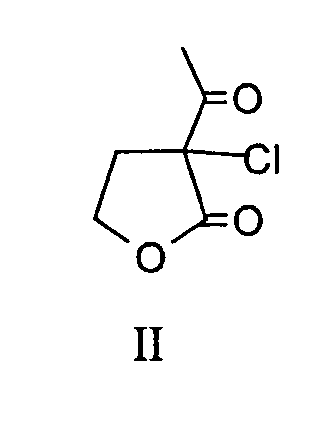
2-Acetyl-2-chlor-y-butyrolacton ist ein wichtiger Rohstoff und Baustein für Pharmawirkstoffe
(zum Beispiel Vitamin B1) oder für die Agroindustrie als Herbicid oder Fungicid.
Insgesamt ist das Zielprodukt vielseitig zum Aufbau von Heterozyklen geeignet.
So wird die Anwendung von 2-Acetyl-2-chlor-γ-butyrolacton als Edukt in den Patentschriften
DE 15 68 177 und US 2 932 653 zur Herstellung von Vitamin B1 sowie in der
wissenschaftlichen Literatur von A. Takamizawa et al. in Ann. Rep. Shionogi Res. Lab. 1967,
17, S. 3 - 9 oder von I. N. Rymoreva et al. in Khim -Farm. Zh.16 (9) 1098 - 1102 beschrieben.
Die Herstellung von II wird nach dem Stand der Technik durch Umsetzung von 2-Acetyl-γ-butyrolacton
mit Chlor gemäß der Patentschrift DE 15 68 177 (1970) beziehungsweise Ger.
Offen. 38 08 024 (1988) oder in Khim. Farm. Zh. 22(2), 231- 234, 1988 beschrieben.
Darüber hinaus wird die Herstellung von II auch durch Umsetzung von 2-Acetyl-γ-butyrolacton
mit SOCl2 im Journal of the Chemical Society, Perkin Transaction 1 (2) 144-
148; 2001 oder in Ger. Offen. 38 08 024 (1988), in J. Med. Chem. 22(3), 306 - 309, 1979 und
in Farmaco Ed. Sci. 34(1), 41 - 51, 1979 vorgeschlagen.
Allen diesen Verfahren ist gemeinsam, dass die Selektivität in Bezug auf die
Monochlorbildung nicht viel höher als 92 - 95 % ist. Das bei der Reaktion sich bildende
dichlorierte 2-Acetyl-γ-butyrolacton als Nebenprodukt bereitet insbesondere in Hinblick auf
die Abtrennbarkeit von der monochlorierten Verbindung zur Darstellung eines hochreinen
monochlorierten Acetylbutyrolactons große Probleme. Auf Grund der ähnlichen
Siedepunktslage sowie der ähnlichen physikalischen Eigenschaften zum monochlorierten
Acetylbutyrolacton und vor allem auf Grund der chemischen Reaktivität (zu Polymerisation
neigend) des dichlorierten Acetylbutyrolacton ist es nahezu unmöglich, diese beiden Produkte
voneinander zu trennen. Für Anwendungen im Bereich der Pharma- aber auch der
Agrochemie ist die wirtschaftlich günstige Herstellung einer hochreinen
Monochlorverbindung des 2-Acetyl-γ-butyrolactons jedoch erstrebenswert.
Es bestand daher die Aufgabe, eine Synthese mit hoher Selektivität in Bezug auf die
monochlorierte Verbindung zu entwickeln.
Überraschend gelingt die Lösung der Aufgabe dadurch, dass die Salze des 2-Acetyl-γ-butyrolactons
von Alkali- oder Erdalkalimetallen als Edukte für die Herstellung von 2-Acetyl-2-chlor-γ-butyrolacton
in Wasser allein oder in einer Mischung aus Wasser und protischen
oder aprotischen Lösemitteln mit gasförmigem oder flüssigem Chlor umgesetzt werden.
Vorzugsweise können mit Wasser mischbare Lösemittel verwendet werden, zum Beispiel
niedermolekulare Alkohole wie Methanol, Ethanol, n- und iso-Propanol, Ether wie
Tetrahydrofuran oder p-Dioxan oder Ester wie Essigsäuremethylester. Bei der Umsetzung
wird dabei ein sehr reines 2-Acetyl-2-chlor-γ-butyrolacton mit einer Selektivität von >98 %
erhalten. Als Nebenprodukt fällt eine wässrige oder mit anderen Lösemitteln entsprechende
Lösung/Mischung der Alkali- oder Erdalkalichloride an, die als Lösung mit Wasser als
Hauptbestandteil einfach entsorgt werden können.
Gegenstand der Erfindung ist also ein Verfahren zur Herstellung von 2-Acetyl-2-chlor-γ-butyrolacton
ausgehend von 2-Acetyl-γ-butyrolacton in Form seiner Alkali- oder
Erdalkalisalze in Gegenwart von Wasser oder Mischungen aus Wasser mit protischen oder
aprotischen Lösemitteln durch Umsetzung mit Chlor.
Vorteilhaft ist dieses Verfahren zusätzlich dadurch, dass alle technischen und kommerziellen
Verfahren zur Herstellung von 2-Acetyl-γ-butyrolacton gewöhnlich über die Bildung der
Alkalisalze verlaufen, wobei es zur Protonierung des freien 2-Acetyl-γ-butyrolactons durch
Behandlung beziehungsweise Neutralisation mit Säuren unter Bildung eines Äquivalentes
Salzes kommt (DE 196 06 975).
Anschließend wird zur Herstellung von 2-Acetyl-2-chlor-γ-butyrolacton durch Umsetzung von 2-Acetyl-γ-butyrolacton mit Chlor nach dem Stand der Technik ein stöchiometrisches Äquivalent Chlorwasserstoff frei, das in technischen Synthesen gewöhnlich mit einer Base wie zum Beispiel Natronlauge neutralisiert und als wässrige Lösung von Natriumchlorid oder als festes Nebenprodukt entsorgt wird. Damit wird grundsätzlich ein weiteres Äquivalent Salz über beide Synthesestufen erzeugt.
Anschließend wird zur Herstellung von 2-Acetyl-2-chlor-γ-butyrolacton durch Umsetzung von 2-Acetyl-γ-butyrolacton mit Chlor nach dem Stand der Technik ein stöchiometrisches Äquivalent Chlorwasserstoff frei, das in technischen Synthesen gewöhnlich mit einer Base wie zum Beispiel Natronlauge neutralisiert und als wässrige Lösung von Natriumchlorid oder als festes Nebenprodukt entsorgt wird. Damit wird grundsätzlich ein weiteres Äquivalent Salz über beide Synthesestufen erzeugt.
Ein weiterer Vorteil des hier geschilderten Verfahrens ist demnach die Bildung nur eines
Äquivalentes Salzes über beide Synthesestufen, wodurch die Kopplung beider Verfahren
gemäß vorliegender Erfindung zusätzlich kostengünstiger und umweltschonender ist.
Der Wassergehalt beträgt 0,1 bis 99 Gew.-%, vorzugsweise 5 bis 95 Gew.-% (bezogen auf die
Reaktionsmischung).
Das Chlor kann flüssig oder gasförmig eingesetzt werden.
Die Reaktionstemperatur beträgt 0 -100 °C, vorzugsweise 10 - 80 °C.
Die Reaktion kann im Druckbereich von 0,5 bis 5 bar durchgeführt werden. Vorteilhaft wird
jedoch bei Normaldruck gearbeitet.
Der Anteil des Salzes im Wasser oder in den Mischungen aus Wasser mit einem oder
mehreren und und dem Alkali- beziehungsweise Erdalkalisalz vom 2-Acetyl-γ-butyrolacton
beträgt 0,1 bis 50 Gew.-%, vorzugsweise 1 bis 40 Gew.-%.
Als Alkalimetalle können Li, Na und K und als Erdalkalimetalle Mg oder Ca als Kationen mit
dem 2-Acetyl-γ-butyrolacton vorliegen.
Das Verfahren kann absatzweise oder kontinuierlich betrieben werden.
Die Reaktions- beziehungsweise Verweilzeit kann 5 Minuten bis 20 Stunden, vorzugsweise
30 Minuten bis 6 Stunden, betragen.
150 g (1 mol) des Natriumsalzes vom 2-Acetyl-γ-butyrolacton wurden in 600 g Wasser gelöst
und bei 20 - 30 °C mit 77 g (1,1 mol) gasförmigem Chlor innerhalb von 3 Stunden behandelt.
Nach Abschluss der Chloreinleitung in diese Mischung wurden bei Raumtemperatur die zwei
flüssigen Phasen getrennt, wobei die organische Phase destillativ aufgearbeitet wurde. Die
wässrige Phase enthielt NaCl, das als Kochsalzlösung entsorgt werden konnte.
Aus der destillativen Aufarbeitung der organischen Phase (Destillationsapparatur bestehend
aus einen 500 ml Kolben und einer 10 cm Kolonne mit einer Raschigringfüllung und
Rücklaufteiler) wurden im Vorlauf beziehungsweise als erste Fraktion wenig Wasser und ca.
7,5 g unumgesetztes 2-Acetyl-γ-butyrolacton sowie im Hauptlauf der Destillation 153 g 2-Acetyl-2-chlor-γ-butyrolacton
mit einer Reinheit von 98,9 % erhalten. Als Verunreinigung
waren ca. 0,2 % 2-Acetyl-γ-butyrolacton und 0,9 % dichloriertes 2-Acetyl-γ-butyrolacton
enthalten.
Claims (8)
- Verfahren zur Herstellung von 2-Acetyl-2-chlor-γ-butyrolacton,
dadurch gekennzeichnet, dass 2-Acetyl-γ-butyrolacton in Form seiner Alkali- oder Erdalkalisalze in Gegenwart von Wasser oder Mischungen aus Wasser mit Lösemitteln mit Chlor umgesetzt wird. - Verfahren nach Anspruch 1,
dadurch gekennzeichnet, dass Chlor flüssig oder gasförmig angewendet wird. - Verfahren nach einem der vorhergehenden Ansprüche,
dadurch gekennzeichnet, dass im Wasser oder in den Mischungen aus Wasser mit Lösemitteln und dem Alkalibeziehungsweise Erdalkalisalz vom 2-Acetyl-γ-butyrolacton das Salz mit einem Anteil von 0,1 % bis 50 % enthalten ist. - Verfahren nach einem der vorhergehenden Ansprüche
dadurch gekennzeichnet, dass als Alkalimetalle Li, Na und K und als Erdalkalimetalle Mg oder Ca als Kationen mit dem 2-Acetyl-γ-butyrolacton vorliegen. - Verfahren nach einem der vorhergehenden Ansprüche,
dadurch gekennzeichnet, dass der Wassergehalt 0,1 bis 99 Gew.-%, vorzugsweise 5 bis 95 Gew.-% (bezogen auf die Reaktionsmischung) beträgt. - Verfahren nach Anspruch 1,
dadurch gekennzeichnet, dass die Reaktionstemperatur 0 - 100 °C beträgt. - Verfahren nach einem der vorhergehenden Ansprüche,
dadurch gekennzeichnet, dass die Reaktions- beziehungsweise Verweilzeit 5 Minuten bis 20 Stunden beträgt. - Verfahren nach Anspruch 1,
dadurch gekennzeichnet, dass das Verfahren absatzweise oder kontinuierlich betrieben wird.
Applications Claiming Priority (2)
| Application Number | Priority Date | Filing Date | Title |
|---|---|---|---|
| DE2002128407 DE10228407A1 (de) | 2002-06-25 | 2002-06-25 | Verfahren zur Herstellung von 2-Acetyl-2-chlor-gamma-butyrolacton durch Umsetzung von 2-Acetyl-gamma-butyrolacton Salz mit Chlor in Gegenwart von Wasser |
| DE10228407 | 2002-06-25 |
Publications (1)
| Publication Number | Publication Date |
|---|---|
| EP1375490A1 true EP1375490A1 (de) | 2004-01-02 |
Family
ID=29716646
Family Applications (1)
| Application Number | Title | Priority Date | Filing Date |
|---|---|---|---|
| EP03010256A Withdrawn EP1375490A1 (de) | 2002-06-25 | 2003-05-07 | Verfahren zur Herstellung von 2-Acetyl-2-chlor-gamma-butyrolacton |
Country Status (3)
| Country | Link |
|---|---|
| EP (1) | EP1375490A1 (de) |
| JP (1) | JP2004026832A (de) |
| DE (1) | DE10228407A1 (de) |
Cited By (6)
| Publication number | Priority date | Publication date | Assignee | Title |
|---|---|---|---|---|
| CN102584740A (zh) * | 2012-01-26 | 2012-07-18 | 滕州市悟通香料有限责任公司 | 4-甲基-5-(2-羟乙基)-噻唑的合成方法 |
| CN106008412A (zh) * | 2016-05-27 | 2016-10-12 | 江苏兄弟维生素有限公司 | 一种α-氯代-α-乙酰基-γ-丁内酯合成新工艺 |
| CN106588832A (zh) * | 2016-12-02 | 2017-04-26 | 连云港市金囤农化有限公司 | 一种α‑氯代‑α‑乙酰基‑γ‑丁内酯的制备方法 |
| CN111018811A (zh) * | 2019-12-20 | 2020-04-17 | 江西天新药业股份有限公司 | 一种制备α-氯代-α-乙酰基-γ-丁内酯的方法 |
| CN111116523A (zh) * | 2019-12-30 | 2020-05-08 | 浙江新和成股份有限公司 | 生产α-氯代-α-乙酰基-γ-丁内酯的系统及工艺 |
| CN114181178A (zh) * | 2021-12-28 | 2022-03-15 | 江苏兄弟维生素有限公司 | α-氯代-α-乙酰基-γ-丁内酯分层水的回收方法及其应用 |
Citations (3)
| Publication number | Priority date | Publication date | Assignee | Title |
|---|---|---|---|---|
| DE664789C (de) * | 1936-08-05 | 1938-09-05 | Merck Ag E | Verfahren zur Herstellung von 4-Methyl-5-ª‰-oxyaethylthiazolen |
| DE835139C (de) * | 1945-11-01 | 1952-03-27 | Hoffmann La Roche | Verfahren zur Herstellung von ª-Chlor-ª-acetobutyrolacton |
| US2932653A (en) * | 1957-07-08 | 1960-04-12 | Pfizer & Co C | Preparation of alpha-halo-alpha-aceto-gamma-butyrolactones |
-
2002
- 2002-06-25 DE DE2002128407 patent/DE10228407A1/de not_active Withdrawn
-
2003
- 2003-05-07 EP EP03010256A patent/EP1375490A1/de not_active Withdrawn
- 2003-06-25 JP JP2003181356A patent/JP2004026832A/ja active Pending
Patent Citations (3)
| Publication number | Priority date | Publication date | Assignee | Title |
|---|---|---|---|---|
| DE664789C (de) * | 1936-08-05 | 1938-09-05 | Merck Ag E | Verfahren zur Herstellung von 4-Methyl-5-ª‰-oxyaethylthiazolen |
| DE835139C (de) * | 1945-11-01 | 1952-03-27 | Hoffmann La Roche | Verfahren zur Herstellung von ª-Chlor-ª-acetobutyrolacton |
| US2932653A (en) * | 1957-07-08 | 1960-04-12 | Pfizer & Co C | Preparation of alpha-halo-alpha-aceto-gamma-butyrolactones |
Non-Patent Citations (2)
| Title |
|---|
| DATABASE CROSSFIRE BEILSTEIN [online] Beilstein Institut zur Förderung der Chemischen Wissenschaften, Frankfurt am Main, DE; XP002252264, Database accession no. 733768 * |
| E. V. MEYER, FINDEISEN, J. PRAKT. CHEM., vol. <2>65, 1902, pages 531 * |
Cited By (8)
| Publication number | Priority date | Publication date | Assignee | Title |
|---|---|---|---|---|
| CN102584740A (zh) * | 2012-01-26 | 2012-07-18 | 滕州市悟通香料有限责任公司 | 4-甲基-5-(2-羟乙基)-噻唑的合成方法 |
| CN102584740B (zh) * | 2012-01-26 | 2013-11-27 | 滕州市悟通香料有限责任公司 | 4-甲基-5-(2-羟乙基)-噻唑的合成方法 |
| CN106008412A (zh) * | 2016-05-27 | 2016-10-12 | 江苏兄弟维生素有限公司 | 一种α-氯代-α-乙酰基-γ-丁内酯合成新工艺 |
| CN106588832A (zh) * | 2016-12-02 | 2017-04-26 | 连云港市金囤农化有限公司 | 一种α‑氯代‑α‑乙酰基‑γ‑丁内酯的制备方法 |
| CN111018811A (zh) * | 2019-12-20 | 2020-04-17 | 江西天新药业股份有限公司 | 一种制备α-氯代-α-乙酰基-γ-丁内酯的方法 |
| CN111116523A (zh) * | 2019-12-30 | 2020-05-08 | 浙江新和成股份有限公司 | 生产α-氯代-α-乙酰基-γ-丁内酯的系统及工艺 |
| CN111116523B (zh) * | 2019-12-30 | 2021-09-07 | 浙江新和成股份有限公司 | 生产α-氯代-α-乙酰基-γ-丁内酯的系统及工艺 |
| CN114181178A (zh) * | 2021-12-28 | 2022-03-15 | 江苏兄弟维生素有限公司 | α-氯代-α-乙酰基-γ-丁内酯分层水的回收方法及其应用 |
Also Published As
| Publication number | Publication date |
|---|---|
| JP2004026832A (ja) | 2004-01-29 |
| DE10228407A1 (de) | 2004-01-15 |
Similar Documents
| Publication | Publication Date | Title |
|---|---|---|
| EP0048373B1 (de) | Verfahren zur Herstellung von Pyrazol | |
| DE10228407A1 (de) | Verfahren zur Herstellung von 2-Acetyl-2-chlor-gamma-butyrolacton durch Umsetzung von 2-Acetyl-gamma-butyrolacton Salz mit Chlor in Gegenwart von Wasser | |
| CH639951A5 (de) | Optisch aktives benzamid, verfahren zu dessen herstellung und therapeutisches mittel enthaltend dasselbe. | |
| WO2018137874A1 (de) | Verfahren zur herstellung von dihydroliponsäure | |
| EP2931703A1 (de) | Verfahren zur herstellung von bis(3-aminophenyl)-disulfiden und 3-aminothiolen | |
| DE60204014T2 (de) | Chlormethylierung von thiophen | |
| DE3104310A1 (de) | Verfahren zur herstellung von 5-chlor-2-nitroanilin | |
| EP0005849B2 (de) | Verfahren zur Herstellung von Alpha-Chlor-N-monoalkyl-acetoacetamiden | |
| DE69115758T2 (de) | Verfahren zur Herstellung von 3,5-Difluoranilin und dessen Derivat | |
| DE2648054C3 (de) | Verfahren zur Herstellung von Dichlornitroanilinen | |
| DE69026119T2 (de) | Verfahren zur Herstellung von Dichlor-(2,2)-Paracyclophanen | |
| DE2148597A1 (de) | Perfluoralkylsulfinsaeuren und verfahren zu ihrer herstellung | |
| EP0136566A2 (de) | Verfahren zur Herstellung von 3,4-Dichlorbenzotrihalogeniden | |
| EP0074072B2 (de) | Verfahren zur kontinuierlichen Herstellung von Salzen des Cholins | |
| EP0166685B1 (de) | Verfahren zur Herstellung von Alpha-Chloracetessigsäuremonomethylamid | |
| DE2503190B2 (de) | Verfahren zur Herstellung von N,N-Diallyldichloracetamid | |
| EP0173201A1 (de) | Verfahren zur Herstellung aromatischer Bromverbindungen | |
| WO2001077062A1 (de) | Verfahren zur herstellung von 4-brom- und 4-chlor-2-nitro-1-trifluormethoxybenzol | |
| DE2306335C3 (de) | Verfahren zur Herstellung von Dichloracetaldehyd | |
| DE3146471C2 (de) | Verfahren zur Herstellung von 1-(3,5-Dimethoxy-4-hydroxyphenyl)-2-(N-methylamino)-ethanol-hydrochlorid | |
| DE2621833A1 (de) | Herstellung organischer saeuren | |
| DE1618476C (de) | ||
| DE1593105C (de) | Verfahren zur Herstellung quater narer Ammoniumhalogenide | |
| DE2548420A1 (de) | 3,7-dimethyl-3-hydroxy-6-octennitril und verfahren zu seiner herstellung | |
| EP4053112A1 (de) | Verfahren zur herstellung von substituiertem 4-oxo-tetrahydrofuran |
Legal Events
| Date | Code | Title | Description |
|---|---|---|---|
| PUAI | Public reference made under article 153(3) epc to a published international application that has entered the european phase |
Free format text: ORIGINAL CODE: 0009012 |
|
| 17P | Request for examination filed |
Effective date: 20030507 |
|
| AK | Designated contracting states |
Kind code of ref document: A1 Designated state(s): AT BE BG CH CY CZ DE DK EE ES FI FR GB GR HU IE IT LI LU MC NL PT RO SE SI SK TR |
|
| AX | Request for extension of the european patent |
Extension state: AL LT LV MK |
|
| AKX | Designation fees paid |
Designated state(s): CH DE FR GB LI |
|
| STAA | Information on the status of an ep patent application or granted ep patent |
Free format text: STATUS: THE APPLICATION IS DEEMED TO BE WITHDRAWN |
|
| 18D | Application deemed to be withdrawn |
Effective date: 20040703 |