EP1372409B1 - Verfahren und anlage zur aufbereitung von extraktionsschrot aus sonnenblumensaat für die tierernährung - Google Patents
Verfahren und anlage zur aufbereitung von extraktionsschrot aus sonnenblumensaat für die tierernährung Download PDFInfo
- Publication number
- EP1372409B1 EP1372409B1 EP02732540A EP02732540A EP1372409B1 EP 1372409 B1 EP1372409 B1 EP 1372409B1 EP 02732540 A EP02732540 A EP 02732540A EP 02732540 A EP02732540 A EP 02732540A EP 1372409 B1 EP1372409 B1 EP 1372409B1
- Authority
- EP
- European Patent Office
- Prior art keywords
- crude
- particles
- fiber
- fraction
- extraction
- Prior art date
- Legal status (The legal status is an assumption and is not a legal conclusion. Google has not performed a legal analysis and makes no representation as to the accuracy of the status listed.)
- Expired - Lifetime
Links
- 238000000605 extraction Methods 0.000 title claims abstract description 99
- 238000000034 method Methods 0.000 title claims abstract description 91
- 235000012054 meals Nutrition 0.000 title claims abstract description 74
- 241001465754 Metazoa Species 0.000 title claims abstract description 19
- 235000020238 sunflower seed Nutrition 0.000 title claims description 33
- 239000000835 fiber Substances 0.000 claims abstract description 75
- 239000002245 particle Substances 0.000 claims abstract description 74
- 239000000463 material Substances 0.000 claims abstract description 61
- 230000008569 process Effects 0.000 claims abstract description 57
- 235000003222 Helianthus annuus Nutrition 0.000 claims abstract description 51
- 108090000623 proteins and genes Proteins 0.000 claims abstract description 42
- 102000004169 proteins and genes Human genes 0.000 claims abstract description 42
- 235000019750 Crude protein Nutrition 0.000 claims abstract description 28
- 241000282849 Ruminantia Species 0.000 claims abstract description 27
- 235000019621 digestibility Nutrition 0.000 claims abstract description 22
- 241000208818 Helianthus Species 0.000 claims abstract description 9
- HEMHJVSKTPXQMS-UHFFFAOYSA-M sodium hydroxide Inorganic materials [OH-].[Na+] HEMHJVSKTPXQMS-UHFFFAOYSA-M 0.000 claims description 58
- 235000011121 sodium hydroxide Nutrition 0.000 claims description 25
- 239000000203 mixture Substances 0.000 claims description 19
- 239000008188 pellet Substances 0.000 claims description 17
- 238000000926 separation method Methods 0.000 claims description 16
- 238000001816 cooling Methods 0.000 claims description 14
- 230000001965 increasing effect Effects 0.000 claims description 14
- 239000002699 waste material Substances 0.000 claims description 14
- 239000010903 husk Substances 0.000 claims description 13
- 238000003825 pressing Methods 0.000 claims description 8
- 238000003860 storage Methods 0.000 claims description 8
- 230000005484 gravity Effects 0.000 claims description 7
- 238000010438 heat treatment Methods 0.000 claims description 7
- 238000002360 preparation method Methods 0.000 claims description 7
- 239000007788 liquid Substances 0.000 claims description 6
- 239000010420 shell particle Substances 0.000 claims description 6
- 238000000227 grinding Methods 0.000 claims description 5
- 230000001105 regulatory effect Effects 0.000 claims description 5
- 239000011159 matrix material Substances 0.000 claims description 4
- 230000035484 reaction time Effects 0.000 claims description 4
- 238000012432 intermediate storage Methods 0.000 claims description 2
- 238000005303 weighing Methods 0.000 claims description 2
- 238000010009 beating Methods 0.000 claims 1
- 230000015556 catabolic process Effects 0.000 claims 1
- 239000011362 coarse particle Substances 0.000 claims 1
- 238000007599 discharging Methods 0.000 claims 1
- 238000005496 tempering Methods 0.000 claims 1
- 230000001464 adherent effect Effects 0.000 abstract description 3
- 238000000354 decomposition reaction Methods 0.000 abstract description 2
- 230000000050 nutritive effect Effects 0.000 abstract 1
- 244000020551 Helianthus annuus Species 0.000 description 44
- 239000000047 product Substances 0.000 description 42
- 235000018102 proteins Nutrition 0.000 description 37
- 238000012216 screening Methods 0.000 description 26
- 235000010469 Glycine max Nutrition 0.000 description 23
- 230000029087 digestion Effects 0.000 description 22
- 239000011162 core material Substances 0.000 description 20
- 239000003921 oil Substances 0.000 description 19
- 235000019198 oils Nutrition 0.000 description 19
- 241000196324 Embryophyta Species 0.000 description 15
- 239000002994 raw material Substances 0.000 description 15
- 235000019728 animal nutrition Nutrition 0.000 description 14
- 238000004519 manufacturing process Methods 0.000 description 13
- 238000002156 mixing Methods 0.000 description 13
- 238000012545 processing Methods 0.000 description 13
- 235000016709 nutrition Nutrition 0.000 description 12
- 244000068988 Glycine max Species 0.000 description 11
- 241000282887 Suidae Species 0.000 description 11
- 240000002791 Brassica napus Species 0.000 description 9
- 239000000969 carrier Substances 0.000 description 9
- 244000144977 poultry Species 0.000 description 9
- 235000019764 Soybean Meal Nutrition 0.000 description 7
- 239000004455 soybean meal Substances 0.000 description 7
- 239000000126 substance Substances 0.000 description 7
- 235000005911 diet Nutrition 0.000 description 6
- 230000037213 diet Effects 0.000 description 6
- 230000006872 improvement Effects 0.000 description 6
- VLKZOEOYAKHREP-UHFFFAOYSA-N n-Hexane Chemical compound CCCCCC VLKZOEOYAKHREP-UHFFFAOYSA-N 0.000 description 6
- 235000015097 nutrients Nutrition 0.000 description 6
- 238000007873 sieving Methods 0.000 description 6
- 235000004977 Brassica sinapistrum Nutrition 0.000 description 5
- 150000001875 compounds Chemical class 0.000 description 5
- 239000000428 dust Substances 0.000 description 5
- 230000000694 effects Effects 0.000 description 5
- 235000013305 food Nutrition 0.000 description 5
- 235000013372 meat Nutrition 0.000 description 5
- 239000005416 organic matter Substances 0.000 description 5
- XEEYBQQBJWHFJM-UHFFFAOYSA-N Iron Chemical compound [Fe] XEEYBQQBJWHFJM-UHFFFAOYSA-N 0.000 description 4
- 239000004480 active ingredient Substances 0.000 description 4
- 239000006227 byproduct Substances 0.000 description 4
- 239000007771 core particle Substances 0.000 description 4
- 238000011161 development Methods 0.000 description 4
- 230000018109 developmental process Effects 0.000 description 4
- 238000003801 milling Methods 0.000 description 4
- LEVWYRKDKASIDU-QWWZWVQMSA-N D-cystine Chemical compound OC(=O)[C@H](N)CSSC[C@@H](N)C(O)=O LEVWYRKDKASIDU-QWWZWVQMSA-N 0.000 description 3
- FFEARJCKVFRZRR-BYPYZUCNSA-N L-methionine Chemical compound CSCC[C@H](N)C(O)=O FFEARJCKVFRZRR-BYPYZUCNSA-N 0.000 description 3
- QIVBCDIJIAJPQS-VIFPVBQESA-N L-tryptophane Chemical compound C1=CC=C2C(C[C@H](N)C(O)=O)=CNC2=C1 QIVBCDIJIAJPQS-VIFPVBQESA-N 0.000 description 3
- OYHQOLUKZRVURQ-HZJYTTRNSA-N Linoleic acid Chemical compound CCCCC\C=C/C\C=C/CCCCCCCC(O)=O OYHQOLUKZRVURQ-HZJYTTRNSA-N 0.000 description 3
- KDXKERNSBIXSRK-UHFFFAOYSA-N Lysine Natural products NCCCCC(N)C(O)=O KDXKERNSBIXSRK-UHFFFAOYSA-N 0.000 description 3
- 239000004472 Lysine Substances 0.000 description 3
- 241000862632 Soja Species 0.000 description 3
- QIVBCDIJIAJPQS-UHFFFAOYSA-N Tryptophan Natural products C1=CC=C2C(CC(N)C(O)=O)=CNC2=C1 QIVBCDIJIAJPQS-UHFFFAOYSA-N 0.000 description 3
- 239000000853 adhesive Substances 0.000 description 3
- 230000001070 adhesive effect Effects 0.000 description 3
- 150000001413 amino acids Chemical class 0.000 description 3
- 230000008901 benefit Effects 0.000 description 3
- 238000004364 calculation method Methods 0.000 description 3
- 239000001913 cellulose Substances 0.000 description 3
- 229920002678 cellulose Polymers 0.000 description 3
- 229960003067 cystine Drugs 0.000 description 3
- 235000014113 dietary fatty acids Nutrition 0.000 description 3
- 235000020776 essential amino acid Nutrition 0.000 description 3
- 239000003797 essential amino acid Substances 0.000 description 3
- 239000003925 fat Substances 0.000 description 3
- 235000019197 fats Nutrition 0.000 description 3
- 239000000194 fatty acid Substances 0.000 description 3
- 229930195729 fatty acid Natural products 0.000 description 3
- 150000004665 fatty acids Chemical class 0.000 description 3
- 238000009472 formulation Methods 0.000 description 3
- 239000004615 ingredient Substances 0.000 description 3
- 235000020778 linoleic acid Nutrition 0.000 description 3
- OYHQOLUKZRVURQ-IXWMQOLASA-N linoleic acid Natural products CCCCC\C=C/C\C=C\CCCCCCCC(O)=O OYHQOLUKZRVURQ-IXWMQOLASA-N 0.000 description 3
- 229930182817 methionine Natural products 0.000 description 3
- 238000007670 refining Methods 0.000 description 3
- 239000007787 solid Substances 0.000 description 3
- 241000894007 species Species 0.000 description 3
- 241000132536 Cirsium Species 0.000 description 2
- 108010082495 Dietary Plant Proteins Proteins 0.000 description 2
- BGPVFRJUHWVFKM-UHFFFAOYSA-N N1=C2C=CC=CC2=[N+]([O-])C1(CC1)CCC21N=C1C=CC=CC1=[N+]2[O-] Chemical compound N1=C2C=CC=CC2=[N+]([O-])C1(CC1)CCC21N=C1C=CC=CC1=[N+]2[O-] BGPVFRJUHWVFKM-UHFFFAOYSA-N 0.000 description 2
- AYFVYJQAPQTCCC-UHFFFAOYSA-N Threonine Natural products CC(O)C(N)C(O)=O AYFVYJQAPQTCCC-UHFFFAOYSA-N 0.000 description 2
- 239000004473 Threonine Substances 0.000 description 2
- 238000010521 absorption reaction Methods 0.000 description 2
- 239000003513 alkali Substances 0.000 description 2
- 230000000433 anti-nutritional effect Effects 0.000 description 2
- 210000004027 cell Anatomy 0.000 description 2
- 239000007795 chemical reaction product Substances 0.000 description 2
- 238000004140 cleaning Methods 0.000 description 2
- 230000003750 conditioning effect Effects 0.000 description 2
- 238000010276 construction Methods 0.000 description 2
- 235000013399 edible fruits Nutrition 0.000 description 2
- 238000002474 experimental method Methods 0.000 description 2
- 239000012467 final product Substances 0.000 description 2
- 125000004383 glucosinolate group Chemical group 0.000 description 2
- IPCSVZSSVZVIGE-UHFFFAOYSA-N hexadecanoic acid Chemical compound CCCCCCCCCCCCCCCC(O)=O IPCSVZSSVZVIGE-UHFFFAOYSA-N 0.000 description 2
- 229910052742 iron Inorganic materials 0.000 description 2
- 238000005259 measurement Methods 0.000 description 2
- 238000001465 metallisation Methods 0.000 description 2
- 238000012821 model calculation Methods 0.000 description 2
- 238000012544 monitoring process Methods 0.000 description 2
- 239000011824 nuclear material Substances 0.000 description 2
- 238000005453 pelletization Methods 0.000 description 2
- JTJMJGYZQZDUJJ-UHFFFAOYSA-N phencyclidine Chemical class C1CCCCN1C1(C=2C=CC=CC=2)CCCCC1 JTJMJGYZQZDUJJ-UHFFFAOYSA-N 0.000 description 2
- 238000004886 process control Methods 0.000 description 2
- 239000000243 solution Substances 0.000 description 2
- 239000002904 solvent Substances 0.000 description 2
- 210000000352 storage cell Anatomy 0.000 description 2
- 238000009736 wetting Methods 0.000 description 2
- WRIDQFICGBMAFQ-UHFFFAOYSA-N (E)-8-Octadecenoic acid Natural products CCCCCCCCCC=CCCCCCCC(O)=O WRIDQFICGBMAFQ-UHFFFAOYSA-N 0.000 description 1
- LQJBNNIYVWPHFW-UHFFFAOYSA-N 20:1omega9c fatty acid Natural products CCCCCCCCCCC=CCCCCCCCC(O)=O LQJBNNIYVWPHFW-UHFFFAOYSA-N 0.000 description 1
- QSBYPNXLFMSGKH-UHFFFAOYSA-N 9-Heptadecensaeure Natural products CCCCCCCC=CCCCCCCCC(O)=O QSBYPNXLFMSGKH-UHFFFAOYSA-N 0.000 description 1
- 241001133760 Acoelorraphe Species 0.000 description 1
- 241000283690 Bos taurus Species 0.000 description 1
- 235000006008 Brassica napus var napus Nutrition 0.000 description 1
- 241000792859 Enema Species 0.000 description 1
- 108010068370 Glutens Proteins 0.000 description 1
- 229920002488 Hemicellulose Polymers 0.000 description 1
- KDXKERNSBIXSRK-YFKPBYRVSA-N L-lysine Chemical compound NCCCC[C@H](N)C(O)=O KDXKERNSBIXSRK-YFKPBYRVSA-N 0.000 description 1
- AYFVYJQAPQTCCC-GBXIJSLDSA-N L-threonine Chemical compound C[C@@H](O)[C@H](N)C(O)=O AYFVYJQAPQTCCC-GBXIJSLDSA-N 0.000 description 1
- 241000219745 Lupinus Species 0.000 description 1
- ZQPPMHVWECSIRJ-UHFFFAOYSA-N Oleic acid Natural products CCCCCCCCC=CCCCCCCCC(O)=O ZQPPMHVWECSIRJ-UHFFFAOYSA-N 0.000 description 1
- 239000005642 Oleic acid Substances 0.000 description 1
- 235000021314 Palmitic acid Nutrition 0.000 description 1
- 235000010582 Pisum sativum Nutrition 0.000 description 1
- 240000004713 Pisum sativum Species 0.000 description 1
- 235000019484 Rapeseed oil Nutrition 0.000 description 1
- 241000700159 Rattus Species 0.000 description 1
- 229920002472 Starch Polymers 0.000 description 1
- 235000021355 Stearic acid Nutrition 0.000 description 1
- 235000019772 Sunflower meal Nutrition 0.000 description 1
- 235000019486 Sunflower oil Nutrition 0.000 description 1
- 108010076830 Thionins Proteins 0.000 description 1
- 235000002096 Vicia faba var. equina Nutrition 0.000 description 1
- 240000008042 Zea mays Species 0.000 description 1
- 235000005824 Zea mays ssp. parviglumis Nutrition 0.000 description 1
- 235000002017 Zea mays subsp mays Nutrition 0.000 description 1
- 230000006978 adaptation Effects 0.000 description 1
- ZOJBYZNEUISWFT-UHFFFAOYSA-N allyl isothiocyanate Chemical compound C=CCN=C=S ZOJBYZNEUISWFT-UHFFFAOYSA-N 0.000 description 1
- 238000004458 analytical method Methods 0.000 description 1
- 235000015278 beef Nutrition 0.000 description 1
- 230000033228 biological regulation Effects 0.000 description 1
- 230000008859 change Effects 0.000 description 1
- 239000003638 chemical reducing agent Substances 0.000 description 1
- 238000005345 coagulation Methods 0.000 description 1
- 230000015271 coagulation Effects 0.000 description 1
- 238000005056 compaction Methods 0.000 description 1
- 230000000052 comparative effect Effects 0.000 description 1
- 238000011109 contamination Methods 0.000 description 1
- 238000010924 continuous production Methods 0.000 description 1
- 235000005822 corn Nutrition 0.000 description 1
- 238000003967 crop rotation Methods 0.000 description 1
- 235000019784 crude fat Nutrition 0.000 description 1
- 238000004925 denaturation Methods 0.000 description 1
- 230000036425 denaturation Effects 0.000 description 1
- 238000000151 deposition Methods 0.000 description 1
- 230000008021 deposition Effects 0.000 description 1
- 210000002249 digestive system Anatomy 0.000 description 1
- 238000010790 dilution Methods 0.000 description 1
- 239000012895 dilution Substances 0.000 description 1
- 238000009826 distribution Methods 0.000 description 1
- 238000001035 drying Methods 0.000 description 1
- 235000005489 dwarf bean Nutrition 0.000 description 1
- 244000013123 dwarf bean Species 0.000 description 1
- 239000007920 enema Substances 0.000 description 1
- 229940095399 enema Drugs 0.000 description 1
- 235000004626 essential fatty acids Nutrition 0.000 description 1
- 239000000284 extract Substances 0.000 description 1
- 210000003608 fece Anatomy 0.000 description 1
- 235000021050 feed intake Nutrition 0.000 description 1
- 238000000855 fermentation Methods 0.000 description 1
- 230000004151 fermentation Effects 0.000 description 1
- 230000035558 fertility Effects 0.000 description 1
- 238000011049 filling Methods 0.000 description 1
- 239000012634 fragment Substances 0.000 description 1
- 210000001035 gastrointestinal tract Anatomy 0.000 description 1
- 235000003869 genetically modified organism Nutrition 0.000 description 1
- 239000011521 glass Substances 0.000 description 1
- 235000021312 gluten Nutrition 0.000 description 1
- 239000008240 homogeneous mixture Substances 0.000 description 1
- 238000000265 homogenisation Methods 0.000 description 1
- 239000013072 incoming material Substances 0.000 description 1
- 230000001939 inductive effect Effects 0.000 description 1
- 238000007689 inspection Methods 0.000 description 1
- 238000009434 installation Methods 0.000 description 1
- 238000009413 insulation Methods 0.000 description 1
- 230000001788 irregular Effects 0.000 description 1
- QXJSBBXBKPUZAA-UHFFFAOYSA-N isooleic acid Natural products CCCCCCCC=CCCCCCCCCC(O)=O QXJSBBXBKPUZAA-UHFFFAOYSA-N 0.000 description 1
- 238000002386 leaching Methods 0.000 description 1
- 235000021374 legumes Nutrition 0.000 description 1
- 229920005610 lignin Polymers 0.000 description 1
- 238000011068 loading method Methods 0.000 description 1
- 239000006148 magnetic separator Substances 0.000 description 1
- 238000012423 maintenance Methods 0.000 description 1
- 230000014759 maintenance of location Effects 0.000 description 1
- 230000007246 mechanism Effects 0.000 description 1
- 239000002923 metal particle Substances 0.000 description 1
- 238000010327 methods by industry Methods 0.000 description 1
- 244000005700 microbiome Species 0.000 description 1
- 239000008164 mustard oil Substances 0.000 description 1
- WQEPLUUGTLDZJY-UHFFFAOYSA-N n-Pentadecanoic acid Natural products CCCCCCCCCCCCCCC(O)=O WQEPLUUGTLDZJY-UHFFFAOYSA-N 0.000 description 1
- 235000021049 nutrient content Nutrition 0.000 description 1
- 230000035764 nutrition Effects 0.000 description 1
- QIQXTHQIDYTFRH-UHFFFAOYSA-N octadecanoic acid Chemical compound CCCCCCCCCCCCCCCCCC(O)=O QIQXTHQIDYTFRH-UHFFFAOYSA-N 0.000 description 1
- OQCDKBAXFALNLD-UHFFFAOYSA-N octadecanoic acid Natural products CCCCCCCC(C)CCCCCCCCC(O)=O OQCDKBAXFALNLD-UHFFFAOYSA-N 0.000 description 1
- ZQPPMHVWECSIRJ-KTKRTIGZSA-N oleic acid Chemical compound CCCCCCCC\C=C/CCCCCCCC(O)=O ZQPPMHVWECSIRJ-KTKRTIGZSA-N 0.000 description 1
- ADIMAYPTOBDMTL-UHFFFAOYSA-N oxazepam Chemical compound C12=CC(Cl)=CC=C2NC(=O)C(O)N=C1C1=CC=CC=C1 ADIMAYPTOBDMTL-UHFFFAOYSA-N 0.000 description 1
- 230000002093 peripheral effect Effects 0.000 description 1
- 239000004033 plastic Substances 0.000 description 1
- 238000003672 processing method Methods 0.000 description 1
- 238000011084 recovery Methods 0.000 description 1
- 230000009467 reduction Effects 0.000 description 1
- 235000015170 shellfish Nutrition 0.000 description 1
- -1 shells Substances 0.000 description 1
- 230000035939 shock Effects 0.000 description 1
- 239000002689 soil Substances 0.000 description 1
- 238000005507 spraying Methods 0.000 description 1
- 239000008107 starch Substances 0.000 description 1
- 235000019698 starch Nutrition 0.000 description 1
- 239000008117 stearic acid Substances 0.000 description 1
- 239000002600 sunflower oil Substances 0.000 description 1
- 239000000725 suspension Substances 0.000 description 1
- 230000009897 systematic effect Effects 0.000 description 1
- 238000012360 testing method Methods 0.000 description 1
- ANRHNWWPFJCPAZ-UHFFFAOYSA-M thionine Chemical compound [Cl-].C1=CC(N)=CC2=[S+]C3=CC(N)=CC=C3N=C21 ANRHNWWPFJCPAZ-UHFFFAOYSA-M 0.000 description 1
- 231100000331 toxic Toxicity 0.000 description 1
- 230000002588 toxic effect Effects 0.000 description 1
- 239000002753 trypsin inhibitor Substances 0.000 description 1
- 230000035899 viability Effects 0.000 description 1
- XLYOFNOQVPJJNP-UHFFFAOYSA-N water Substances O XLYOFNOQVPJJNP-UHFFFAOYSA-N 0.000 description 1
Images


Classifications
-
- B—PERFORMING OPERATIONS; TRANSPORTING
- B07—SEPARATING SOLIDS FROM SOLIDS; SORTING
- B07B—SEPARATING SOLIDS FROM SOLIDS BY SIEVING, SCREENING, SIFTING OR BY USING GAS CURRENTS; SEPARATING BY OTHER DRY METHODS APPLICABLE TO BULK MATERIAL, e.g. LOOSE ARTICLES FIT TO BE HANDLED LIKE BULK MATERIAL
- B07B9/00—Combinations of apparatus for screening or sifting or for separating solids from solids using gas currents; General arrangement of plant, e.g. flow sheets
-
- A—HUMAN NECESSITIES
- A23—FOODS OR FOODSTUFFS; TREATMENT THEREOF, NOT COVERED BY OTHER CLASSES
- A23J—PROTEIN COMPOSITIONS FOR FOODSTUFFS; WORKING-UP PROTEINS FOR FOODSTUFFS; PHOSPHATIDE COMPOSITIONS FOR FOODSTUFFS
- A23J1/00—Obtaining protein compositions for foodstuffs; Bulk opening of eggs and separation of yolks from whites
- A23J1/14—Obtaining protein compositions for foodstuffs; Bulk opening of eggs and separation of yolks from whites from leguminous or other vegetable seeds; from press-cake or oil-bearing seeds
-
- A—HUMAN NECESSITIES
- A23—FOODS OR FOODSTUFFS; TREATMENT THEREOF, NOT COVERED BY OTHER CLASSES
- A23K—FODDER
- A23K10/00—Animal feeding-stuffs
- A23K10/30—Animal feeding-stuffs from material of plant origin, e.g. roots, seeds or hay; from material of fungal origin, e.g. mushrooms
- A23K10/37—Animal feeding-stuffs from material of plant origin, e.g. roots, seeds or hay; from material of fungal origin, e.g. mushrooms from waste material
-
- A—HUMAN NECESSITIES
- A23—FOODS OR FOODSTUFFS; TREATMENT THEREOF, NOT COVERED BY OTHER CLASSES
- A23K—FODDER
- A23K40/00—Shaping or working-up of animal feeding-stuffs
- A23K40/10—Shaping or working-up of animal feeding-stuffs by agglomeration; by granulation, e.g. making powders
-
- A—HUMAN NECESSITIES
- A23—FOODS OR FOODSTUFFS; TREATMENT THEREOF, NOT COVERED BY OTHER CLASSES
- A23K—FODDER
- A23K50/00—Feeding-stuffs specially adapted for particular animals
- A23K50/10—Feeding-stuffs specially adapted for particular animals for ruminants
-
- B—PERFORMING OPERATIONS; TRANSPORTING
- B03—SEPARATION OF SOLID MATERIALS USING LIQUIDS OR USING PNEUMATIC TABLES OR JIGS; MAGNETIC OR ELECTROSTATIC SEPARATION OF SOLID MATERIALS FROM SOLID MATERIALS OR FLUIDS; SEPARATION BY HIGH-VOLTAGE ELECTRIC FIELDS
- B03C—MAGNETIC OR ELECTROSTATIC SEPARATION OF SOLID MATERIALS FROM SOLID MATERIALS OR FLUIDS; SEPARATION BY HIGH-VOLTAGE ELECTRIC FIELDS
- B03C1/00—Magnetic separation
- B03C1/02—Magnetic separation acting directly on the substance being separated
- B03C1/035—Open gradient magnetic separators, i.e. separators in which the gap is unobstructed, characterised by the configuration of the gap
-
- B—PERFORMING OPERATIONS; TRANSPORTING
- B03—SEPARATION OF SOLID MATERIALS USING LIQUIDS OR USING PNEUMATIC TABLES OR JIGS; MAGNETIC OR ELECTROSTATIC SEPARATION OF SOLID MATERIALS FROM SOLID MATERIALS OR FLUIDS; SEPARATION BY HIGH-VOLTAGE ELECTRIC FIELDS
- B03C—MAGNETIC OR ELECTROSTATIC SEPARATION OF SOLID MATERIALS FROM SOLID MATERIALS OR FLUIDS; SEPARATION BY HIGH-VOLTAGE ELECTRIC FIELDS
- B03C1/00—Magnetic separation
- B03C1/02—Magnetic separation acting directly on the substance being separated
- B03C1/26—Magnetic separation acting directly on the substance being separated with free falling material
-
- B—PERFORMING OPERATIONS; TRANSPORTING
- B03—SEPARATION OF SOLID MATERIALS USING LIQUIDS OR USING PNEUMATIC TABLES OR JIGS; MAGNETIC OR ELECTROSTATIC SEPARATION OF SOLID MATERIALS FROM SOLID MATERIALS OR FLUIDS; SEPARATION BY HIGH-VOLTAGE ELECTRIC FIELDS
- B03C—MAGNETIC OR ELECTROSTATIC SEPARATION OF SOLID MATERIALS FROM SOLID MATERIALS OR FLUIDS; SEPARATION BY HIGH-VOLTAGE ELECTRIC FIELDS
- B03C1/00—Magnetic separation
- B03C1/02—Magnetic separation acting directly on the substance being separated
- B03C1/28—Magnetic plugs and dipsticks
- B03C1/286—Magnetic plugs and dipsticks disposed at the inner circumference of a recipient, e.g. magnetic drain bolt
-
- B—PERFORMING OPERATIONS; TRANSPORTING
- B03—SEPARATION OF SOLID MATERIALS USING LIQUIDS OR USING PNEUMATIC TABLES OR JIGS; MAGNETIC OR ELECTROSTATIC SEPARATION OF SOLID MATERIALS FROM SOLID MATERIALS OR FLUIDS; SEPARATION BY HIGH-VOLTAGE ELECTRIC FIELDS
- B03C—MAGNETIC OR ELECTROSTATIC SEPARATION OF SOLID MATERIALS FROM SOLID MATERIALS OR FLUIDS; SEPARATION BY HIGH-VOLTAGE ELECTRIC FIELDS
- B03C1/00—Magnetic separation
- B03C1/02—Magnetic separation acting directly on the substance being separated
- B03C1/30—Combinations with other devices, not otherwise provided for
-
- B—PERFORMING OPERATIONS; TRANSPORTING
- B03—SEPARATION OF SOLID MATERIALS USING LIQUIDS OR USING PNEUMATIC TABLES OR JIGS; MAGNETIC OR ELECTROSTATIC SEPARATION OF SOLID MATERIALS FROM SOLID MATERIALS OR FLUIDS; SEPARATION BY HIGH-VOLTAGE ELECTRIC FIELDS
- B03C—MAGNETIC OR ELECTROSTATIC SEPARATION OF SOLID MATERIALS FROM SOLID MATERIALS OR FLUIDS; SEPARATION BY HIGH-VOLTAGE ELECTRIC FIELDS
- B03C2201/00—Details of magnetic or electrostatic separation
- B03C2201/20—Magnetic separation of bulk or dry particles in mixtures
-
- Y—GENERAL TAGGING OF NEW TECHNOLOGICAL DEVELOPMENTS; GENERAL TAGGING OF CROSS-SECTIONAL TECHNOLOGIES SPANNING OVER SEVERAL SECTIONS OF THE IPC; TECHNICAL SUBJECTS COVERED BY FORMER USPC CROSS-REFERENCE ART COLLECTIONS [XRACs] AND DIGESTS
- Y02—TECHNOLOGIES OR APPLICATIONS FOR MITIGATION OR ADAPTATION AGAINST CLIMATE CHANGE
- Y02P—CLIMATE CHANGE MITIGATION TECHNOLOGIES IN THE PRODUCTION OR PROCESSING OF GOODS
- Y02P60/00—Technologies relating to agriculture, livestock or agroalimentary industries
- Y02P60/80—Food processing, e.g. use of renewable energies or variable speed drives in handling, conveying or stacking
- Y02P60/87—Re-use of by-products of food processing for fodder production
Definitions
- the invention relates to a method for waste treatment of Extraction meal from sunflower seeds from conventional sunflowers for animal nutrition, the extraction meal being particles of shells, Core parts and shells with adhesive core parts covered by at least one sieving by particle size separated into two fractions be separated with different levels of crude proteins, wherein a proteinaceous fraction with a high crude protein content suitable for Monogastric animal feed and a crude fiber fraction of lower Crude protein content suitable for ruminants obtained as pet food, and an installation for carrying out the method.
- a method of the generic type is from the reference Levic, Jovanka et al. "Removal of cellulose from sunflower meal by fraptionation", (Journal of American Oil Chemist's Society Jaocs, 1992, 69 (9) 890-893) known that obtained after peeling the sunflower seed Extraction meal, namely peel with attached core meat, containing 20% the particles are larger than 5.0 mm, 37% of the particles are between 2 and 5 mm and 41% of the particles are smaller than 2 mm, by one or two times Seven can be divided into two fractions of different particle sizes. By sieving there is no detachment of adhering to the shells Kernels still a structuring, such as fiberizing the shells.
- Beef containing raw fiber containing product still contains at least 30% Crude protein and includes all larger particles, especially the large ones Shell particles, which are used for cattle - ruminants - in the present form are hardly digestible.
- the crude protein-rich fraction obtained on sieving containing more than 42% of crude protein by sieving obtained smaller particles of the extraction shot, but still significant quantities of crude fiber containing particles, namely small ones Clump particles with and without adherent core meat are present. Due to the remaining high still over 10% salary Crude fiber is also the crude protein rich in sieve fraction as feed for Monogastric not optimally processed, and thus remains indigestible.
- DE 40 34 738 A1 and DE 40 34 739 D2 are methods for Preparation of sunflower seeds by peeling before oil extraction known. This is tried by repeated peeling and sifting the Separate core meat from the shell and the fines for the Feed animal nutrition to usable fraction. It is a uneconomical peeling process, working with 20% shell waste is burned for disposal. There is no nutritionally useful or usable product. Also the complete detachment of the kernel meat from the shell does not succeed, so that with the waste also valuable proteins are burned with.
- the preparation is rich in fat Oilseeds, described as sunflower seed.
- the process is remarkable characterized in that the drying of the tempered seeds under adjustment a water content below 10% by shock heating at temperatures from 100 to 150 ° over periods of up to 5 minutes.
- this is a Treatment process that takes place before the oil mill process, that is, it is a peeling process of sunflower seeds and not the further processing of sunflower extraction meal, which is after the Oil recovery remains. Due to the strong protein denaturation as a result of high temperatures, the product is only conditionally suitable for animal-friendly feeding used.
- Sunflower seed extraction meal is used in the extraction of Received sunflower oil. Sunflower seed, which is crushed first, becomes de-oiled in a first pressing process to about 15-20% oil. After that will Another oil in an extraction plant by heating with superheated steam and Addition of solvent hexane in countercurrent process except one Remained residual content of about 1-3%, the remainder is now as Extraction meal called.
- GMOs Provinienzen
- the oil obtained from sunflowers as by-product (Waste product) resulting sunflower extraction meal contains proteins, which are biologically valuable, so that the sunflower extraction meal in terms of protein quality, the proteins of the soybean meal is approximately equivalent.
- sunflower seeds contain the essential fatty acid of linoleic acid in a large amount, which makes them superior to soy and rapeseed with respect to this property, as shown in Table 1 below: Fatty acids in% in oil from sunflower seeds, a comparison with soy and rapeseed oil Palmitic acid C 16: 0 Stearic acid C 18: 0 Oleic acid C18: 1w9 Linoleic acid C18: 2w6 Sunflower conventional varieties 4-10 2-6 10-12 33-77 soy 2-14 2-7 20-36 48-60 rape 1-6 1-3 11-52 10-36 Source: H. Jerosch et al. 1993, Henkel KGaA 1997
- the sunflower trains its seeds in the form of nuts - achenes.
- the achenes are lonely fruits, in which the oil and protein-containing
- the nucleus with the pericarp covers so densely that when peeling the nucleus and make the tray no longer smooth and completely separate.
- the result is, that extracted from the cores extraction meal next to the defatted nuclear material a high proportion of fragments of shells contains remnants of nuclear meat.
- This shell share brings it comes with that conventionally produced extraction meal Sunflower seeds - despite the high quality proteins - not the meet nutritional requirements for poultry and Pigs apply.
- Decisive is the factor "digestibility of the organic matter. "The digestibility in the conventional qualities is not sufficient for the requirements of poultry and pigs.
- Table 2 gives details of the different extraction slices
- the raw nutrients have the nutritional value according to Weender analysis Break down raw materials / ration and VQ is the digestion quotient, such that the difference between organic matter with feed and organic matter in feces that yields digestible organic matter that Ratio in% is the VQ.
- the information in Table 2 is taken from Lennerts, L. 1984, Menke K.M., Huss W. 1987, Hugger H. 1989, DLG 1991/1997.
- sunflower husks have a digestibility that is so low (Table 2) that the organism can not use this waste energetically.
- the cause is the high content of builders that the digestive system does not open up.
- the complex becomes Cellulose lignin hemicellulose loosened / cleaved. As a result, more cellulose can be degraded by the microorganisms in the Vorzegen, in this way, the framework substance rich material is energetically upgraded.
- Table 3 shows that Sunflower seed is superior to methionine and cystine in soybean, In terms of lysine, sunflower seed ranks behind soy and rapeseed.
- the invention is based on the object, sunflowerseed extraction meal from conventional sunflowers for animal nutrition without waste for both monogastric and ruminant animals prepare that a high-quality vegetable protein carrier is created, which is approximately equivalent to soy product extraction meal.
- the resulting extraction meal Sunflower seed from the process of oil extraction completely to prepare, i. without waste.
- this object is achieved by a method according to characterizing features of claim 1 solved. It is therefore according to the invention from the conventional sunflower seed extraction meal a fraction produced in which the content of crude protein is enriched in order for the Feeding monogastric animals to be suitable while the remaining protein-poor fraction is still suitable for ruminants.
- the remaining fraction, whose content of crude protein to very low Shares are reduced in favor of a very high crude fiber content against the originally used extraction meal substantially is increased by additional digestion in his Digestibility and nutritional value improved to become a useful feed for To give ruminants.
- the essence of the invention is sunflower extraction meal in particular conventional quality in a special plant with a suitable to prepare the milling process in such a way that the shells of the Core material to be separated.
- the goal is to share the shell in the new Precise to adjust products, because on the shell portion can be the Control the digestibility of organic matter. From the digestibility The organic substance in turn depends on the suitability of the product for the diet of each species.
- the process according to the invention and the plant according to the invention provide Protein carriers of various qualities used in practical animal nutrition are usable. These products are nutritionally accurate to the Requirements of different types of farm animals set. First time stands to make a protein carrier from sunflower seed available that's full for Monogastric is suitable. In addition, it is achieved that at the Processing of sunflower seed by-products, that is, including the shell waste, used in animal nutrition can be.
- a product from the field of renewable Raw materials namely sunflowers, in particular annuals, which are rich in fat and proteins, in two qualities by appropriate Refinement of the resulting from the extraction of oil extraction create.
- a high quality industrial industrial Manufacturing process with a product-sparing, reliable, mechanical treatment process of the feed, namely extraction meal without additional large material heating, so that all natural ingredients are preserved undamaged. It are obtained pure natural feed, through a Environmentally friendly energy saving economical process for Preparation and nutritional improvement with increased digestibility Sunflower extraction meal, valuable raw material for farm animals receive.
- the light particles obtained by air classification are used in the essentially formed by shell parts (husks) and are sucked and at a high crude fiber content of over 15% Fractions collected while the particles with the higher specific gravity essentially from the core particles or
- Core particles are formed with adhesive shells and through Gravity be deposited, if necessary, another process cycle go through and to a high crude protein content of over 40% be collected fraction.
- a crude protein-rich fraction with a proportion of Crude protein over 40% and a crude fiber content below 10% by Treatment and separation obtained from a soybean meal is approximate in composition and for the Feeding of monogastric is suitable.
- the crude fiber-containing fraction in a Two-stage process to unlock, where in the first stage, a first Material flow from the fraction wetted with liquid sodium hydroxide solution and is mixed and then with a second stream of material from the Fraction is intensively mixed and homogenized and then if necessary after Intermediate storage in a second stage the treated mixture one Conditioner with additional steam for temperature control and Increased moisture of the mixture fed and then in a Press at a press temperature in the range of about 40 - 65 ° C to pellets is pressed and the resulting pellets then under approximative Moisture retention to room temperature are cooled.
- the inventive method of treating, structuring and Refining conventional sunflower extraction meal and Making two different fractions different Composition preferably takes place in a closed system, wherein it continuously through appropriate control and regulation and Stockpiling with intermediate containers to the emptying of the To avoid device parts, including the individual Device parts connecting conveyor tracks, by gravity or Compressed air or exhaust air work is performed.
- a plant for carrying out the method of structuring and Refining Sunflower Extraction Slice to get two Fractions of different qualities and quantities comprise at least two successive combinations of a screening device, a Air sifter and a fan with separator with discharge lock, wherein each screening device with the associated air classifier for Transport of large-volume, non-sieve particles and with the subsequent screening device for the removal of the sieve passing small volume particles by means of connecting lines connected is.
- At least the second and each subsequent screening device additionally has a rotating impact device arranged in the interior on and each wind sifter is with an associated fan and Separator via a suction line for the suction of large volume, specific light particles associated with the extracted particles via the discharge lock a collection container for the rohmaschineffle Web Fraction can be supplied via the connecting lines. Furthermore, one is Turbo separator provided to the exhaust ducts of the fans are fed.
- the obtained during the extraction of oil from sunflower seeds as residue extraction meal is further processed and completely processed into two full-fledged usable for animal nutrition fractions.
- Sunflower extraction meal has a bulk density of about 300 to 350 kg / m 3
- the sunflower seed itself still has a bulk density of about 400 to 440 kg / m 3 .
- the extraction meal In order to obtain animal feed for monogastric animals, the extraction meal must not only have a finer, gritty structure, but also raise the crude protein content to over 40% and reduce the crude fiber content to the lower limit below 10%.
- FIGS. 1a, 1b, 1c, 1d A modular construction of a compact modular system, which can be adapted in size to the respective local conditions, is shown schematically in FIGS. 1a, 1b, 1c, 1d, whereby the processing method and method of production of the two fractions can take place in a closed system.
- the materials are conveyed via pipes, screws, chain conveyors and elevators, for example, from one device or station to the next.
- the process starts with the storage container 1 for sunflower extraction meal, the with a control system full and empty message to Monitoring is equipped.
- the capacity is according to the desired production capacity and includes a supply of at least 24 hours to ensure trouble-free, continuous production sure.
- the reservoir is the output side with a Dosing screw 2 provided for the discharge of the material, wherein the Dosing screw has a continuously variable drive for a uniform, volume-adjustable material discharge.
- the sunflower extraction meal available for processing, as supplied by the oil mill as a waste product, is subject to strong fluctuations in the composition of raw materials different proportions of material clumping. Therefore, the continuously discharged from the discharge screw 2 sunflower extraction meal directly to a device 29 for lump fed with passing tools and a sieve insert, through which the finely divided material falls, is equipped. For the Further processing, the material becomes a first two-way flap box 26a and optionally either the pre-tank 22 of Crushing device 24 fed in the form of a special mill or but via the elevator 3 through the magnetic separator 4 to the first Station promoted the screening device 5.
- the discharged material, the extraction meal is by means of a Conveying device, for example, the elevator 3, consisting of a Cup conveyor mounted on a rubber belt to the first Station, the screening device 5 promoted.
- a Conveying device for example, the elevator 3, consisting of a Cup conveyor mounted on a rubber belt to the first Station, the screening device 5 promoted.
- a tube magnet 4 just before enema into the Screening device 5 via a barrel 4a is a tube magnet 4 in the same installed with a magnetic core for safe metal deposition of possibly metal particles contained in the extraction meal.
- the Material flow is distributed in the tube magnet and over the cone-shaped, arranged inside magnetic core for metal deposition guided.
- a double magnetic core effects with the large magnetic Fields a strong adhesive force, so iron contamination with certainty be removed.
- each process step comprising a sieve device, an air classifier, ventilators and separators with locks.
- the first screening device 5 to which the from the reservoir. 1 funded material passes, is designed as a vibrating screen and can in The sieve inclination can be adjusted between 5 and 17 °. It has a Throw angle and allows the even distribution of material on the whole wire width; a practical adaptation of the Screening accuracy requirements is possible.
- the first screening device 5 is as a double deck vibrating screen with two superimposed with distance arranged sieve inserts equipped and further has a Cleaning by means of rubber balls, whereby the clogging of the Screening is guaranteed and at the same time the Absiebgüte is increased.
- the upper sieve of the first screening device 5 forms a first Separating passage, wherein the coarse shell particles including adhering Core particles continue to run over the top sieve and over the Connecting line 5 c directly to the pre-tank 22 of Crushing device 24 are promoted.
- the second lower screen insert in turn forms a separation passage for the passing material from the first screen insert.
- Medium sized shell parts and coarse core parts of the same size do not pass the second screen insert, but are discharged at the end of the lower screen insert again and arrive via the connecting line 5a to the associated Air classifier 9.
- a separation of the particles takes place according to specific gravity in such a way that the heavy core parts and also shell parts with adherent core material for further treatment the wind sifter are discharged gravitationally downwards and via the connecting line 9a, 9c turn the pre-tank 22 for the Crushing device 24 are supplied.
- the specific light in the on the other hand are essentially crude fiber-containing shell parts of the same size from the air separator of the subsequent fan 13 and separator 14 sucked through the suction 9b and the discharge gate 14a and connecting line 14b of the separator for further processing in a connecting line 21d to a conveying device 27, for example the elevator 27, conveyed to the sump 31.
- This is it are essentially shellfish-containing shell particles, i. essentially a crude fiber-containing fraction contained in the sump 31 is intended for ruminants.
- the present Annex contains four stages I, II, III, IV, respectively a screening device 5, 6, 7, 8, an air classifier 9, 10, 11, 12 and a Fan 13, 15, 17, 19 with separator 14, 16, 18, 20 and Discharge lock 14a, 16a, 18a, 20a include.
- the screening machine and the Air classifiers provide a combination for two different types of Separating the particles, wherein light particles, shells, husks different specific weights in each passage - Process stages - are sucked out of the granular extraction shot.
- Air speed and air flow rate are continuously regulated.
- For each air sifter with its own air supply is one Low-pressure fan 13, 15, 17, 19 including cyclone separator 14, 16, 18, 20 and discharge lock 14a, 16a, 18a, 20a assigned to continuous extraction of husks from the air classifier and Separation in the responsible cyclone, and here via the discharge lock discharged and optionally further transported.
- the exhaust air from the Air classifiers and cyclone separators pass over connecting lines 14c, 16c, 18c and 20c, which are merged, for cleaning in the common turbo-separator 21.
- the turbo separator 21 is versatile and replaces the conventional cyclones. For large amounts of air, it can be used on the smallest Room to be accommodated.
- the separator is maintenance-free, as no moving parts are present.
- the dust-air mixture is from the Fans 13, 15, 17, 19 pressed into the turbo separator 21 and in whose snail-shaped housing passed. Due to the shape of the housing the air is set in rotation, the dust particles to the Casing interior wall thrown and with a partial airflow through one slit-shaped opening in the Nachabscheider 21 a are performed.
- the almost dust-free main air flow which flows past the gap, passes the Lamellae. By the sudden change of the Air flow direction is the residual dust in the rotating stream headed back.
- the Nachabscheider works in principle like a cyclone and consists of a central tube, cyclone head and a cylindrical shell. The air is introduced tangentially at the cyclone. The here secluded Dust is removed with excess air. The degree of separation of Turbo separator is adhering to the minimum and maximum Air volume much higher than conventional cyclones.
- the material in the first screening device 5 through the second sieve passes through, in the form of coarser and fine-grained material including husks and already sorted by grain size, will be one subsequent screening device 6 is supplied via the connecting line 5b.
- the Sieb thoroughly fall each screening machine 5, 6, 7, 8 is one each subsequent screening machine 6, 7, 8 on the corresponding Connecting lines 6b, 7b supplied.
- the screening device 6, 7, 8 following the first screening device 5 the stage II, III and IV are used for separation separation of the extraction of the husks, especially the replacement of the core parts of the Shells by means of the impact device and brushes.
- the Stebvoriquesen 6, 7, 8 each have an inlet funnel for over the Connecting lines 5b, 6b, 7b incoming material.
- Auger 6s, 7s, 8s the material is in the interior of a conical Sieve basket brought in which a turnstile 6e, 7e, 8e rotates, with Wirbelleisten is equipped, the screened through the whole circumference Swirling sieves.
- brushes are on the perimeter at the crossbrace arranged, which is a Verstopfungs slaughter the Siebbeschreib ensure a good separation of fine and coarse parts to ensure.
- the baskets can be changed within a few minutes, without the disassembly of any mechanical parts necessary is.
- the connecting lines 5c, 9c, 10c, 11c are merged to the pre-tank 22nd
- the screening device 5 of the first stage I has two separating passages, namely the upper and lower screens, the screening device 6 forms a third Separation passage. That to the air separator 10 via the connecting line 6a reaching material of the same grain size, but different specific weights is in the air classifier 10 after the specific Weights are separated, each with the same size, specifically light Shell parts on the following fan 15 and separator 16 sucked off and via the discharge lock 16a for further processing over the connecting line 16b, 21d of the conveying path 27 to the collecting container 31 are performed.
- the heavier particles containing the high protein Core particles essentially comprises, however, are from the Air classifier (10) discharged via the output 10a and can optionally either by means of a flap box 26b over the Connecting line 10c the pre-tank 22 of the crushing device 24 or already as an end product via the connecting line 10d, 12d the conveyor track 28, for example, an elevator and from here to a Collecting container 50 for the protein-rich fraction for collecting the be supplied to protein-rich particles, which is the final product for Monogastric forms.
- the Air classifier (10) discharged via the output 10a and can optionally either by means of a flap box 26b over the Connecting line 10c the pre-tank 22 of the crushing device 24 or already as an end product via the connecting line 10d, 12d the conveyor track 28, for example, an elevator and from here to a Collecting container 50 for the protein-rich fraction for collecting the be supplied to protein-rich particles, which is the final product for Monogastric forms.
- connection lines - discharge lines 14b, 16b, 18b, 20b and 12c as well as coming from Nachabschneider 21a line 21d after the Flap 26e are brought together to the conveyor 27, the Collecting container 31 leads.
- the connecting lines 21c, 8c, 12d, 11d, 10d, which lead to the conveyor 28, are also merged.
- the fourth and fifth separation passage is with the sieve devices 7 and 8, with the air classifiers 11 and 12, the fans 17 and 19, separators 18 and 20 with discharge locks 18a and 20a realized in the stages III and IV, which as well as the Stage II are constructed.
- each folding box 26 b, 26c, 26d to which two output-side connecting lines 10c, 10d; 11c, 11d; 12c, 12d are connected, which make it possible Optionally control discharged product according to condition, either again in the structuring process back to the other Crushing and sighting or depending on the nature of the Collection tanks 50 and 31 for the two different fractions.
- the exhaust air is from the fans 13, 15, 17 and 19 in the Turbo separator 21 pressed.
- the converged particles in the pre-tank 22 from the Trennsichtung the screening devices and air classifier by means of a metering screw 23, which has a continuously variable drive has, fed in a uniform flow of material of the mill 24.
- a metering screw 23 which has a continuously variable drive has, fed in a uniform flow of material of the mill 24.
- the Pre-tank 22 is equipped with a full and empty detector and secures the uninterrupted material supply of the metering screw 23.
- Die Processing passage with various process engineering Processing equipment comprises a special mill 24 with balanced grinding plate construction with ribbed baffles and so appropriate milling and conditioning operations with variable rotor peripheral speed, so that a uniform structure of the final product is achieved and at the same time in the passage the remaining core parts are separated from the shell parts and the Core parts are crushed during the grinding process to produce a free-flowing product gritty milling structure with a particle size suitable for monogastric to obtain.
- the Milling structure is crucial for the quality of the end product for Ruminant.
- the crushing plant the same time processing plant is equipped with an aspiration system that generated the Overpressure avoids in the grinding chamber, it includes a fan and attachment filter 25. The material is dissipated faster in this way and does not rotate with it. This becomes a desired uniform structure reached the ground material.
- the portion of the extraction meal from the overflow of the Siebtrennpassagen the Sieve devices go after passing through the last patterning-processing passage from the mill 24 via a discharge screw conveyor 24a to a conveyor 3, for example, an elevator to the first Separation passage of the first sliding device 5 back and goes through again the preparation process according to the stages I to IV.
- the protein-rich nuclear material with only small proportions of shells - crude fiber - to a fraction Griesiger Structure picked up directly as animal feed for monogastric is usable.
- the collected in the sump 31 fraction with essential may following a further refining and improvement to increase the Energy value and nutritional value through an exploitation of the raw fibers be subjected.
- the treatment and lye digestion procedure for this crude fiber-containing fraction that was separated in the first part of the plant, is adapted to this material.
- the lye digestion process can be one-stage or in two stages. In the single-stage process is the Reaction time relatively long. The two-step process is preferred.
- ballast components such as Sunflower heads and stems to be processed, in addition to the Increase the energy value of this feed for ruminants.
- Ballast components in a correspondingly comminuted state, could e.g. the collection container 31 are fed directly.
- the extraction meal or the shell parts contained in it were already prepared by the extraction process in the oil mill, the Wax coat of sunflower seed was changed and the wax too no longer exists.
- the wax content and the solvent hexane are in the recovered oil mixture for further processing.
- well structured fraction of sunflower extraction meal from the Processing plant is located in the collecting container 31, a Ensures continuous, safe operation of the entire system.
- the Collecting container 31 may also regulate one for several hours unforeseen production interruption.
- the production process as well also the machines are designed, an uninterrupted way of working to provide for many days.
- the collecting container 31 is with a Control system full and empty message equipped for Material content monitoring.
- the discharge screw 31a operates discontinuously to the material filling of the reservoir 34 by means of Elevators 32 and is automatically from the full and empty detector of Reservoir 34 controlled.
- a strong pipe magnet 33 constructed as the tubular magnet 4, to again possibly existing iron particles from the animal feed too remove.
- the Vor capableer 34 including full and empty detector for Production control is on the output side with the discharge metering screw 35, which is controllable with a frequency control, for a continuous uniform feed to the continuous scale 36, where a Solid matter weighing is carried out and continuous recording of Quantity of product as a guide value for the alkali dosage.
- a Laugensprüh- and vortex mixer 37 For wetting with lye is a Laugensprüh- and vortex mixer 37 with provided three mixing stages, the adjustable mixing tools and a Having split inlet to homogenize solids with liquids mix. With the continuous vortex mixing process it is possible a homogeneous mixture between the particles and the liquor for the Make liquor digestion.
- the crude fiber-containing fraction obtained from the sunflower extraction meal becomes veiled Mixing cylinder added and divided into two streams.
- the first material flow is the required amount of liquid sodium hydroxide solution continuously given a precise process control.
- This with liquids enriched material flow is still in the first mixing stage of Whirl mixer with the remaining amount of solids, i. the second Material stream brought together. Through this two-step dilution you reach an intensive mixing process. In the second mixing zone, Indwelling zone, the intensive mixing takes place.
- the Material speed is reduced compared to the first mixing zone.
- the third mixing zone the material speed is again increased and achieved a final intensive
- the lye is dosed fully automatically by process control.
- a Laugenmaschinetank 38 which is provided with a shut-off valve 38 a, is by means of a metering pump connected directly to the tank Pressure relief valve 39 automatically added the lye exactly.
- the dosage takes place with automatic exact volume control via a motor operated metering valve and flow rate measurement with remote display via a magnetic inductive counter 40.
- the Cruzessionsdosier réelle is designed for accurate addition of smallest quantities, e.g. 0.5 to 10%, here preferably 3 to 5% sodium hydroxide in relation to the wetting Material in a vortex mixer, the finest sprayed and sprayed is mixed in.
- the so wetted Material via the connecting line 37a from the vortex mixer 37th discharged and via a conveyor system by means of an elevator 41 and a Trough chain conveyor 42 in a production silo 43 or optionally via the two-way folding box 52 a directly to a pre-tank 46 for Pelletizing system passed.
- the production silo or waste silo 43 exists for example, 3 storage cells, as well as material full and empty detectors, and is equipped with 3 pneumatic spouts 42.
- Per standing cell For example, the capacity is three-layered Daily production output in 24-hour operation.
- the residence times can depending on the nature of the raw fiber structure optionally from 10 to 75 Hours to be extended in the interim storage to one maximum possible liquor digestion of the treated raw fiber particles too before the material is added to the pelletizing process.
- the crude fiber mixture obtained after the liquor digestion can subsequently fed to the second stage of the digestion process, which is performed in conjunction with a pelleting process.
- the mixture is removed from the waste silo 43 by means of pneumatic Silo outlet slide 44 via a trough chain conveyor 44a to an elevator 45 further promoted and from here into a very large press Vor knowner 46, which is equipped with material full and empty detectors.
- the Capacity of the reservoir corresponds for example to a Pressing power of 10 hours.
- Another way to carry out the two-step process the digestion of the fraction containing crude fiber also consists of that the mixture leaving the vortex mixer 37 via the delivery line 37a by means of the flap box 52a past the holding silo directly to the Press pre-tank 46 is supplied and only after the pelleting process in the holding silo 43 is conveyed via an elevator 45.
- strong Material friction of the fraction to be pelleted which is an increasing Produce product heating, associated with high pressure. constant consistent friction, temperature, pressure and material moisture during the pressing process achieve a mechanically effective Effect of liquor digestion of pretreated crude fiber-containing fraction.
- the digestibility of crude fiber for ruminants is increased. This targeted nutritional increase and the yield of raw materials are from increasing importance.
- raw fiber-containing mixture is from Pressen-Vor essenceer 46 discharged via the metering screw 47 and the Conditioner 48 supplied in a uniform material supply.
- the conditioner the material becomes a vortex mixture subjected and the metered steam penetrates and is homogenized equally distributed. This causes an improvement of the produced Product in conjunction with the liquor digestion process for the crude fiber fraction.
- the conditioner is with a Plastic interior clothing, which causes a low Requires power and prevents material caking and sticking and offers at the same time an insulation against heat loss.
- the steam metering device 53 includes a filter, steam dryer, pressure reducer.
- the control valve will controlled by the temperature control.
- the steam can be through a Solenoid shut-off valve can be interrupted.
- This optimal intensive Preparation contributes significantly to the following liquor digestion Rohfaseranteile in the pelleting press at.
- the material - pressed material - is out the conditioner targeted on the entire ring matrix surface of the Press distributed by forced feed.
- a pelleting press with Ring matrix surface provided provided in the die holes are, in which the pressed material is pressed by means of pressure rollers.
- the pellets thus produced still have an elevated temperature of in the range of 40 to 65 ° C. you will be Therefore, then in a cooling device 49 to room temperature gently cooled.
- the cooling device is, for example, as a counterflow round cooler trained and allows a product adapted gentle uniform cooling. The pellets become even in the inlet spread over the entire cooling surface, so that no irregular cooling of the product.
- Level indicators are set to the minimum and maximum Dwell time fixed, a Vormelder prevents that no product overcrowding arises.
- the pellets produced then the recovered silo again it is fed to store there another reaction time necessary to cool the pellets accordingly.
- Important for an effective Countercurrent cooling is a balanced ratio of Air volume, air speed and residence time and low mechanical stress of the pellets.
- the pellets leave the matrix at a temperature of e.g. about 50 ° C. It is, the pellets gently on bring the temperature, which are close to the ambient temperature should, with the slightest removal of moisture. This is done advantageously by a cooling according to the countercurrent principle.
- the in the pelleting press 48 produced pellets are via a feed lock of the cooling device 49th fed continuously distributed over the whole area.
- the cooling air fan is installed in the hood. Thus, the hood shape ensures a uniform cooling air flow.
- the fan is always operated cost-effectively, adapted to the climatic conditions and the throughput.
- the stably built refrigerator has a large one Inspection door with sight glass.
- adjustable material detectors installed, with which the throughput and the cooling time specified becomes.
- the control of the detectors is done automatically by one here illustrated control system.
- the discharge mechanism is replaced by a pneumatic or hydraulic system driven. That means low energy costs and low maintenance.
- the discharge rate is infinitely adjustable. This achieves an optimum residence time.
- the further promotion of the cooled pellets after the cooling device takes place via a flap box 52c either directly to the finished goods warehouse 51 or via an elevator 45 and flap box 57 to the holding silo 43 with storage cells. From the suspension cells, the finished product after Expiration of the required residence time, i.
- Selected variable Abstehzeit on the respective pneumatic outlet spool 44 means a discharge chain conveyor 44a via the folding boxes 52b directly to Finished goods warehouse or spent on a loading 51.
- That so manufactured finished product is a raw fiber-containing finished product, and indeed a raw fiber-containing extraction meal of sunflower seed, the is open-minded and has a high energy value and for feeding Ruminating is suitable.
- the present invention achievable new feed components Sunflower extraction meal is a pure natural food.
- the Production plants can be set up in the required area.
- the Products can grow on the spot where sunflowers grow, are processed.
- the invention by working up of sunflower extraction meal obtained two factions can now also industrial to compound feed based on formulations containing nutrients and active ingredients in Dosages included in the requirements standards for the applications according to animal species and performance classes, further processed become.
- the inventive sunflower extraction meal can obtained fractions as inexpensive high quality Feed content and as a substitute for soy products and avoiding GVA products.
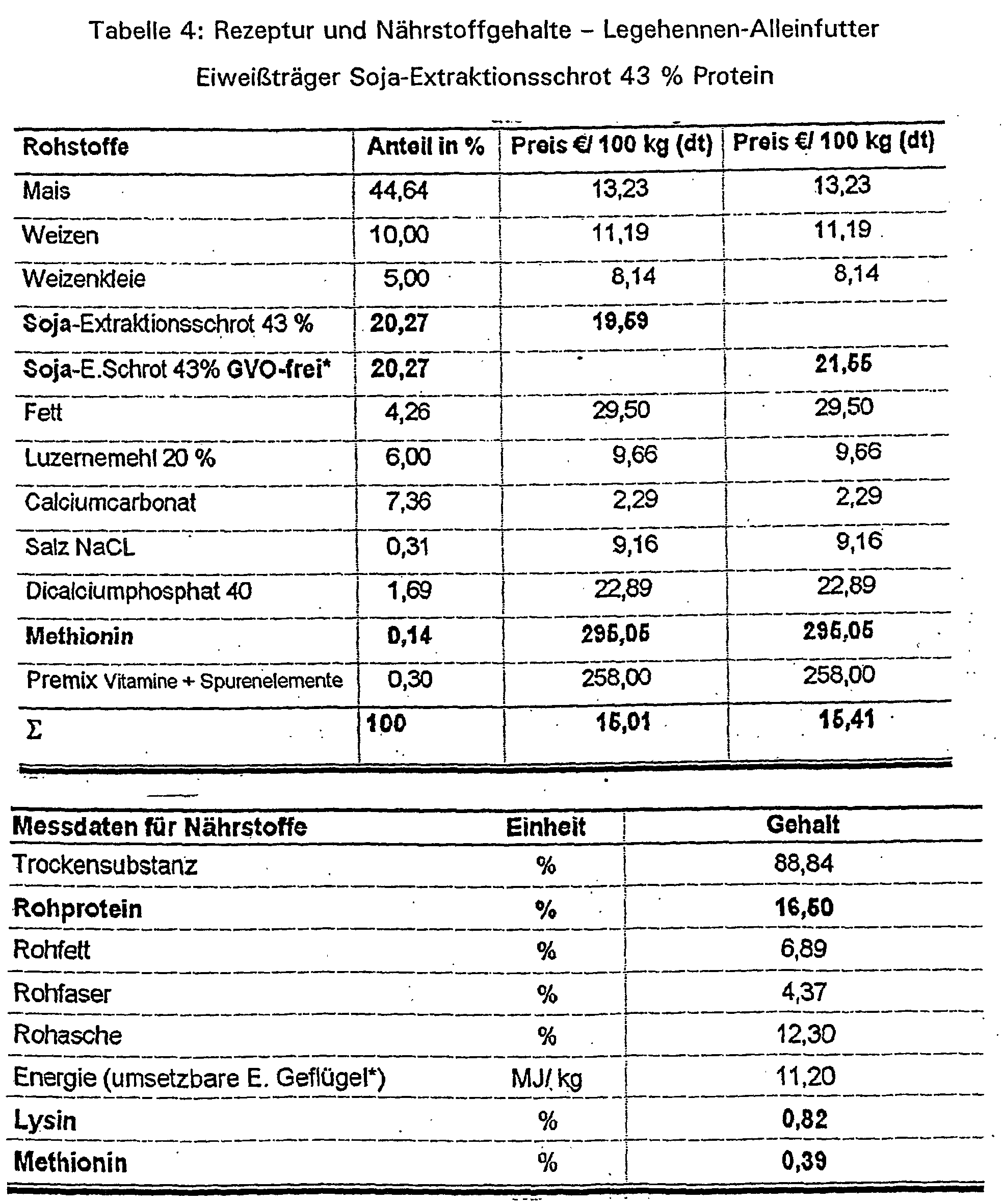
- Model calculations for compound feed German current commodity prices based on.
Landscapes
- Life Sciences & Earth Sciences (AREA)
- Chemical & Material Sciences (AREA)
- Polymers & Plastics (AREA)
- Engineering & Computer Science (AREA)
- Food Science & Technology (AREA)
- Zoology (AREA)
- Animal Husbandry (AREA)
- Molecular Biology (AREA)
- Birds (AREA)
- Botany (AREA)
- Health & Medical Sciences (AREA)
- Mycology (AREA)
- Physiology (AREA)
- Biochemistry (AREA)
- Biotechnology (AREA)
- Fodder In General (AREA)
- Feed For Specific Animals (AREA)
- Combined Means For Separation Of Solids (AREA)
- Apparatuses For Bulk Treatment Of Fruits And Vegetables And Apparatuses For Preparing Feeds (AREA)
- Processing Of Solid Wastes (AREA)
- Extraction Or Liquid Replacement (AREA)
Description
- Rohfasergehalt und Verdaulichkeit/Nährstoffkonzentration
- Proteine nach Menge, Verdaulichkeit und biologischer Wertigkeit
- Fette, Fettsäuren und Wirkstoffe
- Inhaltsstoffe mit anti-nutritiver Wirkung.
| Fettsäuren in % im Öl aus Sonnenblumen-Kernen, ein Vergleich mit Soja- und Raps-Öl | ||||
| Palmitinsäure C 16:0 | Stearinsäure C 18:0 | Ölsäure C18:1w9 | Linolsäure C18:2w6 | |
| Sonnenblume konventionelle Sorten | 4-10 | 2-6 | 10-12 | 33-77 |
| Soja | 2-14 | 2-7 | 20-36 | 48-60 |
| Raps | 1-6 | 1-3 | 11-52 | 10-36 |
| Quelle: H. Jerosch et al. 1993, Henkel KGaA 1997 |
- der hohe ernährungsphysiologische Wert des Öls in Sonnenblumenkernen. Der Gehalt an essentieller Linolsäure (C18:2ω6) liegt deutlich über den entsprechenden Gehalten in Soja und Raps, siehe Tabelle 1.
- Sonnenblumen-Kerne sind praktisch frei von anti-nutritiven Substanzen. Im Gegensatz dazu enthalten Soja und Raps eine Reihe von Wirkstoffen, wie Trypsin-Hemmstoffe (Soja) und Senfölgeycoside / Glucosinolate (Raps, die z.T. sogar toxisch sind. Auf jeden Fall jedoch beeinträchtigen diese Wirkstoffe den Nährwert des Rohstoffs, sofern sie nicht durch eine Hitzebehandlung (Toasten) inaktiviert werden. Falls nicht schonend getoastet wird, werden die Proteine dieser Rohstoffe geschädigt und ihr Nährwert gemindert - in der Praxis ein erhebliches Problem.
- Eine Hitzebehandlung ist bei den Nachprodukten der Sonnenblume nicht erforderlich, was der Eiweiß-Qualität zugute kommt.
- Im Ackerbau - in der Fruchtfolge - ist die Sonnenblume eine wertvolle Vorfrucht, die die Gare des Bodesn und damit die Bodenfruchbarkeit fördert.
| Extraktionsschrote - Rohfaser, Rohnährstoffe und Verdaulichkeitswerte, alle Angaben in % (gerundet), Trockensubstanz ≈ 88 - 90 % | |||||||
| Ölsaat | Gehalte | Organische Substanz Vedaulichkeit = VQ10 | |||||
| Rohfaser | Rohfett | Rohprotein | Wiederkäuer | Schwein | |||
| gemessene Werte | Anforderungen nach Leistung | gemessene Werte | Anforderungen nach Leistung | ||||
| Sojabohne | 6-7 | 20-22 | 35-39 | 92 | 80-50 | 87 | 90-70 |
| Extraktionsschrot unentschälte Saat | 6-7 | 1-2 | 42-45 | 91 | 80-50 | 87 | 90-70 |
| Extraktionsschrot entschälte-Saat | 3-4 | 1-2 | 49-50 | 92 | 80-50 | 92 | 90-70 |
| Schalen | 34 | 2 | 2-12 | 72 | 80-50 | 55 | 90-70 |
| Raps-Saat | 6-14 | 43 | 24 | 77 | 80-50 | 71 | 90-70 |
| Extraktionsschrot | 12-15 | 2 | 35 | 80 | 80-50 | 67 | 90-70 |
| Sonnenblumenkerne | 19-34 | 42-52 | 22-24 | 51 | 80-50 | 62 | 90-70 |
| Extraktionsschrot unentschälte Saat | 30-34 | 2 | 26-29 | 51 | 80-50 | (19) | 90-70 |
| Extraktionsschrot teil-entschälte Saat | 20-22 | 2-2,4 | 34-39 | 75 | 80-50 | 46 | 90-70 |
| Extraktionsschrot entschälte Saat | 13-15 | 1,5 | 40-45 | ||||
| Schalen | 60 | 1 | 4 | 19 | 80-50 |
Sonnenblumensaat hinsichtlich des Methionin und Cystin der Sojabohne überlegen ist,
in Bezug auf Lysin rangiert Sonnenblumensaat hinter Soja und Raps.
| Limitierende essentielle Aminosäuren in Ölsaatschroten Angaben in g/100g Rohprotein (RP) | |||||
| Aminosäure | Soja | Raps | Sonnenblume | ||
| unentschält 44 % RP47 | entschält 50 % RP | unentschält 35 % RP | unentschält 26 % RP | teil-entschält 35 % RP | |
| Lysin | 6,5 | 5,8 | 5,7 | 3,7 | 3,6 |
| Methionin | 1,5 | 1,2 | 2,2 | 1,9 | 2,3 |
| Cystin | 2,4 | 1,6 | 1,8 | ||
| Threonin | 4,0 | 3,7 | 4,5 | 3,9 | 3,7 |
| Tryptophan | 1,3 | 1,3 | 1,3 | 1,4 | 1,2 |
| Quelle: Lennerts, L. 1984, Jerosch H. et al. 1999 |
- Eine Faktion mit niedrigem Schalenanteil und hohem Eiweißgehalt, sie entspricht hinsichtlich der verdaulichen organischen Substanz und der biologischen Wertigkeit der Proteine den Anforderungen für Geflügel und Schweine. Dieses Produkt ist praktisch dem Marktführer Soja-Extraktionsschrot gleichwertig.
- Eine Fraktion mit hohem Schalenanteil und geringerem Eiweißgehalt, dieses Produkt ist für die Ernährung der Wiederkäuer geeignet.
- Zusätzlich werden in einem gesonderten Verfahren die Schalen - an sich ein Abfallprodukt - mit Lauge behandelt, die Gerästsubstanzen werden aufgeschlossen und damit werden auch die Schalen energetisch nutzbar für die Ernährung der Wiederkäuer.
- Bedarfsnormen nach Tierart und Leistungsklasse
- Meßdaten für die Gehalte an Nähr- und Wirkstoffen in den Rohstoffen
- Marktpreise der Rohstoffe
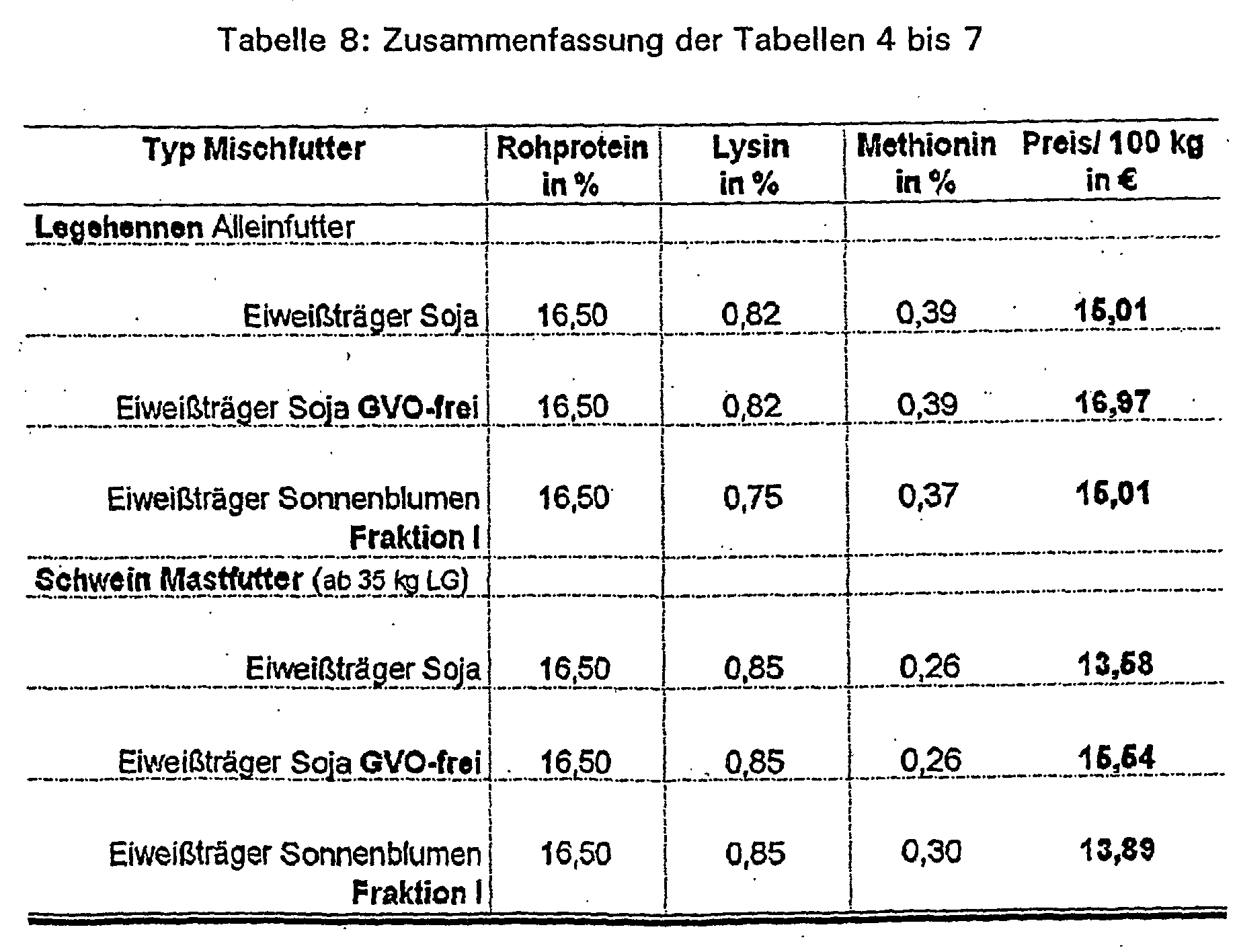
- Die Produkte - Mischfutter für Legehennen und Schweine - sind auf Basis Soja-Extraktionsschrot und Sonnenblumen-Extratktionsschrot Fraktion 1 in ihrer ernährungsphysiologischen Wertigkeit vergleichbar, d.h. die Gehalte an Protein und den limitierenden Aminosäuren liegen bei beiden Eiweißträgern im Bereich der geforderten Normen.
- Sonnenblumen-Extraktionsschrot Fraktion 1 ist - bewertet auf der Basis seiner Nährstoffgehalte - preislich kompetitiv zu handelsüblichen Soja-Extraktionsschrot.
- Sonnenblumen-Extraktionsschrot Fraktion 1 - ein Produkt, das per se GVO-frei ist - ist jedoch wesentlich preiswerter, wenn man zum Vergleich Soja-Extraktionsschrot GVO-frei heranziet.


Claims (23)
- Verfahren zur abfallosen Aufbereitung von Extraktionsschrot aus Sonnenblumensaat von konventionellen Sonnenblumen für die Tierernährung, wobei der Extraktionsschrot Teilchen aus Schalen, Kernteilen und Schalen mit anhaftenden Kernteilen umfaßt, die durch mindestens einmaliges Sieben nach Komgrößen getrennt in zwei Fraktionen mit unterschiedlichen Gehalten an Rohproteinen aufgetrennt werden, wobei eine proteinhaltige Fraktion mit hohem Rohproteingehalt geeignet für Monogastrier als Tiernahrung und eine rohfaserhaltige Fraktion mit niedrigerem Rohproteingehalt geeignet für Wiederkäuer als Tiernahrung erhalten wird, dadurch gekennzeichnet, daß die Teilchen des Extraktionsschrotes einer mechanischen Strukturierung und Zerkleinerung nach mühlentechnischen Verfahren unterworfen werden, wobei die an den Schalen anhaftenden Kernteile abgelöst werden und die Faserstruktur der groben Schalen durch Auffaserung der Schalen verbessert wird, und die Teilchen mittels Sieben nach Korngrößen getrennt werden und aus der erhaltenen Korngrößenfraktion mit den jeweils großvolumigeren Teilchen, welche beim Sieben ein Sieb nicht passiert haben, mittels Windsichten die spezifisch leichten rohfaserhaltigen Teilchen, die im wesentlichen von Schalenteilen (Spelzen) gebildet werden, unter Berücksichtigung ihres spezifischen Gewichtes abgeschieden werden, und die erhaltenen leichten rohfaserhaltigen Teilchen zu einer einen hohen Rohfasergehalt von über 15 % enthaltenden rohfaserhaltigen Fraktion mit niedrigem Rohproteingehalt aufgesammelt werden und die Teilchen mit dem höheren spezifischen Gewicht, die im wesentlichen von den Kernteilchen bzw. Kernteilchen mit anhaftenden Schalen gebildet werden, zu einer einen hohen Rohproteingehalt von über 40 % und einen Rohfasergehalt unter 10 % enthaltenden Fraktion gesammelt werden.
- Verfahren nach Anspruch 1, dadurch gekennzeichnet, daß die Teilchen des Extraktionsschrotes zerkleinert werden, mittels Sieben nach Korngrößen getrennt werden und aus der Korngrößenfraktion mit den jeweils großvolumigeren Teilchen mittels Windsichten die Teilchen unter Berücksichtigung ihres spezifischen Gewichtes getrennt werden, wobei die einzelnen Verfahrensschritte bzw. Verfahrensschrittfolgen mindestens einmal, insbesondere mehrfach wiederholt werden.
- Verfahren nach Anspruch 1 oder 2, dadurch gekennzeichnet, daß die beim Windsichten durch Trennung erhaltenen Teilchen mit dem höheren spezifischen Gewicht, die durch Schwerkraft abgeschieden werden, in den Strukturierungsprozeß zur weiteren Zerkleinerung durch Mahlen und anschließendem Sieben und Windsichten zurückgeführt werden.
- Verfahren nach einem der Ansprüche 1 bis 3, dadurch gekennzeichnet, daß die Abscheidung der leichten rohfaserhaltigen Teilchen aus dem Windsichter nach ihrem spezifischen Gewicht mittels der Luftgeschwindigkeit und Luftdurchgangsmenge stufenlos reguliert wird.
- Verfahren nach einem der Ansprüche 1 bis 4, dadurch gekennzeichnet, daß als rohproteinreiche Fraktion proteinreiches zu griesiger Struktur zerkleinertes Kernmaterial mit geringen Anteilen an Rohfaser (Schalenteilchen) aufgesammelt wird.
- Verfahren nach einem der Ansprüche 1 bis 5, dadurch gekennzeichnet, daß eine rohproteinreiche Fraktion mit einem Anteil an Rohprotein über 40 % und einem Rohfasergehalt unter 10 % erhalten wird, die für die Fütterung von Monogastriern geeignet ist.
- Verfahren nach Anspruch 1, dadurch gekennzeichnet, daß die rohfaserhaltige Fraktion mit einem Anteil an Rohfasern von mindestens 15 % einem Laugen-Aufschließungsverfahren, insbesondere mittels Natronlauge zur Erhöhung des Energiewertes (Verdaulichkeit) unterworfen wird.
- Verfahren nach Anspruch 1, dadurch gekennzeichnet, daß die rohfaserhaltige Fraktion einem zweistufigen Prozeß zum Aufschluß der Rohfaser unterworfen wird, wobei der Aufschluß der Spelzen und Schalenteilchen durch ein Laugen-Aufschlußverfahren in Verbindung und Kombination mit einem Pelletierverfahren verbessert wird, wobei durch Druck, Reibung und Temperaturerhöhung während des Pressens eine Selbsterhitzung in den Pellets entsteht, die die Reaktionszeit des Laugenprozesses wesentlich verkürzt.
- Verfahren nach Anspruch 7 oder 8, dadurch gekennzeichnet, daß die rohfaserhaltige Fraktion in einem Zwei-Stufen-Prozeß aufgeschlossen wird, wobei in der ersten Stufe ein erster Materialstrom aus der Fraktion mit flüssiger Natronlauge benetzt und gemischt wird und anschließend mit einem zweiten Materialstrom aus der Fraktion intensiv vermischt und homogenisiert wird und danach, ggf. nach Zwischenlagerung, in einer zweiten Stufe, das aufbereitete Gemisch einem Konditionierer mit zusätzlicher Dampfzufuhr zwecks Temperierung und Feuchtigkeitssteigerung des Gemisches zugeführt und anschließend in einer Presse bei einer Preßtemperatur von etwa 40 bis 65°C zu Pellets verpreßt wird und die erhaltenen Pellets anschließend unter annäherndem Feuchtigkeitserhalt auf Raumtemperatur abgekühlt werden.
- Anlage zum kontinuierlichen Durchführen des Verfahrens nach einem der Ansprüche 1 bis 9, umfassend einen Vorratsbehälter (1) mit Dosierschnecke (2) für die gleichmäßige mengenregutierbare Austragung des Extraktionsschrotes in eine Vorrichtung (29) zum Auflösen von Klumpen und zum feinen Zerteilen des Extraktionsschrotes, und nachfolgend mindestens zwei aufeinanderfolgende Kombinationen aus einer Siebvorrichtung (5, 6, 7, 8), einem Windsichter (9, 10, 11, 12) und einem Ventilator (13, 15, 17, 19) mit Abscheider (14, 16, 18, 20) mit Austragsschleuse (14a, 16a, 18a, 20a), wobei jede Siebvorrichtung mit dem zugeordneten Windsichter für den Transport der großvolumigen, das Sieb nicht passierenden Teilchen und mit der nachfolgenden Siebvorrichtung für den Abtransport der das Sieb passierenden kleinervolumigen Teilchen mittels Verbindungsleitungen (5a, 6a, 7a, 8a bzw. 5b, 6b, 7b, 8b). verbunden ist und mindestens die zweite und jede folgende Siebvorrichtung (6, 7,8) zusätzlich eine im Inneren angeordnete bewegbare Schlagvorrichtung (6e, 7e, 8e) aufweist und jeder Windsichter (9, 10, 11, 12) mit einem zugeordneten Ventilator (13, 15, 17, 19) und Abscheider (14, 16, 18, 20) über eine Absaugleitung (9b, 10b, 11b, 12b) für das Absaugen der großvolumigen spezifisch leichten rohfaserhaltigen Teilchen verbunden ist und die abgesaugten leichten Teilchen über die Austragsschleuse (14a, 16a, 18a, 20a) und Verbindungsleitungen (14b, 16b, 18b, 20b) einem Sammelbehälter (31) für das Sammeln zu der rohfaserhaltigen Fraktion zuführbar sind, und ein Turboabscheider (21) vorgesehen ist, von dem eine Verbindungsleitung (21d) zu dem Sammelbehälter (31) führt, und die Abluftleitungen (14c, 16c, 18c, 20c) der Ventilatoren (13, 15, 17, 19) zu dem Turboabscheider (21) führen, des weiteren von dem Ausgang (9a, 10a, 11a) jedes Windsichters (9, 10, 11) ausgenommen des letzten Windsichters (12), eine Verbindungsleitung (9c, 10c, 11c) zu einer gemeinsamen Zerkleinerungsvorrichtung (22 bis 25) für die mit Kernteilen behafteten rohproteinhaltigen Teilchen führt, wobei der Ausgang (8b) der letzten Siebvorrichtung (8) und der Ausgang (12a) des letzten Windsichters (12) über einen Zweiwege-Klappenkasten (26d) Verbindungsleitungen (12d bzw. 12c) zu dem Sammelbehälter (50) für die proteinhaltige Fraktion bzw. Sammelbehälter (31) für die rohfaserhaltige Fraktion aufweisen und der Ausgang (24a) der Zerkleinerungsvorrichtung (22 bis 25) mit dem Eingang der ersten Siebvorrichtung (5) über eine Fördervorrichtung (3) verbunden ist.
- Anlage nach Anspruch 10, dadurch gekennzeichnet, daß sie ein geschlossenes System bildet und kontinuierlich betreibbar ist, und die Teilchen mittels Fördervorrichtungen bzw. in Rohren von einer Station zur nächsten gefördert werden.
- Anlage nach einem der Ansprüche 10 oder 11, dadurch gekennzeichnet, daß die Vorrichtung (29) zum Auflösen von Klumpen des Extraktionsschrotes mit Passierwerkzeugen und einem Siebeinsatz ausgestattet ist.
- Anlage nach einem der Ansprüche 10 bis 12, dadurch gekennzeichnet, daß die erste Siebvorrichtung (5) zwei Siebeinlagen aufweist, wobei die erste Siebeinlage die groben Teilchen zurückhält, die direkt der Zerkleinerungsanlage (22 bis 25) zuführbar sind und die zweite Siebeinlage einen weiteren Anteil größervolumiger Teilchen zurückhält, die dem ersten Windsichter (9) zugeführt werden, in dem eine Trennung nach spezifischem Gewicht vorgenommen wird, wobei die spezifisch leichten Teilchen, insbesondere die rohfaserhaltigen Schalenteilchen von dem nachfolgenden Ventilator (13) und Abscheider (14) in die Verbindungsleitung (9b) angesaugt werden und über die Austragsschleuse (14a) und Verbindungsleitung (14b) dem Sammelbehälter (31) für die rohfaserhaltige Fraktion zugeführt werden.
- Anlage nach einem der Ansprüche 10 bis 13, dadurch gekennzeichnet, daß die Windsichter (9, 10, 11, 12) jeweils mit einer Vibrationsrinne (9g, 10g, 11g, 12g) für die von der Siebvorrichtung kommenden Teilchen ausgestattet sind, sowie eine Luftklappe (9h, 10h, 11h, 12h) zum Regeln der Luftmenge und Absaugleistung zwecks Absaugung der spezifisch leichteren Teile, insbesondere der Schalenteile (Spelzen) aus der Vibrationsrinne, wobei die in der Vibrationsrinne verbleibenden Teilchen unter Schwerkraft ausgetragen und über die Verbindungsleitungen (9c, 10c, 11c) wiederum der Zerkleinerungsvorrichtung (22 bis 25) zuführbar sind.
- Anlage nach Anspruch 14, dadurch gekennzeichnet, daß die Trenngrenze basierend auf den spezifischen Gewichten der Teilchen, die auf die Vibrationsrinne des Windsichters gelangen mittels Regelung der Absaugleistung einstellbar ist.
- Anlage nach einem der Ansprüche 10 bis 15, dadurch gekennzeichnet, daß der Turboabscheider (21), der die Abluft aus den Windsichtem und Ventilatoren/Abscheidern über die Abluftleitungen absaugt, ein schneckenförmiges Gehäuse mit Hauptgang aufweist, und über einen Spalt im Hauptgang ein Nachabscheider für in der Abluft mitgeführte leichte rohfaserhaltige Teilchen angeschlossen ist, die über eine Abfuhrleitung (21d) zu dem Sammelbehälter (31) führt.
- Anlage nach einem der Ansprüche 10 bis 16, dadurch gekennzeichnet, daß die der ersten Siebvorrichtung (5) nachfolgenden Siebmaschinen (6 bis 8) einen konischen Siebkorb aufweisen, innerhalb dessen ein rotierendes Schlagkreuz (6e, 7e, 8e) mit Wirbelleisten und Bürsten am Umfang angeordnet ist.
- Anlage nach einem der Ansprüche 10 bis 17, dadurch gekennzeichnet, daß als Zerkleinerungsvorrichtung eine Mühle (24) mit mehreren Prallplatten und variabler Rotorumfangsgeschwindigkeit vorgesehen ist, um die Kemteile von den Schalenteilen zu trennen und zu zerkleinern und ein rieselfähiges Produkt zu erhalten.
- Anlage nach einem der Ansprüche 10 bis 18, dadurch gekennzeichnet, daß am Ausgang (10a, 11a, 12a) der Windsichter (10, 11, 12) je eine Klappe (26b, 26c, 26d) vorgesehen ist, um den Ausgang wahlweise mit der Anschlußleitung (10c, 11c, 12c) für die weitere Behandlung bzw. einer Anschlußleitung (10d, 11d, 12d) zum Sammelbehälter (50) für die proteinhaltige Fraktion zu verbinden.
- Anlage nach einem der Ansprüche 10 bis 19, dadurch gekennzeichnet, daß dem Sammelbehälter (31) für die rohfaserhaltige Fraktion eine Aufbereitungsanlage (33 bis 40) zum Aufschließen der rohfaserhaltigen Fraktion mittels Natronlauge nachgeordnet ist, die einen Vorratsbehälter (34) mit ausgangsseitiger regelbarer Dosierschnecke (35) und Durchlaufwaage (36) für einen Wirbelmischer (37) umfaßt, der mit einer regelbaren Dosiervorrichtung (39, 40) mit Sprüheinrichtung für die Natronlauge verbunden ist.
- Anlage nach Anspruch 20, dadurch gekennzeichnet, daß ausgangsseitig des Wirbelmischers für die Fraktion wahlweise über einen Klappkasten (52a) eine Verbindungsleitung zu einem Verweilsilo (43) oder einer Pelletierpressanlage (46 bis 49) mit Einfüllbehälter (46) förderbar ist, wobei vom Verweilsilo (43) ebenfalls eine weitere Förderleitung zu der Preßvorrichtung (46 bis 49) vorgesehen ist.
- Anlage nach Anspruch 21, dadurch gekennzeichnet, daß die Pelletieranlage einen Konditionierer (48) umfaßt, in welchen die Fraktion aus dem Einlaufbehälter (46) über eine Dosierschnecke (47) geregelt einbringbar ist, wobei der Konditionierer (48) des weiteren mit einer Dampfdosiereinrichtung (53) mit vorgegebener Temperaturautomatik verbunden ist und eine Pelletierpresse mit Ringmatrize vorgesehen ist, die von dem Konditionierer gespeist wird und der Pelletierpresse nachgeordnet eine Kühleinrichtung zur schonenden Abkühlung der Pellets nachgeordnet ist.
- Anlage nach einem der Ansprüche 10 bis 22, dadurch gekennzeichnet, daß ein kontinuierlicher vollautomatischer Betrieb der Anlage mittels des eingangsseitigen Vorratsbehälters (1) für den Extraktionsschrot, Sammelbehälter (31) für die rohfaserhaltige Fraktion, Verweilsilos (43) für die rohfaserhaltige Fraktion, sowie vorratshaltende Einlaufbehälter (22) für die Zerkleinerungsanlage, Einlaufbehälter (34) für den Wirbelmischer und Einlaufbehälter (46) für die Pelletieranlage sowie angetriebene und regelbare Fördereinrichtungen einschließlich Meßeinrichtungen für die Füllstände der Materialien enthaltenden Behälter vorgesehen ist.
Priority Applications (2)
| Application Number | Priority Date | Filing Date | Title |
|---|---|---|---|
| SI200230090T SI1372409T1 (en) | 2001-04-06 | 2002-03-30 | Method and system for preparing extraction meal from sun flower seeds for animal feed |
| DK02732540T DK1372409T3 (da) | 2001-04-06 | 2002-03-30 | Fremgangsmåde og system til oparbejdning af ekstraktionsgrovmel af solsikkekerner til dyrefoder |
Applications Claiming Priority (3)
| Application Number | Priority Date | Filing Date | Title |
|---|---|---|---|
| DE10117421A DE10117421B4 (de) | 2001-04-06 | 2001-04-06 | Verfahren und Anlage zur Aufbereitung von Extraktionsschrot aus Sonnenblumensaat für die Tierernährung |
| DE10117421 | 2001-04-06 | ||
| PCT/EP2002/003565 WO2002080699A2 (de) | 2001-04-06 | 2002-03-30 | Verfahren und anlage zur aufbereitung von extraktionsschrot aus sonnenblumensaat für die tierernährung |
Publications (2)
| Publication Number | Publication Date |
|---|---|
| EP1372409A2 EP1372409A2 (de) | 2004-01-02 |
| EP1372409B1 true EP1372409B1 (de) | 2005-02-02 |
Family
ID=7680787
Family Applications (1)
| Application Number | Title | Priority Date | Filing Date |
|---|---|---|---|
| EP02732540A Expired - Lifetime EP1372409B1 (de) | 2001-04-06 | 2002-03-30 | Verfahren und anlage zur aufbereitung von extraktionsschrot aus sonnenblumensaat für die tierernährung |
Country Status (26)
| Country | Link |
|---|---|
| US (1) | US20040146628A1 (de) |
| EP (1) | EP1372409B1 (de) |
| JP (1) | JP2004524042A (de) |
| CN (1) | CN100361596C (de) |
| AT (1) | ATE288205T1 (de) |
| AU (1) | AU2002304796B9 (de) |
| BG (1) | BG64933B1 (de) |
| BR (1) | BR0208864B1 (de) |
| CA (1) | CA2443073C (de) |
| CZ (1) | CZ296608B6 (de) |
| DE (2) | DE10117421B4 (de) |
| ES (1) | ES2237680T3 (de) |
| HR (1) | HRP20030896B1 (de) |
| HU (1) | HU226356B1 (de) |
| MD (1) | MD3221C2 (de) |
| ME (1) | MEP9809A (de) |
| MX (1) | MXPA03009045A (de) |
| NO (1) | NO322574B1 (de) |
| PL (1) | PL195825B1 (de) |
| PT (1) | PT1372409E (de) |
| RU (1) | RU2297155C2 (de) |
| SK (1) | SK285055B6 (de) |
| UA (1) | UA75645C2 (de) |
| WO (1) | WO2002080699A2 (de) |
| YU (1) | YU76603A (de) |
| ZA (1) | ZA200308043B (de) |
Cited By (3)
| Publication number | Priority date | Publication date | Assignee | Title |
|---|---|---|---|---|
| DE102009032931A1 (de) | 2009-02-18 | 2010-12-02 | Ulrich Walter | Verfahren und Anlage zur abfalllosen Aufbereitung von Extrationsschrot aus Sonnenblumensaat |
| DE102010018220A1 (de) | 2010-04-23 | 2011-10-27 | Erhard Bazak | Aufbereitung von Sonnenblumen-Extraktionsschrot |
| WO2014037564A1 (de) | 2012-09-07 | 2014-03-13 | Bühler AG | Verfahren und vorrichtung zum auftrennen von partikeln aus sonnenblumen-extraktionsschrot in mindestens eine fraktion mit einem hohen proteingehalt und in mindestens eine fraktion mit einem hohen zellulosegehalt |
Families Citing this family (27)
| Publication number | Priority date | Publication date | Assignee | Title |
|---|---|---|---|---|
| DE102004055792A1 (de) * | 2004-11-18 | 2006-05-24 | Bühler AG | Verfahren zur Herstellung von Futtermitteln |
| EP1908355A1 (de) * | 2006-10-03 | 2008-04-09 | Cargill Incorporated | Verringerung des Fasergehalts von Fasernhaltigen Ölsamen |
| JP3970917B1 (ja) | 2007-01-24 | 2007-09-05 | 株式会社J−オイルミルズ | 菜種ミールの製造方法 |
| RU2445780C1 (ru) * | 2010-11-18 | 2012-03-27 | Федеральное государственное унитарное предприятие "Всероссийский научно-исследовательский институт рыбного хозяйства и океанографии" (ФГУП "ВНИРО") | Способ получения пищевых волокон из водорослевого сырья |
| CA2823704A1 (en) * | 2011-01-17 | 2012-07-26 | Patz Corporation | Improved mixing screw |
| DE102011116564A1 (de) * | 2011-10-21 | 2013-04-25 | Erhard Bazak | Verfahren und Anlage zur Aufbereitung von Sonnenblumen-Extraktionsschrot |
| RU2712748C2 (ru) * | 2013-05-02 | 2020-01-30 | Карджилл, Инкорпорейтед | Обогащение белками |
| EP2848128A1 (de) * | 2013-09-13 | 2015-03-18 | Bunge Global Innovation, LLC. | Verfahren zur Herstellung einer proteinreichen Sonnenblumenmehlfraktion |
| US20160143346A1 (en) * | 2013-11-27 | 2016-05-26 | Mississipi State University | Fiber separation from grains and grain products using electrostatic methods |
| DE102013021294A1 (de) * | 2013-12-19 | 2015-06-25 | Kramerbräu Agro & Food GmbH | Verfahren und Anlage zur Gewinnung von pflanzlichem Protein, insbesondere als proteinreiches Nahrungsmittel, sowie proteinreiches Nahrungsmittel |
| RU2558446C1 (ru) * | 2014-05-13 | 2015-08-10 | Федеральное государственное бюджетное образовательное учреждение высшего профессионального образования "Воронежский государственный университет инженерных технологий" | Линия производства псевдокапсулированных биопрепаратов на основе отходов масложировой промышленности |
| RU2565294C1 (ru) * | 2014-06-26 | 2015-10-20 | Федеральное государственное бюджетное научное учреждение "Дальневосточный научно-исследовательский институт механизации и электрификации сельского хозяйства" ФГБНУ ДальНИИМЭСХ | Способ приемки очесанного зернобобового вороха, домолота и очистки с выделением кормовой, семенной и товарной фракций зерна сои и устройство для его осуществления |
| RU2602841C2 (ru) * | 2015-01-28 | 2016-11-20 | Общество с ограниченной ответственностью "Раздолье - Лизинг" | Способ получения высокобелковых растительных продуктов, преимущественно крупки, из шрота/жмыха подсолнечника и устройство для его осуществления |
| FR3035566B1 (fr) * | 2015-04-30 | 2018-10-05 | Terrena | Procede et installation de traitement d'un tourteau issu de la trituration de graines d'oleagineux, pour son enrichissement en proteines |
| WO2016196617A1 (en) * | 2015-06-03 | 2016-12-08 | Cargill, Incorporated | Oilseed meal |
| RU2617597C2 (ru) * | 2015-09-28 | 2017-04-25 | Васько Виталий Викторович | Способ доработки подсолнечного шрота и установка для его осуществления |
| RU2655214C1 (ru) * | 2017-04-21 | 2018-05-24 | Федеральное государственное бюджетное научное учреждение Федеральный научный агроинженерный центр ВИМ (ФГБНУ ФНАЦ ВИМ) | Способ и устройство трёхстадийного измельчения, смешивания малоценного растительного сырья и пищевых отходов для приготовления высокопитательных кормовых добавок |
| US10645950B2 (en) | 2017-05-01 | 2020-05-12 | Usarium Inc. | Methods of manufacturing products from material comprising oilcake, compositions produced from materials comprising processed oilcake, and systems for processing oilcake |
| WO2020028446A1 (en) * | 2018-08-01 | 2020-02-06 | Usarium Inc. | Upcycling solid food wastes and by-products into food-grade nutritional products |
| RU2715629C1 (ru) * | 2019-01-09 | 2020-03-02 | Общество с ограниченной ответственностью "Рубин" (ООО "Рубин") | Способ получения кормового продукта из отходов очистки семян подсолнечника |
| CN109874999B (zh) * | 2019-03-22 | 2024-05-07 | 新疆海瑞盛生物工程股份有限公司 | 同步提取蛋白质和膳食纤维的葡萄籽粉、制备及专用装置 |
| RU2737164C1 (ru) * | 2019-11-12 | 2020-11-25 | Общество с ограниченной ответственностью Научно-производственное объединение "РОСТ" | Установка для получения корма для животных на основе лузги подсолнечника |
| RU2744047C1 (ru) * | 2020-02-21 | 2021-03-02 | Владимир Моисеевич Ковшарь | Способ переработки шрота подсолнечника |
| RU2760742C1 (ru) * | 2021-02-18 | 2021-11-30 | Федеральное государственное бюджетное образовательное учреждение высшего образования "Московский государственный университет пищевых производств" | Способ переработки шрота подсолнечника для комбикормовой промышленности |
| TR2021008705A2 (tr) * | 2021-05-26 | 2021-09-21 | Balsu Gida Sanayi Ve Ticaret Anonim Sirketi | Kali̇brasyon ve kirma özelli̇kleri̇ i̇yi̇leşti̇ri̇lmi̇ş bi̇r findik i̇şleme tesi̇si̇ |
| US11839225B2 (en) | 2021-07-14 | 2023-12-12 | Usarium Inc. | Method for manufacturing alternative meat from liquid spent brewers' yeast |
| EP4762939A1 (de) * | 2024-12-23 | 2026-06-24 | Viktor Bazylchuk | Verfahren zur herstellung eines extraktionsschroterzeugnisses und extraktionsschroterzeugnis |
Family Cites Families (20)
| Publication number | Priority date | Publication date | Assignee | Title |
|---|---|---|---|---|
| US3271160A (en) * | 1963-05-27 | 1966-09-06 | Pacific Vegets Le Oil Corp | Process for preparing feed from undecorticated oil free safflower seed residue |
| US3281160A (en) * | 1964-10-22 | 1966-10-25 | Lawrence W Vinther | Trailer jack |
| US3895003A (en) * | 1971-06-25 | 1975-07-15 | Procter & Gamble | Process for producing protein concentrate using air classification |
| US3783435A (en) * | 1971-12-23 | 1974-01-01 | Illinois Tool Works | Light socket device |
| DE2842259C2 (de) * | 1978-09-28 | 1984-03-08 | Kurt Prof. Dr.-Ing. Leschonski | Verfahren und Sortieranlage zur trockenen Sortierung eines körnigen Gemisches aus Feststoffkomponenten |
| JPS5820486U (ja) * | 1981-07-31 | 1983-02-08 | 株式会社村田製作所 | ランプ保護装置 |
| ATE21206T1 (de) * | 1981-08-11 | 1986-08-15 | Unilever Nv | Erzeugung von nahrungsmittel aus huelsenfruechten. |
| US4548449A (en) * | 1983-12-30 | 1985-10-22 | Corsetti John A | Lamp socket attachment |
| US4759943A (en) * | 1985-08-23 | 1988-07-26 | Holly Farms Poultry Industries, Inc. | Classification of food meals made from animal by-products |
| DD249917A1 (de) * | 1986-06-11 | 1987-09-23 | Thaelmann Schwermaschbau Veb | Verfahren zur aufbereitung fettreicher oelsamen |
| DE4034739C2 (de) * | 1990-10-30 | 1997-02-06 | Thaelmann Schwermaschbau Veb | Anlage zum Schälen und zur Schalenseparation von Ölsaaten und Verfahren zum Betreiben einer Schäl- und Schalenseparationsanlage für Ölsaaten |
| DE4034738A1 (de) * | 1990-10-30 | 1992-05-07 | Thaelmann Schwermaschbau Veb | Verfahren und anordnung zur aufbereitung von sonnenblumensamen durch schaelung fuer die nachfolgende oelgewinnung |
| US5176532A (en) * | 1991-06-25 | 1993-01-05 | Illinois Tool Works Inc. | Threaded receptacle method and device |
| US6077546A (en) * | 1995-06-26 | 2000-06-20 | Kabushiki Kaisha Hayashibara Seibutsu | Quick-fermented feed and method of preparing |
| US5722853A (en) * | 1996-03-12 | 1998-03-03 | Hwang; Min Shien | C-type bulb socket having a draining feature |
| US5823322A (en) * | 1996-03-18 | 1998-10-20 | Johnson; Bates | Snapin instantly wired one piece thermo plastic lamp socket |
| US6033248A (en) * | 1997-09-11 | 2000-03-07 | Lyons; Herb | Light bulb socket structure |
| DK0919294T3 (da) * | 1997-11-27 | 2000-08-28 | Hosokawa Alpine Ag & Co | Fremgangsmåde til proteinberigelse af cerealier, især korn og bælgfrugter |
| DE19909078A1 (de) * | 1999-03-02 | 2000-09-07 | Kahl Amandus Maschf | Verfahren zur hydrothermischen Behandlung von Futtermitteln für Milchkühe und Mastrinder |
| EP1078581A1 (de) * | 1999-08-27 | 2001-02-28 | Dr. Frische GmbH | Verfahren und Vorrichtung zum Schälen von Ölsaatsamen, insbesondere Sonnenblumensamen |
-
2001
- 2001-04-06 DE DE10117421A patent/DE10117421B4/de not_active Expired - Fee Related
-
2002
- 2002-03-30 ES ES02732540T patent/ES2237680T3/es not_active Expired - Lifetime
- 2002-03-30 JP JP2002578747A patent/JP2004524042A/ja active Pending
- 2002-03-30 US US10/474,144 patent/US20040146628A1/en not_active Abandoned
- 2002-03-30 MX MXPA03009045A patent/MXPA03009045A/es active IP Right Grant
- 2002-03-30 DE DE50202169T patent/DE50202169D1/de not_active Expired - Lifetime
- 2002-03-30 AU AU2002304796A patent/AU2002304796B9/en not_active Ceased
- 2002-03-30 MD MDA20030263A patent/MD3221C2/ro not_active IP Right Cessation
- 2002-03-30 PL PL02366695A patent/PL195825B1/pl not_active IP Right Cessation
- 2002-03-30 BR BRPI0208864-9B1A patent/BR0208864B1/pt not_active IP Right Cessation
- 2002-03-30 YU YU76603A patent/YU76603A/sh unknown
- 2002-03-30 WO PCT/EP2002/003565 patent/WO2002080699A2/de not_active Ceased
- 2002-03-30 UA UA20031110000A patent/UA75645C2/uk unknown
- 2002-03-30 SK SK1358-2003A patent/SK285055B6/sk not_active IP Right Cessation
- 2002-03-30 EP EP02732540A patent/EP1372409B1/de not_active Expired - Lifetime
- 2002-03-30 AT AT02732540T patent/ATE288205T1/de active
- 2002-03-30 CN CNB028112385A patent/CN100361596C/zh not_active Expired - Fee Related
- 2002-03-30 CZ CZ20032859A patent/CZ296608B6/cs not_active IP Right Cessation
- 2002-03-30 CA CA002443073A patent/CA2443073C/en not_active Expired - Fee Related
- 2002-03-30 PT PT02732540T patent/PT1372409E/pt unknown
- 2002-03-30 ME MEP-98/09A patent/MEP9809A/xx unknown
- 2002-03-30 RU RU2003132463/13A patent/RU2297155C2/ru not_active IP Right Cessation
- 2002-03-30 HU HU0400286A patent/HU226356B1/hu not_active IP Right Cessation
- 2002-03-30 HR HR20030896A patent/HRP20030896B1/xx not_active IP Right Cessation
-
2003
- 2003-10-06 NO NO20034467A patent/NO322574B1/no not_active IP Right Cessation
- 2003-10-16 ZA ZA200308043A patent/ZA200308043B/en unknown
- 2003-10-30 BG BG108304A patent/BG64933B1/bg unknown
Cited By (5)
| Publication number | Priority date | Publication date | Assignee | Title |
|---|---|---|---|---|
| DE102009032931A1 (de) | 2009-02-18 | 2010-12-02 | Ulrich Walter | Verfahren und Anlage zur abfalllosen Aufbereitung von Extrationsschrot aus Sonnenblumensaat |
| DE102010018220A1 (de) | 2010-04-23 | 2011-10-27 | Erhard Bazak | Aufbereitung von Sonnenblumen-Extraktionsschrot |
| WO2011131218A1 (de) | 2010-04-23 | 2011-10-27 | Erhard Bazak | "aufbereitung von sonnenblumen-extraktionsschrot" |
| EP2560503B1 (de) * | 2010-04-23 | 2023-12-13 | HiProSUN High Protein SunFlower Extraction Meal GmbH | Verfahren und anlage zur aufbereitung von sonnenblumen-extraktionsschrot |
| WO2014037564A1 (de) | 2012-09-07 | 2014-03-13 | Bühler AG | Verfahren und vorrichtung zum auftrennen von partikeln aus sonnenblumen-extraktionsschrot in mindestens eine fraktion mit einem hohen proteingehalt und in mindestens eine fraktion mit einem hohen zellulosegehalt |
Also Published As
Similar Documents
| Publication | Publication Date | Title |
|---|---|---|
| DE10117421B4 (de) | Verfahren und Anlage zur Aufbereitung von Extraktionsschrot aus Sonnenblumensaat für die Tierernährung | |
| CN106071888B (zh) | 一种全脂膨化大豆生产装置及生产工艺 | |
| US20020018842A1 (en) | Method and system for producing pelletized fuzzy cottonseed with cotton fibers replacing lint within the cottonseed | |
| DE10016407C2 (de) | Verfahren und Vorrichtung zur Ernte und Aufbereitung von Fruchtständen und Restpflanzen zu Silagefutter | |
| DE102020005146A1 (de) | Verfahren zur Gewinnung von Insektenmehl und Einrichtung hierfür | |
| DE102011114232A1 (de) | Verfahren und Anlage zur Verwertung von Biomasse | |
| US6322845B1 (en) | Method for producing pelletized fuzzy cottonseed | |
| EP0555792B1 (de) | Verfahren und Vorrichtung zum Herstellen eines Düngemittels aus Traubentrester | |
| EP0082366B1 (de) | Verfahren und Vorrichtung zur Herstellung von Futtermittel durch Nasseinlagerung in einem Silo | |
| DE69605632T2 (de) | Konserviertes Futter/Lebensmittel, Verfahren zu seiner Herstellung und dessen Verwendung | |
| DE19936492A1 (de) | Kaltgepresstes Traubenkernöl | |
| CN220277541U (zh) | 一种虾养殖用饲料分类装置 | |
| EP0613870A1 (de) | Verfahren für die Wiederverwertung von wasserhaltigem pflanzlichem Material | |
| EP0613721A2 (de) | Verfahren und dessen Anwendung sowie Vorrichtung zum Zerkleinern und Aufbereiten von Recycling-Produkten | |
| CN108813694A (zh) | 一种饲料加工用制粒设备 | |
| CN108607640A (zh) | 一种用于饲料加工的分级筛选装置 | |
| CN205436264U (zh) | 饲料分级装置 | |
| AT18594U1 (de) | Maisspindelsammel- und -trennvorrichtung | |
| RU52309U1 (ru) | Линия производства комбикормов с использованием отходов пищевой промышленности | |
| Falgate | Cotton seed and its uses | |
| HU225456B1 (en) | Process and converting equipment for treating extracted grist for increasing its value | |
| DE102016113504A1 (de) | Verfahren zur Herstellung von Karottenmehl und dessen Verwendung | |
| DE2711097A1 (de) | Verfahren und vorrichtung zur aufbereitung von getreide zur herstellung eines brauerei-extraktstoffes | |
| DD143853A1 (de) | Trennung des koerneranteils von getrocknetem getreideganzpflanzenhaecksel |
Legal Events
| Date | Code | Title | Description |
|---|---|---|---|
| PUAI | Public reference made under article 153(3) epc to a published international application that has entered the european phase |
Free format text: ORIGINAL CODE: 0009012 |
|
| 17P | Request for examination filed |
Effective date: 20031002 |
|
| AK | Designated contracting states |
Kind code of ref document: A2 Designated state(s): AT BE CH CY DE DK ES FI FR GB GR IE IT LI LU MC NL PT SE TR |
|
| AX | Request for extension of the european patent |
Extension state: AL LT LV MK RO SI |
|
| 17Q | First examination report despatched |
Effective date: 20031204 |
|
| GRAP | Despatch of communication of intention to grant a patent |
Free format text: ORIGINAL CODE: EPIDOSNIGR1 |
|
| GRAS | Grant fee paid |
Free format text: ORIGINAL CODE: EPIDOSNIGR3 |
|
| GRAA | (expected) grant |
Free format text: ORIGINAL CODE: 0009210 |
|
| AK | Designated contracting states |
Kind code of ref document: B1 Designated state(s): AT BE CH CY DE DK ES FI FR GB GR IE IT LI LU MC NL PT SE TR |
|
| AX | Request for extension of the european patent |
Extension state: MK RO SI |
|
| REG | Reference to a national code |
Ref country code: GB Ref legal event code: FG4D Free format text: NOT ENGLISH |
|
| REG | Reference to a national code |
Ref country code: CH Ref legal event code: EP |
|
| REG | Reference to a national code |
Ref country code: IE Ref legal event code: FG4D Free format text: GERMAN |
|
| REF | Corresponds to: |
Ref document number: 50202169 Country of ref document: DE Date of ref document: 20050310 Kind code of ref document: P |
|
| PG25 | Lapsed in a contracting state [announced via postgrant information from national office to epo] |
Ref country code: LU Free format text: LAPSE BECAUSE OF NON-PAYMENT OF DUE FEES Effective date: 20050330 |
|
| PG25 | Lapsed in a contracting state [announced via postgrant information from national office to epo] |
Ref country code: MC Free format text: LAPSE BECAUSE OF NON-PAYMENT OF DUE FEES Effective date: 20050331 |
|
| GBT | Gb: translation of ep patent filed (gb section 77(6)(a)/1977) |
Effective date: 20050421 |
|
| REG | Reference to a national code |
Ref country code: GR Ref legal event code: EP Ref document number: 20050401147 Country of ref document: GR |
|
| REG | Reference to a national code |
Ref country code: SE Ref legal event code: TRGR |
|
| REG | Reference to a national code |
Ref country code: DK Ref legal event code: T3 |
|
| REG | Reference to a national code |
Ref country code: PT Ref legal event code: SC4A Free format text: AVAILABILITY OF NATIONAL TRANSLATION Effective date: 20050420 |
|
| REG | Reference to a national code |
Ref country code: ES Ref legal event code: FG2A Ref document number: 2237680 Country of ref document: ES Kind code of ref document: T3 |
|
| PLBE | No opposition filed within time limit |
Free format text: ORIGINAL CODE: 0009261 |
|
| STAA | Information on the status of an ep patent application or granted ep patent |
Free format text: STATUS: NO OPPOSITION FILED WITHIN TIME LIMIT |
|
| ET | Fr: translation filed | ||
| 26N | No opposition filed |
Effective date: 20051103 |
|
| PGFP | Annual fee paid to national office [announced via postgrant information from national office to epo] |
Ref country code: DK Payment date: 20110331 Year of fee payment: 10 |
|
| PGFP | Annual fee paid to national office [announced via postgrant information from national office to epo] |
Ref country code: CH Payment date: 20110331 Year of fee payment: 10 |
|
| PGFP | Annual fee paid to national office [announced via postgrant information from national office to epo] |
Ref country code: GB Payment date: 20120920 Year of fee payment: 11 Ref country code: IE Payment date: 20120918 Year of fee payment: 11 Ref country code: FI Payment date: 20120919 Year of fee payment: 11 Ref country code: SE Payment date: 20120920 Year of fee payment: 11 |
|
| PGFP | Annual fee paid to national office [announced via postgrant information from national office to epo] |
Ref country code: GR Payment date: 20120927 Year of fee payment: 11 Ref country code: TR Payment date: 20120921 Year of fee payment: 11 |
|
| PGFP | Annual fee paid to national office [announced via postgrant information from national office to epo] |
Ref country code: IT Payment date: 20120926 Year of fee payment: 11 Ref country code: ES Payment date: 20120924 Year of fee payment: 11 |
|
| PGFP | Annual fee paid to national office [announced via postgrant information from national office to epo] |
Ref country code: NL Payment date: 20120920 Year of fee payment: 11 Ref country code: BE Payment date: 20120919 Year of fee payment: 11 Ref country code: FR Payment date: 20121008 Year of fee payment: 11 Ref country code: CY Payment date: 20120920 Year of fee payment: 11 Ref country code: PT Payment date: 20120330 Year of fee payment: 11 |
|
| PGFP | Annual fee paid to national office [announced via postgrant information from national office to epo] |
Ref country code: AT Payment date: 20120919 Year of fee payment: 11 |
|
| BERE | Be: lapsed |
Owner name: *WALTER ULRICH Effective date: 20130331 |
|
| REG | Reference to a national code |
Ref country code: PT Ref legal event code: MM4A Free format text: LAPSE DUE TO NON-PAYMENT OF FEES Effective date: 20130930 |
|
| REG | Reference to a national code |
Ref country code: NL Ref legal event code: V1 Effective date: 20131001 |
|
| REG | Reference to a national code |
Ref country code: DK Ref legal event code: EBP |
|
| REG | Reference to a national code |
Ref country code: SE Ref legal event code: EUG |
|
| PG25 | Lapsed in a contracting state [announced via postgrant information from national office to epo] |
Ref country code: PT Free format text: LAPSE BECAUSE OF NON-PAYMENT OF DUE FEES Effective date: 20130930 Ref country code: FI Free format text: LAPSE BECAUSE OF NON-PAYMENT OF DUE FEES Effective date: 20130330 Ref country code: SE Free format text: LAPSE BECAUSE OF NON-PAYMENT OF DUE FEES Effective date: 20130331 |
|
| PGFP | Annual fee paid to national office [announced via postgrant information from national office to epo] |
Ref country code: DE Payment date: 20130930 Year of fee payment: 12 |
|
| REG | Reference to a national code |
Ref country code: CH Ref legal event code: PL |
|
| REG | Reference to a national code |
Ref country code: AT Ref legal event code: MM01 Ref document number: 288205 Country of ref document: AT Kind code of ref document: T Effective date: 20130330 |
|
| REG | Reference to a national code |
Ref country code: GR Ref legal event code: ML Ref document number: 20050401147 Country of ref document: GR Effective date: 20131002 |
|
| GBPC | Gb: european patent ceased through non-payment of renewal fee |
Effective date: 20130330 |
|
| PG25 | Lapsed in a contracting state [announced via postgrant information from national office to epo] |
Ref country code: CY Free format text: LAPSE BECAUSE OF NON-PAYMENT OF DUE FEES Effective date: 20130330 |
|
| REG | Reference to a national code |
Ref country code: FR Ref legal event code: ST Effective date: 20131129 |
|
| REG | Reference to a national code |
Ref country code: SI Ref legal event code: KO00 Effective date: 20131108 |
|
| REG | Reference to a national code |
Ref country code: IE Ref legal event code: MM4A |
|
| PG25 | Lapsed in a contracting state [announced via postgrant information from national office to epo] |
Ref country code: GB Free format text: LAPSE BECAUSE OF NON-PAYMENT OF DUE FEES Effective date: 20130330 Ref country code: AT Free format text: LAPSE BECAUSE OF NON-PAYMENT OF DUE FEES Effective date: 20130330 Ref country code: BE Free format text: LAPSE BECAUSE OF NON-PAYMENT OF DUE FEES Effective date: 20130331 Ref country code: IE Free format text: LAPSE BECAUSE OF NON-PAYMENT OF DUE FEES Effective date: 20130330 Ref country code: LI Free format text: LAPSE BECAUSE OF NON-PAYMENT OF DUE FEES Effective date: 20130331 Ref country code: CH Free format text: LAPSE BECAUSE OF NON-PAYMENT OF DUE FEES Effective date: 20130331 Ref country code: FR Free format text: LAPSE BECAUSE OF NON-PAYMENT OF DUE FEES Effective date: 20130402 |
|
| PG25 | Lapsed in a contracting state [announced via postgrant information from national office to epo] |
Ref country code: IT Free format text: LAPSE BECAUSE OF NON-PAYMENT OF DUE FEES Effective date: 20130330 Ref country code: GR Free format text: LAPSE BECAUSE OF NON-PAYMENT OF DUE FEES Effective date: 20131002 Ref country code: TR Free format text: LAPSE BECAUSE OF NON-PAYMENT OF DUE FEES Effective date: 20130330 Ref country code: NL Free format text: LAPSE BECAUSE OF NON-PAYMENT OF DUE FEES Effective date: 20131001 |
|
| PG25 | Lapsed in a contracting state [announced via postgrant information from national office to epo] |
Ref country code: DK Free format text: LAPSE BECAUSE OF NON-PAYMENT OF DUE FEES Effective date: 20130331 |
|
| REG | Reference to a national code |
Ref country code: ES Ref legal event code: FD2A Effective date: 20140606 |
|
| PG25 | Lapsed in a contracting state [announced via postgrant information from national office to epo] |
Ref country code: ES Free format text: LAPSE BECAUSE OF NON-PAYMENT OF DUE FEES Effective date: 20130331 |
|
| REG | Reference to a national code |
Ref country code: DE Ref legal event code: R119 Ref document number: 50202169 Country of ref document: DE |
|
| REG | Reference to a national code |
Ref country code: DE Ref legal event code: R119 Ref document number: 50202169 Country of ref document: DE Effective date: 20141001 |
|
| PG25 | Lapsed in a contracting state [announced via postgrant information from national office to epo] |
Ref country code: DE Free format text: LAPSE BECAUSE OF NON-PAYMENT OF DUE FEES Effective date: 20141001 |