EP1313729B1 - Design and synthesis of thiophene derived nlo materials for electro-optic applications - Google Patents
Design and synthesis of thiophene derived nlo materials for electro-optic applications Download PDFInfo
- Publication number
- EP1313729B1 EP1313729B1 EP01965981A EP01965981A EP1313729B1 EP 1313729 B1 EP1313729 B1 EP 1313729B1 EP 01965981 A EP01965981 A EP 01965981A EP 01965981 A EP01965981 A EP 01965981A EP 1313729 B1 EP1313729 B1 EP 1313729B1
- Authority
- EP
- European Patent Office
- Prior art keywords
- chromophore
- aryl
- alkyl
- heteroalkyl
- composition
- Prior art date
- Legal status (The legal status is an assumption and is not a legal conclusion. Google has not performed a legal analysis and makes no representation as to the accuracy of the status listed.)
- Expired - Lifetime
Links
- 0 CC(C(*)(*)IC1=C(C#N)N)=C1C#N Chemical compound CC(C(*)(*)IC1=C(C#N)N)=C1C#N 0.000 description 25
- CYIFWRDILVUZKT-AFDLXORESA-N C/C=C1\SC(C=[IH])=C(CI)/C1=C(/C)\C#N Chemical compound C/C=C1\SC(C=[IH])=C(CI)/C1=C(/C)\C#N CYIFWRDILVUZKT-AFDLXORESA-N 0.000 description 1
- BDINBSUUIUWFNH-UHFFFAOYSA-N CC(C)(C1)C(C)=CC1=O Chemical compound CC(C)(C1)C(C)=CC1=O BDINBSUUIUWFNH-UHFFFAOYSA-N 0.000 description 1
- ASOSVCXGWPDUGN-UHFFFAOYSA-N CC1OC(C)=CC1=O Chemical compound CC1OC(C)=CC1=O ASOSVCXGWPDUGN-UHFFFAOYSA-N 0.000 description 1
Images











Classifications
-
- C—CHEMISTRY; METALLURGY
- C07—ORGANIC CHEMISTRY
- C07D—HETEROCYCLIC COMPOUNDS
- C07D409/00—Heterocyclic compounds containing two or more hetero rings, at least one ring having sulfur atoms as the only ring hetero atoms
- C07D409/02—Heterocyclic compounds containing two or more hetero rings, at least one ring having sulfur atoms as the only ring hetero atoms containing two hetero rings
- C07D409/06—Heterocyclic compounds containing two or more hetero rings, at least one ring having sulfur atoms as the only ring hetero atoms containing two hetero rings linked by a carbon chain containing only aliphatic carbon atoms
-
- C—CHEMISTRY; METALLURGY
- C07—ORGANIC CHEMISTRY
- C07D—HETEROCYCLIC COMPOUNDS
- C07D307/00—Heterocyclic compounds containing five-membered rings having one oxygen atom as the only ring hetero atom
- C07D307/02—Heterocyclic compounds containing five-membered rings having one oxygen atom as the only ring hetero atom not condensed with other rings
- C07D307/34—Heterocyclic compounds containing five-membered rings having one oxygen atom as the only ring hetero atom not condensed with other rings having two or three double bonds between ring members or between ring members and non-ring members
- C07D307/56—Heterocyclic compounds containing five-membered rings having one oxygen atom as the only ring hetero atom not condensed with other rings having two or three double bonds between ring members or between ring members and non-ring members with hetero atoms or with carbon atoms having three bonds to hetero atoms with at the most one bond to halogen, e.g. ester or nitrile radicals, directly attached to ring carbon atoms
- C07D307/68—Carbon atoms having three bonds to hetero atoms with at the most one bond to halogen
-
- C—CHEMISTRY; METALLURGY
- C07—ORGANIC CHEMISTRY
- C07D—HETEROCYCLIC COMPOUNDS
- C07D333/00—Heterocyclic compounds containing five-membered rings having one sulfur atom as the only ring hetero atom
- C07D333/02—Heterocyclic compounds containing five-membered rings having one sulfur atom as the only ring hetero atom not condensed with other rings
- C07D333/04—Heterocyclic compounds containing five-membered rings having one sulfur atom as the only ring hetero atom not condensed with other rings not substituted on the ring sulphur atom
- C07D333/26—Heterocyclic compounds containing five-membered rings having one sulfur atom as the only ring hetero atom not condensed with other rings not substituted on the ring sulphur atom with hetero atoms or with carbon atoms having three bonds to hetero atoms with at the most one bond to halogen, e.g. ester or nitrile radicals, directly attached to ring carbon atoms
- C07D333/38—Carbon atoms having three bonds to hetero atoms with at the most one bond to halogen, e.g. ester or nitrile radicals
-
- C—CHEMISTRY; METALLURGY
- C07—ORGANIC CHEMISTRY
- C07D—HETEROCYCLIC COMPOUNDS
- C07D405/00—Heterocyclic compounds containing both one or more hetero rings having oxygen atoms as the only ring hetero atoms, and one or more rings having nitrogen as the only ring hetero atom
- C07D405/02—Heterocyclic compounds containing both one or more hetero rings having oxygen atoms as the only ring hetero atoms, and one or more rings having nitrogen as the only ring hetero atom containing two hetero rings
- C07D405/06—Heterocyclic compounds containing both one or more hetero rings having oxygen atoms as the only ring hetero atoms, and one or more rings having nitrogen as the only ring hetero atom containing two hetero rings linked by a carbon chain containing only aliphatic carbon atoms
-
- C—CHEMISTRY; METALLURGY
- C07—ORGANIC CHEMISTRY
- C07D—HETEROCYCLIC COMPOUNDS
- C07D405/00—Heterocyclic compounds containing both one or more hetero rings having oxygen atoms as the only ring hetero atoms, and one or more rings having nitrogen as the only ring hetero atom
- C07D405/14—Heterocyclic compounds containing both one or more hetero rings having oxygen atoms as the only ring hetero atoms, and one or more rings having nitrogen as the only ring hetero atom containing three or more hetero rings
-
- C—CHEMISTRY; METALLURGY
- C07—ORGANIC CHEMISTRY
- C07D—HETEROCYCLIC COMPOUNDS
- C07D409/00—Heterocyclic compounds containing two or more hetero rings, at least one ring having sulfur atoms as the only ring hetero atoms
- C07D409/14—Heterocyclic compounds containing two or more hetero rings, at least one ring having sulfur atoms as the only ring hetero atoms containing three or more hetero rings
-
- C—CHEMISTRY; METALLURGY
- C07—ORGANIC CHEMISTRY
- C07D—HETEROCYCLIC COMPOUNDS
- C07D495/00—Heterocyclic compounds containing in the condensed system at least one hetero ring having sulfur atoms as the only ring hetero atoms
- C07D495/02—Heterocyclic compounds containing in the condensed system at least one hetero ring having sulfur atoms as the only ring hetero atoms in which the condensed system contains two hetero rings
- C07D495/04—Ortho-condensed systems
-
- C—CHEMISTRY; METALLURGY
- C07—ORGANIC CHEMISTRY
- C07D—HETEROCYCLIC COMPOUNDS
- C07D495/00—Heterocyclic compounds containing in the condensed system at least one hetero ring having sulfur atoms as the only ring hetero atoms
- C07D495/12—Heterocyclic compounds containing in the condensed system at least one hetero ring having sulfur atoms as the only ring hetero atoms in which the condensed system contains three hetero rings
- C07D495/14—Ortho-condensed systems
-
- G—PHYSICS
- G02—OPTICS
- G02F—OPTICAL DEVICES OR ARRANGEMENTS FOR THE CONTROL OF LIGHT BY MODIFICATION OF THE OPTICAL PROPERTIES OF THE MEDIA OF THE ELEMENTS INVOLVED THEREIN; NON-LINEAR OPTICS; FREQUENCY-CHANGING OF LIGHT; OPTICAL LOGIC ELEMENTS; OPTICAL ANALOGUE/DIGITAL CONVERTERS
- G02F1/00—Devices or arrangements for the control of the intensity, colour, phase, polarisation or direction of light arriving from an independent light source, e.g. switching, gating or modulating; Non-linear optics
- G02F1/35—Non-linear optics
- G02F1/355—Non-linear optics characterised by the materials used
- G02F1/361—Organic materials
- G02F1/3613—Organic materials containing Sulfur
- G02F1/3614—Heterocycles having S as heteroatom
Definitions
- the field of invention is design, synthesis, use, and devices based on advanced nonlinear optical (NLO) materials.
- NLO nonlinear optical
- chromophores demonstrating nonlinear optical (NLO) properties and the uses thereof, including waveguides incorporating the chromophores and the preparation thereof, and the development of organic polymeric matrices to contain the chromophores, and optical devices incorporating the chromophores/waveguides as well as methods of preparing same, are active areas of research. Disclosures related to these areas have appeared in numerous Patents including the following recently issued U.S.
- the present invention is directed to fulfilling this need and providing uses, devices, and communication systems based on non-linear optically active chromophores.
- chromophores comprise of novel electron acceptors (A), novel electron donors (D), and/or novel conjugated bridges ( ⁇ ).
- the chromophores have non-linear optical properties, i.e ., are NLO chromophores.
- a thiophene-containing chromophore has the structure wherein, independently at each occurrence, D is an electron donating group having low electron affinity relative to the electron affinity of A; ⁇ 1 is a bridge that provides electronic conjugation between D and the thiophene ring; ⁇ 2 is a bridge that provides electronic conjugation between A and the thiophene ring; A is an electron accepting group having high electron affinity relative to the electron affinity of D; X is O or S; R is alkyl, aryl, heteroalkyl or heteroaryl; and n is 1, 2, 3 or 4.
- D groups that are incorporated into a chromophore include, without limitation, D groups of the following structures, wherein, independently at each occurrence, R is alkyl, aryl or heteroalkyl; R 1 is hydrogen, alkyl, aryl or heteroalkyl; Y is O, S or Se; m is 2, 3 or 4; p is 0, 1 or 2; and q is 0 or 1.
- R contains 1-12 carbons; R 1 is hydrogen or contains 1-12 carbons; Y is O or S; m is 2, 3 or 4; p is 0, 1 or 2; and q is 0 or 1.
- Some preferred D groups that may be present in a chromophore according to the present invention are of the structures:
- R 1 is hydrogen, alkyl, aryl or heteroalkyl
- p is 0, 1 or 2
- o is 0, 1 or 2
- o + p is at least 1
- q is 0 or 1.
- Some specific A groups that are incorporated into chromophores according to the present invention are: and wherein, independently at each occurrence, R is alkyl, aryl or heteroalkyl; R 1 is hydrogen, alkyl, aryl or heteroalkyl; Y is O, S or Se; and q is 0 or 1.
- R contains 1-12 carbons; R 1 is hydrogen or contains 1-12 carbons; Y is O or S; and q is 0 or 1.
- a specifically preferred A group is of the formula
- R is alkyl, and/or aryl, and/or heteroalkyl, and/or heteroaryl, including each and every combination thereof.
- R is hydrophobic, while alternatively R is hydrophilic.
- an R group is saturated, while alternatively an R group is unsaturated.
- the R group may have, in various aspects of the invention, 1-6 carbons, or 7-12 carbons, or 13-22 carbons.
- n may be 1, or 2, or 3, or 4, or each and every combination thereof, e.g., 2 or 3.
- X is O, while in another aspect X is S.
- ⁇ 1 and ⁇ 2 are and A is wherein R is independently at each occurrence alkyl, aryl or heteroalkyl.
- a thiophene-containing chromophore has of the structure wherein, independently at each occurrence, D is selected from the group consisting of ⁇ 1 and ⁇ 2 are independently
- D is selected from: and ⁇ is selected from: and
- a chromophore has the structure wherein, independently at each occurrence, R is alkyl, aryl or heteroalkyl; R 1 is alkyl, aryl or heteroalkyl; and X is O or S.
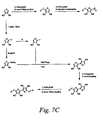
- a chromophore (not necessarily according to the invention) is made by any of the processes illustrated in any of the Figures 4A, 4B, 5A, 6A, 7C, 8A, 9A, 10A, 11A, 12A, 13A, 14A, 15A, 16A, 17, 19, 20, 20,21, 22, 23, 24, and 25.
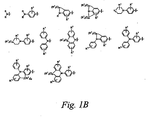
- Chromophores or components thereof are provided as shown in any of the Figures 1A, 1B, 2A, 2B, 3A, 3B, 4A, 4B, 4C, 5A, 5B, 6A, 6B, 7A, 7B, 7C, 8A, 8B, 9A, 9B, 10A, 10B, 11A, 11B, 12A, 12B, 13A, 13B, 14A, 14B, 15A, 15B, 16A, 16B, 17, 19, 20, 21, 22, 23, 24, and 25.
- L may represent a thermally crosslinkable trifluorovinylether group.
- at least one of D, ⁇ , or A of the chromophore is covalently bound to a polymer.
- D, ⁇ , or A is further substituted with halogen, alkyl, aryl, or heteroalkyl.
- the chromophore may be non-covalently incorporated into a crosslinkable polymer matrix, or the chromophore may be covalently incorporated into a crosslinked polymer matrix.
- a process can comprise sequentially 1) incorporating a chromophore according to the present invention as described herein, into a polymer matrix; 2) maintaining the polymer matrix at a selected temperature to allow effective chromophore mobility; and 3) applying an electric field sufficient to induce an effective amount of dipole alignment of the chromophore in the polymer matrix.
- a further optional step includes heating the composition to a selected temperature sufficient to affect crosslinking.
- the chromophores according to the present invention may be incorporated into many useful devices, e.g., electro-optic devices, waveguides, optical switches, optical modulators, optical couplers, optical router, and generally into communications systems. These devices, or other devices containing chromophores according to the present invention may be used in a method of data transmission wherein light is transmitted through a composition of matter comprising a chromophore according to the present invention.
- the present invention provides, in one aspect, a method of telecommunication comprising transmitting light through a composition of matter comprising a chromophore according to the present invention.
- Such transmission may be accomplished, according to the inventive methods, by directing light through or via a composition of matter comprising a chromophore according to the present invention.
- embodiments of the present invention provide, in one aspect, a method of routing light through an optical system comprising transmitting light through or via a composition of matter comprising a chromophore according to the present invention.
- an interferometric optical modulator or switch comprises a modulator or switch incorporating an electrooptic polymer or dendrimer.
- the modulator or switch includes 1) an input waveguide; 2) an output waveguide; 3) a first leg having a first end and a second end, the first leg being coupled to the input waveguide at the first end and to the output waveguide at the second end; and 4) a second leg having a first end and a second end, the second leg being coupled to the input waveguide at the first end and to the output waveguide at the second end, wherein at least one of the first and second legs comprises a composition of matter comprising a chromophore according to the present invention.
- the modulator or switch may further comprise an electrode positioned to produce an electric field across the first or second waveguide. While the exemplified modulator or switch is based on a Mach-Zender type of structure, other modulator or switch structures, such as Y-branch structures, evanescent coupling structures, or controlled loss structures, may be within the scope of the invention.
- an optical router comprises a plurality of switches, wherein each switch comprises: 1) an input; 2) an output; 3) a first waveguide extending between the input and the output; and 4) a second waveguide aligned to the first waveguide and positioned for evanescent coupling to the first waveguide; wherein at least one of the first and second waveguides comprises a chromophore according to the present invention.
- the plurality of switches is arranged in an array of rows and columns.
- a group refers to one or more of such groups
- a chromophore includes a particular chromophore as well as other family members and equivalents thereof as known to those skilled in the art.
- the two X groups may be O and O, or O and S, or S and O, or S and S, within a repeating unit, and the selection within one repeating unit is not dependent or related to the selection in a second or third, etc. repeating unit.
- "independently at each occurrence" means that what X represents at any one occurrence is completely independent of what X represents at any other occurrence, so long as X represents an atom or moiety within the definition of what may represent.
- this phrase is meant to indicate that every symbol used in connection with the structure, or within any substructure contained within a structure or substructure, is selected without regard to the selection of the same symbol or a different symbol at any other occurrence of a symbol within that structure or a substructure thereof.
- a ring may be shown having a line (the bisecting line) drawn across one of the lines that form the ring, where the bisecting line is connected to a symbol.
- the following phenol structure has a bisecting line connected to the symbol R.
- the symbol may be bonded to any atom that forms the ring, if that atom is not otherwise shown to be bonded to any particular non-hydrogen substituent.
- the R group may be bonded to as many as five carbons, as shown in the following structure. However, it is not necessary that an R group replace each hydrogen on the ring.
- the R group need not replace any of the hydrogen atoms, or an R group may replace one, or two, or three, or four, or five of the hydrogens, limited only by the total number of hydrogens bonded to the ring atoms.
- the phenolic structure shown above "wherein R independently at each occurrence is methyl or hydrogen" would correspond to phenol as wells as several methyl substituted phenols including 2-methyl phenol, 3-methyl phenol, 3,4-dimethylphenol, 2,4,6-trimethylphenol, etc.
- Chrophore refers to any molecule, aggregate of molecules, or macromolecular structure that absorbs light. Thus, a chromophore can mean a single molecule that absorbs light, an aggregate or macromolecule containing only one absorbing molecule, or an aggregate or macromolecule containing more than one absorbing molecule.
- Electro-optic pertains to having optical properties of a material alterable by an electric field.
- Electrode pertains to electrons in a molecule or on an atom.
- Electrode pertains to electricity and electrical phenomena arising from applied voltages or other signals.
- Temporal stability refers to long-term retention of a particular property. Temporal stability may be affected by any factor that modifies changes in either intermolecular order or intramolecular chemical structure.
- a donor (represented in chemical structures by "D” or “D n " where n is an integer) is an atom or group of atoms that has a low oxidation potential, wherein the atom or group of atoms can donate electrons to an acceptor "A" through a ⁇ -bridge.
- the donor (D) has a lower electron affinity that does the acceptor (A), so that the chromophore is generally polarized, with relatively less electron density on the donor (D).
- a donor group contains at least one heteroatom that has a lone pair of electrons capable of being in conjugation with the p-orbitals of an atom directly attached to the heteroatom such that a resonance structure can be drawn that moves the lone pair of electrons into a bond with the p-orbital of the atom directly attached to the heteroatom to formally increase the multiplicity of the bond between the heteroatom and the atom directly attached to the heteroatom (i.e ., a single bond is formally converted to double bond, or a double bond is formally converted to a triple bond) so that the heteroatom gains formal positive charge.
- the p-orbitals of the atom directly attached to the heteroatom may be vacant or part of a multiple bond to another atom other than the heteroatom.
- the heteroatom may be a substituent of an atom that has pi bonds or may be in a heterocyclic ring.
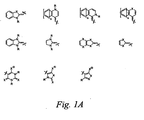
- Exemplary donor groups include but are not limited to R 2 N-, RX- and the structures shown in Figure 1A, where R is alkyl (as defined herein), aryl (as defined herein), and heteroaryl (as defined herein), X is O, S, Se, or Te, and n is 1 or 2.
- R is alkyl, aryl or heteroalkyl
- R 1 is hydrogen, alkyl, aryl or heteroalkyl
- Y is O, S or Se
- m is 2, 3 or 4
- p is 0, 1 or 2
- q is 0 or 1; wherein each of alkyl, aryl and heteroaryl is defined herein.
- the total number of heteroatoms and carbons in a donor group is typically about 30 ( i.e. , five and six membered heterocycles and amine substituted phenyls) and the donor group can be substituted further with alkyl (as defined herein), aryl (as defined herein), and heteroaryl (as defined herein).
- the "donor” and “acceptor” terminology is well known and understood in the art of the present invention. See, e.g., U.S. Pat. Nos. 5,670,091, 5,679,763, and 6,090,332.
- An acceptor (represented in chemical structures by "A” or “A n " where n is an integer) is an atom or group of atoms that has a low reduction potential, wherein the atom or group of atoms can accept electrons from a donor through a ⁇ -bridge.
- the acceptor (A) has a higher electron affinity that does the donor (D), so that the chromophore is generally polarized, with relatively more electron density on the acceptor (D).
- an acceptor group contains at least one electronegative heteroatom that is part of a pi bond (a double or triple bond) such that a resonance structure can be drawn that moves an electron pair of the pi bond to the heteroatom and concomitantly decreases the multiplicity of the pi bond (i.e ., a double bond is formally converted to single bond or a triple bond is formally converted to a double bond) so that the heteroatom gains formal negative charge.
- the heteroatom may be part of a heterocyclic ring.
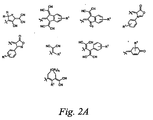
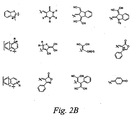
- acceptor groups include but are not limited to -NO 2 , -CN, -CHO, COR, CO 2 R, -PO(OR) 3 , -SOR, -SO 2 R, -SO 3 R and the structures shown in Figure 2A where R is alkyl (as defined herein), aryl (as defined herein), and heteroaryl (as defined herein), X is O, S, Se, or Te, and n is 1 or 2. Additional exemplary acceptor structures are shown in Figure 2B wherein, independently at each occurrence, R is alkyl, aryl or heteroalkyl; R 1 is hydrogen, alkyl, aryl or heteroalkyl; Y is O, S or Se; and q is 0 or 1.
- acceptors are illustrated in Figures 4A, 4B, 4C, 5A, 5B, 6A, 6B, 7A, 7B, 7C, 8A, 8B, 9A, 9B, 10A, 10B, 11A, 11B, 12A, 12B, 13A, 13B, 14A, 14B, 15A, 15B, 16A, 16B, 19, 20, 21, 22, 23, 24, and/or 25.
- the total number of heteroatoms and carbons in an acceptor group is typically about 30 (i.e., five and six membered heterocycles and dicyanovinylenes) and the acceptor group can be substituted further with alkyl (as defined herein), aryl (as defined herein), and heteroaryl (as defined herein).
- the "donor” and "acceptor” terminology is well known and understood in the art of the present invention. See, e.g., U.S. Pat. Nos. 5,670,091, 5,679,763, and 6,090,332.
- a " ⁇ -bridge” or “electronically conjugated bridge” (represented in chemical structures by “ ⁇ ” or “ ⁇ n " where n is an integer) is comprised of an atom or group of atoms through which electrons can be delocalized from an electron donor (defined below) to an electron acceptor (defined below) through the orbitals of atoms in the bridge.
- Such groups are very well known in the art.
- the orbitals will be p-orbitals on double (sp 2 ) or triple (sp) bonded carbon atoms such as those found in alkenes, alkynes, neutral or charged aromatic rings, and neutral or charged heteroaromatic ring systems.
- the orbitals can be p-orbitals on atoms such as boron or nitrogen.
- the orbitals may be p, d or f organometallic orbitals or hybrid organometallic orbitals.
- the atoms of the bridge that contain the orbitals through which the electrons are delocalized are referred to here as the "critical atoms.”
- the number of critical atoms in a bridge can be a number from 1 to about 30.
- the critical atoms may be substituted with any organic or inorganic group.
- the substituent may be selected with a view to improving the solubility of the chromophore in a polymer matrix, to enhancing the stability of the chromophore, or to any other purpose.
- alkyl defined below
- aryl defined below
- heteroalkyl defined below
- substituents of critical atoms in the bridge may be bonded to atoms in other alkyl (defined below), aryl (defined below), or heteroalkyl (defined below) substituents to form one or more rings.
- Donor coupling or " ⁇ bridge and/or donor coupling” refers to the synthetic chemical step or steps that achieves covalent attachment of a first chemical group containing a donor to a second selected chemical structure.
- the step may be divided into multiple steps, wherein the first step covalently attaches a ⁇ bridge that is also reactive and the second step covalently attaches a donor group.
- the coupling involves either reacting a n bridge or donor group containing a carbonyl with a selected chemical structure containing at least one acidic proton, or reacting a ⁇ bridge or donor group containing at least one acid proton with a selected chemical structure containing a reactive carbonyl group.
- Suitable donor coupling reactions are well known to those of ordinary skill in the art.
- Acceptor coupling or " ⁇ bridge and/or acceptor coupling” refers to the synthetic chemical step or steps of covalently attaching a first chemical group containing an acceptor to a second selected chemical structure.
- the step maybe divided into multiple steps, wherein the first step covalently attaches a ⁇ bridge that is also reactive and the second step covalently attaches an acceptor group.
- the coupling involves either reacting a ⁇ bridge or acceptor group containing a carbonyl with a selected chemical structure containing at least one acidic proton or reacting a ⁇ bridge or acceptor group containing at least one acid proton with a selected chemical structure containing a reactive carbonyl group.
- Suitable acceptor coupling reactions are well known to those of ordinary skill in the art.
- a dendron is a branched substituent that has regularly repeating subunits.
- a dendrimer is a macromolecular structure that contains a "core" surrounded by one or more dendrons. Often in the art, the terms dendron and dendrimer are used interchangeably.
- One or more dendrons may be attached to a chromophore according to the present invention.
- R or "R n " where n is an integer refers to a substituent on an atom or a group of atoms ( e.g. , a ring). Unless otherwise specifically assigned, -R represents any single atom or any one of the substituent groups defined below. When there is more than one -R in a molecule, the "-R” may independently at each occurrence refer to a single atom or any one of the substituent groups defined below.
- a given substituent group can have a total number of carbons atoms ranging from 1 to about 200:
- an NLO chromophore (also known as a "push-pull" chromophore) comprises three fundamental building blocks represented by the general formula D- ⁇ -A.
- the D- ⁇ -A arrangement is critical to achieve large second order NLO effects, and the molecular figure of merit for NLO molecules, which is the first molecular electronic hyperpolarizability ( ⁇ , sometimes given as ⁇ , where ⁇ is the dipole moment of the chromophore), can be tuned and optimized by changing the electronic properties of any one of D, ⁇ , or A, see Gorman and Marder Proc. Natl. Acad Sci, USA 1993, 90, 11297.
- Molecular NLO effects can be translated into bulk EO activity in a material by aligning molecules in one direction by applying an electric field.
- any one of D, ⁇ , or A can be derivatized with groups that do not significantly alter the electronic properties of the chromophore.
- Such derivatization may be important, for example, in order either to translate high molecular ⁇ into high EO activity of the bulk material or to increase temporal stability related to relaxation of the aligned dipoles, see Dalton et al., J. Mater. Chem. 1999, 9, 1905-1920.
- a high ⁇ chromophore can be derivatized to, for example: modify its solubility in a polymer matrix; allow its covalent attachment to other molecules or polymers; and spatially hinder intermolecular interactions with other chromophores.
- the chromophores according to the present invention may include chemical groups that impart steric bulk and/or solubility properties that enhance performance and/or processing into a matrix.
- EO electro-optic
- chromophores are comprised of new electron donor groups (D), new ⁇ -bridges or substructures thereof ( ⁇ ), and /or new electron acceptor groups (A).
- chromophores incorporate chemical groups that modify the properties of the chromophores.
- the chromophores according to the present invention may incorporate a group that enhances the solubility of the chromophore in a matrix, particularly a polymeric matrix.
- the chromophore may incorporate a group that imparts certain desirable steric demands to the chromophore.
- the chromophores may include a substituent group that affects the spatial relationship of a chromophore to another chromophore. Desirably, the substituent group will impede a chromophore from getting too close to another chromophore; such substituent groups are typically bulky alkyl or heteroalkyl groups. Dendrons are preferred bulky substituent groups, and can be incorporated into any chromophore that includes an aliphatic or aromatic alcohol functional group, see U.S. Patent No. 5,041,516.
- chromophore there are other functional groups that may be included in a chromophore and that can be utilized to covalently attach dendrons to the chromophore, where such functional groups include amines, carboxylic acids, alkyl bromides, isocyantes, and isothiocyantes. Separating the chromophores from one another can reduce intermolecular electrostatic interaction between the chromophores, consequently reducing optical loss arising from light scattering, and also increase the poling efficiencies.
- the chromophores have been designed to modify the number of active hydrogens adjacent to the chromophore donor, acceptor, and/or ⁇ -bridge (e.g., allylic and benzylic hydrogens).
- Active hydrogens provide reactive sites for photochemical processes and are desirably eliminated from chromophores. Not only are those sites prone to radical attack, but they also can easily generate radicals upon exposure to light irradiation.
- allylic hydrogen(s) can participate in an "ene” reaction with singlet oxygen, see Nicholas J. Turro, Modern Molecular Photochemistry, University Science Books, Mill Valley, Ca, 1991.
- the chromophores incorporate five membered-rings that restrict the torsional freedom of donors and acceptors with respect to ⁇ -bridges.
- five-membered rings rather than six-membered rings, are desirably incorporated into chromophores to provide better p-orbital overlap over an extended conjugation system.
- Six membered polyenes such as isophorone have structural conformations that can lead to somewhat twisted ⁇ -conjugation.
- chromophores incorporate bulky side groups such as adamantane. Positioning such bulky groups on bridges can create quasi-spherical molecular structures, which can highly reduce chromophore-chromophore electrostatic interactions.
- bulky side groups such as adamantane.
- Positioning such bulky groups on bridges can create quasi-spherical molecular structures, which can highly reduce chromophore-chromophore electrostatic interactions.
- dendrons can be readily incorporated onto donors, acceptors, and ⁇ -bridges, making NLO dendrimers.
- chromophores have reduced absorption within the 750-800 nm region for application at 1300 nm and 1550 nm.
- Conventional electron acceptors have multiple electron withdrawing groups (such as 3 CN groups on FTC acceptor) that exert both inductive and resonant effect on electron density delocalization of chromophore.
- One or more (but typically not all) of those groups can be substituted by with a CF 3 group that only has an inductive effect.
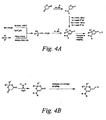
- Chromophores according to formula D1 may be prepared as outlined in Figures 4A and 4B using reactions that are known to those skilled in the art, see Tet. Lett. 1987,28,1857; J. Am. Chem. Soc. 1986, 108, 800; J. Org. Chem. 1987,52, 2378; Chem. Hetero. Comp. (NY) 2000, 35(10), 1150; Synthesis 1977, 12, 869; Mendeleev Comm. 2001, 1, 17; and Tet. Lett. 1988, 29(13), 1489.
- chromophores of formula D1 may be prepared as shown in Figure 4A by condensing a secondary amine with either a ketone or ester, or by condensing a secondary amine with a ⁇ -hydroxy alkynylester to produce an ⁇ -aminounsaturated ester.
- the resulting ⁇ -aminounsaturated ester may optionally be alkylated adjacent to the amino nitrogen when X 2 is a single bond and X 1 is O or S, in order to incorporate R 1 groups into the molecule.
- selected ⁇ bridges and acceptors may be incorporated into the chromophore.
- diesters as shown in Figure 4B.
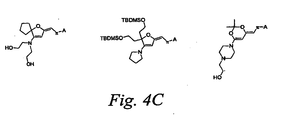
- Figure 4C shows examples of D1 chromophores, which are not meant to limit the scope of the invention, that may be prepared by the methods shown in Figure 4A.
- D1 chromophores which are not meant to limit the scope of the invention, that may be prepared by the methods shown in Figure 4A.
- One skilled in the art would recognize that there are many different variants of D1 chromophores that could be prepared by the methods in Figure 4A without deviating from the scope of the invention.
- Chromophores according to formula B1 may be prepared using reactions that are known to those skilled in the art, see Chem. Ber. 1985, 118(2), 704; J. Chem. Soc., Perkins Trans. 2 1996, 1455; Tet. Lett. 1989, 30(9), 1033; J. Am. Chem. Soc. 1988, 110, 4625, J. Org. Chem. 1977, 42, 2520; J. Am. Chem. Soc. 1980, 102, 5866; Acc. Chem. Res. 1979, 12, 61; Synthesis 1983, 429; Tet. Lett. 2000, 41(5), 763; Org. Lett. 1999, 1(3), 391; J. Org. Chem. 1990, 55(6); 1909, J.
- chromophores contain 5- or 6-membered ring-locked heterocyclic ⁇ bridges according to formula B2: wherein, independently at each occurrence, ⁇ 1 is absent or a bridge that provides electronic conjugation between X 3 and the remainder of the molecule; ⁇ 2 is absent or a bridge that provides electronic conjugation between X 4 and the remainder of the molecule; either X 3 is D and X 4 is A or X 3 is A and X 4 is D; D is an electron donating group having low electron affinity relative to the electron affinity of A; A is an electron accepting group having high electron affinity relative to the electron affinity of D; X 1 is O or S; X 2 is O, S, a single bond, or CR 2 ; R is hydrogen, alkyl, aryl, or heteroalkyl; and X 3 , X 4 , ⁇ 1 , and ⁇ 2 can be further substituted with halogen, alkyl, aryl, and heteroalkyl.
- Chromophores according to formula B2 may be prepared using reactions that are known to those skilled in the art, see Syn Lett. 1995, 503; J. Org. Chem. 1988, 53(9), 2011; Syn. Comm. 1988, 18(9), 949; Helv. Chim. Acta. 1991, 74(1), 27.
- Figure 6A 1) ⁇ bridge and/or donor may be coupling to a selected unsaturated cyclic ketone or ester, followed by 2) ⁇ bridge and/or acceptor coupling.
- Shown in Figure 3B are examples of B2 chromophores, which are not meant to limit the scope of the invention, that may be prepared by the methods shown in Figure 6A.
- B2 chromophores which are not meant to limit the scope of the invention, that may be prepared by the methods shown in Figure 6A.
- One skilled in the art would recognize that there are many different variants of B2 chromophores that could be prepared by the methods in Figure 6A without deviating from the scope of the invention.
- the two R groups may, again independently at each opportunity, join together to form a heterocyclic ring including the two "X" groups to which the two R groups are bonded.
- Chromophores according to formula B3 may be prepared using reactions that are known to those skilled in the art, see Synth. Comm. 1996, 26(11), 2205; Tet. Lett. 2001, 42, 1507; J. Am. Chem. Soc. 2001, 123(19), 4643; Chem. Mater. 1996, 8(11), 2659; J. Chem. Soc. Perkins Trans. 11997, 1957; Chem. Comm. 2000, 17, 1597.
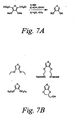
- Shown in Figure 7B are examples of dialkoxy thiophenes, which are not meant to limit the scope of the invention, that may be used to prepare B3 chromophores by the methods shown in Figure 7A.
- dialkoxy thiophenes which are not meant to limit the scope of the invention, that may be used to prepare B3 chromophores by the methods shown in Figure 7A.
- B3 chromophores that could be prepared by the methods in Figure
- Chromophores according to formula B4 may be prepared using reactions that are known to those skilled in the art, see J. Chem. Soc. Perkins Trans 1 1997, 22, 3465; J. Chem. Soc. Perkins Trans. 2 1996, 1377; Heterocycles 1994, 38(1), 143; J. Org. Chem. 1975, 40(23), 3384.
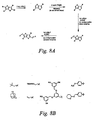
- chromophores of formula B4 may be prepared by: 1) bromine lithium exchange at the most active alpha position; 2) metal catalyzed cross coupling of functionalized or bulky groups to the fused thiophene; 3) formylation at one of the active alpha positions followed ⁇ bridge and/or acceptor coupling; and 4) formylation at the remaining alpha position and ⁇ bridge and/or acceptor coupling.
- Shown in Figure 8B are exemplary structures, which are not meant to limit the scope of the invention, that may be incorporated in the bridge in the metal catalyzed cross coupling step.
- B4-containing chromophores within the scope of the current invention that could be synthesized by methods like those disclosed in Figure 8A.
- Chromophores according to formula B5 may be prepared using reactions that are known to those skilled in the art, see J. Chem. Soc. Perkins Trans 2 1992, 5, 765; J. Org. Chem. 1971, 36(12), 1645; J. Mater. Chem. 1999, 9(9), 2227; Tet. 1999, 55, 14985; Macromolecules 1994, 27(7), 1938.
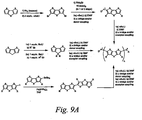
- FIGS. 9B Shown in Figure 9B are exemplary structures, which are not meant to limit the scope of the invention, that may be incorporated in the bridge in the metal catalyzed cross coupling step or alkylation step.
- One skilled in the art would recognize that there are many possible variants of B5-containing chromophores within the scope of the current invention that could be synthesized by methods like those disclosed in Figure 9A.
- Chromophores according to formula B6 may be prepared using reactions that are known to those skilled in the art, see Syn. Comm. 1988, 18(9), 949; Helv. Chim. Acta. 1991, 74(1),27; Synlett 1995, 503; Tet. 1976, 32, 3; Syn. 1976, 177; Tet. Lett. 1993, 34(47), 7641; J. Chem. Soc. Perkins Trans 1 1998,1(6), 1139; Chem. Lett. 1987, 1007.
- chromophores of formula B6 may be prepared as shown in Figure 10A by: 1) formation of the lithium enolate followed by Michael addition to a selected ketone; 2) base induced annulation condensation; 3) ⁇ bridge and/or donor coupling; and 4) ⁇ bridge and/or acceptor coupling.
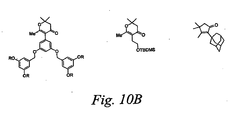
- Shown in Figure 10B are exemplary structures, which are not meant to limit the scope of the invention, that may be incorporated in the bridge.
- One skilled in the art would recognize that there are many possible variants of B6-containing chromophore structures within the scope of the current invention that could be synthesized by methods like those disclosed in Figure 10A.
- chromophores comprise sterically congested n bridges according to the formula B7: wherein, independently at each occurrence, ⁇ 1 is absent or a bridge that provides electronic conjugation between D and the remainder of the molecule; ⁇ 2 is absent or a bridge that provides electronic conjugation between A and the remainder of the molecule; D is an electron donating group having low electron affinity relative to the electron affinity of A; A is an electron accepting group having high electron affinity relative to the electron affinity of D; X 1 is an alkyl linker, an aryl linker, a heteroalkyl linker, or is absent; R is alkyl, aryl, heteroalkyl; the identity of R 1 depends on the identity of X 1 such that (a) if X 1 is an alkyl linker, an aryl linker or a heteroalkyl linker then R 1 is hydrogen, alkyl, aryl or heteroalkyl, but (b) if X 1 is absent then R 1 is alkyl, aryl or heteroalky
- Chromophores according to formula B6 may be prepared using reactions that are known to those skilled in the art, see J. Org. Chem. 1997, 62(7), 1940 ; Macromolecules 2000, 33(1), 4069; J. Org. Chem. 1998, 63(15), 4912.
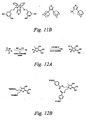
- Shown in Figure 11B are exemplary structures, which are not meant to limit the scope of the invention, that may be incorporated in the bridge.
- B7-containing chromophore structures within the scope of the current invention that could be synthesized by methods like those disclosed in Figure 11A.
- a third chromophore containing 5- or 6-menabered ring-locked heterocyclic ⁇ bridges according to the general formula B2: wherein ⁇ 1 and ⁇ 2 are independently optional; either X 3 is D and X 4 is A or X 3 is A and X 4 is D; X 1 is O or S; X 2 is O, S, a single bond, or CR 2 ; R is independently at each occurrence hydrogen, alkyl, aryl, or heteroalkyl; and X 3 , X 4 , ⁇ 1 , and ⁇ 2 can be further substituted with halogen, alkyl, aryl, and heteroalkyl some of such chromophores falling into the scope of the present invention.
- the invention provides chromophores comprising locked heterocyclic ring vinylidene acceptors according to formula A1: wherein, independently at each occurrence, ⁇ is a bridge that provides electronic conjugation between D and the remainder of the molecule; D is an electron donating group having low electron affinity relative to the remainder of the molecule; R is alkyl, aryl, or heteroalkyl; and ⁇ or D can be further independently substituted with one or more halogen, alkyl aryl, or heteroalkyl. Additionally, to sulfur in the ring can be oxidized to SO or SO 2 .
- Chromophores according to formula A1 may be prepared using reactions that are known to those skilled in the art, see Inorg. Chem. 1998, 37, 5722.
- a chromophore of formula A1 may be prepared as illustrated in Figure 12A by: 1) condensation of 2 equivalents of malononitrile with an alpha thioketone; and 2) ⁇ bridge and/or donor coupling.
- Shown in Figure 12B are exemplary structures, which are not meant to limit the scope of the invention, that are additional embodiments of the current invention.
- One skilled in the art would recognize that there are many possible variants of A1 chromophores within the scope of the current invention that could be synthesized by methods like those disclosed in Figure 12A.
- a ninth chromophore comprising a locked heterocyclic ring vinylidene acceptors according to formula A1: wherein, independently at each occurrence, ⁇ is a bridge that provides electronic conjugation between D and the remainder of the molecule; D is an electron donating group having low electron affinity relative to the remainder of the molecule; R is alkyl, aryl, or heteroalkyl; and ⁇ or D can be further independently substituted with one or more halogen, alkyl, aryl, or heteroalkyl.
- chromophores having a D- ⁇ -A connectivity are chromophores having a D- ⁇ -A connectivity.
- Other chromophores with multiple donors and acceptors can be represented by D- ⁇ (- ⁇ 1 -A) 2 , (D- ⁇ 1 -) 2 ⁇ -A, and (D- ⁇ 1 -) 2 ⁇ (- ⁇ 2 -A) 2.
- Chromophores can also be represented by the D- ⁇ (- ⁇ 1 -A) n connectivity according to the formula MAC: wherein, independently at each occurrence, ⁇ 1 is absent or a bridge that provides electronic conjugation between A and the remainder of the molecule; A is an electron accepting group having high electron affinity relative to the electron affinity of the remainder of the molecule; R is alkyl, aryl, or heteroalkyl; and ⁇ and/or A may be further substituted with halogen, alkyl, aryl, or heteroalkyl.
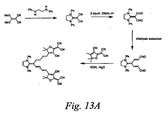
- Chromophores according to formula MAC may be synthesized using reactions like those shown in Figure 13A, by: 1) double nucleophilic displacement of methyl sulfide with amines, which is also shown in Figure 1A; 2) double reduction of the corresponding dinitrile to the dialdehyde; 3) optional aldehyde extension; and 4) coupling of a selected acceptor.
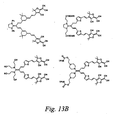
- Shown in Figure 13B are exemplary structures, which are not meant to limit the scope of the invention, that are additional embodiments of the current invention.
- One skilled in the art would recognize that there are many possible variants of MAC chromophores within the scope of the current invention that could be synthesized by methods like those disclosed in Figure 13A.
- Chromophores of (D- ⁇ 1 -) n ⁇ -A connectivity can be represented according to the formula MDC: wherein, independently at each occurrence, ⁇ 1 is absent or a bridge that provides electronic conjugation between D and the remainder of the molecule ; ⁇ 2 is absent or a bridge that provides electronic conjugation between A and the remainder of the molecule; D is an electron donating group having low electron affinity relative to the electron affinity of A; A is an electron accepting group having high electron affinity relative to the electron affinity of D; R 1 is hydrogen, halogen, alkyl, aryl, or heteroalkyl; X is a single bond, O, S, Se, NR 2 wherein R 2 is independently at each occurrence alkyl, aryl, or heteroalkyl, or C(R 3 ) 2 wherein R 3 is independently at each occurrence hydrogen, alkyl, aryl, or heteroalkyl; and any of ⁇ , ⁇ 1 , D, or A independently at each occurrence can be further substituted with halogen, al
- Chromophores according to formula MDC may be synthesized using reactions like those shown in Figure 14A, by, for instance: 1) double condensation of a selected aldehyde with doubly acidic ⁇ bridges; 2) optional aldehyde extension; and 3) coupling of a selected acceptor.
- Shown in Figure 14B are exemplary structures, which are not meant to limit the scope of the invention, that are additional embodiments of the current invention.
- One skilled in the art would recognize that there are many possible variants of MDC chromophores within the scope of the current invention that could be synthesized by methods like those disclosed in Figure 14A.
- Chromophores of (D- ⁇ 1 -) n ⁇ (- ⁇ 2 -A) m connectivity can be represented according to the formula MDAC: wherein, independently at each occurrence, ⁇ 1 is absent or a bridge that provides electronic conjugation between D and the remainder of the molecule; ⁇ 2 is absent or a bridge that provides electronic conjugation between A and the remainder of the molecule; D is an electron donating group having low electron affinity relative to the electron affinity of A; A is an electron accepting group having high electron affinity relative to the electron affinity of D; R 1 is hydrogen, halogen, alkyl, aryl, or heteroalkyl; X is a single bond, O, S, Se, NR 2 wherein R 2 is independently at each occurrence alkyl, aryl, or heteroalkyl, or C(R 3 ) 2 wherein R 3 is independently at each occurrence hydrogen, alkyl, aryl, or heteroalkyl; and any of ⁇ 1 , ⁇ 2 , D, or A independently at each occurrence can be
- Chromophores according to formula MDAC may be synthesized using reactions like those shown, for instance, in Figure 15A by: 1) double condensation of a selected aldehyde with doubly acidic ⁇ bridges; 2) Knoevenagel condensation of malononitrile and double reduction to the dialdehyde; and 3) coupling of a selected acceptor.
- Shown in Figure 15B are exemplary structures, which are not meant to limit the scope of the invention, that are additional embodiments of the current invention.
- MDC chromophores within the scope of the current invention that may be synthesized by methods like those disclosed in Figure 15A.
- a tenth chromophore of D- ⁇ (- ⁇ 1 -A) n connectivity can be represented according to the formula MAC: wherein ⁇ 1 is independently at each occurrence optional, R is independently at each occurrence alkyl, aryl, or heteroalkyl; and ⁇ independently at each occurrence or A independently at each occurrence can be further substituted with halogen, alkyl, aryl, or heteroalkyl.
- An eleventh chromophore of (D- ⁇ 1 -) n ⁇ -A connectivity can be represented according to the formula MDC: wherein ⁇ and ⁇ 1 are independently at each occurrence optional, R 1 is independently at each occurrence hydrogen, halogen, alkyl, aryl, or heteroalkyl; X is a single bond, O, S, Se, NR 2 wherein R 2 is independently at each occurrence alkyl, aryl, or heteroalkyl, or C(R 3 ) 2 wherein R 3 is independently at each occurrence hydrogen, alkyl, aryl, or heteroalkyl; and any of ⁇ , ⁇ 1 , D, or A independently at each occurrence can be further substituted with halogen, alkyl, aryl, or heteroalkyl.
- a twelfth chromophore of (D- ⁇ 1 -) n ⁇ (- ⁇ 2 -A) m connectivity can be represented according to the formula MDAC: wherein ⁇ 1 and ⁇ 2 are independently at each occurrence optional, R 1 is independently at each occurrence hydrogen, halogen, alkyl, aryl, or heteroalkyl; X is a single bond, O, S, Se, NR 2 wherein R 2 is independently at each occurrence alkyl, aryl, or heteroalkyl, or C(R 3 ) 2 wherein R 3 is independently at each occurrence hydrogen, alkyl, aryl, or heteroalkyl; and any of ⁇ 1 , ⁇ 2 , D, or A independently at each occurrence can be further substituted with halogen, alkyl, aryl, or heteroalkyl.
- crosslinking the polymer matrix improves long-term orientational stability (i.e., polar alignment) of chromophores in the matrix; and long-term orientational stability effectively increases the length of time during which the materials are EO active.
- the chromophores of the current invention may be incorporated into crosslinkable polymer matrices in any one of three ways: 1) non-covalently in incorporating the chromophore in a crosslinkable polymer; 2) covalently incorporating the chromophore in a polymer, wherein the polymer is independently crosslinkable; and 3) covalently incorporating a reactive chromophore in a polymer, thereby rendering the polymer crosslinkable.
- Suitable crosslinking processes that are induced by acids, bases, heat, UV light exposure, visible light exposure, and electron beam exposure are all well known to those skilled in the art.
- D groups that may be incorporated into a chromophore that also includes any acceptor, ⁇ -bridge and/or an additional donor as described above include, without limitation, each of the D groups illustrated in any of the Figures described herein, including D groups of the following structures, wherein, independently at each occurrence, R is alkyl, aryl or heteroalkyl; R 1 is hydrogen, alkyl, aryl or heteroalkyl; Y is O, S or Se; m is 2, 3 or 4; p is 0, 1 or 2; and q is 0 or 1.
- R contains 1-12 carbons; R 1 is hydrogen or contains 1-12 carbons; Y is O or S; m is 2, 3 or 4; p is 0, 1 or 2; and q is 0 or 1.
- R 1 is hydrogen, alkyl, aryl or heteroalkyl
- p is 0, 1 or 2
- o is 0, 1 or 2
- o + p is at least 1
- q is 0 or 1.
- a groups that may be incorporated into chromophores that also include one or more donors (D) and ⁇ -bridges as described herein include each of the A groups illustrated in any of the Figures described herein, including A groups of the following structures and wherein, independently at each occurrence, R is alkyl, aryl or heteroalkyl; R 1 is hydrogen, alkyl, aryl or heteroalkyl; Y is O, S or Se; and q is 0 or 1.
- R contains 1-12 carbons; R 1 is hydrogen or contains 1-12 carbons; Y is O or S; and q is 0 or 1.
- a specifically preferred A group is of the formula
- a chromophore may specify that R is alkyl, and/or aryl, and/or heteroalkyl, and/or heteroaryl, including each and every combination thereof.
- R is hydrophobic, while alternatively R is hydrophilic.
- an R group is saturated, while alternatively an R group may be unsaturated.
- the R group may have, in various aspects of the invention, 1-6 carbons, or 7-12 carbons, or 13-22 carbons.
- n in a chromophore as described herein may be 1, or 2, or 3, or 4, or each and every combination thereof, e.g. , 2 or 3.
- X in a chromophore is O, while in another aspect X is S.
- ⁇ 1 and ⁇ 2 are and A is any of the acceptors shown herein, including wherein R is independently at each occurrence alkyl, aryl or heteroalkyl.
- Chromophore as described herein may have a specified structure where portions of the ⁇ -bridge, as well as the donor and acceptor groups, are optionally chosen, e.g., a chromophore of the structure
- the D and A groups may be any of the donor and acceptors groups shown herein
- the ⁇ -bridge may be any of the ⁇ -bridges shown herein.
- the present invention describes chromophores as generally containing one or more A, D and/or ⁇ -bridges.
- a chromophore may be described as having a structure wherein, independently at each occurrence, D is an electron donating group having low electron affinity relative to the electron affinity of ⁇ is absent or a bridge that provides electronic conjugation between D and the double bond adjacent to ⁇ ; and R is alkyl, aryl, heteroalkyl or heteroaryl.
- A, D and/or the ⁇ -bridge may be any of the A, D and/or the ⁇ -bridges described herein, including described in the Figures.
- D may be selected from: and ⁇ may be selected from: and
- the present invention provides a chromophore that has the structure wherein, independently at each occurrence, R is alkyl, aryl or heteroalkyl; R 1 is alkyl, aryl or heteroalkyl; and X is O or S.
- R is alkyl, aryl or heteroalkyl; R 1 is alkyl, aryl or heteroalkyl; and X is O or S.
- R may be -(CH 2 ) w OH, -(CH 2 ) w OR 1 , -(CH 2 ) w SH, -(CH 2 ) w CO 2 Et, -(CH 2 ) w CO 2 H, -(CH 2 ) w NH 2 , -(CH 2 ) w CN, -(CH 2 ) w halogen.
- R 1 may be hydrogen, R, perfluoroalkyl, SiR 3 , Si(CH 3 ) 2 t -Bu, or Si( i -Pr) 3 .
- Yet another chromophore has the structure wherein R is alkyl, aryl, or heteroalkyl and R 1 is hydrogen, alkyl, aryl or heteroalkyl.
- Still another chromophore has the structure wherein R is alkyl, aryl, or heteroalkyl and R 1 is hydrogen, alkyl, aryl or heteroatkyl.
- the L group(s) is formally seen as being joined to the chromophore E through replacement of any hydrogen of E with a bond to L.
- CM1 crosslinkable chromophoric matrices
- E is a chromophore according to the current invention
- L includes a thermally crosslinkable -OCFCF 2 (TFVE) group
- n 1-24
- at least one of D, ⁇ , or A is attached to a polymer
- D, ⁇ , or A may be further substituted with L, halogen, alkyl, aryl, or heteroalkyl.
- Matrices like CM1 may be prepared and crosslinked according general process comprising the steps of: 1) polymerizing or copolymerizing the TFVE containing chromophore with or without a TFVE containing spacer/crosslinking agent to an extent that optical quality films may be obtained and that the chromophore may still be mobile in the polymer at temperatures below the crosslinking temperature of the TFVE group; 2) producing an optical quality film by methods known to those skilled in the art; 3) heating the film long enough to reduce residual solvents to selected levels; 4) heating the copolymer to a selected temperature to increase chromophore mobility; 5) applying a voltage across the polymer film sufficient to induce EO activity; and 6) heating the polymer to the thermoset temperature.
- Materials like CM1 that contain TFVE groups may afford the following advantageous properties: 1) considerably high glass transition temperature when crosslinked; 2) high optical transparency due to the high concentration of C-F bonds, which minimizes optical loss caused by C-H overtones at 1.3 and 1.55 ⁇ m; and 3) enhancement of properties due to the synthetic versatility of the chromophores.
- Some embodiments according to the present invention include polymers having fluorination in the main chain and/or the groups pendant to the main chain of the polymer. Including fluorination in the main chain tends to improve both long-term temporal and thermal stability.
- the preparation, incorporation into molecules, and crosslinking chemistry of the TFVE group is known in the art, see U.S. Pat. Nos.
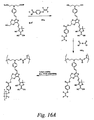
- CM1 matrices may be prepared as shown in Figure 16A, which is not meant to limit the scope of the invention: 1) a chromophore according to the formula B3 is esterified with a TFVE-containing acid chloride and then acid deprotected to give an diol; 2) the diol is polymerized with selected diacid chlorides to give a polymer with selected average molecular weight; and 3) crosslinking of the TFVE group by heating to the effective crosslinking temperature. Shown in Figure 13B are exemplary diacid structures, which are not meant to limit the scope of the invention, that can be used in additional embodiments of the current invention. One skilled in the art would recognize that there are many possible variants of CM1 chromophoric matrices within the scope of the current invention that could be synthesized by methods like those disclosed in Figure 16A.
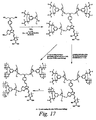
- CM1 matrices may be prepared as shown in Figure 14, which is not meant to limit the scope of the current invention: 1) a triol chromophore according to the formula B3 is triply esterified with a TFVE containing dendron acid chloride; 2) an optional prepolymerization step for the smaller generation dendrimers to a selected viscosity where the chromophore is effectively mobile at selected temperatures; 3) spin coating of the dendrimer or prepolymerized dendrimer; and 4) heating to the effective crosslinking temperature.
- a triol chromophore according to the formula B3 is triply esterified with a TFVE containing dendron acid chloride
- an optional prepolymerization step for the smaller generation dendrimers to a selected viscosity where the chromophore is effectively mobile at selected temperatures 3) spin coating of the dendrimer or prepolymerized dendrimer; and 4) heating to the effective crosslinking temperature.
- the current invention provides:
- a process comprising the steps of: 1) covalently or non-covalently incorporating the chromophore into a polymer matrix, wherein the chromophore is a chromophore of the present invention; 2) maintaining the polymer matrix at a selected temperature to allow effective chromophore mobility; and 3) applying an electric field sufficient to induce polar alignment of the chromophore in the polymer matrix; and
- a process comprising the steps of: 1) providing a chromophore matrix according to the general formula CM or CM1; 2) maintaining the chromophore matrix at a selected temperature to allow effective chromophore mobility; 3) optionally applying an electric field sufficient to induce polar alignment of the chromophore in the polymer matrix; and 4) crosslinking reactive groups included in the chromophore matrix.
- the materials and methods according to the present invention can be useful in a variety of electro-optic (EO) applications.
- these materials and methods may be applied to polymer transistors or other active or passive electronic devices, as well as OLED (organic light emitting diode) or LCD (liquid crystal display) applications.
- OLED organic light emitting diode
- LCD liquid crystal display
- materials may be used in place of currently used materials such as lithium niobate in most type of integrated optics devices, optical computing applications, and optical communication systems.
- the materials of the invention may be fabricated into switches, modulators, waveguides, or other electro-optical devices.
- devices fabricated from the materials of the invention may be incorporated into routers for optical communication systems or waveguides for optical communication systems or for optical switching or computing applications. Because the materials are generally less demanding than currently used materials, devices made from such polymers may be more highly integrated, as described in United States Patent No. 6,049,641, which is incorporated herein by reference. Additionally, such materials may be used in periodically poled applications as well as certain displays, as described in U. S. Patent No. 5,911,018, which is incorporated herein by reference.
- the foregoing references provide instruction and guidance to fabricate waveguides from materials according to the present invention using, e.g., direct photolithography, reactive ion etching, excimer laser ablation, molding, conventional mask photolithography, ablative laser writing, or embossing (e.g. , soft embossing).
- the foregoing references also disclose electron acceptors, electron donors and electron bridges that may be incorporated into chromophores according to the present invention that also incorporate an electron acceptor and/or electron donor and/or electron bridge according to the present invention.
- Components of optical communication systems that may be fabricated, in whole or part, with materials according to the present invention include, without limitation, straight waveguides, bends, single-mode splitters, couplers (including directional couplers, MMI couplers, star couplers), routers, filters (including wavelength filters), switches, modulators (optical and electro-optical, e.g. , birefringent modulator, the Mach-Zender interferometer, and directional and evanescent coupler), arrays (including long, high-density waveguide arrays), optical interconnects, optochips, single-mode DWDM components, and gratings.
- couplers including directional couplers, MMI couplers, star couplers
- filters including wavelength filters
- switches including wavelength filters
- modulators optical and electro-optical, e.g. , birefringent modulator, the Mach-Zender interferometer, and directional and evanescent coupler
- arrays including long, high-density
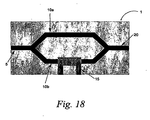
- Figure 18 illustrates one such component, which is a Mach Zehnder modulator (1) having an input (5), an output (20), two legs (10a, 10b) that are both coupled to the input and output, and an electrode (15) positioned near one of the legs. While the exemplified modulator or switch is based on a Mach-Zender type of structure, other modulator or switch structures, such as Y-branch structures, evanescent coupling structures, or controlled loss structures, may be within the scope of the invention.
- the materials according to the present invention may be used with, for example, wafer-level processing, as applied in, for example, vertical cavity surface emitting laser (VCSEL) and CMOS technologies.
- VCSEL vertical cavity surface emitting laser
- CMOS complementary metal-oxide-semiconductor
- the materials according to the present invention may be used in lieu of lithium niobate, gallium arsenide and other inorganic materials that currently find use as light-transmissive materials in optical communication systems.
- a method according to the invention includes transmitting information by light, where the light is transmitted at least in part through a material described herein.
- structures and devices according to the present invention can include:
- An optical modulator or switch comprising: 1) an input; 2) an output; 3) a first waveguide extending between the input and output; and 4) a second waveguide aligned to the first waveguide and positioned for evanescent coupling to the first waveguide; wherein at least one of the first and second legs includes a composition of matter according to the present invention.
- the modulator or switch may further including an electrode positioned to produce an electric field across the first or second waveguide;
- An optical router includes a plurality of switches, wherein each switch includes: 1) an input; 2) an output; 3) a first waveguide extending between the input and output; and 4) a second waveguide aligned to the first waveguide and positioned for evanescent coupling to the first waveguide; wherein at least one of the first and second legs includes a composition of matter according to the present invention.
- the plurality of switches may optionally be arranged in an array of rows and columns.
- the materials described herein may be applied to the devices or methods that control the phase of light waves passing through the material.
- electrical fields are applied across a set of waveguides through which the light waves travel. Controlling the electrical fields allows the relative phases of the light waves to be controlled.
- Such approaches may be particularly useful in applications such as phased-array beam steering or phase matching of light waves passing through alternative waveguides.
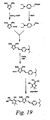
- Step A As illustrated in Scheme 19, 3,4-dibutoxythiophene (12 g, 0.053 mol) ( Syn. Comm. 1996, 26, 2205), DMF (8.14 mL, 0.105 mol) and 1,2-dichloroethane were placed in a flask and cooled to 0 °C. POCl 3 (7.83 mL, 0.084 mol) was added dropwise. The reaction mixture was refluxed for 2 h, and then poured into sodium acetate solution (1N). After work-up, the oil was purified by column chromatography with ethyl acetate/hexane. The aldehyde product, 12.17 g, was obtained with 90 % yield.
- Step B [(4- N,N- Diethylaminopbenyl)methyl]triphenylpbosphonium bromide (17 g, 0.034 mol) and THF (300 mL) were placed in a flask and cooled to -40 °C. BuLi solution in hexane (2.5 M, 13.5 mL, 0.034 mol) was added dropwise and the mixture was stirred at rt for 30 min. Then, a solution of the aldehyde prepared in Step A above (6.15 g, 0.024 mol) in 40 mL THF was added and stirred at RT for 4 h. After work-up, it was purified by column chromatography with ethyl acetate/hexane. The D-B3 product, 9.5 g, was obtained.
- Step C The D-B3 product (9.5 g, 0.024 mol), DMF (3.0 mL, 0.038 mol) and 1,2-dichloroethane were placed in a flask and cooled to 0 °C. POCl 3 (5.1 g, 0.033 mol) was added dropwise and the mixture was refluxed for 2 h. It was then poured into sodium acetate solution. After work-up, the solid was purified by column chromatography with ethyl acetate/hexane. The D-B3 aldehyde product, 4.0 g, was obtained. The combined yield for the two steps is 39 %.
- Step D D-B3 aldehyde as prepared in Step C (2 g, 4.66 nunol), the (dicyanovinylidene)cyanofuran acceptor (1.2 g, 6.05 mmol), piperidine (1 drop) and chloroform (10 mL) were placed in a flask and refluxed for 5 h. The solvent was removed under reduced pressure and the solid was purified by recrystallization with methylene chloride/hexane and column chromatography with ethyl acetate/methylene chloride/hexane. The D-B3-A chromophore, 1.5 g, was obtained in 53 % yield.
- Step A As illustrated in Figure 20, 3,4-dibromo-2-thiophene carboxaldehyde (35 g, 0.137 mol) and methanol (120 mL) were placed in a flask. A solution was made by dissolving NaBH 4 (1.93 g, 0.051 mol) in 2 M NaOH solution (2.7 mL) and diluted with 25 mL water. At 0 °C, the above solution was added dropwise into the flask and it was stirred at RT for 2 h. After work-up, the alcohol product, 34.5 g, was obtained with 98 % yield.
- Step B The alcohol product from Step B (34.5 g, 0.134 mol), PPh 3 ⁇ HBr (41.3 g, 0.12 mol) and chloroform (140 mL) were placed in a flask equipped with Dean-Stark apparatus. The mixture was refluxed for 2 h and then the solvent was removed under reduced pressure. The solid was redissolved in chloroform and precipitated by ethyl ether. The phosphonium salt product, 48.6 g, was obtained with 69 % yield.
- Step C The phosphonium product from Step B (30 g, 0.05 1 mol) and THF (600 mL) were placed in a flask and cooled to -40 °C. BuLi solution in hexane (2.5 M, 22.6 mL, 0.057 mol) was added dropwise and the mixture was stirred at room temperature for 30 min. Then a solution of 4- N,N -Di[(2- tert -butyldimethylsilyloxy)ethyl]aminobenzaldehyde (17.3 g, 0.040 mol) in 100 mL THF was added and stirred at RT for 4 h. After work-up, it was purified by column chromatography with ethyl acetate/hexane. The D-B3 product, 20 g, was obtained in 76 % yield.
- Step D The D-B3 product above (19.5 g, 0.029 mol), DMF (4.1 mL, 0.053 mol) and 1,2-dichloroethane were placed in a flask and cooled to 0 °C. POCl 3 (7.2 g, 0.047 mol) was added dropwise and the mixture was refluxed for 2 h. After the product mixture cooled to room temperature, an HCl solution was added and it was stirred for 2 h. It was then poured into sodium acetate solution. After work-up, the D-B3 aldehyde product, 13.5 g, was obtained.
- Step E The D-B3 aldehyde from Step D (9 g, 19.5 mmol), (dicyanovinylidene)cyanofuran (7.77 g, 39 mmol), piperidine (1 drop) and chloroform (30 mL) were placed in a flask and refluxed for 5 h. The solvent was removed under reduced pressure and the solid was purified by recrystallization with methylene chloride/hexane and column chromatography with ethyl acetate/methylene chloride/hexane. The D-B3-A chromophore, 6.0g, was obtained in 48 % yield.
- Step A As illustrated in Figure 21, 3-mercapto-3-methyl-2-butanone (5 g, 0.042 mol) ( Inorg. Chem. 1998, 37, 5722), malononitrile (5.9 g, 0.089 mol) and ethanol (120 mL) were placed in a flask equipped with Soxlet that is charged with molecular sieves. A catalytic amount of Li was added and the mixture is refluxed for 8 h. It was then cooled to room temperature and solid precipitated out. The solid was collected by filtration. The filtrate was condensed and put into the freezer to collect more solid. Combined, 5.3 of the A1 acceptor was obtained with 58 % yield.
- Step B The D- ⁇ aldehyde (2g, 3.42 mmol), A1 acceptor (0.8g, 3.72 mmol) and 15 mg of sodium ethoxide were dissolved in 40 ml of anhydrous ethanol. The mixture was stirred under reflux for 4 h. The precipitate was filtered off and washed with ethanol to give 1 g (35.7%) of the D- ⁇ -A1 chromophore.
- D-B3 aldehyde (1.8 g, 4.19 mmol), A1 acceptor (1.17 g, 5.45 mmol), piperidine (1 drop) and chloroform (10 mL) were placed in a flask and refluxed for 5 h. The solvent was removed under reduced pressure and the solid was purified by recrystallization with methylene chloride/hexane and column chromatography with ethyl acetate/methylene chloride/hexane. The D-B3-A1 chromophore, 1.8 g, was obtained in 69% yield.
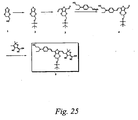
- Step A 2,3-dihydrothieno [3,4-b][1,4]dioxin-2-yl methanol (1) was prepared according to published literature (Stephan, O., et. al. J. Electroanalytical Chem. 443, 1998. 217).
- Step B Preparation of tert -Butyl-(2,3-dihydro-thieno[3,4-b][1,4]dioxin-2-ylmethoxy)-dimethyl-silane(2). 20 g (0.116 mole) of 1, 10.212 g (0.15 mole) of imidizole and 33.16 g (0.22 mole) of t -butyldimethylsilylchloride was dissolved in 100 ml of dry dimethylformamide. The reaction mixture was stirred at room temperature for 12 h at which point the precipitate is filtered from the mixture and discarded. The remaining solution is combined with 1 L of chloroform, and is added to 1 L of water. The organic layer is separated, and washed with water two more times. The organic layered is then dried with MgSO 4 , filtered and the solvent is removed under reduced pressure. The product can be fractionally distilled to give 23g of 2 (69% yield).
- Step C Preparation of 3-( tert- butyl-dimethyl-silanyloxymethyl)-2,3-dihydro-thieno[3,4-b][1,4]dioxine-5-carbaldehyde (3).
- 250 ml of dry tetrahydrofuran is added via syringe to 32 g (0.111 mole) of 2 contained in a nitrogen purged round bottom flask.
- the solution is cooled to -40°C, using a dry ice/acetone bath.
- the solution is stirred at -40°C for 30 minutes, at which point 60 ml of 2.5 M BuLi in hexanes is added dropwise.
- the solution is allowed to stir for 30 min at -40 °C, followed by the addition of 14.62 g (0.2 mole) dimethylformamide.
- the solution is warmed to room temperature, where it was stirred for 1 h.
- the solution is poured into an equal amount of chloroform, and extracted with water (3x).
- the organic phase is dried over MgSO 4 , filtered, and solvent is removed under reduced pressure to yield a viscous red oil.
- the compound is purified on a silica column with a hexane/ethyl acetate mobile phase to yield 17 g (49% yield).
- Step D Preparation of (4- ⁇ 2-[2-(tert-Butyl-dimethyl-silanyloxymethyl)-2,3-dihydro-thieno[3,4-b][1,4]dioxin-5-yl]-vinyl ⁇ -phenyl)-diethyl-amine (4). To 10.47 g (0.021 mole) of diethyl- ⁇ 4-[(triphenylphosphinebromide)-methyl]-phenyl ⁇ -amine was added 25 ml of dry tetrahydrofuran. The suspension was cooled to -40 °C, and stirred for 30 min.
- Step E Preparation of 3-( tert -butyl-dimethyl-silanyloxymethyl)-7-[2-(4-diethylamino-phenyl)-vinyl]-2,3-dihydro-thieno[3,4-b][1,4]dioxine-5-carbaldehyde (5).
- 60 mL of dry tetrahydrofuran is added via syringe to 3.4 g (0.0074 mole) of 4 contained in a nitrogen purged round bottom flask.
- the solution is cooled to 0 °C.
- the solution is stirred at 0 °C for 60 minutes, at which point 3.2 mL of 2.5 M BuLi in hexanes is added dropwise.
- the solution is allowed to stir for 15 min at 0 °C, followed by the addition of 0.697 mL (0.009 mole) of anydrous dimethylformamide.
- the solution is warmed to room temperature, where it was stirred overnight.
- the tetrahydrofuran is removed under reduced pressure, and the resulting material is taken up in 500 mL of chloroform.
- the organic layer is washed with water three times, dried over MgSO 4 , and solvent is then removed under reduced pressure.
- the compound is purified on a silica column with a hexane/ethyl acetate mobile phase.
- Step F Preparation of 2-[4-(2- ⁇ 3-(tert-Butyl-dimethyl-silanyloxymethyl)-7-[2-(4-diethylamino-phenyl)-vinyl]-2,3-dihydro-thieno[3,4-b][1,4]dioxin-5-yl ⁇ -vinyl)-3-cyano-5,5-dimethyl-5H-furan-2-ylidene]-malononitrile (6).
- Step A 2,3-dihydrothieno [3,4-b][1,4]dioxin-2-yl methanol (1, in Figure 21) was prepared according to published literature (Stephan, O., et.al. J. Electroanalytical Chem 443, 1998, 217.)
- Step B Preparation of tert -butyl-(2,3-dihydro-thieno [3,4-b][1,4]-dioxin2-ylmethoxy)-dimethyl-silane (2).
- the reaction mixture was stirred at room temperature for 12 h at which point the precipitate was filtered from the mixture and discarded.
- the remaining solution was combined with 1 L of chloroform, and was added to 1 L of water.
- the organic layer was separated, and washed with water two more times.
- the organic layered was then dried with MgSO 4 , filtered and the solvent was removed under reduced pressure.
- the product can be fractionally distilled to give 23 g of 2 (69% yield
- Step C Preparation of 2-( tert -butyl-dimethyl-silanyloxymethyl)-2,3-dihydro-thieno[3,4-b][1,4]dioxine-5,7-dicarbaldehyde (3).
- 150 mL of dry tetrahydrofuran was added via syringe to 23 g. (0.080 mol) of 2 contained in a nitrogen purged round bottom flask.
- the solution was cooled to -40 °C using a dry ice/acetone bath.
- the solution is stirred at -40 °C for 30 minutes, at which point 60 mL of 2.0 M BuLi in hexanes was added dropwise.
- the solution was allowed to stir for 30 min at -40 °C, followed by the addition of 15.49 mL (0.2 mol) dimethylformamide.
- the solution was warmed to room temperature, where it was stirred for 1 h.
- the solution was poured into an equal amount of chloroform, and extracted with water (3x).
- the organic phase was dried over MgSO 4 , filtered, and solvent was removed under reduced pressure to a yield viscous red oil.
- the compound was purified on a silica column with a hexane/ethyl acetate mobile phase to yield 10 g (36% yield).
- Step D Preparation of 3-( tert -butyl-dimethyl-silanyloxymethyl)-7-(2- ⁇ 4-[ethyl-(2-hydroxy-ethyl)-amino]-phenyl ⁇ -vinyl)-2,3-dihydro-thieno[3,4-b][1,4]dioxine-5-carbaldehyde (4).
- 2-(ethyl- ⁇ 4-[(triphenylphosphinebromide)-methyl]-phenyl ⁇ -amino)-ethanol was added 50 ml of dry tetrahydrofuran. The suspension was cooled to -40 °C, and stirred for 30 min.
- Step E Preparation of 2-(4- ⁇ 2-[3-( tert- butyl-dimethyl-silanyloxymethyl)7-(2- ⁇ 4-[ethyl-(2-hydroxy-ethyl)-amino]-phenyl ⁇ -vinyl)-2,3-dihydrothieno[3,4-b][1,4]dioxin-5-yl]-vinyl ⁇ -3-cyano-5,5-dimethyl-5H-furan-2-ylidene)-malononitrile (5).
Landscapes
- Chemical & Material Sciences (AREA)
- Organic Chemistry (AREA)
- Physics & Mathematics (AREA)
- Nonlinear Science (AREA)
- General Physics & Mathematics (AREA)
- Optics & Photonics (AREA)
- Optical Modulation, Optical Deflection, Nonlinear Optics, Optical Demodulation, Optical Logic Elements (AREA)
- Plural Heterocyclic Compounds (AREA)
- Heterocyclic Compounds Containing Sulfur Atoms (AREA)
- Crystals, And After-Treatments Of Crystals (AREA)
- Compositions Of Macromolecular Compounds (AREA)
- Heterocyclic Carbon Compounds Containing A Hetero Ring Having Oxygen Or Sulfur (AREA)
- Glass Compositions (AREA)
Priority Applications (1)
| Application Number | Priority Date | Filing Date | Title |
|---|---|---|---|
| EP06126949A EP1760080A1 (en) | 2000-08-17 | 2001-08-17 | Design and synthesis of thiophene derived NLO materials for electro-optic applications |
Applications Claiming Priority (3)
| Application Number | Priority Date | Filing Date | Title |
|---|---|---|---|
| US22626700P | 2000-08-17 | 2000-08-17 | |
| US226267P | 2000-08-17 | ||
| PCT/US2001/025779 WO2002014305A2 (en) | 2000-08-17 | 2001-08-17 | Design and synthesis of advanced nlo materials for electro-optic applications |
Related Child Applications (1)
| Application Number | Title | Priority Date | Filing Date |
|---|---|---|---|
| EP06126949A Division EP1760080A1 (en) | 2000-08-17 | 2001-08-17 | Design and synthesis of thiophene derived NLO materials for electro-optic applications |
Publications (2)
| Publication Number | Publication Date |
|---|---|
| EP1313729A2 EP1313729A2 (en) | 2003-05-28 |
| EP1313729B1 true EP1313729B1 (en) | 2007-03-21 |
Family
ID=22848219
Family Applications (1)
| Application Number | Title | Priority Date | Filing Date |
|---|---|---|---|
| EP01965981A Expired - Lifetime EP1313729B1 (en) | 2000-08-17 | 2001-08-17 | Design and synthesis of thiophene derived nlo materials for electro-optic applications |
Country Status (9)
| Country | Link |
|---|---|
| US (6) | US6716995B2 (enExample) |
| EP (1) | EP1313729B1 (enExample) |
| JP (2) | JP5153047B2 (enExample) |
| CN (1) | CN1466583A (enExample) |
| AT (1) | ATE357444T1 (enExample) |
| AU (1) | AU2001286527A1 (enExample) |
| CA (1) | CA2419820A1 (enExample) |
| DE (1) | DE60127420T2 (enExample) |
| WO (1) | WO2002014305A2 (enExample) |
Families Citing this family (63)
| Publication number | Priority date | Publication date | Assignee | Title |
|---|---|---|---|---|
| DE10002424A1 (de) * | 2000-01-20 | 2001-07-26 | Siemens Ag | Di(het)arylaminothiophen-Derivate |
| EP1305305A4 (en) | 2000-07-24 | 2005-07-20 | Univ Washington | HYPERPOLARIZABLE ORGANIC CHROMOPHORES |
| EP1313729B1 (en) * | 2000-08-17 | 2007-03-21 | Lumera Corporation | Design and synthesis of thiophene derived nlo materials for electro-optic applications |
| US7019453B2 (en) * | 2000-08-17 | 2006-03-28 | Lumera Corporation | Polymers having pendant nonlinear optical chromophores and electro-optic devices therefrom |
| US7109355B2 (en) * | 2000-08-17 | 2006-09-19 | Lumera Corporation | Fluorinated π-bridge second order nonlinear optical chromophores and electro-optic devices therefrom |
| US6750603B2 (en) * | 2000-08-17 | 2004-06-15 | Lumera Corporation | Second order nonlinear optical chromophores and electro-optic devices therefrom |
| JP4984343B2 (ja) * | 2000-09-29 | 2012-07-25 | 株式会社日立製作所 | 有機電界発光素子及びそれを用いた光電子素子 |
| DE60229090D1 (de) * | 2001-07-25 | 2008-11-13 | Merck Patent Gmbh | Mono-, Oligo and Poly-3-(1,1-difluoroalkyl)thiophene und ihre Verwendung als Ladungstransportmaterial |
| US7601849B1 (en) | 2001-08-02 | 2009-10-13 | University Of Washington | Nonlinear optical compounds and related macrostructures |
| US7161013B2 (en) * | 2001-09-12 | 2007-01-09 | Pusan National University Industry-University Cooperation Foundation | Terthiophene-3-carboxylic acid compound and fabricating method thereof, functionalized conductive terthiophene polymer with the compound as a monomer, process for DNA hybridization detection using the polymer, and fabricating method of probe DNA |
| US7001708B1 (en) * | 2001-11-28 | 2006-02-21 | University Of Central Florida Research Foundation, Inc. | Photosensitive polymeric material for worm optical data storage with two-photon fluorescent readout |
| DE10248876B4 (de) * | 2002-10-18 | 2006-07-06 | H.C. Starck Gmbh | Verfahren zur Herstellung linearer organischer Oligomere |
| DE10257539A1 (de) * | 2002-12-10 | 2004-07-01 | H.C. Starck Gmbh | Verfahren zur Herstellung von 2,2'-Di(3,4-ethylendioxythiophen)en |
| WO2004065384A1 (en) | 2003-01-15 | 2004-08-05 | University Of Washington | Nonlinear optical compounds and methods for their preparation |
| WO2004079434A2 (en) * | 2003-02-28 | 2004-09-16 | Northwestern University | Vapor deposited electro-optic films self-assembled through hydrogen bonding |
| WO2005002288A1 (ja) * | 2003-03-14 | 2005-01-06 | Semiconductor Energy Laboratory Co., Ltd. | 共役分子及びそれを用いた電界発光素子、並びに電界発光素子を用いた電子機器 |
| JP4453361B2 (ja) * | 2003-12-25 | 2010-04-21 | 富士ゼロックス株式会社 | 非線形光学材料製造用の原料溶液、非線形光学材料、及び非線形光学素子 |
| WO2005070547A2 (en) * | 2004-01-21 | 2005-08-04 | Lumera Corporation | Polymer sustained microelectrodes, processes for fabricating same, processes for fabricating electro-optic polymer devices incorporating same, and fluorinated sol-gel electro-optic materials |
| US7250712B2 (en) * | 2004-01-21 | 2007-07-31 | Lumera Corporation | Polymer sustained microelectrodes |
| US7241394B2 (en) * | 2004-01-21 | 2007-07-10 | Lumera Corporation | Process of fabricating polymer sustained microelectrodes |
| US7425643B1 (en) | 2004-01-26 | 2008-09-16 | University Of Washington | Electron acceptors for nonlinear optical chromophores |
| US20050249248A1 (en) * | 2004-02-10 | 2005-11-10 | He Guang S | Backward stimulated rayleigh-bragg scattering devices based on multi-photon absorbing materials and their applications |
| US7250121B2 (en) * | 2004-05-13 | 2007-07-31 | Nitto Denko Corporation | Non-linear optical device material composition |
| US20050253120A1 (en) * | 2004-05-13 | 2005-11-17 | Michiharu Yamamoto | Non-linear optical device material composition |
| US7344662B2 (en) | 2004-06-24 | 2008-03-18 | Nitto Denko Corporation | Reverse synthetic methods for making organic non-linear optical materials |
| CN101056873A (zh) * | 2004-09-14 | 2007-10-17 | 西北大学 | 羰基官能化的噻吩化合物和相关的器件结构 |
| US7317058B2 (en) * | 2004-11-01 | 2008-01-08 | Nitto Denko Corporation | (Meth)acrylate polymer and non-linear optical device material composition |
| US7161726B2 (en) * | 2004-11-05 | 2007-01-09 | Lumera Corporation | Linear optical modulators and method of linear optical modulation |
| US7553559B2 (en) | 2005-12-21 | 2009-06-30 | Lg Display Co., Ltd. | Hexatriene derivatives for use as blue emitting materials for organic electroluminescent devices |
| US7723462B2 (en) * | 2006-05-03 | 2010-05-25 | Corning Incorporated | Mercaptofunctional high mubeta EO chromophores and high Tg, low optical loss, covalently bonded, high mubeta EO chromophore containing polymers and methods of synthesizing EO materials |
| US20090268999A1 (en) * | 2006-05-16 | 2009-10-29 | Gigoptix, Inc. | Low loss optical polymer and devices made therefrom |
| US20070267606A1 (en) * | 2006-05-16 | 2007-11-22 | Diyun Huang | Low Loss Electro-Optic Polymers Composites |
| US7626185B2 (en) * | 2006-08-11 | 2009-12-01 | Battelle Memorial Institute | Patterning compositions, masks, and methods |
| US20080042127A1 (en) * | 2006-08-17 | 2008-02-21 | Watson Mark D | Transition metal free coupling of highly fluorinated and non-fluorinated pi-electron systems |
| KR100868450B1 (ko) * | 2006-11-20 | 2008-11-11 | 광주과학기술원 | 퍼플루오로싸이클로부탄 기능기를 포함하는 전기변색화합물 |
| US7713428B2 (en) * | 2007-05-24 | 2010-05-11 | Gigoptix, Inc. | Method of fabricating polymer modulators with etch stop clads |
| US20080298737A1 (en) * | 2007-06-04 | 2008-12-04 | Lumera Corporation | Integrated Resistor Fabrication Method and Optical Devices Therefrom |
| US20080298736A1 (en) * | 2007-06-04 | 2008-12-04 | Lumera Corporation | Broadband Electro-Optic Polymer Modulators With Integrated Resistors |
| US8618241B2 (en) * | 2007-11-15 | 2013-12-31 | Gigoptix, Inc. | Stabilized electro-optic materials and electro-optic devices made therefrom |
| US7902322B2 (en) * | 2007-11-15 | 2011-03-08 | Diyun Huang | Nonlinear optical chromophores with stabilizing substituent and electro-optic devices |
| US8934741B2 (en) * | 2007-11-16 | 2015-01-13 | Brphotonics Produtos Optoelectronicos LTDA | Integrated circuit with optical data communication |
| US8483524B2 (en) * | 2008-08-14 | 2013-07-09 | Gigoptix, Inc. | Integrated electro-optic device and method of making |
| US8394499B2 (en) | 2007-12-07 | 2013-03-12 | University Of Washington | Crosslinkable polymer host having pendant nonlinear optical chromophores and containing a nonlinear optical chromophore guest |
| US8409713B2 (en) * | 2007-12-07 | 2013-04-02 | University Of Washington | Crosslinkable polymer host containing a nonlinear optical chromophore guest |
| US8153446B2 (en) | 2008-05-23 | 2012-04-10 | Kent State University | Fluorogenic compounds converted to fluorophores by photochemical or chemical means and their use in biological systems |
| WO2009152165A2 (en) | 2008-06-09 | 2009-12-17 | Plextronics, Inc. | Sulfonated polythiophenes comprising fused ring repeat units |
| CN101845039B (zh) * | 2009-03-23 | 2012-05-30 | 中国科学院理化技术研究所 | 具有D-π-A结构的二阶非线性光学发色团及其合成方法和用途 |
| CN101845040B (zh) * | 2009-03-23 | 2012-05-30 | 中国科学院理化技术研究所 | 树枝状基团修饰的具有D-π-A结构的有机二阶非线性光学发色团及其合成方法和用途 |
| US8728934B2 (en) | 2011-06-24 | 2014-05-20 | Tessera, Inc. | Systems and methods for producing flat surfaces in interconnect structures |
| JP2013181108A (ja) * | 2012-03-01 | 2013-09-12 | Kanto Natural Gas Development Co Ltd | 色素増感型光電変換素子用の高活性完全有機色素化合物、およびそれを用いた光電変換素子 |
| JP5826206B2 (ja) | 2012-03-29 | 2015-12-02 | 富士フイルム株式会社 | 非線形光学材料及びそれを用いた非線形光学素子 |
| WO2019067401A1 (en) * | 2017-09-27 | 2019-04-04 | Arkema Inc. | ADDITIONAL AND CONDENSATION POLYMERS PREPARED FROM HALOGENATED REAGENTS |
| US11661428B1 (en) * | 2017-10-03 | 2023-05-30 | Lightwave Logic, Inc. | Nonlinear optical chromophores, nonlinear optical materials containing the same, and uses thereof in optical devices |
| US10403435B2 (en) | 2017-12-15 | 2019-09-03 | Capacitor Sciences Incorporated | Edder compound and capacitor thereof |
| CN108586441B (zh) | 2018-05-03 | 2020-12-29 | 上海天马有机发光显示技术有限公司 | 一种化合物、一种有机发光显示装置 |
| US11614670B2 (en) | 2018-09-17 | 2023-03-28 | Lightwave Logic, Inc. | Electro-optic polymer devices having high performance claddings, and methods of preparing the same |
| CN120904177A (zh) * | 2020-06-25 | 2025-11-07 | 光波逻辑有限公司 | 包含类金刚烷基团的非线性光学发色团 |
| CA3239316A1 (en) | 2021-12-03 | 2023-06-08 | Cory Pecinovsky | Non-linear optical materials containing high boiling point solvents, and methods of efficiently poling the same |
| KR20250099408A (ko) | 2021-12-10 | 2025-07-01 | 라이트웨이브 로직, 인크. | 테트라히드로카르바졸 공여기를 갖는 비선형 광학 발색단, 이를 함유하는 리오트로픽 조성물, 및 이러한 조성물을 폴링하는 방법 |
| JP2025504377A (ja) | 2022-01-05 | 2025-02-12 | ライトウェーブ ロジック インコーポレイテッド | 短鎖ブリッジ構造を有する非線形光学発色団、それを含む低光損失材料およびその調製方法 |
| CN121568992A (zh) | 2023-06-29 | 2026-02-24 | 光波逻辑有限公司 | 具有吲嗪供体基团的非线性光学生色团 |
| CN121532703A (zh) | 2023-07-07 | 2026-02-13 | 光波逻辑有限公司 | 具有米蚩碱类型供体的非线性光学生色团 |
| WO2026072770A1 (en) * | 2024-09-25 | 2026-04-02 | Lightwave Logic, Inc. | Chromophores with new acceptors that increase refractive index |
Citations (3)
| Publication number | Priority date | Publication date | Assignee | Title |
|---|---|---|---|---|
| US5656207A (en) * | 1989-06-24 | 1997-08-12 | Gen Probe Incorporated | Detecting or quantifying multiple analytes using labelling techniques |
| US6090332A (en) * | 1997-05-16 | 2000-07-18 | California Institute Of Technology | Process of changing the refractive index of a composite containing a polymer and a compound having large dipole moment and polarizability and applications thereof |
| US6822384B2 (en) * | 2000-08-17 | 2004-11-23 | Lumera Corporation | Design and synthesis of advanced NLO materials for electro-optic applicators |
Family Cites Families (59)
| Publication number | Priority date | Publication date | Assignee | Title |
|---|---|---|---|---|
| US3420060A (en) * | 1966-04-22 | 1969-01-07 | Mc Donnell Douglas Corp | Pressure induced jet vectoring augmentation apparatus |
| US3516727A (en) * | 1966-10-20 | 1970-06-23 | Technical Operations Inc | Multipass interferometric optical modulator |
| CA1110385A (en) | 1976-06-05 | 1981-10-06 | Wolfgang Steglich | Polymeric activated esters of 3,4-di-hydroxy-2,5- diphenyl-thiophene-1,1-di-oxide |
| JPS6058918B2 (ja) | 1980-01-22 | 1985-12-23 | 宇部興産株式会社 | チオフエン誘導体および農園芸用殺菌剤 |
| US4421761A (en) | 1981-01-27 | 1983-12-20 | Hokko Chemical Industry Co. Ltd. | Thiophene derivatives |
| JPS6165881A (ja) | 1984-09-10 | 1986-04-04 | Tokuyama Soda Co Ltd | N−置換−クロロアセトアニリド |
| JPH02244059A (ja) | 1989-03-17 | 1990-09-28 | Canon Inc | 電子写真感光体 |
| JPH0331850A (ja) | 1989-06-29 | 1991-02-12 | Canon Inc | 電子写真感光体 |
| TW205041B (enExample) | 1989-08-07 | 1993-05-01 | Fujisawa Pharmaceutical Co | |
| JPH03163460A (ja) * | 1989-08-21 | 1991-07-15 | Mitsubishi Kasei Corp | 電子写真用感光体 |
| US5080991A (en) | 1989-08-21 | 1992-01-14 | Mitsubishi Kasei Corporation | Electrophotographic photoreceptor with a hydrazone |
| GB9019347D0 (en) | 1990-09-05 | 1990-10-17 | Ici Plc | Chromophore-containing compounds for opto-electronic applications |
| US5514799A (en) * | 1993-08-02 | 1996-05-07 | Enichem S.P.A. | 1,1-vinyl substituted nonlinear optical materials |
| US5583636A (en) * | 1991-10-23 | 1996-12-10 | Bulow; Jeffrey A. | Interferometric modulator for optical signal processing |
| JP2928829B2 (ja) | 1992-09-30 | 1999-08-03 | カシオ計算機株式会社 | 電子ゲーム装置 |
| US5670091A (en) | 1993-08-05 | 1997-09-23 | California Institute Of Technology | Nonlinear optical materials with reduced aromaticity and bond length alternation |
| DE4335496A1 (de) | 1993-10-19 | 1995-04-20 | Basf Ag | Diphenylaminverbindungen |
| DE4401911A1 (de) * | 1994-01-24 | 1995-08-03 | Basf Ag | Verwendung von Aryl- oder Heteroarylazoanilinen in der nichtlinearen Optik |
| DE4416476A1 (de) * | 1994-05-10 | 1995-11-16 | Basf Ag | Oligothiophene |
| DE19532828A1 (de) * | 1994-09-16 | 1996-03-21 | Basf Ag | Methinfarbstoffe auf Basis von Dioxaborinen |
| JPH08108624A (ja) * | 1994-10-07 | 1996-04-30 | Mitsui Toatsu Chem Inc | 光記録媒体 |
| US5679763A (en) | 1995-02-24 | 1997-10-21 | Enichem S.P.A. | Polyquinoline-based nonlinear optical materials |
| US5764842A (en) * | 1995-03-23 | 1998-06-09 | Hitachi, Ltd. | Semiconductor guided-wave optical device and method of fabricating thereof |
| EP0828709B1 (en) * | 1995-06-02 | 2002-09-18 | Optilink AB | Novel physically functional materials |
| DE19521503A1 (de) | 1995-06-13 | 1996-12-19 | Basf Ag | Polymerisierbare Azofarbstoffe mit Thiophenstruktur |
| DE19525304A1 (de) * | 1995-07-12 | 1997-01-16 | Basf Ag | Copolymere mit Adamantyl- und Farbstoffseitenketten |
| JP3031850B2 (ja) | 1995-12-15 | 2000-04-10 | 本田技研工業株式会社 | 傘歯車の冷間鍛造成形方法およびその装置 |
| US5834575A (en) | 1996-11-13 | 1998-11-10 | Hitachi Chemical Company, Ltd. | Compounds and polymers, resin compositions, nonlinear optical element and nonlinear optical devices, and production process therefor |
| US6514977B1 (en) | 1997-05-22 | 2003-02-04 | G.D. Searle & Company | Substituted pyrazoles as p38 kinase inhibitors |
| EP1017735B1 (en) * | 1997-09-05 | 2003-11-19 | Cambridge Display Technology Limited | Compounds for electronic devices |
| EP0902043A3 (de) * | 1997-09-10 | 1999-08-11 | Basf Aktiengesellschaft | Polyselenophene, Verfahren zu deren Herstellung, und deren Verwendung |
| US5859251A (en) * | 1997-09-18 | 1999-01-12 | The United States Of America As Represented By The Secretary Of The Air Force | Symmetrical dyes with large two-photon absorption cross-sections |
| SI0928793T1 (en) | 1998-01-02 | 2002-10-31 | F. Hoffmann-La Roche Ag | Thiazole derivatives |
| PL344004A1 (en) | 1998-05-05 | 2001-09-10 | Hoffmann La Roche | Pyrazole derivatives as p-38 map kinase inhibitors |
| UA60365C2 (uk) | 1998-06-04 | 2003-10-15 | Пфайзер Продактс Інк. | Похідні ізотіазолу, спосіб їх одержання, фармацевтична композиція та спосіб лікування гіперпроліферативного захворювання у ссавця |
| US6051722A (en) * | 1998-07-06 | 2000-04-18 | Hitachi Chemical Company, Ltd. | Compounds, polymers, resin compositions and nonlinear optical devices |
| US6348992B1 (en) * | 1998-07-27 | 2002-02-19 | Pacific Wave Industries, Inc. | Sterically stabilized polyene-bridged second-order nonlinear optical chromophores and devices incorporating the same |
| US6067186A (en) * | 1998-07-27 | 2000-05-23 | Pacific Wave Industries, Inc. | Class of high hyperpolarizability organic chromophores and process for synthesizing the same |
| US6361717B1 (en) * | 1998-07-27 | 2002-03-26 | Pacific Wave Industries, Inc. | Sterically stabilized second-order nonlinear optical chromophores and devices incorporating the same |
| JP2000089268A (ja) * | 1998-09-13 | 2000-03-31 | Toshiro Imai | 非線形光学材料 |
| IL142090A0 (en) | 1998-10-22 | 2002-03-10 | Hoffmann La Roche | Thiazole derivatives |
| GB9823873D0 (en) | 1998-10-30 | 1998-12-30 | Pharmacia & Upjohn Spa | 2-ureido-thiazole derivatives,process for their preparation,and their use as antitumour agents |
| GB9823871D0 (en) | 1998-10-30 | 1998-12-23 | Pharmacia & Upjohn Spa | 2-Amino-thiazole derivatives, process for their preparation, and their use as antitumour agents |
| GB9828511D0 (en) | 1998-12-24 | 1999-02-17 | Zeneca Ltd | Chemical compounds |
| KR100711538B1 (ko) | 1998-12-25 | 2007-04-27 | 아스카 세이야쿠 가부시키가이샤 | 아미노피라졸 유도체 |
| JP2000280621A (ja) | 1999-03-30 | 2000-10-10 | Mitsui Chemicals Inc | 光記録媒体 |
| US6197921B1 (en) | 1999-06-01 | 2001-03-06 | The United States Of America As Represented By The Secretary Of The Air Force | Polymers of 1-(bithien-2-yl)-4-aminobenzene |
| US6130339A (en) | 1999-06-01 | 2000-10-10 | The United States Of America As Represented By The Secretary Of The Air Force | Electro-active monomers comprised of aniline-thiophene units |
| JP2001085713A (ja) | 1999-09-14 | 2001-03-30 | Fuji Photo Film Co Ltd | 光電変換素子および太陽電池 |
| JP3959943B2 (ja) | 1999-09-29 | 2007-08-15 | コニカミノルタホールディングス株式会社 | 有機エレクトロルミネッセンス素子 |
| JP2001209018A (ja) * | 2000-01-26 | 2001-08-03 | Nec Corp | モニタ付き光変調器 |
| EP1297021B1 (en) | 2000-06-15 | 2009-03-18 | 3M Innovative Properties Company | Multiphoton photosensitization system |
| US6514434B1 (en) * | 2000-06-16 | 2003-02-04 | Corning Incorporated | Electro-optic chromophore bridge compounds and donor-bridge compounds for polymeric thin film waveguides |
| US6584266B1 (en) * | 2000-06-16 | 2003-06-24 | Corning Incorporated | Chromophores for polymeric thin films and optical waveguides and devices comprising the same |
| EP1305305A4 (en) * | 2000-07-24 | 2005-07-20 | Univ Washington | HYPERPOLARIZABLE ORGANIC CHROMOPHORES |
| US6750603B2 (en) * | 2000-08-17 | 2004-06-15 | Lumera Corporation | Second order nonlinear optical chromophores and electro-optic devices therefrom |
| US7019453B2 (en) * | 2000-08-17 | 2006-03-28 | Lumera Corporation | Polymers having pendant nonlinear optical chromophores and electro-optic devices therefrom |
| US7109355B2 (en) * | 2000-08-17 | 2006-09-19 | Lumera Corporation | Fluorinated π-bridge second order nonlinear optical chromophores and electro-optic devices therefrom |
| WO2004065384A1 (en) * | 2003-01-15 | 2004-08-05 | University Of Washington | Nonlinear optical compounds and methods for their preparation |
-
2001
- 2001-08-17 EP EP01965981A patent/EP1313729B1/en not_active Expired - Lifetime
- 2001-08-17 WO PCT/US2001/025779 patent/WO2002014305A2/en not_active Ceased
- 2001-08-17 DE DE60127420T patent/DE60127420T2/de not_active Expired - Fee Related
- 2001-08-17 US US09/932,831 patent/US6716995B2/en not_active Expired - Lifetime
- 2001-08-17 AT AT01965981T patent/ATE357444T1/de not_active IP Right Cessation
- 2001-08-17 CA CA002419820A patent/CA2419820A1/en not_active Abandoned
- 2001-08-17 JP JP2002519445A patent/JP5153047B2/ja not_active Expired - Fee Related
- 2001-08-17 AU AU2001286527A patent/AU2001286527A1/en not_active Abandoned
- 2001-08-17 CN CNA018162584A patent/CN1466583A/zh active Pending
-
2003
- 2003-03-13 US US10/387,715 patent/US6822384B2/en not_active Expired - Fee Related
- 2003-05-16 US US10/439,621 patent/US6864375B2/en not_active Expired - Lifetime
-
2004
- 2004-02-10 US US10/775,836 patent/US7206111B2/en not_active Expired - Fee Related
-
2007
- 2007-03-21 US US11/689,378 patent/US20070232811A1/en not_active Abandoned
-
2008
- 2008-04-25 US US12/110,256 patent/US7888387B2/en not_active Expired - Lifetime
-
2012
- 2012-03-26 JP JP2012069652A patent/JP2012123425A/ja active Pending
Patent Citations (4)
| Publication number | Priority date | Publication date | Assignee | Title |
|---|---|---|---|---|
| US5656207A (en) * | 1989-06-24 | 1997-08-12 | Gen Probe Incorporated | Detecting or quantifying multiple analytes using labelling techniques |
| US6090332A (en) * | 1997-05-16 | 2000-07-18 | California Institute Of Technology | Process of changing the refractive index of a composite containing a polymer and a compound having large dipole moment and polarizability and applications thereof |
| US6822384B2 (en) * | 2000-08-17 | 2004-11-23 | Lumera Corporation | Design and synthesis of advanced NLO materials for electro-optic applicators |
| US6864375B2 (en) * | 2000-08-17 | 2005-03-08 | Lumera Corporation | Highly stable and efficient nonlinear optical chromophores for electro-optic polymers |
Non-Patent Citations (1)
| Title |
|---|
| ""Konjagation"", 1997, ROEMPP LEXIKON CHEMIE * |
Also Published As
| Publication number | Publication date |
|---|---|
| DE60127420T2 (de) | 2007-11-29 |
| ATE357444T1 (de) | 2007-04-15 |
| US20040192940A1 (en) | 2004-09-30 |
| AU2001286527A1 (en) | 2002-02-25 |
| EP1313729A2 (en) | 2003-05-28 |
| US20070232811A1 (en) | 2007-10-04 |
| WO2002014305A2 (en) | 2002-02-21 |
| WO2002014305A3 (en) | 2002-10-24 |
| US6822384B2 (en) | 2004-11-23 |
| US20030201713A1 (en) | 2003-10-30 |
| US20090231678A1 (en) | 2009-09-17 |
| US6716995B2 (en) | 2004-04-06 |
| JP2004506630A (ja) | 2004-03-04 |
| JP2012123425A (ja) | 2012-06-28 |
| US20030205701A1 (en) | 2003-11-06 |
| CN1466583A (zh) | 2004-01-07 |
| US7206111B2 (en) | 2007-04-17 |
| JP5153047B2 (ja) | 2013-02-27 |
| US7888387B2 (en) | 2011-02-15 |
| CA2419820A1 (en) | 2002-02-21 |
| DE60127420D1 (de) | 2007-05-03 |
| US6864375B2 (en) | 2005-03-08 |
| US20020160282A1 (en) | 2002-10-31 |
Similar Documents
| Publication | Publication Date | Title |
|---|---|---|
| US6822384B2 (en) | Design and synthesis of advanced NLO materials for electro-optic applicators | |
| US7029606B2 (en) | Hyperpolarizable organic chromophores | |
| US6995884B2 (en) | Fluorinated crosslinked electro-optic materials and electro-optic devices therefrom | |
| US7014796B2 (en) | Nonlinear optical compounds and methods for their preparation | |
| US7019453B2 (en) | Polymers having pendant nonlinear optical chromophores and electro-optic devices therefrom | |
| US9023248B2 (en) | Diels-Alder crosslinkable dendritic nonlinear optic chromophores and polymer composites | |
| US7307173B1 (en) | Pyrroline chromophores | |
| US7425643B1 (en) | Electron acceptors for nonlinear optical chromophores | |
| US7601849B1 (en) | Nonlinear optical compounds and related macrostructures | |
| US7749408B2 (en) | Electro-optic dendrimer-based glass composites | |
| EP1760080A1 (en) | Design and synthesis of thiophene derived NLO materials for electro-optic applications | |
| US8648332B2 (en) | Phenyltetraene-based nonlinear optical chromophores | |
| US20090118521A1 (en) | Nanoengineered organic nonlinear optical glasses |
Legal Events
| Date | Code | Title | Description |
|---|---|---|---|
| PUAI | Public reference made under article 153(3) epc to a published international application that has entered the european phase |
Free format text: ORIGINAL CODE: 0009012 |
|
| AK | Designated contracting states |
Designated state(s): AT BE CH CY DE DK ES FI FR GB GR IE IT LI LU MC NL PT SE TR |
|
| AX | Request for extension of the european patent |
Extension state: AL LT LV MK RO SI |
|
| 17P | Request for examination filed |
Effective date: 20030424 |
|
| RIN1 | Information on inventor provided before grant (corrected) |
Inventor name: LONDERGAN, TIM Inventor name: TODOROVA, GALINA, K. Inventor name: ZHU, JINGSONG Inventor name: HUANG, DIYUN |
|
| 17Q | First examination report despatched |
Effective date: 20040708 |
|
| GRAP | Despatch of communication of intention to grant a patent |
Free format text: ORIGINAL CODE: EPIDOSNIGR1 |
|
| GRAS | Grant fee paid |
Free format text: ORIGINAL CODE: EPIDOSNIGR3 |
|
| GRAA | (expected) grant |
Free format text: ORIGINAL CODE: 0009210 |
|
| AK | Designated contracting states |
Kind code of ref document: B1 Designated state(s): AT BE CH CY DE DK ES FI FR GB GR IE IT LI LU MC NL PT SE TR |
|
| PG25 | Lapsed in a contracting state [announced via postgrant information from national office to epo] |
Ref country code: AT Free format text: LAPSE BECAUSE OF FAILURE TO SUBMIT A TRANSLATION OF THE DESCRIPTION OR TO PAY THE FEE WITHIN THE PRESCRIBED TIME-LIMIT Effective date: 20070321 Ref country code: BE Free format text: LAPSE BECAUSE OF FAILURE TO SUBMIT A TRANSLATION OF THE DESCRIPTION OR TO PAY THE FEE WITHIN THE PRESCRIBED TIME-LIMIT Effective date: 20070321 Ref country code: NL Free format text: LAPSE BECAUSE OF FAILURE TO SUBMIT A TRANSLATION OF THE DESCRIPTION OR TO PAY THE FEE WITHIN THE PRESCRIBED TIME-LIMIT Effective date: 20070321 Ref country code: FI Free format text: LAPSE BECAUSE OF FAILURE TO SUBMIT A TRANSLATION OF THE DESCRIPTION OR TO PAY THE FEE WITHIN THE PRESCRIBED TIME-LIMIT Effective date: 20070321 |
|
| REG | Reference to a national code |
Ref country code: GB Ref legal event code: FG4D |
|
| REG | Reference to a national code |
Ref country code: CH Ref legal event code: EP |
|
| REF | Corresponds to: |
Ref document number: 60127420 Country of ref document: DE Date of ref document: 20070503 Kind code of ref document: P |
|
| REG | Reference to a national code |
Ref country code: IE Ref legal event code: FG4D |
|
| PG25 | Lapsed in a contracting state [announced via postgrant information from national office to epo] |
Ref country code: SE Free format text: LAPSE BECAUSE OF FAILURE TO SUBMIT A TRANSLATION OF THE DESCRIPTION OR TO PAY THE FEE WITHIN THE PRESCRIBED TIME-LIMIT Effective date: 20070621 |
|
| PG25 | Lapsed in a contracting state [announced via postgrant information from national office to epo] |
Ref country code: ES Free format text: LAPSE BECAUSE OF FAILURE TO SUBMIT A TRANSLATION OF THE DESCRIPTION OR TO PAY THE FEE WITHIN THE PRESCRIBED TIME-LIMIT Effective date: 20070702 |
|
| REG | Reference to a national code |
Ref country code: CH Ref legal event code: NV Representative=s name: BOVARD AG PATENTANWAELTE |
|
| RIN2 | Information on inventor provided after grant (corrected) |
Inventor name: LONDERGAN, TIM Inventor name: HUANG, DIYUN Inventor name: ZHU, JINGSONG Inventor name: TODOROVA, GALINA, K. |
|
| PG25 | Lapsed in a contracting state [announced via postgrant information from national office to epo] |
Ref country code: PT Free format text: LAPSE BECAUSE OF FAILURE TO SUBMIT A TRANSLATION OF THE DESCRIPTION OR TO PAY THE FEE WITHIN THE PRESCRIBED TIME-LIMIT Effective date: 20070821 |
|
| ET | Fr: translation filed | ||
| NLV1 | Nl: lapsed or annulled due to failure to fulfill the requirements of art. 29p and 29m of the patents act | ||
| PLBE | No opposition filed within time limit |
Free format text: ORIGINAL CODE: 0009261 |
|
| STAA | Information on the status of an ep patent application or granted ep patent |
Free format text: STATUS: NO OPPOSITION FILED WITHIN TIME LIMIT |
|
| PG25 | Lapsed in a contracting state [announced via postgrant information from national office to epo] |
Ref country code: DK Free format text: LAPSE BECAUSE OF FAILURE TO SUBMIT A TRANSLATION OF THE DESCRIPTION OR TO PAY THE FEE WITHIN THE PRESCRIBED TIME-LIMIT Effective date: 20070321 |
|
| 26N | No opposition filed |
Effective date: 20071227 |
|
| PG25 | Lapsed in a contracting state [announced via postgrant information from national office to epo] |
Ref country code: IT Free format text: LAPSE BECAUSE OF FAILURE TO SUBMIT A TRANSLATION OF THE DESCRIPTION OR TO PAY THE FEE WITHIN THE PRESCRIBED TIME-LIMIT Effective date: 20070321 Ref country code: GR Free format text: LAPSE BECAUSE OF FAILURE TO SUBMIT A TRANSLATION OF THE DESCRIPTION OR TO PAY THE FEE WITHIN THE PRESCRIBED TIME-LIMIT Effective date: 20070622 Ref country code: MC Free format text: LAPSE BECAUSE OF NON-PAYMENT OF DUE FEES Effective date: 20070831 |
|
| PG25 | Lapsed in a contracting state [announced via postgrant information from national office to epo] |
Ref country code: IE Free format text: LAPSE BECAUSE OF NON-PAYMENT OF DUE FEES Effective date: 20070817 |
|
| PGFP | Annual fee paid to national office [announced via postgrant information from national office to epo] |
Ref country code: CH Payment date: 20081027 Year of fee payment: 8 Ref country code: DE Payment date: 20081031 Year of fee payment: 8 |
|
| PGFP | Annual fee paid to national office [announced via postgrant information from national office to epo] |
Ref country code: FR Payment date: 20081018 Year of fee payment: 8 |
|
| PGFP | Annual fee paid to national office [announced via postgrant information from national office to epo] |
Ref country code: GB Payment date: 20081029 Year of fee payment: 8 |
|
| PG25 | Lapsed in a contracting state [announced via postgrant information from national office to epo] |
Ref country code: CY Free format text: LAPSE BECAUSE OF FAILURE TO SUBMIT A TRANSLATION OF THE DESCRIPTION OR TO PAY THE FEE WITHIN THE PRESCRIBED TIME-LIMIT Effective date: 20070321 |
|
| PG25 | Lapsed in a contracting state [announced via postgrant information from national office to epo] |
Ref country code: LU Free format text: LAPSE BECAUSE OF NON-PAYMENT OF DUE FEES Effective date: 20070817 |
|
| PG25 | Lapsed in a contracting state [announced via postgrant information from national office to epo] |
Ref country code: TR Free format text: LAPSE BECAUSE OF FAILURE TO SUBMIT A TRANSLATION OF THE DESCRIPTION OR TO PAY THE FEE WITHIN THE PRESCRIBED TIME-LIMIT Effective date: 20070321 |
|
| REG | Reference to a national code |
Ref country code: CH Ref legal event code: PL |
|
| REG | Reference to a national code |
Ref country code: HK Ref legal event code: WD Ref document number: 1055727 Country of ref document: HK |
|
| GBPC | Gb: european patent ceased through non-payment of renewal fee |
Effective date: 20090817 |
|
| PG25 | Lapsed in a contracting state [announced via postgrant information from national office to epo] |
Ref country code: LI Free format text: LAPSE BECAUSE OF NON-PAYMENT OF DUE FEES Effective date: 20090831 Ref country code: CH Free format text: LAPSE BECAUSE OF NON-PAYMENT OF DUE FEES Effective date: 20090831 |
|
| REG | Reference to a national code |
Ref country code: FR Ref legal event code: ST Effective date: 20100430 |
|
| PG25 | Lapsed in a contracting state [announced via postgrant information from national office to epo] |
Ref country code: DE Free format text: LAPSE BECAUSE OF NON-PAYMENT OF DUE FEES Effective date: 20100302 Ref country code: FR Free format text: LAPSE BECAUSE OF NON-PAYMENT OF DUE FEES Effective date: 20090831 |
|
| PG25 | Lapsed in a contracting state [announced via postgrant information from national office to epo] |
Ref country code: GB Free format text: LAPSE BECAUSE OF NON-PAYMENT OF DUE FEES Effective date: 20090817 |