EP1304124B1 - Diagnosemittel für Diabetes, das 13C-markierte Zusammensetzung enthält - Google Patents
Diagnosemittel für Diabetes, das 13C-markierte Zusammensetzung enthält Download PDFInfo
- Publication number
- EP1304124B1 EP1304124B1 EP03000243A EP03000243A EP1304124B1 EP 1304124 B1 EP1304124 B1 EP 1304124B1 EP 03000243 A EP03000243 A EP 03000243A EP 03000243 A EP03000243 A EP 03000243A EP 1304124 B1 EP1304124 B1 EP 1304124B1
- Authority
- EP
- European Patent Office
- Prior art keywords
- diabetes
- administration
- rats
- labelled
- acid
- Prior art date
- Legal status (The legal status is an assumption and is not a legal conclusion. Google has not performed a legal analysis and makes no representation as to the accuracy of the status listed.)
- Expired - Lifetime
Links
Images




Classifications
-
- A—HUMAN NECESSITIES
- A61—MEDICAL OR VETERINARY SCIENCE; HYGIENE
- A61K—PREPARATIONS FOR MEDICAL, DENTAL OR TOILETRY PURPOSES
- A61K51/00—Preparations containing radioactive substances for use in therapy or testing in vivo
- A61K51/12—Preparations containing radioactive substances for use in therapy or testing in vivo characterised by a special physical form, e.g. emulsion, microcapsules, liposomes, characterized by a special physical form, e.g. emulsions, dispersions, microcapsules
- A61K51/1206—Administration of radioactive gases, aerosols or breath tests
-
- A—HUMAN NECESSITIES
- A61—MEDICAL OR VETERINARY SCIENCE; HYGIENE
- A61K—PREPARATIONS FOR MEDICAL, DENTAL OR TOILETRY PURPOSES
- A61K49/00—Preparations for testing in vivo
- A61K49/06—Nuclear magnetic resonance [NMR] contrast preparations; Magnetic resonance imaging [MRI] contrast preparations
- A61K49/18—Nuclear magnetic resonance [NMR] contrast preparations; Magnetic resonance imaging [MRI] contrast preparations characterised by a special physical form, e.g. emulsions, microcapsules, liposomes
- A61K49/1806—Suspensions, emulsions, colloids, dispersions
- A61K49/1815—Suspensions, emulsions, colloids, dispersions compo-inhalant, e.g. breath tests
-
- A—HUMAN NECESSITIES
- A61—MEDICAL OR VETERINARY SCIENCE; HYGIENE
- A61P—SPECIFIC THERAPEUTIC ACTIVITY OF CHEMICAL COMPOUNDS OR MEDICINAL PREPARATIONS
- A61P3/00—Drugs for disorders of the metabolism
-
- A—HUMAN NECESSITIES
- A61—MEDICAL OR VETERINARY SCIENCE; HYGIENE
- A61P—SPECIFIC THERAPEUTIC ACTIVITY OF CHEMICAL COMPOUNDS OR MEDICINAL PREPARATIONS
- A61P43/00—Drugs for specific purposes, not provided for in groups A61P1/00-A61P41/00
Definitions
- the present invention relates to a diagnostic agent for diabetes which comprises a compound labelled with 13 C at least at one specific position.
- Test methods generally used in the primary screening in diagnosis of diabetes are urine sugar test and fasting blood sugar level test. These tests are simple and high in specificity, but are low in sensitivity and give negative results for patients with light diabetes. Thus, 70% or more patients are missed and these tests are considered inadequate as screening tests for diabetes ( Sekikawa et al., Medical Practice 10:63, 1933 ).
- the glucose tolerance test used for diagnosis of diabetes causes side effects due to administration of a large amount of glucose, and this test requires restraint of a subject for several hours and repeated collection of blood, imposing a heavy physical burden on the subject. Further, the procedures of this test are troublesome. Therefore, this test is actually impossible to carry out as a screening test for diabetes.
- HbA1C and fructosamine tests have been used widely for management of outpatients with diabetes and evaluation of therapeutic effects. However, since blood sugar levels will drop at the time of fasting in the case of light diabetes, they cannot be a criterion for the evaluation. HbA1C and fructosamine tests have, in addition to the above-described problems, the following problem: the results of these tests cannot be known until the next visit to the hospital, so instructions are given to the patient on the basis of the past test results.
- the present inventors have found that it is possible to diagnose diabetes accurately by administering to a subject a compound labelled with 13 C at least at one specific position and measuring the degree of increase of 13 C levels in the exhaled CO 2 .
- the present invention has been achieved.
- WO92/01937 discloses a method of measuring the contribution of one or more exogenously administered 13C-labelled substrates to acetyl-CoA.
- WO91/18105 relates to labelled compounds for use in a diagnostic breath test and discloses a process for the production of compounds labelled with stable isotopes of carbon.
- Gastroenterology 82, 911-917 discloses diagnosis and differentiation of fat malabsorption in children using 13C-labelled lipids: trioctanoin, triolein, and palmitic acid breath tests.
- the present invention relates to a compound for use in the diagnosis of diabetes, which is labelled with 13 C at least at one specific position, wherein the compound is glycerol labelled with 13 C at least at one specific position.
- the present invention relates to the use of a compound in the manufacture of an agent for the diagnosis of diabetes, wherein the compound is labelled with 13 C at least at one specific position, and selected from the group consisting of the following (a) or (b):
- the present invention provides the use of a compound in the manufacture of an agent for the diagnosis of diabetes by breath test for 13 CO 2 , the compound being a fatty acid labelled with 13 C at least at one specific position.
- a fatty acid labelled with 13 C at least at one specific position may be used in accordance with the present invention.
- the position of the labelling is not particularly limited.
- fatty acid examples include acetic acid, octanoic acid, palmitic acid, oleic acid, linolic acid and linolenic acid.
- a glyceride labelled with 13 C at least at one specific position may be used in the diagnostic agent of the present invention.
- the position of the labelling is not particularly limited.
- Preferable examples of the glyceride include trioctanoin, tripalmitin, triolein and triacetin.
- glycerol labelled with " C at least at one specific position may be used in the diagnostic agent of the present invention.
- the position of the labelling is not particularly limited.
- any of the above-mentioned compounds used in the present invention is contained in foods, or the safety thereof as a medicine has been established. Further, unlike radioisotopes, " C is a stable isotope, and thus there is no danger of exposure to radiation. Accordingly, the diagnostic agent of the invention has no problem in its safety.
- the test using the diagnostic agent of the invention is a breath test in which the agent is administered to a subject once or continuously and then the increase of 13 C levels in the exhaled CO 2 is measured. Specifically, 13 C levels in the exhaled CO 2 after administration of the agent are measured, followed by evaluation of diabetes from data on the degree of increase of 13 C levels in the exhaled CO 2 ( ⁇ 13 C ( ⁇ )) at predetermined intervals (e.g., 5 min, 10 min, 15 min) after the administration, total amount of 13 CO2 exhalation for a predetermined time after administration of the reagent, or data on the time course (slope at the start, change in the slope, peak time, etc.) of the degree of increase of 13 C levels in the exhaled CO 2 ( ⁇ 13 C ( ⁇ )) for a predetermined time period after the administration.
- the results of this breath,test are useful by themselves, but it is more preferable to use these results in combination with blood sugar levels, HbA1C values and fructosamine values for diagnosis.
- 13 C levels in exhaled CO 2 can be determined using gas chromatography mass spectrometry (GC-MS), infrared spectrophotometry, mass spectrometry, photoelectric acoustic spectrophotometry and NMR (nuclear magnetic resonance).
- GC-MS gas chromatography mass spectrometry
- infrared spectrophotometry infrared spectrophotometry
- mass spectrometry mass spectrometry
- photoelectric acoustic spectrophotometry and NMR (nuclear magnetic resonance).
- the diagnostic agent of the invention for diabetes can be formulated into pharmaceutical preparations such as parenteral agents (tablets, capsules, powder, granules, liquid, etc.), injections and the like, depending on the administration route, by using the above-described compound labelled with 13 C at least at one specific position alone or mixing it with fillers or carriers.
- the fillers or carriers may be any of those conventionally used in this field as long as they are pharmaceutically acceptable.
- the type and composition of such fillers or carriers are altered appropriately according to the route and method of administration. For example, water is used as a liquid carrier.
- solid carriers cellulose derivatives such as hydroxypropyl cellulose and organic acid salts such as magnesium stearate are used.
- Water, physiological saline and various buffer solutions are generally desirable in the preparation of injections.
- Such preparations may be lyophilized for use as oral agents, or the lyophilized preparations may be dissolved in suitable injection solvents e.g. liquids for intravenous administration (such as sterilized water, physiological saline, electrolyte, etc.) just before use.
- suitable injection solvents e.g. liquids for intravenous administration (such as sterilized water, physiological saline, electrolyte, etc.) just before use.
- the content of the labelled compound in the pharmaceutical preparation varies depending to the type of the preparation, and is usually in the range of 1 to 100% by weight, preferably 50 to 100% by weight.
- the labelled compound is added usually in an amount of 1 to 40% by weight.
- the content of the labelled compound is in the range from about 10 to 100% by weight, preferably 50 to 100% by weight, with the remainder being carriers.
- the diagnostic agent of the invention for diabetes should be administered at such a dosage that enables the confirmation of an increase of CO 2 in an exhalation after administration of the diagnostic agent.
- the dosage for each administration ranges from 1 to 1000 mg/kg body weight in the case of an adult.
- a diagnostic agent for diabetes which does not impose a heavy physical burden on a subject, can give accurate test results immediately and can be used safely without side effects.
- the diagnostic agent of the invention patients with light diabetes who exhibit normal blood sugar levels at the time of fasting can be screened.
- the diagnostic agent of the invention makes it possible to discriminate patients with diabetes from normal subjects even under circumstances where patients are easily missed. Further, the diagnostic agent of the invention is useful for management of outpatient with diabetes and evaluation of therapeutic effects.
- the 13 C purity at the position of labelling in each of the compounds used in the present invention is 99% or more. Unless otherwise indicated, all the reagents used were guaranteed reagents.
- SD neonatal rats Male Sprague-Dawley strain (SD) neonatal rats were purchased from Nippon Charles River K.K. together with their lactating rats. They were bred at 23 ⁇ 2 °C under 55 ⁇ 10% humidity before use.
- Insulin secretion-deficient type diabetes was generated by administering streptozotocin .(STZ) to neonatal rats ("Saibokogaku (Cell Engineering)", Extra Issue, medical Experiment Manual Series, for Study of Diabetes, edited by Susumu Seino and Yoshikazu Oka, published by Shujunsha Co., Japan).
- STZ was subcutaneously administered to 2-day-old rats at a dose of 90 mg/kg.
- the STZ had been dissolved in a citrate buffer (pH 4.5) and was administered within 5 min after the dissolution. Two days after the administration, blood was collected by cardiac puncture, and the casual blood sugar level of each rat was measured with Terumo Mediace (blood sugar measurement set).
- Rats fasted overnight were anesthetized by intraperitoneal administration of Nembutal (50 mg/kg) and fixed on an operation table ( Fig. 1 ).
- a blood sample was collected from the tail vein, and its sugar level was determined using Terumo Mediace (blood sugar measurement set).
- the head was covered with a cap for sucking the exhalation.
- a specific amount of the labelled compound was administered from the femoral vein.
- the exhalation was sucked with a stroke pump (variable stroke pump VS-500; Shibata Scientific Technology) at a rate of 100 ml/min and introduced directly into a flow cell in 13 CO 2 Analyzer EX-130S (Japan Spectroscopic Co., Ltd.).
- a Perma Pure Drier (MD-050-12P; Perma Pure Inc.) was located between the cap and the stroke pump to remove moisture in the exhalation ( Fig. 1 ).
- the data output from the 13 CO 2 analyzer were incorporated into a personal computer (Apple Power Macintosh 8500) after AD conversion.
- the converted data were displayed on the screen in real time and then stored in the hard disk.
- the rectum temperature in the rat was monitored and maintained at 37 ⁇ 0.5°C using a body temperature controller for small animals (TR-100; Fine Science Tools Inc.).
- the CO 2 gas concentration in the sucked exhalation was maintained at 3 ⁇ 0.5%.
- Rats fasted overnight were fixed individually in a rat holder of a microwave irradiation apparatus without anesthesia.
- a blood sample was collected from the tail vein, and its sugar level was determined using Terumo Mediace (blood sugar measurement set).
- the exhalation was sucked with a stroke pump (variable stroke pump VS-500; Shibata Scientific Technology) at a rate of 100-300 ml/min and introduced directly into a flow cell in 13 CO.
- Analyzer EX-130S Japan Spectroscopic Co., Ltd.
- a Perma Pure Drier (MD-050-12P; Perma Pure Inc.) was located between the rat holder and the stroke pump to remove moisture in the exhalation ( Fig. 1 ).
- the rat was once released from the rat holder, and then a specific amount of the labelled compound was administered into its stomach using a sound for oral administration.
- the data output from the ''CO, analyzer were incorporated into a personal computer (Apple Power Macintosh 8500) after AD conversion.
- the converted data were displayed on the screen in real time and then stored in the hard disk.
- the CO 2 gas concentration in the sucked exhalation was maintained at 3 ⁇ 0.5%.
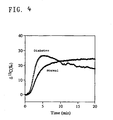
- ⁇ 13 C values ( ⁇ ) increased sharply up to about 5 min after the administration of 1- 13 C-acetic acid, and thereafter remained at an almost constant level up to 20 min.
- ⁇ 13 C values ( ⁇ ) increased sharply up to about 4 min after the administration, but thereafter decreased gradually up to 20 min (Fig. 25).
- the ⁇ 13 C value ( ⁇ ) at 3 min after the administration was 193.09 ⁇ 25.69 ⁇ in the diabetic rats, while the corresponding value was 117.50 ⁇ 8.74 ⁇ in the normal rats.
- the value in the diabetic rats was very significantly (p ⁇ 0.01 (ANOVA with Fischer LSD)) higher than that in the normal rats.
- the slope from 10 to 20 min after the administration was -31.25 ⁇ 13.00 ⁇ /10 min in the diabetic rats, while the corresponding slope was -4.67 ⁇ 8.49 ⁇ /10 min in the normal rats.
- the slope in the diabetic rats was significantly (p ⁇ 0.05 (ANOVA with Fischer LSD)) smaller than that in the normal rats.
- ⁇ 13 C values ( ⁇ ) continued increasing up to 20 min after the administration of 1- 13 C-oleic acid.
- ⁇ 13 C values ( ⁇ ) increased sharply up to about 8 min after the administration, but thereafter decreased gradually up to 20 min (Fig. 26).
- the ⁇ 13 C value ( ⁇ ) at 8 min after the administration was 132.93 ⁇ 7.09 ⁇ in the diabetic rats, while the corresponding value was 86.51 ⁇ 14.72 ⁇ in the normal rats.
- the value in the diabetic rats was very significantly (p ⁇ 0.01 (ANOVA with Fischer LSD)) higher than that in the normal rats.
- the slope from 10 to 20 min after the administration was -12.79 ⁇ 3.72 ⁇ /10 min in the diabetic rats, while the corresponding slope was 13.61 ⁇ 4.58 ⁇ /10 min in the normal rats.
- the slope in the diabetic rats was significantly (p ⁇ 0.001 (ANOVA with Fischer LSD)) smaller than that in the normal rats.
- ⁇ 13 C values ( ⁇ ) continued increasing up to 20 min after the administration of 1- 13 C-palmitic acid.
- ⁇ 13 C values (%0) increased sharply up to about 5 min after the administration, but thereafter decreased gradually up to 20 min (Fig. 27).
- the slope from 10 to 20 min after the administration was -4.40 ⁇ 2.21 ⁇ /10 min in the diabetic rats, while the corresponding slope was 1.43 ⁇ 1.33 ⁇ /10 min in the normal rats.
- the slope in the diabetic rats was very significantly (p ⁇ 0.01 (ANOVA with Fischer LSD)) smaller than that in the normal rats.
- ⁇ 13 C values ( ⁇ ) increased sharply up to about 5 min after the administration of 1- 13 C-octanoic acid, and thereafter remained at an almost constant level up to 20 min.
- ⁇ 13 C values ( ⁇ ) increased sharply up to about 5 min after the administration, but thereafter decreased gradually up to 20 min (Fig. 28).
- the slope from 10 to 20 min after the administration was -20.55 ⁇ 7.75 ⁇ /10 min in the diabetic rats, while the corresponding slope was -4.76 ⁇ 4.41 ⁇ /10 min in the normal rats.
- the slope in the diabetic rats was significantly (p ⁇ 0.05 (ANOVA with Fischer LSD)) smaller than that in the normal rats.
- ⁇ 13 C values ( ⁇ ) continued increasing up to 30 min after the administration of 1,1,1- 13 C-trioctanoin (Fig. 29).
- the ⁇ 13 C value ( ⁇ ) at 20 min after the administration was 150. 72 ⁇ 22.48 ⁇ in the diabetic rats, while the corresponding value was 110.16 ⁇ 16.08 ⁇ in the normal rats.
- the value in the diabetic rats was significantly (p ⁇ 0.05 (ANOVA with Fischer LSD)) higher than that in the normal rats.
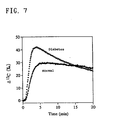
- ⁇ 13 C values ( ⁇ ) continued increasing up to 20 min after the administration of 1,1,1- 13 C-triacetin .
- ⁇ 13 C values ( ⁇ ) increased sharply up to about 8 min after the administration, but thereafter decreased gradually up to 20 min (Fig. 30).
- the ⁇ 13 C value at 4 min after the administration was 41.97 ⁇ 2.79 ⁇ in the diabetic rats, while the corresponding value was 27.29 ⁇ 2.31 ⁇ in the normal rats.
- the value in the diabetic rats was very significantly (p ⁇ 0.01 (ANOVA with Fischer LSD)) higher than that in the normal rats.
- the slope from 6 to 10 min after the administration was -6.26 ⁇ 1.50 ⁇ /4 min in the diabetic rats, while the corresponding slope was - 0.83 ⁇ 0.90 ⁇ /4 min in the normal rats.
- the slope in the diabetic rats was very significantly (p ⁇ 0.01 (ANOVA with Fischer LSD)) smaller than that in the normal rats.
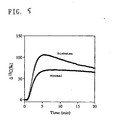
- ⁇ 13 C values ( ⁇ ) continued increasing gradually up to 20 min after the administration of 2- 13 C-glycerol, and thereafter remained at an almost constant level.
- ⁇ 13 C values ( ⁇ ) increased sharply up to about 8 min after the administration, and thereafter increased gradually up to 20 min (Fig. 31).
- the ⁇ 13 C value ( ⁇ ) at 20 min after the administration was 112. 44 ⁇ 5.12 ⁇ in the diabetic rats, while the corresponding value was 54.77 ⁇ 4.23 ⁇ in the normal rats.
- the value in the diabetic rats was very significantly (p ⁇ 0.0001 (ANOVA with Fischer LSD)) higher than that in the normal rats.
- the slope from 2 to 7 min after the administration was 62.72 ⁇ 3.22 ⁇ /5 min in the diabetic rats, while the corresponding slope was 16.99 ⁇ 1.61 ⁇ /5 min in the normal rats.
- the slope in the diabetic rats was very significantly (p ⁇ 0.0001 (ANOVA with Fischer LSD)) greater than that in the normal rats.
Landscapes
- Health & Medical Sciences (AREA)
- Life Sciences & Earth Sciences (AREA)
- Chemical & Material Sciences (AREA)
- Veterinary Medicine (AREA)
- Public Health (AREA)
- General Health & Medical Sciences (AREA)
- Animal Behavior & Ethology (AREA)
- Nuclear Medicine, Radiotherapy & Molecular Imaging (AREA)
- Dispersion Chemistry (AREA)
- Pharmacology & Pharmacy (AREA)
- Epidemiology (AREA)
- Medicinal Chemistry (AREA)
- Optics & Photonics (AREA)
- Physics & Mathematics (AREA)
- Bioinformatics & Cheminformatics (AREA)
- General Chemical & Material Sciences (AREA)
- Radiology & Medical Imaging (AREA)
- Engineering & Computer Science (AREA)
- Organic Chemistry (AREA)
- Chemical Kinetics & Catalysis (AREA)
- Atmospheric Sciences (AREA)
- Obesity (AREA)
- Hematology (AREA)
- Diabetes (AREA)
- Medicines Containing Antibodies Or Antigens For Use As Internal Diagnostic Agents (AREA)
- Investigating Or Analysing Biological Materials (AREA)
- Medicines That Contain Protein Lipid Enzymes And Other Medicines (AREA)
- Acyclic And Carbocyclic Compounds In Medicinal Compositions (AREA)
Claims (11)
- Verbindung zur Verwendung in der Diagnose von Diabetes, die an zumindest einer spezifischen Position mit 13C markiert ist, worin die Verbindung mit 13C markiertes Glycerin ist, das an zumindest einer spezifischen Position mit 13C markiert ist.
- Verbindung nach Anspruch 1, worin das Glycerin 2- 13C-Glycerin ist.
- Diagnosemittel für Diabetes, das eine Verbindung nach einem der vorangegangenen Ansprüche umfasst.
- Verwendung einer Verbindung zur Herstellung eines Mittels zur Diagnose von Diabetes, worin die Verbindung an zumindest einer spezifischen Position mit 13C markiert ist und aus der aus den folgenden (a) und (b) bestehenden Gruppe ausgewählt ist:(a) an zumindest einer spezifischen Position mit 13C markiertes Glycerid und(b) mit 13C markiertes Glycerin, das an zumindest einer spezifischen Position mit 13C markiert ist.
- Verwendung nach Anspruch 4, worin das Glycerid Trioctanoin, Tripalmitin, Triolein oder Triacetin ist.
- Verwendung nach Anspruch 5, worin das Glycerid 1,1,1-13C-Triacetin oder 1,1,1-13C-Trioctanoin ist.
- Verwendung nach Anspruch 4, worin das Glycerin 2-13C-Glycerin ist.
- Verfahren nach einem der Ansprüche 4 bis 7, worin das Mittel zur Diagnose von Diabetes dient, wobei 13C-Mengen in ausgeatmetem CO2 nach Verabreichung des Mittels gemessen werden.
- Verwendung einer Verbindung zur Herstellung eines Mittels zur Diagnose von Diabetes, wobei 13C-Spiegel in ausgeatmetem CO2 nach Verabreichung des Mittels gemessen werden, wobei die Verbindung eine Fettsäure ist, die an zumindest einer spezifischen Position mit 13C markiert ist.
- Verwendung nach Anspruch 9, worin die Fettsäure Essigsäure, Linolsäure, Linolensäure, Octansäure, Ölsäure oder Palmitinsäure ist.
- Verwendung nach Anspruch 10, worin die Fettsäure 1-13C-Essigsäure, 1-13C-Ölsäure, 1-13C-Palmitinsäure oder 1-13C-Octansäure ist.
Applications Claiming Priority (19)
| Application Number | Priority Date | Filing Date | Title |
|---|---|---|---|
| JP28862997 | 1997-10-21 | ||
| JP28862997A JP4007654B2 (ja) | 1997-10-21 | 1997-10-21 | 糖尿病診断剤 |
| JP28852697 | 1997-10-21 | ||
| JP28852697A JP4007653B2 (ja) | 1997-10-21 | 1997-10-21 | 糖尿病診断剤 |
| JP31376397 | 1997-11-14 | ||
| JP31307797 | 1997-11-14 | ||
| JP9313077A JPH11147842A (ja) | 1997-11-14 | 1997-11-14 | 糖尿病診断剤 |
| JP31376397 | 1997-11-14 | ||
| JP32080597 | 1997-11-21 | ||
| JP32080597 | 1997-11-21 | ||
| JP34115497A JP4007659B2 (ja) | 1997-12-11 | 1997-12-11 | 糖尿病診断剤 |
| JP34115497 | 1997-12-11 | ||
| JP641098 | 1998-01-16 | ||
| JP00641098A JP4007663B2 (ja) | 1998-01-16 | 1998-01-16 | 糖尿病診断剤 |
| JP2461498 | 1998-02-05 | ||
| JP02461498A JP4007668B2 (ja) | 1997-11-14 | 1998-02-05 | 糖尿病診断剤 |
| JP2461398 | 1998-02-05 | ||
| JP02461398A JP4007667B2 (ja) | 1997-11-21 | 1998-02-05 | 糖尿病診断剤 |
| EP98308523A EP0913161B1 (de) | 1997-10-21 | 1998-10-19 | Verwendung einer 13C-markierten Aminosäure zur Diagnose von Diabetes |
Related Parent Applications (1)
| Application Number | Title | Priority Date | Filing Date |
|---|---|---|---|
| EP98308523A Division EP0913161B1 (de) | 1997-10-21 | 1998-10-19 | Verwendung einer 13C-markierten Aminosäure zur Diagnose von Diabetes |
Publications (2)
| Publication Number | Publication Date |
|---|---|
| EP1304124A1 EP1304124A1 (de) | 2003-04-23 |
| EP1304124B1 true EP1304124B1 (de) | 2008-03-26 |
Family
ID=27576523
Family Applications (2)
| Application Number | Title | Priority Date | Filing Date |
|---|---|---|---|
| EP98308523A Expired - Lifetime EP0913161B1 (de) | 1997-10-21 | 1998-10-19 | Verwendung einer 13C-markierten Aminosäure zur Diagnose von Diabetes |
| EP03000243A Expired - Lifetime EP1304124B1 (de) | 1997-10-21 | 1998-10-19 | Diagnosemittel für Diabetes, das 13C-markierte Zusammensetzung enthält |
Family Applications Before (1)
| Application Number | Title | Priority Date | Filing Date |
|---|---|---|---|
| EP98308523A Expired - Lifetime EP0913161B1 (de) | 1997-10-21 | 1998-10-19 | Verwendung einer 13C-markierten Aminosäure zur Diagnose von Diabetes |
Country Status (5)
| Country | Link |
|---|---|
| US (1) | US6509002B1 (de) |
| EP (2) | EP0913161B1 (de) |
| CA (1) | CA2250485C (de) |
| DE (2) | DE69812532T2 (de) |
| ES (2) | ES2304472T3 (de) |
Families Citing this family (13)
| Publication number | Priority date | Publication date | Assignee | Title |
|---|---|---|---|---|
| EP1075286A2 (de) | 1998-05-06 | 2001-02-14 | Isotechnika, Inc. | 13c glukose-atemtest zur diagnosis von diabetes |
| US6461870B2 (en) | 1998-05-06 | 2002-10-08 | Isotechnika Inc. | 13C glucose breath test for the diagnosis of diabetic indications and monitoring glycemic control |
| AU5255901A (en) * | 2000-05-02 | 2001-11-12 | Otsuka Pharma Co Ltd | Preparations for evaluating eliminative ability of stomach |
| ITMI20010885A1 (it) * | 2001-04-27 | 2002-10-27 | Eurospital S P A | Metodo per la determinazione di neoplasie gastriche ed esofagee |
| ES2527595T3 (es) | 2005-06-25 | 2015-01-27 | Freie Universität Berlin | Solución acuosa de metacetina 13C |
| WO2007013409A1 (ja) * | 2005-07-25 | 2007-02-01 | Otsuka Pharmaceutical Co., Ltd. | ピリジン代謝能の測定に有用な経口製剤 |
| US8622920B2 (en) * | 2005-11-11 | 2014-01-07 | Exalenz Bioscience Ltd. | Breath test device and method |
| US8512258B2 (en) | 2005-11-11 | 2013-08-20 | Exalenz Bioscience Ltd. | Breath test device and method |
| SG170823A1 (en) * | 2006-04-13 | 2011-05-30 | Otsuka Pharma Co Ltd | Test agent for diagnosing dyspepsia |
| WO2014030650A1 (ja) | 2012-08-20 | 2014-02-27 | 大塚製薬株式会社 | 糖代謝能の測定方法及びそれに使用する組成物 |
| ES2691485T3 (es) * | 2012-10-10 | 2018-11-27 | Stc.Unm | Métodos para el diagnóstico de infecciones bacterianas |
| EP2975400B1 (de) * | 2013-03-15 | 2019-09-04 | Otsuka Pharmaceutical Co., Ltd. | Zusammensetzung zur verwendung in einem verfahren zur messung des zucker- / fettsäureverbrennungsverhältnisses |
| EP3546936A4 (de) * | 2016-11-25 | 2020-08-05 | Otsuka Pharmaceutical Co., Ltd. | Verfahren zur beurteilung des ernährungszustandes |
Family Cites Families (10)
| Publication number | Priority date | Publication date | Assignee | Title |
|---|---|---|---|---|
| US4298347A (en) * | 1980-02-25 | 1981-11-03 | Kor Incorporated | 13 CO2 Breath test |
| US5164308A (en) * | 1990-05-21 | 1992-11-17 | Martek Corporation | Preparation of labelled triglyceride oils by cultivation of microorganisms |
| US5413917A (en) * | 1990-07-18 | 1995-05-09 | Board Of Regents, The University Of Texas System | Method of determining sources of acetyl-CoA under nonsteady-state conditions |
| US5227296A (en) * | 1990-09-25 | 1993-07-13 | Board Of Regents, The University Of Texas System | Enzymatic synthesis of isotopically labeled carbohydrates, nucleotides and citric acid intermediates |
| IL101120A (en) * | 1991-03-08 | 1996-10-31 | Tokyo Gas Co Ltd | Preparation of compounds marked C31 |
| US5834466A (en) * | 1994-12-22 | 1998-11-10 | The Regents Of The University Of California | Method for protecting of heart by limiting metabolic and ionic abnormalities developed during ischemia, following ischemia or resulting from ischemia |
| EP0826377B1 (de) * | 1996-08-27 | 2002-11-06 | Tokyo Gas Co., Ltd. | Diagnostisches Mittel für Diabetes |
| JP3340391B2 (ja) * | 1997-09-11 | 2002-11-05 | 東京瓦斯株式会社 | 肝手術評価用試薬 |
| CA2249173C (en) * | 1997-10-06 | 2008-12-16 | Tokyo Gas Co., Ltd. | Diagnostic agent for liver function |
| EP1075286A2 (de) * | 1998-05-06 | 2001-02-14 | Isotechnika, Inc. | 13c glukose-atemtest zur diagnosis von diabetes |
-
1998
- 1998-10-14 CA CA002250485A patent/CA2250485C/en not_active Expired - Fee Related
- 1998-10-19 ES ES03000243T patent/ES2304472T3/es not_active Expired - Lifetime
- 1998-10-19 DE DE69812532T patent/DE69812532T2/de not_active Expired - Lifetime
- 1998-10-19 EP EP98308523A patent/EP0913161B1/de not_active Expired - Lifetime
- 1998-10-19 EP EP03000243A patent/EP1304124B1/de not_active Expired - Lifetime
- 1998-10-19 ES ES98308523T patent/ES2196501T3/es not_active Expired - Lifetime
- 1998-10-19 DE DE69839314T patent/DE69839314T2/de not_active Expired - Lifetime
- 1998-10-21 US US09/176,246 patent/US6509002B1/en not_active Expired - Fee Related
Also Published As
| Publication number | Publication date |
|---|---|
| EP0913161A2 (de) | 1999-05-06 |
| DE69839314D1 (de) | 2008-05-08 |
| DE69812532T2 (de) | 2003-12-18 |
| EP1304124A1 (de) | 2003-04-23 |
| US6509002B1 (en) | 2003-01-21 |
| DE69812532D1 (de) | 2003-04-30 |
| EP0913161A3 (de) | 2000-08-30 |
| EP0913161B1 (de) | 2003-03-26 |
| ES2304472T3 (es) | 2008-10-16 |
| CA2250485C (en) | 2008-04-29 |
| CA2250485A1 (en) | 1999-04-21 |
| DE69839314T2 (de) | 2009-04-09 |
| ES2196501T3 (es) | 2003-12-16 |
Similar Documents
| Publication | Publication Date | Title |
|---|---|---|
| EP1304125B1 (de) | Diagnostisches Mittel zur Leberfunktion | |
| EP1304124B1 (de) | Diagnosemittel für Diabetes, das 13C-markierte Zusammensetzung enthält | |
| US5916538A (en) | Diagnostic agent for diabetes | |
| Otsuka et al. | Pentobarbital produces dissimilar changes in glucose influx and utilization in brain | |
| US6432382B1 (en) | Measurement of gastric emptying using stable isotopes | |
| JP4007653B2 (ja) | 糖尿病診断剤 | |
| EP0908187A1 (de) | Reagenz zur Auswertung einer Leberoperation | |
| JP4007659B2 (ja) | 糖尿病診断剤 | |
| JP4007668B2 (ja) | 糖尿病診断剤 | |
| JP4007663B2 (ja) | 糖尿病診断剤 | |
| JP4007654B2 (ja) | 糖尿病診断剤 | |
| JP4007647B2 (ja) | 肝機能診断剤 | |
| JP4007660B2 (ja) | 肝機能診断剤 | |
| JP3825098B2 (ja) | 糖尿病診断剤 | |
| JPH11147842A (ja) | 糖尿病診断剤 | |
| JP3862366B2 (ja) | 肝機能診断剤 | |
| USRE38575E1 (en) | Diagnostic method for diabetes using C-13 labeled pyruvic acid | |
| JP2680861B2 (ja) | 診断剤 | |
| JPH1067689A (ja) | 糖尿病診断剤 | |
| JP4007649B2 (ja) | 肝機能診断剤 | |
| JPH11209309A (ja) | 糖尿病診断剤 | |
| JPH09323942A (ja) | 肝機能診断剤 | |
| JPH11116504A (ja) | 肝機能診断剤 |
Legal Events
| Date | Code | Title | Description |
|---|---|---|---|
| PUAI | Public reference made under article 153(3) epc to a published international application that has entered the european phase |
Free format text: ORIGINAL CODE: 0009012 |
|
| 17P | Request for examination filed |
Effective date: 20030127 |
|
| AC | Divisional application: reference to earlier application |
Ref document number: 0913161 Country of ref document: EP Kind code of ref document: P |
|
| AK | Designated contracting states |
Designated state(s): DE ES FR GB IT SE |
|
| AKX | Designation fees paid |
Designated state(s): DE ES FR GB IT SE |
|
| 17Q | First examination report despatched |
Effective date: 20040226 |
|
| GRAP | Despatch of communication of intention to grant a patent |
Free format text: ORIGINAL CODE: EPIDOSNIGR1 |
|
| GRAS | Grant fee paid |
Free format text: ORIGINAL CODE: EPIDOSNIGR3 |
|
| GRAA | (expected) grant |
Free format text: ORIGINAL CODE: 0009210 |
|
| AC | Divisional application: reference to earlier application |
Ref document number: 0913161 Country of ref document: EP Kind code of ref document: P |
|
| AK | Designated contracting states |
Kind code of ref document: B1 Designated state(s): DE ES FR GB IT SE |
|
| REG | Reference to a national code |
Ref country code: GB Ref legal event code: FG4D |
|
| REF | Corresponds to: |
Ref document number: 69839314 Country of ref document: DE Date of ref document: 20080508 Kind code of ref document: P |
|
| REG | Reference to a national code |
Ref country code: SE Ref legal event code: TRGR |
|
| REG | Reference to a national code |
Ref country code: ES Ref legal event code: FG2A Ref document number: 2304472 Country of ref document: ES Kind code of ref document: T3 |
|
| ET | Fr: translation filed | ||
| PLBE | No opposition filed within time limit |
Free format text: ORIGINAL CODE: 0009261 |
|
| STAA | Information on the status of an ep patent application or granted ep patent |
Free format text: STATUS: NO OPPOSITION FILED WITHIN TIME LIMIT |
|
| 26N | No opposition filed |
Effective date: 20081230 |
|
| PGFP | Annual fee paid to national office [announced via postgrant information from national office to epo] |
Ref country code: DE Payment date: 20101013 Year of fee payment: 13 |
|
| PGFP | Annual fee paid to national office [announced via postgrant information from national office to epo] |
Ref country code: IT Payment date: 20101021 Year of fee payment: 13 Ref country code: GB Payment date: 20101013 Year of fee payment: 13 |
|
| PGFP | Annual fee paid to national office [announced via postgrant information from national office to epo] |
Ref country code: ES Payment date: 20111021 Year of fee payment: 14 Ref country code: FR Payment date: 20111103 Year of fee payment: 14 Ref country code: SE Payment date: 20111011 Year of fee payment: 14 |
|
| GBPC | Gb: european patent ceased through non-payment of renewal fee |
Effective date: 20121019 |
|
| REG | Reference to a national code |
Ref country code: FR Ref legal event code: ST Effective date: 20130628 |
|
| PG25 | Lapsed in a contracting state [announced via postgrant information from national office to epo] |
Ref country code: SE Free format text: LAPSE BECAUSE OF NON-PAYMENT OF DUE FEES Effective date: 20121020 Ref country code: DE Free format text: LAPSE BECAUSE OF NON-PAYMENT OF DUE FEES Effective date: 20130501 Ref country code: GB Free format text: LAPSE BECAUSE OF NON-PAYMENT OF DUE FEES Effective date: 20121019 |
|
| REG | Reference to a national code |
Ref country code: DE Ref legal event code: R119 Ref document number: 69839314 Country of ref document: DE Effective date: 20130501 |
|
| PG25 | Lapsed in a contracting state [announced via postgrant information from national office to epo] |
Ref country code: FR Free format text: LAPSE BECAUSE OF NON-PAYMENT OF DUE FEES Effective date: 20121031 Ref country code: IT Free format text: LAPSE BECAUSE OF NON-PAYMENT OF DUE FEES Effective date: 20121019 |
|
| REG | Reference to a national code |
Ref country code: ES Ref legal event code: FD2A Effective date: 20140207 |
|
| PG25 | Lapsed in a contracting state [announced via postgrant information from national office to epo] |
Ref country code: ES Free format text: LAPSE BECAUSE OF NON-PAYMENT OF DUE FEES Effective date: 20121020 |