EP1291047B1 - Spielsystem, Puzzlespielprogramm und Aufzeichungsmedium für Programm - Google Patents
Spielsystem, Puzzlespielprogramm und Aufzeichungsmedium für Programm Download PDFInfo
- Publication number
- EP1291047B1 EP1291047B1 EP02018236A EP02018236A EP1291047B1 EP 1291047 B1 EP1291047 B1 EP 1291047B1 EP 02018236 A EP02018236 A EP 02018236A EP 02018236 A EP02018236 A EP 02018236A EP 1291047 B1 EP1291047 B1 EP 1291047B1
- Authority
- EP
- European Patent Office
- Prior art keywords
- game
- puzzle
- block
- blocks
- tilt
- Prior art date
- Legal status (The legal status is an assumption and is not a legal conclusion. Google has not performed a legal analysis and makes no representation as to the accuracy of the status listed.)
- Expired - Lifetime
Links
- 230000033001 locomotion Effects 0.000 claims description 36
- 230000001133 acceleration Effects 0.000 claims description 28
- 230000009466 transformation Effects 0.000 claims description 20
- 238000001514 detection method Methods 0.000 claims description 10
- 238000000034 method Methods 0.000 description 83
- 230000008569 process Effects 0.000 description 72
- 238000012545 processing Methods 0.000 description 35
- 238000013500 data storage Methods 0.000 description 18
- 230000008859 change Effects 0.000 description 10
- 238000000844 transformation Methods 0.000 description 9
- 238000007792 addition Methods 0.000 description 6
- 238000010586 diagram Methods 0.000 description 5
- 230000004044 response Effects 0.000 description 4
- 230000009471 action Effects 0.000 description 3
- 238000004891 communication Methods 0.000 description 3
- 238000004090 dissolution Methods 0.000 description 3
- 238000004880 explosion Methods 0.000 description 3
- 230000006870 function Effects 0.000 description 3
- KRQUFUKTQHISJB-YYADALCUSA-N 2-[(E)-N-[2-(4-chlorophenoxy)propoxy]-C-propylcarbonimidoyl]-3-hydroxy-5-(thian-3-yl)cyclohex-2-en-1-one Chemical compound CCC\C(=N/OCC(C)OC1=CC=C(Cl)C=C1)C1=C(O)CC(CC1=O)C1CCCSC1 KRQUFUKTQHISJB-YYADALCUSA-N 0.000 description 2
- 239000003086 colorant Substances 0.000 description 2
- 238000011161 development Methods 0.000 description 2
- 230000018109 developmental process Effects 0.000 description 2
- 241000271460 Crotalus cerastes Species 0.000 description 1
- 230000003213 activating effect Effects 0.000 description 1
- 230000004913 activation Effects 0.000 description 1
- 230000006978 adaptation Effects 0.000 description 1
- 238000004364 calculation method Methods 0.000 description 1
- 239000002775 capsule Substances 0.000 description 1
- 238000012937 correction Methods 0.000 description 1
- 230000001186 cumulative effect Effects 0.000 description 1
- 230000000694 effects Effects 0.000 description 1
- 239000004973 liquid crystal related substance Substances 0.000 description 1
- 239000000463 material Substances 0.000 description 1
- 238000012986 modification Methods 0.000 description 1
- 230000004048 modification Effects 0.000 description 1
- 230000003252 repetitive effect Effects 0.000 description 1
- 230000000630 rising effect Effects 0.000 description 1
Images





Classifications
-
- A—HUMAN NECESSITIES
- A63—SPORTS; GAMES; AMUSEMENTS
- A63F—CARD, BOARD, OR ROULETTE GAMES; INDOOR GAMES USING SMALL MOVING PLAYING BODIES; VIDEO GAMES; GAMES NOT OTHERWISE PROVIDED FOR
- A63F13/00—Video games, i.e. games using an electronically generated display having two or more dimensions
- A63F13/20—Input arrangements for video game devices
- A63F13/21—Input arrangements for video game devices characterised by their sensors, purposes or types
- A63F13/211—Input arrangements for video game devices characterised by their sensors, purposes or types using inertial sensors, e.g. accelerometers or gyroscopes
-
- A—HUMAN NECESSITIES
- A63—SPORTS; GAMES; AMUSEMENTS
- A63F—CARD, BOARD, OR ROULETTE GAMES; INDOOR GAMES USING SMALL MOVING PLAYING BODIES; VIDEO GAMES; GAMES NOT OTHERWISE PROVIDED FOR
- A63F13/00—Video games, i.e. games using an electronically generated display having two or more dimensions
- A63F13/50—Controlling the output signals based on the game progress
- A63F13/52—Controlling the output signals based on the game progress involving aspects of the displayed game scene
-
- A—HUMAN NECESSITIES
- A63—SPORTS; GAMES; AMUSEMENTS
- A63F—CARD, BOARD, OR ROULETTE GAMES; INDOOR GAMES USING SMALL MOVING PLAYING BODIES; VIDEO GAMES; GAMES NOT OTHERWISE PROVIDED FOR
- A63F9/00—Games not otherwise provided for
- A63F9/06—Patience; Other games for self-amusement
- A63F9/10—Two-dimensional jig-saw puzzles
-
- A—HUMAN NECESSITIES
- A63—SPORTS; GAMES; AMUSEMENTS
- A63F—CARD, BOARD, OR ROULETTE GAMES; INDOOR GAMES USING SMALL MOVING PLAYING BODIES; VIDEO GAMES; GAMES NOT OTHERWISE PROVIDED FOR
- A63F13/00—Video games, i.e. games using an electronically generated display having two or more dimensions
- A63F13/90—Constructional details or arrangements of video game devices not provided for in groups A63F13/20 or A63F13/25, e.g. housing, wiring, connections or cabinets
- A63F13/92—Video game devices specially adapted to be hand-held while playing
-
- A—HUMAN NECESSITIES
- A63—SPORTS; GAMES; AMUSEMENTS
- A63F—CARD, BOARD, OR ROULETTE GAMES; INDOOR GAMES USING SMALL MOVING PLAYING BODIES; VIDEO GAMES; GAMES NOT OTHERWISE PROVIDED FOR
- A63F2300/00—Features of games using an electronically generated display having two or more dimensions, e.g. on a television screen, showing representations related to the game
- A63F2300/10—Features of games using an electronically generated display having two or more dimensions, e.g. on a television screen, showing representations related to the game characterized by input arrangements for converting player-generated signals into game device control signals
- A63F2300/1006—Features of games using an electronically generated display having two or more dimensions, e.g. on a television screen, showing representations related to the game characterized by input arrangements for converting player-generated signals into game device control signals having additional degrees of freedom
-
- A—HUMAN NECESSITIES
- A63—SPORTS; GAMES; AMUSEMENTS
- A63F—CARD, BOARD, OR ROULETTE GAMES; INDOOR GAMES USING SMALL MOVING PLAYING BODIES; VIDEO GAMES; GAMES NOT OTHERWISE PROVIDED FOR
- A63F2300/00—Features of games using an electronically generated display having two or more dimensions, e.g. on a television screen, showing representations related to the game
- A63F2300/10—Features of games using an electronically generated display having two or more dimensions, e.g. on a television screen, showing representations related to the game characterized by input arrangements for converting player-generated signals into game device control signals
- A63F2300/105—Features of games using an electronically generated display having two or more dimensions, e.g. on a television screen, showing representations related to the game characterized by input arrangements for converting player-generated signals into game device control signals using inertial sensors, e.g. accelerometers, gyroscopes
-
- A—HUMAN NECESSITIES
- A63—SPORTS; GAMES; AMUSEMENTS
- A63F—CARD, BOARD, OR ROULETTE GAMES; INDOOR GAMES USING SMALL MOVING PLAYING BODIES; VIDEO GAMES; GAMES NOT OTHERWISE PROVIDED FOR
- A63F2300/00—Features of games using an electronically generated display having two or more dimensions, e.g. on a television screen, showing representations related to the game
- A63F2300/20—Features of games using an electronically generated display having two or more dimensions, e.g. on a television screen, showing representations related to the game characterised by details of the game platform
- A63F2300/204—Features of games using an electronically generated display having two or more dimensions, e.g. on a television screen, showing representations related to the game characterised by details of the game platform the platform being a handheld device
-
- A—HUMAN NECESSITIES
- A63—SPORTS; GAMES; AMUSEMENTS
- A63F—CARD, BOARD, OR ROULETTE GAMES; INDOOR GAMES USING SMALL MOVING PLAYING BODIES; VIDEO GAMES; GAMES NOT OTHERWISE PROVIDED FOR
- A63F2300/00—Features of games using an electronically generated display having two or more dimensions, e.g. on a television screen, showing representations related to the game
- A63F2300/60—Methods for processing data by generating or executing the game program
- A63F2300/66—Methods for processing data by generating or executing the game program for rendering three dimensional images
Definitions
- the present invention relates to a storage medium storing a puzzle game program for causing a game system to function as a puzzle game.
- Techniques 1 to 3 may be classified as puzzle games concerning dropping objects (dropping-object games), where objects such as blocks or capsules appear to fall down from the top of the game screen, and are operated by a player while they are falling so as to land in particular positions which cannot be changed once the objects have landed and piled up.
- the idea behind the dropping-object games of Techniques 1 to 3 is, by resourcefully changing where to pile up the objects, the player can make sure that objects form a contiguous horizontal row, or any line or chain of a predetermined number of objects; as a result, such objects disappear and any other objects which were present above the disappeared objects shift downwards. The number of erased lines or objects may be counted into the score. If the objects pile up to a certain height as a result of mis-operation or mis-planning on the player's part, the game is over.
- Technique 4 embodies a game where panels of different attributes such as colors or textures rise from the bottom, whose positions can be switched along a vertical or horizontal direction by the operations of a player, such that once a certain number (or more) of panels of the same attribute are present along a vertical or horizontal direction, such panels disappear, until the panels reach a threshold height, at which time the game is over.
- the only input device which is controllable by the player to execute game operations, including switching or addition of blocks, is the button(s) provided on the game apparatus.
- the button(s) provided on the game apparatus.
- new blocks are added (whether falling or rising) into the game screen, such additional blocks will only come from a fixed direction. Therefore, simply by repeatedly playing the puzzle game, a player may eventually become able to formulate some sort of strategy for erasing blocks, and advance the game so as to be able to erase as many blocks as possible with each single operation.
- the only input means for conveying the intentions of a player is the operation switch(es) provided on a controller for the game machine. Therefore, there is a problem in that the game operation may become monotonous, thus detracting from the fun of game playing and reducing the sense of involvement. Moreover, any change in the displayed images (hereinafter referred to as "image transformation") occurs based on the user's operation on the puzzle elements using the controller. Since any changes will occur in predictable and non-accidental manners, the game play may become monotonous and boring.
- the invention is directed to a storage medium storing a puzzle game program for causing a game system to function as a puzzle game as defined in the claim.
- the storage medium may be constructed so as to be detachable from the game apparatus as shown in FIG. 1, and the tilt detection section is integrally formed in the storage medium. Thus, by exchanging the storage medium, it becomes possible to play different games.
- the puzzle game can also be played in a game system where the program is provided in the form of a removable storage medium.
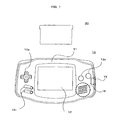
- FIG. 1 is a plan view illustrating a game system according to the present invention.
- the game system comprises a game apparatus 10 and an external storage medium 30, such as a memory cartridge.
- the game apparatus 10 is a portable game machine of a size adequate for being held in both hands of a player. By exchanging the detachable external storage medium 30, it is possible to play different games on the game apparatus 10.
- the game apparatus 10 includes an oblong housing 11.
- a liquid crystal display (LCD) device 12 is formed in an approximate center of one of the principal faces (i.e., the surface shown in FIG. 1) of the housing 11.
- operation members in the form of operation switches 13 are provided on the right and left sides of the LCD 12.
- the operation switches 13 may include, for example, a direction switch 13a, an action switch 13b, and a start/select buttons 13c.
- the direction switch 13a is used to instruct a direction in which to move a game character (e.g., a block or puzzle element).
- the action switch 13b is used to instruct a particular action which the player wants a game character to undergo.
- the start/select buttons 13c is used to begin game playing or to interrupt game operation.
- the game content as processed by the game apparatus 10 is projected by the LCD 12. As the player operates on the various operation switches 13, the displayed image will change accordingly.
- the game apparatus 10 may have a connector 15 on one side of the game apparatus 10, and a loudspeaker 16 underneath a sound hole, the connector 15 being used for connection with another game apparatus 10 to play an on-line game other users.
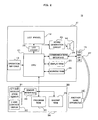
- FIG. 2 is a block diagram illustrating the game machine 10 and the external storage medium 30 storing the puzzle game program according to the present invention.
- the game machine 10 includes a CPU 21.
- the CPU 21 performs game processing in accordance with a program stored in the program ROM 34, which in turn is within the external storage medium 30.
- Connected to the CPU 21 are an LCD driver 22, a sound generation circuit 23, a communication interface 24, a display RAM 25 and a working RAM (hereinafter abbreviated as a "WRAM") 26.
- the sound generation circuit 23 converts sound data which is generated in connection with the game processing of the game by the CPU 21 into an analog signal, so as to output game music or sound effects through the loudspeaker 16.
- Image data to be displayed on the LCD 12 is written to the display RAM 25 so as to be temporarily stored therein, and then displayed via the LCD driver 22.
- Data which is used by the CPU 21 for game processing is loaded onto the WRAM 26, which stores any data generated during the game processing in an updating fashion.
- the communication interface 24 is used for the game apparatus 10 to communicate (or exchange data) with another game apparatus 10' for playing an on-line game.
- the communication interface 24 is connected to the other game machine 10' via the connector 15 and a cable 27.
- the external storage medium 30 includes an X/Y axes acceleration sensor 31, a Z axis contact switch 32, a sensor interface 33, the program ROM 34, and a backup RAM 35.
- the X/Y axes acceleration sensor 31 detects acceleration in an X axis direction as well as acceleration in a Y axis direction.
- the Z axis contact switch 32 senses the vibration of the game machine 10 as it is shaken along a perpendicular direction.
- the sensor interface 33 sends the results of detection by the X/Y axes acceleration sensor 31 or the Z axis contact switch 32 to the CPU 21 of the game machine 10.
- the program ROM 34 stores the puzzle game program according to the present invention in a non-volatile manner.
- the backup RAM 35 which may be implemented as a flash memory, is a memory which enables writing or reading of data concerning a game currently under playing.
- the program ROM 34, the X/Y axes acceleration sensor 31, and the Z axis contact switch 32 may be internalized in the game apparatus 10.
- the present invention is also applicable to a non-hand-held type video game machine which is connected to a home-use television set (CRT), for example.
- the operation switch 13, the X/Y axes acceleration sensor 31, and the Z axis contact switch 32 may be provided on a separate controller or game pad for the game machine, instead of being formed on the housing 11 in an integral manner.
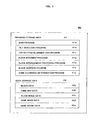
- FIG. 3 shows a memory map 40 used by the game apparatus 10.
- the memory map 40 exemplifies a memory map during the operation of the game program, with reference to both the WRAM 26 in the game apparatus 10 and the program ROM 34 in the external storage medium 30.
- the memory map 40 includes a program storage area 41 and a data storage area 42.
- the program storage area 41 includes a main program storage area 41a, a tilt detection program storage area 41b, a top/bottom determination program storage area 41c, a block movement program storage area 41d, a block arrangement processing program storage area 41e, a block addition program storage area 41f, and a game clearance determination program storage area 41g.
- the main program storage area 41a is an area for storing a main program which has a central function in the game program, e.g., activating a game program in the game apparatus 10, processing operational inputs from a player, and performing image processing.
- the tilt detection program storage area 41b is an area for storing a program which detects a direction (hereinafter referred to as a "tilt direction") in which the game apparatus 10 is being tilted by the player based on an output from the X/Y axes acceleration sensor 31.
- the top/bottom determination program area 41c is an area for storing a program which determines and sets a "top” and a "bottom” of the puzzle game (which in the present example correspond to, respectively, a point where puzzle elements start falling and a point where puzzle elements land in the displayed image), based on the tilt direction of the game apparatus 10.
- the block movement program area 41d is an area for storing a program responsible for the processing concerning falling movements of puzzle elements in the puzzle game as displayed on the LCD 12 in the present example.
- the block arrangement processing program storage area 41e is an area for storing a program which examines the attributes of each of a plurality of puzzle elements displayed in the puzzle game, and upon detecting a predetermined regularity in the arrangement of the puzzle elements, causes an image transformation by erasing the puzzle elements or combining puzzle elements, for example.
- the block addition program area 41f is an area for storing a program which introduces additional puzzle elements within the displayed image on the LCD 12 in order to enhance excitement of the puzzle game. For example, the player may press the operation switch 13b to cause some blocks to be added from the top of the display screen 12.
- the game clearance determination program storage area 41g is an area for storing a program which examines a clearance condition for the puzzle game, e.g., whether or not a predetermined number of puzzle elements have been erased, to determine a game clearance if the predetermined number of puzzle elements have been erased.
- the data storage area 42 includes a block data storage area 42a, a game map data storage area 42b, a block image data storage area 42c, a game image data storage area 42d, and a game sound data storage area 42e.
- the block data storage area 42a is an area for storing the individual blocks such as puzzle elements and background blocks, including regions to be displayed on the LCD 12, to be used in the map of the puzzle game. More specifically, the block data storage area 42a includes an area in which image data for blocks is designated and an area for storing attribute data.
- the game map data storage area 42b is an area for storing game map data, i.e., data concerning a map on which the puzzle game takes place. More specifically, the game map data storage area 42b stores data concerning where on the map the puzzle elements exist, and where on the map no puzzle elements exist but only a background is being displayed.
- the block image data storage area 42c is an area for storing actual color data concerning the puzzle elements and background blocks. More specifically, it is the data stored in the area 42c that is transferred to the display RAM 25 so as to be displayed on the LCD 12.
- the game image data storage area 42d is an area for storing data for displaying various images used in the main program, other than the block data concerning the puzzle elements and background blocks.
- the game sound data storage area 42e is an area for storing sound data used for various programs stored in the program storage area 41.
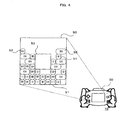
- FIG. 4 an outline of the puzzle game according to the present invention will be described.
- a displayed image 50 of the puzzle game is displayed on the LCD 12.
- the puzzle elements 51 are blocks (also referred to as “erasable blocks” herein) which are to be erased when they take a predetermined arrangement.
- the present example illustrates a case where the puzzle elements 51 may have four kinds of attributes, e.g., "I”, “II”, "III”, and "IV".
- an "attribute" of a puzzle element is an identifier defining the character, look, etc., of the puzzle element, as distinguished in terms of colors, names, and/or shapes, etc.
- the present example illustrates an exemplary puzzle game in which a plurality of puzzle elements 51 taking a predetermined arrangement are erased and disappear.
- the "predetermined arrangement” may be a contiguous sequence or line consisting of a certain number of puzzle elements 51 of the same attribute, or any predetermined pattern (e.g., a checker pattern) consisting of a number of puzzle elements 51 of different attributes, and so on.
- the following description will be directed to the case where the "predetermined arrangement” is defined as a contiguous sequence consisting of a certain number of puzzle elements 51 of the same attribute.
- the plurality of puzzle elements 51 shown in the displayed image 50 are moved in the tilt direction. If the displayed state after the movement is such that three or more contiguous puzzle elements 51 of the same attribute (I), (II) or (III) are present, such puzzle elements 51 are erased.
- the idea of the game is to try to erase as many puzzle elements 51 as possible within a predetermined period of time by repeatedly performing such operations and processing.
- each disturber block 52 has an attribute which is different from that of the erasable puzzle elements (erasable blocks) 51, and may appear at a randomly selected coordinate position or move into the displayed image in a specific direction.
- the disturber blocks 52 although moved similarly to the puzzle elements 51 in accordance with the tilt of the game apparatus 10, serve to prevent puzzle elements 51 of the same attribute from being favorably aligned.
- Each obstacle block 53 is a block which is displayed at a specific coordinate position in the displayed image in a stationary manner; that is, the obstacle blocks 53 will not move even if the game apparatus 10 is tilted.
- any of the puzzle elements 51 on the display screen 12 that is neighbored by a vacancy (i.e., a blank block) to the right is moved right.
- the puzzle elements 56 (IV, III, IV) in the second row from the bottom will be moved right by one block each
- the puzzle elements 51 (IV, II) in the third row from the bottom will be moved right by two blocks each
- the puzzle element 51(III) in the fourth row from the bottom will be moved right by three blocks.
- the acceleration sensor 31 detects a tilt in the left direction (hereinafter referred to as a "left tilt"), as indicated in the displayed image 55L, the puzzle elements 51 (IV, III, IV) in the second row from the bottom, the puzzle elements 51 (IV, II) in the third row from the bottom, and the puzzle element 51 (III) in the fourth row from the bottom will be all moved left by one block each.
- the results of these movements are as follows. Since the lowest three puzzle elements 51 in the leftmost column are of the same attribute "IV" (as indicated within a solid-line box in a displayed image 55L), the predetermined number of puzzle elements 51 of the same attribute "IV" are erased (i.e.
- vacancies or blank blocks are displayed instead), as further indicated in a displayed image 55L-1. Thereafter, the puzzle elements 51 which existed on the right of the predetermined number of puzzle elements 51 of the attribute "IV" (now erased) are moved left to result in a displayed image 55L-2.
- the game apparatus 10 may be tilted in any other direction.
- the puzzle elements 51 when the game apparatus 10 is tilted in the top direction (hereinafter referred to as a "top tilt"), the puzzle elements 51 will be moved as indicated in a displayed image 55U.
- the puzzle elements 51 When the game apparatus 10 is tilted in the bottom direction (hereinafter referred to as a "bottom tilt”), the puzzle elements 51 will be moved as indicated in a displayed image 55D.
- no puzzle elements 51 are erased because there is no alignment of the predetermined number of puzzle elements 51 of the same attribute.
- one or more puzzle elements 51 are moved in the tilt direction of the game apparatus 10. Such movements of puzzle elements according to the tilt of the game apparatus 10 are repeated until the game is cleared, i.e., until there is no more alignment of the predetermined number (or more) of puzzle elements 51 of any single attribute within the displayed image 50 (e.g., each alignment of puzzle elements 51 of any single attribute from "I” to "IV” is equal to or less than two elements long in this exemplary case).
- the player needs to devise strategies as to how to erase as many puzzle elements as possible by taking into consideration the order of tilting the game apparatus 10 in the up, down, right, or left direction, which can be interesting.
- the above example illustrates a case where plural puzzle elements 51 are already present in the displayed image 50 in an initial state which exists at the start.
- the entire displayed image may be kept in a vacant state (i.e., no puzzle elements of any attribute are displayed) until the game apparatus 10 is tilted (optionally followed by the activation of one of the operation switches 13) or an impact is applied to the game apparatus 10.
- a large number of puzzle elements to be displayed in the initial image may be randomly generated so as to be stacked up in the opposite direction to the tilt direction.
- any other type of image transformation i.e., change in the displayed state
- a predetermined number of aligned puzzle elements of the same attribute may be transformed into a bomb block (B), and the resultant bomb block may proceed to explode the neighboring disturber blocks 52 and/or obstacle blocks 53.
- a predetermined number of aligned puzzle elements of the same attribute may be transformed into one large block (or a "combined block"), and the size of such a combined block (or the number of blocks corresponding to such a combined block) may be counted into the points won by the player.
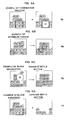
- a block combination process may be performed so as to convert a group of four (2 ⁇ 2) adjoining puzzle elements 51 of a given attribute (e.g., "I" in the example shown) into one large block (V) (as indicated within a solid-line box).
- a block attribute change process may be performed so as to covert any puzzle elements ((III) and (I)) interposed between disturber blocks (D) are converted into bomb blocks (B).
- a block dissolution process may be performed, in response to an operation of one of the operation switches 13 by the player, so as to disrupt a large-sized puzzle element 51 (of attribute "V") into smaller puzzle elements 51 of any arbitrary attribute (e.g., attribute "III”).
- a block explosion process may be performed such that a square box centered around a bomb block (B) is exploded so as to disappear and become vacant, thereby allowing the other puzzle elements around the exploded puzzle elements to move in accordance with the tilt. It will be appreciated that these image transformations are only exemplary; any other types of image transformation may also be realized.
- additional blocks such as new puzzle elements (erasable blocks) 51 and/or disturber blocks 52, are generated within a displayed image 50 on the display screen 12.
- additional blocks may be introduced in response to an operation of one of the operation switches 13 by the player, or after the lapse of a predetermined period of time as timed by a timer which is set off upon detection of a tilt of the game apparatus 10.
- additional puzzle elements may be introduced based on both an operation of a predetermined operation switch and the lapse of a predetermined period of time.
- additional blocks may be displayed in such a manner that additional blocks 57 are generated on the left side (LEFT) of the screen in response to a right tilt of the game apparatus 10.
- the attribute data e.g., attributes "D", “vacant”, “D”, “I”, “II” as from the top of the displayed image exemplified in FIG. 7
- the blocks i.e., puzzle elements and/or disturber blocks
- a data storage area e.g., the work RAM 26
- additional blocks 57 are added from the right side (RIGHT) of the screen.
- additional blocks 57 are added from the bottom side (BOTTOM) of the screen.
- additional blocks 57 are added from the top side (TOP) of the screen.
- the positions at which to introduce additional blocks are not limited to the opposite side of the direction of the tilt applied to the game apparatus 10.
- additional blocks may be introduced from any arbitrary position associated with the tilt direction.
- the plurality of puzzle elements are moved right so as to pile up from the right end and rise toward the left direction, as indicated in a displayed image 60R.
- the additional blocks which were prepared on the opposite end, i.e., the left end are added and moved right so as to fill the vacancies, resulting in a displayed image 60R-1.
- the plurality of puzzle elements are moved down so as to pile up from the bottom end and rise toward the top direction, as indicated in a displayed image 60D.
- the additional blocks which were prepared on the opposite end, i.e., the top end are added and moved down so as to fill the vacancies, resulting in a displayed image 60D-1.
- the plurality of puzzle elements are moved up so as to pile up from the top end and rise toward the bottom direction, as indicated in a displayed image 60U.
- the additional blocks which were prepared on the opposite end, i.e., the bottom end are added and moved up so as to fill the vacancies, resulting in a displayed image 60U-1.
- the predetermined number (three) of aligned puzzle elements of the attribute "I” are erased. Then, the puzzle elements which were on the bottom side of the predetermined number of aligned puzzle elements of the attribute "I" are moved further up to result in a displayed image 60U-2.
- the above example illustrates image transformations each resulting from one tilt of the game apparatus 10 in the up, down, right, or left direction from the initial state (i.e., the displayed image 60).
- the initial state i.e., the displayed image 60.
- the image transformations in such cases can be understood as combinations of the above-described processes associated with the respective tilts.
- the puzzle game may be arranged so that no additional blocks 54 are added until the game apparatus 10 is tilted.
- the initial displayed image 50 described above is illustrated to already include a large number of puzzle elements 51 within the displayed image, the puzzle game may instead be arranged so that the displayed image is kept vacant until a tilt is applied and that a predetermined number of erasable blocks are stacked up on the side toward which the tilt is made only after the application of a tilt.
- the displayed image may be kept vacant until an operation of one of the operation switches 13 is made by the player, and a predetermined number of additional blocks may be stacked up on the side toward which the tilt is made as soon as an input is made by means of the operation switch 13.
- a predetermined number of additional blocks may be stacked up on the side toward which the tilt is made as soon as an input is made by means of the operation switch 13.
- FIG. 9 is a diagram illustrating the relationship between the data storage area 42 and actual picture data used in game processing, in connection with the memory map described with reference to FIG. 3.
- the game map 70 on which the game takes place is divided into blocks. Each block is referenced in terms of a set of coordinates (X, Y).
- the game map 70 is designed so as to include an extra area on each of the four sides of the displayed image which is to be actually displayed on the display screen 12 of the game apparatus, each extra area being one block wide.
- the reason why a space for adding additional blocks is prepared on every one of the four sides of the displayed image is because the position at which blocks are added will vary depending on the tilt direction, as shown in FIG. 8.
- the solid-line frame (5 ⁇ 5 blocks) on the game map 70 defines the actually displayed area.
- the coordinate values are assigned in the following manner in the present example.
- a maximum value xmax of x coordinate values is set to correspond to just within the right side border line (as shown by FIG. 9) of the displayed image.
- a maximum value ymax of y coordinate values is set to be within the extra area for additional blocks, above the top border line (as shown by FIG. 9) of the displayed image.
- a block 82 has coordinates (-1,
- One unit of attribute data comprises a block number 85, role data 86, moving direction attribute data 87, and a blank flag 88.
- the block number 85 is data representing an address in the block image data storage area 42c used for displaying an image of the associated block.
- the role data 86 represents a role of the block, whether it is an erasable block, a disturber block, or the like.
- the moving direction attribute data 87 represents a direction in which to move the block relative to the tilt direction of the game apparatus 10.
- the blank flag 88 is used for an erasure process for the block.
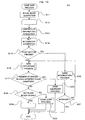
- FIG. 10 shows a flowchart 80 of a main program used in a puzzle game according to the present invention.
- the puzzle game according to the present invention is basically executed by repeating the processing between steps 12 and 19 shown in FIG. 10.
- an initial image to be displayed at the time the game is started i.e. , before the game apparatus 10 is tilted
- An example of the initial image may be the displayed image 50 shown in FIG. 5.
- Various methods for generating the initial image are possible.
- an initial image may be automatically displayed after the game is started, or once a tilt occurs in a certain direction, blocks may fall or rise from a direction corresponding to the tilt.
- the trigger for displaying such an initial image is not limited to a tilt, but may be an operation of one of the operation switches 13 by a player.
- step S13 operation information concerning whether or not the player has operated one of the operation switches 13 of the game apparatus 10 is obtained.
- step S14 information concerning the tilt direction, i.e., the direction of tilt being applied by the player to the game apparatus 10, is obtained from the X/Y axes acceleration sensor 31. The specific method for ascertaining tilt direction based on the output from the acceleration sensor 31 will be described later.
- step S15 it is detected whether the start button 14 of the game apparatus 10 is pressed or not. If the start button is not pressed, control proceeds to a game operation process at step S16.
- step S16 the player performs a game operation to erase an erasable block(s) 51.
- step S17 the cumulative number of erased blocks is checked. If it is determined based on this number that the game has not been cleared at step S17, control proceeds to step S18 to determine whether any blank blocks exist in the game map. If no blank blocks exist on the game map, it is confirmed that the blocks are now stuck in a certain direction within the displayed image, i.e., it is no longer possible to continue the game playing. If any blank blocks are present on the game map, it is still possible to continue the game playing, and therefore control proceeds to step S19 to repeat the above-described game processing.
- step S15 if it is determined at step S15 that the start button is pressed, then the game processing is interrupted at step S20. Then, the player is allowed to choose whether or not to interrupt the game at step S21. If the player chooses to interrupt the game, the game is interrupted. If the player does not choose to interrupt the game, control proceeds to step S16 to continue game processing.
- step S17 If it is determined at step S17 that a predetermined number of blocks have been erased, it is determined that the game has been cleared, and control proceeds to step S22 to perform a game clearance process.
- the condition for determining game clearance is not limited to a predetermined number of blocks having been erased; any other condition may be employed instead.
- step S18 if it is determined at step S18 that no blank blocks exist, control proceeds to step S23 to perform a game over process.
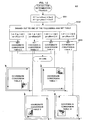
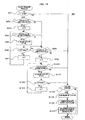
- FIG. 11 is a flowchart 81 of a specific example of a game operation process corresponding to step S16 in FIG. 10.
- a top/bottom determination process (described later with reference to FIG. 12) is performed.
- the top/bottom determination process of step S31 determines a tilt direction of the game apparatus 10, and a direction in which to move the puzzle elements 51 (hereinafter referred to as a "moving direction") is determined.
- step S33 After the first instance of the top/bottom determination process of step S31, control proceeds directly to a block movement settling process at step S33. Note that the flowchart 81 does not explicitly show a step for determining a first instance in order to concisely show a repetitive flow of the overall game processing.
- step S32 After the second or any subsequent instance of the top/bottom determination of step S31, control proceeds to step S32 to confirm whether the player has applied a different tilt to the game apparatus 10 since the last tilt. If such an operation has been made, control proceeds to the block movement settling process at step S33 (described later with reference to FIG. 13) to perform processing for moving the puzzle elements 51.
- a block arrangement settling process at step S34 is performed (described later with reference to FIG. 15).
- the block arrangement settling process determines what sort of relationship a given puzzle element 51 has with respect to the other puzzle elements or blocks, and if it is of a predetermined relationship, erases the puzzle element, for example.
- step S34 After the block arrangement settling process of step S34 is completed, control proceeds to step S35.
- step S35 if a blank set flag (not shown)which was used in the block arrangement settling process to erase a puzzle element 51 is found to be still ON, the flag is cleared, and control returns to step S32.
- step S37 If it is determined at step S32 that no further tilt has been applied, or if it is determined at step S35 that the blank flag is not ON, control proceeds to step S37.
- the flow according to the present example is designed in such a manner that additional blocks will be introduced after the lapse of a predetermined period of time, and that control proceeds from S32 or S35 to step S37 if the movement or erasure of blocks due to a tilt has been completed.
- step S37 a timer (not shown) is set, and additional blocks are added after the lapse of a predetermined period of time (step S38). Note that any additional blocks will first be added at ymax on the game map 70, so that they are not readily seen in the displayed image immediately after the addition.
- step S40 After the addition of the additional blocks, the subsequent processing, a block movement settling process at S39 and a block arrangement settling process at S40 are performed in identical manners to the processing after the tilt detection at step S32. Upon confirming at step S42 that no more blocks are to be erased, the game operation process of step S16 in FIG. 10 is ended.
- step S43 additional blocks are introduced (step S44).
- step S45 A block movement settling process
- step S46 an erasure process
- step S37 If the timer is not set at step S37 and no operation is made on the operation switches at step S43, the game operation process is ended, and control returns to the main process 80.
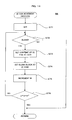
- step S31 the top/bottom determination process of step S31 will be described in detail with reference to FIG. 12.
- tilt information is obtained at step S14 in FIG. 10.
- the "tilt information” comprises output values from the acceleration sensor 31 respectively corresponding to a tilt in a right-left direction of the game display screen 12 and a tilt in a top-bottom direction of the game display screen 12.
- the acceleration sensor 31 outputs signals such that a duty ratio of one cycle of the pulse signal varies in accordance with an acceleration occurring in the right-left direction and an acceleration occurring in the top-bottom direction.
- the sensor interface 33 includes a counter which measures the duration of High level signal pulses outputted from the acceleration sensor 31 with respect to the right-left direction and the top-bottom direction, in accordance with an internal clock of the game apparatus 10. Thus, based on the counter values (xa, ya), it is possible to determine the tilt direction of the game apparatus 10.
- step S51 performs the following calculations by using the counter values with respect to the top-bottom direction and the right-left direction for the game apparatus in a horizontal position as initial values (xBase, yBase), thereby obtaining respective accelerations:
- a 1 ( x a ⁇ x Base ) ⁇ Sen X
- a 2 ( y a ⁇ y Base ) ⁇ Sen Y
- SenX and SenY are arbitrarily-selected correction factors for the right-left direction and the top-bottom direction, respectively.
- step S52 the tilt directions along the right-left direction and the top-bottom direction are confirmed based on absolute values
- the tilt is determined to be in a right-left direction. Furthermore, if xa-xBase ⁇ 0, the tilt is in the left direction, that is, the game machine 10 is determined to be tilted toward the left side of the game display screen. On the other hand, if the tilt is determined to be in a right-left direction and if xa-xBase ⁇ 0, then the game machine 10 is determined to be tilted toward the right side of the game display screen.
- the output from the acceleration sensor 31 is utilized to detect a tilt direction in the present example, other processing would also be possible based on the output from the acceleration sensor 31.
- acceleration will occur as a result of moving the game apparatus in any direction; such an event can be detected and regarded as a direction in which the game apparatus is moved, and the blocks may be moved in the direction that the game apparatus is moved.
- the pulse duration of the output from the acceleration sensor 31 may also be checked to further vary the speed of moving the blocks within the displayed image or to introduce limitations to the distances over which the blocks are moved.
- any substantial impact applied to the game apparatus can draw an output from the acceleration sensor 31, this may be utilized as a trigger for introducing additional blocks.
- the game apparatus may be hit by the player from a specific direction, and additional blocks may introduced from that direction.
- the present is a mere illustration of a specific case of utilizing the output from the acceleration sensor for the detection of a tilt direction.
- a game map when the game apparatus 10 is held in the hands of a player can be represented in terms of absolute coordinates (X, Y).
- relative coordinates (x, y) are defined, where a tilt direction is designated as a -y direction and a perpendicular axis thereto is designated as an x direction. Based on the above definitions of relative coordinates, it will be appreciated that the relative coordinates would coincide with the absolute coordinates when the game machine 10 is tilted in the bottom direction, i.e., so that the top of the game screen is raised.
- tables for converting relative coordinates (x, y) into absolute coordinates (X, Y) are set at step S53.
- any block whose y coordinate is ymax is a block waiting outside the display screen to be additionally introduced.
- the block movement settling process repetitively performs processing which involves: checking a displayed image in a block-by-block manner; and, if any blank block that adjoins an erasable block in the -y direction is located, switching the positions of the two blocks in the displayed image.
- initial coordinate values e.g., (0, 0) in the illustrated example
- a block movement process is performed. The block movement process will be described in more detail later with reference to FIG. 14.
- step S63 it is determined at step S63 whether the block movement process has been performed with respect to all of the blocks present along the y direction. If the block movement process has been performed with respect to all of the blocks present along the y direction, the y coordinate value is incremented at step S64 so that the block of interest is shifted to the next block. Thereafter, control returns to step S62. Thus, any blank block having a given x coordinate value is switched with another block adjoining the blank block in the y direction, such that a blank block is now placed where the other block used to be. Such processing is performed for all of the blocks present along the y direction, thereby causing the blocks to be piled up in the y direction without spaces therebetween.
- step S65 it is determined at step S66 whether the x coordinate has reached xmax or not. If not, the x coordinate value is incremented at step S67. Then control returns to step S62, to repeat block movement process for the new x coordinate value. If it is determined at step S66 that the x coordinate value has reached the maximum value xmax, the block movement settling process is finished.
- the above-described block movement settling process is directed to an embodiment where the moving blocks all appear to fall in the -y direction, irrespective of the attribute data 87 concerning the moving directions.
- FIG. 14 is a flowchart 84 of a block movement process.
- an initial value of a value m which is an increment to be applied to the y coordinate value within a loop process to follow is set.
- block of interest a block having the initial coordinate values
- the block of interest is switched with another block adjoining the block of interest in the y direction at step S73.
- a blank block is placed where the other block used to be.
- the y coordinate value is incremented at step S75.
- step S76 it is determined whether the coordinate value along the y direction has reached the maximum value ymax or not. If not, similar processing is repeated until the y coordinate value reaches ymax.
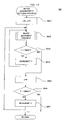
- step S34 If a plurality of blocks are found to be arranged in accordance with predetermined rules in the game process, as shown in FIG. 5, processing for causing a change, e.g., an image transformation concerning such blocks is performed.
- the block arrangement settling process of step S34 will now be described in detail with reference to FIG. 15.
- step S81 it is first determined at step S81 whether or not a plurality of blocks are arranged in such a manner as to qualify for being combined together. If so, as exemplified by the display state 50a shown in FIG. 6A, the displayed image is changed by combing such blocks (step S82). In this example, only the blocks which are indicated as combinable blocks in the role data 86 (FIG. 9) are subjected to this processing. If the blocks are not to be combined, control proceeds to step S83 to determine whether or not a plurality of blocks are arranged in such a manner as to qualify for a change in attribute. If so, as exemplified by the display state 50b shown in FIG. 6B, the attributes of the relevant blocks are changed at step S84.
- step S85 determines whether or not the blocks are arranged in such a manner as to qualify for a block erasure process at step S86.
- the block erasure process will be described in more detail with reference to FIG. 16. Examples of image transformations occurring as a result of an erasure process have been described with reference to FIGS. 5 and 8.
- step S87 If an erasure process is not to be performed, control proceeds to step S87.
- the operation members 13 may be set so as to invoke different types of arrangement settling processes depending on the particular operation performed on the operation members 13, such that a block dissolution process at step S88 (as exemplified by the displayed image 50c shown in FIG. 6C) will be invoked by a certain operation and that a block explosion process at step S89 (as exemplified by the displayed image 50d shown in FIG. 6D) will be invoked by another operation.
- step S92 it is determined at step S92 to determine whether the block of interest and a block adjoining the block in the y direction are of the same attribute (e.g., being erasable blocks in this example) or not. If they are of the same attribute, it is further determined whether or not a next adjoining block in the y direction is also of the same attribute; specifically, an initial value of m to be used in
- step S95 a blank flag 88 is set for the block.
- step S96 the m value is incremented (step S97) to further determine the block attributes in the y direction.
- blank flags are consecutively assigned to blocks of the same attribute.
- step S91 If the first block of interest is determined at step S91 to be a blank block, if it is determined at step S98 that the adjoining block in the x direction is not of the same attribute, or if it is determined at step S102 that the adjoining blocks have been checked up to xmax, control proceeds to step S104. If it is determined at step S104 that blank flags 88 have been set for any blocks, a blank set flag is turned ON at step S105. Then, the blocks for which blank flags have been set are converted into blank blocks (step S106), i.e., the blocks are erased. Since the present example assumes that the erasure of a certain number of blocks is a condition for game clearance, the number of blank blocks at step S107 is added into the erased blocks, and the block erasure process is ended.
Landscapes
- Engineering & Computer Science (AREA)
- Multimedia (AREA)
- Human Computer Interaction (AREA)
- User Interface Of Digital Computer (AREA)
Claims (1)
- Speichermedium (30) zum Speichern eines Puzzlespielprogramms, um ein Spielsystem zu veranlassen, als Puzzlespiel zu funktionieren, das Spielsystem mindestens aufweisend einen Bildanzeigeabschnitt (12, 50) zum Anzeigen einer Vielzahl von Puzzleelementen (51) des Puzzlespiels, einen Erfassungsabschnitt (31, 33) zum Erfassen einer Neigung oder einer Beschleunigung des Spielsystems, und einen Puzzleelement-Speicherabschnitt (25), wobei die Vielzahl von Puzzleelementen innerhalb eines Anzeigeschirms des Bildanzeigeabschnitts operabel sind, wobei das Programm aufweist:einen Bestimmungsschritt (S31) des Bestimmens einer Neigungsrichtung oder einer Beschleunigungsrichtung gemäß einem Ausgang des Erfassungsabschnitts;einen Anzeigeschritt (S33) der Puzzleelementbewegung des Steuerns mindestens eines der Vielzahl von Puzzleelementen, angezeigt auf dem Anzeigeschirm, welches gemäß dem Richtungsbestimmungsschritt zu bewegen ist; undeinen Bildtransformationsschritt (S34) des Verursachens einer Bildtransformation, wenn eine Vielzahl von Puzzleelementen, die auf dem Anzeigeschirm angezeigt sind, eine vorbestimmte Anordnung nach Durchführen des Anzeigeschrittes der Puzzleelementbewegung einnehmen, wobei das Speichermedium (30) den integral darin geformten Erfassungsabschnitt (31, 33) aufweist.
Applications Claiming Priority (2)
| Application Number | Priority Date | Filing Date | Title |
|---|---|---|---|
| JP2001250932 | 2001-08-22 | ||
| JP2001250932A JP2003062341A (ja) | 2001-08-22 | 2001-08-22 | ゲームシステム、パズルゲームプログラムおよびプログラムを記憶した記憶媒体 |
Publications (3)
| Publication Number | Publication Date |
|---|---|
| EP1291047A2 EP1291047A2 (de) | 2003-03-12 |
| EP1291047A3 EP1291047A3 (de) | 2004-10-20 |
| EP1291047B1 true EP1291047B1 (de) | 2006-07-12 |
Family
ID=19079659
Family Applications (1)
| Application Number | Title | Priority Date | Filing Date |
|---|---|---|---|
| EP02018236A Expired - Lifetime EP1291047B1 (de) | 2001-08-22 | 2002-08-21 | Spielsystem, Puzzlespielprogramm und Aufzeichungsmedium für Programm |
Country Status (4)
| Country | Link |
|---|---|
| US (1) | US7094147B2 (de) |
| EP (1) | EP1291047B1 (de) |
| JP (1) | JP2003062341A (de) |
| DE (1) | DE60213047T2 (de) |
Families Citing this family (74)
| Publication number | Priority date | Publication date | Assignee | Title |
|---|---|---|---|---|
| US7749089B1 (en) | 1999-02-26 | 2010-07-06 | Creative Kingdoms, Llc | Multi-media interactive play system |
| US7445550B2 (en) | 2000-02-22 | 2008-11-04 | Creative Kingdoms, Llc | Magical wand and interactive play experience |
| US7878905B2 (en) | 2000-02-22 | 2011-02-01 | Creative Kingdoms, Llc | Multi-layered interactive play experience |
| US6761637B2 (en) | 2000-02-22 | 2004-07-13 | Creative Kingdoms, Llc | Method of game play using RFID tracking device |
| US7066781B2 (en) | 2000-10-20 | 2006-06-27 | Denise Chapman Weston | Children's toy with wireless tag/transponder |
| JP3554848B2 (ja) * | 2001-12-17 | 2004-08-18 | コナミ株式会社 | ボール状遊戯具 |
| US6967566B2 (en) | 2002-04-05 | 2005-11-22 | Creative Kingdoms, Llc | Live-action interactive adventure game |
| US20070066396A1 (en) | 2002-04-05 | 2007-03-22 | Denise Chapman Weston | Retail methods for providing an interactive product to a consumer |
| JP2003325981A (ja) * | 2002-05-09 | 2003-11-18 | Nintendo Co Ltd | 多人数参加型ゲームシステムおよび多人数参加型ゲームプログラム |
| US7785179B2 (en) * | 2002-06-14 | 2010-08-31 | Pancu Mihai Ionescu | Mechanical and electronic combinatory game and puzzle |
| US7674184B2 (en) | 2002-08-01 | 2010-03-09 | Creative Kingdoms, Llc | Interactive water attraction and quest game |
| US7665041B2 (en) * | 2003-03-25 | 2010-02-16 | Microsoft Corporation | Architecture for controlling a computer using hand gestures |
| US9446319B2 (en) | 2003-03-25 | 2016-09-20 | Mq Gaming, Llc | Interactive gaming toy |
| US8745541B2 (en) * | 2003-03-25 | 2014-06-03 | Microsoft Corporation | Architecture for controlling a computer using hand gestures |
| FI119206B (fi) * | 2003-05-21 | 2008-08-29 | Myorigo Sarl | Menetelmä ja välineet mobiilipelaamiseksi |
| US20050043075A1 (en) * | 2003-08-18 | 2005-02-24 | Liang-Yu Lin | Computer game with matchable blocks |
| US7513828B2 (en) * | 2004-02-17 | 2009-04-07 | Igt | Gaming device having secondary game played in parallel with primary game |
| EP1730698A4 (de) * | 2004-03-12 | 2007-05-23 | Michael Nicholas Kefaloukos | Bilderzeugung |
| FR2871710B1 (fr) * | 2004-06-17 | 2008-03-14 | Sylvius Sarl | Systeme de jeu avec commandes d'actions variables |
| JP2006068027A (ja) | 2004-08-31 | 2006-03-16 | Nintendo Co Ltd | ゲーム装置およびゲームプログラム |
| US7706977B2 (en) * | 2004-10-26 | 2010-04-27 | Honeywell International Inc. | Personal navigation device for use with portable device |
| JP2006141453A (ja) * | 2004-11-16 | 2006-06-08 | Bandai Networks Co Ltd | ビデオゲーム用プログラム及びビデオゲーム装置 |
| US7713122B2 (en) * | 2005-02-23 | 2010-05-11 | Wms Gaming Inc. | Wagering game with bonus game elements dictated by basic game |
| JP4756631B2 (ja) * | 2005-05-09 | 2011-08-24 | 任天堂株式会社 | ゲームプログラムおよびゲーム装置 |
| JP4260814B2 (ja) | 2006-03-09 | 2009-04-30 | 任天堂株式会社 | ゲーム装置およびゲームプログラム |
| JP4151982B2 (ja) | 2006-03-10 | 2008-09-17 | 任天堂株式会社 | 動き判別装置および動き判別プログラム |
| JP4684147B2 (ja) | 2006-03-28 | 2011-05-18 | 任天堂株式会社 | 傾き算出装置、傾き算出プログラム、ゲーム装置およびゲームプログラム |
| JP4757089B2 (ja) * | 2006-04-25 | 2011-08-24 | 任天堂株式会社 | 音楽演奏プログラムおよび音楽演奏装置 |
| JP4679429B2 (ja) * | 2006-04-27 | 2011-04-27 | 任天堂株式会社 | 音出力プログラムおよび音出力装置 |
| JP4916762B2 (ja) * | 2006-05-02 | 2012-04-18 | 任天堂株式会社 | ゲームプログラムおよびゲーム装置 |
| JP2008061919A (ja) * | 2006-09-11 | 2008-03-21 | Aruze Corp | スロットマシン及びそのプレイ方法 |
| JP5127242B2 (ja) * | 2007-01-19 | 2013-01-23 | 任天堂株式会社 | 加速度データ処理プログラムおよびゲームプログラム |
| US8096871B2 (en) * | 2007-02-01 | 2012-01-17 | Video Gaming Technologies, Inc. | Gaming machine and method |
| JP4858777B2 (ja) * | 2007-02-01 | 2012-01-18 | 独立行政法人産業技術総合研究所 | 音データ生成装置およびプログラム |
| JP5001677B2 (ja) * | 2007-03-05 | 2012-08-15 | 株式会社スクウェア・エニックス | ゲーム装置、このゲーム装置によって実行されるゲーム方法及びこのゲーム装置にゲーム方法を実行させるためのゲームプログラム |
| US7889175B2 (en) * | 2007-06-28 | 2011-02-15 | Panasonic Corporation | Touchpad-enabled remote controller and user interaction methods |
| US20090166971A1 (en) * | 2007-12-27 | 2009-07-02 | Mebane Palmer C | Puzzle game |
| JP4203115B1 (ja) * | 2008-04-04 | 2008-12-24 | 株式会社バンダイナムコゲームス | ゲームコントローラケース、プログラム、情報記憶媒体、及びゲーム装置 |
| US8313370B2 (en) * | 2008-09-02 | 2012-11-20 | Tetris Holding Llc | Video game systems and methods for providing software-based skill adjustment mechanisms for video game systems |
| JP2008307409A (ja) * | 2008-09-26 | 2008-12-25 | Nintendo Co Ltd | 情報処理装置および情報処理プログラム |
| US8303412B2 (en) * | 2009-03-31 | 2012-11-06 | Nintendo Co., Ltd. | Game apparatus and game program |
| US20100304348A1 (en) * | 2009-05-27 | 2010-12-02 | Shlomo Lehavi | Educational and training tool using matching techniques and method of developing and utilizing the same |
| US8292720B2 (en) | 2009-05-29 | 2012-10-23 | Igt | Gaming system, gaming device and method providing competitive wagering games |
| JP5444862B2 (ja) * | 2009-06-10 | 2014-03-19 | 任天堂株式会社 | ゲームプログラム、ゲーム装置、およびゲームシステム |
| US9120010B2 (en) * | 2009-12-03 | 2015-09-01 | Megatouch, Llc | Touchscreen game allowing simultaneous movement of multiple rows and/or columns |
| US9977472B2 (en) * | 2010-03-19 | 2018-05-22 | Nokia Technologies Oy | Method and apparatus for displaying relative motion of objects on graphical user interface |
| JP5550433B2 (ja) * | 2010-04-22 | 2014-07-16 | 任天堂株式会社 | 操作装置および情報処理システム |
| KR101740439B1 (ko) * | 2010-12-23 | 2017-05-26 | 엘지전자 주식회사 | 이동 단말기 및 그 제어방법 |
| JP5806385B2 (ja) * | 2011-03-31 | 2015-11-10 | テトリス ホールディング,エルエルシー | オブジェクトの操作のためのシステムおよび方法 |
| US20130079079A1 (en) * | 2011-09-21 | 2013-03-28 | David Bouchard | Digital jigsaw puzzle game for mobile device platforms |
| US9373213B1 (en) * | 2011-11-08 | 2016-06-21 | Zynga Inc. | Adaptive object placement in computer-implemented games |
| US8811938B2 (en) | 2011-12-16 | 2014-08-19 | Microsoft Corporation | Providing a user interface experience based on inferred vehicle state |
| US10456686B2 (en) | 2012-09-05 | 2019-10-29 | Zynga Inc. | Methods and systems for adaptive tuning of game events |
| JP6041604B2 (ja) * | 2012-09-27 | 2016-12-14 | 京セラ株式会社 | 表示装置、制御システムおよび制御プログラム |
| US9773378B2 (en) | 2013-09-23 | 2017-09-26 | Bally Gaming, Inc. | Wagering game having player-directed population of a bonus feature |
| US10140803B2 (en) * | 2014-01-06 | 2018-11-27 | Igt | Bonus initiation or game play alteration based on physical position and/or orientation of keno card |
| EP3086869A1 (de) * | 2014-01-31 | 2016-11-02 | King.com Limited | Steuerung einer benutzerschnittstelle einer computervorrichtung |
| US10207186B2 (en) * | 2014-05-28 | 2019-02-19 | King.Com Ltd. | Method for controlling a user interface |
| US20150343310A1 (en) * | 2014-05-28 | 2015-12-03 | King.Com Limited | Apparatus and methods for computer implemented game |
| US10512848B2 (en) * | 2014-05-28 | 2019-12-24 | King.Com Ltd. | System and method for computer implemented game |
| US9724606B2 (en) | 2014-09-09 | 2017-08-08 | Zynga Inc. | Systems and methods for indicating positions of selected symbols in a target sequence |
| US9675889B2 (en) | 2014-09-10 | 2017-06-13 | Zynga Inc. | Systems and methods for determining game level attributes based on player skill level prior to game play in the level |
| US9757650B2 (en) * | 2014-09-10 | 2017-09-12 | Zynga Inc. | Sequencing and locations of selected virtual objects to trigger targeted game actions |
| US10561944B2 (en) | 2014-09-10 | 2020-02-18 | Zynga Inc. | Adjusting object adaptive modification or game level difficulty and physical gestures through level definition files |
| US10409457B2 (en) * | 2014-10-06 | 2019-09-10 | Zynga Inc. | Systems and methods for replenishment of virtual objects based on device orientation |
| WO2017149656A1 (ja) | 2016-03-01 | 2017-09-08 | NHN PlayArt株式会社 | コンピュータ読み取り可能な記録媒体及びゲーム装置 |
| US10179288B2 (en) | 2016-06-20 | 2019-01-15 | Zynga Inc. | Adaptive object placement in computer-implemented games |
| JP6577518B2 (ja) * | 2017-05-14 | 2019-09-18 | 株式会社カプコン | ゲームプログラム、ゲーム装置およびサーバ装置 |
| JP6743102B2 (ja) * | 2018-09-06 | 2020-08-19 | 株式会社アグニ・フレア | ゲームプログラム、記録媒体及びゲーム制御方法 |
| US11207603B2 (en) * | 2019-06-13 | 2021-12-28 | Nintendo Co., Ltd. | Information processing system and information processing apparatus that allow diversified game development, method of controlling information processing system, and information processing program in puzzle game using defensive and offensive paramaters |
| US12128304B2 (en) * | 2022-06-29 | 2024-10-29 | Superplay Ltd | Altering computer game tiles having multiple matchable ends |
| US11857882B1 (en) * | 2022-06-29 | 2024-01-02 | Superplay Ltd | Altering computer game tiles having multiple matchable ends |
| US20250065218A1 (en) * | 2023-08-24 | 2025-02-27 | Evelyn Mary Stiller | Word game with player-driven letter rearrangement |
| JP7644305B1 (ja) * | 2024-10-18 | 2025-03-11 | NHN PlayArt株式会社 | ゲームプログラム |
Family Cites Families (17)
| Publication number | Priority date | Publication date | Assignee | Title |
|---|---|---|---|---|
| US4925189A (en) | 1989-01-13 | 1990-05-15 | Braeunig Thomas F | Body-mounted video game exercise device |
| JPH0371154A (ja) | 1989-08-11 | 1991-03-26 | Ricoh Co Ltd | 複写装置 |
| US5128671A (en) * | 1990-04-12 | 1992-07-07 | Ltv Aerospace And Defense Company | Control device having multiple degrees of freedom |
| US5265888A (en) | 1990-06-22 | 1993-11-30 | Nintendo Co., Ltd. | Game apparatus and memory cartridge used therefor |
| JP2775334B2 (ja) | 1990-06-22 | 1998-07-16 | 任天堂株式会社 | ゲーム装置 |
| US5312113A (en) | 1992-11-24 | 1994-05-17 | Ta Hsien Chen | Video puzzle cube game |
| US5643085A (en) | 1995-09-25 | 1997-07-01 | Aityan; Sergey K. | Two-dimensional cyclic game for creating and implementing puzzles |
| US6062978A (en) | 1995-12-11 | 2000-05-16 | Four Star Software, Inc. | Rotating cube computer video games |
| JPH1066784A (ja) | 1996-06-18 | 1998-03-10 | Konami Co Ltd | 連続的につながった同種の物体が消去されるゲームにおける物体の移動方法、ゲーム装置、ゲームシステム及びゲームプログラムデータが記録されたコンピュータ可読可能な記録媒体 |
| WO2004089486A1 (ja) | 1996-06-21 | 2004-10-21 | Kyota Tanaka | 3次元ゲーム装置及び情報記憶媒体 |
| US5921548A (en) | 1997-01-09 | 1999-07-13 | Goldberg; Melvin L. | Geometric and cryptographic puzzle |
| US6237914B1 (en) | 1998-05-14 | 2001-05-29 | Alexey Saltanov | Multi dimensional puzzle |
| US6200219B1 (en) * | 1998-06-10 | 2001-03-13 | Elliot Rudell | Toy vehicles with integral motion sensitive game display |
| JP2000148694A (ja) | 1998-11-06 | 2000-05-30 | Sony Computer Entertainment Inc | エンタテインメントシステムの携帯用電子機器 |
| US6545661B1 (en) * | 1999-06-21 | 2003-04-08 | Midway Amusement Games, Llc | Video game system having a control unit with an accelerometer for controlling a video game |
| JP3506641B2 (ja) | 1999-07-30 | 2004-03-15 | 任天堂株式会社 | 三次元パズルゲーム装置及び三次元パズルゲーム用記憶媒体 |
| US6375572B1 (en) * | 1999-10-04 | 2002-04-23 | Nintendo Co., Ltd. | Portable game apparatus with acceleration sensor and information storage medium storing a game progam |
-
2001
- 2001-08-22 JP JP2001250932A patent/JP2003062341A/ja active Pending
-
2002
- 2002-08-21 DE DE60213047T patent/DE60213047T2/de not_active Expired - Lifetime
- 2002-08-21 US US10/224,408 patent/US7094147B2/en not_active Expired - Lifetime
- 2002-08-21 EP EP02018236A patent/EP1291047B1/de not_active Expired - Lifetime
Also Published As
| Publication number | Publication date |
|---|---|
| DE60213047D1 (de) | 2006-08-24 |
| EP1291047A3 (de) | 2004-10-20 |
| EP1291047A2 (de) | 2003-03-12 |
| JP2003062341A (ja) | 2003-03-04 |
| US7094147B2 (en) | 2006-08-22 |
| US20030040350A1 (en) | 2003-02-27 |
| DE60213047T2 (de) | 2007-01-11 |
Similar Documents
| Publication | Publication Date | Title |
|---|---|---|
| EP1291047B1 (de) | Spielsystem, Puzzlespielprogramm und Aufzeichungsmedium für Programm | |
| US5265888A (en) | Game apparatus and memory cartridge used therefor | |
| US6132315A (en) | Game system operable with backup data on different kinds of game machines | |
| US7137894B2 (en) | Hand-held display system and display method and storage medium therefor | |
| US8419538B2 (en) | Storage medium storing game program, game apparatus and game control method | |
| EP1557209B1 (de) | Spielsystem mit Touch Panel Eingabe | |
| US5184830A (en) | Compact hand-held video game system | |
| JP2538488B2 (ja) | ゲ−ム装置 | |
| EP0990459A2 (de) | Videospiel mit zufällig erzeugten Bildern | |
| EP1059104A2 (de) | Tragbare Spielmaschine und Spielverlaufsverfahren | |
| US20030216177A1 (en) | Game system and game program | |
| JP2003062341A5 (de) | ||
| USRE36675E (en) | Game apparatus and memory cartridge used therefor | |
| JP2001038047A (ja) | 三次元パズルゲーム装置及び三次元パズルゲーム用記憶媒体 | |
| US20080120460A1 (en) | Game program and game apparatus | |
| US6398641B1 (en) | Puzzle game apparatus and storage medium therefore | |
| CA2045072C (en) | Game apparatus and memory cartridge used therefor | |
| KR20030011623A (ko) | 리버시 게임 장치 | |
| KR20010049527A (ko) | 목표물 맞추기 게임 실행 방법, 게임기 및 기록 매체 | |
| EP1060770A2 (de) | Verfahren zur Ausführung eines Schlag-Stapel-Klotzspieles, dieses Verfahren gebrauchende Spielmaschine und damit ausgerüstetes Aufzeichungsmedium | |
| JP4142513B2 (ja) | 遊技機及び遊技プログラムが記憶された記憶媒体 | |
| EP1060771A2 (de) | Zielscheibenspielausführungsverfahren, Spielvorrichtung und Aufzeichnungsmedium | |
| JP2784645B2 (ja) | ゲーム装置 | |
| JP4143241B2 (ja) | パズルゲーム装置およびその記憶媒体 | |
| JP3752802B2 (ja) | ゲーム装置及びゲームプログラムを記録した記録媒体 |
Legal Events
| Date | Code | Title | Description |
|---|---|---|---|
| PUAI | Public reference made under article 153(3) epc to a published international application that has entered the european phase |
Free format text: ORIGINAL CODE: 0009012 |
|
| AK | Designated contracting states |
Designated state(s): AT BE BG CH CY CZ DE DK EE ES FI FR GB GR IE IT LI LU MC NL PT SE SK TR Kind code of ref document: A2 Designated state(s): AT BE BG CH CY CZ DE DK EE ES FI FR GB GR IE IT LI LU MC NL PT SE SK TR |
|
| AX | Request for extension of the european patent |
Extension state: AL LT LV MK RO SI |
|
| PUAL | Search report despatched |
Free format text: ORIGINAL CODE: 0009013 |
|
| AK | Designated contracting states |
Kind code of ref document: A3 Designated state(s): AT BE BG CH CY CZ DE DK EE ES FI FR GB GR IE IT LI LU MC NL PT SE SK TR |
|
| AX | Request for extension of the european patent |
Extension state: AL LT LV MK RO SI |
|
| 17P | Request for examination filed |
Effective date: 20041202 |
|
| 17Q | First examination report despatched |
Effective date: 20050419 |
|
| AKX | Designation fees paid |
Designated state(s): DE FR GB |
|
| GRAP | Despatch of communication of intention to grant a patent |
Free format text: ORIGINAL CODE: EPIDOSNIGR1 |
|
| GRAS | Grant fee paid |
Free format text: ORIGINAL CODE: EPIDOSNIGR3 |
|
| GRAA | (expected) grant |
Free format text: ORIGINAL CODE: 0009210 |
|
| AK | Designated contracting states |
Kind code of ref document: B1 Designated state(s): DE FR GB |
|
| REG | Reference to a national code |
Ref country code: GB Ref legal event code: FG4D |
|
| REF | Corresponds to: |
Ref document number: 60213047 Country of ref document: DE Date of ref document: 20060824 Kind code of ref document: P |
|
| ET | Fr: translation filed | ||
| PLBE | No opposition filed within time limit |
Free format text: ORIGINAL CODE: 0009261 |
|
| STAA | Information on the status of an ep patent application or granted ep patent |
Free format text: STATUS: NO OPPOSITION FILED WITHIN TIME LIMIT |
|
| 26N | No opposition filed |
Effective date: 20070413 |
|
| REG | Reference to a national code |
Ref country code: FR Ref legal event code: PLFP Year of fee payment: 15 |
|
| REG | Reference to a national code |
Ref country code: FR Ref legal event code: PLFP Year of fee payment: 16 |
|
| REG | Reference to a national code |
Ref country code: FR Ref legal event code: PLFP Year of fee payment: 17 |
|
| PGFP | Annual fee paid to national office [announced via postgrant information from national office to epo] |
Ref country code: FR Payment date: 20210715 Year of fee payment: 20 |
|
| PGFP | Annual fee paid to national office [announced via postgrant information from national office to epo] |
Ref country code: GB Payment date: 20210714 Year of fee payment: 20 Ref country code: DE Payment date: 20210713 Year of fee payment: 20 |
|
| REG | Reference to a national code |
Ref country code: DE Ref legal event code: R071 Ref document number: 60213047 Country of ref document: DE |
|
| REG | Reference to a national code |
Ref country code: GB Ref legal event code: PE20 Expiry date: 20220820 |
|
| PG25 | Lapsed in a contracting state [announced via postgrant information from national office to epo] |
Ref country code: GB Free format text: LAPSE BECAUSE OF EXPIRATION OF PROTECTION Effective date: 20220820 |