EP1240114B1 - VERFAHREN FÜR DIE HERSTELLUNG VON OPAKEM QUARZGLAS, FÜR DIE DURCHFÜHRUNG DES VERFAHRENS GEEIGNETES SiO2-GRANULAT UND BAUTEIL AUS OPAKEM QUARZGLAS - Google Patents
VERFAHREN FÜR DIE HERSTELLUNG VON OPAKEM QUARZGLAS, FÜR DIE DURCHFÜHRUNG DES VERFAHRENS GEEIGNETES SiO2-GRANULAT UND BAUTEIL AUS OPAKEM QUARZGLAS Download PDFInfo
- Publication number
- EP1240114B1 EP1240114B1 EP00993506A EP00993506A EP1240114B1 EP 1240114 B1 EP1240114 B1 EP 1240114B1 EP 00993506 A EP00993506 A EP 00993506A EP 00993506 A EP00993506 A EP 00993506A EP 1240114 B1 EP1240114 B1 EP 1240114B1
- Authority
- EP
- European Patent Office
- Prior art keywords
- sio
- granulate
- granules
- quartz glass
- density
- Prior art date
- Legal status (The legal status is an assumption and is not a legal conclusion. Google has not performed a legal analysis and makes no representation as to the accuracy of the status listed.)
- Expired - Lifetime
Links
- 239000008187 granular material Substances 0.000 title claims description 95
- VYPSYNLAJGMNEJ-UHFFFAOYSA-N Silicium dioxide Chemical compound O=[Si]=O VYPSYNLAJGMNEJ-UHFFFAOYSA-N 0.000 title claims description 75
- 238000000034 method Methods 0.000 title claims description 44
- 238000004519 manufacturing process Methods 0.000 title claims description 18
- 239000011164 primary particle Substances 0.000 claims description 42
- 239000002245 particle Substances 0.000 claims description 25
- 238000004017 vitrification Methods 0.000 claims description 21
- 238000009826 distribution Methods 0.000 claims description 15
- 230000015572 biosynthetic process Effects 0.000 claims description 12
- 239000000377 silicon dioxide Substances 0.000 claims description 12
- 238000007669 thermal treatment Methods 0.000 claims description 11
- 238000010438 heat treatment Methods 0.000 claims description 10
- 229910052782 aluminium Inorganic materials 0.000 claims description 7
- XAGFODPZIPBFFR-UHFFFAOYSA-N aluminium Chemical compound [Al] XAGFODPZIPBFFR-UHFFFAOYSA-N 0.000 claims description 7
- OKTJSMMVPCPJKN-UHFFFAOYSA-N Carbon Chemical compound [C] OKTJSMMVPCPJKN-UHFFFAOYSA-N 0.000 claims description 5
- 238000005245 sintering Methods 0.000 claims description 5
- QJGQUHMNIGDVPM-UHFFFAOYSA-N nitrogen group Chemical group [N] QJGQUHMNIGDVPM-UHFFFAOYSA-N 0.000 claims description 4
- 229910052799 carbon Inorganic materials 0.000 claims description 3
- 239000002344 surface layer Substances 0.000 claims description 3
- 229910052681 coesite Inorganic materials 0.000 claims 11
- 229910052906 cristobalite Inorganic materials 0.000 claims 11
- 229910052682 stishovite Inorganic materials 0.000 claims 11
- 229910052905 tridymite Inorganic materials 0.000 claims 11
- PNEYBMLMFCGWSK-UHFFFAOYSA-N aluminium oxide Inorganic materials [O-2].[O-2].[O-2].[Al+3].[Al+3] PNEYBMLMFCGWSK-UHFFFAOYSA-N 0.000 claims 1
- 229910052593 corundum Inorganic materials 0.000 claims 1
- 238000010891 electric arc Methods 0.000 claims 1
- 239000011796 hollow space material Substances 0.000 claims 1
- 229910001845 yogo sapphire Inorganic materials 0.000 claims 1
- 229910004298 SiO 2 Inorganic materials 0.000 description 58
- 239000011148 porous material Substances 0.000 description 48
- 238000000465 moulding Methods 0.000 description 16
- 238000005469 granulation Methods 0.000 description 15
- 230000003179 granulation Effects 0.000 description 15
- IJGRMHOSHXDMSA-UHFFFAOYSA-N Atomic nitrogen Chemical compound N#N IJGRMHOSHXDMSA-UHFFFAOYSA-N 0.000 description 12
- 239000012535 impurity Substances 0.000 description 12
- 230000007062 hydrolysis Effects 0.000 description 10
- 238000006460 hydrolysis reaction Methods 0.000 description 10
- 239000007789 gas Substances 0.000 description 9
- 239000010410 layer Substances 0.000 description 9
- 239000007921 spray Substances 0.000 description 9
- 239000000460 chlorine Substances 0.000 description 7
- 238000004031 devitrification Methods 0.000 description 7
- 238000002156 mixing Methods 0.000 description 7
- 239000000843 powder Substances 0.000 description 7
- ZAMOUSCENKQFHK-UHFFFAOYSA-N Chlorine atom Chemical compound [Cl] ZAMOUSCENKQFHK-UHFFFAOYSA-N 0.000 description 6
- 229910052801 chlorine Inorganic materials 0.000 description 6
- 229910052757 nitrogen Inorganic materials 0.000 description 6
- 150000003377 silicon compounds Chemical class 0.000 description 6
- 238000003980 solgel method Methods 0.000 description 6
- 229910018072 Al 2 O 3 Inorganic materials 0.000 description 5
- 230000005540 biological transmission Effects 0.000 description 5
- 239000000654 additive Substances 0.000 description 4
- 230000000996 additive effect Effects 0.000 description 4
- 229910021331 inorganic silicon compound Inorganic materials 0.000 description 4
- 239000000203 mixture Substances 0.000 description 4
- 230000003647 oxidation Effects 0.000 description 4
- 238000007254 oxidation reaction Methods 0.000 description 4
- LIVNPJMFVYWSIS-UHFFFAOYSA-N silicon monoxide Chemical compound [Si-]#[O+] LIVNPJMFVYWSIS-UHFFFAOYSA-N 0.000 description 4
- 230000003595 spectral effect Effects 0.000 description 4
- 229910052791 calcium Inorganic materials 0.000 description 3
- 229910052804 chromium Inorganic materials 0.000 description 3
- 238000004581 coalescence Methods 0.000 description 3
- 229910052802 copper Inorganic materials 0.000 description 3
- 239000002019 doping agent Substances 0.000 description 3
- 238000001125 extrusion Methods 0.000 description 3
- 238000009413 insulation Methods 0.000 description 3
- 229910052742 iron Inorganic materials 0.000 description 3
- 229910052744 lithium Inorganic materials 0.000 description 3
- 229910052749 magnesium Inorganic materials 0.000 description 3
- 229910052748 manganese Inorganic materials 0.000 description 3
- 238000002844 melting Methods 0.000 description 3
- 230000008018 melting Effects 0.000 description 3
- 229910052751 metal Inorganic materials 0.000 description 3
- 239000002184 metal Substances 0.000 description 3
- 239000012768 molten material Substances 0.000 description 3
- 229910052700 potassium Inorganic materials 0.000 description 3
- 230000001698 pyrogenic effect Effects 0.000 description 3
- 229910052708 sodium Inorganic materials 0.000 description 3
- 239000007858 starting material Substances 0.000 description 3
- 239000000725 suspension Substances 0.000 description 3
- 229910052719 titanium Inorganic materials 0.000 description 3
- 229910052726 zirconium Inorganic materials 0.000 description 3
- 238000004438 BET method Methods 0.000 description 2
- 238000005054 agglomeration Methods 0.000 description 2
- 230000002776 aggregation Effects 0.000 description 2
- 239000007900 aqueous suspension Substances 0.000 description 2
- 150000001805 chlorine compounds Chemical group 0.000 description 2
- 238000004140 cleaning Methods 0.000 description 2
- 238000005056 compaction Methods 0.000 description 2
- 238000007906 compression Methods 0.000 description 2
- 230000006835 compression Effects 0.000 description 2
- 238000009792 diffusion process Methods 0.000 description 2
- 229910002804 graphite Inorganic materials 0.000 description 2
- 239000010439 graphite Substances 0.000 description 2
- 238000010348 incorporation Methods 0.000 description 2
- 239000007788 liquid Substances 0.000 description 2
- 238000012856 packing Methods 0.000 description 2
- 235000012239 silicon dioxide Nutrition 0.000 description 2
- 239000000126 substance Substances 0.000 description 2
- XLYOFNOQVPJJNP-UHFFFAOYSA-N water Substances O XLYOFNOQVPJJNP-UHFFFAOYSA-N 0.000 description 2
- 238000005550 wet granulation Methods 0.000 description 2
- 229910052581 Si3N4 Inorganic materials 0.000 description 1
- 229910003902 SiCl 4 Inorganic materials 0.000 description 1
- 230000009286 beneficial effect Effects 0.000 description 1
- 239000013590 bulk material Substances 0.000 description 1
- 239000003054 catalyst Substances 0.000 description 1
- 238000006243 chemical reaction Methods 0.000 description 1
- 239000008367 deionised water Substances 0.000 description 1
- 229910021641 deionized water Inorganic materials 0.000 description 1
- 238000000280 densification Methods 0.000 description 1
- 238000001035 drying Methods 0.000 description 1
- 239000000428 dust Substances 0.000 description 1
- 230000000694 effects Effects 0.000 description 1
- 239000000945 filler Substances 0.000 description 1
- 239000012530 fluid Substances 0.000 description 1
- 229910021485 fumed silica Inorganic materials 0.000 description 1
- -1 heat shields Chemical compound 0.000 description 1
- 125000002887 hydroxy group Chemical group [H]O* 0.000 description 1
- 239000000155 melt Substances 0.000 description 1
- 230000002093 peripheral effect Effects 0.000 description 1
- 238000002360 preparation method Methods 0.000 description 1
- 239000010453 quartz Substances 0.000 description 1
- 230000005855 radiation Effects 0.000 description 1
- 239000004065 semiconductor Substances 0.000 description 1
- 230000035939 shock Effects 0.000 description 1
- RMAQACBXLXPBSY-UHFFFAOYSA-N silicic acid Chemical compound O[Si](O)(O)O RMAQACBXLXPBSY-UHFFFAOYSA-N 0.000 description 1
- HQVNEWCFYHHQES-UHFFFAOYSA-N silicon nitride Chemical compound N12[Si]34N5[Si]62N3[Si]51N64 HQVNEWCFYHHQES-UHFFFAOYSA-N 0.000 description 1
- 239000007787 solid Substances 0.000 description 1
- 238000003756 stirring Methods 0.000 description 1
- 238000003860 storage Methods 0.000 description 1
- 238000005979 thermal decomposition reaction Methods 0.000 description 1
Images


Classifications
-
- C—CHEMISTRY; METALLURGY
- C03—GLASS; MINERAL OR SLAG WOOL
- C03B—MANUFACTURE, SHAPING, OR SUPPLEMENTARY PROCESSES
- C03B20/00—Processes specially adapted for the production of quartz or fused silica articles, not otherwise provided for
-
- C—CHEMISTRY; METALLURGY
- C03—GLASS; MINERAL OR SLAG WOOL
- C03C—CHEMICAL COMPOSITION OF GLASSES, GLAZES OR VITREOUS ENAMELS; SURFACE TREATMENT OF GLASS; SURFACE TREATMENT OF FIBRES OR FILAMENTS MADE FROM GLASS, MINERALS OR SLAGS; JOINING GLASS TO GLASS OR OTHER MATERIALS
- C03C1/00—Ingredients generally applicable to manufacture of glasses, glazes, or vitreous enamels
- C03C1/02—Pretreated ingredients
- C03C1/026—Pelletisation or prereacting of powdered raw materials
-
- C—CHEMISTRY; METALLURGY
- C03—GLASS; MINERAL OR SLAG WOOL
- C03B—MANUFACTURE, SHAPING, OR SUPPLEMENTARY PROCESSES
- C03B19/00—Other methods of shaping glass
- C03B19/10—Forming beads
- C03B19/1005—Forming solid beads
- C03B19/106—Forming solid beads by chemical vapour deposition; by liquid phase reaction
- C03B19/1065—Forming solid beads by chemical vapour deposition; by liquid phase reaction by liquid phase reactions, e.g. by means of a gel phase
-
- C—CHEMISTRY; METALLURGY
- C03—GLASS; MINERAL OR SLAG WOOL
- C03C—CHEMICAL COMPOSITION OF GLASSES, GLAZES OR VITREOUS ENAMELS; SURFACE TREATMENT OF GLASS; SURFACE TREATMENT OF FIBRES OR FILAMENTS MADE FROM GLASS, MINERALS OR SLAGS; JOINING GLASS TO GLASS OR OTHER MATERIALS
- C03C3/00—Glass compositions
- C03C3/04—Glass compositions containing silica
- C03C3/06—Glass compositions containing silica with more than 90% silica by weight, e.g. quartz
-
- B—PERFORMING OPERATIONS; TRANSPORTING
- B82—NANOTECHNOLOGY
- B82Y—SPECIFIC USES OR APPLICATIONS OF NANOSTRUCTURES; MEASUREMENT OR ANALYSIS OF NANOSTRUCTURES; MANUFACTURE OR TREATMENT OF NANOSTRUCTURES
- B82Y30/00—Nanotechnology for materials or surface science, e.g. nanocomposites
-
- C—CHEMISTRY; METALLURGY
- C03—GLASS; MINERAL OR SLAG WOOL
- C03C—CHEMICAL COMPOSITION OF GLASSES, GLAZES OR VITREOUS ENAMELS; SURFACE TREATMENT OF GLASS; SURFACE TREATMENT OF FIBRES OR FILAMENTS MADE FROM GLASS, MINERALS OR SLAGS; JOINING GLASS TO GLASS OR OTHER MATERIALS
- C03C2201/00—Glass compositions
- C03C2201/02—Pure silica glass, e.g. pure fused quartz
-
- C—CHEMISTRY; METALLURGY
- C03—GLASS; MINERAL OR SLAG WOOL
- C03C—CHEMICAL COMPOSITION OF GLASSES, GLAZES OR VITREOUS ENAMELS; SURFACE TREATMENT OF GLASS; SURFACE TREATMENT OF FIBRES OR FILAMENTS MADE FROM GLASS, MINERALS OR SLAGS; JOINING GLASS TO GLASS OR OTHER MATERIALS
- C03C2201/00—Glass compositions
- C03C2201/06—Doped silica-based glasses
- C03C2201/20—Doped silica-based glasses containing non-metals other than boron or halide
- C03C2201/24—Doped silica-based glasses containing non-metals other than boron or halide containing nitrogen, e.g. silicon oxy-nitride glasses
-
- C—CHEMISTRY; METALLURGY
- C03—GLASS; MINERAL OR SLAG WOOL
- C03C—CHEMICAL COMPOSITION OF GLASSES, GLAZES OR VITREOUS ENAMELS; SURFACE TREATMENT OF GLASS; SURFACE TREATMENT OF FIBRES OR FILAMENTS MADE FROM GLASS, MINERALS OR SLAGS; JOINING GLASS TO GLASS OR OTHER MATERIALS
- C03C2201/00—Glass compositions
- C03C2201/06—Doped silica-based glasses
- C03C2201/20—Doped silica-based glasses containing non-metals other than boron or halide
- C03C2201/26—Doped silica-based glasses containing non-metals other than boron or halide containing carbon
-
- C—CHEMISTRY; METALLURGY
- C03—GLASS; MINERAL OR SLAG WOOL
- C03C—CHEMICAL COMPOSITION OF GLASSES, GLAZES OR VITREOUS ENAMELS; SURFACE TREATMENT OF GLASS; SURFACE TREATMENT OF FIBRES OR FILAMENTS MADE FROM GLASS, MINERALS OR SLAGS; JOINING GLASS TO GLASS OR OTHER MATERIALS
- C03C2201/00—Glass compositions
- C03C2201/06—Doped silica-based glasses
- C03C2201/30—Doped silica-based glasses containing metals
- C03C2201/32—Doped silica-based glasses containing metals containing aluminium
-
- C—CHEMISTRY; METALLURGY
- C03—GLASS; MINERAL OR SLAG WOOL
- C03C—CHEMICAL COMPOSITION OF GLASSES, GLAZES OR VITREOUS ENAMELS; SURFACE TREATMENT OF GLASS; SURFACE TREATMENT OF FIBRES OR FILAMENTS MADE FROM GLASS, MINERALS OR SLAGS; JOINING GLASS TO GLASS OR OTHER MATERIALS
- C03C2201/00—Glass compositions
- C03C2201/80—Glass compositions containing bubbles or microbubbles, e.g. opaque quartz glass
-
- C—CHEMISTRY; METALLURGY
- C03—GLASS; MINERAL OR SLAG WOOL
- C03C—CHEMICAL COMPOSITION OF GLASSES, GLAZES OR VITREOUS ENAMELS; SURFACE TREATMENT OF GLASS; SURFACE TREATMENT OF FIBRES OR FILAMENTS MADE FROM GLASS, MINERALS OR SLAGS; JOINING GLASS TO GLASS OR OTHER MATERIALS
- C03C2203/00—Production processes
- C03C2203/10—Melting processes
-
- C—CHEMISTRY; METALLURGY
- C03—GLASS; MINERAL OR SLAG WOOL
- C03C—CHEMICAL COMPOSITION OF GLASSES, GLAZES OR VITREOUS ENAMELS; SURFACE TREATMENT OF GLASS; SURFACE TREATMENT OF FIBRES OR FILAMENTS MADE FROM GLASS, MINERALS OR SLAGS; JOINING GLASS TO GLASS OR OTHER MATERIALS
- C03C2203/00—Production processes
- C03C2203/50—After-treatment
- C03C2203/52—Heat-treatment
- C03C2203/54—Heat-treatment in a dopant containing atmosphere
Definitions
- the invention relates to a method for the production of opaque quartz glass, wherein a molded article of synthetic SiO 2 grain is formed and heated at a vitrification temperature to form a shaped article of opaque quartz glass.
- the invention relates to a suitable for carrying out the method synthetic SiO 2 granules, which is formed from at least partially porous agglomerates of SiO 2 primary particles.
- Opaque quartz glass is used essentially for the production of moldings for thermal engineering Applications where it insists on good thermal insulation at the same time Temperature stability arrives. Increasingly higher demands on the Purity of such quartz glass molded body provided.
- Opacity means here thus a low transmission (smaller one Percent) both in the visible (approximately between 350 nm and 800 nm) and in the IR range (about 750 nm to 4800 nm).
- a generic method for producing opaque quartz glass from pure starting materials is described in EP-A1 816 297. Therein it is proposed to produce the opacity of the quartz glass by producing and melting a powder mixture of synthetically produced SiO 2 particles with an average particle size of 300 ⁇ m and an additive in the form of silicon nitride powder. When the powder mixture melts, gaseous components such as nitrogen are released by thermal decomposition of the Si 3 N 4 powder. The gaseous components lead to pore formation in the softened quartz glass and thus produce the desired opacity of the molding. To produce the shaped body, the powder mixture is filled in a graphite mold lined graphite mold and heated in an electrically heated oven at a temperature of 1800 ° C under vacuum. During melting, the front of the softening and melting quartz glass migrates as a "melt front" from the mold wall radially inwards.
- Impurities can cause devitrification of the quartz glass leading to brittleness and reduced thermal shock resistance. Also residues of the additive may affect the quality of the quartz glass in this regard. Harmful also an inhomogeneous pore distribution. During vitrification may be a pore growth occur where larger pores grow at the expense of smaller pores. Wear big pores but little to opacity, resulting in a low density of the opaque quartz glass and reduce the mechanical strength of the quartz glass body.
- a generic SiO 2 granulate is known from DE-A1 44 24 044. It is proposed to treat an aqueous suspension of fumed silica powder in a mixing vessel with rotating whirling tool whose peripheral speed during a first mixing phase to a value in the range of 15 m / s to 30 m / s, and in a second mixing phase to 30 m / s or more.
- the solids content of the suspension is at least 75% by weight, from which, after the first mixing phase, a granular mass having a mean grain diameter of less than 4 mm is formed.
- the degree of compaction of the granular mass is further increased by adding amorphous silicic acid dust and in the second mixing phase the granular mass is comminuted with intensive mixing and impact stress. At the same time water exits from the surface of the granular mass, which is powdered by the addition of more silica powder to prevent sticking of the grain.
- the known process leads to a free-flowing SiO 2 granulate with high bulk density, which is suitable for applications as a filler in the dental sector or as a catalyst support.
- the invention has for its object to provide a method for the production of pure, opaque quartz glass, which has a homogeneous pore distribution at the same time high density, high viscosity and a low devitrification tendency, and to provide a suitable for carrying out the process SiO 2 granules ,
- this object is based on a recited in claim 1 Procedure solved.
- the SiO 2 granules are present in the form of at least partially porous agglomerates of SiO 2 primary particles.
- Such primary particles are obtained for example by flame hydrolysis or oxidation of silicon compounds, by hydrolysis of organic silicon compounds by the so-called sol-gel process or by hydrolysis of inorganic silicon compounds in a liquid.
- Such primary particles are characterized by high purity; However, they are difficult to handle because of their low bulk density. For this purpose, a compression by means of granulation is common.
- agglomerates of larger diameter are formed by the coalescence of the finely divided primary particles. These have a multiplicity of open pore channels which form a correspondingly large pore space.
- the individual grains of the SiO 2 granules used for carrying out the process according to the invention are formed from such agglomerates. Due to the large pore space, the granulate is characterized by a specific surface area (according to BET) of between 10 m 2 / g and 34 m 2 / g. This therefore does not appear as an outer surface, but predominantly as an inner surface in the form of pore channels in appearance.
- a specific surface area according to BET
- the inventively used, synthetically produced SiO 2 granules is characterized by a specific surface area between 10 m 2 / g and 34 m 2 / g at the same time high tamped density.
- the tamped density of 0.9 g / cm 3 - 1.1 g / cm 3 ensures in the first place that from the SiO 2 granules of the molding can be formed, while the opacity of the quartz glass - as explained above - essentially by the large specific surface, which is formed as an inner surface is conditional.
- the specific surface of the SiO 2 granules is determined by the BET method (DIN 66132) and the tamped density according to DIN / ISO 787 Part 11.
- the molding is formed as a loose bed or as a mechanically or thermally precompressed, porous body of the SiO 2 granules.
- SiO 2 granules having a specific surface area (according to BET) in the range between 10 and 30 m 2 / g have proven to be particularly suitable for use in the process according to the invention. This achieves good results with regard to the opacity or the low transmission of the quartz glass-in particular in the infrared spectral range-at high density and, at the same time, low devitrification tendency.
- the SiO 2 primary particles are present with an average particle size in the range of 0.5 ⁇ m and 5 ⁇ m. Such primary particles are obtained in the so-called "sol-gel process" by hydrolysis of organic silicon compounds. In an alternative and equally preferred process variant, the SiO 2 primary particles are present with an average particle size of less than 0.2 ⁇ m. Such pyrogenic primary particles are formed by flame hydrolysis or oxidation of inorganic silicon compounds. In view of a low devitrification tendency during vitrification, the primary particles are preferably amorphous.
- the primary particles are characterized by a large free surface.
- the known granulation methods are used, in particular build-up granulation (wet granulation method) or press granulation (extrusion) of a mass containing the primary particles.
- the primary particles produced by the sol-gel process are present in the granules in dense packing, since these predominantly and also preferably have a spherical shape.
- the free surface is reduced around the contact surfaces of adjacent primary particles; However, as explained above, closed pores can form between the individual primary particles during vitrification.
- the fact that the primary particles have an average particle size of less than 5 microns, resulting in a correspondingly fine pore distribution.
- the average particle size is determined as the so-called D 50 value according to ASTM C1070.
- Granules have been found to be particularly suitable for use in the method according to the invention, in which the individual SiO 2 grains have an inhomogeneous density distribution, wherein an interior area of lower density is at least partially enclosed by an exterior area of higher density. This makes it possible to trap gases in the interior, which then escape during vitrification or only partially escape and thus contribute to pore formation and opacity (low transmission) of the quartz glass.
- granules are used in which the interior comprises a cavity.
- the cavity is at least higher density from the exterior partially closed to the outside.
- the outer area of porous granules is thereby advantageously by thermal treatment, pre-compressed, which sintering at a temperature in the range of 800 ° C to 1350 ° C includes.
- the thermal treatment gives the outdoor area a density that is higher than that of the porous or hollow interior, so that pores and pore channels preferably reduce and close in the outdoor area. This is the thermal treatment terminated or interrupted before the initial temperature gradient between outdoor and indoor is balanced. This can be, for example in a simple way realize that the granules in passing through a Heating zone is performed.
- the thermal treatment comprises heating the porous agglomerates at a temperature between 1000 ° C and 1300 ° C under a nitrogen-containing atmosphere and in the presence of carbon.
- This process variant hereinafter referred to as "carbothermal nitridation" - granules granules are obtained, on whose entire free surface nitrogen is enriched. Nitrogen incorporation is facilitated in the presence of carbon which, however, volatilizes. It has been found that the incorporation of nitrogen increases the viscosity of quartz glass. A high viscosity is also achieved by a granulate consisting of SiO 2 grains which are doped with aluminum in the range between 5 ppm by weight and 20 ppm by weight.
- aluminum doping is advantageously produced by finely divided, nanoscale Al 2 O 3 particles. This ensures a homogeneous distribution of the dopant. Pyrogenically produced Al 2 O 3 particles are particularly well suited for this purpose due to their high specific surface area.
- a temperature gradient develops during the vitrification of the molding or during a thermal treatment for pre-compaction of the granules, which leads to a density gradient within the grain with higher densification in the outer area and thus favors pore formation during vitrification, as explained above .
- the small size of fine grains impedes or prevents the formation of such a density gradient, so that the fine fraction for pore formation is not.
- the fines affect the shrinkage of the quartz glass when collapsing the pore channels and complicates, by it tends to swirling, compliance with predetermined dimensions.
- a molding is formed, which extends one about an axis of rotation Inner surface, wherein the heating of the molding takes place such that a glazing front from the inner surfaces to the outside progresses.
- a glazing front At the glazing front it is a fuzzy boundary between molten and molten Material.
- the molten material has open pores and channels, while the molten material has closed pores that are no longer with the External surface are connected.
- the molding is heated from the inside surface, so that the glazing front wanders from there through the wall of the molding to the outside. Sublimable impurities are transferred into the gas phase and in front of the glazing front to the outside, driven towards even more porous areas of the molding, where they can escape or be sucked off.
- the molding under rotation about the axis of rotation from the inner surface by means of an arc to a glazing temperature to heat above 1900 ° C.
- the rotation ensures a uniform heating of the molding, temperature peaks and density differences are thus avoided.
- the molding is particularly high temperatures above 1900 ° C exposed. Due to the high temperatures, diffusion and other mass transfer processes occur accelerates. Impurities, in particular gaseous impurities, can be effectively eliminated by expanding and before the Escape the glazing front to the outside.
- the SiO 2 granules are present in the form of at least partially porous agglomerates of SiO 2 primary particles.
- Such primary particles are obtained for example by flame hydrolysis or oxidation of silicon compounds, by hydrolysis of organic silicon compounds by the so-called sol-gel process or by hydrolysis of inorganic silicon compounds in a liquid.
- Such primary particles are characterized by high purity; However, they are difficult to handle because of their low bulk density. For this purpose, a compression by means of granulation is common.
- agglomerates of larger diameter are formed by the coalescence of the finely divided primary particles. These have a multiplicity of open pore channels which form a correspondingly large pore space. From such agglomerates, the individual grains of the SiO 2 granules according to the invention are constructed.
- the synthetic SiO 2 granulate according to the invention is thus distinguished by a specific surface area of from 10 m 2 / g to 34 m 2 / g with simultaneously high tamped density.
- the specific surface does not appear as an outer surface but predominantly as an inner surface in the form of pore channels and, when used for the production of opaque quartz glass, produces an opacity (low transmission) both in the visible spectral range and especially in the infrared spectral range.
- the tamped density of 0.9 g / cm 3 to 1.1 g / cm 3 ensures in the first place that from the SiO 2 granules, a molding can be formed.
- the specific surface of the SiO 2 granules is determined by the BET method (DIN 66132) and the tamped density according to DIN / ISO 787 Part 11.
- SiO 2 granules having a specific surface area (according to BET) in the range between 10 m 2 / g and 30 m 2 / g have proven to be particularly suitable for use in the method according to the invention. This achieves good results with regard to the opacity of the quartz glass at high density and at the same time low devitrification tendency.
- the SiO 2 primary particles preferably have an average particle size in the range from 0.5 ⁇ m to 5 ⁇ m. Such primary particles are obtained in the so-called “sol-gel process” from organic silicon compounds. Alternatively and equally preferably, the SiO 2 primary particles are present with an average particle size of less than 0.2 ⁇ m. Such pyrogenic primary particles are formed by flame hydrolysis or oxidation of inorganic silicon compounds.
- the primary particles are each characterized by a large free surface.
- granules of the invention are formed.
- the known granulation methods are used, in particular build-up granulation and press granulation (such as extrusion).
- the primary particles produced by the sol-gel process are in dense packing in the granules, since these predominantly and also preferably have a spherical shape, which causes a high bulk density.
- the free surface is reduced around the contact surfaces of adjacent primary particles; However, as explained above, closed pores can form between the individual primary particles during vitrification.
- the fact that the primary particles have an average particle size of less than 5 microns, resulting in a correspondingly fine pore distribution.
- the average particle size is determined as the so-called D 50 value according to ASTM C1070.
- An embodiment of the granulate according to the invention in which the individual SiO 2 grains have an inhomogeneous density distribution, has proven to be particularly suitable for use in the method according to the invention, wherein an inner region of lower density is at least partially enclosed by an outer region of higher density. This makes it easier to trap gases in the interior, which then escape during vitrification or only partially escape, thus leading to pore formation and opacity of the quartz glass.
- the interior of the aggregate comprises a cavity.
- the cavity is from the outer area of higher density at least partially closed to the outside.
- the specific surface area and the tamped density of the SiO 2 granules are particularly easily adjusted by thermal treatment involving sintering at a temperature in the range of 800 ° C to 1450 ° C. In this case, a higher density can be obtained in the outdoor area.
- a temperature gradient is set. By setting a temperature gradient, the pores and pore channels preferably shrink in the near-volume volume fraction of the individual grains, ie in the outer region. This thus receives a density which is higher than that of the porous or hollow interior.
- the thermal treatment of the SiO 2 grains is terminated or interrupted before the initially adjusting temperature gradient between the outside and the inside is balanced. This can be realized, for example, in a simple manner by passing the granules through a heating zone in the passage. Such a temperature gradient can be adjusted more easily with coarser grains than with fine grains, as will be explained in more detail below.
- SiO 2 granules which contribute to a high viscosity.
- This is achieved by a granulate in which the primary particles have a nitrogen-containing surface layer. This makes it possible, on the one hand, to introduce nitrogen in chemically bonded form into the quartz glass to be produced from the granules, which leads to an increase in the viscosity. On the other hand, loosely bound nitrogen is released on heating and thus contributes to the formation of pores.
- a high viscosity is also achieved by a granulate consisting of SiO 2 grains which are doped with aluminum in the range between 5 ppm by weight and 20 ppm by weight.
- aluminum doping is advantageously produced by finely divided, nanoscale Al 2 O 3 particles. This ensures a homogeneous distribution of the dopant. Pyrogen-produced Al 2 O 3 particles with a high specific surface area are particularly suitable for this purpose.
- the granules consist of rounded SiO 2 -Kömem.
- a granulate which is characterized by good flowability, high tamped density and low shrinkage during vitrification, is obtained, for example, by built-up granulation (wet granulation method).
- the granules are an extrudate.
- Such granules can be produced inexpensively by extrusion processes. It is characterized by elongated SiO 2 grains, which may also contain long cavities.
- the granulate according to the invention is suitable for the production of a component from heat-resistant, opaque quartz glass, such as heat shields, reaction vessels or muffles particularly suitable.
- Such a component is characterized in that it comprises a zone of opaque quartz glass, which consists of a synthetic SiO 2 granules having a specific surface area (according to BET) in the range of 0.5 m 2 / g to 40 m 2 / g and having a tamped density of at least 0.8 g / cm 3 formed of at least partially porous agglomerates of SiO 2 primary particles.
- a zone of opaque quartz glass which consists of a synthetic SiO 2 granules having a specific surface area (according to BET) in the range of 0.5 m 2 / g to 40 m 2 / g and having a tamped density of at least 0.8 g / cm 3 formed of at least partially porous agglomerates of SiO 2 primary particles.
- the opaque zone is obtained. This is characterized by high opacity in the IR range. This is essentially achieved in that the zone is made of a SiO 2 granulate formed from partially porous agglomerates of SiO 2 primary particles and has a BET specific surface area of from 10 m 2 / g to 34 m 2 / g.
- a SiO 2 granulate formed from partially porous agglomerates of SiO 2 primary particles and has a BET specific surface area of from 10 m 2 / g to 34 m 2 / g.
- opaque quartz glass is obtained, which has a homogeneous pore distribution at the same time high density. As a result, a particularly high thermal insulation is achieved in the intended use of the component.
- agglomerates of larger diameter are formed by the coalescence of the finely divided primary particles.
- FIG. 1 schematically shows the process according to the invention for the production of opaque quartz glass in the form of an opaque molded article by vitrification of an initially porous hollow cylinder 1.
- the production of the hollow cylinder 1 will first be explained in more detail:
- SiO 2 granules with a BET specific surface area of 34 m 2 / g and a tamped density of 1.1 g / cm 3 are introduced into a tubular metal mold 2 which rotates about its longitudinal axis 3.
- the direction of rotation is indicated in FIG. 1 by the directional arrow 4.
- a rotationally symmetrical hollow cylinder 1 is formed from the bulk material on the inner wall 5 of the metal mold 2.
- the hollow cylinder 1 has in the bed a layer thickness of about 100 mm, and an inner bore 5 in the form of a through hole 6 with an inner diameter of about 73 mm. Due to the centrifugal force, the bed is easily solidified before carrying out the subsequent process steps.
- the mechanically pre-compressed hollow cylinder 1 is subsequently melted zone by zone by means of an arc 7 from the inner bore 6 of the hollow cylinder 1.
- an electrode pair 8 is inserted into the inner bore 6 and moved towards the opposite end of the hollow cylinder 1 and continuously along the inner wall 9.
- the feed rate of the electrode pair 8 is set to 55 mm / min.
- a glazing front 10 which progresses outward in the direction of the metal mold 2, forms the boundary surface between the still open-pored region 11 of the hollow cylinder 1 and an already partially melted, opaque region 12 of the hollow cylinder 1.
- the gases trapped in the SiO 2 granules lead to pore formation in the opaque region 12, producing the desired opacity.
- the density of the hollow cylinder is 2.10 g / cm 3 , the inner diameter 140 mm, the wall thickness 22 mm.
- the area of the inner wall 9 of the inner bore 6 is due to this method the high temperature of the arc 7 is strongly compressed.
- This gives the molten Shaped body 12 has an inner surface layer 15 made of transparent quartz glass Density exists.
- the tubular shaped body 12 thus made of opaque quartz glass becomes processed into a high temperature resistant muffle.
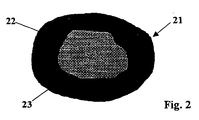
- FIG. 2 schematically shows a single, typical grain 21 of the granules used.
- a central region 22 of lower density is surrounded by an outer layer 23 with higher density.
- the density in the central area is about 40% of the density of transparent quartz glass, in the outer layer it is about 60% thereof.
- the interface between central region 22 and outer layer 23 is fluid.
- the grain diameter is 420 ⁇ m, the thickness of the outer layer 23 is about 100 ⁇ m.
- the SiO 2 granulate is then thermally precompressed in a pass at a temperature of about 1200 ° C in chlorine-containing atmosphere.
- the granules are cleaned at the same time, wherein the cleaning by means of chlorine is particularly effective, since the surface of the SiO 2 particles is accessible via the pore channels for the cleaning gas and the gaseous impurities can be easily removed.
- the throughput is 10 kg / h.
- a temperature gradient is formed in the individual granule grains, which leads to the different densities of central region 22 and outer layer 23.
- the SiO 2 granulate obtained after this pretreatment is characterized by a BET specific surface area of 34 m 2 / g and a tapped density of 1.1 g / cm 3 .
- the mean grain diameter is about 420 microns, taking care that a fine fraction with a diameter below 100 microns - which, however, is not here due to the production - is removed before use for the production of opaque quartz glass.
- the total content of the impurities in Li, Na, K, Mg, Ca, Fe, Cu, Cr, Mn, Ti, and Zr is less than 200 parts by weight ppb.
- the granules of amorphous, nanoscale SiO 2 particles produced in this way can - as described with reference to FIG. 1 - be used to produce opaque quartz glass. Due to the fact that the individual granules grains are formed by the assembly of a plurality of primary particles, which have a very small particle size, a correspondingly fine and homogeneous pore distribution is made possible during vitrification, as described in more detail above.
- FIG. 3 schematically shows a single spray particle 31.
- the typical spray com 31 is present as an agglomerate of SiO 2 primary particles. It has a cavity 32 which is surrounded by an outer layer 33. On the outer layer 33, a feed funnel is formed, which opens into a narrow channel 34 in the cavity 32.
- the outer diameter of the Sprühkoms 31 is about 300 microns and the thickness of the outer layer 33 is about 100 microns.
- the specific surface area (according to BET) is 54 m 2 / g and the bulk density is 0.6 g / cm 3 .
- the granules are then cleaned at 1200 ° C in the flow with a throughput of 6.1 kg / h in an HCl / Cl 2 gas mixture and thermally solidified.
- the BET specific surface area after this treatment is 20 m 2 / g, the bulk density 0.8 g / cm 3 and the tamped density 0.92 g / cm 3 .
- the fines with a diameter of less than 100 microns is here separated by production already in the spray granulation by means of a cyclone.
- the total content of the impurities in Li, Na, K, Mg, Ca, Fe, Cu, Cr, Mn, Ti and Zr is less than 200 parts by weight ppb.
- the spray granules produced from amorphous, nanoscale SiO 2 particles can be used as described with reference to FIG. 1 for the production of opaque quartz glass. Due to the fact that the individual Sprühkömer are formed by co-storage of a plurality of primary particles which have a very small particle size, a correspondingly fine and homogeneous pore distribution is made possible during vitrification. This is facilitated by the fact that an additional, almost closed gas space is formed by the cavity 32, which is at least partially preserved during vitrification because the trapped gas can escape only partially during vitrification and thus contributes to pore formation and opacity of the quartz glass.
Landscapes
- Chemical & Material Sciences (AREA)
- Engineering & Computer Science (AREA)
- Materials Engineering (AREA)
- Organic Chemistry (AREA)
- Chemical Kinetics & Catalysis (AREA)
- Geochemistry & Mineralogy (AREA)
- General Chemical & Material Sciences (AREA)
- Life Sciences & Earth Sciences (AREA)
- Dispersion Chemistry (AREA)
- Manufacturing & Machinery (AREA)
- Glass Melting And Manufacturing (AREA)
- Silicon Compounds (AREA)
- Glass Compositions (AREA)
Applications Claiming Priority (3)
| Application Number | Priority Date | Filing Date | Title |
|---|---|---|---|
| DE19962451A DE19962451C1 (de) | 1999-12-22 | 1999-12-22 | Verfahren für die Herstellung von opakem Quarzglas und für die Durchführung des Verfahrens geeignetes Si0¶2¶-Granulat |
| DE19962451 | 1999-12-22 | ||
| PCT/EP2000/012687 WO2001046079A1 (de) | 1999-12-22 | 2000-12-14 | VERFAHREN FÜR DIE HERSTELLUNG VON OPAKEM QUARZGLAS, FÜR DIE DURCHFÜHRUNG DES VERFAHRENS GEEIGNETES SiO2-GRANULAT UND BAUTEIL AUS OPAKEM QUARZGLAS |
Publications (2)
| Publication Number | Publication Date |
|---|---|
| EP1240114A1 EP1240114A1 (de) | 2002-09-18 |
| EP1240114B1 true EP1240114B1 (de) | 2005-12-07 |
Family
ID=7934123
Family Applications (1)
| Application Number | Title | Priority Date | Filing Date |
|---|---|---|---|
| EP00993506A Expired - Lifetime EP1240114B1 (de) | 1999-12-22 | 2000-12-14 | VERFAHREN FÜR DIE HERSTELLUNG VON OPAKEM QUARZGLAS, FÜR DIE DURCHFÜHRUNG DES VERFAHRENS GEEIGNETES SiO2-GRANULAT UND BAUTEIL AUS OPAKEM QUARZGLAS |
Country Status (9)
| Country | Link |
|---|---|
| US (1) | US6380110B1 (enExample) |
| EP (1) | EP1240114B1 (enExample) |
| JP (1) | JP4681189B2 (enExample) |
| KR (1) | KR100716485B1 (enExample) |
| CN (1) | CN1200896C (enExample) |
| CA (1) | CA2395501A1 (enExample) |
| DE (2) | DE19962451C1 (enExample) |
| TW (1) | TW548246B (enExample) |
| WO (1) | WO2001046079A1 (enExample) |
Families Citing this family (38)
| Publication number | Priority date | Publication date | Assignee | Title |
|---|---|---|---|---|
| DE10019693B4 (de) * | 2000-04-20 | 2006-01-19 | Heraeus Quarzglas Gmbh & Co. Kg | Verfahren zur Herstellung eines Bauteils aus opakem, synthetischen Quarzglas, nach dem Verfahren hergestelltes Quarzglasrohr, sowie Verwendung desselben |
| DE10020955A1 (de) * | 2000-04-28 | 2001-11-22 | Fraunhofer Ges Forschung | Formkörper und Verfahren zur Herstellung |
| DE10055362C1 (de) * | 2000-11-08 | 2002-01-24 | Heraeus Quarzglas | Verfahren zur Herstellung eines SiO¶2¶-Rohlings und Vorrichtung zur Durchführung des Verfahrens |
| DE10055357C1 (de) * | 2000-11-08 | 2002-08-14 | Heraeus Quarzglas | Verfahren und Vorrichtung zur Herstellung eines SiO¶2¶-Rohlings |
| DE10159959A1 (de) * | 2001-12-06 | 2003-06-26 | Heraeus Quarzglas | Quarzglasrohling für ein optisches Bauteil und Verwendung desselben |
| DE10243953B4 (de) * | 2002-09-21 | 2005-11-17 | Heraeus Quarzglas Gmbh & Co. Kg | Verfahren für die Herstellung eines Bauteils aus opakem Quarzglas |
| EP1580170B1 (en) * | 2002-11-29 | 2019-01-16 | Heraeus Quarzglas GmbH & Co. KG | Method for producing synthetic quartz glass and synthetic quartz glass article |
| US7637126B2 (en) * | 2003-12-08 | 2009-12-29 | Heraeus Quarzglas Gmbh & Co. Kg | Method for the production of laser-active quartz glass and use thereof |
| DE102004038602B3 (de) * | 2004-08-07 | 2005-12-29 | Heraeus Quarzglas Gmbh & Co. Kg | Elektrogeschmolzenes, synthetisches Quarzglas, insbesondere für den Einsatz in der Lampen- und in der Halbleiterfertigung und Verfahren zur Herstellung desselben |
| DE102004052312A1 (de) * | 2004-08-23 | 2006-03-02 | Heraeus Quarzglas Gmbh & Co. Kg | Beschichtetes Bauteil aus Quarzglas sowie Verfahren zur Herstellung des Bauteils |
| DE102004051846B4 (de) * | 2004-08-23 | 2009-11-05 | Heraeus Quarzglas Gmbh & Co. Kg | Bauteil mit einer Reflektorschicht sowie Verfahren für seine Herstellung |
| US7563512B2 (en) * | 2004-08-23 | 2009-07-21 | Heraeus Quarzglas Gmbh & Co. Kg | Component with a reflector layer and method for producing the same |
| DE102006018711B4 (de) * | 2006-04-20 | 2008-09-25 | Heraeus Quarzglas Gmbh & Co. Kg | Werkstoff, insbesondere für ein optisches Bauteil zum Einsatz in der Mikrolithographie und Verfahren zur Herstellung eines Formkörpers aus dem Werkstoff |
| WO2008069194A1 (ja) * | 2006-12-05 | 2008-06-12 | Shin-Etsu Quartz Products Co., Ltd. | 合成不透明石英ガラス及びその製造方法 |
| DE102007017004A1 (de) * | 2007-02-27 | 2008-08-28 | Heraeus Quarzglas Gmbh & Co. Kg | Optisches Bauteil aus synthetischem Quarzglas mit erhöhter Strahlenbeständigkeit, sowie Verfahren zur Herstellung des Bauteils |
| JP5171098B2 (ja) * | 2007-04-24 | 2013-03-27 | 岩崎電気株式会社 | 石英ガラス製品の製造方法、それに用いるシリカ顆粒とその生成方法 |
| DE102009005446A1 (de) * | 2009-01-21 | 2010-07-22 | Schott Ag | Granulat, Verfahren zu dessen Herstellung sowie dessen Verwendung |
| KR101246157B1 (ko) * | 2010-12-09 | 2013-03-20 | 한국세라믹기술원 | 엔지니어드 스톤의 제조방법 |
| TWI652240B (zh) * | 2014-02-17 | 2019-03-01 | 日商東曹股份有限公司 | 不透明石英玻璃及其製造方法 |
| EP3000790B2 (de) | 2014-09-29 | 2023-07-26 | Heraeus Quarzglas GmbH & Co. KG | Verfahren für die Herstellung von Bauteilen aus synthetischem Quarzglas aus SiO2-Granulat |
| JP6558137B2 (ja) * | 2015-08-07 | 2019-08-14 | 東ソー株式会社 | 不透明シリカガラス製造用の高強度成形体 |
| CN108698895A (zh) * | 2015-12-18 | 2018-10-23 | 贺利氏石英玻璃有限两合公司 | 在悬挂式烧结坩埚中制备石英玻璃体 |
| CN109153593A (zh) | 2015-12-18 | 2019-01-04 | 贺利氏石英玻璃有限两合公司 | 合成石英玻璃粉粒的制备 |
| CN108698894A (zh) * | 2015-12-18 | 2018-10-23 | 贺利氏石英玻璃有限两合公司 | 在多腔式烘箱中制备石英玻璃体 |
| TWI733723B (zh) | 2015-12-18 | 2021-07-21 | 德商何瑞斯廓格拉斯公司 | 不透明石英玻璃體的製備 |
| CN108698883A (zh) * | 2015-12-18 | 2018-10-23 | 贺利氏石英玻璃有限两合公司 | 石英玻璃制备中的二氧化硅的喷雾造粒 |
| WO2017103131A1 (de) | 2015-12-18 | 2017-06-22 | Heraeus Quarzglas Gmbh & Co. Kg | Verringern des erdalkalimetallgehalts von siliziumdioxidgranulat durch behandlung von kohlenstoffdotiertem siliziumdioxidgranulat bei hoher temperatur |
| TW201731781A (zh) * | 2015-12-18 | 2017-09-16 | 何瑞斯廓格拉斯公司 | 於豎立式燒結坩堝中製備石英玻璃體 |
| KR20180095619A (ko) | 2015-12-18 | 2018-08-27 | 헤래우스 크바르츠글라스 게엠베하 & 컴파니 케이지 | 실리카 유리 제조 동안 규소 함량의 증가 |
| JP2019506349A (ja) * | 2015-12-18 | 2019-03-07 | ヘレウス クワルツグラス ゲーエムベーハー ウント コンパニー カーゲー | 吊り下げ式金属シート坩堝内での石英ガラス体の調製 |
| KR20180094087A (ko) | 2015-12-18 | 2018-08-22 | 헤래우스 크바르츠글라스 게엠베하 & 컴파니 케이지 | 실리카 과립으로부터 실리카 유리 제품의 제조 |
| WO2017103153A1 (de) | 2015-12-18 | 2017-06-22 | Heraeus Quarzglas Gmbh & Co. Kg | Glasfasern und vorformen aus quarzglas mit geringem oh-, cl- und al-gehalt |
| EP3390303B1 (de) | 2015-12-18 | 2024-02-07 | Heraeus Quarzglas GmbH & Co. KG | Herstellung von quarzglaskörpern mit taupunktkontrolle im schmelzofen |
| JP6940235B2 (ja) | 2015-12-18 | 2021-09-22 | ヘレウス クワルツグラス ゲーエムベーハー ウント コンパニー カーゲー | 高融点金属の溶融坩堝内での石英ガラス体の調製 |
| EP3185057A1 (de) * | 2015-12-22 | 2017-06-28 | Heraeus Quarzglas GmbH & Co. KG | Faseroptische streueinrichtung und herstellungsverfahren dafür |
| EP3248950B1 (de) * | 2016-05-24 | 2020-08-05 | Heraeus Quarzglas GmbH & Co. KG | Verfahren zur herstellung eines poren enthaltenden, opaken quarzglases |
| JP6878829B2 (ja) * | 2016-10-26 | 2021-06-02 | 東ソー株式会社 | シリカ粉末及び高流動性シリカ造粒粉末並びにその製造方法 |
| EP3476815B1 (en) | 2017-10-27 | 2023-11-29 | Heraeus Quarzglas GmbH & Co. KG | Production of a porous product including post-adapting a pore structure |
Family Cites Families (16)
| Publication number | Priority date | Publication date | Assignee | Title |
|---|---|---|---|---|
| DE1567440B1 (de) | 1965-04-29 | 1971-02-25 | Degussa | Kugelfoermiges kieselsaeuregranulat |
| DE2557932A1 (de) * | 1975-12-22 | 1977-06-30 | Dynamit Nobel Ag | Verfahren zur herstellung von koernigem quarzglas |
| JPH02219814A (ja) * | 1989-02-21 | 1990-09-03 | Sumitomo Bakelite Co Ltd | エポキシ樹脂組成物 |
| JPH0326717A (ja) * | 1989-06-26 | 1991-02-05 | Sumitomo Bakelite Co Ltd | エポキシ樹脂組成物 |
| JPH07138015A (ja) * | 1993-06-15 | 1995-05-30 | Catalysts & Chem Ind Co Ltd | シリカ微小球状粒子およびその製造方法 |
| DE4338807C1 (de) * | 1993-11-12 | 1995-01-26 | Heraeus Quarzglas | Formkörper mit hohem Gehalt an Siliziumdioxid und Verfahren zur Herstellung solcher Formkörper |
| JP3368547B2 (ja) * | 1994-04-28 | 2003-01-20 | 信越石英株式会社 | 不透明石英ガラスおよびその製造方法 |
| DE4424044A1 (de) * | 1994-07-11 | 1996-01-18 | Heraeus Quarzglas | Verfahren zur Herstellung von Kieselsäuregranulat und Verwendung des so hergestellten Granulats |
| EP0725037B2 (de) * | 1995-02-04 | 2012-04-25 | Evonik Degussa GmbH | Granulate auf Basis von pyrogen hergestelltem Siliciumdioxid, Verfahren zu ihrer Herstellung und ihre Verwendung |
| JPH0912325A (ja) * | 1995-06-29 | 1997-01-14 | Nitto Chem Ind Co Ltd | 高純度不透明石英ガラス及びその製造方法並びにその用途 |
| JP3471514B2 (ja) * | 1996-02-01 | 2003-12-02 | 水澤化学工業株式会社 | 半導体封止用樹脂組成物及びそれに用いる吸湿性充填剤 |
| JP3647959B2 (ja) * | 1996-02-01 | 2005-05-18 | 水澤化学工業株式会社 | 非晶質シリカ系定形粒子の製造方法 |
| DE69716822T2 (de) * | 1996-07-04 | 2003-09-11 | Tosoh Corp., Shinnanyo | Opakes Quarzglas und Verfahren zu dessen Herstellung |
| GB2316414B (en) * | 1996-07-31 | 2000-10-11 | Tosoh Corp | Abrasive shaped article, abrasive disc and polishing method |
| DE19729505A1 (de) * | 1997-07-10 | 1999-01-14 | Heraeus Quarzglas | Verfahren zur Herstellung von Si0¶2¶-Granulat |
| FR2766170B1 (fr) * | 1997-07-17 | 1999-09-24 | Alsthom Cge Alcatel | Procede ameliore de fabrication d'une poudre de silice |
-
1999
- 1999-12-22 DE DE19962451A patent/DE19962451C1/de not_active Expired - Fee Related
-
2000
- 2000-01-14 US US09/484,113 patent/US6380110B1/en not_active Expired - Lifetime
- 2000-12-14 WO PCT/EP2000/012687 patent/WO2001046079A1/de not_active Ceased
- 2000-12-14 CA CA002395501A patent/CA2395501A1/en not_active Abandoned
- 2000-12-14 JP JP2001546594A patent/JP4681189B2/ja not_active Expired - Lifetime
- 2000-12-14 DE DE50011832T patent/DE50011832D1/de not_active Expired - Lifetime
- 2000-12-14 CN CNB008177104A patent/CN1200896C/zh not_active Expired - Lifetime
- 2000-12-14 EP EP00993506A patent/EP1240114B1/de not_active Expired - Lifetime
- 2000-12-14 KR KR1020027008182A patent/KR100716485B1/ko not_active Expired - Lifetime
- 2000-12-22 TW TW089127771A patent/TW548246B/zh not_active IP Right Cessation
Also Published As
| Publication number | Publication date |
|---|---|
| DE19962451C1 (de) | 2001-08-30 |
| KR100716485B1 (ko) | 2007-05-10 |
| US6380110B1 (en) | 2002-04-30 |
| TW548246B (en) | 2003-08-21 |
| EP1240114A1 (de) | 2002-09-18 |
| KR20020066333A (ko) | 2002-08-14 |
| CN1413175A (zh) | 2003-04-23 |
| JP2004500299A (ja) | 2004-01-08 |
| WO2001046079A1 (de) | 2001-06-28 |
| DE50011832D1 (de) | 2006-01-12 |
| JP4681189B2 (ja) | 2011-05-11 |
| CA2395501A1 (en) | 2001-06-28 |
| CN1200896C (zh) | 2005-05-11 |
Similar Documents
| Publication | Publication Date | Title |
|---|---|---|
| EP1240114B1 (de) | VERFAHREN FÜR DIE HERSTELLUNG VON OPAKEM QUARZGLAS, FÜR DIE DURCHFÜHRUNG DES VERFAHRENS GEEIGNETES SiO2-GRANULAT UND BAUTEIL AUS OPAKEM QUARZGLAS | |
| DE19962449C2 (de) | Quarzglastiegel und Verfahren für seine Herstellung | |
| DE10019693B4 (de) | Verfahren zur Herstellung eines Bauteils aus opakem, synthetischen Quarzglas, nach dem Verfahren hergestelltes Quarzglasrohr, sowie Verwendung desselben | |
| DE10114484C2 (de) | Verfahren für die Herstellung eines Komposit-Werkstoffs mit einem SiO¶2¶-Gehalt von mindestens 99 Gew.-%, und Verwendung des nach dem Verfahren erhaltenen Komposit-Werkstoffs | |
| EP3000790B1 (de) | Verfahren für die Herstellung von synthetischem Quarzglas aus SiO2-Granulat und geeignetes SiO2-Granulat dafür | |
| DE102010008162B4 (de) | Verfahren für die Herstellung von Quarzglas für einen Quarzglastiegel | |
| EP2632865B1 (de) | Verfahren zur herstellung synthetischer quarzglaskörnung | |
| EP2834200B1 (de) | Verfahren zur herstellung eines formkörpers aus elektrogeschmolzenem synthetischem quarzglas | |
| DE102012008437B3 (de) | Verfahren zur Herstellung synthetischer Quarzglaskörnung | |
| DE102004038602B3 (de) | Elektrogeschmolzenes, synthetisches Quarzglas, insbesondere für den Einsatz in der Lampen- und in der Halbleiterfertigung und Verfahren zur Herstellung desselben | |
| DE10243953B4 (de) | Verfahren für die Herstellung eines Bauteils aus opakem Quarzglas | |
| EP2315727A2 (de) | Verfahren zur herstellung von mit stickstoff dotiertem quarzglas sowie zur durchführung des verfahrens geeignete quarzglaskörnung | |
| DE19936478A1 (de) | Sinterwerkstoffe | |
| DE102012008123B4 (de) | Verfahren zur Herstellung eines Formkörpers aus elektrogeschmolzenem synthetischem Quarzglas | |
| DE69815324T2 (de) | Verfahren zur herstellung von hochreinem quarzglas durch ein sol-gelverfahren | |
| EP3381870B1 (de) | Verfahren zur herstellung eines bauteils aus seltenerdmetalldotiertem quarzglas | |
| DE19962452B4 (de) | Verfahren für die Herstellung von opakem Quarzglas | |
| WO2012038209A1 (de) | Verfahren für die herstellung eines quarzglastiegels mit transparenter innenschicht aus synthetisch erzeugtem quarzglas | |
| DE102009005446A1 (de) | Granulat, Verfahren zu dessen Herstellung sowie dessen Verwendung | |
| DE102015102858B4 (de) | Verfahren zur Herstellung eines Licht absorbierenden Quarzglases | |
| DE102008046892A1 (de) | Verfahren für die Herstellung einer mikrostrukturierten optischen Faser | |
| DE102008016230A1 (de) | Verfahren für die Herstellung eines Zylinders aus synthetischem Quarzglas |
Legal Events
| Date | Code | Title | Description |
|---|---|---|---|
| PUAI | Public reference made under article 153(3) epc to a published international application that has entered the european phase |
Free format text: ORIGINAL CODE: 0009012 |
|
| 17P | Request for examination filed |
Effective date: 20020531 |
|
| AK | Designated contracting states |
Kind code of ref document: A1 Designated state(s): AT BE CH CY DE DK ES FI FR GB GR IE IT LI LU MC NL PT SE TR |
|
| 17Q | First examination report despatched |
Effective date: 20030121 |
|
| RBV | Designated contracting states (corrected) |
Designated state(s): AT BE CH CY DE FI FR GB IT LI |
|
| GRAP | Despatch of communication of intention to grant a patent |
Free format text: ORIGINAL CODE: EPIDOSNIGR1 |
|
| RBV | Designated contracting states (corrected) |
Designated state(s): DE FI FR GB IT |
|
| GRAS | Grant fee paid |
Free format text: ORIGINAL CODE: EPIDOSNIGR3 |
|
| GRAA | (expected) grant |
Free format text: ORIGINAL CODE: 0009210 |
|
| AK | Designated contracting states |
Kind code of ref document: B1 Designated state(s): DE FI FR GB IT |
|
| REG | Reference to a national code |
Ref country code: GB Ref legal event code: FG4D Free format text: NOT ENGLISH |
|
| PGFP | Annual fee paid to national office [announced via postgrant information from national office to epo] |
Ref country code: FR Payment date: 20051220 Year of fee payment: 6 |
|
| PGFP | Annual fee paid to national office [announced via postgrant information from national office to epo] |
Ref country code: FI Payment date: 20051223 Year of fee payment: 6 |
|
| GBT | Gb: translation of ep patent filed (gb section 77(6)(a)/1977) |
Effective date: 20051207 |
|
| REF | Corresponds to: |
Ref document number: 50011832 Country of ref document: DE Date of ref document: 20060112 Kind code of ref document: P |
|
| PGFP | Annual fee paid to national office [announced via postgrant information from national office to epo] |
Ref country code: GB Payment date: 20060124 Year of fee payment: 6 |
|
| ET | Fr: translation filed | ||
| PLBE | No opposition filed within time limit |
Free format text: ORIGINAL CODE: 0009261 |
|
| STAA | Information on the status of an ep patent application or granted ep patent |
Free format text: STATUS: NO OPPOSITION FILED WITHIN TIME LIMIT |
|
| 26N | No opposition filed |
Effective date: 20060908 |
|
| PG25 | Lapsed in a contracting state [announced via postgrant information from national office to epo] |
Ref country code: FI Free format text: LAPSE BECAUSE OF NON-PAYMENT OF DUE FEES Effective date: 20061214 |
|
| GBPC | Gb: european patent ceased through non-payment of renewal fee |
Effective date: 20061214 |
|
| REG | Reference to a national code |
Ref country code: FR Ref legal event code: ST Effective date: 20070831 |
|
| PG25 | Lapsed in a contracting state [announced via postgrant information from national office to epo] |
Ref country code: GB Free format text: LAPSE BECAUSE OF NON-PAYMENT OF DUE FEES Effective date: 20061214 |
|
| PG25 | Lapsed in a contracting state [announced via postgrant information from national office to epo] |
Ref country code: FR Free format text: LAPSE BECAUSE OF NON-PAYMENT OF DUE FEES Effective date: 20070102 |
|
| PGFP | Annual fee paid to national office [announced via postgrant information from national office to epo] |
Ref country code: IT Payment date: 20111227 Year of fee payment: 12 |
|
| PG25 | Lapsed in a contracting state [announced via postgrant information from national office to epo] |
Ref country code: IT Free format text: LAPSE BECAUSE OF NON-PAYMENT OF DUE FEES Effective date: 20121214 |
|
| REG | Reference to a national code |
Ref country code: DE Ref legal event code: R082 Ref document number: 50011832 Country of ref document: DE Representative=s name: BRAND, NORMEN, DIPL.-CHEM. UNIV. DR. RER. NAT., DE Ref country code: DE Ref legal event code: R082 Ref document number: 50011832 Country of ref document: DE Representative=s name: EULER, MATTHIAS, DR., DE |
|
| REG | Reference to a national code |
Ref country code: DE Ref legal event code: R082 Ref document number: 50011832 Country of ref document: DE Representative=s name: BRAND, NORMEN, DIPL.-CHEM. UNIV. DR. RER. NAT., DE |
|
| PGFP | Annual fee paid to national office [announced via postgrant information from national office to epo] |
Ref country code: DE Payment date: 20191210 Year of fee payment: 20 |
|
| REG | Reference to a national code |
Ref country code: DE Ref legal event code: R071 Ref document number: 50011832 Country of ref document: DE |