EP1237236A2 - Appareil et procédé pour découper des tresses de fils blindés - Google Patents
Appareil et procédé pour découper des tresses de fils blindés Download PDFInfo
- Publication number
- EP1237236A2 EP1237236A2 EP02004766A EP02004766A EP1237236A2 EP 1237236 A2 EP1237236 A2 EP 1237236A2 EP 02004766 A EP02004766 A EP 02004766A EP 02004766 A EP02004766 A EP 02004766A EP 1237236 A2 EP1237236 A2 EP 1237236A2
- Authority
- EP
- European Patent Office
- Prior art keywords
- braid
- shielded wire
- guide member
- punch
- opening
- Prior art date
- Legal status (The legal status is an assumption and is not a legal conclusion. Google has not performed a legal analysis and makes no representation as to the accuracy of the status listed.)
- Granted
Links
Images


Classifications
-
- H—ELECTRICITY
- H01—ELECTRIC ELEMENTS
- H01R—ELECTRICALLY-CONDUCTIVE CONNECTIONS; STRUCTURAL ASSOCIATIONS OF A PLURALITY OF MUTUALLY-INSULATED ELECTRICAL CONNECTING ELEMENTS; COUPLING DEVICES; CURRENT COLLECTORS
- H01R43/00—Apparatus or processes specially adapted for manufacturing, assembling, maintaining, or repairing of line connectors or current collectors or for joining electric conductors
- H01R43/28—Apparatus or processes specially adapted for manufacturing, assembling, maintaining, or repairing of line connectors or current collectors or for joining electric conductors for wire processing before connecting to contact members, not provided for in groups H01R43/02 - H01R43/26
-
- H—ELECTRICITY
- H01—ELECTRIC ELEMENTS
- H01R—ELECTRICALLY-CONDUCTIVE CONNECTIONS; STRUCTURAL ASSOCIATIONS OF A PLURALITY OF MUTUALLY-INSULATED ELECTRICAL CONNECTING ELEMENTS; COUPLING DEVICES; CURRENT COLLECTORS
- H01R9/00—Structural associations of a plurality of mutually-insulated electrical connecting elements, e.g. terminal strips or terminal blocks; Terminals or binding posts mounted upon a base or in a case; Bases therefor
- H01R9/03—Connectors arranged to contact a plurality of the conductors of a multiconductor cable, e.g. tapping connections
- H01R9/05—Connectors arranged to contact a plurality of the conductors of a multiconductor cable, e.g. tapping connections for coaxial cables
-
- Y—GENERAL TAGGING OF NEW TECHNOLOGICAL DEVELOPMENTS; GENERAL TAGGING OF CROSS-SECTIONAL TECHNOLOGIES SPANNING OVER SEVERAL SECTIONS OF THE IPC; TECHNICAL SUBJECTS COVERED BY FORMER USPC CROSS-REFERENCE ART COLLECTIONS [XRACs] AND DIGESTS
- Y10—TECHNICAL SUBJECTS COVERED BY FORMER USPC
- Y10T—TECHNICAL SUBJECTS COVERED BY FORMER US CLASSIFICATION
- Y10T29/00—Metal working
- Y10T29/49—Method of mechanical manufacture
- Y10T29/49002—Electrical device making
- Y10T29/49117—Conductor or circuit manufacturing
- Y10T29/49123—Co-axial cable
Definitions
- This invention relates to an apparatus and method for effectively automatically cutting a braid of a shielded wire having a relatively large diameter for use in an electric vehicle and others.
- the sheath of the tip of a shielded wire cut into segments of a prescribed length is stripped using a tabletop tool so that the braid of conductive metal is exposed.
- the braid is cut into segments each having a prescribed length.
- the braid is folded back toward the contact using a center punching.
- the shield pipe is squeezed using a squeezing machine.
- the inner face at the tip of the shielded wire is stripped using the tabletop tool so that a terminal is connected to a core wire by a crimping machine (The shape and other details of the shield contact and shield pipe can be seen from Fig. 3).
- the shielded wire is used in such a mode that a connecting flange is combined with the shield pipe and earth-connected to a vehicle body along the outer surface of the housing of resin.
- the terminal of the shielded wire is connected to a motor, inverter or battery of an electric vehicle.
- a first object of this invention is to provide an apparatus which can cut the braid of a shielded wire into precise lengths cleanly with no irregularity and effectively with a small number of man-hours.
- a second object of this invention is to provide a method for cutting the braid of a shielded wire into precise lengths cleanly with no irregularity and effectively with a small number of man-hours.
- a braid cutting apparatus for a shielded wire described in claim 1 is characterized by comprising: a die located outside an exposed braid of the shielded wire; means for opening the braid; a punch which is to advance inside the braid; and a guide member for guiding the braid in a direction to open further and an inner shin of the shielded wire inside the braid to an inside of the punch.
- the exposed braid of the shielded wire is inserted into the inside of die, the braid is opened outwardly in taper by a braid opening means, the inner sheath of the shielded wire is inserted in the inside of the punch, and the braid is further opened in taper outwardly by a guide member.
- the tip of the punch is inserted surely and smoothly inside the braid, i.e. between the braid and the inner sheath of the shielded wire so that the braid can be surely sheared between the punch and the die.
- the opening means comprises: a pair of opening pallets which are freely reclosable, a pair of sliding members with the pair of opening pallets fixed; a link for moving the pair of sliding members in opposite directions; and driving means for swinging the link.
- the link is swung by the driving means so that the pair of sliders are opened or closed simultaneously with the opening pallets. Therefore, the braid of the shielded wire is pressed repeatedly by the opening pallets under appropriate force. Accordingly, the braid can be surely opened in a trumpet without being injured.
- the guide member is made dividable, and when the punch advances, the guide member is opened outwardly by the driving means and a moving means to retreat.
- a method of cutting a braid of a shielded wire comprising the steps of: opening an exposed braid of the shielded wire, further opening the braid along an outer slope of a guide member while guiding an inner sheath of the shielded wire inside the braid to an inside of a circular punch, and shearing the braid into a required length between the punch and a die located outside the braid while advancing the punch inside the braid.
- the braid opened primarily opened by the opening means is guided along the outer slope of the guide member so that it is further (secondarily) opened greatly outwardly.
- the inner sheath of the shielded wire is smoothly inserted into the guide member, i.e. inside the punch along the inner slope of the guide member.
- the guide member is opened outwardly.
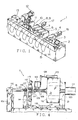
- Fig. 1 schematically shows an embodiment of a shielded wire processing device including a device for cutting the braid of a shielded wire according to this invention.
- a shielded wire processing apparatus generally 1 includes individual devices arranged successively from the right side, i.e., an operation console 2 for performing a change in a product number, switching between a manual operation and an automatic operation, etc., a wire setting device 3, a shield contact fitting device 4, a sheath incision device 5, a sheath extracting device 6, a braid cutting device 7, a braid fold-back device 8, shield pipe inserting device 9 (8 and 9 are illustrated as a single device for brevity of illustration) , sheath pipe squeezing device 10, a peeling device 11, a terminal squeezing device 12, a product drawing device 13, and a conveying device 14 for moving a shielded wire 15 along the respective devices 3 to 13. These devices 3 to 13 are arranged in parallel at substantially regular intervals.
- reference numeral 16 denotes a hopper for supplying a shield contact
- reference numeral 17 denotes a hopper for supplying a shield pipe.
- the shielded wires 15 each may a thick wire having a sectional area of about 15 mm 2 .
- the shielded wires 15 folded back in a U-shape or not folded back are set one by one in parallel in the wire setting device 3 at the right end of the conveying device 14.
- FIGs. 1 and 2 an explanation will be given of a shielded wire processing method using the shielded wire processing device 1, and its operation.
- the shielded wire 15 cut into a segment having a prescribed length is set in the shield setting device 3 by an operator.
- the only operation performed by the operator is to set the wire.
- the wire conveying device 14 is shifted by one pitch leftward to convey the shielded wire 15 to the adjacent shield contact inserting device 4.
- a ring-shaped shield contact 19 of conductive metal is fit over the shielded wire 15 by the shield contact fitting device 4.
- the shield contact 19 is composed of a large-diameter segment 19a and a small-diameter segment 19b which are stepped.
- the shielded wire 15 inserted into the shield contact 19 is conveyed to the sheath incision device 5 by the conveyer device 14.
- a circular incision 21 is made on the insulating sheath (outer sheath) 20 of the shielded wire 15 at a prescribed position located nearer to the tip of the wire than the shield contact 19.
- the shielded wire 15 is conveyed to the sheath drawing device 6.
- the sheath 20 is drawn out so that an internal metallic braid 22 is exposed over a prescribed length.
- the braid 22 is composed of slender metallic wires which are knitted in a crossing manner as seen from Fig. 3.
- the shielded wire is conveyed to the braid cutting device 7.
- the exposed braid 22 is cut into a prescribed length so that an insulating inner sheath 24 is exposed.
- the shielded wire 15 is conveyed to the braid fold-back device 8.
- the braid 22 is folded back toward the small-diameter portion 19b of the shield contact 19.
- a ring-shaped shield pipe 23 of conductive metal is inserted the from the tip side of the shielded wire 15 so that the braid 22 (not shown) is sandwiched between and brought in contact with the outer surface of the small diameter portion 19b of the shield contact 19 and the inner surface of the shield pipe 23.
- the angle of fold-back of the braid 22 ranges from 90° to 180°.
- the shielded wire 15 is conveyed to the shield pipe squeezing device 10. As seen from Fig. 2H, the shield pipe 23 is squeezed in a hexagon so that it is fixed to the shield contact 19. Since the braid 23 is sandwiched between the shield contact 19 and the shield pipe 23, the shield contact 19 and the shield pipe 23 are firmly fixed to the shielded wire 15.
- the shielded wire 15 is conveyed to the peeling device 11. As seen from Fig. 21, the tip side of the inner sheath 24 is peeled over a prescribed length so that a core (conductor) is exposed. Further, the shielded wire 15 is conveyed to the terminal squeezing device 12. As seen from Fig. 2J, a terminal 26 is crimped on the exposed core 25. Finally, the product 27 of the shielded wire is taken from the shielded wire processing device 1 into an external pallet (not shown) with the aid of the product drawing device 13.
- the terminal squeezing device 12 may be provided separately from the shielded wire processing device 1.
- reference numeral 107 denotes a ring-shaped die for cutting a braid; 109 a ring-shaped guide member; 110 a ring-shaped braid opening pallet; 111 an air-actuated or hydraulic horizontal cylinder for primarily advancing a punch 108; and 112 a large-sized and strong air-actuated or hydraulic cylinder for secondarily advancing the punch 108 and cutting the braid 22 of the shielded wire 15 between the die 107 and the punch 108.
- Reference numerals 113 and 114 (Fig. 5) denote air cylinders (driving means) for laterally opening/closing the ring-shaped braid opening pallet 110, respectively.
- the shielded wire 15 is caught by a chuck 115 in its intermediate portion in the longitudinal direction.
- the shielded wire 15 is also supported by a supporting chuck (supporting member) 116 in its tip side so that it is movable in the longitudinal direction.
- the chuck 115 includes a pair of left and right catching pallets.
- the chuck 115 is opened/closed by the air chuck cylinder 105.
- the wire chuck in the conveyer device 4 (Fig. 1) has the same structure.
- the supporting chuck 116 includes a pair of left and right symmetrical closable pallets which do not catch the shielded wire 15, but horizontally supports it in light contact therewith.
- the die 107 is located ahead of the supporting chuck 116.
- a frame 117 to which the die 107 is fixed and the supporting chuck 116 are integrally fixed to a horizontal base plate 118.
- the base plate 118 is adapted to be slidable in the longitudinal direction of the wire along a guide rail 119.
- the base plate 118 is driven back and forth by a ball screw shaft (not shown) .
- a primary cylinder 111 with a small diameter for moving a punch is attached to the frame 120 extended upright at the rear of the base plate 118.
- a secondary cylinder 112 with a large diameter is adapted to be movable back and forth relative to a frame 120 by a guiding means 121 such as a guide rail.
- a horizontal air cylinder (moving means) 122 with a small diameter for moving the guide member back and forth is attached to the secondary cylinder 112.
- the guide member 109 in a chuck-system is coupled with an opening/closing cylinder 123 which is in turn coupled with a rod 124 of the moving cylinder 122.
- a braid opening means 125 has a pair of left and right braid opening pallets 110 which are attached to sliding plates (sliding member) 126 and 127 which are movable in opposite directions.
- sliding plates sliding member
- Each of the sliding plates 126, 127 are engaged with a single substantially vertical link 128 at upper and lower shaft positions.
- the upper end and lower end of the link 128 are coupled with the rods 129 and 130 of the cylinders 113 and 114, respectively.
- the stem of each of the cylinders 113 and 114 is rotatably supported.
- Each of the sliding plates 126 and 127 is adapted to be movable in a horizontal direction (radial direction of the wire)within a gap between a hole portion and a shaft portion.
- Fig. 6 is an enlarged view of the cutting means such as the die 107 and punch 108 in Fig. 4.
- the die 107 is formed in a circular shape.
- the punch 108 is movable into an inner diameter portion 107a of the die 107.
- the inner diameter portion 107a is constituted by a horizontal narrow segment with a uniform inner diameter. This portion is successive to a front vertical plane 107b and a rear tapered plane 107c.
- the edge at the front end of the inner diameter portion 107a serves as a shearing blade.
- the outer periphery of the die is stepped and the stepped portion is engaged with an outer front half frame 117a so that it is not movable forward.
- the braid opening pallets 110 are kept in intimate contact with the front end of the die 107 so as to be slidable in the radial direction.
- a rear half frame 117b is kept in contact with the rear end of the die 107.
- the tapered plane 107c is smoothly successive to the tapered plane 117c.
- Each of the tapered planes 117c and 107c serves as a guide plane for guiding the tip of the braid 22 of the shielded wire (Fig. 4).
- the punch 108 is cylindrically shaped, and composed of a thin segment 108a with a small diameter on the tip side and a thick segment 108b with a large diameter backward successive thereto.
- the inner diameter of the thin segment 108a is equal to that of the thick segment 108b.
- the outer diameter of the thin segment 108a is smaller than that of the thick segment 108b.
- the outer edge 108c at the tip of the thin segment 108a serves as a shearing blade.
- the thin segment 108a advances into the inner diameter portion 109c of the guide member 109 with a slight gap therefrom.
- the guide member 109 is formed in a circular shape divided into two left and right segments.
- the guide member 109 has an inner slope 109a for wire guiding, which covers the tip of the thin segment 108a of the punch 108, and an outer slope 109b for braid guiding.
- the inner slope 109a is formed is a short length whereas the outer slope 109b is formed in a relatively long length extended backward.
- the inner slope 109a is successive to a circular vertical plane 109d with which the tip of the thin segment 108a of the punch 108 is in contact.
- the minimum inner diameter of the guide member 109 is equal to the inner diameter of the thin segment 108a of the punch 108.
- Both slopes 109a and 109b cross to form an acute angle.
- the tip of the guide member 109 is formed in a wedge shape in section.
- the guide member 109 is provided integrally to or separately from a pair of left and right arms 104 which can be opened/closed freely. Specifically, the one semi-circular guide member 109 and the other semi-circular guide member 109 are attached to the one arm 104 and the other arm 104, respectively.
- the pair of left and right guide members 109 are opened/closed by an opening/closing cylinder 123 (Fig. 4).
- the braid opening pallet 110 has a slightly acute circular tip, whose degree is less than a cutter.
- the "front" of the shielded wire 15 is coincident to the "front” of the die 107.
- the "front” of the punch 108 is opposite to the "front” of the guide member 109.
- the horizontal base plate 118 is advanced slidably by a ball screwing shaft and servo motor so that the tip of the shielded wire 15 (exposed portion of the braid 22) is inserted into the die 107.
- a pair of upper and lower cylinders 113 and 114 are operated several times in opposite directions, respectively.
- a link 128 swings so that the braid opening pallets 110 repeatedly open/close integrally to the pair of left and right slide plates 126 and 127.
- the pallets 110 press the braid 22 of the shielded wire 15 against the inner sheath 24 several times (four to five times) so that the braid 22 is gradually expanded in diameter outwardly. Accordingly, the circular punch 108 can be inserted comparatively easily between the braid 22 of the wire 15 and inner sheath 24.
- the secondary cylinder 112, punch 108 and guide member 109 are advanced by the operation of extending the primary cylinder 111 as shown in Fig. 4. Then, as shown in Fig. 8, the inner sheath 24 of the shielded wire 15 is initially (slightly) inserted into the inner diameter portion (inner space) of the punch 108. Simultaneously, the opened portion of the braid 22 slides along the outer slope 109b of the guide member 109 so that it is further opened. Since the guide member 109 is opened left and right, the braid 22 is extended more outwardly. In this state, the guide member 109 is moved backward.
- the operation of the guide member 109 of opening the braid further facilitates the insertion of the punch 108.
- the tip of the punch 108 is completely housed in the inner diameter portion 109c of the guide member 109 so that interference between the tip of the inner sheath of the shielded wire 15 and that of the tip of the punch 108 is prevented.
- the wire can be smoothly inserted.
- the guide member 109 is opened outwardly, and moved backward by the compressing operation of the horizontal air cylinder 122 as shown in Fig. 4 so that the secondary cylinder 112 is extended. Then, the punch 108 is inserted into the opened portion of the braid 22 as shown in Fig. 7. At this time, the braid 22 is sandwiched between the outer periphery of the punch 108 and the inner periphery of the die 7 and sheared or cut instantaneously. This is performed to exclude the redundant segment at the tip of the braid 22 and define the protruding length of the braid 22 of the outer sheath 20.
- the main part of the cutting device inclusive of the punch 108 and die 107 moves backward along a guide rail 119 by the function of the servo motor and ball screw shaft (not shown) so that the shielded wire 105 is extracted from the die 107.
- the braid opening pallets 110 are operated several times in its empty state, owing to its vibration, the refuse of the braid is thrown into a waste box.
- the cutting length of the braid 22 can be adjusted freely so as to correspond to the shielded wires 15 of the several product numbers.
- the braid 22 is turned over so that the inner sheath 24 is located on the inner wall of the punch 108.
- the braid 22 is cut by the outside of the punch 108 so that only the braid 22 can be surely cut without injuring the inner sheath 24 and the core 25.
- the shielded wire 15 with the braid 22 thus partially cut is sent to the adjacent braid fold-back device 8 by the conveying device 14 (Fig. 1).
Landscapes
- Engineering & Computer Science (AREA)
- Manufacturing & Machinery (AREA)
- Removal Of Insulation Or Armoring From Wires Or Cables (AREA)
- Processing Of Terminals (AREA)
Applications Claiming Priority (2)
| Application Number | Priority Date | Filing Date | Title |
|---|---|---|---|
| JP2001058476 | 2001-03-02 | ||
| JP2001058476A JP3908915B2 (ja) | 2001-03-02 | 2001-03-02 | シールド電線の編組切断装置及び編組切断方法 |
Publications (3)
| Publication Number | Publication Date |
|---|---|
| EP1237236A2 true EP1237236A2 (fr) | 2002-09-04 |
| EP1237236A3 EP1237236A3 (fr) | 2004-01-02 |
| EP1237236B1 EP1237236B1 (fr) | 2005-06-01 |
Family
ID=18918193
Family Applications (1)
| Application Number | Title | Priority Date | Filing Date |
|---|---|---|---|
| EP02004766A Expired - Lifetime EP1237236B1 (fr) | 2001-03-02 | 2002-03-01 | Appareil et procédé pour découper des tresses de fils blindés |
Country Status (4)
| Country | Link |
|---|---|
| US (1) | US6659140B2 (fr) |
| EP (1) | EP1237236B1 (fr) |
| JP (1) | JP3908915B2 (fr) |
| DE (1) | DE60204369T2 (fr) |
Cited By (2)
| Publication number | Priority date | Publication date | Assignee | Title |
|---|---|---|---|---|
| WO2020016056A1 (fr) * | 2018-07-16 | 2020-01-23 | Metzner Maschinenbau Gmbh | Dispositif et procédé de traitement d'une extrémité d'un câble électrique |
| WO2020200827A1 (fr) * | 2019-03-29 | 2020-10-08 | Metzner Maschinenbau Gmbh | Dispositif et procédé de montage d'un connecteur électrique enfichable |
Families Citing this family (19)
| Publication number | Priority date | Publication date | Assignee | Title |
|---|---|---|---|---|
| JP3790416B2 (ja) * | 2000-11-06 | 2006-06-28 | 矢崎総業株式会社 | シールド電線の加工方法と加工装置 |
| EP1515403B1 (fr) * | 2003-09-10 | 2007-10-24 | komax Holding AG | Dispositif de traitement de câble |
| JP2005229770A (ja) * | 2004-02-16 | 2005-08-25 | Yazaki Corp | シールド電線の編組切断装置 |
| DE102005024683B4 (de) * | 2005-05-30 | 2011-02-03 | Rosenberger Hochfrequenztechnik Gmbh & Co. Kg | Verfahren zum Vorbereiten eines Kabelendes für die Montage eines Steckverbinders |
| US7632147B2 (en) * | 2008-03-04 | 2009-12-15 | Nexus, Incorporated | Shielded cable plug and jack assembly |
| JP5095491B2 (ja) * | 2008-05-09 | 2012-12-12 | 矢崎総業株式会社 | スリーブ挿入装置 |
| JP5362270B2 (ja) * | 2008-07-03 | 2013-12-11 | 矢崎総業株式会社 | シールド電線、及び該シールド電線の編組端末処理方法、並びに、編組端末処理装置 |
| DE102012020798B3 (de) * | 2012-10-23 | 2014-04-10 | Rosenberger Hochfrequenztechnik Gmbh & Co. Kg | Vorrichtung und Verfahren zum Bearbeiten eines Endes eines Kabels |
| DE202013002575U1 (de) | 2013-03-15 | 2013-04-17 | Rosenberger Hochfrequenztechnik Gmbh & Co. Kg | Steckverbinder |
| DE102015009989A1 (de) | 2015-07-31 | 2017-02-02 | Komax SLE GmbH & Co. KG | Kabelklemmvorrichtung zur Aufweitung für Schirmgeflechten von Kabeln |
| CN107196175B (zh) * | 2017-07-07 | 2023-07-07 | 深圳市日研精密机械有限公司 | 一种单头打端子单头插胶壳机以及线材插胶壳的方法 |
| CN108963720A (zh) * | 2018-07-17 | 2018-12-07 | 吉林省中赢高科技有限公司 | 一种线缆屏蔽网翻转装置 |
| US11018483B2 (en) * | 2018-09-04 | 2021-05-25 | Te Connectivity Corporation | Cable preparation machine |
| US11056852B2 (en) | 2018-09-05 | 2021-07-06 | TE Connectivity Services Gmbh | Cable preparation machine |
| CN109500913A (zh) * | 2019-01-09 | 2019-03-22 | 深圳市沃尔新能源电气科技股份有限公司 | 线缆屏蔽的裁剪装置 |
| JP7157100B2 (ja) * | 2020-06-05 | 2022-10-19 | 矢崎総業株式会社 | 編組折返し切断装置及び編組折返し切断方法 |
| CN114336224B (zh) * | 2020-09-30 | 2025-12-30 | 泰科电子(上海)有限公司 | 同轴线缆加工装置及加工同轴线缆的方法 |
| US12438347B2 (en) * | 2021-11-29 | 2025-10-07 | Aptiv Technologies AG | Method of cutting shielding conductor of a high voltage cable and apparatus to be used therefore |
| US12646913B2 (en) * | 2024-06-17 | 2026-06-02 | Te Connectivity Solutions Gmbh | Method for cable braid folding |
Family Cites Families (5)
| Publication number | Priority date | Publication date | Assignee | Title |
|---|---|---|---|---|
| US4719697A (en) * | 1985-08-05 | 1988-01-19 | Amp Incorporated | Method of preparing coaxial cable for termination |
| US4763410A (en) * | 1987-07-20 | 1988-08-16 | Amp Incorporated | Method for braided coaxial cable preparation |
| DE4027904C2 (de) * | 1990-09-03 | 1994-04-14 | Siemens Ag | Vorrichtung zur Bearbeitung von abgeschirmten elektrischen Leitungen |
| US6243947B1 (en) * | 1998-09-22 | 2001-06-12 | Sumitomo Wiring Systems, Ltd. | Method for processing an end of a shielded cable |
| US6363604B1 (en) * | 1999-05-21 | 2002-04-02 | Autonetworks Technologies, Ltd. | Method and apparatus for cutting braided sheath of shielding wire |
-
2001
- 2001-03-02 JP JP2001058476A patent/JP3908915B2/ja not_active Expired - Fee Related
-
2002
- 2002-02-27 US US10/083,603 patent/US6659140B2/en not_active Expired - Lifetime
- 2002-03-01 DE DE60204369T patent/DE60204369T2/de not_active Expired - Lifetime
- 2002-03-01 EP EP02004766A patent/EP1237236B1/fr not_active Expired - Lifetime
Cited By (3)
| Publication number | Priority date | Publication date | Assignee | Title |
|---|---|---|---|---|
| WO2020016056A1 (fr) * | 2018-07-16 | 2020-01-23 | Metzner Maschinenbau Gmbh | Dispositif et procédé de traitement d'une extrémité d'un câble électrique |
| WO2020200827A1 (fr) * | 2019-03-29 | 2020-10-08 | Metzner Maschinenbau Gmbh | Dispositif et procédé de montage d'un connecteur électrique enfichable |
| US12107376B2 (en) | 2019-03-29 | 2024-10-01 | Metzner Holding GmbH | Device and method for assembling an electrical plug connector |
Also Published As
| Publication number | Publication date |
|---|---|
| EP1237236A3 (fr) | 2004-01-02 |
| DE60204369T2 (de) | 2006-03-16 |
| US20020121159A1 (en) | 2002-09-05 |
| US6659140B2 (en) | 2003-12-09 |
| DE60204369D1 (de) | 2005-07-07 |
| EP1237236B1 (fr) | 2005-06-01 |
| JP3908915B2 (ja) | 2007-04-25 |
| JP2002262427A (ja) | 2002-09-13 |
Similar Documents
| Publication | Publication Date | Title |
|---|---|---|
| EP1237236B1 (fr) | Appareil et procédé pour découper des tresses de fils blindés | |
| JP3803013B2 (ja) | シールド電線加工装置及びシールド電線加工方法 | |
| EP2871737B1 (fr) | Dispositif et procédé de dénudage | |
| DE69926701T2 (de) | Verarbeitungsverfahren und -apparat eines Kabelendes | |
| KR100225316B1 (ko) | 와이어압착소켓 커넥터 제조 방법 및 장치 | |
| US7607217B2 (en) | Device for processing a wire | |
| US6776196B2 (en) | Braid folding unit and a braid folding method of a shielded wire | |
| JP3117114B2 (ja) | 圧接ハーネス製造装置及び圧接ハーネス製造方法 | |
| US6363604B1 (en) | Method and apparatus for cutting braided sheath of shielding wire | |
| EP1079478B1 (fr) | Procédé et dispositif pour couper et/ou dénuder des fils isolés | |
| EP3713023A1 (fr) | Dispositif ainsi que procédé d'isolation | |
| DE2928704A1 (de) | Vorrichtung zum gleichzeitigen anschluss einer reihe von kabeln an entsprechende kontakte | |
| JPH0817107B2 (ja) | 自動圧接機におけるシールドリボンケーブルの切断処理方法及びその装置 | |
| US5085114A (en) | Method for facilitating removal of insulation from wires | |
| EP2190080A2 (fr) | Dispositif de sertissage et de dénudement d'un conducteur d'un câble à plusieurs fils | |
| JP3790416B2 (ja) | シールド電線の加工方法と加工装置 | |
| US6442833B1 (en) | Method of stripping electric wire | |
| JP2001045623A (ja) | シールド電線の編組シールド切断方法及び切断装置 | |
| US4043032A (en) | Terminal applicator apparatus for terminals in strip form | |
| US3431621A (en) | Apparatus for connecting corresponding wires of pairs of wires to each other | |
| DE68923071T2 (de) | Leiterentmantelung und -abschluss in Multiaderkabeln. | |
| US3555672A (en) | High speed semiautomatic termination of coaxial cable | |
| CN111585143B (zh) | 一种接线端子冲压成型设备及冲压方法 | |
| US6289573B1 (en) | Apparatus for making up a cable | |
| DE10212993A1 (de) | Crimp-Verfahren |
Legal Events
| Date | Code | Title | Description |
|---|---|---|---|
| PUAI | Public reference made under article 153(3) epc to a published international application that has entered the european phase |
Free format text: ORIGINAL CODE: 0009012 |
|
| AK | Designated contracting states |
Kind code of ref document: A2 Designated state(s): AT BE CH CY DE DK ES FI FR GB GR IE IT LI LU MC NL PT SE TR |
|
| AX | Request for extension of the european patent |
Free format text: AL;LT;LV;MK;RO;SI |
|
| PUAL | Search report despatched |
Free format text: ORIGINAL CODE: 0009013 |
|
| AK | Designated contracting states |
Kind code of ref document: A3 Designated state(s): AT BE CH CY DE DK ES FI FR GB GR IE IT LI LU MC NL PT SE TR |
|
| AX | Request for extension of the european patent |
Extension state: AL LT LV MK RO SI |
|
| RIC1 | Information provided on ipc code assigned before grant |
Ipc: 7H 02G 1/12 A |
|
| 17P | Request for examination filed |
Effective date: 20040227 |
|
| 17Q | First examination report despatched |
Effective date: 20040513 |
|
| AKX | Designation fees paid |
Designated state(s): CH DE FR LI |
|
| RIC1 | Information provided on ipc code assigned before grant |
Ipc: 7H 01R 43/28 B Ipc: 7H 02G 1/12 A |
|
| RIC1 | Information provided on ipc code assigned before grant |
Ipc: 7H 02G 1/12 A Ipc: 7H 01R 43/28 B |
|
| RIC1 | Information provided on ipc code assigned before grant |
Ipc: 7H 01R 43/28 B Ipc: 7H 02G 1/12 A |
|
| RIN1 | Information on inventor provided before grant (corrected) |
Inventor name: YAMAKAWA, NOBUAKI,C/O YAZAKI PARTS CO., LTD. |
|
| GRAP | Despatch of communication of intention to grant a patent |
Free format text: ORIGINAL CODE: EPIDOSNIGR1 |
|
| GRAS | Grant fee paid |
Free format text: ORIGINAL CODE: EPIDOSNIGR3 |
|
| GRAA | (expected) grant |
Free format text: ORIGINAL CODE: 0009210 |
|
| AK | Designated contracting states |
Kind code of ref document: B1 Designated state(s): CH DE FR LI |
|
| REG | Reference to a national code |
Ref country code: CH Ref legal event code: EP |
|
| REF | Corresponds to: |
Ref document number: 60204369 Country of ref document: DE Date of ref document: 20050707 Kind code of ref document: P |
|
| REG | Reference to a national code |
Ref country code: CH Ref legal event code: NV Representative=s name: PATENTANWAELTE SCHAAD, BALASS, MENZL & PARTNER AG |
|
| PLBE | No opposition filed within time limit |
Free format text: ORIGINAL CODE: 0009261 |
|
| STAA | Information on the status of an ep patent application or granted ep patent |
Free format text: STATUS: NO OPPOSITION FILED WITHIN TIME LIMIT |
|
| ET | Fr: translation filed | ||
| 26N | No opposition filed |
Effective date: 20060302 |
|
| REG | Reference to a national code |
Ref country code: FR Ref legal event code: PLFP Year of fee payment: 15 |
|
| REG | Reference to a national code |
Ref country code: FR Ref legal event code: PLFP Year of fee payment: 16 |
|
| REG | Reference to a national code |
Ref country code: FR Ref legal event code: PLFP Year of fee payment: 17 |
|
| PGFP | Annual fee paid to national office [announced via postgrant information from national office to epo] |
Ref country code: DE Payment date: 20200218 Year of fee payment: 19 |
|
| PGFP | Annual fee paid to national office [announced via postgrant information from national office to epo] |
Ref country code: CH Payment date: 20200313 Year of fee payment: 19 |
|
| PGFP | Annual fee paid to national office [announced via postgrant information from national office to epo] |
Ref country code: FR Payment date: 20200214 Year of fee payment: 19 |
|
| REG | Reference to a national code |
Ref country code: DE Ref legal event code: R119 Ref document number: 60204369 Country of ref document: DE |
|
| REG | Reference to a national code |
Ref country code: CH Ref legal event code: PL |
|
| PG25 | Lapsed in a contracting state [announced via postgrant information from national office to epo] |
Ref country code: CH Free format text: LAPSE BECAUSE OF NON-PAYMENT OF DUE FEES Effective date: 20210331 Ref country code: LI Free format text: LAPSE BECAUSE OF NON-PAYMENT OF DUE FEES Effective date: 20210331 Ref country code: FR Free format text: LAPSE BECAUSE OF NON-PAYMENT OF DUE FEES Effective date: 20210331 Ref country code: DE Free format text: LAPSE BECAUSE OF NON-PAYMENT OF DUE FEES Effective date: 20211001 |