EP1144478B1 - Viscosity modifier for thermosetting resin composition - Google Patents
Viscosity modifier for thermosetting resin composition Download PDFInfo
- Publication number
- EP1144478B1 EP1144478B1 EP99937530.6A EP99937530A EP1144478B1 EP 1144478 B1 EP1144478 B1 EP 1144478B1 EP 99937530 A EP99937530 A EP 99937530A EP 1144478 B1 EP1144478 B1 EP 1144478B1
- Authority
- EP
- European Patent Office
- Prior art keywords
- resin composition
- polyepoxide
- resin
- polyisocyanate
- epoxy
- Prior art date
- Legal status (The legal status is an assumption and is not a legal conclusion. Google has not performed a legal analysis and makes no representation as to the accuracy of the status listed.)
- Expired - Lifetime
Links
Images


Classifications
-
- C—CHEMISTRY; METALLURGY
- C08—ORGANIC MACROMOLECULAR COMPOUNDS; THEIR PREPARATION OR CHEMICAL WORKING-UP; COMPOSITIONS BASED THEREON
- C08G—MACROMOLECULAR COMPOUNDS OBTAINED OTHERWISE THAN BY REACTIONS ONLY INVOLVING UNSATURATED CARBON-TO-CARBON BONDS
- C08G59/00—Polycondensates containing more than one epoxy group per molecule; Macromolecules obtained by polymerising compounds containing more than one epoxy group per molecule using curing agents or catalysts which react with the epoxy groups
-
- C—CHEMISTRY; METALLURGY
- C08—ORGANIC MACROMOLECULAR COMPOUNDS; THEIR PREPARATION OR CHEMICAL WORKING-UP; COMPOSITIONS BASED THEREON
- C08G—MACROMOLECULAR COMPOUNDS OBTAINED OTHERWISE THAN BY REACTIONS ONLY INVOLVING UNSATURATED CARBON-TO-CARBON BONDS
- C08G18/00—Polymeric products of isocyanates or isothiocyanates
- C08G18/003—Polymeric products of isocyanates or isothiocyanates with epoxy compounds having no active hydrogen
-
- C—CHEMISTRY; METALLURGY
- C08—ORGANIC MACROMOLECULAR COMPOUNDS; THEIR PREPARATION OR CHEMICAL WORKING-UP; COMPOSITIONS BASED THEREON
- C08L—COMPOSITIONS OF MACROMOLECULAR COMPOUNDS
- C08L63/00—Compositions of epoxy resins; Compositions of derivatives of epoxy resins
-
- Y—GENERAL TAGGING OF NEW TECHNOLOGICAL DEVELOPMENTS; GENERAL TAGGING OF CROSS-SECTIONAL TECHNOLOGIES SPANNING OVER SEVERAL SECTIONS OF THE IPC; TECHNICAL SUBJECTS COVERED BY FORMER USPC CROSS-REFERENCE ART COLLECTIONS [XRACs] AND DIGESTS
- Y10—TECHNICAL SUBJECTS COVERED BY FORMER USPC
- Y10T—TECHNICAL SUBJECTS COVERED BY FORMER US CLASSIFICATION
- Y10T428/00—Stock material or miscellaneous articles
- Y10T428/31504—Composite [nonstructural laminate]
- Y10T428/31511—Of epoxy ether
Definitions
- This invention relates to resin formulations, and in particular to curable thermosetting resin formulations such as epoxy resins.
- the invention relates to resin formulations useful for making prepregs and electrical laminates.
- formulations that are used in such processes typically contain:
- Viscosity is critical in laminate making processes. See, for example, Delmonte, Hoggatt & May at 903. High viscosity resins distort the position of fibers in the substrate, and are difficult to impregnate into the substrate. However, if the viscosity of the resin is too low, the resin tends to flow out of the prepreg stack during the lamination process, resulting in a laminate which is deficient in resin, such that it is very difficult to obtain a homogeneous thickness over the whole laminate.
- the ability to control the thickness of laminates is important in some applications. For example, recently, a new chip memory module technology has been developed to achieve faster bus/substrate speed (>300 MHz) to better utilize the capabilities of faster CPUs. The critical need in this application is for extremely tight control of the dielectric constant which translates into much better thickness control of the laminate layers.
- Formulations which contain liquid epoxy resins and a chain extender have not commonly been used in laminating processes, because their viscosity in the treater and prepreg is often too low.
- the formulations run and drip in the treater before the B-stage is complete. Furthermore, the formulations flow too much after the prepreg is put into the laminating press. The resin is forced out of the laminate and into the press, and the resulting laminate is too thin.
- Extra catalysts may be added to the formulation to encourage quick reaction of epoxy resin and chain extender in the treater, so that higher molecular weight advanced resins are produced before dripping occurs.
- those catalysts also accelerate curing of the resin with the curing agent. It is difficult to prevent the viscosity from building too high for effective lamination.
- formulations which contain too much catalyst have a short shelf- or pot-life, and the resulting prepregs have a short shelf-life.
- thermoplastic resins in electrical laminate formulations to reduce the resin flow out (waste) by increasing the melt viscosity of the B-staged materials of the prepregs during the lamination process.
- a high molecular weight polymer obtained by an advancement reaction using bisphenol-A and the diglycidylether of bisphenol-A and is sold commercially by Phenoxy Associates (USA), under the trademark PKHH.
- PKHH Phenoxy Associates
- This material is frequently used to reduce resin flow-out by increasing the melt viscosity of the B-staged materials without shortening the gel time.
- Tg of the resulting laminate is adversely affected.
- polyoxazolidones There are three end products (conventionally referred to as polyoxazolidones) which can be obtained in the condensation reaction of polyisocyanates with polyfunctional epoxides, namely isocyanate-terminated polyoxazolidones, linear polyoxazolidones, and epoxy-terminated polyoxazolidones. These three possible end products and various methods for their production, are described in U.S. Patent No. A 5,112,932 .
- Epoxy terminated polyoxazolidones are prepared by reacting an epoxy resin with a polyisocyanate compound using stoichiometric excess of epoxy resin (isocyanate/epoxide ratio lower than 1).
- U.S. Patent No. A 4,070,416 (Hitachi) describes a process for producing thermosetting resins by mixing one equivalent or more of polyfunctional isocyanate per one equivalent of a polyfunctional epoxide in the presence of a tertiary amine, morpholine derivatives or imidazole as catalysts.
- the catalyst is used within a range of 0.1 to 2 weight percent, based on the combined weight of the reactants.
- the reaction temperature of 130°C or lower is said to result in the formation of mainly isocyanurate rings, whereas it is assumed that oxazolidone rings should be mainly formed at temperature above 130°C.
- the resins produced are said to exhibit excellent electrical and mechanical properties and high thermal stability. They are said to have various applications as heat resistance insulation varnishes, casting resins, impregnation resins, molding resins for electrical parts, adhesives, resins for laminating boards, resins for printed circuits etc.
- EP A 0,113,575 discloses powder coating compositions comprising epoxy terminated polyoxazolidone resins prepared by reacting a diepoxide and a diisocyanate in amounts which provide a ratio of epoxide equivalents to isocyanate equivalents of from 1.1:1 to 10:1 and curing agents.
- the polyoxazolidone resins are said to have comparatively high glass transition temperatures and provide coatings of improved resistance to cathodic disbandment.
- the coating compositions are applied by fluidized bed sintering or electrostatic spray methods.
- U.S. Patent No. A 3,334,110 discloses a method for preparing epoxy terminated polyoxazolidones by reacting a polyisocyanate with a polyepoxide in the presence of a catalyst mixture comprising an alcohol and tertiary amine or a quaternary ammonium salt.
- the epoxy terminated polyoxazolidones can be cured with epoxy curing catalysts or reacted with epoxy hardeners to give a variety of products useful in the fields of coatings, laminating, bonding, molding, and foams.
- EP B 0,695,316 and U.S. Patent No. A 5,449,737 also disclose the preparation of oxazolidone-containing base resins.
- both of these CIBA references refer in general terms to materials having an epoxy equivalent weight (EEW) of from 200 to 10,000, they are concerned with "base resins", intended to be cured with a crosslinking agent, and for such purposes, a material having a low EEW (for example no more than 500) would invariably be used. If a material with a high equivalent weight (in particular, higher than 500) is used as a base resin in the production of laminates, the resin fails to wet out the glass fibers, and is therefore unsatisfactory. All of the Examples in both of the CIBA patents use an amount of isocyanate of no more than 18.7 percent (TDI) for the preparation of the base resin, and result in materials having an EEW of no more than 500. In practice therefore, the skilled addressee following the teaching of these references would not prepare a material having a molecular weight of 5000 or more.
- EWD epoxy equivalent weight
- prepregs incorporating the viscosity modifiers exhibit better storage stability and higher laminate Tg than systems employing PKHH.
- Tg of laminates obtained using PKHH exhibit lower Tg when the prepregs were stored over a period of time whereas prepregs prepared using the viscosity modifiers of the present invention exhibited a lower drop in laminate Tg after same period of storage.
- thermoplastic resin has a molecular weight of at least 5000, and a hydroxyl content not exceeding 0.2 hydroxyl equivalents per 100 g of the resin composition, and wherein the viscosity modifier is :
- the viscosity modifier is an oxazolidone ring-containing compound which is obtained by the reaction of :
- thermosetting resin composition comprising a heat-curable thermosetting resin having a molecular weight of from 200 to 3000, and from 0. 5 to 40 percent by weight, based on the resin composition, of a viscosity modifier which is a thermoplastic resin having a molecular weight of at least 5000 and a hydroxyl content not exceeding 0.2 hydroxyl equivalents per 100 g of the resin composition, wherein the viscosity modifier is :
- thermosetting resin composition which method comprises combining a heat curable thermosetting resin having a molecular weight of from 200 to 3000, with from 0. 5 to 40 percent by weight, based on the resin composition, of a viscosity modifier wherein the viscosity modifier is a thermoplastic resin having a molecular weight of at least 5000 and a hydroxyl content not exceeding 0.2 hydroxyl equivalents per 100 g of the resin composition, wherein the viscosity modifier is :
- the amount of the oxazolidone ring-containing compound in the epoxy resin composition is preferably such as to provide from 0.01 to 1
- the polyepoxide compound useful in the preparation of the viscosity modifier is suitably a compound which possesses an average of from 1.9 to 2.1 1,2-epoxy groups per molecule.
- the polyepoxide compound is saturated or unsaturated aliphatic, cycloaliphatic, aromatic or heterocyclic compound which possesses more than one 1,2-epoxy group.
- the polyepoxide compound can be substituted with one or more substituents which are non reactive with the isocyanate groups such as lower alkyls and halogens.
- Such polyepoxide compounds are well known in the art. Illustrative polyepoxide compounds useful in the practice of the present invention are described in the Handbook of Epoxy Resins by H.E. Lee and K. Neville published in 1967 by McGraw Hill, New York and U.S. Patent No. 4,066,628 .
- aromatic polyepoxides examples include bisphenol-A, bisphenol-F, bisphenol-AD, bisphenol-S, tetramethyl bisphenol-A, tetramethyl bisphenol-F, tetramethyl bisphenol-AD, tetramethyl bisphenol-S, tetrabromobisphenol-A, tetrachlorobisphenol-A, biphenols such as 4,4'-biphenol or 3,3',5,5'-tetramethyl-4,4'-biphenol, and dihydroxynaphthalene.
- Suitable aliphatic polyepoxides are diglycidyl esters of hexahydrophthalic acid and diglycidyl esters of dicarboxylic acids, epoxidized polybutadiene, epoxidized soyabean oil, and epoxidized diols.
- Preferred polyepoxides are glycidyl compounds of bisphenol-A, of bisphenol-F, of tetrabromobisphenol-A and of 3,3',5,5'-tetramethyl-4,4-biphenol. Mixtures of any two or more polyepoxides can also be used in the practice of the present invention.
- suitable polyisocyanates are the difunctional isocyanate disclosed in WO A 9,521,879 .
- Preferred examples are 2,4'-methylene bis(phenylisocyanate) and 4,4'-methylene bis(phenylisocyanate) (MDI) and isomers thereof, higher functional homologs of MDI (commonly designated as "polymeric MDI"), toluene diisocyanate (TDI) such as 2,4-toluene diisocyanate and 2,6-toluene diisocyanate, m-xylylene diisocyanate, hexamethylene diisocyanate (HMDI) and isophoronediisocyanate.
- Particularly preferred polyisocyanates are 2,4'-methylene bis(phenylisocyanate) and 4,4'-methylene bis(phenylisocyanate). Mixtures of any two or more polyisocyanates can also be used.
- a suitable catalyst may be employed to facilitate reaction of the polyepoxide compound with the polyisocyanate compound.
- suitable catalysts include zinc carboxylate, organozinc chelate compound, trialkyl aluminum, quaternary phosphonium and ammonium salts, tertiary amines and imidazole compounds.
- the preferred catalysts are imidazole compounds and azo compounds.
- preferred catalysts are 2-phenylimidazole 2-methylimidazole, 1 methylimidazole, 2-methylimidazole, 4,4'-methylene methylimidazole), 1,5-diazabicyclo[4.3.0] non-5-en, 1,4-diazabicyclo[2.2.2] octane and 1,8-diazabicyclo[5.4.0] undec-7-en.
- the catalyst is generally employed in an amount of from 0.01 to 2; preferably 0.02 to 1, most preferably 0.02 to 0.1, weight percent based on the combined weight of the polyepoxide compound and polyisocyanate compound used.
- the polyepoxide compound is generally employed in an amount of from 85 to 57, preferably 80 to 57, more preferably 80 to 60, most preferably 75 to 65, weight percent, based on the polyepoxide and polyisocyanate reactants.
- the reaction of the polyepoxide with the polyisocyanate is usually conducted at a temperature of from 100°C to 240°C, preferably from 120°C to 230°C, more preferably from 130°C to 220°C, most preferably from 140°C to 210°C.
- the polyoxazolidone-containing viscosity modifier can be produced via either a batch reactor or an extruder.
- the extrusion products exhibit lower polydispersity and lower gel particle content verses the batch reactor-produced materials.
- the resident time in an extruder depends on the temperature of the extrusion temperature, the size of the extruder and the catalyst levels.
- the catalyst is usually added to the reaction vessel containing the polyepoxide prior to the start of the addition of polyisocyanate compound.
- the catalyst can be dissolved in a suitable solvent prior to the addition to the polyepoxide to improve homogenization if desired.
- the temperature at which the catalyst is added is not critical. In general the catalyst is added at a temperature lower than the reaction temperature. The temperature is then raised and the reaction temperature maintained while the controlled addition of the polyisocyanate to the mixture of the catalyst and the polyepoxide is started.
- the polyisocyanate addition time will depend on the physical characteristics of the reactor, for example, stirrer size, and heat transfer characteristics, but usually, the polyisocyanate is added to the reaction vessel within a period of time of from 3 to 300, preferably 5 to 240, more preferably 10 to 180, most preferably 20 to 150 minutes, while maintaining the reaction temperature.
- the reaction temperature is maintained after the complete addition of the polyisocyanate for a period of time of from 5 to 180, preferably 15 to 120, most preferably 30 to 90 minutes.
- reaction of the polyepoxide compound and the polyisocyanate compound is preferably conducted neat, that is, in the absence of a solvent or other liquid reaction diluent, although the reaction may be carried out in the presence of a polar solvent such as DMF, NMP and DMSO.
- a polar solvent such as DMF, NMP and DMSO.
- the optional chain extender employed in the production of the polyoxazolidone compound is one which is able to increase the molecular weight of the polyoxazolidone compound.
- Preferred chain extenders are dihydric phenols, halogenated dihydric phenols, dicarboxylic acids, diamines, aminoamides and alkanolamines.
- Suitable dicarboxylic acid chain extenders are compounds of the formula R-(COOH) u wherein R is a C 1-40 hydrocarbyl moiety optionally containing oxygen along the backbone, and u is from 1.9 to 2.1.
- R is a C 1-40 hydrocarbyl moiety optionally containing oxygen along the backbone, and u is from 1.9 to 2.1.
- Examples are succinic acid, glutaric acid, adipic acid, oxalic acid, phthalic acid, hexahydrophthalic acid, maleic acid, citraconic acid, itaconic acid, dodecenylsuccinic acid and alkylated endoalkylenetetrahydrophthalic acid, and half esters obtained from the reaction of a polyol with an acid anhydride.
- hydrocarbyl as employed herein means any aliphatic, cycloaliphatic, aromatic, aryl substituted aliphatic or cycloaliphatic, or aliphatic or cycloaliphatic substituted aromatic groups.
- Suitable chain extenders useful in the practice of the present invention are diamines and aminoamides, that is, amine- or amino amide-containing compounds having two N-H bonds capable of reacting with an epoxy group.
- Such compounds useful in the present invention include, for example, di-secondary amines of the general formula R-NH-R'-NH-R" wherein R, R' and R" are alkyl, cycloalkyl or aryl moieties; and heterocyclic di-secondary amines wherein one or both of the N atom is part of a nitrogen-containing heterocyclic compound such as:
- di-secondary amines or primary amines having sterically hindered amine groups are preferred as, for example, 2,6-dimethyl cyclohexylamine or 2,6-xylidene (1-amino-2,6-dimethylbenzene).
- Amino amide-containing compounds useful as advancement monomers in the present invention include for example derivatives of carboxylic and amides as well as derivatives of sulfonic acid amides having additionally one primary or two secondary amino groups.
- Preferred examples of such compounds are amino-aryl carboxylic acid amides and amino-arylsulfonamides.
- a preferred compound of this group is, for example, sulphanilamide (4-amino benzylsulfonic acid amide).
- piperazine and substituted piperazine such as 2-methyl piperazine, monoethanolamine, and piperidin-4-carbonic acid.
- the chain extender is particularly preferably a phenolic compound, containing on average more than 1 and less than 3, preferably from 1.8 to 2.2 and more preferably 2 active hydrogen (for example, phenolic hydroxyl) groups per molecule.
- the phenolic chain extender When the phenolic chain extender is non-halogenated, its molecular weight is preferably at least 110 and more preferably at least 185. The molecular weight is preferably no more than 800, more preferably no more than 500, and most preferably no more than 250.
- the formula weight of non-halogen atoms in the chain extender preferably meets the foregoing preferred limitations, and the total molecular weight is preferably within the preferred embodiments plus the formula weight of the halogen.
- the polyoxazolidone compounds are used in accordance with the invention as viscosity modifying additives to improve the viscosity characteristics of curable thermosetting resin formulations such as epoxy-resins, in particular in the manufacture of prepregs and laminates, in particular electrical laminates.
- curable thermosetting resin formulations such as epoxy-resins
- the compositions may also be used in encapsulation, coating and structural composite applications.
- thermosetting resin into which the viscosity modifier is incorporated is preferably an epoxy resin, more preferably a diglycidyl ether of bisphenol-A or a diglycidyl ether of a halogenated bisphenol-A.
- epoxy resin more preferably a diglycidyl ether of bisphenol-A or a diglycidyl ether of a halogenated bisphenol-A.
- Other useful low-viscosity epoxy resins are glycidyl ether derivatives of 1,1,1-tris-(hydroxyphenyl)-alkanes and halogenated variations thereof. Examples of suitable epoxy resins and processes to make them are also described in H. Lee & K. Neville, Handbook of Epoxy Resins at 2-1 to 3-20 (McGraw-Hill Book Co. 1967 ).
- the epoxy resin is generally an epoxy-terminated resin having a molecular weight of from 200 to 3000, and may incorporate flame-retardant groups, for example, halogen (for example, bromine or chlorine) or phosphorous, in the resin.
- flame-retardant groups for example, halogen (for example, bromine or chlorine) or phosphorous
- the epoxy resin may be, for example, a resin derived from the reaction of a polyepoxide with a polyisocyanate, and having an molecular weight of from 200 to 3000 (for example, as described in U.S. Patent No. A 5,112,932 ).
- the formulation may comprise a low viscosity resin and low solvent content, as described in WO A 9,612,751 .
- the formulation may furthermore comprise styrene maleic acid anhydride copolymer as the hardener, in order to provide low dielectric constant properties, as disclosed in PCT/US98/01041
- the formulation may also comprise a boron-containing compound, for example boric acid or a boron oxide, as a cure inhibitor, as disclosed in GB A 0,458,502 .
- a boron-containing compound for example boric acid or a boron oxide
- the heat-curable thermosetting resin preferably further contains a hardener (otherwise known as a "curing agent").
- Suitable hardeners are multifunctional cross-linkers. Such multifunctional cross-linkers are described in numerous references, such as Vol. 6, Encyclopedia of Poly. Sci. & Eng., "Epoxy Resins," at 348-56 (J. Wiley & Sons 1986 ).
- Multifunctional cross-linkers (as opposed to catalysts and chain extenders) preferably contain on average more than two active hydrogen moieties per molecule.
- the cross-linker preferably contains a plurality of secondary amine groups, one or more primary amine groups, more than 2 phenolic hydroxyl groups, a plurality of primary amide groups or more than two carboxylic acid groups.
- suitable multifunctional cross-linkers known to be useful as hardeners for epoxy resins include polyamines, polyamides, polyanhydrides, polyphenols and polyacids that contain more than two reactive sites per molecule on average.
- Preferred examples of multifunctional cross-linkers include dicyandiamide and polyphenols such as novolacs.
- Examples of other multifunctional cross-linkers which can be used include polyanhydrides as disclosed, for example, in WO A 9,411,415 (published 26 May, 1994 ).
- the quantity of multifunctional cross-linker is preferably from 0.1 to 200 parts by weight, per hundred parts by weight of the resin composition.
- the formulation preferably contains from 0.5 to 8 parts by weight of dicyandiamide per hundred parts of the resin composition.
- the polyanhydrides are preferably used in an amount of from 20 to 100 parts, per hundred parts of the resin composition.
- Epoxy resin composition according to the invention may optionally contain other additives of a generally conventional type, such as stabilizers, flame retardants, organic or inorganic fillers, pigments and wetting agents.
- additives are described in U.S. Patent No. A 5,066,735 and in C.A. Epoxy Resins-Second Ed. at 506-512 (Mercel Dekker, Inc., 1988 ).
- Particular examples of additives are methyl-toluene-4-sulfonate, aluminum oxides, phosphonic acid ester (such as Amgard P45 supplied by Albright and Wilson Ltd. United Kingdom), and Talc.
- a typical epoxy resin in accordance with the invention is as follows: % BY WEIGHT Solvent 0-60 Pigment 0-10 Filler 0-20 Stabilizer 0.01-2 Hardener 0.1-60 Catalyst 0.01-5 Chain extender 0-50 Viscosity modifier 0.5-40 Epoxy resin 20-99
- the formulations previously described may be used to make prepregs and electrical laminates.
- the formulations advance quickly and controllably during B-staging to avoid drip, and cure to provide good laminates in the laminating step.
- An epoxy resin (D.E.R. 330) was heated to 100°C under nitrogen purge in a 1-liter flange-top glass reactor equipped with an electrically driven mechanical stirrer, air and nitrogen inlets, sample port, condenser and thermocouple 1500 ppm based on the total solids (epoxy plus isocyanate) of a reaction catalyst (1,8-diazabicyclo[5.4.0] undec-7-en, a commercial product obtainable from Anchor under the trademark AMICURE DBU-E) was added and the mixture was heated to 150°C (for MDI) or 180°C (for TDI).
- a reaction catalyst (1,8-diazabicyclo[5.4.0] undec-7-en, a commercial product obtainable from Anchor under the trademark AMICURE DBU-E
- An isocyanate (as described in Table I) was charged into the epoxy resin via an additional funnel portionwise within a period of 5-240 minutes.
- the heat of reaction caused the reaction temperature to rise to at least 190°C-210°C.
- the reaction temperature was maintained between 200°C and 205°C until all the isocyanate was added. After addition was complete, the reaction mixture was kept at 200°C for 5-60 minutes until the theoretical epoxy equivalent weight (EEW) was reached.
- EW epoxy equivalent weight
- the solid resin was diluted with DMF to 50-55 weight percent solid solution and cooled to room temperature.
- Epoxy/isocyanate copolymers produced in accordance with Preparation 1 were introduced as a charge into a 1-liter flange-top glass reactor equipped with an electrically driven mechanical stirrer, air and nitrogen inlets, sample port, condenser and thermocouple.
- reaction temperature was between 60°C-100°C and no additional catalyst was needed.
- reaction mixture was cooled to room temperature, and additional solvent was added to adjust the solid content to 30 weight percent.
- Polyoxazolidone compositions were prepared, using the general preparation method 1 outlined above, and the ingredients and amounts set out in Table I.
- Epoxy Equivalent Weight EW
- Reactivity of the resins was measured according to the following method: the resin solution was blended with catalyst and hardened in amounts as shown in Table III and Table IX. The mixture was then reacted on the surface of a hot plate, and reactivity was reported as elapsed time required for gelation.
- the glass transition temperature of the resin was measured by DSC at 10°C/minute, from 0 to 150°C.
- melt viscosity was measured according to the ASTM D445 method using an ICI cone and plate viscometer.
- Weight average molecular weight (M w ) was measured by GPC using DMF as solvent.
- ISOCYANATE A is a mixture of 50/50 weight percent of 2,4'- and 4,4'-methylenebis(phenyisocyanate), sold by The Dow Chemical Company under the trademark XZ95263.00
- ISOCYANATE B is 4,4'- methylenebis(phenyisocyanate), sold by The Dow Chemical Company under the trademark ISONATE M125
- ISOCYANATE C is technical grade TDI (95% 2,4-and 5% 2,6-isomer) sold by Fluka, under the desaignation 89871 DBU is a catalyst for the epoxy/MDI reaction ⁇ 1,8- diazabicyclo(5,4,0)undec-7-en ⁇
- Examples 1 to 6 each have a Tg of at least 86, which is generally comparable with that of PKHH.
- Example 1 Each of Examples 1 to 6 have a hydroxyl content which was, for practical purposes, 0.
- Comparative Example 1 is intended to illustrate the type of product obtained following the method disclosed in Example 6 of EP B 0,695,316 , which uses TDI, in an amount of 18.7 percent, based on the total amount of TDI/epoxy resin (this being the highest amount of TDI suggested in the reference). It can be seen that the molecular weight of the resulting product is less than 5,000, and the melt viscosity and Tg values of the product are low. By comparison, Example 6 employs a larger amount of isocyanate (TDI) which results in a material having a higher molecular weight, and consequently a higher Tg.
- TDI isocyanate
- Epoxy resin varnish compositions were prepared using the viscosity modifiers prepared according to Examples 2 and 7 and the ingredients and amounts set out in Table III. The various components were mixed at room temperature, using a mechanical stirrer. Physical properties of the compositions are also shown in Table III.
- Epoxy resin B is a reaction product of a commercially available liquid epoxy resin having an EEW of 180 (D.E.R. 383), tetabromobisphenol-A (TBBA), a commercially available brominated epoxy resin having an EEW of 441 (D.E.R. 560), and a catalyst (Triphenylethyl phosphoniumacetate).
- D.E.R. 383 and D.E.R. 560 are used at various points in the following description to refer to the commercial designations of various epoxy resins produced by The Dow Chemical Company.
- Prepregs were prepared from formulation Examples I to IV by dipping, using a substrate of glass cloth (Type 7628 from Porcher Textile, Badinieres, Fr-38300 Bourgoin-Jallieu France, or Interglas Textil GmbH, Ulm/Donau, Germany).
- the impregnated substrates were passed through a CARATSCHTM pilot treater (built by Caratsch AG, Bremgarten, Switzerland) having a 3-meter horizontal oven, at an air temperature of from 180°C to 185°C, and a winding speed of from 1 to 2.1 meters/minute.
- compositions were prepared using styrene/maleic anhydride copolymer as an epoxy hardener, and various hydroxyl-free viscosity modifiers, as shown in Table IX.
- the epoxy resin C has the following composition (parts by weight): D.E.R.TM 330 19.452 D.E.R.TM 560 25.352 TBBA 11.196 TOTAL 56.000
- To prepare resin C the 3 components listed above were blended at 130°C for 1 hour, and the solids were dissolved in DOWANOLTM PMA to give a solution containing 85 percent solids.
- the styrene/maleic anhydride copolymer was SMA 3000, available from ELF ATOCHEM.
- Formulations V, VI, and VII containing viscosity modifiers with a near-zero hydroxy content all show similar gel time reduction, with no phase separation caused by onset of gelling, compared to the compositions containing no viscosity modifier.
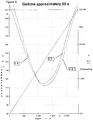
- Figures 4 to 6 demonstrate that the Examples according to the invention have a viscosity at least as good as that of a formulation containing PKHH (Formulation IX).
- a polyoxazolidone viscosity modifier composition was prepared using the general preparation method 1 outlined above with the following ingredients: 68 weight percent epoxy resin A, 32 weight percent isocyanate A, and 1500 ppm DBU.
- the resulting modifier resin had an EEW of 780 and a melt viscosity of 34 Pa ⁇ s at 200°C.
- D.E.R. 592A80 is a resin based on epoxy-terminated polyoxazolidone resin and is commercially available from The Dow Chemical Company.
- the ingredients and amounts of the varnishes are set out in Table XV below.
- the varnishes were prepared by blending the various components at room temperature using a mechanical stirrer. The stroke cure reactivity of each of the varnishes are also shown in Table XV.
- Prepregs from the above described varnishes were prepared and the gel time of each were measured according to the procedure described above for Formulation Examples I to IV except that the prepregs were pressed at 190°C in 90 minutes under a pressure of 150 KN/900 square centimeter.
- the gel time of the prepregs are shown in Table XV.
Landscapes
- Chemical & Material Sciences (AREA)
- Health & Medical Sciences (AREA)
- Chemical Kinetics & Catalysis (AREA)
- Medicinal Chemistry (AREA)
- Polymers & Plastics (AREA)
- Organic Chemistry (AREA)
- Epoxy Resins (AREA)
- Reinforced Plastic Materials (AREA)
- Polyurethanes Or Polyureas (AREA)
- Compositions Of Macromolecular Compounds (AREA)
- Manufacture Of Macromolecular Shaped Articles (AREA)
Applications Claiming Priority (3)
| Application Number | Priority Date | Filing Date | Title |
|---|---|---|---|
| GB9817799 | 1998-08-14 | ||
| GB9817799A GB9817799D0 (en) | 1998-08-14 | 1998-08-14 | Viscosity modifier for thermosetting resin compositioning |
| PCT/US1999/016984 WO2000009581A2 (en) | 1998-08-14 | 1999-07-28 | Viscosity modifier for thermosetting resin composition |
Publications (3)
| Publication Number | Publication Date |
|---|---|
| EP1144478A2 EP1144478A2 (en) | 2001-10-17 |
| EP1144478A3 EP1144478A3 (en) | 2002-03-13 |
| EP1144478B1 true EP1144478B1 (en) | 2016-12-21 |
Family
ID=10837313
Family Applications (1)
| Application Number | Title | Priority Date | Filing Date |
|---|---|---|---|
| EP99937530.6A Expired - Lifetime EP1144478B1 (en) | 1998-08-14 | 1999-07-28 | Viscosity modifier for thermosetting resin composition |
Country Status (11)
| Country | Link |
|---|---|
| US (2) | US6333064B1 (https=) |
| EP (1) | EP1144478B1 (https=) |
| JP (1) | JP4824164B2 (https=) |
| KR (1) | KR100654591B1 (https=) |
| CN (1) | CN1144830C (https=) |
| AU (1) | AU5234499A (https=) |
| GB (1) | GB9817799D0 (https=) |
| HK (1) | HK1041894A1 (https=) |
| MY (1) | MY122590A (https=) |
| TW (1) | TWI237046B (https=) |
| WO (1) | WO2000009581A2 (https=) |
Families Citing this family (29)
| Publication number | Priority date | Publication date | Assignee | Title |
|---|---|---|---|---|
| US6534181B2 (en) * | 2000-03-27 | 2003-03-18 | Neltec, Inc. | Styrene-maleic anhydride copolymer and epoxy resin blend crosslinked with multifunctional amine compounds |
| TW593404B (en) * | 2001-03-14 | 2004-06-21 | Akzo Nobel Nv | Powder coated rotor, stator or field coil and powder coating composition |
| JP4102112B2 (ja) * | 2002-06-06 | 2008-06-18 | 株式会社東芝 | 半導体装置及びその製造方法 |
| US20040101689A1 (en) * | 2002-11-26 | 2004-05-27 | Ludovic Valette | Hardener composition for epoxy resins |
| US20060177666A1 (en) * | 2005-02-08 | 2006-08-10 | Masanao Kawabe | Curable resin compositions |
| WO2006109744A1 (ja) * | 2005-04-07 | 2006-10-19 | Asahi Kasei Chemicals Corporation | エポキシ樹脂組成物 |
| JP2008542522A (ja) * | 2005-06-07 | 2008-11-27 | アルベマール・コーポレーシヨン | 優れた熱安定性および燃焼遅延性を示す燃焼遅延剤組成物およびその使用 |
| US7378455B2 (en) * | 2005-06-30 | 2008-05-27 | General Electric Company | Molding composition and method, and molded article |
| US20070004871A1 (en) * | 2005-06-30 | 2007-01-04 | Qiwei Lu | Curable composition and method |
| US7429800B2 (en) * | 2005-06-30 | 2008-09-30 | Sabic Innovative Plastics Ip B.V. | Molding composition and method, and molded article |
| US20070066698A1 (en) * | 2005-09-20 | 2007-03-22 | Yang Wenliang P | Dual cure compositions, methods of curing thereof and articles therefrom |
| US20070066710A1 (en) * | 2005-09-21 | 2007-03-22 | Peters Edward N | Method for electrical insulation and insulated electrical conductor |
| US20080071036A1 (en) * | 2006-09-15 | 2008-03-20 | Delsman Erik R | Cured poly(arylene ether) composition, method, and article |
| US20080071035A1 (en) * | 2006-09-15 | 2008-03-20 | Delsman Erik R | Curable poly(arylene ether) composition and method |
| US7655278B2 (en) * | 2007-01-30 | 2010-02-02 | Sabic Innovative Plastics Ip B.V. | Composite-forming method, composites formed thereby, and printed circuit boards incorporating them |
| WO2008102853A1 (ja) * | 2007-02-23 | 2008-08-28 | Panasonic Electric Works Co., Ltd. | エポキシ樹脂組成物、プリプレグ、積層板、及びプリント配線板 |
| US7678673B2 (en) * | 2007-08-01 | 2010-03-16 | International Business Machines Corporation | Strengthening of a structure by infiltration |
| US8337163B2 (en) * | 2007-12-05 | 2012-12-25 | General Electric Company | Fiber composite half-product with integrated elements, manufacturing method therefor and use thereof |
| US8079820B2 (en) * | 2008-12-18 | 2011-12-20 | General Electric Company | Blade module, a modular rotor blade and a method for assembling a modular rotor blade |
| SG176923A1 (en) * | 2009-06-22 | 2012-01-30 | Dow Global Technologies Llc | Hardener composition for epoxy resins |
| KR100985998B1 (ko) * | 2009-09-29 | 2010-10-06 | 백대현 | 경량 팰릿 |
| US8980376B2 (en) | 2009-11-06 | 2015-03-17 | Dow Global Technologies Llc | Storage stable epoxy resin compositions for electrical laminates |
| US8871892B2 (en) * | 2009-11-12 | 2014-10-28 | Dow Global Technologies Llc | Polyoxazolidone resins |
| US20120040106A1 (en) | 2010-08-16 | 2012-02-16 | Stefan Simmerer | Apparatus for impregnating a fiber material with a resin and methods for forming a fiber-reinforced plastic part |
| AU2012262983B2 (en) * | 2011-06-03 | 2016-06-16 | Cytec Technology Corp. | Resin coated radius fillers and system and method of making the same |
| US20120138223A1 (en) | 2011-09-29 | 2012-06-07 | General Electric Company | Uv-ir combination curing system and method of use for wind blade manufacture and repair |
| TWI496804B (zh) * | 2011-12-06 | 2015-08-21 | Taiwan Union Technology Corp | 環氧樹脂組成物及由其製成的預浸材和印刷電路積層板 |
| EP2864418B1 (en) * | 2012-06-26 | 2017-08-16 | Dow Global Technologies LLC | Insulating composites for power transmission and distribution |
| CN103937163A (zh) * | 2014-05-08 | 2014-07-23 | 新誉集团有限公司 | 一种粘度可控型快速手糊环氧树脂体系及其制备方法 |
Family Cites Families (38)
| Publication number | Priority date | Publication date | Assignee | Title |
|---|---|---|---|---|
| US2083697A (en) | 1934-04-05 | 1937-06-15 | Safety Mining Co | Apparatus for breaking material |
| US3354114A (en) | 1964-03-03 | 1967-11-21 | Grace W R & Co | Polystyrene fiber-finely divided silica thickening agent, and organic liquid materials thickened therewith |
| GB1037895A (en) | 1964-06-29 | 1966-08-03 | Sels Et Prod Chim Sa | Epoxy resin compositions |
| US3334110A (en) | 1965-08-16 | 1967-08-01 | Baker Chem Co J T | Method for preparing epoxyoxazolidinones |
| GB1370782A (en) | 1970-11-11 | 1974-10-16 | Ciba Geigy Ag | Adhesive compositions |
| US4070416A (en) | 1972-11-29 | 1978-01-24 | Hitachi, Ltd. | Novel thermosetting resin and a process for producing same |
| US4066628A (en) | 1976-08-02 | 1978-01-03 | Mitsubishi Chemical Industries Ltd. | Oxazolidone catalyst |
| JPS5515870A (en) | 1978-07-23 | 1980-02-04 | Toho Beslon Co | Strand preepreg composition |
| JPS59189173A (ja) * | 1983-04-12 | 1984-10-26 | Sumitomo Bakelite Co Ltd | 耐熱性電気絶縁塗料組成物 |
| DE3323084A1 (de) | 1983-06-27 | 1985-01-10 | Siemens AG, 1000 Berlin und 8000 München | Verfahren zur herstellung von formstoffen |
| DE3323122A1 (de) | 1983-06-27 | 1985-05-23 | Siemens AG, 1000 Berlin und 8000 München | Verfahren zur herstellung von reaktionsharzformstoffen |
| US4622983A (en) | 1983-08-08 | 1986-11-18 | Kimberly-Clark Corporation | Reduced ignition proclivity smoking article wrapper and smoking article |
| EP0289632A1 (en) * | 1987-05-04 | 1988-11-09 | American Cyanamid Company | High green strength induction curable adhesives |
| DE3720759A1 (de) * | 1987-06-24 | 1989-01-05 | Bayer Ag | Oxazolidongruppen enthaltende epoxidharze |
| JPS6424825A (en) * | 1987-07-20 | 1989-01-26 | Mitsubishi Gas Chemical Co | Epoxy resin composition |
| US4912172A (en) * | 1987-09-03 | 1990-03-27 | General Electric Company | Compositions comprising polyphenylene ethers, polyepoxides and aluminum or zinc diketone salt |
| US5066735A (en) | 1987-11-16 | 1991-11-19 | The Dow Chemical Company | Curable composition containing a difunctional epoxy resin, a polyfunctional epoxy resin, a difunctional phenol and a polyfunctional phenol |
| EP0318325B1 (en) | 1987-11-26 | 1994-03-16 | Nippon Shokubai Co., Ltd. | Resin composition for artificial marble |
| US5317067A (en) * | 1988-01-25 | 1994-05-31 | Tokyo Tire & Rubber Company Limited | Molding and punching out melt-mixed epoxy resin-thermoplastic resin composition with hardener |
| JPH01236226A (ja) | 1988-03-17 | 1989-09-21 | Sumitomo Bakelite Co Ltd | 半導体封止用エポキシ樹脂組成物 |
| GB8912952D0 (en) | 1989-06-06 | 1989-07-26 | Dow Rheinmuenster | Epoxy-terminated polyoxazolidones,process for the preparation thereof and electrical laminates made from the epoxy-terminated polyoxazolidones |
| EP0458502B1 (en) * | 1990-05-21 | 2003-06-18 | Dow Global Technologies Inc. | Latent catalysts, cure-inhibited epoxy resin compositions and laminates prepared therefrom |
| ZA913801B (en) | 1990-05-21 | 1993-01-27 | Dow Chemical Co | Latent catalysts,cure-inhibited epoxy resin compositions and laminates prepared therefrom |
| US5721323A (en) * | 1990-05-21 | 1998-02-24 | The Dow Chemical Company | Cure inhibited epoxy resin compositions and laminates prepared from the compositions |
| JP3322909B2 (ja) * | 1991-08-15 | 2002-09-09 | 旭化成エポキシ株式会社 | エポキシ樹脂組成物 |
| JP3290449B2 (ja) * | 1991-08-19 | 2002-06-10 | 旭化成エポキシ株式会社 | エポキシ樹脂組成物 |
| JP3355658B2 (ja) | 1992-08-13 | 2002-12-09 | 旭化成エポキシ株式会社 | エポキシ樹脂組成物 |
| CA2147361A1 (en) | 1992-11-12 | 1994-05-26 | Michael L. Gould | Curable composition containing anhydride resins |
| US5308565A (en) * | 1993-02-05 | 1994-05-03 | General Electric Company | Method of preparing modified polyphenylene oxide resin systems for electrical laminates having improved solderability and solvent resistance |
| JPH07197000A (ja) | 1993-12-28 | 1995-08-01 | Shin Etsu Chem Co Ltd | 耐熱性接着剤 |
| CA2115533C (en) * | 1994-02-11 | 2002-06-18 | Hiroshi Uchida | Urethane modified epoxy resin compositions |
| US5545697A (en) * | 1994-02-14 | 1996-08-13 | Ciba-Geigy Corporation | Urethane modified epoxy resin compositions |
| US5480958A (en) * | 1994-09-21 | 1996-01-02 | Air Products And Chemicals, Inc. | Polyepoxide resins incorporating epoxy terminated urethanes as tougheners |
| GB9421405D0 (en) | 1994-10-21 | 1994-12-07 | Dow Chemical Co | Low voc laminating formulations |
| JP3415349B2 (ja) * | 1995-11-20 | 2003-06-09 | 三菱レイヨン株式会社 | 複合材料用エポキシ樹脂組成物 |
| NL1003499C2 (nl) | 1996-07-04 | 1998-01-07 | Holland Sweetener Co | Aspartaampoeders voor poedermengsels. |
| EP0935628B1 (en) * | 1996-10-29 | 2001-12-05 | Isola Laminate Systems Corporation | Copolymer of styrene and maleic anhydride comprising an epoxy resin composition and a co-cross-linking agent |
| WO1998044017A1 (fr) | 1997-03-27 | 1998-10-08 | Mitsubishi Rayon Co., Ltd. | Composition de resine epoxyde pour plastique renforce de fibre de verre, preimpregne et moulage tubulaire produit au moyen de cette composition |
-
1998
- 1998-08-14 GB GB9817799A patent/GB9817799D0/en not_active Ceased
-
1999
- 1999-07-28 HK HK02101377.9A patent/HK1041894A1/zh unknown
- 1999-07-28 WO PCT/US1999/016984 patent/WO2000009581A2/en not_active Ceased
- 1999-07-28 JP JP2000565023A patent/JP4824164B2/ja not_active Expired - Fee Related
- 1999-07-28 CN CNB998096717A patent/CN1144830C/zh not_active Expired - Fee Related
- 1999-07-28 AU AU52344/99A patent/AU5234499A/en not_active Abandoned
- 1999-07-28 EP EP99937530.6A patent/EP1144478B1/en not_active Expired - Lifetime
- 1999-07-28 KR KR1020017001921A patent/KR100654591B1/ko not_active Expired - Lifetime
- 1999-08-06 US US09/370,656 patent/US6333064B1/en not_active Expired - Lifetime
- 1999-08-13 MY MYPI99003489A patent/MY122590A/en unknown
- 1999-08-13 TW TW88113881A patent/TWI237046B/zh not_active IP Right Cessation
-
2001
- 2001-09-25 US US09/964,119 patent/US20020076482A1/en not_active Abandoned
Non-Patent Citations (1)
| Title |
|---|
| None * |
Also Published As
| Publication number | Publication date |
|---|---|
| CN1315974A (zh) | 2001-10-03 |
| JP4824164B2 (ja) | 2011-11-30 |
| AU5234499A (en) | 2000-03-06 |
| HK1041894A1 (zh) | 2002-07-26 |
| KR100654591B1 (ko) | 2006-12-07 |
| JP2002527529A (ja) | 2002-08-27 |
| WO2000009581A2 (en) | 2000-02-24 |
| MY122590A (en) | 2006-04-29 |
| US6333064B1 (en) | 2001-12-25 |
| GB9817799D0 (en) | 1998-10-14 |
| US20020076482A1 (en) | 2002-06-20 |
| TWI237046B (en) | 2005-08-01 |
| KR20010079646A (ko) | 2001-08-22 |
| CN1144830C (zh) | 2004-04-07 |
| EP1144478A2 (en) | 2001-10-17 |
| EP1144478A3 (en) | 2002-03-13 |
| WO2000009581A3 (en) | 2001-12-13 |
Similar Documents
| Publication | Publication Date | Title |
|---|---|---|
| EP1144478B1 (en) | Viscosity modifier for thermosetting resin composition | |
| EP1137683B1 (en) | Polyoxazolidone adhesive resin composition prepared from polyepoxides and polyisocyanates | |
| JP2003522217A5 (https=) | ||
| EP2507283B1 (en) | Epoxy resin compositions | |
| TWI432471B (zh) | 阻燃組成物 | |
| EP0478606B1 (en) | Process for the preparation of epoxy-terminated polyoxazolidones and of electrical laminates therefrom | |
| US20120289624A1 (en) | Composite compositions | |
| JP2013166959A (ja) | 混合触媒系を含む硬化性エポキシ樹脂組成物およびそれから作られた積層体 | |
| JP5974134B2 (ja) | エポキシ樹脂を調製するためのオリゴマー性ハロゲン化鎖延長剤 | |
| CN105713182A (zh) | 环氧树脂的金属稳定剂和增长方法 | |
| JPH09328601A (ja) | 熱硬化性樹脂組成物並びにそれを用いたプリプレグおよび積層板 | |
| US20110132646A1 (en) | Flame retardant epoxy resin composition, prepreg and laminate thereof | |
| JPH1017642A (ja) | エポキシ樹脂混合物、エポキシ樹脂組成物及びその硬化物 | |
| HK1139166B (en) | Flame retardant composition |
Legal Events
| Date | Code | Title | Description |
|---|---|---|---|
| PUAI | Public reference made under article 153(3) epc to a published international application that has entered the european phase |
Free format text: ORIGINAL CODE: 0009012 |
|
| AK | Designated contracting states |
Kind code of ref document: A2 Designated state(s): AT BE CH CY DE DK ES FI FR GB GR IE IT LI LU MC NL PT SE |
|
| XX | Miscellaneous (additional remarks) |
Free format text: DERZEIT SIND DIE WIPO-PUBLIKATIONSDATEN A3 NICHT VERFUEGBAR. |
|
| PUAK | Availability of information related to the publication of the international search report |
Free format text: ORIGINAL CODE: 0009015 |
|
| AK | Designated contracting states |
Kind code of ref document: A3 Designated state(s): AT BE CH CY DE DK ES FI FR GB GR IE IT LI LU MC NL PT SE |
|
| 17P | Request for examination filed |
Effective date: 20020613 |
|
| RAP1 | Party data changed (applicant data changed or rights of an application transferred) |
Owner name: DOW GLOBAL TECHNOLOGIES INC. |
|
| RAP1 | Party data changed (applicant data changed or rights of an application transferred) |
Owner name: DOW GLOBAL TECHNOLOGIES LLC |
|
| RAP1 | Party data changed (applicant data changed or rights of an application transferred) |
Owner name: BLUE CUBE IP LLC |
|
| GRAP | Despatch of communication of intention to grant a patent |
Free format text: ORIGINAL CODE: EPIDOSNIGR1 |
|
| INTG | Intention to grant announced |
Effective date: 20160715 |
|
| GRAS | Grant fee paid |
Free format text: ORIGINAL CODE: EPIDOSNIGR3 |
|
| GRAA | (expected) grant |
Free format text: ORIGINAL CODE: 0009210 |
|
| AK | Designated contracting states |
Kind code of ref document: B1 Designated state(s): AT BE CH CY DE DK ES FI FR GB GR IE IT LI LU MC NL PT SE |
|
| REG | Reference to a national code |
Ref country code: GB Ref legal event code: FG4D |
|
| XX | Miscellaneous (additional remarks) |
Free format text: DERZEIT SIND DIE WIPO-PUBLIKATIONSDATEN A3 NICHT VERFUEGBAR.WIPO A3 PUBLICATION DATA IS NOT CURRENTLY AVAILABLE.L'OMPI DONNEES DE PUBLICATION A3 NE SONT PAS ACTUELLEMENT DISPONIBLES. |
|
| REG | Reference to a national code |
Ref country code: CH Ref legal event code: EP |
|
| REG | Reference to a national code |
Ref country code: IE Ref legal event code: FG4D |
|
| REG | Reference to a national code |
Ref country code: AT Ref legal event code: REF Ref document number: 855437 Country of ref document: AT Kind code of ref document: T Effective date: 20170115 |
|
| REG | Reference to a national code |
Ref country code: DE Ref legal event code: R096 Ref document number: 69945678 Country of ref document: DE |
|
| REG | Reference to a national code |
Ref country code: NL Ref legal event code: MP Effective date: 20161221 |
|
| PG25 | Lapsed in a contracting state [announced via postgrant information from national office to epo] |
Ref country code: SE Free format text: LAPSE BECAUSE OF FAILURE TO SUBMIT A TRANSLATION OF THE DESCRIPTION OR TO PAY THE FEE WITHIN THE PRESCRIBED TIME-LIMIT Effective date: 20161221 Ref country code: GR Free format text: LAPSE BECAUSE OF FAILURE TO SUBMIT A TRANSLATION OF THE DESCRIPTION OR TO PAY THE FEE WITHIN THE PRESCRIBED TIME-LIMIT Effective date: 20170322 |
|
| REG | Reference to a national code |
Ref country code: AT Ref legal event code: MK05 Ref document number: 855437 Country of ref document: AT Kind code of ref document: T Effective date: 20161221 |
|
| PG25 | Lapsed in a contracting state [announced via postgrant information from national office to epo] |
Ref country code: FI Free format text: LAPSE BECAUSE OF FAILURE TO SUBMIT A TRANSLATION OF THE DESCRIPTION OR TO PAY THE FEE WITHIN THE PRESCRIBED TIME-LIMIT Effective date: 20161221 |
|
| PG25 | Lapsed in a contracting state [announced via postgrant information from national office to epo] |
Ref country code: NL Free format text: LAPSE BECAUSE OF FAILURE TO SUBMIT A TRANSLATION OF THE DESCRIPTION OR TO PAY THE FEE WITHIN THE PRESCRIBED TIME-LIMIT Effective date: 20161221 |
|
| PG25 | Lapsed in a contracting state [announced via postgrant information from national office to epo] |
Ref country code: PT Free format text: LAPSE BECAUSE OF FAILURE TO SUBMIT A TRANSLATION OF THE DESCRIPTION OR TO PAY THE FEE WITHIN THE PRESCRIBED TIME-LIMIT Effective date: 20170421 Ref country code: BE Free format text: LAPSE BECAUSE OF FAILURE TO SUBMIT A TRANSLATION OF THE DESCRIPTION OR TO PAY THE FEE WITHIN THE PRESCRIBED TIME-LIMIT Effective date: 20161221 Ref country code: IT Free format text: LAPSE BECAUSE OF FAILURE TO SUBMIT A TRANSLATION OF THE DESCRIPTION OR TO PAY THE FEE WITHIN THE PRESCRIBED TIME-LIMIT Effective date: 20161221 Ref country code: ES Free format text: LAPSE BECAUSE OF FAILURE TO SUBMIT A TRANSLATION OF THE DESCRIPTION OR TO PAY THE FEE WITHIN THE PRESCRIBED TIME-LIMIT Effective date: 20161221 Ref country code: AT Free format text: LAPSE BECAUSE OF FAILURE TO SUBMIT A TRANSLATION OF THE DESCRIPTION OR TO PAY THE FEE WITHIN THE PRESCRIBED TIME-LIMIT Effective date: 20161221 |
|
| REG | Reference to a national code |
Ref country code: DE Ref legal event code: R097 Ref document number: 69945678 Country of ref document: DE |
|
| PLBE | No opposition filed within time limit |
Free format text: ORIGINAL CODE: 0009261 |
|
| STAA | Information on the status of an ep patent application or granted ep patent |
Free format text: STATUS: NO OPPOSITION FILED WITHIN TIME LIMIT |
|
| 26N | No opposition filed |
Effective date: 20170922 |
|
| PG25 | Lapsed in a contracting state [announced via postgrant information from national office to epo] |
Ref country code: DK Free format text: LAPSE BECAUSE OF FAILURE TO SUBMIT A TRANSLATION OF THE DESCRIPTION OR TO PAY THE FEE WITHIN THE PRESCRIBED TIME-LIMIT Effective date: 20161221 |
|
| REG | Reference to a national code |
Ref country code: DE Ref legal event code: R119 Ref document number: 69945678 Country of ref document: DE |
|
| REG | Reference to a national code |
Ref country code: CH Ref legal event code: PL |
|
| GBPC | Gb: european patent ceased through non-payment of renewal fee |
Effective date: 20170728 |
|
| REG | Reference to a national code |
Ref country code: IE Ref legal event code: MM4A |
|
| REG | Reference to a national code |
Ref country code: FR Ref legal event code: ST Effective date: 20180330 |
|
| PG25 | Lapsed in a contracting state [announced via postgrant information from national office to epo] |
Ref country code: CH Free format text: LAPSE BECAUSE OF NON-PAYMENT OF DUE FEES Effective date: 20170731 Ref country code: DE Free format text: LAPSE BECAUSE OF NON-PAYMENT OF DUE FEES Effective date: 20180201 Ref country code: LI Free format text: LAPSE BECAUSE OF NON-PAYMENT OF DUE FEES Effective date: 20170731 Ref country code: GB Free format text: LAPSE BECAUSE OF NON-PAYMENT OF DUE FEES Effective date: 20170728 Ref country code: IE Free format text: LAPSE BECAUSE OF NON-PAYMENT OF DUE FEES Effective date: 20170728 |
|
| PG25 | Lapsed in a contracting state [announced via postgrant information from national office to epo] |
Ref country code: FR Free format text: LAPSE BECAUSE OF NON-PAYMENT OF DUE FEES Effective date: 20170731 |
|
| PG25 | Lapsed in a contracting state [announced via postgrant information from national office to epo] |
Ref country code: LU Free format text: LAPSE BECAUSE OF NON-PAYMENT OF DUE FEES Effective date: 20170728 |
|
| PG25 | Lapsed in a contracting state [announced via postgrant information from national office to epo] |
Ref country code: MC Free format text: LAPSE BECAUSE OF FAILURE TO SUBMIT A TRANSLATION OF THE DESCRIPTION OR TO PAY THE FEE WITHIN THE PRESCRIBED TIME-LIMIT Effective date: 20161221 |
|
| PG25 | Lapsed in a contracting state [announced via postgrant information from national office to epo] |
Ref country code: CY Free format text: LAPSE BECAUSE OF NON-PAYMENT OF DUE FEES Effective date: 20161221 |