EP1128233A2 - Reinigungsvorrichtung - Google Patents
Reinigungsvorrichtung Download PDFInfo
- Publication number
- EP1128233A2 EP1128233A2 EP01301086A EP01301086A EP1128233A2 EP 1128233 A2 EP1128233 A2 EP 1128233A2 EP 01301086 A EP01301086 A EP 01301086A EP 01301086 A EP01301086 A EP 01301086A EP 1128233 A2 EP1128233 A2 EP 1128233A2
- Authority
- EP
- European Patent Office
- Prior art keywords
- collecting roller
- cleaning
- image
- cleaning blade
- roller
- Prior art date
- Legal status (The legal status is an assumption and is not a legal conclusion. Google has not performed a legal analysis and makes no representation as to the accuracy of the status listed.)
- Withdrawn
Links
Images
Classifications
-
- G—PHYSICS
- G03—PHOTOGRAPHY; CINEMATOGRAPHY; ANALOGOUS TECHNIQUES USING WAVES OTHER THAN OPTICAL WAVES; ELECTROGRAPHY; HOLOGRAPHY
- G03G—ELECTROGRAPHY; ELECTROPHOTOGRAPHY; MAGNETOGRAPHY
- G03G15/00—Apparatus for electrographic processes using a charge pattern
- G03G15/14—Apparatus for electrographic processes using a charge pattern for transferring a pattern to a second base
- G03G15/16—Apparatus for electrographic processes using a charge pattern for transferring a pattern to a second base of a toner pattern, e.g. a powder pattern, e.g. magnetic transfer
- G03G15/1605—Apparatus for electrographic processes using a charge pattern for transferring a pattern to a second base of a toner pattern, e.g. a powder pattern, e.g. magnetic transfer using at least one intermediate support
- G03G15/161—Apparatus for electrographic processes using a charge pattern for transferring a pattern to a second base of a toner pattern, e.g. a powder pattern, e.g. magnetic transfer using at least one intermediate support with means for handling the intermediate support, e.g. heating, cleaning, coating with a transfer agent
-
- G—PHYSICS
- G03—PHOTOGRAPHY; CINEMATOGRAPHY; ANALOGOUS TECHNIQUES USING WAVES OTHER THAN OPTICAL WAVES; ELECTROGRAPHY; HOLOGRAPHY
- G03G—ELECTROGRAPHY; ELECTROPHOTOGRAPHY; MAGNETOGRAPHY
- G03G21/00—Arrangements not provided for by groups G03G13/00 - G03G19/00, e.g. cleaning, elimination of residual charge
- G03G21/0005—Arrangements not provided for by groups G03G13/00 - G03G19/00, e.g. cleaning, elimination of residual charge for removing solid developer or debris from the electrographic recording medium
- G03G21/0035—Arrangements not provided for by groups G03G13/00 - G03G19/00, e.g. cleaning, elimination of residual charge for removing solid developer or debris from the electrographic recording medium using a brush; Details of cleaning brushes, e.g. fibre density
Definitions
- the present invention is related to a cleaning device applicable to an electrostatic recording system, such as for instance a copying or a printing system, in order to remove residual developer from the surface of an image-forming member.
- a charged latent image is formed on an image-forming member by image-wise exposure.
- the image-forming member can be an endless member such as a drum or a belt.
- Typical graphical processes include amongst others magnetography, ionography and electrography, particularly electrophotography. In the latter process for instance, the charged latent image is formed on a pre-charged photosensitive member by image-wise exposure to light.
- the latent image is subsequently made visible on the image-forming member with developer at a development zone, the developer comprising, or consisting of, charged toner.
- the developed image is transferred to a recording medium, directly or via one or more intermediate image-carrying members, where it may be permanently fixed.
- intermediate image-carrying members are endless belts.
- transfer from an image-delivering member being either an image-forming member or an intermediate image-carrying member to an image-receiving member being either an intermediate image-carrying member or a recording medium may be incomplete. Multiple subsequent transfers are possible. In normal operating conditions, typical transfer efficiencies range from 95% to 100%. The residual image on the image-delivering member has to be removed because otherwise the image quality of subsequently formed or transferred images can be seriously disturbed.
- This residual image has to be removed before re-entering into the development zone. Otherwise this could lead to serious image defects because of mixing up of the new developed or transferred image with the residual image.
- the cleaning station comprises at least a revolving brush which can be engaged against the image-delivering member for removing residual developer therefrom, a high voltage collecting roller in rolling contact with the brush roller for brush de-toning and a scraper blade contacting the high voltage roller for scraping developer therefrom.
- the cleaning of the high voltage roller is a problem.
- This roller is a rigid roller in rolling contact with the cleaning brush.
- developer is transferred to the high voltage roller by biasing the high voltage roller such that an attractive electrical field is created.
- a cleaning blade is positioned downstream of the contact zone to scrape off the developer from the high voltage roller.
- the cleaning blade is positioned at an obtuse contact angle.
- the contact angle is defined with respect to a line tangent to the point of contact of the cleaning blade with the rotating high voltage roller and is the angle between this tangent line, at the uncleaned section of the roller, and the cleaning blade.
- This obtuse contact angle is typically between 160 and 170 degrees.
- a cleaning blade mounted at an obtuse contact angle is typically made of an incompressible rigid material such as stainless steel.
- a cleaning device being part of a copying or printing system for removing residual developer from the surface of an image-delivering member comprising:
- the cleaning device is retractable.
- the cleaning device is a part of a copying or printing system and is intended for removing residual developer from the surface of an image-delivering member such as for instance an image-forming member or an image-carrying member.
- image-forming members are drums or belts with a photoreceptive or a magneto-sensitive outer layer.
- image carrying members are seamed or seamless intermediate transfer belts.
- Such an intermediate transfer belt may be composed of an electrically semi-insulating or insulating material with a low surface energy, or comprises at least a top coating of such a material.
- polyesters such as e.g. Hytrel 7246, polyimides, polycarbonates or dissipative polymer blends.
- the collecting roller in rolling contact with said revolving brush is electrically biased such that an electrical field is generated which attracts the residual developer from the cleaning brush and collects it onto its surface.
- the cleaning blade is preferably composed of an elastic material with a hardness ranging from 50 to 80 Shore A.
- cleaning blades are widely used, particularly for cleaning the image-forming member.
- the image-forming member is usually a drum or a belt covered with an organic photo-conductive layer.
- the cleaning of this smooth sensitive layer can however in no way be compared with the cleaning of the high voltage roller, which is usually an incompressible rigid roller. Irrespective of the positioning of the cleaning blade, the force required to completely remove the residual developer from the image-forming layer is such that the image-forming layer is damaged.
- the cleaning blade is usually mounted such that the image-forming member is not damaged which by consequence results in an incomplete cleaning. Therefore, extra cleaning means are provided, e.g. in the form of a revolving cleaning brush in rolling contact with the image-forming members, to improve cleaning results.
- the developer used in the recording system with which the cleaning device according to the invention is associated can be a mono-component or a two-component developer.
- a common development technique uses a two-component developer material of toner particles adhering tribo-electrically to larger carrier beads.
- the developer material contained in a developer unit, is placed in an appropriate magnetic field, the carrier beads with the toner thereon form a magnetic brush.
- the carrier beads and the toner particles are oppositely charged, in the development zone the toner particles are attracted from the carrier beads to develop the latent image on the image-forming member.
- both the developed image and the residual image are primarily composed of toner particles.
- due to failures as e.g.
- the cleaning blade of the present invention easily removes such hard carrier beads without causing damage to the blade.
- the cleaning brush rotates in a first predetermined direction, which is preferably opposite to the propagation direction of the image-delivering member.
- the collecting roller contacts the cleaning brush and rotates in a second predetermined direction, preferably opposite to said first predetermined direction.
- the collecting roller may be a freely rotating roller or may be driven.
- the cleaning brush and the collecting roller may be independently driven and their rotation speed may be independently controlled.
- the collecting roller is incompressible and electrically conductive and bias means are provided to apply a voltage to the collecting roller in order to create an electrical field which is attractive for the developer gathered on the cleaning brush.
- the cleaning blade according to the present invention is preferably an elastic cleaning blade with a hardness in the range from 50 to 85 Shore A.
- the rebound resilience is typically in the range from 20 to 40%.
- Preferably a polyurethane cleaning blade is used.
- the cleaning blade is mounted at an acute contact angle.
- the thickness of the cleaning blade is typically between 1.5 mm and 4 mm.
- the cleaning blade is partly attached to a support such that the free portion of the cleaning blade has a length typically in the range from 4 to 11 mm.
- the free portion of the blade is the portion which is not attached to the support.
- the blade material is compressible and the thickness and free length of the blade are chosen such that at least the forward end portion of the blade is allowed to bend slightly while in contact with the collecting roller, i.e. while exerting pressure on the blade.
- the blade is positioned such that the pressure exerted by the blade on the collecting roller would correspond to an impression of the blade in the incompressible collecting roller ranging from 0.25 mm to 1 mm.
- the cleaning blade is mounted such that it contacts the collecting roller at a position where the collecting roller moves in an upward direction. This enables waste developer being scraped of the collecting roller to freely fall down and inhibits potential built up of waste material between the blade and the collecting roller.
- the cleaning blade is mounted such that the acute contact angle of the cleaning blade with respect to the collecting roller is in the range from 60 to 80 degrees. It has been observed that smaller contact angles result in inefficient cleaning, more particularly, a contact angle below 60 degrees causes developer filming on the collecting roller which results in a decreased de-toning ability of the collecting roller and consequently in a less efficient cleaning of the image-delivering member. Moreover, a blade mounted at such a small contact angle is not able to remove carrier beads from the surface of the collecting roller.
- the collecting roller is composed of a metal.
- a metal aluminum or steel can be used.
- the surface of the collecting roller may be hard anodized to increase at least the hardness of the roller.
- a ceramic coating may be provided as a surface layer.
- the surface can have an average roughness, Ra, in the range from 0.05 to 0.15.
- the cleaning device further comprises an auger, being positioned below the collecting roller to remove the waste developer, which is scraped off the collecting roller by the cleaning blade.
- An air flow may be provided to assist in the removal of the waste developer.
- an auger instead of an auger, only an air flow may be provided to remove the waste.
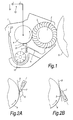
- Figure 1 depicts a schematic representation of a retractable cleaning device 1, which is engaged into contact with the surface of an image-delivering member 5.
- a rotating cleaning brush 2 having bristles 3 extending therefrom contacts the surface.
- the bristles remove the residual image from the surface of the image-delivering member.
- the residual image is primarily composed of charged toner particles. More particularly, negatively charged toner particles are used.
- the cleaning device of the present invention can easily cope with positively charged toner particles or other types of developer.
- the direction of movement of the cleaning brush is opposite to the direction of movement of the image-delivering member.
- a rotating collecting roller 4 is placed adjacent said rotating cleaning brush such that portions of said rotating cleaning brush selectively contact said collecting roller in a contact zone as said cleaning brush rotates.
- the collecting roller is a steel roller with an average surface roughness, Ra, of 0.09.
- Bias means generally indicated by reference 13 are provided to apply a voltage to the collecting roller to establish an attractive electrical field in the contact zone between the cleaning brush and the collecting roller.
- the voltage applied to the collecting roller is typically in the range from 300 V to 1000 V.
- a polyurethane cleaning blade 7 contacts the collecting roller at a position where the collecting roller moves in an upward direction.
- the cleaning blade is partly attached to a support 6. The attachment is executed by means of an adhesive.
- the free portion of the cleaning blade has a length of 7 mm.
- the cleaning blade has a thickness of 2 mm, a hardness of 70 Shore A and a rebound resilience of 31%.
- the rebound resilience is determined prior to the mounting by attaching both ends of the blade to two fixed points and measuring the rebound of a reference weight which is dropped on the blade.
- the cleaning blade is mounted at an acute contact angle 8 with respect to the collecting roller.
- the contact angle defined as the angle 8 between the portion of the line 9, tangent to the collecting roller 4 at said contact position and extending towards the uncleaned portion of the collecting roller, and said cleaning blade 7, is 69 degrees.
- the contact angle 8 is defined with respect to a line 9 tangent to the point of contact of the cleaning blade 7 with the rotating high voltage roller 4 and is the angle between this tangent line, at the uncleaned section of the roller, and the cleaning blade.
- the cleaning blade is mounted as such efficiently scrapes off the developer collected on the collecting roller.
- the cleaning blade also efficiently removes debris and carrier beads from the collecting roller without being damaged.
- the waste which is removed from the collecting roller can freely fall down and is further removed by a revolving auger 10.
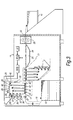
- FIG. 3 a schematic representation of an electrophotographic duplex colour printer is depicted, incorporating the cleaning unit according to the present invention.
- the printer comprises a light-tight housing 11, which has at its inside a stack 12 of sheets to be printed. At its output the printer has a platform 14 onto which the printed sheets are received.
- a sheet to be printed is removed from stack 12 and is fed through an alignment station 16. As the sheet leaves the alignment station, it follows a straight horizontal path 17 up to output section 18 of the printer. The speed of the sheet, upon entering said path, is determined by driven pressure roller pair 47.
- a number of processing stations are located along the path 17.
- a first image-forming unit 20 indicated in a dash-and-dot line is provided for applying a multi-colour image to the obverse side of the sheet and is followed by a second station 21 for applying a multi-colour image to the reverse sheet side.
- a buffer station 23 then follows, with an endless transport belt 24 for transporting the sheet to a fuser station 25.
- the photoconductive belt 26 is guided over a plurality of rollers 27 to follow a path in the direction of arrow 22 to advance successive portions of the photoconductive surface sequentially through the various processing stations disposed along the path of movement thereof.
- the photoconductive belt may comprise a base layer of polyethylene terephthalate of 100 ⁇ m thickness covered with a thin layer of aluminum as a back electrode (less than 0.5 ⁇ m thickness).
- the organic photoconductor (OPC) layer is on top of the aluminum layer and is from 15 ⁇ m in thickness.
- the belt is arranged such that the photoconductive layer is positioned on the outside of the belt loop.
- a portion of the photoconductive belt 26 passes through charging station 28.
- a charge-generating device electrostatically charges the belt to a relatively high, substantially uniform potential, i.e. the dark potential.
- Exposure station 29 exposes the photoconductive belt to successively record four latent colour separation images by image-wise discharging the belt.
- the belt advances these images to the development unit.
- This unit includes four individual developer stations 35, 36, 37 and 38 with for example cyan, yellow, magenta and black developer. During development of each electrostatic latent image only one developer station is in the operative position (developer station 35 in fig.3).
- the developer used is two-component developer consisting of non-permanently magnetised magnetic carrier beads having toner particles adhering triboelectrically thereto.
- a magnetic brush of developer particles is formed in the operative developer station adjacent the photoconductive member.
- the negatively charged toner particles are attracted by an electrical field from the magnetic brush to thereby develop the corresponding latent image on the photoconductive belt.
- Each latent image is developed subsequently using the developer station of the corresponding colour to thereby form four spaced-apart subsequently developed images on the photoconductive belt.
- the toner images are moved to toner image transfer stations 40, 41, 42 and 43 where they are transferred on a sheet of support material, such as plain paper or transparent film.
- a sheet of support material such as plain paper or transparent film.
- the sheet follows the rectilinear path 17 into contact with photoconductive belt 26.
- the sheet is advanced in synchronism with the movement of the belt such that at each transfer station an image is transferred to the paper in perfect register one onto the other to thereby form a registered multi-colour image on the sheet.
- the belt which acts both as an image-delivering and an image-forming member, is directed towards a cleaning unit 45, which is positioned downstream the transfer stations.
- a rotating fibrous-like brush contacts the photoconductive belt 26 to remove residual developer particles remaining after the transfer operation.
- Cleaning unit 45 is identical to the cleaning unit 10 (Fig. 1) as described above.
- lamp 46 illuminates the belt to remove any residual charge remaining thereon prior to the start of a next cycle.
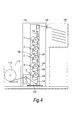
- FIG. 4 a schematic representation of another electrophotographic colour printer is depicted incorporating cleaning units according to the present invention.
- This printer has a supply station 113 in which a roll 114 of web material 112 is housed.
- the web 112 is conveyed into a tower-like printer housing 144 in which a support column 146 is provided housing at least four printing stations A-D, e.g. black, yellow, magenta and cyan.
- A-D e.g. black, yellow, magenta and cyan.
- each printing station comprises a cylindrical drum 124 having a photoconductive outer surface 126.
- the drum acts both as an image-delivering member and as an image-forming member.
- This latent image is developed on the drum by the developer station 132 by contacting the drum with a magnet brush of a two-component developer of non-permanently magnetised magnetic carrier beads having toner particles adhering triboelectrically thereto formed on the surface of a magnet roller 133. Negatively charged toner particles are attracted to the exposed (discharged) areas of the photoconductor.
- the toner image on the drum surface is transferred to the moving web 112 by a transfer corona device 134 which generates an attractive electrical field for the negatively charged toner particles.
- This transfer corona together with the guiding rollers 136 establishes also a strong adherent contact between the web and the drum over an angle ⁇ of about 15 degrees which causes the latter to be rotated in synchronism with the movement of the web 112 and urges the toner particles into firm contact with the surface of the web 112.
- a web discharge corona 138 is provided to establish a controlled release of the web.
- Cleaning unit 142 is similar to the cleaning unit 10 (Fig. 1) as described above.
- the cleaning unit includes an adjustably mounted fibrous-like cleaning brush 143, the position of which can be adjusted towards or away from the drum surface to ensure optimum cleaning.
- the cleaning brush 143 is grounded or subject to such a potential with respect to the drum as to attract the residual developer particles away from the drum surface.
- the rest of cleaning unit 142 is similar to the cleaning unit 10 (Fig. 1) as described above.
- the rotatable cleaning brush 143 which is driven to rotate in a sense the same as to that of the drum 124 and at a peripheral speed of, for example twice the peripheral speed of the drum surface.
- the developer station 132 includes a magnetic roller with a brush formed thereon 133 which rotates in a sense opposite to that of the drum 124.
- the resultant torque applied to the drum by the rotating developing brush 133 and the counter-rotating cleaning brush 143 is adjusted to be close to zero, thereby ensuring that the only torque applied to the drum is derived from the adherent force between the drum and the web.
- the web After a first image of a first colour is formed and transferred to the web in a first print station, the web passes successively the other print stations where image of other colours are formed and transferred in register to thereby form a registered multi-colour image on the web. After leaving the final print station E, the image on the web is fixed by means of the image fixing station 116 and fed to a cutting station 120 and a stacker 152 if desired.
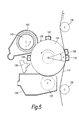
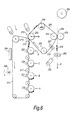
- FIG. 6 a schematic representation of an electrophotographic colour printer is depicted incorporating cleaning units according to the present invention.
- the printer comprises a primary transfer belt 212 formed of polyethylene terephthalate (PET) having a thickness of 100 ⁇ m and having spaced along one run thereof a plurality of toner image-forming stations A, B, C, D. Each of these stations is similar as described in fig. 5 and example 2.
- Charge generating devices 219, 221, 223, 225 are provided to subsequently electrostatically transfer a toner image of a particular colour from each image-forming station to the PET belt 212 while the belt is advanced over a number of guide rollers 217 along the stations to thereby form a registered multi-colour toner image.
- the primary transfer belt 212 acts as an image-delivering member.
- the multi-colour toner image is transferred to an intermediate transfer belt 250.
- the intermediate transfer nip 216 is formed between the guide roller 213 and an opposing guide roller 252 pressed towards each other to cause tangential contact between said primary transfer belt 212 and a heated intermediate transfer belt 250.
- the guide roller 213 comprises an electrically conductive core carrying a semi-insulating covering.
- a supply of electrical potential is provided for electrically biasing at least the first guide roller 213 to create an electrical field at the intermediate transfer nip 216 to assist in transferring the image 214 from the primary belt 212 to the intermediate transfer belt 250.
- the primary transfer belt 212 passes thereafter through a cooling station 268, where the belt is forcibly cooled by directing cooled air onto the primary transfer belt 212.
- a cooling liquid such as water may be directed through roller 215 to cool the primary transfer belt.
- the primary transfer belt 212 is thereby cooled to a temperature of about 35°C. This cooling assists in establishing the required temperature gradient at the intermediate transfer nip 216.
- the residual toner image on the primary transfer belt 212 is removed by cleaning unit 246 before the deposition of further developed toner images thereon.
- the cleaning unit 246 is similar to the cleaning unit 10 (Fig. 1) as described above.
- the intermediate transfer belt 250 with the transferred multi-colour image is advanced over a heated roller 266 to a final transfer station 226.
- the final transfer station 226 comprises a nip formed between a guide roller 254 of the intermediate transfer belt 250 and a counter roller 270, through which nip the intermediate transfer belt 250 and a substrate in the form of a paper web 258 pass in intimate contact with each other.
- Drive rollers 262, driven by a motor 230, drive the web 258 in the direction of the arrow X from a supply roll 260 continuously through the final transfer station 226 where it is pressed against the intermediate transfer belt 250 by the counter roller 270.
- the multi-colour image is transferred from the intermediate transfer belt to the paper web.
- the intermediate transfer belt 250 Downstream of the final transfer station 226, the intermediate transfer belt 250 passes through a cleaning station comprising a tacky cleaning roller 229 opposed to a counter roller 227, and thereafter over a steering and tensioning roller 232, before returning to the intermediate transfer nip 216.
Landscapes
- Physics & Mathematics (AREA)
- General Physics & Mathematics (AREA)
- Cleaning In Electrography (AREA)
Applications Claiming Priority (2)
| Application Number | Priority Date | Filing Date | Title |
|---|---|---|---|
| GB0004428 | 2000-02-24 | ||
| GBGB0004428.9A GB0004428D0 (en) | 2000-02-24 | 2000-02-24 | Cleaning device |
Publications (2)
| Publication Number | Publication Date |
|---|---|
| EP1128233A2 true EP1128233A2 (de) | 2001-08-29 |
| EP1128233A3 EP1128233A3 (de) | 2002-07-31 |
Family
ID=9886356
Family Applications (1)
| Application Number | Title | Priority Date | Filing Date |
|---|---|---|---|
| EP01301086A Withdrawn EP1128233A3 (de) | 2000-02-24 | 2001-02-07 | Reinigungsvorrichtung |
Country Status (4)
| Country | Link |
|---|---|
| US (1) | US6539197B2 (de) |
| EP (1) | EP1128233A3 (de) |
| JP (1) | JP2001242759A (de) |
| GB (1) | GB0004428D0 (de) |
Families Citing this family (13)
| Publication number | Priority date | Publication date | Assignee | Title |
|---|---|---|---|---|
| US7043187B2 (en) * | 2001-09-05 | 2006-05-09 | Eastman Kodak Company | Conductive fiber brush cleaner having brush speed control |
| JP2004109917A (ja) * | 2002-09-20 | 2004-04-08 | Fuji Xerox Co Ltd | 画像形成装置 |
| DE10335920B4 (de) * | 2003-08-06 | 2005-08-18 | Schott Ag | Druckeinrichtung |
| US20060016460A1 (en) * | 2004-07-20 | 2006-01-26 | Cozart Curtis W Jr | Method and apparatus for cleaning plastic film wherein the plastic film remains substantially intact |
| JP2006209088A (ja) * | 2004-12-28 | 2006-08-10 | Hokushin Ind Inc | クリーニングブレード部材及びその製造方法 |
| US20070189793A1 (en) * | 2006-02-14 | 2007-08-16 | Xerox Corporation | Toner and additive removal system for copier or printer |
| JP4948885B2 (ja) * | 2006-04-27 | 2012-06-06 | 京セラミタ株式会社 | 画像形成装置 |
| JP2008309902A (ja) * | 2007-06-12 | 2008-12-25 | Ricoh Co Ltd | クリーニング装置、並びに、これを備えた画像形成装置及びプロセスカートリッジ |
| JP5286056B2 (ja) * | 2008-12-04 | 2013-09-11 | 京セラドキュメントソリューションズ株式会社 | 画像形成装置 |
| JP2011102958A (ja) * | 2009-10-13 | 2011-05-26 | Ricoh Co Ltd | クリーニング装置及び画像形成装置 |
| JP2014074776A (ja) * | 2012-10-03 | 2014-04-24 | Ricoh Co Ltd | クリーニング装置、プロセスカートリッジ、及び画像形成装置 |
| JP6079290B2 (ja) * | 2013-02-15 | 2017-02-15 | 株式会社リコー | クリーニング装置、プロセスカートリッジおよび画像形成装置 |
| JP7533103B2 (ja) * | 2020-10-12 | 2024-08-14 | コニカミノルタ株式会社 | クリーニング装置、ドラムユニット及び画像形成装置 |
Family Cites Families (13)
| Publication number | Priority date | Publication date | Assignee | Title |
|---|---|---|---|---|
| US4026648A (en) * | 1971-12-17 | 1977-05-31 | Canon Kabushiki Kaisha | Cleaning device for use in electrophotographic copying apparatus |
| JPH0244304Y2 (de) | 1980-08-30 | 1990-11-26 | ||
| JPS5778579A (en) * | 1980-11-05 | 1982-05-17 | Sharp Corp | Cleaning device |
| US4506975A (en) | 1981-12-24 | 1985-03-26 | Konishiroku Photo Industry Co., Ltd. | Cleaning device |
| JPS63141087A (ja) * | 1986-12-03 | 1988-06-13 | Ricoh Co Ltd | 電子写真記録装置のクリ−ニング方法 |
| JPH01219881A (ja) * | 1988-02-29 | 1989-09-01 | Alps Electric Co Ltd | クリーニング方法及び装置 |
| JPH04204785A (ja) * | 1990-11-30 | 1992-07-27 | Hitachi Koki Co Ltd | 電子写真装置のクリーニング装置 |
| JP2997555B2 (ja) | 1991-02-27 | 2000-01-11 | 株式会社東芝 | 画像形成装置 |
| JP2986120B2 (ja) * | 1991-03-27 | 1999-12-06 | 株式会社リコー | クリーニング装置 |
| EP0512362A3 (en) * | 1991-05-02 | 1993-05-26 | Mita Industrial Co. Ltd. | Cleaning unit for removing residual toner on photoreceptor drum for use in image forming apparatus |
| US5663788A (en) * | 1992-04-02 | 1997-09-02 | Ricoh Company, Ltd. | Efficiently removable developing toner in an electrostatic image forming apparatus |
| US5761598A (en) * | 1997-01-21 | 1998-06-02 | Xerox Corporation | Composition for a ceramic coated detoning roll for use in an electrostatographic cleaning apparatus |
| JPH1173080A (ja) * | 1997-07-04 | 1999-03-16 | Hitachi Koki Co Ltd | クリーニング装置およびそれを用いた電子写真装置 |
-
2000
- 2000-02-24 GB GBGB0004428.9A patent/GB0004428D0/en not_active Ceased
-
2001
- 2001-02-07 EP EP01301086A patent/EP1128233A3/de not_active Withdrawn
- 2001-02-22 JP JP2001047220A patent/JP2001242759A/ja active Pending
- 2001-02-23 US US09/792,230 patent/US6539197B2/en not_active Expired - Fee Related
Also Published As
| Publication number | Publication date |
|---|---|
| GB0004428D0 (en) | 2000-04-12 |
| US20010018003A1 (en) | 2001-08-30 |
| EP1128233A3 (de) | 2002-07-31 |
| JP2001242759A (ja) | 2001-09-07 |
| US6539197B2 (en) | 2003-03-25 |
Similar Documents
| Publication | Publication Date | Title |
|---|---|---|
| US6539197B2 (en) | Printer cleaning device | |
| US5923943A (en) | Device and method for reducing reverse transfer of electrophotographic image | |
| JP2000206755A (ja) | カラ―画像形成装置 | |
| JP5124546B2 (ja) | 画像形成装置のクリーニング装置及び画像形成装置 | |
| JP2003228214A (ja) | 画像形成装置 | |
| JP2003177584A (ja) | 画像形成装置および画像形成方法 | |
| JP3945423B2 (ja) | 画像形成装置 | |
| JP4207469B2 (ja) | 画像形成装置 | |
| JP3780110B2 (ja) | 当接装置及び画像形成装置 | |
| JP2002351210A (ja) | 画像形成装置 | |
| JP7615820B2 (ja) | 画像形成装置 | |
| JP3261927B2 (ja) | 画像形成装置 | |
| JP3400246B2 (ja) | 画像形成方法及びその装置 | |
| JPH0916046A (ja) | 電子写真式画像形成装置のクリーニング装置 | |
| JP2001042726A (ja) | 画像形成装置 | |
| JP4340406B2 (ja) | 画像形成装置 | |
| JP3317044B2 (ja) | クリーニング装置 | |
| JP2003186364A (ja) | 画像形成装置 | |
| JPH09319278A (ja) | 画像形成装置 | |
| JP2000187396A (ja) | 画像形成装置 | |
| JP2024151440A (ja) | 画像形成装置 | |
| EP1278106A2 (de) | Wiederherstellung von Bildträgerelementen eines Bildwiedergabesystem | |
| JP2003167446A (ja) | 画像形成装置 | |
| JP2007108494A (ja) | クリーニング装置及びこれを用いた画像形成装置 | |
| JP2000081742A (ja) | カラ―画像記録装置とそれに用いる中間転写ベルトユニット |
Legal Events
| Date | Code | Title | Description |
|---|---|---|---|
| PUAI | Public reference made under article 153(3) epc to a published international application that has entered the european phase |
Free format text: ORIGINAL CODE: 0009012 |
|
| AK | Designated contracting states |
Kind code of ref document: A2 Designated state(s): AT BE CH CY DE DK ES FI FR GB GR IE IT LI LU MC NL PT SE TR |
|
| AX | Request for extension of the european patent |
Free format text: AL;LT;LV;MK;RO;SI |
|
| PUAL | Search report despatched |
Free format text: ORIGINAL CODE: 0009013 |
|
| AK | Designated contracting states |
Kind code of ref document: A3 Designated state(s): AT BE CH CY DE DK ES FI FR GB GR IE IT LI LU MC NL PT SE TR |
|
| AX | Request for extension of the european patent |
Free format text: AL;LT;LV;MK;RO;SI |
|
| RIC1 | Information provided on ipc code assigned before grant |
Free format text: 7G 03G 21/00 A, 7G 03G 15/16 B |
|
| RAP1 | Party data changed (applicant data changed or rights of an application transferred) |
Owner name: XEIKON INTERNATIONAL N.V. |
|
| 17P | Request for examination filed |
Effective date: 20030124 |
|
| AKX | Designation fees paid |
Designated state(s): DE FR GB |
|
| 17Q | First examination report despatched |
Effective date: 20040623 |
|
| STAA | Information on the status of an ep patent application or granted ep patent |
Free format text: STATUS: THE APPLICATION IS DEEMED TO BE WITHDRAWN |
|
| 18D | Application deemed to be withdrawn |
Effective date: 20041105 |