EP1121963B1 - Spielanordnung - Google Patents
Spielanordnung Download PDFInfo
- Publication number
- EP1121963B1 EP1121963B1 EP01100696A EP01100696A EP1121963B1 EP 1121963 B1 EP1121963 B1 EP 1121963B1 EP 01100696 A EP01100696 A EP 01100696A EP 01100696 A EP01100696 A EP 01100696A EP 1121963 B1 EP1121963 B1 EP 1121963B1
- Authority
- EP
- European Patent Office
- Prior art keywords
- layer
- arrangement according
- sensor
- sensors
- play arrangement
- Prior art date
- Legal status (The legal status is an assumption and is not a legal conclusion. Google has not performed a legal analysis and makes no representation as to the accuracy of the status listed.)
- Expired - Lifetime
Links
Images

Classifications
-
- A—HUMAN NECESSITIES
- A63—SPORTS; GAMES; AMUSEMENTS
- A63F—CARD, BOARD, OR ROULETTE GAMES; INDOOR GAMES USING SMALL MOVING PLAYING BODIES; VIDEO GAMES; GAMES NOT OTHERWISE PROVIDED FOR
- A63F9/00—Games not otherwise provided for
- A63F9/06—Patience; Other games for self-amusement
- A63F9/10—Two-dimensional [2D] jig-saw puzzles
-
- A—HUMAN NECESSITIES
- A63—SPORTS; GAMES; AMUSEMENTS
- A63F—CARD, BOARD, OR ROULETTE GAMES; INDOOR GAMES USING SMALL MOVING PLAYING BODIES; VIDEO GAMES; GAMES NOT OTHERWISE PROVIDED FOR
- A63F9/00—Games not otherwise provided for
- A63F9/06—Patience; Other games for self-amusement
- A63F9/10—Two-dimensional [2D] jig-saw puzzles
- A63F2009/1061—Two-dimensional [2D] jig-saw puzzles with electric features, e.g. light, wires
- A63F2009/1066—Two-dimensional [2D] jig-saw puzzles with electric features, e.g. light, wires completing a circuit if solved correctly
Definitions
- the invention relates to a game arrangement comprising a playing field with areas to accommodate assigned motifs or elements having partial motifs, and a signaling device, which is connected to at least one of the at least one electrical line Areas are connected, the areas and / or the elements having at least one sensor have and wherein the sensor is connected to an electronic circuit on which the acoustic and / or optical signal device is connected, at least at an acoustic and / or correct assignment of one of the elements to the corresponding area emits optical signal.
- a game arrangement of the aforementioned type is known from US 5,087,043, which relates to an interactive audio-visual puzzle with a variety of pre-defined sections relates to which inserts can be assigned.
- a flexible membrane arranged below the cutouts and has a plurality of conductors predetermined relative position.
- the flexible membrane is from under the cutouts Images covered.
- an electronic sound generator is provided, each one predetermined assigned noise generated.
- the flexible membrane conductors are vulnerable and can cause malfunctions.
- this game arrangement shows a complex structure.
- DE 86 08 413 U1 relates to a puzzle with a frame in which a completed puzzle picture fits in and which has a light for each puzzle piece. On the underside of the individual puzzle pieces there are contact bridges for closing the Circuits associated with lamps.
- GB 2 337 942 A discloses a puzzle game wherein the inserts have a conductive underside have and connect each other when inserting electrical contacts so that an acoustic signal is generated when all parts are inserted.
- a puzzle game is known from EP 0 527 269 A1, comprising a base plate with a A large number of conductors arranged in a row and a switch between two adjacent conductors is arranged, with an insert arranged on the switch can be pressed to operate the switch, thereby generating an acoustic signal when all switches are operated, d. H. when all inserts are inserted.
- a puzzle is known from JP 10 201 946 A in which an acoustic signal is only generated when all puzzle elements are inserted.
- This puzzle is based on a magnetic one Principle, wherein a magnet is arranged on the underside of the inserts, which with a Hall element interacts.
- a game of the "puzzle” type is known from WO 9506503, which consists of a set of fixed individual parts, by juxtaposing and / or interleaving in one possible way on one flat base are put together and the top of which shows a predetermined image, in which an electrical circuit is closed when all puzzle pieces are on a surface properly merged.
- the items have on their back, the at Assembling the underside of this surface represent an electrically conductive layer.
- composition of the individual parts is done on a base, their shape is identical to the edition and on which certain positions are provided, the ones mentioned Share correspond, each of these locations through a power line with two others Places is connected, except for two marginal places, each with only one of the other places are connected and thus create the electrical circuit that all the individual points with joins the edges when the picture is fully composed.
- each token has a code that is assigned by one to a central unit connected code reader is readable and identifiable, being in a memory of the central unit sound information that can be individually assigned to each coding is stored.
- This can with an acoustic output organ to output the sound information after reading and identifying the encoding of the token, the plurality of tokens is formed by a number of pairs, determine which pairs each include the same number of at least two pieces, the coding or the associated sound information is the same as a pair of pieces.
- Inlay puzzles are also known, the playing field preferably being a wooden panel with shaped parts is formed, in the corresponding inserts with, for example, animal motifs, Vehicle motifs, number and / or letter motifs can be inserted.
- the present invention is based on the problem of a game arrangement of the previously further described type in such a way that the correct Assignment of insert and molding can be indicated acoustically and / or optically.
- the problem is solved in that the playing field has a first (upper) position in the form of a plate in which the formations for the inserts as openings preferably millings are formed and that the first layer at least on one Underside of a recess for receiving the electronic circuit and for receiving of an optical and / or acoustic signal generator that the playing field second (middle) layer formed as a plate, in the receptacles for the sensors are introduced, with the second layer on the underside of the one for the recordings Has channel-like milling connecting sensors to form a conduit and a front of the middle layer at least in some areas the base of the Forms and forms the game board a third (lower) layer in the form of a plate to cover the channel-like cutout.
- the advantage of the game arrangement according to the invention is that when a Child assigns one of the elements to the correct area, for example a signal sounds that corresponds to the motif shown on the insert. This way the right thing will be Assignment of the inserts "rewarded”.
- the playing field is designed as a multi-layer game board, comprising a first (upper) layer in Form of a plate, preferably made of wood such as plywood with shapes for the inserts and at least one opening for a loudspeaker signal, a second (middle) layer, preferably made of MDF (medium density fiberboard) or plywood, preferably birch with holes for receiving the sensors and a groove-like Milling to form line channels for guiding the sensors with the electrical circuit connecting lines and a third layer, preferably from MDF for covering the cable ducts and sensors as well as for receiving a power supply like battery.
- a first (upper) layer in Form of a plate, preferably made of wood such as plywood with shapes for the inserts and at least one opening for a loudspeaker signal
- a second (middle) layer preferably made of MDF (medium density fiberboard) or plywood, preferably birch with holes for receiving the sensors and a groove-like Milling to form line channels for guiding the sensors with the electrical circuit connecting lines
- the electronic circuit has a sound generator for reproducing the acoustic information connected to a speaker.
- a sound generator for reproducing the acoustic information connected to a speaker.
- an optical signal device can be provided, with the correct assignment of the insert and formation, for example, a green light-emitting diode and in the event of incorrect assignment a red LED lights up.
- the senor acts as a light sensor trained and connected to the electronic circuit via an electrical line is. After inserting the insert into the corresponding shape, it becomes in the shape arranged light sensor darkened, so that the output signal state of the Sensor changes.
- the signal change is evaluated by the electronic circuit and with an acoustic signal corresponding to the motif of the associated insert, such as Animal voice, engine noise or acoustic by naming a symbol shown.
- the sensor as Magnetic sensor is formed, comprising a preferably arranged in the area Magnetic switch and a preferably arranged on the element and the magnetic switch assigned magnets.
- the areas are preferred sawn or milled formations formed, comprising a base area as well a border essentially following a contour of a motif.
- the Elements designed as inserts with handles.
- a simple and inexpensive embodiment is characterized in that in one Base of the formation a receptacle such as a hole for receiving the light sensor is introduced. As soon as the corresponding insert is inserted into the molding, the light sensor is darkened.
- the sensors a bus line is connected to the electronic circuit such as a microcontroller, the electronic circuit evaluates the sensors connected to the bus line.
- the inserts separate sensors and / or Have active or passive electrical circuits, which are arranged in the formations Sensors interact.
- the sound generator arranged in the electronic circuit contains the sound information assigned to the motifs. The duration of everyone acoustic signal is adjustable and preferably limited to approx. 1 sec.
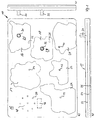
- FIG. 1 a shows a top view of a game arrangement 10, the insertion puzzle below is called.
- the insertion puzzle 10 comprises a playing field 12, the formations or cutouts 14 - 24 for receiving inserts 26, 28.
- To handle the Inserts 26, 28 are each provided with a handle 30, 32.
- the formations 14, 16, 18, 20, 22, 24 and / or the Inserts 26, 28 have at least one sensor 34, 36, 38, 40, 42, 44, the Sensor is connected to an electrical / electronic circuit 46 on which one acoustic and / or optical signal device 48 is connected. With correct assignment one of the inserts for the corresponding shape sounds as a "reward" acoustic signal.
- the acoustic signal device 48 formed as an integrated speaker in the game board, the sound signals over in the game board 12 arranged openings 50 outputs.
- the game board 12 is formed in three layers and consists of a total of three layers 52, 54 and 56, which are described with reference to FIGS. 2 to 4 become.
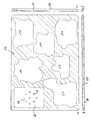
- the first (upper) layer 52 according to FIGS. 2a and 2c preferably consists of plywood and has a thickness of 4 to 8 mm, preferably 6 mm.
- the formations 14-24 are preferably designed as millings.
- a recess 60 is provided to accommodate the electronic circuit 46 and a loudspeaker (not shown) is on an underside 58 of the first layer 52 a recess 60 is provided.
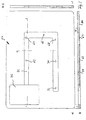
- FIG. 3a shows a top view of the second (middle) layer 54, the bores 62, 64, 66, 68, 70, 72 for receiving the sensors 34 - 44 which correspond to the respective formations 14, 16, 18, 20, 22, 24 are assigned.
- the bores 62-72 are channel-shaped Milling arranged to accommodate leads not shown for the Sensors 34-44 is formed.
- the channel-shaped cutout 74 is on an underside 78 the middle layer.
- a top 80 becomes with the bottom 58 of the top layer 52 connected as glued, the surface 80 of the middle layer at least in some areas forms a base for the formations 14-24.
- the channel-shaped milling 74 opens into a substantially rectangular opening 76, which together with the recess 60 in the bottom 58 of the upper layer 52 a space for receiving the Speaker and the electrical circuit 46 forms.
- the middle layer 54 exists either made of plywood or MDF (medium density fireboard) and includes a thickness in Range from 3 to 5 mm.
- the third (lower) layer 56 can be seen in different views in FIGS. 4a) - c).
- the lower layer 56 has in the area of the opening 76 of the second layer 54 and the Recess 60 of the first layer 52 has an opening 82 for receiving a battery (not shown).
- the lower layer 56 becomes with the underside 78 of the middle layer 54 connected so that the conduit 74 and the sensors 62-72 are covered on one side.
- the lower layer is preferably made of MDF (medium density fireboard) and has one Thickness from 2 to 5, preferably 3 mm.
- MDF medium density fireboard
- the surface of the playing field 12 is painted, the motifs of the inserts 26, 28 applied, for example, by screen printing can be.
- the inserts 26, 28 are made of wood or plastic.
- the inserts 26, 28 are removed from the moldings without a The signal sounds. If now a child one of the inserts 26, 28 in the associated shape 16, 18 inserted, a signal sounds corresponding to the motif shown on the insert. In this way, the correct assignment is "rewarded".
- the inserts 26, 28 can take any shape.
- vehicle shapes and natural objects can also use numbers and letters, the terms corresponding to the numbers and letters are given acoustically become.
Landscapes
- Engineering & Computer Science (AREA)
- Multimedia (AREA)
- Toys (AREA)
- Eye Examination Apparatus (AREA)
- Massaging Devices (AREA)
- Medicines Containing Material From Animals Or Micro-Organisms (AREA)
- Electronic Switches (AREA)
- Pinball Game Machines (AREA)
- Polishing Bodies And Polishing Tools (AREA)
Description
- Fig. 1a - c
- Gesamtansicht einer Spielanordnung umfassend ein dreilagiges Spielfeld mit Ausformungen zur Aufnahme von Einlegeteilen,
- Fig. 2a - c
- eine Draufsicht sowie Seitenansichten einer ersten Lage des Spielfeldes gemäß Fig. 1,
- Fig. 3a - c
- eine Draufsicht sowie Seitenansichten einer zweiten Lage des Spielfeldes gemäß Fig. 1 und
- Fig. 4a - c
- eine Draufsicht sowie Seitenansichten einer dritten Lage des Spielfeldes gemäß Fig. 1.
Claims (10)
- Spielanordnung (10), umfassend ein Spielfeld (12) mit Bereichen (14, 16, 18, 20, 22, 24) zur Aufnahme von zugeordneten Motive oder Teilmotive aufweisenden Elementen (26, 28) sowie eine Signaleinrichtung (48), die über zumindest eine elektrische Leitung mit zumindest einem der Bereiche verbunden ist, wobei die Bereiche (14, 16, 18, 20, 22, 24) und/oder die Elemente (26, 28) zumindest einen Sensor (34, 36, 38, 40, 42, 44) aufweisen und wobei der Sensor (34, 36, 38, 40, 42, 44) mit einem elektronischen Schaltkreis (46) verbunden ist, an dem die akustische und/oder optische Signaleinrichtung (48) angeschlossen ist, die zumindest bei korrekter Zuordnung eines der Elemente (26, 28) zu dem entsprechenden Bereich (14, 16, 18, 20, 22, 24) ein akustisches und/oder optisches Signal abgibt,
dadurch gekennzeichnet, dass das Spielfeld (12) eine erste (obere) Lage (52) in Form einer Platte umfasst, in der die Ausformungen (14, 16, 18, 20, 22, 24) für die Einlegeteile (26, 28) als Durchbrechungen ausgebildet sind und dass die erste Lage zumindest auf einer Unterseite (58) eine Ausnehmung (60) zur Aufnahme des elektronischen Schaltkreises (46) sowie zur Aufnahme eines optischen und/oder akustischen Signalgebers aufweist, dass das Spielfeld (12) eine zweite (mittlere) als Platte ausgebildete Lage (54) umfasst, in der Aufnahmen für die Sensoren eingebracht sind, wobei die zweite Lage (54) auf einer Unterseite (78) eine die Aufnahmen für die Sensoren verbindende kanalartige Ausfräsung (74) zur Bildung eines Leitungskanals aufweist und wobei eine Vorderseite (80) der mittleren Lage (54) zumindest bereichsweise die Grundfläche der Ausformungen (14, 16, 18, 20, 22, 24) bildet und wobei das Spielbrett (12) eine dritte (untere) Lage (56) in Form einer Platte zur Abdeckung der kanalartigen Ausfräsung aufweist. - Spielanordnung nach Anspruch 1,
dadurch gekennzeichnet, dass der elektronische Schaltkreis (46) einen Soundgenerator aufweist, der bei formgleicher Zuordnung des Elementes (26, 28) zu dem entsprechenden Bereich (14, 16, 18, 20, 22, 24) ein dem Motiv des Elementes (26, 28) entsprechendes Signal wie Tierstimme, Motorgeräusch, Zahlen- oder Buchstabenbenennungen akustisch wiedergibt, wobei insbesondere die Dauer des akustischen Signals einstellbar ist und vorzugsweise auf ca. 1 sec begrenzt ist. - Spielanordnung nach Anspruch 1 oder 2,
dadurch gekennzeichnet, dass der Sensor (34, 36, 38, 40, 42, 44) als Lichtsensor ausgebildet und über eine elektrische Leitung mit dem elektronischen Schaltkreis (46) verbunden ist bzw. dass der Sensor (34, 36, 38, 40, 42, 44) als Magnetsensor ausgebildet ist, umfassend einen vorzugsweise in dem Bereich (14, 16, 18, 20, 22, 24) angeordneten Magnetschalter sowie einen vorzugsweise an dem Element (26, 28) angeordneten und dem Magnetschalter zugeordneten Magneten. - Spielanordnung nach zumindest einem der vorhergehenden Ansprüche,
dadurch gekennzeichnet, dass die Bereiche (14, 16, 18, 20, 22, 24) als vorzugsweise gesägte oder gefräste Ausformungen ausgebildet sind, umfassend eine Grundfläche sowie eine im Wesentlichen einer Kontur eines Motives folgende Berandung. - Spielanordnung nach zumindest einem der vorhergehenden Ansprüche,
dadurch gekennzeichnet, dass in einer Grundfläche der Ausformung (14, 16, 18, 20, 22, 24) eine Aufnahme wie Bohrung (62, 64, 66, 68, 70, 72) zur Aufnahme des Sensors (34, 36, 38, 40, 42, 44) eingebracht ist. - Spielanordnung nach zumindest einem der vorhergehenden Ansprüche,
dadurch gekennzeichnet, dass das Spielfeld (12) als mehrlagiges, vorzugsweise dreilagiges Spielbrett ausgebildet ist und/oder dass die Elemente (26, 28) als Einlegeteile ausgebildet sind. - Spielanordnung nach zumindest einem der vorhergehenden Ansprüche,
dadurch gekennzeichnet, dass die kanalartige Ausfräsung (74) in einer Durchbrechung (76) mündet, die zusammen mit der Ausnehmung (60) in der ersten Lage (52) eine Aufnahme für den elektronischen Schaltkreis sowie den Lautsprecher bildet. - Spielanordnung nach zumindest einem der vorhergehenden Ansprüche,
dadurch gekennzeichnet, dass in der dritten Lage (56) eine weitere Durchbrechung (82) zur Aufnahme einer Energieversorgung wie Batterie vorgesehen ist, die mittels eines Verschlusses verschließbar ist, und/oder dass die Sensoren (34, 36, 38, 40, 42, 44) über eine Busleitung mit dem elektronischen Schaltkreis verbunden sind, wobei der elektronische Schaltkreis die an der Busleitung angeschlossenen Sensoren (34, 36, 38, 40, 42, 44) auswertet. - Spielanordnung nach zumindest einem der vorhergehenden Ansprüche,
dadurch gekennzeichnet, dass die Einlegeteile (26, 28) eigenständige Sensoren und/oder aktive oder passive elektronische Schaltkreise aufweisen, die mit in den Ausformungen (14 - 24) angeordneten Sensoren (34 - 44) zusammenwirken. - Spielanordnung nach zumindest einem der vorhergehenden Ansprüche,
dadurch gekennzeichnet, dass die als Platte ausgebildete erste, zweite oder dritte Lage (52, 54, 56) aus Holz wie Sperrholz und/oder aus MDF (medium density fiberboard) besteht.
Applications Claiming Priority (2)
| Application Number | Priority Date | Filing Date | Title |
|---|---|---|---|
| DE20001536U DE20001536U1 (de) | 2000-01-31 | 2000-01-31 | Spielanordnung |
| DE20001536U | 2000-01-31 |
Publications (3)
| Publication Number | Publication Date |
|---|---|
| EP1121963A2 EP1121963A2 (de) | 2001-08-08 |
| EP1121963A3 EP1121963A3 (de) | 2001-10-24 |
| EP1121963B1 true EP1121963B1 (de) | 2004-04-07 |
Family
ID=7936553
Family Applications (1)
| Application Number | Title | Priority Date | Filing Date |
|---|---|---|---|
| EP01100696A Expired - Lifetime EP1121963B1 (de) | 2000-01-31 | 2001-01-12 | Spielanordnung |
Country Status (6)
| Country | Link |
|---|---|
| EP (1) | EP1121963B1 (de) |
| AT (1) | ATE263602T1 (de) |
| DE (2) | DE20001536U1 (de) |
| DK (1) | DK1121963T3 (de) |
| ES (1) | ES2218284T3 (de) |
| PT (1) | PT1121963E (de) |
Cited By (1)
| Publication number | Priority date | Publication date | Assignee | Title |
|---|---|---|---|---|
| WO2014167565A1 (en) * | 2013-04-08 | 2014-10-16 | Digisense Ltd. | Interactive toy |
Families Citing this family (1)
| Publication number | Priority date | Publication date | Assignee | Title |
|---|---|---|---|---|
| FR2826588A1 (fr) * | 2001-06-29 | 2003-01-03 | Pilou Company Ltd | Perfectionnement aux jouets du genre puzzles |
Family Cites Families (8)
| Publication number | Priority date | Publication date | Assignee | Title |
|---|---|---|---|---|
| US4417732A (en) * | 1981-05-08 | 1983-11-29 | Guill Andrew J | Electrical construction game |
| DE8608413U1 (de) * | 1986-03-27 | 1986-05-07 | Bonkowski, Josef, 4000 Düsseldorf | Puzzlespiel |
| US5087043A (en) * | 1990-02-09 | 1992-02-11 | Sight And Sound Inc. | Interactive audio-visual puzzle |
| AU7948691A (en) * | 1991-07-10 | 1993-01-07 | Morgan Chang | Jigsaw puzzle |
| FR2709427B1 (fr) | 1993-08-30 | 1995-11-03 | Erligmann Ariane | Jeu du type puzzle associé à une manifestation sonore visuelle ou olfactive. |
| DE19532698A1 (de) | 1994-12-12 | 1996-06-13 | Cragg Tatjana | Vorrichtung zum Spielen eines Gesellschaftsspieles |
| JP3026944B2 (ja) | 1997-01-22 | 2000-03-27 | サンボー電子株式会社 | ジグソーパズル |
| GB2337942B (en) * | 1999-03-10 | 2001-08-01 | Malcolm Baxter | Jig saw puzzle apparatus |
-
2000
- 2000-01-31 DE DE20001536U patent/DE20001536U1/de not_active Expired - Lifetime
-
2001
- 2001-01-12 DK DK01100696T patent/DK1121963T3/da active
- 2001-01-12 EP EP01100696A patent/EP1121963B1/de not_active Expired - Lifetime
- 2001-01-12 ES ES01100696T patent/ES2218284T3/es not_active Expired - Lifetime
- 2001-01-12 PT PT01100696T patent/PT1121963E/pt unknown
- 2001-01-12 DE DE50101873T patent/DE50101873D1/de not_active Expired - Lifetime
- 2001-01-12 AT AT01100696T patent/ATE263602T1/de not_active IP Right Cessation
Cited By (1)
| Publication number | Priority date | Publication date | Assignee | Title |
|---|---|---|---|---|
| WO2014167565A1 (en) * | 2013-04-08 | 2014-10-16 | Digisense Ltd. | Interactive toy |
Also Published As
| Publication number | Publication date |
|---|---|
| PT1121963E (pt) | 2004-08-31 |
| DK1121963T3 (da) | 2004-08-09 |
| EP1121963A2 (de) | 2001-08-08 |
| ATE263602T1 (de) | 2004-04-15 |
| ES2218284T3 (es) | 2004-11-16 |
| EP1121963A3 (de) | 2001-10-24 |
| DE50101873D1 (de) | 2004-05-13 |
| DE20001536U1 (de) | 2000-08-17 |
Similar Documents
| Publication | Publication Date | Title |
|---|---|---|
| DE69020769T2 (de) | Spielmaschine mit automatischer Beurteilungsfunktion. | |
| DE69319802T2 (de) | Interaktives elektronisches Spielbuch | |
| DE69216949T2 (de) | Spielzeug mit Klangereignis | |
| DE60011575T2 (de) | Interaktives spielzeug | |
| DE3785766T2 (de) | Spielzeugbaustein mit Positionsinformation zur Verfügung stellenden Elementen. | |
| DE3026397A1 (de) | Spiel | |
| US4376538A (en) | Educational game for construction and identifying electrical and electronic circuits | |
| DE2926420C2 (de) | Vorrichtung zur Durchführung eines Frage- und Antwortspieles | |
| DE1547589A1 (de) | Automatisches Rhythmusinstrument | |
| EP0669149B1 (de) | Kinderfahrzeug mit integrierter Audio-Wiedergabeeinrichtung | |
| US5277588A (en) | Audio educational game | |
| DE10158629B4 (de) | Schalter | |
| EP1121963A2 (de) | Spielanordnung | |
| DE3019432A1 (de) | Elektronikspielplatte | |
| DE8608413U1 (de) | Puzzlespiel | |
| DE8813956U1 (de) | Mikrocomputer-gesteuertes Spielgerät | |
| DE8705142U1 (de) | Musikspiel- und Lerngerät | |
| DE2259346A1 (de) | Brettspiel fuer schulanfaenger | |
| DE2208352A1 (de) | Programmierbares frage- und antwortspiel | |
| DE4111720A1 (de) | Verfahren zum auslosen und vorrichtung zur durchfuehrung des verfahrens | |
| CN211125007U (zh) | 一种地板钢琴的琴座结构 | |
| DE2445723C3 (de) | ||
| DE2117973A1 (de) | Automatische Begleitungsvorrichtung für ein elektronisches Tastenmusikinstrument | |
| DE202021000237U1 (de) | Spiel- und/oder Übungsvorrichtung | |
| DE10134684A1 (de) | Puzzle und Puzzleteil |
Legal Events
| Date | Code | Title | Description |
|---|---|---|---|
| PUAI | Public reference made under article 153(3) epc to a published international application that has entered the european phase |
Free format text: ORIGINAL CODE: 0009012 |
|
| AK | Designated contracting states |
Kind code of ref document: A2 Designated state(s): AT BE CH CY DE DK ES FI FR GB GR IE IT LI LU MC NL PT SE TR |
|
| AX | Request for extension of the european patent |
Free format text: AL;LT;LV;MK;RO;SI |
|
| PUAL | Search report despatched |
Free format text: ORIGINAL CODE: 0009013 |
|
| AK | Designated contracting states |
Kind code of ref document: A3 Designated state(s): AT BE CH CY DE DK ES FI FR GB GR IE IT LI LU MC NL PT SE TR |
|
| AX | Request for extension of the european patent |
Free format text: AL;LT;LV;MK;RO;SI |
|
| 17P | Request for examination filed |
Effective date: 20020423 |
|
| AKX | Designation fees paid |
Free format text: AT BE CH CY DE DK ES FI FR GB GR IE IT LI LU MC NL PT SE TR |
|
| TPAD | Observations filed by third parties |
Free format text: ORIGINAL CODE: EPIDOS TIPA |
|
| GRAH | Despatch of communication of intention to grant a patent |
Free format text: ORIGINAL CODE: EPIDOS IGRA |
|
| GBC | Gb: translation of claims filed (gb section 78(7)/1977) | ||
| GRAS | Grant fee paid |
Free format text: ORIGINAL CODE: EPIDOSNIGR3 |
|
| GRAA | (expected) grant |
Free format text: ORIGINAL CODE: 0009210 |
|
| AK | Designated contracting states |
Kind code of ref document: B1 Designated state(s): AT BE CH CY DE DK ES FI FR GB GR IE IT LI LU MC NL PT SE TR |
|
| PG25 | Lapsed in a contracting state [announced via postgrant information from national office to epo] |
Ref country code: FI Free format text: LAPSE BECAUSE OF FAILURE TO SUBMIT A TRANSLATION OF THE DESCRIPTION OR TO PAY THE FEE WITHIN THE PRESCRIBED TIME-LIMIT Effective date: 20040407 Ref country code: NL Free format text: LAPSE BECAUSE OF FAILURE TO SUBMIT A TRANSLATION OF THE DESCRIPTION OR TO PAY THE FEE WITHIN THE PRESCRIBED TIME-LIMIT Effective date: 20040407 Ref country code: TR Free format text: LAPSE BECAUSE OF FAILURE TO SUBMIT A TRANSLATION OF THE DESCRIPTION OR TO PAY THE FEE WITHIN THE PRESCRIBED TIME-LIMIT Effective date: 20040407 |
|
| REG | Reference to a national code |
Ref country code: GB Ref legal event code: FG4D Free format text: NOT ENGLISH |
|
| REG | Reference to a national code |
Ref country code: CH Ref legal event code: EP |
|
| REF | Corresponds to: |
Ref document number: 50101873 Country of ref document: DE Date of ref document: 20040513 Kind code of ref document: P |
|
| REG | Reference to a national code |
Ref country code: IE Ref legal event code: FG4D Free format text: GERMAN |
|
| REG | Reference to a national code |
Ref country code: CH Ref legal event code: NV Representative=s name: LUCHS & PARTNER PATENTANWAELTE |
|
| REG | Reference to a national code |
Ref country code: SE Ref legal event code: TRGR |
|
| PG25 | Lapsed in a contracting state [announced via postgrant information from national office to epo] |
Ref country code: GR Free format text: LAPSE BECAUSE OF FAILURE TO SUBMIT A TRANSLATION OF THE DESCRIPTION OR TO PAY THE FEE WITHIN THE PRESCRIBED TIME-LIMIT Effective date: 20040707 |
|
| REG | Reference to a national code |
Ref country code: DK Ref legal event code: T3 |
|
| GBT | Gb: translation of ep patent filed (gb section 77(6)(a)/1977) |
Effective date: 20040722 |
|
| REG | Reference to a national code |
Ref country code: PT Ref legal event code: SC4A Free format text: AVAILABILITY OF NATIONAL TRANSLATION Effective date: 20040630 |
|
| NLV1 | Nl: lapsed or annulled due to failure to fulfill the requirements of art. 29p and 29m of the patents act | ||
| REG | Reference to a national code |
Ref country code: ES Ref legal event code: FG2A Ref document number: 2218284 Country of ref document: ES Kind code of ref document: T3 |
|
| ET | Fr: translation filed | ||
| PGFP | Annual fee paid to national office [announced via postgrant information from national office to epo] |
Ref country code: PT Payment date: 20050105 Year of fee payment: 5 |
|
| PG25 | Lapsed in a contracting state [announced via postgrant information from national office to epo] |
Ref country code: CY Free format text: LAPSE BECAUSE OF FAILURE TO SUBMIT A TRANSLATION OF THE DESCRIPTION OR TO PAY THE FEE WITHIN THE PRESCRIBED TIME-LIMIT Effective date: 20050112 |
|
| PGFP | Annual fee paid to national office [announced via postgrant information from national office to epo] |
Ref country code: SE Payment date: 20050120 Year of fee payment: 5 |
|
| PGFP | Annual fee paid to national office [announced via postgrant information from national office to epo] |
Ref country code: LU Payment date: 20050124 Year of fee payment: 5 |
|
| PGFP | Annual fee paid to national office [announced via postgrant information from national office to epo] |
Ref country code: IE Payment date: 20050125 Year of fee payment: 5 |
|
| PG25 | Lapsed in a contracting state [announced via postgrant information from national office to epo] |
Ref country code: MC Free format text: LAPSE BECAUSE OF NON-PAYMENT OF DUE FEES Effective date: 20050131 |
|
| PLBE | No opposition filed within time limit |
Free format text: ORIGINAL CODE: 0009261 |
|
| STAA | Information on the status of an ep patent application or granted ep patent |
Free format text: STATUS: NO OPPOSITION FILED WITHIN TIME LIMIT |
|
| 26N | No opposition filed |
Effective date: 20050110 |
|
| PG25 | Lapsed in a contracting state [announced via postgrant information from national office to epo] |
Ref country code: IE Free format text: LAPSE BECAUSE OF NON-PAYMENT OF DUE FEES Effective date: 20060112 |
|
| PG25 | Lapsed in a contracting state [announced via postgrant information from national office to epo] |
Ref country code: SE Free format text: LAPSE BECAUSE OF NON-PAYMENT OF DUE FEES Effective date: 20060113 |
|
| PG25 | Lapsed in a contracting state [announced via postgrant information from national office to epo] |
Ref country code: LU Free format text: LAPSE BECAUSE OF NON-PAYMENT OF DUE FEES Effective date: 20060131 |
|
| PG25 | Lapsed in a contracting state [announced via postgrant information from national office to epo] |
Ref country code: PT Free format text: LAPSE BECAUSE OF NON-PAYMENT OF DUE FEES Effective date: 20060712 |
|
| EUG | Se: european patent has lapsed | ||
| REG | Reference to a national code |
Ref country code: PT Ref legal event code: MM4A Effective date: 20060712 |
|
| REG | Reference to a national code |
Ref country code: IE Ref legal event code: MM4A |
|
| PGFP | Annual fee paid to national office [announced via postgrant information from national office to epo] |
Ref country code: CH Payment date: 20080228 Year of fee payment: 8 Ref country code: DK Payment date: 20080115 Year of fee payment: 8 Ref country code: ES Payment date: 20080122 Year of fee payment: 8 |
|
| PGFP | Annual fee paid to national office [announced via postgrant information from national office to epo] |
Ref country code: IT Payment date: 20080123 Year of fee payment: 8 |
|
| PGFP | Annual fee paid to national office [announced via postgrant information from national office to epo] |
Ref country code: AT Payment date: 20080130 Year of fee payment: 8 |
|
| PGFP | Annual fee paid to national office [announced via postgrant information from national office to epo] |
Ref country code: FR Payment date: 20080111 Year of fee payment: 8 |
|
| PGFP | Annual fee paid to national office [announced via postgrant information from national office to epo] |
Ref country code: BE Payment date: 20080115 Year of fee payment: 8 |
|
| REG | Reference to a national code |
Ref country code: CH Ref legal event code: PL |
|
| REG | Reference to a national code |
Ref country code: DK Ref legal event code: EBP |
|
| PG25 | Lapsed in a contracting state [announced via postgrant information from national office to epo] |
Ref country code: AT Free format text: LAPSE BECAUSE OF NON-PAYMENT OF DUE FEES Effective date: 20090112 Ref country code: CH Free format text: LAPSE BECAUSE OF NON-PAYMENT OF DUE FEES Effective date: 20090131 Ref country code: LI Free format text: LAPSE BECAUSE OF NON-PAYMENT OF DUE FEES Effective date: 20090131 |
|
| REG | Reference to a national code |
Ref country code: FR Ref legal event code: ST Effective date: 20091030 |
|
| PG25 | Lapsed in a contracting state [announced via postgrant information from national office to epo] |
Ref country code: BE Free format text: LAPSE BECAUSE OF NON-PAYMENT OF DUE FEES Effective date: 20090131 |
|
| REG | Reference to a national code |
Ref country code: ES Ref legal event code: FD2A Effective date: 20090113 |
|
| PG25 | Lapsed in a contracting state [announced via postgrant information from national office to epo] |
Ref country code: FR Free format text: LAPSE BECAUSE OF NON-PAYMENT OF DUE FEES Effective date: 20090202 Ref country code: ES Free format text: LAPSE BECAUSE OF NON-PAYMENT OF DUE FEES Effective date: 20090113 |
|
| PG25 | Lapsed in a contracting state [announced via postgrant information from national office to epo] |
Ref country code: DK Free format text: LAPSE BECAUSE OF NON-PAYMENT OF DUE FEES Effective date: 20090731 |
|
| PG25 | Lapsed in a contracting state [announced via postgrant information from national office to epo] |
Ref country code: IT Free format text: LAPSE BECAUSE OF NON-PAYMENT OF DUE FEES Effective date: 20090112 |
|
| PGFP | Annual fee paid to national office [announced via postgrant information from national office to epo] |
Ref country code: GB Payment date: 20130122 Year of fee payment: 13 Ref country code: DE Payment date: 20130124 Year of fee payment: 13 |
|
| REG | Reference to a national code |
Ref country code: DE Ref legal event code: R119 Ref document number: 50101873 Country of ref document: DE |
|
| GBPC | Gb: european patent ceased through non-payment of renewal fee |
Effective date: 20140112 |
|
| REG | Reference to a national code |
Ref country code: DE Ref legal event code: R119 Ref document number: 50101873 Country of ref document: DE Effective date: 20140801 |
|
| PG25 | Lapsed in a contracting state [announced via postgrant information from national office to epo] |
Ref country code: DE Free format text: LAPSE BECAUSE OF NON-PAYMENT OF DUE FEES Effective date: 20140801 |
|
| PG25 | Lapsed in a contracting state [announced via postgrant information from national office to epo] |
Ref country code: GB Free format text: LAPSE BECAUSE OF NON-PAYMENT OF DUE FEES Effective date: 20140112 |