EP1120161A1 - Molekulargewichtsgrösserte Liganden für asymetrische homogenlösliche Hydrierkatalysatoren, Verfahren zu deren Herstellung und Verwendung - Google Patents
Molekulargewichtsgrösserte Liganden für asymetrische homogenlösliche Hydrierkatalysatoren, Verfahren zu deren Herstellung und Verwendung Download PDFInfo
- Publication number
- EP1120161A1 EP1120161A1 EP00127626A EP00127626A EP1120161A1 EP 1120161 A1 EP1120161 A1 EP 1120161A1 EP 00127626 A EP00127626 A EP 00127626A EP 00127626 A EP00127626 A EP 00127626A EP 1120161 A1 EP1120161 A1 EP 1120161A1
- Authority
- EP
- European Patent Office
- Prior art keywords
- molecular weight
- ligand
- linker
- polymer
- ligands
- Prior art date
- Legal status (The legal status is an assumption and is not a legal conclusion. Google has not performed a legal analysis and makes no representation as to the accuracy of the status listed.)
- Withdrawn
Links
- 239000003054 catalyst Substances 0.000 title claims abstract description 36
- 238000000034 method Methods 0.000 title claims abstract description 10
- 238000002360 preparation method Methods 0.000 title claims description 5
- 238000009876 asymmetric hydrogenation reaction Methods 0.000 title description 2
- 239000012477 high molecular weight ligand Substances 0.000 title 1
- 229920000642 polymer Polymers 0.000 claims abstract description 44
- 239000003446 ligand Substances 0.000 claims abstract description 32
- 239000012528 membrane Substances 0.000 claims abstract description 22
- 238000005984 hydrogenation reaction Methods 0.000 claims abstract description 15
- 125000005647 linker group Chemical group 0.000 claims description 38
- -1 polysiloxanes Polymers 0.000 claims description 19
- 239000000178 monomer Substances 0.000 claims description 16
- 229910052717 sulfur Inorganic materials 0.000 claims description 14
- 125000004209 (C1-C8) alkyl group Chemical group 0.000 claims description 11
- 229910052799 carbon Inorganic materials 0.000 claims description 7
- 239000000203 mixture Substances 0.000 claims description 7
- 239000004793 Polystyrene Substances 0.000 claims description 6
- 125000003118 aryl group Chemical group 0.000 claims description 6
- 229920001296 polysiloxane Polymers 0.000 claims description 6
- 229920002223 polystyrene Polymers 0.000 claims description 6
- 229920000058 polyacrylate Polymers 0.000 claims description 5
- 229920000570 polyether Polymers 0.000 claims description 5
- RWRDLPDLKQPQOW-UHFFFAOYSA-N Pyrrolidine Chemical compound C1CCNC1 RWRDLPDLKQPQOW-UHFFFAOYSA-N 0.000 claims description 4
- 125000000732 arylene group Chemical group 0.000 claims description 4
- 238000009901 transfer hydrogenation reaction Methods 0.000 claims description 4
- 125000003710 aryl alkyl group Chemical group 0.000 claims description 3
- 229910052751 metal Inorganic materials 0.000 claims description 3
- 239000002184 metal Substances 0.000 claims description 3
- 229910052757 nitrogen Inorganic materials 0.000 claims description 3
- 229910052707 ruthenium Inorganic materials 0.000 claims description 3
- 125000004450 alkenylene group Chemical group 0.000 claims description 2
- 125000002947 alkylene group Chemical group 0.000 claims description 2
- 229910052741 iridium Inorganic materials 0.000 claims description 2
- 229910021645 metal ion Inorganic materials 0.000 claims description 2
- 150000002739 metals Chemical class 0.000 claims description 2
- 229910052759 nickel Inorganic materials 0.000 claims description 2
- 150000002894 organic compounds Chemical class 0.000 claims description 2
- 229910052763 palladium Inorganic materials 0.000 claims description 2
- 229910052697 platinum Inorganic materials 0.000 claims description 2
- 229920000765 poly(2-oxazolines) Polymers 0.000 claims description 2
- 229920002857 polybutadiene Polymers 0.000 claims description 2
- 229920001195 polyisoprene Polymers 0.000 claims description 2
- 229910052703 rhodium Inorganic materials 0.000 claims description 2
- 229910052721 tungsten Inorganic materials 0.000 claims 1
- 238000003786 synthesis reaction Methods 0.000 abstract description 8
- OKKJLVBELUTLKV-UHFFFAOYSA-N Methanol Chemical compound OC OKKJLVBELUTLKV-UHFFFAOYSA-N 0.000 description 12
- 238000006243 chemical reaction Methods 0.000 description 12
- 229910052739 hydrogen Inorganic materials 0.000 description 12
- UFHFLCQGNIYNRP-UHFFFAOYSA-N Hydrogen Chemical compound [H][H] UFHFLCQGNIYNRP-UHFFFAOYSA-N 0.000 description 11
- 239000001257 hydrogen Substances 0.000 description 11
- 239000000047 product Substances 0.000 description 11
- 239000000758 substrate Substances 0.000 description 11
- RTZKZFJDLAIYFH-UHFFFAOYSA-N Diethyl ether Chemical compound CCOCC RTZKZFJDLAIYFH-UHFFFAOYSA-N 0.000 description 10
- 239000002904 solvent Substances 0.000 description 10
- YXFVVABEGXRONW-UHFFFAOYSA-N Toluene Chemical compound CC1=CC=CC=C1 YXFVVABEGXRONW-UHFFFAOYSA-N 0.000 description 9
- YMWUJEATGCHHMB-UHFFFAOYSA-N Dichloromethane Chemical compound ClCCl YMWUJEATGCHHMB-UHFFFAOYSA-N 0.000 description 6
- ZMANZCXQSJIPKH-UHFFFAOYSA-N Triethylamine Chemical compound CCN(CC)CC ZMANZCXQSJIPKH-UHFFFAOYSA-N 0.000 description 6
- 238000001914 filtration Methods 0.000 description 6
- 125000005842 heteroatom Chemical group 0.000 description 5
- 239000000126 substance Substances 0.000 description 5
- CSNNHWWHGAXBCP-UHFFFAOYSA-L Magnesium sulfate Chemical compound [Mg+2].[O-][S+2]([O-])([O-])[O-] CSNNHWWHGAXBCP-UHFFFAOYSA-L 0.000 description 4
- 238000006459 hydrosilylation reaction Methods 0.000 description 4
- 229910052760 oxygen Inorganic materials 0.000 description 4
- HEMHJVSKTPXQMS-UHFFFAOYSA-M Sodium hydroxide Chemical compound [OH-].[Na+] HEMHJVSKTPXQMS-UHFFFAOYSA-M 0.000 description 3
- 238000004519 manufacturing process Methods 0.000 description 3
- 238000006116 polymerization reaction Methods 0.000 description 3
- 150000003377 silicon compounds Chemical class 0.000 description 3
- 125000006648 (C1-C8) haloalkyl group Chemical group 0.000 description 2
- IEQAICDLOKRSRL-UHFFFAOYSA-N 2-[2-[2-[2-[2-[2-[2-[2-[2-[2-[2-[2-[2-[2-[2-[2-[2-[2-[2-[2-[2-[2-(2-dodecoxyethoxy)ethoxy]ethoxy]ethoxy]ethoxy]ethoxy]ethoxy]ethoxy]ethoxy]ethoxy]ethoxy]ethoxy]ethoxy]ethoxy]ethoxy]ethoxy]ethoxy]ethoxy]ethoxy]ethoxy]ethoxy]ethoxy]ethanol Chemical compound CCCCCCCCCCCCOCCOCCOCCOCCOCCOCCOCCOCCOCCOCCOCCOCCOCCOCCOCCOCCOCCOCCOCCOCCOCCOCCOCCO IEQAICDLOKRSRL-UHFFFAOYSA-N 0.000 description 2
- XKRFYHLGVUSROY-UHFFFAOYSA-N Argon Chemical compound [Ar] XKRFYHLGVUSROY-UHFFFAOYSA-N 0.000 description 2
- 241000819038 Chichester Species 0.000 description 2
- VEXZGXHMUGYJMC-UHFFFAOYSA-N Hydrochloric acid Chemical compound Cl VEXZGXHMUGYJMC-UHFFFAOYSA-N 0.000 description 2
- 238000005481 NMR spectroscopy Methods 0.000 description 2
- YGYAWVDWMABLBF-UHFFFAOYSA-N Phosgene Chemical compound ClC(Cl)=O YGYAWVDWMABLBF-UHFFFAOYSA-N 0.000 description 2
- FAPWRFPIFSIZLT-UHFFFAOYSA-M Sodium chloride Chemical compound [Na+].[Cl-] FAPWRFPIFSIZLT-UHFFFAOYSA-M 0.000 description 2
- PPBRXRYQALVLMV-UHFFFAOYSA-N Styrene Chemical compound C=CC1=CC=CC=C1 PPBRXRYQALVLMV-UHFFFAOYSA-N 0.000 description 2
- 239000002253 acid Substances 0.000 description 2
- 125000003545 alkoxy group Chemical group 0.000 description 2
- 238000004458 analytical method Methods 0.000 description 2
- 150000005840 aryl radicals Chemical class 0.000 description 2
- 230000015572 biosynthetic process Effects 0.000 description 2
- 125000004432 carbon atom Chemical group C* 0.000 description 2
- 238000006555 catalytic reaction Methods 0.000 description 2
- 239000000460 chlorine Substances 0.000 description 2
- 238000009295 crossflow filtration Methods 0.000 description 2
- MGNZXYYWBUKAII-UHFFFAOYSA-N cyclohexa-1,3-diene Chemical compound C1CC=CC=C1 MGNZXYYWBUKAII-UHFFFAOYSA-N 0.000 description 2
- HGCIXCUEYOPUTN-UHFFFAOYSA-N cyclohexene Chemical compound C1CCC=CC1 HGCIXCUEYOPUTN-UHFFFAOYSA-N 0.000 description 2
- 125000000113 cyclohexyl group Chemical group [H]C1([H])C([H])([H])C([H])([H])C([H])(*)C([H])([H])C1([H])[H] 0.000 description 2
- ZUOUZKKEUPVFJK-UHFFFAOYSA-N diphenyl Chemical group C1=CC=CC=C1C1=CC=CC=C1 ZUOUZKKEUPVFJK-UHFFFAOYSA-N 0.000 description 2
- 238000001035 drying Methods 0.000 description 2
- 230000032050 esterification Effects 0.000 description 2
- 238000005886 esterification reaction Methods 0.000 description 2
- 150000002148 esters Chemical class 0.000 description 2
- 239000000706 filtrate Substances 0.000 description 2
- 125000005843 halogen group Chemical group 0.000 description 2
- 229910052943 magnesium sulfate Inorganic materials 0.000 description 2
- 235000019341 magnesium sulphate Nutrition 0.000 description 2
- BDAGIHXWWSANSR-UHFFFAOYSA-N methanoic acid Natural products OC=O BDAGIHXWWSANSR-UHFFFAOYSA-N 0.000 description 2
- 230000003287 optical effect Effects 0.000 description 2
- 239000012074 organic phase Substances 0.000 description 2
- 229920001983 poloxamer Polymers 0.000 description 2
- 230000000379 polymerizing effect Effects 0.000 description 2
- 229910052710 silicon Inorganic materials 0.000 description 2
- LYXHWHHENVLYCN-QMDOQEJBSA-N (1z,5z)-cycloocta-1,5-diene;rhodium;tetrafluoroborate Chemical compound [Rh].F[B-](F)(F)F.C\1C\C=C/CC\C=C/1.C\1C\C=C/CC\C=C/1 LYXHWHHENVLYCN-QMDOQEJBSA-N 0.000 description 1
- YMRKZKDKJJCIHH-UHFFFAOYSA-N (4-diphenylphosphanylpyrrolidin-3-yl)-diphenylphosphane Chemical compound C1NCC(P(C=2C=CC=CC=2)C=2C=CC=CC=2)C1P(C=1C=CC=CC=1)C1=CC=CC=C1 YMRKZKDKJJCIHH-UHFFFAOYSA-N 0.000 description 1
- 125000001140 1,4-phenylene group Chemical group [H]C1=C([H])C([*:2])=C([H])C([H])=C1[*:1] 0.000 description 1
- XODAOBAZOQSFDS-UHFFFAOYSA-N 2-acetamido-3-phenylprop-2-enoic acid Chemical compound CC(=O)NC(C(O)=O)=CC1=CC=CC=C1 XODAOBAZOQSFDS-UHFFFAOYSA-N 0.000 description 1
- OSWFIVFLDKOXQC-UHFFFAOYSA-N 4-(3-methoxyphenyl)aniline Chemical compound COC1=CC=CC(C=2C=CC(N)=CC=2)=C1 OSWFIVFLDKOXQC-UHFFFAOYSA-N 0.000 description 1
- LBSXSAXOLABXMF-UHFFFAOYSA-N 4-Vinylaniline Chemical class NC1=CC=C(C=C)C=C1 LBSXSAXOLABXMF-UHFFFAOYSA-N 0.000 description 1
- HBAQYPYDRFILMT-UHFFFAOYSA-N 8-[3-(1-cyclopropylpyrazol-4-yl)-1H-pyrazolo[4,3-d]pyrimidin-5-yl]-3-methyl-3,8-diazabicyclo[3.2.1]octan-2-one Chemical class C1(CC1)N1N=CC(=C1)C1=NNC2=C1N=C(N=C2)N1C2C(N(CC1CC2)C)=O HBAQYPYDRFILMT-UHFFFAOYSA-N 0.000 description 1
- NIXOWILDQLNWCW-UHFFFAOYSA-M Acrylate Chemical compound [O-]C(=O)C=C NIXOWILDQLNWCW-UHFFFAOYSA-M 0.000 description 1
- RBZMSGOBSOCYHR-UHFFFAOYSA-N BrCc1ccc(CBr)cc1 Chemical compound BrCc1ccc(CBr)cc1 RBZMSGOBSOCYHR-UHFFFAOYSA-N 0.000 description 1
- 0 C[Si](C)(C(*)(*)O[Si](C)(C)Cl)OC(*)(*)[Si](C)(C)Cl Chemical compound C[Si](C)(C(*)(*)O[Si](C)(C)Cl)OC(*)(*)[Si](C)(C)Cl 0.000 description 1
- ZAMOUSCENKQFHK-UHFFFAOYSA-N Chlorine atom Chemical compound [Cl] ZAMOUSCENKQFHK-UHFFFAOYSA-N 0.000 description 1
- JOYRKODLDBILNP-UHFFFAOYSA-N Ethyl urethane Chemical group CCOC(N)=O JOYRKODLDBILNP-UHFFFAOYSA-N 0.000 description 1
- PXGOKWXKJXAPGV-UHFFFAOYSA-N Fluorine Chemical compound FF PXGOKWXKJXAPGV-UHFFFAOYSA-N 0.000 description 1
- CERQOIWHTDAKMF-UHFFFAOYSA-M Methacrylate Chemical compound CC(=C)C([O-])=O CERQOIWHTDAKMF-UHFFFAOYSA-M 0.000 description 1
- NTIZESTWPVYFNL-UHFFFAOYSA-N Methyl isobutyl ketone Chemical compound CC(C)CC(C)=O NTIZESTWPVYFNL-UHFFFAOYSA-N 0.000 description 1
- UIHCLUNTQKBZGK-UHFFFAOYSA-N Methyl isobutyl ketone Natural products CCC(C)C(C)=O UIHCLUNTQKBZGK-UHFFFAOYSA-N 0.000 description 1
- VVQNEPGJFQJSBK-UHFFFAOYSA-N Methyl methacrylate Chemical compound COC(=O)C(C)=C VVQNEPGJFQJSBK-UHFFFAOYSA-N 0.000 description 1
- 239000004721 Polyphenylene oxide Substances 0.000 description 1
- KJTLSVCANCCWHF-UHFFFAOYSA-N Ruthenium Chemical class [Ru] KJTLSVCANCCWHF-UHFFFAOYSA-N 0.000 description 1
- XUIMIQQOPSSXEZ-UHFFFAOYSA-N Silicon Chemical compound [Si] XUIMIQQOPSSXEZ-UHFFFAOYSA-N 0.000 description 1
- YMRKZKDKJJCIHH-VSGBNLITSA-N [(3r,4r)-4-diphenylphosphanylpyrrolidin-3-yl]-diphenylphosphane Chemical compound C=1C=CC=CC=1P([C@H]1[C@@H](CNC1)P(C=1C=CC=CC=1)C=1C=CC=CC=1)C1=CC=CC=C1 YMRKZKDKJJCIHH-VSGBNLITSA-N 0.000 description 1
- 230000010933 acylation Effects 0.000 description 1
- 238000005917 acylation reaction Methods 0.000 description 1
- 238000007792 addition Methods 0.000 description 1
- 150000001298 alcohols Chemical class 0.000 description 1
- 230000029936 alkylation Effects 0.000 description 1
- 238000005804 alkylation reaction Methods 0.000 description 1
- 238000010640 amide synthesis reaction Methods 0.000 description 1
- 125000005428 anthryl group Chemical group [H]C1=C([H])C([H])=C2C([H])=C3C(*)=C([H])C([H])=C([H])C3=C([H])C2=C1[H] 0.000 description 1
- 238000013459 approach Methods 0.000 description 1
- 239000008346 aqueous phase Substances 0.000 description 1
- 229910052786 argon Inorganic materials 0.000 description 1
- 239000012300 argon atmosphere Substances 0.000 description 1
- 239000012298 atmosphere Substances 0.000 description 1
- QVGXLLKOCUKJST-UHFFFAOYSA-N atomic oxygen Chemical compound [O] QVGXLLKOCUKJST-UHFFFAOYSA-N 0.000 description 1
- 238000010923 batch production Methods 0.000 description 1
- 230000009286 beneficial effect Effects 0.000 description 1
- 235000010290 biphenyl Nutrition 0.000 description 1
- 239000004305 biphenyl Substances 0.000 description 1
- 229910052796 boron Inorganic materials 0.000 description 1
- 239000004202 carbamide Chemical group 0.000 description 1
- 150000004651 carbonic acid esters Chemical class 0.000 description 1
- 238000003889 chemical engineering Methods 0.000 description 1
- 229910052801 chlorine Inorganic materials 0.000 description 1
- AOGYCOYQMAVAFD-UHFFFAOYSA-N chlorocarbonic acid Chemical class OC(Cl)=O AOGYCOYQMAVAFD-UHFFFAOYSA-N 0.000 description 1
- 150000001875 compounds Chemical class 0.000 description 1
- 238000010924 continuous production Methods 0.000 description 1
- 229920001577 copolymer Polymers 0.000 description 1
- UBHZUDXTHNMNLD-UHFFFAOYSA-N dimethylsilane Chemical group C[SiH2]C UBHZUDXTHNMNLD-UHFFFAOYSA-N 0.000 description 1
- LOGZJGPDGPASEP-UHFFFAOYSA-N diphosphinine Chemical compound C1=CC=PP=C1 LOGZJGPDGPASEP-UHFFFAOYSA-N 0.000 description 1
- KPUWHANPEXNPJT-UHFFFAOYSA-N disiloxane Chemical compound [SiH3]O[SiH3] KPUWHANPEXNPJT-UHFFFAOYSA-N 0.000 description 1
- 239000000428 dust Substances 0.000 description 1
- 238000005516 engineering process Methods 0.000 description 1
- 125000004185 ester group Chemical group 0.000 description 1
- 125000001495 ethyl group Chemical group [H]C([H])([H])C([H])([H])* 0.000 description 1
- 239000011737 fluorine Substances 0.000 description 1
- 229910052731 fluorine Inorganic materials 0.000 description 1
- 235000019253 formic acid Nutrition 0.000 description 1
- 150000004675 formic acid derivatives Chemical class 0.000 description 1
- 125000000524 functional group Chemical group 0.000 description 1
- 229920001002 functional polymer Polymers 0.000 description 1
- 238000010438 heat treatment Methods 0.000 description 1
- 125000003187 heptyl group Chemical group [H]C([*])([H])C([H])([H])C([H])([H])C([H])([H])C([H])([H])C([H])([H])C([H])([H])[H] 0.000 description 1
- 125000004051 hexyl group Chemical group [H]C([H])([H])C([H])([H])C([H])([H])C([H])([H])C([H])([H])C([H])([H])* 0.000 description 1
- 238000004128 high performance liquid chromatography Methods 0.000 description 1
- 238000007172 homogeneous catalysis Methods 0.000 description 1
- 238000009905 homogeneous catalytic hydrogenation reaction Methods 0.000 description 1
- 230000036571 hydration Effects 0.000 description 1
- 238000006703 hydration reaction Methods 0.000 description 1
- 125000002887 hydroxy group Chemical group [H]O* 0.000 description 1
- 230000002779 inactivation Effects 0.000 description 1
- 230000003993 interaction Effects 0.000 description 1
- 125000000959 isobutyl group Chemical group [H]C([H])([H])C([H])(C([H])([H])[H])C([H])([H])* 0.000 description 1
- 125000001449 isopropyl group Chemical group [H]C([H])([H])C([H])(*)C([H])([H])[H] 0.000 description 1
- 229920002521 macromolecule Polymers 0.000 description 1
- 230000014759 maintenance of location Effects 0.000 description 1
- VHRYZQNGTZXDNX-UHFFFAOYSA-N methacryloyl chloride Chemical compound CC(=C)C(Cl)=O VHRYZQNGTZXDNX-UHFFFAOYSA-N 0.000 description 1
- 238000010327 methods by industry Methods 0.000 description 1
- USKHBABPFFAKJD-FLIBITNWSA-N methyl (z)-2-acetamido-3-phenylprop-2-enoate Chemical compound COC(=O)C(\NC(C)=O)=C\C1=CC=CC=C1 USKHBABPFFAKJD-FLIBITNWSA-N 0.000 description 1
- 125000001624 naphthyl group Chemical group 0.000 description 1
- 125000002347 octyl group Chemical group [H]C([*])([H])C([H])([H])C([H])([H])C([H])([H])C([H])([H])C([H])([H])C([H])([H])C([H])([H])[H] 0.000 description 1
- 238000010943 off-gassing Methods 0.000 description 1
- 150000002902 organometallic compounds Chemical class 0.000 description 1
- 230000003647 oxidation Effects 0.000 description 1
- 238000007254 oxidation reaction Methods 0.000 description 1
- 239000001301 oxygen Substances 0.000 description 1
- 125000004430 oxygen atom Chemical group O* 0.000 description 1
- 125000001147 pentyl group Chemical group C(CCCC)* 0.000 description 1
- 239000003208 petroleum Substances 0.000 description 1
- 239000012071 phase Substances 0.000 description 1
- 125000005561 phenanthryl group Chemical group 0.000 description 1
- 125000001997 phenyl group Chemical group [H]C1=C([H])C([H])=C(*)C([H])=C1[H] 0.000 description 1
- 229910052698 phosphorus Inorganic materials 0.000 description 1
- 239000000843 powder Substances 0.000 description 1
- 125000002924 primary amino group Chemical group [H]N([H])* 0.000 description 1
- 239000011541 reaction mixture Substances 0.000 description 1
- 230000009257 reactivity Effects 0.000 description 1
- 239000012465 retentate Substances 0.000 description 1
- 125000002914 sec-butyl group Chemical group [H]C([H])([H])C([H])([H])C([H])(*)C([H])([H])[H] 0.000 description 1
- 239000010703 silicon Substances 0.000 description 1
- 238000006884 silylation reaction Methods 0.000 description 1
- 239000011780 sodium chloride Substances 0.000 description 1
- 238000003756 stirring Methods 0.000 description 1
- 238000003860 storage Methods 0.000 description 1
- 125000000999 tert-butyl group Chemical group [H]C([H])([H])C(*)(C([H])([H])[H])C([H])([H])[H] 0.000 description 1
- 229910052723 transition metal Inorganic materials 0.000 description 1
- 150000003624 transition metals Chemical class 0.000 description 1
- ILWRPSCZWQJDMK-UHFFFAOYSA-N triethylazanium;chloride Chemical compound Cl.CCN(CC)CC ILWRPSCZWQJDMK-UHFFFAOYSA-N 0.000 description 1
- 238000000108 ultra-filtration Methods 0.000 description 1
- XLYOFNOQVPJJNP-UHFFFAOYSA-N water Substances O XLYOFNOQVPJJNP-UHFFFAOYSA-N 0.000 description 1
Images

Classifications
-
- C—CHEMISTRY; METALLURGY
- C08—ORGANIC MACROMOLECULAR COMPOUNDS; THEIR PREPARATION OR CHEMICAL WORKING-UP; COMPOSITIONS BASED THEREON
- C08F—MACROMOLECULAR COMPOUNDS OBTAINED BY REACTIONS ONLY INVOLVING CARBON-TO-CARBON UNSATURATED BONDS
- C08F8/00—Chemical modification by after-treatment
- C08F8/40—Introducing phosphorus atoms or phosphorus-containing groups
-
- B—PERFORMING OPERATIONS; TRANSPORTING
- B01—PHYSICAL OR CHEMICAL PROCESSES OR APPARATUS IN GENERAL
- B01J—CHEMICAL OR PHYSICAL PROCESSES, e.g. CATALYSIS OR COLLOID CHEMISTRY; THEIR RELEVANT APPARATUS
- B01J31/00—Catalysts comprising hydrides, coordination complexes or organic compounds
- B01J31/16—Catalysts comprising hydrides, coordination complexes or organic compounds containing coordination complexes
- B01J31/165—Polymer immobilised coordination complexes, e.g. organometallic complexes
- B01J31/1658—Polymer immobilised coordination complexes, e.g. organometallic complexes immobilised by covalent linkages, i.e. pendant complexes with optional linking groups, e.g. on Wang or Merrifield resins
- B01J31/1675—Polymer immobilised coordination complexes, e.g. organometallic complexes immobilised by covalent linkages, i.e. pendant complexes with optional linking groups, e.g. on Wang or Merrifield resins the linkage being to an organometallic polymer covered by groups B01J31/123 - B01J31/127, e.g. polyhydrosiloxanes
-
- B—PERFORMING OPERATIONS; TRANSPORTING
- B01—PHYSICAL OR CHEMICAL PROCESSES OR APPARATUS IN GENERAL
- B01J—CHEMICAL OR PHYSICAL PROCESSES, e.g. CATALYSIS OR COLLOID CHEMISTRY; THEIR RELEVANT APPARATUS
- B01J31/00—Catalysts comprising hydrides, coordination complexes or organic compounds
- B01J31/16—Catalysts comprising hydrides, coordination complexes or organic compounds containing coordination complexes
- B01J31/165—Polymer immobilised coordination complexes, e.g. organometallic complexes
- B01J31/1658—Polymer immobilised coordination complexes, e.g. organometallic complexes immobilised by covalent linkages, i.e. pendant complexes with optional linking groups, e.g. on Wang or Merrifield resins
- B01J31/1683—Polymer immobilised coordination complexes, e.g. organometallic complexes immobilised by covalent linkages, i.e. pendant complexes with optional linking groups, e.g. on Wang or Merrifield resins the linkage being to a soluble polymer, e.g. PEG or dendrimer, i.e. molecular weight enlarged complexes
-
- B—PERFORMING OPERATIONS; TRANSPORTING
- B01—PHYSICAL OR CHEMICAL PROCESSES OR APPARATUS IN GENERAL
- B01J—CHEMICAL OR PHYSICAL PROCESSES, e.g. CATALYSIS OR COLLOID CHEMISTRY; THEIR RELEVANT APPARATUS
- B01J31/00—Catalysts comprising hydrides, coordination complexes or organic compounds
- B01J31/16—Catalysts comprising hydrides, coordination complexes or organic compounds containing coordination complexes
- B01J31/18—Catalysts comprising hydrides, coordination complexes or organic compounds containing coordination complexes containing nitrogen, phosphorus, arsenic or antimony as complexing atoms, e.g. in pyridine ligands, or in resonance therewith, e.g. in isocyanide ligands C=N-R or as complexed central atoms
- B01J31/1805—Catalysts comprising hydrides, coordination complexes or organic compounds containing coordination complexes containing nitrogen, phosphorus, arsenic or antimony as complexing atoms, e.g. in pyridine ligands, or in resonance therewith, e.g. in isocyanide ligands C=N-R or as complexed central atoms the ligands containing nitrogen
-
- B—PERFORMING OPERATIONS; TRANSPORTING
- B01—PHYSICAL OR CHEMICAL PROCESSES OR APPARATUS IN GENERAL
- B01J—CHEMICAL OR PHYSICAL PROCESSES, e.g. CATALYSIS OR COLLOID CHEMISTRY; THEIR RELEVANT APPARATUS
- B01J31/00—Catalysts comprising hydrides, coordination complexes or organic compounds
- B01J31/16—Catalysts comprising hydrides, coordination complexes or organic compounds containing coordination complexes
- B01J31/18—Catalysts comprising hydrides, coordination complexes or organic compounds containing coordination complexes containing nitrogen, phosphorus, arsenic or antimony as complexing atoms, e.g. in pyridine ligands, or in resonance therewith, e.g. in isocyanide ligands C=N-R or as complexed central atoms
- B01J31/1805—Catalysts comprising hydrides, coordination complexes or organic compounds containing coordination complexes containing nitrogen, phosphorus, arsenic or antimony as complexing atoms, e.g. in pyridine ligands, or in resonance therewith, e.g. in isocyanide ligands C=N-R or as complexed central atoms the ligands containing nitrogen
- B01J31/181—Cyclic ligands, including e.g. non-condensed polycyclic ligands, comprising at least one complexing nitrogen atom as ring member, e.g. pyridine
- B01J31/1815—Cyclic ligands, including e.g. non-condensed polycyclic ligands, comprising at least one complexing nitrogen atom as ring member, e.g. pyridine with more than one complexing nitrogen atom, e.g. bipyridyl, 2-aminopyridine
- B01J31/182—Cyclic ligands, including e.g. non-condensed polycyclic ligands, comprising at least one complexing nitrogen atom as ring member, e.g. pyridine with more than one complexing nitrogen atom, e.g. bipyridyl, 2-aminopyridine comprising aliphatic or saturated rings
-
- B—PERFORMING OPERATIONS; TRANSPORTING
- B01—PHYSICAL OR CHEMICAL PROCESSES OR APPARATUS IN GENERAL
- B01J—CHEMICAL OR PHYSICAL PROCESSES, e.g. CATALYSIS OR COLLOID CHEMISTRY; THEIR RELEVANT APPARATUS
- B01J31/00—Catalysts comprising hydrides, coordination complexes or organic compounds
- B01J31/16—Catalysts comprising hydrides, coordination complexes or organic compounds containing coordination complexes
- B01J31/18—Catalysts comprising hydrides, coordination complexes or organic compounds containing coordination complexes containing nitrogen, phosphorus, arsenic or antimony as complexing atoms, e.g. in pyridine ligands, or in resonance therewith, e.g. in isocyanide ligands C=N-R or as complexed central atoms
- B01J31/1845—Catalysts comprising hydrides, coordination complexes or organic compounds containing coordination complexes containing nitrogen, phosphorus, arsenic or antimony as complexing atoms, e.g. in pyridine ligands, or in resonance therewith, e.g. in isocyanide ligands C=N-R or as complexed central atoms the ligands containing phosphorus
- B01J31/1875—Phosphinites (R2P(OR), their isomeric phosphine oxides (R3P=O) and RO-substitution derivatives thereof)
-
- B—PERFORMING OPERATIONS; TRANSPORTING
- B01—PHYSICAL OR CHEMICAL PROCESSES OR APPARATUS IN GENERAL
- B01J—CHEMICAL OR PHYSICAL PROCESSES, e.g. CATALYSIS OR COLLOID CHEMISTRY; THEIR RELEVANT APPARATUS
- B01J31/00—Catalysts comprising hydrides, coordination complexes or organic compounds
- B01J31/16—Catalysts comprising hydrides, coordination complexes or organic compounds containing coordination complexes
- B01J31/18—Catalysts comprising hydrides, coordination complexes or organic compounds containing coordination complexes containing nitrogen, phosphorus, arsenic or antimony as complexing atoms, e.g. in pyridine ligands, or in resonance therewith, e.g. in isocyanide ligands C=N-R or as complexed central atoms
- B01J31/189—Catalysts comprising hydrides, coordination complexes or organic compounds containing coordination complexes containing nitrogen, phosphorus, arsenic or antimony as complexing atoms, e.g. in pyridine ligands, or in resonance therewith, e.g. in isocyanide ligands C=N-R or as complexed central atoms containing both nitrogen and phosphorus as complexing atoms, including e.g. phosphino moieties, in one at least bidentate or bridging ligand
-
- B—PERFORMING OPERATIONS; TRANSPORTING
- B01—PHYSICAL OR CHEMICAL PROCESSES OR APPARATUS IN GENERAL
- B01J—CHEMICAL OR PHYSICAL PROCESSES, e.g. CATALYSIS OR COLLOID CHEMISTRY; THEIR RELEVANT APPARATUS
- B01J31/00—Catalysts comprising hydrides, coordination complexes or organic compounds
- B01J31/16—Catalysts comprising hydrides, coordination complexes or organic compounds containing coordination complexes
- B01J31/22—Organic complexes
- B01J31/2204—Organic complexes the ligands containing oxygen or sulfur as complexing atoms
- B01J31/2208—Oxygen, e.g. acetylacetonates
- B01J31/2221—At least one oxygen and one phosphorous atom present as complexing atoms in an at least bidentate or bridging ligand
-
- B—PERFORMING OPERATIONS; TRANSPORTING
- B01—PHYSICAL OR CHEMICAL PROCESSES OR APPARATUS IN GENERAL
- B01J—CHEMICAL OR PHYSICAL PROCESSES, e.g. CATALYSIS OR COLLOID CHEMISTRY; THEIR RELEVANT APPARATUS
- B01J31/00—Catalysts comprising hydrides, coordination complexes or organic compounds
- B01J31/16—Catalysts comprising hydrides, coordination complexes or organic compounds containing coordination complexes
- B01J31/22—Organic complexes
- B01J31/2204—Organic complexes the ligands containing oxygen or sulfur as complexing atoms
- B01J31/2208—Oxygen, e.g. acetylacetonates
- B01J31/2226—Anionic ligands, i.e. the overall ligand carries at least one formal negative charge
- B01J31/2243—At least one oxygen and one nitrogen atom present as complexing atoms in an at least bidentate or bridging ligand
-
- B—PERFORMING OPERATIONS; TRANSPORTING
- B01—PHYSICAL OR CHEMICAL PROCESSES OR APPARATUS IN GENERAL
- B01J—CHEMICAL OR PHYSICAL PROCESSES, e.g. CATALYSIS OR COLLOID CHEMISTRY; THEIR RELEVANT APPARATUS
- B01J31/00—Catalysts comprising hydrides, coordination complexes or organic compounds
- B01J31/16—Catalysts comprising hydrides, coordination complexes or organic compounds containing coordination complexes
- B01J31/22—Organic complexes
- B01J31/2282—Unsaturated compounds used as ligands
- B01J31/2295—Cyclic compounds, e.g. cyclopentadienyls
-
- B—PERFORMING OPERATIONS; TRANSPORTING
- B01—PHYSICAL OR CHEMICAL PROCESSES OR APPARATUS IN GENERAL
- B01J—CHEMICAL OR PHYSICAL PROCESSES, e.g. CATALYSIS OR COLLOID CHEMISTRY; THEIR RELEVANT APPARATUS
- B01J31/00—Catalysts comprising hydrides, coordination complexes or organic compounds
- B01J31/16—Catalysts comprising hydrides, coordination complexes or organic compounds containing coordination complexes
- B01J31/24—Phosphines, i.e. phosphorus bonded to only carbon atoms, or to both carbon and hydrogen atoms, including e.g. sp2-hybridised phosphorus compounds such as phosphabenzene, phosphole or anionic phospholide ligands
- B01J31/2404—Cyclic ligands, including e.g. non-condensed polycyclic ligands, the phosphine-P atom being a ring member or a substituent on the ring
- B01J31/2409—Cyclic ligands, including e.g. non-condensed polycyclic ligands, the phosphine-P atom being a ring member or a substituent on the ring with more than one complexing phosphine-P atom
-
- B—PERFORMING OPERATIONS; TRANSPORTING
- B01—PHYSICAL OR CHEMICAL PROCESSES OR APPARATUS IN GENERAL
- B01J—CHEMICAL OR PHYSICAL PROCESSES, e.g. CATALYSIS OR COLLOID CHEMISTRY; THEIR RELEVANT APPARATUS
- B01J31/00—Catalysts comprising hydrides, coordination complexes or organic compounds
- B01J31/16—Catalysts comprising hydrides, coordination complexes or organic compounds containing coordination complexes
- B01J31/24—Phosphines, i.e. phosphorus bonded to only carbon atoms, or to both carbon and hydrogen atoms, including e.g. sp2-hybridised phosphorus compounds such as phosphabenzene, phosphole or anionic phospholide ligands
- B01J31/2404—Cyclic ligands, including e.g. non-condensed polycyclic ligands, the phosphine-P atom being a ring member or a substituent on the ring
- B01J31/2409—Cyclic ligands, including e.g. non-condensed polycyclic ligands, the phosphine-P atom being a ring member or a substituent on the ring with more than one complexing phosphine-P atom
- B01J31/2414—Cyclic ligands, including e.g. non-condensed polycyclic ligands, the phosphine-P atom being a ring member or a substituent on the ring with more than one complexing phosphine-P atom comprising aliphatic or saturated rings
-
- B—PERFORMING OPERATIONS; TRANSPORTING
- B01—PHYSICAL OR CHEMICAL PROCESSES OR APPARATUS IN GENERAL
- B01J—CHEMICAL OR PHYSICAL PROCESSES, e.g. CATALYSIS OR COLLOID CHEMISTRY; THEIR RELEVANT APPARATUS
- B01J31/00—Catalysts comprising hydrides, coordination complexes or organic compounds
- B01J31/16—Catalysts comprising hydrides, coordination complexes or organic compounds containing coordination complexes
- B01J31/24—Phosphines, i.e. phosphorus bonded to only carbon atoms, or to both carbon and hydrogen atoms, including e.g. sp2-hybridised phosphorus compounds such as phosphabenzene, phosphole or anionic phospholide ligands
- B01J31/2404—Cyclic ligands, including e.g. non-condensed polycyclic ligands, the phosphine-P atom being a ring member or a substituent on the ring
- B01J31/2419—Cyclic ligands, including e.g. non-condensed polycyclic ligands, the phosphine-P atom being a ring member or a substituent on the ring comprising P as ring member
- B01J31/2428—Cyclic ligands, including e.g. non-condensed polycyclic ligands, the phosphine-P atom being a ring member or a substituent on the ring comprising P as ring member with more than one complexing phosphine-P atom
- B01J31/2433—Cyclic ligands, including e.g. non-condensed polycyclic ligands, the phosphine-P atom being a ring member or a substituent on the ring comprising P as ring member with more than one complexing phosphine-P atom comprising aliphatic or saturated rings
-
- B—PERFORMING OPERATIONS; TRANSPORTING
- B01—PHYSICAL OR CHEMICAL PROCESSES OR APPARATUS IN GENERAL
- B01J—CHEMICAL OR PHYSICAL PROCESSES, e.g. CATALYSIS OR COLLOID CHEMISTRY; THEIR RELEVANT APPARATUS
- B01J31/00—Catalysts comprising hydrides, coordination complexes or organic compounds
- B01J31/16—Catalysts comprising hydrides, coordination complexes or organic compounds containing coordination complexes
- B01J31/24—Phosphines, i.e. phosphorus bonded to only carbon atoms, or to both carbon and hydrogen atoms, including e.g. sp2-hybridised phosphorus compounds such as phosphabenzene, phosphole or anionic phospholide ligands
- B01J31/2404—Cyclic ligands, including e.g. non-condensed polycyclic ligands, the phosphine-P atom being a ring member or a substituent on the ring
- B01J31/2442—Cyclic ligands, including e.g. non-condensed polycyclic ligands, the phosphine-P atom being a ring member or a substituent on the ring comprising condensed ring systems
- B01J31/2447—Cyclic ligands, including e.g. non-condensed polycyclic ligands, the phosphine-P atom being a ring member or a substituent on the ring comprising condensed ring systems and phosphine-P atoms as substituents on a ring of the condensed system or on a further attached ring
- B01J31/2452—Cyclic ligands, including e.g. non-condensed polycyclic ligands, the phosphine-P atom being a ring member or a substituent on the ring comprising condensed ring systems and phosphine-P atoms as substituents on a ring of the condensed system or on a further attached ring with more than one complexing phosphine-P atom
-
- B—PERFORMING OPERATIONS; TRANSPORTING
- B01—PHYSICAL OR CHEMICAL PROCESSES OR APPARATUS IN GENERAL
- B01J—CHEMICAL OR PHYSICAL PROCESSES, e.g. CATALYSIS OR COLLOID CHEMISTRY; THEIR RELEVANT APPARATUS
- B01J31/00—Catalysts comprising hydrides, coordination complexes or organic compounds
- B01J31/16—Catalysts comprising hydrides, coordination complexes or organic compounds containing coordination complexes
- B01J31/24—Phosphines, i.e. phosphorus bonded to only carbon atoms, or to both carbon and hydrogen atoms, including e.g. sp2-hybridised phosphorus compounds such as phosphabenzene, phosphole or anionic phospholide ligands
- B01J31/2404—Cyclic ligands, including e.g. non-condensed polycyclic ligands, the phosphine-P atom being a ring member or a substituent on the ring
- B01J31/2442—Cyclic ligands, including e.g. non-condensed polycyclic ligands, the phosphine-P atom being a ring member or a substituent on the ring comprising condensed ring systems
- B01J31/2447—Cyclic ligands, including e.g. non-condensed polycyclic ligands, the phosphine-P atom being a ring member or a substituent on the ring comprising condensed ring systems and phosphine-P atoms as substituents on a ring of the condensed system or on a further attached ring
- B01J31/2452—Cyclic ligands, including e.g. non-condensed polycyclic ligands, the phosphine-P atom being a ring member or a substituent on the ring comprising condensed ring systems and phosphine-P atoms as substituents on a ring of the condensed system or on a further attached ring with more than one complexing phosphine-P atom
- B01J31/2457—Cyclic ligands, including e.g. non-condensed polycyclic ligands, the phosphine-P atom being a ring member or a substituent on the ring comprising condensed ring systems and phosphine-P atoms as substituents on a ring of the condensed system or on a further attached ring with more than one complexing phosphine-P atom comprising aliphatic or saturated rings, e.g. Xantphos
-
- B—PERFORMING OPERATIONS; TRANSPORTING
- B01—PHYSICAL OR CHEMICAL PROCESSES OR APPARATUS IN GENERAL
- B01J—CHEMICAL OR PHYSICAL PROCESSES, e.g. CATALYSIS OR COLLOID CHEMISTRY; THEIR RELEVANT APPARATUS
- B01J31/00—Catalysts comprising hydrides, coordination complexes or organic compounds
- B01J31/16—Catalysts comprising hydrides, coordination complexes or organic compounds containing coordination complexes
- B01J31/24—Phosphines, i.e. phosphorus bonded to only carbon atoms, or to both carbon and hydrogen atoms, including e.g. sp2-hybridised phosphorus compounds such as phosphabenzene, phosphole or anionic phospholide ligands
- B01J31/2404—Cyclic ligands, including e.g. non-condensed polycyclic ligands, the phosphine-P atom being a ring member or a substituent on the ring
- B01J31/2442—Cyclic ligands, including e.g. non-condensed polycyclic ligands, the phosphine-P atom being a ring member or a substituent on the ring comprising condensed ring systems
- B01J31/2461—Cyclic ligands, including e.g. non-condensed polycyclic ligands, the phosphine-P atom being a ring member or a substituent on the ring comprising condensed ring systems and phosphine-P atoms as ring members in the condensed ring system or in a further ring
- B01J31/2471—Cyclic ligands, including e.g. non-condensed polycyclic ligands, the phosphine-P atom being a ring member or a substituent on the ring comprising condensed ring systems and phosphine-P atoms as ring members in the condensed ring system or in a further ring with more than one complexing phosphine-P atom
- B01J31/2476—Cyclic ligands, including e.g. non-condensed polycyclic ligands, the phosphine-P atom being a ring member or a substituent on the ring comprising condensed ring systems and phosphine-P atoms as ring members in the condensed ring system or in a further ring with more than one complexing phosphine-P atom comprising aliphatic or saturated rings
-
- B—PERFORMING OPERATIONS; TRANSPORTING
- B01—PHYSICAL OR CHEMICAL PROCESSES OR APPARATUS IN GENERAL
- B01J—CHEMICAL OR PHYSICAL PROCESSES, e.g. CATALYSIS OR COLLOID CHEMISTRY; THEIR RELEVANT APPARATUS
- B01J31/00—Catalysts comprising hydrides, coordination complexes or organic compounds
- B01J31/16—Catalysts comprising hydrides, coordination complexes or organic compounds containing coordination complexes
- B01J31/24—Phosphines, i.e. phosphorus bonded to only carbon atoms, or to both carbon and hydrogen atoms, including e.g. sp2-hybridised phosphorus compounds such as phosphabenzene, phosphole or anionic phospholide ligands
- B01J31/2404—Cyclic ligands, including e.g. non-condensed polycyclic ligands, the phosphine-P atom being a ring member or a substituent on the ring
- B01J31/2442—Cyclic ligands, including e.g. non-condensed polycyclic ligands, the phosphine-P atom being a ring member or a substituent on the ring comprising condensed ring systems
- B01J31/2461—Cyclic ligands, including e.g. non-condensed polycyclic ligands, the phosphine-P atom being a ring member or a substituent on the ring comprising condensed ring systems and phosphine-P atoms as ring members in the condensed ring system or in a further ring
- B01J31/248—Bridged ring systems, e.g. 9-phosphabicyclononane
-
- B—PERFORMING OPERATIONS; TRANSPORTING
- B01—PHYSICAL OR CHEMICAL PROCESSES OR APPARATUS IN GENERAL
- B01J—CHEMICAL OR PHYSICAL PROCESSES, e.g. CATALYSIS OR COLLOID CHEMISTRY; THEIR RELEVANT APPARATUS
- B01J31/00—Catalysts comprising hydrides, coordination complexes or organic compounds
- B01J31/40—Regeneration or reactivation
- B01J31/4015—Regeneration or reactivation of catalysts containing metals
- B01J31/4061—Regeneration or reactivation of catalysts containing metals involving membrane separation
-
- C—CHEMISTRY; METALLURGY
- C07—ORGANIC CHEMISTRY
- C07B—GENERAL METHODS OF ORGANIC CHEMISTRY; APPARATUS THEREFOR
- C07B53/00—Asymmetric syntheses
-
- B—PERFORMING OPERATIONS; TRANSPORTING
- B01—PHYSICAL OR CHEMICAL PROCESSES OR APPARATUS IN GENERAL
- B01J—CHEMICAL OR PHYSICAL PROCESSES, e.g. CATALYSIS OR COLLOID CHEMISTRY; THEIR RELEVANT APPARATUS
- B01J2231/00—Catalytic reactions performed with catalysts classified in B01J31/00
- B01J2231/60—Reduction reactions, e.g. hydrogenation
- B01J2231/64—Reductions in general of organic substrates, e.g. hydride reductions or hydrogenations
- B01J2231/641—Hydrogenation of organic substrates, i.e. H2 or H-transfer hydrogenations, e.g. Fischer-Tropsch processes
- B01J2231/643—Hydrogenation of organic substrates, i.e. H2 or H-transfer hydrogenations, e.g. Fischer-Tropsch processes of R2C=O or R2C=NR (R= C, H)
-
- B—PERFORMING OPERATIONS; TRANSPORTING
- B01—PHYSICAL OR CHEMICAL PROCESSES OR APPARATUS IN GENERAL
- B01J—CHEMICAL OR PHYSICAL PROCESSES, e.g. CATALYSIS OR COLLOID CHEMISTRY; THEIR RELEVANT APPARATUS
- B01J2231/00—Catalytic reactions performed with catalysts classified in B01J31/00
- B01J2231/60—Reduction reactions, e.g. hydrogenation
- B01J2231/64—Reductions in general of organic substrates, e.g. hydride reductions or hydrogenations
- B01J2231/641—Hydrogenation of organic substrates, i.e. H2 or H-transfer hydrogenations, e.g. Fischer-Tropsch processes
- B01J2231/645—Hydrogenation of organic substrates, i.e. H2 or H-transfer hydrogenations, e.g. Fischer-Tropsch processes of C=C or C-C triple bonds
-
- B—PERFORMING OPERATIONS; TRANSPORTING
- B01—PHYSICAL OR CHEMICAL PROCESSES OR APPARATUS IN GENERAL
- B01J—CHEMICAL OR PHYSICAL PROCESSES, e.g. CATALYSIS OR COLLOID CHEMISTRY; THEIR RELEVANT APPARATUS
- B01J2531/00—Additional information regarding catalytic systems classified in B01J31/00
- B01J2531/02—Compositional aspects of complexes used, e.g. polynuclearity
- B01J2531/0202—Polynuclearity
- B01J2531/0205—Bi- or polynuclear complexes, i.e. comprising two or more metal coordination centres, without metal-metal bonds, e.g. Cp(Lx)Zr-imidazole-Zr(Lx)Cp
-
- B—PERFORMING OPERATIONS; TRANSPORTING
- B01—PHYSICAL OR CHEMICAL PROCESSES OR APPARATUS IN GENERAL
- B01J—CHEMICAL OR PHYSICAL PROCESSES, e.g. CATALYSIS OR COLLOID CHEMISTRY; THEIR RELEVANT APPARATUS
- B01J2531/00—Additional information regarding catalytic systems classified in B01J31/00
- B01J2531/02—Compositional aspects of complexes used, e.g. polynuclearity
- B01J2531/0238—Complexes comprising multidentate ligands, i.e. more than 2 ionic or coordinative bonds from the central metal to the ligand, the latter having at least two donor atoms, e.g. N, O, S, P
- B01J2531/0241—Rigid ligands, e.g. extended sp2-carbon frameworks or geminal di- or trisubstitution
- B01J2531/0244—Pincer-type complexes, i.e. consisting of a tridentate skeleton bound to a metal, e.g. by one to three metal-carbon sigma-bonds
-
- B—PERFORMING OPERATIONS; TRANSPORTING
- B01—PHYSICAL OR CHEMICAL PROCESSES OR APPARATUS IN GENERAL
- B01J—CHEMICAL OR PHYSICAL PROCESSES, e.g. CATALYSIS OR COLLOID CHEMISTRY; THEIR RELEVANT APPARATUS
- B01J2531/00—Additional information regarding catalytic systems classified in B01J31/00
- B01J2531/02—Compositional aspects of complexes used, e.g. polynuclearity
- B01J2531/0238—Complexes comprising multidentate ligands, i.e. more than 2 ionic or coordinative bonds from the central metal to the ligand, the latter having at least two donor atoms, e.g. N, O, S, P
- B01J2531/0241—Rigid ligands, e.g. extended sp2-carbon frameworks or geminal di- or trisubstitution
- B01J2531/0255—Ligands comprising the N2S2 or N2P2 donor atom set, e.g. diiminodithiolates or diiminodiphosphines with complete pi-conjugation between all donor centres
-
- B—PERFORMING OPERATIONS; TRANSPORTING
- B01—PHYSICAL OR CHEMICAL PROCESSES OR APPARATUS IN GENERAL
- B01J—CHEMICAL OR PHYSICAL PROCESSES, e.g. CATALYSIS OR COLLOID CHEMISTRY; THEIR RELEVANT APPARATUS
- B01J2531/00—Additional information regarding catalytic systems classified in B01J31/00
- B01J2531/02—Compositional aspects of complexes used, e.g. polynuclearity
- B01J2531/0261—Complexes comprising ligands with non-tetrahedral chirality
- B01J2531/0263—Planar chiral ligands, e.g. derived from donor-substituted paracyclophanes and metallocenes or from substituted arenes
-
- B—PERFORMING OPERATIONS; TRANSPORTING
- B01—PHYSICAL OR CHEMICAL PROCESSES OR APPARATUS IN GENERAL
- B01J—CHEMICAL OR PHYSICAL PROCESSES, e.g. CATALYSIS OR COLLOID CHEMISTRY; THEIR RELEVANT APPARATUS
- B01J2531/00—Additional information regarding catalytic systems classified in B01J31/00
- B01J2531/02—Compositional aspects of complexes used, e.g. polynuclearity
- B01J2531/0261—Complexes comprising ligands with non-tetrahedral chirality
- B01J2531/0266—Axially chiral or atropisomeric ligands, e.g. bulky biaryls such as donor-substituted binaphthalenes, e.g. "BINAP" or "BINOL"
-
- B—PERFORMING OPERATIONS; TRANSPORTING
- B01—PHYSICAL OR CHEMICAL PROCESSES OR APPARATUS IN GENERAL
- B01J—CHEMICAL OR PHYSICAL PROCESSES, e.g. CATALYSIS OR COLLOID CHEMISTRY; THEIR RELEVANT APPARATUS
- B01J2531/00—Additional information regarding catalytic systems classified in B01J31/00
- B01J2531/02—Compositional aspects of complexes used, e.g. polynuclearity
- B01J2531/0269—Complexes comprising ligands derived from the natural chiral pool or otherwise having a characteristic structure or geometry
- B01J2531/0272—Complexes comprising ligands derived from the natural chiral pool or otherwise having a characteristic structure or geometry derived from carbohydrates, including e.g. tartrates or DIOP
-
- B—PERFORMING OPERATIONS; TRANSPORTING
- B01—PHYSICAL OR CHEMICAL PROCESSES OR APPARATUS IN GENERAL
- B01J—CHEMICAL OR PHYSICAL PROCESSES, e.g. CATALYSIS OR COLLOID CHEMISTRY; THEIR RELEVANT APPARATUS
- B01J2531/00—Additional information regarding catalytic systems classified in B01J31/00
- B01J2531/80—Complexes comprising metals of Group VIII as the central metal
- B01J2531/82—Metals of the platinum group
- B01J2531/821—Ruthenium
-
- B—PERFORMING OPERATIONS; TRANSPORTING
- B01—PHYSICAL OR CHEMICAL PROCESSES OR APPARATUS IN GENERAL
- B01J—CHEMICAL OR PHYSICAL PROCESSES, e.g. CATALYSIS OR COLLOID CHEMISTRY; THEIR RELEVANT APPARATUS
- B01J2531/00—Additional information regarding catalytic systems classified in B01J31/00
- B01J2531/80—Complexes comprising metals of Group VIII as the central metal
- B01J2531/82—Metals of the platinum group
- B01J2531/822—Rhodium
-
- B—PERFORMING OPERATIONS; TRANSPORTING
- B01—PHYSICAL OR CHEMICAL PROCESSES OR APPARATUS IN GENERAL
- B01J—CHEMICAL OR PHYSICAL PROCESSES, e.g. CATALYSIS OR COLLOID CHEMISTRY; THEIR RELEVANT APPARATUS
- B01J2531/00—Additional information regarding catalytic systems classified in B01J31/00
- B01J2531/80—Complexes comprising metals of Group VIII as the central metal
- B01J2531/82—Metals of the platinum group
- B01J2531/824—Palladium
-
- B—PERFORMING OPERATIONS; TRANSPORTING
- B01—PHYSICAL OR CHEMICAL PROCESSES OR APPARATUS IN GENERAL
- B01J—CHEMICAL OR PHYSICAL PROCESSES, e.g. CATALYSIS OR COLLOID CHEMISTRY; THEIR RELEVANT APPARATUS
- B01J2531/00—Additional information regarding catalytic systems classified in B01J31/00
- B01J2531/80—Complexes comprising metals of Group VIII as the central metal
- B01J2531/82—Metals of the platinum group
- B01J2531/827—Iridium
-
- B—PERFORMING OPERATIONS; TRANSPORTING
- B01—PHYSICAL OR CHEMICAL PROCESSES OR APPARATUS IN GENERAL
- B01J—CHEMICAL OR PHYSICAL PROCESSES, e.g. CATALYSIS OR COLLOID CHEMISTRY; THEIR RELEVANT APPARATUS
- B01J2531/00—Additional information regarding catalytic systems classified in B01J31/00
- B01J2531/80—Complexes comprising metals of Group VIII as the central metal
- B01J2531/82—Metals of the platinum group
- B01J2531/828—Platinum
-
- B—PERFORMING OPERATIONS; TRANSPORTING
- B01—PHYSICAL OR CHEMICAL PROCESSES OR APPARATUS IN GENERAL
- B01J—CHEMICAL OR PHYSICAL PROCESSES, e.g. CATALYSIS OR COLLOID CHEMISTRY; THEIR RELEVANT APPARATUS
- B01J2531/00—Additional information regarding catalytic systems classified in B01J31/00
- B01J2531/80—Complexes comprising metals of Group VIII as the central metal
- B01J2531/84—Metals of the iron group
- B01J2531/845—Cobalt
-
- B—PERFORMING OPERATIONS; TRANSPORTING
- B01—PHYSICAL OR CHEMICAL PROCESSES OR APPARATUS IN GENERAL
- B01J—CHEMICAL OR PHYSICAL PROCESSES, e.g. CATALYSIS OR COLLOID CHEMISTRY; THEIR RELEVANT APPARATUS
- B01J2531/00—Additional information regarding catalytic systems classified in B01J31/00
- B01J2531/80—Complexes comprising metals of Group VIII as the central metal
- B01J2531/84—Metals of the iron group
- B01J2531/847—Nickel
-
- Y—GENERAL TAGGING OF NEW TECHNOLOGICAL DEVELOPMENTS; GENERAL TAGGING OF CROSS-SECTIONAL TECHNOLOGIES SPANNING OVER SEVERAL SECTIONS OF THE IPC; TECHNICAL SUBJECTS COVERED BY FORMER USPC CROSS-REFERENCE ART COLLECTIONS [XRACs] AND DIGESTS
- Y02—TECHNOLOGIES OR APPLICATIONS FOR MITIGATION OR ADAPTATION AGAINST CLIMATE CHANGE
- Y02P—CLIMATE CHANGE MITIGATION TECHNOLOGIES IN THE PRODUCTION OR PROCESSING OF GOODS
- Y02P20/00—Technologies relating to chemical industry
- Y02P20/50—Improvements relating to the production of bulk chemicals
- Y02P20/584—Recycling of catalysts
Definitions
- the present invention relates to increased molecular weights Ligands for catalysts for the asymmetric homogeneous Hydrogenation of double bonds.
- Such catalytically active species are for industrial Syntheses of organic substances extremely beneficial because of their improved recyclability help manufacturing costs for synthetically manufactured products to keep low.
- the object of the present invention was to provide further ligands to provide for catalysts for the purpose indicated above.
- the molecular weight-increased, homogeneously soluble hydrogenation catalysts can thus be constructed as follows from the increase in molecular weight, optionally linker and active center.
- the increase in molecular weight can be within the scope of the invention can be freely chosen. On the one hand, it is and cost considerations, on the other hand through technical Framework conditions (retention, solubility etc.) limited.
- Some polymer enlargements are from the prior art known for catalysts (Reetz et al., Appl. Chem. 1997, 109, 1559f .; Seebach et al., Helv. Chim Acta 1996, 79, 1710f .; Kragl et al., Angew. Chem. 1996, 108, 684f .; Schurig et al., Chem. Ber./Recueil 1997, 130, 879f .; Bolm et al., Angew. Chem.
- Preferred molecular weight-increasing polymers for binding the ligands are polyacrylates, polyvinylpyrrolidinones, Polysiloxanes, polybutadienes, polyisoprenes, polyalkanes, Polystyrenes, polyoxazolines or polyethers (PEG, PEP) or mixtures thereof. Under mixtures is in the frame the invention understood the fact that individual polymers different provenance polymerized together to form block polymers become. Also statistical mixtures of the monomers in the polymer are possible.
- Polyacrylates, polysiloxanes, Polystyrenes and / or polyethers are suitable for this purpose.
- the molecular weight increasing polymers can be one average molecular weight in the range of 1,000-1,000,000, preferably 5,000-500,000, particularly preferred Have 5,000-300,000 g / mol.
- a linker can be installed between the actual catalyst or ligand (active center) and the polymer enlargement.
- the catalyst can also be linked directly to the polymer enlargement.
- the linker serves to establish a distance between the active center and the polymer in order to mitigate or eliminate mutual interactions which are disadvantageous for the reaction.
- these actually active hydrogenation catalysts are therefore bound to the polymer enlargement directly or preferably via a linker selected from the group specified above. Further preferred linkers are shown in the following scheme:
- linkers such as e.g. B. 1,4'-biphenyl, 1,2-ethylene, 1,3-propylene, PEG- (2-10), ⁇ , ⁇ - siloxanylene or 1,4-phenylene and ⁇ , ⁇ -1,4-bisethylenebenzene or linkers which, starting from siloxanes of the general formula I are available. Under hydrosilylation conditions (overview of the hydrosilylation reaction by Ojima in The Chemistry of Organic Silicon Compounds, 1989 John Wiley & Sons Ltd., 1480 - 1526), they can easily be bound to any double bonds present in the polymers and suitable functional groups of the active centers.
- An active center is understood in the context of the invention the actual low molecular weight ligand, which so far normally used for hydrogenation. This can - as stated above - directly or via one as above specified linker attached to the molecular weight increase become.
- active centers that are particularly easy to use are those which on the one hand has a high optical yield with the greatest possible ensure rapid hydration and thus a high Help generate throughput.
- the active Center sufficiently sensitive to atmospheric oxygen be so that the use of degassed solvent is not necessary and adequate storage stability the ligand is given.
- the principle also applies to the number of linkers / active Centers per monomer in the polymer that possible many such catalytically active centers on a polymer Space should be found so that the maximum sales per polymer is.
- the centers should take such a distance from each other that a mutual negative influence on reactivity (TOF, selectivity) is minimized or does not take place at all.
- the linker / active distance should therefore preferably be used Centers in the polymer from each other in the range of 1-200 monomer units, preferably 5-25 monomer units.
- Such positions in the polymer or are preferably polymerizing monomer to bind the linker / active Center, which are functionalized easily let or allow existing functionality to use for connection.
- heteroatoms are preferred or unsaturated carbon atoms to build up the Connection.
- styrene / polystyrene Aromatics as connection points to the linkers / active centers be used.
- the 4-position is particularly preferred, about normal aromatics chemistry functionalities to be well connected.
- polymerizing mixture e.g. already functionalized Mix in monomer and after the polymerization to the im Polystyrene existing functionalities to bind the linker.
- para-hydroxy, para-chloromethyl or para-aminostyrene derivatives are suitable.
- the terminal which is already present, is suitable for polyethers OH group to connect to the linker / active centers Ester or ether formation or by oxidation of this group to an acid group with subsequent esterification or Amide formation (Nagel et al., Chem. Ber. 1986, 119, 3326-3343; Oehme et al. DE 19730657.8).
- the monomer component contains there is an acid group or ester group on which before or after polymerization the linker or the active Center preferably connected via an ester or amide bond can be.
- Polysiloxanes as an increase in molecular weight are preferably constructed in such a way that, in addition to dimethylsilane units, there are also hydromethylsilane units which are modified by alkyl radicals which have double bonds or heteroatoms.
- the linker / active centers can then still be coupled to these points.
- These can preferably be linked to the functionalities envisaged in the polymer under hydrosilylation conditions (overview of the hydrosilylation reaction by Ojima in The Chemistry of Organic Silicon Compounds, 1989 John Wiley & Sons Ltd., 1480-1526).
- Suitable polysiloxanes modified in this way are known in the literature ("Siloxane polymers and copolymers" White et al., In Ed. S. Patai "The Chemistry of Organic Silicon Compounds” Wiley, Chichester, 1989, 46, 2954; C. Wandrey et al TH: Asymmetry 1997, 8, 1975).
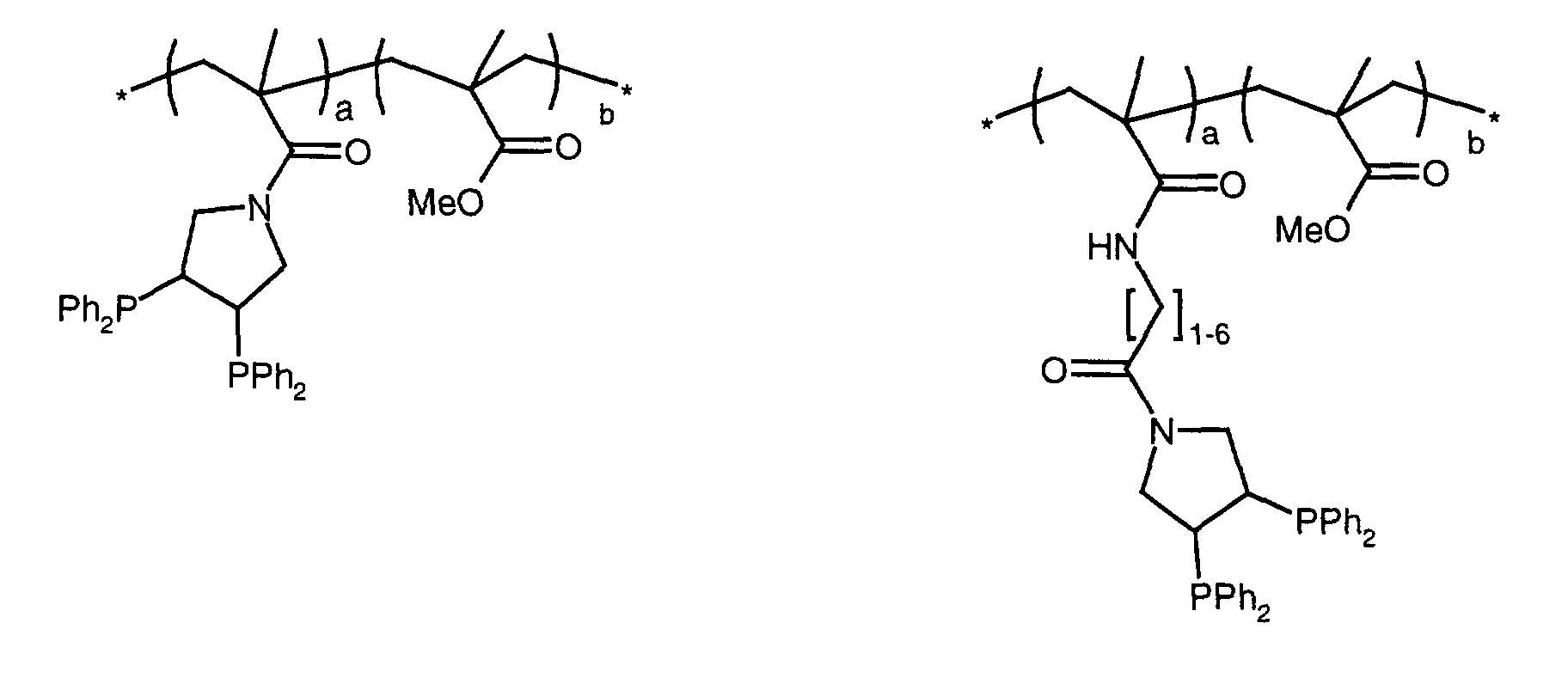
- the active centers are preferably linked via these, as is the case with the general structures 1-3 of the table using the amino function.
- the connection in the positions 5-7 or 5'-7 ' is particularly suitable, the 6 or 6' position being extremely preferred.
- the 4-6 or 4'-6 'position is well suited. The 5 or 6 or 5 'or 6' position is particularly good to select.
- the ligands according to the invention are preferred for the preparation of enantiomerically enriched organic compounds used. Their use is very particularly preferred in a membrane reactor. This can usually Syntheses carried out in a batch process quasi-continuously or be done continuously, from a cost perspective particularly advantageous for a technical process appears.
- the application of the ligands according to the invention or catalysts produced therefrom in the membrane reactor runs analogously to that described in the prior art Methods (DE 199 10 691.6; Wandrey et al., Tetrahedron Asymmetry 1999, 10, 923-928).
- the continuous mode of operation can be carried out as desired in the cross-flow filtration mode (FIG. 2) or as dead-end filtration (FIG. 1).
- dead-end operation the catalyst and solvent are placed in the reactor and then the dissolved substrate is metered in, a hydrogen source having to be present at the same time.
- the substrate is reduced enantioselectively via the catalyst and then discharged from the membrane reactor with the solvent stream via the ultrafiltration membrane.
- the reaction solution including the solvent, substrate, product and catalyst, and hydrogen source, is guided past a membrane above which there is a pressure potential.
- the hydrogen source for the hydrogenation according to the invention can be gaseous hydrogen which is introduced into the system during the reaction.
- the entire apparatus is preferably in a hydrogen atmosphere at hydrogenation pressure, so that the same hydrogen pressure prevails on both sides of the filtration membrane and so hydrogen cannot diffuse out of the system through the membrane.
- the pressure conditions across the membrane can be adapted more easily to the reaction as mentioned above. A high pressure difference before and after the membrane would lead to outgassing on the filtrate side, which could lead to equipment difficulties. In addition, increased hydrogen passage through the membrane could accelerate fouling.
- This method is preferably carried out at pressures of 0.1-20, preferably 0.2-0.5 MPa of hydrogen.
- the invention also relates to a molecular weight-increased catalyst which consists of a ligand according to the invention and metals or metal ions selected from the group Ru, Rh, Ir, Pd, Ni, Pt, Co is constructed.
- a (C 6 -C 18 ) aryl radical is understood to mean an aromatic radical having 6 to 18 carbon atoms.
- these include compounds such as phenyl, naphthyl, anthryl, phenanthryl, biphenyl radicals. These can be substituted one or more times with (C 1 -C 8 ) alkoxy, (C 1 -C 8 ) haloalkyl, OH, C1, NH 2 , NO 2 .
- the rest can have one or more heteroatoms such as N, O, S.
- (C 1 -C 8 ) alkoxy is a (C 1 -C 8 ) alkyl radical bonded to the molecule under consideration via an oxygen atom.
- (C 1 -C 8 ) haloalkyl is a (C 1 -C 8 ) alkyl radical substituted by one or more halogen atoms. Chlorine and fluorine are particularly suitable as halogen atoms.
- a (C 7 -C 19 ) aralkyl radical is a (C 6 -C 18 ) aryl radical bonded to the molecule via a (C 1 -C 8 ) alkyl radical.
- acrylate is also used in the context of the invention understood the term methacrylate.
- any under membrane reactor Understanding reaction vessel in which the catalyst in one Reactor is enclosed, while low molecular weight Substances can be fed to the reactor or leave it.
- the membrane can be integrated directly into the reaction space be or outside in a separate filtration module be installed in which the reaction solution is continuous or intermittently through the filtration module flows and the retentate is returned to the reactor.
- Suitable embodiments include in WO98 / 22415 and in Wandrey et al. in 1998 yearbook, process engineering and Chemical engineering, VDI p. 151ff .; Wandrey et al. in Applied Homogeneous Catalysis with Organometallic Compounds, Vol. 2, VCH 1996, p.832 ff .; Kragl et al., Angew. Chem. 1996, 6, 684f. described.
- the chemical structures shown refer to all possible stereoisomers, by changing the Configuration of the individual chiral centers, axes or Levels can be reached, i.e. all possible diastereomers, as well as all optical isomers (enantiomers) included.
- the substrate 1 shows a membrane reactor with dead-end filtration.
- the substrate 1 is fed into the reactor space 3 via a pump 2 transferred, which has a membrane 5.
- a pump 2 transferred, which has a membrane 5.
- the stirrer-powered Reactor room are next to the solvent of the Catalyst 4, the product 6 and unreacted substrate 1.
- About the membrane 5 is mainly low molecular weight 6 filtered off.
- Fig. 2 shows a membrane reactor with cross-flow filtration.
- the substrate 7 is here in via the pump 8 transferred the stirred reactor space, in which also solvents, Catalyst 9 and product 14 is located.
- about the pump 16 is set to a solvent flow which via a possibly existing heat exchanger 12 into the cros flow filtration cell 15 leads.
- the low molecular weight Product 14 separated over the membrane 13.
- High molecular weight Catalyst 9 is then with the solvent flow if necessary again via a heat exchanger 12 if necessary With the help of the valve 11 passed back into the reactor 10.
- MMA-PYRPHOS (3,4-bis- (diphenylphosphino) -N-isobutenone-pyrrolidine):
Landscapes
- Chemical & Material Sciences (AREA)
- Organic Chemistry (AREA)
- Inorganic Chemistry (AREA)
- Chemical Kinetics & Catalysis (AREA)
- Engineering & Computer Science (AREA)
- Materials Engineering (AREA)
- Medicinal Chemistry (AREA)
- Health & Medical Sciences (AREA)
- General Chemical & Material Sciences (AREA)
- Polymers & Plastics (AREA)
- Addition Polymer Or Copolymer, Post-Treatments, Or Chemical Modifications (AREA)
- Catalysts (AREA)
- Pyrrole Compounds (AREA)
- Indole Compounds (AREA)
- Other Resins Obtained By Reactions Not Involving Carbon-To-Carbon Unsaturated Bonds (AREA)
- Heterocyclic Carbon Compounds Containing A Hetero Ring Having Nitrogen And Oxygen As The Only Ring Hetero Atoms (AREA)
- Plural Heterocyclic Compounds (AREA)
Abstract
Description

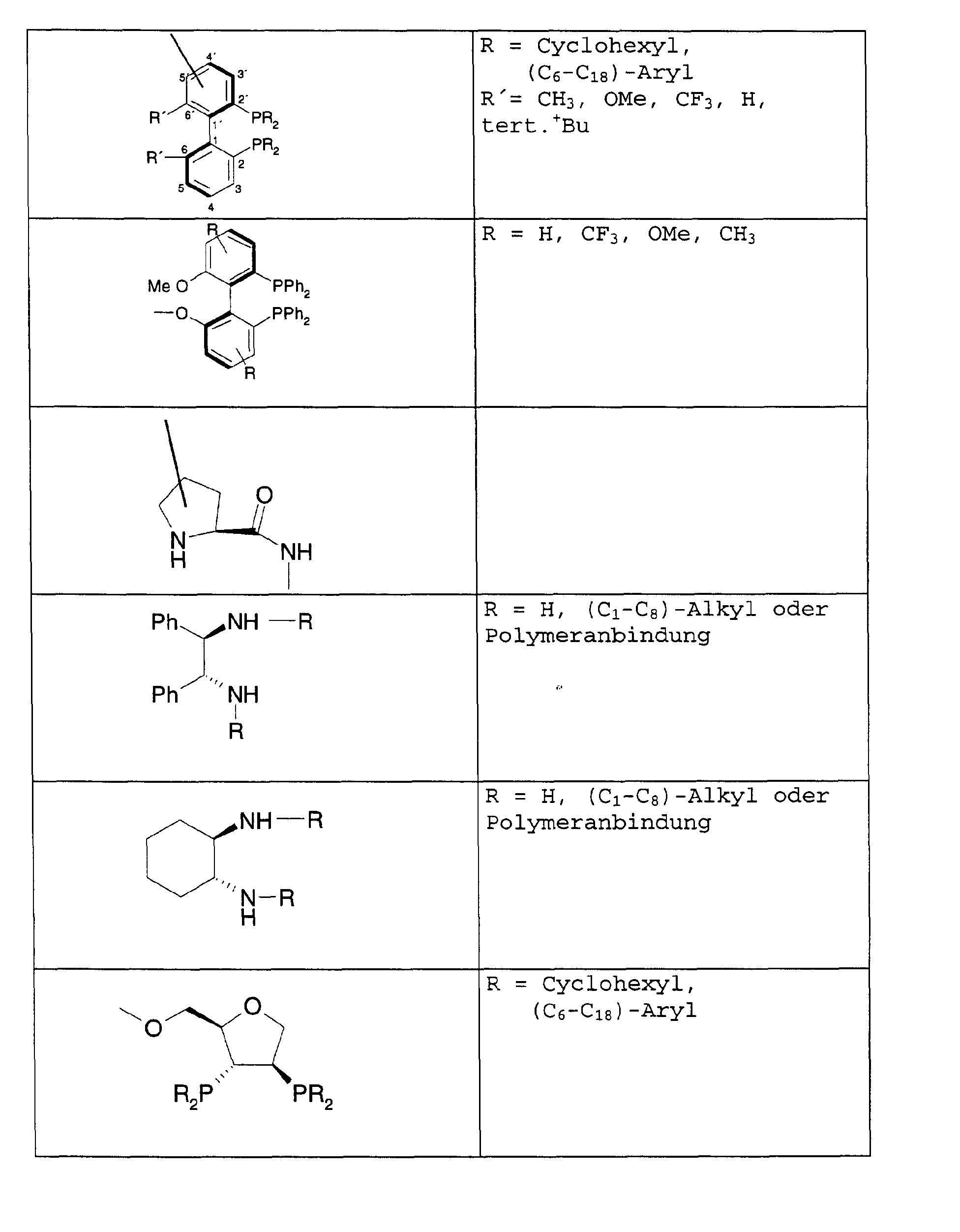

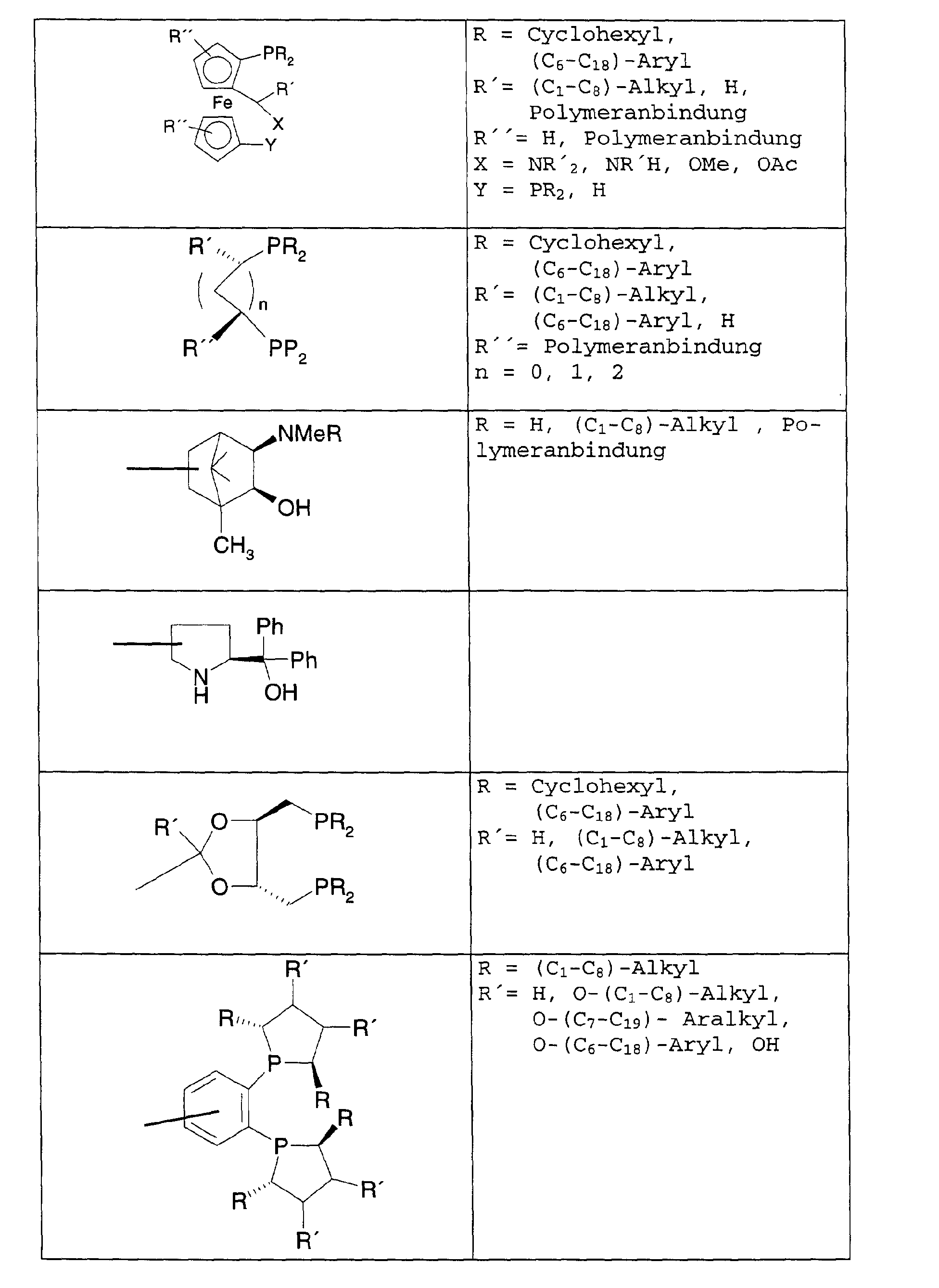
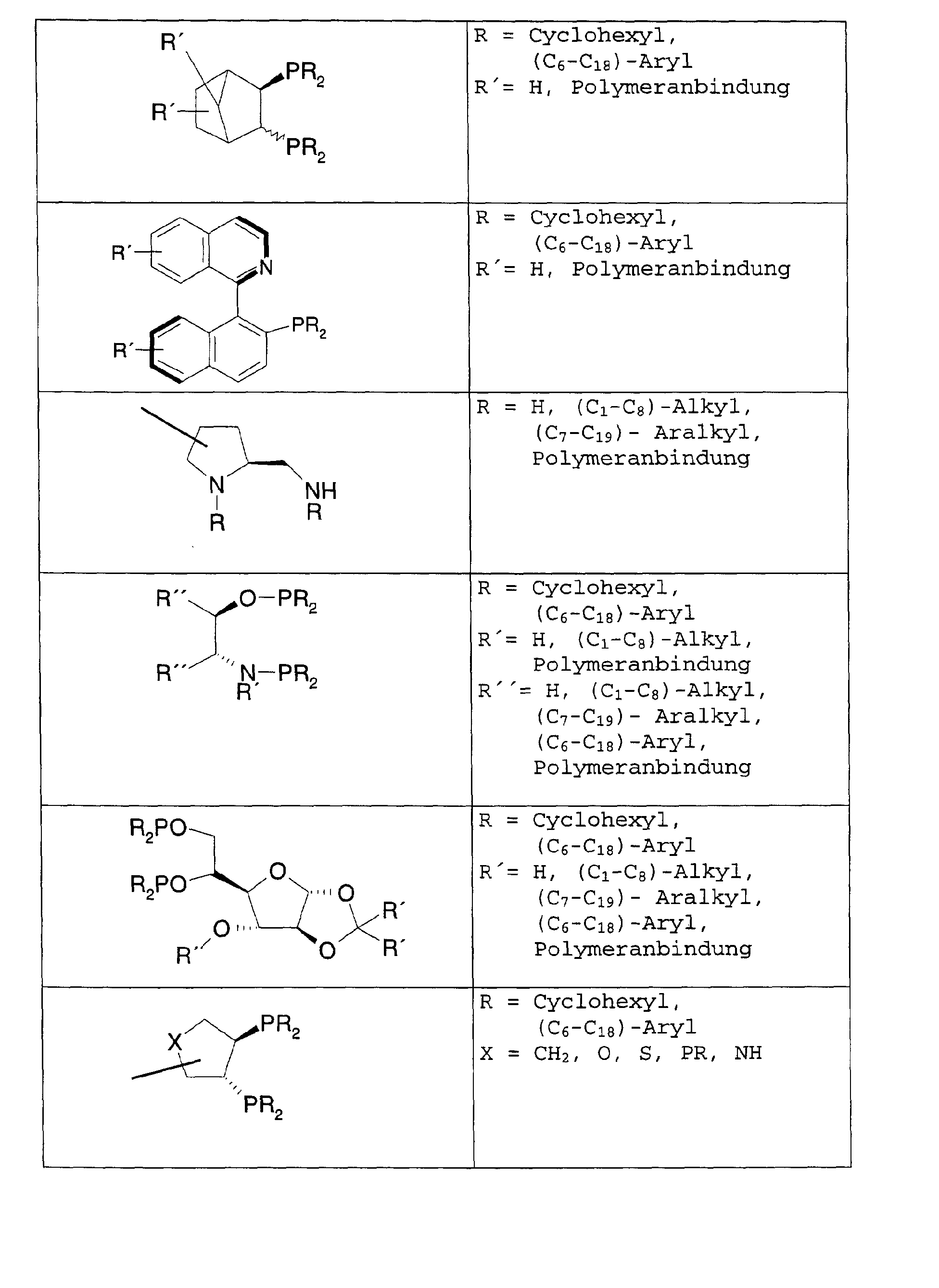

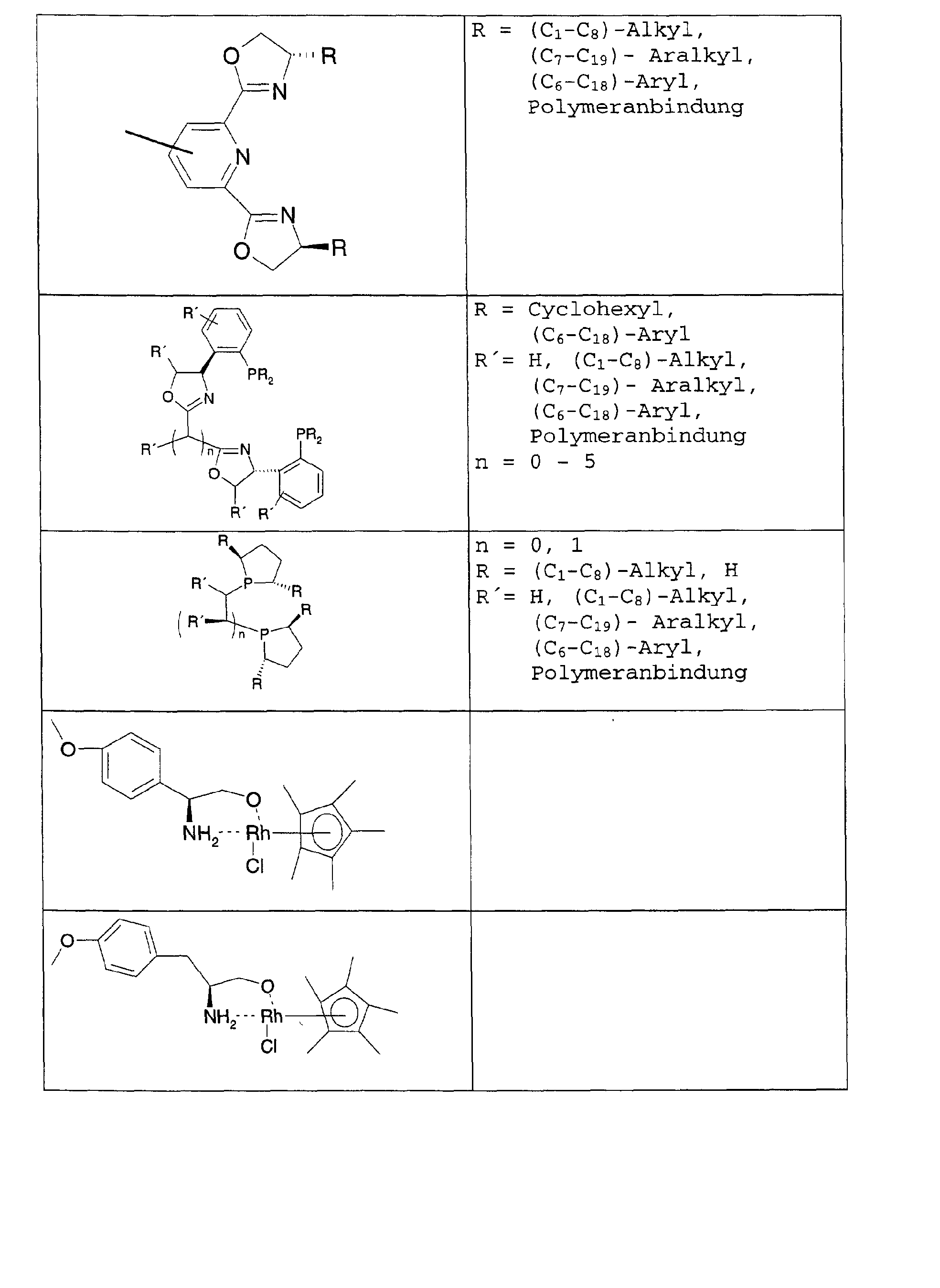


wobei diese aktiven Zentren über einen Linker ausgewählt aus der Gruppe
| a) | - Si (R2) - | |
| b) | - (SiR2-O)n- | n=1-10000 |
| c) | - (CHR-CHR-O)n- | n=1-10000 |
| d) | - (X)n- | n=1-20 |
| e) | Z- (x)n- | n=0-20 |
| f) | - (X)n-W | n=0-20 |
| g) | Z- (X)n-W | n=0-20 |

Der Linker dient dazu, einen Abstand zwischen aktivem Zentrum und Polymer aufzubauen, um gegenseitige für die Reaktion nachteilige Wechselwirkungen abzumildern bzw. auszuschalten.
Im Rahmen der Erfindung sind diese eigentlich aktiven Hydrierkatalysatoren also direkt oder bevorzugt über einen Linker ausgewählt aus der oben angegebenen Gruppe an die Polymervergrößerung gebunden.
Weitere bevorzugte Linker sind in folgendem Schema dargestellt:
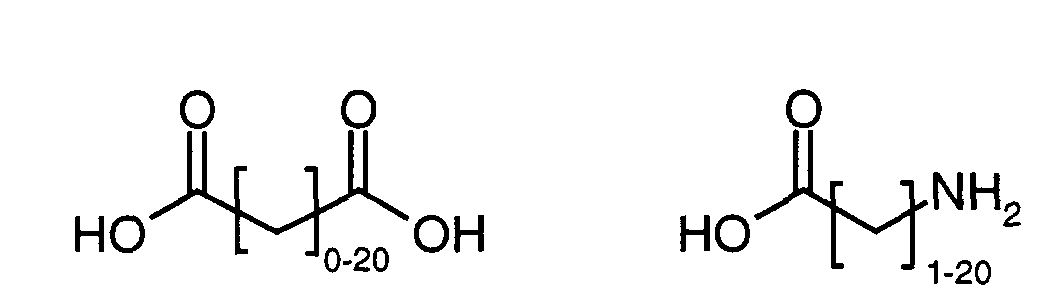




Geeignete derart modifizierte Polysiloxane sind in der Literatur bekannt ("Siloxane polymers and copolymers" White et al., in Ed. S. Patai "The Chemistry of Organic Silicon Compounds" Wiley, Chichester, 1989, 46, 2954; C. Wandrey et al. TH:Asymmetry 1997, 8, 1975).
Bei der allg. Struktur 4 der Tabelle ist die Anknüpfung in den Positionen 5-7 oder 5'-7' besonders geeignet, äußerst bevorzugt ist die 6 bzw. 6'-Position.
Bei der allg. Struktur 5 der Tabelle ist die 4-6 bzw. 4'-6'-Position gut geeignet. Besonders gut ist die 5 oder 6 oder 5' oder 6'-Position auszuwählen.
Im Dead-End-Betrieb wird Katalysator und Lösungsmittel im Reaktor vorgelegt und anschließend das gelöste Substrat zudosiert, wobei gleichzeitig eine Wasserstoffquelle anwesend sein muß. Das Substrat wird über den Katalysator enantioselektiv reduziert und anschließend über die Ultrafiltrationsmembran mit dem Lösungsmittelstrom aus dem Membranreaktor ausgetragen.
In der Cross-Flow-Fahrweise wird die Reaktionslösung, beinhaltend Lösungsmittel Substrat, Produkt und Katalysator sowie Wasserstoffquelle, an einer Membran, über der ein Druckpotential liegt, vorbeigeführt.
Für beide Fälle erfolgt das Zudosieren des gelösten Substrats in einer solchen Geschwindigkeit, und das Druckpotential über die jeweilige Membran wird so eingestellt, daß die ausgeschleuste Lösung überwiegend enantioselektiv hydriertes Produkt enthält. Beide Verfahrensvarianten sind im Stand der Technik beschrieben (Engineering processes for Bioseparations Ed.: L. R. Weatherley, Butterworth-Heinemann, 1994, S. 135-165).
Zusätzlich können so leichter die Druckverhältnisse über die Membran der Reaktion wie oben angesprochen angepaßt werden. Ein hoher Druckunterschied vor und nach der Membran würde zu Ausgasungen auf der Filtratseite führen, die apparative Schwierigkeiten zur Folge haben könnte. Außerdem könnte ein erhöhter Wasserstoffdurchtritt durch die Membran ein Fouling beschleunigen.
Vorzugsweise arbeitet man bei dieser Methode bei Drücken von 0,1 - 20, vorzugsweise 0,2 - 0,5 MPa Wasserstoff.
Als bevorzugte wasserstofferzeugende Substrate werden dabei Alkohole, Formiate, Cyclohexen oder Cyclohexadien, ganz besonders bevorzugt Ameisensäure in Gegenwart einer Base, wie z.B. Triethylamin, eingesetzt.
Ru, Rh, Ir, Pd, Ni, Pt, Co
aufgebaut ist.
(C12H25(OCH2CH2)32OH) bzw. 5,24g (1;1 mmol) Synperonic PE/P 103 (HO(CH2CH2O)17(CH(CH3)CH2O)56(CH2CH2O)17H) in 10ml Dichlormethan werden langsam zu 90ml einer auf -40°C gekühlten Lösung von Phosgen (1,7662 mmol/ml) getropft und innerhalb 5h auf 0°C gebracht. Das überschüssige Phosgen wird unter entsprechenden Vosichtsmassnahmen durch Einengen der Lösung auf etwa 3ml entfernt und der verbleibende Rückstand direkt weiter verwendet.
| Medium | Rh:I:Substrat | t ½ (min) | % eeS | Umsatz % |
| H2O | 1:1:100 | ~ 10 h | 88 | 98 (Rho↓) |
| Rh:II:Substrat | ||||
| H2O | 2:1:100 | ~ 12 h | 80 | 94 (Rho↓) |
| H2O | 1:0,5:100 | - 11 h | 83 | 96 (Rho↓) |
| Methanol | 1:0,5:100 | 248 min | 88 | 100 |
| H2O+(Rh:SDS=1:2) | 1:0,5:100 | ~ 9 h | 79 | 97 |
Claims (11)
- Molekulargewichtsvergrößerte homogen lösliche Liganden für Hydrierkatalysatoren aufweisend homochirale aktive Zentren ausgewählt aus der Gruppe


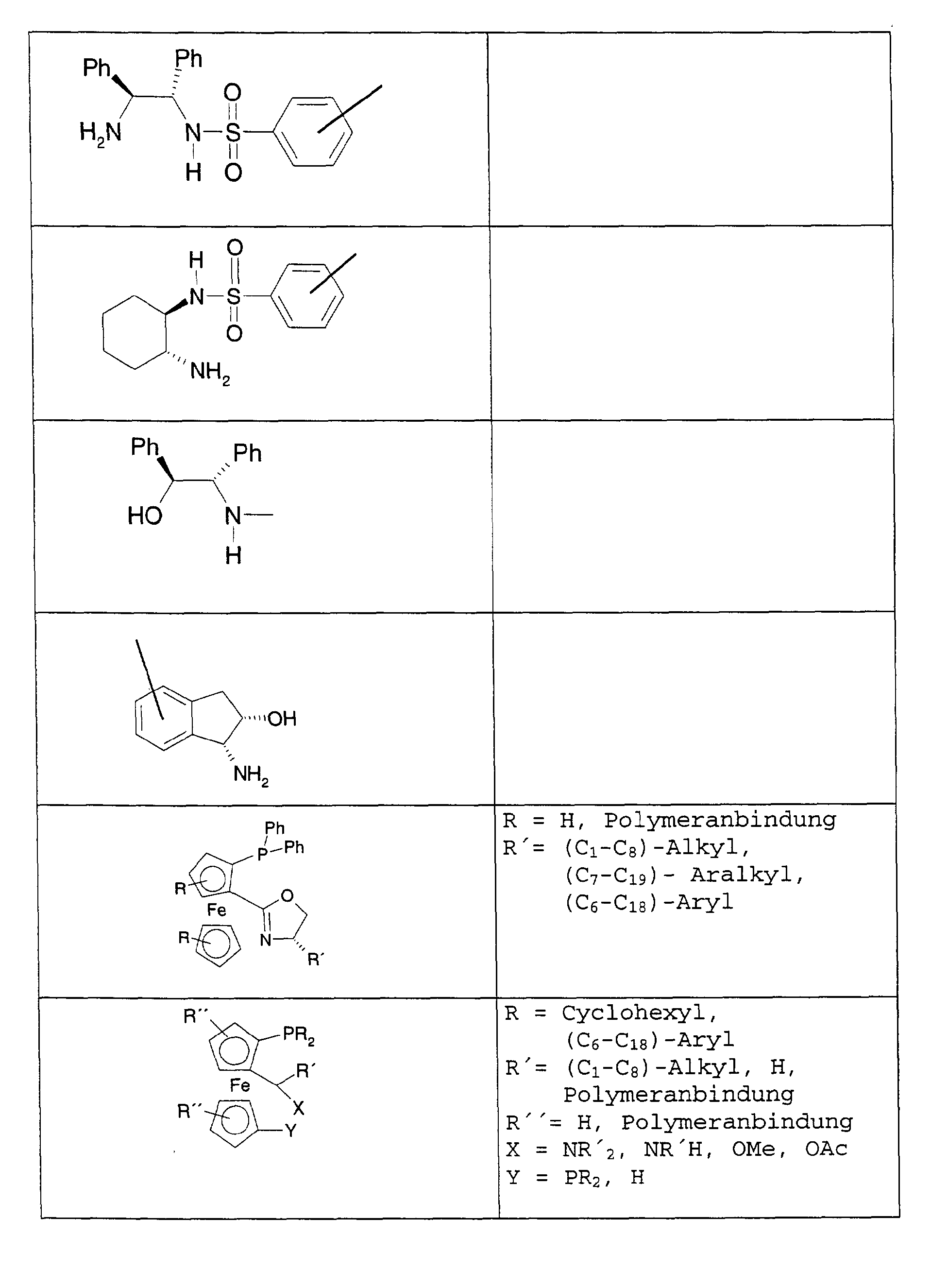
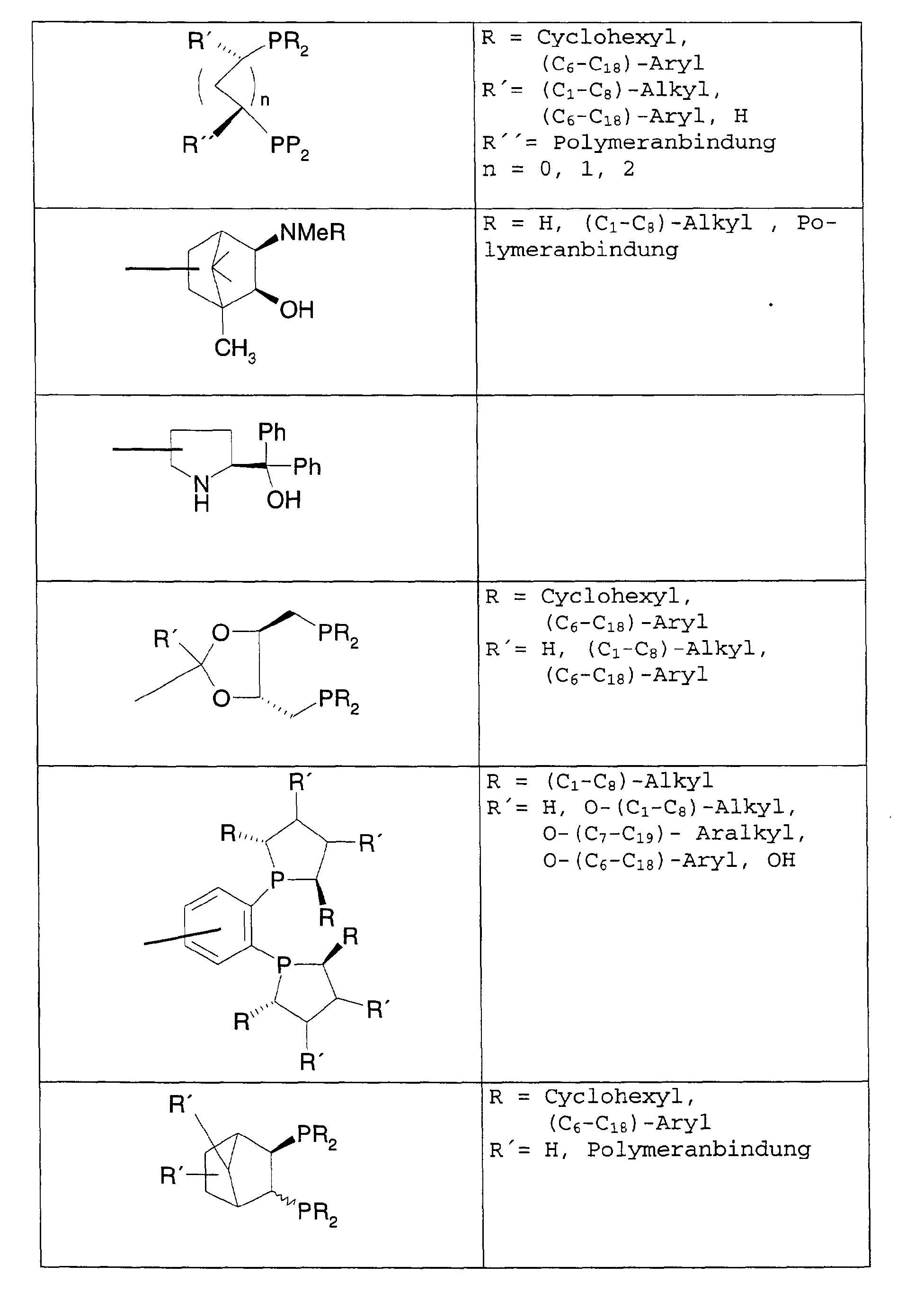

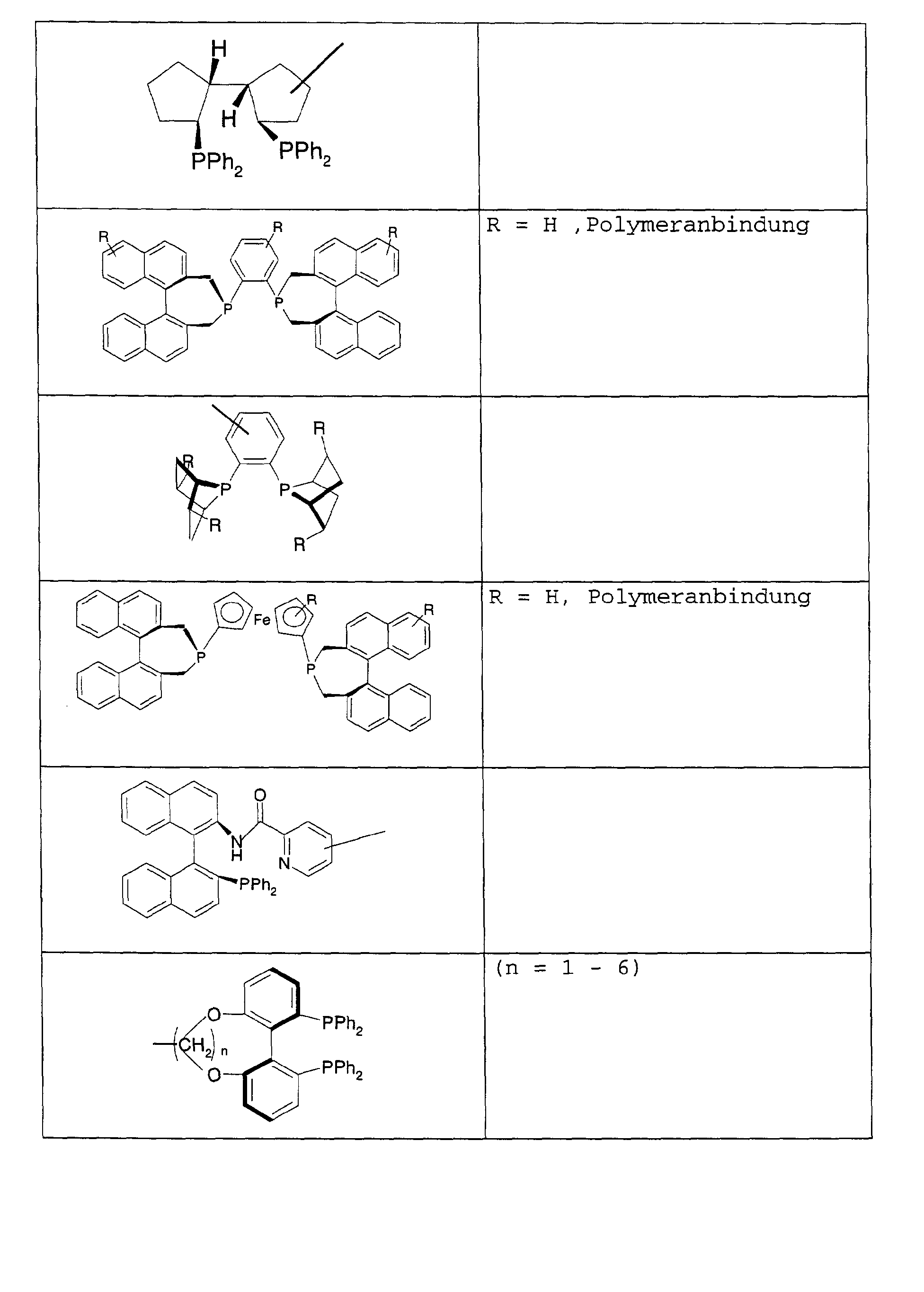
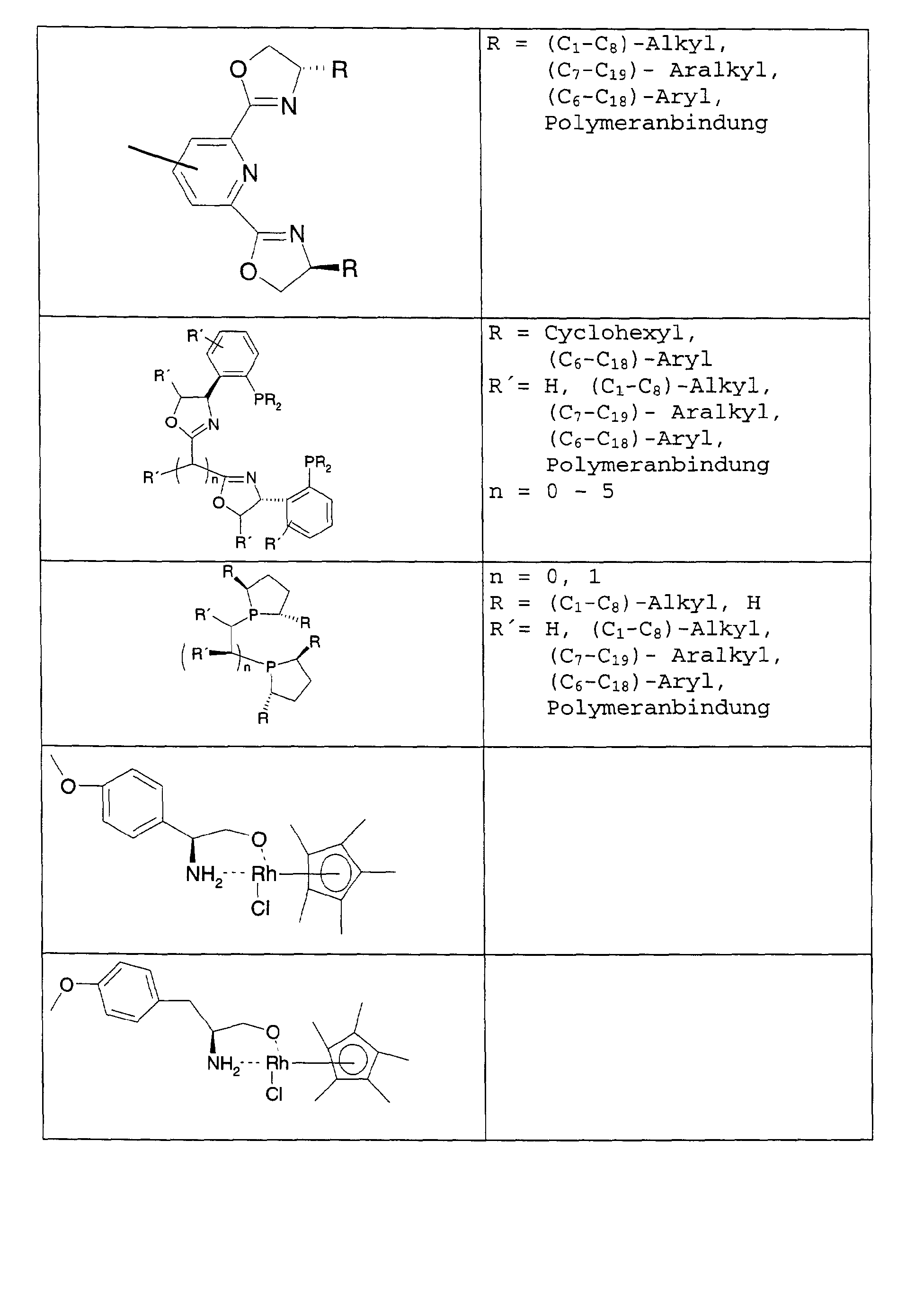

 wobei diese Zentren über einen Linker ausgewählt aus der Gruppe
a) - Si(R2)- b) - (SiR2-O)n- n=1-10000 c) - (CHR-CHR-O)n- n=1-10000 d) - (X)n- n=1-20 e) Z- (X)n- n=0-20 f) - (X)n-W n=0-20 g) Z- (X)n-W n=0-20 R bedeutet H, (C1-C8)-Alkyl, (C6-C18)-Aryl , (C7-C19)-Aralkyl, ((C1-C8)-Alkyl)1-3-(C6-C18)-Aryl,X bedeutet (C6-C18)-Arylen, (C1-C8)-Alkylen, (C1-C8)-Alkenylen, ((C1-C8)-Alkyl)1-3-(C6-C18) -Arylen, (C7-C19)-Aralkylen,Z bedeutet polymerseitig C(=O)O-, C(=O)NH-, C(=O)-, NR, O, CHR, CH2, C=S, S, PR,W bedeutet ligandenseitig C(=O)O-, C(=O)NH-, C(=O)-, NR, O, CHR, CH2, C=S, S, PR,oder direkt an das molekulargewichtsvergrößernde Polymer gebunden sind und das Molekulargewicht des polymeren Liganden > 1000 g/mol beträgt. - Ligand nach Anspruch 1,
dadurch gekennzeichnet, daß
die Molekulargewichtsvergrößerung durch Polyacrylate, Polyvinylpyrrolidinone, Polysiloxane, Polybutadiene, Polyisoprene, Polyalkane, Polystyrole, Polyoxazoline oder Polyether oder Mischungen derselben gebildet wird. - Ligand nach Anspruch 1 und/oder 2,
dadurch gekennzeichnet, daß
die Molekulargewichtsvergrößerung durch Polysiloxane, Polystyrole oder Polyacrylate gebildet wird. - Ligand nach einem oder mehreren der Ansprüche 1 bis 3,
dadurch gekennzeichnet, daß
dessen mittleres Molekulargewicht im Bereich von 1.000 - 1.000.000, vorzugsweise 5.000 - 300.000 g/mol liegt. - Ligand nach einem oder mehreren der vorhergehenden Ansprüche,
dadurch gekennzeichnet, daß
man als aktives Zentrum ein Bis-(3,4-diarylphosphinyl)-pyrrolidin einsetzt. - Verfahren zur Herstellung von Liganden nach Anspruch 1,
dadurch gekennzeichnet, daß mana) das katalytisch aktive Zentrum mit angebundenem Linker oder direkt an ein Monomer bindet und dieses in Gegenwart nicht modifizierter Monomere polymerisiert,b) das katalytisch aktive Zentrum über einen Linker oder direkt an das fertige Polymer bindet, oderc) Polymere nach a) oder b) erstellt und diese mit anderen Polymeren copolymerisiert, welche katalytisch aktive Zentren aufweisen können. - Verwendung der Liganden nach Anspruch 1 zur Herstellung von enantiomer angereicherten organischen Verbindungen.
- Verwendung nach Anspruch 7,
dadurch gekennzeichnet, daß
man in einem Membranreaktor arbeitet. - Verwendung nach Anspruch 7 und/oder 8,
dadurch gekennzeichnet, daß
man C=C-, C=N- oder C=O-Doppelbindungen hydriert. - Verwendung nach einem oder mehreren der Ansprüche 7 bis 9,
dadurch gekennzeichnet, daß
man mittels Transferhydrierung hydriert. - Molekulargewichtsvergrößerter Katalysator
dadurch gekennzeichnet, daß
er aus einem Liganden der Ansprüche 1-5 und Metallen oder Metallionen ausgewählt aus der Gruppe Ru, Rh, Ir, Pd, Ni, Pt, Co
aufgebaut ist.
Applications Claiming Priority (2)
| Application Number | Priority Date | Filing Date | Title |
|---|---|---|---|
| DE10002976 | 2000-01-24 | ||
| DE10002976A DE10002976A1 (de) | 2000-01-24 | 2000-01-24 | Molekulargewichtsvergrößerte Liganden für asymmetrische homogen lösliche Hydrierkatalysatoren, Verfahren zu deren Herstellung und Verwendung |
Publications (1)
| Publication Number | Publication Date |
|---|---|
| EP1120161A1 true EP1120161A1 (de) | 2001-08-01 |
Family
ID=7628589
Family Applications (1)
| Application Number | Title | Priority Date | Filing Date |
|---|---|---|---|
| EP00127626A Withdrawn EP1120161A1 (de) | 2000-01-24 | 2000-12-16 | Molekulargewichtsgrösserte Liganden für asymetrische homogenlösliche Hydrierkatalysatoren, Verfahren zu deren Herstellung und Verwendung |
Country Status (5)
| Country | Link |
|---|---|
| US (1) | US6617480B2 (de) |
| EP (1) | EP1120161A1 (de) |
| JP (1) | JP2001288218A (de) |
| CA (1) | CA2331993A1 (de) |
| DE (1) | DE10002976A1 (de) |
Families Citing this family (6)
| Publication number | Priority date | Publication date | Assignee | Title |
|---|---|---|---|---|
| DE10002975A1 (de) * | 2000-01-24 | 2001-07-26 | Degussa | Verwendung von molekulargewichtsvergrößerten Katalysatoren in einem Verfahren zur asymmetrischen kontinuierlichen Hydrierung, neue molekulargewichtsvergrößerte Liganden und Katalysatoren |
| US20050101813A1 (en) * | 2003-09-08 | 2005-05-12 | Degussa Ag, | Molecular weight-enlarged ligands for asymmetric, homogeneously soluble hydrogenation catalysts, process for the production thereof and use |
| JP4517155B2 (ja) * | 2006-07-10 | 2010-08-04 | 国立大学法人 千葉大学 | ビスイミダゾリン配位子及びそれを用いた触媒 |
| CN102513157B (zh) * | 2011-12-23 | 2013-06-05 | 渤海大学 | 一种基于双吡啶双酰胺有机配体和Keggin型多酸的铜配合物及其合成方法和应用 |
| CN104028305B (zh) * | 2014-06-19 | 2016-02-10 | 渤海大学 | 基于丁基吡唑铜配合物修饰的Keggin型晶态材料、制备方法及其在光催化材料方面的应用 |
| CN104310524B (zh) * | 2014-09-30 | 2016-03-30 | 渤海大学 | 一种罗丹明b和靛蓝有机污染物的降解方法 |
Citations (13)
| Publication number | Priority date | Publication date | Assignee | Title |
|---|---|---|---|---|
| US4424312A (en) * | 1981-03-16 | 1984-01-03 | Polymer Sciences Corporation | Preparation of amino acids in high optical yield via catalytic hydrogenation |
| US4605750A (en) * | 1983-09-16 | 1986-08-12 | Takasago Perfumery Co., Ltd. | Rhodium-phosphine complex |
| US4634775A (en) * | 1984-01-31 | 1987-01-06 | Degussa Aktiengesellschaft | Optically active 3,4-bis-(diphenylphosphino)-pyrrolidine, and rhodium complexes, containing it as chiral ligands |
| US4695631A (en) * | 1981-06-30 | 1987-09-22 | Takasago Perfumery Co., Ltd. | Process for the preparation of enamines or imines |
| FR2634209A1 (fr) * | 1988-07-13 | 1990-01-19 | Toulouse Inst Nat Polytech | Nouveau compose organometallique supporte, procede de preparation, et application comme catalyseur d'hydroformylation |
| EP0592881A2 (de) * | 1992-10-05 | 1994-04-20 | Takasago International Corporation | Verfahren zur Herstellung von optisch aktiven gamma-Hydroxyketonen |
| EP0729969A1 (de) * | 1995-02-24 | 1996-09-04 | Ciba-Geigy Ag | Silylierte Ferrocenyldiphosphine, an anorganische oder polymere organische Träger gebundene silylierte Ferrocenyldiphosphine sowie Metallkomplexe davon, ihre Herstellung und Verwendung |
| WO1998012202A1 (en) * | 1996-09-20 | 1998-03-26 | Oxford Asymmetry International Plc. | Phosphine ligands |
| DE19647892A1 (de) * | 1996-11-20 | 1998-06-04 | Forschungszentrum Juelich Gmbh | Verfahren zur katalytischen, enantioselektiven Reduktion von Ketonen |
| US5777062A (en) * | 1996-02-23 | 1998-07-07 | Novartis Corporation | Diphosphines bonded to side chains of polymers, and metal complexes thereof |
| EP0877029A2 (de) * | 1997-03-11 | 1998-11-11 | Takasago International Corporation | Optisch-aktive Phosphin Derivate mit einer Vinylgruppe, davon abgeleitetes Polymer und dessen Übergangsmetallkomplexe |
| WO1999062855A1 (en) * | 1998-05-29 | 1999-12-09 | E.I. Du Pont De Nemours And Company | Hydroformylation of olefins using supported bis(phosphorus) ligands |
| US6087481A (en) * | 1996-08-02 | 2000-07-11 | Studiengesellschaft Kohle Mbh | Olefin hydroformylation process in a two-phase system |
Family Cites Families (8)
| Publication number | Priority date | Publication date | Assignee | Title |
|---|---|---|---|---|
| DE3818435A1 (de) * | 1988-02-19 | 1989-08-31 | Hoechst Ag | Optisch aktive rhodiumkomplexe von 3,4-bis(diarylphosphino)-pyrrolidinen und ihre verwendung zur herstellung von phosphinothricin durch asymmetrische hydrierung |
| DE19730657C2 (de) | 1996-11-20 | 1998-10-08 | Degussa | Verfahren zur Herstellung arylsubstituierter aminoacylierter Phosphohnsäurederivate mit Hilfe von Metallkomplexen chiraler amphiphiler Liganden |
| US5990318A (en) * | 1998-03-06 | 1999-11-23 | The Hong Kong Polytechnic University | Soluble polyester-supported chiral phosphines |
| EP0965574B1 (de) * | 1998-06-19 | 2004-10-13 | Degussa AG | Verfahren zur enantioselektiven Hydrierung |
| EP0967015B1 (de) * | 1998-06-19 | 2005-01-12 | Degussa AG | Verwendung von Ferrocenylliganden zur katalytischen enantioselektiven Hydrierung |
| DE19921924A1 (de) * | 1998-06-19 | 1999-12-23 | Degussa | Verwendung von Ferrocenylliganden zur katalytischen enantioselektiven Hydrierung |
| DE19956374A1 (de) * | 1998-12-19 | 2000-06-21 | Degussa | Verfahren zur enantioselektiven Hydrierung |
| CA2400183A1 (en) * | 2000-02-10 | 2001-08-16 | The Penn State Research Foundation | Chiral ferrocene phosphines and their use in asymmetric catalytic reactions |
-
2000
- 2000-01-24 DE DE10002976A patent/DE10002976A1/de not_active Withdrawn
- 2000-12-16 EP EP00127626A patent/EP1120161A1/de not_active Withdrawn
-
2001
- 2001-01-22 JP JP2001013677A patent/JP2001288218A/ja active Pending
- 2001-01-23 CA CA002331993A patent/CA2331993A1/en not_active Abandoned
- 2001-01-24 US US09/767,684 patent/US6617480B2/en not_active Expired - Fee Related
Patent Citations (13)
| Publication number | Priority date | Publication date | Assignee | Title |
|---|---|---|---|---|
| US4424312A (en) * | 1981-03-16 | 1984-01-03 | Polymer Sciences Corporation | Preparation of amino acids in high optical yield via catalytic hydrogenation |
| US4695631A (en) * | 1981-06-30 | 1987-09-22 | Takasago Perfumery Co., Ltd. | Process for the preparation of enamines or imines |
| US4605750A (en) * | 1983-09-16 | 1986-08-12 | Takasago Perfumery Co., Ltd. | Rhodium-phosphine complex |
| US4634775A (en) * | 1984-01-31 | 1987-01-06 | Degussa Aktiengesellschaft | Optically active 3,4-bis-(diphenylphosphino)-pyrrolidine, and rhodium complexes, containing it as chiral ligands |
| FR2634209A1 (fr) * | 1988-07-13 | 1990-01-19 | Toulouse Inst Nat Polytech | Nouveau compose organometallique supporte, procede de preparation, et application comme catalyseur d'hydroformylation |
| EP0592881A2 (de) * | 1992-10-05 | 1994-04-20 | Takasago International Corporation | Verfahren zur Herstellung von optisch aktiven gamma-Hydroxyketonen |
| EP0729969A1 (de) * | 1995-02-24 | 1996-09-04 | Ciba-Geigy Ag | Silylierte Ferrocenyldiphosphine, an anorganische oder polymere organische Träger gebundene silylierte Ferrocenyldiphosphine sowie Metallkomplexe davon, ihre Herstellung und Verwendung |
| US5777062A (en) * | 1996-02-23 | 1998-07-07 | Novartis Corporation | Diphosphines bonded to side chains of polymers, and metal complexes thereof |
| US6087481A (en) * | 1996-08-02 | 2000-07-11 | Studiengesellschaft Kohle Mbh | Olefin hydroformylation process in a two-phase system |
| WO1998012202A1 (en) * | 1996-09-20 | 1998-03-26 | Oxford Asymmetry International Plc. | Phosphine ligands |
| DE19647892A1 (de) * | 1996-11-20 | 1998-06-04 | Forschungszentrum Juelich Gmbh | Verfahren zur katalytischen, enantioselektiven Reduktion von Ketonen |
| EP0877029A2 (de) * | 1997-03-11 | 1998-11-11 | Takasago International Corporation | Optisch-aktive Phosphin Derivate mit einer Vinylgruppe, davon abgeleitetes Polymer und dessen Übergangsmetallkomplexe |
| WO1999062855A1 (en) * | 1998-05-29 | 1999-12-09 | E.I. Du Pont De Nemours And Company | Hydroformylation of olefins using supported bis(phosphorus) ligands |
Also Published As
| Publication number | Publication date |
|---|---|
| JP2001288218A (ja) | 2001-10-16 |
| CA2331993A1 (en) | 2001-07-24 |
| DE10002976A1 (de) | 2001-07-26 |
| US6617480B2 (en) | 2003-09-09 |
| US20020062004A1 (en) | 2002-05-23 |
Similar Documents
| Publication | Publication Date | Title |
|---|---|---|
| DE69820635T2 (de) | Geträgerte diole | |
| DE102005046250B4 (de) | Anlage zur Abtrennung von organischen Übergangsmetallkomplexkatalysatoren | |
| EP0374615B1 (de) | Verfahren zur Abtrennung von metallorganischen Verbindungen und/oder Metallcarbonylen aus ihren Lösungen in organischen Medien | |
| DE10309356A1 (de) | Bisphosphine als bidentate Liganden | |
| EP3750627B1 (de) | Verfahren zur abtrennung von einer oder mehreren komponente(n) aus einem gemisch | |
| DE102009001225A1 (de) | Verfahren zur Anreicherung eines Homogenkatalysators aus einem Prozessstrom | |
| EP1120160B1 (de) | Polymere Diphosphinliganden für homogen lösliche Hydrierkatalysatoren, Verfahren zu deren Herstellung und Verwendung | |
| DE2326489C2 (de) | ||
| DE60033975T2 (de) | Hydroformylierung von ungesättigten Verbindungen unter Verwendung von polymerischen Phosphitliganden | |
| DE10002976A1 (de) | Molekulargewichtsvergrößerte Liganden für asymmetrische homogen lösliche Hydrierkatalysatoren, Verfahren zu deren Herstellung und Verwendung | |
| EP1120162A2 (de) | Verwendung von molekulargewichtsvergrösserten Katalysatoren in einem Verfahren zur Asymmetrischen kontinuerlichen Hydrierung, neue molekulargewichtsvergrösserte Liganden und Katalysatoren | |
| EP0491239B1 (de) | Verfahren zur Herstellung von Aldehyden | |
| AT511852B1 (de) | Olefinmetathese | |
| DE10029597A1 (de) | Verfahren zur Oxidation von Alkoholen mit homogen löslichen polymervergrößerten Stickstoffverbindungen als Katalysator | |
| EP1381462A1 (de) | Polymergebundener katalysator für die enantioselektive aldol- bzw. mannich-reaktion | |
| EP0352478A2 (de) | Verfahren zur Trennung von in wässriger oder wässrig/organischer Lösung enthaltenen Substanzgemischen | |
| DE10036328B4 (de) | Polymervergrößerte Liganden, Verfahren zu deren Herstellung und deren Verwendung | |
| DE60020775T2 (de) | Stereospezifische Isomerierung von Allylaminen unter Verwendung von immobiliserten chiralen Phospho-Liganden | |
| DE69912097T2 (de) | Verwendung komprimierten kohlendioxids in chemischen reaktionen | |
| DE10029601A1 (de) | Polymervergrößerte Katalysatoren, Verfahren zur Herstellung und Verwendung | |
| DE69718878T2 (de) | Ruthenium-optisch-aktiver Phosphin-Komplex, Verfahren zur Herstellung und Verfahren zur Herstellung von optisch-aktiven 4-Methyl-2-Oxetanon unter Verwendung derselben | |
| DE69602947T2 (de) | Anwendung von dendrimeren makromolekülen als katalysatoren oder verarbeitungshilfstoffe für phasenübertragungsreaktionen | |
| EP1381583A1 (de) | Polymergebundener katalysator zur enantioselektiven öffnung von prochiralen anhydriden | |
| DE10208592A1 (de) | Polymergebundener Katalysator zur enantioselektiven Öffnung von prochiralen Anhydriden | |
| DE10003110A1 (de) | Polymervergrößerte Katalysatoren |
Legal Events
| Date | Code | Title | Description |
|---|---|---|---|
| PUAI | Public reference made under article 153(3) epc to a published international application that has entered the european phase |
Free format text: ORIGINAL CODE: 0009012 |
|
| 17P | Request for examination filed |
Effective date: 20001216 |
|
| AK | Designated contracting states |
Kind code of ref document: A1 Designated state(s): AT BE CH CY DE DK ES FI FR GB GR IE IT LI LU MC NL PT SE TR |
|
| AX | Request for extension of the european patent |
Free format text: AL;LT;LV;MK;RO;SI |
|
| AKX | Designation fees paid |
Free format text: AT BE CH CY DE DK ES FI FR GB GR IE IT LI LU MC NL PT SE TR |
|
| 17Q | First examination report despatched |
Effective date: 20020826 |
|
| STAA | Information on the status of an ep patent application or granted ep patent |
Free format text: STATUS: THE APPLICATION IS DEEMED TO BE WITHDRAWN |
|
| 18D | Application deemed to be withdrawn |
Effective date: 20030702 |