EP1111384B1 - Verfahren zur Vorbeugung der Hemoglobin A1c-Erzeugung in trockenem Blut und Bluttestvorrichtung - Google Patents
Verfahren zur Vorbeugung der Hemoglobin A1c-Erzeugung in trockenem Blut und Bluttestvorrichtung Download PDFInfo
- Publication number
- EP1111384B1 EP1111384B1 EP99940568A EP99940568A EP1111384B1 EP 1111384 B1 EP1111384 B1 EP 1111384B1 EP 99940568 A EP99940568 A EP 99940568A EP 99940568 A EP99940568 A EP 99940568A EP 1111384 B1 EP1111384 B1 EP 1111384B1
- Authority
- EP
- European Patent Office
- Prior art keywords
- blood
- test tool
- blood test
- carboxylic acid
- porous material
- Prior art date
- Legal status (The legal status is an assumption and is not a legal conclusion. Google has not performed a legal analysis and makes no representation as to the accuracy of the status listed.)
- Expired - Lifetime
Links
- 210000004369 blood Anatomy 0.000 title claims description 185
- 239000008280 blood Substances 0.000 title claims description 185
- 238000009534 blood test Methods 0.000 title claims description 109
- 238000000034 method Methods 0.000 title claims description 24
- 230000015572 biosynthetic process Effects 0.000 title claims description 5
- 102000001554 Hemoglobins Human genes 0.000 title description 5
- 108010054147 Hemoglobins Proteins 0.000 title description 5
- KRKNYBCHXYNGOX-UHFFFAOYSA-N citric acid Chemical compound OC(=O)CC(O)(C(O)=O)CC(O)=O KRKNYBCHXYNGOX-UHFFFAOYSA-N 0.000 claims description 54
- 239000011148 porous material Substances 0.000 claims description 52
- 238000009792 diffusion process Methods 0.000 claims description 35
- 150000001732 carboxylic acid derivatives Chemical class 0.000 claims description 32
- 239000003146 anticoagulant agent Substances 0.000 claims description 14
- 229940127219 anticoagulant drug Drugs 0.000 claims description 14
- 239000003963 antioxidant agent Substances 0.000 claims description 14
- RWSXRVCMGQZWBV-WDSKDSINSA-N glutathione Chemical compound OC(=O)[C@@H](N)CCC(=O)N[C@@H](CS)C(=O)NCC(O)=O RWSXRVCMGQZWBV-WDSKDSINSA-N 0.000 claims description 14
- 230000003078 antioxidant effect Effects 0.000 claims description 13
- MUBZPKHOEPUJKR-UHFFFAOYSA-N Oxalic acid Chemical compound OC(=O)C(O)=O MUBZPKHOEPUJKR-UHFFFAOYSA-N 0.000 claims description 11
- 229930006000 Sucrose Natural products 0.000 claims description 11
- 239000005720 sucrose Substances 0.000 claims description 11
- QTBSBXVTEAMEQO-UHFFFAOYSA-N Acetic acid Chemical compound CC(O)=O QTBSBXVTEAMEQO-UHFFFAOYSA-N 0.000 claims description 9
- KCXVZYZYPLLWCC-UHFFFAOYSA-N EDTA Chemical compound OC(=O)CN(CC(O)=O)CCN(CC(O)=O)CC(O)=O KCXVZYZYPLLWCC-UHFFFAOYSA-N 0.000 claims description 9
- 239000000463 material Substances 0.000 claims description 9
- HTTJABKRGRZYRN-UHFFFAOYSA-N Heparin Chemical compound OC1C(NC(=O)C)C(O)OC(COS(O)(=O)=O)C1OC1C(OS(O)(=O)=O)C(O)C(OC2C(C(OS(O)(=O)=O)C(OC3C(C(O)C(O)C(O3)C(O)=O)OS(O)(=O)=O)C(CO)O2)NS(O)(=O)=O)C(C(O)=O)O1 HTTJABKRGRZYRN-UHFFFAOYSA-N 0.000 claims description 7
- 229960002897 heparin Drugs 0.000 claims description 7
- 229920000669 heparin Polymers 0.000 claims description 7
- 230000002209 hydrophobic effect Effects 0.000 claims description 7
- LCTONWCANYUPML-UHFFFAOYSA-N Pyruvic acid Chemical compound CC(=O)C(O)=O LCTONWCANYUPML-UHFFFAOYSA-N 0.000 claims description 6
- 229960003180 glutathione Drugs 0.000 claims description 6
- 108010024636 Glutathione Proteins 0.000 claims description 5
- 125000000185 sucrose group Chemical group 0.000 claims description 4
- 235000006408 oxalic acid Nutrition 0.000 claims description 3
- 229940107700 pyruvic acid Drugs 0.000 claims description 3
- GVJHHUAWPYXKBD-IEOSBIPESA-N α-tocopherol Chemical compound OC1=C(C)C(C)=C2O[C@@](CCC[C@H](C)CCC[C@H](C)CCCC(C)C)(C)CCC2=C1C GVJHHUAWPYXKBD-IEOSBIPESA-N 0.000 claims description 2
- 239000007788 liquid Substances 0.000 description 26
- 238000004925 denaturation Methods 0.000 description 21
- 239000000243 solution Substances 0.000 description 19
- 229920005989 resin Polymers 0.000 description 17
- 239000011347 resin Substances 0.000 description 17
- 238000005259 measurement Methods 0.000 description 12
- 230000036425 denaturation Effects 0.000 description 11
- 238000004519 manufacturing process Methods 0.000 description 9
- 230000000052 comparative effect Effects 0.000 description 8
- CZMRCDWAGMRECN-UGDNZRGBSA-N Sucrose Chemical compound O[C@H]1[C@H](O)[C@@H](CO)O[C@@]1(CO)O[C@@H]1[C@H](O)[C@@H](O)[C@H](O)[C@@H](CO)O1 CZMRCDWAGMRECN-UGDNZRGBSA-N 0.000 description 7
- -1 polyethylene terephthalate Polymers 0.000 description 6
- 238000010828 elution Methods 0.000 description 5
- 150000004682 monohydrates Chemical class 0.000 description 5
- WQZGKKKJIJFFOK-GASJEMHNSA-N Glucose Natural products OC[C@H]1OC(O)[C@H](O)[C@@H](O)[C@@H]1O WQZGKKKJIJFFOK-GASJEMHNSA-N 0.000 description 4
- 239000004793 Polystyrene Substances 0.000 description 4
- 238000007605 air drying Methods 0.000 description 4
- 238000001035 drying Methods 0.000 description 4
- 239000011521 glass Substances 0.000 description 4
- 239000008103 glucose Substances 0.000 description 4
- 239000004033 plastic Substances 0.000 description 4
- 229920003023 plastic Polymers 0.000 description 4
- 229920000139 polyethylene terephthalate Polymers 0.000 description 4
- 239000005020 polyethylene terephthalate Substances 0.000 description 4
- 229920002223 polystyrene Polymers 0.000 description 4
- 238000004080 punching Methods 0.000 description 4
- 239000000853 adhesive Substances 0.000 description 3
- 230000001070 adhesive effect Effects 0.000 description 3
- 239000007864 aqueous solution Substances 0.000 description 3
- 206010012601 diabetes mellitus Diseases 0.000 description 3
- 238000003745 diagnosis Methods 0.000 description 3
- 230000000694 effects Effects 0.000 description 3
- 230000002949 hemolytic effect Effects 0.000 description 3
- 239000012466 permeate Substances 0.000 description 3
- 238000012360 testing method Methods 0.000 description 3
- XLYOFNOQVPJJNP-UHFFFAOYSA-N water Substances O XLYOFNOQVPJJNP-UHFFFAOYSA-N 0.000 description 3
- 238000001914 filtration Methods 0.000 description 2
- 238000004128 high performance liquid chromatography Methods 0.000 description 2
- 239000002184 metal Substances 0.000 description 2
- 230000002265 prevention Effects 0.000 description 2
- 239000000047 product Substances 0.000 description 2
- 238000003860 storage Methods 0.000 description 2
- HDTRYLNUVZCQOY-UHFFFAOYSA-N α-D-glucopyranosyl-α-D-glucopyranoside Natural products OC1C(O)C(O)C(CO)OC1OC1C(O)C(O)C(O)C(CO)O1 HDTRYLNUVZCQOY-UHFFFAOYSA-N 0.000 description 1
- SXAMGRAIZSSWIH-UHFFFAOYSA-N 2-[3-[2-(2,3-dihydro-1H-inden-2-ylamino)pyrimidin-5-yl]-1,2,4-oxadiazol-5-yl]-1-(2,4,6,7-tetrahydrotriazolo[4,5-c]pyridin-5-yl)ethanone Chemical compound C1C(CC2=CC=CC=C12)NC1=NC=C(C=N1)C1=NOC(=N1)CC(=O)N1CC2=C(CC1)NN=N2 SXAMGRAIZSSWIH-UHFFFAOYSA-N 0.000 description 1
- 238000003691 Amadori rearrangement reaction Methods 0.000 description 1
- VYZAMTAEIAYCRO-UHFFFAOYSA-N Chromium Chemical compound [Cr] VYZAMTAEIAYCRO-UHFFFAOYSA-N 0.000 description 1
- 239000001856 Ethyl cellulose Substances 0.000 description 1
- ZZSNKZQZMQGXPY-UHFFFAOYSA-N Ethyl cellulose Chemical compound CCOCC1OC(OC)C(OCC)C(OCC)C1OC1C(O)C(O)C(OC)C(CO)O1 ZZSNKZQZMQGXPY-UHFFFAOYSA-N 0.000 description 1
- 108010010803 Gelatin Proteins 0.000 description 1
- 102000017011 Glycated Hemoglobin A Human genes 0.000 description 1
- 108010014663 Glycated Hemoglobin A Proteins 0.000 description 1
- 239000000020 Nitrocellulose Substances 0.000 description 1
- 239000004677 Nylon Substances 0.000 description 1
- 229930182556 Polyacetal Natural products 0.000 description 1
- 239000004698 Polyethylene Substances 0.000 description 1
- HDTRYLNUVZCQOY-WSWWMNSNSA-N Trehalose Natural products O[C@@H]1[C@@H](O)[C@@H](O)[C@@H](CO)O[C@@H]1O[C@@H]1[C@H](O)[C@@H](O)[C@@H](O)[C@@H](CO)O1 HDTRYLNUVZCQOY-WSWWMNSNSA-N 0.000 description 1
- FJWGYAHXMCUOOM-QHOUIDNNSA-N [(2s,3r,4s,5r,6r)-2-[(2r,3r,4s,5r,6s)-4,5-dinitrooxy-2-(nitrooxymethyl)-6-[(2r,3r,4s,5r,6s)-4,5,6-trinitrooxy-2-(nitrooxymethyl)oxan-3-yl]oxyoxan-3-yl]oxy-3,5-dinitrooxy-6-(nitrooxymethyl)oxan-4-yl] nitrate Chemical compound O([C@@H]1O[C@@H]([C@H]([C@H](O[N+]([O-])=O)[C@H]1O[N+]([O-])=O)O[C@H]1[C@@H]([C@@H](O[N+]([O-])=O)[C@H](O[N+]([O-])=O)[C@@H](CO[N+]([O-])=O)O1)O[N+]([O-])=O)CO[N+](=O)[O-])[C@@H]1[C@@H](CO[N+]([O-])=O)O[C@@H](O[N+]([O-])=O)[C@H](O[N+]([O-])=O)[C@H]1O[N+]([O-])=O FJWGYAHXMCUOOM-QHOUIDNNSA-N 0.000 description 1
- HDTRYLNUVZCQOY-LIZSDCNHSA-N alpha,alpha-trehalose Chemical compound O[C@@H]1[C@@H](O)[C@H](O)[C@@H](CO)O[C@@H]1O[C@@H]1[C@H](O)[C@@H](O)[C@H](O)[C@@H](CO)O1 HDTRYLNUVZCQOY-LIZSDCNHSA-N 0.000 description 1
- 230000003141 anti-fusion Effects 0.000 description 1
- 150000001735 carboxylic acids Chemical class 0.000 description 1
- 229920002301 cellulose acetate Polymers 0.000 description 1
- 238000006243 chemical reaction Methods 0.000 description 1
- 239000003085 diluting agent Substances 0.000 description 1
- 201000010099 disease Diseases 0.000 description 1
- 208000037265 diseases, disorders, signs and symptoms Diseases 0.000 description 1
- 239000003814 drug Substances 0.000 description 1
- 229920001249 ethyl cellulose Polymers 0.000 description 1
- 235000019325 ethyl cellulose Nutrition 0.000 description 1
- 229920000159 gelatin Polymers 0.000 description 1
- 239000008273 gelatin Substances 0.000 description 1
- 235000019322 gelatine Nutrition 0.000 description 1
- 235000011852 gelatine desserts Nutrition 0.000 description 1
- 125000002791 glucosyl group Chemical group C1([C@H](O)[C@@H](O)[C@H](O)[C@H](O1)CO)* 0.000 description 1
- 230000034659 glycolysis Effects 0.000 description 1
- 230000005484 gravity Effects 0.000 description 1
- 210000003677 hemocyte Anatomy 0.000 description 1
- 230000002401 inhibitory effect Effects 0.000 description 1
- 239000000203 mixture Substances 0.000 description 1
- 230000004048 modification Effects 0.000 description 1
- 238000012986 modification Methods 0.000 description 1
- 229920001220 nitrocellulos Polymers 0.000 description 1
- ODUCDPQEXGNKDN-UHFFFAOYSA-N nitroxyl Chemical compound O=N ODUCDPQEXGNKDN-UHFFFAOYSA-N 0.000 description 1
- 229920001778 nylon Polymers 0.000 description 1
- 229920002037 poly(vinyl butyral) polymer Polymers 0.000 description 1
- 239000004417 polycarbonate Substances 0.000 description 1
- 229920000515 polycarbonate Polymers 0.000 description 1
- 229920000728 polyester Polymers 0.000 description 1
- 229920000573 polyethylene Polymers 0.000 description 1
- 229920006324 polyoxymethylene Polymers 0.000 description 1
- 229920000915 polyvinyl chloride Polymers 0.000 description 1
- 239000004800 polyvinyl chloride Substances 0.000 description 1
- 108090000623 proteins and genes Proteins 0.000 description 1
- 102000004169 proteins and genes Human genes 0.000 description 1
- 230000002441 reversible effect Effects 0.000 description 1
- 229920002050 silicone resin Polymers 0.000 description 1
- PUZPDOWCWNUUKD-UHFFFAOYSA-M sodium fluoride Chemical compound [F-].[Na+] PUZPDOWCWNUUKD-UHFFFAOYSA-M 0.000 description 1
- 239000002904 solvent Substances 0.000 description 1
Images




Classifications
-
- G—PHYSICS
- G01—MEASURING; TESTING
- G01N—INVESTIGATING OR ANALYSING MATERIALS BY DETERMINING THEIR CHEMICAL OR PHYSICAL PROPERTIES
- G01N33/00—Investigating or analysing materials by specific methods not covered by groups G01N1/00 - G01N31/00
- G01N33/48—Biological material, e.g. blood, urine; Haemocytometers
- G01N33/50—Chemical analysis of biological material, e.g. blood, urine; Testing involving biospecific ligand binding methods; Immunological testing
- G01N33/72—Chemical analysis of biological material, e.g. blood, urine; Testing involving biospecific ligand binding methods; Immunological testing involving blood pigments, e.g. haemoglobin, bilirubin or other porphyrins; involving occult blood
- G01N33/721—Haemoglobin
- G01N33/723—Glycosylated haemoglobin
-
- G—PHYSICS
- G01—MEASURING; TESTING
- G01N—INVESTIGATING OR ANALYSING MATERIALS BY DETERMINING THEIR CHEMICAL OR PHYSICAL PROPERTIES
- G01N33/00—Investigating or analysing materials by specific methods not covered by groups G01N1/00 - G01N31/00
- G01N33/48—Biological material, e.g. blood, urine; Haemocytometers
- G01N33/50—Chemical analysis of biological material, e.g. blood, urine; Testing involving biospecific ligand binding methods; Immunological testing
- G01N33/96—Chemical analysis of biological material, e.g. blood, urine; Testing involving biospecific ligand binding methods; Immunological testing involving blood or serum control standard
-
- G—PHYSICS
- G01—MEASURING; TESTING
- G01N—INVESTIGATING OR ANALYSING MATERIALS BY DETERMINING THEIR CHEMICAL OR PHYSICAL PROPERTIES
- G01N2496/00—Reference solutions for assays of biological material
- G01N2496/05—Reference solutions for assays of biological material containing blood cells or plasma
Definitions
- the present invention relates to a method for preventing the denaturation of blood, particularly hemoglobin, and a blood test tool to be used therein.
- Hemoglobin Alc (HbAlc) in which hemoglobin (Hb) is bonded to glucose reflects the average glucose level of the body one or two months earlier. Therefore, it is widely used in physical examinations for geriatric diseases or treatment and consultation therefor.
- HbAlc hemoglobin Alc
- the result of the examination of HbAlc is generally evaluated when the patient visits to the hospital the next time. Therefore, although the measurement value of HbAlc is an important factor for diagnosis of diabetes, actually, it has not been used effectively for treatment.
- a blood collection card made of filter paper has been proposed ("Diabetes" Vol. 38, No. 10 (1995), JP10-104226A, etc.).
- the patients collect blood onto the collection card by themselves and allow the collection card to be impregnated with the collected blood, dried, and then mail the card to the hospital.
- the part impregnated with the blood of the card is cut out or punched out (punch-out), and then blood is eluted therefrom.
- the eluted blood is examined for the predetermined items including HbAlc, etc. When the patient visits to the hospital, the treatment or diagnosis is performed based on the examination results.
- Hb may be denatured.
- Hb and glucose react with each other in the blood collection card, and HbAlc is newly produced, the value of HbAlc produced in the body cannot be determined exactly.
- HPLC high performance liquid chromatography
- a denatured Hb peak appears in the measurement using the high performance liquid chromatography (HPLC), and a denatured Hb peak appears and affects the peak of HbAlc, which may lead to the inability to measure or measurement errors.
- US 5 204 267 discloses the use of citric acid for inhibiting glycolysis in dried blood spots.
- HbAlc When carboxylic acid and blood are allowed to be present together, even in a dried state, the production of new HbAlc is prevented and also the protein-denaturation of Hb is prevented.
- HbAlc first Hb and glucose are reacted nonenzymatically with each other (a reversible reaction) to produce an unstable aldoimine, which is formed into a stable ketoamine (HbAlc) through an Amadori rearrangement.
- Carboxylic acid is believed to prevent the production of the unstable aldoimine so as to prevent the production of new HbAlc.
- the mechanism by which the protein-denaturation of Hb is prevented is not clear. However, as known from the below mentioned Examples, the effect is significant.
- Hb is denatured means not only that the structure of the protein is changed like protein-denaturation, but also modification of Hb by other materials, and the like.
- carboxylic acid is added to blood in a non-dry state and then the blood is dried. In this way, if carboxylic acid is added to a liquid blood before being dried, the blood and carboxylic acid can mix completely, improving the prevention of the denaturation of the blood in the following dried state.
- the carboxylic acid is citric acid because it exhibits a high effect in preventing the denaturation of Hb.
- carboxylic acid for example, oxalic acid, pyruvic acid, acetic acid, etc. may be used.
- the amount of carboxylic acid to be added is generally 1.5 to 10 parts by weight, and preferably 2.5 to 6 parts by weight, with respect to 100 parts by weight of the blood in a non-dry state.
- a non-reducing sugar and the blood are allowed to be present together because the non-reducing sugar is not likely to react with Hb and can prevent the denaturation of Hb further.
- the non-reducing sugar is sucrose.
- a non-reducing sugar such as trehalose can be used.
- the amount of the non-reducing sugar is generally 10 to 50 parts by weight, and preferably 20 to 30 parts by weight, with respect to 100 parts by weight of the blood in a non-dry state.
- an anticoagulant and an antioxidant is allowed to be present together with blood.
- the anticoagulant includes ethylenediaminetetraacetic acid (EDTA), heparin, oxalic acid salt, and the like. Among them, EDTA is preferable.
- the amount of the anticoagulant is generally 1 to 5 parts by weight, and preferably 1.5 to 3 parts by weight, with respect to 100 parts by weight of the blood in a non-dry state.
- an example of the antioxidant includes glutathione (GSH), a-tocopherol, and the like. Among them, GSH is preferable.
- the amount of the antioxidant is generally 0.1 to 8 parts by weight, and preferably 0.1 to 3 parts by weight, with respect to 100 parts by weight of the blood in a non-dry state.
- the blood is in a dried state, formed after a porous material is impregnated with the blood and the blood dried.
- the blood test tool holds blood in a dried state with a porous material impregnated with the blood, and a part of the porous material for holding the blood (hereinafter, "blood holding part” will be referred to) contains carboxylic acid and a non-reducing sugar.
- the carboxylic acid is citric acid.
- the above-mentioned carboxylic acids may be used.
- the amount of carboxylic acid is the same as in the above.
- the non-reducing sugar is preferably sucrose, and the above-mentioned non-reducing sugar can also be used. Furthermore, the amount of the non-reducing sugar is the same as in the above.
- the blood holding part contains at least one of an anticoagulant and an antioxidant in addition to carboxylic acid and non-reducing sugar.
- the anticoagulant is preferably EDTA, and the above-mentioned anticoagulants also can be used.
- the amount of the anticoagulant is the same as in the above.
- the above-mentioned antioxidant is preferably GSH, and the above-mentioned antioxidants also can be used. The amount of the antioxidant is the same as in the above.
- the blood holding part is surrounded by a blood anti-diffusion layer provided in or around the porous material.
- the blood test tool of the present invention has such a liquid anti-diffusion layer, it is possible to prevent the blood smeared on the porous material from diffusing, so that the diffusion of the blood in the direction of thickness is promoted. Therefore, the blood can be secured in a defined region (the blood holding part) of the porous material. Furthermore, since the blood holding part is the above-mentioned defined region, it is possible to prevent a sieve effect by the porous material. For example, there is little concentration difference in the components such as the hemocytes between the central part to which the blood is smeared and the diffusion part in which the blood is diffused in the planar direction.
- the part to be punched out for the blood holding part is not particularly limited, so that the procedure is much simplified, and also measurement can be carried out with excellent repeatability.
- the blood anti-diffusion layer has a non-porous structure since it is possible reliably to prevent the blood in the blood holding part from diffusing to the outside.
- the layer of the non-porous structure may be formed, for example, by impregnating the porous material with resin so as to make the porous structure into a non-porous structure.
- resin with which the porous material is impregnated includes, for example, polyvinyl butyral, ethyl cellulose, cellulose acetate, polyethylene terephthalate, polyethylene, gelatin, and the like.
- the liquid anti-diffusion layer may be a member, for example, a plastic such as polystyrene, polyethylene terephthalate, polyvinyl chloride, etc.; glass; metal; and the like.
- the porous material may be surrounded by these members.
- the blood anti-diffusion layer is hydrophobic since it is possible to prevent the blood from diffusing regardless of a non-porous structure and a porous structure.
- An example of the hydrophobic blood anti-diffusion layer may be a layer formed by impregnating the porous material with hydrophobic resin.
- An example of the usable hydrophobic resin includes, for example, polyacetal resin, fluororesin, silicone resin, and the like.
- the porous material is a card type.
- the card type blood test tool is easy to handle and is convenient when mailed, and the like.
- the blood holding part is supported by a supporter and is detachable from the supporter. In this way, if the blood holding part is detachable from the supporter, for example, a step of punching out the card can be omitted and the generation of pieces can be prevented. Therefore, prior to the measurement, it is not necessary to remove pieces by filtration or centrifuge, thus making the measurement more easily.
- the blood test tool of the present invention has a cylindrical shape with a bottom and the bottom part is formed of a porous material.
- the blood test tool itself can be used as a container for elution, and thus it is not necessary to prepare the particular container for elution.
- the eluate extract
- the eluate is put into the test tool so as to infiltrate into and permeate the porous material at the bottom part, thereby eluting the blood.
- the eluate that is put into the cylindrical blood test tool with a bottom infiltrates into the porous material by gravity, and when the eluate passes through the porous material, the blood held is eluted (extracted).
- the eluate passing through the porous material is collected in the container located in the lower part of the blood test tool, whereby the elution is completed.
- a blood test tool for example, right after the elution is completed, the measurement can be performed, so that the punching-out step can be omitted, and the generation of small pieces of the porous material is prevented.
- a special machine such as a shaker, etc. is not used and the elution can be performed briefly for a short time.
- the blood test tool of the present invention can be manufactured by, for example, impregnating a porous material with a solution in which carboxylic acid (if necessary, a non-reducing sugar, an anticoagulant and an antioxidant) is dissolved or diffused, and then by drying the impregnated solution.
- the drying method may be natural drying or air-drying.
- the average pore diameter of the porous layer is not particularly limited as long as it is sufficient to allow the blood to infiltrate and to be held, but generally the pore diameter is in the range from 3 to 10 ⁇ m.
- the porous material is not particularly limited.
- filter paper, glass filter, resin porous film, and the like generally are used. Among them, filter paper is preferable from the viewpoint of the cost or handling etc.
- an example of the material of the resin porous film includes polystyrene, polyester, nylon, cellulose nitrate, polycarbonate, and the like.
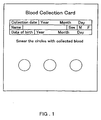
- Fig. 1 shows one example of the blood test tool according to the present invention.
- this blood test tool is a card type.
- On the lower part of this card there are three parts onto which blood is smeared (i.e. blood holding parts) shown by circles, and on the upper part of the card predetermined matters such as name can be written.
- the entire part of this blood test tool may be formed of a porous material such as filter paper etc., or only the blood holding part may be formed of a porous material.
- This blood holding part includes carboxylic acid, and if necessary, a non-reducing sugar, an anticoagulant and an antioxidant.
- the size of this blood test tool is not particularly limited, but is preferably a post card size or a little bit smaller than the post card size from the viewpoint of the convenience in mailing, etc. Furthermore, in order to shield the blood holding parts from the outer environment, the surface of the blood holding parts may be shielded by a resin film, etc. after the part is impregnated with blood.
- Subjects etc. collect the blood from the finger tip etc. by themselves and smear the holding part shown by circles of the blood test tool with the collected blood.
- the smeared blood rapidly infiltrates and is held therein.
- the patient allows the smeared blood to dry by natural drying, air-drying, or the like, puts it into envelope, etc, and mails it to the predetermined hospital or examination institution.
- the denaturation of Hb is prevented by action of the carboxylic acid.
- the blood holding part of the blood test tool is cut out or punched out in the hospital etc., and then the eluting procedure is carried out and the resultant eluate is examined with respect to the predetermined items, for HbAlc, etc.
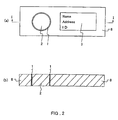
- Fig. 2 shows an example of the blood test tool having a liquid anti-diffusion layer according to the present invention.
- Fig. 2 (a) is a top view showing the schematic structure of the blood test tool; and
- Fig. 2 (b) is a sectional view in the I-I direction of the blood test tool.
- the entire part of this blood test tool is formed of rectangular flat porous material 8 and includes a ring-shaped liquid anti-diffusion layer 1 therein, and the part surrounded by the ring-shaped liquid anti-fusion layer 1 is a blood holding part 2.
- a part of the surface of the porous material 8 constitutes a part to be written 3 where name, address, ID number, etc. are written.
- the size of this blood test tool has, for example, maximum length of 40 to 150 mm; maximum width of 10 to 100 mm; and the maximum thickness of 5 to 100 ⁇ m.
- the size and shape of the blood holding part 2 are not particularly limited, but when the shape is a circle, the diameter is, for example, 5 to 50 mm. Furthermore, similar to the above, carboxylic acid, and if necessary, a non-reducing sugar, an anticoagulant and an antioxidant, are present in the blood holding part 2. Furthermore, the shape or width of the liquid anti-diffusion layer 1 also is not particularly limited, but the width is, for example, 0.5 to 5 mm.
- the whole structure may be formed of a porous material, or only the blood holding part 2 may be formed of a porous material.
- a porous material for example, a filter paper, glass filter, a resin porous film, and the like can be used, and among them, the filter paper is preferably used from the viewpoint of the cost or handling, etc.
- the average pore diameter of the porous material is not limited as long as the blood can infiltrate and be held, but the hole diameter is, for example, 1 to 10 ⁇ m.
- the liquid anti-diffusion layer 1 can be formed by, for example, preparing a solution in which the above-mentioned resin is dissolved or diffused in the solvent (hereinafter, "resin solution” will be referred to), and by printing or applying the resin solution onto the porous material 8.
- the size of the blood holding part 2 can be determined appropriately by the formation of this liquid anti-diffusion layer 1.
- the porous structure of the porous material may be made into a non-porous structure by the resin, or it may have a porous structure if it is made to be hydrophobic by impregnating the porous material with hydrophobic resin.
- the blood test tool for example, when the blood is smeared onto the surface of the blood holding part 2, the blood diffuses and infiltrates in the face direction and the thickness direction of the blood holding part 2. At this time, with the liquid anti-diffusion layer 1, it is possible to prevent blood from diffusing toward the porous material 8 outside of the blood holding part 2.
- Figs. 3 and 4 show an example of the blood test tool including a detachable blood holding part according to the present invention.
- Fig. 3(a) is a top view showing a blood holding part surrounded by a liquid anti-diffusion layer; and
- Fig. 3(b) is a top view showing a holder supporting the blood holding part.
- Fig. 4(a) is a sectional view in the I-I direction of the blood holding part surrounded by the liquid anti-diffusion layer shown in Fig. 3; and
- Fig. 4(b) is a sectional view in the II-II direction of the holder shown in Fig. 3.
- the same parts as in Fig. 2 are given the same remarks.
- Such a blood test tool can be used by, for example, fitting the blood holding part 2 surrounded by the liquid anti-diffusion layer 1 shown in Figs. 3(a) and 4 (a) into a concave supporting portion 4 of the holders 7 shown in Figs. 3(b) and 4(b). Moreover, the both may be adhered detachably by adhesives, etc.
- the blood holding part 2 surrounded by the liquid anti-diffusion layer 1 shown in Figs. 3(a) and 4(a), can be formed by, for example, punching out the porous material in the form of circle, and then applying the resin solution, etc. on the side face of the circle punched material. Similar to the above, this blood holding part 2 includes carboxylic acid, and if necessary, a non-reducing sugar, an anticoagulant and an antioxidant.
- the blood holding part 2 surrounded by the liquid anti-diffusion layer 1 is detached from the holder 7 and immersed in the eluate. Since, for example, the above-mentioned resin, etc. is applied around the blood holding part 2, the porous materials is prevented from getting loose and being released into the eluate. Therefore, prior to the measurement, it is not necessary to remove pieces by filtration or centrifuge. Moreover, the shape, etc. of the blood holding part and liquid anti-diffusion layer is not particularly limited.
- Fig. 5 shows an example of the blood test tool according to the present invention having a different shape for the liquid anti-diffusion layer.
- Fig. 5 (a) is a top view showing a blood holding part surrounded by a liquid anti-diffusion layer; and
- Fig. 5 (b) is a top view showing a holder supporting the blood holding part.
- the same parts as in Fig. 3 are given the same reference numerals.
- the external shape of the liquid anti-diffusion layer 1 is a square, and a circular blood holding part 2 is formed therein.
- the liquid anti-diffusion layer 1 and the blood holding part 2 can be formed by impregnating the circumference of the circle part of the porous material with the resin solution by printing or applying, and by punching out the porous material in a square form.
- Fig. 6 is a sectional view showing another example of the blood test tool including a detachable blood holding part surrounded by the anti-diffusion layer according to the present invention.
- a blood holding part 2 surrounded by the liquid anti-diffusion layer 1 is laminated on a flat holder 7. Furthermore, in order to prevent the blood holding part 2 from peeling off from the holder 7, the blood holding part 2 and the holder 7 are adhered detachably by adhesive.
- the structure and the using method are the same as in the proceeding embodiments.
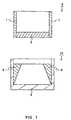
- Fig. 7 is a sectional view showing one example of a cylindrical blood test tool with a bottom according to the present invention.
- reference numeral 9 denotes a cylindrical blood test tool with a bottom
- 10 denotes an eluate collection vessel.
- this cylindrical blood test tool with a bottom 9 is formed by fitting the porous material into the bottom part of the cylindrical body.
- the cylindrical body is a blood anti-diffusion layer 1 and the porous material is a blood holding part 2.
- the eluate collection vessel 10 is provided with a holding part 6 for holding the blood test tool 9 on the internal wall of the container 5.
- the same parts as in Fig. 2 are given the same reference numerals.
- the shape of the cylindrical body(the liquid anti-diffusion layer 1) is not particularly limited.
- An example of the shapes includes cylindrical shape, hollow prismatic shape, or the like.
- Such a cylindrical blood test tool with a bottom 9 can be formed by, for example, punching out the porous material so that the punched-out part becomes the bottom part of the cylindrical body and then by fitting it into the cylindrical body. At this time, preferably the contact faces of both parts are adhered by adhesives, etc. Similar to the above, this blood holding part 2 (porous material of the bottom part) includes carboxylic acid, and if necessary, a non-reducing sugar, an anticoagulant and an antioxidant.
- the cylindrical blood test tool with a bottom 9 has, for example, an internal depth of 5 to 50 mm, and a volume of 1 to 3 ml. Furthermore, it is preferable that the inner diameter of the eluate collection vessel 10 is larger than the outer diameter of the cylindrical blood test tool with a bottom 9. For example, the eluate collection vessel 10 has an inner diameter of 7 to 55 mm, an internal depth of 5 to 50 mm, and a volume of 1 to 5 ml. It is preferable that the cylindrical blood test tool with a bottom 9 and the eluate collection vessel 10 are detachable from each other.
- the shape of the holder 6 is not particularly limited as long as the holder 6 can hold the cylindrical blood test tool with a bottom 9. However, the shape having a tapered surface as shown in this figure is preferred because it can collect an eluate containing blood along the tapered face.
- Material of the cylindrical body (liquid anti-diffusion layer) 1 of the cylindrical blood test tool with a bottom 9 and a container 5 of the eluate collection vessel 10 are not particularly limited.
- plastic, glass, metal, and the like can be used and a transparent member is preferable because the amount of added eluate and the amount of the collected eluate can be checked from the outside.
- An example of the useful material includes a plastic such as polystyrene, polyethylene terephthalate, etc.
- a material of the holder 6 is not particularly limited, and an example of the material includes a plastic such as polystyrene, polyethylene terephthalate, and the like.
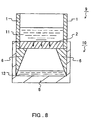
- FIG. 8 An example of the method for collecting blood by using such a cylindrical blood test tool with a bottom 9 is explained with reference to the sectional view of Fig. 8.
- Fig. 8 the same parts as in Fig. 7 are given the same reference numerals.
- the bottom part (a blood holding part 2) of the cylindrical blood test tool with a bottom 9 is smeared with the blood and dried. Then, as shown in this figure, this cylindrical blood test tool 9 is placed on the holder 6 of the eluate collection vessel 10. Then, an eluate 11 is put into the sample holding tool 9. The eluate 11 moves in the blood holding part 2 in the direction (the direction shown by an arrow in Fig. 8) and elutes the held blood and permeates the blood holding part 2.
- the eluate 12 containing the permeated blood moves along the holder 6 provided on the eluate collection vessel 10 and is stored in the eluate collection vessel 10. Moreover, when the blood is eluted, for example, the eluate 11 is forced to infiltrate and permeate the porous material (the blood holding part) 2 by setting the internal pressure of the cylindrical blood test tool with a bottom 9 to be positive.
- Monohydrate of citric acid was dissolved in pure water in the amounts of 20 mg/ml and 50mg/ml to prepare two kinds of treating solutions.
- Two kinds of blood test tools (a and b) were formed by impregnating the circular filter paper (ADVANTEC 101, diameter 100mm, product of TOYO ROSHI) with 2.5 ml of the treating solution and then air-drying. 20 mg/ml treating solution was used for the blood test tool a; and 50 mg/ml treating solution was used for the blood test tool b.
- Comparative Example 1 used a blood test tool c, in which filter paper was not treated with citric acid aqueous solution.
- the three kinds of blood test tools (a, b, and c) were impregnated with fresh blood collected from normal subjects and then air-dried. Then, the three kinds of blood test tools (a, b, and c) were stored at room temperature for 0, 2, 7, 8, and 10 days, and then the part that was impregnated with the blood was punched out in a shape of circle with a diameter of about 6 mm by using a punch. This punched part was put into 0.6 ml of eluate (High-Auto A1C specific diluent, product of KYOTO DAIICHI KAGAKU CO. LTD) and was allowed to stand still for about 10 minutes, and the eluting procedure was performed.
- eluate High-Auto A1C specific diluent, product of KYOTO DAIICHI KAGAKU CO. LTD
- the HbAlc in this eluate was measured by the use of an automatic glycohemoglobin measuring device (High-Auto A1C HA-8150, KYOTO DAIICHI KAGAKU CO. LTD) in a hemolytic mode. Furthermore, as a control, HbAlc in the blood right after collection from healthy subjects was measured by using the automatic glycohemoglobin measurement device. Table 1 shows the results. Moreover, in Table 1, the amount of HbAlc in blood is expressed by percentage (%) with respect to the whole amount of Hb. The same is true in the following tables.
- the five blood test tools were impregnated with fresh blood collected in the presence of heparin from healthy subjects and air-dried. Then, the five blood test tools (d, e, f, g, and h) were stored at room temperature for 0, 1, 3 and 6 days, and then the part that is impregnated with the blood was punched out by a punch so as to form a circle shape with a diameter of about 6 mm. The punched-out part was put into 0.6 ml of eluate and allowed to stand still for about 10 minutes and the eluting procedure was performed. The HbAlc in the eluate was measured by the use of an automatic glycohemoglobin measuring device to measure the eluate in a hemolytic mode.
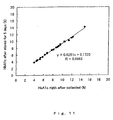
- Each test tool was impregnated with twenty-six blood samples collected by using EDTA, heparin and NaF respectively, and air-dried and stored for 1, 4, and 5 days.
- the part of the blood test tool f impregnated with the blood was punched out into a circle shape with a diameter of about 6 mm.
- the punched-out part was put into 0.6 ml of the eluate and allowed to stand still for about 10 minutes and the eluting procedure was performed.
- the HbAlc in the eluate was measured by using an automatic glycohemoglobin measuring device.
- HbAlc in blood sample right after collection was measured by using the automatic glycohemoglobin device measurement device.
- Fig. 9 is a graph showing the correlation between HbAlc in blood after stored for one day and HbAlc in blood right after collection
- Fig. 10 is a graph showing the correlation between HbAlc in blood after stored for four days and HbAlc in blood right after collection
- Figure 11 is a graph showing the correlation between HbAlc in blood after stored for five days and HbAlc right after collection.
- the blood test tool was impregnated with the blood collected in the presence of heparin from healthy subjects, and air-dried and stored for 0, 1, and 3 days at room temperature. Then, each part that was impregnated with the blood was cut out by a punch into a circle shape with a diameter of about 6 mm, and put into 0.6 ml of the eluate and allowed to stand still for about 10 minutes. HbAlc in this eluate was measured by the use of an automatic glycohemoglobin measuring device in a hemolytic mode. Furthermore, the protein-denaturation of Hb in each eluate was measured by the use of general purposed HPLC (La Chrom manufactured by Hitachi Ltd.).
- the method for preventing the denaturation of blood and the blood test tool of the present invention it is possible to prevent the production of HbAlc and the protein-denaturation of Hb in a dried state blood. Therefore, when, for example, the blood test tool of the present invention is applied for clinical medicine, it is possible to determine HbAlc, which is an important index for diagnosis of diabetes, exactly and effectively.
Landscapes
- Health & Medical Sciences (AREA)
- Life Sciences & Earth Sciences (AREA)
- Hematology (AREA)
- Engineering & Computer Science (AREA)
- Molecular Biology (AREA)
- Biomedical Technology (AREA)
- Chemical & Material Sciences (AREA)
- Immunology (AREA)
- Urology & Nephrology (AREA)
- Biotechnology (AREA)
- Microbiology (AREA)
- Cell Biology (AREA)
- Food Science & Technology (AREA)
- Medicinal Chemistry (AREA)
- Physics & Mathematics (AREA)
- Analytical Chemistry (AREA)
- Biochemistry (AREA)
- General Health & Medical Sciences (AREA)
- General Physics & Mathematics (AREA)
- Pathology (AREA)
- Investigating Or Analysing Biological Materials (AREA)
Claims (20)
- Verwendung einer Carbonsäure zur Unterdrückung der Bildung von HbAlc in Blut in getrocknetem Zustand.
- Verwendung nach Anspruch 1, wobei die Carbonsäure dem Blut in nicht trockenem Zustand zugesetzt wird und das Blut dann getrocknet wird.
- Verwendung nach Anspruch 1 oder 2, wobei die Carbonsäure wenigstens eine Carbonsäure ist, die ausgewählt ist unter Zitronensäure, Oxalsäure, Brenztraubensäure und Essigsäure.
- Verwendung nach Anspruch 3, wobei die Carbonsäure Zitronensäure ist.
- Verwendung nach einem der Ansprüche 2 bis 4, wobei 1,5 bis 10 Gewichtsteile Carbonsäure 100 Gewichtsteilen Blut in nicht trockenem Zustand zugesetzt werden.
- Verfahren zur unterdrückung der Bildung von HbAlc, wobei man dafür sorgt, dass eine Carbonsäure, ein nicht reduzierender Zucker und Blut in getrocknetem Zustand gemeinsam zugegen sind.
- Verfahren nach Anspruch 6, wobei der nicht reduzierende Zucker Saccharose ist.
- Verfahren nach einem der Ansprüche 8 bis 7, wobei man wenigstens ein Antikoagulans und/oder ein Antioxidans zugegen sein lässt.
- Verfahren nach Anspruch 8, wobei das Antikoagulans wenigstens ein Stoff ist, der ausgewählt ist unter Ethylendiamintetraessigsäure, Heparin und Oxalsäuresalz.
- Verfahren nach Anspruch 8 oder 9, wobei das Antioxidans einer von den Stoffen Glutathion und α-Tocopherol ist.
- Verfahren nach einem der Ansprüche 6 bis 10, wobei das Blut in getrocknetem Zustand gebildet wird, nachdem man ein poröses Material mit dem Blut imprägniert und das Blut getrocknet hat.
- Bluttestmittel, das Blut in getrocknetem Zustand aufnimmt, umfassend poröses Material, wobei ein Teil des porösen Materials zum Aufnehmen von Blut Carbonsäure und einen nicht reduzierenden Zucker enthält.
- Bluttestmittel nach Anspruch 12, wobei die Carbonsäure wenigstens eine Carbonsäure ist, die ausgewählt ist unter Zitronensäure, Oxalsäure, Brenztraubensäure und Essigsäure.
- Bluttestmittel nach Anspruch 13, wobei die Carbonsäure Zitronensäure ist.
- Bluttestmittel nach einem der Ansprüche 12 bis 14, wobei der nicht reduzierende Zucker Saccharose ist.
- Bluttestmittel nach einem der Ansprüche 12 bis 15, wobei der Teil des porösen Materials zur Aufn ahme von Blut von einer Blut-Antidiffusionsschicht umgeben ist, die in dem oder um das poröse Material herum vorgesehen ist.
- Bluttestmittel nach Anspruch 16, wobei die Blut-Antidiffusionsschicht eine Schicht mit einer nicht porösen Struktur ist.
- Bluttestmittel nach Anspruch 16, wobei die Blut-Antidiffusionsschicht hydrophob ist.
- Bluttestmittel nach einem der Ansprüche 12 bis 18, wobei der Teil des porösen Materials zur Aufnahme von Blut von einem Träger getragen und von dem Träger ablösbar ist.
- Bluttestmittel nach einem der Ansprüche 12 bis 19, wobei das Mittel zylindrisch ist und ein Unterteil aufweist, das aus einem porösen Material gebildet ist.
Applications Claiming Priority (5)
| Application Number | Priority Date | Filing Date | Title |
|---|---|---|---|
| JP24865398 | 1998-09-02 | ||
| JP24865398 | 1998-09-02 | ||
| JP20340199 | 1999-07-16 | ||
| JP20340199 | 1999-07-16 | ||
| PCT/JP1999/004691 WO2000014532A1 (fr) | 1998-09-02 | 1999-08-30 | Procede de prevention de la denaturation sanguine et dispositif d'analyse sanguine utile a cette fin |
Publications (3)
| Publication Number | Publication Date |
|---|---|
| EP1111384A1 EP1111384A1 (de) | 2001-06-27 |
| EP1111384A4 EP1111384A4 (de) | 2004-12-15 |
| EP1111384B1 true EP1111384B1 (de) | 2006-01-18 |
Family
ID=26513903
Family Applications (1)
| Application Number | Title | Priority Date | Filing Date |
|---|---|---|---|
| EP99940568A Expired - Lifetime EP1111384B1 (de) | 1998-09-02 | 1999-08-30 | Verfahren zur Vorbeugung der Hemoglobin A1c-Erzeugung in trockenem Blut und Bluttestvorrichtung |
Country Status (6)
| Country | Link |
|---|---|
| US (1) | US6379318B1 (de) |
| EP (1) | EP1111384B1 (de) |
| JP (1) | JP3380230B2 (de) |
| AU (1) | AU5445799A (de) |
| DE (1) | DE69929527T8 (de) |
| WO (1) | WO2000014532A1 (de) |
Families Citing this family (17)
| Publication number | Priority date | Publication date | Assignee | Title |
|---|---|---|---|---|
| US6465202B1 (en) * | 2000-02-17 | 2002-10-15 | Biosafe Laboratories, Inc. | Method for stabilizing aminotransferase activity in a biological fluid |
| WO2002089723A2 (en) * | 2001-05-08 | 2002-11-14 | Biosafe Medical Technologies, Inc. | Body fluid collection device |
| US20050133181A1 (en) * | 2003-12-22 | 2005-06-23 | Weyerhaeuser Company | Paper product and method of making |
| US20050133182A1 (en) * | 2003-12-22 | 2005-06-23 | Weyerhaeuser Company | Paper product and method of making field |
| ES2356343T3 (es) | 2005-05-20 | 2011-04-07 | Germediq Forschungs- Und Entwicklungsgesellschaft Mbh | Método para la determinación de factores de riesgo cardiovasculares en sangre desecada. |
| US7976792B2 (en) * | 2007-05-30 | 2011-07-12 | Ally Shivji | Biological specimen collection card |
| EP2263544A1 (de) * | 2009-05-18 | 2010-12-22 | F. Hoffmann-La Roche AG | Testeinheit zur Untersuchung einer Körperflüssigkeit und Herstellungsverfahren |
| KR101190492B1 (ko) * | 2010-05-20 | 2012-10-12 | 엘지전자 주식회사 | 히트펌프 연동 급탕장치 |
| JP6030633B2 (ja) * | 2011-04-19 | 2016-11-24 | ポーレックス コーポレイション | 焼結多孔性プラスチックを含む試料貯蔵および送達のためのカード |
| WO2013044124A1 (en) | 2011-09-23 | 2013-03-28 | Nanoink, Inc. | Accurate quantitiation of biomarkers in samples |
| WO2013043562A1 (en) | 2011-09-23 | 2013-03-28 | Waters Technologies Corporation | Solid phase extraction device for dried sample cards |
| EP2802867B1 (de) * | 2012-01-11 | 2022-08-03 | Adelaide Research & Innovation Pty Ltd. | Stabilisierung und analyse von fettsäuren in einer biologischen probe auf festen medien |
| GB2515210A (en) * | 2012-03-30 | 2014-12-17 | Waters Technologies Corp | Sample carrier for dried biological samples |
| JP6904561B2 (ja) * | 2017-02-22 | 2021-07-21 | 独立行政法人国立病院機構 | 乾燥血液試料保存基材 |
| WO2018155410A1 (ja) * | 2017-02-22 | 2018-08-30 | 公益財団法人ヒューマンサイエンス振興財団 | 乾燥血液試料保存基材 |
| EP3775927B1 (de) * | 2018-03-28 | 2024-02-07 | Two-Tag Holdings Pty Ltd | Verfahren zur messung der relativen oxidationswerte eines proteins |
| WO2020032270A1 (ja) * | 2018-08-09 | 2020-02-13 | 公益財団法人ヒューマンサイエンス振興財団 | 乾燥血液試料保存基材 |
Family Cites Families (9)
| Publication number | Priority date | Publication date | Assignee | Title |
|---|---|---|---|---|
| JPH0687062B2 (ja) * | 1985-05-10 | 1994-11-02 | 株式会社京都医科学研究所 | 血液中の解糖阻止方法 |
| US5204267A (en) * | 1991-12-17 | 1993-04-20 | Osborn Laboratories, Inc. | Method of glucose stabilization and analysis in dried blood spot samples |
| JP3177863B2 (ja) * | 1992-07-17 | 2001-06-18 | 東ソー株式会社 | 不安定型糖化ヘモグロビンの除去方法 |
| JP3306182B2 (ja) * | 1993-09-14 | 2002-07-24 | 積水化学工業株式会社 | カテコールアミン検査用採血管 |
| US5516487A (en) * | 1994-06-22 | 1996-05-14 | Isolab, Inc. | Absorbent paper for liquid sampling and impregnated paper calibrators and controls |
| JP3686482B2 (ja) | 1996-06-27 | 2005-08-24 | 株式会社ビー・エム・エル | ヘモグロビンa1cの管理試料 |
| RU2079307C1 (ru) * | 1996-07-08 | 1997-05-20 | Михаил Александрович Каплан | Противоанемическое средство |
| JPH10104226A (ja) | 1996-09-30 | 1998-04-24 | Masaki Kobayashi | 血液検体採集カード |
| JPH10175987A (ja) * | 1996-12-13 | 1998-06-30 | Nof Corp | 重合性基含有有機リン酸エステル化合物およびその製造方法 |
-
1999
- 1999-08-30 EP EP99940568A patent/EP1111384B1/de not_active Expired - Lifetime
- 1999-08-30 JP JP2000569226A patent/JP3380230B2/ja not_active Expired - Fee Related
- 1999-08-30 AU AU54457/99A patent/AU5445799A/en not_active Abandoned
- 1999-08-30 DE DE69929527T patent/DE69929527T8/de not_active Expired - Fee Related
- 1999-08-30 US US09/786,147 patent/US6379318B1/en not_active Expired - Fee Related
- 1999-08-30 WO PCT/JP1999/004691 patent/WO2000014532A1/ja not_active Ceased
Also Published As
| Publication number | Publication date |
|---|---|
| DE69929527T2 (de) | 2006-09-21 |
| DE69929527T8 (de) | 2007-03-15 |
| AU5445799A (en) | 2000-03-27 |
| US6379318B1 (en) | 2002-04-30 |
| DE69929527D1 (de) | 2006-04-06 |
| EP1111384A1 (de) | 2001-06-27 |
| WO2000014532A1 (fr) | 2000-03-16 |
| EP1111384A4 (de) | 2004-12-15 |
| JP3380230B2 (ja) | 2003-02-24 |
Similar Documents
| Publication | Publication Date | Title |
|---|---|---|
| EP1111384B1 (de) | Verfahren zur Vorbeugung der Hemoglobin A1c-Erzeugung in trockenem Blut und Bluttestvorrichtung | |
| AU682999B2 (en) | Process for stabilizing the content of glycated protein of a sample on a matrix material | |
| US6231815B1 (en) | Storage and transport system for sample material | |
| US6811753B2 (en) | Blood testing tool | |
| US5695949A (en) | Combined assay for current glucose level and intermediate or long-term glycemic control | |
| EP0030684B1 (de) | Testzusammensetzung für peroxidatisch wirksame Substanzen, die Zusammensetzung enthaltendes Testgerät, Verfahren zu seiner Herstellung und Verfahren zur Bestimmung peroxidatisch wirksamer Substanzen | |
| FI91023C (fi) | Sensori | |
| JPWO2000014532A1 (ja) | 血液変性防止方法およびそれに用いる血液検査用具 | |
| US3235337A (en) | Diagnostic compositions and test indicators | |
| EP1025442A1 (de) | Analytisches gerät mit kapillarreagenzträger | |
| WO1988005912A1 (en) | Dry reagent delivery system | |
| EP1767935A1 (de) | Vorrichtung und verfahren zum sammeln einer biologischen probe | |
| US4251223A (en) | Sensitizers for peroxidative activity tests | |
| DE69228963T2 (de) | Verfahren zur Bestimmung von Analyte unter Verwendung eines trockenen analytischen Elements | |
| Watkins | The effect of ketone bodies on the determination of creatinine | |
| JP5993382B2 (ja) | 固体支持体、及びそこから生物学的材料を回収する方法 | |
| US4251222A (en) | Sensitizers for peroxidative activity tests | |
| Radde et al. | Practical aspects of a measurement technique for calcium ion activity in plasma | |
| US20040147854A1 (en) | Instrument for use in collecting and recovering liquid secretion in oral cavity | |
| JPS5881800A (ja) | グルコ−ス検出用試薬 | |
| CN119064601A (zh) | 干化学测试卡及其制备方法 | |
| EP0124285A2 (de) | Verfahren und Vorrichtung zum Nachweis von Mikroorganismen | |
| US3362886A (en) | Composition and method for the detection of galactose | |
| WO2022114031A1 (ja) | 血漿又は血清を分離し保管するための媒体、それを製造する方法、デバイス、キット、及び糖化タンパク質の測定方法 | |
| JP3147560B2 (ja) | 多項目分析方法 |
Legal Events
| Date | Code | Title | Description |
|---|---|---|---|
| PUAI | Public reference made under article 153(3) epc to a published international application that has entered the european phase |
Free format text: ORIGINAL CODE: 0009012 |
|
| 17P | Request for examination filed |
Effective date: 20010330 |
|
| AK | Designated contracting states |
Kind code of ref document: A1 Designated state(s): AT BE CH CY DE DK ES FI FR GB GR IE IT LI LU MC NL PT SE |
|
| AX | Request for extension of the european patent |
Free format text: AL;LT;LV;MK;RO;SI |
|
| RBV | Designated contracting states (corrected) |
Designated state(s): DE FR GB IT |
|
| A4 | Supplementary search report drawn up and despatched |
Effective date: 20041103 |
|
| RAP1 | Party data changed (applicant data changed or rights of an application transferred) |
Owner name: ARKRAY, INC. |
|
| RIN1 | Information on inventor provided before grant (corrected) |
Inventor name: HIGASHINO, KOUJI,ARKRAY, INC., Inventor name: NISHIMURA, SATOSHI,ARKRAY, INC., |
|
| 17Q | First examination report despatched |
Effective date: 20050120 |
|
| GRAP | Despatch of communication of intention to grant a patent |
Free format text: ORIGINAL CODE: EPIDOSNIGR1 |
|
| RTI1 | Title (correction) |
Free format text: METHOD FOR PREVENTING FORMATION OF HEMOGLOBIN A1C IN BLOOD IN A DRIED STATE AND BLOOD TEST TOOL |
|
| GRAS | Grant fee paid |
Free format text: ORIGINAL CODE: EPIDOSNIGR3 |
|
| GRAA | (expected) grant |
Free format text: ORIGINAL CODE: 0009210 |
|
| AK | Designated contracting states |
Kind code of ref document: B1 Designated state(s): DE FR GB IT |
|
| REG | Reference to a national code |
Ref country code: GB Ref legal event code: FG4D |
|
| REF | Corresponds to: |
Ref document number: 69929527 Country of ref document: DE Date of ref document: 20060406 Kind code of ref document: P |
|
| ET | Fr: translation filed | ||
| PLBE | No opposition filed within time limit |
Free format text: ORIGINAL CODE: 0009261 |
|
| STAA | Information on the status of an ep patent application or granted ep patent |
Free format text: STATUS: NO OPPOSITION FILED WITHIN TIME LIMIT |
|
| 26N | No opposition filed |
Effective date: 20061019 |
|
| PGFP | Annual fee paid to national office [announced via postgrant information from national office to epo] |
Ref country code: DE Payment date: 20080822 Year of fee payment: 10 |
|
| PGFP | Annual fee paid to national office [announced via postgrant information from national office to epo] |
Ref country code: IT Payment date: 20080825 Year of fee payment: 10 Ref country code: FR Payment date: 20080813 Year of fee payment: 10 |
|
| PGFP | Annual fee paid to national office [announced via postgrant information from national office to epo] |
Ref country code: GB Payment date: 20080821 Year of fee payment: 10 |
|
| GBPC | Gb: european patent ceased through non-payment of renewal fee |
Effective date: 20090830 |
|
| REG | Reference to a national code |
Ref country code: FR Ref legal event code: ST Effective date: 20100430 |
|
| PG25 | Lapsed in a contracting state [announced via postgrant information from national office to epo] |
Ref country code: FR Free format text: LAPSE BECAUSE OF NON-PAYMENT OF DUE FEES Effective date: 20090831 Ref country code: DE Free format text: LAPSE BECAUSE OF NON-PAYMENT OF DUE FEES Effective date: 20100302 |
|
| PG25 | Lapsed in a contracting state [announced via postgrant information from national office to epo] |
Ref country code: GB Free format text: LAPSE BECAUSE OF NON-PAYMENT OF DUE FEES Effective date: 20090830 |
|
| PG25 | Lapsed in a contracting state [announced via postgrant information from national office to epo] |
Ref country code: IT Free format text: LAPSE BECAUSE OF NON-PAYMENT OF DUE FEES Effective date: 20090830 |