EP1079698B1 - Produit composite a base de fromage et procede de fabrication - Google Patents
Produit composite a base de fromage et procede de fabrication Download PDFInfo
- Publication number
- EP1079698B1 EP1079698B1 EP99918050A EP99918050A EP1079698B1 EP 1079698 B1 EP1079698 B1 EP 1079698B1 EP 99918050 A EP99918050 A EP 99918050A EP 99918050 A EP99918050 A EP 99918050A EP 1079698 B1 EP1079698 B1 EP 1079698B1
- Authority
- EP
- European Patent Office
- Prior art keywords
- cheese
- external shell
- composite product
- based composite
- shell
- Prior art date
- Legal status (The legal status is an assumption and is not a legal conclusion. Google has not performed a legal analysis and makes no representation as to the accuracy of the status listed.)
- Expired - Lifetime
Links
Images
Classifications
-
- A—HUMAN NECESSITIES
- A23—FOODS OR FOODSTUFFS; TREATMENT THEREOF, NOT COVERED BY OTHER CLASSES
- A23C—DAIRY PRODUCTS, e.g. MILK, BUTTER OR CHEESE; MILK OR CHEESE SUBSTITUTES; PREPARATION THEREOF
- A23C19/00—Cheese; Cheese preparations; Making thereof
- A23C19/06—Treating cheese curd after whey separation; Products obtained thereby
- A23C19/09—Other cheese preparations; Mixtures of cheese with other foodstuffs
- A23C19/0908—Sliced cheese; Multilayered or stuffed cheese; Cheese loaves
Definitions
- the present invention relates to the cheese industry. It relates to more particularly composite cheese products comprising a paste external cheese maker also designated by external shell and internal fodder of identical or different texture, the external cheese dough being composed of melted cheese.
- Examples include the patents FR 2 411 539, FR 2 475 301 and FR 2 504 781 which describe cheeses produced in several stages distinct and successive, formed by several layers of melted pasta.
- the external paste is a homogeneous melted paste which ensures good mechanical resistance to the finished product, and the technique manufacturing is that of a processed cheese.
- EP-A-102 232, EP-A-130 740 and EP-A-130 772 describe extrusion techniques for making products marbled or with an external paste surrounding a paste internal.
- This process includes a first step of protein addition with cheese as well as a subsequent step of mechanical treatment and setting form of the treated product.
- This process is however limited in its realization of a starts with the raw material used, which is a ripened cheese pressed with a dry extract (ES) of at least 50% and, on the other hand, by two separate production steps.
- ES dry extract
- document EP-A-727 138 describes the production by co-extrusion of a composite cheese product, the exterior of which consists of mixing, texturing and cooking of fresh curds and the heart of cheese or other food product, so as to create a contrast in texture.
- Document FR-A-728 807 describes the manufacture of a product formed from meat and cheese.
- Document GB-A-990 068 discloses a process for coating small pieces of hard cheese in the cheese making up the outer shell, the molten state.
- DE-U-296 20 117 describes a food product formed of an outer shell and a processed cheese containing a filling fully included in the outer shell and formed from a pasteurized product.
- the document US-A-1,721,406 describes a product comprising a fodder consisting of a piece of meat coated with cheese.
- EP-A-0 128 963 discloses a method and an installation for manufacturing multi-layer food portions.
- Document EP-A-128 963 describes the production of cheeses well composites with separate alternating layers, cheese based melted by a hot dosing technique, the production of these products is making in several stages by involving an intermediate mold with walls allowing the delimitation of the different pastes at the time of casting and the gelled product then being transferred to its final packaging.
- this process relates to products formed from several pastes in the form of separate layers or strips which are all made from processed cheese.
- the outer shell is made from a uncoagulated milk concentrate but containing a coagulation agent (rennet, acidifying agent) and it is at the time of co-molding that the mass or gelation of the outer shell.
- a coagulation agent rennet, acidifying agent
- the process described makes it possible to obtain cheese shells with from milk protein concentrates and not from processed cheese and co-dosing and co-molding is carried out cold (30 to 50 ° C).
- the methods used in the previously mentioned techniques are either the successive hot casting of different melted pastes to obtain superimposed layers made up of different products, or co-extrusion which allows to obtain products comprising a coating and a core of different texture and / or nature.
- this last technique which makes it possible to obtain products with coating and filling is only carried out on cold products. Indeed, it has never been described or carried out by co-extrusion on hot products.
- the technique described does not, because of its characteristics (shear) of obtaining a gel coating homogeneous and continuous. Indeed, its application to already gelled products would have as a consequence the destructuring of the gel which would therefore no longer be continuous.
- the invention aims to meet this demand. For it, it implements a process of hot co-metering of the constituents, that is to say beyond the protein gel point, then cooling down static which allows continuous gelation.
- a second objective of the present invention is to provide a composite cheese product of the type comprising an external shell and internal fodder totally included in the external shell, at least the shell external being based on a processed cheese.
- Another object of the present invention also relates to the process for manufacturing a composite cheese of the aforementioned type.
- the object of the present invention has been achieved by adapting the co-dosing and co-molding technique described in FR-A-2 650 484 with a paste melted cheese for the production of the outer shell, and taking advantage of the special properties of processed cheeses including their ability to creaming which allows the passage from the ground state to the gel state.
- the subject of the invention is therefore a composite cheese product of type comprising an external shell and internal fodder totally included in the outer shell, at least said outer shell being obtained from a Processed cheese with creamability.
- processed cheese or “cheese paste fondue”
- dairy products butter, cream, powder milk, whey
- other additives gelling agents, thickeners
- the filling may consist of a melted cheese paste or other or a food product of a different nature, in particular a coulis.
- the external shell and the internal fodder are made by co-dosing and hot co-molding of the melted cheese dough forming the outer shell and the food product forming the fodder, the temperature implemented during these stages being higher than the gelling temperature of the processed cheese constituting the outer shell.
- the invention therefore also relates to a manufacturing process a cheese-based composite product of the type comprising a shell external and internal fodder totally included in the external shell, at least said outer shell being obtained from a processed cheese having a creamability, the process being characterized in that hot is carried out the co-dosing of the constituents respectively forming the outer shell and the and that said constituents are introduced simultaneously into a mold where they are cooled at least to a temperature below the temperature gelling of the melted cheese paste constituting the outer shell.
- the implementation of the method of the invention is based on the use of the specific properties of processed cheese, in particular its ability to "cream” allowing the transition from the SOL state to a GEL state.
- the transition from the SOL state to the GEL state takes place during the cooling to a temperature below 50 ° C. This cooling is done in static which allows to obtain a continuous gel. It is carried out after dosage in the packaging and shaping of the product.
- this change of state is sought for the formation of the external coating but will be optional for the central fodder, especially in the case where a "flowing" heart of melted cheese.
- neighboring viscosities is meant that the components forming the outer shell and the fodder exhibit, during the simultaneous co-dosing and introduction into the mold, a difference in viscosity of less than 30 poises (3 Pa.s) under shear from 150 s -1 .
- This viscosity neighbor condition of the two pastes is particularly important at the time of the introduction into the mold of the two pasta to obtain a final product with two distinct components and not mixed.
- the apparent viscosity of the two components is advantageously between 5 to 50 poises (0.5 to 5 Pa.s) measured at 80 ° C under a shear of 150 s -1 .
- the apparent viscosity should not be too low because at this viscosity, the pasta would be too fluid and would mix with each other at the time of introduction into the mold; nor should it be too high because, in this case, the pasta would be difficult to firm compatible with the co-dosing and introduction into the mold process works simultaneously.
- the pasta has advantageously of neighboring pH.
- the pH of the two products is preferably between 5.0 and 5.8, acidic pH (pH ⁇ 4.5) being low desirable due to the destabilization of the resulting product.
- neighboring pH is meant a pH difference of not more than 0.5 units, at the temperature of co-dosing and of introduction into the mold of components.
- the pasta advantageously has dry extracts neighbors.
- Neighboring dry extracts means a difference of not more than 5% in weight.
- the co-dosing of the constituents is carried out at a temperature of preferably between 70 and 90 ° C.
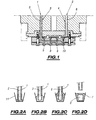
- Figure 1 is a view of the installation used for setting work of the process in which the shaping of the final product is carried out a single operation using the so-called "one shot” technique.
- This process consists of simultaneous co-dosing and co-molding of the two constituents which will produce respectively the shell and the fodder and which may represent a taste. a very different texture and consistency.
- the constituent 1 forming the cheese paste intended for carry out the external coating and the internal component 2 advantageously under form of dough are sent to different hoppers not shown on the figure at the bottom of which are fixed nozzles 3 and 4.
- the flow in the nozzles is controlled by two pistons (one for each product), not shown in the figure, which allow synchronized adjustment of the quantity of product delivered during each co-dosing operation.
- the nozzle 3 receives the paste 1, while the nozzle 4 receives the paste 2.
- the components are then brought respectively by means of conduits 5 and 6 to level of four parallel metering tubes 7, 8, 9 and 10, under which come to place the forming molds.
- the pistons then send the two constituents into the forming receptacles 11 where the co-dosing is carried out as illustrated in the Figures 2A to 2D.
- the dosed product is cooled to a temperature below 50 ° C. so as to obtain a gelation of the external paste, which makes it possible to obtain a firm shell around the forage.
- the outer layer or coating consists of processed cheese for which the creaming properties are wanted; one can also but not necessarily incorporate, in the formula of processed cheese, egg protein or serum protein these proteins allow to obtain a non-reversible gel on reheating and facilitate the function of the coating as a shell which holds the core stably.
- the heating temperatures are advantageously below the coagulation temperature of these proteins, so that these only coagulate when the product is reheated (reheated by bain-marie or passage in an oven).
- the processed cheese constituting the coating may be also flavored or enriched with figurative elements.
- the filling or core consists either of melted cheese. by nature identical or different to that of the shell, either of curd or cream cheese, or any other food product advantageously in the form of grout and having a viscosity and a pH compatible with processed cheese constituting the outer shell, as described above.
- the constituent product of the heart can be flavored and / or abundant.
- the weight ratio of the constituent of the heart compared to the finished product is between 10 and 50%, 10% representing the threshold for obtaining a mouth feel and 50% the threshold beyond which the process can no longer to be implemented.
- the outer shell therefore constitutes from 50 to 90% by weight relative to the total weight of the finished product.
- the products obtained are packaged in all types of packaging well known to those skilled in the art; preferentially, they are conditioned directly in aluminum hulls, in "bi-hulls" or sealable cups, for example made of plastic or other material adapted.
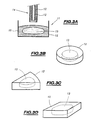
- FIG. 3A represents an embodiment in which a cheese portion 11 formed of constituents 12 and 13 respectively forming the external shell and internal fodder, are sent via a tube metering 14, in an aluminum receptacle 15 in the same manner as that described in connection with FIG. 1, the constituent 12 being poured into the receptacle 15 until a bottom layer of dough is obtained at the bottom of the receptacle the thickness corresponds to that of the desired shell, then while the flow of component 12 is maintained, the component of the internal paste 13 takes its place in the receptacle for a time corresponding to the quantity of desired fodder, the process being followed by pouring a layer of external constituent 12.
- This embodiment makes it possible to produce shaped products variable, in particular cylindrical (3B), in the form of a triangular portion (3C) and rectangular square section (3D), comprising an outer shell of melted cheese and internal fodder totally included in the external shell.
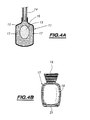
- FIG. 4A represents an embodiment in which the cheese portion 11 formed of constituents 12 and 13 respectively forming the external shell and internal fodder are sent via a tube metering 14 in a receptacle 16.
- the latter is formed as known per se of two identical half-shells arranged symmetrically. They are assembled to each other along a peripheral outer rim 18 in order to delimit an enclosed space in which the cheese portion is confined.
- Each half-shell 17 is formed of a polymer film shaped hollow in particular by blowing in a mold of suitable shape.
- the hollow thus defined is bordered by the plane peripheral rim 18 intended to the assembly of the two half-shells.
- the package has a rectangular shape.
- the half-shells have a longitudinal axis.
- the peripheral rim 18 of each half-shell is extended on one side by a tab or ear 19 forming a gripping.
- the rim 18 of each half-shell has a flat extension 21.
- the shell external forming the packaging is first produced by assembling two half-shells along their peripheral edge.
- the two half-shells are secured to each other along most of the length of this rim by heat sealing.
- the two half-shells are left disjoint between the two extensions 21.
- the interval of the shell delimited defines a passage for introducing the metering tubes 14.
- the casting in the shell 16 of the constituent of the external shell 12 and the internal fodder 13 is produced analogously to that described with reference to FIGS. 2A to 2D.
- the dosing tube 14 is extracted and the two extensions 21 are applied and welded securely one against the other.
- they are for example pressed between two heating jaws so as to to ensure their joining by heat sealing.
- the shell 16 is then hermetically sealed, ensuring the isolation of the cheese portion from the environment external.
- the consumer grabs an ear 19 in each hand. By pulling on it, it spreads the two half-shells which revolve around the hinge formed by two extensions 21, revealing the cheese portion.
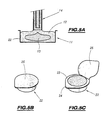
- FIG. 5A shows an embodiment, in which the cheese portion 11, formed of constituents 12 and 13 respectively forming the external shell and the internal fodder are sent via a tube metering 14 in a thermoformed dish 22 according to the method described in relationship to Figure 1.
- thermoformed cup 22 includes a flat peripheral rim 23, extended on one side by a tab 24 forming a gripping member.
- the products can also be co-dosed while hot in an intermediate mold where the gelling step will take place during cooling, then after cooling, they are removed from the mold and coated either under an edible coating based on lipids, proteins or polysaccharides, or food wax, before being packaged in the final packaging.
- the products can have any shape and have a grammage between 5 and 200 g, preferably 5 to 50 g.
- the product is cooled to 90 ° C and transferred to one of the two machine dosing tanks.
- This product will serve as an external paste. It has a dry extract of 41%, a 48% dry matter-to-dry matter ratio and a pH of 5.50.
- This product used as fodder has a dry extract of 42%, a fat / dry matter ratio of 56% and a pH of 5.6.
- the two pastes are simultaneously dosed and introduced into packaging according to the "one-shot” process.
- the finished product is a 20g bite packaged in a plastic double-shell type shell and closed tightly, then cooled
- the external dough is firm, orange in color and the filling is melting in the mouth, cream-colored and with a typical Brie taste.
- the product is cooled to 60 ° C and the egg white powder is then incorporated into the product with gentle agitation.
- the whole is transferred to one among two metering tanks of an installation as illustrated in Figure 1.
- the ingredients are mixed and heated under shear intense at 110 ° C.
- This product used as fodder has a dry extract of 43 %, a fat / dry extract ratio of 51.5% and a pH of 5.6.
- the two pastes are dosed simultaneously according to the "one-shot" process.
- the finished product weighs 50 g. It is packaged in a tray aluminum, which is hermetically sealed.
- pre-melt a gelled melted cheese by creaming from a previous cast of the same composition and which will serve initiating the formation of the protein network. In the traditional way or manufacturing of processed cheese, this compound is added at a rate of 3 to 6% of the formula
Landscapes
- Life Sciences & Earth Sciences (AREA)
- Chemical & Material Sciences (AREA)
- Engineering & Computer Science (AREA)
- Food Science & Technology (AREA)
- Polymers & Plastics (AREA)
- Dairy Products (AREA)
Applications Claiming Priority (3)
| Application Number | Priority Date | Filing Date | Title |
|---|---|---|---|
| FR9806256A FR2778532B1 (fr) | 1998-05-18 | 1998-05-18 | Produit composite a base de fromage et procede de fabrication |
| FR9806256 | 1998-05-18 | ||
| PCT/FR1999/001122 WO1999059420A1 (fr) | 1998-05-18 | 1999-05-11 | Produit composite a base de fromage et procede de fabrication |
Publications (2)
| Publication Number | Publication Date |
|---|---|
| EP1079698A1 EP1079698A1 (fr) | 2001-03-07 |
| EP1079698B1 true EP1079698B1 (fr) | 2002-08-28 |
Family
ID=9526462
Family Applications (1)
| Application Number | Title | Priority Date | Filing Date |
|---|---|---|---|
| EP99918050A Expired - Lifetime EP1079698B1 (fr) | 1998-05-18 | 1999-05-11 | Produit composite a base de fromage et procede de fabrication |
Country Status (15)
| Country | Link |
|---|---|
| US (1) | US6551637B1 (da) |
| EP (1) | EP1079698B1 (da) |
| JP (1) | JP2002515227A (da) |
| AT (1) | ATE222702T1 (da) |
| CA (1) | CA2333424A1 (da) |
| CZ (1) | CZ300311B6 (da) |
| DE (1) | DE69902652T2 (da) |
| DK (1) | DK1079698T3 (da) |
| ES (1) | ES2182515T3 (da) |
| FR (1) | FR2778532B1 (da) |
| HU (1) | HUP0101908A3 (da) |
| PL (1) | PL190842B1 (da) |
| PT (1) | PT1079698E (da) |
| SK (1) | SK284808B6 (da) |
| WO (1) | WO1999059420A1 (da) |
Cited By (1)
| Publication number | Priority date | Publication date | Assignee | Title |
|---|---|---|---|---|
| CZ300311B6 (cs) * | 1998-05-18 | 2009-04-15 | Fromageries Bel | Kompozitní sýrové produkty a postup jejich výroby |
Families Citing this family (12)
| Publication number | Priority date | Publication date | Assignee | Title |
|---|---|---|---|---|
| NL1012973C2 (nl) * | 1999-09-03 | 2001-03-06 | Meton | Voedingsmiddel bestaande uit ten minste twee kaassoorten en werkwijze voor het bereiden daarvan. |
| KR100478116B1 (ko) * | 2000-04-21 | 2005-03-24 | 모리나가 뉴교 가부시키가이샤 | 식품원료 및 그 제조방법, 치즈류 식품 및 그 제조방법 |
| FR2819994B1 (fr) * | 2001-02-01 | 2003-04-25 | Sonjal Sas | Procede et dispositif de fabrication et de conditionnement de produits de type saucisse |
| NL1018347C2 (nl) * | 2001-06-21 | 2002-12-30 | Campina Melkunie Bv | Bakbaar voedingsproduct alsmede werkwijze voor het bereiden van een eetbare materiaalsamenstelling voor toepassing in een bakbaar voedingsproduct. |
| EP1417891A1 (de) * | 2002-11-09 | 2004-05-12 | Ceposa AG | Käsekonfekt |
| EP1933637A1 (en) * | 2005-10-12 | 2008-06-25 | Unilever N.V. | Method for preparing a chilled dessert product |
| WO2007042096A1 (en) * | 2005-10-12 | 2007-04-19 | Unilever N.V. | Chilled dessert product and method for preparing such product |
| JP4627060B2 (ja) * | 2006-11-02 | 2011-02-09 | キユーピー株式会社 | 加工チーズ |
| HUP0700143A2 (en) * | 2007-02-08 | 2009-04-28 | Friesland Hungaria Zrt | Curd dessert and process for its production |
| DK2225951T3 (da) * | 2009-03-06 | 2017-07-31 | Kraft Foods R & D Inc | Fremgangsmåde og maskine til fremstilling af en fyldt skive af smelteost samt en fyldt skive af |
| FR2959102B1 (fr) * | 2010-04-21 | 2012-05-04 | Le Chevrefeuille | Procede d'elaboration et de conditionnement d'une bouchee alimentaire composee, bouchee ainsi obtenue |
| GB2531263B (en) * | 2014-10-13 | 2019-01-09 | Kraft Foods R&D Inc | Filled cheese product |
Family Cites Families (12)
| Publication number | Priority date | Publication date | Assignee | Title |
|---|---|---|---|---|
| US1721406A (en) * | 1928-07-21 | 1929-07-16 | Swift & Co | Meat-cheese loaf and method of preparing same |
| FR728807A (fr) * | 1931-12-24 | 1932-07-12 | Swift & Co | Perfectionnements au procédé pour la préparation d'un produit alimentaire formé de viande et de fromage et produit obtenu par le procédé en question |
| DE1161451B (de) * | 1961-11-15 | 1964-01-16 | Alberto Mingiardi | Verfahren zur Herstellung von Laibchen des Grana- bzw. Parmesankaeses kleinen Formats |
| DE7710457U1 (de) * | 1977-04-01 | 1977-12-29 | Molkerei-Zentrale Sued Gmbh & Co Kg, 8500 Nuernberg | Block aus schmelzkaese und/oder schmelzkaesezubereitungen |
| DE7737795U1 (de) * | 1977-12-10 | 1978-06-29 | Molkerei-Zentrale Sued Gmbh & Co Kg, 8500 Nuernberg | Kaeseerzeugnis in blockform |
| DE3373401D1 (en) * | 1983-06-13 | 1987-10-15 | Nestle Sa | Method and apparatus for the production of multilayered portions of foodstuffs |
| FR2603457B1 (fr) * | 1986-09-08 | 1989-12-08 | Bongrain Sa | Procede de traitement d'un fromage, installation de traitement d'un fromage, specialite fromagere et produits alimentaires comportant cette specialite fromagere |
| US5194283A (en) * | 1988-09-15 | 1993-03-16 | Nestec S.A. | Process for the manufacture of composite cheese and product thereof |
| FR2650484B1 (fr) * | 1989-08-03 | 1992-09-04 | Bel Fromageries | Procede de fabrication d'un produit fromager composite et produits obtenus par ce procede |
| FR2730380B1 (fr) * | 1995-02-15 | 1997-03-21 | Bongrain | Procede de preparation en continu d'un fromage ou d'une specialite fromagere, installations pour la mise en oeuvre du procede et produit obtenu par le procede |
| DE29620117U1 (de) * | 1996-11-19 | 1997-01-23 | Unilever N.V., Rotterdam | Gefülltes Nahrungsmittelprodukt auf Schmelzkäsebasis |
| FR2778532B1 (fr) * | 1998-05-18 | 2000-06-30 | Bel Fromageries | Produit composite a base de fromage et procede de fabrication |
-
1998
- 1998-05-18 FR FR9806256A patent/FR2778532B1/fr not_active Expired - Fee Related
-
1999
- 1999-05-11 HU HU0101908A patent/HUP0101908A3/hu unknown
- 1999-05-11 PT PT99918050T patent/PT1079698E/pt unknown
- 1999-05-11 WO PCT/FR1999/001122 patent/WO1999059420A1/fr not_active Ceased
- 1999-05-11 CA CA002333424A patent/CA2333424A1/fr not_active Abandoned
- 1999-05-11 EP EP99918050A patent/EP1079698B1/fr not_active Expired - Lifetime
- 1999-05-11 DK DK99918050T patent/DK1079698T3/da active
- 1999-05-11 AT AT99918050T patent/ATE222702T1/de not_active IP Right Cessation
- 1999-05-11 US US09/700,553 patent/US6551637B1/en not_active Expired - Fee Related
- 1999-05-11 CZ CZ20004247A patent/CZ300311B6/cs not_active IP Right Cessation
- 1999-05-11 DE DE69902652T patent/DE69902652T2/de not_active Expired - Fee Related
- 1999-05-11 SK SK1746-2000A patent/SK284808B6/sk unknown
- 1999-05-11 PL PL344287A patent/PL190842B1/pl unknown
- 1999-05-11 JP JP2000549101A patent/JP2002515227A/ja not_active Withdrawn
- 1999-05-11 ES ES99918050T patent/ES2182515T3/es not_active Expired - Lifetime
Cited By (1)
| Publication number | Priority date | Publication date | Assignee | Title |
|---|---|---|---|---|
| CZ300311B6 (cs) * | 1998-05-18 | 2009-04-15 | Fromageries Bel | Kompozitní sýrové produkty a postup jejich výroby |
Also Published As
| Publication number | Publication date |
|---|---|
| SK284808B6 (sk) | 2005-11-03 |
| US6551637B1 (en) | 2003-04-22 |
| CZ20004247A3 (cs) | 2001-04-11 |
| CA2333424A1 (fr) | 1999-11-25 |
| JP2002515227A (ja) | 2002-05-28 |
| DK1079698T3 (da) | 2002-12-23 |
| FR2778532A1 (fr) | 1999-11-19 |
| PL344287A1 (en) | 2001-10-22 |
| EP1079698A1 (fr) | 2001-03-07 |
| SK17462000A3 (sk) | 2001-06-11 |
| CZ300311B6 (cs) | 2009-04-15 |
| DE69902652D1 (de) | 2002-10-02 |
| HUP0101908A3 (en) | 2003-03-28 |
| PT1079698E (pt) | 2002-12-31 |
| PL190842B1 (pl) | 2006-02-28 |
| ES2182515T3 (es) | 2003-03-01 |
| HUP0101908A2 (hu) | 2001-10-28 |
| WO1999059420A1 (fr) | 1999-11-25 |
| DE69902652T2 (de) | 2003-01-30 |
| ATE222702T1 (de) | 2002-09-15 |
| FR2778532B1 (fr) | 2000-06-30 |
Similar Documents
| Publication | Publication Date | Title |
|---|---|---|
| EP1079698B1 (fr) | Produit composite a base de fromage et procede de fabrication | |
| FR2462873A1 (fr) | Procede de preparation d'un extrait concentre de cafe, the ou leurs succedanes | |
| EP1022953B1 (fr) | Produit alimentaire composite a base de fromage et de biscuit et procede de fabrication | |
| EP1378164B1 (fr) | Procédé de fabrication, par moulage,d'un produit laitier et fromager | |
| EP0281441B1 (fr) | Procédé de fabrication de fromages fondus à texture originale et fromage fondu obtenu par ce procédé | |
| FR3004070A1 (fr) | Procede d'enrobage de produits fromagers | |
| EP0959688B1 (fr) | Fromages affines et procede de fabrication | |
| WO2002051256A2 (fr) | Procede de fabrication de fromages | |
| FR2650484A1 (fr) | Procede de fabrication d'un produit fromager composite et produits obtenus par ce procede | |
| FR2710820A1 (fr) | Procédé de fabrication de produits par prise en masse ou gélification d'une matière protéique. | |
| US20210130063A1 (en) | Method of packaging an edible product and a unit of packaged product | |
| FR2886518A1 (fr) | Procede de fabrication d'un fromage enrobe et ferme et fromage sterile obtenu | |
| US11510422B1 (en) | Method for manufacturing of frozen confection product | |
| EP0395525B1 (fr) | Procédé de fabrication de produits alimentaires pâteux et produits obtenus par ce procédé | |
| JPS596846A (ja) | 複層構造食品およびその製法 | |
| CA2636410A1 (fr) | Procede de fabrication d'un fromage et fromage obtenu | |
| WO2006131625A1 (fr) | Nouveau systeme de conditionnement de fromages | |
| BE500357A (da) |
Legal Events
| Date | Code | Title | Description |
|---|---|---|---|
| PUAI | Public reference made under article 153(3) epc to a published international application that has entered the european phase |
Free format text: ORIGINAL CODE: 0009012 |
|
| 17P | Request for examination filed |
Effective date: 20001107 |
|
| AK | Designated contracting states |
Kind code of ref document: A1 Designated state(s): AT BE CH CY DE DK ES FI FR GB GR IE IT LI LU MC NL PT SE |
|
| AX | Request for extension of the european patent |
Free format text: RO PAYMENT 20001107 |
|
| 17Q | First examination report despatched |
Effective date: 20010321 |
|
| GRAG | Despatch of communication of intention to grant |
Free format text: ORIGINAL CODE: EPIDOS AGRA |
|
| GRAG | Despatch of communication of intention to grant |
Free format text: ORIGINAL CODE: EPIDOS AGRA |
|
| GRAH | Despatch of communication of intention to grant a patent |
Free format text: ORIGINAL CODE: EPIDOS IGRA |
|
| GRAH | Despatch of communication of intention to grant a patent |
Free format text: ORIGINAL CODE: EPIDOS IGRA |
|
| GRAA | (expected) grant |
Free format text: ORIGINAL CODE: 0009210 |
|
| AK | Designated contracting states |
Kind code of ref document: B1 Designated state(s): AT BE CH CY DE DK ES FI FR GB GR IE IT LI LU MC NL PT SE |
|
| AX | Request for extension of the european patent |
Free format text: RO PAYMENT 20001107 |
|
| PG25 | Lapsed in a contracting state [announced via postgrant information from national office to epo] |
Ref country code: GR Free format text: LAPSE BECAUSE OF FAILURE TO SUBMIT A TRANSLATION OF THE DESCRIPTION OR TO PAY THE FEE WITHIN THE PRESCRIBED TIME-LIMIT Effective date: 20020828 Ref country code: FI Free format text: LAPSE BECAUSE OF FAILURE TO SUBMIT A TRANSLATION OF THE DESCRIPTION OR TO PAY THE FEE WITHIN THE PRESCRIBED TIME-LIMIT Effective date: 20020828 |
|
| REF | Corresponds to: |
Ref document number: 222702 Country of ref document: AT Date of ref document: 20020915 Kind code of ref document: T |
|
| REG | Reference to a national code |
Ref country code: GB Ref legal event code: FG4D Free format text: NOT ENGLISH |
|
| REG | Reference to a national code |
Ref country code: CH Ref legal event code: EP |
|
| REF | Corresponds to: |
Ref document number: 69902652 Country of ref document: DE Date of ref document: 20021002 |
|
| REG | Reference to a national code |
Ref country code: IE Ref legal event code: FG4D Free format text: FRENCH |
|
| GBT | Gb: translation of ep patent filed (gb section 77(6)(a)/1977) |
Effective date: 20021011 |
|
| PG25 | Lapsed in a contracting state [announced via postgrant information from national office to epo] |
Ref country code: SE Free format text: LAPSE BECAUSE OF FAILURE TO SUBMIT A TRANSLATION OF THE DESCRIPTION OR TO PAY THE FEE WITHIN THE PRESCRIBED TIME-LIMIT Effective date: 20021128 |
|
| REG | Reference to a national code |
Ref country code: DK Ref legal event code: T3 |
|
| REG | Reference to a national code |
Ref country code: PT Ref legal event code: SC4A Free format text: AVAILABILITY OF NATIONAL TRANSLATION Effective date: 20021023 |
|
| REG | Reference to a national code |
Ref country code: ES Ref legal event code: FG2A Ref document number: 2182515 Country of ref document: ES Kind code of ref document: T3 |
|
| PG25 | Lapsed in a contracting state [announced via postgrant information from national office to epo] |
Ref country code: LU Free format text: LAPSE BECAUSE OF NON-PAYMENT OF DUE FEES Effective date: 20030511 Ref country code: CY Free format text: LAPSE BECAUSE OF FAILURE TO SUBMIT A TRANSLATION OF THE DESCRIPTION OR TO PAY THE FEE WITHIN THE PRESCRIBED TIME-LIMIT Effective date: 20030511 |
|
| PG25 | Lapsed in a contracting state [announced via postgrant information from national office to epo] |
Ref country code: MC Free format text: LAPSE BECAUSE OF NON-PAYMENT OF DUE FEES Effective date: 20030531 |
|
| PLBE | No opposition filed within time limit |
Free format text: ORIGINAL CODE: 0009261 |
|
| STAA | Information on the status of an ep patent application or granted ep patent |
Free format text: STATUS: NO OPPOSITION FILED WITHIN TIME LIMIT |
|
| 26N | No opposition filed |
Effective date: 20030530 |
|
| PGFP | Annual fee paid to national office [announced via postgrant information from national office to epo] |
Ref country code: CH Payment date: 20040413 Year of fee payment: 6 |
|
| PGFP | Annual fee paid to national office [announced via postgrant information from national office to epo] |
Ref country code: AT Payment date: 20040420 Year of fee payment: 6 |
|
| PGFP | Annual fee paid to national office [announced via postgrant information from national office to epo] |
Ref country code: DK Payment date: 20040430 Year of fee payment: 6 |
|
| PGFP | Annual fee paid to national office [announced via postgrant information from national office to epo] |
Ref country code: PT Payment date: 20040511 Year of fee payment: 6 |
|
| PGFP | Annual fee paid to national office [announced via postgrant information from national office to epo] |
Ref country code: ES Payment date: 20040514 Year of fee payment: 6 |
|
| PGFP | Annual fee paid to national office [announced via postgrant information from national office to epo] |
Ref country code: IE Payment date: 20040525 Year of fee payment: 6 |
|
| PGFP | Annual fee paid to national office [announced via postgrant information from national office to epo] |
Ref country code: BE Payment date: 20040608 Year of fee payment: 6 |
|
| PGFP | Annual fee paid to national office [announced via postgrant information from national office to epo] |
Ref country code: NL Payment date: 20050425 Year of fee payment: 7 |
|
| PG25 | Lapsed in a contracting state [announced via postgrant information from national office to epo] |
Ref country code: IT Free format text: LAPSE BECAUSE OF NON-PAYMENT OF DUE FEES;WARNING: LAPSES OF ITALIAN PATENTS WITH EFFECTIVE DATE BEFORE 2007 MAY HAVE OCCURRED AT ANY TIME BEFORE 2007. THE CORRECT EFFECTIVE DATE MAY BE DIFFERENT FROM THE ONE RECORDED. Effective date: 20050511 Ref country code: IE Free format text: LAPSE BECAUSE OF NON-PAYMENT OF DUE FEES Effective date: 20050511 Ref country code: AT Free format text: LAPSE BECAUSE OF NON-PAYMENT OF DUE FEES Effective date: 20050511 |
|
| PG25 | Lapsed in a contracting state [announced via postgrant information from national office to epo] |
Ref country code: ES Free format text: LAPSE BECAUSE OF NON-PAYMENT OF DUE FEES Effective date: 20050512 |
|
| PG25 | Lapsed in a contracting state [announced via postgrant information from national office to epo] |
Ref country code: LI Free format text: LAPSE BECAUSE OF NON-PAYMENT OF DUE FEES Effective date: 20050531 Ref country code: DK Free format text: LAPSE BECAUSE OF NON-PAYMENT OF DUE FEES Effective date: 20050531 Ref country code: CH Free format text: LAPSE BECAUSE OF NON-PAYMENT OF DUE FEES Effective date: 20050531 Ref country code: BE Free format text: LAPSE BECAUSE OF NON-PAYMENT OF DUE FEES Effective date: 20050531 |
|
| PG25 | Lapsed in a contracting state [announced via postgrant information from national office to epo] |
Ref country code: PT Free format text: LAPSE BECAUSE OF NON-PAYMENT OF DUE FEES Effective date: 20051111 |
|
| BERE | Be: lapsed |
Owner name: *FROMAGERIES BEL Effective date: 20050531 |
|
| REG | Reference to a national code |
Ref country code: CH Ref legal event code: PL |
|
| REG | Reference to a national code |
Ref country code: IE Ref legal event code: MM4A |
|
| REG | Reference to a national code |
Ref country code: DK Ref legal event code: EBP |
|
| REG | Reference to a national code |
Ref country code: ES Ref legal event code: FD2A Effective date: 20050512 |
|
| PG25 | Lapsed in a contracting state [announced via postgrant information from national office to epo] |
Ref country code: NL Free format text: LAPSE BECAUSE OF NON-PAYMENT OF DUE FEES Effective date: 20061201 |
|
| NLV4 | Nl: lapsed or anulled due to non-payment of the annual fee |
Effective date: 20061201 |
|
| PGFP | Annual fee paid to national office [announced via postgrant information from national office to epo] |
Ref country code: DE Payment date: 20070511 Year of fee payment: 9 |
|
| PGFP | Annual fee paid to national office [announced via postgrant information from national office to epo] |
Ref country code: GB Payment date: 20070514 Year of fee payment: 9 |
|
| BERE | Be: lapsed |
Owner name: *FROMAGERIES BEL Effective date: 20050531 |
|
| GBPC | Gb: european patent ceased through non-payment of renewal fee |
Effective date: 20080511 |
|
| PG25 | Lapsed in a contracting state [announced via postgrant information from national office to epo] |
Ref country code: DE Free format text: LAPSE BECAUSE OF NON-PAYMENT OF DUE FEES Effective date: 20081202 |
|
| PG25 | Lapsed in a contracting state [announced via postgrant information from national office to epo] |
Ref country code: GB Free format text: LAPSE BECAUSE OF NON-PAYMENT OF DUE FEES Effective date: 20080511 |
|
| PGFP | Annual fee paid to national office [announced via postgrant information from national office to epo] |
Ref country code: FR Payment date: 20090518 Year of fee payment: 11 |
|
| REG | Reference to a national code |
Ref country code: FR Ref legal event code: ST Effective date: 20110131 |
|
| PG25 | Lapsed in a contracting state [announced via postgrant information from national office to epo] |
Ref country code: FR Free format text: LAPSE BECAUSE OF NON-PAYMENT OF DUE FEES Effective date: 20100531 |