EP1078974A1 - Cholesterisches Schichtmaterial mit verbesserter Farbbeständigkeit und Verfahren zu dessen Herstellung - Google Patents
Cholesterisches Schichtmaterial mit verbesserter Farbbeständigkeit und Verfahren zu dessen Herstellung Download PDFInfo
- Publication number
- EP1078974A1 EP1078974A1 EP00118521A EP00118521A EP1078974A1 EP 1078974 A1 EP1078974 A1 EP 1078974A1 EP 00118521 A EP00118521 A EP 00118521A EP 00118521 A EP00118521 A EP 00118521A EP 1078974 A1 EP1078974 A1 EP 1078974A1
- Authority
- EP
- European Patent Office
- Prior art keywords
- cholesteric
- layer
- carrier
- layers
- layer material
- Prior art date
- Legal status (The legal status is an assumption and is not a legal conclusion. Google has not performed a legal analysis and makes no representation as to the accuracy of the status listed.)
- Granted
Links
- 230000003098 cholesteric effect Effects 0.000 title claims abstract description 180
- 238000004519 manufacturing process Methods 0.000 title claims abstract description 18
- 239000000463 material Substances 0.000 title claims description 47
- 239000000203 mixture Substances 0.000 claims abstract description 68
- 239000000049 pigment Substances 0.000 claims abstract description 50
- 239000002245 particle Substances 0.000 claims abstract description 3
- 238000000034 method Methods 0.000 claims description 43
- 239000000853 adhesive Substances 0.000 claims description 25
- 230000001070 adhesive effect Effects 0.000 claims description 25
- 239000003085 diluting agent Substances 0.000 claims description 22
- 239000002131 composite material Substances 0.000 claims description 18
- 238000001035 drying Methods 0.000 claims description 18
- CTQNGGLPUBDAKN-UHFFFAOYSA-N O-Xylene Chemical compound CC1=CC=CC=C1C CTQNGGLPUBDAKN-UHFFFAOYSA-N 0.000 claims description 15
- 238000004132 cross linking Methods 0.000 claims description 15
- 239000008096 xylene Substances 0.000 claims description 14
- 230000005855 radiation Effects 0.000 claims description 12
- 238000000576 coating method Methods 0.000 claims description 11
- 230000003287 optical effect Effects 0.000 claims description 10
- 230000008569 process Effects 0.000 claims description 10
- 239000000126 substance Substances 0.000 claims description 10
- 239000011248 coating agent Substances 0.000 claims description 9
- 239000008199 coating composition Substances 0.000 claims description 8
- XLYOFNOQVPJJNP-UHFFFAOYSA-N water Substances O XLYOFNOQVPJJNP-UHFFFAOYSA-N 0.000 claims description 8
- 229910052751 metal Inorganic materials 0.000 claims description 7
- 239000002184 metal Substances 0.000 claims description 7
- 229920003023 plastic Polymers 0.000 claims description 7
- 239000004033 plastic Substances 0.000 claims description 7
- 238000010894 electron beam technology Methods 0.000 claims description 6
- 238000010438 heat treatment Methods 0.000 claims description 6
- 230000008859 change Effects 0.000 claims description 5
- 239000003973 paint Substances 0.000 claims description 5
- 239000011521 glass Substances 0.000 claims description 4
- 230000015572 biosynthetic process Effects 0.000 claims description 3
- 238000007664 blowing Methods 0.000 claims description 3
- 238000010276 construction Methods 0.000 claims description 3
- 239000002537 cosmetic Substances 0.000 claims description 3
- 239000010985 leather Substances 0.000 claims description 3
- 230000006855 networking Effects 0.000 claims description 3
- 238000010422 painting Methods 0.000 claims description 3
- 238000012545 processing Methods 0.000 claims description 3
- 238000003847 radiation curing Methods 0.000 claims description 3
- 239000004753 textile Substances 0.000 claims description 3
- 239000000919 ceramic Substances 0.000 claims description 2
- 239000003086 colorant Substances 0.000 claims description 2
- 230000003203 everyday effect Effects 0.000 claims description 2
- 230000001939 inductive effect Effects 0.000 claims 1
- 239000000758 substrate Substances 0.000 abstract description 10
- 239000011888 foil Substances 0.000 abstract description 2
- 239000002648 laminated material Substances 0.000 abstract 1
- 239000010410 layer Substances 0.000 description 250
- 150000001875 compounds Chemical class 0.000 description 36
- WYURNTSHIVDZCO-UHFFFAOYSA-N Tetrahydrofuran Chemical compound C1CCOC1 WYURNTSHIVDZCO-UHFFFAOYSA-N 0.000 description 27
- -1 methylimino groups Chemical group 0.000 description 22
- 238000005266 casting Methods 0.000 description 21
- 239000010408 film Substances 0.000 description 19
- 239000002904 solvent Substances 0.000 description 16
- ZWEHNKRNPOVVGH-UHFFFAOYSA-N 2-Butanone Chemical compound CCC(C)=O ZWEHNKRNPOVVGH-UHFFFAOYSA-N 0.000 description 14
- HVYWMOMLDIMFJA-DPAQBDIFSA-N cholesterol Chemical compound C1C=C2C[C@@H](O)CC[C@]2(C)[C@@H]2[C@@H]1[C@@H]1CC[C@H]([C@H](C)CCCC(C)C)[C@@]1(C)CC2 HVYWMOMLDIMFJA-DPAQBDIFSA-N 0.000 description 14
- 238000006116 polymerization reaction Methods 0.000 description 14
- 238000001723 curing Methods 0.000 description 13
- YLQBMQCUIZJEEH-UHFFFAOYSA-N tetrahydrofuran Natural products C=1C=COC=1 YLQBMQCUIZJEEH-UHFFFAOYSA-N 0.000 description 13
- 229920000642 polymer Polymers 0.000 description 12
- 239000007788 liquid Substances 0.000 description 11
- 239000003795 chemical substances by application Substances 0.000 description 10
- 230000000052 comparative effect Effects 0.000 description 10
- 150000003254 radicals Chemical class 0.000 description 10
- IAYPIBMASNFSPL-UHFFFAOYSA-N Ethylene oxide Chemical compound C1CO1 IAYPIBMASNFSPL-UHFFFAOYSA-N 0.000 description 9
- GOOHAUXETOMSMM-UHFFFAOYSA-N Propylene oxide Chemical group CC1CO1 GOOHAUXETOMSMM-UHFFFAOYSA-N 0.000 description 8
- 238000012360 testing method Methods 0.000 description 8
- 235000012000 cholesterol Nutrition 0.000 description 7
- 239000003431 cross linking reagent Substances 0.000 description 7
- 150000002170 ethers Chemical class 0.000 description 7
- 239000000178 monomer Substances 0.000 description 7
- 229920000139 polyethylene terephthalate Polymers 0.000 description 7
- 239000005020 polyethylene terephthalate Substances 0.000 description 7
- 239000000243 solution Substances 0.000 description 7
- PEDCQBHIVMGVHV-UHFFFAOYSA-N Glycerine Chemical compound OCC(O)CO PEDCQBHIVMGVHV-UHFFFAOYSA-N 0.000 description 6
- HEMHJVSKTPXQMS-UHFFFAOYSA-M Sodium hydroxide Chemical compound [OH-].[Na+] HEMHJVSKTPXQMS-UHFFFAOYSA-M 0.000 description 6
- PPBRXRYQALVLMV-UHFFFAOYSA-N Styrene Chemical compound C=CC1=CC=CC=C1 PPBRXRYQALVLMV-UHFFFAOYSA-N 0.000 description 6
- YXFVVABEGXRONW-UHFFFAOYSA-N Toluene Chemical compound CC1=CC=CC=C1 YXFVVABEGXRONW-UHFFFAOYSA-N 0.000 description 6
- 239000011230 binding agent Substances 0.000 description 6
- 239000002270 dispersing agent Substances 0.000 description 6
- 238000000227 grinding Methods 0.000 description 6
- 239000004973 liquid crystal related substance Substances 0.000 description 6
- 229920000728 polyester Polymers 0.000 description 6
- 125000006850 spacer group Chemical group 0.000 description 6
- 150000001252 acrylic acid derivatives Chemical class 0.000 description 5
- 150000002148 esters Chemical class 0.000 description 5
- 239000004922 lacquer Substances 0.000 description 5
- 238000005259 measurement Methods 0.000 description 5
- 229910052760 oxygen Inorganic materials 0.000 description 5
- 239000007787 solid Substances 0.000 description 5
- QNODIIQQMGDSEF-UHFFFAOYSA-N (1-hydroxycyclohexyl)-phenylmethanone Chemical compound C=1C=CC=CC=1C(=O)C1(O)CCCCC1 QNODIIQQMGDSEF-UHFFFAOYSA-N 0.000 description 4
- WMYINDVYGQKYMI-UHFFFAOYSA-N 2-[2,2-bis(hydroxymethyl)butoxymethyl]-2-ethylpropane-1,3-diol Chemical compound CCC(CO)(CO)COCC(CC)(CO)CO WMYINDVYGQKYMI-UHFFFAOYSA-N 0.000 description 4
- XEKOWRVHYACXOJ-UHFFFAOYSA-N Ethyl acetate Natural products CCOC(C)=O XEKOWRVHYACXOJ-UHFFFAOYSA-N 0.000 description 4
- ZJCCRDAZUWHFQH-UHFFFAOYSA-N Trimethylolpropane Chemical compound CCC(CO)(CO)CO ZJCCRDAZUWHFQH-UHFFFAOYSA-N 0.000 description 4
- 239000000654 additive Substances 0.000 description 4
- 239000012965 benzophenone Substances 0.000 description 4
- 229910052794 bromium Inorganic materials 0.000 description 4
- 229910052799 carbon Inorganic materials 0.000 description 4
- 239000000460 chlorine Substances 0.000 description 4
- 229910052731 fluorine Inorganic materials 0.000 description 4
- 239000012948 isocyanate Substances 0.000 description 4
- 150000002513 isocyanates Chemical class 0.000 description 4
- 239000001301 oxygen Substances 0.000 description 4
- WXZMFSXDPGVJKK-UHFFFAOYSA-N pentaerythritol Chemical compound OCC(CO)(CO)CO WXZMFSXDPGVJKK-UHFFFAOYSA-N 0.000 description 4
- 125000001424 substituent group Chemical group 0.000 description 4
- 125000000391 vinyl group Chemical group [H]C([*])=C([H])[H] 0.000 description 4
- MYRTYDVEIRVNKP-UHFFFAOYSA-N 1,2-Divinylbenzene Chemical compound C=CC1=CC=CC=C1C=C MYRTYDVEIRVNKP-UHFFFAOYSA-N 0.000 description 3
- RFFLAFLAYFXFSW-UHFFFAOYSA-N 1,2-dichlorobenzene Chemical compound ClC1=CC=CC=C1Cl RFFLAFLAYFXFSW-UHFFFAOYSA-N 0.000 description 3
- RYHBNJHYFVUHQT-UHFFFAOYSA-N 1,4-Dioxane Chemical compound C1COCCO1 RYHBNJHYFVUHQT-UHFFFAOYSA-N 0.000 description 3
- FWWXYLGCHHIKNY-UHFFFAOYSA-N 2-ethoxyethyl prop-2-enoate Chemical compound CCOCCOC(=O)C=C FWWXYLGCHHIKNY-UHFFFAOYSA-N 0.000 description 3
- WKBOTKDWSSQWDR-UHFFFAOYSA-N Bromine atom Chemical compound [Br] WKBOTKDWSSQWDR-UHFFFAOYSA-N 0.000 description 3
- DKPFZGUDAPQIHT-UHFFFAOYSA-N Butyl acetate Natural products CCCCOC(C)=O DKPFZGUDAPQIHT-UHFFFAOYSA-N 0.000 description 3
- ZAMOUSCENKQFHK-UHFFFAOYSA-N Chlorine atom Chemical compound [Cl] ZAMOUSCENKQFHK-UHFFFAOYSA-N 0.000 description 3
- YMWUJEATGCHHMB-UHFFFAOYSA-N Dichloromethane Chemical compound ClCCl YMWUJEATGCHHMB-UHFFFAOYSA-N 0.000 description 3
- 239000004593 Epoxy Substances 0.000 description 3
- LYCAIKOWRPUZTN-UHFFFAOYSA-N Ethylene glycol Chemical compound OCCO LYCAIKOWRPUZTN-UHFFFAOYSA-N 0.000 description 3
- CERQOIWHTDAKMF-UHFFFAOYSA-M Methacrylate Chemical compound CC(=C)C([O-])=O CERQOIWHTDAKMF-UHFFFAOYSA-M 0.000 description 3
- NINIDFKCEFEMDL-UHFFFAOYSA-N Sulfur Chemical compound [S] NINIDFKCEFEMDL-UHFFFAOYSA-N 0.000 description 3
- 238000003848 UV Light-Curing Methods 0.000 description 3
- QYKIQEUNHZKYBP-UHFFFAOYSA-N Vinyl ether Chemical group C=COC=C QYKIQEUNHZKYBP-UHFFFAOYSA-N 0.000 description 3
- NIXOWILDQLNWCW-UHFFFAOYSA-N acrylic acid group Chemical group C(C=C)(=O)O NIXOWILDQLNWCW-UHFFFAOYSA-N 0.000 description 3
- 239000012790 adhesive layer Substances 0.000 description 3
- 239000002390 adhesive tape Substances 0.000 description 3
- 125000000217 alkyl group Chemical group 0.000 description 3
- 150000001412 amines Chemical class 0.000 description 3
- RWCCWEUUXYIKHB-UHFFFAOYSA-N benzophenone Chemical compound C=1C=CC=CC=1C(=O)C1=CC=CC=C1 RWCCWEUUXYIKHB-UHFFFAOYSA-N 0.000 description 3
- 238000009835 boiling Methods 0.000 description 3
- GDTBXPJZTBHREO-UHFFFAOYSA-N bromine Substances BrBr GDTBXPJZTBHREO-UHFFFAOYSA-N 0.000 description 3
- 125000004432 carbon atom Chemical group C* 0.000 description 3
- 229910052801 chlorine Inorganic materials 0.000 description 3
- 230000000295 complement effect Effects 0.000 description 3
- MTHSVFCYNBDYFN-UHFFFAOYSA-N diethylene glycol Chemical compound OCCOCCO MTHSVFCYNBDYFN-UHFFFAOYSA-N 0.000 description 3
- 239000000975 dye Substances 0.000 description 3
- 230000000694 effects Effects 0.000 description 3
- 125000001495 ethyl group Chemical group [H]C([H])([H])C([H])([H])* 0.000 description 3
- 239000000945 filler Substances 0.000 description 3
- 239000011737 fluorine Substances 0.000 description 3
- 125000002485 formyl group Chemical group [H]C(*)=O 0.000 description 3
- 235000011187 glycerol Nutrition 0.000 description 3
- 229910052736 halogen Inorganic materials 0.000 description 3
- 150000002367 halogens Chemical class 0.000 description 3
- FUZZWVXGSFPDMH-UHFFFAOYSA-N hexanoic acid Chemical compound CCCCCC(O)=O FUZZWVXGSFPDMH-UHFFFAOYSA-N 0.000 description 3
- 125000004435 hydrogen atom Chemical class [H]* 0.000 description 3
- 125000001841 imino group Chemical group [H]N=* 0.000 description 3
- 150000002576 ketones Chemical class 0.000 description 3
- 239000012299 nitrogen atmosphere Substances 0.000 description 3
- 239000000546 pharmaceutical excipient Substances 0.000 description 3
- 229920000058 polyacrylate Polymers 0.000 description 3
- 150000003839 salts Chemical class 0.000 description 3
- 229920001169 thermoplastic Polymers 0.000 description 3
- 239000004416 thermosoftening plastic Substances 0.000 description 3
- 229920002554 vinyl polymer Polymers 0.000 description 3
- 125000004178 (C1-C4) alkyl group Chemical group 0.000 description 2
- QPFMBZIOSGYJDE-UHFFFAOYSA-N 1,1,2,2-tetrachloroethane Chemical compound ClC(Cl)C(Cl)Cl QPFMBZIOSGYJDE-UHFFFAOYSA-N 0.000 description 2
- RBACIKXCRWGCBB-UHFFFAOYSA-N 1,2-Epoxybutane Chemical compound CCC1CO1 RBACIKXCRWGCBB-UHFFFAOYSA-N 0.000 description 2
- WNXJIVFYUVYPPR-UHFFFAOYSA-N 1,3-dioxolane Chemical compound C1COCO1 WNXJIVFYUVYPPR-UHFFFAOYSA-N 0.000 description 2
- XXCVIFJHBFNFBO-UHFFFAOYSA-N 1-ethenoxyoctane Chemical compound CCCCCCCCOC=C XXCVIFJHBFNFBO-UHFFFAOYSA-N 0.000 description 2
- JWYVGKFDLWWQJX-UHFFFAOYSA-N 1-ethenylazepan-2-one Chemical compound C=CN1CCCCCC1=O JWYVGKFDLWWQJX-UHFFFAOYSA-N 0.000 description 2
- 239000012956 1-hydroxycyclohexylphenyl-ketone Substances 0.000 description 2
- LEJBBGNFPAFPKQ-UHFFFAOYSA-N 2-(2-prop-2-enoyloxyethoxy)ethyl prop-2-enoate Chemical compound C=CC(=O)OCCOCCOC(=O)C=C LEJBBGNFPAFPKQ-UHFFFAOYSA-N 0.000 description 2
- HZAXFHJVJLSVMW-UHFFFAOYSA-N 2-Aminoethan-1-ol Chemical compound NCCO HZAXFHJVJLSVMW-UHFFFAOYSA-N 0.000 description 2
- XFCMNSHQOZQILR-UHFFFAOYSA-N 2-[2-(2-methylprop-2-enoyloxy)ethoxy]ethyl 2-methylprop-2-enoate Chemical compound CC(=C)C(=O)OCCOCCOC(=O)C(C)=C XFCMNSHQOZQILR-UHFFFAOYSA-N 0.000 description 2
- SBYMUDUGTIKLCR-UHFFFAOYSA-N 2-chloroethenylbenzene Chemical compound ClC=CC1=CC=CC=C1 SBYMUDUGTIKLCR-UHFFFAOYSA-N 0.000 description 2
- QZPSOSOOLFHYRR-UHFFFAOYSA-N 3-hydroxypropyl prop-2-enoate Chemical compound OCCCOC(=O)C=C QZPSOSOOLFHYRR-UHFFFAOYSA-N 0.000 description 2
- YEJRWHAVMIAJKC-UHFFFAOYSA-N 4-Butyrolactone Chemical compound O=C1CCCO1 YEJRWHAVMIAJKC-UHFFFAOYSA-N 0.000 description 2
- OZJPLYNZGCXSJM-UHFFFAOYSA-N 5-valerolactone Chemical compound O=C1CCCCO1 OZJPLYNZGCXSJM-UHFFFAOYSA-N 0.000 description 2
- CSCPPACGZOOCGX-UHFFFAOYSA-N Acetone Chemical compound CC(C)=O CSCPPACGZOOCGX-UHFFFAOYSA-N 0.000 description 2
- IJGRMHOSHXDMSA-UHFFFAOYSA-N Atomic nitrogen Chemical compound N#N IJGRMHOSHXDMSA-UHFFFAOYSA-N 0.000 description 2
- OKTJSMMVPCPJKN-UHFFFAOYSA-N Carbon Chemical group [C] OKTJSMMVPCPJKN-UHFFFAOYSA-N 0.000 description 2
- 206010013786 Dry skin Diseases 0.000 description 2
- PXGOKWXKJXAPGV-UHFFFAOYSA-N Fluorine Chemical compound FF PXGOKWXKJXAPGV-UHFFFAOYSA-N 0.000 description 2
- CERQOIWHTDAKMF-UHFFFAOYSA-N Methacrylic acid Chemical compound CC(=C)C(O)=O CERQOIWHTDAKMF-UHFFFAOYSA-N 0.000 description 2
- WHNWPMSKXPGLAX-UHFFFAOYSA-N N-Vinyl-2-pyrrolidone Chemical compound C=CN1CCCC1=O WHNWPMSKXPGLAX-UHFFFAOYSA-N 0.000 description 2
- 239000004988 Nematic liquid crystal Substances 0.000 description 2
- 239000004952 Polyamide Substances 0.000 description 2
- 239000004721 Polyphenylene oxide Substances 0.000 description 2
- FAPWRFPIFSIZLT-UHFFFAOYSA-M Sodium chloride Chemical compound [Na+].[Cl-] FAPWRFPIFSIZLT-UHFFFAOYSA-M 0.000 description 2
- DHXVGJBLRPWPCS-UHFFFAOYSA-N Tetrahydropyran Chemical compound C1CCOCC1 DHXVGJBLRPWPCS-UHFFFAOYSA-N 0.000 description 2
- XTXRWKRVRITETP-UHFFFAOYSA-N Vinyl acetate Chemical compound CC(=O)OC=C XTXRWKRVRITETP-UHFFFAOYSA-N 0.000 description 2
- 239000002250 absorbent Substances 0.000 description 2
- 230000002745 absorbent Effects 0.000 description 2
- 230000009471 action Effects 0.000 description 2
- 125000002252 acyl group Chemical group 0.000 description 2
- 150000001298 alcohols Chemical class 0.000 description 2
- 125000004453 alkoxycarbonyl group Chemical group 0.000 description 2
- 125000003806 alkyl carbonyl amino group Chemical group 0.000 description 2
- 125000004448 alkyl carbonyl group Chemical group 0.000 description 2
- 125000005196 alkyl carbonyloxy group Chemical group 0.000 description 2
- XYLMUPLGERFSHI-UHFFFAOYSA-N alpha-Methylstyrene Chemical compound CC(=C)C1=CC=CC=C1 XYLMUPLGERFSHI-UHFFFAOYSA-N 0.000 description 2
- 229920003235 aromatic polyamide Polymers 0.000 description 2
- 125000003118 aryl group Chemical group 0.000 description 2
- QVGXLLKOCUKJST-UHFFFAOYSA-N atomic oxygen Chemical compound [O] QVGXLLKOCUKJST-UHFFFAOYSA-N 0.000 description 2
- MQDJYUACMFCOFT-UHFFFAOYSA-N bis[2-(1-hydroxycyclohexyl)phenyl]methanone Chemical compound C=1C=CC=C(C(=O)C=2C(=CC=CC=2)C2(O)CCCCC2)C=1C1(O)CCCCC1 MQDJYUACMFCOFT-UHFFFAOYSA-N 0.000 description 2
- 125000003178 carboxy group Chemical group [H]OC(*)=O 0.000 description 2
- 229920002678 cellulose Polymers 0.000 description 2
- MVPPADPHJFYWMZ-UHFFFAOYSA-N chlorobenzene Chemical compound ClC1=CC=CC=C1 MVPPADPHJFYWMZ-UHFFFAOYSA-N 0.000 description 2
- 238000001816 cooling Methods 0.000 description 2
- 229920001577 copolymer Polymers 0.000 description 2
- 150000004292 cyclic ethers Chemical class 0.000 description 2
- 125000000664 diazo group Chemical group [N-]=[N+]=[*] 0.000 description 2
- JQVDAXLFBXTEQA-UHFFFAOYSA-N dibutylamine Chemical compound CCCCNCCCC JQVDAXLFBXTEQA-UHFFFAOYSA-N 0.000 description 2
- 150000001991 dicarboxylic acids Chemical class 0.000 description 2
- 150000005690 diesters Chemical class 0.000 description 2
- 238000009792 diffusion process Methods 0.000 description 2
- 150000002009 diols Chemical class 0.000 description 2
- USIUVYZYUHIAEV-UHFFFAOYSA-N diphenyl ether Chemical compound C=1C=CC=CC=1OC1=CC=CC=C1 USIUVYZYUHIAEV-UHFFFAOYSA-N 0.000 description 2
- 238000009826 distribution Methods 0.000 description 2
- UIWXSTHGICQLQT-UHFFFAOYSA-N ethenyl propanoate Chemical compound CCC(=O)OC=C UIWXSTHGICQLQT-UHFFFAOYSA-N 0.000 description 2
- 125000001033 ether group Chemical group 0.000 description 2
- 239000012634 fragment Substances 0.000 description 2
- 238000007710 freezing Methods 0.000 description 2
- 230000008014 freezing Effects 0.000 description 2
- 230000009477 glass transition Effects 0.000 description 2
- 125000000623 heterocyclic group Chemical group 0.000 description 2
- 239000001257 hydrogen Substances 0.000 description 2
- 229910052739 hydrogen Inorganic materials 0.000 description 2
- 125000004356 hydroxy functional group Chemical group O* 0.000 description 2
- ZBKFYXZXZJPWNQ-UHFFFAOYSA-N isothiocyanate group Chemical group [N-]=C=S ZBKFYXZXZJPWNQ-UHFFFAOYSA-N 0.000 description 2
- NYGZLYXAPMMJTE-UHFFFAOYSA-M metanil yellow Chemical group [Na+].[O-]S(=O)(=O)C1=CC=CC(N=NC=2C=CC(NC=3C=CC=CC=3)=CC=2)=C1 NYGZLYXAPMMJTE-UHFFFAOYSA-M 0.000 description 2
- 125000005395 methacrylic acid group Chemical group 0.000 description 2
- 125000002496 methyl group Chemical group [H]C([H])([H])* 0.000 description 2
- ZQXSMRAEXCEDJD-UHFFFAOYSA-N n-ethenylformamide Chemical compound C=CNC=O ZQXSMRAEXCEDJD-UHFFFAOYSA-N 0.000 description 2
- 125000000449 nitro group Chemical group [O-][N+](*)=O 0.000 description 2
- 150000002924 oxiranes Chemical class 0.000 description 2
- 125000001997 phenyl group Chemical group [H]C1=C([H])C([H])=C(*)C([H])=C1[H] 0.000 description 2
- 229920002647 polyamide Polymers 0.000 description 2
- 229920000515 polycarbonate Polymers 0.000 description 2
- 239000004417 polycarbonate Substances 0.000 description 2
- 229920000570 polyether Polymers 0.000 description 2
- 229920002635 polyurethane Polymers 0.000 description 2
- 239000004814 polyurethane Substances 0.000 description 2
- 238000002360 preparation method Methods 0.000 description 2
- 238000006467 substitution reaction Methods 0.000 description 2
- 229910052717 sulfur Inorganic materials 0.000 description 2
- 239000011593 sulfur Substances 0.000 description 2
- 230000003746 surface roughness Effects 0.000 description 2
- VOVUARRWDCVURC-UHFFFAOYSA-N thiirane Chemical compound C1CS1 VOVUARRWDCVURC-UHFFFAOYSA-N 0.000 description 2
- 150000003568 thioethers Chemical group 0.000 description 2
- 150000003673 urethanes Chemical class 0.000 description 2
- 239000002966 varnish Substances 0.000 description 2
- 229920001567 vinyl ester resin Polymers 0.000 description 2
- WXPWZZHELZEVPO-UHFFFAOYSA-N (4-methylphenyl)-phenylmethanone Chemical compound C1=CC(C)=CC=C1C(=O)C1=CC=CC=C1 WXPWZZHELZEVPO-UHFFFAOYSA-N 0.000 description 1
- LAIJAUHBAWLPCO-UHFFFAOYSA-N (4-tert-butylcyclohexyl) prop-2-enoate Chemical compound CC(C)(C)C1CCC(OC(=O)C=C)CC1 LAIJAUHBAWLPCO-UHFFFAOYSA-N 0.000 description 1
- 125000000229 (C1-C4)alkoxy group Chemical group 0.000 description 1
- 125000006552 (C3-C8) cycloalkyl group Chemical group 0.000 description 1
- ZDQNWDNMNKSMHI-UHFFFAOYSA-N 1-[2-(2-prop-2-enoyloxypropoxy)propoxy]propan-2-yl prop-2-enoate Chemical compound C=CC(=O)OC(C)COC(C)COCC(C)OC(=O)C=C ZDQNWDNMNKSMHI-UHFFFAOYSA-N 0.000 description 1
- JTPNRXUCIXHOKM-UHFFFAOYSA-N 1-chloronaphthalene Chemical compound C1=CC=C2C(Cl)=CC=CC2=C1 JTPNRXUCIXHOKM-UHFFFAOYSA-N 0.000 description 1
- VOBUAPTXJKMNCT-UHFFFAOYSA-N 1-prop-2-enoyloxyhexyl prop-2-enoate Chemical compound CCCCCC(OC(=O)C=C)OC(=O)C=C VOBUAPTXJKMNCT-UHFFFAOYSA-N 0.000 description 1
- PIZHFBODNLEQBL-UHFFFAOYSA-N 2,2-diethoxy-1-phenylethanone Chemical compound CCOC(OCC)C(=O)C1=CC=CC=C1 PIZHFBODNLEQBL-UHFFFAOYSA-N 0.000 description 1
- KWVGIHKZDCUPEU-UHFFFAOYSA-N 2,2-dimethoxy-2-phenylacetophenone Chemical compound C=1C=CC=CC=1C(OC)(OC)C(=O)C1=CC=CC=C1 KWVGIHKZDCUPEU-UHFFFAOYSA-N 0.000 description 1
- ZXDDPOHVAMWLBH-UHFFFAOYSA-N 2,4-Dihydroxybenzophenone Chemical class OC1=CC(O)=CC=C1C(=O)C1=CC=CC=C1 ZXDDPOHVAMWLBH-UHFFFAOYSA-N 0.000 description 1
- SMZOUWXMTYCWNB-UHFFFAOYSA-N 2-(2-methoxy-5-methylphenyl)ethanamine Chemical compound COC1=CC=C(C)C=C1CCN SMZOUWXMTYCWNB-UHFFFAOYSA-N 0.000 description 1
- HZMXJTJBSWOCQB-UHFFFAOYSA-N 2-(2-methoxyethoxy)ethyl prop-2-enoate Chemical compound COCCOCCOC(=O)C=C HZMXJTJBSWOCQB-UHFFFAOYSA-N 0.000 description 1
- JECYNCQXXKQDJN-UHFFFAOYSA-N 2-(2-methylhexan-2-yloxymethyl)oxirane Chemical group CCCCC(C)(C)OCC1CO1 JECYNCQXXKQDJN-UHFFFAOYSA-N 0.000 description 1
- KJSGODDTWRXQRH-UHFFFAOYSA-N 2-(dimethylamino)ethyl benzoate Chemical compound CN(C)CCOC(=O)C1=CC=CC=C1 KJSGODDTWRXQRH-UHFFFAOYSA-N 0.000 description 1
- GJKGAPPUXSSCFI-UHFFFAOYSA-N 2-Hydroxy-4'-(2-hydroxyethoxy)-2-methylpropiophenone Chemical compound CC(C)(O)C(=O)C1=CC=C(OCCO)C=C1 GJKGAPPUXSSCFI-UHFFFAOYSA-N 0.000 description 1
- HWSSEYVMGDIFMH-UHFFFAOYSA-N 2-[2-[2-(2-methylprop-2-enoyloxy)ethoxy]ethoxy]ethyl 2-methylprop-2-enoate Chemical compound CC(=C)C(=O)OCCOCCOCCOC(=O)C(C)=C HWSSEYVMGDIFMH-UHFFFAOYSA-N 0.000 description 1
- LTHJXDSHSVNJKG-UHFFFAOYSA-N 2-[2-[2-[2-(2-methylprop-2-enoyloxy)ethoxy]ethoxy]ethoxy]ethyl 2-methylprop-2-enoate Chemical compound CC(=C)C(=O)OCCOCCOCCOCCOC(=O)C(C)=C LTHJXDSHSVNJKG-UHFFFAOYSA-N 0.000 description 1
- WVRHNZGZWMKMNE-UHFFFAOYSA-N 2-hydroxy-1-[2-(2-methylpropyl)phenyl]-2-phenylethanone Chemical compound CC(C)CC1=CC=CC=C1C(=O)C(O)C1=CC=CC=C1 WVRHNZGZWMKMNE-UHFFFAOYSA-N 0.000 description 1
- XMLYCEVDHLAQEL-UHFFFAOYSA-N 2-hydroxy-2-methyl-1-phenylpropan-1-one Chemical compound CC(C)(O)C(=O)C1=CC=CC=C1 XMLYCEVDHLAQEL-UHFFFAOYSA-N 0.000 description 1
- LWRBVKNFOYUCNP-UHFFFAOYSA-N 2-methyl-1-(4-methylsulfanylphenyl)-2-morpholin-4-ylpropan-1-one Chemical compound C1=CC(SC)=CC=C1C(=O)C(C)(C)N1CCOCC1 LWRBVKNFOYUCNP-UHFFFAOYSA-N 0.000 description 1
- RZVINYQDSSQUKO-UHFFFAOYSA-N 2-phenoxyethyl prop-2-enoate Chemical compound C=CC(=O)OCCOC1=CC=CC=C1 RZVINYQDSSQUKO-UHFFFAOYSA-N 0.000 description 1
- KTALPKYXQZGAEG-UHFFFAOYSA-N 2-propan-2-ylthioxanthen-9-one Chemical compound C1=CC=C2C(=O)C3=CC(C(C)C)=CC=C3SC2=C1 KTALPKYXQZGAEG-UHFFFAOYSA-N 0.000 description 1
- MCSXGCZMEPXKIW-UHFFFAOYSA-N 3-hydroxy-4-[(4-methyl-2-nitrophenyl)diazenyl]-N-(3-nitrophenyl)naphthalene-2-carboxamide Chemical compound Cc1ccc(N=Nc2c(O)c(cc3ccccc23)C(=O)Nc2cccc(c2)[N+]([O-])=O)c(c1)[N+]([O-])=O MCSXGCZMEPXKIW-UHFFFAOYSA-N 0.000 description 1
- DBCAQXHNJOFNGC-UHFFFAOYSA-N 4-bromo-1,1,1-trifluorobutane Chemical compound FC(F)(F)CCCBr DBCAQXHNJOFNGC-UHFFFAOYSA-N 0.000 description 1
- JHWGFJBTMHEZME-UHFFFAOYSA-N 4-prop-2-enoyloxybutyl prop-2-enoate Chemical compound C=CC(=O)OCCCCOC(=O)C=C JHWGFJBTMHEZME-UHFFFAOYSA-N 0.000 description 1
- IKVYHNPVKUNCJM-UHFFFAOYSA-N 4-propan-2-ylthioxanthen-9-one Chemical compound S1C2=CC=CC=C2C(=O)C2=C1C(C(C)C)=CC=C2 IKVYHNPVKUNCJM-UHFFFAOYSA-N 0.000 description 1
- NIXOWILDQLNWCW-UHFFFAOYSA-M Acrylate Chemical compound [O-]C(=O)C=C NIXOWILDQLNWCW-UHFFFAOYSA-M 0.000 description 1
- NOWKCMXCCJGMRR-UHFFFAOYSA-N Aziridine Chemical compound C1CN1 NOWKCMXCCJGMRR-UHFFFAOYSA-N 0.000 description 1
- 229920002799 BoPET Polymers 0.000 description 1
- 0 C*(C)c(cc1)ccc1*(*c1ccc(*(C2c(cc3)ccc3O)C2=O)cc1C)=O Chemical compound C*(C)c(cc1)ccc1*(*c1ccc(*(C2c(cc3)ccc3O)C2=O)cc1C)=O 0.000 description 1
- 125000003860 C1-C20 alkoxy group Chemical group 0.000 description 1
- GAWIXWVDTYZWAW-UHFFFAOYSA-N C[CH]O Chemical group C[CH]O GAWIXWVDTYZWAW-UHFFFAOYSA-N 0.000 description 1
- HAOMGYTYIOCFHX-UHFFFAOYSA-N Cc(cc(cc1)OC(C2C=CC(OC(OCCCCOC(C=C)=O)=O)=CC2)=O)c1OC(c(cc1)ccc1OC(OCCCCOC=O)=O)=O Chemical compound Cc(cc(cc1)OC(C2C=CC(OC(OCCCCOC(C=C)=O)=O)=CC2)=O)c1OC(c(cc1)ccc1OC(OCCCCOC=O)=O)=O HAOMGYTYIOCFHX-UHFFFAOYSA-N 0.000 description 1
- 229920002284 Cellulose triacetate Polymers 0.000 description 1
- 239000004986 Cholesteric liquid crystals (ChLC) Substances 0.000 description 1
- XDTMQSROBMDMFD-UHFFFAOYSA-N Cyclohexane Chemical compound C1CCCCC1 XDTMQSROBMDMFD-UHFFFAOYSA-N 0.000 description 1
- MYMOFIZGZYHOMD-UHFFFAOYSA-N Dioxygen Chemical compound O=O MYMOFIZGZYHOMD-UHFFFAOYSA-N 0.000 description 1
- LFQSCWFLJHTTHZ-UHFFFAOYSA-N Ethanol Chemical compound CCO LFQSCWFLJHTTHZ-UHFFFAOYSA-N 0.000 description 1
- 241001295925 Gegenes Species 0.000 description 1
- UFHFLCQGNIYNRP-UHFFFAOYSA-N Hydrogen Chemical compound [H][H] UFHFLCQGNIYNRP-UHFFFAOYSA-N 0.000 description 1
- 229920000877 Melamine resin Polymers 0.000 description 1
- VVQNEPGJFQJSBK-UHFFFAOYSA-N Methyl methacrylate Chemical compound COC(=O)C(C)=C VVQNEPGJFQJSBK-UHFFFAOYSA-N 0.000 description 1
- SECXISVLQFMRJM-UHFFFAOYSA-N N-Methylpyrrolidone Chemical compound CN1CCCC1=O SECXISVLQFMRJM-UHFFFAOYSA-N 0.000 description 1
- QVHMSMOUDQXMRS-UHFFFAOYSA-N PPG n4 Chemical compound CC(O)COC(C)COC(C)COC(C)CO QVHMSMOUDQXMRS-UHFFFAOYSA-N 0.000 description 1
- ABLZXFCXXLZCGV-UHFFFAOYSA-N Phosphorous acid Chemical group OP(O)=O ABLZXFCXXLZCGV-UHFFFAOYSA-N 0.000 description 1
- 229920005372 Plexiglas® Polymers 0.000 description 1
- 239000004642 Polyimide Substances 0.000 description 1
- 235000021355 Stearic acid Nutrition 0.000 description 1
- AWMVMTVKBNGEAK-UHFFFAOYSA-N Styrene oxide Chemical compound C1OC1C1=CC=CC=C1 AWMVMTVKBNGEAK-UHFFFAOYSA-N 0.000 description 1
- 239000004809 Teflon Substances 0.000 description 1
- 229920006362 Teflon® Polymers 0.000 description 1
- GWEVSGVZZGPLCZ-UHFFFAOYSA-N Titan oxide Chemical compound O=[Ti]=O GWEVSGVZZGPLCZ-UHFFFAOYSA-N 0.000 description 1
- DAKWPKUUDNSNPN-UHFFFAOYSA-N Trimethylolpropane triacrylate Chemical compound C=CC(=O)OCC(CC)(COC(=O)C=C)COC(=O)C=C DAKWPKUUDNSNPN-UHFFFAOYSA-N 0.000 description 1
- 239000007983 Tris buffer Substances 0.000 description 1
- NNLVGZFZQQXQNW-ADJNRHBOSA-N [(2r,3r,4s,5r,6s)-4,5-diacetyloxy-3-[(2s,3r,4s,5r,6r)-3,4,5-triacetyloxy-6-(acetyloxymethyl)oxan-2-yl]oxy-6-[(2r,3r,4s,5r,6s)-4,5,6-triacetyloxy-2-(acetyloxymethyl)oxan-3-yl]oxyoxan-2-yl]methyl acetate Chemical compound O([C@@H]1O[C@@H]([C@H]([C@H](OC(C)=O)[C@H]1OC(C)=O)O[C@H]1[C@@H]([C@@H](OC(C)=O)[C@H](OC(C)=O)[C@@H](COC(C)=O)O1)OC(C)=O)COC(=O)C)[C@@H]1[C@@H](COC(C)=O)O[C@@H](OC(C)=O)[C@H](OC(C)=O)[C@H]1OC(C)=O NNLVGZFZQQXQNW-ADJNRHBOSA-N 0.000 description 1
- DBHQYYNDKZDVTN-UHFFFAOYSA-N [4-(4-methylphenyl)sulfanylphenyl]-phenylmethanone Chemical compound C1=CC(C)=CC=C1SC1=CC=C(C(=O)C=2C=CC=CC=2)C=C1 DBHQYYNDKZDVTN-UHFFFAOYSA-N 0.000 description 1
- 125000001931 aliphatic group Chemical group 0.000 description 1
- 150000001338 aliphatic hydrocarbons Chemical class 0.000 description 1
- 125000003545 alkoxy group Chemical group 0.000 description 1
- 150000005215 alkyl ethers Chemical class 0.000 description 1
- 125000005277 alkyl imino group Chemical group 0.000 description 1
- 150000001408 amides Chemical class 0.000 description 1
- PYKYMHQGRFAEBM-UHFFFAOYSA-N anthraquinone Natural products CCC(=O)c1c(O)c2C(=O)C3C(C=CC=C3O)C(=O)c2cc1CC(=O)OC PYKYMHQGRFAEBM-UHFFFAOYSA-N 0.000 description 1
- 150000004056 anthraquinones Chemical class 0.000 description 1
- 238000013459 approach Methods 0.000 description 1
- 239000004760 aramid Substances 0.000 description 1
- 150000004945 aromatic hydrocarbons Chemical class 0.000 description 1
- 239000012298 atmosphere Substances 0.000 description 1
- 238000000418 atomic force spectrum Methods 0.000 description 1
- 150000001541 aziridines Chemical class 0.000 description 1
- 239000000981 basic dye Substances 0.000 description 1
- 150000001555 benzenes Chemical class 0.000 description 1
- 239000004305 biphenyl Substances 0.000 description 1
- WXNRYSGJLQFHBR-UHFFFAOYSA-N bis(2,4-dihydroxyphenyl)methanone Chemical class OC1=CC(O)=CC=C1C(=O)C1=CC=C(O)C=C1O WXNRYSGJLQFHBR-UHFFFAOYSA-N 0.000 description 1
- CDQSJQSWAWPGKG-UHFFFAOYSA-N butane-1,1-diol Chemical compound CCCC(O)O CDQSJQSWAWPGKG-UHFFFAOYSA-N 0.000 description 1
- 229930188620 butyrolactone Natural products 0.000 description 1
- 150000001721 carbon Chemical group 0.000 description 1
- 239000006229 carbon black Substances 0.000 description 1
- 125000005587 carbonate group Chemical group 0.000 description 1
- 150000004649 carbonic acid derivatives Chemical class 0.000 description 1
- 150000001735 carboxylic acids Chemical class 0.000 description 1
- 239000000969 carrier Substances 0.000 description 1
- 239000001913 cellulose Substances 0.000 description 1
- 150000008280 chlorinated hydrocarbons Chemical class 0.000 description 1
- 239000000470 constituent Substances 0.000 description 1
- 238000007334 copolymerization reaction Methods 0.000 description 1
- 238000003851 corona treatment Methods 0.000 description 1
- 229920006037 cross link polymer Polymers 0.000 description 1
- 239000002178 crystalline material Substances 0.000 description 1
- XLJMAIOERFSOGZ-UHFFFAOYSA-M cyanate Chemical group [O-]C#N XLJMAIOERFSOGZ-UHFFFAOYSA-M 0.000 description 1
- 150000001913 cyanates Chemical class 0.000 description 1
- 150000007973 cyanuric acids Chemical class 0.000 description 1
- 125000004122 cyclic group Chemical group 0.000 description 1
- RIQVSVGXJVQRNM-UHFFFAOYSA-N cyclopenta-2,4-dien-1-ylbenzene titanium(2+) Chemical class [Ti++].c1cc[c-](c1)-c1ccccc1.c1cc[c-](c1)-c1ccccc1 RIQVSVGXJVQRNM-UHFFFAOYSA-N 0.000 description 1
- 230000002354 daily effect Effects 0.000 description 1
- 230000032798 delamination Effects 0.000 description 1
- 238000011161 development Methods 0.000 description 1
- 125000004386 diacrylate group Chemical group 0.000 description 1
- 238000010586 diagram Methods 0.000 description 1
- ZBCBWPMODOFKDW-UHFFFAOYSA-N diethanolamine Chemical compound OCCNCCO ZBCBWPMODOFKDW-UHFFFAOYSA-N 0.000 description 1
- 238000010790 dilution Methods 0.000 description 1
- 239000012895 dilution Substances 0.000 description 1
- 150000005125 dioxazines Chemical class 0.000 description 1
- VFHVQBAGLAREND-UHFFFAOYSA-N diphenylphosphoryl-(2,4,6-trimethylphenyl)methanone Chemical compound CC1=CC(C)=CC(C)=C1C(=O)P(=O)(C=1C=CC=CC=1)C1=CC=CC=C1 VFHVQBAGLAREND-UHFFFAOYSA-N 0.000 description 1
- 239000006185 dispersion Substances 0.000 description 1
- 239000000428 dust Substances 0.000 description 1
- 238000005516 engineering process Methods 0.000 description 1
- 125000003700 epoxy group Chemical group 0.000 description 1
- 150000002168 ethanoic acid esters Chemical class 0.000 description 1
- GLVVKKSPKXTQRB-UHFFFAOYSA-N ethenyl dodecanoate Chemical compound CCCCCCCCCCCC(=O)OC=C GLVVKKSPKXTQRB-UHFFFAOYSA-N 0.000 description 1
- RTZKZFJDLAIYFH-UHFFFAOYSA-N ether Substances CCOCC RTZKZFJDLAIYFH-UHFFFAOYSA-N 0.000 description 1
- STVZJERGLQHEKB-UHFFFAOYSA-N ethylene glycol dimethacrylate Substances CC(=C)C(=O)OCCOC(=O)C(C)=C STVZJERGLQHEKB-UHFFFAOYSA-N 0.000 description 1
- 238000002474 experimental method Methods 0.000 description 1
- 238000001125 extrusion Methods 0.000 description 1
- 125000001153 fluoro group Chemical group F* 0.000 description 1
- 238000009472 formulation Methods 0.000 description 1
- 125000000524 functional group Chemical group 0.000 description 1
- 150000002314 glycerols Chemical class 0.000 description 1
- 150000002334 glycols Chemical class 0.000 description 1
- ACCCMOQWYVYDOT-UHFFFAOYSA-N hexane-1,1-diol Chemical compound CCCCCC(O)O ACCCMOQWYVYDOT-UHFFFAOYSA-N 0.000 description 1
- 239000003701 inert diluent Substances 0.000 description 1
- 239000011261 inert gas Substances 0.000 description 1
- 239000003112 inhibitor Substances 0.000 description 1
- 239000003999 initiator Substances 0.000 description 1
- 150000002484 inorganic compounds Chemical class 0.000 description 1
- 229910010272 inorganic material Inorganic materials 0.000 description 1
- 239000011229 interlayer Substances 0.000 description 1
- 238000011835 investigation Methods 0.000 description 1
- 229910052740 iodine Inorganic materials 0.000 description 1
- UQSXHKLRYXJYBZ-UHFFFAOYSA-N iron oxide Inorganic materials [Fe]=O UQSXHKLRYXJYBZ-UHFFFAOYSA-N 0.000 description 1
- 235000013980 iron oxide Nutrition 0.000 description 1
- VBMVTYDPPZVILR-UHFFFAOYSA-N iron(2+);oxygen(2-) Chemical class [O-2].[Fe+2] VBMVTYDPPZVILR-UHFFFAOYSA-N 0.000 description 1
- 125000000959 isobutyl group Chemical group [H]C([H])([H])C([H])(C([H])([H])[H])C([H])([H])* 0.000 description 1
- GWVMLCQWXVFZCN-UHFFFAOYSA-N isoindoline Chemical class C1=CC=C2CNCC2=C1 GWVMLCQWXVFZCN-UHFFFAOYSA-N 0.000 description 1
- 125000001449 isopropyl group Chemical group [H]C([H])([H])C([H])(*)C([H])([H])[H] 0.000 description 1
- 150000002540 isothiocyanates Chemical class 0.000 description 1
- 150000002596 lactones Chemical class 0.000 description 1
- 238000003475 lamination Methods 0.000 description 1
- 239000011159 matrix material Substances 0.000 description 1
- JDSHMPZPIAZGSV-UHFFFAOYSA-N melamine Chemical compound NC1=NC(N)=NC(N)=N1 JDSHMPZPIAZGSV-UHFFFAOYSA-N 0.000 description 1
- 150000002734 metacrylic acid derivatives Chemical class 0.000 description 1
- 239000011104 metalized film Substances 0.000 description 1
- 238000002156 mixing Methods 0.000 description 1
- 238000012986 modification Methods 0.000 description 1
- 230000004048 modification Effects 0.000 description 1
- 150000002763 monocarboxylic acids Chemical class 0.000 description 1
- 125000004108 n-butyl group Chemical group [H]C([H])([H])C([H])([H])C([H])([H])C([H])([H])* 0.000 description 1
- 125000004123 n-propyl group Chemical group [H]C([H])([H])C([H])([H])C([H])([H])* 0.000 description 1
- 150000002790 naphthalenes Chemical class 0.000 description 1
- 229910052757 nitrogen Inorganic materials 0.000 description 1
- QIQXTHQIDYTFRH-UHFFFAOYSA-N octadecanoic acid Chemical compound CCCCCCCCCCCCCCCCCC(O)=O QIQXTHQIDYTFRH-UHFFFAOYSA-N 0.000 description 1
- OQCDKBAXFALNLD-UHFFFAOYSA-N octadecanoic acid Natural products CCCCCCCC(C)CCCCCCCCC(O)=O OQCDKBAXFALNLD-UHFFFAOYSA-N 0.000 description 1
- 125000004430 oxygen atom Chemical group O* 0.000 description 1
- 239000000123 paper Substances 0.000 description 1
- FZUGPQWGEGAKET-UHFFFAOYSA-N parbenate Chemical compound CCOC(=O)C1=CC=C(N(C)C)C=C1 FZUGPQWGEGAKET-UHFFFAOYSA-N 0.000 description 1
- FVDOBFPYBSDRKH-UHFFFAOYSA-N perylene-3,4,9,10-tetracarboxylic acid Chemical compound C=12C3=CC=C(C(O)=O)C2=C(C(O)=O)C=CC=1C1=CC=C(C(O)=O)C2=C1C3=CC=C2C(=O)O FVDOBFPYBSDRKH-UHFFFAOYSA-N 0.000 description 1
- 125000002467 phosphate group Chemical group [H]OP(=O)(O[H])O[*] 0.000 description 1
- 229910052698 phosphorus Inorganic materials 0.000 description 1
- IEQIEDJGQAUEQZ-UHFFFAOYSA-N phthalocyanine Chemical compound N1C(N=C2C3=CC=CC=C3C(N=C3C4=CC=CC=C4C(=N4)N3)=N2)=C(C=CC=C2)C2=C1N=C1C2=CC=CC=C2C4=N1 IEQIEDJGQAUEQZ-UHFFFAOYSA-N 0.000 description 1
- FSDNTQSJGHSJBG-UHFFFAOYSA-N piperidine-4-carbonitrile Chemical compound N#CC1CCNCC1 FSDNTQSJGHSJBG-UHFFFAOYSA-N 0.000 description 1
- 238000009832 plasma treatment Methods 0.000 description 1
- 229920003207 poly(ethylene-2,6-naphthalate) Polymers 0.000 description 1
- 229920002492 poly(sulfone) Polymers 0.000 description 1
- 229920000647 polyepoxide Polymers 0.000 description 1
- 229920006267 polyester film Polymers 0.000 description 1
- 229920001223 polyethylene glycol Polymers 0.000 description 1
- 239000011112 polyethylene naphthalate Substances 0.000 description 1
- 229920001721 polyimide Polymers 0.000 description 1
- 229920000098 polyolefin Polymers 0.000 description 1
- 229920001296 polysiloxane Polymers 0.000 description 1
- 239000000843 powder Substances 0.000 description 1
- 125000002924 primary amino group Chemical group [H]N([H])* 0.000 description 1
- 238000007639 printing Methods 0.000 description 1
- ULWHHBHJGPPBCO-UHFFFAOYSA-N propane-1,1-diol Chemical compound CCC(O)O ULWHHBHJGPPBCO-UHFFFAOYSA-N 0.000 description 1
- YRJYANBGTAMXRQ-UHFFFAOYSA-N pyrazolo[3,4-h]quinazolin-2-one Chemical class C1=C2N=NC=C2C2=NC(=O)N=CC2=C1 YRJYANBGTAMXRQ-UHFFFAOYSA-N 0.000 description 1
- 238000010526 radical polymerization reaction Methods 0.000 description 1
- 230000009257 reactivity Effects 0.000 description 1
- 229920005989 resin Polymers 0.000 description 1
- 239000011347 resin Substances 0.000 description 1
- 150000003902 salicylic acid esters Chemical class 0.000 description 1
- 229920006395 saturated elastomer Polymers 0.000 description 1
- 238000007790 scraping Methods 0.000 description 1
- 238000006748 scratching Methods 0.000 description 1
- 230000002393 scratching effect Effects 0.000 description 1
- 238000012216 screening Methods 0.000 description 1
- 150000003335 secondary amines Chemical class 0.000 description 1
- 230000035945 sensitivity Effects 0.000 description 1
- 229920002545 silicone oil Polymers 0.000 description 1
- 239000011780 sodium chloride Substances 0.000 description 1
- 239000007921 spray Substances 0.000 description 1
- 239000003381 stabilizer Substances 0.000 description 1
- 239000008117 stearic acid Substances 0.000 description 1
- 125000003011 styrenyl group Chemical group [H]\C(*)=C(/[H])C1=C([H])C([H])=C([H])C([H])=C1[H] 0.000 description 1
- 125000001273 sulfonato group Chemical group [O-]S(*)(=O)=O 0.000 description 1
- 125000004434 sulfur atom Chemical group 0.000 description 1
- 125000000999 tert-butyl group Chemical group [H]C([H])([H])C(*)(C([H])([H])[H])C([H])([H])[H] 0.000 description 1
- JOUDBUYBGJYFFP-FOCLMDBBSA-N thioindigo Chemical class S\1C2=CC=CC=C2C(=O)C/1=C1/C(=O)C2=CC=CC=C2S1 JOUDBUYBGJYFFP-FOCLMDBBSA-N 0.000 description 1
- 239000010936 titanium Substances 0.000 description 1
- 229910052719 titanium Inorganic materials 0.000 description 1
- OGIDPMRJRNCKJF-UHFFFAOYSA-N titanium oxide Inorganic materials [Ti]=O OGIDPMRJRNCKJF-UHFFFAOYSA-N 0.000 description 1
- 238000012549 training Methods 0.000 description 1
- 230000007704 transition Effects 0.000 description 1
- 239000001003 triarylmethane dye Substances 0.000 description 1
- ZIBGPFATKBEMQZ-UHFFFAOYSA-N triethylene glycol Chemical compound OCCOCCOCCO ZIBGPFATKBEMQZ-UHFFFAOYSA-N 0.000 description 1
- WLOQLWBIJZDHET-UHFFFAOYSA-N triphenylsulfonium Chemical class C1=CC=CC=C1[S+](C=1C=CC=CC=1)C1=CC=CC=C1 WLOQLWBIJZDHET-UHFFFAOYSA-N 0.000 description 1
- LENZDBCJOHFCAS-UHFFFAOYSA-N tris Chemical compound OCC(N)(CO)CO LENZDBCJOHFCAS-UHFFFAOYSA-N 0.000 description 1
- 238000002604 ultrasonography Methods 0.000 description 1
- 150000003672 ureas Chemical class 0.000 description 1
Images

Classifications
-
- C—CHEMISTRY; METALLURGY
- C09—DYES; PAINTS; POLISHES; NATURAL RESINS; ADHESIVES; COMPOSITIONS NOT OTHERWISE PROVIDED FOR; APPLICATIONS OF MATERIALS NOT OTHERWISE PROVIDED FOR
- C09B—ORGANIC DYES OR CLOSELY-RELATED COMPOUNDS FOR PRODUCING DYES, e.g. PIGMENTS; MORDANTS; LAKES
- C09B67/00—Influencing the physical, e.g. the dyeing or printing properties of dyestuffs without chemical reactions, e.g. by treating with solvents grinding or grinding assistants, coating of pigments or dyes; Process features in the making of dyestuff preparations; Dyestuff preparations of a special physical nature, e.g. tablets, films
- C09B67/0001—Post-treatment of organic pigments or dyes
- C09B67/0004—Coated particulate pigments or dyes
-
- C—CHEMISTRY; METALLURGY
- C09—DYES; PAINTS; POLISHES; NATURAL RESINS; ADHESIVES; COMPOSITIONS NOT OTHERWISE PROVIDED FOR; APPLICATIONS OF MATERIALS NOT OTHERWISE PROVIDED FOR
- C09D—COATING COMPOSITIONS, e.g. PAINTS, VARNISHES OR LACQUERS; FILLING PASTES; CHEMICAL PAINT OR INK REMOVERS; INKS; CORRECTING FLUIDS; WOODSTAINS; PASTES OR SOLIDS FOR COLOURING OR PRINTING; USE OF MATERIALS THEREFOR
- C09D5/00—Coating compositions, e.g. paints, varnishes or lacquers, characterised by their physical nature or the effects produced; Filling pastes
- C09D5/36—Pearl essence, e.g. coatings containing platelet-like pigments for pearl lustre
-
- C—CHEMISTRY; METALLURGY
- C09—DYES; PAINTS; POLISHES; NATURAL RESINS; ADHESIVES; COMPOSITIONS NOT OTHERWISE PROVIDED FOR; APPLICATIONS OF MATERIALS NOT OTHERWISE PROVIDED FOR
- C09B—ORGANIC DYES OR CLOSELY-RELATED COMPOUNDS FOR PRODUCING DYES, e.g. PIGMENTS; MORDANTS; LAKES
- C09B67/00—Influencing the physical, e.g. the dyeing or printing properties of dyestuffs without chemical reactions, e.g. by treating with solvents grinding or grinding assistants, coating of pigments or dyes; Process features in the making of dyestuff preparations; Dyestuff preparations of a special physical nature, e.g. tablets, films
- C09B67/0098—Organic pigments exhibiting interference colours, e.g. nacrous pigments
-
- C—CHEMISTRY; METALLURGY
- C09—DYES; PAINTS; POLISHES; NATURAL RESINS; ADHESIVES; COMPOSITIONS NOT OTHERWISE PROVIDED FOR; APPLICATIONS OF MATERIALS NOT OTHERWISE PROVIDED FOR
- C09K—MATERIALS FOR MISCELLANEOUS APPLICATIONS, NOT PROVIDED FOR ELSEWHERE
- C09K19/00—Liquid crystal materials
Definitions
- the invention relates to cholesteric layer materials with improved Color fastness, comprising at least one three-dimensional cross-linked, oriented cholesteric layer, method for their manufacture and their use.
- Cholesteric layers, pigments made from these as well Find compositions containing cholesteric pigments diverse uses, for example in vehicles or Vehicle accessories sector, in the IT, leisure, sports and games sector, as optical components, such as polarizers or filters, in Cosmetics, textiles, leather or jewelry, gifts, for writing utensils or on glasses frames, in the construction sector, in the household sector, for all kinds of printed matter as well as in the production of lacquers or paints, continue to counterfeit processing of objects, for coating of everyday objects or for painting Vehicles.
- the cholesteric layers as well as the pigments and compositions containing them meet a number of conditions meet to be used for the aforementioned purposes.
- the color impression should be as brilliant as possible, on the other the color impression should be as largely as possible from external stimuli be independent, especially in a wide temperature and Pressure range as well as against the influence of solvents be stable.
- the cholesteric layers be as thin as possible so that the pigments made from them have the smallest possible thickness, which reduces costs, and the applications are facilitated.
- EP-A 0887398 circumvents the problem of the sensitivity of cross-linked cholesteric pigments against solvents by the Development of a special matrix in which the networked cholesteric Pigments that are not generally temperature and solvent stable are showing improved stability.
- the object of the present invention was to achieve to provide cholesteric layer material that has sufficient color stability.
- the task was surprisingly accomplished by providing one dissolved cholesteric layer material, comprising at least a three-dimensionally networked, oriented cholesteric Layer, wherein the crosslinked cholesteric layer (s) shows no visually recognizable color shift.
- Cholesteric layer materials which meet this stability criterion meet, show a superior color stability under influence of temperature and / or solvent.
- the reflection maximum e.g. after 15 minutes of xylene treatment at 80 ° C to not more than about 10 nm, e.g. 0 to 8 nm, 0 to 5 nm or 0 up to 2 nm, in the higher or lower wavelength range is movable.
- the reflection maximum in above range is no "visually recognizable color shift" in the sense of the invention.
- each cholesteric layer has an average dry layer thickness (Layer thickness of the dried and, if necessary, crosslinked Layer) of at least one pitch height and less than about 5 ⁇ m, e.g. 0.5 to 3 ⁇ m, in particular less than or equal to about 2 ⁇ m, e.g. 0.5 to 2 ⁇ m, preferably less than or equal to about 1 ⁇ m, e.g. 0.5 to 1 ⁇ m.
- Layer thickness of the dried and, if necessary, crosslinked Layer of at least one pitch height and less than about 5 ⁇ m, e.g. 0.5 to 3 ⁇ m, in particular less than or equal to about 2 ⁇ m, e.g. 0.5 to 2 ⁇ m, preferably less than or equal to about 1 ⁇ m, e.g. 0.5 to 1 ⁇ m.
- the individual layer thicknesses are the same or different. This affects another Subject cholesteric layer material with several color shift-resistant cholesteric layers of the same or different Thick and the same or different chemical composition.
- the invention particularly also relates to cholesteric Layer materials which are built up in three layers and between two color shift-resistant cholesteric according to the invention Layers of a transmitted light partially or completely have absorbent intermediate layer.
- the absorbent intermediate layer can have properties such as in PCT / EP 98/05544, PCT / EP 98/05545 or DE-A-197 57 699 are. On the disclosure of these property rights hereby expressly referred.
- the invention furthermore relates to cholesteric pigments, comprising at least one cross-linked oriented cholesteric Layer that are available by crushing one above described single or multi-layer cholesteric layer material.
- the invention relates in particular to such pigments with an average particle size in the range from 5 to 50 ⁇ m and a thickness of up to 5 ⁇ m, which are also characterized are that the networked cholesteric (s) Layer (s) shows high temperature stability.
- the pigments preferably have a wide temperature range, such as. from 20 to 250 ° C no color shift. In particular they preferably show no color shift when the temperature rises to about 80 to 160 ° C or 80 to 130 ° C with or without action of organic diluents such as toluene and xylene and others Thinners, as they are usually used in paint technology be used.
- the resistance to solvents of the cholesteric layer material is influenced by the curing conditions, whereas other parameters such as layer thickness, shear force and drying conditions are more variable.
- the curing conditions can be varied Manipulated variables, in particular power of the radiation source, duration curing (i.e. dwell time in the radiation area of the radiation source) and layer temperature during curing can be set.
- the layer temperature during curing e.g. via a heatable Roller
- the adhesive force between a newly applied and the underlying cholesteric layer in a targeted and therefore needs-based manner is adjustable.
- multi-layer composites with stable interlayer liability and low liability to Carrier can be produced, which in this way works well in conjunction with the carrier are removable.
- a carrier is preferably used, which is the Orientation of the cholesteric layer poured onto it does not interfere with drying and curing. It is further preferred that the carrier compared to the dried on it and crosslinked a first cholesteric layer Holds less than about 1 cN.
- Suitable carriers are selected from plastic, metal, glass or ceramic supports.
- Plastic carrier that contains a release layer, such as from cross-linked, preferably oriented cholesteric material, on which the first cholesteric layer is poured becomes.
- a release layer such as from cross-linked, preferably oriented cholesteric material, on which the first cholesteric layer is poured becomes.
- suitable release layer materials are e.g. Polyamides, Polyacrylates and teflon. This is particularly useful if a cholesteric layer or a layer composite of Carrier must be removed, e.g. if from the layer material Pigments are to be produced or a polarizer layer composite to be transferred to another carrier.
- there is the adhesive force between the plastic carrier and the release layer preferably at least about two to ten times, e.g. five times, is greater than the adhesive force between the release layer and first cholesteric layer. This favors easy detachment the cholesteric layer or the layer composite of Carrier while the release layer remains on the Carrier which can then be coated again if necessary.
- Coating compositions according to the invention are preferably used for the cholesteric layer (s) and the release layer, which are independent from each other a viscosity in the range of about 1 to Own 50 mPas.
- the coating speed is is in the range of about 1 to 800 m / min.
- the solids content the coating mass is usually about 30 to 70% by weight.
- crosslinking takes place the cholesteric layer (s) and any present cholesteric release layer by radiation curing, especially by electron beams or UV radiation simultaneous heating of the layer to be hardened.
- Lamp output in the range of approximately 50 to 200 watts / cm.
- the hardening preferably takes place in an inert gas atmosphere, e.g. under Nitrogen.
- the layer temperature is increased during radiation curing than about 60 ° C, preferably at least 80 ° C, preferably at least 90 ° C, e.g. 90 to 120 ° C set.
- one or more are removed cholesteric layers from the carrier by blowing off with compressed air, Water jet or water vapor and ground to pigments.
- the invention also relates to compositions containing at least one cholesteric single or multilayer pigment with improved color shift stability.
- Another object of the invention relates to the use of the invention Layer materials or pigments in the vehicle or Vehicle accessories sector, in the IT, leisure, sports and games sector, in optical elements, in cosmetics, in textile, Leather or jewelry area, for gifts, for writing utensils, or on eyeglass frames, in the construction sector, in the household sector, for all kinds of printed matter, in the production of Lacquers or paints.
- the cholesteric films or cholesteric films according to the invention Color effects that can be achieved by pigments include conditionally due to the variety of reflection wavelengths that can be achieved the UV and IR range and of course the range of visible light.
- the pigments according to the invention on banknotes, credit cards, other cashless means of payment or ID cards applied (for example by known printing processes) or incorporated into it, this complicates the identical Copying these items significantly.
- Another item The present invention is therefore the use of the inventive Pigments for counterfeit processing of objects, in particular bank notes, check cards or other cashless means of payment or ID.
- optical elements in the sense of the invention meant the optical properties of nematic and / or cholesteric liquid crystals.
- the three-dimensional shape of the optical Elements can be planar, but also concave or convex curved his.
- the subject of the invention is also the use The above compositions for coating articles of daily use or for painting vehicles.
- a preferred area of use is also polarizers, comprising a layer material according to the invention, optionally applied on a carrier film.
- polarizers comprising a layer material according to the invention, optionally applied on a carrier film.
- Broadband polarizers can be produced, comprising a layer material with a number from e.g. 3 to 20 cholesteric layers with each other matched reflection maxima, the polarizer being a total thickness (without carrier film) in the range of about 2 to 50 microns.
- the layer material according to the invention can remain on the carrier, be detached therefrom, or on a new carrier will be transferred.
- IR-reflective layer composites with transparent adhesive layer
- Suitable compositions of the cholesteric layer are in DE-A-197 38 368.8 and 197 38 369.6 of the same applicant described.
- the disclosure upon registration will be in full Scope referred.
- goes from the DE-A-197 38 369.6 shows that it is expedient to manufacture cholesteric layers are made pourable by dilution to use cholesteric mixture.
- cholesteric and nematic molecules described for example in DE-A-43 42 280, 196 02 848, 197 136 38, 195 32 408, 197 04 506, 196 31 658, 197 17 371, 195 41 820, 196 19 460, 197 35 829, 197 44 321 and 197 49 123, EP-A-0 358 208, WO 97/00600, 97/49694, 98/03610, 98/04544, 98/14442, 98/23580 and 98/47979, to which express reference is hereby made is taken.
- the layers are of different handedness, so that for example a layer of light of a certain Wavelength left circularly polarized reflected, whereas one another layer of light of the same wavelength right circularly polarized reflected.
- the inventive pigments in this preferred embodiment contains, particularly brilliant since the Pigments in the lacquer layer in a statistical distribution of the incident Light are facing so that the varnish is both right and also left circularly polarized light of a certain wavelength reflected, whereas a varnish that only contains pigments with only one cholesteric layer or with several cholesteric Contains layers of equal handedness, either the left or the right circular polarized light passes.
- the multiple layers can also be mechanical Properties be the same or different. For example, you can have different thickness or brittleness.
- Preferred radicals Z 1 and Z 2 are wherein the radicals R are C 1 -C 4 alkyl and can be the same or different.
- the cyanates trimerize spontaneously to cyanurates and are therefore preferred to call.
- Compounds with epoxy, thiirane, aziridine, isocyanate and Isothiocyanate groups require further polymerization
- Compounds with complementary reactive groups For example Isocyanates with alcohols to urethanes and with amines polymerize to urea derivatives. The same applies to Thiirane and aziridines.
- the complementary reactive groups can either present in a second compound according to the invention be mixed with the former, or they can by Auxiliary connections that are two or more of these complementary Contain groups, introduced into the polymerization mixture become. Do these compounds each contain two of these reactive Groups, so linear polymers with predominantly arise thermoplastic character. Contain the connections more as two reactive groups, cross-linked polymers are formed which are particularly stable mechanically.
- the maleimido group is suitable radical copolymerization with olefinic ones Compounds such as styrene.
- Preferred polymerizable groups Z 1 and Z 2 are those which are accessible to radical polymerization, that is to say especially the olefinically unsaturated groups, and among these in combination with Y 1 and Y 2 have the groups special meaning.
- the molecular parts Z 1 , Z 2 , A 1 , A 2 , M and X contained in the compounds according to the invention are connected via bridge members Y 1 - Y 4 such as -O-, -S-, -CO-O-, -O-CO- , -O-CO-O-, -CO-NR-, -NR-CO-, -O-CO-NR-, -NR-CO-O-, -NR-CO-NR- or also via a direct bond linked together.
- Chiral polymerizable compounds with one of these groups have the advantageous property of particularly low phase transition temperatures and broad phase ranges and are therefore particularly suitable for applications at room temperature. This is especially true for the carbonate group.
- spacers A 1 and A 2 All groups known for this purpose can be considered as spacers A 1 and A 2 .
- the spacers generally contain 1 to 30, preferably 3 to 12, carbon atoms and consist of predominantly linear aliphatic groups. They can be interrupted in the chain, for example, by non-adjacent oxygen or sulfur atoms or imino or alkylimino groups such as methylimino groups. Fluorine, chlorine, bromine, cyano, methyl and ethyl can also be used as substituents for the spacer chain.
- R is preferably 1 or 2.
- radicals T can also be ring systems substituted by fluorine, chlorine, bromine, cyano, hydroxy or nitro.
- Preferred radicals T are:
- Preferred mesogenic groups M are, for example:
- each ring can have up to three identical or different substituents from the following group: C 1 -C 20 alkyl, C 1 -C 20 alkoxy, C 1 -C 20 alkoxycarbonyl, C 1 -C 20 monoalkylaminocarbonyl, C 1 -C 20 alkylcarbonyl, C 1 -C 20 alkylcarbonyloxy, C 1 -C 20 alkylcarbonylamino, formyl, halogen, cyan, hydroxy or nitro.
- Preferred substituents for the aromatic rings are besides Fluorine, chlorine, bromine, cyan, formyl and hydroxy especially short-chain aliphatic radicals such as methyl, ethyl, n-propyl, isopropyl, n-butyl, isobutyl, tert-butyl and alkoxy, alkoxycarbonyl, Alkylcarbonyl, alkylcarbonyloxy, alkylcarbonylamino and monoalkylaminocarbonyl radicals that contain these alkyl groups contain.
- the outer benzene rings of the particularly preferred groups M preferably have the following substitution patterns: analogously substituted with F, Br, CH 3 , OCH 3 , CHO, COCH 3 , OCOCH 3 or CN instead of Cl, where the substituents can also be mixed. Furthermore, the structures to be mentioned in which s is 2 to 20, preferably 8 to 15.
- the preferred substitution patterns of the middle benzene ring of the particularly preferred groups M are:
- Preferred compounds I according to the invention are also those in which the pairs of residues Z 1 and Z 2 , Y 1 and Y 2 , Y 3 and Y 4 and A 1 and A 2 are each the same.
- the mesogenic group M of the following formula is very particularly preferred
- Mixtures of the compounds I according to the invention can also be used getting produced.
- Such mixtures usually have one opposite the pure mixture components reduced viscosity and usually have lower liquid crystalline phase temperatures, making them partially suitable for room temperature applications are.
- Particularly preferred "binuclear" mesogenic groups M are the fragments which can additionally be substituted on the aromatic rings as described above.
- Liquid crystal compositions comprising one or more of the Compounds of formula I can also contain a or contain several chiral compounds. This way arise cholesteric liquid crystalline phases, especially have interesting optical properties and, for example, in Dependence on the viewing angle light of different Reflect wavelength. Such liquid crystal compositions are particularly suitable for use in optical elements.
- Particularly suitable chiral components are those which on the one hand have a great ability to twist and on the other hand easily miscible with the liquid crystalline compounds are without the liquid crystalline phase structure disturb.
- Preferred chiral compounds which are used, for example, in mixtures in accordance with group b) above are, for example, those of the general formulas Ib, Ic, Id, Ie (Z 1 -Y 5 ) n X (Z 1 -Y 1 -A 1 -Y 5 ) n X (P 1 -Y 5 ) n X (Z 1 -Y 1 -A 1 -Y 3 -MY 4 ) n X in which the variables A 1 , Z 1 , Y 1 , Y 3 , Y 4 , Y 5 and n have the meaning given above for the formula I, P 1 for a radical selected from hydrogen, C 1 -C 30 -alkyl , C 1 -C 30 acyl, C 3 -C 8 cycloalkyl, optionally substituted by one to three C 1 -C 6 alkyl and wherein the carbon chain of the alkyl, acyl and cycloalkyl radicals by oxygen in
- n 1 and n 2 independently of one another are 2, 3, 4 or 6, the monomer of the formula (K) preferably being a mixture of compounds with n 1 / n 2 equal to 2/3, 2/4, 2/6, 3/4, 3/6, 4/4, 4/6, 6/4 and 6/6 is used.
- the methyl substituent on the central benzene nucleus can optionally also be replaced by a hydrogen atom.
- the compounds according to the invention are polymerized or Liquid crystal compositions, so the liquid crystalline Fix orderly state.
- the polymerization can depending on the polymerizable group e.g. thermal or photochemical respectively. Together with the compounds according to the invention or liquid crystal compositions can be also copolymerize other monomers. These monomers can other polymerizable liquid crystalline compounds, chiral Compounds which are also preferably polymerized covalently or common cross-linking agents such as multiple valent Acrylates, vinyl compounds or epoxies.
- the crosslinking agent is preferred a multi-valent alcohol, so for example urethanes can be formed.
- the crosslinking agent must be in its Amount can be adjusted to the polymerization conditions that on the one hand satisfactory mechanical stability is achieved, but on the other hand the liquid crystalline phase behavior is not affected.
- the amount of crosslinking agent therefore depends on the specific application of the polymers from. A large amount of crosslinking agent is used to produce pigments advantageous to manufacture thermoplastic Layers or e.g. for display orientation layers is one less amount of crosslinking agent required.
- the amount of Crosslinking agents can be determined by a few preliminary tests.
- polymeric excipients Possible before polymerization.
- excipients should preferably either be soluble in the starting mixtures or but in an organic compatible with the starting mixtures Solvent.
- Typical representatives of such polymeric auxiliaries are e.g. Polyester, cellulose esters, polyurethanes as well polyether or polyester modified or unmodified Silicones.
- the ones that may need to be added for the desired purpose Amount of polymeric excipient, its chemical nature and possibly the amount and type of solvent are generally familiar to the person skilled in the art or can also be used determine experimentally by a few preliminary tests.
- additives can also include pigments, dyes and fillers his.
- pigments these can be inorganic compounds such as for example iron oxides, titanium oxide and carbon black, in the organic Connections e.g. Pigments or dyes from the classes the monoazo pigments, monoazo dyes and their metal salts, Disazo pigments, condensed disazo pigments, isoindoline derivatives, Derivatives of naphthalene or perylene tetracarboxylic acid, anthraquinone pigments, Thioindigo derivatives, azomethine derivatives, quinacridones, Dioxazines, pyrazoloquinazolones, phthalocyanine pigments or basic dyes such as triarylmethane dyes and their Salts.
- Pigments or dyes from the classes the monoazo pigments, monoazo dyes and their metal salts, Disazo pigments, condensed disazo pigments, isoindoline derivatives, Derivatives of naphthalene or perylene tetracarboxylic acid, an
- liquid crystalline materials are in dissolved in a volatile solvent and optionally combined with necessary additives.
- Polymerization inhibitors can be used as additives or initiators, flow aids, Deaerators, adhesives, binders, dispersants etc. be used.
- the cholesteric layers as well as any that are present Release layer are made by clicking on one, preferably movable, support a layer of the optionally reactive, pourable cholesteric mixture, preferably by Pour, apply and form a solid cholesterol layer.
- the reactive, pourable cholesteric is preferably carried Mixture in the isotropic phase. In a preferred embodiment dilute the reactive, pourable cholesteric Mix before pouring and forms the solid cholesteric layer optionally with (i.e. during or after) removing the diluent out.
- the formation of the solid cholesterol layer can by crosslinking, by polymerization or by rapid Cooling below the glass transition temperature (freezing the cholesteric Phase), the covalent Linking polymeric compounds and under polymerization the understood covalent linkage of monomeric compounds to polymers becomes. Crosslinking, polymerization or understood the freezing of the cholesteric phase.
- a mixture is referred to as reactive in the context of the present invention, if at least one compound contained in the mixture for Is capable of forming covalent links.
- the movable carrier is preferably in the form of a band and is made of e.g. from a sheet of metal, paper or plastic.
- the cholesteric mixture is preferably with a proportion of diluent from about 5 to 95% by weight, in particular about 30 to 80% by weight, in particular approximately 40 to 70% by weight, is particularly preferred about 55 to 60 wt .-%, each based on the total weight of the mixture to be applied.
- Diluents which can be used in the process according to the invention are, for example, linear or branched esters, especially acetic acid esters such as ethyl and butyl acetate, cyclic ethers and Esters, alcohols, lactones, aliphatic and aromatic hydrocarbons, such as toluene, xylene and cyclohexane, as well as ketones, amides, N-alkyl pyrrolidones, especially N-methyl pyrrolidone, and in particular Tetrahydrofuran (THF), dioxane and methyl ethyl ketone (MEK).
- organic diluents with a boiling point are preferred below 140 ° C.
- polymerizable diluents examples include 2-ethoxyethyl acrylate, diethylene glycol diacrylate, ethylene glycol dimethacrylate, Diethylene glycol dimethacrylate, triethylene glycol dimethacrylate, Diethylene glycol monomethyl ether acrylate, phenoxyethyl acrylate and tetraethylene glycol dimethacrylate.
- a particularly preferred one polymerizable diluent is styrene.
- the mixtures can also contain polymerizable diluents in small amounts included in addition to the inert diluent.
- Preferred addable, polymerizable solvents are acrylates, especially higher functional acrylates such as bis-, Tris or tetraacrylates, particularly preferably high-boiling oligoacrylates.
- the preferred amount is about 5% by weight, based on the total weight of the mixture.
- water can also be added to the diluent be or even used as the sole diluent.
- the crosslinkable or polymerizable mixture can contain commercially available photoinitiators for the photochemical polymerization. Such are not necessary for hardening by electron beams.
- Suitable photoinitiators are, for example, isobutyl benzoin ether, 2,4,6-trimethylbenzoyldiphenylphosphine oxide, 1-hydroxycyclohexylphenyl ketone, 2-benzyl-2-dimethylamino-1- (4-morpholinophenyl) furan-1-one, mixtures of benzophenone and 1-hydroxycyclohexylphenyl ketone, 2,2-dimethoxy-2-phenylacetophenone, perfluorinated diphenyltitanocenes, 2-methyl-1- (4- [methylthio] phenyl) -2- (4-morpholinyl) -1-propanone, 2-hydroxy- 2-methyl-1-phenyl-propan-1-one, 4- (2-hydroxyethoxy) phenyl-2-hydroxy-2-propy
- the brilliance of the pigment layer can be increased by adding small amounts suitable leveling agents can be increased.
- suitable leveling agents are, for example, glycols, silicone oils and in particular acrylate polymers, like those under the designation Byk 361 or Byk 358 Byk-Chemie available acrylate copolymers and those under the Designation Tego flow ZFS 460 from Tego modified silicone-free acrylic polymers.
- the polymerizable or crosslinkable mixture optionally contains also stabilizers against UV and weather influences.
- stabilizers against UV and weather influences Therefor derivatives of 2,4-dihydroxybenzophenone are suitable, for example, Derivatives of 2-cyan-3,3-diphenyl acrylate, derivatives of 2,2 ', 4,4'-tetrahydroxybenzophenone, derivatives of orthohydroxyphenylbenztriazole, Salicylic acid esters, orthohydroxyphenyl-s-triazines or sterically hindered amines. These substances can be used alone or preferably used in the form of mixtures.
- the pourable, reactive cholesteric mixture preferably has a viscosity in the range of about 0.1 to 50 mPas, in particular about 1 to 10 mPas, measured at 23 ° C.
- the cholesteric mixture is particularly preferably brought with a Speed of about 1 to 800 m / min, in particular about 5 up to 100 m / min on the carrier.
- the mixture is advantageously applied by means of a pouring device, the mixture when applying a high shear rate submits. Measures to influence the shear gradient are familiar to the expert familiar with casting devices.
- Particularly suitable devices for the production of cholesteric Layers are coating machines with a Messergiesser application with which a cholesteric mixture on a carrier film the one running with a very high concentricity Roll is guided, can be applied.
- This is advantageous Casting knife mounted on a precision slide so that precisely set a defined gap against the carrier film leaves.
- the applied layer is through a drying device, for example through a circulating air dryer, dried and then or instead of drying, thermally, by UV rays or polymerized or crosslinked by electron beams, where curing by UV radiation or by electron beams is preferred is.
- a drying device for example through a circulating air dryer, dried and then or instead of drying, thermally, by UV rays or polymerized or crosslinked by electron beams, where curing by UV radiation or by electron beams is preferred is.
- the applied layer is preferably up to a residual content of volatile diluents of less than 1% by weight, based on the dry weight of the applied layer, dried. Drying is preferably carried out at one temperature in the range of 20 to 100 ° C over a period of about 1 to 120 seconds.
- the optimal drying conditions can the layer thickness and coating speed used in each case be adjusted. In this way you get e.g. hardened cholesteric layers with a medium dry layer thickness from 0.2 to 1 ⁇ m.
- the minimum drying thickness corresponds to the pitch height, that means the ratio of the reflection wavelength Refractive index.
- the cholesteric layers produced according to the invention have an average layer thickness variation of 50 nm or less, such as. less than 40, 30, 20 or 10 nm, on what a high color consistency of the cholesteric layer.
- the medium layer thickness fluctuation can be done in a simple manner, such as e.g. can be determined microscopically using thin sections.
- a suitable determination method can be based on, for example the methodology described in EP-A-0 566 100 are carried out.
- binder for the release layer and for the cholesteric layers are also monomeric agents and their Mixtures with polymeric binders can be used.
- monomeric Agents are preferably those that have two or more crosslinkable groups such as acrylic, methacrylic, ⁇ -chloroacrylic, Vinyl, vinyl ether, epoxy, cyanate, isocyanate or Contain isothiocyanate groups. Acrylic, Methacrylic or vinyl ether groups.
- Monomeric agent with two crosslinkable groups are, for example, the diacrylates, the divinyl ethers or the dimethacrylates of diols such as for example propanediol, butanediol, hexanediol, ethylene glycol, Diethylene glycol, triethylene glycol or tetrapropylene glycol.
- Monomeric agents with three crosslinkable groups are for example the triacrylates, the trivinyl ethers or the trimethacrylates of triplets such as trimethylolpropane, ethoxylated Trimethylolpropane with 1 to 20 ethylene oxide units, propoxylated Trimethylolpropane with 1 to 20 propylene oxide units, mixed ethoxylated and propoxylated trimethylolpropane, at which is the sum of ethylene oxide units and propylene oxide units Is 1 to 20.
- Monomeric agents with three crosslinkable Groups are, for example, the triacrylates, the trivinyl ethers or the trimethacrylates of glycerin, ethoxylated glycerin with 1 to 20 ethylene oxide units, propoxylated glycerin with 1 to 20 propylene oxide units, mixed ethoxylated and propoxylated glycerin, in which the sum of ethylene oxide units and propylene oxide units is 1 to 20.
- Examples are monomeric agents with four crosslinkable groups the tetraacrylates, the tetravinyl ethers or the tetramethacrylates tetraols such as bis-trimethylolpropane, ethoxylated bis-trimethylolpropane with 1 to 20 ethylene oxide units, propoxylated bis-trimethylolpropane with 1 to 20 propylene oxide units, mixed ethoxylated and propoxylated Bis-trimethylolpropane, in which the sum of ethylene oxide units and propylene oxide units is 1 to 20.
- the tetraacrylates such as bis-trimethylolpropane, ethoxylated bis-trimethylolpropane with 1 to 20 ethylene oxide units, propoxylated bis-trimethylolpropane with 1 to 20 propylene oxide units, mixed ethoxylated and propoxylated Bis-trimethylolpropane, in which the sum of ethylene oxide units and propylene oxide units is
- Monomeric agents with four networkable groups for example the tetraacrylates, the tetravinyl ethers or the tetramethacrylates of tetraols such as pentaerythritol, ethoxylated Pentaerythritol with 1 to 20 ethylene oxide units, propoxylated Pentaerythritol with 1 to 20 propylene oxide units, mixed ethoxylated and propoxylated pentaerythritol, the sum of which Ethylene oxide units and propylene oxide units is 1 to 20.
- tetraacrylates such as pentaerythritol, ethoxylated Pentaerythritol with 1 to 20 ethylene oxide units, propoxylated Pentaerythritol with 1 to 20 propylene oxide units, mixed ethoxylated and propoxylated pentaerythritol, the sum of which Ethylene oxide units and propylene oxide units
- the binders and the monomeric agents 0.1 contain up to 10% of a primary or secondary amine.
- suitable amines are ethanolamine, diethanolamine or Dibutylamine.
- the pigment-containing compositions can be prepared according to the usual dispersion processes known in the art and using diluents, dispersants, photoinitiators and optionally further additives.
- Organic liquids can be used as diluents or mixtures thereof are used, wherein organic liquids are preferred.
- Organic liquids are particularly preferred with a boiling point below 140 ° C, in particular Ethers such as tetrahydrofuran, ketones such as ethyl methyl ketone and Esters such as butyl acetate.
- low molecular weight dispersants such as stearic acid or polymeric dispersants be used.
- Suitable polymeric dispersants or Dispersing resins are known to the person skilled in the art. In particular are too name sulfonate groups, phosphate groups, phosphonate groups or carboxyl group-containing polyurethanes, carboxyl group-containing Vinyl chloride copolymers, polyimine polyesters or polyether acrylates with or without built-in functional groups.
- photoinitiators for the production of cross-linkable or polymerizable pigment-containing Compositions can be used for photochemical polymerization
- photoinitiators for example the above for the photochemical polymerization of cholesteric mixtures listed photoinitiators.
- thermoplastic, Films made of polyesters, such as polyethylene terephthalate or Polyethylene naphthalate and polyolefins, cellulose triacetate, polycarbonates, Polyamides, polyimides, polyamidoimides, polysulfones, Aramids or aromatic polyamides.
- the thickness of the straps is preferably about 5 to 100 microns, especially about 10 to 20 ⁇ m.
- the carrier can be coated with a corona discharge treatment, a plasma treatment, a light adhesion treatment, a heat treatment, a dust removal treatment or the like.
- the carrier preferably has an average centerline surface roughness of 0.03 ⁇ m or less, especially 0.02 ⁇ m or less, particularly preferably from 0.01 ⁇ m or less.
- the roughness profile the surface of the carrier can be replaced by fillers which Layer support added during its production varies become. Examples of suitable fillers are oxides and carbonates of Ca, Si and Ti as well as organic fine powders of acrylic substances.
- the carrier can also be a metallized film or, preferably be polished metal band, for example as an endless band can be trained.
- the detachment of the cholesteric multilayer structure from the first Release layer can e.g. in that the composite is guided over a pulley with a small diameter.
- the cross-linked cholesteric material peels off the release layer.
- Other known methods are also suitable, e.g. pulling off the substrate over a sharp one Edge, using Airknife (air knife), scratching the layer package and subsequent blowing off using compressed air, water or steam jet, Ultrasound, mechanical removal, e.g. Scraping, or combinations thereof.
- the now carrier-free cholesteric multilayer material can optionally by grinding to the desired grain size a multi-layer pigment can be processed. For example by grinding in universal mills.
- the crushed Pigments can then be used to narrow the grain size distribution, for example, classified by a screening process.
- the color shift stability of the layer materials according to the invention can be determined as follows, for example:
- a piece of material from a coated sample e.g. consisting of Layer support, release layer and the one or more coated thereon Cholesteric layers are kept at 80 ° C for 15 minutes treated heated xylene bath and then dried what for example at about 80 ° C for an hour can; then the reflection maximum of the sample treated in this way compared to an untreated sample with known optical Determines methods and calculates the color shift from them. It was found that when this color shift measured at most is about 5 to 10 nm, preferably less than 3 nm, a sufficient solvent or temperature stability of the inventive cholesteric layers is given. In particular was under these conditions in a conventional paint composition with a cholesteric pigment according to the invention none Visually recognizable color difference between 80 ° C and 130 ° C application temperature detected.
- the coated The film is then passed through a drying tunnel that is at 65 ° C is tempered. Then the physically dried Layer in-line by exposure to UV light with an exposure time hardened by 120 ms under nitrogen atmosphere. This was done the layer composite on the carrier side at a temperature of 95 ° C Roller guided, the opposite on part of the circumference a commercially available UV radiation device (lamp power 120 watts / min) was arranged.
- the coated film is on a coil wound.
- the cholesteric layer has a thickness of 3 ⁇ m and reflects light with a maximum perpendicular to the layer plane the reflection at a wavelength of 505 nm. With the When viewed from the eye, the layer appears on a black background when viewed vertically green with a color change to blue, if you look at the layer at an angle. Adhesion on carrier> 7.6 cN.
- the supported two-layer composite produced according to Example 1 is removed from the polyester carrier film by the composite is injured transversely to the film web direction with a razor blade and then with compressed air that is forced through a slot nozzle, is blown off.
- the coated film becomes continuous passed the slot nozzle and the blown-off two-layer composite is caught in the form of flakes.
- the two-layer flakes are 1.6 ⁇ m thick and show vertical on both sides Look up a strong green color with a color change to blue when you look at the flakes at an angle.
- Example 3 The procedure was as in Example 3, but the cholesteric Layer applied with a dry layer thickness of 3.5 microns (Holding force 0.8 cN).
- the following table shows the result of the layer samples, which are obtained according to the examples and the comparative examples regarding color shift according to xylene test and brilliance.
- the adhesion values given above relate to the adhesion of the cholesteric layer to the carrier layer.
- the adhesion of the support layer to the support was more than 8.6 cN in all examples and comparative examples.
- Sample according to brilliance Color shift Example 1 (release layer) Good - 1 mn
- Example 3 Good - 1 nm
- Example 4 Good - 4 nm
- Example 5 bad - 1 nm See e.g. 1 Good -22 nm See e.g. 2 Good -19 nm
- the layer thus obtained gave one on a black base deep red brilliant impression with a strong angle dependence too black when viewing at an angle.
- This mixture was made using a knife caster at a casting pressure of 0.2 bar on a 14 ⁇ m thick PET substrate with a dry layer thickness coated of 2.5 ⁇ m.
- the dwell time in the on the drying zone following the casting device was 24 s at 85 ° C.
- the casting speed was 10 m / min.
- the networking took place with a UV lamp with 120 W / cm power in a nitrogen atmosphere at 100 ° C.
- the layer thus obtained gave one on a black base green brilliant impression with a strong angle dependence too blue when viewing at an angle.
- Example 6 The procedure was first as in Example 6. Then a second cholesteric layer of identical composition and thickness was also applied to the layer obtained in accordance with Example 6. Since the 1st layer, as shown in Example 6, is very solvent-resistant, the 1st layer is not dissolved when the 2nd layer is poured on, which is reflected in the low adhesion of the 2nd to the 1st layer (see Table 4 ). Layer thickness Adhesive force 2nd cholesteric layer 2.5 ⁇ m 0.4 cN 1st cholesteric layer 2.5 ⁇ m > 8 cN PET substrates 14 ⁇ m
- the detached Laminate shows only after the grinding process described above a moderate degree of delamination, i.e. with a microscopic Consideration of the network is increasingly connected Two-layer flakes observed.
- the cholesteric layers obtained according to Example 8 and Comparative Examples 3a, 3b, 4a and 4b were separated from the layer support by means of an air knife and each ground to pigments with a flake size of 35 ⁇ m.
- These pigments were made into a spray formulation consisting of a cross-linked with melamine -containing stoving lacquer with a solids content of 20% and a solvent content of 80%, consisting of a mixture of xylene, butyl acetate and ethyl acetate.
- the mixture was sprayed onto a black sample plate with a dry layer thickness of 25 ⁇ m, the pigment concentration in each case being 4%.
- the coatings were then subjected to baking temperatures of 80, 130 and 160 ° C. with a baking time of 30 minutes each. Table 6 below shows the wavelength changes that occurred, which were measured with a commercially available spectrometer.
- Example 8 0 nm 0 nm See e.g. 3a - 4 nm - 4 nm See e.g. 3b - 10 nm - 10 nm See e.g. 4a - 3 nm - 4 nm See e.g. 4b - 13 nm - 13 nm
- Example 10 Investigation of the influence of the radiation duration as well the radiant power to the color shift resistance.
- a mathematical relationship can be determined from the specified color shift values and the product of lamp power (in watts / cm) and the dwell time UV (in ms). The correlation between the two parameters is shown in FIG. 3. From this it can be seen that by specifically increasing the product of lamp power and residence time, the color shift resistance of cholesteric layers and consequently the pigments produced from the layers can be specifically improved.
- Trial number Casting speed Lamp power A 10 m / min 100% B 20 m / min 100% C.
Landscapes
- Chemical & Material Sciences (AREA)
- Organic Chemistry (AREA)
- Engineering & Computer Science (AREA)
- Materials Engineering (AREA)
- Chemical Kinetics & Catalysis (AREA)
- Life Sciences & Earth Sciences (AREA)
- Wood Science & Technology (AREA)
- Crystallography & Structural Chemistry (AREA)
- Polarising Elements (AREA)
- Paints Or Removers (AREA)
- Processes Of Treating Macromolecular Substances (AREA)
- Addition Polymer Or Copolymer, Post-Treatments, Or Chemical Modifications (AREA)
- Liquid Crystal (AREA)
- Polymerisation Methods In General (AREA)
- Laminated Bodies (AREA)
- Liquid Crystal Substances (AREA)
Abstract
Description
- Z1, Z2
- unabhängig voneinander für einen Rest mit reaktiven, polymerisierbaren Gruppen, stehen;
- Y1 - Y4
- unabhängig voneinander für eine chemische Einfachbindung, -O-, -S-, -O-CO-, -CO-O-, -O-CO-O-, -CO-NR-, -NR-CO-, -O-CO-NR-, -NR-CO-O- oder -NR-CO-NR stehen, und R für C1-C4-Alkyl steht;
- A1, A2
- unabhängig voneinander für einen Spacer mit 1 bis 30 C-Atomen stehen, in welchem die Kohlenstoffkette gegebenenfalls durch Sauerstoff in Etherfunktion, Schwefel in Thioetherfunktion oder durch nichtbenachbarte Imino- oder C1-C4-Alkyliminogruppen unterbrochen ist; und,
- M
- für eine mesogene Gruppe steht.


-(CH2)p-, -(CH2CH2O)mCH2CH2-, -CH2CH2SCH2CH2-, -CH2CH2NHCH2CH2-,

- T
- zweiwertige gesättigte oder ungesättigte iso- oder heterocyclische Reste,
- Y5
- Brückenglieder gemäss der Definition für Y1 - Y4 -CH2-O-; -O-CH2-; -CH=N-, -N=CH- oder -N=N-,
- r
- 0, 1, 2 oder 3,

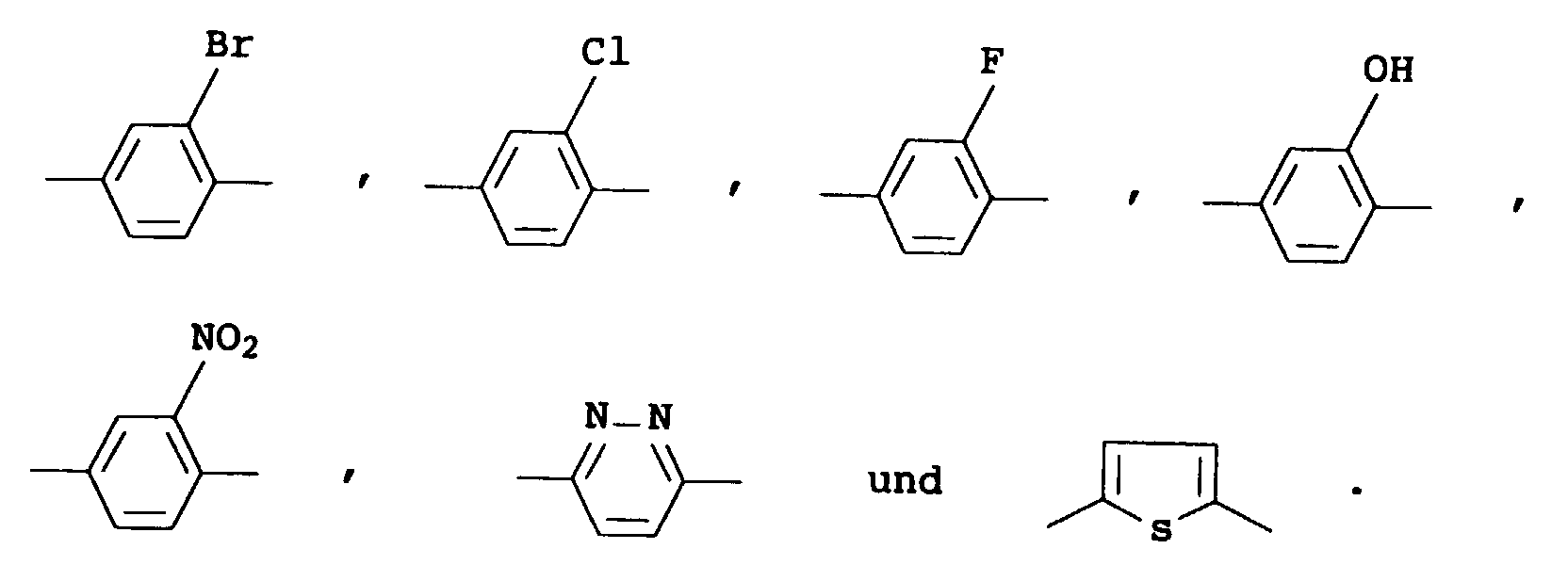


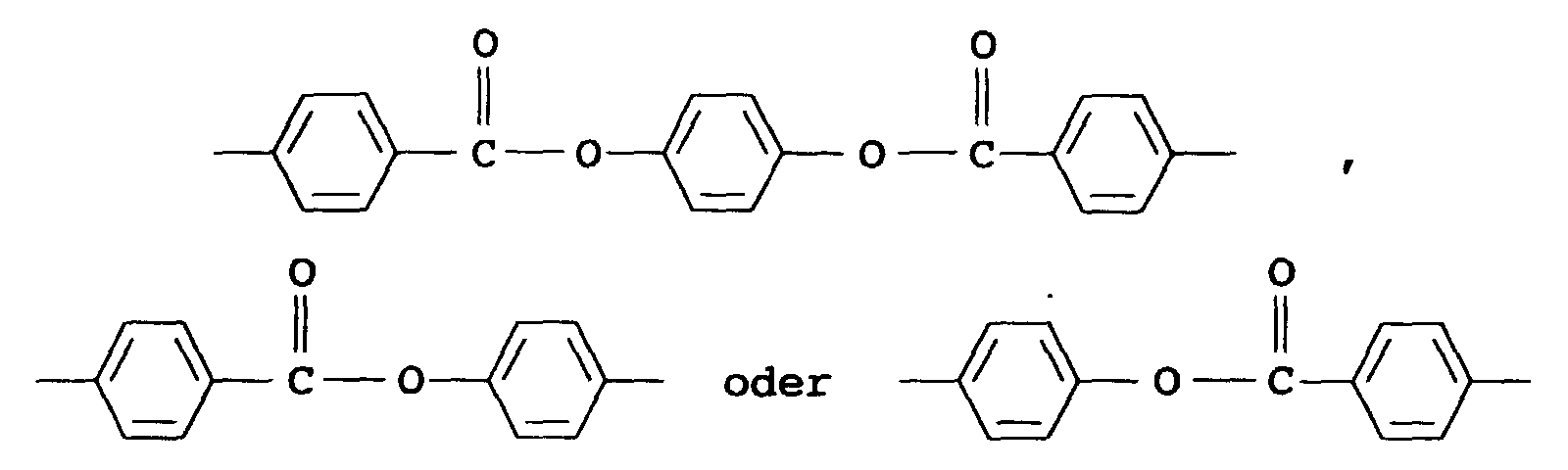
C1-C20-Alkyl, C1-C20-Alkoxy, C1-C20-Alkoxycarbonyl, C1-C20-Monoalkylaminocarbonyl, C1-C20-Alkylcarbonyl, C1-C20-Alkylcarbonyloxy, C1-C20-Alkylcarbonylamino, Formyl, Halogen, Cyan, Hydroxy oder Nitro.

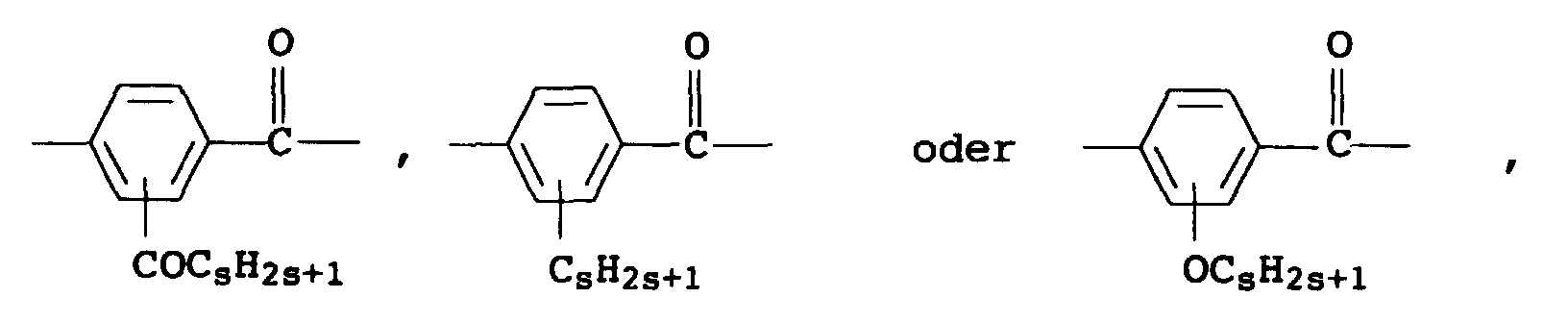
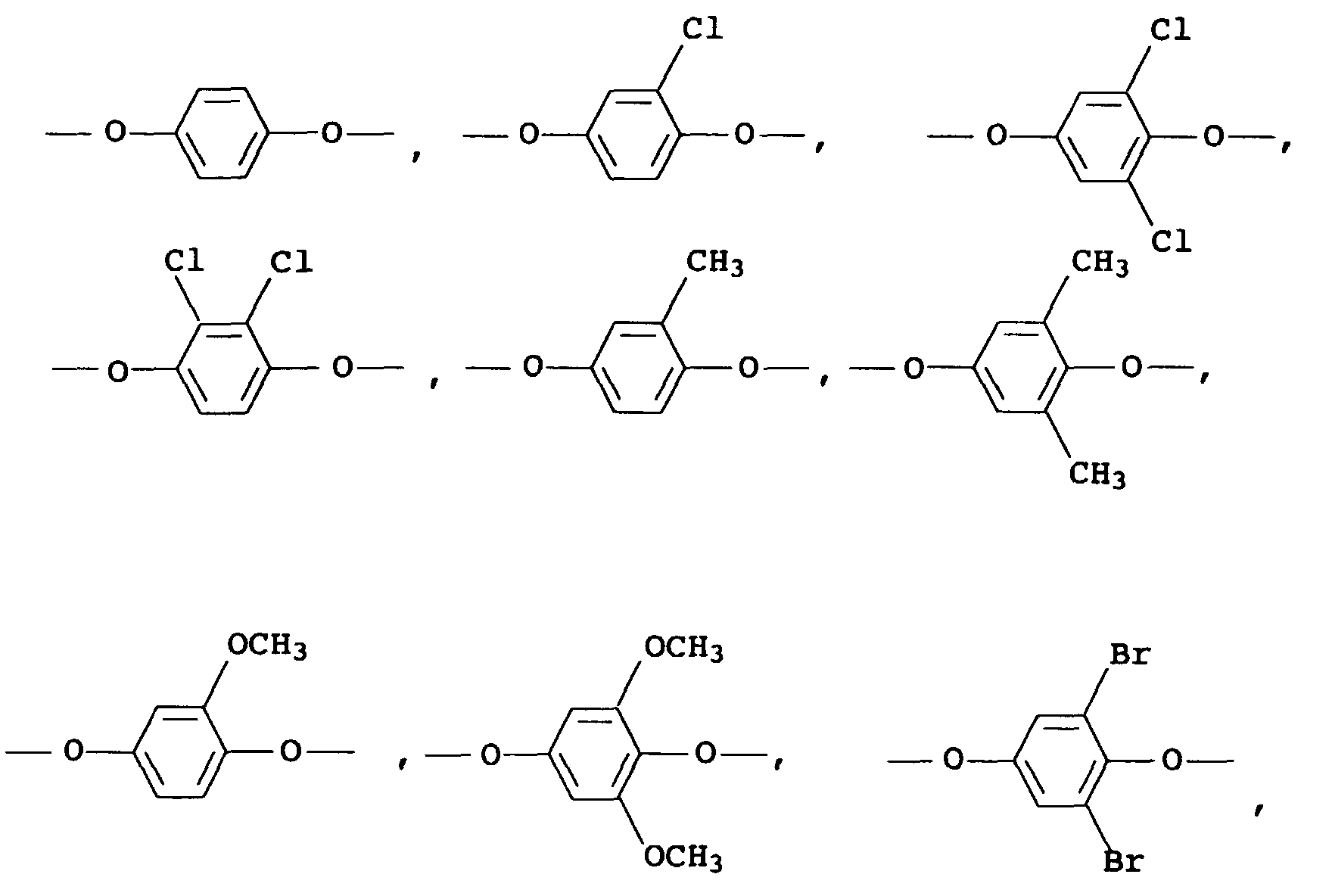


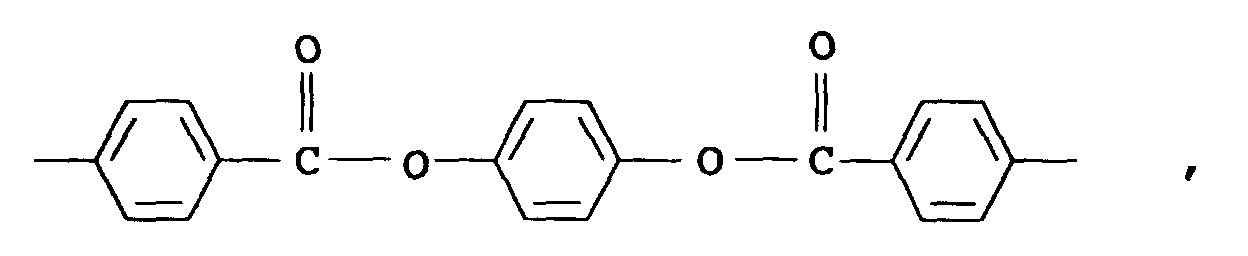
- Y5
- für

- T
-

- r
- für 2,

- Y5
- für eine chemische Einfachbindung,
- T
-

und(gesättigt heterocyclisch), und
- r
- für 1,)
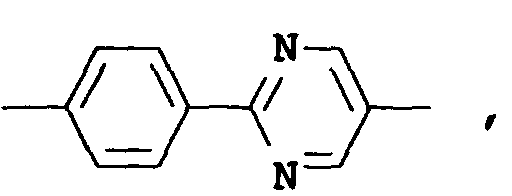
- Y5
- für eine chemische Einfachbindung,
- T
- und
 (ungesättigt heterocyclisch), und
- r
- für 1.


- L
- C1- bis C4-Alkyl, C1-C4-Alkoxy, Halogen, COOR, OCOR, CONHR
oder NHCOR ist und R C1-C4-Alkyl bedeutet.
(Die endständigen Striche in den aufgeführten Formeln geben die freien Valenzen an).
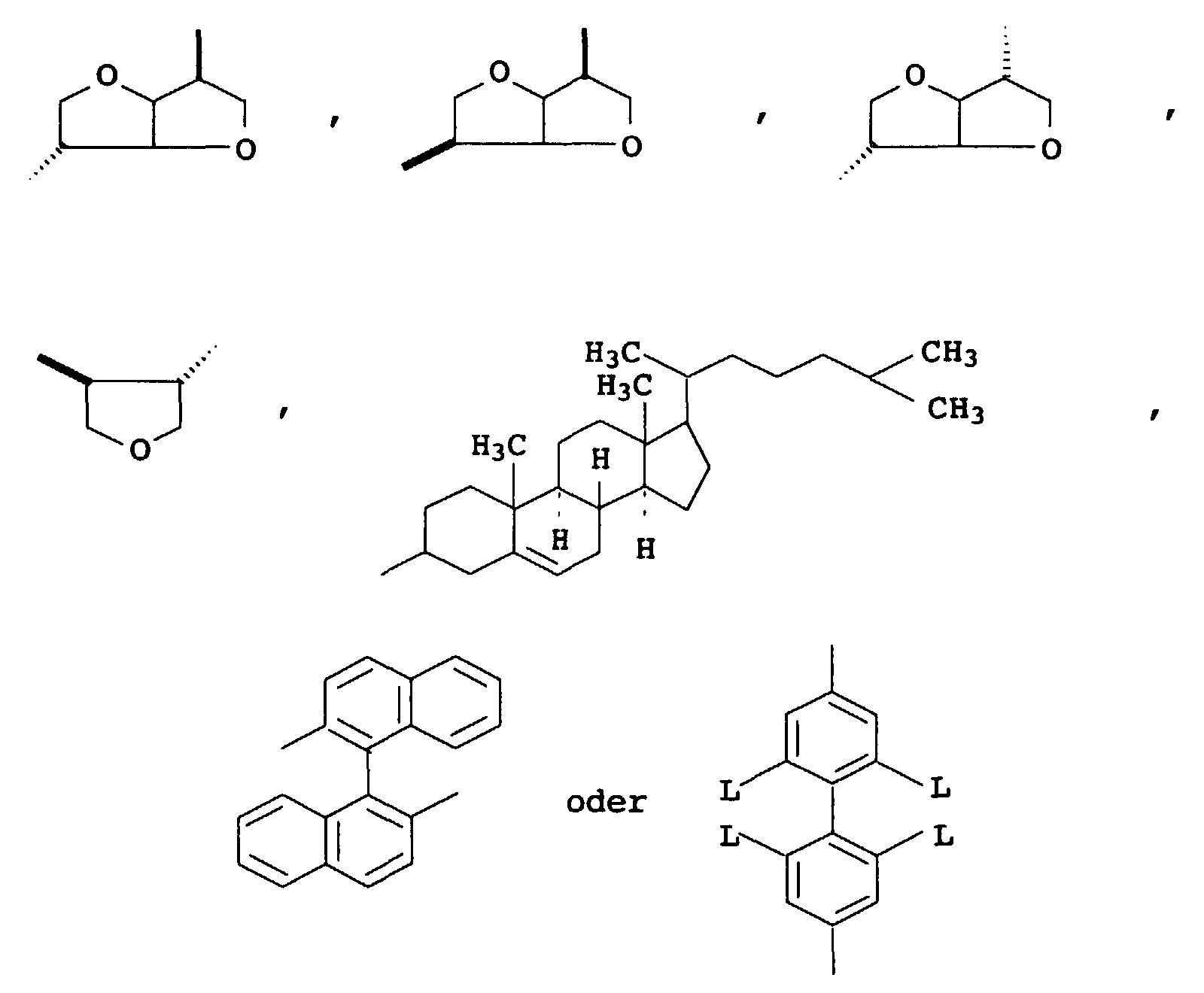
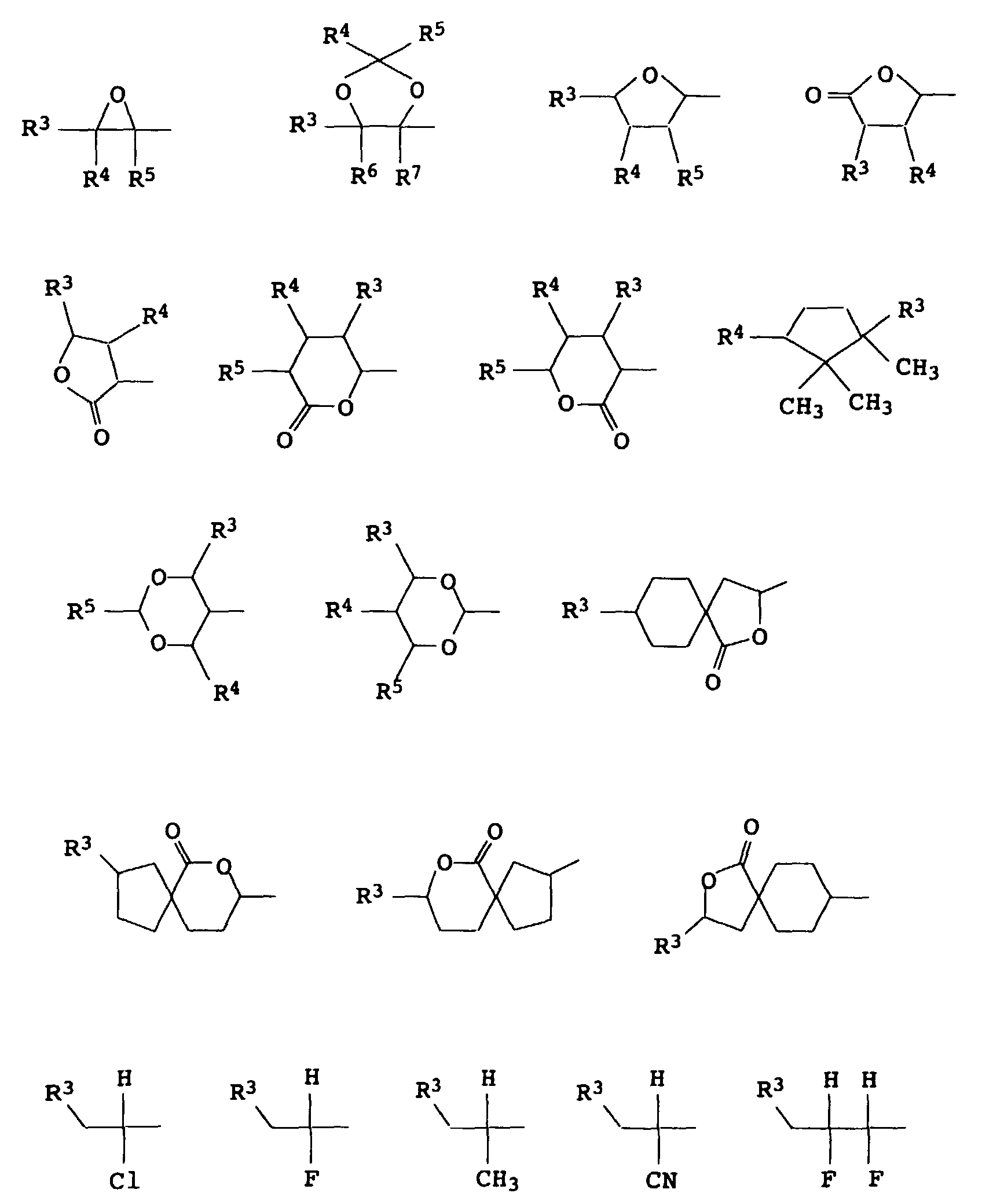
- Wasserstoff, oder
- einen geradkettigen oder verzweigten Alkylrest mit oder ohne
asymmetrischem Kohlenstoffatom mit 1 bis 16 C-Atomen, wobei
eine oder mehrere nicht benachbarte und nicht terminale CH2-Gruppen durch O ersetzt sein können und/oder
eine oder zwei CH2-Gruppen durch CH=CH- ersetzt sein können, stehen, oder - R4 und R5 zusammen auch -(CH2)4- oder -(CH2)5- bedeuten können, wenn sie an ein Oxiran-, Dioxolan-, Tetrahydrofuran-, Tetrahydropyran-, Butyrolacton- oder Valerolacton-System gebunden sind.
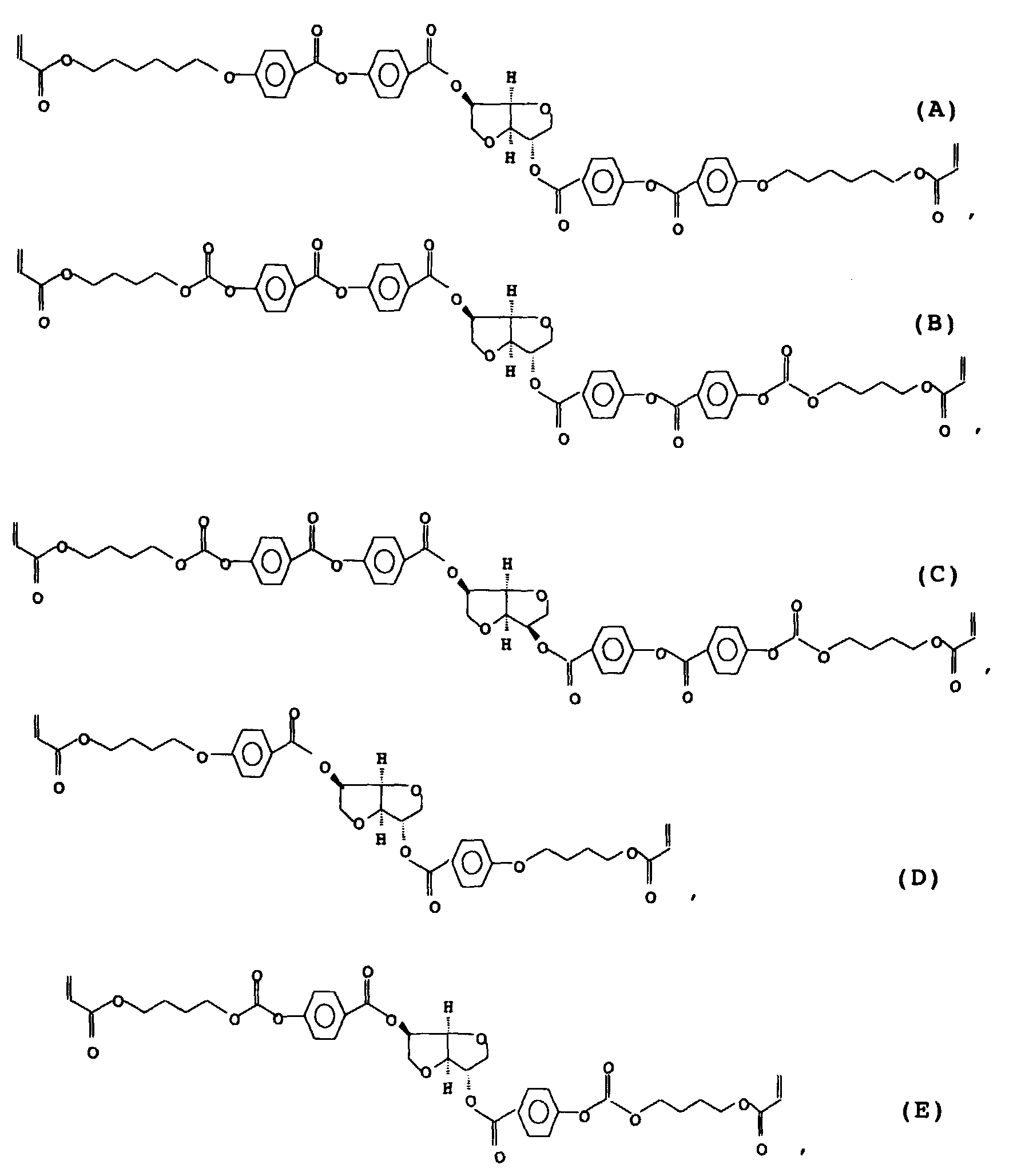
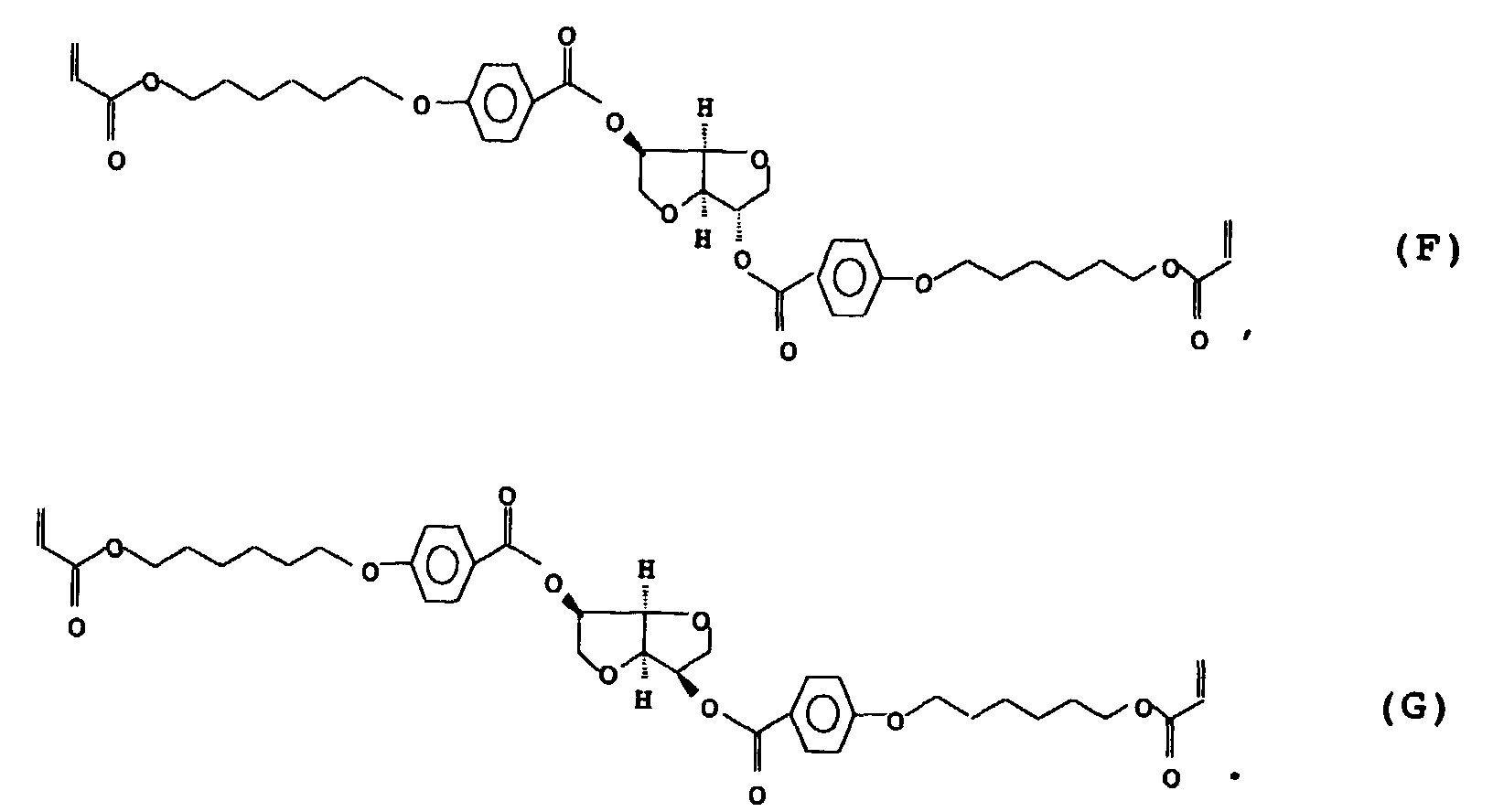

- Ester α,β-ungesättigter Mono- oder Dicarbonsäuren, insbesondere C3-C6-Mono- oder Dicarbonsäuren, mit C1-C12-Alkanolen, C2-C12 -Alkandiolen oder deren C1-C6-Alkylether und Phenylether, beispielsweise Acrylate und Methacrylate, Hydroxyethyl- oder Hydroxypropylacrylat oder -methacrylat sowie 2-Ethoxyethylacrylat oder -methacrylat;
- Vinyl-C1-C12-alkylether, wie Vinylethyl-, Vinylhexyl- oder Vinyloctylether;
- Vinylester von C1-C12-Carbonsäuren, wie Vinylacetat, Vinylpropionat Vinyllaurat;
- C3-C9-Epoxide, wie 1,2-Butylenoxid, Styroloxid;
- N-Vinylpyrrolidon, N-Vinylcaprolactam, N-Vinylformamid;
- vinylaromatische Verbindungen, wie Styrol, α-Methylstyrol, Chlorstyrol und
- Verbindungen mit zwei oder mehreren vernetzbaren Gruppen wie Diester von Diolen (einschliesslich Polyethylenglykole) mit Acryl- oder Methacrylsäure oder Divinylbenzol.
- Es findet keine störende Diffusion von Bestandteilen des Trägers oder der Releaseschicht in die darüberliegenden cholesterischen Schichten statt;
- nach dem Ablösen der cholesterischen Schichten von der auf dem Träger verbleibenden Releaseschicht ist dieser für weitere Beschichtungsvorgänge verwendbar.
| Probe gemäss | Brillanz | Farbshift |
| Beispiel 1 (Releaseschicht) | gut | - 1 mn |
| Beispiel 3 | gut | - 1 nm |
| Beispiel 4 | gut | - 4 nm |
| Beispiel 5 | schlecht | - 1 nm |
| Vgl.bsp. 1 | gut | -22 nm |
| Vgl.bsp. 2 | gut | -19 nm |
| Reflexionsmaxim um vor Behandlung | Reflexionsmaximum nach Behandlung | Haftkraft | |
| Beispiel 6 | 721 um | 721 um | > 8 cN |
| Vgl.bsp. 3a | 715 nm | 703 nm | 0,7 cN |
| Vgl.bsp. 3b | 718 um | 671 nm | 0,3 cN |
| Messung vor Behandlung | Messung nach Behandlung | Haftkraft | |
| Beispiel 7 | 524 nm | 523 nm | > 8 cN |
| Vgl.bsp. 4a | 525 nm | 519 nm | 0,6 cN |
| Vgl.bsp. 4b | 525 nm | 506 nm | 0,3 cN |
| Schichtdicke | Haftkraft | |
| 2. cholesterische Schicht | 2,5 µm | 0,4 cN |
| 1. cholesterische Schicht | 2,5 µm | > 8 cN |
| PET-Schichtträger | 14 µm |
| Schichtdicke | Haftkraft | |
| 2. cholesterische Schicht | 2,5 µm | 2,3 cN |
| 1. cholesterische Schicht | 2,5 µm | 0,7 cN |
| PET-Schichtträger | 14 µm |
| Probe | Änderungen der Wellenlänge bei Einbrenntemperatur | |
| 80°C zu 130°C | 80°C zu 160°C | |
| Beispiel 8 | 0 nm | 0 nm |
| Vgl.bsp. 3a | - 4 nm | - 4 nm |
| Vgl.bsp. 3b | - 10 nm | - 10 nm |
| Vgl.bsp. 4a | - 3 nm | - 4 nm |
| Vgl.bsp. 4b | - 13 nm | - 13 nm |
- 9,55 g
- Nemat der Formel (H)
- 23,33 g
- THF, NaOH getrocknet
- 0,45 g
- Verdriller der Formel (B)
- 0,10 g
- Byk 361, 10%ig in THF
- 0,20 g
- Irgacure 184
| Versuchsnummer | Giessgeschwindigkeit | Lampenleistung |
| A | 10 m/min | 100% |
| B | 20 m/min | 100% |
| C | 30 m/min | 100% |
| D | 40 m/min | 100% |
| D1 | 40 m/min | 80% |
| D2 | 40 m/min | 60% |
| D3 | 40 m/min | 40% |
| Nummer | Giessgeschw. | Lampenleistung | Δ Reflexionsmaximum nach Xylolbehandlung [nm] |
| A | 10 m/min | 100% | + 1 |
| B | 20 m/min | 100% | - 6 |
| C | 30 m/min | 100% | -10 |
| D | 40 m/min | 100% | -10 |
| D1 | 40 m/min | 80% | -15 |
| D2 | 40 m/min | 60% | -21 |
| D3 | 40 m/min | 40% | -38 |
| Nummer | Giessgeschwindigkeit/Verweilzeit UV | Lampenleistung | Δ Refl.max. (nm) | Haftung (cN) |
| A | 10 m/min / 120 msec | 100% / 120 W/cm | + 1 | > 7,5 |
| B | 20 m/min / 60 msec | 100% / 120 W/cm | - 6 | |
| C | 30 m/min / 40 msec | 100% / 120 W/cm | - 10 | |
| D | 40 m/min / 30 msec | 100% / 120 W/cm | - 10 | 3,7 |
| D1 | 40 m/min / 30 msec | 80% / 96 W/cm | - 15 | |
| D2 | 40 m/min / 30 msec | 60% / 72 W/cm | - 21 | |
| D3 | 40 m/min / 30 msec | 40% / 48 W/cm | - 36 | 0 |
Claims (25)
- Cholesterisches Schichtmaterial, umfassend wenigstens eine dreidimensional vernetzte, orientierte cholesterische Schicht, dadurch gekennzeichnet, dass die vernetzte(n) cholesterische(n) Schicht(en) keinen durch externe Stimuli induzierbaren Farbshift zeigt (zeigen).
- Cholesterisches Schichtmaterial nach Anspruch 1, dadurch gekennzeichnet, dass die externen Stimuli ausgewählt sind unter Veränderungen der Temperatur des Schichtmaterials, wie insbesondere Erwärmen, Einwirken von Verdünnungsmitteln auf das Schichtmaterial und Kombinationen davon.
- Cholesterisches Schichtmaterial nach Anspruch 2, dadurch gekennzeichnet, dass es keinen Farbshift zeigt beia) Änderung der Temperatur im Bereich von -30°C bis 250°C;b) Erwärmen auf Temperaturen im Bereich von 80 bis 160°C und gleichzeitiger Einwirkung eines Verdünnungsmittels; und/oderc) 15-minütiger Behandlung bei 80°C in Xylol und anschliessendem Trocknen.
- Cholesterisches Schichtmaterial nach einem der vorherigen Ansprüche, dadurch gekennzeichnet, dass das Reflexionsmaximum der cholesterischen Schicht nach der Xylolbehandlung um nicht mehr als etwa 10 um in den höheren oder niedrigeren Wellenlängenbereich verschiebbar ist.
- Cholesterisches Schichtmaterial nach einem der vorherigen Ansprüche, dadurch gekennzeichnet, dass die cholesterische Schicht eine mittlere Trockenschichtdicke von weniger als etwa 5 µm, insbesondere weniger als etwa 2 µm, vorzugsweise kleiner oder gleich etwa 1 µm, aufweist.
- Cholesterisches Schichtmaterial nach einem der vorherigen Ansprüche, dadurch gekennzeichnet, dass die cholesterische Schicht eine mittlere Trockenschichtdicke von mindestens einer Pitch-Höhe aufweist.
- Cholesterisches Schichtmaterial nach einem der vorherigen Ansprüche, dadurch gekennzeichnet, dass es mehrere farbshiftbeständige cholesterische Schichten gleicher oder verschiedener Dicke und gleicher oder verschiedener chemischer Zusammensetzung umfasst.
- Cholesterisches Pigment, umfassend wenigstens eine vernetzte orientierte cholesterische Schicht, mit einer mittleren Teilchengrösse im Bereich von 5 bis 50 µm und eine Dicke von 0,2 bis 5 µm, dadurch gekennzeichnet, dass die vernetzte(n) cholesterische(n) Schicht(en) keinen visuell erkennbaren Farbshift zeigt (zeigen).
- Verfahren zur Herstellung eines cholesterischen Schichtmaterials nach Anspruch 1, gekennzeichnet durch:a) Aufgiessen und dabei Orientieren einer cholesterischen Beschichtungsmasse, die wenigstens eine vernetzbare Substanz unfasst, auf einen Träger unter Ausbildung einer ersten cholesterischen Schicht, wobei der Träger im Wesentlichen chemisch inert gegenüber der auf zutragenden cholesterischen Schicht ist;b) Trocknen und Vernetzung der aufgetragenen Schicht, wobei die Bedingungen so gewählt werden, dass die erhaltene Schicht keinen visuell erkennbaren Farbshift zeigt;c) Entfernen des Schichtmaterials vom Träger, nachdem gegebenenfalls eine oder mehrere weitere orientierte, cholesterische Schichten auf die gemäss Schritt a) erhaltenen Schicht aufgetragen wurden.
- Verfahren nach Anspruch 9, dadurch gekennzeichnet, dass ein Träger eingesetzt wird, der die Orientierung der darauf aufgegossenen cholesterischen Schicht während der Trocknung und Härtung nicht stört.
- Verfahren nach einem der Ansprüche 9 und 10, dadurch gekennzeichnet, dass der Träger gegenüber der auf ihn aufgegossenen, getrockneten und vernetzten ersten cholesterischen Schicht eine Haftkraft von weniger als etwa 1 cN besitzt.
- Verfahren nach einem der Ansprüche 9 bis 11, dadurch gekennzeichnet, dass man ein Schichtmaterial, umfassend mehrere cholesterische Schichten, herstellt, wobei die zweite Schicht im Verbund mit gegebenenfalls weiteren Schichten selektiv von der ersten, auf dem Träger befindlichen Schicht entfernbar ist.
- Verfahren nach einem der Ansprüche 9 bis 12, dadurch gekennzeichnet, dass der Träger ausgewählt ist unter einem Kunststoff-, Metall-, Glas- oder Keramikträger.
- Verfahren nach Anspruch 13, dadurch gekennzeichnet, dass der Kunststoffträger eine Releaseschicht aus vernetztem, vorzugsweise orientiertem, cholesterischem Material umfasst, auf welche die erste cholesterische Schicht aufgegossen wird.
- Verfahren nach Anspruch 14, dadurch gekennzeichnet, dass die Haftkraft zwischen Kunststoffträger und Releaseschicht mindestens etwa zweifach grösser ist als die Haftkraft zwischen Releaseschicht und erster cholesterischer Schicht.
- Verfahren nach einem der Ansprüche 9 bis 15, dadurch gekennzeichnet, dass die Beschichtungsmassen für die cholesterische(n) Schicht(en) und der Releaseschicht unabhängig voneinander eine Viskosität im Bereich von etwa 1 bis 50 mPas besitzen und die Beschichtungsgeschwindigkeit im Bereich von etwa 1 bis 800 m/min liegt.
- Verfahren nach einem der Ansprüche 9 bis 16, dadurch gekennzeichnet, dass die Vernetzung der cholesterischen Schicht(en) und der gegebenfalls vorliegenden cholesterischen Releaseschicht durch Elektronenstrahlen oder UV-Strahlung bei gleichzeitigem Erwärmen der zu härtenden Schicht erfolgt, wobei die Strahlerleistung im Bereich von etwa 50 bis 200 Watt/cm liegt.
- Verfahren nach Anspruch 17, dadurch gekennzeichnet, dass die Schichttemperatur während der Strahlungshärtung mindestens 60°C, insbesondere mindestens 80°C, vorzugsweise mindestens 90°C, beträgt.
- Verfahren nach einem der Ansprüche 9 bis 18, dadurch gekennzeichnet, dass man auf die zuletzt aufgetragene cholesterische Schicht eine weitere Trägerfolie aufbringt und die eine oder mehreren cholesterischen Schichten im Verbund vom Träger entfernt.
- Verfahren nach einem der Ansprüche 9 bis 18, dadurch gekennzeichnet, dass man eine oder mehreren cholesterischen Schichten vom Träger durch Abblasen mit Druckluft, Wasserstrahl, Wasserdampf oder mit Hilfe einer Rakel entfernt und zu Pigmenten vermahlt.
- Zusammensetzung, enthaltend wenigstens ein cholesterisches Pigment nach Anspruch 8.
- Verwendung von Schichtmaterial nach einem der Ansprüche 1 bis 7 oder von Pigmenten nach Anspruch 8 im Fahrzeug- oder Fahrzeugzubehörsektor, im EDV-, Freizeit-, Sport- und Spielsektor, in optischen Bauelementen, wie Polarisatoren oder Filter, im Kosmetikbereich, im Textil-, Leder- oder Schmuckbereich, bei Geschenkartikeln, bei Schreibutensilien, oder auf Brillengestellen, im Bausektor, im Haushaltssektor, bei Drukkerzeugnissen aller Art, bei der Herstellung von Lacken oder Farben, zur fälschungserschwerenden Bearbeitung von Gegenständen.
- Verwendung einer Zusammensetzung nach Anspruch 21 zur Beschichtung von Gebrauchsgegenständen oder zur Lackierung von Fahrzeugen.
- Polarisator, umfassend ein Schichtmaterial nach einem der Ansprüche 1 bis 7, gegebenenfalls aufgetragen auf eine Trägerfolie.
- Breitbandpolarisator, umfassend ein Schichtmaterial nach einem der Ansprüche 1 bis 7 mit einer Anzahl von 3 bis 20 cholesterischer Schichten mit aufeinander abgestimmten Reflexionsmaxima, wobei der Polarisator eine Gesamtdicke (ohne Trägerfolie) im Bereich von etwa 2 bis 50 µm besitzt.
Applications Claiming Priority (2)
| Application Number | Priority Date | Filing Date | Title |
|---|---|---|---|
| DE19940681 | 1999-08-27 | ||
| DE19940681A DE19940681A1 (de) | 1999-08-27 | 1999-08-27 | Cholesterisches Schichtmaterial mit verbesserter Farbbeständigkeit und Verfahren zu dessen Herstellung |
Publications (2)
| Publication Number | Publication Date |
|---|---|
| EP1078974A1 true EP1078974A1 (de) | 2001-02-28 |
| EP1078974B1 EP1078974B1 (de) | 2004-03-03 |
Family
ID=7919800
Family Applications (1)
| Application Number | Title | Priority Date | Filing Date |
|---|---|---|---|
| EP00118521A Expired - Lifetime EP1078974B1 (de) | 1999-08-27 | 2000-08-25 | Cholesterisches Schichtmaterial mit verbesserter Farbbeständigkeit und Verfahren zu dessen Herstellung |
Country Status (7)
| Country | Link |
|---|---|
| US (1) | US6850310B1 (de) |
| EP (1) | EP1078974B1 (de) |
| JP (1) | JP2001154024A (de) |
| KR (1) | KR100853162B1 (de) |
| AT (1) | ATE260963T1 (de) |
| CA (1) | CA2316702A1 (de) |
| DE (2) | DE19940681A1 (de) |
Cited By (3)
| Publication number | Priority date | Publication date | Assignee | Title |
|---|---|---|---|---|
| EP1424369A1 (de) * | 2002-11-18 | 2004-06-02 | Benecke-Kaliko Aktiengesellschaft | Verbundgebilde mit einem Gehalt an Effekt-Pigmenten, Verfahren zu dessen Herstellung und dessen Verwendung |
| CN102959437A (zh) * | 2010-07-26 | 2013-03-06 | 大日本印刷株式会社 | 电磁波反射膜及其制造方法 |
| WO2021032518A1 (en) | 2019-08-19 | 2021-02-25 | Basf Se | A process for the production of fingerprint texture free liquid crystal films |
Families Citing this family (12)
| Publication number | Priority date | Publication date | Assignee | Title |
|---|---|---|---|---|
| JP2002097392A (ja) * | 2000-09-22 | 2002-04-02 | Toppan Forms Co Ltd | 偽造防止用インキおよびそれを用いた偽造防止用シート |
| DE50305634D1 (de) * | 2003-06-11 | 2006-12-21 | Contitech Elastomer Besch Gmbh | Verbundmaterial für Cabriolet-Fahrzeugabdeckungen |
| JP4688431B2 (ja) * | 2004-04-21 | 2011-05-25 | 日東電工株式会社 | フラットパネルディスプレイ用マザーガラス保護フィルムおよびその用途 |
| JP4455139B2 (ja) * | 2004-04-21 | 2010-04-21 | 日東電工株式会社 | フラットパネルディスプレイ用マザーガラス保護フィルムおよびその用途 |
| JP2008102271A (ja) * | 2006-10-18 | 2008-05-01 | Nitto Denko Corp | 表面保護フィルムおよび表面保護フィルム付き光学フィルム |
| MY155884A (en) * | 2008-04-04 | 2015-12-15 | Hitachi Chemical Co Ltd | Two-layered laminate having metal foil cladded on its one surface, method for production of the laminate, single-sided printed wiring board, and method for production of the wiring board |
| US9320687B2 (en) | 2013-03-13 | 2016-04-26 | Johnson & Johnson Consumer Inc. | Pigmented skin-care compositions |
| US9168209B2 (en) | 2013-03-13 | 2015-10-27 | Johnson & Johnson Consumer Inc. | Pigmented skin-care compositions |
| US9168394B2 (en) | 2013-03-13 | 2015-10-27 | Johnson & Johnson Consumer Inc. | Pigmented skin-care compositions |
| US9168393B2 (en) | 2013-03-13 | 2015-10-27 | Johnson & Johnson Consumer Inc. | Pigmented skin-care compositions |
| CN103343014B (zh) | 2013-06-21 | 2014-12-03 | 惠州市华阳光学技术有限公司 | 一种液体着色物 |
| JP2015063478A (ja) * | 2013-09-24 | 2015-04-09 | 富士フイルム株式会社 | メイクアップ化粧料 |
Citations (6)
| Publication number | Priority date | Publication date | Assignee | Title |
|---|---|---|---|---|
| DE4240743A1 (de) * | 1992-12-03 | 1994-06-09 | Consortium Elektrochem Ind | Pigmente mit vom Betrachtungswinkel abhängiger Farbigkeit, ihre Herstellung und Verwendung |
| EP0724005A2 (de) * | 1995-01-26 | 1996-07-31 | Daimler-Benz Aktiengesellschaft | Pigment mit vom Betrachungswinkel abhängiger Farbigkeit, dessen Herstellung sowie Verwendung in einem Lack, insbesondere für Kraftfahrzeuge |
| DE19726050A1 (de) * | 1997-06-19 | 1998-12-24 | Wacker Chemie Gmbh | Mischung enthaltend Pigmente mit flüssigkristalliner Struktur mit chiraler Phase sowie ihrer Verwendung |
| WO1999011719A1 (de) * | 1997-09-02 | 1999-03-11 | Basf Aktiengesellschaft | Mehrschichtige cholesterische pigmente |
| DE19739263A1 (de) * | 1997-09-08 | 1999-03-11 | Clariant Gmbh | Verfahren zur Herstellung von dünnen Filmen aus nicht-wäßriger Dispersion und daraus hergestellte Effektpigmente mit vom Betrachtungswinkel abhängiger Farbigkeit |
| DE19757699A1 (de) * | 1997-12-23 | 1999-06-24 | Basf Ag | Mehrschichtige cholesterische Pigmente |
Family Cites Families (35)
| Publication number | Priority date | Publication date | Assignee | Title |
|---|---|---|---|---|
| DE3830592A1 (de) | 1988-09-08 | 1990-04-12 | Consortium Elektrochem Ind | (meth)acryloxygruppen enthaltende fluessigkristalline polyorganosiloxane |
| JP2991577B2 (ja) * | 1992-11-13 | 1999-12-20 | 日本放送協会 | 液晶素子の駆動方法、液晶装置および照明装置 |
| DE4342280A1 (de) | 1993-12-11 | 1995-06-14 | Basf Ag | Polymerisierbare chirale Verbindungen und deren Verwendung |
| DE4418075C2 (de) * | 1994-05-24 | 2000-06-29 | Daimler Chrysler Ag | Effektlack bzw. Effektlackierung, insbesondere für Fahrzeugkarosserien, unter Verwendung von flüssigkristallinen Interferenzpigmenten |
| DE4416191A1 (de) * | 1994-05-06 | 1995-11-09 | Consortium Elektrochem Ind | Interferenzpigmente aus in cholesterischer Anordnung fixierten Molekülen sowie deren Verwendung |
| DE4419239A1 (de) * | 1994-06-01 | 1995-12-07 | Consortium Elektrochem Ind | Optische Elemente mit farb- und polarisationsselektiver Reflexion enthaltend LC-Pigmente sowie Herstellung dieser Elemente |
| DE19520704A1 (de) | 1995-06-09 | 1996-12-12 | Basf Ag | Polymerisierbare chirale Verbindungen und deren Verwendung |
| DE19520660A1 (de) | 1995-06-09 | 1996-12-12 | Basf Ag | Polymerisierbare chirale Verbindungen und deren Verwendung |
| DE19532408A1 (de) | 1995-09-01 | 1997-03-06 | Basf Ag | Polymerisierbare flüssigkristalline Verbindungen |
| DE19541820A1 (de) | 1995-11-09 | 1997-05-15 | Consortium Elektrochem Ind | Chirale Dianhydrohexit-Derivate enthaltende flüssigkristalline Organosiloxane |
| DE19602848A1 (de) | 1996-01-26 | 1997-07-31 | Basf Ag | Verfahren zur Herstellung von Pigmenten |
| EP1132451A1 (de) * | 1996-02-15 | 2001-09-12 | MERCK PATENT GmbH | Cholesterische Flocke |
| DE19619460A1 (de) | 1996-05-14 | 1997-11-20 | Consortium Elektrochem Ind | Flüssigkristallmischungen, Verfahren zu ihrer Herstellung und ihre Verwendung |
| DE19625441A1 (de) | 1996-06-25 | 1998-01-02 | Basf Ag | Chirale Dotierstoffe für flüssigkristalline Medien |
| DE19628700A1 (de) | 1996-07-17 | 1998-01-22 | Basf Ag | Flüssigkristalline Zuckerderivate |
| DE19630068A1 (de) | 1996-07-25 | 1998-01-29 | Basf Ag | Neue flüssigkristalline Verbindungen und deren Vorprodukte |
| DE19631658A1 (de) | 1996-08-05 | 1998-02-12 | Basf Ag | Chiral nematische Polycarbonate |
| JPH10206636A (ja) * | 1997-01-17 | 1998-08-07 | Nitto Denko Corp | 偏光素子、照明装置及び液晶表示装置 |
| DE19704506A1 (de) | 1997-02-06 | 1998-08-13 | Basf Ag | Chiral nematische Polyester |
| DE19713638A1 (de) | 1997-04-02 | 1998-10-08 | Basf Ag | Mischester von Hydroxyalkylcellulosen |
| DE19715993A1 (de) * | 1997-04-17 | 1998-10-22 | Clariant Gmbh | Polymerlaminate mit erhöhtem Deckvermögen |
| DE19716822A1 (de) | 1997-04-22 | 1998-10-29 | Basf Ag | Verfahren zur Herstellung polymerisierbarer flüssigkristalliner Verbindungen |
| DE19717371A1 (de) | 1997-04-24 | 1998-10-29 | Basf Ag | Propargyl-terminierte, nematische oder cholesterische Polymere |
| DE19718293A1 (de) * | 1997-04-30 | 1999-03-18 | Consortium Elektrochem Ind | Verfahren zur Herstellung von dreidimensional vernetzten polymeren Materialien mit breiten cholesterischen Reflexionsbanden und nach diesem Verfahren hergestellte Filter, Reflektoren und Polarisatoren |
| DE19835730A1 (de) | 1997-08-18 | 1999-02-25 | Basf Ag | Flüssigkristalline Verbindungen |
| JPH11130966A (ja) | 1997-08-28 | 1999-05-18 | Mitsui Mining & Smelting Co Ltd | 金属半導体微粉末含有熱線非吸収性着色組成物及び成型物 |
| DE19738369A1 (de) | 1997-09-02 | 1999-03-25 | Basf Ag | Cholesterische Effektpigmente und Verfahren zu deren Herstellung |
| DE19738368A1 (de) | 1997-09-02 | 1999-03-04 | Basf Ag | Mehrschichtige cholesterische Pigmente |
| US6410130B1 (en) | 1997-09-02 | 2002-06-25 | Basf Aktiengesellschaft | Coatings with a cholesteric effect and method for the production thereof |
| DE19843724A1 (de) | 1997-10-08 | 1999-04-15 | Basf Ag | Polymerisierbare chirale Verbindungen und deren Verwendung |
| DE19749123A1 (de) | 1997-11-06 | 1999-05-12 | Basf Ag | Cholesterische Oligomere mit vernetzbaren Endgruppen |
| JP2000085258A (ja) | 1998-09-10 | 2000-03-28 | Riso Kagaku Corp | 感熱孔版原紙 |
| JP2000085257A (ja) | 1998-09-10 | 2000-03-28 | Riso Kagaku Corp | 孔版原紙及びその製版方法 |
| KR100675997B1 (ko) * | 1999-07-02 | 2007-01-29 | 메르크 파텐트 게엠베하 | 다층 콜레스테릭 필름의 제조 방법 |
| KR100675996B1 (ko) * | 1999-07-02 | 2007-01-29 | 메르크 파텐트 게엠베하 | 다층 콜레스테릭 필름의 제조 방법 |
-
1999
- 1999-08-27 DE DE19940681A patent/DE19940681A1/de not_active Withdrawn
-
2000
- 2000-08-24 CA CA002316702A patent/CA2316702A1/en not_active Abandoned
- 2000-08-25 EP EP00118521A patent/EP1078974B1/de not_active Expired - Lifetime
- 2000-08-25 KR KR1020000049662A patent/KR100853162B1/ko not_active Expired - Fee Related
- 2000-08-25 JP JP2000255435A patent/JP2001154024A/ja active Pending
- 2000-08-25 US US09/648,368 patent/US6850310B1/en not_active Expired - Lifetime
- 2000-08-25 AT AT00118521T patent/ATE260963T1/de not_active IP Right Cessation
- 2000-08-25 DE DE50005489T patent/DE50005489D1/de not_active Expired - Lifetime
Patent Citations (7)
| Publication number | Priority date | Publication date | Assignee | Title |
|---|---|---|---|---|
| DE4240743A1 (de) * | 1992-12-03 | 1994-06-09 | Consortium Elektrochem Ind | Pigmente mit vom Betrachtungswinkel abhängiger Farbigkeit, ihre Herstellung und Verwendung |
| EP0724005A2 (de) * | 1995-01-26 | 1996-07-31 | Daimler-Benz Aktiengesellschaft | Pigment mit vom Betrachungswinkel abhängiger Farbigkeit, dessen Herstellung sowie Verwendung in einem Lack, insbesondere für Kraftfahrzeuge |
| DE19726050A1 (de) * | 1997-06-19 | 1998-12-24 | Wacker Chemie Gmbh | Mischung enthaltend Pigmente mit flüssigkristalliner Struktur mit chiraler Phase sowie ihrer Verwendung |
| EP0887398A1 (de) * | 1997-06-19 | 1998-12-30 | Wacker-Chemie GmbH | Mischung enthaltend Pigmente mit flüssigkristalliner Struktur mit chiraler Phase sowie ihre Verwendung |
| WO1999011719A1 (de) * | 1997-09-02 | 1999-03-11 | Basf Aktiengesellschaft | Mehrschichtige cholesterische pigmente |
| DE19739263A1 (de) * | 1997-09-08 | 1999-03-11 | Clariant Gmbh | Verfahren zur Herstellung von dünnen Filmen aus nicht-wäßriger Dispersion und daraus hergestellte Effektpigmente mit vom Betrachtungswinkel abhängiger Farbigkeit |
| DE19757699A1 (de) * | 1997-12-23 | 1999-06-24 | Basf Ag | Mehrschichtige cholesterische Pigmente |
Cited By (3)
| Publication number | Priority date | Publication date | Assignee | Title |
|---|---|---|---|---|
| EP1424369A1 (de) * | 2002-11-18 | 2004-06-02 | Benecke-Kaliko Aktiengesellschaft | Verbundgebilde mit einem Gehalt an Effekt-Pigmenten, Verfahren zu dessen Herstellung und dessen Verwendung |
| CN102959437A (zh) * | 2010-07-26 | 2013-03-06 | 大日本印刷株式会社 | 电磁波反射膜及其制造方法 |
| WO2021032518A1 (en) | 2019-08-19 | 2021-02-25 | Basf Se | A process for the production of fingerprint texture free liquid crystal films |
Also Published As
| Publication number | Publication date |
|---|---|
| DE50005489D1 (de) | 2004-04-08 |
| KR20010070036A (ko) | 2001-07-25 |
| DE19940681A1 (de) | 2001-03-01 |
| EP1078974B1 (de) | 2004-03-03 |
| CA2316702A1 (en) | 2001-02-27 |
| JP2001154024A (ja) | 2001-06-08 |
| US6850310B1 (en) | 2005-02-01 |
| KR100853162B1 (ko) | 2008-08-20 |
| ATE260963T1 (de) | 2004-03-15 |
Similar Documents
| Publication | Publication Date | Title |
|---|---|---|
| EP1017755B1 (de) | Cholesterische effektschichten und verfahren zu deren herstellung | |
| EP1078975B1 (de) | Cholesterisches Schichtmaterial mit verbessertem Farbeindruck und Verfahren zu dessen Herstellung | |
| EP1009776B1 (de) | Mehrschichtige cholesterische pigmente | |
| EP1155097B1 (de) | Cholesterisches schichtmaterial und verfahren zu dessen herstellung | |
| EP0793693B1 (de) | Verfahren zum beschichten und bedrucken von substraten | |
| EP1078974B1 (de) | Cholesterisches Schichtmaterial mit verbesserter Farbbeständigkeit und Verfahren zu dessen Herstellung | |
| EP1084209B1 (de) | Mehrschichtige cholesterische pigmente | |
| EP0686674B1 (de) | Interferenzpigmente aus in cholesterischer Anordnung fixierten Molekülen sowie deren Verwendung | |
| EP0601483B1 (de) | Pigmente mit vom Betrachtungswinkel abhängiger Farbigkeit, ihre Herstellung und Verwendung | |
| DE60106311T2 (de) | Mehrschichtiger reflektierender Film oder Pigment mit von Blickwinkel abhängigen Reflektionseigenschaften | |
| DE69815076T2 (de) | Pigmentflocken | |
| EP0877776B1 (de) | Verfahren zur herstellung von pigmentpartikeln | |
| DE19738369A1 (de) | Cholesterische Effektpigmente und Verfahren zu deren Herstellung | |
| DE19738368A1 (de) | Mehrschichtige cholesterische Pigmente | |
| DE19757699A1 (de) | Mehrschichtige cholesterische Pigmente |
Legal Events
| Date | Code | Title | Description |
|---|---|---|---|
| PUAI | Public reference made under article 153(3) epc to a published international application that has entered the european phase |
Free format text: ORIGINAL CODE: 0009012 |
|
| AK | Designated contracting states |
Kind code of ref document: A1 Designated state(s): AT BE CH CY DE DK ES FI FR GB GR IE IT LI LU MC NL PT SE |
|
| AX | Request for extension of the european patent |
Free format text: AL;LT;LV;MK;RO;SI |
|
| 17P | Request for examination filed |
Effective date: 20010621 |
|
| AKX | Designation fees paid |
Free format text: AT BE CH CY DE DK ES FI FR GB GR IE IT LI LU MC NL PT SE |
|
| 17Q | First examination report despatched |
Effective date: 20020222 |
|
| GRAP | Despatch of communication of intention to grant a patent |
Free format text: ORIGINAL CODE: EPIDOSNIGR1 |
|
| GRAS | Grant fee paid |
Free format text: ORIGINAL CODE: EPIDOSNIGR3 |
|
| GRAA | (expected) grant |
Free format text: ORIGINAL CODE: 0009210 |
|
| AK | Designated contracting states |
Kind code of ref document: B1 Designated state(s): AT BE CH CY DE DK ES FI FR GB GR IE IT LI LU MC NL PT SE |
|
| PG25 | Lapsed in a contracting state [announced via postgrant information from national office to epo] |
Ref country code: IT Free format text: LAPSE BECAUSE OF FAILURE TO SUBMIT A TRANSLATION OF THE DESCRIPTION OR TO PAY THE FEE WITHIN THE PRE;WARNING: LAPSES OF ITALIAN PATENTS WITH EFFECTIVE DATE BEFORE 2007 MAY HAVE OCCURRED AT ANY TIME BEFORE 2007. THE CORRECT EFFECTIVE DATE MAY BE DIFFERENT FROM THE ONE RECORDED.SCRIBED TIME-LIMIT Effective date: 20040303 Ref country code: CY Free format text: LAPSE BECAUSE OF FAILURE TO SUBMIT A TRANSLATION OF THE DESCRIPTION OR TO PAY THE FEE WITHIN THE PRESCRIBED TIME-LIMIT Effective date: 20040303 Ref country code: IE Free format text: LAPSE BECAUSE OF FAILURE TO SUBMIT A TRANSLATION OF THE DESCRIPTION OR TO PAY THE FEE WITHIN THE PRESCRIBED TIME-LIMIT Effective date: 20040303 Ref country code: FI Free format text: LAPSE BECAUSE OF FAILURE TO SUBMIT A TRANSLATION OF THE DESCRIPTION OR TO PAY THE FEE WITHIN THE PRESCRIBED TIME-LIMIT Effective date: 20040303 |
|
| REG | Reference to a national code |
Ref country code: GB Ref legal event code: FG4D Free format text: NOT ENGLISH |
|
| REG | Reference to a national code |
Ref country code: CH Ref legal event code: EP |
|
| REG | Reference to a national code |
Ref country code: IE Ref legal event code: FG4D Free format text: GERMAN |
|
| REF | Corresponds to: |
Ref document number: 50005489 Country of ref document: DE Date of ref document: 20040408 Kind code of ref document: P |
|
| GBT | Gb: translation of ep patent filed (gb section 77(6)(a)/1977) |
Effective date: 20040407 |
|
| PG25 | Lapsed in a contracting state [announced via postgrant information from national office to epo] |
Ref country code: DK Free format text: LAPSE BECAUSE OF FAILURE TO SUBMIT A TRANSLATION OF THE DESCRIPTION OR TO PAY THE FEE WITHIN THE PRESCRIBED TIME-LIMIT Effective date: 20040603 Ref country code: SE Free format text: LAPSE BECAUSE OF FAILURE TO SUBMIT A TRANSLATION OF THE DESCRIPTION OR TO PAY THE FEE WITHIN THE PRESCRIBED TIME-LIMIT Effective date: 20040603 Ref country code: GR Free format text: LAPSE BECAUSE OF FAILURE TO SUBMIT A TRANSLATION OF THE DESCRIPTION OR TO PAY THE FEE WITHIN THE PRESCRIBED TIME-LIMIT Effective date: 20040603 |
|
| PG25 | Lapsed in a contracting state [announced via postgrant information from national office to epo] |
Ref country code: ES Free format text: LAPSE BECAUSE OF FAILURE TO SUBMIT A TRANSLATION OF THE DESCRIPTION OR TO PAY THE FEE WITHIN THE PRESCRIBED TIME-LIMIT Effective date: 20040614 |
|
| PGFP | Annual fee paid to national office [announced via postgrant information from national office to epo] |
Ref country code: FR Payment date: 20040824 Year of fee payment: 5 |
|
| PG25 | Lapsed in a contracting state [announced via postgrant information from national office to epo] |
Ref country code: LU Free format text: LAPSE BECAUSE OF NON-PAYMENT OF DUE FEES Effective date: 20040825 Ref country code: AT Free format text: LAPSE BECAUSE OF NON-PAYMENT OF DUE FEES Effective date: 20040825 |
|
| PG25 | Lapsed in a contracting state [announced via postgrant information from national office to epo] |
Ref country code: MC Free format text: LAPSE BECAUSE OF NON-PAYMENT OF DUE FEES Effective date: 20040831 Ref country code: BE Free format text: LAPSE BECAUSE OF NON-PAYMENT OF DUE FEES Effective date: 20040831 |
|
| REG | Reference to a national code |
Ref country code: IE Ref legal event code: FD4D |
|
| ET | Fr: translation filed | ||
| PLBE | No opposition filed within time limit |
Free format text: ORIGINAL CODE: 0009261 |
|
| STAA | Information on the status of an ep patent application or granted ep patent |
Free format text: STATUS: NO OPPOSITION FILED WITHIN TIME LIMIT |
|
| 26N | No opposition filed |
Effective date: 20041206 |
|
| BERE | Be: lapsed |
Owner name: *BASF A.G. Effective date: 20040831 |
|
| PG25 | Lapsed in a contracting state [announced via postgrant information from national office to epo] |
Ref country code: FR Free format text: LAPSE BECAUSE OF NON-PAYMENT OF DUE FEES Effective date: 20060428 |
|
| REG | Reference to a national code |
Ref country code: FR Ref legal event code: ST Effective date: 20060428 |
|
| BERE | Be: lapsed |
Owner name: *BASF A.G. Effective date: 20040831 |
|
| PG25 | Lapsed in a contracting state [announced via postgrant information from national office to epo] |
Ref country code: PT Free format text: LAPSE BECAUSE OF NON-PAYMENT OF DUE FEES Effective date: 20040803 |
|
| PGFP | Annual fee paid to national office [announced via postgrant information from national office to epo] |
Ref country code: NL Payment date: 20070805 Year of fee payment: 8 |
|
| NLV4 | Nl: lapsed or anulled due to non-payment of the annual fee |
Effective date: 20090301 |
|
| PG25 | Lapsed in a contracting state [announced via postgrant information from national office to epo] |
Ref country code: NL Free format text: LAPSE BECAUSE OF NON-PAYMENT OF DUE FEES Effective date: 20090301 |
|
| PGFP | Annual fee paid to national office [announced via postgrant information from national office to epo] |
Ref country code: CH Payment date: 20180824 Year of fee payment: 19 Ref country code: GB Payment date: 20180831 Year of fee payment: 19 |
|
| PGFP | Annual fee paid to national office [announced via postgrant information from national office to epo] |
Ref country code: DE Payment date: 20181031 Year of fee payment: 19 |
|
| REG | Reference to a national code |
Ref country code: DE Ref legal event code: R119 Ref document number: 50005489 Country of ref document: DE |
|
| GBPC | Gb: european patent ceased through non-payment of renewal fee |
Effective date: 20190825 |
|
| PG25 | Lapsed in a contracting state [announced via postgrant information from national office to epo] |
Ref country code: CH Free format text: LAPSE BECAUSE OF NON-PAYMENT OF DUE FEES Effective date: 20190831 Ref country code: LI Free format text: LAPSE BECAUSE OF NON-PAYMENT OF DUE FEES Effective date: 20190831 |
|
| PG25 | Lapsed in a contracting state [announced via postgrant information from national office to epo] |
Ref country code: DE Free format text: LAPSE BECAUSE OF NON-PAYMENT OF DUE FEES Effective date: 20200303 |
|
| PG25 | Lapsed in a contracting state [announced via postgrant information from national office to epo] |
Ref country code: GB Free format text: LAPSE BECAUSE OF NON-PAYMENT OF DUE FEES Effective date: 20190825 |