EP1076654B1 - Verfahren zur kontinuierlichen herstellung von 1,3-dioxolan-2-onen - Google Patents
Verfahren zur kontinuierlichen herstellung von 1,3-dioxolan-2-onen Download PDFInfo
- Publication number
- EP1076654B1 EP1076654B1 EP99923434A EP99923434A EP1076654B1 EP 1076654 B1 EP1076654 B1 EP 1076654B1 EP 99923434 A EP99923434 A EP 99923434A EP 99923434 A EP99923434 A EP 99923434A EP 1076654 B1 EP1076654 B1 EP 1076654B1
- Authority
- EP
- European Patent Office
- Prior art keywords
- reactor
- reaction
- oxirane
- carbon dioxide
- catalyst
- Prior art date
- Legal status (The legal status is an assumption and is not a legal conclusion. Google has not performed a legal analysis and makes no representation as to the accuracy of the status listed.)
- Expired - Lifetime
Links
- 0 C*C(C(*)(*)OCO)N Chemical compound C*C(C(*)(*)OCO)N 0.000 description 1
Classifications
-
- C—CHEMISTRY; METALLURGY
- C07—ORGANIC CHEMISTRY
- C07D—HETEROCYCLIC COMPOUNDS
- C07D317/00—Heterocyclic compounds containing five-membered rings having two oxygen atoms as the only ring hetero atoms
- C07D317/08—Heterocyclic compounds containing five-membered rings having two oxygen atoms as the only ring hetero atoms having the hetero atoms in positions 1 and 3
- C07D317/10—Heterocyclic compounds containing five-membered rings having two oxygen atoms as the only ring hetero atoms having the hetero atoms in positions 1 and 3 not condensed with other rings
- C07D317/32—Heterocyclic compounds containing five-membered rings having two oxygen atoms as the only ring hetero atoms having the hetero atoms in positions 1 and 3 not condensed with other rings with hetero atoms or with carbon atoms having three bonds to hetero atoms with at the most one bond to halogen, e.g. ester or nitrile radicals, directly attached to ring carbon atoms
- C07D317/34—Oxygen atoms
- C07D317/36—Alkylene carbonates; Substituted alkylene carbonates
-
- C—CHEMISTRY; METALLURGY
- C07—ORGANIC CHEMISTRY
- C07D—HETEROCYCLIC COMPOUNDS
- C07D317/00—Heterocyclic compounds containing five-membered rings having two oxygen atoms as the only ring hetero atoms
- C07D317/08—Heterocyclic compounds containing five-membered rings having two oxygen atoms as the only ring hetero atoms having the hetero atoms in positions 1 and 3
- C07D317/10—Heterocyclic compounds containing five-membered rings having two oxygen atoms as the only ring hetero atoms having the hetero atoms in positions 1 and 3 not condensed with other rings
- C07D317/32—Heterocyclic compounds containing five-membered rings having two oxygen atoms as the only ring hetero atoms having the hetero atoms in positions 1 and 3 not condensed with other rings with hetero atoms or with carbon atoms having three bonds to hetero atoms with at the most one bond to halogen, e.g. ester or nitrile radicals, directly attached to ring carbon atoms
- C07D317/34—Oxygen atoms
- C07D317/36—Alkylene carbonates; Substituted alkylene carbonates
- C07D317/38—Ethylene carbonate
Definitions
- the present invention relates to an improved method for continuous production of 1,3-dioxolan-2-ones such as ethylene carbonate or propylene carbonate from the corresponding oxiranes and carbon dioxide in the liquid phase in the presence of a Catalyst.
- 1,3-dioxolan-2-ones such as ethylene carbonate or propylene carbonate from the corresponding oxiranes and carbon dioxide in the liquid phase in the presence of a Catalyst.
- the object of the present invention was to provide an improved To develop processes that have a particularly high turnover of the Oxirans, especially of at least 99.9%, with simultaneous high selectivity and high space-time yield allowed. Also the product should have such a high purity that by-products only occur in the ppm range. The desired high turnover will be achieved above all in that in the sense of present invention, a two-part reactor with countercurrent mode between oxirane and carbon dioxide.
- a process for the continuous production of 1,3-dioxolan-2-ones of the general formula I in which R 1 represents hydrogen or an organic radical having up to 40 C atoms and R 2 and R 3 each represent hydrogen or a C 1 to C 4 alkyl group, R 2 and R 3 also forming a five-membered group six-membered ring can be connected by reacting an oxirane of the general formula II with carbon dioxide in the liquid phase in the presence of a catalyst, which is characterized in that the reaction is carried out in a two-part reactor in which the reaction with backmixing in the first part up to a conversion of oxirane II of at least 80%, in particular at least 90 %, and in the second part the reaction is completed under non-backmixing conditions, the carbon dioxide being conducted in counter-current to the oxirane II in the entire reactor.
- the two parts of the reactor can each consist of one stage or from several stages connected in series or in parallel consist.
- the entire reactor can be constructed from one or consist of several devices. Conveniently one leads the fresh Oxiran II and the fresh catalyst first part of the reactor and the fresh carbon dioxide to the second Part of the reactor too.
- the heat of reaction is passed through an internal or external heat exchanger with a volume flow of 30 times to 500 times the throughput through the reaction reactor.
- the temperature fluctuations are usually in the first part of the Reactor at a maximum of ⁇ 5 ° C, in particular at a maximum of ⁇ 3 ° C.
- the pressure at which the reactor is operated is in both Parts of the reactor normally at 2 to 50 bar, especially at 5 to 40 bar, especially at 10 to 30 bar. Through this The pressure according to the invention is relatively low Processes in terms of equipment usually uncomplicated.
- the temperature should not be above 150 ° C at any point in the reactor.
- Preferred temperature ranges are 70 to 150 ° C, in particular 90 to 145 ° C, especially 100 to 140 ° C.
- In the second part of the Reactor temperature can be up to 40 ° C, especially up to 25 ° C, especially up to 10 ° C, above the temperature in the first Part of the reactor
- the first part of the reactor works due to a high adiabatic Temperature increase preferably isothermal.
- the heat of reaction can, depending on the design of the reactor, by an internal or external heat exchanger can be removed.
- the good backmixing in the reactor prevents the occurrence of undesirable Temperature peaks.
- the inventively supplied in countercurrent to oxirane II gaseous carbon dioxide in each part of the reactor disperse to obtain high mass transfer areas.
- the carbon dioxide is usually saturated in the liquid phase in front. This ensures that in the entire reactor enough carbon dioxide is available.
- Particularly advantageous is in the sense of the present invention in the countercurrent mode of operation, that unreacted oxirane from the second part of the reactor is stripped into the first part, in which the main turnover takes place. This technique reduces the outlet concentration Oxirane in the alkylene carbonate produced and thus favors one high sales.
- the upper part of the reactor is usually the construction represents the first, back-mixed reactor part Mixing in this part of the reactor by a liquid jet reached.
- a liquid jet reached.
- Installations in the reactor e.g. a guide scope or a Impulse exchange tube, be attached.
- the dispersion of the The gas phase in this part of the reactor can pass through the liquid jet or a finely distributed gas supply on the floor.
- the The catalyst and the fresh oxirane can be placed anywhere be fed to this part of the reactor. An entry is preferred of the oxirane in the liquid jet so that it is in the liquid is evenly distributed.
- the catalyst arrives with the liquid discharge from the first Stage in the second part of the reactor.
- the liquid discharge from the first part can be anywhere, but preferably on the ground, respectively.
- Inerts noble gases, Nitrogen
- unreacted carbon dioxide to the reaction mixture be removed.
- a partial flow of the exhaust gas can be combined fed with the fresh gas back to the second reactor part become.
- the second part of the reactor can be designed as a multi-stage countercurrent gas and liquid contact apparatus (cooled or operated adiabatically).
- the design as a bubble column cascade is preferred, but other designs, for example a stirred tank cascade, are also possible.
- This reactor part can be divided into several stages by means of internals such as perforated plates, bell bottoms or special mixing elements or by using several apparatuses.
- the gas should be dispersed as well as possible in each stage, for which purpose static or dynamic gas distributors such as perforated plates, nozzles or stirring elements are suitable.
- the carbon dioxide is stationary and the reaction solution forms a film on the internals, which also creates a large mass transfer area. It is also conceivable to add the fresh gas carbon dioxide distributed over the individual stages of the second reactor part. However, the complete entry in the last stage is preferred. In order to obtain a flow control as explained above, it may be necessary to operate the two reactor parts and the individual stages with different pressure levels (within the range specified for the entire reaction reactor). The highest pressure level is preferably in the last stage.
- the reaction mixture with the process product I produced is continuously discharged from the last reactor stage.
- catalysts for the process of the invention all from literature, e.g. from US-A 2 773 070, US-A 2 773 881, Chem. Lett. (1979) p. 1261, Chem. Lett (1977) p. 517, DE-A 35 29 263, DE-B 11 69 459, EP-A 069 494 or EP-B 543 249, for Such reactions into known catalysts.
- onium salts are used as catalysts or metal salts or mixtures thereof.
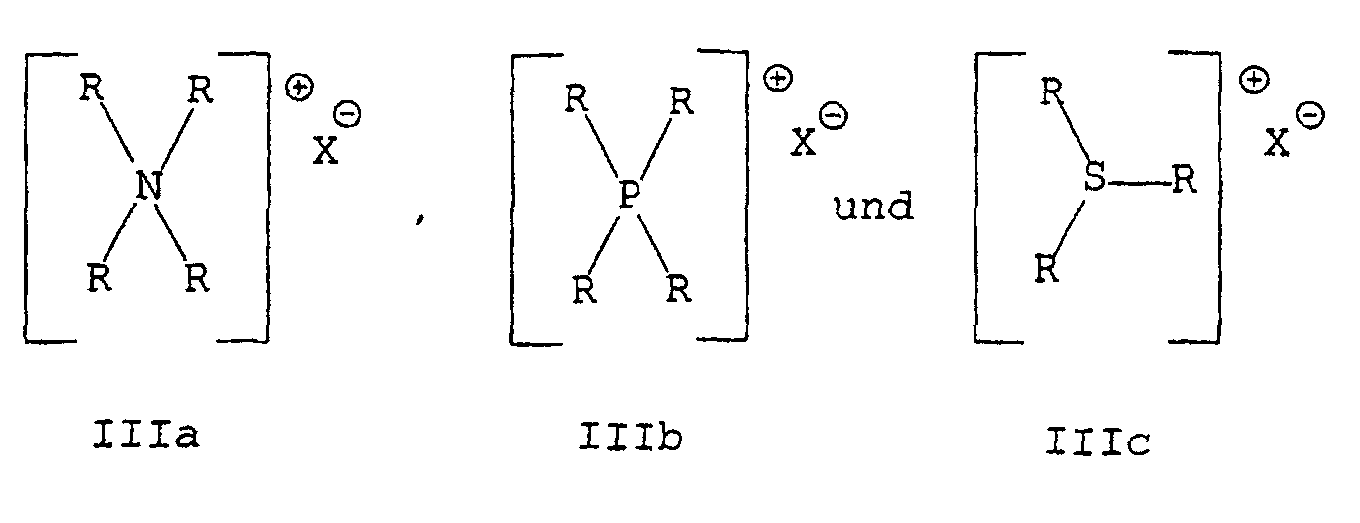
- onium salts including in particular ammonium, phosphonium and sulfonium salts of the general formulas IIIa to IIIc in which the substituents R are identical or different hydrocarbon radicals each having 1 to 20 carbon atoms, the sum of the carbon atoms in the radicals R not exceeding 24, and in which X is especially halogen, preferably bromine or iodine, means.
- the most accessible of the phosphonium salts IIIb are those which are derived from triphenylphosphine and whose fourth substituent has been introduced into the molecule by quaternization with a C 1 -C 6 -alkyl bromide.
- the hydrocarbon radicals R in the compounds IIIa to IIIc can be branched or preferably unbranched C 1 to C 20 alkyl groups, aralkyl groups such as the benzyl groups, the cyclohexyl group and aromatic groups such as the phenyl or the p-tolyl group.
- alkyl radicals R can also be linked to one another, for example to form a piperidine ring.
- halogen for example sulfate and nitrate can be considered as anions.
- the metal salts are salts of alkali metals, alkaline earth metals and transition metals, especially divalent ones Transition metals, into consideration, for example sodium, potassium, Magnesium, calcium, aluminum, manganese (II), iron (II) -, Nickel (II), copper (II), zinc, cadmium or lead (II) salts.
- Suitable anions for these salts are sulfate, nitrate, phosphate, Carbonate, acetate, formate and especially halides such as chloride, Bromide and iodide.
- zinc salts such as zinc sulfate, zinc nitrate, zinc phosphate, zinc carbonate, Zinc acetate, zinc formate, zinc chloride, zinc bromide or zinc iodide.
- Zinc acetate, zinc formate, zinc chloride, zinc bromide or zinc iodide can of course also be used insert, the same also applies to the above Onium salts. Mixtures of onium salts with metal salts are also possible and in some cases even show surprising Benefits.
- the amount of onium salts and / or used as catalysts the metal salt is in principle arbitrary as it is obvious only has an influence on the reaction rate, the order of which in turn depends on the type of used Oxirans II judges. For the technically satisfactory response times from about 0.5 to 5 hours you usually need about 0.01 up to 3% by weight, based on oxirane II used.
- catalysts are used Alkali metal bromides, alkali metal iodides, tetraalkylammonium bromides, Tetraalkylammionium iodides, halides divalent Metals or mixtures thereof.
- one sets as Catalysts a mixture of onium salts, in particular Ammonium, phosphonium and / or sulfonium salts of the general Formula IIIa to IIIc, and zinc salts, especially those above explicitly mentioned.
- the effective amounts of zinc salts depending on the reactivity of the oxirane used, the activity of the onium salt and the other reaction conditions between 0.1 to 1.0 mol, preferably between 0.3 and 0.7 mol, per mol of the onium salt. In case of using Zinc bromide, these amounts are generally 0.2 to 0.8 mol, preferably 0.3 to 0.5 mol, per mol of the onium salt.
- Process product I is under the reaction conditions liquid, one expediently uses this as Solvent. It has proven to be convenient in such cases proven to dissolve the catalyst in the process product and add this solution, practically no other Solvents are present in the reaction reactor.
- the concentration of the catalyst in process product I usually 0.5 to 20% by weight, in particular 1 to 15% by weight; the molar ratio of added in the same time unit Quantity of starting material II to process product added with the catalyst I is usually 100: 1 to 1: 1, in particular 50: 1 up to 2: 1.
- the educt streams are used Oxirane II and carbon dioxide preferably in a molar ratio of 1: 1 to 1: 1.05, in particular 1: 1 to 1: 1.02.
- a possible one slight excess of carbon dioxide is due to the losses Carbon dioxide caused when the pressure is released.
- the method according to the invention is used practically quantitative sales of II, usually at least 99%, especially at least 99.5%, especially at least 99.9%, after which the reaction mixture is in principle as usual worked up.
- the resulting catalyst-containing residues can usually be used several times for further reactions until a metal salt is used due to the fact that it can never be completely excluded Traces of water deactivated by hydrolysis have been.
- the success of the process according to the invention is not dependent on the type of oxirane (epoxide) II used, provided that the radical R 1 , as is self-evident, does not contain any acidic substituents which give rise to side reactions when the oxirane ring is opened give.
- the group can have substituents such as halogen, nitro groups, free or substituted amino groups, hydroxyl groups, formyl groups or carry cyano groups or ether, ketone or ester groups contain.
- the radicals R 2 and R 3 are generally hydrogen or the methyl group and those radicals which are linked to one another to form a five- or six-membered ring, of which cyclohexene oxide as compound II is an example. If II contains two oxirane rings, each with a (CH 2 -) grouping, then the corresponding bis-dioxolanes I are included. Oxirane rings that are substituted on both C atoms are generally attacked more slowly than those that only attack one of the C atoms are substituted.
- the process according to the invention is used to prepare 1,3-dioxolan-2-ones of the general formula I in which the radical R 1 is hydrogen or a C 1- to C 18 -alkyl group, in particular a C 1- to C 4 alkyl group.
- the process according to the invention is particularly suitable for the production of ethylene carbonate or propylene carbonate, but also for the production of the corresponding carbonates from isobutylene oxide, styrene oxide or epichlorohydrin.
- Process products I are valuable intermediates for organic syntheses.
- ethylene and Propylene carbonate to a greater extent use as a solvent, especially in the synthetic fiber industry.
- the reactor used had a first (upper) part of the reactor (Loop reactor) with an external circuit stream with external Heat exchanger, through which the reaction temperature to 120 ° C ⁇ 2 ° C was held, and a second (lower) reactor part from a five-stage countercurrent bubble column cascade, the at temperatures from 122 ° C (in the top stage) to 130 ° C (in the lowest level) worked on.
- the reactor was in all Parts operated at a pressure of 16 bar.
Landscapes
- Chemical & Material Sciences (AREA)
- Organic Chemistry (AREA)
- Epoxy Compounds (AREA)
- Low-Molecular Organic Synthesis Reactions Using Catalysts (AREA)
- Organic Low-Molecular-Weight Compounds And Preparation Thereof (AREA)
Abstract
Description

durch Umsetzung eines Oxirans der allgemeinen Formel II

Bevorzugt wird jedoch der vollständige Eintrag in der letzten Stufe. Um eine Strömungsführung wie oben erläutert zu erhalten, kann es erforderlich sein, die beiden Reaktorteile und die einzelnen Stufen mit verschiedenen Druckniveaus (im Rahmen des für den gesamten Umsetzungsreaktor vorgegebenen Bereiches) zu betreiben. Vorzugsweise ist hierbei das höchste Druckniveau in der letzten Stufe.
- gesättigte und ungesättigte verzweigte und unverzweigte aliphatische Reste mit bis zu 40 C-Atomen, insbesondere bis zu 18 C-Atomen,
- iso- oder heterocyclische cycloaliphatische Gruppen mit vorzugsweise 5 bis 7 Ringgliedern,
- iso- oder heterocyclische aromatische Gruppen und
- gemischte Reste mit Gruppierungen der vorgenannten Art, beispielsweise araliphatische Reste wie die Benzylgruppe.
Claims (12)
- Verfahren zur kontinuierlichen Herstellung von 1,3-Dioxolan-2-onen der allgemeinen Formel Iin der R1 für Wasserstoff oder einen organischen Rest mit bis zu 40 C-Atomen steht und R2 und R3 jeweils Wasserstoff oder eine C1- bis C4-Alkylgruppe bedeuten, wobei R2 und R3 auch miteinander zu einem fünf- oder sechsgliedrigen Ring verbunden sein können,

durch Umsetzung eines Oxirans der allgemeinen Formel IImit Kohlendioxid in flüssiger Phase in Gegenwart eines Katalysators, dadurch gekennzeichnet, daß man die Umsetzung in einem zweiteiligen Reaktor durchführt, bei dem im ersten Teil die Umsetzung unter Rückvermischung bis zu einem Umsatz des Oxirans II von mindestens 80 %, insbesondere mindestens 90 %, geführt und im zweiten Teil die Umsetzung unter nicht rückvermischenden Bedingungen vervollständigt wird, wobei das Kohlendioxid im gesamten Reaktor im Gegenstrom zum Oxiran II geführt wird.
- Verfahren nach Anspruch 1, dadurch gekennzeichnet, daß man das frische Oxiran II sowie den frischen Katalysator dem ersten Teil des Reaktors und das frische Kohlendioxid dem zweiten Teil des Reaktors zuführt.
- Verfahren nach Anspruch 1 oder 2, dadurch gekennzeichnet, daß man die Umsetzung im ersten Teil des Reaktors isotherm unter Abfuhr der Reaktionswärme durchführt.
- Verfahren nach Anspruch 3, dadurch gekennzeichnet, daß man die Reaktionswärme durch einen internen oder externen Wärmeaustauscher mit einem Volumenstrom vom 30fachen bis 500fachen des Durchsatzes durch den Reaktor abführt.
- Verfahren nach den Ansprüchen 1 bis 4, dadurch gekennzeichnet, daß man im zweiten Reaktorteil die Umsetzung bis zu einem Umsatz des Oxirans II von mindestens 99 %, insbesondere mindestens 99,5 %, vervollständigt.
- Verfahren nach den Ansprüchen 1 bis 5, dadurch gekennzeichnet, daß man den Reaktor in beiden Teilen bei einem Druck von 2 bis 50 bar, insbesondere von 5 bis 40 bar, betreibt.
- Verfahren nach den Ansprüchen 1 bis 6, dadurch gekennzeichnet, daß man den Reaktor in beiden Teilen bei Temperaturen von 70 bis 150°C, insbesondere von 90 bis 145°C, betreibt.
- Verfahren nach den Ansprüchen 1 bis 7, dadurch gekennzeichnet, daß man das Oxiran II und das Kohlendioxid im molaren Verhältnis von 1:1 bis 1:1,05 einsetzt.
- Verfahren nach den Ansprüchen 1 bis 8, dadurch gekennzeichnet, daß man als Katalysatoren Oniumsalze oder Metallsalze oder Mischungen hieraus einsetzt.
- Verfahren nach Anspruch 9, dadurch gekennzeichnet, daß man als Katalysatoren Alkalimetalliodide, Alkalimetallbromide, Tetraalkylammoniumiodide, Tetraalkylammoniumbromide, Halogenide zweiwertiger Metalle oder Mischungen hieraus einsetzt.
- Verfahren nach den Ansprüchen 1 bis 10 zur Herstellung von 1,3-Dioxolan-2-onen I, in der der Rest R1 für Wasserstoff oder eine C1- bis C18-Alkylgruppe steht.
- Verfahren nach Anspruch 11 zur Herstellung von Ethylencarbonat oder Propylencarbonat.
Applications Claiming Priority (3)
| Application Number | Priority Date | Filing Date | Title |
|---|---|---|---|
| DE19819586 | 1998-04-30 | ||
| DE19819586A DE19819586A1 (de) | 1998-04-30 | 1998-04-30 | Verfahren zur kontinuierlichen Herstellung von 1,3-Dioxolan-2-onen |
| PCT/EP1999/002701 WO1999057108A2 (de) | 1998-04-30 | 1999-04-22 | Verfahren zur kontinuierlichen herstellung von 1,3-dioxolan-2-onen |
Publications (2)
| Publication Number | Publication Date |
|---|---|
| EP1076654A2 EP1076654A2 (de) | 2001-02-21 |
| EP1076654B1 true EP1076654B1 (de) | 2003-06-25 |
Family
ID=7866447
Family Applications (1)
| Application Number | Title | Priority Date | Filing Date |
|---|---|---|---|
| EP99923434A Expired - Lifetime EP1076654B1 (de) | 1998-04-30 | 1999-04-22 | Verfahren zur kontinuierlichen herstellung von 1,3-dioxolan-2-onen |
Country Status (10)
| Country | Link |
|---|---|
| US (1) | US6265592B1 (de) |
| EP (1) | EP1076654B1 (de) |
| JP (1) | JP2002513787A (de) |
| KR (1) | KR100609674B1 (de) |
| CN (1) | CN1119341C (de) |
| CA (1) | CA2326888C (de) |
| DE (2) | DE19819586A1 (de) |
| ES (1) | ES2203138T3 (de) |
| ID (1) | ID26310A (de) |
| WO (1) | WO1999057108A2 (de) |
Families Citing this family (32)
| Publication number | Priority date | Publication date | Assignee | Title |
|---|---|---|---|---|
| DE10210692A1 (de) * | 2002-03-12 | 2003-10-02 | Clariant Gmbh | Verfahren zur Herstellung von Alkylencarbonaten |
| CN100415733C (zh) * | 2003-06-30 | 2008-09-03 | 国际壳牌研究有限公司 | 碳酸亚丙酯的制备方法 |
| KR100686203B1 (ko) | 2004-08-27 | 2007-02-22 | 삼성정밀화학 주식회사 | 페닐싸이오-1,3-다이옥소란-2-온 유도체의 제조방법 |
| KR100686204B1 (ko) | 2004-08-27 | 2007-02-23 | 삼성정밀화학 주식회사 | 페닐옥소-1,3-다이옥소란-2-온 유도체의 제조방법 |
| JP4624056B2 (ja) * | 2004-10-04 | 2011-02-02 | 旭化成ケミカルズ株式会社 | アルキレンカーボネートの連続的製造方法 |
| US20070203352A1 (en) * | 2005-12-22 | 2007-08-30 | Bolk Jeroen W | Method Of Installing An Epoxidation Catalyst In A Reactor, A Method Of Preparing An Epoxidation Catalyst, An Epoxidation Catalyst, A Process For The Preparation Of An Olefin Oxide Or A Chemical Derivable From An Olefin Oxide, And A Reactor Suitable For Such A Process |
| US20070203350A1 (en) * | 2005-12-22 | 2007-08-30 | Bolk Jeroen W | Method Of Installing An Epoxidation Catalyst In A Reactor, A Method Of Preparing An Epoxidation Catalyst, An Epoxidation Catalyst, A Process For The Preparation Of An Olefin Oxide Or A Chemical Derivable From An Olefin Oxide, And A Reactor Suitable For Such A Process |
| FR2895405A1 (fr) * | 2005-12-22 | 2007-06-29 | Shell Int Research | Procede de preparation d'un oxyde d'olefine ou d'un produit chimique pouvant provenir d'un oxyde d'olefine |
| US7459589B2 (en) * | 2005-12-22 | 2008-12-02 | Shell Oil Company | Process for the preparation of an alkylene glycol |
| US20070197801A1 (en) * | 2005-12-22 | 2007-08-23 | Bolk Jeroen W | Method of installing an epoxidation catalyst in a reactor, a method of preparing an epoxidation catalyst, an epoxidation catalyst, a process for the preparation of an olefin oxide or a chemical derivable from an olefin oxide, and a reactor suitables for such a process |
| US20070203349A1 (en) * | 2005-12-22 | 2007-08-30 | Bolk Jeroen W | Method Of Installing An Epoxidation Catalyst In A Reactor, A Method Of Preparing An Epoxidation Catalyst, An Epoxidation Catalyst, A Process For The Preparation Of An Olefin Oxide Or A Chemical Derivable From An Olefin Oxide, And A Reactor Suitable For Such A Process |
| US7750170B2 (en) * | 2005-12-22 | 2010-07-06 | Shell Oil Company | Process for mixing an oxidant having explosive potential with a hydrocarbon |
| US20070197808A1 (en) * | 2005-12-22 | 2007-08-23 | Bolk Jeroen W | Method Of Installing An Epoxidation Catalyst In A Reactor, A Method Of Preparing An Epoxidation Catalyst, An Epoxidation Catalyst, A Process For The Preparation Of An Olefin Oxide Or A Chemical Derivable From An Olefin Oxide, And A Reactor Suitable For Such A Process |
| TW200740731A (en) | 2006-02-22 | 2007-11-01 | Shell Int Research | Process for the preparation of alkanediol |
| TWI378087B (en) | 2006-02-22 | 2012-12-01 | Shell Int Research | Process for the preparation of an alkanediol and a dialkyl carbonate |
| TWI383976B (zh) | 2006-02-22 | 2013-02-01 | Shell Int Research | 製備碳酸二烷酯及烷二醇的方法 |
| TWI382979B (zh) | 2006-02-22 | 2013-01-21 | Shell Int Research | 碳酸伸烷酯之生產方法及由此生產的碳酸伸烷酯於烷二醇及碳酸二烷酯之製造中的用途 |
| EP2374803A1 (de) * | 2006-03-20 | 2011-10-12 | Mitsubishi Chemical Corporation | Verfahren zur Aufreinigung von Ethylencarbonat, Verfahren zur Herstellung von aufgereinigtem Ethylencarbonat und Ethylencarbonat |
| US20080154051A1 (en) * | 2006-12-20 | 2008-06-26 | Jeroen Willem Bolk | Method of installing an epoxidation catalyst in a reactor, a method of preparing an epoxidation catalyst, an epoxidation catalyst, a process for the preparation of an olefin oxide or a chemical derivable from an olefin oxide, and a reactor suitable for such a process |
| CN101519397B (zh) * | 2008-02-28 | 2011-12-28 | 中国石油化工股份有限公司 | 一种1,3-二氧戊环类化合物的制备方法及其在制备乙二醇中的应用 |
| EA201001325A1 (ru) * | 2008-02-29 | 2011-02-28 | Басф Се | Способ мембранного разделения высококипящих компонентов при получении 1,3-диоксолан-2-онов |
| TWI457317B (zh) | 2008-05-20 | 2014-10-21 | Shell Int Research | 碳酸伸烷酯之製造方法 |
| WO2009141377A1 (en) * | 2008-05-20 | 2009-11-26 | Shell Internationale Research Maatschappij B.V. | Process for preparing an 1,2-alkylene carbonate |
| CN102250052A (zh) * | 2010-05-18 | 2011-11-23 | 中国科学院兰州化学物理研究所 | 一种连续制备环状碳酸酯的工艺过程 |
| JP5851250B2 (ja) * | 2012-01-13 | 2016-02-03 | 大阪瓦斯株式会社 | 環状カーボネート構造を有する新規なホスフィン酸エステル化合物およびその製造方法 |
| JP5851350B2 (ja) * | 2012-06-04 | 2016-02-03 | 大阪瓦斯株式会社 | 二酸化炭素の精製方法 |
| CN108178752B (zh) * | 2017-12-19 | 2021-02-23 | 西安近代化学研究所 | 一种联产制备3,3,3-三氟丙烯碳酸酯与3,3,3-三氟-1,2-丙二醇的方法 |
| CN108084143B (zh) * | 2017-12-19 | 2021-02-26 | 西安近代化学研究所 | 连续制备4-三氟甲基碳酸乙烯酯的方法 |
| CN108033942B (zh) * | 2017-12-19 | 2021-02-23 | 西安近代化学研究所 | 联产3,3,3-三氟-1,2-丙二醇与4-三氟甲基碳酸乙烯酯的制备方法 |
| CN109438409A (zh) * | 2018-12-05 | 2019-03-08 | 常州大学 | 一种合成环状碳酸酯的方法 |
| WO2021094447A1 (en) * | 2019-11-15 | 2021-05-20 | New Green World B.V. | Process to continuously prepare a cyclic carbonate |
| WO2026002649A1 (en) | 2024-06-24 | 2026-01-02 | Shell Internationale Research Maatschappij B.V. | Process for the production of alkylene carbonate |
Family Cites Families (6)
| Publication number | Priority date | Publication date | Assignee | Title |
|---|---|---|---|---|
| US2773070A (en) * | 1952-10-31 | 1956-12-04 | Jefferson Chem Co Inc | Catalytic process for producing alkylene carbonates |
| US2773881A (en) | 1953-02-09 | 1956-12-11 | Union Carbide & Carbon Corp | Glycol carbonates |
| DE1169459B (de) * | 1960-06-09 | 1964-05-06 | Basf Ag | Verfahren zur Herstellung von Alkylen-carbonaten |
| CA1176622A (en) * | 1981-06-29 | 1984-10-23 | James E. Rinz | Catalytic synthesis of cyclic carbonates |
| DE3529263A1 (de) | 1985-08-16 | 1987-02-19 | Hoechst Ag | Verfahren zur herstellung von 2-oxo-1,3-dioxolanen |
| EP0543249B1 (de) * | 1991-11-22 | 1996-04-10 | Bayer Ag | Verfahren zur Herstellung von Alkylencarbonaten |
-
1998
- 1998-04-30 DE DE19819586A patent/DE19819586A1/de not_active Withdrawn
-
1999
- 1999-04-22 ES ES99923434T patent/ES2203138T3/es not_active Expired - Lifetime
- 1999-04-22 EP EP99923434A patent/EP1076654B1/de not_active Expired - Lifetime
- 1999-04-22 CN CN99805521A patent/CN1119341C/zh not_active Expired - Fee Related
- 1999-04-22 CA CA002326888A patent/CA2326888C/en not_active Expired - Fee Related
- 1999-04-22 ID IDW20002218A patent/ID26310A/id unknown
- 1999-04-22 US US09/674,281 patent/US6265592B1/en not_active Expired - Lifetime
- 1999-04-22 KR KR1020007011861A patent/KR100609674B1/ko not_active Expired - Fee Related
- 1999-04-22 JP JP2000547078A patent/JP2002513787A/ja active Pending
- 1999-04-22 WO PCT/EP1999/002701 patent/WO1999057108A2/de not_active Ceased
- 1999-04-22 DE DE59906105T patent/DE59906105D1/de not_active Expired - Lifetime
Also Published As
| Publication number | Publication date |
|---|---|
| WO1999057108A2 (de) | 1999-11-11 |
| ES2203138T3 (es) | 2004-04-01 |
| US6265592B1 (en) | 2001-07-24 |
| CA2326888C (en) | 2008-01-29 |
| KR100609674B1 (ko) | 2006-08-09 |
| CN1298401A (zh) | 2001-06-06 |
| EP1076654A2 (de) | 2001-02-21 |
| DE19819586A1 (de) | 1999-11-04 |
| CN1119341C (zh) | 2003-08-27 |
| JP2002513787A (ja) | 2002-05-14 |
| ID26310A (id) | 2000-12-14 |
| CA2326888A1 (en) | 1999-11-11 |
| KR20010043010A (ko) | 2001-05-25 |
| WO1999057108A3 (de) | 2000-01-13 |
| DE59906105D1 (de) | 2003-07-31 |
Similar Documents
| Publication | Publication Date | Title |
|---|---|---|
| EP1076654A2 (de) | Verfahren zur kontinuierlichen herstellung von 1,3-dioxolan-2-onen | |
| DE60104129T2 (de) | Verfahren zur kontinuierlichen herstellung eines epoxids | |
| EP0807619B1 (de) | Verfahren zur Herstellung von Diarylcarbonaten | |
| DE3016668C2 (de) | ||
| DE60001881T3 (de) | Verfahren zur Herstellung von Olefinoxiden | |
| EP0634386B1 (de) | Verfahren zur Herstellung von Dimethylcarbonat | |
| DE3016670C2 (de) | Verfahren zur Herstellung von Epoxiverbindungen | |
| EP3663284B1 (de) | Verbessertes verfahren zur herstellung von triacetonamin | |
| DE4403075A1 (de) | Verfahren zur kontinuierlichen Herstellung von Diarylcarbonaten | |
| EP0175241B1 (de) | Verfahren zur Herstellung von 4,4-disubstituierten 5-Methylen-1,3-dioxolan-2-onen | |
| DE60013049T2 (de) | Verfahren zur Herstellung von Olefinoxiden | |
| DE68914992T2 (de) | Herstellung von durch nitratoalkyl substituierten cyclischen äthern. | |
| EP0636601A1 (de) | Verfahren zur Herstellung von Dialkylcarbonaten | |
| DE4344159A1 (de) | Verfahren zur Herstellung von Dimethylcarbonat | |
| DE3602254A1 (de) | Verfahren zur herstellung von oxiranylcarbonsaeureestern | |
| DE3936297A1 (de) | Verfahren zur herstellung von symmetrischen diarylacetylenen | |
| DE2324390C2 (de) | Verfahren zur Herstellung von Derivaten des 2,2-Dichlor- bzw. 2,2-Dibromcyclopropans | |
| DE1964619C3 (de) | Adiabatisches Verfahren zur Her stellung von N monosubstituierten 2,4 Dichlor 6 amino s tnazinen | |
| EP0735016B1 (de) | Verfahren zur Herstellung von Alpha-Chloralkylarylketonen | |
| DE2748799C2 (de) | Verfahren zur Herstellung von Glycerin | |
| DE19815323C2 (de) | Verfahren zur Herstellung von Isochroman-3-onen | |
| DE69109841T2 (de) | Verfahren zur katalytischen Monoepoxidierung von Diolefinen. | |
| DE69413803T2 (de) | Verfahren zur herstellung von diazomethanderivaten | |
| EP2809663A1 (de) | Verfahren zur herstellung von epoxy-carbonsäureestern | |
| EP0074009B1 (de) | Verfahren zur Herstellung von Tetramethyloxiran |
Legal Events
| Date | Code | Title | Description |
|---|---|---|---|
| PUAI | Public reference made under article 153(3) epc to a published international application that has entered the european phase |
Free format text: ORIGINAL CODE: 0009012 |
|
| 17P | Request for examination filed |
Effective date: 20000909 |
|
| AK | Designated contracting states |
Kind code of ref document: A2 Designated state(s): BE CH DE ES FR GB IT LI NL |
|
| GRAH | Despatch of communication of intention to grant a patent |
Free format text: ORIGINAL CODE: EPIDOS IGRA |
|
| GRAH | Despatch of communication of intention to grant a patent |
Free format text: ORIGINAL CODE: EPIDOS IGRA |
|
| GRAA | (expected) grant |
Free format text: ORIGINAL CODE: 0009210 |
|
| AK | Designated contracting states |
Designated state(s): BE CH DE ES FR GB IT LI NL |
|
| REG | Reference to a national code |
Ref country code: GB Ref legal event code: FG4D Free format text: NOT ENGLISH |
|
| REG | Reference to a national code |
Ref country code: CH Ref legal event code: EP |
|
| REF | Corresponds to: |
Ref document number: 59906105 Country of ref document: DE Date of ref document: 20030731 Kind code of ref document: P |
|
| GBT | Gb: translation of ep patent filed (gb section 77(6)(a)/1977) | ||
| REG | Reference to a national code |
Ref country code: ES Ref legal event code: FG2A Ref document number: 2203138 Country of ref document: ES Kind code of ref document: T3 |
|
| PLBE | No opposition filed within time limit |
Free format text: ORIGINAL CODE: 0009261 |
|
| STAA | Information on the status of an ep patent application or granted ep patent |
Free format text: STATUS: NO OPPOSITION FILED WITHIN TIME LIMIT |
|
| ET | Fr: translation filed | ||
| 26N | No opposition filed |
Effective date: 20040326 |
|
| REG | Reference to a national code |
Ref country code: FR Ref legal event code: PLFP Year of fee payment: 18 |
|
| PGFP | Annual fee paid to national office [announced via postgrant information from national office to epo] |
Ref country code: NL Payment date: 20160426 Year of fee payment: 18 |
|
| PGFP | Annual fee paid to national office [announced via postgrant information from national office to epo] |
Ref country code: CH Payment date: 20160426 Year of fee payment: 18 Ref country code: GB Payment date: 20160502 Year of fee payment: 18 Ref country code: ES Payment date: 20160518 Year of fee payment: 18 |
|
| PGFP | Annual fee paid to national office [announced via postgrant information from national office to epo] |
Ref country code: IT Payment date: 20160428 Year of fee payment: 18 Ref country code: FR Payment date: 20160428 Year of fee payment: 18 Ref country code: BE Payment date: 20160427 Year of fee payment: 18 |
|
| PGFP | Annual fee paid to national office [announced via postgrant information from national office to epo] |
Ref country code: DE Payment date: 20160630 Year of fee payment: 18 |
|
| REG | Reference to a national code |
Ref country code: DE Ref legal event code: R119 Ref document number: 59906105 Country of ref document: DE |
|
| REG | Reference to a national code |
Ref country code: CH Ref legal event code: PL |
|
| REG | Reference to a national code |
Ref country code: NL Ref legal event code: MM Effective date: 20170501 |
|
| GBPC | Gb: european patent ceased through non-payment of renewal fee |
Effective date: 20170422 |
|
| REG | Reference to a national code |
Ref country code: FR Ref legal event code: ST Effective date: 20171229 |
|
| PG25 | Lapsed in a contracting state [announced via postgrant information from national office to epo] |
Ref country code: FR Free format text: LAPSE BECAUSE OF NON-PAYMENT OF DUE FEES Effective date: 20170502 Ref country code: DE Free format text: LAPSE BECAUSE OF NON-PAYMENT OF DUE FEES Effective date: 20171103 Ref country code: NL Free format text: LAPSE BECAUSE OF NON-PAYMENT OF DUE FEES Effective date: 20170501 |
|
| PG25 | Lapsed in a contracting state [announced via postgrant information from national office to epo] |
Ref country code: GB Free format text: LAPSE BECAUSE OF NON-PAYMENT OF DUE FEES Effective date: 20170422 Ref country code: CH Free format text: LAPSE BECAUSE OF NON-PAYMENT OF DUE FEES Effective date: 20170430 Ref country code: LI Free format text: LAPSE BECAUSE OF NON-PAYMENT OF DUE FEES Effective date: 20170430 |
|
| REG | Reference to a national code |
Ref country code: BE Ref legal event code: MM Effective date: 20170430 |
|
| PG25 | Lapsed in a contracting state [announced via postgrant information from national office to epo] |
Ref country code: IT Free format text: LAPSE BECAUSE OF NON-PAYMENT OF DUE FEES Effective date: 20170422 Ref country code: BE Free format text: LAPSE BECAUSE OF NON-PAYMENT OF DUE FEES Effective date: 20170430 |
|
| REG | Reference to a national code |
Ref country code: ES Ref legal event code: FD2A Effective date: 20180629 |
|
| PG25 | Lapsed in a contracting state [announced via postgrant information from national office to epo] |
Ref country code: ES Free format text: LAPSE BECAUSE OF NON-PAYMENT OF DUE FEES Effective date: 20170423 |