EP1075544B1 - Chemically modified nucleic acids and methods for coupling nucleic acids to solid support - Google Patents
Chemically modified nucleic acids and methods for coupling nucleic acids to solid support Download PDFInfo
- Publication number
- EP1075544B1 EP1075544B1 EP99920342A EP99920342A EP1075544B1 EP 1075544 B1 EP1075544 B1 EP 1075544B1 EP 99920342 A EP99920342 A EP 99920342A EP 99920342 A EP99920342 A EP 99920342A EP 1075544 B1 EP1075544 B1 EP 1075544B1
- Authority
- EP
- European Patent Office
- Prior art keywords
- nucleic acid
- group
- modified nucleic
- dna
- modified
- Prior art date
- Legal status (The legal status is an assumption and is not a legal conclusion. Google has not performed a legal analysis and makes no representation as to the accuracy of the status listed.)
- Expired - Lifetime
Links
- 239000007787 solid Substances 0.000 title claims abstract description 59
- 238000000034 method Methods 0.000 title claims abstract description 43
- 150000007523 nucleic acids Chemical class 0.000 title claims description 138
- 108020004707 nucleic acids Proteins 0.000 title claims description 133
- 102000039446 nucleic acids Human genes 0.000 title claims description 133
- 238000005859 coupling reaction Methods 0.000 title description 4
- 230000008878 coupling Effects 0.000 title description 2
- 238000010168 coupling process Methods 0.000 title description 2
- 238000002493 microarray Methods 0.000 claims abstract description 22
- 150000001875 compounds Chemical group 0.000 claims description 21
- 125000003277 amino group Chemical group 0.000 claims description 19
- 150000002118 epoxides Chemical group 0.000 claims description 19
- PCLIMKBDDGJMGD-UHFFFAOYSA-N N-bromosuccinimide Chemical compound BrN1C(=O)CCC1=O PCLIMKBDDGJMGD-UHFFFAOYSA-N 0.000 claims description 14
- BPSIOYPQMFLKFR-UHFFFAOYSA-N trimethoxy-[3-(oxiran-2-ylmethoxy)propyl]silane Chemical compound CO[Si](OC)(OC)CCCOCC1CO1 BPSIOYPQMFLKFR-UHFFFAOYSA-N 0.000 claims description 14
- OPTASPLRGRRNAP-UHFFFAOYSA-N cytosine Chemical group NC=1C=CNC(=O)N=1 OPTASPLRGRRNAP-UHFFFAOYSA-N 0.000 claims description 11
- UYTPUPDQBNUYGX-UHFFFAOYSA-N guanine Chemical compound O=C1NC(N)=NC2=C1N=CN2 UYTPUPDQBNUYGX-UHFFFAOYSA-N 0.000 claims description 9
- 230000003100 immobilizing effect Effects 0.000 claims description 9
- 229910000077 silane Inorganic materials 0.000 claims description 8
- BLRPTPMANUNPDV-UHFFFAOYSA-N Silane Chemical compound [SiH4] BLRPTPMANUNPDV-UHFFFAOYSA-N 0.000 claims description 7
- 230000007935 neutral effect Effects 0.000 claims description 7
- 125000005647 linker group Chemical group 0.000 claims description 6
- WYTZZXDRDKSJID-UHFFFAOYSA-N (3-aminopropyl)triethoxysilane Chemical compound CCO[Si](OCC)(OCC)CCCN WYTZZXDRDKSJID-UHFFFAOYSA-N 0.000 claims description 4
- 229940104302 cytosine Drugs 0.000 claims description 4
- 125000001436 propyl group Chemical group [H]C([*])([H])C([H])([H])C([H])([H])[H] 0.000 claims description 4
- 239000000758 substrate Substances 0.000 claims description 4
- IAYPIBMASNFSPL-UHFFFAOYSA-N Ethylene oxide Chemical compound C1CO1 IAYPIBMASNFSPL-UHFFFAOYSA-N 0.000 claims description 3
- 150000003141 primary amines Chemical class 0.000 claims description 3
- DWAQJAXMDSEUJJ-UHFFFAOYSA-M Sodium bisulfite Chemical compound [Na+].OS([O-])=O DWAQJAXMDSEUJJ-UHFFFAOYSA-M 0.000 claims description 2
- 235000010267 sodium hydrogen sulphite Nutrition 0.000 claims description 2
- 125000000956 methoxy group Chemical group [H]C([H])([H])O* 0.000 claims 5
- 125000001931 aliphatic group Chemical group 0.000 claims 1
- 239000011521 glass Substances 0.000 abstract description 54
- 238000006243 chemical reaction Methods 0.000 description 33
- 239000000523 sample Substances 0.000 description 23
- 150000004756 silanes Chemical class 0.000 description 18
- RTZKZFJDLAIYFH-UHFFFAOYSA-N Diethyl ether Chemical compound CCOCC RTZKZFJDLAIYFH-UHFFFAOYSA-N 0.000 description 10
- XLYOFNOQVPJJNP-UHFFFAOYSA-N water Substances O XLYOFNOQVPJJNP-UHFFFAOYSA-N 0.000 description 10
- 230000007480 spreading Effects 0.000 description 9
- 238000000576 coating method Methods 0.000 description 8
- 239000011248 coating agent Substances 0.000 description 7
- 238000009396 hybridization Methods 0.000 description 7
- 238000000018 DNA microarray Methods 0.000 description 6
- ZMXDDKWLCZADIW-UHFFFAOYSA-N N,N-Dimethylformamide Chemical compound CN(C)C=O ZMXDDKWLCZADIW-UHFFFAOYSA-N 0.000 description 6
- 150000001412 amines Chemical class 0.000 description 6
- 230000008901 benefit Effects 0.000 description 6
- 238000002360 preparation method Methods 0.000 description 6
- LFQSCWFLJHTTHZ-UHFFFAOYSA-N Ethanol Chemical compound CCO LFQSCWFLJHTTHZ-UHFFFAOYSA-N 0.000 description 5
- 230000014509 gene expression Effects 0.000 description 5
- 230000002209 hydrophobic effect Effects 0.000 description 5
- GWEVSGVZZGPLCZ-UHFFFAOYSA-N Titan oxide Chemical compound O=[Ti]=O GWEVSGVZZGPLCZ-UHFFFAOYSA-N 0.000 description 4
- 238000007385 chemical modification Methods 0.000 description 4
- 238000001212 derivatisation Methods 0.000 description 4
- 238000001514 detection method Methods 0.000 description 4
- 238000011835 investigation Methods 0.000 description 4
- 239000002777 nucleoside Substances 0.000 description 4
- 238000002444 silanisation Methods 0.000 description 4
- 108020004414 DNA Proteins 0.000 description 3
- 102000053602 DNA Human genes 0.000 description 3
- 108091034117 Oligonucleotide Proteins 0.000 description 3
- VYPSYNLAJGMNEJ-UHFFFAOYSA-N Silicium dioxide Chemical compound O=[Si]=O VYPSYNLAJGMNEJ-UHFFFAOYSA-N 0.000 description 3
- 229910052794 bromium Inorganic materials 0.000 description 3
- 238000012869 ethanol precipitation Methods 0.000 description 3
- 230000002349 favourable effect Effects 0.000 description 3
- 230000007062 hydrolysis Effects 0.000 description 3
- 238000006460 hydrolysis reaction Methods 0.000 description 3
- 239000000463 material Substances 0.000 description 3
- 150000003833 nucleoside derivatives Chemical class 0.000 description 3
- 230000009257 reactivity Effects 0.000 description 3
- 230000035945 sensitivity Effects 0.000 description 3
- 239000000126 substance Substances 0.000 description 3
- SJECZPVISLOESU-UHFFFAOYSA-N 3-trimethoxysilylpropan-1-amine Chemical compound CO[Si](OC)(OC)CCCN SJECZPVISLOESU-UHFFFAOYSA-N 0.000 description 2
- WKBOTKDWSSQWDR-UHFFFAOYSA-N Bromine atom Chemical compound [Br] WKBOTKDWSSQWDR-UHFFFAOYSA-N 0.000 description 2
- 108090000790 Enzymes Proteins 0.000 description 2
- 102000004190 Enzymes Human genes 0.000 description 2
- 239000004677 Nylon Substances 0.000 description 2
- 229910008051 Si-OH Inorganic materials 0.000 description 2
- 229910002808 Si–O–Si Inorganic materials 0.000 description 2
- 229910006358 Si—OH Inorganic materials 0.000 description 2
- UIIMBOGNXHQVGW-UHFFFAOYSA-M Sodium bicarbonate Chemical compound [Na+].OC([O-])=O UIIMBOGNXHQVGW-UHFFFAOYSA-M 0.000 description 2
- JLCPHMBAVCMARE-UHFFFAOYSA-N [3-[[3-[[3-[[3-[[3-[[3-[[3-[[3-[[3-[[3-[[3-[[5-(2-amino-6-oxo-1H-purin-9-yl)-3-[[3-[[3-[[3-[[3-[[3-[[5-(2-amino-6-oxo-1H-purin-9-yl)-3-[[5-(2-amino-6-oxo-1H-purin-9-yl)-3-hydroxyoxolan-2-yl]methoxy-hydroxyphosphoryl]oxyoxolan-2-yl]methoxy-hydroxyphosphoryl]oxy-5-(5-methyl-2,4-dioxopyrimidin-1-yl)oxolan-2-yl]methoxy-hydroxyphosphoryl]oxy-5-(6-aminopurin-9-yl)oxolan-2-yl]methoxy-hydroxyphosphoryl]oxy-5-(6-aminopurin-9-yl)oxolan-2-yl]methoxy-hydroxyphosphoryl]oxy-5-(6-aminopurin-9-yl)oxolan-2-yl]methoxy-hydroxyphosphoryl]oxy-5-(6-aminopurin-9-yl)oxolan-2-yl]methoxy-hydroxyphosphoryl]oxyoxolan-2-yl]methoxy-hydroxyphosphoryl]oxy-5-(5-methyl-2,4-dioxopyrimidin-1-yl)oxolan-2-yl]methoxy-hydroxyphosphoryl]oxy-5-(4-amino-2-oxopyrimidin-1-yl)oxolan-2-yl]methoxy-hydroxyphosphoryl]oxy-5-(5-methyl-2,4-dioxopyrimidin-1-yl)oxolan-2-yl]methoxy-hydroxyphosphoryl]oxy-5-(5-methyl-2,4-dioxopyrimidin-1-yl)oxolan-2-yl]methoxy-hydroxyphosphoryl]oxy-5-(6-aminopurin-9-yl)oxolan-2-yl]methoxy-hydroxyphosphoryl]oxy-5-(6-aminopurin-9-yl)oxolan-2-yl]methoxy-hydroxyphosphoryl]oxy-5-(4-amino-2-oxopyrimidin-1-yl)oxolan-2-yl]methoxy-hydroxyphosphoryl]oxy-5-(4-amino-2-oxopyrimidin-1-yl)oxolan-2-yl]methoxy-hydroxyphosphoryl]oxy-5-(4-amino-2-oxopyrimidin-1-yl)oxolan-2-yl]methoxy-hydroxyphosphoryl]oxy-5-(6-aminopurin-9-yl)oxolan-2-yl]methoxy-hydroxyphosphoryl]oxy-5-(4-amino-2-oxopyrimidin-1-yl)oxolan-2-yl]methyl [5-(6-aminopurin-9-yl)-2-(hydroxymethyl)oxolan-3-yl] hydrogen phosphate Polymers Cc1cn(C2CC(OP(O)(=O)OCC3OC(CC3OP(O)(=O)OCC3OC(CC3O)n3cnc4c3nc(N)[nH]c4=O)n3cnc4c3nc(N)[nH]c4=O)C(COP(O)(=O)OC3CC(OC3COP(O)(=O)OC3CC(OC3COP(O)(=O)OC3CC(OC3COP(O)(=O)OC3CC(OC3COP(O)(=O)OC3CC(OC3COP(O)(=O)OC3CC(OC3COP(O)(=O)OC3CC(OC3COP(O)(=O)OC3CC(OC3COP(O)(=O)OC3CC(OC3COP(O)(=O)OC3CC(OC3COP(O)(=O)OC3CC(OC3COP(O)(=O)OC3CC(OC3COP(O)(=O)OC3CC(OC3COP(O)(=O)OC3CC(OC3COP(O)(=O)OC3CC(OC3COP(O)(=O)OC3CC(OC3COP(O)(=O)OC3CC(OC3CO)n3cnc4c(N)ncnc34)n3ccc(N)nc3=O)n3cnc4c(N)ncnc34)n3ccc(N)nc3=O)n3ccc(N)nc3=O)n3ccc(N)nc3=O)n3cnc4c(N)ncnc34)n3cnc4c(N)ncnc34)n3cc(C)c(=O)[nH]c3=O)n3cc(C)c(=O)[nH]c3=O)n3ccc(N)nc3=O)n3cc(C)c(=O)[nH]c3=O)n3cnc4c3nc(N)[nH]c4=O)n3cnc4c(N)ncnc34)n3cnc4c(N)ncnc34)n3cnc4c(N)ncnc34)n3cnc4c(N)ncnc34)O2)c(=O)[nH]c1=O JLCPHMBAVCMARE-UHFFFAOYSA-N 0.000 description 2
- 125000003545 alkoxy group Chemical group 0.000 description 2
- 238000013459 approach Methods 0.000 description 2
- GDTBXPJZTBHREO-UHFFFAOYSA-N bromine Substances BrBr GDTBXPJZTBHREO-UHFFFAOYSA-N 0.000 description 2
- 229910052799 carbon Inorganic materials 0.000 description 2
- 239000003153 chemical reaction reagent Substances 0.000 description 2
- 230000000295 complement effect Effects 0.000 description 2
- 239000002299 complementary DNA Substances 0.000 description 2
- 239000008139 complexing agent Substances 0.000 description 2
- 239000008367 deionised water Substances 0.000 description 2
- 229910021641 deionized water Inorganic materials 0.000 description 2
- 230000008030 elimination Effects 0.000 description 2
- 238000003379 elimination reaction Methods 0.000 description 2
- 125000001033 ether group Chemical group 0.000 description 2
- 238000002474 experimental method Methods 0.000 description 2
- 239000007850 fluorescent dye Substances 0.000 description 2
- 238000002509 fluorescent in situ hybridization Methods 0.000 description 2
- 239000000203 mixture Substances 0.000 description 2
- 238000012544 monitoring process Methods 0.000 description 2
- -1 nucleoside phosphate Chemical class 0.000 description 2
- 239000002773 nucleotide Substances 0.000 description 2
- 125000003729 nucleotide group Chemical group 0.000 description 2
- 229920001778 nylon Polymers 0.000 description 2
- 238000002966 oligonucleotide array Methods 0.000 description 2
- 239000008363 phosphate buffer Substances 0.000 description 2
- BASFCYQUMIYNBI-UHFFFAOYSA-N platinum Chemical compound [Pt] BASFCYQUMIYNBI-UHFFFAOYSA-N 0.000 description 2
- 230000005855 radiation Effects 0.000 description 2
- WOCIAKWEIIZHES-UHFFFAOYSA-N ruthenium(iv) oxide Chemical compound O=[Ru]=O WOCIAKWEIIZHES-UHFFFAOYSA-N 0.000 description 2
- 238000004574 scanning tunneling microscopy Methods 0.000 description 2
- FZHAPNGMFPVSLP-UHFFFAOYSA-N silanamine Chemical compound [SiH3]N FZHAPNGMFPVSLP-UHFFFAOYSA-N 0.000 description 2
- 238000006467 substitution reaction Methods 0.000 description 2
- XOLBLPGZBRYERU-UHFFFAOYSA-N tin dioxide Chemical compound O=[Sn]=O XOLBLPGZBRYERU-UHFFFAOYSA-N 0.000 description 2
- BDNKZNFMNDZQMI-UHFFFAOYSA-N 1,3-diisopropylcarbodiimide Chemical compound CC(C)N=C=NC(C)C BDNKZNFMNDZQMI-UHFFFAOYSA-N 0.000 description 1
- NILZGRNPRBIQOG-UHFFFAOYSA-N 3-iodopropyl(trimethoxy)silane Chemical compound CO[Si](OC)(OC)CCCI NILZGRNPRBIQOG-UHFFFAOYSA-N 0.000 description 1
- 102000036365 BRCA1 Human genes 0.000 description 1
- 108700020463 BRCA1 Proteins 0.000 description 1
- 101150072950 BRCA1 gene Proteins 0.000 description 1
- OKTJSMMVPCPJKN-UHFFFAOYSA-N Carbon Chemical compound [C] OKTJSMMVPCPJKN-UHFFFAOYSA-N 0.000 description 1
- 108020004635 Complementary DNA Proteins 0.000 description 1
- 206010028980 Neoplasm Diseases 0.000 description 1
- XOJVVFBFDXDTEG-UHFFFAOYSA-N Norphytane Natural products CC(C)CCCC(C)CCCC(C)CCCC(C)C XOJVVFBFDXDTEG-UHFFFAOYSA-N 0.000 description 1
- 229910019142 PO4 Inorganic materials 0.000 description 1
- 229910019020 PtO2 Inorganic materials 0.000 description 1
- 229910007157 Si(OH)3 Inorganic materials 0.000 description 1
- 239000002253 acid Substances 0.000 description 1
- 239000003377 acid catalyst Substances 0.000 description 1
- 230000009471 action Effects 0.000 description 1
- 230000003213 activating effect Effects 0.000 description 1
- 230000004913 activation Effects 0.000 description 1
- YKIOKAURTKXMSB-UHFFFAOYSA-N adams's catalyst Chemical compound O=[Pt]=O YKIOKAURTKXMSB-UHFFFAOYSA-N 0.000 description 1
- 125000003172 aldehyde group Chemical group 0.000 description 1
- 230000002152 alkylating effect Effects 0.000 description 1
- 230000029936 alkylation Effects 0.000 description 1
- 238000005804 alkylation reaction Methods 0.000 description 1
- PNEYBMLMFCGWSK-UHFFFAOYSA-N aluminium oxide Inorganic materials [O-2].[O-2].[O-2].[Al+3].[Al+3] PNEYBMLMFCGWSK-UHFFFAOYSA-N 0.000 description 1
- 229910000323 aluminium silicate Inorganic materials 0.000 description 1
- 238000004458 analytical method Methods 0.000 description 1
- 238000003491 array Methods 0.000 description 1
- 230000001588 bifunctional effect Effects 0.000 description 1
- 238000009835 boiling Methods 0.000 description 1
- 230000031709 bromination Effects 0.000 description 1
- 238000005893 bromination reaction Methods 0.000 description 1
- 238000010804 cDNA synthesis Methods 0.000 description 1
- 201000011510 cancer Diseases 0.000 description 1
- 125000002091 cationic group Chemical group 0.000 description 1
- 239000003638 chemical reducing agent Substances 0.000 description 1
- 239000003795 chemical substances by application Substances 0.000 description 1
- MGNCLNQXLYJVJD-UHFFFAOYSA-N cyanuric chloride Chemical compound ClC1=NC(Cl)=NC(Cl)=N1 MGNCLNQXLYJVJD-UHFFFAOYSA-N 0.000 description 1
- 125000004122 cyclic group Chemical group 0.000 description 1
- 239000003599 detergent Substances 0.000 description 1
- GBSIYTILHVLXDE-UHFFFAOYSA-N dichloro-(4-chlorobutyl)-methylsilane Chemical compound C[Si](Cl)(Cl)CCCCCl GBSIYTILHVLXDE-UHFFFAOYSA-N 0.000 description 1
- BGRWYRAHAFMIBJ-UHFFFAOYSA-N diisopropylcarbodiimide Natural products CC(C)NC(=O)NC(C)C BGRWYRAHAFMIBJ-UHFFFAOYSA-N 0.000 description 1
- HNPSIPDUKPIQMN-UHFFFAOYSA-N dioxosilane;oxo(oxoalumanyloxy)alumane Chemical compound O=[Si]=O.O=[Al]O[Al]=O HNPSIPDUKPIQMN-UHFFFAOYSA-N 0.000 description 1
- 230000002255 enzymatic effect Effects 0.000 description 1
- 238000012921 fluorescence analysis Methods 0.000 description 1
- 239000003517 fume Substances 0.000 description 1
- 230000002068 genetic effect Effects 0.000 description 1
- 150000004820 halides Chemical class 0.000 description 1
- 229910052736 halogen Inorganic materials 0.000 description 1
- 230000026030 halogenation Effects 0.000 description 1
- 238000005658 halogenation reaction Methods 0.000 description 1
- 150000002367 halogens Chemical class 0.000 description 1
- 125000000623 heterocyclic group Chemical group 0.000 description 1
- 125000001165 hydrophobic group Chemical group 0.000 description 1
- 125000002887 hydroxy group Chemical group [H]O* 0.000 description 1
- 238000003384 imaging method Methods 0.000 description 1
- 238000001727 in vivo Methods 0.000 description 1
- 238000011065 in-situ storage Methods 0.000 description 1
- 238000013507 mapping Methods 0.000 description 1
- 229910044991 metal oxide Inorganic materials 0.000 description 1
- 150000004706 metal oxides Chemical class 0.000 description 1
- 239000010445 mica Substances 0.000 description 1
- 229910052618 mica group Inorganic materials 0.000 description 1
- 238000013508 migration Methods 0.000 description 1
- 230000005012 migration Effects 0.000 description 1
- 230000004048 modification Effects 0.000 description 1
- 238000012986 modification Methods 0.000 description 1
- 108010004563 mussel adhesive protein Proteins 0.000 description 1
- 239000003988 mussel adhesive protein Substances 0.000 description 1
- 239000003471 mutagenic agent Substances 0.000 description 1
- 231100000707 mutagenic chemical Toxicity 0.000 description 1
- 230000035772 mutation Effects 0.000 description 1
- 238000002515 oligonucleotide synthesis Methods 0.000 description 1
- 230000003287 optical effect Effects 0.000 description 1
- 239000010452 phosphate Substances 0.000 description 1
- 229910052697 platinum Inorganic materials 0.000 description 1
- 229920000729 poly(L-lysine) polymer Polymers 0.000 description 1
- 108091033319 polynucleotide Proteins 0.000 description 1
- 102000040430 polynucleotide Human genes 0.000 description 1
- 239000002157 polynucleotide Substances 0.000 description 1
- 230000008569 process Effects 0.000 description 1
- 108090000623 proteins and genes Proteins 0.000 description 1
- 238000011155 quantitative monitoring Methods 0.000 description 1
- 230000002285 radioactive effect Effects 0.000 description 1
- 239000000376 reactant Substances 0.000 description 1
- 238000009877 rendering Methods 0.000 description 1
- 238000011160 research Methods 0.000 description 1
- 125000000548 ribosyl group Chemical group C1([C@H](O)[C@H](O)[C@H](O1)CO)* 0.000 description 1
- 238000007142 ring opening reaction Methods 0.000 description 1
- 150000003839 salts Chemical class 0.000 description 1
- 150000003335 secondary amines Chemical class 0.000 description 1
- SCPYDCQAZCOKTP-UHFFFAOYSA-N silanol Chemical compound [SiH3]O SCPYDCQAZCOKTP-UHFFFAOYSA-N 0.000 description 1
- 229910000030 sodium bicarbonate Inorganic materials 0.000 description 1
- 238000001308 synthesis method Methods 0.000 description 1
- 230000002194 synthesizing effect Effects 0.000 description 1
- 238000012360 testing method Methods 0.000 description 1
- 238000005891 transamination reaction Methods 0.000 description 1
- GFJGILDCJZMQTN-UHFFFAOYSA-N trichloro(8-trichlorosilyloctyl)silane Chemical compound Cl[Si](Cl)(Cl)CCCCCCCC[Si](Cl)(Cl)Cl GFJGILDCJZMQTN-UHFFFAOYSA-N 0.000 description 1
- QQQSFSZALRVCSZ-UHFFFAOYSA-N triethoxysilane Chemical compound CCO[SiH](OCC)OCC QQQSFSZALRVCSZ-UHFFFAOYSA-N 0.000 description 1
- VDLAKRLDXDLKJS-UHFFFAOYSA-N trimethoxy-[4-(1-trimethoxysilylethyl)phenyl]silane Chemical compound CO[Si](C(C)C1=CC=C(C=C1)[Si](OC)(OC)OC)(OC)OC VDLAKRLDXDLKJS-UHFFFAOYSA-N 0.000 description 1
- YUYCVXFAYWRXLS-UHFFFAOYSA-N trimethoxysilane Chemical compound CO[SiH](OC)OC YUYCVXFAYWRXLS-UHFFFAOYSA-N 0.000 description 1
Images


Classifications
-
- C—CHEMISTRY; METALLURGY
- C12—BIOCHEMISTRY; BEER; SPIRITS; WINE; VINEGAR; MICROBIOLOGY; ENZYMOLOGY; MUTATION OR GENETIC ENGINEERING
- C12Q—MEASURING OR TESTING PROCESSES INVOLVING ENZYMES, NUCLEIC ACIDS OR MICROORGANISMS; COMPOSITIONS OR TEST PAPERS THEREFOR; PROCESSES OF PREPARING SUCH COMPOSITIONS; CONDITION-RESPONSIVE CONTROL IN MICROBIOLOGICAL OR ENZYMOLOGICAL PROCESSES
- C12Q1/00—Measuring or testing processes involving enzymes, nucleic acids or microorganisms; Compositions therefor; Processes of preparing such compositions
- C12Q1/68—Measuring or testing processes involving enzymes, nucleic acids or microorganisms; Compositions therefor; Processes of preparing such compositions involving nucleic acids
- C12Q1/6806—Preparing nucleic acids for analysis, e.g. for polymerase chain reaction [PCR] assay
-
- C—CHEMISTRY; METALLURGY
- C07—ORGANIC CHEMISTRY
- C07H—SUGARS; DERIVATIVES THEREOF; NUCLEOSIDES; NUCLEOTIDES; NUCLEIC ACIDS
- C07H21/00—Compounds containing two or more mononucleotide units having separate phosphate or polyphosphate groups linked by saccharide radicals of nucleoside groups, e.g. nucleic acids
-
- C—CHEMISTRY; METALLURGY
- C07—ORGANIC CHEMISTRY
- C07B—GENERAL METHODS OF ORGANIC CHEMISTRY; APPARATUS THEREFOR
- C07B2200/00—Indexing scheme relating to specific properties of organic compounds
- C07B2200/11—Compounds covalently bound to a solid support
-
- C—CHEMISTRY; METALLURGY
- C12—BIOCHEMISTRY; BEER; SPIRITS; WINE; VINEGAR; MICROBIOLOGY; ENZYMOLOGY; MUTATION OR GENETIC ENGINEERING
- C12Q—MEASURING OR TESTING PROCESSES INVOLVING ENZYMES, NUCLEIC ACIDS OR MICROORGANISMS; COMPOSITIONS OR TEST PAPERS THEREFOR; PROCESSES OF PREPARING SUCH COMPOSITIONS; CONDITION-RESPONSIVE CONTROL IN MICROBIOLOGICAL OR ENZYMOLOGICAL PROCESSES
- C12Q1/00—Measuring or testing processes involving enzymes, nucleic acids or microorganisms; Compositions therefor; Processes of preparing such compositions
- C12Q1/68—Measuring or testing processes involving enzymes, nucleic acids or microorganisms; Compositions therefor; Processes of preparing such compositions involving nucleic acids
- C12Q1/6813—Hybridisation assays
- C12Q1/6834—Enzymatic or biochemical coupling of nucleic acids to a solid phase
- C12Q1/6837—Enzymatic or biochemical coupling of nucleic acids to a solid phase using probe arrays or probe chips
-
- C—CHEMISTRY; METALLURGY
- C12—BIOCHEMISTRY; BEER; SPIRITS; WINE; VINEGAR; MICROBIOLOGY; ENZYMOLOGY; MUTATION OR GENETIC ENGINEERING
- C12Q—MEASURING OR TESTING PROCESSES INVOLVING ENZYMES, NUCLEIC ACIDS OR MICROORGANISMS; COMPOSITIONS OR TEST PAPERS THEREFOR; PROCESSES OF PREPARING SUCH COMPOSITIONS; CONDITION-RESPONSIVE CONTROL IN MICROBIOLOGICAL OR ENZYMOLOGICAL PROCESSES
- C12Q2525/00—Reactions involving modified oligonucleotides, nucleic acids, or nucleotides
- C12Q2525/10—Modifications characterised by
- C12Q2525/197—Modifications characterised by incorporating a spacer/coupling moiety
-
- C—CHEMISTRY; METALLURGY
- C40—COMBINATORIAL TECHNOLOGY
- C40B—COMBINATORIAL CHEMISTRY; LIBRARIES, e.g. CHEMICAL LIBRARIES
- C40B40/00—Libraries per se, e.g. arrays, mixtures
Definitions
- the present Invention claims a closely related family of compounds and methods relating to techniques for immobilizing nucleic acids to a solid support for the purpose of conducting scientific investigation or routine testing upon the bound nucleic acid samples in areas such as genome-wide genetic mapping and gene expression studies.
- DNA is a water-soluble compound, that if left in solution (i.e., a water-based solution),is likely to degrade, through hydrolysis, and so forth. Obviously this frustrates any investigation involving DNA, and so therefore, accurate and reliable study involving DNA requires a method or device to ensure the integrity of DNA.
- immobilizing DNA means fixing one end of the strand to the solid support so that the remainder of the strand is unmodified and free to undergo further reaction depending upon the particular study. Indeed, this is a widely used method to conduct laboratory studies involving DNA.
- the particular immobilized strand to which the probe reacts reveals the nucleotide sequence of the previously unknown immobilized strand.
- probe studies are severely confounded by electrostatic sticking of the probe to the derivatized (hence electrostatically charged) glass surface.
- the probe is often radiolabeled so that its presence can be detected by an ordinary radiation detector.
- the location of the probe on the glass surface as evidenced by the detector, reveals the chemical identity or sequence of the immobilized DNA strand at that particular location on the glass surface (which is known and designated in advance).
- the radiation detector is unable to distinguish between probe that is chemically bound to a complementary strand of DNA affixed to the solid support, and probe that is simply electrostatically stuck to the glass surface (but not to a DNA strand).
- One very common substance used to prepare a glass surface to receive a nucleic acid sample is poly-L-lysine. See, e.g., DeRisi, et al., Use of a cDNA Microarray to Analyze Gene Expression Pattern in Human Cancer, 14 Nature Genetics 457 (1996 ); Shalon et al. in A DNA Microarray System for Analyzing Complex DNA Samples Using Two-Color Fluorescent Probe Hybridization, 6 Genome Res. 639 (1996 ); and Schena, et al., Quantitative Monitoring of Gene Expression Patterns With a Complementary DNA Microarray, 270 Science 467 (1995 ).
- pre-derivatized glass supports are commercially available (e.g., silylated microscope slides). See, e.g., Schena, et al., Parallel Human Genome Analysis: Microarray-Based Expression Monitoring of 1000 Genes, 93 P.N.A.S. 10614 (1996 ).
- U.S. Pat. No. 5,630,932 assigned to Molecular Imaging Corp. discloses a coating for a probe (platinum) tip for use in scanning tunneling microscopy; numerous means are disclosed for coating the surface, notably, Si(OCH 3 )CH 2 I.
- U.S. Pat. No. 5,610,287 assigned to Molecular Tool, discloses coating a solid support with a salt or cationic detergent to non-covalently bond nucleic acids to the support.
- U.S. Pat. No. 5,024,933 assigned to Enzo Biochem, discloses coating a solid support with an isolate of naturally occurring mussel adhesive protein.
- Another approach to this problem involves derivatizing both the solid support and the nucleic acid sought to be immobilized. See, e.g., U.S. Pat. No. 5,641,630 , assigned to Amgen and Abbott, discloses coating a solid support with a complexing agent that binds to an other complexing agent to which the nucleic acid sought to be bound is likewise bound.
- U.S. Pat No. 5,554,744 assigned to Hybridon, discloses contacting a solid support with diisopropylcarbodiimide and an acid catalyst and a succinylated nucleoside to immobilize the nucleoside.
- 5,514,785 assigned to Becton Dickinson, discloses coating a solid support with, preferably, primary and secondary amines, followed by activation of the nucleic acid using cyanuric chloride.
- U.S. Pat. No. 5,215,882 assigned to Ortho Diagnostic Systems, discloses modifying the nucleic acid sought to be immobilized with a primary amine or equivalent, followed by reaction of the modified nucleic acid with the solid support (the support must have free aldehyde groups) in the presence of a reducing agent.
- the solid support in order to effectively immobilize nucleic acids onto solid surfaces, the solid support must first be derivatized, or made chemically labile, so that the nucleic acid can then be reacted with solid support.
- epoxides are known mutagens; that is, they are known to damage nucleic acids, particularly DNA.
- the Invention presented here discloses and claims DNA (and nucleic acid more generally) that is modified such that they readily adhere to an unmodified or underivatized glass surface.
- the present Invention discloses and claims epoxide-modified nucleic acid (particularly DNA) which is readily affixed to an unmodified solid support.
- One object of the present Invention is modified nucleic acid that will adhere to a solid surface to allow subsequent biochemical investigation.
- a modified nucleic acid comprising a nucleic acid covalently bound to a compound having the formula: R 1 - X - R 2 wherein R 1 is an epoxide group or, an amino group; and wherein R 2 is an alkoxysilane group; and wherein X is a moiety, chemically suitable for linking said epoxide group or said amino group and said alkoxysilane group.
- a method for immobilizing nucleic acid to solid support comprising:
- a high-density microarray which comprises a glass or other inert surface, made by printing numerous highly discrete modified DNA sample spots upon the surface, comprising the modified nucleic acid of the invention.
- a method which allows printing of the aforementioned high-density microarrays, the method comprising disposing a modified nucleic acid of the invention on a substrate using a device comprising a plurality of capillary micropipets, having a distal and a tapered proximal end, wherein said micropipets are: arranged equatorially in a close-packed arrangement; and tapered at each said proximal end and wherein said ends are planar.
- the present invention possesses numerous advantages over the prior art. Many of the advantages derive from the fact that the solid surface, which is typically ordinary glass, remains highly chemically inert. Thus the previously mentioned problems of probe (or other reactant) sticking to the glass as well as “spreading" are entirely eliminated. The ultimate result is, among other things, far higher detection sensitivity compared with state-of-the-art derivatized solid support.
- nucleic acid to be immobilized upon the solid support is readily derivatized.
- the reaction of the epoxide derivatives of the present Invention is simply to execute-it occurs under mild conditions, reaction rates are quick, and equilibrium is highly favorable.
- the epoxide-modified nucleic acid of the present Invention is essentially permanently stable, thus it can be prepared and stored for later use. Additional, more specific advantages will be disclosed later during discussion of particular embodiments of the present Invention.
- the gist of this invention is chemical modification of the nucleic acid sought to be immobilized. This chemically modified nucleic acid is then readily reacted to a solid support such as a glass surface, rendering the nucleic acid immobilized. Again, this is in direct contradiction to the prior art, which teaches modification of the solid support, rather than the nucleic acid itself.
- modified nucleic acids of the present Invention readily adhere to a variety of solid surfaces having hydroxyl groups. These include, though are not limited to: quartz glass, mica, alumina (Al 2 O 3 ), titania (TiO 2 ), SnO 2 , RuO 2 , PtO 2 , as well as numerous other metal oxide surfaces.
- the chemically modified nucleic acids of the present Invention are so modified with compounds having two crucial functionalities: a ring ether and an alkoxysilane group.
- the nucleic acid reacts with the ring ether, then the newly modified nucleic acid is contacted with the otherwise inert glass surface, where the alkoxysilane group reacts with the Si-OH groups on the glass surface.
- the chemically modified nucleic acids of the present Invention are so modified with compounds having two crucial functionalities: an amino group and an alkoxysilane group.
- the nucleic acid reacts with the amino group, then the newly modified nucleic acid is contacted with the otherwise inert glass surface, where the alkoxysilane group reacts with the Si-OH groups on the glass surface.
- nucleic acids are modified by reaction with halogenated silane compounds.
- nucleic acids are derivatized by a two-step process involving a final reaction with amine-containing silanes and brominated nucleic acids.
- This example describes one form of modified nucleic acid of the present Invention.
- the purpose of the chemical modification is to enable the nucleic acid to be readily affixed to an underivatized solid surface.
- GPTS 3-glycidoxypropyltrimethoxysilane
- GPTS 3-glycidoxypropyltrimethoxysilane
- affixing the nucleic acid to the solid support consists essentially of two steps.
- the nucleic acid reacts with the epoxide end of the GPTS molecule;
- the glass surface reacts with the other end, or the silane end of the GPTS-modified nucleic acid, thereby affixing the nucleic acid onto an underivatized glass surface.
- the entire reaction is rapid, is characterized by a favorable equilibrium, and occurs under very mild conditions using a minimum of inexpensive reagents. Though there quite obviously are numerous ways to carry out either step of the reaction, the preferred method is shown in this and the following example.
- the compound shown is 3-glycidoxypropyltrimethoxysilane or GPTS.
- DNA is reacted with GPTS at basic pH, preferably above 9.5, to form the modified DNA.
- the modified DNA is then reacted with an underivatized glass (or other silanol-containing) surface at neutral pH, thus immobilizing the DNA onto the glass surface.
- the ring ether functionality reacts with the DNA.
- the ring ether need not be ethylene oxide, as it is in GPTS, although the small ring is preferred to increase reactivity of the ether functionality which is relatively unreactive.
- the first reaction leading to the derivatized DNA, is a ring-opening reaction likely involving carbon 5 of the ribose ring of the DNA.
- This derivatized DNA is unusually stable and can be stored for long periods of time prior to actual use.
- the second reaction, immobilizing the derivatized DNA onto the glass surface is a simple substitution reaction creating an Si-O-Si linkage in the glass surface, and removing one of the alkoxy groups from the GPTS molecule.
- nucleic acid of the present Invention describes another preferred form of modified nucleic acid of the present Invention.
- the purpose of the chemical modification is to enable the nucleic acid to be readily affixed to an underivatized solid surface.
- the nucleic acid preferably DNA
- the nucleic acid is modified by reaction with 3-aminopropyltrimethoxysilane, according to Fig. 2 .
- affixing the nucleic acid to the solid support consists essentially of two steps.
- the nucleic acid reacts with the epoxide end of the 3-aminopropyltrimethoxysilane molecule; in the second step, the glass surface reacts with the other end, or the silane end of the 3-aminopropyltrimethoxysilane-modified nucleic acid, thereby affixing the nucleic acid onto an underivatized glass surface.
- the entire reaction is rapid, is characterized by a favorable equilibrium, and occurs under very mild conditions using a minimum of inexpensive reagents. Though there quite obviously are numerous ways to carry out either step of the reaction, the preferred method is shown in this and the following example.
- the compound shown is 3-aminopropyltriethoxysilane.
- DNA is reacted with 3-aminopropyltriethoxysilane at neutral pH in the presence of preferably sodium bisulfite.
- the first reaction, leading to the derivatized DNA, is transamination reaction of the cytosine residues on nucleic acids.
- the second reaction as in Example 1, immobilizing the derivatized DNA onto the glass surface is a simple substitution reaction creating an Si-O-Si linkage in the glass surface, and removing one of the alkoxy groups from the GPTS molecule.
- modified nucleic acids of the present Invention such as those described in Examples 1 and 2
- these modified nucleic acids can be immobilized onto a glass surface simply by contacting the modified DNA onto the underivatized surface.
- the significance of this is, among other things, that spreading (migration of the DNA sought to be immobilized from the desired location) and non-specific probe sticking (caused by derivatization of the glass surface which creates a net positive electrostatic charge upon the surface which attracts the net negatively charged DNA) are essentially eliminated.
- microarrays which is highly desirable. For instance, due to the elimination of spreading, and the effective elimination of probe sticking, a single small glass surface can contain virtually thousands of DNA samples to be tested, each of which is microscopic in size, all immobilized upon a single glass surface. Indeed, one can construct a microarray consisting of multiple single sample spots smaller than 50 microns placed upon a glass surface.
- a high-density microarray consisting of multiple DNA samples of this type is also easily constructed using the modified nucleic acids of the present Invention.
- the modified DNA can be prepared (for instance, in accordance with Examples 1 and 2) well in advance of actual use. These chemically modified DNA samples are analogous to "DNA chips" that can then be readily “imprinted” upon an unaltered glass sheet in, for instance, grid fashion.
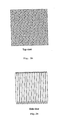
- Fig. 3 illustrates one embodiment of a device for preparing such a high-density microarray using the DNA chips of the present Invention.
- the device is made from a plurality of inexpensive commercially available capillary micropipets, preferably 10 cm micropipets, although other sizes will, of course, work. As depicted in Fig.
- each 10 cm micropipet is pulled to make a taper at one end. They are arranged in a hexagonal close-packed array, bounded by a square frame. The micropipets can be glued to one another to form a stable unit within the frame. The tapered ends ( Fig. 3B ) are cut off and polished to optical flatness.
- the tips of the device are dipped into a multi-well container which contains the (chemically modified in accordance with the present Invention) DNA samples to be tested, and whose wells are aligned with the micropipets of the device.
- a small portion of each DNA sample is deposited into the micropipet corresponding to the particular well by simple capillary action.
- the size of the spot can be carefully controlled by the size of the tapered end.
- the high-density microarray described herein can also be readily incorporated into the microarray systems of the prior art, such as those disclosed in the prior art section above. These methods are hereby incorporated by reference into the present Application, for instance, fluorescent in situ hybridization (FISH) and the method described in Shalon, et al. in A DNA Microarray System for Analyzing Complex DNA Samples Using Two-Color Fluorescent Probe Hybridization, 6 Genome Res. 639 (1996 ). In the Shalon, et al .
- FISH fluorescent in situ hybridization
- a microarray system for analyzing DNA samples that involves making microarrays of DNA samples on glass substrates, probing them by hybridization with complex fluorescent-labeled probes, and using a laser-scanning microscope to detect the fluorescent signals representing hybridization.
- Sargent, et al. U.S. Pat. No. 5,601,982 discloses a method and apparatus for determining the sequence of polynucleotides involving scanning the nucleic acids by scanning tunneling microscopy.
- a modified nucleic acid in accordance with the present Invention is prepared by reacting unmodified nucleic acid under near neutral pH with suitable silane compounds.
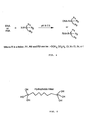
- the "X" in Fig. 4 can refer to any halide, preferably Cl, Br, or I; R 1 , R 2 , and R 3 , can be the same or different, including, --OCH 3 , and --OC 2 H 5 .
- the halogenated silane depicted to the left of the arrow in Fig. 4 is 8-bromocytltrichlorosilane, 8-bromocytltrimethoxysilane, 4-chlorobutylmethyldichlorosilane, and 3-iodopropyltrimethoxysilane.
- the conversion depicted in Fig. 4 was performed as follows.
- the halogenated silane was dissolved in dimethylformamide (DMF) at a concentration of about 30 mM.
- 3 to 10 ug of nucleic acid was dissolved in 100 ul of 0.01 M phosphate buffer (pH 7.0).
- 1 to 3 ug of 30 mM halogenated silane was added, the solution is then mixed well, and allowed to react at about 37 C for about 3 hours (alternatively, it can be reacted at ambient temperature overnight).
- the desired product-the modified nucleic acid- is purified by ethanol precipitation; then the modified nucleic acid is dissolved in water.
- one particular advantage of the present Invention is that it allows the investigator to prepare unusually high-density microarrays to conduct nucleic acid studies.
- This example is best understood in relation to example 3 which disclosed the preparation of a high-density microarray using modified nucleic acids of the present Invention.
- This example discloses enhanced methods for controlling the size of the individual nucleic acid "spots" on the solid supports, in accordance with the present Invention.
- silanes of the present Invention contains an Si(OH) 3 at each end, linked by a hydrophobic group. See Figure 6 . Any of a variety of hydrophobic linkers can be used.
- Particularly preferred embodiments include: 1,6-Bis-trichlorosilyhexane, 1,8-Bis-trichlorosilyloctane, 1,6-Bis-trimethoxysilyhexane, and 1,4 Bis-trimethoxysilylethylbenzene.
- one end of the silane attaches to the surface, and the other end remains reactive to the modified nucleic acids.
- the hydrophobic linker confers hydrophobicity to the surface.
- the skilled artisan can readily see how the electrostatic properties of the surface (hydrophobic versus hydrophilic) can be readily modulated-e.g., the chain length of the linker can be adjusted to control hydrophobicity, and the surface reactivity can be controlled by adjusting the amount of silane contacted with the surface.
- the glass surface was cleaned by slowly boiling in 3 M HCl for about 2 hrs in a fume hood. Next, the surfaces were rinsed with deionized water then kept in 0.1 M HCl until ready for use. When ready for use, the surfaces were rinsed with doubly distilled deionized water to remove any extant acid, then rinsed in absolute ethanol. Next, the surfaces were immediately transferred to an ethanol solution containing 0.0005 % to 0.002 % of the bifunctional silanes of this aspect of the Invention. The surfaces were then treated at room temperature for about 48 hours. The surfaces were then rinsed with ethanol and air dried. Finally, the glass surfaces were stored in a dust-free environment until ready for use.
- the modified nucleic acid is prepared by reacting pristine nucleic acids with an amine-containing silane.
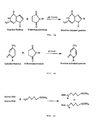
- the derivatization of nucleic acid with amine-containing silanes is comprised of two steps: (1) the halogenation (or bromination, as shown) of the nucleic acid ( Fig. 5a, 5b ); and ( 2 ) the derivatization of the halogenated nucleic acid ( Fig. 5c ). As depicted in Fig.
- the reaction can occur in the presence of N-bromosuccinimide under mild pH conditions; varying either of these reaction variables allows the skilled biochemist to control the reaction rate. Also as evidenced by Fig. 5a, 5b , the reaction normally occurs at the guanine or cytosine base depending upon the pH-i.e., neutral to slightly basic pH favors reaction at the guanine residue, more basic pH favors reaction at the cytosine residue.
- DNA DNA
- RNA DNA
- 5 ug of DNA was dissolved in 100 ul of 0.1 M NaHCO 3 , to reach a pH of about 9.5. This solution is kept on ice for about 5 minutes.
- a fresh N-bromosuccinimide solution at concentration of about 10 mM was prepared and also chilled on ice.
- 1 ul of the N-bromosuccinimide solution is added to the DNA solution; the solution was then stirred vigorously (to vortex). The reaction was then allowed to proceed on ice for about 15 minutes.
- silane-modified DNA was purified by methods well known in the art; preferably, it is purified by ethanol precipitation.
- RNA was dissolved in 100 ul of 0.1 M phosphate buffer, to reach a pH of about 7.5. This solution is kept on ice for about 5 minutes. Contemporaneously, a fresh N-bromosuccinimide solution at concentration of about 10 mM was prepared and also chilled on ice. Next, 1 ul of the N-bromosuccinimide solution is added to the DNA solution; the solution was then stirred vigorously (to vortex). The reaction was then allowed to proceed on ice for about 15 minutes. Next, 10 ul of 1 M aminosilane solution at pH about 8.0, was added to the bromine-activated DNA solution; this new mixture was allowed to react at 45 C for about 2 hours. Finally, the silane-modified DNA was purified by methods well known in the art; preferably, it is purified by ethanol precipitation.
Landscapes
- Chemical & Material Sciences (AREA)
- Organic Chemistry (AREA)
- Life Sciences & Earth Sciences (AREA)
- Health & Medical Sciences (AREA)
- Biochemistry (AREA)
- Molecular Biology (AREA)
- Engineering & Computer Science (AREA)
- Proteomics, Peptides & Aminoacids (AREA)
- Genetics & Genomics (AREA)
- Biotechnology (AREA)
- General Health & Medical Sciences (AREA)
- Analytical Chemistry (AREA)
- Zoology (AREA)
- Wood Science & Technology (AREA)
- Chemical Kinetics & Catalysis (AREA)
- Physics & Mathematics (AREA)
- Microbiology (AREA)
- Bioinformatics & Cheminformatics (AREA)
- General Engineering & Computer Science (AREA)
- Immunology (AREA)
- Biophysics (AREA)
- Apparatus Associated With Microorganisms And Enzymes (AREA)
- Measuring Or Testing Involving Enzymes Or Micro-Organisms (AREA)
- Saccharide Compounds (AREA)
Applications Claiming Priority (3)
| Application Number | Priority Date | Filing Date | Title |
|---|---|---|---|
| US71876 | 1998-05-04 | ||
| US09/071,876 US6048695A (en) | 1998-05-04 | 1998-05-04 | Chemically modified nucleic acids and methods for coupling nucleic acids to solid support |
| PCT/US1999/009810 WO1999057323A1 (en) | 1998-05-04 | 1999-05-04 | Chemically modified nucleic acids and methods for coupling nucleic acids to solid support |
Publications (3)
| Publication Number | Publication Date |
|---|---|
| EP1075544A1 EP1075544A1 (en) | 2001-02-14 |
| EP1075544A4 EP1075544A4 (en) | 2005-03-09 |
| EP1075544B1 true EP1075544B1 (en) | 2011-11-30 |
Family
ID=22104163
Family Applications (1)
| Application Number | Title | Priority Date | Filing Date |
|---|---|---|---|
| EP99920342A Expired - Lifetime EP1075544B1 (en) | 1998-05-04 | 1999-05-04 | Chemically modified nucleic acids and methods for coupling nucleic acids to solid support |
Country Status (8)
| Country | Link |
|---|---|
| US (3) | US6048695A (enExample) |
| EP (1) | EP1075544B1 (enExample) |
| JP (1) | JP4477774B2 (enExample) |
| AT (1) | ATE535615T1 (enExample) |
| AU (1) | AU770695B2 (enExample) |
| CA (1) | CA2326684C (enExample) |
| DE (1) | DE99920342T1 (enExample) |
| WO (1) | WO1999057323A1 (enExample) |
Families Citing this family (181)
| Publication number | Priority date | Publication date | Assignee | Title |
|---|---|---|---|---|
| US6426183B1 (en) * | 1995-12-21 | 2002-07-30 | Kenneth L. Beattie | Oligonucleotide microarrays: direct covalent attachment to glass |
| US7078224B1 (en) | 1999-05-14 | 2006-07-18 | Promega Corporation | Cell concentration and lysate clearance using paramagnetic particles |
| AU2001263094B2 (en) * | 1998-05-04 | 2008-07-10 | Baylor College Of Medicine | Compositions and methods for array-based genomic nucleic acid analysis of biological molecules |
| US6048695A (en) * | 1998-05-04 | 2000-04-11 | Baylor College Of Medicine | Chemically modified nucleic acids and methods for coupling nucleic acids to solid support |
| US6979728B2 (en) * | 1998-05-04 | 2005-12-27 | Baylor College Of Medicine | Articles of manufacture and methods for array based analysis of biological molecules |
| US6248127B1 (en) * | 1998-08-21 | 2001-06-19 | Medtronic Ave, Inc. | Thromboresistant coated medical device |
| JP2000157272A (ja) * | 1998-12-01 | 2000-06-13 | Hitachi Software Eng Co Ltd | バイオチップ及びその製造方法 |
| DE19957827C2 (de) * | 1999-11-25 | 2003-06-12 | Epigenomics Ag | Verwendung eines Oligomer-Arrays mit PNA- und/oder DNA-Oligomeren auf einer Oberfläche |
| JP2001149060A (ja) * | 1999-11-29 | 2001-06-05 | Nisshinbo Ind Inc | 核酸固定化基板 |
| SE9904506D0 (sv) * | 1999-12-09 | 1999-12-09 | Karolinska Innovations Ab | Method for immobilisation |
| AU2843201A (en) * | 1999-12-21 | 2001-07-03 | Vbc-Genomics Bioscience Research Gmbh | Compound comprising a peptide moiety and an organo-silane moiety. |
| EP1110967A1 (en) * | 1999-12-21 | 2001-06-27 | LION Bioscience AG | Compound comprising a biomolecule moiety and an organo-silane moiety |
| EP1111069A1 (en) * | 1999-12-22 | 2001-06-27 | BioChip Technologies GmbH | Modified nucleic acids and their use |
| ATE356231T1 (de) * | 2000-01-11 | 2007-03-15 | Nanogen Recognomics Gmbh | Biomoleküle mit multiplen anbindungsabschnitten zur bindung an eine substratoberfläche |
| FR2804129B1 (fr) * | 2000-01-20 | 2002-10-18 | Centre Nat Rech Scient | Procedes de synthese et d'immobilisation d'acides nucleiques sur un support solide silanise |
| US20040014102A1 (en) * | 2000-02-22 | 2004-01-22 | Shiping Chen | High density parallel printing of microarrays |
| CA2399189A1 (en) * | 2000-02-22 | 2001-08-30 | Genospectra, Inc. | Microarray fabrication techniques and apparatus |
| CN1404415A (zh) | 2000-02-22 | 2003-03-19 | 基因谱公司 | 微阵列制造技术及设备 |
| JP3502803B2 (ja) * | 2000-03-06 | 2004-03-02 | 日立ソフトウエアエンジニアリング株式会社 | マイクロアレイ、マイクロアレイ作製方法及びマイクロアレイにおけるピン間スポット量誤差補正方法 |
| CA2402525A1 (en) * | 2000-03-31 | 2001-10-11 | Genentech, Inc. | Compositions and methods for detecting and quantifying gene expression |
| KR100352171B1 (ko) * | 2000-04-14 | 2002-09-12 | (주) 제노텍 | 올리고뉴클레오타이드를 지지체에 고정시키는 방법 및 그방법에 의하여 제조되는 올리고뉴클레오타이드 어레이 |
| US20030219816A1 (en) * | 2001-07-02 | 2003-11-27 | Keith Solomon | Composite microarray slides |
| US6890483B2 (en) | 2000-07-05 | 2005-05-10 | Cuno Incorporated | Non-luminescent substrate |
| WO2002002585A2 (en) * | 2000-07-05 | 2002-01-10 | Cuno, Inc. | Low fluorescence nylon/glass composites for microdiagnostics |
| CA2418105A1 (en) * | 2000-08-03 | 2002-02-14 | Massachusetts Institute Of Technology | Microarrays of functional biomolecules, and uses therefor |
| US20020102617A1 (en) * | 2000-08-03 | 2002-08-01 | Macbeath Gavin | Protein microarrays |
| KR100379720B1 (ko) * | 2000-10-14 | 2003-04-11 | 주식회사 마크로젠 | 덴드리머 단일층 지지체 및 그의 제조방법 |
| CA2426540A1 (en) * | 2000-10-20 | 2002-07-25 | Biocardia, Inc. | Leukocyte expression profiling |
| US6861214B1 (en) | 2000-10-23 | 2005-03-01 | Beckman Coulter, Inc. | Immobilization of biopolymers to aminated substrates by direct adsorption |
| US20020150887A1 (en) * | 2000-11-09 | 2002-10-17 | National Institute Of Advanced Industrial Science And Technology | Methods and nucleic acid probes for molecular genetic analysis of polluted environments and environmental samples |
| US20020146684A1 (en) * | 2001-04-09 | 2002-10-10 | Meldal Morten Peter | One dimensional unichemo protection (UCP) in organic synthesis |
| CA2446417A1 (en) * | 2001-05-03 | 2002-11-14 | Sigma Genosys, L.P. | Methods for assembling protein microarrays |
| EP1385859A2 (en) * | 2001-05-10 | 2004-02-04 | Baylor College Of Medicine | Compositions and methods for array-based genomic nucleic acid analysis of biological molecules |
| US7235358B2 (en) | 2001-06-08 | 2007-06-26 | Expression Diagnostics, Inc. | Methods and compositions for diagnosing and monitoring transplant rejection |
| US7026121B1 (en) | 2001-06-08 | 2006-04-11 | Expression Diagnostics, Inc. | Methods and compositions for diagnosing and monitoring transplant rejection |
| US6905827B2 (en) * | 2001-06-08 | 2005-06-14 | Expression Diagnostics, Inc. | Methods and compositions for diagnosing or monitoring auto immune and chronic inflammatory diseases |
| FR2826957B1 (fr) * | 2001-07-09 | 2005-09-30 | Centre Nat Rech Scient | Procede de fonctionnalisation de supports solides, supports solides fonctionnalises et leurs utilisations |
| US10272409B2 (en) | 2001-07-11 | 2019-04-30 | Michael E. Hogan | Methods and devices based upon a novel form of nucleic acid duplex on a surface |
| ATE424468T1 (de) * | 2001-07-11 | 2009-03-15 | Baylor College Medicine | Verfahren und vorrichtungen auf grundlage einer neuen form eines nukleinsäureduplex auf einer oberfläche |
| DE10139283A1 (de) * | 2001-08-09 | 2003-03-13 | Epigenomics Ag | Verfahren und Nukleinsäuren zur Analyse von Colon-Krebs |
| US20030087309A1 (en) * | 2001-08-27 | 2003-05-08 | Shiping Chen | Desktop drug screening system |
| US20050032060A1 (en) * | 2001-08-31 | 2005-02-10 | Shishir Shah | Arrays comprising pre-labeled biological molecules and methods for making and using these arrays |
| US9671396B2 (en) * | 2001-09-05 | 2017-06-06 | Joon Won Park | Solid substrate comprising array of dendrons and methods for using the same |
| US7351529B2 (en) * | 2001-09-27 | 2008-04-01 | Perkinelmer Las, Inc. | Methods for detecting genetic mosaicisms using arrays |
| CA2463725A1 (en) | 2001-10-12 | 2003-11-06 | Spectral Genomics, Inc. | Compilations of nucleic acids and arrays and methods of using them |
| US7439346B2 (en) * | 2001-10-12 | 2008-10-21 | Perkinelmer Las Inc. | Nucleic acids arrays and methods of use therefor |
| WO2003042697A1 (en) * | 2001-11-14 | 2003-05-22 | Genospectra, Inc. | Biochemical analysis system with combinatorial chemistry applications |
| WO2003048727A2 (en) * | 2001-12-03 | 2003-06-12 | Invitrogen Corporation | Identification of rearrangements in nucleic acid molecules |
| CN1610742B (zh) * | 2001-12-26 | 2010-05-05 | 佳能株式会社 | 探针介质 |
| KR100450191B1 (ko) * | 2001-12-28 | 2004-10-02 | 삼성에스디아이 주식회사 | 생체물질 고정용 기판 및 이의 제조방법 |
| AU2003220159A1 (en) * | 2002-03-08 | 2003-09-22 | Spectral Genomics, Inc. | Articles of manufacture and methods for making hydrophobic derivatized arrays |
| US6916621B2 (en) * | 2002-03-27 | 2005-07-12 | Spectral Genomics, Inc. | Methods for array-based comparitive binding assays |
| US7226771B2 (en) | 2002-04-19 | 2007-06-05 | Diversa Corporation | Phospholipases, nucleic acids encoding them and methods for making and using them |
| EP1497418B1 (en) | 2002-04-19 | 2012-10-17 | Verenium Corporation | Phospholipases, nucleic acids encoding them and methods for making and using them |
| US7217512B2 (en) | 2002-05-09 | 2007-05-15 | Corning Incorporated | Reagent and method for attaching target molecules to a surface |
| AU2003272548A1 (en) * | 2002-09-16 | 2004-04-30 | Plexxikon, Inc. | Crystal structure of pim-1 kinase |
| US7129046B2 (en) * | 2002-10-21 | 2006-10-31 | Agilent Technologies, Inc. | Linking to chemical array assemblies with metal layers |
| US7195908B2 (en) | 2002-10-31 | 2007-03-27 | Corning Incorporated | Supports treated with triamine for immobilizing biomolecules |
| US20050048573A1 (en) * | 2003-02-03 | 2005-03-03 | Plexxikon, Inc. | PDE5A crystal structure and uses |
| EP1627045A2 (en) * | 2003-02-28 | 2006-02-22 | Plexxikon, Inc. | Pyk2 crystal structure and uses |
| EP2194133B1 (en) | 2003-03-06 | 2015-12-02 | BASF Enzymes LLC | Amylases, nucleic acids encoding them and methods for making and using them |
| CA2515583C (en) | 2003-03-07 | 2015-07-14 | Diversa Corporation | Hydrolases, nucleic acids encoding them and methods for making and using them |
| EP1613733B1 (en) | 2003-04-04 | 2015-06-03 | BASF Enzymes LLC | Pectate lyases, nucleic acids encoding them and methods for making and using them |
| US7892745B2 (en) * | 2003-04-24 | 2011-02-22 | Xdx, Inc. | Methods and compositions for diagnosing and monitoring transplant rejection |
| FR2854696A1 (fr) * | 2003-05-06 | 2004-11-12 | Commissariat Energie Atomique | Support de biopuce utilisant des couches minces de materiau sol gel et procede de realisation |
| CN103484486B (zh) | 2003-07-02 | 2018-04-24 | 维莱尼姆公司 | 葡聚糖酶,编码它们的核酸以及制备和使用它们的方法 |
| US20050079548A1 (en) * | 2003-07-07 | 2005-04-14 | Plexxikon, Inc. | Ligand development using PDE4B crystal structures |
| US7741089B2 (en) | 2003-08-11 | 2010-06-22 | Verenium Corporation | Laccases, nucleic acids encoding them and methods for making and using them |
| WO2005028624A2 (en) * | 2003-09-15 | 2005-03-31 | Plexxikon, Inc. | Molecular scaffolds for kinase ligand development |
| US7279280B2 (en) * | 2003-09-25 | 2007-10-09 | Mgp Biotech, Inc. | Apparatus and method for detecting genetic mutations and single nucleotide polymorphisms |
| CA2543091C (en) * | 2003-10-24 | 2013-09-03 | John Austin | Apparatus and method for dispensing fluid, semi-solid and solid samples |
| AU2004286845A1 (en) * | 2003-10-30 | 2005-05-19 | Tufts-New England Medical Center | Prenatal diagnosis using cell-free fetal DNA in amniotic fluid |
| US20070066641A1 (en) * | 2003-12-19 | 2007-03-22 | Prabha Ibrahim | Compounds and methods for development of RET modulators |
| JP5138938B2 (ja) * | 2003-12-19 | 2013-02-06 | プレキシコン インコーポレーテッド | Ret調節剤の開発のための化合物および方法 |
| EP1720015A1 (en) * | 2004-03-17 | 2006-11-08 | Matsushita Electric Industrial Co., Ltd. | Process for producing biochip, probe solution, and biochip |
| JP2008503446A (ja) * | 2004-05-06 | 2008-02-07 | プレキシコン,インコーポレーテッド | Pde4b阻害剤及びその使用 |
| US8911942B2 (en) * | 2004-05-20 | 2014-12-16 | Quest Diagnostics Investments Incorporated | Single label comparative hybridization |
| AU2005264938B2 (en) | 2004-06-16 | 2011-11-24 | Verenium Corporation | Compositions and methods for enzymatic decolorization of chlorophyll |
| US7498342B2 (en) * | 2004-06-17 | 2009-03-03 | Plexxikon, Inc. | Compounds modulating c-kit activity |
| TW200616632A (en) * | 2004-06-17 | 2006-06-01 | Plexxikon Inc | Compounds modulating c-kit activity and uses therefor |
| CN101048407A (zh) * | 2004-09-03 | 2007-10-03 | 普莱希科公司 | 双环杂芳基pde4b抑制剂 |
| US7645575B2 (en) * | 2004-09-08 | 2010-01-12 | Xdx, Inc. | Genes useful for diagnosing and monitoring inflammation related disorders |
| US20090142854A1 (en) * | 2004-11-16 | 2009-06-04 | Robert Veronique | Silanizing agents comprising a saccharide end group and uses thereof, in particular for the functionalization of solid supports |
| US20060160114A1 (en) * | 2004-12-02 | 2006-07-20 | Oncotech, Inc. | Reagents and methods for predicting drug resistance |
| US20060147943A1 (en) * | 2004-12-30 | 2006-07-06 | Lewis Mark A | Substrates having pendant epoxide groups for binding biomolecules and methods of making and using thereof |
| EP1846760B1 (en) * | 2005-01-27 | 2010-12-15 | Quest Diagnostics Investments Incorporated | Rapid comparative genome hybridization |
| EP1869174B1 (en) | 2005-03-10 | 2015-02-18 | BASF Enzymes LLC | Lyase enzymes, nucleic acids encoding them and methods for making and using them |
| EA018577B1 (ru) | 2005-03-15 | 2013-09-30 | Верениум Корпорейшн | Целлюлазы, нуклеиновые кислоты, кодирующие их, и способы их получения и применения |
| WO2006102497A2 (en) * | 2005-03-22 | 2006-09-28 | The Board Of Trustees Of The Leland Stanford Junior University | Methods and compositions for diagnosis, monitoring and development of therapeutics for treatment of atherosclerotic disease |
| WO2006122295A2 (en) * | 2005-05-11 | 2006-11-16 | Expression Diagnostics, Inc. | Methods of monitoring functional status of transplants using gene panels |
| AU2006272951A1 (en) * | 2005-05-17 | 2007-02-01 | Plexxikon, Inc. | Pyrrol (2,3-b) pyridine derivatives protein kinase inhibitors |
| MY153898A (en) * | 2005-06-22 | 2015-04-15 | Plexxikon Inc | Compounds and methods for kinase modulation, and indications therefor |
| WO2007005613A2 (en) * | 2005-07-01 | 2007-01-11 | Promega Corporation | Network of buoyant particles for biomolecule purification |
| CN1908189A (zh) * | 2005-08-02 | 2007-02-07 | 博奥生物有限公司 | 体外辅助鉴定肠型胃癌及其分化程度的方法与专用试剂盒 |
| US8076074B2 (en) | 2005-11-29 | 2011-12-13 | Quest Diagnostics Investments Incorporated | Balanced translocation in comparative hybridization |
| WO2007070381A2 (en) | 2005-12-09 | 2007-06-21 | Promega Corporation | Nucleic acid purification with a binding matrix |
| EP2508622B1 (en) | 2005-12-23 | 2016-09-14 | Perkinelmer Las, Inc. | Comparative genomic hybridization on encoded multiplex particles |
| US7932037B2 (en) | 2007-12-05 | 2011-04-26 | Perkinelmer Health Sciences, Inc. | DNA assays using amplicon probes on encoded particles |
| US20090104613A1 (en) * | 2005-12-23 | 2009-04-23 | Perkinelmer Las, Inc. | Methods and compositions relating to multiplexed genomic gain and loss assays |
| US20100009373A1 (en) * | 2005-12-23 | 2010-01-14 | Perkinelmer Health Sciences, Inc. | Methods and compositions relating to multiplex genomic gain and loss assays |
| EP1987142A4 (en) | 2006-02-02 | 2009-07-15 | Verenium Corp | ESTERASES AND ASSOCIATED NUCLEIC ACIDS AND METHODS |
| NZ595502A (en) | 2006-02-10 | 2013-11-29 | Verenium Corp | Cellulolytic enzymes, nucleic acids encoding them and methods for making and using them |
| ES2682284T3 (es) | 2006-02-14 | 2018-09-19 | Bp Corporation North America Inc. | Xilanasas, ácidos nucleicos que las codifican y métodos para elaborarlas y usarlas |
| KR101622894B1 (ko) | 2006-03-07 | 2016-05-19 | 바스프 엔자임스 엘엘씨 | 알돌라제, 이것을 코딩하는 핵산과 그 제조 방법 및 사용 방법 |
| ES2416104T3 (es) | 2006-03-07 | 2013-07-30 | Cargill, Incorporated | Aldolasas, ácidos nucleicos que las codifican y métodos para producir y usar las mismas |
| US20070232556A1 (en) * | 2006-03-31 | 2007-10-04 | Montine Thomas J | Methods and compositions for the treatment of neurological diseases and disorders |
| AU2007309726A1 (en) * | 2006-04-07 | 2008-05-02 | Xdx, Inc. | Steroid responsive nucleic acid expression and prediction of disease activity |
| CN106222185B (zh) | 2006-08-04 | 2021-12-03 | 维莱尼姆公司 | 葡聚糖酶、编码它们的核酸及制备和使用它们的方法 |
| WO2008021431A2 (en) * | 2006-08-14 | 2008-02-21 | Xdx, Inc. | Methods and compositions for diagnosing and monitoring the status of transplant rejection and immune disorders |
| EP2057274B1 (en) | 2006-09-21 | 2013-12-11 | DSM IP Assets B.V. | Phospholipases, nucleic acids encoding them and methods for making and using them |
| US8877478B2 (en) | 2006-09-21 | 2014-11-04 | Verenium Corporation | Phytases, nucleic acids encoding them and methods for making and using them |
| US8618248B2 (en) | 2006-10-31 | 2013-12-31 | President And Fellows Of Harvard College | Phosphopeptide compositions and anti-phosphopeptide antibody compositions and methods of detecting phosphorylated peptides |
| EP2102367A2 (en) * | 2006-11-09 | 2009-09-23 | XDX, Inc. | Methods for diagnosing and monitoring the status of systemic lupus erythematosus |
| WO2008063888A2 (en) | 2006-11-22 | 2008-05-29 | Plexxikon, Inc. | Compounds modulating c-fms and/or c-kit activity and uses therefor |
| PL3101128T3 (pl) | 2006-12-21 | 2019-09-30 | Basf Enzymes Llc | Amylazy i glukoamylazy, kwasy nukleinowe kodujące te związki oraz sposoby wytwarzania tych związków oraz stosowania ich |
| RU2009122670A (ru) | 2006-12-21 | 2011-01-27 | Плекссикон, Инк. (Us) | Соединения и способы для модуляции киназ и показания к их применению |
| PE20121126A1 (es) * | 2006-12-21 | 2012-08-24 | Plexxikon Inc | Compuestos pirrolo [2,3-b] piridinas como moduladores de quinasa |
| WO2008079909A1 (en) * | 2006-12-21 | 2008-07-03 | Plexxikon, Inc. | Pyrrolo [2,3-b] pyridines as kinase modulators |
| CN104212822A (zh) | 2007-01-30 | 2014-12-17 | Bp法人北美有限公司 | 用于处理木质纤维素的酶、编码它们的核酸及其制备和应用方法 |
| EA019514B1 (ru) | 2007-04-27 | 2014-04-30 | Те Риджентс Оф Те Юниверсити Оф Калифорния | Сенсоры coрастений, нуклеиновые кислоты, кодирующие их, способы их получения и применение |
| JP2010533729A (ja) | 2007-07-17 | 2010-10-28 | プレキシコン,インコーポレーテッド | キナーゼ調節のための化合物と方法、及びそのための適応 |
| US7507539B2 (en) * | 2007-07-30 | 2009-03-24 | Quest Diagnostics Investments Incorporated | Substractive single label comparative hybridization |
| NZ601191A (en) | 2007-10-03 | 2014-01-31 | Verenium Corp | Xylanases, nucleic acids encoding them and methods for making and using them |
| AU2008347234B2 (en) | 2008-01-03 | 2015-05-28 | Basf Enzymes Llc | Transferases and oxidoreductases, nucleic acids encoding them and methods for making and using them |
| US20090215050A1 (en) * | 2008-02-22 | 2009-08-27 | Robert Delmar Jenison | Systems and methods for point-of-care amplification and detection of polynucleotides |
| WO2009137369A1 (en) * | 2008-05-03 | 2009-11-12 | Tufts Medical Center, Inc. | Neonatal salivary genomics |
| US8357503B2 (en) | 2008-08-29 | 2013-01-22 | Bunge Oils, Inc. | Hydrolases, nucleic acids encoding them and methods for making and using them |
| AU2009285644B2 (en) | 2008-08-29 | 2015-08-20 | Janssen Biotech, Inc. | Markers and methods for assessing and treating ulcerative colitis and related disorders using a 20 gene panel |
| US8198062B2 (en) | 2008-08-29 | 2012-06-12 | Dsm Ip Assets B.V. | Hydrolases, nucleic acids encoding them and methods for making and using them |
| US8153391B2 (en) | 2008-08-29 | 2012-04-10 | Bunge Oils, Inc. | Hydrolases, nucleic acids encoding them and methods for making and using them |
| DE102008053270A1 (de) * | 2008-10-27 | 2010-05-12 | Medizinische Hochschule Hannover | Vorrichtung und Verfahren zur Analyse von Zellen |
| WO2010054195A2 (en) | 2008-11-07 | 2010-05-14 | Centocor Ortho Biotech Inc. | Markers and methods for assessing and treating lupus patients susceptible to photoprovocation |
| MX355507B (es) * | 2009-03-09 | 2018-04-19 | Bioatla Llc | Proteinas mirac. |
| CA2738573C (en) * | 2009-04-03 | 2013-02-19 | F. Hoffmann-La Roche Ag | Compositions of propane-1 sulfonic acid {3-[5-(4-chloro-phenyl)-1h-pyrrolo[2,3-b]pyridine-3-carbonyl]-2,4-difluoro-phenyl}-amide and uses thereof |
| HUE030948T2 (en) | 2009-05-21 | 2017-06-28 | Basf Enzymes Llc | Phytases, nucleic acids and processes encoding them for their production and use |
| US8329724B2 (en) | 2009-08-03 | 2012-12-11 | Hoffmann-La Roche Inc. | Process for the manufacture of pharmaceutically active compounds |
| WO2011028533A2 (en) * | 2009-08-24 | 2011-03-10 | Perkinelmer Health Sciences, Inc. | Methods for detecting dna methylation using encoded particles |
| US8222397B2 (en) * | 2009-08-28 | 2012-07-17 | Promega Corporation | Methods of optimal purification of nucleic acids and kit for use in performing such methods |
| US8039613B2 (en) | 2009-08-28 | 2011-10-18 | Promega Corporation | Methods of purifying a nucleic acid and formulation and kit for use in performing such methods |
| US20110086772A1 (en) * | 2009-09-25 | 2011-04-14 | Signature Genomics Laboratories Llc | Multiplex (+/-) stranded arrays and assays for detecting chromosomal abnormalities associated with cancer and other diseases |
| UA109884C2 (uk) | 2009-10-16 | 2015-10-26 | Поліпептид, що має активність ферменту фосфатидилінозитол-специфічної фосфоліпази с, нуклеїнова кислота, що його кодує, та спосіб його виробництва і застосування | |
| UA111708C2 (uk) | 2009-10-16 | 2016-06-10 | Бандж Ойлз, Інк. | Спосіб рафінування олії |
| US20120322677A1 (en) | 2009-10-19 | 2012-12-20 | Stichting Het Nederlands Kanker Instituut | Predicting benefit of anti-cancer therapy via array comparative genomic hybridization |
| WO2011048498A2 (en) | 2009-10-19 | 2011-04-28 | Stichting Het Nederlands Kanker Instituut | Differentiation between brca2-associated tumours and sporadic tumours via array comparative genomic hybridization |
| US20120277112A1 (en) | 2009-10-19 | 2012-11-01 | Stichting Het Nederlands Kanker Instituut | Predicting response to anti-cancer therapy via array comparative genomic hybridization |
| JP2013510166A (ja) | 2009-11-06 | 2013-03-21 | プレキシコン インコーポレーテッド | キナーゼ調節のための化合物、方法およびその適用 |
| NL2004275C2 (en) * | 2010-02-22 | 2011-08-23 | Univ Leiden | Raman spectrometry. |
| US20140018251A1 (en) | 2010-09-20 | 2014-01-16 | Stichting Het Nederlands Kanker Instituut | Methods for Predicting Response to Anti-Cancer Therapy in Cancer Patients |
| CA2811787A1 (en) | 2010-10-06 | 2012-04-19 | Bp Corporation North America Inc. | Variant cbh i polypeptides |
| PE20141360A1 (es) | 2011-02-07 | 2014-10-13 | Plexxikon Inc | Compuestos y metodos para la modulacion de quinasas e indicaciones para los mismos. |
| TWI558702B (zh) | 2011-02-21 | 2016-11-21 | 普雷辛肯公司 | 醫藥活性物質的固態形式 |
| CA2836474A1 (en) | 2011-05-17 | 2012-11-22 | Plexxikon Inc. | Kinase modulation and indications therefor |
| WO2013067448A2 (en) | 2011-11-03 | 2013-05-10 | Vca Antech Inc. | Compositions and methods to detect various infectious organisms |
| US9850541B2 (en) | 2011-12-19 | 2017-12-26 | Valley Health System | Methods and kits for detecting subjects at risk of having cancer |
| US9150570B2 (en) | 2012-05-31 | 2015-10-06 | Plexxikon Inc. | Synthesis of heterocyclic compounds |
| HUE065221T2 (hu) | 2012-06-15 | 2024-05-28 | Genesis Theranostix Korlatolt Feleloessegue Tarsasag | Biomarker teszt praeeclampsia elõrejelzésére vagy korai kimutatására |
| US10670610B2 (en) | 2012-06-15 | 2020-06-02 | Wayne State University | Biomarker test for prediction or early detection of preeclampsia and/or HELLP syndrome |
| WO2014028461A2 (en) | 2012-08-13 | 2014-02-20 | The Rockefeller University | Treatment and diagnosis of melanoma |
| EP2914344B1 (en) | 2012-10-31 | 2020-01-15 | The Rockefeller University | Treatment of metastatic colon cancer |
| US9267171B2 (en) | 2013-02-28 | 2016-02-23 | New York University | DNA photolithography with cinnamate crosslinkers |
| ES2913205T3 (es) | 2014-05-13 | 2022-06-01 | Bioatla Inc | Proteínas biológicas activas condicionalmente |
| CN106795557A (zh) | 2014-06-02 | 2017-05-31 | 瓦利保健系统公司 | 用于肺癌诊断的方法和系统 |
| US11111288B2 (en) | 2014-08-28 | 2021-09-07 | Bioatla, Inc. | Conditionally active chimeric antigen receptors for modified t-cells |
| DK3186284T3 (da) | 2014-08-28 | 2022-05-09 | Bioatla Inc | Betinget aktive kimæriske antigenreceptorer til modificerede t-celler |
| US10513699B2 (en) | 2014-09-03 | 2019-12-24 | Bioatla, Llc | Discovering and producing conditionally active biologic proteins in the same eukaryotic cell production hosts |
| SG11201705988UA (en) | 2015-02-24 | 2017-08-30 | Bioatla Llc | Conditionally active biological proteins |
| US10160755B2 (en) | 2015-04-08 | 2018-12-25 | Plexxikon Inc. | Compounds and methods for kinase modulation, and indications therefor |
| FR3038734A1 (fr) * | 2015-07-10 | 2017-01-13 | Centre Nat De La Rech Scient (Cnrs) | Nouveaux materiaux optiques fonctionnalises |
| US10829484B2 (en) | 2015-07-28 | 2020-11-10 | Plexxikon Inc. | Compounds and methods for kinase modulation, and indications therefor |
| US9938273B2 (en) | 2015-12-07 | 2018-04-10 | Plexxikon Inc. | Compounds and methods for kinase modulation, and indications therefor |
| EP4122958A1 (en) | 2016-05-13 | 2023-01-25 | BioAtla, Inc. | Anti-ror2 antibodies, antibody fragments, their immunoconjugates and uses thereof |
| TW201815766A (zh) | 2016-09-22 | 2018-05-01 | 美商普雷辛肯公司 | 用於ido及tdo調節之化合物及方法以及其適應症 |
| JP7193460B2 (ja) | 2016-12-23 | 2022-12-20 | プレキシコン インコーポレーテッド | Cdk8調節およびその適応症のための化合物および方法 |
| WO2018226846A1 (en) | 2017-06-07 | 2018-12-13 | Plexxikon Inc. | Compounds and methods for kinase modulation |
| EP3713575A4 (en) | 2017-11-21 | 2021-08-25 | Rgenix, Inc. | POLYMORPHS AND THEIR USES |
| WO2019136560A1 (en) | 2018-01-09 | 2019-07-18 | Mcmaster University | Fluorosilinated liquid-infused surfaces with embedded biomolecules, methods of making and uses thereof |
| EP3594290A1 (en) | 2018-07-13 | 2020-01-15 | Haelixa GmbH | Marked items and verification methods |
| US11884980B2 (en) | 2018-11-28 | 2024-01-30 | Bioscreening & Diagnostics Llc | Method for detection of traumatic brain injury |
| JP7689964B2 (ja) | 2019-12-13 | 2025-06-09 | インスピルナ,インコーポレーテッド | 金属塩及びその使用 |
| EP4368613A1 (fr) | 2022-11-08 | 2024-05-15 | aeChem Life Technologies Sàrl | Dérivés de dicyanomethanides de phthalazinium |
| US20250314664A1 (en) | 2024-04-03 | 2025-10-09 | Mars, Incorporated | Compositions and methods to detect infectious organisms |
Family Cites Families (39)
| Publication number | Priority date | Publication date | Assignee | Title |
|---|---|---|---|---|
| US4231910A (en) * | 1979-02-08 | 1980-11-04 | Dow Corning Corporation | Primer composition |
| CA1130228A (en) * | 1980-05-21 | 1982-08-24 | Chiang-Chang Liao | Support matrix for amino-containing biologically active substances |
| CA1253129A (en) * | 1984-02-09 | 1989-04-25 | Thomas R. Jones | Porous inorganic materials |
| US4957858A (en) * | 1986-04-16 | 1990-09-18 | The Salk Instute For Biological Studies | Replicative RNA reporter systems |
| US4637687A (en) * | 1984-06-14 | 1987-01-20 | General Electric Company | Cascaded, dual cell transflective liquid crystal display |
| US4818681A (en) * | 1985-02-22 | 1989-04-04 | Molecular Diagnostics, Inc. | Fast and specific immobilization of nucleic acids to solid supports |
| US5641630A (en) * | 1985-06-13 | 1997-06-24 | Amgen Inc. | Method and kit for performing nucleic acid hybridization assays |
| US4806631A (en) * | 1985-09-30 | 1989-02-21 | Miles Inc. | Immobilization of nucleic acids on solvolyzed nylon supports |
| US5190864A (en) * | 1986-04-15 | 1993-03-02 | Northeastern University | Enzyme amplification by using free enzyme to release enzyme from an immobilized enzyme material |
| US4937188A (en) * | 1986-04-15 | 1990-06-26 | Northeastern University | Enzyme activity amplification method for increasing assay sensitivity |
| US4713116A (en) * | 1987-01-02 | 1987-12-15 | Ralston Purina Company | Protein modified with a silanation reagent as an adhesive binder and process of producing |
| AU613982B2 (en) * | 1987-11-27 | 1991-08-15 | Ecc International Limited | Porous inorganic material |
| GB8803413D0 (en) * | 1988-02-15 | 1988-03-16 | Ecc Int Ltd | Biological support |
| US5024933A (en) * | 1988-05-10 | 1991-06-18 | Enzo Biochem, Inc. | Method and kit for sample adherence to test substrate |
| US5071909A (en) * | 1989-07-26 | 1991-12-10 | Millipore Corporation | Immobilization of proteins and peptides on insoluble supports |
| US5252743A (en) * | 1989-11-13 | 1993-10-12 | Affymax Technologies N.V. | Spatially-addressable immobilization of anti-ligands on surfaces |
| US5215882A (en) * | 1989-11-30 | 1993-06-01 | Ortho Diagnostic Systems, Inc. | Method of immobilizing nucleic acid on a solid surface for use in nucleic acid hybridization assays |
| EP0455905B1 (en) * | 1990-05-11 | 1998-06-17 | Microprobe Corporation | Dipsticks for nucleic acid hybridization assays and methods for covalently immobilizing oligonucleotides |
| DE4018778A1 (de) * | 1990-06-12 | 1991-12-19 | Braun Melsungen Ag | Adsorptionsmaterial zur selektiven entfernung von ldl- oder/und vldl |
| IL102486A (en) * | 1991-10-04 | 1997-11-20 | Orgenics Ltd | Method and apparatus for detection of nucleic acid sequences with a nucleic acid probe |
| US5632957A (en) * | 1993-11-01 | 1997-05-27 | Nanogen | Molecular biological diagnostic systems including electrodes |
| US5412087A (en) * | 1992-04-24 | 1995-05-02 | Affymax Technologies N.V. | Spatially-addressable immobilization of oligonucleotides and other biological polymers on surfaces |
| US5610287A (en) * | 1993-12-06 | 1997-03-11 | Molecular Tool, Inc. | Method for immobilizing nucleic acid molecules |
| US6015880A (en) * | 1994-03-16 | 2000-01-18 | California Institute Of Technology | Method and substrate for performing multiple sequential reactions on a matrix |
| US5807522A (en) * | 1994-06-17 | 1998-09-15 | The Board Of Trustees Of The Leland Stanford Junior University | Methods for fabricating microarrays of biological samples |
| US5554744A (en) * | 1994-09-23 | 1996-09-10 | Hybridon, Inc. | Method for loading solid supports for nucleic acid synthesis |
| US5688642A (en) * | 1994-12-01 | 1997-11-18 | The United States Of America As Represented By The Secretary Of The Navy | Selective attachment of nucleic acid molecules to patterned self-assembled surfaces |
| US5807756A (en) * | 1995-01-10 | 1998-09-15 | At Point Bio | Ceramic assembly for use in biological assays |
| US5601982A (en) * | 1995-02-07 | 1997-02-11 | Sargent; Jeannine P. | Method and apparatus for determining the sequence of polynucleotides |
| US5959098A (en) * | 1996-04-17 | 1999-09-28 | Affymetrix, Inc. | Substrate preparation process |
| US5630932A (en) * | 1995-09-06 | 1997-05-20 | Molecular Imaging Corporation | Tip etching system and method for etching platinum-containing wire |
| US5658802A (en) * | 1995-09-07 | 1997-08-19 | Microfab Technologies, Inc. | Method and apparatus for making miniaturized diagnostic arrays |
| US5851769A (en) * | 1995-09-27 | 1998-12-22 | The Regents Of The University Of California | Quantitative DNA fiber mapping |
| US6156502A (en) * | 1995-12-21 | 2000-12-05 | Beattie; Kenneth Loren | Arbitrary sequence oligonucleotide fingerprinting |
| US6426183B1 (en) * | 1995-12-21 | 2002-07-30 | Kenneth L. Beattie | Oligonucleotide microarrays: direct covalent attachment to glass |
| US5567294A (en) * | 1996-01-30 | 1996-10-22 | Board Of Governors, University Of Alberta | Multiple capillary biochemical analyzer with barrier member |
| AU734704B2 (en) * | 1996-05-30 | 2001-06-21 | Cellomics, Inc. | Miniaturized cell array methods and apparatus for cell-based screening |
| US6979728B2 (en) * | 1998-05-04 | 2005-12-27 | Baylor College Of Medicine | Articles of manufacture and methods for array based analysis of biological molecules |
| US6048695A (en) * | 1998-05-04 | 2000-04-11 | Baylor College Of Medicine | Chemically modified nucleic acids and methods for coupling nucleic acids to solid support |
-
1998
- 1998-05-04 US US09/071,876 patent/US6048695A/en not_active Expired - Lifetime
-
1999
- 1999-05-04 CA CA002326684A patent/CA2326684C/en not_active Expired - Fee Related
- 1999-05-04 JP JP2000547274A patent/JP4477774B2/ja not_active Expired - Fee Related
- 1999-05-04 AU AU37861/99A patent/AU770695B2/en not_active Ceased
- 1999-05-04 EP EP99920342A patent/EP1075544B1/en not_active Expired - Lifetime
- 1999-05-04 WO PCT/US1999/009810 patent/WO1999057323A1/en not_active Ceased
- 1999-05-04 DE DE99920342T patent/DE99920342T1/de active Pending
- 1999-05-04 AT AT99920342T patent/ATE535615T1/de active
-
2000
- 2000-04-10 US US09/546,085 patent/US6858713B1/en not_active Expired - Fee Related
-
2004
- 2004-09-24 US US10/948,858 patent/US20050064494A1/en not_active Abandoned
Also Published As
| Publication number | Publication date |
|---|---|
| US20050064494A1 (en) | 2005-03-24 |
| AU770695B2 (en) | 2004-02-26 |
| EP1075544A4 (en) | 2005-03-09 |
| CA2326684C (en) | 2006-03-14 |
| US6858713B1 (en) | 2005-02-22 |
| US6048695A (en) | 2000-04-11 |
| WO1999057323A1 (en) | 1999-11-11 |
| JP2002513814A (ja) | 2002-05-14 |
| CA2326684A1 (en) | 1999-11-11 |
| JP4477774B2 (ja) | 2010-06-09 |
| AU3786199A (en) | 1999-11-23 |
| EP1075544A1 (en) | 2001-02-14 |
| DE99920342T1 (de) | 2005-01-20 |
| ATE535615T1 (de) | 2011-12-15 |
Similar Documents
| Publication | Publication Date | Title |
|---|---|---|
| AU770695B2 (en) | Chemically modified nucleic acids and methods for coupling nucleic acids to solid support | |
| US6558907B2 (en) | Methods and compositions for arraying nucleic acids onto a solid support | |
| US20040106110A1 (en) | Preparation of polynucleotide arrays | |
| US20020037509A1 (en) | Polymer coated surfaces for microarray applications | |
| US6979728B2 (en) | Articles of manufacture and methods for array based analysis of biological molecules | |
| JP3883539B2 (ja) | エポキシ基を有する放射状ポリエチレングリコール誘導体を用いたハイドロゲルバイオチップの製造方法 | |
| JP3398366B2 (ja) | Dna分析用マイクロアレイの製造方法 | |
| EP1312685A2 (en) | Oligonucleotide array for detecting the methylation state | |
| KR100450822B1 (ko) | 에폭시기를 갖는 방사형 폴리에틸렌글리콜 유도체를이용한 하이드로 젤 바이오칩의 제조방법 | |
| US20020076832A1 (en) | Method of attaching a biopolymer to a solid support | |
| Frydrych-Tomczak et al. | Application of epoxy functional silanes in the preparation of DNA microarrays | |
| EP1483583B1 (en) | Acyl fluoride activation of carboxysilyl-coated glass substrates | |
| EP1385859A2 (en) | Compositions and methods for array-based genomic nucleic acid analysis of biological molecules | |
| AU2001263094B2 (en) | Compositions and methods for array-based genomic nucleic acid analysis of biological molecules | |
| JP3975042B2 (ja) | 固相担体表面へのdna断片の固定方法及びdnaチップ | |
| EP4191638A1 (en) | Surface linker of semiconductor chip, preparation method therefor and application thereof | |
| KR100487167B1 (ko) | 바이오칩 및 이의 제조방법 | |
| AU2001263094A1 (en) | Compositions and methods for array-based genomic nucleic acid analysis of biological molecules | |
| US20030232361A1 (en) | Nucleic acid array preparation using purified phosphoramidites |
Legal Events
| Date | Code | Title | Description |
|---|---|---|---|
| PUAI | Public reference made under article 153(3) epc to a published international application that has entered the european phase |
Free format text: ORIGINAL CODE: 0009012 |
|
| 17P | Request for examination filed |
Effective date: 20001204 |
|
| AK | Designated contracting states |
Kind code of ref document: A1 Designated state(s): AT BE CH CY DE DK ES FI FR GB GR IE IT LI LU MC NL PT SE |
|
| RIN1 | Information on inventor provided before grant (corrected) |
Inventor name: CAI, WEI, WEN Inventor name: BRADLEY, ALLAN |
|
| EL | Fr: translation of claims filed | ||
| RIC1 | Information provided on ipc code assigned before grant |
Ipc: 7B 01J 19/00 B Ipc: 7C 07H 21/00 B Ipc: 7C 07H 21/04 B Ipc: 7C 12Q 1/68 A |
|
| DET | De: translation of patent claims | ||
| A4 | Supplementary search report drawn up and despatched |
Effective date: 20050117 |
|
| 17Q | First examination report despatched |
Effective date: 20071121 |
|
| GRAP | Despatch of communication of intention to grant a patent |
Free format text: ORIGINAL CODE: EPIDOSNIGR1 |
|
| GRAS | Grant fee paid |
Free format text: ORIGINAL CODE: EPIDOSNIGR3 |
|
| GRAA | (expected) grant |
Free format text: ORIGINAL CODE: 0009210 |
|
| AK | Designated contracting states |
Kind code of ref document: B1 Designated state(s): AT BE CH CY DE DK ES FI FR GB GR IE IT LI LU MC NL PT SE |
|
| REG | Reference to a national code |
Ref country code: GB Ref legal event code: FG4D Ref country code: CH Ref legal event code: EP |
|
| REG | Reference to a national code |
Ref country code: IE Ref legal event code: FG4D |
|
| REG | Reference to a national code |
Ref country code: DE Ref legal event code: R096 Ref document number: 69943893 Country of ref document: DE Effective date: 20120202 |
|
| REG | Reference to a national code |
Ref country code: NL Ref legal event code: VDEP Effective date: 20111130 |
|
| PG25 | Lapsed in a contracting state [announced via postgrant information from national office to epo] |
Ref country code: SE Free format text: LAPSE BECAUSE OF FAILURE TO SUBMIT A TRANSLATION OF THE DESCRIPTION OR TO PAY THE FEE WITHIN THE PRESCRIBED TIME-LIMIT Effective date: 20111130 Ref country code: PT Free format text: LAPSE BECAUSE OF FAILURE TO SUBMIT A TRANSLATION OF THE DESCRIPTION OR TO PAY THE FEE WITHIN THE PRESCRIBED TIME-LIMIT Effective date: 20120330 Ref country code: BE Free format text: LAPSE BECAUSE OF FAILURE TO SUBMIT A TRANSLATION OF THE DESCRIPTION OR TO PAY THE FEE WITHIN THE PRESCRIBED TIME-LIMIT Effective date: 20111130 Ref country code: GR Free format text: LAPSE BECAUSE OF FAILURE TO SUBMIT A TRANSLATION OF THE DESCRIPTION OR TO PAY THE FEE WITHIN THE PRESCRIBED TIME-LIMIT Effective date: 20120301 Ref country code: NL Free format text: LAPSE BECAUSE OF FAILURE TO SUBMIT A TRANSLATION OF THE DESCRIPTION OR TO PAY THE FEE WITHIN THE PRESCRIBED TIME-LIMIT Effective date: 20111130 |
|
| PG25 | Lapsed in a contracting state [announced via postgrant information from national office to epo] |
Ref country code: CY Free format text: LAPSE BECAUSE OF FAILURE TO SUBMIT A TRANSLATION OF THE DESCRIPTION OR TO PAY THE FEE WITHIN THE PRESCRIBED TIME-LIMIT Effective date: 20111130 |
|
| PG25 | Lapsed in a contracting state [announced via postgrant information from national office to epo] |
Ref country code: DK Free format text: LAPSE BECAUSE OF FAILURE TO SUBMIT A TRANSLATION OF THE DESCRIPTION OR TO PAY THE FEE WITHIN THE PRESCRIBED TIME-LIMIT Effective date: 20111130 |
|
| PG25 | Lapsed in a contracting state [announced via postgrant information from national office to epo] |
Ref country code: IT Free format text: LAPSE BECAUSE OF FAILURE TO SUBMIT A TRANSLATION OF THE DESCRIPTION OR TO PAY THE FEE WITHIN THE PRESCRIBED TIME-LIMIT Effective date: 20111130 |
|
| REG | Reference to a national code |
Ref country code: AT Ref legal event code: MK05 Ref document number: 535615 Country of ref document: AT Kind code of ref document: T Effective date: 20111130 |
|
| PLBE | No opposition filed within time limit |
Free format text: ORIGINAL CODE: 0009261 |
|
| STAA | Information on the status of an ep patent application or granted ep patent |
Free format text: STATUS: NO OPPOSITION FILED WITHIN TIME LIMIT |
|
| 26N | No opposition filed |
Effective date: 20120831 |
|
| REG | Reference to a national code |
Ref country code: DE Ref legal event code: R097 Ref document number: 69943893 Country of ref document: DE Effective date: 20120831 |
|
| PG25 | Lapsed in a contracting state [announced via postgrant information from national office to epo] |
Ref country code: MC Free format text: LAPSE BECAUSE OF NON-PAYMENT OF DUE FEES Effective date: 20120531 |
|
| REG | Reference to a national code |
Ref country code: CH Ref legal event code: PL |
|
| PG25 | Lapsed in a contracting state [announced via postgrant information from national office to epo] |
Ref country code: CH Free format text: LAPSE BECAUSE OF NON-PAYMENT OF DUE FEES Effective date: 20120531 Ref country code: AT Free format text: LAPSE BECAUSE OF FAILURE TO SUBMIT A TRANSLATION OF THE DESCRIPTION OR TO PAY THE FEE WITHIN THE PRESCRIBED TIME-LIMIT Effective date: 20111130 Ref country code: LI Free format text: LAPSE BECAUSE OF NON-PAYMENT OF DUE FEES Effective date: 20120531 |
|
| REG | Reference to a national code |
Ref country code: IE Ref legal event code: MM4A |
|
| REG | Reference to a national code |
Ref country code: FR Ref legal event code: ST Effective date: 20130131 |
|
| PG25 | Lapsed in a contracting state [announced via postgrant information from national office to epo] |
Ref country code: FR Free format text: LAPSE BECAUSE OF NON-PAYMENT OF DUE FEES Effective date: 20120531 Ref country code: IE Free format text: LAPSE BECAUSE OF NON-PAYMENT OF DUE FEES Effective date: 20120504 Ref country code: ES Free format text: LAPSE BECAUSE OF FAILURE TO SUBMIT A TRANSLATION OF THE DESCRIPTION OR TO PAY THE FEE WITHIN THE PRESCRIBED TIME-LIMIT Effective date: 20120311 |
|
| PG25 | Lapsed in a contracting state [announced via postgrant information from national office to epo] |
Ref country code: FI Free format text: LAPSE BECAUSE OF FAILURE TO SUBMIT A TRANSLATION OF THE DESCRIPTION OR TO PAY THE FEE WITHIN THE PRESCRIBED TIME-LIMIT Effective date: 20111130 |
|
| PGFP | Annual fee paid to national office [announced via postgrant information from national office to epo] |
Ref country code: DE Payment date: 20130530 Year of fee payment: 15 Ref country code: GB Payment date: 20130528 Year of fee payment: 15 |
|
| PG25 | Lapsed in a contracting state [announced via postgrant information from national office to epo] |
Ref country code: LU Free format text: LAPSE BECAUSE OF NON-PAYMENT OF DUE FEES Effective date: 20120504 |
|
| REG | Reference to a national code |
Ref country code: DE Ref legal event code: R119 Ref document number: 69943893 Country of ref document: DE |
|
| GBPC | Gb: european patent ceased through non-payment of renewal fee |
Effective date: 20140504 |
|
| REG | Reference to a national code |
Ref country code: DE Ref legal event code: R119 Ref document number: 69943893 Country of ref document: DE Effective date: 20141202 |
|
| PG25 | Lapsed in a contracting state [announced via postgrant information from national office to epo] |
Ref country code: DE Free format text: LAPSE BECAUSE OF NON-PAYMENT OF DUE FEES Effective date: 20141202 |
|
| PG25 | Lapsed in a contracting state [announced via postgrant information from national office to epo] |
Ref country code: GB Free format text: LAPSE BECAUSE OF NON-PAYMENT OF DUE FEES Effective date: 20140504 |