EP1069122B1 - VERFAHREN ZUR HERSTELLUNG VON 5-HYDROXYBENZO[b]THIOPHEN-3-CARBONSÄURE - Google Patents
VERFAHREN ZUR HERSTELLUNG VON 5-HYDROXYBENZO[b]THIOPHEN-3-CARBONSÄURE Download PDFInfo
- Publication number
- EP1069122B1 EP1069122B1 EP99910764A EP99910764A EP1069122B1 EP 1069122 B1 EP1069122 B1 EP 1069122B1 EP 99910764 A EP99910764 A EP 99910764A EP 99910764 A EP99910764 A EP 99910764A EP 1069122 B1 EP1069122 B1 EP 1069122B1
- Authority
- EP
- European Patent Office
- Prior art keywords
- compound
- formula
- hydroxy
- group
- alkyl
- Prior art date
- Legal status (The legal status is an assumption and is not a legal conclusion. Google has not performed a legal analysis and makes no representation as to the accuracy of the status listed.)
- Expired - Lifetime
Links
- 0 *c1c[s]c(cc2)c1cc2O* Chemical compound *c1c[s]c(cc2)c1cc2O* 0.000 description 4
- MHIWUXXIQRIOJQ-UHFFFAOYSA-N C#CCSc(cc1)ccc1OS(c1ccccc1)(=O)=O Chemical compound C#CCSc(cc1)ccc1OS(c1ccccc1)(=O)=O MHIWUXXIQRIOJQ-UHFFFAOYSA-N 0.000 description 1
- BXAVKNRWVKUTLY-UHFFFAOYSA-N Oc(cc1)ccc1S Chemical compound Oc(cc1)ccc1S BXAVKNRWVKUTLY-UHFFFAOYSA-N 0.000 description 1
Classifications
-
- C—CHEMISTRY; METALLURGY
- C07—ORGANIC CHEMISTRY
- C07D—HETEROCYCLIC COMPOUNDS
- C07D333/00—Heterocyclic compounds containing five-membered rings having one sulfur atom as the only ring hetero atom
- C07D333/50—Heterocyclic compounds containing five-membered rings having one sulfur atom as the only ring hetero atom condensed with carbocyclic rings or ring systems
- C07D333/52—Benzo[b]thiophenes; Hydrogenated benzo[b]thiophenes
- C07D333/62—Benzo[b]thiophenes; Hydrogenated benzo[b]thiophenes with hetero atoms or with carbon atoms having three bonds to hetero atoms with at the most one bond to halogen, e.g. ester or nitrile radicals, directly attached to carbon atoms of the hetero ring
- C07D333/68—Carbon atoms having three bonds to hetero atoms with at the most one bond to halogen
-
- Y—GENERAL TAGGING OF NEW TECHNOLOGICAL DEVELOPMENTS; GENERAL TAGGING OF CROSS-SECTIONAL TECHNOLOGIES SPANNING OVER SEVERAL SECTIONS OF THE IPC; TECHNICAL SUBJECTS COVERED BY FORMER USPC CROSS-REFERENCE ART COLLECTIONS [XRACs] AND DIGESTS
- Y02—TECHNOLOGIES OR APPLICATIONS FOR MITIGATION OR ADAPTATION AGAINST CLIMATE CHANGE
- Y02P—CLIMATE CHANGE MITIGATION TECHNOLOGIES IN THE PRODUCTION OR PROCESSING OF GOODS
- Y02P20/00—Technologies relating to chemical industry
- Y02P20/50—Improvements relating to the production of bulk chemicals
- Y02P20/55—Design of synthesis routes, e.g. reducing the use of auxiliary or protecting groups
Definitions
- the present invention relates to 5-hydroxybenzo[b]thiophene-3-carboxylic acid derivatives which are key starting materials for producing compounds useful in the field of pharmaceuticals.
- Hydroxybenzo[b]thiophene-3-carboxylic acid derivatives of the general formula (I): wherein R is hydrogen or a hydroxy-protecting group are important starting materials in the synthesis of pharmacologically active compounds.
- a compound of the formula (I) is essential in the synthesis of benzothiophenecarboxamide derivatives of the general formula (VI): wherein R is as defined above and X is hydrogen or alkyl.
- the benzothiophenecarboxamide derivatives are specific antagonists of PGD 2 and known to be useful as drugs in the treatment of various diseases related to mast cell dysfunction caused by excessive production of PGD 2 , for example, systemic mastocytosis, disorder of systemic mast cell activation, tracheal contraction, asthma, allergic rhinitis, allergic conjunctivitis, urticaria, injury due to ischemic reperfusion, inflammation, and atopic dermatis (WO97/00853, PCT/JP97/04527 (WO98/25919)).
- diseases related to mast cell dysfunction caused by excessive production of PGD 2 for example, systemic mastocytosis, disorder of systemic mast cell activation, tracheal contraction, asthma, allergic rhinitis, allergic conjunctivitis, urticaria, injury due to ischemic reperfusion, inflammation, and atopic dermatis (WO97/00853, PCT/JP97/04527 (WO98/25919)).
- Compound A a compound wherein OR is a 5-hydroxy and X is hydrogen (hereinafter, referred to as "Compound A”) has especially high antagonistic effect on PGD 2 , showing an excellent anti-nasal occlusion activity, and is envisaged to be a promising drug for treating nasal occlusion.
- WO97/02269 discloses condensed thiazole derivatives having 5-HT Receptor Affinity, which are useful for the treatment of central nervous disorders.
- 5-Hydroxybenzo[b]thiophene-3-carboxylic acid or 5-acetoxybenzo[b]thiophene-3-carboxylic acid are then synthesized starting from the reaction products above.
- a starting material such as 5-hydroxybenzo[b]thiophene or 5-bromobenzo [b] thiophene is not commercially available and had to be synthesized from an appropriate reagent (e.g., J. Am. Chem. Soc., 57, 1611 (1935), J. Heterocyclic Chem., 25, 1271 (1988)) in all cases, which has made the synthetic process longer and complex.
- the present invention solves the problems of the existing methods and provides a method for the preparation of the compounds of the formula (I), which method is industrially applicable, efficient and safe.
- the present invention provides a process for preparing a compound of the formula (I): wherein R is hydrogen or a hydroxy-protecting group, or a reactive derivative thereof comprising subjecting 4-mercaptophenol to reactions for introduction of a propargyl group and protection of the hydroxyl group to yield a compound of the formula (II) wherein R 1 is a hydroxy-protecting group; oxidizing the compound (II) to yield a compound of the formula (III): wherein R 1 is a hydroxy-protecting group; subjecting the compound (III) to a thermal rearrangement reaction to yield a compound of the formula (IV): wherein R 1 is as defined above; and subjecting the compound (IV) to stepwise oxidation of the hydroxymethyl group and optionally deprotection.
- hydroxy-protecting group means alkyl, alkoxyalkyl, acyl, aralkyl, alkylsulfonyl, arylsulfonyl, alkyl-substituted silyl, alkoxycarbonyl, aryloxycarbonyl, aralkyloxycarbonyl or tetrahydropyranyl.
- alkyl means C 1 -C 20 linear or branched alkyl, particularly, methyl, ethyl, n-propyl, isopropyl, n-butyl, isobutyl, sec-butyl, tert-butyl, n-pentyl, isopentyl, neopentyl, tert-pentyl, hexyl, heptyl, octyl, nonyl, decyl, undecyl, dodecyl, tridecyl, tetradecyl, pentadecyl, hexadecyl, heptadecyl, octadecyl, nonadecyl and eicosyl, and C 1 -C 6 alkyl is preferred.
- alkoxy means C 1 -C 6 linear or branched alkoxy, particularly, methoxy, ethoxy, n-propoxy, i-propoxy, n-butoxy, i-butoxy, s-butoxy, t-butoxy, n-pentyloxy, i-pentyloxy, neopentyloxy, s-pentyloxy, t-pentyloxy, n-hexyloxy, neohexyloxy, i-hexyloxy, s-hexyloxy and t-hexyloxy, and C 1 -C 3 alkoxy is preferred.
- alkoxyalkyl means alkyl group substituted by alkoxy group, including methoxymethyl, ethoxymethyl, methoxyethoxymethyl, ethoxyethyl and methoxypropyl.
- acyl means C 1 -C 11 acyl derived from aliphatic carboxylic acid or aromatic carboxylic acid.
- aliphatic carboxylic acid-derived acyl include acetyl, chloroacetyl, trichloroacetyl, propionyl, butyryl and valeryl
- aromatic carboxylic acid-derived acyl include benzoyl, p-nitrobenzoyl, p-methoxybenzoyl, p-bromobenzoyl, toluoyl and naphthoyl.
- aryl means e.g. phenyl, naphthyl or polycyclic aromatic hydrocarbon group.
- aryl may be substituted by the following substituents:
- substituents include alkyl such as methyl, ethyl, n-propyl, isopropyl, isobutyl, sec-butyl, tert-butyl, n-pentyl, isopentyl, neopentyl or tert-pentyl, lower alkoxy such as methoxy or ethoxy, halogen such as fluoro, chloro, bromo or iodo, nitro, hydroxy, carboxy, cyano, sulfonyl, amino, lower alkylamino such as methylamino, dimethylamino, ethylmethylamino or diethylamino.
- alkyl such as methyl, ethyl, n-propyl, isopropyl, isobutyl, sec-butyl, tert-butyl, n-pentyl, isopentyl, neopentyl or tert-
- the aryl group may have one or more substituents at any possible position.
- aryl include 2-methylphenyl, 3-methylphenyl, 4-methylphenyl, 2-ethylphenyl, 3-ethylphenyl, 4-ethylphenyl, 4-pentylphenyl, 4-carboxyphenyl, 4-acetylphenyl, 4-(N,N-dimethylamino)phenyl, 4-nitrophenyl, 4-hydroxyphenyl, 4-methoxyphenyl, 4-fluorophenyl, 4-chlorophenyl and 4 iodophenyl.
- aryl group in the "aralkyl”, “arylsulfonyl”, “aryloxycarbonyl” or “aralkyloxycarbonyl” described below may have similar substituents as defined above.
- aralkyl means an alkyl group substituted by an aryl group, and includes benzyl, 4-methylbenzyl, 4-methoxybenzyl, 3,4-dimethoxybenzyl, naphthylmethyl, and phenethyl.
- alkylsulfonyl means a sulfonyl group substituted by an alkyl group, and includes methanesulfonyl and ethanesulfonyl.
- arylsulfonyl means a sulfonyl group substituted by aryl group, and includes benzenesulfonyl and p-toluenesulfonyl.
- alkyl-substituted silyl means mono-, di- or tri-alkyl-substituted silyl, for example, methylsilyl, dimethylsilyl, trimethylsilyl, and t-butyldimethylsilyl.
- alkoxycarbonyl means e.g. methoxycarbonyl, isopropoxycarbonyl, and t-butoxycarbonyl.
- aryloxycarbonyl means e.g. phenoxycarbonyl.
- aralkyloxycarbonyl means e.g. benzyloxycarbonyl.
- hydroxy-protecting groups are preferred as the hydroxy-protecting group shown by R 1 or R in the respective formulae above, aryl sulfonyl is more preferred and benzenesulfonyl is particularly preferred among them.
- R and R 1 are as defined above.
- This step relates to the introduction of a propargyl group at the mercapto group of 4-mercaptophenol (1) and protection of the hydroxyl group.
- a propargyl group is accomplished by using a propargyl halide such as propargyl bromide or propargyl chloride in the presence of a basic agent.
- the reaction can be accomplished within several tens of minutes to several hours at room temperature by employing, as a basic agent, an inorganic base such as potassium carbonate or sodium carbonate, or an organic base such as triethylamine, pyridine or 4-dimethylaminopyridine in a solvent such as acetone, ethyl acetate, tetrahydrofuran or acetonitrile.
- a strong base such as potassium hydroxide or sodium hydroxide
- it can also be accomplished in a two-layer solvent system such as toluene-water or xylene-water.
- the protection of the hydroxyl group may be conducted using an ordinary hydroxy-protecting group in a conventional manner.
- Preferred protecting groups to be used in the present method are those which do not undergo changes during the oxidative reactions in the 2nd and 4th steps of the present process and the 2nd step of Process II below for the preparation of the compound of the formula (VI) and also during the Wittig reaction of the 3rd step of said Process, and can be easily deprotected in the 4th step to give leaving groups which are easily separable from, for example, Compound A for purification thereof, which corresponds to a compound of the formula (VI) wherein OR is 5-hydroxy, X is hydrogen and the double bond is in the Z-configuration.
- hydroxy-protecting group examples include alkyl, alkoxyalkyl, acyl, aralkyl, alkylsulfonyl, arylsulfonyl, alkyl-substituted silyl, alkoxycarbonyl, aryloxycarbonyl, aralkyloxycarbonyl or tetrahydropyranyl.
- arylsulfonyl is more preferred and benzenesulfonyl is particularly preferred.
- the benzenesulfonyl group is relatively stable to bases in anhydrous solvents and, upon deprotection, gives benzenesulfonic acid which is water-soluble and is easily separated from the final product of the formula (VI).
- the protection and deprotection can be carried out by methods known in the art.
- the introduction of the benzenesulfonyl group is carried out in a manner similar to that for the introduction of a propargyl group by using benzenesulfonyl chloride.
- This step relates to the oxidation of the compound (II).
- oxidizing methods which use, for instance, aqueous hydrogen peroxide - acetic acid (J. Am, Chem. Soc., 87, 1109-1114 (1965)), aqueous hydrogen peroxide - titanium(III) chloride (Synthesis 1981, 204-206), m-chloroperbenzoic acid (Org. Synth., 64, 157-163 (1985)), or sodium metaperiodate (J. Org. Chem., 27, 282-284 (1962)).
- aqueous hydrogen peroxide in an alcoholic solvent such as ethanol, methanol, isopropanol or tert-butanol solution containing formic acid.
- an alcoholic solvent such as ethanol, methanol, isopropanol or tert-butanol solution containing formic acid.
- This step relates to the conversion of the compound (III) into the hydroxymethyl compound (IV) by a thermal rearrangement reaction.
- the thermal rearrangement reaction in this step is carried out according to the method described in J. C. S. Chem. Communication., 1974, 848-849.
- Examples of preferred solvents for this reaction include dioxane, 1,2-dimethoxyethane, propyl acetate and 3-pentanone.
- the reaction is accomplished by refluxing in a solvent for several hours followed by adding to the resultant intermediate an acid (e.g. p-toluenesulfonic acid, methanesulfonic acid or sulfuric acid).
- This step relates to the oxidation of the compound (IV) to provide a carboxylic acid (I).
- the oxidation can be carried out either directly or in a stepwise manner.
- the oxidizing agent for converting an aromatic primary alcohol to the corresponding carboxylic acid directly include chromic acids (Synthesis. 1986, 285-288), potassium permanganate (J. Org. Chem., 18, 806-809 (1953)) and ruthenium oxides (J. C. S. Chem. Communication., 1979, 58-59)).
- these methods have disadvantages not only in the yield but also in the following matters. For instance, the reaction time is long, a detoxification treatment of the oxidizing agent is needed following the reaction, the reagents are unstable and/or they involve complicated operations.
- a stepwise oxidation wherein a primary alcohol is oxidized to an aldehyde and then to a carboxylic acid may be of advantage with regard to yield.
- the oxidation of an alcohol to an aldehyde has been carried out using an oxidizing agent of the chromic acid series, for example, Jones reagents (J. Org. Chem., 40, 1664-1665 (1975)), Collins reagents (J. C. S. Chem. Communication., 1972 1126)), pyridinium chlorochromate (Tetrahedron Lett., 2647-2650 (1975)).
- an oxidizing agent of the chromic acid series for example, Jones reagents (J. Org. Chem., 40, 1664-1665 (1975)), Collins reagents (J. C. S. Chem. Communication., 1972 1126)), pyridinium chlorochromate (Tetrahedron Lett., 2647-2650 (1975)).
- manganese dioxide Hel
- Alcohol (IV) can be converted into aldehyde (IV') almost quantitatively by a method wherein an alcohol (IV) is oxidized with an oxidizing reagent such as a halo oxoacid in the presence of e.g. 2, 2, 6, 6-tetramethylpiperidine-1-oxyl (referred to as 'TEMPOs”) according to the description in the literature (e.g., J. Org. Chem., 52, 2559-2562 (1987)), whereby the problems of the existing methods are solved.
- an oxidizing reagent such as a halo oxoacid in the presence of e.g. 2, 2, 6, 6-tetramethylpiperidine-1-oxyl (referred to as 'TEMPOs) according to the description in the literature (e.g., J. Org. Chem., 52, 2559-2562 (1987)), whereby the problems of the existing methods are solved.
- Examples of usable TEMPOs include 2,2,6,6-tetramethylpiperidine-1-oxyl, 4-methoxy-2,2,6,6-tetramethylpiperidine-1-oxyl, 4-acetylamino-2,2,6,6-tetramethylpiperidine-1-oxyl, 4-benzoyloxy-2,2,6,6-tetramethylpiperidine-1-oxyl, and 4-cyano-2,2,6,6-tetramethylpiperidine-1-oxyl.
- Examples of usable halo oxoacids include sodium hypochlorite, sodium hypobromite, sodium bromite and higher bleaching powder.
- a solution of an oxidizing agent may be adjusted to, for example, pH 8.5 to 9.5 with a mineral acid such as sodium hydrogen carbonate, hydrogen chloride or sulfuric acid.
- a solution of an oxidizing agent may be added in the presence of sodium hydrogen carbonate. The reaction can be accomplished within several minutes to several tens of minutes at a temperature from ice-cooling to room temperature in a solvent such as ethyl acetate, acetonitrile or dichloromethane.
- reaction solution containing the resultant aldehyde (IV') is acidified and sodium chlorite and aqueous hydrogen peroxide are added thereto, the aldehyde is converted into carboxylic acid under ice-cooling within several tens of minutes to several hours.
- the product may be further subjected to the deprotection of the 5-hydroxy-protecting group and/or conversion into reactive derivatives at the 3-carboxyl group.
- 'reactive derivatives include the corresponding acid halides (e.g., chloride, bromide, iodide), acid anhydrides (e.g. mixed acid anhydride with formic acid or acetic acid), activated esters (e.g., succinimide ester), and includes acylating agents generally used for the acylation of amino groups.
- a carboxylic acid is reacted with thionyl halide (e.g., thionyl chloride), phosphorous halide (e.g.,phosphorous trichloride, phosphorous pentachloride), oxalyl halide (e.g., oxalyl chloride), according to a known methods (e.g., Shin-jikken Kagaku Koza, vol. 14, p.1787 (1978); Synthesis 852-854 (1986); Shin-jikken Kagaku Koza vol. 22, p. 115 (1992)).
- thionyl halide e.g., thionyl chloride
- phosphorous halide e.g.,phosphorous trichloride, phosphorous pentachloride
- oxalyl halide e.g., oxalyl chloride
- Process II is not a process of the present invention, but requires the compound of formula I as a starting material.
- R and X are as defined above and the double bond represents the E- or Z-configuration.
- This step relates to the preparation of a compound of the formula (IX) by reacting a compound of the formula (I) or a reactive derivative thereof with a compound of the formula (V') or its salt in a manner similar to that described in Process III above.
- the preparation of some of the compounds of the formula (V') is described in Chem. Pharm. Bull. Vol.37, No. 6 1524-1533 (1989).
- This step relates to the preparation of an aldehyde of the formula (X) by oxidizing a compound of the formula (IX).
- the reaction can be carried out for several hours under cooling or at room temperature using an oxidizing agent selected from the chromic acid series such as Jones reagents, Collins reagents, pyridinium chlorochromate, pyridinium dichromate or dimethyl sulfoxide-oxalyl chloride in a solvent such as a chlorinated hydrocarbon (e.g. chloroform or dichloromethane), an ether (e.g. ethyl ether or tetrahydrofuran), acetone or benzene.
- an oxidizing agent selected from the chromic acid series such as Jones reagents, Collins reagents, pyridinium chlorochromate, pyridinium dichromate or dimethyl sulfoxide-oxalyl chloride in a solvent such as a chlorinated hydrocarbon (e.
- the reaction for providing a double bond can be carried out in a conventional manner for the Wittig reaction.
- the ylides used in the reaction can be synthesized, in the presence of a base, by treating a phosphonium salt which has been synthesized from triphenylphosphine and an alkyl halide having a desired alkyl group to be condensed, for example, 5-bromopentanoic acid.
- bases include dimsyl sodium, dimsyl potassium, sodium hydride, n-butyl lithium, potassium t-butoxide and lithium diisopropylamide.
- the reaction is accomplished within several hours at room temperature in a solvent such as ether, tetrahydrofuran, n-hexane, 1,2-dimethoxyethane or dimethyl sulfoxide.
- a compound (VI) wherein R is a hydroxy-protecting group is optionally deprotected to give compound (VI-1).
- the reaction can be carried out in a conventional manner using a catalyst such as hydrochloric acid, sulfuric acid, sodium hydroxide, potassium hydroxide or barium hydroxide.
- the reaction is accomplished within several tens of minutes to several hours with heating in a solvent such as methanol-water, ethanol-water, acetone-water or acetonitrile-water, preferably dimethyl sulfoxide-water.
- the compound (3) (65.47g, 183 mmol) obtained in (2) above was dissolved in 1,2-dimethoxyethane (1.6L) and the solution was refluxed for 4 hours. To the solution were added water (64 ml) and p-toluenesulfonic acid monohydrate (19.2g, 100 mmol) and refluxing was continued for 2 hours. The reaction mixture was concentrated under reduced pressure. After water (200 ml) was added to the resulting oil, the mixture was extracted with ethyl acetate (300 ml).
- the compound (4) (51.26g, 155 mmol) prepared in (3) above was dissolved in acetonitrile (1.54L), and TEMPO (2, 2, 6, 6-tetramethylpiperidine-l-oxyl, 250 mg, 0.01 eq.) was added thereto.
- TEMPO 2, 6, 6-tetramethylpiperidine-l-oxyl, 250 mg, 0.01 eq.
- To the mixture was added dropwise 0.81 N aqueous sodium hypochlorite, which had been prepared by diluting 1.63 N aqueous sodium hypochlorite (150ml) with water (75 ml), adjusting to pH 8.6 with 1 N sulfuric acid, and adjusting to the total volume to 300ml, over 15 minutes, while maintaining the inner temperature between -1°C and 8°C.
Landscapes
- Chemical & Material Sciences (AREA)
- Organic Chemistry (AREA)
- Pharmaceuticals Containing Other Organic And Inorganic Compounds (AREA)
- Organic Low-Molecular-Weight Compounds And Preparation Thereof (AREA)
- Plural Heterocyclic Compounds (AREA)
Claims (3)
- Verfahren zur Herstellung einer Verbindung der Formel (I):wobei R für Wasserstoff oder eine Hydroxyschutzgruppe steht, oder eines reaktiven Derivats davon, umfassend Aussetzen von 4-Mercaptophenol Reaktionen zum Einführen einer Propargylgruppe und Schützen der Hydroxylgruppe, um eine Verbindung der Formel (II) zu erhalten:
 wobei R1 für eine Hydroxyschutzgruppe steht; Oxidieren der Verbindung (II), um eine Verbindung der Formel (III) zu erhalten:
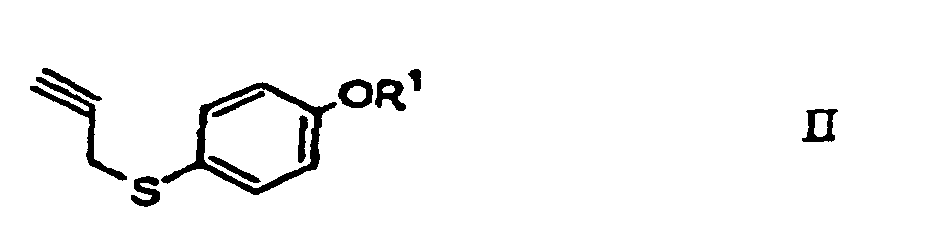 wobei R1 für eine Hydroxyschutzgruppe steht; Aussetzen der Verbindung (III) einer thermischen Umlagerungsreaktion, um eine Verbindung der Formel (IV) zu erhalten:
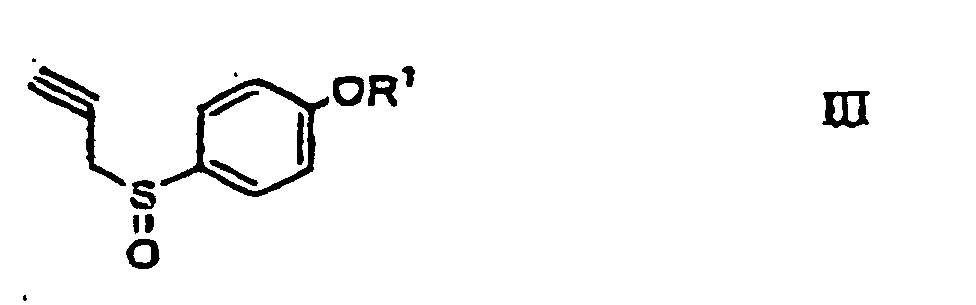 wobei R1 wie vorstehend definiert ist; und Aussetzen der Verbindung (IV) schrittweiser Oxidierung der Hydroxymethylgruppe und gegebenenfalls Entfernen der Schutzgruppe.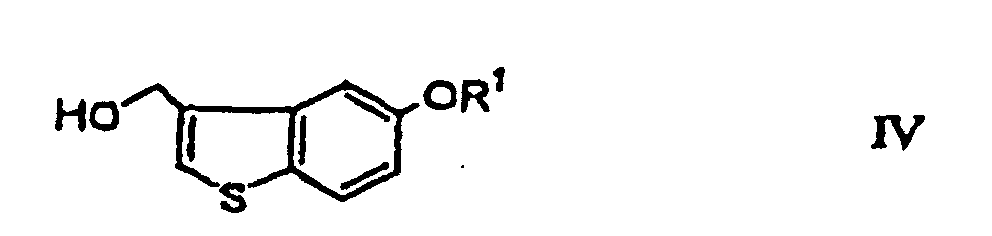
- Verfahren nach Anspruch 1, wobei die Hydroxyschutzgruppe, dargestellt durch R1, Alkyl, Alkoxyalkyl, Acyl, Aralkyl, Alkylsulfonyl, Arylsulfonyl, Alkyl-substituiertes Silyl, Alkoxycarbonyl, Aryloxycarbonyl, Aralkyloxycarbonyl oder Tetrahydropyranyl ist, wobei jede Alkyleinheit ein lineares oder verzweigtes C1-C20-Alkyl ist, jede Alkoxyeinheit ein lineares oder verzweigtes C1-C6-Alkoxy ist, jede Acyleinheit ein von einer al phatischon Carbonsäure abgeleitetes C1-C11-Acyl ist und jede Aralkyleinheit ein mit einem Arylrest substituiertes lineares oder verzweigtes C1-C20-Alkyl ist.
- Verfahren nach Anspruch 1, wobei die Hydroxyschutzgruppe, dargestellt durch R1, Arylsulfonyl ist.
Priority Applications (1)
| Application Number | Priority Date | Filing Date | Title |
|---|---|---|---|
| EP04026501A EP1528060A1 (de) | 1998-03-31 | 1999-03-30 | Verfahren zur Herstellung von 5-Hydroxy(b)thiophen-3-carbonsäure-Derivaten |
Applications Claiming Priority (3)
| Application Number | Priority Date | Filing Date | Title |
|---|---|---|---|
| JP8581998 | 1998-03-31 | ||
| JP8581998 | 1998-03-31 | ||
| PCT/JP1999/001616 WO1999050260A1 (en) | 1998-03-31 | 1999-03-30 | PROCESS FOR PRODUCING 5-HYDROXYBENZO[b]THIOPHENE-3-CARBOXYLIC ACID DERIVATIVES |
Related Child Applications (1)
| Application Number | Title | Priority Date | Filing Date |
|---|---|---|---|
| EP04026501A Division EP1528060A1 (de) | 1998-03-31 | 1999-03-30 | Verfahren zur Herstellung von 5-Hydroxy(b)thiophen-3-carbonsäure-Derivaten |
Publications (3)
| Publication Number | Publication Date |
|---|---|
| EP1069122A1 EP1069122A1 (de) | 2001-01-17 |
| EP1069122A4 EP1069122A4 (de) | 2002-06-26 |
| EP1069122B1 true EP1069122B1 (de) | 2005-06-29 |
Family
ID=13869477
Family Applications (2)
| Application Number | Title | Priority Date | Filing Date |
|---|---|---|---|
| EP99910764A Expired - Lifetime EP1069122B1 (de) | 1998-03-31 | 1999-03-30 | VERFAHREN ZUR HERSTELLUNG VON 5-HYDROXYBENZO[b]THIOPHEN-3-CARBONSÄURE |
| EP04026501A Withdrawn EP1528060A1 (de) | 1998-03-31 | 1999-03-30 | Verfahren zur Herstellung von 5-Hydroxy(b)thiophen-3-carbonsäure-Derivaten |
Family Applications After (1)
| Application Number | Title | Priority Date | Filing Date |
|---|---|---|---|
| EP04026501A Withdrawn EP1528060A1 (de) | 1998-03-31 | 1999-03-30 | Verfahren zur Herstellung von 5-Hydroxy(b)thiophen-3-carbonsäure-Derivaten |
Country Status (20)
| Country | Link |
|---|---|
| US (3) | US6320060B1 (de) |
| EP (2) | EP1069122B1 (de) |
| JP (1) | JP3455181B2 (de) |
| KR (1) | KR100596284B1 (de) |
| CN (2) | CN1117743C (de) |
| AT (1) | ATE298747T1 (de) |
| AU (1) | AU745129B2 (de) |
| BR (1) | BR9909290A (de) |
| CA (1) | CA2326419A1 (de) |
| DE (1) | DE69925992T2 (de) |
| ES (1) | ES2244179T3 (de) |
| HU (1) | HUP0101728A3 (de) |
| ID (1) | ID26346A (de) |
| NO (1) | NO20004919L (de) |
| PL (2) | PL343316A1 (de) |
| RU (1) | RU2186065C1 (de) |
| TR (2) | TR200002839T2 (de) |
| TW (1) | TWI247007B (de) |
| WO (1) | WO1999050260A1 (de) |
| ZA (1) | ZA200004720B (de) |
Families Citing this family (13)
| Publication number | Priority date | Publication date | Assignee | Title |
|---|---|---|---|---|
| FR2769165B1 (fr) * | 1997-09-26 | 2002-11-29 | Technical Maintenance Corp | Systeme sans fil a transmission numerique pour haut-parleurs |
| US6051044A (en) | 1998-05-04 | 2000-04-18 | Cabot Corporation | Nitrided niobium powders and niobium electrolytic capacitors |
| EP1808427A3 (de) * | 1999-07-02 | 2008-06-25 | Shionogi & Co., Ltd. | Neue Verfahren zur Herstellung von bicyclischen Aminoalkoholen |
| AU2002230409A1 (en) * | 2000-11-27 | 2002-06-03 | Eli Lilly And Company | Process for preparing 3-aryl-benzo(b)thiophenes |
| US20050192271A1 (en) * | 2003-07-15 | 2005-09-01 | Hythiam, Inc. | Use of selective chloride channel modulators to treat alcohol and/or stimulant substance abuse |
| KR20030031486A (ko) * | 2001-05-07 | 2003-04-21 | 데이진 가부시키가이샤 | 3-히드록시메틸벤조[b]티오펜 유도체 및 그의 제조 방법 |
| US6727277B1 (en) | 2002-11-12 | 2004-04-27 | Kansas State University Research Foundation | Compounds affecting cholesterol absorption |
| TW200538127A (en) * | 2004-04-07 | 2005-12-01 | Millennium Pharm Inc | PGD2 receptor antagonists for the treatment of inflammatory diseases |
| RU2397169C2 (ru) * | 2005-03-28 | 2010-08-20 | Тояма Кемикал Ко., Лтд. | Способ получения 1-(3-(2-(1-бензотиофен-5-ил)этокси) пропил)азетидин-3-ола или его солей |
| JO3598B1 (ar) * | 2006-10-10 | 2020-07-05 | Infinity Discovery Inc | الاحماض والاسترات البورونية كمثبطات اميد هيدروليز الحامض الدهني |
| US20110244798A1 (en) * | 2010-02-24 | 2011-10-06 | Wherepro, Llc | Data Packet Generator and Implementations of Same |
| RU2722595C1 (ru) * | 2019-12-27 | 2020-06-02 | Федеральное государственное бюджетное учреждение науки институт биоорганической химии им. академиков М.М. Шемякина и Ю.А. Овчинникова Российской академии наук (ИБХ РАН) | Способ получения сложного эфира 4-формил-6,7-дигидрокси-бензо[b]тиофен-3-карбоновой кислоты |
| CN117384186B (zh) * | 2023-10-12 | 2026-07-10 | 沧州那瑞化学科技有限公司 | 一种可用于制备依度沙班的中间体的合成方法 |
Family Cites Families (7)
| Publication number | Priority date | Publication date | Assignee | Title |
|---|---|---|---|---|
| BE809894A (nl) * | 1973-01-30 | 1974-07-18 | Antikleursluierstoffen voor fotografische kleurenmaterialen | |
| NZ218115A (en) * | 1985-11-18 | 1990-02-26 | Shionogi & Co | Bicyclic sulphonamides and pharmaceutical compositions |
| CA1294974C (en) * | 1987-05-08 | 1992-01-28 | Sanji Hagishita | Bicyclic sulfonamide derivatives and process therefor |
| US5328927A (en) * | 1992-03-03 | 1994-07-12 | Merck Sharpe & Dohme, Ltd. | Hetercyclic compounds, processes for their preparation and pharmaceutical compositions containing them |
| PL185107B1 (pl) * | 1995-06-21 | 2003-02-28 | Shionogi & Co | Bicykliczne związki aminowe, kompozycja farmaceutyczna i jej stosowanie |
| GB9513467D0 (en) * | 1995-07-01 | 1995-09-06 | Knoll Ag | Therapeutic agents |
| BR9714016A (pt) | 1996-12-13 | 2000-02-29 | Shionogi & Co | Derivados de benzotiofenocarboxamida e antagonistas a pgd2, que compreendem os mesmos |
-
1999
- 1999-03-30 ID IDW20002020A patent/ID26346A/id unknown
- 1999-03-30 AU AU29601/99A patent/AU745129B2/en not_active Ceased
- 1999-03-30 TW TW088105047A patent/TWI247007B/zh not_active IP Right Cessation
- 1999-03-30 HU HU0101728A patent/HUP0101728A3/hu unknown
- 1999-03-30 TR TR2000/02839T patent/TR200002839T2/xx unknown
- 1999-03-30 PL PL99343316A patent/PL343316A1/xx not_active IP Right Cessation
- 1999-03-30 JP JP2000541164A patent/JP3455181B2/ja not_active Expired - Fee Related
- 1999-03-30 TR TR2001/01628T patent/TR200101628T2/xx unknown
- 1999-03-30 EP EP99910764A patent/EP1069122B1/de not_active Expired - Lifetime
- 1999-03-30 KR KR1020007010877A patent/KR100596284B1/ko not_active Expired - Fee Related
- 1999-03-30 RU RU2000127108/04A patent/RU2186065C1/ru not_active IP Right Cessation
- 1999-03-30 CN CN99804788A patent/CN1117743C/zh not_active Expired - Fee Related
- 1999-03-30 BR BR9909290-5A patent/BR9909290A/pt not_active Application Discontinuation
- 1999-03-30 US US09/647,354 patent/US6320060B1/en not_active Expired - Fee Related
- 1999-03-30 DE DE69925992T patent/DE69925992T2/de not_active Expired - Fee Related
- 1999-03-30 ES ES99910764T patent/ES2244179T3/es not_active Expired - Lifetime
- 1999-03-30 WO PCT/JP1999/001616 patent/WO1999050260A1/ja not_active Ceased
- 1999-03-30 CA CA002326419A patent/CA2326419A1/en not_active Abandoned
- 1999-03-30 AT AT99910764T patent/ATE298747T1/de not_active IP Right Cessation
- 1999-03-30 PL PL380954A patent/PL197331B1/pl unknown
- 1999-03-30 EP EP04026501A patent/EP1528060A1/de not_active Withdrawn
-
2000
- 2000-09-07 ZA ZA200004720A patent/ZA200004720B/xx unknown
- 2000-09-29 NO NO20004919A patent/NO20004919L/no not_active Application Discontinuation
-
2001
- 2001-09-26 US US09/962,189 patent/US6346628B1/en not_active Expired - Fee Related
- 2001-09-26 US US09/962,439 patent/US6495702B2/en not_active Expired - Fee Related
-
2003
- 2003-01-21 CN CNB031035337A patent/CN1249048C/zh not_active Expired - Fee Related
Also Published As
Similar Documents
| Publication | Publication Date | Title |
|---|---|---|
| US6495702B2 (en) | Process for preparing 5-hydroxybenzo [b] thiophene-3-carboxylic acid derivatives | |
| JPWO1999050260A1 (ja) | 5−ヒドロキシベンゾ[b]チオフェン−3−カルボン酸誘導体の製造法 | |
| DE69805974T2 (de) | 5-aroylnaphthalin derivate | |
| RU2185380C1 (ru) | Способ получения производных бензотиофенкарбоксамида и аминоспиртов (варианты) | |
| US5994547A (en) | Process for preparing benzo[b]thiophenes | |
| JP3621373B2 (ja) | 5−ヒドロキシベンゾ[b]チオフェン−3−カルボン酸誘導体の製造法 | |
| MXPA00009477A (es) | Proceso para preparar derivados del acido 5-hidroxibenzo [b]tiofen-3-carboxilico | |
| MXPA00009478A (en) | Process for producing benzothiophenecarboxylic acid amide derivatives |
Legal Events
| Date | Code | Title | Description |
|---|---|---|---|
| PUAI | Public reference made under article 153(3) epc to a published international application that has entered the european phase |
Free format text: ORIGINAL CODE: 0009012 |
|
| 17P | Request for examination filed |
Effective date: 20000925 |
|
| AK | Designated contracting states |
Kind code of ref document: A1 Designated state(s): AT BE CH CY DE DK ES FI FR GB GR IE IT LI LU MC NL PT SE |
|
| A4 | Supplementary search report drawn up and despatched |
Effective date: 20020507 |
|
| AK | Designated contracting states |
Kind code of ref document: A4 Designated state(s): AT BE CH CY DE DK ES FI FR GB GR IE IT LI LU MC NL PT SE |
|
| 17Q | First examination report despatched |
Effective date: 20030929 |
|
| GRAP | Despatch of communication of intention to grant a patent |
Free format text: ORIGINAL CODE: EPIDOSNIGR1 |
|
| GRAS | Grant fee paid |
Free format text: ORIGINAL CODE: EPIDOSNIGR3 |
|
| GRAA | (expected) grant |
Free format text: ORIGINAL CODE: 0009210 |
|
| RTI1 | Title (correction) |
Free format text: PROCESS FOR PRODUCING 5-HYDROXYBENZO (B)THIOPHENE-3-CARBOXYLIC ACID DERIVATIVES |
|
| AK | Designated contracting states |
Kind code of ref document: B1 Designated state(s): AT BE CH CY DE DK ES FI FR GB GR IE IT LI LU MC NL PT SE |
|
| PG25 | Lapsed in a contracting state [announced via postgrant information from national office to epo] |
Ref country code: NL Free format text: LAPSE BECAUSE OF FAILURE TO SUBMIT A TRANSLATION OF THE DESCRIPTION OR TO PAY THE FEE WITHIN THE PRESCRIBED TIME-LIMIT Effective date: 20050629 Ref country code: LI Free format text: LAPSE BECAUSE OF FAILURE TO SUBMIT A TRANSLATION OF THE DESCRIPTION OR TO PAY THE FEE WITHIN THE PRESCRIBED TIME-LIMIT Effective date: 20050629 Ref country code: FI Free format text: LAPSE BECAUSE OF FAILURE TO SUBMIT A TRANSLATION OF THE DESCRIPTION OR TO PAY THE FEE WITHIN THE PRESCRIBED TIME-LIMIT Effective date: 20050629 Ref country code: CH Free format text: LAPSE BECAUSE OF FAILURE TO SUBMIT A TRANSLATION OF THE DESCRIPTION OR TO PAY THE FEE WITHIN THE PRESCRIBED TIME-LIMIT Effective date: 20050629 Ref country code: BE Free format text: LAPSE BECAUSE OF FAILURE TO SUBMIT A TRANSLATION OF THE DESCRIPTION OR TO PAY THE FEE WITHIN THE PRESCRIBED TIME-LIMIT Effective date: 20050629 Ref country code: AT Free format text: LAPSE BECAUSE OF FAILURE TO SUBMIT A TRANSLATION OF THE DESCRIPTION OR TO PAY THE FEE WITHIN THE PRESCRIBED TIME-LIMIT Effective date: 20050629 |
|
| REG | Reference to a national code |
Ref country code: GB Ref legal event code: FG4D |
|
| REG | Reference to a national code |
Ref country code: CH Ref legal event code: EP |
|
| REF | Corresponds to: |
Ref document number: 69925992 Country of ref document: DE Date of ref document: 20050804 Kind code of ref document: P |
|
| REG | Reference to a national code |
Ref country code: IE Ref legal event code: FG4D |
|
| PG25 | Lapsed in a contracting state [announced via postgrant information from national office to epo] |
Ref country code: SE Free format text: LAPSE BECAUSE OF FAILURE TO SUBMIT A TRANSLATION OF THE DESCRIPTION OR TO PAY THE FEE WITHIN THE PRESCRIBED TIME-LIMIT Effective date: 20050929 Ref country code: GR Free format text: LAPSE BECAUSE OF FAILURE TO SUBMIT A TRANSLATION OF THE DESCRIPTION OR TO PAY THE FEE WITHIN THE PRESCRIBED TIME-LIMIT Effective date: 20050929 Ref country code: DK Free format text: LAPSE BECAUSE OF FAILURE TO SUBMIT A TRANSLATION OF THE DESCRIPTION OR TO PAY THE FEE WITHIN THE PRESCRIBED TIME-LIMIT Effective date: 20050929 |
|
| NLV1 | Nl: lapsed or annulled due to failure to fulfill the requirements of art. 29p and 29m of the patents act | ||
| REG | Reference to a national code |
Ref country code: ES Ref legal event code: FG2A Ref document number: 2244179 Country of ref document: ES Kind code of ref document: T3 |
|
| PG25 | Lapsed in a contracting state [announced via postgrant information from national office to epo] |
Ref country code: PT Free format text: LAPSE BECAUSE OF FAILURE TO SUBMIT A TRANSLATION OF THE DESCRIPTION OR TO PAY THE FEE WITHIN THE PRESCRIBED TIME-LIMIT Effective date: 20051207 |
|
| REG | Reference to a national code |
Ref country code: CH Ref legal event code: PL |
|
| ET | Fr: translation filed | ||
| PG25 | Lapsed in a contracting state [announced via postgrant information from national office to epo] |
Ref country code: IE Free format text: LAPSE BECAUSE OF NON-PAYMENT OF DUE FEES Effective date: 20060330 |
|
| PG25 | Lapsed in a contracting state [announced via postgrant information from national office to epo] |
Ref country code: MC Free format text: LAPSE BECAUSE OF NON-PAYMENT OF DUE FEES Effective date: 20060331 Ref country code: LU Free format text: LAPSE BECAUSE OF NON-PAYMENT OF DUE FEES Effective date: 20060331 |
|
| PLBE | No opposition filed within time limit |
Free format text: ORIGINAL CODE: 0009261 |
|
| STAA | Information on the status of an ep patent application or granted ep patent |
Free format text: STATUS: NO OPPOSITION FILED WITHIN TIME LIMIT |
|
| 26N | No opposition filed |
Effective date: 20060330 |
|
| REG | Reference to a national code |
Ref country code: IE Ref legal event code: MM4A |
|
| PGFP | Annual fee paid to national office [announced via postgrant information from national office to epo] |
Ref country code: IT Payment date: 20080327 Year of fee payment: 10 |
|
| PGFP | Annual fee paid to national office [announced via postgrant information from national office to epo] |
Ref country code: FR Payment date: 20080311 Year of fee payment: 10 Ref country code: ES Payment date: 20080331 Year of fee payment: 10 Ref country code: DE Payment date: 20080407 Year of fee payment: 10 |
|
| PG25 | Lapsed in a contracting state [announced via postgrant information from national office to epo] |
Ref country code: CY Free format text: LAPSE BECAUSE OF FAILURE TO SUBMIT A TRANSLATION OF THE DESCRIPTION OR TO PAY THE FEE WITHIN THE PRESCRIBED TIME-LIMIT Effective date: 20050629 |
|
| PGFP | Annual fee paid to national office [announced via postgrant information from national office to epo] |
Ref country code: GB Payment date: 20080402 Year of fee payment: 10 |
|
| GBPC | Gb: european patent ceased through non-payment of renewal fee |
Effective date: 20090330 |
|
| REG | Reference to a national code |
Ref country code: FR Ref legal event code: ST Effective date: 20091130 |
|
| PG25 | Lapsed in a contracting state [announced via postgrant information from national office to epo] |
Ref country code: DE Free format text: LAPSE BECAUSE OF NON-PAYMENT OF DUE FEES Effective date: 20091001 |
|
| PG25 | Lapsed in a contracting state [announced via postgrant information from national office to epo] |
Ref country code: GB Free format text: LAPSE BECAUSE OF NON-PAYMENT OF DUE FEES Effective date: 20090330 Ref country code: FR Free format text: LAPSE BECAUSE OF NON-PAYMENT OF DUE FEES Effective date: 20091123 |
|
| REG | Reference to a national code |
Ref country code: ES Ref legal event code: FD2A Effective date: 20090331 |
|
| PG25 | Lapsed in a contracting state [announced via postgrant information from national office to epo] |
Ref country code: ES Free format text: LAPSE BECAUSE OF NON-PAYMENT OF DUE FEES Effective date: 20090331 |
|
| PG25 | Lapsed in a contracting state [announced via postgrant information from national office to epo] |
Ref country code: IT Free format text: LAPSE BECAUSE OF NON-PAYMENT OF DUE FEES Effective date: 20090330 |