EP1046402B2 - Equivalent de peau agée, son procédé de préparation et son utilisation - Google Patents
Equivalent de peau agée, son procédé de préparation et son utilisation Download PDFInfo
- Publication number
- EP1046402B2 EP1046402B2 EP00401073A EP00401073A EP1046402B2 EP 1046402 B2 EP1046402 B2 EP 1046402B2 EP 00401073 A EP00401073 A EP 00401073A EP 00401073 A EP00401073 A EP 00401073A EP 1046402 B2 EP1046402 B2 EP 1046402B2
- Authority
- EP
- European Patent Office
- Prior art keywords
- collagen
- equivalent
- epidermis
- aged
- glycation
- Prior art date
- Legal status (The legal status is an assumption and is not a legal conclusion. Google has not performed a legal analysis and makes no representation as to the accuracy of the status listed.)
- Expired - Lifetime
Links
Images
Classifications
-
- A—HUMAN NECESSITIES
- A61—MEDICAL OR VETERINARY SCIENCE; HYGIENE
- A61L—METHODS OR APPARATUS FOR STERILISING MATERIALS OR OBJECTS IN GENERAL; DISINFECTION, STERILISATION OR DEODORISATION OF AIR; CHEMICAL ASPECTS OF BANDAGES, DRESSINGS, ABSORBENT PADS OR SURGICAL ARTICLES; MATERIALS FOR BANDAGES, DRESSINGS, ABSORBENT PADS OR SURGICAL ARTICLES
- A61L27/00—Materials for grafts or prostheses or for coating grafts or prostheses
- A61L27/36—Materials for grafts or prostheses or for coating grafts or prostheses containing ingredients of undetermined constitution or reaction products thereof, e.g. transplant tissue, natural bone, extracellular matrix
- A61L27/38—Materials for grafts or prostheses or for coating grafts or prostheses containing ingredients of undetermined constitution or reaction products thereof, e.g. transplant tissue, natural bone, extracellular matrix containing added animal cells
- A61L27/3886—Materials for grafts or prostheses or for coating grafts or prostheses containing ingredients of undetermined constitution or reaction products thereof, e.g. transplant tissue, natural bone, extracellular matrix containing added animal cells comprising two or more cell types
-
- A—HUMAN NECESSITIES
- A61—MEDICAL OR VETERINARY SCIENCE; HYGIENE
- A61L—METHODS OR APPARATUS FOR STERILISING MATERIALS OR OBJECTS IN GENERAL; DISINFECTION, STERILISATION OR DEODORISATION OF AIR; CHEMICAL ASPECTS OF BANDAGES, DRESSINGS, ABSORBENT PADS OR SURGICAL ARTICLES; MATERIALS FOR BANDAGES, DRESSINGS, ABSORBENT PADS OR SURGICAL ARTICLES
- A61L27/00—Materials for grafts or prostheses or for coating grafts or prostheses
- A61L27/14—Macromolecular materials
- A61L27/22—Polypeptides or derivatives thereof, e.g. degradation products
- A61L27/24—Collagen
-
- A—HUMAN NECESSITIES
- A61—MEDICAL OR VETERINARY SCIENCE; HYGIENE
- A61L—METHODS OR APPARATUS FOR STERILISING MATERIALS OR OBJECTS IN GENERAL; DISINFECTION, STERILISATION OR DEODORISATION OF AIR; CHEMICAL ASPECTS OF BANDAGES, DRESSINGS, ABSORBENT PADS OR SURGICAL ARTICLES; MATERIALS FOR BANDAGES, DRESSINGS, ABSORBENT PADS OR SURGICAL ARTICLES
- A61L27/00—Materials for grafts or prostheses or for coating grafts or prostheses
- A61L27/36—Materials for grafts or prostheses or for coating grafts or prostheses containing ingredients of undetermined constitution or reaction products thereof, e.g. transplant tissue, natural bone, extracellular matrix
- A61L27/38—Materials for grafts or prostheses or for coating grafts or prostheses containing ingredients of undetermined constitution or reaction products thereof, e.g. transplant tissue, natural bone, extracellular matrix containing added animal cells
- A61L27/3804—Materials for grafts or prostheses or for coating grafts or prostheses containing ingredients of undetermined constitution or reaction products thereof, e.g. transplant tissue, natural bone, extracellular matrix containing added animal cells characterised by specific cells or progenitors thereof, e.g. fibroblasts, connective tissue cells, kidney cells
-
- A—HUMAN NECESSITIES
- A61—MEDICAL OR VETERINARY SCIENCE; HYGIENE
- A61L—METHODS OR APPARATUS FOR STERILISING MATERIALS OR OBJECTS IN GENERAL; DISINFECTION, STERILISATION OR DEODORISATION OF AIR; CHEMICAL ASPECTS OF BANDAGES, DRESSINGS, ABSORBENT PADS OR SURGICAL ARTICLES; MATERIALS FOR BANDAGES, DRESSINGS, ABSORBENT PADS OR SURGICAL ARTICLES
- A61L27/00—Materials for grafts or prostheses or for coating grafts or prostheses
- A61L27/36—Materials for grafts or prostheses or for coating grafts or prostheses containing ingredients of undetermined constitution or reaction products thereof, e.g. transplant tissue, natural bone, extracellular matrix
- A61L27/38—Materials for grafts or prostheses or for coating grafts or prostheses containing ingredients of undetermined constitution or reaction products thereof, e.g. transplant tissue, natural bone, extracellular matrix containing added animal cells
- A61L27/3804—Materials for grafts or prostheses or for coating grafts or prostheses containing ingredients of undetermined constitution or reaction products thereof, e.g. transplant tissue, natural bone, extracellular matrix containing added animal cells characterised by specific cells or progenitors thereof, e.g. fibroblasts, connective tissue cells, kidney cells
- A61L27/3813—Epithelial cells, e.g. keratinocytes, urothelial cells
-
- A—HUMAN NECESSITIES
- A61—MEDICAL OR VETERINARY SCIENCE; HYGIENE
- A61L—METHODS OR APPARATUS FOR STERILISING MATERIALS OR OBJECTS IN GENERAL; DISINFECTION, STERILISATION OR DEODORISATION OF AIR; CHEMICAL ASPECTS OF BANDAGES, DRESSINGS, ABSORBENT PADS OR SURGICAL ARTICLES; MATERIALS FOR BANDAGES, DRESSINGS, ABSORBENT PADS OR SURGICAL ARTICLES
- A61L27/00—Materials for grafts or prostheses or for coating grafts or prostheses
- A61L27/36—Materials for grafts or prostheses or for coating grafts or prostheses containing ingredients of undetermined constitution or reaction products thereof, e.g. transplant tissue, natural bone, extracellular matrix
- A61L27/38—Materials for grafts or prostheses or for coating grafts or prostheses containing ingredients of undetermined constitution or reaction products thereof, e.g. transplant tissue, natural bone, extracellular matrix containing added animal cells
- A61L27/3804—Materials for grafts or prostheses or for coating grafts or prostheses containing ingredients of undetermined constitution or reaction products thereof, e.g. transplant tissue, natural bone, extracellular matrix containing added animal cells characterised by specific cells or progenitors thereof, e.g. fibroblasts, connective tissue cells, kidney cells
- A61L27/383—Nerve cells, e.g. dendritic cells, Schwann cells
-
- A—HUMAN NECESSITIES
- A61—MEDICAL OR VETERINARY SCIENCE; HYGIENE
- A61L—METHODS OR APPARATUS FOR STERILISING MATERIALS OR OBJECTS IN GENERAL; DISINFECTION, STERILISATION OR DEODORISATION OF AIR; CHEMICAL ASPECTS OF BANDAGES, DRESSINGS, ABSORBENT PADS OR SURGICAL ARTICLES; MATERIALS FOR BANDAGES, DRESSINGS, ABSORBENT PADS OR SURGICAL ARTICLES
- A61L27/00—Materials for grafts or prostheses or for coating grafts or prostheses
- A61L27/50—Materials characterised by their function or physical properties, e.g. injectable or lubricating compositions, shape-memory materials, surface modified materials
- A61L27/60—Materials for use in artificial skin
-
- C—CHEMISTRY; METALLURGY
- C12—BIOCHEMISTRY; BEER; SPIRITS; WINE; VINEGAR; MICROBIOLOGY; ENZYMOLOGY; MUTATION OR GENETIC ENGINEERING
- C12N—MICROORGANISMS OR ENZYMES; COMPOSITIONS THEREOF; PROPAGATING, PRESERVING, OR MAINTAINING MICROORGANISMS; MUTATION OR GENETIC ENGINEERING; CULTURE MEDIA
- C12N5/00—Undifferentiated human, animal or plant cells, e.g. cell lines; Tissues; Cultivation or maintenance thereof; Culture media therefor
- C12N5/06—Animal cells or tissues; Human cells or tissues
- C12N5/0697—Artificial constructs associating cells of different lineages, e.g. tissue equivalents
- C12N5/0698—Skin equivalents
-
- G—PHYSICS
- G01—MEASURING; TESTING
- G01N—INVESTIGATING OR ANALYSING MATERIALS BY DETERMINING THEIR CHEMICAL OR PHYSICAL PROPERTIES
- G01N33/00—Investigating or analysing materials by specific methods not covered by groups G01N1/00 - G01N31/00
- G01N33/48—Biological material, e.g. blood, urine; Haemocytometers
- G01N33/50—Chemical analysis of biological material, e.g. blood, urine; Testing involving biospecific ligand binding methods; Immunological testing
- G01N33/5005—Chemical analysis of biological material, e.g. blood, urine; Testing involving biospecific ligand binding methods; Immunological testing involving human or animal cells
- G01N33/5008—Chemical analysis of biological material, e.g. blood, urine; Testing involving biospecific ligand binding methods; Immunological testing involving human or animal cells for testing or evaluating the effect of chemical or biological compounds, e.g. drugs, cosmetics
- G01N33/5082—Supracellular entities, e.g. tissue, organisms
- G01N33/5088—Supracellular entities, e.g. tissue, organisms of vertebrates
-
- C—CHEMISTRY; METALLURGY
- C12—BIOCHEMISTRY; BEER; SPIRITS; WINE; VINEGAR; MICROBIOLOGY; ENZYMOLOGY; MUTATION OR GENETIC ENGINEERING
- C12N—MICROORGANISMS OR ENZYMES; COMPOSITIONS THEREOF; PROPAGATING, PRESERVING, OR MAINTAINING MICROORGANISMS; MUTATION OR GENETIC ENGINEERING; CULTURE MEDIA
- C12N2502/00—Coculture with; Conditioned medium produced by
- C12N2502/09—Coculture with; Conditioned medium produced by epidermal cells, skin cells, oral mucosa cells
- C12N2502/094—Coculture with; Conditioned medium produced by epidermal cells, skin cells, oral mucosa cells keratinocytes
-
- C—CHEMISTRY; METALLURGY
- C12—BIOCHEMISTRY; BEER; SPIRITS; WINE; VINEGAR; MICROBIOLOGY; ENZYMOLOGY; MUTATION OR GENETIC ENGINEERING
- C12N—MICROORGANISMS OR ENZYMES; COMPOSITIONS THEREOF; PROPAGATING, PRESERVING, OR MAINTAINING MICROORGANISMS; MUTATION OR GENETIC ENGINEERING; CULTURE MEDIA
- C12N2502/00—Coculture with; Conditioned medium produced by
- C12N2502/13—Coculture with; Conditioned medium produced by connective tissue cells; generic mesenchyme cells, e.g. so-called "embryonic fibroblasts"
- C12N2502/1323—Adult fibroblasts
-
- C—CHEMISTRY; METALLURGY
- C12—BIOCHEMISTRY; BEER; SPIRITS; WINE; VINEGAR; MICROBIOLOGY; ENZYMOLOGY; MUTATION OR GENETIC ENGINEERING
- C12N—MICROORGANISMS OR ENZYMES; COMPOSITIONS THEREOF; PROPAGATING, PRESERVING, OR MAINTAINING MICROORGANISMS; MUTATION OR GENETIC ENGINEERING; CULTURE MEDIA
- C12N2503/00—Use of cells in diagnostics
- C12N2503/04—Screening or testing on artificial tissues
- C12N2503/06—Screening or testing on artificial skin
Definitions
- the present invention relates to a new equivalent of aged skin, its method of obtaining and the equivalent of epidermis and the equivalent of aged dermis included in this equivalent of aged skin and their uses in vitro.
- models more or less close to human skin could be developed.
- the models described in the patent applications EP-A-285471 , EP-A-285474 , EP-A-789074 , EP-A-502172 , EP-A-418035 , WO-A-9116010 , EP-A-197090 , EP-A-20753 , FR-A-2665175 , FR-A-2689904 .
- Studies have also been carried out on the evaluation of the allergenicity of the constituents of a human skin equivalent (Nemecek G et al., Toxicology Pathology, vol.27, No.
- reconstructed skin described in these documents include human keratinocytes whether or not associated with other cells of the pea u like melanocytes and / or Langerhans cells, deposited on a support, often a dermis equivalent, and cultured under conditions such that they enter a differentiation program resulting in the formation of an epidermis equivalent.
- the dermis equivalents described to date are either artificial membranes such as Millipore brand filters, subcutaneous substitutes based on collagen, plastic or any other support compatible with cell viability, or more elaborate supports for to make them closer to the natural dermis, such as the dermis previously derepidermized or mixed lattices collagen / fibroblasts.
- the protocols used for the preparation of said lattices uses collagen generally originating from young tissues, collagen which however has undergone significant post-translational modifications involved in the complex but nevertheless normal processes of its biosynthesis, but which has not undergone all the changes that may occur particularly during aging. It is known in particular that during aging, as well as during certain diseases such as diabetes, non-enzymatic processes take place involving an ose (glucose or ribose) which reacts according to the Maillard reaction with a grouping. amine (e.g. lysine residue) collagen to form a Schiff base. This, after a molecular rearrangement called Amadori, can lead, by a succession of reactions, intramolecular bridging such as pentosidine type.
- glycation products are, for example, pyrraline, carboxymethyl-lysine, pentosidine, crosslines, N ⁇ (2-carboxyethyl) -lysine (CEL), glyoxal-lysine dimer (GOLD), methylglyoxal-lysine dimer ( MOLD), 3DG-ARG imidazolone, verssparlysin A, B, C, thesosidine or the end products of advanced glycosylation (advanced glycosylation ends products or AGEs).
- CEL (2-carboxyethyl) -lysine
- GOLD glyoxal-lysine dimer
- MOLD methylglyoxal-lysine dimer
- 3DG-ARG imidazolone verssparlysin A, B, C, thesosidine or the end products of advanced glycosylation (advanced glycosylation ends products or AGEs).
- the skin results from a close association between at least two compartments which constitute it, namely the epidermis and the dermis.
- the interactions between the dermis and the epidermis are such that it is reasonable to think that a modification of one can have consequences on the other.
- the aging of the dermis in particular with its glycation phenomena can only have consequences on the epidermis associated with it.
- the glycation of collagen must lead to changes in the epidermis that necessarily contribute to aging of the epidermis.
- this protein is expressed in the very lower layers of the epidermis, namely at most until the 2nd layer suprabasal, it is quite different in an aged epidermis, ie in the sense of the plaintiff in an epidermis of old subject, where this protein is expressed in most layers of the epidermis, even in the last suprabasal layers under the stratum corneum.
- a skin equivalent comprising an equivalent of epidermis obtained on an equivalent of aged dermis, particularly on a lattice comprising at least glycylated collagen and fibroblasts.
- the Applicant who has for a long time been interested in the realization of a model of skin reconstructed in vitro, has developed a new model of reconstructed skin comprising an epidermis equivalent and a dermis equivalent, characterized in that said equivalent of dermis comprises an aged dermis equivalent, particularly a lattice comprising at least glycated collagen and fibroblasts.
- a first subject of the invention is a new equivalent of aged dermis, comprising at least glycated collagen and fibroblasts and obtainable by a process for the preparation of an equivalent of aged skin comprising an epidermis equivalent and an equivalent of aged dermis comprising a lattice comprising at least glycylated collagen and fibroblasts, characterized in that in a first step a lattice comprising at least glycylated collagen and fibroblasts is prepared, said collagen being a mixture of preglycated collagen and non-glycated collagen, the collagen being glycated prior to the formation of the lattice, and that in a second step is reconstituted on the lattice obtained in the first step an epidermis equivalent comprising at least keratinocytes, the equivalent of dermis elderly with a glycation level between 2 and 30.
- glycation of collagen leads to the formation of glycation products such as, for example, pyrraline, carboxymethyl-lysine, pentosidine, crosslines, N ⁇ (2-carboxyethyl) -lysine (CEL), glyoxal-lysine dimer (GOLD), methylglyoxal-lysine dimer (MOLD), 3DG-ARG imidazolone, versslylysines A, B, C, threosidine or advanced glycosylation products (AGEs).
- glycation products such as, for example, pyrraline, carboxymethyl-lysine, pentosidine, crosslines, N ⁇ (2-carboxyethyl) -lysine (CEL), glyoxal-lysine dimer (GOLD), methylglyoxal-lysine dimer (MOLD), 3DG-ARG imidazolone, versslylysines A, B, C
- these glycation products have the particularity of emitting after excitation a measurable fluorescence.
- pentosidine when excited at a wavelength ( ⁇ ex) of 328 nm, emits fluorescence at a wavelength ( ⁇ em) of 378 nm.
- AGEs when excited at a wavelength ( ⁇ ex) of 370 nm emit fluorescence at a wavelength ( ⁇ em) of 440 nm.
- the ratio of the fluorescence emitted by a given glycation product in the dermis equivalent comprising at least glycated collagen and fluorescent fibroblasts emitted by the same glycation product in a control dermis equivalent comprising at least unglycated collagen and fibroblasts, measured under the same experimental conditions, makes it possible to characterize the glycation rate of the equivalent of aged dermis.
- the fluorescence of pentosidine and / or AGEs is measured both in the aged dermis equivalent comprising glycated collagen and in a control comprising non-glycated collagen.
- the equivalent of aged dermis has a glycation level of between 2 and 30, and particularly between 8 and 18.
- the collagen may be any type of collagen of any origin.
- the collagen is preferably chosen from fibrillar collagens of type I, III or V.
- collagen of animal origin particularly collagen of bovine origin.
- the collagen preferentially used according to the invention is type I collagen.
- type I bovine collagen is used.
- the fibroblasts can come from all sources, but are preferably fibroblasts of human origin. They can be prepared according to any known method of the prior art, for example by mechanical and / or enzymatic dissociation of the macromolecules of the extracellular matrix of the dermis or by growth of fibroblasts from explants.
- the dermis equivalent of the invention comprises at least glycylated collagen and fibroblasts but may also contain any other component that could be interesting to introduce therein, for example endothelial cells, macrophages or nerve cells.
- a second subject of the invention is an epidermis equivalent comprising at least keratinocytes, characterized in that it is capable of being obtained by seeding at least one keratinocyte on an aged dermis equivalent comprising at least one glycated collagen and fibroblasts, as defined above, and having ⁇ 1 integrin expression in the cells of at least the first three suprabasal layers.
- the epidermis equivalent is characterized by the fact that it exhibits an expression of the modified ⁇ 1 integrin, particularly an expression of the ⁇ 1 integrin in the cells of at least the first three layers. suprabasal.
- the epidermis equivalent comprising at least keratinocytes is characterized by the fact that it exhibits an expression of the modified ⁇ 1 integrin, particularly an expression of the ⁇ 1 integrin in the cells of the least the first three suprabasal layers and in that it is obtained by seeding at least one keratinocyte on a dermis equivalent comprising at least glycated collagen and fibroblasts.
- any method making it possible to demonstrate the expression of the ⁇ 1 integrin can be used to characterize the epidermis of the invention.
- the keratinocytes used according to the invention may come from all sources, but are preferably keratinocytes of human origin. They can be prepared according to any known method of the prior art. By way of example, mention may be made of the culture from dissociated epidermis originating from normal skin sampling or the culture of keratinocytes derived from the sheath of the hair follicle. Preferably, according to the invention, keratinocytes of normal human skin are used.
- the keratinocytes used are prepared from dissociated human epidermis derived from normal human skin samples according to the method described in Regnier et al., Frontier of Matrix Biology, Vol.9, 4-35 (Karger, Basel nineteen eighty one).
- the epidermis equivalent of the invention comprises at least keratinocytes but it may comprise any other cell type which could be incorporated therein, for example Langerhans cells and / or Langerhans cell precursors and / or melanocytes.
- the skin equivalent that has the best similarity to normal skin is the equivalent of skin that contains the three essential cell types found in normal skin.
- the reconstructed skin model according to the invention further comprises melanocytes and / or Langerhans cells and / or precursors of Langerhans cells.
- the melanocytes used according to the invention can be isolated from any organ containing it, for example normal skin or the hair follicle.
- melanocytes isolated from normal skin are used.
- Any method for the preparation of melanocytes known from the prior art can be used according to the invention.
- the Langerhans cells and / or the Langerhans cell precursors that may be used according to the invention may be as described by the applicant in its European patent application published under the number EP-A-789074.
- a third subject of the invention is an equivalent of aged skin, characterized in that it comprises at least one equivalent of epidermis and one equivalent of aged dermis.
- a very preferential aged skin equivalent according to the invention comprises an epidermis equivalent comprising at least keratinocytes having a modified ⁇ 1 integrin expression, particularly an expression of the ⁇ 1 integrin in the cells of at least the first three cells.
- suprabasal layers and is characterized in that it is capable of being obtained by inoculation of at least keratinocytes with an equivalent of aged dermis comprising at least glycylated collagen and fibroblasts, said aged dermis equivalent having a glycation between 2 and 30, and particularly between 8 and 18.
- a fourth subject of the invention is a process for preparing an equivalent of aged skin, comprising an epidermis equivalent and a dermis equivalent itself comprising a lattice comprising at least glycylated collagen and fibroblasts, characterized by the in a first step, a lattice comprising at least glycylated collagen and fibroblasts is prepared, said collagen being a mixture of pre-glycated collagen and non-glycated collagen, the collagen being glycated prior to the formation of the lattice and in a second step is reconstituted on the lattice obtained in the first step an epidermis equivalent comprising at least keratinocytes.
- the first step can be carried out by any method known from the prior art, provided that the collagen used can be glycated beforehand.
- the lattice is prepared using collagen previously glycated.
- the lattice is prepared according to the method described by Asselineau et al., 1987 (Models in dermatology, vol. III, Ed. Lowe & Maibach, 1-7) using preglycated collagen.
- any known method of glycation can be used to obtain glycated collagen.
- Tanaka et al. J. Mol Biol., 1988, 203, 495-505), by Tarsio JF. and col. (1985, Diabetes, 34, 477-484), by Tarsio JF. and col. (1988, Diabetes, 37, 532-539) or by Frey J. et al. (1992, C.R. R. Biol., 187, 223-231).
- the glycation can be obtained by bringing into contact with a solution of at least one collagen and a solution of at least one glycating agent so as to induce the collagen glycation reaction in vitro. in the absence of cells.
- the collagen used can be any type of collagen, of any origin, alone or as a mixture.
- collagen of animal origin particularly collagen of bovine origin.
- the collagen preferentially used according to the invention is type I collagen.
- type I bovine collagen is used.
- the collagen solution may be at a concentration of between 2 mg / ml and 6 mg / ml and preferably between 3 mg / ml and 5 mg / ml.
- the glycating agent may be any agent allowing glycation, that is to say capable of reacting according to the Maillard reaction with an amine group of collagen to form a Schiff base.
- certain intermediates of the Maillard reaction for example glucosone, 3-deoxyglucosone, glyoxal, methylglyoxal or sugars.
- Any type of sugar is usable according to the invention, whether in monomeric or polymeric form.
- a monomeric sugar is preferably used.
- sugar is meant according to the invention the products which have several times an alcohol function with at least one aldehyde function.
- the oses are particularly, Among the sugars that can be used according to the invention, mention may be made, inter alia, of ribose, fructose, or glucose.
- ribose or glucose is used.
- the sugar may be in any of the dextrorotatory or laevorotatory conformations.
- a sugar in dextrorotatory conformation is used.
- D-fructose, D-ribose or D-glucose is used.
- D-ribose or D-glucose is used.
- the glycerizing agent may be used alone or as a mixture.
- the amount of glycating agent that can be used according to the invention must be sufficient to allow the start of the non-enzymatic reactions leading to the Schiff base formation. It is understood that the variation of this amount makes it possible to obtain an end product, glycated collagen, whose glycation level varies from very low glycated to very highly glycated.
- the amount of glycating agent may be between 0.5% and 20%, preferably between 1% and 10% by weight of the total weight of the collagen solution.
- the glycation reaction is carried out at a temperature close to room temperature.
- the reaction is carried out at a temperature between 15 ° C and 30 ° C, preferably between 20 ° C and 25 ° C.
- the duration of the glycation reaction is a function of the desired glycation level. It is understood that the longer the time is longer the glycation rate is high. Thus the duration of the glycation reaction is between 15 days and 2 months, preferably between 25 and 35 days.
- the pre-glycated collagen solution is subjected to a series of dialyses against water and / or acetic acid.
- the "preglycated" collagen solution obtained can be mixed with native collagen before use for the preparation of the dermis equivalent.
- the ratio of glycated collagen to non-glycated collagen may be between 25 and 75 and preferably between 45 and 55. The variation of this ratio makes it possible to modulate the glycation rate of the lattice.
- a mixture of glycated collagen and non-glycated collagen is used, and even more preferentially a mixture of glycated collagen and non-glycated collagen in a 50/50 ratio.
- the second step of the process of the invention can be carried out by any method known from the prior art.
- the method described by Asselineau and collaborator is used.
- the keratinocytes used according to the invention may come from all sources, but are preferably keratinocytes of human origin. They can be prepared according to any known method of the prior art. By way of example, mention may be made of the culture from dissociated epidermis originating from normal skin sampling or the culture of keratinocytes derived from the sheath of the hair follicle.
- the keratinocytes used are prepared from dissociated human epidermis derived from normal human skin samples according to the method described in Regnier et al., Frontier of Matrix Biology, Vol.9, 4-35 (Karger, Basel nineteen eighty one).
- the culture can be kept immersed in a nutrient medium which can be, for example, the medium described by Rheinwald and Green, 1975, (Cell, 6, (3), 317-330). allows the proliferation of keratinocytes (named elsewhere in the text medium 3F).
- the skin equivalent is maintained at the air / liquid interface, for example by deposition on a metal grid.
- the liquid is then preferably composed of the same nutrient medium as the previous one.
- a skin equivalent having the characteristics of a skin namely the support on which there is an epidermis equivalent having the four types of conventional cell layers, namely the layers basal, suprabasal, granular and cornea.
- the incubation is continued for a period of between 5 and 30 days, preferably between 7 and 10 days.
- the reconstructed skin model thus produced comprises two entities, the support and the epidermis equivalent, which can be physically separated from one another.
- the epidermis equivalent can then be used separately from the support.
- the skin equivalent obtained according to the invention solves its problems since it has at least one of the characteristics of aged skin, namely a glycated collagen.
- the subject of the invention is also the use in vitro of an equivalent of aged skin and / or aged dermis and / or an equivalent of aged epidermis as described above for the study of the glycation phenomenon in vitro. itself and modulators (inhibitors or activators) of this phenomenon, the study of phenomena related to the skin and / or the aged epidermis such as wrinkles, the study of modulators (isolated compounds and / or compositions) the appearance of wrinkles (especially inhibitors), the study of photoaging and the effect of ultraviolet radiation on the skin and / or the dermis and / or the epidermis, as well as modulators of these effects (compounds and / or protective compositions, filters, etc.), the study of the influence of glycation on the components of the skin and / or the dermis and / or the epidermis (hair and / or hair, blood vessels, nerve fibers , etc.), and in the therapeutic field the study of complications caused by diabetes via glycation.
- the equivalent of reconstructed epidermis on the dermis equivalent comprising at least glycylated collagen and fibroblasts may have a distribution of the expression of the modified ⁇ 1 integrin.
- the variation of the distribution of this marker is related to the age of the epidermis, it is conceivable to use the aged skin equivalent of the invention to evaluate any product capable of treating aged skin. by measuring its effect by the effect it has on the modification of the distribution of ⁇ 1 integrin expression in the epidermis equivalent.
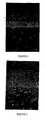
- the figure 1 allows to better illustrate the invention, without limiting its scope.
- the photos show sections of skin equivalents after immunolabeling using an anti-integrin ⁇ 1 antibody.
- Photo 1 represents the immunostaining of a skin equivalent comprising one equivalent of reconstructed epidermis on a dermis equivalent prepared with non-glycated collagen.
- the photo 2 represents the immunostaining of a skin equivalent comprising an equivalent of reconstructed epidermis on a dermis equivalent prepared with glycated collagen according to the invention.
- MEM / Hep medium containing 10% fetal calf serum
- MEM / Hepes / SVF10 0.50 ml MEM / Hepes / SVF10 medium containing fibroblasts from human mammary plasties previously prepared according to the method described by Bell et al. 1979, (PNAS USA, 76, 1274-1278), Asselineau and Prunieras, 1984, (British J.
- Example 3 Measurement of the glycation level of the aged dermis equivalent of Example 2:
- the glycation rate of the equivalent of the elderly dermis is therefore 9.4 for pentosidine and 4 for AGEs.
- Example 2 An equivalent of aged dermis as prepared in Example 2 is mounted well spread in a culture dish Corning type ⁇ 60 mm on a drop of collagen "adhesive" (0.6 ml) and then maintained at 37 ° C. in an oven for 20 - 30 minutes.
- a sterile steel ring is placed on the lattice and 0.5 ml of a cell suspension of human keratinocytes from mammoplasties prepared according to Régnier et al., (Frontier of Matrix Biology, Vol.9, 4-35, Karger, Basel 1981), at a rate of 100,000 cells / ml in MEM medium 10% FCS + 3F are placed inside the ring.
- Example 4 The expression of the ⁇ 1 integrin in the epidermis equivalent obtained in Example 4 is observed after immunostaining using a mouse monoclonal antibody directed against the ⁇ 1 integrin (Immunotech, Marseille, France, Cat .1151) After freezing, the skin equivalents obtained in Example 4 are cut into strips of 5 microns thick using a cryostat (make / model). The sections are then rinsed twice with PBS and 25 .mu.l of antiingretin antibodies ⁇ 1 diluted 1/50 (Immunotech, Marseille, France, Cat.1151) are deposited on each section and left for 30 minutes at room temperature (25 ° C.).
- FITC conjugate antibodies Rabbit anti mouse FITC, Dako F232
- the sections were rinsed twice with PBS and observed after a LEICA fluorescent microscope, model LEITZ DMRB.
Landscapes
- Health & Medical Sciences (AREA)
- Life Sciences & Earth Sciences (AREA)
- Engineering & Computer Science (AREA)
- Biomedical Technology (AREA)
- Chemical & Material Sciences (AREA)
- Cell Biology (AREA)
- General Health & Medical Sciences (AREA)
- Medicinal Chemistry (AREA)
- Transplantation (AREA)
- Dermatology (AREA)
- Public Health (AREA)
- Veterinary Medicine (AREA)
- Epidemiology (AREA)
- Zoology (AREA)
- Oral & Maxillofacial Surgery (AREA)
- Animal Behavior & Ethology (AREA)
- Urology & Nephrology (AREA)
- Immunology (AREA)
- Botany (AREA)
- Chemical Kinetics & Catalysis (AREA)
- Biotechnology (AREA)
- Bioinformatics & Cheminformatics (AREA)
- Genetics & Genomics (AREA)
- Hematology (AREA)
- Wood Science & Technology (AREA)
- Biochemistry (AREA)
- Microbiology (AREA)
- Organic Chemistry (AREA)
- Molecular Biology (AREA)
- Physics & Mathematics (AREA)
- Pathology (AREA)
- Toxicology (AREA)
- Food Science & Technology (AREA)
- General Engineering & Computer Science (AREA)
- Analytical Chemistry (AREA)
- General Physics & Mathematics (AREA)
- Tropical Medicine & Parasitology (AREA)
- Biophysics (AREA)
- Materials For Medical Uses (AREA)
- Medicines Containing Material From Animals Or Micro-Organisms (AREA)
Priority Applications (1)
| Application Number | Priority Date | Filing Date | Title |
|---|---|---|---|
| DE60036047T DE60036047T3 (de) | 1999-04-20 | 2000-04-18 | Äquivalent der Altershaut, Verfahren zu seiner Herstellung und seine Verwendung |
Applications Claiming Priority (2)
| Application Number | Priority Date | Filing Date | Title |
|---|---|---|---|
| FR9904970A FR2792650B1 (fr) | 1999-04-20 | 1999-04-20 | Equivalent de peau agee, son procede de preparation et son utilisation |
| FR9904970 | 1999-04-20 |
Publications (3)
| Publication Number | Publication Date |
|---|---|
| EP1046402A1 EP1046402A1 (fr) | 2000-10-25 |
| EP1046402B1 EP1046402B1 (fr) | 2007-08-22 |
| EP1046402B2 true EP1046402B2 (fr) | 2012-04-04 |
Family
ID=9544638
Family Applications (1)
| Application Number | Title | Priority Date | Filing Date |
|---|---|---|---|
| EP00401073A Expired - Lifetime EP1046402B2 (fr) | 1999-04-20 | 2000-04-18 | Equivalent de peau agée, son procédé de préparation et son utilisation |
Country Status (8)
| Country | Link |
|---|---|
| US (3) | US6605466B1 (es) |
| EP (1) | EP1046402B2 (es) |
| JP (1) | JP3387891B2 (es) |
| AT (1) | ATE370755T1 (es) |
| CA (1) | CA2306317C (es) |
| DE (1) | DE60036047T3 (es) |
| ES (1) | ES2292412T5 (es) |
| FR (1) | FR2792650B1 (es) |
Families Citing this family (25)
| Publication number | Priority date | Publication date | Assignee | Title |
|---|---|---|---|---|
| US7622117B2 (en) * | 2002-04-17 | 2009-11-24 | Dynamis Therapeutics, Inc. | 3-deoxyglucosone and skin |
| PT1496891E (pt) * | 2002-04-19 | 2011-09-02 | Univ Arizona State | Métodos para modulação de fototoxicidade |
| FR2847345B1 (fr) * | 2002-11-18 | 2005-02-18 | Oreal | Procede de criblage et/ou d'evaluation de l'activite anti-ride de produits |
| FR2847269B1 (fr) * | 2002-11-19 | 2006-07-28 | Coletica | Procede d'identification d'une modification eventuelle d'au moins un parametre biologique mettant en oeuvre des cellules vivantes jeunes et agees |
| FR2847268B1 (fr) * | 2002-11-19 | 2006-09-29 | Coletica | Procede d'identification d'une modification eventuelle d'au moins un parametre biologique mettant en oeuvre des cellules vivantes soumises a un stress et des cellules vivantes non soumises a ce meme stress |
| US7169382B2 (en) * | 2003-01-30 | 2007-01-30 | L'oreal | Reconstructed epidermis/skin equivalent comprising a ceramide 7 and /or 5.5 and lipid lamellar vesicular compositions comprising ceramide 7 and/or 5.5 compounds |
| FR2878035B1 (fr) | 2004-11-15 | 2014-10-17 | Oreal | Dispositif comportant un echantillon de peau reconstruite et un systeme de detection. |
| US8399349B2 (en) | 2006-04-18 | 2013-03-19 | Air Products And Chemicals, Inc. | Materials and methods of forming controlled void |
| FR2903702B1 (fr) | 2006-07-13 | 2012-10-19 | Oreal | Equivalent d'epiderme capable de se pigmenter obtenu a partir de cellules de la matrice, procede de preparation et utilisation |
| JPWO2008108155A1 (ja) * | 2007-03-01 | 2010-06-10 | ポーラ化成工業株式会社 | 抗シワ物質の評価法及び皮膚の鑑別法 |
| JP2007313333A (ja) * | 2007-06-08 | 2007-12-06 | Kao Corp | 再構成皮膚の構築方法 |
| US20090195696A1 (en) * | 2008-01-07 | 2009-08-06 | Toshiba America Consumer Products, Llc | Channel system and method |
| CN102085392B (zh) * | 2011-01-28 | 2013-04-10 | 成都维德医疗器械有限责任公司 | 纳米钙磷盐/胶原复合支架及其制备方法与应用 |
| DE102012223061A1 (de) * | 2012-12-13 | 2014-06-18 | Henkel Ag & Co. Kgaa | Altershautmodell |
| FR3007037B1 (fr) * | 2013-06-18 | 2016-07-29 | Clarins Lab | Modele d'epiderme reconstruit presentant des caracteristiques des taches de vieillesse |
| CN103788139B (zh) * | 2014-02-17 | 2016-10-05 | 青岛大学 | 具抗癌活性的昆布氨酸希夫碱异双核配合物的合成及其药物组合物 |
| CN104368043B (zh) * | 2014-09-25 | 2016-02-24 | 浙江星月生物科技股份有限公司 | 一种胶原基质软骨修复膜、制备方法及应用 |
| KR20170114229A (ko) * | 2016-04-04 | 2017-10-13 | 스페클립스 주식회사 | 질병 진단과 피부 나이 측정이 가능한 시스템과 이에 사용되는 핸드피스 |
| FR3054449B1 (fr) | 2016-07-29 | 2018-08-31 | L'oreal | Equivalent de peau a compartiments dermiques juxtaposes distincts |
| KR102213922B1 (ko) * | 2017-06-30 | 2021-02-08 | (주)아모레퍼시픽 | 인공피부 제조방법 및 인공피부 |
| KR102540981B1 (ko) * | 2017-06-30 | 2023-06-08 | (주)아모레퍼시픽 | 인공피부 제조방법 및 인공피부 |
| KR20190130358A (ko) * | 2018-05-14 | 2019-11-22 | (주)아모레퍼시픽 | 콜라겐 젤 강도 조절제, 이를 이용한 인공피부 제조방법 및 인공피부 |
| WO2020197005A1 (ko) | 2019-03-22 | 2020-10-01 | 스페클립스 주식회사 | 레이저 유도 붕괴 스펙트럼 분석을 이용하는 진단 방법 및 이를 수행하는 진단 장치 |
| JP7069270B2 (ja) * | 2020-10-13 | 2022-05-17 | モリンダ インコーポレーテッド | Age由来メラニン産生方法及び組成物 |
| KR102466098B1 (ko) * | 2021-01-12 | 2022-11-11 | 주식회사 클리셀 | 인간피부의 진피능선 구현과 진피층 당화를 유발시킨 인공피부모델 및 이의 제조방법 |
Family Cites Families (8)
| Publication number | Priority date | Publication date | Assignee | Title |
|---|---|---|---|---|
| US618793A (en) * | 1899-01-31 | Printing-machine | ||
| US4971954A (en) | 1988-11-23 | 1990-11-20 | University Of Medicine And Dentistry Of New Jersey | Collagen-based matrices ribose cross-linked |
| RU2135191C1 (ru) * | 1990-04-24 | 1999-08-27 | Ортек Интернэшнл, Инк. | Композиционный эквивалент живой кожи, способ его получения, тест-набор |
| IT1248934B (it) | 1990-06-01 | 1995-02-11 | Fidia Spa | Membrane forate biocompatibili,processi per la loro preparazione,loro impiego come supporto per la crescita in vitro di cellule epiteliali, pelli artificiali cosi' ottenute e loro impiego nei trapianti di pelle |
| GB9026384D0 (en) | 1990-12-05 | 1991-01-23 | Vitaphore Wound Healing | Wound dressings and processes for manufacture thereof |
| US5728553A (en) * | 1992-09-23 | 1998-03-17 | Delta Biotechnology Limited | High purity albumin and method of producing |
| EP0811072A1 (en) * | 1995-02-25 | 1997-12-10 | Imperial Cancer Research Technology Limited | Transgenic animals as model of psoriasis |
| FR2743817B1 (fr) * | 1996-01-23 | 1998-03-13 | Oreal | Equivalent de peau comprenant des cellules de langerhans |
-
1999
- 1999-04-20 FR FR9904970A patent/FR2792650B1/fr not_active Expired - Lifetime
-
2000
- 2000-04-18 ES ES00401073T patent/ES2292412T5/es not_active Expired - Lifetime
- 2000-04-18 DE DE60036047T patent/DE60036047T3/de not_active Expired - Lifetime
- 2000-04-18 AT AT00401073T patent/ATE370755T1/de not_active IP Right Cessation
- 2000-04-18 EP EP00401073A patent/EP1046402B2/fr not_active Expired - Lifetime
- 2000-04-18 CA CA2306317A patent/CA2306317C/fr not_active Expired - Lifetime
- 2000-04-20 US US09/556,124 patent/US6605466B1/en not_active Expired - Lifetime
- 2000-04-20 JP JP2000120127A patent/JP3387891B2/ja not_active Expired - Fee Related
-
2001
- 2001-11-30 US US09/996,905 patent/US6660522B2/en not_active Expired - Lifetime
-
2003
- 2003-09-11 US US10/659,250 patent/US6890754B2/en not_active Expired - Lifetime
Non-Patent Citations (2)
| Title |
|---|
| EIJI KAWANO ET AL.: "Nonenzymatic Glycation Alters Properties of Collagen as a Substratum for Cells", MATRIX, vol. 10, 1990, pages 300 - 305 † |
| JACQUES FREY ET AL.: "Effets de la glycation sur la fibrillogenèse du collagène de type I dans un modèle de tissu conjonctif", C. R. SOC. BIOL., vol. 187, 1993, pages 223 - 231 † |
Also Published As
| Publication number | Publication date |
|---|---|
| CA2306317A1 (fr) | 2000-10-20 |
| US20020058337A1 (en) | 2002-05-16 |
| US6605466B1 (en) | 2003-08-12 |
| FR2792650A1 (fr) | 2000-10-27 |
| EP1046402B1 (fr) | 2007-08-22 |
| ES2292412T3 (es) | 2008-03-16 |
| ES2292412T5 (es) | 2012-06-28 |
| JP2000350778A (ja) | 2000-12-19 |
| FR2792650B1 (fr) | 2003-02-28 |
| DE60036047T2 (de) | 2008-05-21 |
| DE60036047T3 (de) | 2012-07-26 |
| ATE370755T1 (de) | 2007-09-15 |
| US6660522B2 (en) | 2003-12-09 |
| CA2306317C (fr) | 2012-01-10 |
| US20040052772A1 (en) | 2004-03-18 |
| EP1046402A1 (fr) | 2000-10-25 |
| JP3387891B2 (ja) | 2003-03-17 |
| DE60036047D1 (de) | 2007-10-04 |
| US6890754B2 (en) | 2005-05-10 |
Similar Documents
| Publication | Publication Date | Title |
|---|---|---|
| EP1046402B2 (fr) | Equivalent de peau agée, son procédé de préparation et son utilisation | |
| EP2103687B1 (fr) | Equivalent de peau pigmentée fonctionnelle | |
| EP0502172B1 (fr) | Biomateriau a base de collagene et ses applications | |
| CA2596599C (fr) | Equivalent d'epiderme capable de se pigmenter obtenu a partir de cellules de la matrice, procede de preparation et utilisation | |
| US8222031B2 (en) | Three-dimensional skin model | |
| EP1242045B1 (fr) | Utilisation d'un extrait du genre vaccinium comme agent anti-glycation | |
| FR2809412A1 (fr) | Utilisation de collagene d'origine aquatique pour la realisation de supports destines a l'ingenierie tissulaire, et supports et biomateriaux obtenus | |
| WO2001092322A1 (fr) | Utilisation de collagene d'origine aquatique pour la realisation de supports destines a l'ingenierie tissulaire, et supports et biomateriaux obtenus | |
| EP1068864A1 (fr) | Utilisation d'au moins un hydroxystilbène comme agent anti-glycation. | |
| FR2745088A1 (fr) | Procede pour tester une substance eventuellement active dans le domaine capillaire | |
| FR2928654A1 (fr) | Equivalent de peau pigmentee fonctionnelle. | |
| FR2809313A1 (fr) | Procedes de preparation de nouveaux supports a base de collagene pour l'ingenieurie tissulaire et biomateriaux obtenus | |
| FR2665175A1 (fr) | Equivalent d'epiderme, son procede d'obtention et son utilisation. | |
| FR2976001A1 (fr) | Modele de cuir chevelu reconstruit et procede de screening de molecules actives | |
| EP1806396B1 (fr) | Modèle de culture cellulaire et ses applications | |
| FR2792728A1 (fr) | Procede d'evaluation de l'effet d'un produit sur la lipogenese de l'epiderme | |
| FR2927632A1 (fr) | Cornee et muqueuse reconstruites. | |
| WO2012059703A1 (fr) | Procede in vitro ou ex vivo pour la conservation et/ou la maintenance en survie d'un epiderme | |
| FR2930644A1 (fr) | Procede d'evaluation de la pigmentation | |
| FR3108505A1 (fr) | Biomatériau comprenant une matrice poreuse résorbable et procédé de fabrication associé | |
| FR3054449A1 (fr) | Equivalent de peau a compartiments dermiques juxtaposes distincts | |
| FR2809314A1 (fr) | Utilisation de collagene d'origine aquatique pour la realisation de supports destines a l'ingenierie tissulaire, et supports et biomateriaux obtenus | |
| FR2946662A1 (fr) | Procede d'evaluation in vitro de l'activite d'un agent cosmetique ou dermatologique. |
Legal Events
| Date | Code | Title | Description |
|---|---|---|---|
| PUAI | Public reference made under article 153(3) epc to a published international application that has entered the european phase |
Free format text: ORIGINAL CODE: 0009012 |
|
| AK | Designated contracting states |
Kind code of ref document: A1 Designated state(s): AT BE CH CY DE DK ES FI FR GB GR IE IT LI LU MC NL PT SE |
|
| AX | Request for extension of the european patent |
Free format text: AL;LT;LV;MK;RO;SI |
|
| 17P | Request for examination filed |
Effective date: 20000922 |
|
| RIN1 | Information on inventor provided before grant (corrected) |
Inventor name: ASSELINEAU, DANIEL Inventor name: PAGEON, HERVE Inventor name: TACHON, PIERRE |
|
| AKX | Designation fees paid |
Free format text: AT BE CH CY DE DK ES FI FR GB GR IE IT LI LU MC NL PT SE |
|
| 17Q | First examination report despatched |
Effective date: 20030319 |
|
| GRAP | Despatch of communication of intention to grant a patent |
Free format text: ORIGINAL CODE: EPIDOSNIGR1 |
|
| RIC1 | Information provided on ipc code assigned before grant |
Ipc: C12N 5/06 20060101ALI20070207BHEP Ipc: A61L 27/36 20060101AFI20070207BHEP Ipc: A61L 27/60 20060101ALI20070207BHEP |
|
| RIN1 | Information on inventor provided before grant (corrected) |
Inventor name: PAGEON, HERVE Inventor name: ASSELINEAU, DANIEL Inventor name: TACHON, PIERRE |
|
| GRAS | Grant fee paid |
Free format text: ORIGINAL CODE: EPIDOSNIGR3 |
|
| GRAA | (expected) grant |
Free format text: ORIGINAL CODE: 0009210 |
|
| AK | Designated contracting states |
Kind code of ref document: B1 Designated state(s): AT BE CH CY DE DK ES FI FR GB GR IE IT LI LU MC NL PT SE |
|
| REG | Reference to a national code |
Ref country code: GB Ref legal event code: FG4D Free format text: NOT ENGLISH |
|
| REG | Reference to a national code |
Ref country code: CH Ref legal event code: EP |
|
| REG | Reference to a national code |
Ref country code: IE Ref legal event code: FG4D Free format text: LANGUAGE OF EP DOCUMENT: FRENCH |
|
| REF | Corresponds to: |
Ref document number: 60036047 Country of ref document: DE Date of ref document: 20071004 Kind code of ref document: P |
|
| GBT | Gb: translation of ep patent filed (gb section 77(6)(a)/1977) |
Effective date: 20071105 |
|
| PG25 | Lapsed in a contracting state [announced via postgrant information from national office to epo] |
Ref country code: FI Free format text: LAPSE BECAUSE OF FAILURE TO SUBMIT A TRANSLATION OF THE DESCRIPTION OR TO PAY THE FEE WITHIN THE PRESCRIBED TIME-LIMIT Effective date: 20070822 Ref country code: NL Free format text: LAPSE BECAUSE OF FAILURE TO SUBMIT A TRANSLATION OF THE DESCRIPTION OR TO PAY THE FEE WITHIN THE PRESCRIBED TIME-LIMIT Effective date: 20070822 |
|
| NLV1 | Nl: lapsed or annulled due to failure to fulfill the requirements of art. 29p and 29m of the patents act | ||
| PG25 | Lapsed in a contracting state [announced via postgrant information from national office to epo] |
Ref country code: AT Free format text: LAPSE BECAUSE OF FAILURE TO SUBMIT A TRANSLATION OF THE DESCRIPTION OR TO PAY THE FEE WITHIN THE PRESCRIBED TIME-LIMIT Effective date: 20070822 |
|
| REG | Reference to a national code |
Ref country code: ES Ref legal event code: FG2A Ref document number: 2292412 Country of ref document: ES Kind code of ref document: T3 |
|
| REG | Reference to a national code |
Ref country code: IE Ref legal event code: FD4D |
|
| PG25 | Lapsed in a contracting state [announced via postgrant information from national office to epo] |
Ref country code: DK Free format text: LAPSE BECAUSE OF FAILURE TO SUBMIT A TRANSLATION OF THE DESCRIPTION OR TO PAY THE FEE WITHIN THE PRESCRIBED TIME-LIMIT Effective date: 20070822 Ref country code: GR Free format text: LAPSE BECAUSE OF FAILURE TO SUBMIT A TRANSLATION OF THE DESCRIPTION OR TO PAY THE FEE WITHIN THE PRESCRIBED TIME-LIMIT Effective date: 20071123 |
|
| PG25 | Lapsed in a contracting state [announced via postgrant information from national office to epo] |
Ref country code: IE Free format text: LAPSE BECAUSE OF FAILURE TO SUBMIT A TRANSLATION OF THE DESCRIPTION OR TO PAY THE FEE WITHIN THE PRESCRIBED TIME-LIMIT Effective date: 20070822 Ref country code: PT Free format text: LAPSE BECAUSE OF FAILURE TO SUBMIT A TRANSLATION OF THE DESCRIPTION OR TO PAY THE FEE WITHIN THE PRESCRIBED TIME-LIMIT Effective date: 20080122 |
|
| PLBI | Opposition filed |
Free format text: ORIGINAL CODE: 0009260 |
|
| PLAX | Notice of opposition and request to file observation + time limit sent |
Free format text: ORIGINAL CODE: EPIDOSNOBS2 |
|
| PG25 | Lapsed in a contracting state [announced via postgrant information from national office to epo] |
Ref country code: SE Free format text: LAPSE BECAUSE OF FAILURE TO SUBMIT A TRANSLATION OF THE DESCRIPTION OR TO PAY THE FEE WITHIN THE PRESCRIBED TIME-LIMIT Effective date: 20071122 |
|
| 26 | Opposition filed |
Opponent name: PHENION GMBH & CO. KG Effective date: 20080521 |
|
| PLAF | Information modified related to communication of a notice of opposition and request to file observations + time limit |
Free format text: ORIGINAL CODE: EPIDOSCOBS2 |
|
| BERE | Be: lapsed |
Owner name: L'OREAL Effective date: 20080430 |
|
| PG25 | Lapsed in a contracting state [announced via postgrant information from national office to epo] |
Ref country code: MC Free format text: LAPSE BECAUSE OF NON-PAYMENT OF DUE FEES Effective date: 20080430 |
|
| REG | Reference to a national code |
Ref country code: CH Ref legal event code: PL |
|
| PLBB | Reply of patent proprietor to notice(s) of opposition received |
Free format text: ORIGINAL CODE: EPIDOSNOBS3 |
|
| PG25 | Lapsed in a contracting state [announced via postgrant information from national office to epo] |
Ref country code: LI Free format text: LAPSE BECAUSE OF NON-PAYMENT OF DUE FEES Effective date: 20080430 Ref country code: CH Free format text: LAPSE BECAUSE OF NON-PAYMENT OF DUE FEES Effective date: 20080430 |
|
| PG25 | Lapsed in a contracting state [announced via postgrant information from national office to epo] |
Ref country code: BE Free format text: LAPSE BECAUSE OF NON-PAYMENT OF DUE FEES Effective date: 20080430 |
|
| PG25 | Lapsed in a contracting state [announced via postgrant information from national office to epo] |
Ref country code: CY Free format text: LAPSE BECAUSE OF FAILURE TO SUBMIT A TRANSLATION OF THE DESCRIPTION OR TO PAY THE FEE WITHIN THE PRESCRIBED TIME-LIMIT Effective date: 20070822 |
|
| PLAB | Opposition data, opponent's data or that of the opponent's representative modified |
Free format text: ORIGINAL CODE: 0009299OPPO |
|
| PG25 | Lapsed in a contracting state [announced via postgrant information from national office to epo] |
Ref country code: LU Free format text: LAPSE BECAUSE OF NON-PAYMENT OF DUE FEES Effective date: 20080418 |
|
| R26 | Opposition filed (corrected) |
Opponent name: PHENION GMBH & CO. KG Effective date: 20080521 |
|
| PLAB | Opposition data, opponent's data or that of the opponent's representative modified |
Free format text: ORIGINAL CODE: 0009299OPPO |
|
| R26 | Opposition filed (corrected) |
Opponent name: HENKEL AG & CO. KGAA Effective date: 20080521 |
|
| RIC2 | Information provided on ipc code assigned after grant |
Ipc: C12N 5/07 20100101ALI20111108BHEP Ipc: A61L 27/36 20060101AFI20111108BHEP Ipc: A61L 27/60 20060101ALI20111108BHEP Ipc: A61L 27/24 20060101ALI20111108BHEP |
|
| PUAH | Patent maintained in amended form |
Free format text: ORIGINAL CODE: 0009272 |
|
| STAA | Information on the status of an ep patent application or granted ep patent |
Free format text: STATUS: PATENT MAINTAINED AS AMENDED |
|
| 27A | Patent maintained in amended form |
Effective date: 20120404 |
|
| AK | Designated contracting states |
Kind code of ref document: B2 Designated state(s): AT BE CH CY DE DK ES FI FR GB GR IE IT LI LU MC NL PT SE |
|
| REG | Reference to a national code |
Ref country code: DE Ref legal event code: R102 Ref document number: 60036047 Country of ref document: DE Effective date: 20120404 |
|
| REG | Reference to a national code |
Ref country code: ES Ref legal event code: DC2A Ref document number: 2292412 Country of ref document: ES Kind code of ref document: T5 Effective date: 20120628 |
|
| REG | Reference to a national code |
Ref country code: FR Ref legal event code: PLFP Year of fee payment: 17 |
|
| REG | Reference to a national code |
Ref country code: FR Ref legal event code: PLFP Year of fee payment: 18 |
|
| REG | Reference to a national code |
Ref country code: FR Ref legal event code: PLFP Year of fee payment: 19 |
|
| PGFP | Annual fee paid to national office [announced via postgrant information from national office to epo] |
Ref country code: GB Payment date: 20180329 Year of fee payment: 19 |
|
| PGFP | Annual fee paid to national office [announced via postgrant information from national office to epo] |
Ref country code: FR Payment date: 20180315 Year of fee payment: 19 |
|
| PGFP | Annual fee paid to national office [announced via postgrant information from national office to epo] |
Ref country code: DE Payment date: 20180404 Year of fee payment: 19 Ref country code: ES Payment date: 20180503 Year of fee payment: 19 |
|
| PGFP | Annual fee paid to national office [announced via postgrant information from national office to epo] |
Ref country code: IT Payment date: 20180420 Year of fee payment: 19 |
|
| REG | Reference to a national code |
Ref country code: DE Ref legal event code: R119 Ref document number: 60036047 Country of ref document: DE |
|
| GBPC | Gb: european patent ceased through non-payment of renewal fee |
Effective date: 20190418 |
|
| PG25 | Lapsed in a contracting state [announced via postgrant information from national office to epo] |
Ref country code: DE Free format text: LAPSE BECAUSE OF NON-PAYMENT OF DUE FEES Effective date: 20191101 Ref country code: GB Free format text: LAPSE BECAUSE OF NON-PAYMENT OF DUE FEES Effective date: 20190418 |
|
| PG25 | Lapsed in a contracting state [announced via postgrant information from national office to epo] |
Ref country code: FR Free format text: LAPSE BECAUSE OF NON-PAYMENT OF DUE FEES Effective date: 20190430 |
|
| PG25 | Lapsed in a contracting state [announced via postgrant information from national office to epo] |
Ref country code: IT Free format text: LAPSE BECAUSE OF NON-PAYMENT OF DUE FEES Effective date: 20190418 |
|
| REG | Reference to a national code |
Ref country code: ES Ref legal event code: FD2A Effective date: 20200831 |
|
| PG25 | Lapsed in a contracting state [announced via postgrant information from national office to epo] |
Ref country code: ES Free format text: LAPSE BECAUSE OF NON-PAYMENT OF DUE FEES Effective date: 20190419 |