EP1034217B1 - Phosphonatosiloxanbehandelte anorganische partikel - Google Patents
Phosphonatosiloxanbehandelte anorganische partikel Download PDFInfo
- Publication number
- EP1034217B1 EP1034217B1 EP98963348A EP98963348A EP1034217B1 EP 1034217 B1 EP1034217 B1 EP 1034217B1 EP 98963348 A EP98963348 A EP 98963348A EP 98963348 A EP98963348 A EP 98963348A EP 1034217 B1 EP1034217 B1 EP 1034217B1
- Authority
- EP
- European Patent Office
- Prior art keywords
- inorganic particles
- fact
- compounds
- organosilane
- residues
- Prior art date
- Legal status (The legal status is an assumption and is not a legal conclusion. Google has not performed a legal analysis and makes no representation as to the accuracy of the status listed.)
- Expired - Lifetime
Links
- 239000010954 inorganic particle Substances 0.000 title claims description 38
- -1 phosphonatosiloxane Chemical class 0.000 title claims description 33
- GWEVSGVZZGPLCZ-UHFFFAOYSA-N Titan oxide Chemical compound O=[Ti]=O GWEVSGVZZGPLCZ-UHFFFAOYSA-N 0.000 claims description 58
- 239000004408 titanium dioxide Substances 0.000 claims description 27
- 239000002245 particle Substances 0.000 claims description 25
- 238000000034 method Methods 0.000 claims description 19
- 150000001875 compounds Chemical class 0.000 claims description 18
- 239000000126 substance Substances 0.000 claims description 14
- 125000004432 carbon atom Chemical group C* 0.000 claims description 13
- 239000011248 coating agent Substances 0.000 claims description 13
- 238000000576 coating method Methods 0.000 claims description 13
- 239000000725 suspension Substances 0.000 claims description 11
- 125000000753 cycloalkyl group Chemical group 0.000 claims description 9
- 125000000217 alkyl group Chemical group 0.000 claims description 8
- 238000000227 grinding Methods 0.000 claims description 8
- 239000000203 mixture Substances 0.000 claims description 8
- 150000001282 organosilanes Chemical class 0.000 claims description 7
- 229920001296 polysiloxane Polymers 0.000 claims description 7
- 125000003118 aryl group Chemical group 0.000 claims description 6
- QVGXLLKOCUKJST-UHFFFAOYSA-N atomic oxygen Chemical group [O] QVGXLLKOCUKJST-UHFFFAOYSA-N 0.000 claims description 6
- 229920003023 plastic Polymers 0.000 claims description 6
- 239000004033 plastic Substances 0.000 claims description 6
- 238000003756 stirring Methods 0.000 claims description 6
- BLRPTPMANUNPDV-UHFFFAOYSA-N Silane Chemical compound [SiH4] BLRPTPMANUNPDV-UHFFFAOYSA-N 0.000 claims description 5
- UEZVMMHDMIWARA-UHFFFAOYSA-M phosphonate Chemical compound [O-]P(=O)=O UEZVMMHDMIWARA-UHFFFAOYSA-M 0.000 claims description 5
- 229910000077 silane Inorganic materials 0.000 claims description 5
- 239000004593 Epoxy Substances 0.000 claims description 4
- 125000002947 alkylene group Chemical group 0.000 claims description 4
- 238000001035 drying Methods 0.000 claims description 4
- 229910052757 nitrogen Inorganic materials 0.000 claims description 4
- IJGRMHOSHXDMSA-UHFFFAOYSA-N nitrogen Substances N#N IJGRMHOSHXDMSA-UHFFFAOYSA-N 0.000 claims description 4
- VEXZGXHMUGYJMC-UHFFFAOYSA-M Chloride anion Chemical compound [Cl-] VEXZGXHMUGYJMC-UHFFFAOYSA-M 0.000 claims description 3
- 150000001412 amines Chemical class 0.000 claims description 3
- 229910052736 halogen Inorganic materials 0.000 claims description 3
- 150000002367 halogens Chemical class 0.000 claims description 3
- 125000002887 hydroxy group Chemical group [H]O* 0.000 claims description 3
- 150000002466 imines Chemical class 0.000 claims description 3
- 239000003973 paint Substances 0.000 claims description 3
- 238000002360 preparation method Methods 0.000 claims description 3
- QAOWNCQODCNURD-UHFFFAOYSA-L Sulfate Chemical compound [O-]S([O-])(=O)=O QAOWNCQODCNURD-UHFFFAOYSA-L 0.000 claims description 2
- 125000003545 alkoxy group Chemical group 0.000 claims description 2
- 150000001768 cations Chemical class 0.000 claims description 2
- 239000000835 fiber Substances 0.000 claims description 2
- 238000001914 filtration Methods 0.000 claims description 2
- 229910052739 hydrogen Inorganic materials 0.000 claims description 2
- 239000001257 hydrogen Substances 0.000 claims description 2
- 229910052751 metal Inorganic materials 0.000 claims description 2
- 239000002184 metal Substances 0.000 claims description 2
- 229910044991 metal oxide Inorganic materials 0.000 claims description 2
- 150000004706 metal oxides Chemical class 0.000 claims description 2
- 229910001463 metal phosphate Inorganic materials 0.000 claims description 2
- 125000002924 primary amino group Chemical group [H]N([H])* 0.000 claims description 2
- 239000004576 sand Substances 0.000 claims description 2
- 125000004435 hydrogen atom Chemical group [H]* 0.000 claims 3
- QJGQUHMNIGDVPM-UHFFFAOYSA-N nitrogen group Chemical group [N] QJGQUHMNIGDVPM-UHFFFAOYSA-N 0.000 claims 2
- 235000021317 phosphate Nutrition 0.000 claims 2
- QGZKDVFQNNGYKY-UHFFFAOYSA-O Ammonium Chemical compound [NH4+] QGZKDVFQNNGYKY-UHFFFAOYSA-O 0.000 claims 1
- 229910019142 PO4 Inorganic materials 0.000 claims 1
- 125000003668 acetyloxy group Chemical group [H]C([H])([H])C(=O)O[*] 0.000 claims 1
- PNEYBMLMFCGWSK-UHFFFAOYSA-N aluminium oxide Inorganic materials [O-2].[O-2].[O-2].[Al+3].[Al+3] PNEYBMLMFCGWSK-UHFFFAOYSA-N 0.000 claims 1
- 239000007864 aqueous solution Substances 0.000 claims 1
- 229910052593 corundum Inorganic materials 0.000 claims 1
- 125000005641 methacryl group Chemical group 0.000 claims 1
- NBIIXXVUZAFLBC-UHFFFAOYSA-K phosphate Chemical compound [O-]P([O-])([O-])=O NBIIXXVUZAFLBC-UHFFFAOYSA-K 0.000 claims 1
- 239000010452 phosphate Substances 0.000 claims 1
- 150000003013 phosphoric acid derivatives Chemical class 0.000 claims 1
- 230000000485 pigmenting effect Effects 0.000 claims 1
- 230000009257 reactivity Effects 0.000 claims 1
- 238000005406 washing Methods 0.000 claims 1
- 238000001238 wet grinding Methods 0.000 claims 1
- 229910001845 yogo sapphire Inorganic materials 0.000 claims 1
- 239000000049 pigment Substances 0.000 description 29
- HEMHJVSKTPXQMS-UHFFFAOYSA-M Sodium hydroxide Chemical compound [OH-].[Na+] HEMHJVSKTPXQMS-UHFFFAOYSA-M 0.000 description 18
- 230000014759 maintenance of location Effects 0.000 description 15
- 229910052698 phosphorus Inorganic materials 0.000 description 11
- OAICVXFJPJFONN-UHFFFAOYSA-N Phosphorus Chemical compound [P] OAICVXFJPJFONN-UHFFFAOYSA-N 0.000 description 9
- XUIMIQQOPSSXEZ-UHFFFAOYSA-N Silicon Chemical group [Si] XUIMIQQOPSSXEZ-UHFFFAOYSA-N 0.000 description 9
- 230000002209 hydrophobic effect Effects 0.000 description 9
- 239000011574 phosphorus Substances 0.000 description 9
- ABLZXFCXXLZCGV-UHFFFAOYSA-N Phosphorous acid Chemical class OP(O)=O ABLZXFCXXLZCGV-UHFFFAOYSA-N 0.000 description 7
- 239000004698 Polyethylene Substances 0.000 description 7
- 229920000573 polyethylene Polymers 0.000 description 7
- 238000012360 testing method Methods 0.000 description 7
- RCHUVCPBWWSUMC-UHFFFAOYSA-N trichloro(octyl)silane Chemical compound CCCCCCCC[Si](Cl)(Cl)Cl RCHUVCPBWWSUMC-UHFFFAOYSA-N 0.000 description 7
- XLYOFNOQVPJJNP-UHFFFAOYSA-N water Substances O XLYOFNOQVPJJNP-UHFFFAOYSA-N 0.000 description 7
- 229910018072 Al 2 O 3 Inorganic materials 0.000 description 6
- VEXZGXHMUGYJMC-UHFFFAOYSA-N Hydrochloric acid Chemical compound Cl VEXZGXHMUGYJMC-UHFFFAOYSA-N 0.000 description 6
- OKKJLVBELUTLKV-UHFFFAOYSA-N Methanol Chemical compound OC OKKJLVBELUTLKV-UHFFFAOYSA-N 0.000 description 6
- 150000005840 aryl radicals Chemical class 0.000 description 6
- 150000002903 organophosphorus compounds Chemical class 0.000 description 6
- OKTJSMMVPCPJKN-UHFFFAOYSA-N Carbon Chemical compound [C] OKTJSMMVPCPJKN-UHFFFAOYSA-N 0.000 description 5
- 239000003513 alkali Substances 0.000 description 5
- 229910052799 carbon Inorganic materials 0.000 description 5
- 229910052710 silicon Inorganic materials 0.000 description 5
- 125000001424 substituent group Chemical group 0.000 description 5
- 150000003961 organosilicon compounds Chemical class 0.000 description 4
- 229910052760 oxygen Inorganic materials 0.000 description 4
- 239000001301 oxygen Substances 0.000 description 4
- 238000012545 processing Methods 0.000 description 4
- 150000004756 silanes Chemical class 0.000 description 4
- 239000012141 concentrate Substances 0.000 description 3
- 238000001125 extrusion Methods 0.000 description 3
- 229920001684 low density polyethylene Polymers 0.000 description 3
- 239000004800 polyvinyl chloride Substances 0.000 description 3
- 229920000915 polyvinyl chloride Polymers 0.000 description 3
- 238000004381 surface treatment Methods 0.000 description 3
- CPLXHLVBOLITMK-UHFFFAOYSA-N Magnesium oxide Chemical compound [Mg]=O CPLXHLVBOLITMK-UHFFFAOYSA-N 0.000 description 2
- 239000004743 Polypropylene Substances 0.000 description 2
- 239000004793 Polystyrene Substances 0.000 description 2
- 239000002585 base Substances 0.000 description 2
- 230000015572 biosynthetic process Effects 0.000 description 2
- 125000003178 carboxy group Chemical group [H]OC(*)=O 0.000 description 2
- 230000000052 comparative effect Effects 0.000 description 2
- 239000002270 dispersing agent Substances 0.000 description 2
- 150000002148 esters Chemical class 0.000 description 2
- 230000007062 hydrolysis Effects 0.000 description 2
- 238000006460 hydrolysis reaction Methods 0.000 description 2
- 229910052809 inorganic oxide Inorganic materials 0.000 description 2
- 239000010410 layer Substances 0.000 description 2
- 239000000463 material Substances 0.000 description 2
- 239000011159 matrix material Substances 0.000 description 2
- MSRJTTSHWYDFIU-UHFFFAOYSA-N octyltriethoxysilane Chemical compound CCCCCCCC[Si](OCC)(OCC)OCC MSRJTTSHWYDFIU-UHFFFAOYSA-N 0.000 description 2
- 229960003493 octyltriethoxysilane Drugs 0.000 description 2
- 150000002894 organic compounds Chemical class 0.000 description 2
- 125000004437 phosphorous atom Chemical group 0.000 description 2
- 125000002743 phosphorus functional group Chemical group 0.000 description 2
- 229920001155 polypropylene Polymers 0.000 description 2
- 229920002223 polystyrene Polymers 0.000 description 2
- 150000003254 radicals Chemical class 0.000 description 2
- 150000003839 salts Chemical class 0.000 description 2
- 239000010703 silicon Substances 0.000 description 2
- 239000005046 Chlorosilane Substances 0.000 description 1
- DBVJJBKOTRCVKF-UHFFFAOYSA-N Etidronic acid Chemical compound OP(=O)(O)C(O)(C)P(O)(O)=O DBVJJBKOTRCVKF-UHFFFAOYSA-N 0.000 description 1
- 238000005033 Fourier transform infrared spectroscopy Methods 0.000 description 1
- UFHFLCQGNIYNRP-UHFFFAOYSA-N Hydrogen Chemical compound [H][H] UFHFLCQGNIYNRP-UHFFFAOYSA-N 0.000 description 1
- 239000004594 Masterbatch (MB) Substances 0.000 description 1
- TTZMPOZCBFTTPR-UHFFFAOYSA-N O=P1OCO1 Chemical compound O=P1OCO1 TTZMPOZCBFTTPR-UHFFFAOYSA-N 0.000 description 1
- 239000004952 Polyamide Substances 0.000 description 1
- 239000004642 Polyimide Substances 0.000 description 1
- 229920000388 Polyphosphate Polymers 0.000 description 1
- 229910004298 SiO 2 Inorganic materials 0.000 description 1
- XTXRWKRVRITETP-UHFFFAOYSA-N Vinyl acetate Chemical compound CC(=O)OC=C XTXRWKRVRITETP-UHFFFAOYSA-N 0.000 description 1
- GEIAQOFPUVMAGM-UHFFFAOYSA-N ZrO Inorganic materials [Zr]=O GEIAQOFPUVMAGM-UHFFFAOYSA-N 0.000 description 1
- 239000002253 acid Substances 0.000 description 1
- 230000002378 acidificating effect Effects 0.000 description 1
- 150000007513 acids Chemical class 0.000 description 1
- 150000001252 acrylic acid derivatives Chemical class 0.000 description 1
- 239000000654 additive Substances 0.000 description 1
- 230000000996 additive effect Effects 0.000 description 1
- 150000001447 alkali salts Chemical class 0.000 description 1
- 125000003342 alkenyl group Chemical group 0.000 description 1
- 229920000180 alkyd Polymers 0.000 description 1
- AZDRQVAHHNSJOQ-UHFFFAOYSA-N alumane Chemical class [AlH3] AZDRQVAHHNSJOQ-UHFFFAOYSA-N 0.000 description 1
- ANBBXQWFNXMHLD-UHFFFAOYSA-N aluminum;sodium;oxygen(2-) Chemical compound [O-2].[O-2].[Na+].[Al+3] ANBBXQWFNXMHLD-UHFFFAOYSA-N 0.000 description 1
- 150000001414 amino alcohols Chemical class 0.000 description 1
- 150000003863 ammonium salts Chemical class 0.000 description 1
- 238000004458 analytical method Methods 0.000 description 1
- 239000012736 aqueous medium Substances 0.000 description 1
- 239000008346 aqueous phase Substances 0.000 description 1
- 239000007900 aqueous suspension Substances 0.000 description 1
- 238000006243 chemical reaction Methods 0.000 description 1
- KOPOQZFJUQMUML-UHFFFAOYSA-N chlorosilane Chemical class Cl[SiH3] KOPOQZFJUQMUML-UHFFFAOYSA-N 0.000 description 1
- 238000003776 cleavage reaction Methods 0.000 description 1
- 229920001577 copolymer Polymers 0.000 description 1
- 238000012937 correction Methods 0.000 description 1
- 230000007547 defect Effects 0.000 description 1
- 239000008367 deionised water Substances 0.000 description 1
- 229910021641 deionized water Inorganic materials 0.000 description 1
- 238000003795 desorption Methods 0.000 description 1
- 239000000428 dust Substances 0.000 description 1
- 230000000694 effects Effects 0.000 description 1
- 238000011156 evaluation Methods 0.000 description 1
- 238000001704 evaporation Methods 0.000 description 1
- 230000008020 evaporation Effects 0.000 description 1
- 238000000605 extraction Methods 0.000 description 1
- 239000000945 filler Substances 0.000 description 1
- 239000011888 foil Substances 0.000 description 1
- 229940005740 hexametaphosphate Drugs 0.000 description 1
- 150000004677 hydrates Chemical class 0.000 description 1
- GBHRVZIGDIUCJB-UHFFFAOYSA-N hydrogenphosphite Chemical class OP([O-])[O-] GBHRVZIGDIUCJB-UHFFFAOYSA-N 0.000 description 1
- 230000003301 hydrolyzing effect Effects 0.000 description 1
- 150000004679 hydroxides Chemical class 0.000 description 1
- 238000010902 jet-milling Methods 0.000 description 1
- 238000004519 manufacturing process Methods 0.000 description 1
- 229910000000 metal hydroxide Inorganic materials 0.000 description 1
- 125000005395 methacrylic acid group Chemical group 0.000 description 1
- 238000002156 mixing Methods 0.000 description 1
- 238000012986 modification Methods 0.000 description 1
- 230000004048 modification Effects 0.000 description 1
- 125000002347 octyl group Chemical group [H]C([*])([H])C([H])([H])C([H])([H])C([H])([H])C([H])([H])C([H])([H])C([H])([H])C([H])([H])[H] 0.000 description 1
- 238000006384 oligomerization reaction Methods 0.000 description 1
- 238000005457 optimization Methods 0.000 description 1
- 239000006259 organic additive Substances 0.000 description 1
- 239000012044 organic layer Substances 0.000 description 1
- 239000012074 organic phase Substances 0.000 description 1
- TWNQGVIAIRXVLR-UHFFFAOYSA-N oxo(oxoalumanyloxy)alumane Chemical compound O=[Al]O[Al]=O TWNQGVIAIRXVLR-UHFFFAOYSA-N 0.000 description 1
- 150000003009 phosphonic acids Chemical class 0.000 description 1
- 150000003014 phosphoric acid esters Chemical class 0.000 description 1
- 230000019612 pigmentation Effects 0.000 description 1
- 229920002647 polyamide Polymers 0.000 description 1
- 229920001748 polybutylene Polymers 0.000 description 1
- 239000004417 polycarbonate Substances 0.000 description 1
- 229920000515 polycarbonate Polymers 0.000 description 1
- 229920000728 polyester Polymers 0.000 description 1
- 229920001721 polyimide Polymers 0.000 description 1
- 229920005862 polyol Polymers 0.000 description 1
- 150000003077 polyols Chemical class 0.000 description 1
- 239000001205 polyphosphate Substances 0.000 description 1
- 235000011176 polyphosphates Nutrition 0.000 description 1
- 229920002635 polyurethane Polymers 0.000 description 1
- 239000004814 polyurethane Substances 0.000 description 1
- 229920001290 polyvinyl ester Polymers 0.000 description 1
- 238000011084 recovery Methods 0.000 description 1
- 230000007017 scission Effects 0.000 description 1
- 229920002545 silicone oil Polymers 0.000 description 1
- 229910001388 sodium aluminate Inorganic materials 0.000 description 1
- 238000001694 spray drying Methods 0.000 description 1
- 150000005846 sugar alcohols Polymers 0.000 description 1
- 238000004383 yellowing Methods 0.000 description 1
Classifications
-
- C—CHEMISTRY; METALLURGY
- C08—ORGANIC MACROMOLECULAR COMPOUNDS; THEIR PREPARATION OR CHEMICAL WORKING-UP; COMPOSITIONS BASED THEREON
- C08K—Use of inorganic or non-macromolecular organic substances as compounding ingredients
- C08K9/00—Use of pretreated ingredients
- C08K9/04—Ingredients treated with organic substances
- C08K9/06—Ingredients treated with organic substances with silicon-containing compounds
-
- C—CHEMISTRY; METALLURGY
- C09—DYES; PAINTS; POLISHES; NATURAL RESINS; ADHESIVES; COMPOSITIONS NOT OTHERWISE PROVIDED FOR; APPLICATIONS OF MATERIALS NOT OTHERWISE PROVIDED FOR
- C09C—TREATMENT OF INORGANIC MATERIALS, OTHER THAN FIBROUS FILLERS, TO ENHANCE THEIR PIGMENTING OR FILLING PROPERTIES ; PREPARATION OF CARBON BLACK ; PREPARATION OF INORGANIC MATERIALS WHICH ARE NO SINGLE CHEMICAL COMPOUNDS AND WHICH ARE MAINLY USED AS PIGMENTS OR FILLERS
- C09C1/00—Treatment of specific inorganic materials other than fibrous fillers; Preparation of carbon black
- C09C1/36—Compounds of titanium
- C09C1/3692—Combinations of treatments provided for in groups C09C1/3615 - C09C1/3684
-
- C—CHEMISTRY; METALLURGY
- C09—DYES; PAINTS; POLISHES; NATURAL RESINS; ADHESIVES; COMPOSITIONS NOT OTHERWISE PROVIDED FOR; APPLICATIONS OF MATERIALS NOT OTHERWISE PROVIDED FOR
- C09C—TREATMENT OF INORGANIC MATERIALS, OTHER THAN FIBROUS FILLERS, TO ENHANCE THEIR PIGMENTING OR FILLING PROPERTIES ; PREPARATION OF CARBON BLACK ; PREPARATION OF INORGANIC MATERIALS WHICH ARE NO SINGLE CHEMICAL COMPOUNDS AND WHICH ARE MAINLY USED AS PIGMENTS OR FILLERS
- C09C3/00—Treatment in general of inorganic materials, other than fibrous fillers, to enhance their pigmenting or filling properties
- C09C3/12—Treatment with organosilicon compounds
-
- C—CHEMISTRY; METALLURGY
- C09—DYES; PAINTS; POLISHES; NATURAL RESINS; ADHESIVES; COMPOSITIONS NOT OTHERWISE PROVIDED FOR; APPLICATIONS OF MATERIALS NOT OTHERWISE PROVIDED FOR
- C09D—COATING COMPOSITIONS, e.g. PAINTS, VARNISHES OR LACQUERS; FILLING PASTES; CHEMICAL PAINT OR INK REMOVERS; INKS; CORRECTING FLUIDS; WOODSTAINS; PASTES OR SOLIDS FOR COLOURING OR PRINTING; USE OF MATERIALS THEREFOR
- C09D7/00—Features of coating compositions, not provided for in group C09D5/00; Processes for incorporating ingredients in coating compositions
- C09D7/40—Additives
- C09D7/60—Additives non-macromolecular
- C09D7/61—Additives non-macromolecular inorganic
- C09D7/62—Additives non-macromolecular inorganic modified by treatment with other compounds
-
- C—CHEMISTRY; METALLURGY
- C08—ORGANIC MACROMOLECULAR COMPOUNDS; THEIR PREPARATION OR CHEMICAL WORKING-UP; COMPOSITIONS BASED THEREON
- C08K—Use of inorganic or non-macromolecular organic substances as compounding ingredients
- C08K3/00—Use of inorganic substances as compounding ingredients
- C08K3/18—Oxygen-containing compounds, e.g. metal carbonyls
- C08K3/20—Oxides; Hydroxides
- C08K3/22—Oxides; Hydroxides of metals
-
- C—CHEMISTRY; METALLURGY
- C08—ORGANIC MACROMOLECULAR COMPOUNDS; THEIR PREPARATION OR CHEMICAL WORKING-UP; COMPOSITIONS BASED THEREON
- C08K—Use of inorganic or non-macromolecular organic substances as compounding ingredients
- C08K9/00—Use of pretreated ingredients
- C08K9/02—Ingredients treated with inorganic substances
Definitions
- the invention relates to inorganic particles coated with at least one reactive organosilane compound, a process for the preparation of phosphonatosiloxane-treated inorganic particles and their use.
- inorganic particles are evenly distributed in a (plastic) matrix and installed, it may be necessary to cover the surface of the particles modify.
- An inorganic particle such as a titanium dioxide pigment, has inherently hydrophilic properties and it should, for example, in Polyethylene can be optimally distributed, have a hydrophobic character.
- Such a modification of the particles is usually carried out with a coating achieved an organic substance ("organic treatment"). To one against To achieve a stable coating, the organic substance has to reach the coating Particles are chemically bound, which requires special measures.
- DE AS 12 34 234 proposes to improve the dispersibility the particles with an acidic organic phosphorus compound, such as a mono- or diorthophosphoric ester. So you can bind organic residues to a particle surface, a net-like covering cannot be achieved with such organophosphorus groups.
- an acidic organic phosphorus compound such as a mono- or diorthophosphoric ester. So you can bind organic residues to a particle surface, a net-like covering cannot be achieved with such organophosphorus groups.
- titanium dioxide pigments with phosphoric acid esters of the general formula are used to improve the dispersibility in an organic or aqueous medium or treated.
- EP 0 073 343 describes titanium dioxide pigments with an organophosphate / alkanolamine addition product and modified a polyol.
- a chemically bound to the surface of the inorganic particles networked structure is not achieved with all these substances.
- WO 97/20001 on page 2 above generally explains that non-reactive organic phosphorus compounds electrostatically on the pigment surface are bound and when processing such a pigment these organic Desorb residues from the pigment and an undesirable additive in the matrix represent. Desorption effects result particularly in the plastics processing industry to surface defects of the plastic workpiece and deteriorate For example, the printability and the weldability are very considerable.
- the invention relates to inorganic particles with a crosslinked organic Wrapped by an organopolysiloxane in which organic phosphonate compounds are built in and in which at least the silicon atoms (via oxygen) are largely chemically bound to the particle surface.
- the invention also relates to a process for the preparation of inorganic Particles coated with cross-linked organic phosphonatosiloxane.
- the invention also relates to the use of organophosphonatosiloxane-treated Pigments in plastic and paint systems, as well as in paper and Faserpigment ought.
- the organophosphonate compound is not adsorptively attached to the surface, but chemically bound.
- the usable idea develops that in that with the surface linked, crosslinked polysiloxane organophosphonate groups chemically are involved and although there is usually no chemical bond directly from the Phosphorus atom is given to the particle surface, because of the phosphonate group their binding to one or two silicon groups bonded to the particle cannot be easily removed chemically.
- pigments and fillers are particularly suitable.
- organic treatment is preferred for titanium dioxide pigments, which after the Sulfate or chloride processes are made and the anatase or rutile structure can have.
- the inorganic particles are organic before they are treated, inorganic post-treated, d. H. they get on the particle surface first a coating of metal oxides, hydroxides or - phosphates. Surface treatment is particularly preferred for titanium dioxide pigments with aluminum oxide.
- the inorganic (at least partially) coated with crosslinked phosphonatosiloxane Particles can be both uniform and different organic Have residues on the phosphorus and / or silicon atom.
- On the silicon atom are alkyl, Alkenyl, cycloalkyl and aryl residues are possible, whereby they in turn also with oxygen or nitrogen-functional residues, such as amine, epoxy or methacrylic residues can be substituted.
- the Polysiloxane connected and / or directly bound to the particle surface Organophosphonate compounds uniform or different organofunctional Have residues.
- the number of carbon atoms is preferably 1 to 16, in the case of cycloalkyl groups at least 5, with pure aryl groups at least 6.
- organosilane and organophosphonate compounds each have reactive residues, the hydrolytic cleavage of these residues the chemical fixation of the compound on the particle surface or on a (bound) neighboring group.
- organosilane compound alkoxy Known and suitable as reactive radicals for the organosilane compound alkoxy are Hydroxy, but also halogen.
- the reactive residues in the organophosphonate compound are essentially the same as for silane.
- you can the phosphonate compounds are present as alkali or ammonium salts.
- organic phosphonate compound hydrophilic / hydrophobic character of an inorganic particle adjustable.
- Processing properties such as dispersibility, tendency to dust, Wettability, processibility and lacing are replaced by organosilicon Groups modified by organophosphorus groups. It will better stability (“PVC graying”) is achieved. It can also result in economic advantages.
- the general treatment of the base material does not have to be changed by the method according to the invention;
- a layer of inorganic oxides such as. B. Al 2 O 3 , MgO, SiO 2 , ZrO 2 , preferably Al 2 O 3, are applied in the aqueous phase.
- an optionally sand-ground titanium dioxide suspension which may contain, for example, polyphosphates, amino alcohols or acrylates as dispersants, is admixed with salts of the inorganic oxides, preferably with aluminum salts, and the corresponding oxide hydrates are noticed by changing the pH.
- the organophosphonates and organosilicon compounds are applied in the following manner: the pH of a titanium dioxide suspension is adjusted to between 2 and 11, preferably between 3 and 5, by adding customary acids and alkalis, such as HCl, H 2 SO 4 , NaOH, KOH , However, it is also possible in the case of a previous inorganic surface treatment to control the desired pH for the organic additives by the choice of treatment chemicals and the treatment procedure.
- the temperature is between 20 and 80 ° C when the organics are added to the aqueous suspension.
- organosilane and organophosphonate compounds release substances due to hydrolysis, such as, for example, hydrochloric acid in chlorosilanes, which lead to a change in pH
- a further pH correction by adding the above-mentioned chemicals may be necessary.
- the organophosphorus and organosilicon compounds are not premixed with one another, but are added separately simultaneously or in succession to the titanium dioxide suspension. As is common in the aftertreatment of pigments, certain holding times associated with stirring must be observed.
- R 1 is a non-hydrolyzable alkyl, cycloalkyl or aryl radical having 1 to 16 carbon atoms, where R 1 has at least 5 carbon atoms in pure cycloalkyl radicals, at least 6 carbon atoms in pure aryl radicals and R 1 moreover in the above-mentioned alkyl, cycloalkyl or Aryl radicals can also carry one or more substituents which are nitrogen and / or oxygen functional, such as amine, imine, carboxyl, hydroxyl radicals or the like (mixtures with different R 1 are also possible) and R 2 and R 3 either both or individually an alkyl radical, hydrogen or a monovalent metal cation such as. B. Na + , K + or NH 4 + (mixtures are also possible).
- Silanes of the general formula are used as organosilicon compounds used, where R 4 is a non-hydrolyzable alkyl, alkylene, cycloalkyl or aryl radical having 1 to 20 carbon atoms, and R 4 has at least 2 carbon atoms in the case of alkylene radicals, at least 5 carbon atoms in the case of cycloalkyl radicals, at least 6 carbon atoms in the case of pure aryl radicals and R 4 furthermore on the Above-mentioned alkyl, alkylene, cycloalkyl or aryl radicals can also carry one or more substituents such as amino, epoxy or methacrylic radicals, R 5 , R 6 and R 7 can be the same or different hydrolyzable radicals of alkoxy, acetoxy, hydroxy, halogen or mixtures thereof.
- the organosilicon compound can also consist of silane hydrolyzates, such as they are described in European patent application 0 518 057
- grinding such as. B. a steam jet grinding.
- organic may be necessary
- Substances such as polyalcohols, organosilicon substances, e.g. B. silicone oils or silane hydrolyzates.
- the inorganic particles according to the invention can be used in plastic and paint systems, for example in polyethylene, Polypropylene, polybutylene and copolymers of polyethylene, vinyl acetate, Polyvinyl chloride, polyvinyl ester, polystyrene, polyamide, polyester, polyurethane, polycarbonate, Polyimide, alkyd, epoxy.
- polyethylene polypropylene, polystyrene and is particularly preferred Polyvinyl chloride, especially in the production of PE masterbatches for the Foil extrusion and paper coating.
- the products are assessed according to dispersibility, removability and Water wettability, which are briefly described below.
- the dispersibility test in polyethylene (PE) uses a 50% concentrate (masterbatch, MB) made in PE-LD. To determine the dispersibility the increase in pressure is determined, which occurs during extrusion through a 25 ⁇ m sieve a Brabender measuring extruder under special test conditions:
- Excellent titanium dioxide pigments have ⁇ P values ⁇ 50 bar / kg.
- 10 g of the pigment to be examined are mixed with 50 ml of methanol p.a. mixed and at Digested at 60 ° C for 4 hours. Then allowed to cool to room temperature and centrifuged. After evaporation, the organic phase is weighed and in In case of a measurable residue using analytical methods (e.g. FT-IR) examined. The separated pigment is dried at 110 ° C, homogenized and the carbon and phosphorus content is determined using customary methods.
- analytical methods e.g. FT-IR
- a small amount of pigment is applied to the surface of deionized water (Room temperature). Hydrophobic products become even after stirring not wetted and remain on the water surface. Hydrophilic products immediately sink below. Partially hydrophobic products are added dropwise wetted by methanol.
- hydrophobic - partially hydrophobic - partially hydrophilic - hydrophilic hydrophilic.
- a titanium dioxide base material made by the chloride process is used in all of the examples below.
- An alkaline suspension is prepared in a known manner using hexametaphosphate as the dispersant and ground in a sand mill.
- the pigments in the suspension are provided in a known manner with an Al 2 O 3 layer (0.2% by weight based on titanium dioxide).
- a sand-ground titanium dioxide suspension is stirred at pH 7.25 ⁇ 0.25 with 0.2% of an alkali phosphonate with the trade name LOPON WN® from BK Giulini Chemie added and after a retention time of 60 minutes filtered with Washed water and dried. This is followed by one in the titanium dioxide industry usual steam jet grinding.
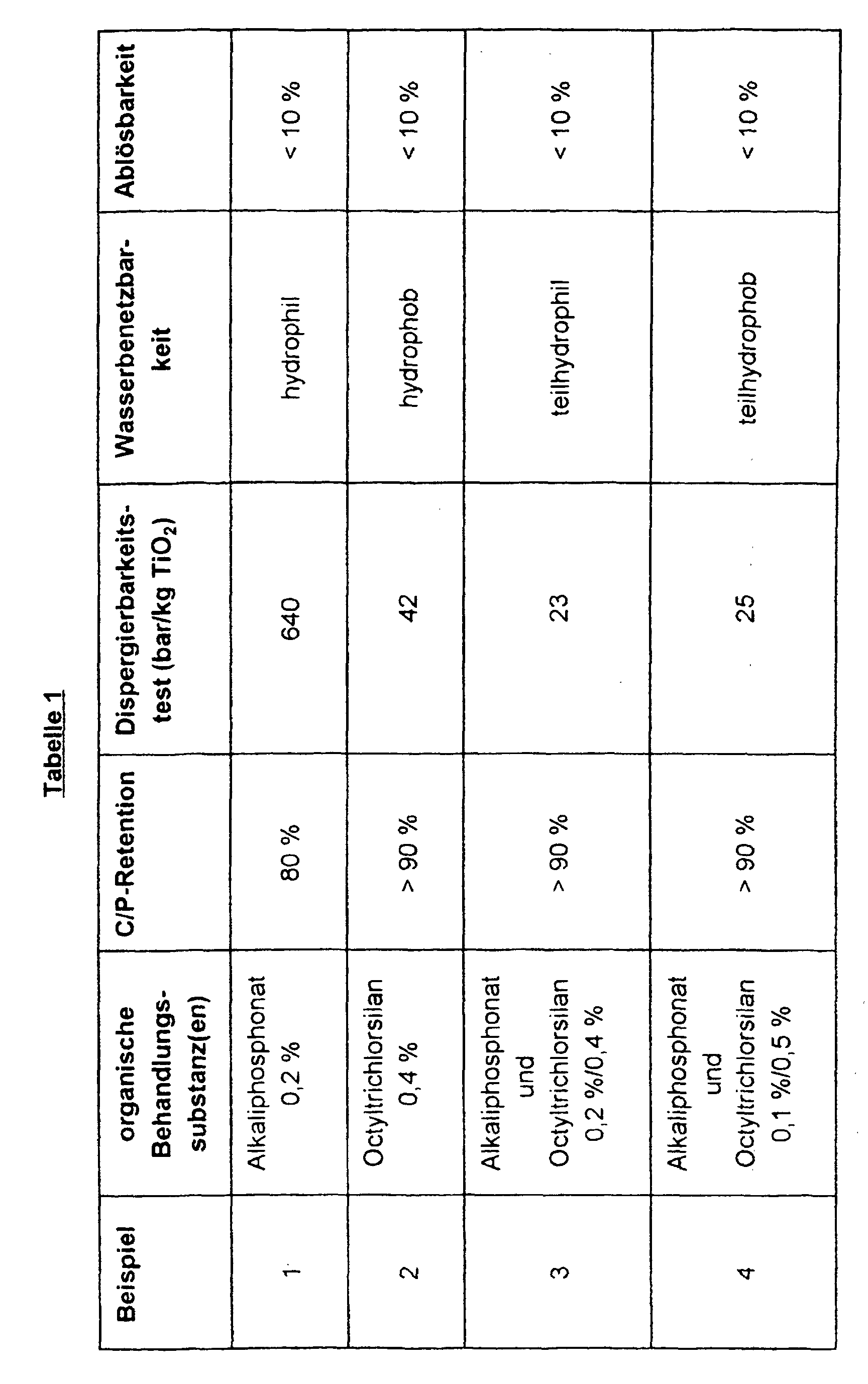
- the pigment thus obtained becomes the above submitted tests. For the results, see Table 1.
- a sand-ground titanium dioxide suspension is stirred at pH 7.25 ⁇ 0.25 treated with 0.4% octyltrichlorosilane and to keep the pH constant 10% NaOH is added to the above-mentioned level.
- the titanium dioxide is filtered off, washed and dried. This is followed by steam jet milling, which is common in the titanium dioxide industry.
- the pigment thus obtained is subjected to the tests mentioned above. To the See Table 1 for results.
- Examples 3 and 4 in comparison to Examples 1 and 2 can be achieved through the mixed organic mesh-like coating of the pigments achieve very good dispersibility.
- the water wettability is individual adjustable.
- the retention is over 90% in both cases, which is due to the chemical Binding of the organic phosphorus group either directly or via silicon on Pigment is due.
- a sodium aluminate solution is added to a sand-ground titanium dioxide suspension with stirring.
- the pH should not exceed 8 to 9 when added.
- the pH is adjusted to 7.5 ⁇ 0.25 with 10% HCl.
- 0.5% octyltrichlorosilane and 0.2% LOPON WN® are added simultaneously and while stirring.
- 10% NaOH is added to keep the pH constant in the range mentioned.
- the titanium dioxide is filtered off, washed and dried.
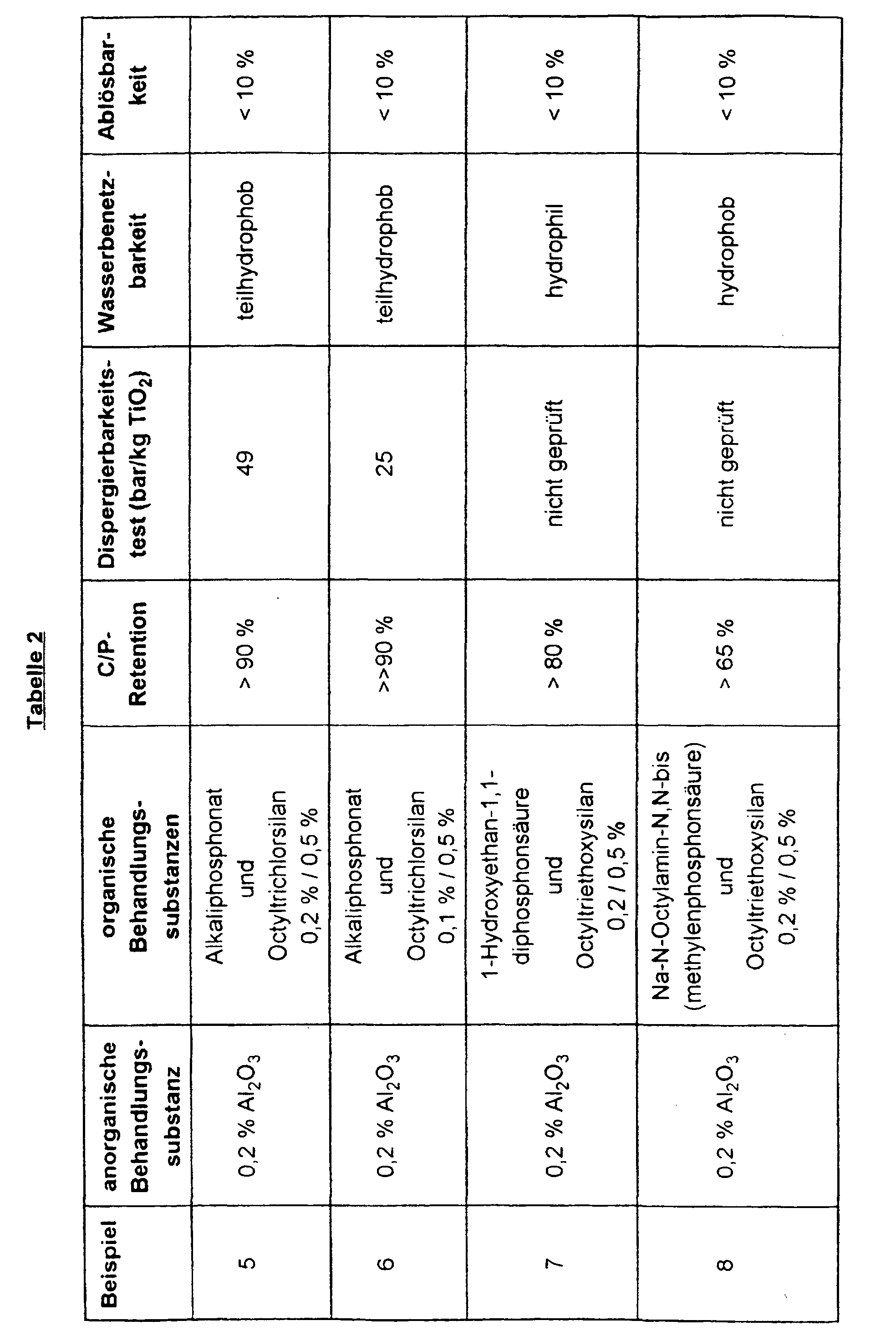
- a steam jet grinding follows. The pigment thus obtained is subjected to the tests mentioned above. For the results, see Table 2.
- Example 5 Analogous to Example 5, an inorganic treatment with 0.2% Al 2 O 3 takes place . After a retention time of 10 minutes, octyltrichlorosilane is first added until the pH has dropped into the range 4.25 ⁇ 0.25. Then this pH range is kept constant during the addition of the remaining octyltrichlorosilane by adding 10% NaOH. The total amount of octyltrichlorosilane is 0.5%. Then 0.1% alkali phosphonate LOPON WN® is added in the pH range mentioned. After a retention time of 60 minutes, the procedure is as described in Example 5. For the results, see Table 2. The organic treatment at a pH in the range from 3 to 5 shows advantages in the retention of the compounds.
- Example 5 Treatment with 0.2% Al 2 O 3 is carried out analogously to Example 5. After the 10 minute retention time, the pH is adjusted to 7.25 ⁇ 0.25 by adding 10% HCl. This is followed by the simultaneous, non-premixed addition of 0.5% octyltriethoxysilane and 0.2% 1-hydroxyethane-1,1-diphosphonic acid. The pH is adjusted during the addition by 10% NaOH in the above range. After the retention time of 60 minutes, the titanium dioxide is filtered off, washed, dried and ground on a laboratory mill. For C / P retention, water wettability and releasability, see Table 2.
- Example 7 The procedure is as in Example 7. At pH 7.5 ⁇ 0.25, the simultaneous Add 0.5% octyltriethoxysilane and 0.2% sodium-N-octylamine-N, N-bis (Methylene phosphonate). The pH is adjusted during the addition by adding 10% HCl set in the above range. It will continue as in Example 7 described.
- Examples 7 and 8 show that the hydrophilic / hydrophobic properties can be influenced by the choice of certain functional phosphonates.
- the low retention of the organics is a disadvantage.
Landscapes
- Chemical & Material Sciences (AREA)
- Organic Chemistry (AREA)
- Inorganic Chemistry (AREA)
- Medicinal Chemistry (AREA)
- Polymers & Plastics (AREA)
- Chemical Kinetics & Catalysis (AREA)
- Health & Medical Sciences (AREA)
- Life Sciences & Earth Sciences (AREA)
- Engineering & Computer Science (AREA)
- Materials Engineering (AREA)
- Wood Science & Technology (AREA)
- Pigments, Carbon Blacks, Or Wood Stains (AREA)
- Compositions Of Macromolecular Compounds (AREA)
- Paints Or Removers (AREA)
Description

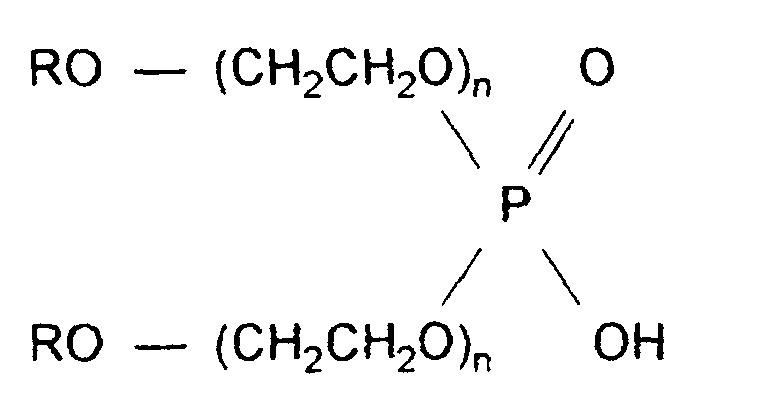
Als phosphororganische Verbindungen kommen Phosphonate der allgemeinen Formel

R1 ein nicht hydrolysierbarer Alkyl-, Cycloalkyl- oder Arylrest mit 1 bis 16 Kohlenstoffatomen ist, wobei R1 bei reinen Cycloalkylresten mindestens 5 Kohlenstoffatome, bei reinen Arylresten mindestens 6 Kohlenstoffatome aufweist und R1 darüberhinaus an den oben genannten Alkyl-, Cycloalkyl- oder Arylresten noch einen oder mehrere Substituenten, die stickstoff- und/oder sauerstofffunktionell sind, wie Amin-, Imin-, Carboxyl-, Hydroxylreste o. ä. tragen kann (auch Gemische mit unterschiedlichem R1 sind möglich) und
R2 und R3 entweder beide oder einzeln ein Alkylrest, Wasserstoff oder ein einwertiges Metallkation wie z. B. Na+, K+ oder NH4 + (auch Gemische sind möglich) sein können.

R4 ein nicht hydrolysierbarer Alkyl-, Alkylen-, Cycloalkyl- oder Arylrest mit 1 bis 20 Kohlenstoffatomen ist, und R4 bei Alkylenresten mindestens 2 Kohlenstoffatome, bei Cycloalkylresten mindestens 5 Kohlenstoffatome, bei reinen Arylresten mindestens 6 Kohlenstoffatome aufweist und R4 darüberhinaus an den oben genannten Alkyl-, Alkylen, Cycloalkyl- oder Arylresten noch einen oder mehrere Substituenten wie Amino-, Epoxy- oder Methacrylreste tragen kann,
R5, R6 und R7 gleiche oder verschiedene hydrolysierbare Reste aus Alkoxy, Acetoxy, Hydroxy, Halogen oder Mischungen daraus sein können.
Claims (15)
- Anorganische Partikel, beschichtet mit wenigstens einer reaktiven Organosilanverbindung, wobei wegen deren Reaktivität die Organosilanverbindungen untereinander und mit der Partikeloberfläche chemische Bindungen eingegangen sind und ein organisches Polysiloxan an der Partikel chemisch gebunden ist,
dadurch gekennzeichnet, dass die reaktive Organosilanverbindung ein Silan der allgemeinen Formelist, wobei R4 ein nicht hydrolisierbarer Alkyl-, Alkylen-, Cycloalkyl- oder
Arylrest mit 1 bis 20 Kohlenstoffatomen ist, und R4 bei Alkylenresten mindestens 2 Kohlenstoffatome, bei reinen Arylresten mindestens 6 Kohlenstoffatome aufweist (auch Gemische mit unterschiedlichem R4 sind möglich) und bei R4 darüber hinaus ein oder mehrere Wasserstoffatome durch stickstoff- und/oder sauerstofffunktionelle Reste wie Amino, Epoxy oder Methacryl substituiert sein können, und R5, R6 und R7 gleiche oder verschiedene Reste aus Alkoxy, Acetoxy, Halogen oder Mischungen daraus sein können,
und dass ein Teil der reaktiven Organosilanverbindungen durch reaktive Organophosphonatverbindungen ersetzt ist. - Anorganische Partikel nach Anspruch 1, dadurch gekennzeichnet, dass zwischen der Partikel und der organischen Verbindung wenigstens eine weitere Schicht aus einem Metalloxid oder -phosphat oder -oxyhydrat vorhanden ist.
- Anorganische Partikel nach Anspruch 1 oder 2 dadurch gekennzeichnet, dass die reaktive Organophosphonatverbindung ein Phosphonat der allgemeinen Formelist, wobei R, ein nicht hydrolisierbarer Alkyl-, Cycloalkyl- oder Arylrest mit 1 bis 16 Kohlenstoffatomen ist, wobei R, bei reinen Cycloalkylresten mindestens 5 und bei reinen Arylresten mindestens 6 Kohlenstoffatome aufweist (auch Gemische mit unterschiedlichem R1 sind möglich) und R2 und R3 entweder beide oder einzeln ein Alkylrest, Wasserstoff, ein einwertiges Metallkation oder Ammonium (auch Gemische sind möglich) sein können.

- Anorganische Partikel nach Anspruch 3, dadurch gekennzeichnet, dass beim Rest R1 ein oder mehrere Wasserstoffatome durch stickstoffund/oder sauerstofffunktionelle Reste wie Amin, Imin oder Hydroxyl substituiert sind.
- Anorganische Partikel nach einem oder mehreren der Ansprüche 1 bis 4,
dadurch gekennzeichnet, dass die Partikel mit einheitlichen Organosilan- und einheitlichen Organophosphatverbindungen umhüllt sind. - Anorganische Partikel nach einem oder mehreren der Ansprüche 1 bis 4,
dadurch gekennzeichnet, dass die Partikel mit Gemischen verschiedener Organosilan- und/oder Organophosphatverbindungen umhüllt sind. - Anorganische Partikel nach einem oder mehreren der Ansprüche 1 bis 6,
dadurch gekennzeichnet, dass das Mol-Verhältnis der Organosilanverbindungen zu Organophosphatverbindungen zwischen 10:1 und 1:10 variiert. - Anorganische Partikel nach einem oder mehreren der Ansprüche 1 bis 7,
dadurch gekennzeichnet, dass die Beschichtungsmenge der anorganischen Partkel mit Organosilanverbindungen und Organophosphatverbindungen 0,05 bis 5 % (bezogen auf das Gewicht der anorganischen Partikel) beträgt. - Verfahren zur Herstellung von anorganischen Partikeln gemäß einem oder mehreren der Ansprüche 1 bis 8 gekennzeichnet durch folgende Schritte:a) Dispergieren der anorganischen Partikel in einer wässrigen Lösung;b) Einstellen eines pH-Wertes im Bereich 2 bis 11, bevorzugt 3 bis 5;c) getrennte Zugabe der reaktiven Organosilan- und reaktiven Organophosphonatverbindungen;d) Nachstellen des pH-Wertes;e) Rühren der Suspension;f) Filtrieren, Waschen, Trocknen und Mahlen der anorganischen Partikel.
- Verfahren nach Anspruch 9, dadurch gekennzeichnet, dass von Titandioxidpigmenten, die nach dem Sulfat- oder Chloridverfahren hergestellt worden sind und die eine Anatas- oder Rutilstruktur aufweisen, ausgegangen wird.
- Verfahren nach Anspruch 9 oder 10, dadurch gekennzeichnet, dass die anorganischen Partikel einer Nassmahlung, z.B. einer Sandmahlung, unterzogen werden.
- Verfahren nach Anspruch 9, 10 oder 11, dadurch gekennzeichnet, dass die anorganischen Partikel vor der Beschichtung mit reaktivem Organosilan und reaktiven Organophosphonatverbindungen mit Oxiden oder Phosphaten, bevorzugt mit Al2O3 der Menge 0,1 bis 0,5 Gew.-% bezogen auf die anorganischen Partikel, behandelt werden.
- Verfahren nach Anspruch 9, 10, 11 oder 12, dadurch gekennzeichnet, dass die anorganischen Partikel nach dem Trocknen dampfgemahlen werden.
- Verwendung der anorganischen Partikel nach einem oder mehreren der Ansprüche 1 bis 8 in Kunststoffsystemen oder Lacksystemen.
- Verwendung der anorganischen Partikel nach einem oder mehreren der Ansprüche 1 bis 8 im Bereich der Papier- und Faserpigmentierung.
Priority Applications (1)
| Application Number | Priority Date | Filing Date | Title |
|---|---|---|---|
| DK98963348T DK1034217T3 (da) | 1997-11-22 | 1998-11-06 | Phosphonatosiloxanbehandlede uorganiske partikler |
Applications Claiming Priority (3)
| Application Number | Priority Date | Filing Date | Title |
|---|---|---|---|
| DE19751857A DE19751857A1 (de) | 1997-11-22 | 1997-11-22 | Phosphonatosiloxanbehandelte anorganische Partikel |
| DE19751857 | 1997-11-22 | ||
| PCT/DE1998/003327 WO1999027011A2 (de) | 1997-11-22 | 1998-11-06 | Phosphonatosiloxanbehandelte anorganische partikel |
Publications (2)
| Publication Number | Publication Date |
|---|---|
| EP1034217A2 EP1034217A2 (de) | 2000-09-13 |
| EP1034217B1 true EP1034217B1 (de) | 2004-09-15 |
Family
ID=7849560
Family Applications (1)
| Application Number | Title | Priority Date | Filing Date |
|---|---|---|---|
| EP98963348A Expired - Lifetime EP1034217B1 (de) | 1997-11-22 | 1998-11-06 | Phosphonatosiloxanbehandelte anorganische partikel |
Country Status (10)
| Country | Link |
|---|---|
| EP (1) | EP1034217B1 (de) |
| JP (1) | JP4206197B2 (de) |
| CN (1) | CN100387647C (de) |
| BR (1) | BR9814985A (de) |
| DE (2) | DE19751857A1 (de) |
| DK (1) | DK1034217T3 (de) |
| ES (1) | ES2226197T3 (de) |
| IL (1) | IL134586A (de) |
| TR (1) | TR200000204T2 (de) |
| WO (1) | WO1999027011A2 (de) |
Cited By (1)
| Publication number | Priority date | Publication date | Assignee | Title |
|---|---|---|---|---|
| US11142648B2 (en) | 2015-10-02 | 2021-10-12 | Huntsman P&A Uk Limited | Particle surface treatment |
Families Citing this family (22)
| Publication number | Priority date | Publication date | Assignee | Title |
|---|---|---|---|---|
| DE19843498A1 (de) * | 1998-09-22 | 2000-03-30 | Thomas Sievers | Oberflächenbehandelte mineralische Werkstoffe und Verfahren zu ihrer Herstellung |
| US6765041B1 (en) | 2000-11-27 | 2004-07-20 | Millenium Inorganic Chemicals, Inc. | Organo-acid phosphate treated pigments |
| DE10064637A1 (de) * | 2000-12-22 | 2002-07-04 | Henkel Kgaa | Nanopartikuläres oberflächenmodifiziertes Titanoxid und seine Verwendung in Zahnpflegemitteln |
| DE10209698A1 (de) † | 2002-03-06 | 2003-09-18 | Sachtleben Chemie Gmbh | Verfahren zur Herstellung von gecoateten, feinteiligen, anorganischer Festkörpern und deren Verwendung |
| DE10351803A1 (de) * | 2003-11-06 | 2005-06-09 | Consortium für elektrochemische Industrie GmbH | Verfahren zur Herstellung von mit Phosphonsäureester modifizierten Organosiloxanen |
| DE112006001459B4 (de) * | 2005-06-07 | 2019-05-29 | The Chemours Company Fc, Llc | Papier und lammatpapiere, die modifiziertes titandioxid enthalten |
| CN100447314C (zh) * | 2006-01-10 | 2008-12-31 | 上海千泰高科技发展有限公司 | 一种干法腈纶纺丝消光用钛白粉的制备方法 |
| JP5152600B2 (ja) * | 2007-02-21 | 2013-02-27 | ウオーターズ・テクノロジーズ・コーポレイシヨン | 高い有機物含有量および向上性細孔形状を有するクロマトグラフィー分離用の多孔質無機/有機ハイブリッド粒子 |
| EP2269963B1 (de) * | 2008-03-31 | 2012-10-17 | Sekisui Chemical Co., Ltd. | Zwischenfilm für verbundglas, verbundglas und zinkoxidmikropartikeldisperson |
| CN101624481B (zh) * | 2008-07-10 | 2012-07-25 | 道奇威(成都)科技有限公司 | 色母粒钛白粉有机包膜方法 |
| WO2012027337A1 (en) * | 2010-08-23 | 2012-03-01 | Dow Corning Corporation | Phosphosiloxane resins, and curable silicone compositions, free-standing films, and laminates comprising the phosphosiloxane resins |
| US9267039B2 (en) * | 2013-03-14 | 2016-02-23 | Cristal Inorganic Chemicals Switzerland Ltd | Non-micronized pigment for plastics application |
| CN103254662A (zh) * | 2013-05-27 | 2013-08-21 | 道奇威(成都)科技有限公司 | 一种制造超分散金红石型钛白粉的有机表面改性方法 |
| EP3260502A1 (de) * | 2016-06-21 | 2017-12-27 | Kronos International, Inc. | Leicht dispergierbares pigment |
| KR20190022656A (ko) * | 2016-06-30 | 2019-03-06 | 다우 글로벌 테크놀로지스 엘엘씨 | 포스포네이트 개질된 금속 산화물 입자 |
| CN108034323B (zh) * | 2018-01-31 | 2020-05-15 | 南通涂冠环保科技有限公司 | 一种环保内墙涂料及其制备方法 |
| CN108587495B (zh) * | 2018-03-02 | 2020-10-27 | 南宁珀源能源材料有限公司 | 用硅烷偶联剂处理粘接面改进厌氧胶性能的方法 |
| MX2021003543A (es) | 2018-09-27 | 2021-06-23 | Xilio Dev Inc | Polipeptidos de citocinas enmascaradas. |
| JP2023553323A (ja) | 2020-11-25 | 2023-12-21 | エクシリオ デベロップメント, インコーポレイテッド | 腫瘍特異的に切断可能なリンカー |
| CN113583503B (zh) * | 2021-08-27 | 2022-12-30 | 河南佰利联新材料有限公司 | 一种杂化浆料及其制备方法和涂料 |
| CN115029019A (zh) * | 2022-07-12 | 2022-09-09 | 龙佰禄丰钛业有限公司 | 一种钛白粉生产中有机包膜剂的添加工艺 |
| CN115717001B (zh) * | 2022-11-21 | 2024-02-06 | 桂林电子科技大学 | 一种磷硅酸包覆炭黑及其制备方法和应用 |
Citations (1)
| Publication number | Priority date | Publication date | Assignee | Title |
|---|---|---|---|---|
| DE3015766A1 (de) * | 1980-04-24 | 1981-10-29 | Bayer Ag, 5090 Leverkusen | Anorganische pigmente und fuellstoffe mit verbesserter kunststoffdispergierbarkeit |
Family Cites Families (26)
| Publication number | Priority date | Publication date | Assignee | Title |
|---|---|---|---|---|
| GB1442756A (en) * | 1972-08-17 | 1976-07-14 | Laporte Industries Ltd | Pigments |
| US4209430A (en) * | 1978-11-24 | 1980-06-24 | Scm Corporation | Treatment of inorganic pigments |
| DE2946549A1 (de) * | 1979-11-17 | 1981-05-27 | Bayer Ag, 5090 Leverkusen | Neuartige tio(pfeil abwaerts)2(pfeil abwaerts) -pigmente mit guter dispergierbarkeit, verfahren zu ihrer herstellung un verwendung |
| US4328041A (en) * | 1980-06-09 | 1982-05-04 | Milliken Research Corporation | Comminuted inorganic materials |
| DE3035350A1 (de) * | 1980-09-19 | 1982-05-06 | Bayer Ag, 5090 Leverkusen | Leicht dispergierbare anorganische pigmente auf der basis von cadmiumsulfid |
| JPS5767681A (en) * | 1980-10-14 | 1982-04-24 | Ishihara Sangyo Kaisha Ltd | Ultraviolet absorber |
| JPS5910750B2 (ja) * | 1981-04-11 | 1984-03-10 | 岡山県 | 有機リン酸系化合物による改質無機粉体 |
| US4377417A (en) * | 1981-07-30 | 1983-03-22 | Gulf & Western Industries, Inc. | Titanium dioxide pigment treated to suppress yellowing in polymers |
| JPS6217707A (ja) * | 1985-07-16 | 1987-01-26 | Toshiba Corp | 光学素子 |
| JPH064802B2 (ja) * | 1986-01-30 | 1994-01-19 | パイロツトインキ株式会社 | 着色液 |
| JPH01126375A (ja) * | 1987-11-10 | 1989-05-18 | Mitsubishi Kasei Vinyl Co | 合成樹脂充填材用被覆無機フィラー |
| DE3914874A1 (de) * | 1989-05-05 | 1990-11-08 | Wacker Chemie Gmbh | Verfahren zur verstaerkung des haftens von polymeren stoffen an carbonatoberflaechen |
| JPH0416518A (ja) * | 1990-05-07 | 1992-01-21 | Mitsubishi Heavy Ind Ltd | 無機物質表面の改質方法 |
| DE4125440A1 (de) * | 1990-08-09 | 1992-02-13 | Sandoz Ag | Mono-, bi- oder tri-carbocyclische phosphin- oder phosphonsaeureverbindungen |
| DE4030727A1 (de) * | 1990-09-28 | 1992-04-02 | Eckart Standard Bronzepulver | Kunstharzbeschichtete metallpigmente, verfahren zu ihrer herstellung und ihre verwendung |
| DE4233396A1 (de) * | 1992-10-05 | 1994-04-07 | Merck Patent Gmbh | Oberflächenmodifizierte Oxidpartikel und ihre Anwendung als Füll- und Modifizierungsmittel in Polymermaterialien |
| US5156677A (en) * | 1992-05-15 | 1992-10-20 | Basf Corporation | Treatment of aluminum flake pigment for use in organic coating compositions |
| GB9222434D0 (en) * | 1992-10-24 | 1992-12-09 | Tioxide Group Services Ltd | Process for coating inorganic particles |
| JP3511269B2 (ja) * | 1992-12-01 | 2004-03-29 | 触媒化成工業株式会社 | 無機酸化物コロイド粒子およびコーティング組成物 |
| JPH06217707A (ja) | 1993-01-29 | 1994-08-09 | Nisshin Flour Milling Co Ltd | 油脂被覆固形飼料およびそれに用いる油脂混合物 |
| DE4323914A1 (de) * | 1993-07-16 | 1995-01-19 | Merck Patent Gmbh | Perlglanzpigment-Zubereitung |
| DE4340400A1 (de) * | 1993-11-26 | 1995-06-01 | Wacker Chemie Gmbh | Wäßrige Dispersionen von Organopolysiloxanen |
| DE69520921T2 (de) * | 1994-10-14 | 2001-08-30 | Tioxide Group Services Ltd., London | Anorganische Teilchen beschichtet mit Alkylphosphonsäure oder einem Ester davon, deren Herstellung und deren Verwendung |
| DE19500674A1 (de) * | 1995-01-12 | 1996-07-18 | Degussa | Oberflächenmodifizierte pyrogen hergestellte Mischoxide, Verfahren zu ihrer Herstellung und Verwendung |
| US5922121A (en) * | 1995-10-03 | 1999-07-13 | Videojet Systems International, Inc. | Hydrophobic treatment of pigments |
| DE19639783A1 (de) * | 1996-09-27 | 1998-04-02 | Merck Patent Gmbh | Modifizierte Perlglanzpigmente für Wasserlacksysteme |
-
1997
- 1997-11-22 DE DE19751857A patent/DE19751857A1/de not_active Withdrawn
-
1998
- 1998-11-06 DE DE59811964T patent/DE59811964D1/de not_active Expired - Fee Related
- 1998-11-06 CN CNB988076705A patent/CN100387647C/zh not_active Expired - Fee Related
- 1998-11-06 EP EP98963348A patent/EP1034217B1/de not_active Expired - Lifetime
- 1998-11-06 DK DK98963348T patent/DK1034217T3/da active
- 1998-11-06 WO PCT/DE1998/003327 patent/WO1999027011A2/de not_active Ceased
- 1998-11-06 ES ES98963348T patent/ES2226197T3/es not_active Expired - Lifetime
- 1998-11-06 JP JP2000522160A patent/JP4206197B2/ja not_active Expired - Fee Related
- 1998-11-06 IL IL13458698A patent/IL134586A/xx not_active IP Right Cessation
- 1998-11-06 TR TR2000/00204T patent/TR200000204T2/xx unknown
- 1998-11-06 BR BR9814985-7A patent/BR9814985A/pt not_active IP Right Cessation
Patent Citations (1)
| Publication number | Priority date | Publication date | Assignee | Title |
|---|---|---|---|---|
| DE3015766A1 (de) * | 1980-04-24 | 1981-10-29 | Bayer Ag, 5090 Leverkusen | Anorganische pigmente und fuellstoffe mit verbesserter kunststoffdispergierbarkeit |
Cited By (1)
| Publication number | Priority date | Publication date | Assignee | Title |
|---|---|---|---|---|
| US11142648B2 (en) | 2015-10-02 | 2021-10-12 | Huntsman P&A Uk Limited | Particle surface treatment |
Also Published As
| Publication number | Publication date |
|---|---|
| DE19751857A1 (de) | 1999-05-27 |
| TR200000204T2 (tr) | 2000-05-22 |
| WO1999027011A2 (de) | 1999-06-03 |
| DK1034217T3 (da) | 2004-11-29 |
| ES2226197T3 (es) | 2005-03-16 |
| CN100387647C (zh) | 2008-05-14 |
| IL134586A (en) | 2005-06-19 |
| CN1265691A (zh) | 2000-09-06 |
| BR9814985A (pt) | 2000-10-03 |
| DE59811964D1 (de) | 2004-10-21 |
| JP2001524567A (ja) | 2001-12-04 |
| JP4206197B2 (ja) | 2009-01-07 |
| WO1999027011A3 (de) | 1999-07-22 |
| EP1034217A2 (de) | 2000-09-13 |
| IL134586A0 (en) | 2001-04-30 |
Similar Documents
| Publication | Publication Date | Title |
|---|---|---|
| DE19751857A1 (de) | Phosphonatosiloxanbehandelte anorganische Partikel | |
| EP0615531B1 (de) | Oberflächenmodifizierte oxidpartikel und ihre anwendung als füll- und modifizierungsmittel in polymermaterialien | |
| EP0126871B1 (de) | An der Oberfläche modifizierte natürliche oxidische oder silikatische Füllstoffe, ein Verfahren zur Herstellung und deren Verwendung | |
| DE68921220T2 (de) | Chemisch inerte zinkoxidpigmente. | |
| DE60011472T2 (de) | Titandioxidpigment, verfahren zur herstellung desselben und dieses enthaltende harzzusammensetzung | |
| DE69633296T2 (de) | Silanbehandelte anorganische pigmente | |
| EP0341383B1 (de) | Feinteilige Fällungskieselsäure mit hoher Struktur, Verfahren zu seiner Herstellung und Verwendung | |
| EP3080207B1 (de) | Calciumphosphat-haltige titandioxid-kompositpigmente und verfahren zu ihrer herstellung | |
| DE60318225T2 (de) | Organosiliciumverbindungen und mischungen zur behandlung von siliciumdioxid | |
| DE102006012564B4 (de) | Mit Mikrohohlkugeln beschichtetes Titandioxid-Pigment und Verfahren zur Herstellung | |
| EP2358821A1 (de) | Oberflächenbehandelte titandioxid-pigmente für kunststoffe und verfahren zur herstellung | |
| EP1203795A1 (de) | Nachbeschichtung von Perlglanzpigmenten mit hydrophoben Kupplungsreagenzien | |
| DE19818924A1 (de) | Oberflächenmodifizierte Füllstoffe, Verfahren zu deren Herstellung sowie deren Verwendung | |
| DE102005056622A1 (de) | Nanopartikel | |
| EP2099868A1 (de) | Transparentes zinksulfid grosser spezifischer oberfläche | |
| DE10332852A1 (de) | Modifizierter roter Phosphor, Verfahren zur Herstellung desselben, entfärbte Zusammensetzung von rotem Phosphor und flammwidrige Polymerzusammensetzung | |
| DE69602221T2 (de) | Zusammengesetztes Pigmentmaterial | |
| EP1690884B1 (de) | Organosilan-modifizierte Polysiloxane und deren Verwendung zur Oberflächenmodifizierung | |
| WO2017009033A1 (de) | Sio2 enthaltende dispersion mit hoher salzstabilität | |
| EP2571943A1 (de) | Funktionalisierte partikel und deren verwendung | |
| EP3116958A2 (de) | Verfahren zur oberflächenbehandlung von partikeln, die so erhaltenen partikel und deren verwendung | |
| DE3912877A1 (de) | Feines pulver aus einem siliconharz, enthaltend quaternaere ammoniumgruppen | |
| EP1017745A1 (de) | An ihrer oberfläche anisotrop verteilte überwiegend hydrophile und überwiegend hydrophobe domänen aufweisende amphiphile teilchen oder moleküle | |
| DE69103131T2 (de) | Pigmente mit verbesserter Dispersionsfähigkeit in thermoplastischen Harzen. | |
| DE60116259T3 (de) | Zusammengesetzte pigmente enthaltend in situ gefälltem calciumcarbonat |
Legal Events
| Date | Code | Title | Description |
|---|---|---|---|
| PUAI | Public reference made under article 153(3) epc to a published international application that has entered the european phase |
Free format text: ORIGINAL CODE: 0009012 |
|
| 17P | Request for examination filed |
Effective date: 19991125 |
|
| AK | Designated contracting states |
Kind code of ref document: A2 Designated state(s): BE DE DK ES FI FR GB IT NL |
|
| 17Q | First examination report despatched |
Effective date: 20030917 |
|
| GRAP | Despatch of communication of intention to grant a patent |
Free format text: ORIGINAL CODE: EPIDOSNIGR1 |
|
| GRAS | Grant fee paid |
Free format text: ORIGINAL CODE: EPIDOSNIGR3 |
|
| RAP1 | Party data changed (applicant data changed or rights of an application transferred) |
Owner name: KRONOS TITAN GMBH |
|
| GRAA | (expected) grant |
Free format text: ORIGINAL CODE: 0009210 |
|
| AK | Designated contracting states |
Kind code of ref document: B1 Designated state(s): BE DE DK ES FI FR GB IT NL |
|
| REG | Reference to a national code |
Ref country code: GB Ref legal event code: FG4D Free format text: NOT ENGLISH |
|
| REF | Corresponds to: |
Ref document number: 59811964 Country of ref document: DE Date of ref document: 20041021 Kind code of ref document: P |
|
| REG | Reference to a national code |
Ref country code: DK Ref legal event code: T3 |
|
| GBT | Gb: translation of ep patent filed (gb section 77(6)(a)/1977) |
Effective date: 20050106 |
|
| REG | Reference to a national code |
Ref country code: ES Ref legal event code: FG2A Ref document number: 2226197 Country of ref document: ES Kind code of ref document: T3 |
|
| PLBE | No opposition filed within time limit |
Free format text: ORIGINAL CODE: 0009261 |
|
| STAA | Information on the status of an ep patent application or granted ep patent |
Free format text: STATUS: NO OPPOSITION FILED WITHIN TIME LIMIT |
|
| ET | Fr: translation filed | ||
| 26N | No opposition filed |
Effective date: 20050616 |
|
| PGFP | Annual fee paid to national office [announced via postgrant information from national office to epo] |
Ref country code: NL Payment date: 20081103 Year of fee payment: 11 Ref country code: DK Payment date: 20081114 Year of fee payment: 11 Ref country code: DE Payment date: 20081104 Year of fee payment: 11 |
|
| PGFP | Annual fee paid to national office [announced via postgrant information from national office to epo] |
Ref country code: FI Payment date: 20081112 Year of fee payment: 11 Ref country code: ES Payment date: 20081216 Year of fee payment: 11 |
|
| PGFP | Annual fee paid to national office [announced via postgrant information from national office to epo] |
Ref country code: BE Payment date: 20081110 Year of fee payment: 11 Ref country code: IT Payment date: 20081127 Year of fee payment: 11 |
|
| PGFP | Annual fee paid to national office [announced via postgrant information from national office to epo] |
Ref country code: FR Payment date: 20081112 Year of fee payment: 11 |
|
| PGFP | Annual fee paid to national office [announced via postgrant information from national office to epo] |
Ref country code: GB Payment date: 20081105 Year of fee payment: 11 |
|
| BERE | Be: lapsed |
Owner name: *KRONOS TITAN G.M.B.H. Effective date: 20091130 |
|
| REG | Reference to a national code |
Ref country code: NL Ref legal event code: V1 Effective date: 20100601 |
|
| REG | Reference to a national code |
Ref country code: DK Ref legal event code: EBP |
|
| GBPC | Gb: european patent ceased through non-payment of renewal fee |
Effective date: 20091106 |
|
| REG | Reference to a national code |
Ref country code: FR Ref legal event code: ST Effective date: 20100730 |
|
| PG25 | Lapsed in a contracting state [announced via postgrant information from national office to epo] |
Ref country code: FI Free format text: LAPSE BECAUSE OF NON-PAYMENT OF DUE FEES Effective date: 20091106 |
|
| PG25 | Lapsed in a contracting state [announced via postgrant information from national office to epo] |
Ref country code: NL Free format text: LAPSE BECAUSE OF NON-PAYMENT OF DUE FEES Effective date: 20100601 Ref country code: FR Free format text: LAPSE BECAUSE OF NON-PAYMENT OF DUE FEES Effective date: 20091130 Ref country code: BE Free format text: LAPSE BECAUSE OF NON-PAYMENT OF DUE FEES Effective date: 20091130 |
|
| PG25 | Lapsed in a contracting state [announced via postgrant information from national office to epo] |
Ref country code: DE Free format text: LAPSE BECAUSE OF NON-PAYMENT OF DUE FEES Effective date: 20100601 |
|
| PG25 | Lapsed in a contracting state [announced via postgrant information from national office to epo] |
Ref country code: GB Free format text: LAPSE BECAUSE OF NON-PAYMENT OF DUE FEES Effective date: 20091106 |
|
| PG25 | Lapsed in a contracting state [announced via postgrant information from national office to epo] |
Ref country code: DK Free format text: LAPSE BECAUSE OF NON-PAYMENT OF DUE FEES Effective date: 20091130 |
|
| PG25 | Lapsed in a contracting state [announced via postgrant information from national office to epo] |
Ref country code: IT Free format text: LAPSE BECAUSE OF NON-PAYMENT OF DUE FEES Effective date: 20091106 |
|
| REG | Reference to a national code |
Ref country code: ES Ref legal event code: FD2A Effective date: 20110411 |
|
| PG25 | Lapsed in a contracting state [announced via postgrant information from national office to epo] |
Ref country code: ES Free format text: LAPSE BECAUSE OF NON-PAYMENT OF DUE FEES Effective date: 20110329 |
|
| PG25 | Lapsed in a contracting state [announced via postgrant information from national office to epo] |
Ref country code: ES Free format text: LAPSE BECAUSE OF NON-PAYMENT OF DUE FEES Effective date: 20091107 |