EP1032792B1 - Ensemble prefabrique destine a la realisation de tables de cuisson - Google Patents
Ensemble prefabrique destine a la realisation de tables de cuisson Download PDFInfo
- Publication number
- EP1032792B1 EP1032792B1 EP99943030A EP99943030A EP1032792B1 EP 1032792 B1 EP1032792 B1 EP 1032792B1 EP 99943030 A EP99943030 A EP 99943030A EP 99943030 A EP99943030 A EP 99943030A EP 1032792 B1 EP1032792 B1 EP 1032792B1
- Authority
- EP
- European Patent Office
- Prior art keywords
- frame
- elastomer
- assembly according
- plate
- assembly
- Prior art date
- Legal status (The legal status is an assumption and is not a legal conclusion. Google has not performed a legal analysis and makes no representation as to the accuracy of the status listed.)
- Expired - Lifetime
Links
- 238000010411 cooking Methods 0.000 title description 7
- 229920001971 elastomer Polymers 0.000 claims description 30
- 239000000806 elastomer Substances 0.000 claims description 30
- 229920001296 polysiloxane Polymers 0.000 claims description 23
- 238000010438 heat treatment Methods 0.000 claims description 13
- 238000004519 manufacturing process Methods 0.000 claims description 13
- 238000000034 method Methods 0.000 claims description 13
- 239000004033 plastic Substances 0.000 claims description 12
- 229920003023 plastic Polymers 0.000 claims description 12
- 239000002241 glass-ceramic Substances 0.000 claims description 11
- 239000000463 material Substances 0.000 claims description 7
- 230000000295 complement effect Effects 0.000 claims description 3
- 229910052736 halogen Inorganic materials 0.000 claims description 3
- 150000002367 halogens Chemical class 0.000 claims description 3
- 238000007373 indentation Methods 0.000 claims description 2
- 230000006698 induction Effects 0.000 claims description 2
- 239000002952 polymeric resin Substances 0.000 claims 1
- 229920003002 synthetic resin Polymers 0.000 claims 1
- 239000000919 ceramic Substances 0.000 description 24
- 239000003292 glue Substances 0.000 description 12
- 239000002184 metal Substances 0.000 description 10
- 230000002093 peripheral effect Effects 0.000 description 4
- 230000008901 benefit Effects 0.000 description 3
- 238000002347 injection Methods 0.000 description 3
- 239000007924 injection Substances 0.000 description 3
- 238000006116 polymerization reaction Methods 0.000 description 3
- -1 polytetrafluoroethylene Polymers 0.000 description 3
- 230000008569 process Effects 0.000 description 3
- 229920000106 Liquid crystal polymer Polymers 0.000 description 2
- 239000004977 Liquid-crystal polymers (LCPs) Substances 0.000 description 2
- 239000004696 Poly ether ether ketone Substances 0.000 description 2
- 239000004697 Polyetherimide Substances 0.000 description 2
- 239000004734 Polyphenylene sulfide Substances 0.000 description 2
- 239000004954 Polyphthalamide Substances 0.000 description 2
- 238000005520 cutting process Methods 0.000 description 2
- 235000013305 food Nutrition 0.000 description 2
- 210000000056 organ Anatomy 0.000 description 2
- 229920002492 poly(sulfone) Polymers 0.000 description 2
- 229920002490 poly(thioether-sulfone) polymer Polymers 0.000 description 2
- 229920000058 polyacrylate Polymers 0.000 description 2
- 229920001707 polybutylene terephthalate Polymers 0.000 description 2
- 229920002530 polyetherether ketone Polymers 0.000 description 2
- 229920005649 polyetherethersulfone Polymers 0.000 description 2
- 229920001601 polyetherimide Polymers 0.000 description 2
- 229920000069 polyphenylene sulfide Polymers 0.000 description 2
- 229920006375 polyphtalamide Polymers 0.000 description 2
- 229920001343 polytetrafluoroethylene Polymers 0.000 description 2
- 239000004810 polytetrafluoroethylene Substances 0.000 description 2
- 229920005989 resin Polymers 0.000 description 2
- 239000011347 resin Substances 0.000 description 2
- 238000006748 scratching Methods 0.000 description 2
- 230000002393 scratching effect Effects 0.000 description 2
- 238000007789 sealing Methods 0.000 description 2
- 239000013464 silicone adhesive Substances 0.000 description 2
- 229920002449 FKM Polymers 0.000 description 1
- 229920008285 Poly(ether ketone) PEK Polymers 0.000 description 1
- 229920012266 Poly(ether sulfone) PES Polymers 0.000 description 1
- 239000004642 Polyimide Substances 0.000 description 1
- 241001080024 Telles Species 0.000 description 1
- 239000000853 adhesive Substances 0.000 description 1
- 230000001070 adhesive effect Effects 0.000 description 1
- 230000008859 change Effects 0.000 description 1
- 239000003086 colorant Substances 0.000 description 1
- 238000005336 cracking Methods 0.000 description 1
- 238000005553 drilling Methods 0.000 description 1
- 229920000840 ethylene tetrafluoroethylene copolymer Polymers 0.000 description 1
- 239000005357 flat glass Substances 0.000 description 1
- 229920002313 fluoropolymer Polymers 0.000 description 1
- 239000004811 fluoropolymer Substances 0.000 description 1
- 239000011521 glass Substances 0.000 description 1
- 239000003365 glass fiber Substances 0.000 description 1
- 238000009776 industrial production Methods 0.000 description 1
- 238000009434 installation Methods 0.000 description 1
- 230000010354 integration Effects 0.000 description 1
- 239000007788 liquid Substances 0.000 description 1
- 239000011159 matrix material Substances 0.000 description 1
- 239000008267 milk Substances 0.000 description 1
- 210000004080 milk Anatomy 0.000 description 1
- 235000013336 milk Nutrition 0.000 description 1
- 238000012986 modification Methods 0.000 description 1
- 230000004048 modification Effects 0.000 description 1
- 238000000465 moulding Methods 0.000 description 1
- 229920000647 polyepoxide Polymers 0.000 description 1
- 229920001225 polyester resin Polymers 0.000 description 1
- 239000004645 polyester resin Substances 0.000 description 1
- 229920001721 polyimide Polymers 0.000 description 1
- 229920000642 polymer Polymers 0.000 description 1
- 238000002360 preparation method Methods 0.000 description 1
- 238000003825 pressing Methods 0.000 description 1
- 230000001105 regulatory effect Effects 0.000 description 1
- 230000008439 repair process Effects 0.000 description 1
- 230000035939 shock Effects 0.000 description 1
- 239000000243 solution Substances 0.000 description 1
- 239000000126 substance Substances 0.000 description 1
- 229920001169 thermoplastic Polymers 0.000 description 1
- 229920001187 thermosetting polymer Polymers 0.000 description 1
- 239000004416 thermosoftening plastic Substances 0.000 description 1
- 229920003249 vinylidene fluoride hexafluoropropylene elastomer Polymers 0.000 description 1
- XLYOFNOQVPJJNP-UHFFFAOYSA-N water Substances O XLYOFNOQVPJJNP-UHFFFAOYSA-N 0.000 description 1
Images


Classifications
-
- H—ELECTRICITY
- H05—ELECTRIC TECHNIQUES NOT OTHERWISE PROVIDED FOR
- H05B—ELECTRIC HEATING; ELECTRIC LIGHT SOURCES NOT OTHERWISE PROVIDED FOR; CIRCUIT ARRANGEMENTS FOR ELECTRIC LIGHT SOURCES, IN GENERAL
- H05B3/00—Ohmic-resistance heating
- H05B3/68—Heating arrangements specially adapted for cooking plates or analogous hot-plates
- H05B3/74—Non-metallic plates, e.g. vitroceramic, ceramic or glassceramic hobs, also including power or control circuits
-
- F—MECHANICAL ENGINEERING; LIGHTING; HEATING; WEAPONS; BLASTING
- F24—HEATING; RANGES; VENTILATING
- F24C—DOMESTIC STOVES OR RANGES ; DETAILS OF DOMESTIC STOVES OR RANGES, OF GENERAL APPLICATION
- F24C15/00—Details
- F24C15/10—Tops, e.g. hot plates; Rings
- F24C15/102—Tops, e.g. hot plates; Rings electrically heated
Definitions
- the invention relates to a prefabricated assembly, intended for the production of hobs, including a hob ceramic.
- Such hobs may include, among other things, heating elements such as radiant or halogen fireplaces and regulating means for varying the power thereof.
- the assembly of these hobs ends with the installation glass ceramic plate on the metal structure.
- the assembly of the ceramic hob and the frame is carried out by bonding using a silicone adhesive, which is suitable for such use.
- the silicone glue fulfills functions of natures different and complementary.
- silicone glue Another function of the silicone glue is to seal between the metal frame and the ceramic hob.
- the sub-assembly formed by the plate and the frame must, on the one hand, have a good seal so that water, for example used to clean the visible surface of the ceramic hob, do not not enter inside and may create a short circuit.
- water for example used to clean the visible surface of the ceramic hob
- a plate used for preparation food avoid any risk of fouling in areas difficult to access and impossible to clean so as not to see the appearance of germ development.
- silicone glue Another function still fulfilled by silicone glue is to cushion mechanical shock. It thus avoids direct contact between the frame metal and the ceramic hob and also can compensate the expansions of the metal frame, the ceramic hob having practically zero expansion.
- An advantageous feature silicone glue is to have good temperature resistance. Although silicone glue is only used in the peripheral part of the ceramic hob and therefore at a certain distance from the areas of heating, this resistance to temperature must be high.
- a heated container such as a pan, can be placed on the edge of the plate and therefore subjects the frame to a high temperature.
- a final function of the silicone glue is aesthetic: at minus part of the glue being deposited from above, it is important to be able to smooth it so as to give it a beautiful appearance because the less a part can remain visible.
- the inventors then set themselves the goal of providing a set prefabricated of the type mentioned above, that is to say comprising a plate ceramic hob and a frame that allows, once assembled in cooktop, the latter to have a clear interface with the work plan for which it is intended.
- the invention relates to a prefabricated assembly, intended for the production of a hob, comprising a plate of glass ceramic cooking and a frame consisting of a part extending to the periphery of the plate and of another part extending in a plane substantially vertical to the plate, characterized in that at least one of the two parts of the frame has an elastomer overmolding, this topping comprising legs to immobilize the frame in the workplan.
- the prefabricated assembly thus proposed by the invention satisfies the problem.
- the overmolding in the outer peripheral part of the frame ensures a clear interface with the upper part of the work plan, in particular from a sealing point of view.
- Nature elastic of the elastomer allows the profile to marry the form of the work plan, which can be particularly effective when it is not plumb and / or when its surface condition is not regular.
- the frame according to the invention is preferably made of plastic. he is advantageously molded. Preferably again, it is made of resin polymer resistant to temperatures of at least 180 ° C.
- connection between the hob glass ceramic and the frame it can be chosen to overmold the frame directly on the plate instead of bonding them together by a joint in elastomer, silicone type.
- the frame advantageously has holes opening through which are molded elastomer buttons.
- the overmolding is a profile.
- each of the two parts of the above-mentioned frame advantageously comprises an elastomer profile.
- the elastomer profile of the part of the frame extending in the substantially vertical plane of the plate consists of legs, preferably having indentations.
- the Flexible “legs” of the overmolded profile allow, according to this variant, to immobilize the hob perfectly in the worktop, even if it has not been cut within the tolerances desired. This way, we avoid leaving an important game between the vertical walls of the frame and the worktop, play that cannot be compensated in this case only by the presence of parts of setting tricky to set up.
- Another advantage provided by this variant of the invention is the guarantee not to damage the worktop when setting the table of cooking assembled in the latter.
- the elastomer profile of the part of the frame extending to the periphery of the plate preferably has a lip, which allows further avoid the risk of fouling.
- this lip participates, with the elements of flexible supports mentioned above, in support of the frame on the worktop.
- the molding elastomer according to the invention is advantageously silicone.
- the invention also relates to a hob incorporating a prefabricated assembly previously defined in claims 1 to 12, the frame of which is fixed to a base supporting heating elements, such as radiant elements or halogen and / or at least one burner with atmospheric gas and / or minus a means of induction heating.
- a base supporting heating elements such as radiant elements or halogen and / or at least one burner with atmospheric gas and / or minus a means of induction heating.
- the advantages provided by the invention are numerous. First of all the fact that the elastomer is injected and then polymerized, it no longer has to be smoothed by hand as could be the case according to the prior art, its state of surface is no longer penalizing for the decorative aspect. Similarly, in injecting the elastomer onto an already shaped frame, it is possible to from frames of various shapes and / or colors. Such varieties help to give an aesthetic appearance to the hob.
- the various shapes also allow the integration of equipment usually integrated into the plate such as the controls heating elements which most of the time require careful drilling of the plate.
- the frame used according to the process of the invention is preferably made of plastic.
- the elastomer used is advantageously silicone.
- step e) of high frequency polymerization According to a very advantageous characteristic of the process, one realizes step e) of high frequency polymerization.
- the milk to polymerize the elastomer according to the invention by high frequency also saves considerable time during manufacturing.
- the tool used is usually a elastomer. Therefore, the flexible contact between the tool, in particular the mold, and the different parts making up the prefabricated assembly according to the invention does not risk altering the materials, in particular the glass ceramic constituting the hob.
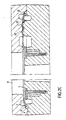
- Figure 1 is a sectional view showing a table of cooking 1, carried out in accordance with the invention, integrated into a plan of work 2 of a kitchen.
- This hob 1 essentially consists of a plate of vitroceramic cooking 3 and a prefabricated assembly according to the invention 4 fixed to a metal base 5, of rectangular section, by means of screws not represented.
- This frame 6 essentially comprises three parts, namely the sides vertical 61, 62, the outer peripheral portion 63 which surrounds the vitroceramic cooking plate 3 by being directly in contact with it and a flat part 64 which extends substantially in the main plane of the ceramic glass hob 3.
- This flat part 64 has openings whose function will be explained below.
- a silicone profile 7 extends over the entire periphery of the frame 6. This has the shape of a lip 71 for the part directly in contact with the upper part of the worktop. This lip 71 has the function ensure a clear interface between frame 6 and the upper part of the work surface, i.e., among other things, a liquid tightness and foods likely to come nearby.
- the curved shape of the lip 71 gives it an appearance aesthetic.
- the silicone profile 7 has, in its vertical part, tabs 72, 73 in contact, on the one hand, with the entire height of the vertical flanks 61, 62 of the frame 6 and, on the other hand, with the entire height of the plane of job.
- the elastic nature of the silicone allows these tabs 72, 73 to be deformed when the hob is inserted into the hob work and therefore ensure perfect immobilization without play between these two elements.
- Removing the hob is also very easy, without risk damage frame 6 and / or work surface 2.
- the flat part 64 of the frame meanwhile, has two openings circular 65 and a rectangular opening 66.
- buttons in silicone 67 which allow, once pressed, to trigger the operation of the heating members not shown.
- a display digital type which allows viewing the programmed time and / or duration a heating cycle of at least one of the heating members. he can also indicate which heater is in operation if the plate is under electric voltage, the temperature of the organ (s) of heated...
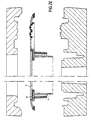
- Figures 2a and 2e represent the different successive stages the manufacturing process of a second prefabricated assembly according to the invention.
- the prefabricated assembly 4 and the plate glass ceramic cooking plates 3 are linked together by means of a silicone seal 8.
- Figure 2a relates to the initial stage of setting up a frame molded 6 in a punch 9.
- This molded frame 6 is of a chemical nature and similar in shape to that of FIG. 1.
- Figure 2b shows the glass ceramic plate 3 placed in the punch 9, so as to be slightly raised relative to the frame 6 and leaves an empty space 10.
- Silicone is then injected inside these channels 12 at by means of an appropriate device.
- the injection is stopped and proceeds to a polymerization of this same material using a high frequency technique for a time of 0.5 to 2 min, in depending on the mass of silicone to be transformed.
- the die 11 is then unlocked from the punch 9 and the ejection of the prefabricated assembly is produced, as shown in Figure 2e.
- Such a method has the advantage of being simple to implement and fast. It is also advantageous since the production of new series with new molded frame shapes can be easily carried out at no additional production cost, the creation of new die and / or punch tools being easy.
- So brand new plastic of the molded frame may be suitable as long as it withstands high temperatures, typically above 250 ° C.
- the plastic of the frame conforms to the invention may be chosen from polybutyleneterephthalate (PBT), polyphenylene sulfide (PPS), polyetheretherketone (PEEK), polyacrylate (PAR), polyethersulfone (PES), polyetherimide (PEI), polyamideimlide (PAI), liquid crystal polymer (LCP), polytetrafluoroethylene (PTFE), polyetherethersulfone (PEES), polyepoxides (EP) and, optionally, polysulfone (PSF), fluoropolymer resins (FEP such as for example PTEFE, PFA, ETFE, etc.), polythioethersulfone (PTES), thermoplastic poyimide (TPI), cross linked polyimide (CLPI), polyetherketone (PEK), polyethermitrile (PEN), polycyclohexyleneterephthalate (PCT), polyphthalamide (PPA).
- PBT polybutyleneterephthalate
- PPS polyphenylene
- the frame may be chosen advantageously among polyester resins (UP).
- any other equivalent profile that can be injected in accordance with the invention is included within the scope of the invention in the provided that silicone-like features such as elasticity and high temperature resistance are fulfilled.
Landscapes
- Engineering & Computer Science (AREA)
- Chemical & Material Sciences (AREA)
- Combustion & Propulsion (AREA)
- Mechanical Engineering (AREA)
- General Engineering & Computer Science (AREA)
- Ceramic Engineering (AREA)
- Cookers (AREA)
- Moulds For Moulding Plastics Or The Like (AREA)
- Injection Moulding Of Plastics Or The Like (AREA)
- Baking, Grill, Roasting (AREA)
- Induction Heating Cooking Devices (AREA)
Description
Claims (17)
- Ensemble préfabriqué (4), destiné à la réalisation de table de cuisson, comportant une plaque de cuisson vitrocéramique (3) et un cadre (6) comportant une partie s'étendant à la périphérie de la plaque (63) et une autre partie s'étendant dans un plan substantiellement vertical à la plaque (61, 62), caractérisé en ce qu'au moins une des deux parties (61, 62) du cadre comporte un surmoulage en élastomère (7, 8), ce surmoulage comprenant des pattes (72, 73) aptes à immobiliser le cadre dans le plan de travail.
- Ensemble selon la revendication 1, caractérisé en ce que le cadre est en matière plastique.
- Ensemble selon la revendication 1 ou 2, caractérisé en ce que le cadre est moulé.
- Ensemble selon l'une des revendications 2 ou 3, caractérisé en ce que le cadre est en résine polymère résistant à des températures d'au moins 180°C.
- Ensemble selon l'une des revendications 1 à 4, caractérisé en ce que le cadre en matière plastique est directement surmoulé sur la plaque de cuisson vitrocéramique.
- Ensemble selon l'une des revendications 1 à 4, caractérisé en ce que le cadre et la plaque de cuisson vitrocéramique sont liés ensemble par un joint en élastomère, du type silicone (8).
- Ensemble selon l'une des revendications précédentes, caractérisé en ce que le cadre comporte des trous débouchant au travers desquels sont surmoulés des boutons en élastomère (67, 68).
- Ensemble selon l'une quelconque des revendications précédentes, caractérisé en ce que le surmoulage est un profilé (72, 73).
- Ensemble selon la revendication 8, caractérisé en ce que chacune des deux parties du cadre comporte un profilé en élastomère.
- Ensemble selon la revendication 8 ou la revendication 9, caractérisé en ce que les pattes du profilé en élastomère présentent des échancrures.
- Ensemble selon la revendication 8 ou la revendication 9, caractérisé en ce que le profilé en élastomère de la partie du cadre s'étendant à la périphérie de la plaque comporte une lèvre (71).
- Ensemble selon l'une quelconque des revendications précédentes, caractérisé en ce que l'élastomère du surmoulage est en silicone.
- Table de cuisson incorporant un ensemble préfabriqué selon l'une des revendications 1 à 12 dont le cadre est fixé à un socle supportant des éléments chauffants, tels que des éléments radiant ou halogène et/ou au moins un brûleur à gaz atmosphérique et/ou au moins un moyen de chauffage par induction.
- Procédé de fabrication d'un ensemble préfabriqué (4), destiné à la réalisation de table de cuisson, selon au moins une des revendications 1 à 12, comportant une plaque de cuisson vitrocéramique (3) et un cadre (6) constitué d'une partie s'étendant à la périphérie de la plaque et d'une autre partie s'étendant dans un plan substantiellement vertical à la plaque (61, 62), caractérisé en ce qu'on réalise les étapes suivantes :a)on introduit un cadre moulé (6) dans un poinçon (9) de forme telle qu'on puisse injecter un élastomère à la surface d'au moins une des deux parties du cadre et de façon à ce que l'élastomère injecté forme des pattes (72, 73) aptes à immobiliser le cadre dans le plan de travail;b) on place une plaque de cuisson vitrocéramique dans le poinçon en légère surélévation par rapport au cadre moulé ;c) on ferme l'ensemble ainsi constitué au moyen d'une matrice (11) de forme au moins en partie complémentaire au poinçon ;d) on injecte un élastomère dans les canaux (12) formés par l'espace libre entre le poinçon et la matrice ;e) on polymérise l'élastomère ;f) puis on éjecte l'ensemble ainsi constitué.
- Procédé selon la revendication 14, caractérisé en ce que le cadre est en matière plastique.
- Procédé selon la revendication 14 ou la revendication 15, caractérisé en ce que l'élastomère est du silicone.
- Procédé selon la revendication 15 ou la revendication 16, caractérisé en ce qu'on réalise l'étape e) de polymérisation à haute fréquence.
Applications Claiming Priority (3)
| Application Number | Priority Date | Filing Date | Title |
|---|---|---|---|
| FR9811841 | 1998-09-23 | ||
| FR9811841A FR2783596B1 (fr) | 1998-09-23 | 1998-09-23 | Ensemble prefabrique destine a la realisation de tables de cuisson |
| PCT/FR1999/002259 WO2000017579A1 (fr) | 1998-09-23 | 1999-09-23 | Ensemble prefabrique destine a la realisation de tables de cuisson |
Publications (2)
| Publication Number | Publication Date |
|---|---|
| EP1032792A1 EP1032792A1 (fr) | 2000-09-06 |
| EP1032792B1 true EP1032792B1 (fr) | 2004-06-23 |
Family
ID=9530728
Family Applications (1)
| Application Number | Title | Priority Date | Filing Date |
|---|---|---|---|
| EP99943030A Expired - Lifetime EP1032792B1 (fr) | 1998-09-23 | 1999-09-23 | Ensemble prefabrique destine a la realisation de tables de cuisson |
Country Status (8)
| Country | Link |
|---|---|
| US (1) | US6492623B1 (fr) |
| EP (1) | EP1032792B1 (fr) |
| JP (1) | JP3808704B2 (fr) |
| AU (1) | AU5631999A (fr) |
| DE (1) | DE69918257T2 (fr) |
| ES (1) | ES2222723T3 (fr) |
| FR (1) | FR2783596B1 (fr) |
| WO (1) | WO2000017579A1 (fr) |
Families Citing this family (11)
| Publication number | Priority date | Publication date | Assignee | Title |
|---|---|---|---|---|
| EP1450847B1 (fr) | 2001-11-13 | 2010-09-29 | Genentech, Inc. | Compositions à base de APO2 ligand/TRAIL et leur utilisation |
| US7842668B1 (en) | 2001-11-13 | 2010-11-30 | Genentech, Inc. | Apo-2 ligand/trail formulations |
| DE10350587A1 (de) * | 2003-10-30 | 2005-06-02 | BSH Bosch und Siemens Hausgeräte GmbH | Haushaltsgerät mit einer Bedienleiste |
| DE10350588A1 (de) | 2003-10-30 | 2005-06-02 | BSH Bosch und Siemens Hausgeräte GmbH | Haushaltsgerät mit einer Bedienleiste |
| FR2889580B1 (fr) * | 2005-08-02 | 2013-11-22 | Eurokera | Plaque de cuisson, appareil de cuisson et procede de fabrication de la plaque |
| US20080145595A1 (en) * | 2006-12-14 | 2008-06-19 | Pratt Charles F | Composite pedestal base assembly |
| DE102007055312A1 (de) * | 2007-11-20 | 2009-05-28 | BSH Bosch und Siemens Hausgeräte GmbH | Anordnung mit einem Kochfeld und einer Arbeitsplatte |
| JP5244626B2 (ja) * | 2009-01-21 | 2013-07-24 | 日立アプライアンス株式会社 | 加熱調理器 |
| EP2366953B1 (fr) * | 2010-03-18 | 2016-06-15 | Electrolux Home Products Corporation N.V. | Appareil de cuisson à gaz |
| EP2615377B1 (fr) * | 2012-01-13 | 2017-05-03 | Electrolux Home Products Corporation N.V. | Cavité de four et four |
| KR102024162B1 (ko) * | 2017-06-28 | 2019-09-23 | 엘지전자 주식회사 | 유리 조성물 및 조리기기 |
Family Cites Families (9)
| Publication number | Priority date | Publication date | Assignee | Title |
|---|---|---|---|---|
| DE19637784C1 (de) * | 1996-09-17 | 1997-10-16 | Schott Glaswerke | Halterung für eine Kochfläche |
| DE2352272C3 (de) * | 1973-10-18 | 1979-07-19 | Teroson Gmbh, 6900 Heidelberg | Wärmeveraetzbare Dichtungsmassen |
| US3866018A (en) * | 1974-04-01 | 1975-02-11 | Gen Electric | Molded plastic cooktop with heated glass-ceramic plate insert |
| DE3104114C2 (de) * | 1981-02-06 | 1984-06-14 | Schott Glaswerke, 6500 Mainz | Halterung für eine Platte aus Glas, Glaskeramik oder ähnlichem Material, insbesondere für eine Kochfläche |
| DE3341194C2 (de) * | 1983-11-14 | 1986-08-14 | Bosch-Siemens Hausgeräte GmbH, 7000 Stuttgart | Verfahren zum Herstellen einer Kochmulde, Vorrichtung zur Durchführung des Verfahrens und mittels der Vorrichtung hergestellte Kochmulde |
| ES2022003A6 (es) | 1990-03-28 | 1991-11-16 | Balay Sa | Sistema de union entre el vidrio ceramico y el marco de fijacion a la encimera. |
| DE19521690A1 (de) * | 1995-06-14 | 1996-12-19 | Bosch Siemens Hausgeraete | Glaskeramikmulde |
| FR2744201B3 (fr) | 1996-01-26 | 1998-03-13 | Eurokera | Plaque vitroceramique |
| DE19703268C2 (de) * | 1997-01-31 | 1999-09-16 | Lkh Kunststoffwerk Gmbh & Co | Halterung für eine Kochfläche |
-
1998
- 1998-09-23 FR FR9811841A patent/FR2783596B1/fr not_active Expired - Fee Related
-
1999
- 1999-09-23 ES ES99943030T patent/ES2222723T3/es not_active Expired - Lifetime
- 1999-09-23 JP JP2000571194A patent/JP3808704B2/ja not_active Expired - Fee Related
- 1999-09-23 AU AU56319/99A patent/AU5631999A/en not_active Abandoned
- 1999-09-23 EP EP99943030A patent/EP1032792B1/fr not_active Expired - Lifetime
- 1999-09-23 WO PCT/FR1999/002259 patent/WO2000017579A1/fr not_active Ceased
- 1999-09-23 US US09/554,089 patent/US6492623B1/en not_active Expired - Lifetime
- 1999-09-23 DE DE69918257T patent/DE69918257T2/de not_active Expired - Lifetime
Also Published As
| Publication number | Publication date |
|---|---|
| FR2783596A1 (fr) | 2000-03-24 |
| ES2222723T3 (es) | 2005-02-01 |
| FR2783596B1 (fr) | 2001-03-09 |
| JP3808704B2 (ja) | 2006-08-16 |
| US6492623B1 (en) | 2002-12-10 |
| AU5631999A (en) | 2000-04-10 |
| DE69918257T2 (de) | 2005-07-14 |
| WO2000017579A1 (fr) | 2000-03-30 |
| JP2002525549A (ja) | 2002-08-13 |
| DE69918257D1 (de) | 2004-07-29 |
| EP1032792A1 (fr) | 2000-09-06 |
Similar Documents
| Publication | Publication Date | Title |
|---|---|---|
| FR2783596A1 (fr) | Ensemble prefabrique destine a la realisation de tables de cuisson | |
| EP0202969B1 (fr) | Elément chauffant plat à résistance électrique et article chauffant comprenant un tel élément | |
| FR2679751A1 (fr) | Appareil electrique de cuisson et son procede de fabrication. | |
| JP5396485B2 (ja) | 境界部を備えた調理器具蓋体 | |
| EP2923154B1 (fr) | Plaque de cuisson à fenêtre et flasque, appareil de cuisson, et procédé de fabrication de la plaque | |
| EP0930806B1 (fr) | Plaque vitrocéramique comportant un relief de repérage tactile | |
| EP2761227B1 (fr) | Plaque de cuisson a fenetre, appareil de cuisson, et procede de fabrication de la plaque | |
| EP1913307A2 (fr) | Plaque de cuisson, appareil de cuisson, capot pour cet appareil et procede de fabrication de la plaque du capot | |
| FR3047147A1 (fr) | Moule flexible a raidisseur peripherique, et procede pour sa realisation | |
| FR2744201A1 (fr) | Plaque vitroceramique | |
| EP2923153B1 (fr) | Plaque de cuisson a fenêtre et flasque, appareil de cuisson, et procédé de fabrication de la plaque | |
| EP0930468B1 (fr) | Appareil de cuisson | |
| EP2604156A1 (fr) | Accessoire pour appareil de cuisson | |
| EP0913369B1 (fr) | Plaque en matériau verrier | |
| FR2485910A1 (fr) | Appareil perfectionne pour la cuisson d'aliments divers | |
| JP6332770B2 (ja) | 取っ手付き鍋蓋およびその生産方法 | |
| EP0730058A1 (fr) | Structure chauffante, notamment pour appareil electromenager, realisée selon une structure sandwich et appareil electromenager comportant une telle structure chauffante | |
| FR3126608A1 (fr) | Element de cuisson revetu par un film polymerique fluore antiadhesif pelable | |
| WO2025088110A1 (fr) | Plaque vitrocéramique avec fenêtre d'affichage fixée par surmoulage | |
| WO2025088111A1 (fr) | Plaque vitrocéramique avec fenêtre d'affichage | |
| FR2551940A2 (fr) | Corps chauffant electrique, et foyer de cuisson equipe de ce corps chauffant | |
| FR2889581A1 (fr) | Procede de fabrication d'un capot, capot, appareil de cuisson, et utilisation de ce capot | |
| EP0711098A1 (fr) | Appareil de cuisson à induction | |
| JPH06215860A (ja) | 加熱調理器 |
Legal Events
| Date | Code | Title | Description |
|---|---|---|---|
| PUAI | Public reference made under article 153(3) epc to a published international application that has entered the european phase |
Free format text: ORIGINAL CODE: 0009012 |
|
| 17P | Request for examination filed |
Effective date: 20000603 |
|
| AK | Designated contracting states |
Kind code of ref document: A1 Designated state(s): AT BE CH CY DE DK ES FI FR GB GR IE IT LI LU MC NL PT SE |
|
| AX | Request for extension of the european patent |
Free format text: AL;LT;LV;MK;RO;SI |
|
| 17Q | First examination report despatched |
Effective date: 20030218 |
|
| GRAP | Despatch of communication of intention to grant a patent |
Free format text: ORIGINAL CODE: EPIDOSNIGR1 |
|
| GRAS | Grant fee paid |
Free format text: ORIGINAL CODE: EPIDOSNIGR3 |
|
| GRAA | (expected) grant |
Free format text: ORIGINAL CODE: 0009210 |
|
| AK | Designated contracting states |
Kind code of ref document: B1 Designated state(s): DE ES FR GB IT |
|
| REG | Reference to a national code |
Ref country code: GB Ref legal event code: FG4D Free format text: NOT ENGLISH |
|
| REG | Reference to a national code |
Ref country code: IE Ref legal event code: FG4D Free format text: FRENCH |
|
| REF | Corresponds to: |
Ref document number: 69918257 Country of ref document: DE Date of ref document: 20040729 Kind code of ref document: P |
|
| GBT | Gb: translation of ep patent filed (gb section 77(6)(a)/1977) | ||
| LTIE | Lt: invalidation of european patent or patent extension |
Effective date: 20040623 |
|
| REG | Reference to a national code |
Ref country code: ES Ref legal event code: FG2A Ref document number: 2222723 Country of ref document: ES Kind code of ref document: T3 |
|
| REG | Reference to a national code |
Ref country code: IE Ref legal event code: FD4D |
|
| PLBE | No opposition filed within time limit |
Free format text: ORIGINAL CODE: 0009261 |
|
| STAA | Information on the status of an ep patent application or granted ep patent |
Free format text: STATUS: NO OPPOSITION FILED WITHIN TIME LIMIT |
|
| 26N | No opposition filed |
Effective date: 20050324 |
|
| PGFP | Annual fee paid to national office [announced via postgrant information from national office to epo] |
Ref country code: GB Payment date: 20110921 Year of fee payment: 13 |
|
| GBPC | Gb: european patent ceased through non-payment of renewal fee |
Effective date: 20120923 |
|
| PG25 | Lapsed in a contracting state [announced via postgrant information from national office to epo] |
Ref country code: GB Free format text: LAPSE BECAUSE OF NON-PAYMENT OF DUE FEES Effective date: 20120923 |
|
| PGFP | Annual fee paid to national office [announced via postgrant information from national office to epo] |
Ref country code: ES Payment date: 20130813 Year of fee payment: 15 |
|
| PGFP | Annual fee paid to national office [announced via postgrant information from national office to epo] |
Ref country code: IT Payment date: 20130820 Year of fee payment: 15 |
|
| PGFP | Annual fee paid to national office [announced via postgrant information from national office to epo] |
Ref country code: FR Payment date: 20131202 Year of fee payment: 16 |
|
| REG | Reference to a national code |
Ref country code: FR Ref legal event code: ST Effective date: 20150529 |
|
| PG25 | Lapsed in a contracting state [announced via postgrant information from national office to epo] |
Ref country code: IT Free format text: LAPSE BECAUSE OF NON-PAYMENT OF DUE FEES Effective date: 20140923 Ref country code: FR Free format text: LAPSE BECAUSE OF NON-PAYMENT OF DUE FEES Effective date: 20140930 |
|
| REG | Reference to a national code |
Ref country code: ES Ref legal event code: FD2A Effective date: 20151026 |
|
| PG25 | Lapsed in a contracting state [announced via postgrant information from national office to epo] |
Ref country code: ES Free format text: LAPSE BECAUSE OF NON-PAYMENT OF DUE FEES Effective date: 20140924 |
|
| PGFP | Annual fee paid to national office [announced via postgrant information from national office to epo] |
Ref country code: DE Payment date: 20180911 Year of fee payment: 20 |
|
| REG | Reference to a national code |
Ref country code: DE Ref legal event code: R071 Ref document number: 69918257 Country of ref document: DE |