EP1029877A2 - Stabilisierte, feindisperse niedrigviskose Polymerpolyole mit einem hohen Gehalt an Polystyrol oder Polystyrol-Copolymerisaten - Google Patents
Stabilisierte, feindisperse niedrigviskose Polymerpolyole mit einem hohen Gehalt an Polystyrol oder Polystyrol-Copolymerisaten Download PDFInfo
- Publication number
- EP1029877A2 EP1029877A2 EP00100278A EP00100278A EP1029877A2 EP 1029877 A2 EP1029877 A2 EP 1029877A2 EP 00100278 A EP00100278 A EP 00100278A EP 00100278 A EP00100278 A EP 00100278A EP 1029877 A2 EP1029877 A2 EP 1029877A2
- Authority
- EP
- European Patent Office
- Prior art keywords
- styrene
- component
- polymer
- polyol
- polyols
- Prior art date
- Legal status (The legal status is an assumption and is not a legal conclusion. Google has not performed a legal analysis and makes no representation as to the accuracy of the status listed.)
- Granted
Links
Classifications
-
- C—CHEMISTRY; METALLURGY
- C08—ORGANIC MACROMOLECULAR COMPOUNDS; THEIR PREPARATION OR CHEMICAL WORKING-UP; COMPOSITIONS BASED THEREON
- C08G—MACROMOLECULAR COMPOUNDS OBTAINED OTHERWISE THAN BY REACTIONS ONLY INVOLVING UNSATURATED CARBON-TO-CARBON BONDS
- C08G18/00—Polymeric products of isocyanates or isothiocyanates
- C08G18/06—Polymeric products of isocyanates or isothiocyanates with compounds having active hydrogen
- C08G18/28—Polymeric products of isocyanates or isothiocyanates with compounds having active hydrogen characterised by the compounds used containing active hydrogen
- C08G18/40—High-molecular-weight compounds
- C08G18/63—Block or graft polymers obtained by polymerising compounds having carbon-to-carbon double bonds on to polymers
- C08G18/638—Block or graft polymers obtained by polymerising compounds having carbon-to-carbon double bonds on to polymers characterised by the use of compounds having carbon-to-carbon double bonds other than styrene and/or olefinic nitriles
-
- C—CHEMISTRY; METALLURGY
- C08—ORGANIC MACROMOLECULAR COMPOUNDS; THEIR PREPARATION OR CHEMICAL WORKING-UP; COMPOSITIONS BASED THEREON
- C08F—MACROMOLECULAR COMPOUNDS OBTAINED BY REACTIONS ONLY INVOLVING CARBON-TO-CARBON UNSATURATED BONDS
- C08F16/00—Homopolymers and copolymers of compounds having one or more unsaturated aliphatic radicals, each having only one carbon-to-carbon double bond, and at least one being terminated by an alcohol, ether, aldehydo, ketonic, acetal or ketal radical
- C08F16/02—Homopolymers and copolymers of compounds having one or more unsaturated aliphatic radicals, each having only one carbon-to-carbon double bond, and at least one being terminated by an alcohol, ether, aldehydo, ketonic, acetal or ketal radical by an alcohol radical
-
- C—CHEMISTRY; METALLURGY
- C08—ORGANIC MACROMOLECULAR COMPOUNDS; THEIR PREPARATION OR CHEMICAL WORKING-UP; COMPOSITIONS BASED THEREON
- C08F—MACROMOLECULAR COMPOUNDS OBTAINED BY REACTIONS ONLY INVOLVING CARBON-TO-CARBON UNSATURATED BONDS
- C08F283/00—Macromolecular compounds obtained by polymerising monomers on to polymers provided for in subclass C08G
-
- C—CHEMISTRY; METALLURGY
- C08—ORGANIC MACROMOLECULAR COMPOUNDS; THEIR PREPARATION OR CHEMICAL WORKING-UP; COMPOSITIONS BASED THEREON
- C08F—MACROMOLECULAR COMPOUNDS OBTAINED BY REACTIONS ONLY INVOLVING CARBON-TO-CARBON UNSATURATED BONDS
- C08F283/00—Macromolecular compounds obtained by polymerising monomers on to polymers provided for in subclass C08G
- C08F283/06—Macromolecular compounds obtained by polymerising monomers on to polymers provided for in subclass C08G on to polyethers, polyoxymethylenes or polyacetals
-
- C—CHEMISTRY; METALLURGY
- C08—ORGANIC MACROMOLECULAR COMPOUNDS; THEIR PREPARATION OR CHEMICAL WORKING-UP; COMPOSITIONS BASED THEREON
- C08G—MACROMOLECULAR COMPOUNDS OBTAINED OTHERWISE THAN BY REACTIONS ONLY INVOLVING UNSATURATED CARBON-TO-CARBON BONDS
- C08G18/00—Polymeric products of isocyanates or isothiocyanates
- C08G18/06—Polymeric products of isocyanates or isothiocyanates with compounds having active hydrogen
- C08G18/28—Polymeric products of isocyanates or isothiocyanates with compounds having active hydrogen characterised by the compounds used containing active hydrogen
- C08G18/40—High-molecular-weight compounds
- C08G18/48—Polyethers
- C08G18/50—Polyethers having heteroatoms other than oxygen
- C08G18/5072—Polyethers having heteroatoms other than oxygen containing sulfur
-
- C—CHEMISTRY; METALLURGY
- C08—ORGANIC MACROMOLECULAR COMPOUNDS; THEIR PREPARATION OR CHEMICAL WORKING-UP; COMPOSITIONS BASED THEREON
- C08G—MACROMOLECULAR COMPOUNDS OBTAINED OTHERWISE THAN BY REACTIONS ONLY INVOLVING UNSATURATED CARBON-TO-CARBON BONDS
- C08G18/00—Polymeric products of isocyanates or isothiocyanates
- C08G18/06—Polymeric products of isocyanates or isothiocyanates with compounds having active hydrogen
- C08G18/28—Polymeric products of isocyanates or isothiocyanates with compounds having active hydrogen characterised by the compounds used containing active hydrogen
- C08G18/40—High-molecular-weight compounds
- C08G18/63—Block or graft polymers obtained by polymerising compounds having carbon-to-carbon double bonds on to polymers
- C08G18/632—Block or graft polymers obtained by polymerising compounds having carbon-to-carbon double bonds on to polymers onto polyethers
-
- C—CHEMISTRY; METALLURGY
- C08—ORGANIC MACROMOLECULAR COMPOUNDS; THEIR PREPARATION OR CHEMICAL WORKING-UP; COMPOSITIONS BASED THEREON
- C08G—MACROMOLECULAR COMPOUNDS OBTAINED OTHERWISE THAN BY REACTIONS ONLY INVOLVING UNSATURATED CARBON-TO-CARBON BONDS
- C08G18/00—Polymeric products of isocyanates or isothiocyanates
- C08G18/06—Polymeric products of isocyanates or isothiocyanates with compounds having active hydrogen
- C08G18/28—Polymeric products of isocyanates or isothiocyanates with compounds having active hydrogen characterised by the compounds used containing active hydrogen
- C08G18/40—High-molecular-weight compounds
- C08G18/63—Block or graft polymers obtained by polymerising compounds having carbon-to-carbon double bonds on to polymers
- C08G18/636—Block or graft polymers obtained by polymerising compounds having carbon-to-carbon double bonds on to polymers characterised by the presence of a dispersion-stabiliser
-
- C—CHEMISTRY; METALLURGY
- C08—ORGANIC MACROMOLECULAR COMPOUNDS; THEIR PREPARATION OR CHEMICAL WORKING-UP; COMPOSITIONS BASED THEREON
- C08G—MACROMOLECULAR COMPOUNDS OBTAINED OTHERWISE THAN BY REACTIONS ONLY INVOLVING UNSATURATED CARBON-TO-CARBON BONDS
- C08G2110/00—Foam properties
- C08G2110/0008—Foam properties flexible
Definitions
- the present invention relates to novel stabilized, finely dispersed, low-viscosity Polymer polyols with a high content of polystyrene or polystyrene copolymers as well as the production of such polymer polyols and their use for the production of PU materials, especially polyurethane foams.
- polymer polyols are understood to mean products which by polymerization of ethylenically unsaturated compounds in polyols, so-called Base polyols can be obtained.
- Base polyols the polymer polyols are based on those commonly used in polyurethane chemistry Guarded polyols, these are primarily the well-known polyester and polyether polyols and their mixtures with one another.
- the Polymer polyols can be used for the production of polyurethane foams.
- the polymers of ethylenically unsaturated compounds contained in the polymer polyols serve mainly for the targeted modification of the physical properties of the polyurethane plastics made from the polymer polyols.
- dispersion stabilizers are added to the base polyols.
- examples for such dispersion stabilizers are the known macromers or those containing OH end groups Prepolymers.
- Such dispersion stabilizers are described, for example in US 4,454,255 and 4,689,354 as well as in EP 0 768 324 and US 4,357,430.
- An improved stabilizer system for polystyrene-rich polymer polyols is, for example in EP 0 495 551 and EP 0 786 480, in which about multifunctional Isocyanate-coupled polyether polyols are used as stabilizers.
- the stabilizers used in EP 0 495 551 and EP 0 786 480 also result when used, there are still no satisfactory viscosities for polymer polyols high solids content.
- the object of the present invention is now to improve finely dispersed, low-viscosity and easily filterable polymer polyols with a high content of styrene or To provide styrene copolymers, which have the disadvantages in terms of Avoid stabilizing the previous polystyrene-rich polymer polyols.
- Component B) in are preferred in the polymer polyols according to the invention an amount of 35 to 55 parts by weight and component C) in an amount of 2 to 4 parts by weight available.
- Suitable polyols A) are all polyols which are customary in the preparation of polyurethanes are used. These are the well-known polyether polyols and Polyester polyols, both individually and in any mixtures with one another can be used. Of course, as polyols, too several hydroxyl-terminated polyurethanes, several hydroxyl-containing Phosphorus compounds as well as others containing several hydroxyl groups Connections are used, such as those described in more detail in US 4,454,255 are described.
- Polyether polyols and polyester polyols are preferably used, in particular Polyether polyols.
- Suitable polyether polyols are preferably those obtained by an addition reaction a suitable one containing at least two active hydrogen atoms Starter compound on cyclic ether can be obtained.
- Examples of such Polyether polyols are those which are obtained by reacting ethylene oxide, Propylene oxide, butylene oxide, tetrahydrofuran and mixtures thereof multifunctional starter compounds such as alkylene glycols e.g. Glycerin, trimethylolpropane, Pentaerythritol, sorbitol, glucose and succose.
- Other suitable starter connections are e.g.
- Polyether polyols usually have a molecular weight of 500 to 12,000, preferably from 2,000 to 8,000, and have a hydroxy functionality of 2 to 6. Very particular preference is given to using as polyether polyols those which are obtained by reacting ethylene oxide and / or propylene oxide with the Above-mentioned starter compounds containing several hydroxyl groups.
- polyester polyols which are used in the mixtures according to the invention are particularly those that are derived from polycarboxylic acids and polyalcohols.
- polycarboxylic acids can be used Oxalic acid, malonic acid, glutaric acid, adipic acid, maleic acid, fumaric acid, Isophthalic acid and / or terephthalic acid.
- Both aliphatic come as polyalcohols as well as aromatic polyalcohols, such as ethylene glycol, propylene glycol, Trimethylene glycol, 1,2-butanediol, 1,3-butanediol, 1,4-butanediol, 1,2-pentanediol, 1,4-pentanediol, 1,5-pentanediol, 1,6-hexanediol, 1,7-heptanediol, glycerin, 1,1,1-trimethylolpropane, 1,1,1-trimethylolethane, 1,2,6-hexanetriol, ⁇ -methylglycosit, pentaerythrol and / or sorbitol, and also polyether polyols with a molecular weight of 500 to 6000 and a hydroxy functionality of 2 to 8.
- polyalcohols be used, which are derived from phenol, such as bisphenol A.
- polyester polyols can be used which differ from derive corresponding polyester amides (reaction products of corresponding Amines or amino alcohols with polycarboxylic acids. We refer in this context to US 4,454,255).
- Polycarbonates containing hydroxy groups can also be used be used.
- reaction products from are preferably used as polyester polyols
- polycarboxylic acids with the polyether polyols and / or the low molecular weight Polyols in suitable proportions.
- polyester polyols to be used have an average molecular weight in essentially corresponds to the average molecular weight of the aforementioned polyether polyols. This also applies to the hydroxy functionality.
- Such polymers come as component B) of the polymer polyols according to the invention guarded, which are made of styrene or of styrene and others ethylenically unsaturated monomers.
- styrene or of styrene and others ethylenically unsaturated monomers are preferred Monomers that are copolymerizable with styrene.
- Such ethylenically unsaturated all compounds can be polymerized with styrene be, which contain radically polymerizable double bonds, for example Butadiene, ⁇ -methylstyrene, methylstyrene isomers, ethylstyrene isomers, acrylonitrile, Methacrylonitrile, methacrylic acid esters, such as methyl methacrylate, acrylic acid alkyl esters and aliphatic or aromatic di (meth) acrylates and oligomeric butadienes and Derivatives of maleic acid, such as maleimides.
- styrene contain two different co-monomers, so that corresponding terpolymers are formed.
- Polystyrene as component B and copolymers of styrene and acrylonitrile as component B, the amount of acrylonitrile in the copolymer being 60 to 0.5% by weight.
- Polystyrene is very particularly preferred as component B) used alone.
- component C) (also referred to as stabilizer) includes mercaptan groups and / or disulfide group-containing polymers, which with the polyol component A) are compatible.
- the average molecular weight is preferably 1000 to 80,000.
- Component C) is said to be compatible with component A) if component C) with component A) is essentially homogeneous Mixture forms.
- Component C) preferably contains on average 0.5 to 30 mercaptan groups Polymer molecule, in particular 1 to 8 mercaptan groups or 1 to 15, preferably 2 up to 4 disulfide groups. This information applies in the event that component C) only Contains mercaptan groups or only disulfide groups in the polymer molecule.
- polymers are suitable as component C) or contain disulfide groups and are compatible with the polyol component A).
- Polymers on which component C is based include, for example name polyether polyols (PE), polyester polyols (PES) and / or polyurethane polyols.
- the mercaptan groups are over Ether or ester groups on the polyether polyols or polyester polyols bound.
- the mercaptan groups are above carbamate groups bound to the polyurethane.
- the radical R 1 can of course be substituted one or more times with those substituents which do not impair the compatibility of component C) with component A).
- substituents which do not impair the compatibility of component C) with component A).
- Examples include alkoxy radicals with 1 to 4 carbon atoms, polyoxy-C 1 to C 4 alkylene radicals and halogen atoms.
- Polyurethanes containing mercaptan groups are in particular those whose mercaptan groups are bonded to the polyurethane via a carbamate group, the mercaptan bonded via a carbamate group corresponding to the formula (II) in the R 1 and R 2 have the meaning given above.
- polyether polyols and polyester polyols on which component C) is based can the polyether polyols and polyester polyols mentioned for component A) be used.
- the mercaptan groups-containing polyether polyols and polyester polyols can are obtained, for example, by reacting the polyether polyols mentioned or polyester polyols with corresponding mercaptans, such as mercaptoacetic acid or mercaptopropionic acid.
- polyether polyols containing the mercaptan groups or to produce polyester polyols by reacting corresponding ones Construction components of the polyether polyols or polyester polyols with corresponding Mercaptans in situ.
- the polyurethanes containing mercaptan groups are reaction products of one Polyether or polyester polyol, a polyisocyanate and a hydroxy group Mercaptan, for example mercaptoethanol.
- the manufacture of such products is described for example by D. Dieterich in Houben-Weyl, methods of organic chemistry, volume E20, page 1658 (Georg Thieme Verlag, Stuttgart, New York 1987).
- the polymer polyols according to the invention have a finely dispersed, low viscosity texture.
- the viscosity of the polymer polyols according to the invention are in the range from 2500 to 15,000, preferably 2500 to 10,000 mPa ⁇ s, in particular 2500 to 6500 mPa ⁇ s, measured on the polymer polyol at a temperature of 25 ° C (according to DIN 53 019 / shear rate: 48 / s).
- Another object of the present invention is a method for manufacturing the stabilized, finely dispersed, low-viscosity polymer polyols according to the invention.
- a preferred way of producing the polymer polyols according to the invention consists in polymerizing the styrene or styrene with others ethylenically unsaturated monomers which are copolymerizable with styrene, in Presence of the polyols (component A) to be used according to the invention - also Base polyol called -, and in the presence of mercaptan groups and / or disulfide groups containing polymers (component C)) and in the presence of a effective amount of a free radical initiator, the component C) in an amount of 1 to 6 parts by weight and the component B) building Styrene optionally with the ethylenically copolymerizable with styrene unsaturated monomers are used in such an amount that the component B) in an amount of 30 to 60 parts by weight in the finished polymer polyol is available.
- the polymerization of styrene or of styrene with other ethylenically unsaturated As mentioned, monomers which are copolymerizable with styrene are present in the presence component A), the polyol, and in the presence of component C), the Mercaptan groups and / or polymer containing disulfide groups take place at temperatures from about 60 ° C to 140 ° C, preferably 80 to 100 ° C.
- the pressures can be 1 to 10 bar.
- styrene or styrene with others ethylenically unsaturated monomers except in the presence of component A), the Polyol, and in the presence of component C), the mercapto groups and / or Polymer containing disulfide groups, additionally in the presence of a minor Amount, for example 2 to 8% by weight, based on the weight of the finished polymer polyol, a polymer polyol previously prepared separately (so-called Seed polymerization process).
- the polymerization can optionally be carried out in the presence of a solvent be, the proportion of the solvent up to 20 wt .-%, based on the total amount of the finished polymer polyol.
- a solvent be, the proportion of the solvent up to 20 wt .-%, based on the total amount of the finished polymer polyol.
- Preference is given in the presence polymerized by polar solvents, for example in the presence of lower mono- or oligo-functional alcohols, such as methanol, ethanol, n-propanol, Isopropanol, n-butanol, 2-butanol, ethylene glycol and / or amyl alcohol.
- Conceivable is also the use of solvent mixtures, for example by adding toluene, ethylbenzene or other aromatic or aliphatic Solvents can be obtained for the alcohols.
- the solvent or that Solvent mixture can be added to the reaction mixture during the polymerization be added in whole
- low molecular weight compounds can be used in the polymerization Control of the molecular weight of the polymer can be added.
- examples for such compounds are dodecanethiol, tert-dodecyl mercaptan, 2-thioethanol, Thioglycerin and halogenated compounds such as carbon tetrachloride.
- the free radical initiator is usually used in amounts of about 0.3 to 1.5 mol%, based on the amount of monomer used to build up component B), used.
- Organic (hydro) peroxides for example, come as free radical initiators guarded, such as dibenzoyl peroxide, tert-butyl peroctoate, tert-amyl peroxy-2-ethylhexanoate, as well as azo compounds, e.g. Azoisobutyronitrile and 2,2'-azobis- (2-methylbutyronitrile).
- free radical initiators guarded such as dibenzoyl peroxide, tert-butyl peroctoate, tert-amyl peroxy-2-ethylhexanoate, as well as azo compounds, e.g. Azoisobutyronitrile and 2,2'-azobis- (2-methylbutyronitrile).
- the initiator either to submit or partially or in during the polymerization to add to the total amount.
- polymer polyols according to the invention can of course also be used in known additives are added to polyurethane chemistry, which are responsible for the property profile the molded polyurethane articles to be produced from the polymer polyols, especially foams, are important.
- the polymer polyols according to the invention can be treated with flame retardants, Antioxidants, catalysts, crosslinkers and chain extenders, Inhibitors, surfactants and emulsifiers as well as foam stabilizers, cell regulators and Combine blowing agents in the usual amounts.
- flame retardants Antioxidants, catalysts, crosslinkers and chain extenders, Inhibitors, surfactants and emulsifiers as well as foam stabilizers, cell regulators and Combine blowing agents in the usual amounts.
- auxiliaries and additives are described, for example, in Kunststoff-Handbuch, Polyurethane, 3. reworked Edition, Volume VII, Carl-Hanser-Verlag, Kunststoff, Vienna. It is easily possible the cheapest amount of auxiliaries and additives through suitable preliminary tests to investigate.
- the polymer polyols according to the invention are preferably suitable for production of polyurethane materials, especially polyurethane foams, which in turn Find use e.g. in the car and furniture industry.
- the polyurethane foams can be made in a conventional manner from the inventive Polymer polyols are produced by reaction with organic polyisocyanates in the presence of suitable blowing agents and, as already mentioned, in Presence of known auxiliaries and additives.
- suitable blowing agents and, as already mentioned, in Presence of known auxiliaries and additives.
- the solids content the polymer polyol component by admixing any polyols Be adapted to requirements. All suitable come as organic polyisocyanates aromatic, aliphatic and cycloaliphatic isocyanates or their Mixtures and / or chemical modifications of these isocyanates in question.
- blowing agents for example water, low-boiling hydrocarbons, such as butanes, pentanes, hexanes, heptanes, pentenes and / or heptenes, including their cyclo compounds, azo compounds, halogenated hydrocarbons, such as dichlorodifluoromethane, trichlorofluoromethane, dichlorodifluoroethane, are in turn suitable as blowing agents for the production of polyurethane foams , Vinyl chloride and / or methylene chloride as well as carbon dioxide and adducts of tertiary amines and CO 2 .
- low-boiling hydrocarbons such as butanes, pentanes, hexanes, heptanes, pentenes and / or heptenes, including their cyclo compounds, azo compounds, halogenated hydrocarbons, such as dichlorodifluoromethane, trichloroflu
- Mercaptoacetic acid Product commercially available from Merck (purity> 98%).
- Initiators VAZO 67® (2,2'-azobis (2-methylbutyronitrile), commercially available from DuPont available product; Luperox 575® (tert-amyl peroxy-2-ethylhexanoate), commercial Product available from Elf Atochem.
- polyol B There are 912.2 g of polyol B, 22.2 g of the stabilizer from Example 1, 200 g of ethanol and 740 g of styrene submitted, before adding styrene through the solution 1 ⁇ 2 h nitrogen is passed at room temperature for a long time.
- the template is heated to 88 ° C to 90 ° C and then metered in 250 g of polyol B, 13.3 g of the stabilizer from Example 1, 50 g ethanol and 7.9 g Luperox 575® over a period of 90 min. to.
- 50 g of polyol B 4.4 g of the stabilizer from Example 1 and 50 g Ethanol over a period of 40 min. added. It is then left for 60 min.
Landscapes
- Chemical & Material Sciences (AREA)
- Health & Medical Sciences (AREA)
- Chemical Kinetics & Catalysis (AREA)
- Medicinal Chemistry (AREA)
- Polymers & Plastics (AREA)
- Organic Chemistry (AREA)
- Dispersion Chemistry (AREA)
- Polyurethanes Or Polyureas (AREA)
- Processes Of Treating Macromolecular Substances (AREA)
Abstract
Description
sowie
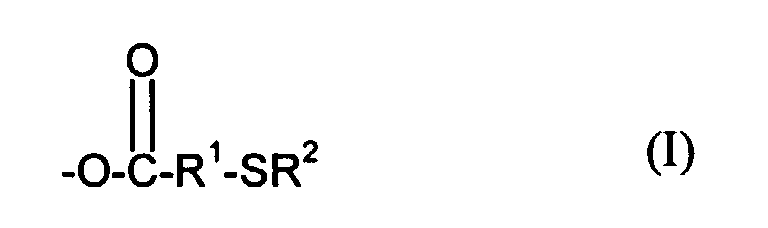
- R1
- ein geradkettiges, verzweigtes oder cyclisches Alkylendiradikal mit 1 bis 20
Kohlenstoffatomen, bevorzugt 1 bis 10 Kohlenstoffatomen, bedeutet,
und - R2
- für Wasserstoff steht.

R1 und R2 die zuvor genannte Bedeutung besitzen.
Polyetherpolyol der Molmasse 11 800 auf Basis Sorbitol, hergestellt durch Addition von Propylenoxid (82 %) und Ethylenoxid (18 %), OH-Zahl 28,5.
Polyetherpolyol der Molmasse 4 950 auf Basis Glycerin, hergestellt durch Addition von Propylenoxid (83 %) und Ethylenoxid (17 %), OH-Zahl 34.
Polyetherpolyol der Molmasse 3 250 auf Basis Glycerin, hergestellt durch Addition von Propylenoxid (90 %) und Ethylenoxid (10 %), OH-Zahl 52.
- Stauchhärte (40 % Kompression):
- 9,0 kPa
- Zugfestigkeit:
- 200 kPa
- Bruchdehnung:
- 90 %
Claims (3)
- Feindisperse, niedrigviskose Polymerpolyole, welche bestehen auswobei die Komponente B) in einer Menge von 30 bis 60 Gew.-Teilen und die Komponente C) in einer Menge von 1 bis 6 Gew.-Teilen, jeweils bezogen auf das Gewicht des fertigen Polymerpolyols, vorhanden sind.A) einem Polyol,B) einem Polymerisat aufgebaut aus Styrol oder Styrol und anderen ethylenisch ungesättigten Monomeren,
sowieC) einem Mercaptangruppen und/oder Disulfidgruppen enthaltenden Polymer, das mit der Polyolkomponente A) verträglich ist, dessen mittleres Molekulargewicht 500 bis 100 000 beträgt, welches im Mittel mindestens 0,5 Mercaptangruppen oder 1 Disulfidgruppe pro Molekül besitzt und eine Viskosität im Bereich von 100 bis 80 000 mPa·s (gemessen am Polymer bei einer Temperatur von 25°C nach DIN 53 019/Scherrate: 48/s) hat, - Verfahren zur Herstellung der Polymerpolyole gemäß Anspruch 1, dadurch gekennzeichnet, dass man die Polymerisation des Styrols oder des Styrols mit anderen ethylenisch ungesättigten Monomeren, die mit Styrol copolymerisierbar sind, in Gegenwart der erfindungsgemäß einzusetzenden Polyole (Komponente A) und in Gegenwart von Mercaptangruppen und/oder Disulfidgruppen enthaltenden Polymeren (Komponente C)) sowie in Anwesenheit einer wirksamen Menge eines radikalbildenden Initiators durchführt, wobei die Komponente C) in einer Menge von 1 bis 6 Gew.-Teilen eingesetzt wird, und das die Komponente B) aufbauende Styrol gegebenenfalls mit den mit Styrol polymerisierbaren ethylenisch ungesättigten Monomeren in einer solchen Menge verwendet wird, dass die Komponente B) in einer Menge von 30 bis 60 Gew.-Teilen, jeweils bezogen auf das Gewicht des fertigen Polymer-polyols, vorhanden ist.
- Verwendung der Polymerpolyole nach Anspruch 1, zur Herstellung von Polyurethanwerkstoffen, insbesondere Polyurethanschäumen.
Applications Claiming Priority (2)
| Application Number | Priority Date | Filing Date | Title |
|---|---|---|---|
| DE19903390A DE19903390A1 (de) | 1999-01-29 | 1999-01-29 | Stabilisierte, feindisperse niedrigviskose Polymerpolyole mit einem hohen Gehalt an Polystyrol oder Polystyrol-Copolymerisaten |
| DE19903390 | 1999-01-29 |
Publications (3)
| Publication Number | Publication Date |
|---|---|
| EP1029877A2 true EP1029877A2 (de) | 2000-08-23 |
| EP1029877A3 EP1029877A3 (de) | 2001-07-25 |
| EP1029877B1 EP1029877B1 (de) | 2003-05-07 |
Family
ID=7895674
Family Applications (1)
| Application Number | Title | Priority Date | Filing Date |
|---|---|---|---|
| EP00100278A Expired - Lifetime EP1029877B1 (de) | 1999-01-29 | 2000-01-19 | Verfahren zur Herstellung stabilisierter, feindisperser und niedrigviskoser Polymerpolyole mit hohen Gehalt an Styrol oder Styrol-Copolymerisaten |
Country Status (11)
| Country | Link |
|---|---|
| US (1) | US6472447B1 (de) |
| EP (1) | EP1029877B1 (de) |
| JP (1) | JP2000219722A (de) |
| KR (1) | KR100615495B1 (de) |
| AT (1) | ATE239759T1 (de) |
| BR (1) | BR0000290A (de) |
| CA (1) | CA2296885A1 (de) |
| DE (2) | DE19903390A1 (de) |
| ES (1) | ES2198230T3 (de) |
| MX (1) | MXPA00001036A (de) |
| TW (1) | TWI259838B (de) |
Families Citing this family (22)
| Publication number | Priority date | Publication date | Assignee | Title |
|---|---|---|---|---|
| US20050245724A1 (en) * | 2002-04-10 | 2005-11-03 | Sanyo Chemical Industries, Ltd. | Process for production of polymer polyol, and polymer polyol |
| DE10335250B3 (de) * | 2003-08-01 | 2005-05-25 | Bayer Materialscience Ag | Polymerdispersionen in Polyesterpolyolen |
| US20080071056A1 (en) * | 2006-09-14 | 2008-03-20 | Borst Joseph P | Method of forming a graft polyol and polyurethane article formed from the graft polyol |
| AU2009259994B2 (en) * | 2008-06-19 | 2014-03-20 | Centre National De La Recherche Scientifique | Melt dispersion process for making polymer polyols |
| CN102165015A (zh) * | 2008-07-25 | 2011-08-24 | 巴斯夫欧洲公司 | 木质纤维产品及其制备方法 |
| US8303680B2 (en) | 2009-06-24 | 2012-11-06 | Basf Se | Encapsulated particle |
| CN104039859B (zh) | 2011-12-20 | 2017-03-01 | 科思创德国股份有限公司 | 羟基氨基聚合物及其制备方法 |
| US10066047B2 (en) | 2012-02-02 | 2018-09-04 | Covestro Llc | Polyurethane foams with decreased aldehyde emissions, a process for preparing these foams and a method for decreasing aldehyde in polyurethane foams |
| WO2015048441A1 (en) | 2013-09-30 | 2015-04-02 | Basf Se | Lignocellulosic composite articles |
| US9951174B2 (en) | 2015-05-20 | 2018-04-24 | Covestro Llc | Polyol compositions, a process for the production of these polyol compositions, and their use in the production of open celled polyurethane foams having high airflow |
| CN110402263B (zh) | 2017-03-15 | 2022-06-07 | 科思创有限公司 | 具有降低的温度敏感性的粘弹性聚氨酯泡沫 |
| SG11201911924PA (en) * | 2017-06-29 | 2020-01-30 | Arkema Inc | Polymer compositions stabilized with organopolysulfides |
| US10766998B2 (en) | 2017-11-21 | 2020-09-08 | Covestro Llc | Flexible polyurethane foams |
| AU2019271291A1 (en) | 2018-05-16 | 2020-12-03 | Basf Se | Wood composite articles |
| WO2020046891A1 (en) | 2018-08-28 | 2020-03-05 | Basf Se | Lignocellulosic composite articles |
| US10793692B2 (en) | 2018-10-24 | 2020-10-06 | Covestro Llc | Viscoelastic flexible foams comprising hydroxyl-terminated prepolymers |
| US10781310B2 (en) | 2019-02-08 | 2020-09-22 | Covestro Llc | Polymer polyol stabilizers |
| CA3133349A1 (en) | 2019-03-15 | 2020-09-24 | Basf Se | Lignocellulosic composite articles |
| EP4041794A1 (de) | 2019-10-09 | 2022-08-17 | Covestro LLC | Verfahren, systeme und computerprogrammprodukte zum produzieren von steifen schaumstoffplatten unter verwendung optischer und infrarotbildgebung |
| EP4178993A1 (de) * | 2020-07-08 | 2023-05-17 | Dow Global Technologies LLC | Schmelzdispersionsverfahren zur herstellung von polymerpolyolen |
| US11572433B2 (en) | 2021-03-12 | 2023-02-07 | Covestro Llc | In-situ formed polyols, a process for their preparation, foams prepared from these in-situ formed polyols and a process for their preparation |
| US11718705B2 (en) | 2021-07-28 | 2023-08-08 | Covestro Llc | In-situ formed polyether polyols, a process for their preparation, and a process for the preparation of polyurethane foams |
Family Cites Families (19)
| Publication number | Priority date | Publication date | Assignee | Title |
|---|---|---|---|---|
| US4357430A (en) | 1981-10-02 | 1982-11-02 | Union Carbide Corporation | Polymer/polyols, methods for making same and polyurethanes based thereon |
| US4689354A (en) | 1982-04-01 | 1987-08-25 | Basf Corporation | Process for the preparation of white graft polymer dispersions and flame-retardant polyurethane foams |
| US4454255A (en) | 1982-04-01 | 1984-06-12 | Basf Wyandotte Corporation | Process for the preparation of white graft polymer dispersions and flame-retardant polyurethane foams |
| JPS59219322A (ja) * | 1983-05-30 | 1984-12-10 | Asahi Denka Kogyo Kk | ポリウレタン物質の製造方法 |
| JPS59219317A (ja) * | 1983-05-30 | 1984-12-10 | Asahi Denka Kogyo Kk | ポリヒドロキシル化合物の製造方法 |
| JPH0238083B2 (ja) * | 1983-06-29 | 1990-08-29 | Asahi Denka Kogyo Kk | Horihidorokishirukagobutsunoseizohoho |
| JPH0240093B2 (ja) * | 1983-06-29 | 1990-09-10 | Asahi Denka Kogyo Kk | Horiuretanbutsushitsunoseizoho |
| JPS6020914A (ja) * | 1983-07-15 | 1985-02-02 | Asahi Denka Kogyo Kk | ヒドロキシル化合物の製造方法 |
| JPS6020923A (ja) * | 1983-07-15 | 1985-02-02 | Asahi Denka Kogyo Kk | ポリウレタン物質の製造方法 |
| US4522976A (en) * | 1984-05-17 | 1985-06-11 | Basf Wyandotte Corporation | Graft polymer dispersion in a mixture of low molecular weight polyols and polyether polyols and polyurethane foams prepared therefrom |
| EP0293060A3 (de) | 1987-05-27 | 1990-02-14 | Hitachi, Ltd. | Steifer Polyurethanschaumstoff und Verfahren zu seiner Herstellung |
| GB8721712D0 (en) * | 1987-09-15 | 1987-10-21 | Bp Chem Int Ltd | Polymer polyols |
| US4891395A (en) * | 1988-05-24 | 1990-01-02 | Arco Chemical Technology, Inc. | High styrene content, stable polymer using epoxy resin-modified polyols as dispersants |
| US4837247A (en) * | 1988-05-24 | 1989-06-06 | Arco Chemical Technology, Inc. | Stable polymer polyols in base polyols with molecular weight greater than 4000 using high molecular weight dispersants |
| GB9100988D0 (en) | 1991-01-17 | 1991-02-27 | Shell Int Research | Polyether polyols containing polymer dispersions for polyurethane foams,and/or polyisocyanurate foams |
| BE1009195A3 (nl) | 1995-03-13 | 1996-12-03 | Dsm Nv | Samenstelling die polycarbonaat en een wrijvingverlagend middel bevat, en hieruit verkregen voorwerpen. |
| EP0768324B1 (de) | 1995-10-10 | 2000-08-16 | Bayer Ag | Kontinuierliches Verfahren zur Herstellung von sehr stabilen, feinstteiligen, niedrig viskösen Polymerpolyolen mit niedriger durchmittlicher Teilchengrösse |
| DE19547632A1 (de) * | 1995-12-20 | 1997-06-26 | Bayer Ag | Niedrigviskose Polymerpolyole, ein Verfahren zu ihrer Herstellung sowie ihre Verwendung zur Herstellung von Polyurethanschaumstoffen |
| PL318128A1 (en) | 1996-01-29 | 1997-08-04 | Shell Int Research | Polymer-polyol and method of obtaining polymer-polyols |
-
1999
- 1999-01-29 DE DE19903390A patent/DE19903390A1/de not_active Withdrawn
-
2000
- 2000-01-14 TW TW089100506A patent/TWI259838B/zh not_active IP Right Cessation
- 2000-01-19 ES ES00100278T patent/ES2198230T3/es not_active Expired - Lifetime
- 2000-01-19 EP EP00100278A patent/EP1029877B1/de not_active Expired - Lifetime
- 2000-01-19 AT AT00100278T patent/ATE239759T1/de not_active IP Right Cessation
- 2000-01-19 DE DE50002030T patent/DE50002030D1/de not_active Expired - Lifetime
- 2000-01-20 US US09/488,468 patent/US6472447B1/en not_active Expired - Fee Related
- 2000-01-24 CA CA002296885A patent/CA2296885A1/en not_active Abandoned
- 2000-01-28 MX MXPA00001036A patent/MXPA00001036A/es unknown
- 2000-01-28 JP JP2000020233A patent/JP2000219722A/ja active Pending
- 2000-01-28 KR KR1020000004171A patent/KR100615495B1/ko not_active Expired - Fee Related
- 2000-01-28 BR BR0000290-9A patent/BR0000290A/pt not_active Application Discontinuation
Also Published As
| Publication number | Publication date |
|---|---|
| KR20000053651A (ko) | 2000-08-25 |
| DE50002030D1 (de) | 2003-06-12 |
| MXPA00001036A (es) | 2002-03-08 |
| ES2198230T3 (es) | 2004-02-01 |
| KR100615495B1 (ko) | 2006-08-25 |
| EP1029877B1 (de) | 2003-05-07 |
| BR0000290A (pt) | 2000-08-29 |
| JP2000219722A (ja) | 2000-08-08 |
| CA2296885A1 (en) | 2000-07-29 |
| ATE239759T1 (de) | 2003-05-15 |
| DE19903390A1 (de) | 2000-08-03 |
| TWI259838B (en) | 2006-08-11 |
| US6472447B1 (en) | 2002-10-29 |
| EP1029877A3 (de) | 2001-07-25 |
Similar Documents
| Publication | Publication Date | Title |
|---|---|---|
| EP1029877B1 (de) | Verfahren zur Herstellung stabilisierter, feindisperser und niedrigviskoser Polymerpolyole mit hohen Gehalt an Styrol oder Styrol-Copolymerisaten | |
| DE60003035T2 (de) | Verfahren zur herstellung von pfropfpolyolen mit einem t-amylperoxid als radikalinitiator | |
| EP0699693B1 (de) | Niedrigviskose, stabile, agglomeratfreie Polymerpolyole, ein Verfahren zu ihrer Herstellung und ihre Verwendung zur Herstellung von Polyurethankunststoffen | |
| EP2066717B1 (de) | Verfahren zur herstellung von polyurethan-hartschaumstoffen | |
| EP0061627B1 (de) | Polymerisathaltige Polyetherpolyamine, Verfahren zur Herstellung dieser Polyamine und deren Verwendung als Aufbaukomponente zur Herstellung von Polyurethanen | |
| DE19526921A1 (de) | Niedrigviskose Polymerpolyole, ein Verfahren zu ihrer Herstellung sowie ihre Verwendung zur Herstellung von Polyurethanschaumstoffen | |
| DE2609355A1 (de) | Polymerisat-polyaetherisocyanat- vorpolymerisat-zusammensetzung, verfahren zu ihrer herstellung und ihrer verwendung | |
| DE1769089C3 (de) | Verfahren zur Herstellung von, gegebenenfalls mikroporösen, Formkörpern | |
| DE69130938T2 (de) | Polymerpolyole enthaltende halogenierte aromatische Monomere | |
| DE60017093T2 (de) | Verfahren zur herstellung anionischer wässrigen polymerdispersionen die kein flüchtiges tertiäres amin enthalten, die hergestellte dispersion und die darauf basierende beschichtung | |
| DE3401878A1 (de) | Polymerdispersionen und ihre verwendung | |
| DE68918528T2 (de) | Polyacrylatgepfropfte Polyoldispergiermittel. | |
| EP1174452B1 (de) | Verfahren zur Herstellung von Polyurethan-Schaumstoffen unter Verwendung von Polyacrylatpolyolen | |
| EP0731118B1 (de) | Niedrigviskose Polymerpolyole, ein Verfahren zu ihrer Herstellung sowie ihre Verwendung zur Herstellung von Polyurethanschaumstoffen | |
| DE4123223C2 (de) | Verfahren zur Herstellung von wäßrigen Block-Copolymer-Emulsionen und deren Verwendung | |
| EP1127913A2 (de) | Verfahren zur Herstellung von Polyurethan-Schaumstoffen | |
| WO2010066598A1 (de) | Polyurethanschaumstoffe mit verbesserten dauerbiegeeigenschaften | |
| EP2510028A2 (de) | Dimensionsstabile polyurethanschaumstoffformkörper | |
| DE68923222T2 (de) | Verwendung von hochmolekularen Dispersionsmitteln bei der Herstellung von stabilen Polymerpolyolen in Polyolen mit Molekulargewichten Über 4000. | |
| WO2012098145A1 (de) | Mikrozelluläre schäume mit verbesserten mechanischen eigenschaften | |
| DE19547632A1 (de) | Niedrigviskose Polymerpolyole, ein Verfahren zu ihrer Herstellung sowie ihre Verwendung zur Herstellung von Polyurethanschaumstoffen | |
| EP1664147B1 (de) | Autoteppich umfassend einen polyurethan-thermoformweichschaumstoff | |
| DD268967A5 (de) | Loesung oder dispersion eines fluessigkristallien polymers | |
| DE10153690A1 (de) | Wassergetriebene Schaumstoffe niedriger Rohdichte | |
| DE19702208A1 (de) | Niedrigviskose Polymerpolyole, ein Verfahren zu ihrer Herstellung sowie ihre Verwendung zur Herstellung von Polyurethanschaumstoffen |
Legal Events
| Date | Code | Title | Description |
|---|---|---|---|
| PUAI | Public reference made under article 153(3) epc to a published international application that has entered the european phase |
Free format text: ORIGINAL CODE: 0009012 |
|
| AK | Designated contracting states |
Kind code of ref document: A2 Designated state(s): AT BE CH CY DE DK ES FI FR GB GR IE IT LI LU MC NL PT SE |
|
| AX | Request for extension of the european patent |
Free format text: AL;LT;LV;MK;RO;SI |
|
| PUAL | Search report despatched |
Free format text: ORIGINAL CODE: 0009013 |
|
| AK | Designated contracting states |
Kind code of ref document: A3 Designated state(s): AT BE CH CY DE DK ES FI FR GB GR IE IT LI LU MC NL PT SE |
|
| AX | Request for extension of the european patent |
Free format text: AL;LT;LV;MK;RO;SI |
|
| RIC1 | Information provided on ipc code assigned before grant |
Free format text: 7C 08G 18/40 A, 7C 08F 283/00 B, 7C 08F 283/06 B, 7C 08G 18/50 B, 7C 08G 18/63 B |
|
| 17P | Request for examination filed |
Effective date: 20020125 |
|
| AKX | Designation fees paid |
Free format text: AT BE CH CY DE DK ES FI FR GB GR IE IT LI LU MC NL PT SE |
|
| 17Q | First examination report despatched |
Effective date: 20020620 |
|
| GRAH | Despatch of communication of intention to grant a patent |
Free format text: ORIGINAL CODE: EPIDOS IGRA |
|
| RTI1 | Title (correction) |
Free format text: PROCESS OF MANUFACTURE OF STABILISED, FINELY DISPERSED, LOW VISCOSITY POLYMER POLYOLS WITH HIGH CONTENT OF POLYSTYRENE OR POLYSTYRENE COPOLYMERS |
|
| GRAH | Despatch of communication of intention to grant a patent |
Free format text: ORIGINAL CODE: EPIDOS IGRA |
|
| GRAA | (expected) grant |
Free format text: ORIGINAL CODE: 0009210 |
|
| AK | Designated contracting states |
Designated state(s): AT BE CH CY DE DK ES FI FR GB GR IE IT LI LU MC NL PT SE |
|
| PG25 | Lapsed in a contracting state [announced via postgrant information from national office to epo] |
Ref country code: CY Free format text: LAPSE BECAUSE OF FAILURE TO SUBMIT A TRANSLATION OF THE DESCRIPTION OR TO PAY THE FEE WITHIN THE PRESCRIBED TIME-LIMIT Effective date: 20030507 Ref country code: FI Free format text: LAPSE BECAUSE OF FAILURE TO SUBMIT A TRANSLATION OF THE DESCRIPTION OR TO PAY THE FEE WITHIN THE PRESCRIBED TIME-LIMIT Effective date: 20030507 Ref country code: IE Free format text: LAPSE BECAUSE OF NON-PAYMENT OF DUE FEES Effective date: 20030507 |
|
| REG | Reference to a national code |
Ref country code: GB Ref legal event code: FG4D Free format text: NOT ENGLISH |
|
| REG | Reference to a national code |
Ref country code: CH Ref legal event code: EP |
|
| REG | Reference to a national code |
Ref country code: IE Ref legal event code: FG4D Free format text: GERMAN |
|
| REF | Corresponds to: |
Ref document number: 50002030 Country of ref document: DE Date of ref document: 20030612 Kind code of ref document: P |
|
| PG25 | Lapsed in a contracting state [announced via postgrant information from national office to epo] |
Ref country code: SE Free format text: LAPSE BECAUSE OF FAILURE TO SUBMIT A TRANSLATION OF THE DESCRIPTION OR TO PAY THE FEE WITHIN THE PRESCRIBED TIME-LIMIT Effective date: 20030807 Ref country code: GR Free format text: LAPSE BECAUSE OF FAILURE TO SUBMIT A TRANSLATION OF THE DESCRIPTION OR TO PAY THE FEE WITHIN THE PRESCRIBED TIME-LIMIT Effective date: 20030807 Ref country code: PT Free format text: LAPSE BECAUSE OF FAILURE TO SUBMIT A TRANSLATION OF THE DESCRIPTION OR TO PAY THE FEE WITHIN THE PRESCRIBED TIME-LIMIT Effective date: 20030807 Ref country code: DK Free format text: LAPSE BECAUSE OF FAILURE TO SUBMIT A TRANSLATION OF THE DESCRIPTION OR TO PAY THE FEE WITHIN THE PRESCRIBED TIME-LIMIT Effective date: 20030807 |
|
| GBT | Gb: translation of ep patent filed (gb section 77(6)(a)/1977) | ||
| REG | Reference to a national code |
Ref country code: IE Ref legal event code: FD4D Ref document number: 1029877E Country of ref document: IE |
|
| PG25 | Lapsed in a contracting state [announced via postgrant information from national office to epo] |
Ref country code: LU Free format text: LAPSE BECAUSE OF NON-PAYMENT OF DUE FEES Effective date: 20040119 Ref country code: AT Free format text: LAPSE BECAUSE OF NON-PAYMENT OF DUE FEES Effective date: 20040119 |
|
| PG25 | Lapsed in a contracting state [announced via postgrant information from national office to epo] |
Ref country code: MC Free format text: LAPSE BECAUSE OF NON-PAYMENT OF DUE FEES Effective date: 20040131 Ref country code: CH Free format text: LAPSE BECAUSE OF NON-PAYMENT OF DUE FEES Effective date: 20040131 Ref country code: LI Free format text: LAPSE BECAUSE OF NON-PAYMENT OF DUE FEES Effective date: 20040131 |
|
| REG | Reference to a national code |
Ref country code: ES Ref legal event code: FG2A Ref document number: 2198230 Country of ref document: ES Kind code of ref document: T3 |
|
| ET | Fr: translation filed | ||
| PLBE | No opposition filed within time limit |
Free format text: ORIGINAL CODE: 0009261 |
|
| STAA | Information on the status of an ep patent application or granted ep patent |
Free format text: STATUS: NO OPPOSITION FILED WITHIN TIME LIMIT |
|
| 26N | No opposition filed |
Effective date: 20040210 |
|
| REG | Reference to a national code |
Ref country code: CH Ref legal event code: PL |
|
| PG25 | Lapsed in a contracting state [announced via postgrant information from national office to epo] |
Ref country code: IT Free format text: LAPSE BECAUSE OF NON-PAYMENT OF DUE FEES Effective date: 20050119 |
|
| PGFP | Annual fee paid to national office [announced via postgrant information from national office to epo] |
Ref country code: ES Payment date: 20080218 Year of fee payment: 9 |
|
| PGFP | Annual fee paid to national office [announced via postgrant information from national office to epo] |
Ref country code: GB Payment date: 20080116 Year of fee payment: 9 |
|
| PGFP | Annual fee paid to national office [announced via postgrant information from national office to epo] |
Ref country code: FR Payment date: 20080108 Year of fee payment: 9 |
|
| GBPC | Gb: european patent ceased through non-payment of renewal fee |
Effective date: 20090119 |
|
| REG | Reference to a national code |
Ref country code: FR Ref legal event code: ST Effective date: 20091030 |
|
| PG25 | Lapsed in a contracting state [announced via postgrant information from national office to epo] |
Ref country code: GB Free format text: LAPSE BECAUSE OF NON-PAYMENT OF DUE FEES Effective date: 20090119 |
|
| REG | Reference to a national code |
Ref country code: ES Ref legal event code: FD2A Effective date: 20090120 |
|
| PG25 | Lapsed in a contracting state [announced via postgrant information from national office to epo] |
Ref country code: FR Free format text: LAPSE BECAUSE OF NON-PAYMENT OF DUE FEES Effective date: 20090202 Ref country code: ES Free format text: LAPSE BECAUSE OF NON-PAYMENT OF DUE FEES Effective date: 20090120 |
|
| PGFP | Annual fee paid to national office [announced via postgrant information from national office to epo] |
Ref country code: IT Payment date: 20080129 Year of fee payment: 9 |
|
| PGRI | Patent reinstated in contracting state [announced from national office to epo] |
Ref country code: IT Effective date: 20091201 |
|
| PGRI | Patent reinstated in contracting state [announced from national office to epo] |
Ref country code: IT Effective date: 20091201 |
|
| PGFP | Annual fee paid to national office [announced via postgrant information from national office to epo] |
Ref country code: DE Payment date: 20130116 Year of fee payment: 14 |
|
| PGFP | Annual fee paid to national office [announced via postgrant information from national office to epo] |
Ref country code: NL Payment date: 20130116 Year of fee payment: 14 Ref country code: BE Payment date: 20130114 Year of fee payment: 14 |
|
| BERE | Be: lapsed |
Owner name: *BAYER A.G. Effective date: 20140131 |
|
| REG | Reference to a national code |
Ref country code: DE Ref legal event code: R119 Ref document number: 50002030 Country of ref document: DE |
|
| REG | Reference to a national code |
Ref country code: NL Ref legal event code: V1 Effective date: 20140801 |
|
| REG | Reference to a national code |
Ref country code: DE Ref legal event code: R119 Ref document number: 50002030 Country of ref document: DE Effective date: 20140801 |
|
| PG25 | Lapsed in a contracting state [announced via postgrant information from national office to epo] |
Ref country code: DE Free format text: LAPSE BECAUSE OF NON-PAYMENT OF DUE FEES Effective date: 20140801 Ref country code: NL Free format text: LAPSE BECAUSE OF NON-PAYMENT OF DUE FEES Effective date: 20140801 |
|
| PG25 | Lapsed in a contracting state [announced via postgrant information from national office to epo] |
Ref country code: BE Free format text: LAPSE BECAUSE OF NON-PAYMENT OF DUE FEES Effective date: 20140131 |