EP1025738B1 - Verfahren und system zum abschalten elektronischer geräte, z.b. mobilteilen, in sperrzonen - Google Patents
Verfahren und system zum abschalten elektronischer geräte, z.b. mobilteilen, in sperrzonen Download PDFInfo
- Publication number
- EP1025738B1 EP1025738B1 EP98954197A EP98954197A EP1025738B1 EP 1025738 B1 EP1025738 B1 EP 1025738B1 EP 98954197 A EP98954197 A EP 98954197A EP 98954197 A EP98954197 A EP 98954197A EP 1025738 B1 EP1025738 B1 EP 1025738B1
- Authority
- EP
- European Patent Office
- Prior art keywords
- turn
- pop
- ade
- switching commands
- network
- Prior art date
- Legal status (The legal status is an assumption and is not a legal conclusion. Google has not performed a legal analysis and makes no representation as to the accuracy of the status listed.)
- Expired - Lifetime
Links
- 238000000034 method Methods 0.000 title claims abstract description 22
- 230000011664 signaling Effects 0.000 claims description 6
- 238000004891 communication Methods 0.000 claims description 4
- 230000001960 triggered effect Effects 0.000 claims description 3
- 101000829419 Homo sapiens Spermatogenic leucine zipper protein 1 Proteins 0.000 abstract description 7
- 102100023704 Spermatogenic leucine zipper protein 1 Human genes 0.000 abstract description 7
- 230000007717 exclusion Effects 0.000 description 12
- 230000001413 cellular effect Effects 0.000 description 6
- 230000005540 biological transmission Effects 0.000 description 4
- 101001068136 Homo sapiens Hepatitis A virus cellular receptor 1 Proteins 0.000 description 3
- 101000831286 Homo sapiens Protein timeless homolog Proteins 0.000 description 3
- 101000752245 Homo sapiens Rho guanine nucleotide exchange factor 5 Proteins 0.000 description 3
- 102100021688 Rho guanine nucleotide exchange factor 5 Human genes 0.000 description 3
- 238000013475 authorization Methods 0.000 description 3
- 238000010586 diagram Methods 0.000 description 3
- 101150074789 Timd2 gene Proteins 0.000 description 2
- 230000004913 activation Effects 0.000 description 2
- 230000000903 blocking effect Effects 0.000 description 2
- 238000011161 development Methods 0.000 description 2
- 230000018109 developmental process Effects 0.000 description 2
- 101100150240 Drosophila melanogaster NT1 gene Proteins 0.000 description 1
- 241000475699 Euphaedusa digonoptyx comes Species 0.000 description 1
- 101100073352 Streptomyces halstedii sch1 gene Proteins 0.000 description 1
- 101100073357 Streptomyces halstedii sch2 gene Proteins 0.000 description 1
- 101100054666 Streptomyces halstedii sch3 gene Proteins 0.000 description 1
- 101100276531 Streptomyces halstedii sch4 gene Proteins 0.000 description 1
- 230000006978 adaptation Effects 0.000 description 1
- 238000013461 design Methods 0.000 description 1
- 230000000694 effects Effects 0.000 description 1
- 238000010295 mobile communication Methods 0.000 description 1
- 238000012544 monitoring process Methods 0.000 description 1
- 230000000737 periodic effect Effects 0.000 description 1
- 238000011160 research Methods 0.000 description 1
- 201000009032 substance abuse Diseases 0.000 description 1
- 230000001360 synchronised effect Effects 0.000 description 1
Images


Classifications
-
- H—ELECTRICITY
- H04—ELECTRIC COMMUNICATION TECHNIQUE
- H04W—WIRELESS COMMUNICATION NETWORKS
- H04W48/00—Access restriction; Network selection; Access point selection
- H04W48/02—Access restriction performed under specific conditions
- H04W48/04—Access restriction performed under specific conditions based on user or terminal location or mobility data, e.g. moving direction, speed
-
- H—ELECTRICITY
- H04—ELECTRIC COMMUNICATION TECHNIQUE
- H04M—TELEPHONIC COMMUNICATION
- H04M1/00—Substation equipment, e.g. for use by subscribers
- H04M1/72—Mobile telephones; Cordless telephones, i.e. devices for establishing wireless links to base stations without route selection
- H04M1/724—User interfaces specially adapted for cordless or mobile telephones
- H04M1/72448—User interfaces specially adapted for cordless or mobile telephones with means for adapting the functionality of the device according to specific conditions
- H04M1/72457—User interfaces specially adapted for cordless or mobile telephones with means for adapting the functionality of the device according to specific conditions according to geographic location
-
- H—ELECTRICITY
- H04—ELECTRIC COMMUNICATION TECHNIQUE
- H04M—TELEPHONIC COMMUNICATION
- H04M1/00—Substation equipment, e.g. for use by subscribers
- H04M1/72—Mobile telephones; Cordless telephones, i.e. devices for establishing wireless links to base stations without route selection
- H04M1/724—User interfaces specially adapted for cordless or mobile telephones
- H04M1/72448—User interfaces specially adapted for cordless or mobile telephones with means for adapting the functionality of the device according to specific conditions
- H04M1/72463—User interfaces specially adapted for cordless or mobile telephones with means for adapting the functionality of the device according to specific conditions to restrict the functionality of the device
-
- H—ELECTRICITY
- H04—ELECTRIC COMMUNICATION TECHNIQUE
- H04M—TELEPHONIC COMMUNICATION
- H04M1/00—Substation equipment, e.g. for use by subscribers
- H04M1/66—Substation equipment, e.g. for use by subscribers with means for preventing unauthorised or fraudulent calling
Definitions
- the invention relates to a method and a system for switching off functions of an electronic device according to the preamble of claim 1 or claim 15th
- the invention has set itself the task of automatic Switching off electronic devices in such areas against to secure misuse.
- This task is accomplished with a procedure or a system starting from switching off electronic devices for restricted areas by means of a shutdown device via a radio interface, solved in that the shutdown device a communication network is assigned and when the shutdown device is started up authentication of the network is required becomes. This results in an increase in security against misuse of the shutdown device.
- the invention offers the advantage that it achieves a forced shutdown and above all takes into account the security requirements become. Whether all or some functions of the device are switched off depends on the type of device or the Exclusion zone. In cinemas or theaters it is generally be sufficient to put the handset ringer off hold.
- the method according to the invention offers its advantages in particular then if the electronic device is a handset of a Cellular system is. Such handsets produce relatively low radio frequency power in their immediate Considerable field strengths in the vicinity.
- the switch-off device To enable switching off even if that Switch-off device finds no associated network or such is not available, according to a preferred further development the switch-off device nevertheless issue switching commands. This will be the case more often, for example, if the shutdown device is on board an airplane. To a longer one misuse, for example, of a stolen one To avoid switching off device, one can preferably also provide that after repeated activation of the shutdown device without finding an associated network Switching commands is blocked.
- the request for Authentication of the shutdown device by the electronic Device will be triggered after this switching commands had received. It is recommended that the Shutdown device an indicator signal is given, if one Network - preferably a cellular network - the intended authentication unsupported. In this case Although the handset is not switched off, it is displayed that a (not switched off) handset in the restricted area located.
- the switching commands channels assigned via the mobile radio system take place. Rather, the switching commands or their feedback received via an HF part that is independent of the mobile radio or be sent.
- the switching commands or their Feedback is sent in frequency ranges that are different from those of mobile radio. This has the advantage that you can choose frequencies that are safety-related are harmless and, for example, on navigation systems have no influence or little influence.
- the switching commands can advantageously be used for privileged users Mobile parts of a mobile radio system at least partially be ignored. This makes it possible, e.g. specialized Reach emergency personnel in a restricted area.
- the rest period can on the part of the switch-off device the electronic device via the Radio interface can be specified using the switching signals, thus an adaptation to changing conditions, such as the Duration of a play, is possible.
- the radio interface between switch-off device and electronic device only erected in an entry / exit area of the restricted zone. This allows the rest of the restricted area to be free of corresponding electromagnetic waves remain. In this Case, it is also useful if the switching commands at Entry into the restricted zone for the shutdown of selected functions and when leaving the exclusion zone to reactivate it leads.
- Another variant provides that the radio interface between shutdown device and electronic device throughout Exclusion zone is maintained, i.e. that the entire Exclusion zone in the radio coverage area of the shutdown device lies. Through this measure, the certainty that actually shutdown takes place, significantly increased.
- the switching commands with a security code be encrypted.
- a handset that is in active connection with a base station, upon receipt of a switching command only after prior notice and under Compliance with a closed period switched off.
- a handset be received after receiving the Switching commands logged into the associated mobile network remains or that a handset after receiving the switching commands is actively booked out via a write-off notification, e.g. in the GSM system through an IMSI detach message.
- a write-off notification e.g. in the GSM system through an IMSI detach message.
- the advantages of the invention come in particular when used a handset or a shutdown device in a mobile radio system to advantage.
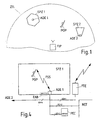
- a base station FIP of a mobile radio system for example a GSM system with a radio cell ZEL, in which two exclusion zones SPZ1 and SPZ2 exist, e.g. an intensive care unit and a theater hall.
- Every exclusion zone is a shutdown device ADE1 or ADE2 assigned to the task comes to switch off certain functions of a POP handset or shut down as soon as it enters a restricted area.
- a shutdown device ADE has an HF part AHF to which at least one antenna AAN is assigned is.
- the HF part AHF e.g. be designed in the MHz or GHz range.
- a signal processor SPR to control the functions of the shutdown device available, a counter CON being indicated.
- the ADE device can also display DIS, e.g. an LCD display, and have an input keyboard EGA.
- a flashing light BLI or the like can be obtained from an indicator signal ICS can be controlled.
- an interface SCH, a power supply NDE and a ACC battery that bridges power failures be provided.
- a microcontroller MCR controls the essential ones Functions of the individual units. These are essentially an HF part HFT with an antenna ANT, a digital signal processor DSP with microphone MIC and speaker LSP one Control UAS for a safety signaling channel UAC, which has two timers TIM1, TIM2, one of an announcement signal AKS controlled signal light SLI or the like, if necessary an additional HF part ZHF, a main accumulator HAC and possibly an additional accumulator ZAC.
- a shutdown device ADE1 is provided in a blocking zone SPZ1, which covers an entry / exit area EAB via an antenna, i.e. supplied with broadcast switching commands.
- the switch-off device ADE1 can completely work alone or through an interface SCH1 be connected to a radio part FTE, which a Maintains connection to a cellular network.
- FTE radio part
- Possible is also a connection to a fixed network NET via a Interface SCH2, to a personal computer PEC via a Interface SCH3 and to one or more other shutdown devices ADE2 via an interface SCH4.
- the switching commands of the device ADE1 either via their own HF part ZHF or on a specially reserved channel in the frame of the cellular network received.
- Cellular devices usually work according to a TDMA method, so that for the security signaling channel UAC specific frequencies / time slots to be provided.
- a switching command can advantageously also provide information included, according to which between extensive decommissioning of the Functions or just decommissioning, e.g. of the ringing tone becomes. In restricted areas, in which not security aspects priority, as in movie theaters etc., it is sufficient if the Handset ringer is switched off.
- the shutdown device ADE1 is only the entry / exit area EAB covers either the above-mentioned rest period be respected or reactivated. of the functions of the Handset POP as soon as it enters the entry / exit area again EAB happens and receives switching commands. In general it will however, be preferable if the shutdown device ADE1 covers the entire Exclusion zone SPZ1 covers, so that a radio interface constantly FSS exists between the POP handset and the ADE1 switch-off device. Then, for example, the relevant functions of the POP handset be shut down for as long as regularly Switching commands are received. Only when a certain one If no switching commands have been received for a while, the Functions are reactivated.
- a POP handset is advantageously set up after receipt of switching commands to confirm their receipt with feedback. Further details are given below.
- the TIM2 timer in the UAC control of the POP handset is used to specify a closed season. This means that when receiving switching commands in the call state of the handset POP is not an immediate shutdown, it is only after the end of the closed season is carried out to talk not to interrupt abruptly. At the same time Receipt of the switching commands triggered an announcement signal AKS, that trigger a signal light SLI and / or to acoustic Warning signals can result.
- the switch-off device ADE1 is also required if a misuse of the POP handset can be avoided should. An empty or removed battery in the handset there is a gap in access control. If the device can not receive a switching command not received, registered and executed. Is it only after walking through the
- GSM 02.09 security aspects
- GSM 03.20 security related network functions
- the switch-off device ADE If the switch-off device ADE is not assigned to a network, it must for security a secret algorithm Adsorgen that both in the POP handset and in the shutdown device ADE located. With the help of this algorithm the signaling encrypted on the UAC security signaling channel. It shows how such an encryption process can work the flow diagram according to Fig. 5.
- the POP handset searches on agreed channel or in a defined area and synchronized the shutdown device ADE, for example a specific time slot. After synchronization the POP handset sends an "Entry Message" with a random number RANU as well as with a sequence number SEQUNU Switch-off device ADE. The random number and the sequence number assigned by the POP handset.
- the shutdown device is ADE assigned to a network, here a GSM network.
- a network here a GSM network.
- LUPD Location Update
- a network-based shutdown device ADE does not find access to a network, for example if the shutdown device ADE is on board a Airplane is located, and this at an airport without corresponding Mobile phone coverage picks up passengers.
- switching commands are still sent to switch off of handsets in the danger zone.
- the previously mentioned counter CON is now incremented and from a certain counter reading there will be another transmission prevented by switching commands. This is also a remedy for misuse of, for example, a stolen device.
- Fig. 7 With the help of Fig. 7 is still an expanded solution described. If you assume that it’s not enough, that Authenticate shutdown device ADE to a network, which would be a normal process if the shutdown device ADE as special GSM terminal is defined, but the respective one POP handset with every contact with an ADE switch-off device must check its legality, the following considerations apply.
- the An entry / exit area must be authenticated Switch-off device ADE against the POP handset.
- the shutdown device ADE is part of a specific Network (Home-PLMN ADE) and thus in this Network registered.
- the respective handset POP which just in the access area of the switch-off device ADE authentication for the shutdown device ADE initiate via the "Visited Network" of the POP handset.
- VLR Visitor Location Register
- the invention has always been in connection with a Handset POP of a mobile radio system described, but is in principle they can also be applied to other electronic devices, their commissioning or commissioning remain in certain Areas is undesirable or dangerous. It can happen for example, CD players, radios, etc. Such devices can also be included in the invention, provided that they contain at least one recipient for the shutdown commands of a shutdown device ADE.
- shutdown devices ADE which consists in that with help a switching device ADE also transmit other information to let. For example, in business areas Information about offers, prices, addresses, etc. by the way are transmitted and on a display of the handset POP are displayed. Also, specific software could work on that Switch-off device ADE in the POP handset or another electronic A user's device.
Landscapes
- Engineering & Computer Science (AREA)
- Computer Networks & Wireless Communication (AREA)
- Signal Processing (AREA)
- Human Computer Interaction (AREA)
- Environmental & Geological Engineering (AREA)
- Computer Security & Cryptography (AREA)
- Mobile Radio Communication Systems (AREA)
Abstract
Description
Claims (19)
- Verfahren zum Abschalten von Funktionen eines elektronischen Geräts, bei dem örtlich beschränkt für Sperrzonen (SPZ) seitens eines Abschaltgeräts (ADE) über eine Funkschnittstelle (FSS) Schaltbefehle an einen Empfänger des elektronischen Geräts (POP) gesandt werden und in diesem nach Erhalt der Schaltbefehle ausgewählte Funktionen stillgelegt bzw. wieder aktiviert werden
dadurch gekennzeichnet, daß das Abschaltgerät (ADE) einem Kommunikationsnetz (NET) zugeordnet wird und daß bei Inbetriebnahme des Abschaltgeräts (ADE) dessen Authentifizierung dem Netz gegenüber gefordert wird. - Verfahren nach Anspruch 1,
dadurch gekennzeichnet, daß das Abschaltgerät (ADE), falls es kein zugehöriges Netz findet bzw. ein solches nicht vorhanden ist, demgegenüber eine Authentifizierung möglich ist, dennoch Schaltbefehle abgibt. - Verfahren nach Anspruch 1 oder 2,
dadurch gekennzeichnet, daß nach mehrmaligem Aktivieren des Abschaltgeräts (ADE) ohne Auffinden eines zugehörigen Netzes die Abgabe von Schaltbefehlen gesperrt wird. - Verfahren nach einem der vorhergehenden Ansprüche,
dadurch gekennzeichnet, daß die Forderung nach Authentifizierung des Abschaltgeräts (ADE) seitens des elektronischen Geräts (POP) ausgelöst wird, nachdem dieses Schaltbefehle erhalten hat. - Verfahren nach Anspruch 4,
dadurch gekennzeichnet, daß seitens des Abschaltgeräts (ADE) ein Indikatorsignal (IKS) abgegeben wird, falls das Netz die vorgesehene Authentifizierung nicht unterstützt. - Verfahren nach einem der vorhergehenden Ansprüche,
dadurch gekennzeichnet, daß die Schaltbefehle über einen vorgegebenen, für diesen Zweck reservierten Sicherheits-Signalisierungskanal (UAC) gesendet werden. - Verfahren nach einem der vorhergehenden Ansprüche,
dadurch gekennzeichnet, daß der Erhalt der Schaltbefehle bzw. deren Durchführung an das Abschaltgerät bestätigt wird. - Verfahren nach einem der vorhergehenden Ansprüche,
dadurch gekennzeichnet, daß das elektronische Gerät (POP) ein Mobilteil (POP) eines Mobilfunknetzes ist. - Verfahren nach einem der vorhergehenden Ansprüche,
dadurch gekennzeichnet, daß ein Stillegen von Funktionen auf Grund von Schaltbefehlen lediglich für eine vorgebbare Ruhedauer erfolgt. - Verfahren nach Anspruch 9,
dadurch gekennzeichnet, daß die Ruhedauer seitens des Abschaltgeräts (ADE) dem elektronischen Gerät (POP) über die Funkschnittstelle mittels der Schaltbefehle vorgegeben wird. - Verfahren nach einem der vorhergehenden Ansprüche,
dadurch gekennzeichnet, daß die Schaltbefehle mit einem Sicherheitscode verschlüsselt werden. - Verfahren nach einem der vorhergehenden Ansprüche,
dadurch gekennzeichnet, daß das elektronische Gerät ein Mobilteil (POP) eines Mobilfunknetzes ist, welches in aktiver Verbindung mit einer Basisstation (FIP) steht, und bei Erhalt eines Schaltbefehls erst nach einer Vorankündigung und unter Einhaltung einer Schonzeit abgeschaltet wird. - Verfahren nach einem der Ansprüche 1 bis 11,
dadurch gekennzeichnet, daß das elektronische Gerät ein Mobilteil (POP) eines Mobilfunknetzes ist und daß das Mobilteil (POP) nach Erhalt der Schaltbefehle in einem zugehörigen Mobilfunknetz eingebucht bleibt. - Verfahren nach einem der Ansprüche 1 bis 11,
dadurch gekennzeichnet, daß daß das elektronische Gerät ein Mobilteil (POP) eines Mobilfunknetzes ist und daß das Mobilteil (POP) nach Erhalt der Schaltbefehle über eine Ausbuchungsmeldung aktiv ausgebucht wird. - System zum Abschalten von Funktionen eines elektronischen Gerätes, bei dem ein Abschaltgerät (ADE) im Bereich einer Sperrzone (SPZ) vorgesehen und dazu eingerichtet ist, örtlich beschränkt über eine Funkschnittstelle (FSS) Schaltbefehle an einen Empfänger (HFT, ZHF) des elektronischen Geräts (POP) zu senden, und dieses dazu eingerichtet ist, nach Erhalt der Schaltbefehle ausgewählte Geräteeinheiten bzw. -funktionen stillzulegen oder wieder zu aktivieren
dadurch gekennzeichnet, daß das Abschaltgerät (ADE) einem Kommunikationsnetz (MET) zugeordnet ist, welches bei Inbetriebnahme des Abschaltgeräts zur Abgabe einer Authentifizierungsanfrage an das Abschaltgerät (ADE) eingerichtet ist. - System nach Anspruch 15,
dadurch gekennzeichnet, daß das Abschaltgerät (ADE) zur Aussendung von Schaltbefehlen auch dann eingerichtet ist, falls kein zugehöriges Kommunikationsnetz auffindbar ist, demgegenüber eine Authentifizierung möglich ist. - System nach Anspruch 16,
dadurch gekennzeichnet, daß in dem Abschaltgerät (ADE) ein Zähler (CON) vorgesehen ist, dessen Stand bei jedem Aktivieren des Gerätes ohne Authentifizierung erhöht wird und das Abschaltgerät dazu eingerichtet ist, sich bei Erreichen eines vorgegebenen Zählerstandes zu deaktivieren. - System nach Anspruch 16 oder 17,
dadurch gekennzeichnet, daß das elektronische Gerät ein Mobilteil (POP) eines Mobilfunknetzes ist und daß das Mobilteil (POP) dazu eingerichtet ist, nach Erhalt von Schaltbefehlen die Forderung nach Authentifizierung des Abschaltgeräts (ADE) über dieses an das Netz (NET) anzustoßen. - System nach Anspruch 18,
dadurch gekennzeichnet, daß das Abschaltgerät (ADE) sich gegenüber dem Mobilfunknetz authentisiert und dass es dazu eingerichtet ist, ein Indikatorsignal (IKS) abzugeben, falls ein Mobilfunknetz die vorgesehene Authentifizierung des Abschaltgerätes nicht unterstützt.
Applications Claiming Priority (3)
| Application Number | Priority Date | Filing Date | Title |
|---|---|---|---|
| DE19744263A DE19744263C1 (de) | 1997-10-07 | 1997-10-07 | Verfahren zum Abschalten elektronischer Geräte, z. B. Mobilteilen, in Sperrzonen |
| DE19744263 | 1997-10-07 | ||
| PCT/DE1998/002781 WO1999018745A1 (de) | 1997-10-07 | 1998-09-18 | Verfahren und system zum abschalten elektronischer geräte, z.b. mobilteilen, in sperrzonen |
Publications (2)
| Publication Number | Publication Date |
|---|---|
| EP1025738A1 EP1025738A1 (de) | 2000-08-09 |
| EP1025738B1 true EP1025738B1 (de) | 2002-11-20 |
Family
ID=7844842
Family Applications (1)
| Application Number | Title | Priority Date | Filing Date |
|---|---|---|---|
| EP98954197A Expired - Lifetime EP1025738B1 (de) | 1997-10-07 | 1998-09-18 | Verfahren und system zum abschalten elektronischer geräte, z.b. mobilteilen, in sperrzonen |
Country Status (5)
| Country | Link |
|---|---|
| EP (1) | EP1025738B1 (de) |
| CN (1) | CN1132483C (de) |
| DE (2) | DE19744263C1 (de) |
| ES (1) | ES2188025T3 (de) |
| WO (1) | WO1999018745A1 (de) |
Cited By (2)
| Publication number | Priority date | Publication date | Assignee | Title |
|---|---|---|---|---|
| US9274576B2 (en) | 2003-03-17 | 2016-03-01 | Callahan Cellular L.L.C. | System and method for activation of portable and mobile media player devices for wireless LAN services |
| US10054998B2 (en) | 2015-05-19 | 2018-08-21 | Carrier Corporation | Automatically enabled airplane-mode portable power source |
Families Citing this family (39)
| Publication number | Priority date | Publication date | Assignee | Title |
|---|---|---|---|---|
| DE19831627A1 (de) * | 1998-07-15 | 2000-01-20 | Gerd Heinrichs | Steuerung bestehend aus Sende-, Empfangs- und Steuerteil, zum Abschalten von Mobiltelefonen, CD-Playern, Laptops und anderen elektronischen Geräten bzw. zum Aktivieren von Steuermechanismen an Fahrzeugen oder anderen Geräten, an Orten, an denen diese Störungen hervorrufen können |
| DE19859264A1 (de) * | 1998-12-22 | 2000-07-06 | Bosch Gmbh Robert | Verfahren zur Lokalisierung von mobilen Stationen und mobile Station |
| EP1035747A1 (de) * | 1999-03-12 | 2000-09-13 | Sony International (Europe) GmbH | Basisstation für das Schützen eines vorbestimmten Bereiches mittels eines getrennten Schutzsystems |
| EP1035746A1 (de) * | 1999-03-12 | 2000-09-13 | Sony International (Europe) GmbH | Bewegliches Endgerät zum Schützen eines vorbestimmten Bereiches mittels eines separaten Schutzsystems |
| EP1041848A1 (de) * | 1999-03-12 | 2000-10-04 | Sony International (Europe) GmbH | Schützen eines vorbestimmten Bereiches vor störender Nutzung mobiler Endgeräte mittels einer Funkrufnachricht |
| EP1052864A1 (de) * | 1999-05-11 | 2000-11-15 | Sony International (Europe) GmbH | Mobiles Endgerät mit Schutzmodus |
| EP1054570A1 (de) * | 1999-05-18 | 2000-11-22 | Sony International (Europe) GmbH | Mobiles Endgerät mit Ausgabe eines Anzeigesignals im Schutzmodus |
| US6721542B1 (en) * | 1999-05-28 | 2004-04-13 | Nokia Corporation | System for location specific, automatic mobile station behavior control |
| FR2795592B1 (fr) * | 1999-06-22 | 2001-08-10 | Sagem | Procede de gestion du trafic dans un reseau de telephonie mobile |
| EP1190587A1 (de) * | 1999-06-28 | 2002-03-27 | Siemens Aktiengesellschaft | Verfahren zum betreiben eines mobilen endgeräts und entsprechendes mobilfunksystem |
| DE19929753B4 (de) * | 1999-06-29 | 2005-06-30 | Siemens Ag | Zellulares Mobilfunknetz und Verfahren zum Betrieb eines solchen |
| FR2804569B1 (fr) * | 2000-01-27 | 2002-06-21 | Jean Claude Saurat | Systeme de detection de telephones cellulaires en mode reception ou veille operationnelle |
| EP1128697A1 (de) * | 2000-02-24 | 2001-08-29 | Ascom AG | Verfahren zum Betreiben eines mobilen Gerätes |
| AU2001243433A1 (en) * | 2000-03-06 | 2001-09-17 | Stacy Chin | Automatic profile changing apparatus, method and computer program for a wirelessterminal |
| SG90119A1 (en) * | 2000-03-30 | 2002-07-23 | Seong Jae Cho | Apparatus for automatically switching operation mode of portable mobile communication unit |
| JP2002077993A (ja) * | 2000-06-16 | 2002-03-15 | Ofaa Sekkei Jimusho:Kk | 移動体通信機の自動切り替えシステム及び移動体通信機、並びに制御信号発信装置。 |
| EP1180902B1 (de) * | 2000-08-09 | 2005-10-19 | Telefonaktiebolaget LM Ericsson (publ) | Verfahren zur bereichsabhängigen Betriebsparametereinstellung bei einem mobilen Endgerät, zugehöriges Endgerät und Bereichsinformationssender |
| US6898445B2 (en) * | 2000-09-07 | 2005-05-24 | Telefonaktiebolaget Lm Ericsson (Publ) | Politeness zones for wireless communication devices |
| US7343317B2 (en) | 2001-01-18 | 2008-03-11 | Nokia Corporation | Real-time wireless e-coupon (promotion) definition based on available segment |
| JP2002334097A (ja) * | 2001-02-09 | 2002-11-22 | Seiko Epson Corp | サービス提供システム、管理端末、移動体、サービス提供プログラム及びサービス提供方法 |
| JP4246404B2 (ja) * | 2001-03-29 | 2009-04-02 | パイオニア株式会社 | 移動体通信装置 |
| FI111569B (fi) | 2001-06-28 | 2003-08-15 | Nokia Corp | Tilantunnistusjärjestelmä |
| EP1274269A1 (de) * | 2001-07-02 | 2003-01-08 | Lucent Technologies Inc. | Automatische Steuerung des Betriebszustandes eines Mobiltelefons |
| US6961561B2 (en) * | 2002-01-16 | 2005-11-01 | International Business Machines Corporation | Enhancing/limiting use of mobile electronic devices |
| DE10234157A1 (de) * | 2002-07-26 | 2004-02-05 | Giesecke & Devrient Gmbh | Mobiles Kommunikationsgerät |
| US7768234B2 (en) | 2004-02-28 | 2010-08-03 | Janik Craig M | System and method for automatically synchronizing and acquiring content for battery powered devices |
| US20040228460A1 (en) * | 2003-05-15 | 2004-11-18 | Cherif Keramane | Portable communications devices providing selective inhibition of functionalities and related control devices and methods |
| FI20035109A7 (fi) * | 2003-06-27 | 2004-12-28 | Nokia Corp | Menetelmä ja laitteisto toiminnon estämiseksi |
| CN100391283C (zh) * | 2004-04-30 | 2008-05-28 | 华为技术有限公司 | 一种具备摄像功能的移动终端及其控制摄像功能的方法 |
| GB2426667A (en) * | 2005-05-26 | 2006-11-29 | Symbian Software Ltd | Location based push presence and profile on a wireless communications device |
| CN101263724A (zh) * | 2005-07-15 | 2008-09-10 | 迈克尔·J·肯尼迪 | 进行移动电子设备的地理空间功能控制的系统 |
| EP1855496A1 (de) * | 2006-05-11 | 2007-11-14 | International Business Machines Corporation | Verfahren und Gerät zum Schalten des Modus eines Funkgeräts in einer bestimmten Umgebung |
| US8520645B2 (en) | 2006-06-30 | 2013-08-27 | Core Wireless Licensing S.A.R.L. | Method of controlling a mobile terminal, and an associated mobile terminal |
| US8000692B2 (en) | 2006-09-19 | 2011-08-16 | Microsoft Corporation | Mobile device manners propagation and compliance |
| DE102007025640A1 (de) * | 2007-06-01 | 2008-12-04 | Frank Haug | Verfahren zur Übermittlung von Informationen an Empfangsgeräte sowie zugehöriges Empfangsgerät |
| EP2429247B1 (de) * | 2010-09-06 | 2014-12-24 | Alcatel Lucent | Verfahren für den Betrieb eines drahtlosen Kommunikationsnetzwerks, Basisstation eines drahtlosen Kommunikationsnetzwerks, Endgerät eines drahtlosen Kommunikationsnetzwerks und drahtloses Kommunikationsnetzwerk |
| CN103139365A (zh) * | 2011-12-05 | 2013-06-05 | 中兴通讯股份有限公司 | 自动控制电子产品无线功能的方法和系统 |
| US9775095B2 (en) | 2015-06-18 | 2017-09-26 | Carrier Corporation | Aircraft proximity sensor system for radio frequency transmission device |
| CN108495268B (zh) * | 2018-03-19 | 2020-08-28 | 中国联合网络通信集团有限公司 | 一种敏感区域的安防方法及平台 |
Family Cites Families (2)
| Publication number | Priority date | Publication date | Assignee | Title |
|---|---|---|---|---|
| US5295180A (en) * | 1992-04-08 | 1994-03-15 | U S West Newvector Group, Inc. | Cellular telephone zone system |
| DE29709087U1 (de) * | 1997-05-23 | 1997-09-04 | LeGuin, Hermann, 88279 Amtzell | Vorrichtung zum Ausrichten der Aufmerksamkeit einer Person auf einen Anruf |
-
1997
- 1997-10-07 DE DE19744263A patent/DE19744263C1/de not_active Expired - Fee Related
-
1998
- 1998-09-18 CN CN988099985A patent/CN1132483C/zh not_active Expired - Fee Related
- 1998-09-18 DE DE59806377T patent/DE59806377D1/de not_active Expired - Fee Related
- 1998-09-18 WO PCT/DE1998/002781 patent/WO1999018745A1/de not_active Ceased
- 1998-09-18 EP EP98954197A patent/EP1025738B1/de not_active Expired - Lifetime
- 1998-09-18 ES ES98954197T patent/ES2188025T3/es not_active Expired - Lifetime
Cited By (2)
| Publication number | Priority date | Publication date | Assignee | Title |
|---|---|---|---|---|
| US9274576B2 (en) | 2003-03-17 | 2016-03-01 | Callahan Cellular L.L.C. | System and method for activation of portable and mobile media player devices for wireless LAN services |
| US10054998B2 (en) | 2015-05-19 | 2018-08-21 | Carrier Corporation | Automatically enabled airplane-mode portable power source |
Also Published As
| Publication number | Publication date |
|---|---|
| ES2188025T3 (es) | 2003-06-16 |
| CN1132483C (zh) | 2003-12-24 |
| DE19744263C1 (de) | 1999-05-06 |
| WO1999018745A1 (de) | 1999-04-15 |
| EP1025738A1 (de) | 2000-08-09 |
| CN1274512A (zh) | 2000-11-22 |
| DE59806377D1 (de) | 2003-01-02 |
Similar Documents
| Publication | Publication Date | Title |
|---|---|---|
| DE19744263C1 (de) | Verfahren zum Abschalten elektronischer Geräte, z. B. Mobilteilen, in Sperrzonen | |
| DE10084966B4 (de) | Sichere Zonen für tragbare elektronische Einrichtungen | |
| DE112004002372B4 (de) | Private Basisstation mit Exklusivität | |
| DE60117007T2 (de) | Zeichengabeeinrichtung und kommunikations-system | |
| DE60106198T2 (de) | Automatische aktivierung für drahtlosen dienst in einem privaten lokalen drahtlosen system | |
| CN1084557C (zh) | 便携式电话机用限制系统和便携式电话机 | |
| DE60109890T2 (de) | Senden-und Empfangensystem und Senden-und Empfangenvorrichtung zur Verwaltung von Audiodaten | |
| AU7322898A (en) | Deactivation of a mobile telephone handset | |
| EP0956720A2 (de) | Verfahren zum detektieren von mobilfunkstationen | |
| EP1013130B1 (de) | Verfahren zum schutz eines beschränkten örtlichen bereiches vor durch mobilfunkendgeräte ausgesendeter elektromagneticsher strahlung, sowie entsprechende funkstation | |
| DE69515403T2 (de) | Verfahren zum abhören von umgebungsgeräuschen und funkgerät dafür | |
| WO2003019907A2 (en) | System for defining and maintaining an exclusion area, wherein the usage of cellular telephones is restricted | |
| DE602004008050T2 (de) | Verfahren und vorrichtung zum schutz vor hochfrequenzstörungen | |
| CN1272758A (zh) | 用位置更新应答消息保护预定区域不受移动终端干扰 | |
| DE60200600T2 (de) | Mobiles Kommunikationsgerät mit Sendesperrfunktion | |
| DE69717432T2 (de) | Gerät und verfahren zum senden und empfangen einer signalisierungsnachricht in einem kommunikationssystem | |
| WO2000007396A1 (de) | Verfahren, vorrichtung und system zum betreiben von mobilen telekommunikationsendgeräten in einem öffentlichen, zellularen mobilfunknetz | |
| DE60305624T2 (de) | Vorrichtung zum Einschränken der Kommunikation abhängig vom Gebiet | |
| DE19629535A1 (de) | Handy-Telefon | |
| JP2970559B2 (ja) | セルラの使用制限信号送受信装置 | |
| DE69634331T2 (de) | Verfahren und vorrichtung zur mitteilung der betriebsart eines schnurlosen kommunikationsgerät an ein schnurloses netzwerk | |
| KR100323763B1 (ko) | 휴대폰의분실또는도난방지방법 | |
| EP1128697A1 (de) | Verfahren zum Betreiben eines mobilen Gerätes | |
| DE19710135A1 (de) | Sicherheitsinformationssystem | |
| DE60122946T2 (de) | Zweiwegfolgesystem sowie Verfahren mittels eines bestehenden Netzwerkes |
Legal Events
| Date | Code | Title | Description |
|---|---|---|---|
| PUAI | Public reference made under article 153(3) epc to a published international application that has entered the european phase |
Free format text: ORIGINAL CODE: 0009012 |
|
| 17P | Request for examination filed |
Effective date: 20000331 |
|
| AK | Designated contracting states |
Kind code of ref document: A1 Designated state(s): DE ES FR GB |
|
| 17Q | First examination report despatched |
Effective date: 20011023 |
|
| GRAG | Despatch of communication of intention to grant |
Free format text: ORIGINAL CODE: EPIDOS AGRA |
|
| GRAG | Despatch of communication of intention to grant |
Free format text: ORIGINAL CODE: EPIDOS AGRA |
|
| GRAH | Despatch of communication of intention to grant a patent |
Free format text: ORIGINAL CODE: EPIDOS IGRA |
|
| GRAH | Despatch of communication of intention to grant a patent |
Free format text: ORIGINAL CODE: EPIDOS IGRA |
|
| GRAA | (expected) grant |
Free format text: ORIGINAL CODE: 0009210 |
|
| AK | Designated contracting states |
Kind code of ref document: B1 Designated state(s): DE ES FR GB |
|
| REG | Reference to a national code |
Ref country code: GB Ref legal event code: FG4D Free format text: NOT ENGLISH |
|
| REF | Corresponds to: |
Ref document number: 59806377 Country of ref document: DE Date of ref document: 20030102 |
|
| GBT | Gb: translation of ep patent filed (gb section 77(6)(a)/1977) |
Effective date: 20030211 |
|
| REG | Reference to a national code |
Ref country code: ES Ref legal event code: FG2A Ref document number: 2188025 Country of ref document: ES Kind code of ref document: T3 |
|
| ET | Fr: translation filed | ||
| PLBE | No opposition filed within time limit |
Free format text: ORIGINAL CODE: 0009261 |
|
| STAA | Information on the status of an ep patent application or granted ep patent |
Free format text: STATUS: NO OPPOSITION FILED WITHIN TIME LIMIT |
|
| 26N | No opposition filed |
Effective date: 20030821 |
|
| PGFP | Annual fee paid to national office [announced via postgrant information from national office to epo] |
Ref country code: GB Payment date: 20060912 Year of fee payment: 9 Ref country code: FR Payment date: 20060912 Year of fee payment: 9 |
|
| PGFP | Annual fee paid to national office [announced via postgrant information from national office to epo] |
Ref country code: ES Payment date: 20061024 Year of fee payment: 9 |
|
| PGFP | Annual fee paid to national office [announced via postgrant information from national office to epo] |
Ref country code: DE Payment date: 20061120 Year of fee payment: 9 |
|
| GBPC | Gb: european patent ceased through non-payment of renewal fee |
Effective date: 20070918 |
|
| PG25 | Lapsed in a contracting state [announced via postgrant information from national office to epo] |
Ref country code: DE Free format text: LAPSE BECAUSE OF NON-PAYMENT OF DUE FEES Effective date: 20080401 |
|
| REG | Reference to a national code |
Ref country code: FR Ref legal event code: ST Effective date: 20080531 |
|
| PG25 | Lapsed in a contracting state [announced via postgrant information from national office to epo] |
Ref country code: FR Free format text: LAPSE BECAUSE OF NON-PAYMENT OF DUE FEES Effective date: 20071001 |
|
| PG25 | Lapsed in a contracting state [announced via postgrant information from national office to epo] |
Ref country code: GB Free format text: LAPSE BECAUSE OF NON-PAYMENT OF DUE FEES Effective date: 20070918 |
|
| REG | Reference to a national code |
Ref country code: ES Ref legal event code: FD2A Effective date: 20070919 |
|
| PG25 | Lapsed in a contracting state [announced via postgrant information from national office to epo] |
Ref country code: ES Free format text: LAPSE BECAUSE OF NON-PAYMENT OF DUE FEES Effective date: 20070919 |