EP1180902B1 - Verfahren zur bereichsabhängigen Betriebsparametereinstellung bei einem mobilen Endgerät, zugehöriges Endgerät und Bereichsinformationssender - Google Patents
Verfahren zur bereichsabhängigen Betriebsparametereinstellung bei einem mobilen Endgerät, zugehöriges Endgerät und Bereichsinformationssender Download PDFInfo
- Publication number
- EP1180902B1 EP1180902B1 EP00117076A EP00117076A EP1180902B1 EP 1180902 B1 EP1180902 B1 EP 1180902B1 EP 00117076 A EP00117076 A EP 00117076A EP 00117076 A EP00117076 A EP 00117076A EP 1180902 B1 EP1180902 B1 EP 1180902B1
- Authority
- EP
- European Patent Office
- Prior art keywords
- regional information
- area information
- area
- mobile
- terminal
- Prior art date
- Legal status (The legal status is an assumption and is not a legal conclusion. Google has not performed a legal analysis and makes no representation as to the accuracy of the status listed.)
- Expired - Lifetime
Links
- 238000000034 method Methods 0.000 title claims abstract description 15
- 230000001419 dependent effect Effects 0.000 title description 12
- 230000005540 biological transmission Effects 0.000 claims abstract description 53
- 238000004590 computer program Methods 0.000 claims abstract description 12
- 230000011664 signaling Effects 0.000 claims abstract description 8
- 238000004891 communication Methods 0.000 claims description 28
- 238000012545 processing Methods 0.000 claims description 10
- 230000006870 function Effects 0.000 description 5
- 230000000694 effects Effects 0.000 description 3
- 238000003860 storage Methods 0.000 description 3
- 230000004888 barrier function Effects 0.000 description 2
- 230000009286 beneficial effect Effects 0.000 description 2
- 238000011161 development Methods 0.000 description 2
- 230000018109 developmental process Effects 0.000 description 2
- 230000003993 interaction Effects 0.000 description 2
- 238000004519 manufacturing process Methods 0.000 description 2
- 238000012544 monitoring process Methods 0.000 description 2
- 238000004088 simulation Methods 0.000 description 2
- 238000012360 testing method Methods 0.000 description 2
- 238000012546 transfer Methods 0.000 description 2
- 230000009471 action Effects 0.000 description 1
- 230000004913 activation Effects 0.000 description 1
- 238000007792 addition Methods 0.000 description 1
- 230000008901 benefit Effects 0.000 description 1
- 230000032823 cell division Effects 0.000 description 1
- 230000001413 cellular effect Effects 0.000 description 1
- 210000003850 cellular structure Anatomy 0.000 description 1
- 230000009849 deactivation Effects 0.000 description 1
- 238000013461 design Methods 0.000 description 1
- 238000005516 engineering process Methods 0.000 description 1
- 238000011156 evaluation Methods 0.000 description 1
- 230000006872 improvement Effects 0.000 description 1
- 230000001939 inductive effect Effects 0.000 description 1
- 238000013507 mapping Methods 0.000 description 1
- 230000007246 mechanism Effects 0.000 description 1
- 238000010295 mobile communication Methods 0.000 description 1
- 230000003287 optical effect Effects 0.000 description 1
- 238000012946 outsourcing Methods 0.000 description 1
- 230000000737 periodic effect Effects 0.000 description 1
- 238000003825 pressing Methods 0.000 description 1
- 230000004044 response Effects 0.000 description 1
- 238000012552 review Methods 0.000 description 1
Images




Classifications
-
- H—ELECTRICITY
- H04—ELECTRIC COMMUNICATION TECHNIQUE
- H04W—WIRELESS COMMUNICATION NETWORKS
- H04W8/00—Network data management
- H04W8/22—Processing or transfer of terminal data, e.g. status or physical capabilities
- H04W8/24—Transfer of terminal data
- H04W8/245—Transfer of terminal data from a network towards a terminal
-
- H—ELECTRICITY
- H04—ELECTRIC COMMUNICATION TECHNIQUE
- H04W—WIRELESS COMMUNICATION NETWORKS
- H04W4/00—Services specially adapted for wireless communication networks; Facilities therefor
- H04W4/02—Services making use of location information
- H04W4/029—Location-based management or tracking services
-
- H—ELECTRICITY
- H04—ELECTRIC COMMUNICATION TECHNIQUE
- H04W—WIRELESS COMMUNICATION NETWORKS
- H04W4/00—Services specially adapted for wireless communication networks; Facilities therefor
- H04W4/02—Services making use of location information
Definitions
- the present invention relates to an area information transmitter for Signaling of an area information for setting operating parameters a mobile terminal (MS) and a method for signaling this Area information.
- MS mobile terminal
- the document WO 98/27778 discloses a method and a device for Display of a text on the screen of a mobile terminal, which belongs to a mobile radio system with location-based services known.
- location dependent services are such services that the mobile terminal in the sphere of influence of a particular exchange provided by the communication system.
- the exchange asks User data from a subscriber database of the system. Based on these User data, the switch sends a service zone identification value to the mobile device.
- the mobile terminal compares the received Service zone identification value with stored service zone identification values.
- the stored service zone identification value is in the mobile terminal respectively associated with a text (e.g., "downtown,” "office,” or "home zone”).
- the received with one of the stored ones Service zone identification values will be the associated text on the View screen of the mobile device displayed to a user on the Service zone in which the mobile terminal is currently located.
- the described method of text display requires the determination of Service zone identification value by means of the mobile radio system. It is to the Availability of the network bound, i. in case of failure of the mobile system can no display text is signaled to the mobile terminal. By the described method can be no operating parameters of the terminal to adjust.
- Said device requires to activate a group of settings a mobile phone subscriber action, such as selecting a corresponding menu item, pressing a function key or the Connecting an accessory to the hardware interface of the mobile phone, for example, by connecting the phone to a charging station, with a Handsfree or a car adapter.
- a mobile phone subscriber action such as selecting a corresponding menu item, pressing a function key or the Connecting an accessory to the hardware interface of the mobile phone, for example, by connecting the phone to a charging station, with a Handsfree or a car adapter.
- a mobile radio terminal is known in which location-dependent Air interface parameters are set. This is a place information transmitted to the terminal via a GPS satellite.
- a mobile terminal is for example a Mobile telephone of a mobile network, a vehicle-mounted telephone, a Personal Digital Assistant PDA, a laptop or a device that comes with connected to another terminal for communication with a mobile network can be, for example, a PCMCIA card for a laptop.
- the terminal can, for example, a GSM, GPRS, or UMTS transceiver more Transmission devices include, e.g. a Bluetooth TM, DECT or WLAN adapter.
- the mode of operation of the terminal depends on the set operating parameters. For example, a mobile phone may have a certain ringing volume be set, a vibrating alert activated or on by the user entered Rufum effetsprofil be set. Depending on the Current operating parameter setting may be a laptop or PDA Offer users different application programs.
- the Power supply of a terminal can by means of a built-in power source or, with another operating parameter setting, by a connected one Charger done.
- certain terminal functions to others Devices are handed over. For example, a microphone or a Signal processor to be turned off for echo cancellation of a mobile phone, if an additional handsfree is used.
- a Terminal are turned off by a specific operating parameter setting.
- a residence area is for example a Meeting room, a vehicle interior, a theater, a restaurant or a Church.
- a location area is assigned an area information in each case, which designates the residence area. This area information is in one limited transmission area sent wirelessly. Broadcasting area and residence area can match.
- an area information sender may Area information 'Meeting room', which corresponds to a specific Operating parameter setting in the terminal, such as for mute of the ringer leads to send out within a meeting room.
- the location area and the broadcast area do not or are not correct completely coincide.
- the area information for a Lounge area which can only be reached via defined access, only in the Additions are sent out.
- an area information sender the area information 'aircraft', which leads to turning off the terminal, within a gangway as a limited coverage area, while the Lounge area represents the aircraft which is accessed via the gangway.
- the operating parameter setting remains even after leaving the transmission area until to get a new setting.
- the terminal receives the area information wirelessly transmitted in the transmission area.
- the reception takes place by means of a first transmission device of the terminal, for example, by monitoring a broadcast channel.
- the supervision can be done, for example, continuously or at certain intervals.
- the reception of the area information takes place in one step, i. if only the area information as such from the area information transmitter is transmitted.
- the reception of the area information in several Steps are taken and an authentication dialog or a decryption include.
- After receiving the terminal determines operating parameters by means of received area information and sets them.
- a computer unit provides for the determination and adjustment of Operating parameters.
- the adjustment preferably takes place by means of a status memory, indicating which operating parameters are currently valid for the terminal.
- the invention enables a simple way of a stay-dependent Operating parameter setting of a mobile terminal. It does not require one User interaction.
- the user thus has no own Effort via a terminal whose operating parameter settings to his Environment are automatically adjusted.
- the automatic adjustment of the Operating parameter setting is also beneficial to the user's environment. For example, visitors to a theatrical performance are not ringing through Mobile phones disturbed when using the received area information 'theater' the ringing tone of a mobile phone is muted and the vibration alarm is activated becomes.
- the invention can advantageously also safety requirements certain areas of residence. For example, the Area information 'aircraft' for legally required shutdown of a Mobile phones in the aircraft lead.
- the present invention relates to an area information transmitter for Signaling of an area information for setting operating parameters a mobile terminal. It contains a first transmission device, which receives a range information request and an associated one Transmits area information wirelessly in a limited coverage area. He contains an area information memory, which area information data stores, and a computer unit, which by means of the stored Area information data determines the area information that the Assigned to area information request.
- Such an area information transmitter can be produced inexpensively.
- the necessary components require only a small footprint and can be housed in an inconspicuous housing, so that in the Transmission area placed area information transmitter is inconspicuous.
- the transmitter must not be connected to a mobile phone system or a computer network. He does not require any additional infrastructure for operation and can therefore be used flexibly become.
- the invention can be realized as a computer program. This allows the use of the invention in terminals without any changes are required on the hardware. Furthermore, the computer program allows in Framework of manufacture and development the simple and cost-effective Conducting tests and simulations.
- the terminal sends a range information request. This is preferably done by means of the first transmission device of Terminal.
- the reception of the Range information on a regular monitoring of a broadcast channel be omitted, which saves energy and, for example, the Battery life is extended.
- Another advantage is the transmission of the Range information on demand instead of broadcast transmissions if it is different for a common area Area information for individual users or user groups.
- the Terminals then do not have a multitude of irrelevant area information evaluate, but only the specifically requested area information.
- the For example, area information request may be periodic from the terminal to be sent out.
- the terminal area information and Operating parameters are assigned to each other and stored.
- the determination of Operating parameters are made by comparing the received area information with stored range information to determine a match.
- the operating parameters are those of the matching area information determined operating parameters determined.
- the area information and Operating parameters in a range information memory of the terminal each other assigned and saved.
- the comparison is carried out by the computer unit of Terminal.
- comparison tables stored in the terminal allows easy and flexible assignment of Operating parameter settings and area information by the Terminal manufacturer or the user.
- the assignments can be changed and be extended.
- the operating parameter settings can be easily transferred to terminals adapted from different manufacturers.
- an interpretation rule is present in the terminal saved.
- the determination of the operating parameters is done by interpreting the received area information by means of the interpretation rule. This happens for example, by the computer unit.
- the interpretation is in the Usually stored in an interpretation prescriptor memory of the terminal, For example, in a memory or memory area of the computer unit. Alternatively, the interpretation rule from the computer unit of a be loaded further memory or memory area of the terminal.
- the computer unit of the terminal interprets the received Area information using the stored rule.
- Advantageously saved space in the terminal if instead of extensive Assignment tables stored a comparatively short interpretation rule becomes.
- the use of an interpretation rule to determine the Operating parameter setting is also in combination with assignment tables advantageous, since this example, multi-part or hierarchical structure Area information supports what is both detailed and individual Allows area information.
- the setting of the ascertained takes place Operating parameters by storing the status information in one Status information memory of the terminal. So space can be in the terminal be saved if, for example, as a status information determines a flag and is set, which in the table of operating parameter settings the currently valid setting.
- the status information store can as a separate memory module or as a memory area of a memory module will be realized.
- the terminal is a communication device a mobile radio system.
- a communication device like For example, a mobile phone usually has a variety of Operating parameters, their settings in terms of the residence area can be adapted. Due to the multitude of different ones Operating parameter is for the user of such Communication device particularly advantageous when the setting is done automatically.
- the mobile terminal receives the Area information by means of a first transmission device.
- the Setting the operating parameters will be one for communicating the Communication device provided with the mobile radio system second Transmission device disabled, and communication with the Mobile radio system is carried out by means of the first transmission device.
- the mobile terminal includes a second Transmission device for communication with the mobile network.
- the provision of two different transmission equipment is special advantageous because an operating parameter setting for the Communication device independent of the mobile radio system and its Network coverage or cell division can be made. There will be no Resources needed in the mobile network.
- the definition of the common areas is regardless of the cellular structure of the mobile network and can be flexible and be changed independently of the mobile network. It is particularly advantageous the use of a transmission device according to the Bluetooth TM, DECT or WLAN standard.
- the transmission can also be done with the help of an infrared or Ultrasonic transmission device, or by inductive transmission, for example by means of a TAG system.
- An operating parameter setting, which communicates with the terminal the mobile radio system is effected by means of the first transmission device is For example, advantageous in closed vehicles, where the connection to the mobile network by means of the second transmission device due to Shielding effects, e.g. because metal-damped windows of the vehicle, difficult is.
- a mobile telephone receives by means of its first transmission means when whose user enters the vehicle, the area information 'KFZ' and provides the operating parameters such that the second transmission device, the Communication with the base stations of the mobile network is provided, is deactivated and the communication of the mobile phone with the Mobile radio system by means of the first transmission device and a corresponding base station, which is mounted inside the vehicle takes place.
- the Base station in the vehicle provides the connection to the mobile radio system by means of a Antenna, for example, attached to the outside of the vehicle ago. So The user can also use his mobile phone in vehicles in which the Cellular reception is usually difficult or even impossible.
- the received area information contains several area types.
- there is a general area type e.g. 'Car'
- a user-dependent group area type e.g., 'company car'
- a user-independent group area type e.g., 'rental car'
- an individual user-dependent area type e.g., 'Ulrike_Mustermann'
- one individual user-independent area type e.g., vehicle_with_flag AC XYZ '.
- common areas From mobile devices can be so individual properties that are in show individual operating parameter settings of mobile terminals for certain users or user groups are assigned. terminals different users can over in the same lounge area have different, automatically set, operating parameters.
- An embodiment of the present invention relates to a Area information transmitter that is mobile. This allows the definition of a mobile broadcasting area or a mobile area for which a certain operating parameter setting of a mobile terminal should apply. Particularly advantageous is the use of a mobile area information transmitter in a vehicle.
- Another embodiment of the present invention relates to a Range information transmitter, where in the range information store Area information requirements and area information each other are assigned and stored, and wherein the computer unit by comparing a match between the received and a stored Determines area information request and area information to be sent the one associated with the matching area information request Area information determined.
- comparison tables in the area information sender stored allows a simple and flexible assignment of Area information requests and area information by the Area information sender manufacturer or the operator.
- the assignments can easily changed and expanded.
- the present invention determines Computer unit of the area information transmitter by means of the area information an interpretation rule.
- the interpretation rule is usually in an interpretation prescriptive memory of the area information transmitter stored, for example in a memory or memory area of Computer unit. Alternatively, the interpretation rule of the computer unit from another memory or storage area of the area information transmitter getting charged. This embodiment saves storage space. It is beneficial in multi-part area information requirements by means of which individual Area information can be requested. Multipart Range information requests may be for a range information sender be ambiguous if, for example, certain parts of the Range information request can not be evaluated. The Interpretation rule can specify in this case, which parts of the Range information request for determining range information be evaluated.
- the Area information transmitter a second transmission device for Communication with a mobile network.
- This is advantageous in vehicles, in which shielding effects the direct communication of a terminal with the Mobile network difficult or prevent.
- the sent area information informs the terminal about the possibility of indirect communication with the mobile network by means of the area information transmitter. Switching the Terminal device requires no user interaction, so that a permanent accessibility of the mobile user is guaranteed.
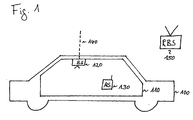
- Fig. 1 shows a vehicle 100, in the passenger compartment 110 a Area information transmitter BS 120 is attached.
- the area information sender 120 transmits wirelessly within the passenger compartment 110 of the vehicle 100 a Area information from, for example, the area information 'car'. These Area information applies within the entire passenger compartment 110 for terminals, which are located in this common area. The area information becomes sent out within the entire passenger compartment. In the example shown agree the location area to which the area information is assigned, and the limited transmission area in which the area information is sent, match.
- a mobile phone MS 130 within the passenger compartment 110 receives the from the Area information transmitter 120 sent area information. It determines how will be explained in detail later, from the received area information Operating parameter setting and sets this. For example, for the Passenger area 'car' set the ringer to the highest possible volume and the vibration alarm will be turned off.
- the area information transmitter 120 is with an outdoor antenna 140 of the vehicle 100 is connected.
- the Area information transmitter 120 includes a Bluetooth TM transceiver for Connection to a mobile device and a transceiver to connect to a mobile radio system, i. to a base station RBS 150 of the mobile radio system.
- the MS 130 mobile phone has a mobile transceiver for connection to the mobile radio system and via a Bluetooth TM transmission device for connection to the area information transmitter 120.
- the mobile phone 130 uses its Mobile radio transceiver and a built-in antenna for connection to the Base station 150 of the mobile radio system.
- the vehicle i.
- the mobile phone MS 130 By means of the received area information 'PKW' the mobile phone MS 130 its operating parameters so that the mobile radio transceiver is turned off and the connection to the mobile system using the Bluetooth TM transceiver he follows. Within the vehicle, therefore, the mobile phone uses its Bluetooth TM transmitter, about the area information transmitter 120 and the Outdoor antenna 140 to connect to the base station 150, instead about his mobile radio transceiver and the built-in antenna with the Base station 150 to connect.
- operating parameter settings of a mobile terminal relate to the outsourcing of terminal functions to external devices.
- Using the Bluetooth TM transmission technology can be For example, in the car installed microphones, car speakers of Stereo system or a keyboard or a display of the on-board computer wirelessly to the mobile phone.
- the operating parameter setting that the Area information 'car' is assigned, then causes the mobile phone, this existing external instead of built-in devices.
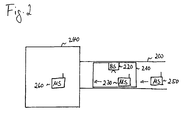
- Fig. 2 shows an application of the invention, in which the limited transmission area, in the area information is transmitted wirelessly, and the area of residence, for which the associated operating parameter setting of a mobile terminal applies, do not match.
- a residence area 240 for example a cabin of an aircraft.
- BS 220 which in one limited transmission area 210, which is located within the access 200, a Area information, such as the area information 'aircraft' sends out.
- An MS 250 mobile phone is outside the coverage area or the Occupied area via an operating parameter setting.
- a Mobile phone MS 230 is located in the transmission area 210, it receives a Area information.
- the broadcasting of the area information by the area information transmitter 220 can be done continuously or at certain intervals or for example be caused by a light barrier, which is mounted in the access. It can be between users who enter the lounge area, and users who leave the residence area, be differentiated to different Send range information for these users. This makes possible For example, when leaving the residence area 240 a reset the Operating parameter setting of the mobile phone to its previous setting. in the example given is the mobile phone MS 260 when leaving the Location area 240 ready to receive area information when by setting the operating parameter 'Off' while the mobile phone is turned off, the transmission means for receiving the Range information is in a standby mode, or if the Mobile phone is switched on again by the user.
- the transmission of the Area information through a broadcast transmission on a broadcast channel by the area information transmitter BS i. the transmission takes place continuously or at certain intervals.
- a receiver in the mobile Terminal monitors the broadcast channel continuously or at regular intervals Time intervals and receives the area information when the terminal in the Stopping broadcasting area.
- the area information transmitter BS sends the area information in response a corresponding area information request.
- This requirement can from both the mobile terminal and another device, for example, from a light barrier in the access area, to the Area information transmitters are sent.
- the sent area information request may originate from the terminal a broadcast channel continuously or at regular intervals become.
- FIG. 3 shows an information exchange between an area information transmitter BS 320 and a mobile telephone MS 310 for the application already described in FIG. 1. Both devices have a Bluetooth TM transmission device and also a mobile radio transceiver, for example via a GSM or GPRS transceiver.
- a communication connection is established between both devices.
- the messages exchanged for the purpose of establishing a basic Bluetooth TM communication connection are shown in a message bundle 330.
- This message bundle 330 causes the establishment of an ad hoc connection, ie generally the establishment of a piconet, which consists of two communication partners, or the registration in a scatternet, which consists of several piconets.
- Bluetooth TM may include the establishment of the connection by means of a wake-up carrier, a frequency synchronization, a determination of the master and slave functions, as well as an authentication.
- a wake-up carrier a frequency synchronization
- a determination of the master and slave functions as well as an authentication.
- Bluetooth TM Bluetooth-The universal radio interface for ad hoc , wireless connectivity' by Jaap Haartsen, Ericsson Review No.3, 1998, p.110-117.
- message bundle 330 in addition messages of security functions of higher protocol layers can be exchanged, for example for authentication.
- the area information may For example, be an identifier of the area information transmitter BS 320.
- the area information may be explained later in detail, contain one or more area information shares, for example one general area information, user-dependent group area information, a user-independent group area information, a individual user-dependent area information, or an individual user-independent area information.
- the area information can also be a Bluetooth TM address or an IP address.
- the mobile telephone MS 310 determines by means of the received area information Operating parameters and adjusts them.
- An operating parameter setting included with the application of FIG. 1 is set, the deactivation of the built-in mobile transceivers and the activation of the built-in Bluetooth TM transmission device for communication with the mobile network.
- the communication is then not directly with a base station, but indirectly via the area information transmitter BS 320.
- the required Messaging which includes both signaling information as well User information is simplified in Fig. 3 by the Message bundle 350 shown.
- the area information already when making the basic Bluetooth TM connection For example, a scatternet identifier may be transmitted as area information become.
- the message with the area information 340 in this case is in Message bundles 330 included.
- the area information request 440 includes an identifier mobile phone MS 410. It may contain one or more parts containing the Call a mobile phone or its user, such as a general requirement part, eg. B. 'mobile phone', a user-dependent Group request part, e.g. B. 'Multitelefon', a user-independent Group request part, e.g.
- the area information request 440 may also include a Bluetooth TM address or an IP address of the mobile phone that is in the Area information sender BS 420 for determining area information is interpreted.
- the area information transmitter BS 420 determines by means of the received Area information request 440 area information 450 and sends it to the mobile phone MS 410.
- the determination of the area information can by a method similar to that used in the mobile phone an operating parameter setting by means of a received area information is done.
- the area information transmitter BS 420 possible range information requests and associated ones Area information saved. By comparing the stored Range information requests with the received Range information request 440 determines the range information transmitter BS 420 the assigned area information.
- the Area information transmitter BS 420 stored an interpretation rule, by means of which the determination of the area information by interpreting the received area information request 440 takes place.
- the determination of the area information by a combination of comparisons and interpretations.
- the area information request becomes and the area information already while creating the basic Bluetooth TM connection exchanged, for example during authentication.
- the messages with the area information request 440 and the Region information 450 is included in message bundle 430 in this case.
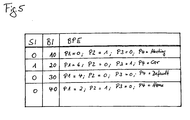
- the Area information BI is on numerical value (10, 20, 30, 40).
- the status information takes the values '0' or '1' on.
- the status information '1' which is also called flag, denotes a currently set operating parameter setting of the terminal, while the Status information '0' indicates that the appropriate operating parameter setting currently not activated.
- Four different operating parameters (P1, P2, P3, P4) can be adjusted.
- P1 takes integer values between 0 and 6 and sets, for example, the call volume of a mobile phone.
- P2 and P3 can accept the values 0 and 1.
- P2 1 activates the Vibrating alert of a mobile phone.
- P3 1 activates one Bluetooth TM communication device for communication with a Mobile network and simultaneously deactivates a GSM transceiver of Mobile phone.
- P4 is a string, for example, a text that is on a display of the mobile phone is displayed contains.
- the shown in Fig. 5 active setting is assigned to the area information '20'.
- the corresponding Operating parameter setting provides ringer volume '6', off Vibration alert, Bluetooth TM enabled transfer device and display 'car' on the display.
- the Mapping table as area information BI numeric values and as each assigned operating parameter settings BPE one or more AT commands in the form of one or more strings.
- the table does not contain any Status information SI.
- the setting of an operating parameter setting takes place by reading out the AT commands associated with area information BI are, and by the further processing of these AT commands of the Computer unit of the terminal. Details of AT commands for setting Operating parameters of a mobile phone are for example in the ETSI Standard TS 100 916, version 7.5.0 specified.
- Fig. 6 shows an example of an interpretation rule for a received one Area information.
- the area information BI is a decimal value from 0 to 255, i. the range information can be a byte being represented.
- the range information is interpreted by means of the bit values.
- the received Area information BI is in the terminal in binary representation in one Status information memory stored.
- the Operating parameter setting through the interpretation of the sixth, seventh and eighth bit position for adjusting the ring volume, by interpreting the second bit position for the vibrating alarm and the interpretation of the first bit position for the active transceiver.
- the three bits for the ring volume allow the Settings '0' to '6'.
- the bit values 000 correspond to the Ringer volume '0' and the bit values 110 the ringer volume '6'.
- the bit value 111 is not occupied.
- the vibration alarm is given by the bit value 1 of the second bit position of the status information memory is turned on and by the bit value 0 switched off.
- the bit value 1 at the first bit location places a Bluetooth TM transceiver of the terminal as active transceiver, while the bit value 0 sets a GSM transceiver as the active transceiver.
- the received Area information 75 which is shown as binary value 01001011 in the Status information memory is stored, leads to the setting of the Ring volume '2', vibration alert enabled and Bluetooth TM transceiver enabled.
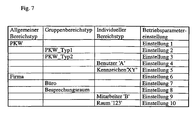
- a range information sent from a range information transmitter can contain one or more range types.
- Fig. 7 shows by way of example different types of areas, from which an area information can consist, as well as their assignment to operating parameter settings in the terminal. Shown are a general area type ('PKW', 'Company'), a group area type ('PKW_Typ1, 'PKW_Typ2') and an individual area type ('User' A '", "Indicator 'XY'", “Employee'B '", "Room' 123 '”).
- the general area type acts as a superordinate type an operating parameter setting in the terminal, the is the same for all living areas of this type. He is from a variety of Evaluated terminals.
- the area information 'PKW' contributes terminals according to the invention in all cars, i. regardless of the car type or the terminal user, to 'setting 1'. If a clear evaluation of the Area information by means of the stored comparison data is not possible, the transmitted area information can additionally by means of a Interpretation rule are interpreted.
- the group area type allows a more differentiated setting of Operating parameters for the residence area.
- the individual area type causes for a certain area of residence or a particular operating parameter setting for a particular user. This allows the setting of personal, individually determined by the user Operating parameters in the terminal. For example, in a laptop a personalized program environment.
- multi-part area information has a format of a DNS address, e.g. "Firma.Büro.Raum123".
- An area information transmitter may be the different parts of the area information together in a message or distribute across multiple messages.
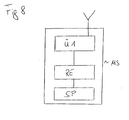
- Fig. 8 shows a simplified representation of components of a mobile Terminal MS. Shown are a first transmission device Ü1, which a Receive area information wirelessly. The transmission device Ü1 is connected to a computer unit RE, which by means of the received Area information operating parameters of the terminal MS determined. The Computer unit RE is connected to a status memory SP. The computer unit RE uses the status memory SP to set the determined operating parameters as Operating parameters of the terminal.
- the mobile terminal MS further includes a Area information store where area information and Operating parameters are assigned to each other.
- a shared memory contains areas for area information storage data or status memory data.
- the mobile terminal MS further includes a Interpretation rules memory, in which an interpretation rule for a Area information is stored.
- the Interpretation rules memory in the status memory or in the Integrated area information memory.
- the SIM card of the terminal components such as the Computer unit RE, the area information memory or the Interpretation in memory.
- FIG. 9 shows components of a simplified representation Area information transmitter BSB.
- the area information transmitter BSB contains a first transmission device UA, a second transmission device UB, an area information store BIS and a Interpretation Library IVS. Furthermore, contains the Area information transmitter one computer unit REB, with all the others Components is connected.
- the first transmission device receives a range information request, and sends out an associated area information.
- the area information is computed by the computing unit from the area information request
- Area information data stored in the area information memory BIS are stored, and by means of an interpretation rule, which in Interpretation library IVS is detected.
- the second Transmission device UB serves a communication exchange between a mobile device and a mobile network. Both transmission facilities UA, UB are interconnected.
- In the uplink case of communication with the Mobile network receives the first transmission device UA user data and Signaling information from the terminal and passes it on to the second Transmission device UB, which forwards it to the communication system.
- the downlink case is the other way round.
- the computer unit REB controls each the use of the transmission devices UA, UB.
- the Memory IVS, BIS represent memory areas of a shared memory.
- the Memory IVS, BIS can be integrated in the computer unit REB.
- a further embodiment of the present invention relates to a Computer program.
- the computer program which in an internal memory a digital computer unit, in particular a mobile phone to be loaded can, contains software code parts that are suitable, the inventive method perform when the computer program executed on the computer unit becomes.
- This computer program can also be used on a computer-readable computer Medium such as a floppy disk, CD-ROM or an optical disk be saved.
Landscapes
- Engineering & Computer Science (AREA)
- Computer Networks & Wireless Communication (AREA)
- Signal Processing (AREA)
- Databases & Information Systems (AREA)
- Mobile Radio Communication Systems (AREA)
- Telephonic Communication Services (AREA)
- Near-Field Transmission Systems (AREA)
Description
- Fig. 1
- eine Anwendung der vorliegenden Erfindung für einen Aufenthaltsbereich in einem Fahrzeug,
- Fig. 2
- eine weitere Anwendung der Erfindung,
- Fig. 3
- einen Informationsaustausch zwischen einem Bereichsinformationssender und einem mobilen Endgerät,
- Fig.4
- einen weiteren Informationsaustausch zwischen einem Bereichsinformationssender und einem mobilen Endgerät,
- Fig. 5
- eine Zuordnung von Bereichsinformationen und Betriebsparametereinstellungen in einem Endgerät,
- Fig. 6
- eine Interpretationsvorschrift für Bereichsinformationen in einem Endgerät,
- Fig. 7
- verschiedene Bereichstypen und deren Zuordnung zu Betriebsparametereinstellungen in einem Endgerät,
- Fig. 8
- eine vereinfachte Darstellung von Komponenten eines mobilen Endgerätes,
- Fig. 9
- eine vereinfachte Darstellung von Komponenten eines Bereichsinformationssenders.
Claims (11)
- Bereichsinformationssender (BSB) zur Signalisierung einer Bereichsinformation (BI) zur Einstellung von Betriebsparametern eines mobilen Endgerätes (MS),
gekennzeichnet durcheine erste Übertragungsvorrichtung (UA), welche eine Bereichsinformationsanforderung empfängt und eine zugeordnete Bereichsinformation (BI) drahtlos in einem begrenzten Sendegebiet (110, 210) aussendet,einen Bereichsinformationsspeicher (BIS), welcher Bereichsinformationsdaten speichert, undeine Rechnereinheit (REB), welche mittels der gespeicherten Bereichsinformationsdaten die Bereichsinformation (BI) ermittelt, die der Bereichsinformationsanforderung zugeordnet ist. - Bereichsinformationssender (BSB) nach Anspruch 1, bei dem der Bereichsinformationssender (BSB) mobil ist.
- Bereichsinformationssender (BSB) nach Anspruch 1 oder 2, bei dem im Bereichsinformationsspeicher (BIS) Bereichsinformationsanforderungen und Bereichsinformationen (BI) einander zugeordnet und gespeichert sind, und bei dem die Rechnereinheit (REB) durch Vergleichen eine Übereinstimmung zwischen der empfangenen Bereichsinformationsanforderung und einer gespeicherten Bereichsinformationsanforderung feststellt und als zu sendende Bereichsinformation die der übereinstimmenden Bereichsinformationsanforderung zugeordnete Bereichsinformation ermittelt.
- Bereichsinformationssender (BSB) nach einem der Ansprüche 1 bis 3, bei dem die Rechnereinheit (REB) die Bereichsinformation (BI) mittels einer Interpretationsvorschrift ermittelt.
- Bereichsinformationssender (BSB) nach einem der Ansprüche 1 bis 4, mit einer zweiten Übertragungseinrichtung (UB) zur Kommunikation mit einem Mobilfunknetz.
- Verfahren zur Signalisierung einer Bereichsinformation (BI) zur Einstellung von Betriebsparametern eines mobilen Endgerätes (MS),
dadurch gekennzeichnet, dasseine erste Übertragungsvorrichtung (UA) eines Bereichsinformationssenders (BSB) eine Bereichsinformationsanforderung empfängt,eine Rechnereinheit (REB) des Bereichsinformationssenders (BSB) mittels in einem Bereichsinformationsspeicher (BIS) gespeicherter Bereichsinformationsdaten die Bereichsinformation (BI) ermittelt, die der Bereichsinformationsanforderung zugeordnet ist, unddie erste Übertragungsvorrichtung (UA) die zugeordnete Bereichsinformation (BI) drahtlos in einem begrenzten Sendegebiet (110, 210) aussendet. - Verfahren nach Anspruch 6, bei dem im Bereichsinformationsspeicher (BIS) Bereichsinformationsanforderungen und Bereichsinformationen (BI) einander zugeordnet und gespeichert sind, und bei dem die Rechnereinheit (REB) durch Vergleichen eine Übereinstimmung zwischen der empfangenen Bereichsinformationsanforderung und einer gespeicherten Bereichsinformationsanforderung feststellt und als zu sendende Bereichsinformation die der übereinstimmenden Bereichsinformationsanforderung zugeordnete Bereichsinformation ermittelt.
- Verfahren nach Anspruch 6 oder 7, bei dem die Rechnereinheit (REB) die Bereichsinformation (BI) mittels einer Interpretationsvorschrift ermittelt.
- Verfahren nach einem der Ansprüche 6 bis 8,bei dem die Rechnereinheit REB den Einsatz einer zweiten Übertragungseinrichtung (UB) zur Kommunikationsvermittlung zwischen einem Mobilfunkgerät und einem Mobilfunknetz kontrolliert.
- Computerprogramm, welches in einen internen Speicher einer digitalen Rechnereinheit geladen werden kann, und welches Softwarecodeteile enthält, die geeignet sind, die Schritte nach einem der Ansprüche 6 bis 9 durchzuführen, wenn das Computerprogramm auf der Rechnereinheit ausgeführt wird.
- Computerprogramm nach Anspruch 10, bei dem das Computerprogramm auf einem computerlesbaren Medium gespeichert ist.
Priority Applications (9)
| Application Number | Priority Date | Filing Date | Title |
|---|---|---|---|
| ES00117076T ES2251339T3 (es) | 2000-08-09 | 2000-08-09 | Metodo de establecimiento de parametros operativos de una estacion movil dependiendo de la posicion, estacion correspondiente y emisor para emitir informacion de posicion. |
| EP00117076A EP1180902B1 (de) | 2000-08-09 | 2000-08-09 | Verfahren zur bereichsabhängigen Betriebsparametereinstellung bei einem mobilen Endgerät, zugehöriges Endgerät und Bereichsinformationssender |
| DE50011383T DE50011383D1 (de) | 2000-08-09 | 2000-08-09 | Verfahren zur bereichsabhängigen Betriebsparametereinstellung bei einem mobilen Endgerät, zugehöriges Endgerät und Bereichsinformationssender |
| AT00117076T ATE307467T1 (de) | 2000-08-09 | 2000-08-09 | Verfahren zur bereichsabhängigen betriebsparametereinstellung bei einem mobilen endgerät, zugehöriges endgerät und bereichsinformationssender |
| DE20023772U DE20023772U1 (de) | 2000-08-09 | 2000-08-09 | Bereichsinformationssender |
| DE20023771U DE20023771U1 (de) | 2000-08-09 | 2000-08-09 | Mobiles Endgerät |
| PCT/EP2001/008964 WO2002013557A1 (en) | 2000-08-09 | 2001-08-02 | Method for setting zone-dependent operational parameters of a mobile terminal, corresponding mobile terminal and zone information transmitter |
| AU2001291727A AU2001291727A1 (en) | 2000-08-09 | 2001-08-02 | Method for setting zone-dependent operational parameters of a mobile terminal, corresponding mobile terminal and zone information transmitter |
| US09/924,928 US20020077144A1 (en) | 2000-08-09 | 2001-08-08 | Mobile terminal with zone-dependent operational parameter settings |
Applications Claiming Priority (1)
| Application Number | Priority Date | Filing Date | Title |
|---|---|---|---|
| EP00117076A EP1180902B1 (de) | 2000-08-09 | 2000-08-09 | Verfahren zur bereichsabhängigen Betriebsparametereinstellung bei einem mobilen Endgerät, zugehöriges Endgerät und Bereichsinformationssender |
Publications (2)
| Publication Number | Publication Date |
|---|---|
| EP1180902A1 EP1180902A1 (de) | 2002-02-20 |
| EP1180902B1 true EP1180902B1 (de) | 2005-10-19 |
Family
ID=8169475
Family Applications (1)
| Application Number | Title | Priority Date | Filing Date |
|---|---|---|---|
| EP00117076A Expired - Lifetime EP1180902B1 (de) | 2000-08-09 | 2000-08-09 | Verfahren zur bereichsabhängigen Betriebsparametereinstellung bei einem mobilen Endgerät, zugehöriges Endgerät und Bereichsinformationssender |
Country Status (7)
| Country | Link |
|---|---|
| US (1) | US20020077144A1 (de) |
| EP (1) | EP1180902B1 (de) |
| AT (1) | ATE307467T1 (de) |
| AU (1) | AU2001291727A1 (de) |
| DE (1) | DE50011383D1 (de) |
| ES (1) | ES2251339T3 (de) |
| WO (1) | WO2002013557A1 (de) |
Families Citing this family (68)
| Publication number | Priority date | Publication date | Assignee | Title |
|---|---|---|---|---|
| US7149529B2 (en) * | 2001-05-07 | 2006-12-12 | Hewlett-Packard Development Company, L.P. | Method and system for controlling selective wireless communication access |
| US7371041B2 (en) | 2001-08-30 | 2008-05-13 | Seagate Technology Llc | Assembly station with rotatable turret which forms and unloads a completed stack of articles |
| US7154859B2 (en) * | 2001-10-24 | 2006-12-26 | The Boeing Company | Method for improving bandwidth performance of a mobile computer network |
| US7006845B2 (en) * | 2002-04-03 | 2006-02-28 | General Motors Corporation | Method and system for interfacing a portable transceiver in a telematics system |
| JP2004094736A (ja) * | 2002-09-02 | 2004-03-25 | Toshiba Corp | 電子機器、通信環境設定方法およびプログラム |
| US7298275B2 (en) | 2002-09-27 | 2007-11-20 | Rockwell Automation Technologies, Inc. | Machine associating method and apparatus |
| US7043316B2 (en) | 2003-02-14 | 2006-05-09 | Rockwell Automation Technologies Inc. | Location based programming and data management in an automated environment |
| US7991406B2 (en) * | 2003-05-23 | 2011-08-02 | Nokia Corporation | Changing settings of a mobile terminal |
| DE10336732A1 (de) * | 2003-08-11 | 2005-04-14 | Siemens Ag | Funknetzwerk |
| US8023892B2 (en) * | 2003-09-25 | 2011-09-20 | Smithlee Technologies, Llc | Wafer mobile phone platform system |
| US6968185B2 (en) * | 2003-11-05 | 2005-11-22 | Interdigital Technology Corporation | Mobile wireless presence and situation management system and method |
| US20050108558A1 (en) * | 2003-11-19 | 2005-05-19 | Intel Corporation | Method and apparatus for managing localized emergency splash screens |
| US7251535B2 (en) | 2004-02-06 | 2007-07-31 | Rockwell Automation Technologies, Inc. | Location based diagnostics method and apparatus |
| WO2006000896A1 (en) * | 2004-06-24 | 2006-01-05 | Nokia Corporation | System and method for using licensed radio technology to determine the operation parameters of an unlicensed radio technology in a mobile terminal |
| US20060135067A1 (en) * | 2004-12-20 | 2006-06-22 | Dunko Gregory A | Method and apparatus for configuring a WLAN |
| US7522915B2 (en) | 2005-02-22 | 2009-04-21 | Motorola, Inc. | Method and apparatus to facilitate alternative modes of operation for a portable communication device |
| EP1856932B1 (de) * | 2005-03-08 | 2019-09-04 | Vodafone Holding GmbH | Vorrichtung mit zwei sende-/empfangseinrichtungen zum austausch von informationen zwischen einem mobilen endgerät und einem mobilfunknetz |
| US7353034B2 (en) | 2005-04-04 | 2008-04-01 | X One, Inc. | Location sharing and tracking using mobile phones or other wireless devices |
| US20070011171A1 (en) * | 2005-07-08 | 2007-01-11 | Nurminen Jukka K | System and method for operation control functionality |
| US8364746B2 (en) | 2005-10-21 | 2013-01-29 | T-Mobile Usa, Inc. | System and method for determining device location in an IP-based wireless telecommunications network |
| US8977275B2 (en) * | 2005-12-30 | 2015-03-10 | Google Technology Holdings LLC | In-vehicle pico-cell system and methods therefor |
| US9014705B2 (en) * | 2005-12-30 | 2015-04-21 | Google Technology Holdings LLC | In-vehicle pico-cell system and method therefor |
| JP4675792B2 (ja) * | 2006-02-01 | 2011-04-27 | 株式会社エヌ・ティ・ティ・ドコモ | 遠隔制御装置、通信ネットワークシステム及び遠隔制御方法 |
| US7818264B2 (en) | 2006-06-19 | 2010-10-19 | Visa U.S.A. Inc. | Track data encryption |
| US9065643B2 (en) | 2006-04-05 | 2015-06-23 | Visa U.S.A. Inc. | System and method for account identifier obfuscation |
| WO2007121331A2 (en) | 2006-04-13 | 2007-10-25 | T-Mobile, Usa, Inc. | Mobile computing device geographic location determination |
| CA2620249C (en) | 2006-10-20 | 2016-04-19 | T-Mobile Usa, Inc. | Two stage mobile device geographic location determination |
| CA2620409A1 (en) | 2006-10-20 | 2008-04-20 | T-Mobile Usa, Inc. | System and method for determining a subscriber's zone information |
| US8953567B2 (en) | 2006-10-20 | 2015-02-10 | T—Mobile USA, Inc. | System and method for utilizing IP-based wireless telecommunications client location data |
| US20080096518A1 (en) * | 2006-10-23 | 2008-04-24 | Motorola, Inc. | Overriding telecommunication quiet zone defaults for emergency contact list communications |
| US9326201B2 (en) * | 2006-12-22 | 2016-04-26 | Alcatel Lucent | Detecting and reporting a picocell by a mobile station |
| US8275352B2 (en) | 2007-06-28 | 2012-09-25 | Apple Inc. | Location-based emergency information |
| US8774825B2 (en) | 2007-06-28 | 2014-07-08 | Apple Inc. | Integration of map services with user applications in a mobile device |
| US9109904B2 (en) | 2007-06-28 | 2015-08-18 | Apple Inc. | Integration of map services and user applications in a mobile device |
| US8175802B2 (en) | 2007-06-28 | 2012-05-08 | Apple Inc. | Adaptive route guidance based on preferences |
| US8332402B2 (en) | 2007-06-28 | 2012-12-11 | Apple Inc. | Location based media items |
| US8108144B2 (en) | 2007-06-28 | 2012-01-31 | Apple Inc. | Location based tracking |
| US8204684B2 (en) | 2007-06-28 | 2012-06-19 | Apple Inc. | Adaptive mobile device navigation |
| US8385946B2 (en) | 2007-06-28 | 2013-02-26 | Apple Inc. | Disfavored route progressions or locations |
| US8311526B2 (en) | 2007-06-28 | 2012-11-13 | Apple Inc. | Location-based categorical information services |
| US8180379B2 (en) * | 2007-06-28 | 2012-05-15 | Apple Inc. | Synchronizing mobile and vehicle devices |
| US8762056B2 (en) | 2007-06-28 | 2014-06-24 | Apple Inc. | Route reference |
| US8290513B2 (en) | 2007-06-28 | 2012-10-16 | Apple Inc. | Location-based services |
| US9066199B2 (en) | 2007-06-28 | 2015-06-23 | Apple Inc. | Location-aware mobile device |
| US8355862B2 (en) | 2008-01-06 | 2013-01-15 | Apple Inc. | Graphical user interface for presenting location information |
| US9250092B2 (en) | 2008-05-12 | 2016-02-02 | Apple Inc. | Map service with network-based query for search |
| US8644843B2 (en) | 2008-05-16 | 2014-02-04 | Apple Inc. | Location determination |
| FI20085604A0 (fi) * | 2008-06-18 | 2008-06-18 | Elektrobit Wireless Comm Oy | Yhteyksien hallinta |
| US8369867B2 (en) | 2008-06-30 | 2013-02-05 | Apple Inc. | Location sharing |
| US8725171B2 (en) * | 2008-09-04 | 2014-05-13 | Qualcomm Incorporated | System and method of providing mode changes to wireless devices |
| US9398443B2 (en) | 2008-09-04 | 2016-07-19 | Qualcomm Incorporated | System and method of providing mode changes to wireless devices |
| US8359643B2 (en) | 2008-09-18 | 2013-01-22 | Apple Inc. | Group formation using anonymous broadcast information |
| US8260320B2 (en) | 2008-11-13 | 2012-09-04 | Apple Inc. | Location specific content |
| US9793982B2 (en) | 2009-04-21 | 2017-10-17 | Commscope Technologies Llc | System for automatic configuration of a mobile communication system |
| US8849190B2 (en) * | 2009-04-21 | 2014-09-30 | Andrew Llc | Radio communication systems with integrated location-based measurements for diagnostics and performance optimization |
| US8670748B2 (en) | 2009-05-01 | 2014-03-11 | Apple Inc. | Remotely locating and commanding a mobile device |
| US8660530B2 (en) | 2009-05-01 | 2014-02-25 | Apple Inc. | Remotely receiving and communicating commands to a mobile device for execution by the mobile device |
| US8666367B2 (en) | 2009-05-01 | 2014-03-04 | Apple Inc. | Remotely locating and commanding a mobile device |
| US8718592B2 (en) | 2009-05-15 | 2014-05-06 | T-Mobile Usa, Inc. | Mobile device location determination using micronetworks |
| DE102009054891A1 (de) * | 2009-12-17 | 2011-06-22 | Airbus Operations GmbH, 21129 | Vorrichtung und Verfahren zum Schutz einer sensiblen Zone vor Emissionen |
| US8472974B2 (en) | 2010-04-28 | 2013-06-25 | T-Mobile Usa, Inc. | Location continuity service for locating mobile devices using multiple access networks including wireless telecommunication networks |
| US9094927B2 (en) | 2010-04-28 | 2015-07-28 | T-Mobile Usa, Inc. | Location continuity service for locating mobile devices using multiple access networks including wireless telecommunication networks |
| US8644165B2 (en) | 2011-03-31 | 2014-02-04 | Navteq B.V. | Method and apparatus for managing device operational modes based on context information |
| DE102014004265A1 (de) | 2014-03-22 | 2015-09-24 | Audi Ag | Mobiles Endgerät mit einer Empfangs- und Auswerteeinheit zum Empfangen und Auswerten einer Information und Verfahren zum orts- und/oder situationsabhängigen Konfigurieren eines Bildschirmes eines mobilen Endgerätes. |
| NO342235B1 (en) | 2015-07-03 | 2018-04-23 | Zaptec As | Facilitating services in an electric vehicle supply equipment environment |
| DE102016203737A1 (de) * | 2016-03-08 | 2017-09-14 | Bayerische Motoren Werke Aktiengesellschaft | Mobile Datenverarbeitungseinrichtung für einen lokalen Geräteverbund |
| EP3515052A1 (de) * | 2018-01-22 | 2019-07-24 | TP Vision Holding B.V. | Betriebsverfahren einer mobilkommunikationsvorrichtung |
| US10694022B1 (en) * | 2019-01-09 | 2020-06-23 | Dell Products L.P. | Autonomous profile switcher for devices based upon external environment |
Family Cites Families (24)
| Publication number | Priority date | Publication date | Assignee | Title |
|---|---|---|---|---|
| US5442805A (en) * | 1988-10-05 | 1995-08-15 | Motorola, Inc. | Location-based adaptive radio control |
| US5255306A (en) * | 1991-01-10 | 1993-10-19 | Bi Inc. | Cellular interface unit for use with an electronic house arrest monitoring system |
| US5742910A (en) * | 1995-05-23 | 1998-04-21 | Mci Corporation | Teleadministration of subscriber ID modules |
| US5754962A (en) * | 1995-07-27 | 1998-05-19 | Ericsson Inc. | Method and apparatus for indicating an operable or non-operable connection between a portable radio and a vehicle kit |
| US6711418B1 (en) * | 1995-10-13 | 2004-03-23 | General Wireless Communications Inc. | Wireless personal mobile data terminal receiving a wide-area broadcast and capable of two-way communication in a local area |
| CN1110916C (zh) * | 1996-03-27 | 2003-06-04 | 罗伯特·博施有限公司 | 点到多点的无线电传输系统 |
| US5914668A (en) * | 1996-08-30 | 1999-06-22 | Lucent Technologies Inc. | Wireless terminal controlled mobility operational parameters |
| US6088598A (en) * | 1996-12-17 | 2000-07-11 | Telefonaktiebolaget L M Ericsson | Method and system for displaying greetings in a mobile radio communications system |
| WO1998041044A2 (en) * | 1997-03-14 | 1998-09-17 | Northern Telecom Inc. | Method and apparatus for network initiated parameter updating |
| DE19744263C1 (de) * | 1997-10-07 | 1999-05-06 | Siemens Ag | Verfahren zum Abschalten elektronischer Geräte, z. B. Mobilteilen, in Sperrzonen |
| FR2776884B1 (fr) * | 1998-03-30 | 2000-11-10 | Alsthom Cge Alkatel | Installation mixte de telephone |
| KR100318940B1 (ko) * | 1998-04-17 | 2002-04-22 | 윤종용 | 이동통신시스템에서의호장애시재접속방법 |
| EP1143641B1 (de) * | 1998-09-21 | 2008-01-09 | Obschestvo S Ogranichennoi Otvetstvennostiju "SIVERA" | Verfahren und gerät zur übertragung einer nachricht in einem mobilen kommunikationssystem |
| JP4090595B2 (ja) * | 1998-10-08 | 2008-05-28 | 株式会社日立製作所 | 情報通知方法、提供情報装置、無線通信システム |
| JP2000197118A (ja) * | 1998-12-24 | 2000-07-14 | Toshiba Corp | 無線通信装置及び無線通信装置の仕様設定方法 |
| JP3395690B2 (ja) * | 1999-02-08 | 2003-04-14 | 株式会社デンソー | 無線通信装置 |
| US7062484B2 (en) * | 1999-04-16 | 2006-06-13 | Pass Dwayne A | Interactive wireless devices to on-line system |
| EP1052867A1 (de) * | 1999-05-12 | 2000-11-15 | Lucent Technologies Inc. | Einrichten einer Kommunikationsverbindung unter Nutzung vorheriger Kanaleigenschaftsaushandlung |
| US6539230B2 (en) * | 1999-08-19 | 2003-03-25 | Lucent Technologies Inc. | Dynamic maintenance of location dependent operating parameters in a wireless terminal |
| US6522888B1 (en) * | 1999-08-31 | 2003-02-18 | Lucent Technologies Inc. | System for determining wireless coverage using location information for a wireless unit |
| US6625437B1 (en) * | 1999-09-23 | 2003-09-23 | Sprint Spectrum, L.P. | Location and events reporting in a wireless telecommunications network |
| KR100399396B1 (ko) * | 1999-12-30 | 2003-09-26 | 엘지전자 주식회사 | 피씨에스 망을 이용한 교통 정보 수집 및 제공 시스템 |
| EP1134995A1 (de) * | 2000-03-17 | 2001-09-19 | Telefonaktiebolaget Lm Ericsson | Verfahren und Vorrichtungen zur verbesserten Standortsaktualisierung in einem Mobilkommunikationssystem |
| US20020103936A1 (en) * | 2001-02-01 | 2002-08-01 | Bashar Jano | Method and apparatus for location information transfer and collection in a WAP environment |
-
2000
- 2000-08-09 DE DE50011383T patent/DE50011383D1/de not_active Expired - Lifetime
- 2000-08-09 EP EP00117076A patent/EP1180902B1/de not_active Expired - Lifetime
- 2000-08-09 ES ES00117076T patent/ES2251339T3/es not_active Expired - Lifetime
- 2000-08-09 AT AT00117076T patent/ATE307467T1/de not_active IP Right Cessation
-
2001
- 2001-08-02 AU AU2001291727A patent/AU2001291727A1/en not_active Abandoned
- 2001-08-02 WO PCT/EP2001/008964 patent/WO2002013557A1/en not_active Ceased
- 2001-08-08 US US09/924,928 patent/US20020077144A1/en not_active Abandoned
Also Published As
| Publication number | Publication date |
|---|---|
| WO2002013557A1 (en) | 2002-02-14 |
| ATE307467T1 (de) | 2005-11-15 |
| US20020077144A1 (en) | 2002-06-20 |
| EP1180902A1 (de) | 2002-02-20 |
| AU2001291727A1 (en) | 2002-02-18 |
| ES2251339T3 (es) | 2006-05-01 |
| DE50011383D1 (de) | 2006-03-02 |
Similar Documents
| Publication | Publication Date | Title |
|---|---|---|
| EP1180902A1 (de) | Verfahren zur bereichsabhängigen Betriebsparametereinstellung bei einem mobilen Endgerät, zugehöriges Endgerät und Bereichsinformationssender | |
| DE102012211930B4 (de) | Detektion der Kontaktaufnahme durch paarweise zugeordnete Fahrzeugvorrichtungen mit Bluetooth Low Energy | |
| DE60219681T2 (de) | Verfahren und system zum weiterleiten von aufenthaltsortsinformation | |
| DE102007051157B4 (de) | Verfahren zum Herstellen einer Datenverbindung zu einem Fahrzeug mit Telematikausstattung | |
| DE69433004T2 (de) | Handover zwischen verschiedenen Funktelefonsystemen | |
| DE69716402T2 (de) | Schnurloses zeitduplextelefon mit verbessertem hörgerätekompatibilitätsmodus | |
| DE102008062546B4 (de) | Verfahren zum Steuern des Timing von drahtlosen Übermittlungen zwischen Fahrzeugen mit Telematikausstattung und einem Call Center | |
| DE112018004690T5 (de) | Drahtlose kommunikationsvorrichtung | |
| DE102020103125A1 (de) | Verfahren und system zur maskierung von insassengeräuschen in einer fahrgemeinschaftsumgebung | |
| DE60214790T2 (de) | Verfahren zur Meldung des Eingangs eines Ereignis zu einem Mobilgerät, und Mobilgerät für diese Verfahren | |
| DE102018114595A1 (de) | Verwaltung einer drahtlos-geräteverbindung | |
| DE102018113159A1 (de) | System und verfahren zur anwesenheitsanzeige von fahrgästen | |
| DE112013007655T5 (de) | Verfahren und System zum Handhaben einer Zusammenarbeit mobiler und tragbarer Zweiwegefunkgeräte | |
| DE10007806C2 (de) | Verfahren zum Betrieb eines in einem Fahrzeug eingebauten Funkgeräts und eines tragbaren Funktelefons | |
| DE69310432T2 (de) | Anschlusseinheit zum Verbinden eines oder mehrerer konventioneller Telefonapparate an ein zellulares Funknetz | |
| DE69515403T2 (de) | Verfahren zum abhören von umgebungsgeräuschen und funkgerät dafür | |
| EP3116237A1 (de) | Verfahren zum betrieb eines hörgerätesystems und hörgerätesystem | |
| EP1044578B1 (de) | Verfahren zum betrieb eines telekommunikationsendgerätes und telekommunikationsendgerät | |
| DE4324573C1 (de) | Verfahren zum Ermöglichen einer akustischen Überwachung beim schnurlosen Telefon | |
| DE20023771U1 (de) | Mobiles Endgerät | |
| EP0932997B1 (de) | Verfahren zum zugreifen von mobilen kommunikationsendgeräten auf öffentliche, private bzw. heim-kommunikationsbereiche | |
| EP1961255B1 (de) | Verfahren und vorrichtung zum deaktivieren von mobilfunkstationen | |
| DE20023772U1 (de) | Bereichsinformationssender | |
| EP0729284A2 (de) | Mobilfunksystem mit einer in einer Feststation enthaltenen Mithöreinrichtung | |
| EP1719364A1 (de) | Verfahren zur herstellung einer kommunikationsverbindung in einem kommunikationsnetz |
Legal Events
| Date | Code | Title | Description |
|---|---|---|---|
| PUAI | Public reference made under article 153(3) epc to a published international application that has entered the european phase |
Free format text: ORIGINAL CODE: 0009012 |
|
| AK | Designated contracting states |
Kind code of ref document: A1 Designated state(s): AT BE CH CY DE DK ES FI FR GB GR IE IT LI LU MC NL PT SE |
|
| AX | Request for extension of the european patent |
Free format text: AL;LT;LV;MK;RO;SI |
|
| 17P | Request for examination filed |
Effective date: 20020807 |
|
| AKX | Designation fees paid |
Free format text: AT BE CH CY DE DK ES FI FR GB GR IE IT LI LU MC NL PT SE |
|
| 17Q | First examination report despatched |
Effective date: 20030430 |
|
| RAP1 | Party data changed (applicant data changed or rights of an application transferred) |
Owner name: TELEFONAKTIEBOLAGET LM ERICSSON (PUBL) |
|
| GRAP | Despatch of communication of intention to grant a patent |
Free format text: ORIGINAL CODE: EPIDOSNIGR1 |
|
| GRAS | Grant fee paid |
Free format text: ORIGINAL CODE: EPIDOSNIGR3 |
|
| GRAA | (expected) grant |
Free format text: ORIGINAL CODE: 0009210 |
|
| AK | Designated contracting states |
Kind code of ref document: B1 Designated state(s): AT BE CH CY DE DK ES FI FR GB GR IE IT LI LU MC NL PT SE |
|
| PG25 | Lapsed in a contracting state [announced via postgrant information from national office to epo] |
Ref country code: IT Free format text: LAPSE BECAUSE OF FAILURE TO SUBMIT A TRANSLATION OF THE DESCRIPTION OR TO PAY THE FEE WITHIN THE PRESCRIBED TIME-LIMIT;WARNING: LAPSES OF ITALIAN PATENTS WITH EFFECTIVE DATE BEFORE 2007 MAY HAVE OCCURRED AT ANY TIME BEFORE 2007. THE CORRECT EFFECTIVE DATE MAY BE DIFFERENT FROM THE ONE RECORDED. Effective date: 20051019 Ref country code: FI Free format text: LAPSE BECAUSE OF FAILURE TO SUBMIT A TRANSLATION OF THE DESCRIPTION OR TO PAY THE FEE WITHIN THE PRESCRIBED TIME-LIMIT Effective date: 20051019 Ref country code: NL Free format text: LAPSE BECAUSE OF FAILURE TO SUBMIT A TRANSLATION OF THE DESCRIPTION OR TO PAY THE FEE WITHIN THE PRESCRIBED TIME-LIMIT Effective date: 20051019 Ref country code: IE Free format text: LAPSE BECAUSE OF FAILURE TO SUBMIT A TRANSLATION OF THE DESCRIPTION OR TO PAY THE FEE WITHIN THE PRESCRIBED TIME-LIMIT Effective date: 20051019 |
|
| REG | Reference to a national code |
Ref country code: GB Ref legal event code: FG4D Free format text: NOT ENGLISH |
|
| REG | Reference to a national code |
Ref country code: CH Ref legal event code: EP |
|
| REG | Reference to a national code |
Ref country code: IE Ref legal event code: FG4D Free format text: LANGUAGE OF EP DOCUMENT: GERMAN |
|
| PG25 | Lapsed in a contracting state [announced via postgrant information from national office to epo] |
Ref country code: DK Free format text: LAPSE BECAUSE OF FAILURE TO SUBMIT A TRANSLATION OF THE DESCRIPTION OR TO PAY THE FEE WITHIN THE PRESCRIBED TIME-LIMIT Effective date: 20060119 Ref country code: SE Free format text: LAPSE BECAUSE OF FAILURE TO SUBMIT A TRANSLATION OF THE DESCRIPTION OR TO PAY THE FEE WITHIN THE PRESCRIBED TIME-LIMIT Effective date: 20060119 Ref country code: GR Free format text: LAPSE BECAUSE OF FAILURE TO SUBMIT A TRANSLATION OF THE DESCRIPTION OR TO PAY THE FEE WITHIN THE PRESCRIBED TIME-LIMIT Effective date: 20060119 |
|
| GBT | Gb: translation of ep patent filed (gb section 77(6)(a)/1977) |
Effective date: 20060109 |
|
| REF | Corresponds to: |
Ref document number: 50011383 Country of ref document: DE Date of ref document: 20060302 Kind code of ref document: P |
|
| PG25 | Lapsed in a contracting state [announced via postgrant information from national office to epo] |
Ref country code: PT Free format text: LAPSE BECAUSE OF FAILURE TO SUBMIT A TRANSLATION OF THE DESCRIPTION OR TO PAY THE FEE WITHIN THE PRESCRIBED TIME-LIMIT Effective date: 20060320 |
|
| NLV1 | Nl: lapsed or annulled due to failure to fulfill the requirements of art. 29p and 29m of the patents act | ||
| REG | Reference to a national code |
Ref country code: ES Ref legal event code: FG2A Ref document number: 2251339 Country of ref document: ES Kind code of ref document: T3 |
|
| REG | Reference to a national code |
Ref country code: IE Ref legal event code: FD4D |
|
| ET | Fr: translation filed | ||
| PLBE | No opposition filed within time limit |
Free format text: ORIGINAL CODE: 0009261 |
|
| STAA | Information on the status of an ep patent application or granted ep patent |
Free format text: STATUS: NO OPPOSITION FILED WITHIN TIME LIMIT |
|
| PG25 | Lapsed in a contracting state [announced via postgrant information from national office to epo] |
Ref country code: LI Free format text: LAPSE BECAUSE OF NON-PAYMENT OF DUE FEES Effective date: 20060831 Ref country code: BE Free format text: LAPSE BECAUSE OF NON-PAYMENT OF DUE FEES Effective date: 20060831 Ref country code: CH Free format text: LAPSE BECAUSE OF NON-PAYMENT OF DUE FEES Effective date: 20060831 Ref country code: MC Free format text: LAPSE BECAUSE OF NON-PAYMENT OF DUE FEES Effective date: 20060831 |
|
| 26N | No opposition filed |
Effective date: 20060720 |
|
| REG | Reference to a national code |
Ref country code: CH Ref legal event code: PL |
|
| PG25 | Lapsed in a contracting state [announced via postgrant information from national office to epo] |
Ref country code: AT Free format text: LAPSE BECAUSE OF NON-PAYMENT OF DUE FEES Effective date: 20060809 |
|
| BERE | Be: lapsed |
Owner name: TELEFONAKTIEBOLAGET LM ERICSSON (PUBL) Effective date: 20060831 |
|
| PG25 | Lapsed in a contracting state [announced via postgrant information from national office to epo] |
Ref country code: LU Free format text: LAPSE BECAUSE OF NON-PAYMENT OF DUE FEES Effective date: 20060809 |
|
| PG25 | Lapsed in a contracting state [announced via postgrant information from national office to epo] |
Ref country code: CY Free format text: LAPSE BECAUSE OF FAILURE TO SUBMIT A TRANSLATION OF THE DESCRIPTION OR TO PAY THE FEE WITHIN THE PRESCRIBED TIME-LIMIT Effective date: 20051019 |
|
| REG | Reference to a national code |
Ref country code: FR Ref legal event code: PLFP Year of fee payment: 16 |
|
| PGFP | Annual fee paid to national office [announced via postgrant information from national office to epo] |
Ref country code: ES Payment date: 20150826 Year of fee payment: 16 Ref country code: GB Payment date: 20150827 Year of fee payment: 16 Ref country code: DE Payment date: 20150827 Year of fee payment: 16 |
|
| PGFP | Annual fee paid to national office [announced via postgrant information from national office to epo] |
Ref country code: FR Payment date: 20150817 Year of fee payment: 16 |
|
| REG | Reference to a national code |
Ref country code: DE Ref legal event code: R119 Ref document number: 50011383 Country of ref document: DE |
|
| GBPC | Gb: european patent ceased through non-payment of renewal fee |
Effective date: 20160809 |
|
| REG | Reference to a national code |
Ref country code: FR Ref legal event code: ST Effective date: 20170428 |
|
| PG25 | Lapsed in a contracting state [announced via postgrant information from national office to epo] |
Ref country code: FR Free format text: LAPSE BECAUSE OF NON-PAYMENT OF DUE FEES Effective date: 20160831 Ref country code: GB Free format text: LAPSE BECAUSE OF NON-PAYMENT OF DUE FEES Effective date: 20160809 Ref country code: DE Free format text: LAPSE BECAUSE OF NON-PAYMENT OF DUE FEES Effective date: 20170301 |
|
| PG25 | Lapsed in a contracting state [announced via postgrant information from national office to epo] |
Ref country code: ES Free format text: LAPSE BECAUSE OF NON-PAYMENT OF DUE FEES Effective date: 20160810 |
|
| REG | Reference to a national code |
Ref country code: ES Ref legal event code: FD2A Effective date: 20180627 |