EP1024210B1 - Apparatus and method for producing tungsten nitride film - Google Patents
Apparatus and method for producing tungsten nitride film Download PDFInfo
- Publication number
- EP1024210B1 EP1024210B1 EP00100937A EP00100937A EP1024210B1 EP 1024210 B1 EP1024210 B1 EP 1024210B1 EP 00100937 A EP00100937 A EP 00100937A EP 00100937 A EP00100937 A EP 00100937A EP 1024210 B1 EP1024210 B1 EP 1024210B1
- Authority
- EP
- European Patent Office
- Prior art keywords
- gas
- film
- jetted
- feedstock
- reactor
- Prior art date
- Legal status (The legal status is an assumption and is not a legal conclusion. Google has not performed a legal analysis and makes no representation as to the accuracy of the status listed.)
- Expired - Lifetime
Links
Images
Classifications
-
- C—CHEMISTRY; METALLURGY
- C23—COATING METALLIC MATERIAL; COATING MATERIAL WITH METALLIC MATERIAL; CHEMICAL SURFACE TREATMENT; DIFFUSION TREATMENT OF METALLIC MATERIAL; COATING BY VACUUM EVAPORATION, BY SPUTTERING, BY ION IMPLANTATION OR BY CHEMICAL VAPOUR DEPOSITION, IN GENERAL; INHIBITING CORROSION OF METALLIC MATERIAL OR INCRUSTATION IN GENERAL
- C23C—COATING METALLIC MATERIAL; COATING MATERIAL WITH METALLIC MATERIAL; SURFACE TREATMENT OF METALLIC MATERIAL BY DIFFUSION INTO THE SURFACE, BY CHEMICAL CONVERSION OR SUBSTITUTION; COATING BY VACUUM EVAPORATION, BY SPUTTERING, BY ION IMPLANTATION OR BY CHEMICAL VAPOUR DEPOSITION, IN GENERAL
- C23C16/00—Chemical coating by decomposition of gaseous compounds, without leaving reaction products of surface material in the coating, i.e. chemical vapour deposition [CVD] processes
- C23C16/44—Chemical coating by decomposition of gaseous compounds, without leaving reaction products of surface material in the coating, i.e. chemical vapour deposition [CVD] processes characterised by the method of coating
- C23C16/455—Chemical coating by decomposition of gaseous compounds, without leaving reaction products of surface material in the coating, i.e. chemical vapour deposition [CVD] processes characterised by the method of coating characterised by the method used for introducing gases into reaction chamber or for modifying gas flows in reaction chamber
- C23C16/45563—Gas nozzles
- C23C16/45565—Shower nozzles
-
- H—ELECTRICITY
- H10—SEMICONDUCTOR DEVICES; ELECTRIC SOLID-STATE DEVICES NOT OTHERWISE PROVIDED FOR
- H10P—GENERIC PROCESSES OR APPARATUS FOR THE MANUFACTURE OR TREATMENT OF DEVICES COVERED BY CLASS H10
- H10P14/00—Formation of materials, e.g. in the shape of layers or pillars
- H10P14/20—Formation of materials, e.g. in the shape of layers or pillars of semiconductor materials
-
- C—CHEMISTRY; METALLURGY
- C23—COATING METALLIC MATERIAL; COATING MATERIAL WITH METALLIC MATERIAL; CHEMICAL SURFACE TREATMENT; DIFFUSION TREATMENT OF METALLIC MATERIAL; COATING BY VACUUM EVAPORATION, BY SPUTTERING, BY ION IMPLANTATION OR BY CHEMICAL VAPOUR DEPOSITION, IN GENERAL; INHIBITING CORROSION OF METALLIC MATERIAL OR INCRUSTATION IN GENERAL
- C23C—COATING METALLIC MATERIAL; COATING MATERIAL WITH METALLIC MATERIAL; SURFACE TREATMENT OF METALLIC MATERIAL BY DIFFUSION INTO THE SURFACE, BY CHEMICAL CONVERSION OR SUBSTITUTION; COATING BY VACUUM EVAPORATION, BY SPUTTERING, BY ION IMPLANTATION OR BY CHEMICAL VAPOUR DEPOSITION, IN GENERAL
- C23C16/00—Chemical coating by decomposition of gaseous compounds, without leaving reaction products of surface material in the coating, i.e. chemical vapour deposition [CVD] processes
- C23C16/22—Chemical coating by decomposition of gaseous compounds, without leaving reaction products of surface material in the coating, i.e. chemical vapour deposition [CVD] processes characterised by the deposition of inorganic material, other than metallic material
- C23C16/30—Deposition of compounds, mixtures or solid solutions, e.g. borides, carbides, nitrides
- C23C16/34—Nitrides
-
- C—CHEMISTRY; METALLURGY
- C23—COATING METALLIC MATERIAL; COATING MATERIAL WITH METALLIC MATERIAL; CHEMICAL SURFACE TREATMENT; DIFFUSION TREATMENT OF METALLIC MATERIAL; COATING BY VACUUM EVAPORATION, BY SPUTTERING, BY ION IMPLANTATION OR BY CHEMICAL VAPOUR DEPOSITION, IN GENERAL; INHIBITING CORROSION OF METALLIC MATERIAL OR INCRUSTATION IN GENERAL
- C23C—COATING METALLIC MATERIAL; COATING MATERIAL WITH METALLIC MATERIAL; SURFACE TREATMENT OF METALLIC MATERIAL BY DIFFUSION INTO THE SURFACE, BY CHEMICAL CONVERSION OR SUBSTITUTION; COATING BY VACUUM EVAPORATION, BY SPUTTERING, BY ION IMPLANTATION OR BY CHEMICAL VAPOUR DEPOSITION, IN GENERAL
- C23C16/00—Chemical coating by decomposition of gaseous compounds, without leaving reaction products of surface material in the coating, i.e. chemical vapour deposition [CVD] processes
- C23C16/44—Chemical coating by decomposition of gaseous compounds, without leaving reaction products of surface material in the coating, i.e. chemical vapour deposition [CVD] processes characterised by the method of coating
- C23C16/4401—Means for minimising impurities, e.g. dust, moisture or residual gas, in the reaction chamber
-
- C—CHEMISTRY; METALLURGY
- C23—COATING METALLIC MATERIAL; COATING MATERIAL WITH METALLIC MATERIAL; CHEMICAL SURFACE TREATMENT; DIFFUSION TREATMENT OF METALLIC MATERIAL; COATING BY VACUUM EVAPORATION, BY SPUTTERING, BY ION IMPLANTATION OR BY CHEMICAL VAPOUR DEPOSITION, IN GENERAL; INHIBITING CORROSION OF METALLIC MATERIAL OR INCRUSTATION IN GENERAL
- C23C—COATING METALLIC MATERIAL; COATING MATERIAL WITH METALLIC MATERIAL; SURFACE TREATMENT OF METALLIC MATERIAL BY DIFFUSION INTO THE SURFACE, BY CHEMICAL CONVERSION OR SUBSTITUTION; COATING BY VACUUM EVAPORATION, BY SPUTTERING, BY ION IMPLANTATION OR BY CHEMICAL VAPOUR DEPOSITION, IN GENERAL
- C23C16/00—Chemical coating by decomposition of gaseous compounds, without leaving reaction products of surface material in the coating, i.e. chemical vapour deposition [CVD] processes
- C23C16/44—Chemical coating by decomposition of gaseous compounds, without leaving reaction products of surface material in the coating, i.e. chemical vapour deposition [CVD] processes characterised by the method of coating
- C23C16/455—Chemical coating by decomposition of gaseous compounds, without leaving reaction products of surface material in the coating, i.e. chemical vapour deposition [CVD] processes characterised by the method of coating characterised by the method used for introducing gases into reaction chamber or for modifying gas flows in reaction chamber
- C23C16/45514—Mixing in close vicinity to the substrate
-
- C—CHEMISTRY; METALLURGY
- C23—COATING METALLIC MATERIAL; COATING MATERIAL WITH METALLIC MATERIAL; CHEMICAL SURFACE TREATMENT; DIFFUSION TREATMENT OF METALLIC MATERIAL; COATING BY VACUUM EVAPORATION, BY SPUTTERING, BY ION IMPLANTATION OR BY CHEMICAL VAPOUR DEPOSITION, IN GENERAL; INHIBITING CORROSION OF METALLIC MATERIAL OR INCRUSTATION IN GENERAL
- C23C—COATING METALLIC MATERIAL; COATING MATERIAL WITH METALLIC MATERIAL; SURFACE TREATMENT OF METALLIC MATERIAL BY DIFFUSION INTO THE SURFACE, BY CHEMICAL CONVERSION OR SUBSTITUTION; COATING BY VACUUM EVAPORATION, BY SPUTTERING, BY ION IMPLANTATION OR BY CHEMICAL VAPOUR DEPOSITION, IN GENERAL
- C23C16/00—Chemical coating by decomposition of gaseous compounds, without leaving reaction products of surface material in the coating, i.e. chemical vapour deposition [CVD] processes
- C23C16/44—Chemical coating by decomposition of gaseous compounds, without leaving reaction products of surface material in the coating, i.e. chemical vapour deposition [CVD] processes characterised by the method of coating
- C23C16/455—Chemical coating by decomposition of gaseous compounds, without leaving reaction products of surface material in the coating, i.e. chemical vapour deposition [CVD] processes characterised by the method of coating characterised by the method used for introducing gases into reaction chamber or for modifying gas flows in reaction chamber
- C23C16/45563—Gas nozzles
- C23C16/4558—Perforated rings
Definitions
- This invention relates to the technical field of forming metal nitrides. More particularly, it provides a technique adequate for forming tungsten nitride films.
- titanium nitride films are formed as barrier films at the interface between the aluminum films and silicon substrates.
- these titanium nitride films are poor in the ability to prevent the diffusion of copper.
- W x N films tungsten nitride films
- Patent Abstracts of Japan, vol. 16, no. 55 describes the manufacture of a semi-conductor device wherein a tungsten nitride film is formed on a coated silicon substrate. It is essential that two gases such as nitrogen and oxygen are introduced from the first gas feed pipe while tungsten hexafluoride is introduced from the second gas feed pipe.
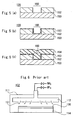
- a substrate 120 on which a W x N film and a copper film are to be formed, consists of a silicon substrate 150, a silicon oxide film 152 formed on the silicon substrate 150 and a pore 160 formed in the silicon oxide film 152.
- a reactor 111 is first evacuated. Then the substrate 120 is carried thereinto and placed on a holder 114 provided in the bottom side of the reactor 111.
- a shower nozzle 112 is provided in the ceiling side of the reactor 111.
- two types of feedstock gases for example, WF 6 gas and NH 3 gas
- WF 6 gas and NH 3 gas are jetted from the shower nozzle 112 toward the substrate 120 as shown by arrows 151, thereby inducing the following chemical reaction: 4WF 6 + 8NH 3 ⁇ 2W 2 N + 24HF + 3N 2 .
- a W x N film 153 is formed on the surface of the substrate 120 as shown in Fig. 5(b), wherein X is referred tentatively as to 2.
- the substrate 120 is taken out from the reactor 111. Then a copper film 154 is formed on the W x N film 153 as shown in Fig. 5 (c) and followed by the transportation to the subsequent stage, i.e., the patterning of the copper film 154, etc.
- the substrate 120 can be continuously treated without exposing to the atmosphere by connecting a apparatus for forming a tungsten film and a apparatus for forming a copper film to a multi-chamber type apparatus.
- the above-described reactor 111 of the prior art suffers from another problem of a low growth speed of the W x N film. Thus, it has been required to clarify the cause of this phenomenon and to establish a countermeasure effective therefor.
- the present invention which has been made to overcome the above-described problems encountering in the prior art, aims at providing a technique for forming a tungsten nitride film without causing dusting, and a technique for forming a tungsten nitride film showing a high growth speed.
- the present invention relates to a method for producing a tungsten nitride film using a film forming apparatus provided with an evacuatable reactor, an adhesion preventive container placed in said reactor, a holder whereby a object on which the film is to be formed is located in said adhesion preventive container, a first gas inlet equipment which faces to said holder and constructed so that it can jet a gas into said adhesion preventive container, and a second gas inlet equipment which is constructed so that it can jet a gas between said first gas inlet equipment and said holder.
- the film forming apparatus is constructed so that, in said adhesion preventive container, at least the part around said material on which the film is to be formed is maintained at a temperature of 150 to 300°C.
- the film forming apparatus comprising said first gas inlet equipment has a shower nozzle provided with a number of gas jet orifices formed on the almost same plane.
- the film forming apparatus comprising said second gas inlet equipment has a nozzle made of a hollow pipe shaped into a ring and a number of gas jet orifices are formed in said hollow pipe.
- the present invention relates to a method for producing a tungsten nitride film which comprises jetting a first NH 3 feedstock gas and a second WF 6 feedstock gas into a reactor and reacting said first feedstock gas with said second feedstock gas so as to form a tungsten nitride film on the surface of a material on which the film is to be formed, wherein the distance between the position from which said first feedstock gas is jetted and the surface of said material on which the film is to be formed is different from the distance between the position from which said second feedstock gas is jetted and the surface of said material on which the film is to be formed.
- the present invention relates to the method for producing a tungsten nitride film which comprises providing an adhesion preventive container in said reactor and placing said object on which a film is to be formed in the adhesion preventive container; heating, in said adhesion preventive container, at least the part around said material on which the film is to be formed to a temperature of preferably 150 to 250°C; and jetting said first feedstock gas and second feedstock gas into said adhesion preventive container.
- the present invention relates to the method for producing a tungsten nitride film, wherein one of said first feedstock gas and second feedstock gas is jetted downward in the vertical direction toward the surface of said object on which a film is to be formed.
- the present invention relates to the method for producing a tungsten nitride film, wherein, between said first feedstock gas and second feedstock gas, the one gas jetted from the lower position is jetted sideways toward center of said object on which a film is to be formed.
- the film forming apparatus used in the method according to the present invention which has the constitution as described above, has an adhesion preventive container placed in the reactor.
- a holder is provided so that a object on which a film is to be formed (i.e., the substrate) can be hold in the adhesion preventive container.
- This film forming apparatus is provided with a first gas inlet equipment and a second gas inlet equipment through which feedstock gases are respectively jetted into the adhesion preventive container.
- the second gas inlet equipment is located at such a position that it can jet the gas between the jetting position of the first gas inlet equipment and the holder.
- the first and second feedstock gases respectively jetted from the gas inlet equipment can attain the surface of the object on which a film is to be formed located on the holder without mixing with each other even under a pressure within the viscous flow region (i.e., 1.0 to 100 Pa).
- first feedstock gas being NH 3 gas and the second feedstock gas being WF 6 gas are supplied respectively from the first gas inlet equipment and the second gas inlet equipment, therefore, these gases react with each other not in the space but on the surface of the object on which a film is to be formed and thus a tungsten nitride film can be efficiently formed.
- a tungsten nitride film having a good film thickness distribution can be formed on the surface of the object on which a film is to be formed by providing the first gas inlet equipment with a shower nozzle and thus jetting downward the feedstock gas toward the object on which a film is to be formed.
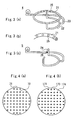
- Fig. 4(a) 71 shows the surface of the shower nozzle. On this shower nozzle which has a number of jet orifices 72, the same feedstock gas is jetted.
- two types of gas jet orifices 173 and 174 are formed. From one type 173 of these orifices, a feedstock gas containing nitrogen atom is jetted, while another feedstock gas containing tungsten atom is jetted from the remainders 174. In this case, these gases are mixed together and react with each other before attaining the surface of the object on which a film is to be formed, which supposedly results in the low film formation (deposition)rate achieved by the prior art.
- a nozzle shaped into a ring is further provided in the second gas inlet equipment.
- This nozzle has a number of gas jet orifices from which a gas is jetted toward the center of the ring, optionally somewhat shifting toward the object on which a film is to be formed.
- the feedstock gas supplied from the second gas inlet equipment can uniformly attain the surface of the object on which a film is to be formed.
- the feedstock gas supplied from the first gas inlet equipment attains the surface of the object on which a film is to be formed via the center of the ring of the nozzle. Therefore, the gases supplied respectively from the first and second gas inlet equipment can attain the surface of the object on which a film is to be formed, without being mixed together and thus the reaction can efficiently proceed on the surface of the object on which a film is to be formed.
- WF 6 ⁇ 4NH 3 is formed at a temperature less than 150°C while a W x N (i.e., a tungsten nitride film) is formed at a temperature exceeding 300°C.
- the adhesion preventive container is maintained at a temperature preferably of from 150 to 250°C (preferably around 200°C). As a result, neither WF 6 ⁇ 4NH 3 nor W x N is formed on the surface of the adhesion preventive container, thereby causing no dusting.
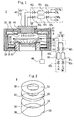
- sign 2 shows an example of the film forming apparatus used in the method according to the present invention which has a reactor 11.
- a cavity adhesion preventive container 8 is placed in this reactor 11.
- this adhesion preventive container 8 is provided with a bottom plate 31, a rectifier plate 32 and a top plate 33, each in a circular shape, and a cylindrical wall plate 30.
- Circular holes 36 to 38 are formed at the center of the bottom plate 31, the rectifier plate 32 and the top plate 33 respectively.
- the bottom plate 30 is located at the bottom of the wall plate 30, while the rectifier plate 32 is located above the bottom plate 31 and surrounded by the wall plate 30.
- the top plate 33 is located at the opening of the wall plate 30 above the rectifier plate 32.
- the bottom plate 31, the rectifier plate 32 and the top plate 33 are arranged in parallel at definite intervals and each fixed to the wall plate 30.
- the holes 36 to 38 formed respectively on the bottom plate 31, the rectifier plate 32 and the top plate 33 are each arranged in such a manner that the center thereof is located on the center axis of the wall plate 30.
- the adhesion preventive container 8 having the above-described constitution is placed as such on the bottom of the reactor 11.
- the reactor 11 is provided with a holder 14 on the bottom thereof and the adhesion preventive container 8 is placed so that the holder 14 is located in the hole 36 of the bottom plate 31 and the hole 37 of the rectifier plate 32.
- the surface of the holder 14 is located between the rectifier plate 31 and the top plate 33.
- a first gas source 45 and a second gas source 46 are provided outside the reactor 11.
- 61 1 to 61 4 are mass flow controller, and 62 1 to 62 8 are valves.
- the first gas source 45 is connected to a shower nozzle 12 as a first gas inlet equipment.
- a first gas inlet system consists of this first gas source 45 and the shower nozzle 12 which is a first gas inlet equipment.
- the shower nozzle 12 has a cavity structure and a number of orifices are formed on the bottom 18 thereof. Thus, a gas is supplied from the first gas source 45 into the cavity part of shower nozzle 12 is jetted from the orifices on the bottom.
- the shower nozzle 12 is located above the hole 38 of the top plate 33 and attached to the top part of the reactor 11 so that the bottom 18 of the shower nozzle 12 faces to the surface of the holder 14.
- the hole 38 of the top plate 33 is larger than the bottom 18 of the shower nozzle 12.
- the bottom 18 of the shower nozzle 12 is located almost at the same height as the top plate 33 but the bottom 18 is located lower than the hole 38 of the top plate 33.
- the gas jetted form the shower nozzle 12 is introduced directly into the adhesion preventive container 8 and blown to the surface of the holder 14.
- the second gas source 46 is connected to a gas jet member 4 as a second gas inlet equipment.
- a second gas inlet system 42 consists of the second gas source 46 and the gas jet member 4 which is a second gas inlet equipment.
- This gas jet member 4 which is roughly shaped into a ring, is arranged between the holder 14 and the shower nozzle 12 in the adhesion preventive container 8 in parallel to the surface of the holder 14. Namely, the gas jet member 4 is located between the rectifier plate 32 and the top plate 33 and in parallel to the rectifier plate 32 and the top plate 33.
- Fig. 3(a) is a perspective view of the gas jet member 4.
- This gas jet member 4 consists of a ring nozzle 21, a support 22 supporting this nozzle 21, and a pipe 23 with which the support 22 is connected to the gas inlet system 42 which is located outside of the reactor 11.
- the nozzle 21, the support 22 and the pipe 23 are each made up of a hollow pipe.
- a gas is introduced from the second gas source 46 into the gas jet member 4, the gas passes through the pipe 23 and the support 22 and attains the nozzle 21.
- the gas nozzle 21 shaped into a ring is provided a number of holes 25 on the inner face.
- Fig. 3(b) is an enlarged view of the holes 25.
- These holes 25 are arranged on somewhat lower part of the surface of the ring gas nozzle 21 at almost constant intervals so that the gas flown into the nozzle 21 is regularly discharged from these holes 25 somewhat downward toward the center.
- the first gas source 45 is provided with a gas cylinder containing the first feedstock gas comprising NH 3, while the second gas source 46 is provided with another gas cylinder containing the second feedstock gas comprising WF 6 , thus allowing the introduction of these gases respectively from the first and second gas inlet systems 41 and 42 into the reactor 11.
- the reactor 11 is evacuated into vacuum atmosphere with the evacuation system 48 connected to the reactor 11.
- the substrate holder 17 is comprised operable to lift up and down.
- the substrate 20 is carried into the reactor 11 while lifting up the substrate holder 17 and placed on the holder 14.
- This substrate 20 is arranged in parallel to the bottom 18 of the shower nozzle 12.
- the substrate holder 17 is taken down and the substrate 20 is adhered to the holder 14 followed by heating by switching on the heater 15.
- the adhesion preventive container 8 is heated with the inner heater as well as the heat radiated from the holder 14. In this step, the electricity supplied to the inner heater is controlled so as to maintain the temperature of the adhesion preventive container 8 to 200°C.
- the gas sources 45 and 46 are manipulated so that the first feedstock gas NH 3 is jetted from the shower nozzle 12 toward the substrate 20 and, at the same time, the second feedstock gas WF 6 is jetted from the nozzle 21 of the gas jet member 4.
- the first and second feedstock gases i.e., the NH 3 and WF 6 gases
- two different feedstock gases i.e., the NH 3 and WF 6 gases
- the pressure in the adhesion preventive container 8 can be maintained within the viscous flow region (i.e., 1.0 to 100 Pa) and the first feedstock gas and the second feedstock gas can separately attain the surface of the substrate 20 without being mixed together.
- the reaction of forming thin W x N proceeds on the surface of the substrate 20 and thus a thin W x N film is obtained.
- the substrate 20 is taken out from the reactor 11 and transported into a copper film forming apparatus. At the same time, another untreated substrate is carried into the reactor 11 and subjected to the formation of a thin W x N film.
- thin W x N films can be continuously formed.
- the adhesion preventive container 8 is filled up with the first feedstock NH 3 gas and the second WF 6 feedstock gas, which protects the inner wall of the reactor 11 from the deposition of WF 6 ⁇ 4NH 3 or W x N thereon.
- the adhesion preventive container 8 is filled up with the first feedstock NH 3 gas and the second WF 6 feedstock gas, which protects the inner wall of the reactor 11 from the deposition of WF 6 ⁇ 4NH 3 or W x N thereon.
- the temperature of the adhesion preventive container 8 is controlled within a range preferably of from 200 to 300°C, neither WF 6 ⁇ 4NH 3 , which is liable to be formed at lower temperatures, nor W x N, which is liable to be formed at higher temperatures, is formed.
- W x N can be formed in dust-free environment. Because of being removable, moreover, the adhesion preventive container 8 can be easily cleaned.
- a number of holes 25 are formed in the inner side of the gas jet member 4 in the above case, other constitutions may be employed therefor so long as the feedstock gas can uniformly jetted from two or more positions toward the substrate 20.
- a tip 24 of the support 22 is bent toward the central axis of the substrate located below and the feedstock gas is jetted from the hole 26 formed on the tip 24, as Fig. 3(c) shows.
- W x N is formed in vacuum (under reduced pressure) of 1.0 to 100 Pa in the above example, it can be formed under higher pressure, i.e., atmospheric pressure or more.
Landscapes
- Chemical & Material Sciences (AREA)
- General Chemical & Material Sciences (AREA)
- Chemical Kinetics & Catalysis (AREA)
- Engineering & Computer Science (AREA)
- Materials Engineering (AREA)
- Mechanical Engineering (AREA)
- Metallurgy (AREA)
- Organic Chemistry (AREA)
- Inorganic Chemistry (AREA)
- Chemical Vapour Deposition (AREA)
- Electrodes Of Semiconductors (AREA)
Applications Claiming Priority (2)
| Application Number | Priority Date | Filing Date | Title |
|---|---|---|---|
| JP11013791A JP2000212749A (ja) | 1999-01-22 | 1999-01-22 | 薄膜形成装置、及び窒化タングステン薄膜製造方法 |
| JP1379199 | 1999-01-22 |
Publications (2)
| Publication Number | Publication Date |
|---|---|
| EP1024210A1 EP1024210A1 (en) | 2000-08-02 |
| EP1024210B1 true EP1024210B1 (en) | 2006-05-17 |
Family
ID=11843083
Family Applications (1)
| Application Number | Title | Priority Date | Filing Date |
|---|---|---|---|
| EP00100937A Expired - Lifetime EP1024210B1 (en) | 1999-01-22 | 2000-01-18 | Apparatus and method for producing tungsten nitride film |
Country Status (6)
| Country | Link |
|---|---|
| US (2) | US6312761B1 (enExample) |
| EP (1) | EP1024210B1 (enExample) |
| JP (1) | JP2000212749A (enExample) |
| KR (1) | KR100630647B1 (enExample) |
| DE (1) | DE60027935T2 (enExample) |
| TW (1) | TW579393B (enExample) |
Cited By (3)
| Publication number | Priority date | Publication date | Assignee | Title |
|---|---|---|---|---|
| US7655543B2 (en) | 2007-12-21 | 2010-02-02 | Asm America, Inc. | Separate injection of reactive species in selective formation of films |
| US7939447B2 (en) | 2007-10-26 | 2011-05-10 | Asm America, Inc. | Inhibitors for selective deposition of silicon containing films |
| US8486191B2 (en) | 2009-04-07 | 2013-07-16 | Asm America, Inc. | Substrate reactor with adjustable injectors for mixing gases within reaction chamber |
Families Citing this family (11)
| Publication number | Priority date | Publication date | Assignee | Title |
|---|---|---|---|---|
| US6635570B1 (en) * | 1999-09-30 | 2003-10-21 | Carl J. Galewski | PECVD and CVD processes for WNx deposition |
| JP2002085950A (ja) * | 2000-09-18 | 2002-03-26 | Horiba Ltd | 流体混合装置 |
| KR101035221B1 (ko) | 2002-12-27 | 2011-05-18 | 가부시키가이샤 알박 | 질화 텅스텐막의 형성 방법 |
| KR101178743B1 (ko) | 2004-04-12 | 2012-09-07 | 가부시키가이샤 알박 | 배리어막의 형성 방법, 및 전극막의 형성 방법 |
| US7420227B2 (en) * | 2005-06-22 | 2008-09-02 | National Chiao Tung University | Cu-metalized compound semiconductor device |
| US8148564B2 (en) * | 2006-08-30 | 2012-04-03 | Wayne State University | Compounds for forming metal nitrides |
| JP4523661B1 (ja) * | 2009-03-10 | 2010-08-11 | 三井造船株式会社 | 原子層堆積装置及び薄膜形成方法 |
| US9499905B2 (en) * | 2011-07-22 | 2016-11-22 | Applied Materials, Inc. | Methods and apparatus for the deposition of materials on a substrate |
| WO2014097280A1 (en) * | 2012-12-21 | 2014-06-26 | Prasad Narhar Gadgil | Methods of low temperature deposition of ceramic thin films |
| WO2017165016A1 (en) * | 2016-03-25 | 2017-09-28 | Applied Materials, Inc. | Chamber liner for high temperature processing |
| CN114850003B (zh) * | 2021-02-03 | 2023-06-27 | 芝浦机械电子装置株式会社 | 加热处理装置 |
Family Cites Families (10)
| Publication number | Priority date | Publication date | Assignee | Title |
|---|---|---|---|---|
| JPS59131511A (ja) * | 1983-01-17 | 1984-07-28 | Zenko Hirose | アモルフアスシリコン膜の成膜方法 |
| JPS62116770A (ja) * | 1985-11-15 | 1987-05-28 | Canon Inc | 成膜装置 |
| JP2859632B2 (ja) * | 1988-04-14 | 1999-02-17 | キヤノン株式会社 | 成膜装置及び成膜方法 |
| JP2803297B2 (ja) * | 1990-03-05 | 1998-09-24 | 日本電気株式会社 | 半導体装置の製造方法 |
| KR930001300A (ko) * | 1991-06-10 | 1993-01-16 | 김광호 | 화학 기상 박막 형성 방법 및 그 장치 |
| US5470800A (en) * | 1992-04-03 | 1995-11-28 | Sony Corporation | Method for forming an interlayer film |
| US5534072A (en) * | 1992-06-24 | 1996-07-09 | Anelva Corporation | Integrated module multi-chamber CVD processing system and its method for processing subtrates |
| JP3590416B2 (ja) * | 1993-11-29 | 2004-11-17 | アネルバ株式会社 | 薄膜形成方法および薄膜形成装置 |
| JP3360098B2 (ja) * | 1995-04-20 | 2002-12-24 | 東京エレクトロン株式会社 | 処理装置のシャワーヘッド構造 |
| JP3699504B2 (ja) * | 1995-05-30 | 2005-09-28 | アネルバ株式会社 | 真空処理装置 |
-
1999
- 1999-01-22 JP JP11013791A patent/JP2000212749A/ja active Pending
- 1999-12-27 KR KR1019990062682A patent/KR100630647B1/ko not_active Expired - Fee Related
- 1999-12-30 TW TW088123340A patent/TW579393B/zh not_active IP Right Cessation
-
2000
- 2000-01-18 EP EP00100937A patent/EP1024210B1/en not_active Expired - Lifetime
- 2000-01-18 DE DE60027935T patent/DE60027935T2/de not_active Expired - Lifetime
- 2000-01-21 US US09/489,338 patent/US6312761B1/en not_active Expired - Lifetime
-
2001
- 2001-07-26 US US09/912,504 patent/US20020000199A1/en not_active Abandoned
Cited By (4)
| Publication number | Priority date | Publication date | Assignee | Title |
|---|---|---|---|---|
| US7939447B2 (en) | 2007-10-26 | 2011-05-10 | Asm America, Inc. | Inhibitors for selective deposition of silicon containing films |
| US7655543B2 (en) | 2007-12-21 | 2010-02-02 | Asm America, Inc. | Separate injection of reactive species in selective formation of films |
| US7897491B2 (en) | 2007-12-21 | 2011-03-01 | Asm America, Inc. | Separate injection of reactive species in selective formation of films |
| US8486191B2 (en) | 2009-04-07 | 2013-07-16 | Asm America, Inc. | Substrate reactor with adjustable injectors for mixing gases within reaction chamber |
Also Published As
| Publication number | Publication date |
|---|---|
| US6312761B1 (en) | 2001-11-06 |
| KR20000052580A (ko) | 2000-08-25 |
| KR100630647B1 (ko) | 2006-10-02 |
| TW579393B (en) | 2004-03-11 |
| JP2000212749A (ja) | 2000-08-02 |
| DE60027935T2 (de) | 2007-04-26 |
| DE60027935D1 (de) | 2006-06-22 |
| US20020000199A1 (en) | 2002-01-03 |
| EP1024210A1 (en) | 2000-08-02 |
Similar Documents
| Publication | Publication Date | Title |
|---|---|---|
| EP1024210B1 (en) | Apparatus and method for producing tungsten nitride film | |
| CN100519834C (zh) | 薄膜制造装置以及制造方法 | |
| US5580822A (en) | Chemical vapor deposition method | |
| US6306216B1 (en) | Apparatus for deposition of thin films on wafers through atomic layer epitaxial process | |
| US11286566B2 (en) | Apparatus for deposition of a III-V semiconductor layer | |
| KR101044355B1 (ko) | 가스 헤드 및 박막제조장치 | |
| JP4399206B2 (ja) | 薄膜製造装置 | |
| US20050034662A1 (en) | Methods, systems, and apparatus for uniform chemical-vapor depositions | |
| US8450220B2 (en) | Substrate processing apparatus , method of manufacturing semiconductor device, and method of manufacturing substrate | |
| US6004885A (en) | Thin film formation on semiconductor wafer | |
| TWI423383B (zh) | Substrate support for the III-V film growth reaction chamber, its reaction chamber and process treatment | |
| JPH09246192A (ja) | 薄膜気相成長装置 | |
| KR20020027211A (ko) | 화학증착장치 및 화학증착방법 | |
| US20130220222A1 (en) | Gas Distribution Apparatus with Heat Exchanging Channels | |
| WO2012120991A1 (ja) | 基板処理装置、及び、基板の製造方法 | |
| KR100580062B1 (ko) | 화학기상성장장치 및 막 성장방법 | |
| JP2005054252A (ja) | 薄膜製造装置及び製造方法 | |
| KR100369859B1 (ko) | 원자층 증착 장치 | |
| JP5011631B2 (ja) | 半導体製造装置および半導体製造システム | |
| JP3816090B2 (ja) | 化学気相成長装置および膜成長方法 | |
| JPH08104984A (ja) | ガス導入装置及び方法及びタングステン薄膜の形成方法 | |
| JP2026051608A (ja) | 基板処理装置および基板処理方法 | |
| JPH04337627A (ja) | 気相成長装置 | |
| JPH03190218A (ja) | 半導体製造装置 | |
| JPS60253213A (ja) | 気相成長装置およびその装置による気相成長方法 |
Legal Events
| Date | Code | Title | Description |
|---|---|---|---|
| PUAI | Public reference made under article 153(3) epc to a published international application that has entered the european phase |
Free format text: ORIGINAL CODE: 0009012 |
|
| AK | Designated contracting states |
Kind code of ref document: A1 Designated state(s): DE FR GB NL |
|
| AX | Request for extension of the european patent |
Free format text: AL;LT;LV;MK;RO;SI |
|
| 17P | Request for examination filed |
Effective date: 20000713 |
|
| AKX | Designation fees paid |
Free format text: DE FR GB NL |
|
| 17Q | First examination report despatched |
Effective date: 20020719 |
|
| GRAP | Despatch of communication of intention to grant a patent |
Free format text: ORIGINAL CODE: EPIDOSNIGR1 |
|
| GRAS | Grant fee paid |
Free format text: ORIGINAL CODE: EPIDOSNIGR3 |
|
| GRAA | (expected) grant |
Free format text: ORIGINAL CODE: 0009210 |
|
| AK | Designated contracting states |
Kind code of ref document: B1 Designated state(s): DE FR GB NL |
|
| REG | Reference to a national code |
Ref country code: GB Ref legal event code: FG4D |
|
| REF | Corresponds to: |
Ref document number: 60027935 Country of ref document: DE Date of ref document: 20060622 Kind code of ref document: P |
|
| ET | Fr: translation filed | ||
| PLBE | No opposition filed within time limit |
Free format text: ORIGINAL CODE: 0009261 |
|
| STAA | Information on the status of an ep patent application or granted ep patent |
Free format text: STATUS: NO OPPOSITION FILED WITHIN TIME LIMIT |
|
| 26N | No opposition filed |
Effective date: 20070220 |
|
| REG | Reference to a national code |
Ref country code: FR Ref legal event code: PLFP Year of fee payment: 17 |
|
| REG | Reference to a national code |
Ref country code: FR Ref legal event code: PLFP Year of fee payment: 18 |
|
| REG | Reference to a national code |
Ref country code: FR Ref legal event code: PLFP Year of fee payment: 19 |
|
| PGFP | Annual fee paid to national office [announced via postgrant information from national office to epo] |
Ref country code: GB Payment date: 20190124 Year of fee payment: 20 Ref country code: NL Payment date: 20190122 Year of fee payment: 20 Ref country code: FR Payment date: 20190122 Year of fee payment: 20 Ref country code: DE Payment date: 20190129 Year of fee payment: 20 |
|
| REG | Reference to a national code |
Ref country code: DE Ref legal event code: R071 Ref document number: 60027935 Country of ref document: DE |
|
| REG | Reference to a national code |
Ref country code: NL Ref legal event code: MK Effective date: 20200117 |
|
| REG | Reference to a national code |
Ref country code: GB Ref legal event code: PE20 Expiry date: 20200117 |
|
| PG25 | Lapsed in a contracting state [announced via postgrant information from national office to epo] |
Ref country code: GB Free format text: LAPSE BECAUSE OF EXPIRATION OF PROTECTION Effective date: 20200117 |