EP1017623B1 - Verfahren und vorrichtung zur herstellung von phosgen aus diphosgen und/oder triphosgen - Google Patents
Verfahren und vorrichtung zur herstellung von phosgen aus diphosgen und/oder triphosgen Download PDFInfo
- Publication number
- EP1017623B1 EP1017623B1 EP98948930A EP98948930A EP1017623B1 EP 1017623 B1 EP1017623 B1 EP 1017623B1 EP 98948930 A EP98948930 A EP 98948930A EP 98948930 A EP98948930 A EP 98948930A EP 1017623 B1 EP1017623 B1 EP 1017623B1
- Authority
- EP
- European Patent Office
- Prior art keywords
- triphosgene
- deactivated
- diphosgene
- phosgene
- reaction
- Prior art date
- Legal status (The legal status is an assumption and is not a legal conclusion. Google has not performed a legal analysis and makes no representation as to the accuracy of the status listed.)
- Expired - Lifetime
Links
- UCPYLLCMEDAXFR-UHFFFAOYSA-N triphosgene Chemical compound ClC(Cl)(Cl)OC(=O)OC(Cl)(Cl)Cl UCPYLLCMEDAXFR-UHFFFAOYSA-N 0.000 title claims abstract description 55
- YGYAWVDWMABLBF-UHFFFAOYSA-N Phosgene Chemical compound ClC(Cl)=O YGYAWVDWMABLBF-UHFFFAOYSA-N 0.000 title claims abstract description 45
- HCUYBXPSSCRKRF-UHFFFAOYSA-N diphosgene Chemical compound ClC(=O)OC(Cl)(Cl)Cl HCUYBXPSSCRKRF-UHFFFAOYSA-N 0.000 title claims abstract description 34
- 238000000034 method Methods 0.000 title claims abstract description 27
- 238000006243 chemical reaction Methods 0.000 claims abstract description 80
- 150000001875 compounds Chemical class 0.000 claims abstract description 18
- 125000004433 nitrogen atom Chemical group N* 0.000 claims abstract description 11
- 229910052751 metal Inorganic materials 0.000 claims description 23
- 239000002184 metal Substances 0.000 claims description 23
- IEQIEDJGQAUEQZ-UHFFFAOYSA-N phthalocyanine Chemical compound N1C(N=C2C3=CC=CC=C3C(N=C3C4=CC=CC=C4C(=N4)N3)=N2)=C(C=CC=C2)C2=C1N=C1C2=CC=CC=C2C4=N1 IEQIEDJGQAUEQZ-UHFFFAOYSA-N 0.000 claims description 12
- -1 nitro, amino Chemical group 0.000 claims description 10
- 150000002466 imines Chemical group 0.000 claims description 9
- 229910052757 nitrogen Inorganic materials 0.000 claims description 9
- 150000001412 amines Chemical group 0.000 claims description 8
- 238000004519 manufacturing process Methods 0.000 claims description 7
- 229920000642 polymer Polymers 0.000 claims description 7
- 125000000217 alkyl group Chemical group 0.000 claims description 5
- 238000010438 heat treatment Methods 0.000 claims description 5
- 239000007788 liquid Substances 0.000 claims description 5
- RDOWQLZANAYVLL-UHFFFAOYSA-N phenanthridine Chemical compound C1=CC=C2C3=CC=CC=C3C=NC2=C1 RDOWQLZANAYVLL-UHFFFAOYSA-N 0.000 claims description 4
- 125000001424 substituent group Chemical group 0.000 claims description 4
- 125000003118 aryl group Chemical group 0.000 claims description 3
- 125000005605 benzo group Chemical group 0.000 claims description 3
- 125000004122 cyclic group Chemical group 0.000 claims description 2
- 125000000753 cycloalkyl group Chemical group 0.000 claims description 2
- 229910052736 halogen Inorganic materials 0.000 claims description 2
- 150000002367 halogens Chemical class 0.000 claims description 2
- 125000000623 heterocyclic group Chemical group 0.000 claims description 2
- 229920000885 poly(2-vinylpyridine) Polymers 0.000 claims description 2
- 230000003197 catalytic effect Effects 0.000 claims 4
- 238000004064 recycling Methods 0.000 claims 1
- 239000003054 catalyst Substances 0.000 abstract description 33
- 238000003860 storage Methods 0.000 description 12
- 239000000463 material Substances 0.000 description 10
- 239000007789 gas Substances 0.000 description 9
- 230000008569 process Effects 0.000 description 7
- 239000003574 free electron Substances 0.000 description 6
- 229920001343 polytetrafluoroethylene Polymers 0.000 description 6
- 239000004810 polytetrafluoroethylene Substances 0.000 description 6
- 239000004033 plastic Substances 0.000 description 5
- 229920003023 plastic Polymers 0.000 description 5
- 239000011541 reaction mixture Substances 0.000 description 5
- 239000011521 glass Substances 0.000 description 4
- 150000002739 metals Chemical class 0.000 description 4
- 238000010992 reflux Methods 0.000 description 4
- OKTJSMMVPCPJKN-UHFFFAOYSA-N Carbon Chemical compound [C] OKTJSMMVPCPJKN-UHFFFAOYSA-N 0.000 description 3
- 125000004429 atom Chemical group 0.000 description 3
- 230000015572 biosynthetic process Effects 0.000 description 3
- 238000011049 filling Methods 0.000 description 3
- 125000006850 spacer group Chemical group 0.000 description 3
- CURLTUGMZLYLDI-UHFFFAOYSA-N Carbon dioxide Chemical compound O=C=O CURLTUGMZLYLDI-UHFFFAOYSA-N 0.000 description 2
- 239000002841 Lewis acid Substances 0.000 description 2
- JUJWROOIHBZHMG-UHFFFAOYSA-N Pyridine Chemical compound C1=CC=NC=C1 JUJWROOIHBZHMG-UHFFFAOYSA-N 0.000 description 2
- 238000007792 addition Methods 0.000 description 2
- VSCWAEJMTAWNJL-UHFFFAOYSA-K aluminium trichloride Chemical compound Cl[Al](Cl)Cl VSCWAEJMTAWNJL-UHFFFAOYSA-K 0.000 description 2
- 239000006227 byproduct Substances 0.000 description 2
- 239000011248 coating agent Substances 0.000 description 2
- 238000000576 coating method Methods 0.000 description 2
- 239000013078 crystal Substances 0.000 description 2
- 230000009849 deactivation Effects 0.000 description 2
- 238000001035 drying Methods 0.000 description 2
- 239000003622 immobilized catalyst Substances 0.000 description 2
- 150000007517 lewis acids Chemical class 0.000 description 2
- 239000000155 melt Substances 0.000 description 2
- 238000012986 modification Methods 0.000 description 2
- 230000004048 modification Effects 0.000 description 2
- 229920001223 polyethylene glycol Polymers 0.000 description 2
- 239000002243 precursor Substances 0.000 description 2
- 239000007858 starting material Substances 0.000 description 2
- 238000003786 synthesis reaction Methods 0.000 description 2
- VZGDMQKNWNREIO-UHFFFAOYSA-N tetrachloromethane Chemical compound ClC(Cl)(Cl)Cl VZGDMQKNWNREIO-UHFFFAOYSA-N 0.000 description 2
- 239000002879 Lewis base Substances 0.000 description 1
- 229920001774 Perfluoroether Polymers 0.000 description 1
- 239000002202 Polyethylene glycol Chemical group 0.000 description 1
- 239000004793 Polystyrene Substances 0.000 description 1
- VYPSYNLAJGMNEJ-UHFFFAOYSA-N Silicium dioxide Chemical compound O=[Si]=O VYPSYNLAJGMNEJ-UHFFFAOYSA-N 0.000 description 1
- 229920002125 Sokalan® Polymers 0.000 description 1
- LBGCRGLFTKVXDZ-UHFFFAOYSA-M ac1mc2aw Chemical compound [Al+3].[Cl-].C12=CC=CC=C2C(N=C2[N-]C(C3=CC=CC=C32)=N2)=NC1=NC([C]1C=CC=CC1=1)=NC=1N=C1[C]3C=CC=CC3=C2[N-]1 LBGCRGLFTKVXDZ-UHFFFAOYSA-M 0.000 description 1
- 125000003545 alkoxy group Chemical group 0.000 description 1
- 150000003973 alkyl amines Chemical group 0.000 description 1
- 230000004888 barrier function Effects 0.000 description 1
- 229910002092 carbon dioxide Inorganic materials 0.000 description 1
- 239000001569 carbon dioxide Substances 0.000 description 1
- 125000005518 carboxamido group Chemical group 0.000 description 1
- 230000008859 change Effects 0.000 description 1
- 238000012824 chemical production Methods 0.000 description 1
- 125000001309 chloro group Chemical group Cl* 0.000 description 1
- SOGXWMAAMKKQCB-UHFFFAOYSA-M chloroalumane Chemical compound Cl[AlH2] SOGXWMAAMKKQCB-UHFFFAOYSA-M 0.000 description 1
- 229910052804 chromium Inorganic materials 0.000 description 1
- 238000001816 cooling Methods 0.000 description 1
- 229910052802 copper Inorganic materials 0.000 description 1
- 150000001923 cyclic compounds Chemical class 0.000 description 1
- MKNXBRLZBFVUPV-UHFFFAOYSA-L cyclopenta-1,3-diene;dichlorotitanium Chemical compound Cl[Ti]Cl.C=1C=C[CH-]C=1.C=1C=C[CH-]C=1 MKNXBRLZBFVUPV-UHFFFAOYSA-L 0.000 description 1
- 125000005442 diisocyanate group Chemical group 0.000 description 1
- 230000000694 effects Effects 0.000 description 1
- 125000001495 ethyl group Chemical group [H]C([H])([H])C([H])([H])* 0.000 description 1
- 238000002474 experimental method Methods 0.000 description 1
- 239000002360 explosive Substances 0.000 description 1
- 125000003827 glycol group Chemical group 0.000 description 1
- 125000001072 heteroaryl group Chemical group 0.000 description 1
- 150000002391 heterocyclic compounds Chemical class 0.000 description 1
- 231100000086 high toxicity Toxicity 0.000 description 1
- 239000005457 ice water Substances 0.000 description 1
- 239000011261 inert gas Substances 0.000 description 1
- 239000012442 inert solvent Substances 0.000 description 1
- XEEYBQQBJWHFJM-UHFFFAOYSA-N iron Substances [Fe] XEEYBQQBJWHFJM-UHFFFAOYSA-N 0.000 description 1
- 229910052742 iron Inorganic materials 0.000 description 1
- FBAFATDZDUQKNH-UHFFFAOYSA-M iron chloride Chemical compound [Cl-].[Fe] FBAFATDZDUQKNH-UHFFFAOYSA-M 0.000 description 1
- 150000007527 lewis bases Chemical class 0.000 description 1
- 239000003446 ligand Substances 0.000 description 1
- 229910052748 manganese Inorganic materials 0.000 description 1
- 230000007246 mechanism Effects 0.000 description 1
- 125000002496 methyl group Chemical group [H]C([H])([H])* 0.000 description 1
- 239000000203 mixture Substances 0.000 description 1
- 229910052759 nickel Inorganic materials 0.000 description 1
- 239000004584 polyacrylic acid Substances 0.000 description 1
- 239000004417 polycarbonate Substances 0.000 description 1
- 229920000515 polycarbonate Polymers 0.000 description 1
- 229920002223 polystyrene Polymers 0.000 description 1
- 238000002360 preparation method Methods 0.000 description 1
- 125000001436 propyl group Chemical group [H]C([*])([H])C([H])([H])C([H])([H])[H] 0.000 description 1
- UMJSCPRVCHMLSP-UHFFFAOYSA-N pyridine Natural products COC1=CC=CN=C1 UMJSCPRVCHMLSP-UHFFFAOYSA-N 0.000 description 1
- 230000035484 reaction time Effects 0.000 description 1
- 230000001105 regulatory effect Effects 0.000 description 1
- 150000003839 salts Chemical class 0.000 description 1
- 229910052706 scandium Inorganic materials 0.000 description 1
- 238000007789 sealing Methods 0.000 description 1
- 239000000741 silica gel Substances 0.000 description 1
- 229910002027 silica gel Inorganic materials 0.000 description 1
- 239000002904 solvent Substances 0.000 description 1
- 239000000126 substance Substances 0.000 description 1
- 150000003512 tertiary amines Chemical group 0.000 description 1
- UWHCKJMYHZGTIT-UHFFFAOYSA-N tetraethylene glycol Chemical group OCCOCCOCCOCCO UWHCKJMYHZGTIT-UHFFFAOYSA-N 0.000 description 1
- 229910052719 titanium Inorganic materials 0.000 description 1
- ZIBGPFATKBEMQZ-UHFFFAOYSA-N triethylene glycol Chemical compound OCCOCCOCCO ZIBGPFATKBEMQZ-UHFFFAOYSA-N 0.000 description 1
- 229910052720 vanadium Inorganic materials 0.000 description 1
- 229910052725 zinc Inorganic materials 0.000 description 1
- QMBQEXOLIRBNPN-UHFFFAOYSA-L zirconocene dichloride Chemical compound [Cl-].[Cl-].[Zr+4].C=1C=C[CH-]C=1.C=1C=C[CH-]C=1 QMBQEXOLIRBNPN-UHFFFAOYSA-L 0.000 description 1
Images


Classifications
-
- B—PERFORMING OPERATIONS; TRANSPORTING
- B01—PHYSICAL OR CHEMICAL PROCESSES OR APPARATUS IN GENERAL
- B01J—CHEMICAL OR PHYSICAL PROCESSES, e.g. CATALYSIS OR COLLOID CHEMISTRY; THEIR RELEVANT APPARATUS
- B01J7/00—Apparatus for generating gases
-
- B—PERFORMING OPERATIONS; TRANSPORTING
- B01—PHYSICAL OR CHEMICAL PROCESSES OR APPARATUS IN GENERAL
- B01J—CHEMICAL OR PHYSICAL PROCESSES, e.g. CATALYSIS OR COLLOID CHEMISTRY; THEIR RELEVANT APPARATUS
- B01J8/00—Chemical or physical processes in general, conducted in the presence of fluids and solid particles; Apparatus for such processes
- B01J8/0015—Feeding of the particles in the reactor; Evacuation of the particles out of the reactor
- B01J8/002—Feeding of the particles in the reactor; Evacuation of the particles out of the reactor with a moving instrument
-
- B—PERFORMING OPERATIONS; TRANSPORTING
- B01—PHYSICAL OR CHEMICAL PROCESSES OR APPARATUS IN GENERAL
- B01J—CHEMICAL OR PHYSICAL PROCESSES, e.g. CATALYSIS OR COLLOID CHEMISTRY; THEIR RELEVANT APPARATUS
- B01J8/00—Chemical or physical processes in general, conducted in the presence of fluids and solid particles; Apparatus for such processes
- B01J8/0015—Feeding of the particles in the reactor; Evacuation of the particles out of the reactor
- B01J8/0045—Feeding of the particles in the reactor; Evacuation of the particles out of the reactor by means of a rotary device in the flow channel
-
- C—CHEMISTRY; METALLURGY
- C01—INORGANIC CHEMISTRY
- C01B—NON-METALLIC ELEMENTS; COMPOUNDS THEREOF; METALLOIDS OR COMPOUNDS THEREOF NOT COVERED BY SUBCLASS C01C
- C01B32/00—Carbon; Compounds thereof
- C01B32/80—Phosgene
Definitions
- the present invention relates to a method for Production of phosgene from diphosgene and / or triphosgene by reaction on a catalyst and the use a device for performing the method.
- phosgene is used as an important starting compound, inter alia, for the preparation of diisocyanates and polycarbonates. Because of its high toxicity on the one hand and the resulting, highly restrictive legal safety regulations regarding transport, storage and use on the other hand, there has been a need for phosgene substitutes. This requirement is met by the diphosgene (trichloromethyl chloroformate), which is liquid under standard conditions, and the crystalline triphosgene (bis (trichloromethyl) carbonate) [H. Eckert, B. Forster, Angew. Chem., 99 (1987) 922-23; Angew. Chem. Int. Ed. Engl., 26 (1987) 894-95; F. Bracher, T. Litz, J. Prakt. Chem., 1995 ( 337 ) 516-18; L. Cotarca, P. Delogu, A. Nardelli, V. Sunjic, Synthesis, (1996) 553-76].
- the yield of phosgene is therefore only one Third of the theoretically possible value.
- the by-products formed in subsequent reactions of the phosgene disturb, and the implementation reaction proceeds to a high degree uncontrollable.
- triphosgene is opposite weaker Lewis acids, such as titanocene dichloride and Zirconocene dichloride, completely stable.
- Triphosgene can also be converted to phosgene on activated carbon become. Although here the implementation is almost quantitative the reaction is uncontrollable and can even take on an explosive character.
- Lewis bases such as pyridine can also contain diphosgene and Convert triphosgene to phosgene, however, is also in this In case the extremely fast implementation reaction cannot be controlled.
- Triphosgene can be used both in the form mentioned above (bis (trichloromethyl) carbonate) and in the cyclic form indicated by the following formula:
- the term 'in the neighborhood' means in particular 'in the ⁇ , ⁇ or ⁇ position' to the nitrogen atom with deactivated free electron pair, particularly preferred 'in ⁇ position'.
- Preferred examples of compounds having a nitrogen atom deactivated free electron pair are compounds with deactivated imine and / or deactivated amine function.
- they are by binding on polymers such as polyacrylic acid or polystyrene, immobilized.
- polymers such as polyacrylic acid or polystyrene
- the immobilized connections with deactivated imine and / or amine function possibly via spacer molecules (so-called 'spacers') connected to the polymer chain.
- spacers are alkoxy groups, such as triethylene glycol, tetraethylene glycol and polyethylene glycol groups.
- Compounds with deactivated imine function are, for example, higher aromatic or heteroaromatic systems as well as compounds with alkyl groups in the vicinity of the nitrogen atom.
- Preferred compounds with deactivated imine function which can be used in the process according to the invention are poly (2-vinylpyridine), phenanthridine and phthalocyanine (H 2 Pc) and metal phthalocyanines (MePc), the basic structure of which is shown below:
- the preferred metal atoms of the metal phthalocyanine are Subgroup metals of the 4th to 6th period as well as the metals the 3rd to 6th period of the main groups 2 to 5 and especially prefers the subgroup metals of the 4th period (Sc, Ti, V, Cr, Mn, Fe, Co, Ni, Cu, Zn) are used.
- the metal atoms of the metal phthalocyanine can, in particular in the case of subgroup metals, with one or more additional ligands, such as chloro or oxo, can be complexed.
- the phthalocyanine or the metal phthalocyanines can in any crystal modifications can be used. Examples for such crystal modifications of metal phthalocyanines are ⁇ -CuPc and ⁇ -CuPc.
- the above preferred compounds with deactivated imine function can if necessary on Carbon structure may be substituted.
- the substituents include alkyl, cycloalkyl, aryl, halogen, nitro, amino, Cyano, carboxy, carbalkoxy, carboxamido and heterocyclic Groups.
- the phthalocyanine or the metal phthalocyanines on the benzo groups independently be substituted one or more times from one another, the Substituents preferably from the above-mentioned substituents as well as other phthalocyanines and fused cyclic or heterocyclic compounds, which may be themselves are substituted are selected.
- the compounds with deactivated amine function are preferably selected from deactivated tertiary Amine compounds. Deactivation is more preferred Way by immobilization by binding the amine compound of polymers, with particular preference being given to tertiary alkylamines are and the alkyl groups are the same or different and are selected from methyl, ethyl, propyl and higher linear or branched alkyl groups.
- An example for a catalyst according to the invention with deactivated tertiary amine function is N, N-dimethylaminomethylpolystyrene.
- the catalyst for the implementation of diphosgene and / or Triphosgene is preferred in a concentration of 0.01 to 10 mol%, particularly preferably from 0.1 to 2 mol%, based on the amount of diphosgene and / or triphosgene used. is the catalyst one by binding a compound with Nitrogen atom with deactivated free electron pair a polymer immobilized catalyst, is calculated the concentration based on the amount of substance (in moles) to the Polymer chain bound compounds with deactivated free electron pair.
- reaction temperature is preferably 80 to 150 ° C, particularly preferably 90 to 130 ° C, and most preferably 100 to 125 ° C.
- the present invention also provides use a device for performing the invention Process available, which is a reservoir for Diphosgene and / or triphosgene and one with the Reservoir connected and containing the catalyst Reaction chamber with phosgene outlet included.
- reaction chamber with a possibly electronically controllable heating fitted.
- This heater can be used to move from Storage container transported into the reaction chamber If necessary, melt the reaction material and / or the Reaction reaction due to an elevated temperature accelerate.
- a reaction chamber with a funnel-shaped opening into the reaction chamber
- To provide return device evaporated or entrained diphosgene and / or Triphosgene are condensed in the reaction chamber and in the reaction system can be returned.
- the return device from a reflux condenser with outside the device attached heat exchanger or inclined baffle plates.
- the baffle plates are preferably made of coated Metal sheets. The coating can e.g. from a suitable inert plastic, such as polytetrafluoroethylene or Perfluoroalkoxypolymer, or glass exist.
- the baffle plates made of metal have a high thermal conductivity, so that a thermal equilibrium in the reaction chamber easier can be adjusted.
- the storage container in one preferred embodiment for taking triphosgene in Designed in tablet form.
- the filling of the Storage container if necessary by means of a tablet magazine, e.g. in the form of a tube made of glass or Plastic, such as PTFE or PFA, are made. That way an easier filling without the risk of touching Triphosgene can be performed.
- FIGS 1 and 2 show preferred embodiments of the Device used according to the invention.
- the device consists of an encapsulated housing (17) made of suitable inert plastic (e.g. polytetrafluoroethylene (PTFE) or Perfluoroalkoxy polymers (PFA)) or metal with plastic (PTFE, PFA) or glass insert or coating (19).
- the Storage container (1) for diphosgene and / or triphosgene (4) comprises a lockable closure cover (21) or a Locking screw (23) on the top and one Dosing device with closable passage opening (25) to the reaction chamber (5) for the reaction material.
- the Closure (27) of the passage opening (25) can e.g. a Flap, a contactor or a slide.
- a pressure lock can be used which have a higher pressure in the reaction chamber than that Storage container allowed without having to open Passage opening, e.g. when transporting reaction material from the reservoir into the reaction chamber, phosgene in reaches the reservoir.
- the dosing device can be easily pierced (29) (especially in the case of using triphosgene in Tablet form (2)) or a motor-driven drive (31), such as. a worm drive.
- a drying cartridge (33) with a suitable dry matter e.g. Silica gel
- a suitable dry matter e.g. Silica gel
- the catalyst (3) is in amorphous or crystalline form in the reaction chamber (5), is on the Walls of the reaction chamber applied or is through a Immobilized carrier.
- the reaction chamber is equipped with a heater (9) for heating of the reaction mixture.
- a safety valve (35) in the Reaction chamber attached which with a gas line a deduction.
- the return device is in Form of baffle plates (15) or as a reflux condenser (11) Heat exchanger (13) executed.
- a gas outlet valve (7) for the phosgene produced.
- the reaction chamber can run out reaction with gas, e.g. an inert gas or drier Air, are flushed, the gas exchange via the Safety valve (35) and the gas outlet valve (7) take place can.
- Figures 3 and 4 schematically show special Embodiments of the metering device with which Reaction material is transferred to the reaction chamber.
- Figure 3 is the supply of the tablet-shaped Reaction material (2) from the storage container (1) in the Reaction chamber (4) according to the "turret principle" with a rotatable disc (37) with at least one passage opening (25), preferably two or more openings for Taking a tablet (2).
- a rotatable disc (37) with at least one passage opening (25), preferably two or more openings for Taking a tablet (2).
- the disc (37) works at the same time as a pressure lock.
- FIG. 4 acts a disc (39) with a plurality of openings (41) with the Reaction material (2) are filled in tablet form, as pre-assembled storage container for transporting the Tablets on the heater (9).
- the storage container can e.g. in the form of a conventional blister pack for tablets be executed.
- Preferred material for the washers (37) and (39) is plastic, e.g. PTFE or PFA, or glass.
- an electronic control device can be used be the supply of reaction material from the Storage tank, the temperature in the reaction chamber, the Return device from reflux cooler and heat exchanger and indicates and regulates the gas outlet via a valve.
- the reactions are carried out in a two-necked flask A reflux condenser that ends in a drying tube Cold trap is connected.
- the Implementation temperature is measured by a thermometer in the second Neck of the reaction flask measured.
- the heating of the Reaction flask is done through an oil bath with a thermometer.
- at The cold trap is measured by a Gas burette replaced with ice water / ice as a barrier liquid.
- the triphosgene or diphosgene is in the reaction flask submitted and heated at a bath temperature of 100 ° C. If all of the reaction material has melted (for triphosgene at 80 to 85 ° C), one passes through the one with the thermometer provided the catalyst at once and closes the piston. After about 30 seconds to 1 minute uniform phosgene development occurs, which is constant continues until the end of the reaction. The bath temperature will set to the desired value and during the Reaction sublimed triphosgene becomes intermediate created (liquid) and entrained by the phosgene flow Diphosgene washed back into the swamp. The reaction is ended when the catalyst remains dry. This in the cold trap condensed phosgene becomes Yield determination weighed.
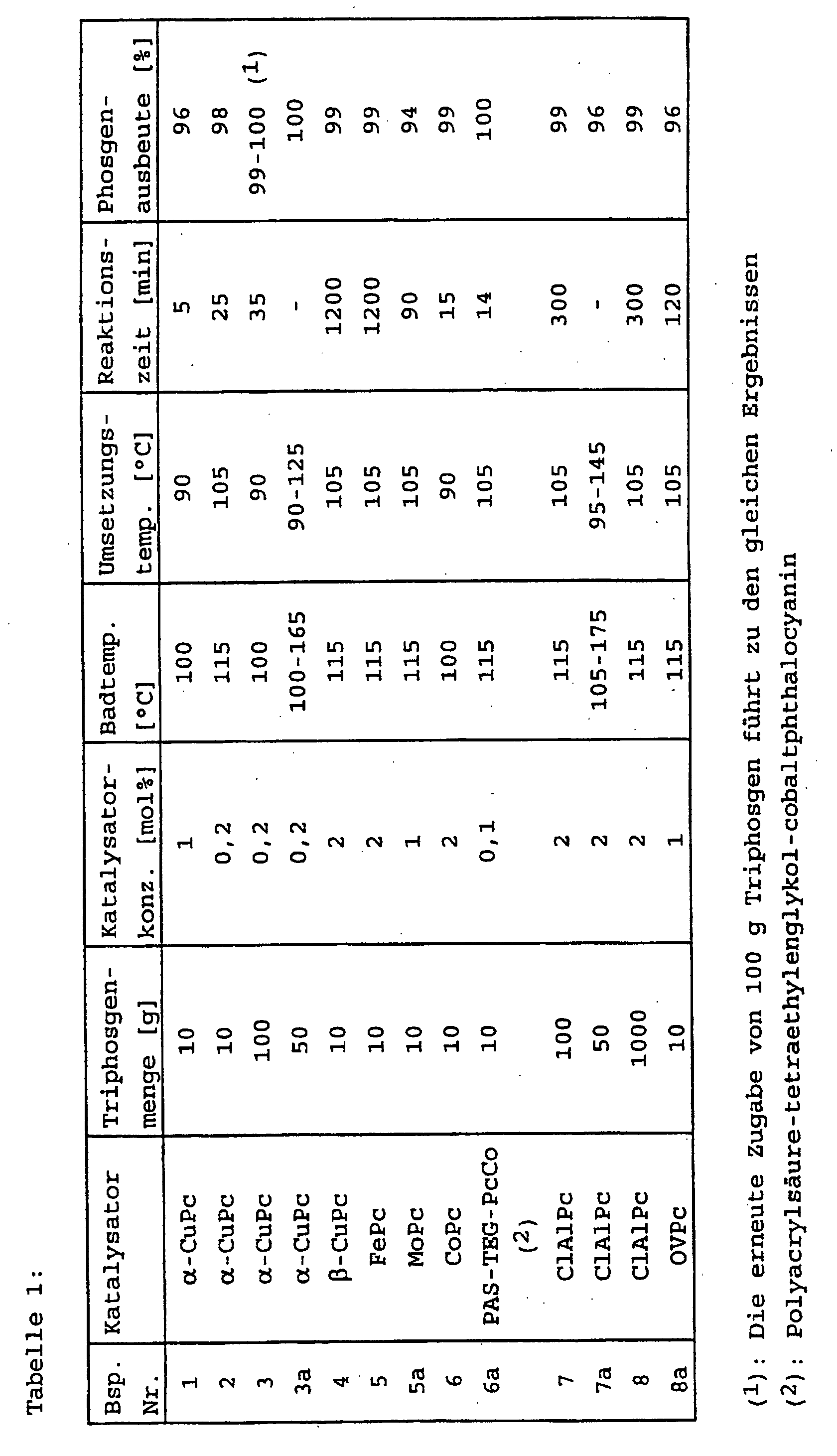
- Table 1 shows the phosgene development from triphosgene on metal phthalocyanines as a function of the catalyst concentration and the bath or reaction temperature.
- Example No. 3 the further addition of 100 g triphosgene to the previously used catalyst leads to the same result, which shows that the catalyst is stable in the reaction over a longer period of time.
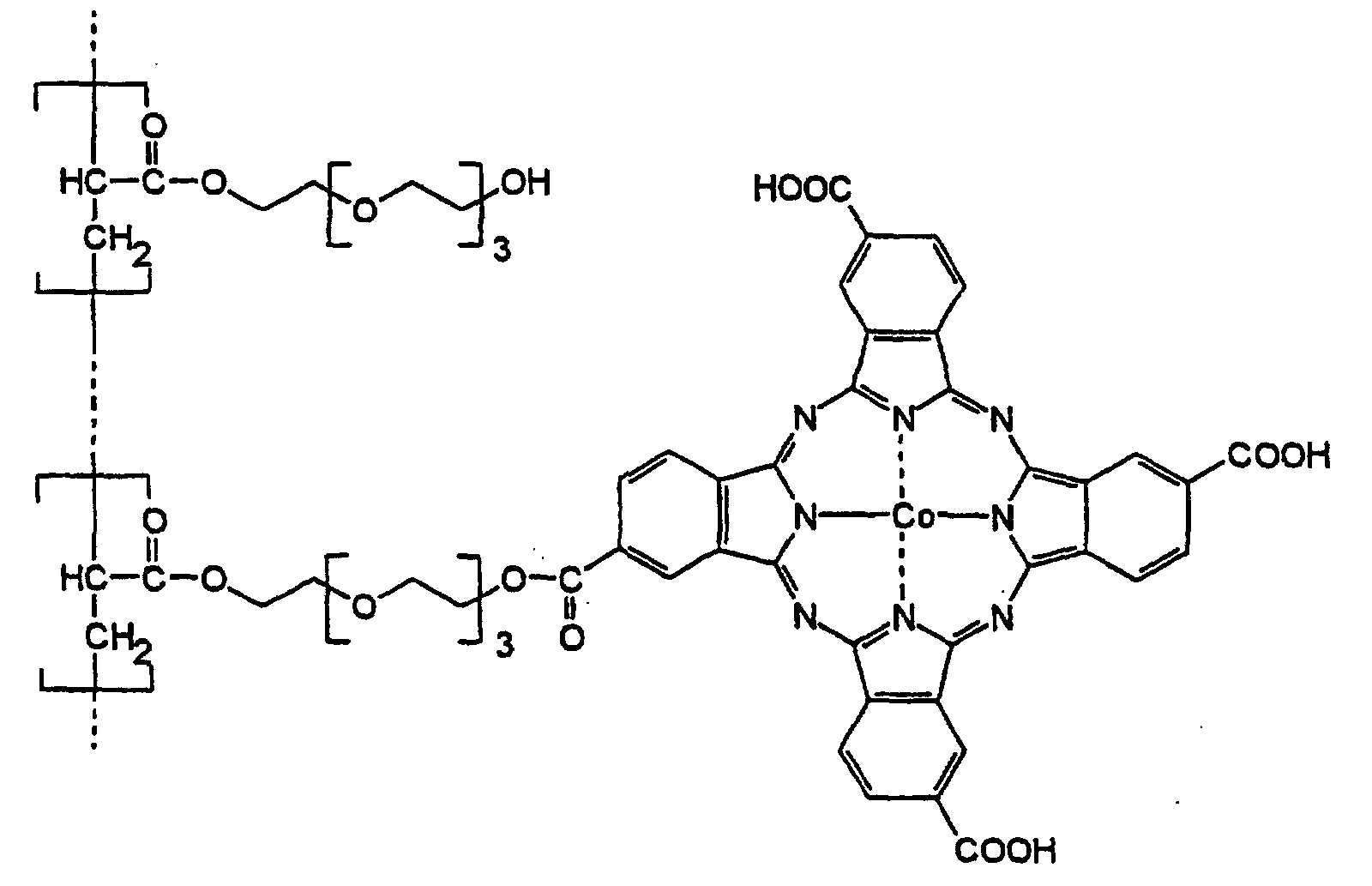
- the immobilized polyacrylic acid-tetraethylene glycol-cobalt phthalocyanine (PAS-TEG-PcCo) shown below also catalyzes the reaction of the triphosgene in low concentrations (see Example 6a):
- PAS-TEG-PcCo polyacrylic acid-tetraethylene glycol-cobalt phthalocyanine
- Table 2 shows the controllability of the process according to the invention by regulating the reaction temperature and the amount of catalyst.
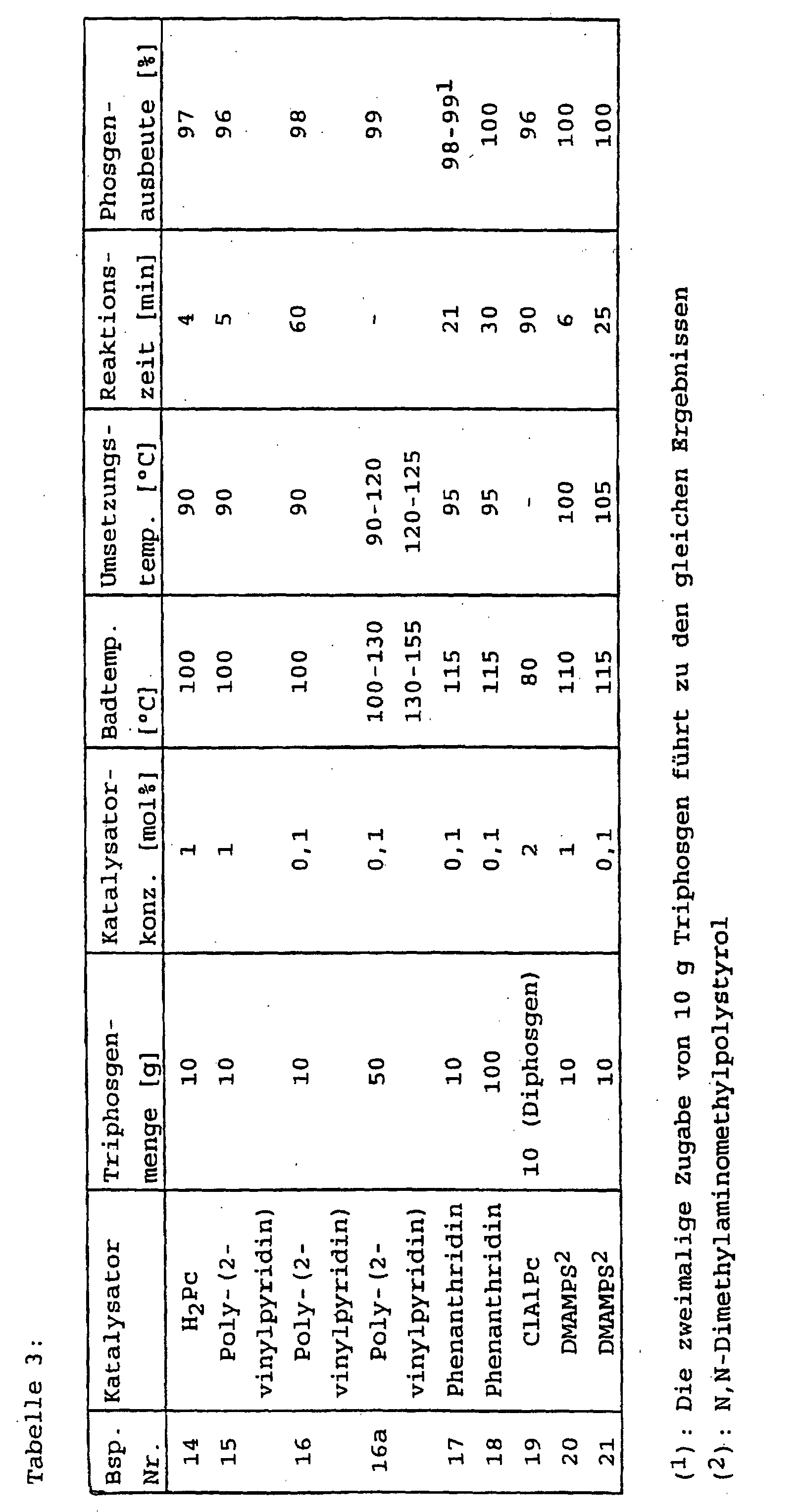
- Table 3 shows the phosgene development from triphosgene on further catalysts with imine and amine function as a function of the catalyst concentration. In these cases, too, approximately 100% phosgene yields are obtained.
- Example No. 17 a further two additions of 10 g triphosgene to the catalyst in Example No. 17 leads to the same yield result, which also confirms the catalyst stability.
- Immobilized catalysts are shown in Examples 15, 16, 16a and 20 and 21, with Examples 20 and 21 using as the catalyst a compound which contains an amine function with deactivated free electron pair.
- diphosgene to phosgene on chloroaluminium phthalocyanine takes place from 50 ° C and is about four times as fast as when using triphosgene as the starting material. Since diphosgene occurs during the conversion of triphosgene to phosgene, it follows that the decay step from triphosgene to diphosgene determines the rate:
- the catalyst activity can be specifically in the Metal phthalocyanines on the choice of the metal atom preset while the more accurate implementation speed about the temperature and, if appropriate, the catalyst concentration can be done.
- the reaction also runs at higher reaction temperatures approximately stoichiometric, and there are none By-products.
- the process can be considered self-regulating reaction to be carried out when the Downed diphosgene (along with resublimated triphosgene) in the reaction mixture runs back and its temperature is reduced. So they give Examples 3a, 7a and 16a the temperature profile of the reaction against: In all three reactions there is Reaction temperature up to a bath temperature of 135 ° C 10 ° C below. At a bath temperature above up to approx. The conversion temperature remains at 180 ° C with the fast ones Reactions (Examples 3a and 16a) due to the stronger one Diphosgen return at approx. 125 ° C, with the slow Reaction (Example 7a) increases the reaction temperature 145 ° C at a constant value.
- the present invention thus provides a method with which phosgene can be produced in a controllable and controlled manner from the safely manageable substitutes (precursors), diphosgene and triphosgene, as well as a device for the rapid and simple production of phosgene from the substitutes mentioned.
Landscapes
- Chemical & Material Sciences (AREA)
- Organic Chemistry (AREA)
- Chemical Kinetics & Catalysis (AREA)
- Inorganic Chemistry (AREA)
- Organic Low-Molecular-Weight Compounds And Preparation Thereof (AREA)
- Catalysts (AREA)
- Polymers With Sulfur, Phosphorus Or Metals In The Main Chain (AREA)
- Low-Molecular Organic Synthesis Reactions Using Catalysts (AREA)
- Saccharide Compounds (AREA)
Description


Tabelle 2 zeigt am Beispiel des Volumenstroms des durch Umsetzung von Triphosgen an Chloraluminiumphthalocyanins entwickelten Phosgens die Steuerbarkeit des erfindungsgemäßen Verfahrens durch Regulierung von Umsetzungstemperatur und Katalysatormenge.


Claims (17)
- Verfahren zur Herstellung von Phosgen aus Diphosgen und/oder Triphosgen durch Umsetzung an einem Katalysator, dadurch gekennzeichnet, daß der Katalysator ein oder mehrere Verbindungen mit ein oder mehreren Stickstoffatomen mit desaktiviertem freien Elektronenpaar umfaßt.
- Verfahren gemäß Anspruch 1, dadurch gekennzeichnet, daß das freie Elektronenpaar durch Mesomerie und/oder eine oder mehrere elektronenziehende und/oder raumfüllende Gruppen in Nachbarschaft zum Stickstoffatom desaktiviert sind.
- Verfahren gemäß Anspruch 1 oder 2, dadurch gekennzeichnet, daß die Verbindungen mit Stickstoffatom mit desaktiviertem freien Elektronenpaar ausgewählt sind aus Verbindungen mit desaktivierter Imin-Funktion und/oder desaktivierter Amin-Funktion.
- Verfahren gemäß Anspruch 3, dadurch gekennzeichnet, daß die Verbindung mit desaktivierter Imin-Funktion und/oder desaktivierter Amin-Funktion durch Bindung an Polymere immobilisiert ist.
- Verfahren gemäß Anspruch 3 oder 4, dadurch gekennzeichnet, daß die Verbindung mit desaktivierter Imin-Funktion ausgewählt ist aus Poly(2-vinylpyridin), Phenanthridin, Phthalocyanin und Metallphthalocyaninen.
- Verfahren gemäß Anspruch 5, dadurch gekennzeichnet, daß das Phthalocyanin oder Metallphthalocyanin ein- oder mehrfach an den Benzo-Gruppen substituiert ist.
- Verfahren gemäß Anspruch 6, dadurch gekennzeichnet, daß die Substituenten der Benzo-Gruppen des Phthalocyanins oder Metallphthalocyanins ausgewählt sind aus Alkyl, Cycloalkyl, Aryl, Halogen, Nitro, Amino, Cyano, Carboxy, Carbalkoxy, Carboxamido, Phthalocyanin und anellierten cyclischen oder heterocyclischen Gruppen, die gegebenenfalls selbst substituiert sind.
- Verfahren gemäß Anspruch 3, dadurch gekennzeichnet, daß die Verbindung mit desaktivierter Amin-Funktion eine desaktivierte tertiäre Aminverbindung ist.
- Verfahren gemäß einem der vorhergehenden Ansprüche, dadurch gekennzeichnet, daß die Katalysatorkonzentration 0,01-10 mol-% beträgt, insbesondere 0,1-2 mol-%, bezogen auf die Menge an Diphosgen und/oder Triphosgen.
- Verfahren gemäß einem der vorhergehenden Ansprüche, dadurch gekennzeichnet, daß das Diphosgen und/oder Triphosgen im flüssigen Zustand vorliegt.
- Verfahren gemäß einem der vorhergehenden Ansprüche, dadurch gekennzeichnet, daß die Umsetzungstemperatur 80 bis 150°C beträgt.
- Verwendung einer Vorrichtung zur Durchführung des Verfahrens zur Phosgen-Herstellung aus Diphosgen und/oder Triphosgen gemäß einem der Ansprüche 1 bis 11, wobei die Vorrichtung einen Vorratsbehälter (1) für Diphosgen und/oder Triphosgen und eine mit dem Vorratsbehälter (1) verbundene und den Katalysator (3) enthaltende Reaktionskammer (5) mit Phosgenauslass (7) umfaßt.
- Verwendung gemäß Anspruch 12, worin die Reaktionskammer (5) mit einer gegebenenfalls elektronisch. regelbaren Heizung (9) ausgestattet ist.
- Verwendung gemäß Anspruch 12 oder 13, worin die Reaktionskammer (5) mit einer in die Reaktionskammer mündenden Rücklaufeinrichtung ausgestattet ist.
- Verwendung gemäß Anspruch 14, worin die Rücklaufeinrichtung ein Rückflußkühler (11) mit außerhalb der Vorrichtung angebrachtem Wärmetauscher (13) oder geneigte Prallbleche (15) sind.
- Verwendung gemäß Anspruch 15, worin die Prallbleche (15) aus beschichtetem Metall bestehen.
- Verwendung gemäß einem der Ansprüche 12 bis 16, worin der Vorratsbehälter (1) zur Aufnahme von Triphosgen in Tablettenform ausgestaltet ist.
Applications Claiming Priority (3)
| Application Number | Priority Date | Filing Date | Title |
|---|---|---|---|
| DE19740577 | 1997-09-15 | ||
| DE19740577A DE19740577A1 (de) | 1997-09-15 | 1997-09-15 | Verfahren und Vorrichtung zur Herstellung von Phosgen aus Diphosgen und/oder Triphosgen |
| PCT/EP1998/005693 WO1999014159A1 (de) | 1997-09-15 | 1998-09-08 | Verfahren und vorrichtung zur herstellung von phosgen aus diphosgen und/oder triphosgen |
Publications (2)
| Publication Number | Publication Date |
|---|---|
| EP1017623A1 EP1017623A1 (de) | 2000-07-12 |
| EP1017623B1 true EP1017623B1 (de) | 2002-01-16 |
Family
ID=7842436
Family Applications (1)
| Application Number | Title | Priority Date | Filing Date |
|---|---|---|---|
| EP98948930A Expired - Lifetime EP1017623B1 (de) | 1997-09-15 | 1998-09-08 | Verfahren und vorrichtung zur herstellung von phosgen aus diphosgen und/oder triphosgen |
Country Status (21)
| Country | Link |
|---|---|
| US (1) | US6399822B1 (de) |
| EP (1) | EP1017623B1 (de) |
| JP (1) | JP4187924B2 (de) |
| KR (1) | KR20010030602A (de) |
| CN (1) | CN1275962A (de) |
| AT (1) | ATE212004T1 (de) |
| AU (1) | AU751830B2 (de) |
| BR (1) | BR9812302A (de) |
| CA (1) | CA2302742C (de) |
| DE (3) | DE19740577A1 (de) |
| DK (1) | DK1017623T3 (de) |
| HR (1) | HRP20000149A2 (de) |
| HU (1) | HUP0003479A3 (de) |
| ID (1) | ID24869A (de) |
| IL (1) | IL134981A0 (de) |
| PL (1) | PL339289A1 (de) |
| RU (1) | RU2207978C2 (de) |
| SK (1) | SK283324B6 (de) |
| TR (1) | TR200000738T2 (de) |
| WO (1) | WO1999014159A1 (de) |
| YU (1) | YU15100A (de) |
Families Citing this family (14)
| Publication number | Priority date | Publication date | Assignee | Title |
|---|---|---|---|---|
| DE19860496A1 (de) * | 1998-12-28 | 1999-10-14 | Eckert Gmbh Dr | Verfahren und Vorrichtung zur Herstellung von Laborgasen |
| FR2852530A1 (fr) * | 2003-03-19 | 2004-09-24 | Jean Louis Queri | Dispositif generateur de gaz autonome inexplosible et portable a partir de reactifs solides |
| ITMI20040452A1 (it) * | 2004-03-09 | 2004-06-09 | Clariant Lsm Italia Spa | Processo per la preparazione di oxcarbazepina |
| RU2299852C2 (ru) * | 2005-06-27 | 2007-05-27 | Открытое Акционерное Общество "Каустик" | Способ получения фосгена из дифосгена и/или трифосгена |
| RU2288217C1 (ru) * | 2005-06-27 | 2006-11-27 | Открытое Акционерное Общество "Каустик" | Способ получения перхлорированных метиловых эфиров угольной и хлоругольной кислот |
| FR2965490B1 (fr) | 2010-09-30 | 2013-01-11 | Aet Group | Dispositif et procede pour la phosgenation en continu |
| US8552217B2 (en) * | 2011-02-04 | 2013-10-08 | Warsaw Orthopedic, Inc. | Isocyanate manufacture |
| US9266824B2 (en) * | 2014-01-13 | 2016-02-23 | Warsaw Orthopedic, Inc. | Methods and compositions for making an amino acid triisocyanate |
| CN105817183B (zh) * | 2015-01-07 | 2018-04-13 | 万华化学集团股份有限公司 | 一种光气合成塔催化剂更换的方法 |
| CN108341784A (zh) * | 2017-01-24 | 2018-07-31 | 重庆紫光化工股份有限公司 | 4,6-二氯嘧啶的合成方法 |
| CN107324334B (zh) * | 2017-07-17 | 2020-01-14 | 薛永和 | 一种由双光气或三光气生产光气的方法 |
| EP4019493B1 (de) * | 2019-08-22 | 2025-08-13 | FUJIFILM Corporation | Verfahren zur herstellung einer carbonylverbindung und durchflussreaktionssystem zur herstellung einer carbonylverbindung |
| CN113101983A (zh) * | 2021-04-19 | 2021-07-13 | 盐城市挽纱商贸有限公司 | 一种基于云数据的智慧教育系统及其使用方法 |
| CN115520868B (zh) * | 2022-10-25 | 2023-11-21 | 摩珈(上海)生物科技有限公司 | 一种光气的循环制备方法及其装置系统 |
Family Cites Families (1)
| Publication number | Priority date | Publication date | Assignee | Title |
|---|---|---|---|---|
| FR2729585B1 (fr) * | 1995-01-24 | 1997-04-04 | Inst Francais Du Petrole | Enceintes a lit mobile en ecoulement regularise |
-
1997
- 1997-09-15 DE DE19740577A patent/DE19740577A1/de not_active Withdrawn
- 1997-09-24 DE DE29717105U patent/DE29717105U1/de not_active Expired - Lifetime
-
1998
- 1998-09-08 DK DK98948930T patent/DK1017623T3/da active
- 1998-09-08 WO PCT/EP1998/005693 patent/WO1999014159A1/de not_active Ceased
- 1998-09-08 SK SK349-2000A patent/SK283324B6/sk unknown
- 1998-09-08 JP JP2000511716A patent/JP4187924B2/ja not_active Expired - Fee Related
- 1998-09-08 HR HR20000149A patent/HRP20000149A2/hr not_active Application Discontinuation
- 1998-09-08 EP EP98948930A patent/EP1017623B1/de not_active Expired - Lifetime
- 1998-09-08 PL PL98339289A patent/PL339289A1/xx not_active Application Discontinuation
- 1998-09-08 YU YU15100A patent/YU15100A/sh unknown
- 1998-09-08 AT AT98948930T patent/ATE212004T1/de not_active IP Right Cessation
- 1998-09-08 RU RU2000109586/12A patent/RU2207978C2/ru not_active IP Right Cessation
- 1998-09-08 IL IL13498198A patent/IL134981A0/xx unknown
- 1998-09-08 ID IDW20000623D patent/ID24869A/id unknown
- 1998-09-08 HU HU0003479A patent/HUP0003479A3/hu unknown
- 1998-09-08 BR BR9812302-5A patent/BR9812302A/pt unknown
- 1998-09-08 KR KR1020007002711A patent/KR20010030602A/ko not_active Withdrawn
- 1998-09-08 DE DE59802665T patent/DE59802665D1/de not_active Expired - Fee Related
- 1998-09-08 AU AU95376/98A patent/AU751830B2/en not_active Ceased
- 1998-09-08 CA CA002302742A patent/CA2302742C/en not_active Expired - Fee Related
- 1998-09-08 TR TR2000/00738T patent/TR200000738T2/xx unknown
- 1998-09-08 CN CN98810217A patent/CN1275962A/zh active Pending
-
2000
- 2000-03-14 US US09/524,912 patent/US6399822B1/en not_active Expired - Fee Related
Also Published As
| Publication number | Publication date |
|---|---|
| HUP0003479A2 (hu) | 2001-02-28 |
| HRP20000149A2 (en) | 2001-02-28 |
| CN1275962A (zh) | 2000-12-06 |
| EP1017623A1 (de) | 2000-07-12 |
| SK3492000A3 (en) | 2000-09-12 |
| PL339289A1 (en) | 2000-12-04 |
| IL134981A0 (en) | 2001-05-20 |
| SK283324B6 (sk) | 2003-06-03 |
| DE19740577A1 (de) | 1999-03-18 |
| CA2302742C (en) | 2008-02-12 |
| DK1017623T3 (da) | 2002-04-22 |
| DE59802665D1 (de) | 2002-02-21 |
| BR9812302A (pt) | 2000-09-05 |
| CA2302742A1 (en) | 1999-03-25 |
| ID24869A (id) | 2000-08-31 |
| TR200000738T2 (tr) | 2000-09-21 |
| JP4187924B2 (ja) | 2008-11-26 |
| WO1999014159A1 (de) | 1999-03-25 |
| KR20010030602A (ko) | 2001-04-16 |
| HUP0003479A3 (en) | 2003-04-28 |
| JP2001516692A (ja) | 2001-10-02 |
| ATE212004T1 (de) | 2002-02-15 |
| RU2207978C2 (ru) | 2003-07-10 |
| AU751830B2 (en) | 2002-08-29 |
| DE29717105U1 (de) | 1998-02-26 |
| AU9537698A (en) | 1999-04-05 |
| YU15100A (sh) | 2002-09-19 |
| US6399822B1 (en) | 2002-06-04 |
Similar Documents
| Publication | Publication Date | Title |
|---|---|---|
| DE19740577A1 (de) | Verfahren und Vorrichtung zur Herstellung von Phosgen aus Diphosgen und/oder Triphosgen | |
| DE19803208C2 (de) | Substrat zum Verpacken von oder Anbringen an Produkten und Verfahren zur Qualitätsbestimmung | |
| DE102009007176A1 (de) | Verfahren und Vorrichtung zur isothermen Pyrolyse mit autothermer Teilvergasung | |
| EP2987571B1 (de) | Verfahren zur Herstellung von aktivem Palladium(0)-Pulver, aktives Palladium(0)-Pulver und seiner Verwendung für die Herstellung eines Palladiumsalzes | |
| EP0326914B1 (de) | Verfahren zur Herstellung von Natriumpolysulfiden aus den Elementen Natrium und Schwefel | |
| DE3117393C2 (de) | ||
| DE3929300C3 (de) | Verfahren zur kontinuierlichen Herstellung von Zinntetrachlorid | |
| DE69522443T2 (de) | THIONATION-PROZESS UNTER VERWENDUNG VON ELEMENTAREN PHOSPHOR UND Schwefel | |
| US2672399A (en) | Trivalent compounds of titanium and method of making same | |
| DE1692187B2 (de) | Vorrichtung zur künstlichen Absenkung des Sauerstoffgehaltes für die Erzeugung einer kontrollierten Atmosphäre in einem gekühlten Lagerraum für Früchte, Gemüse, Blumen, Pilze und dergleichen | |
| DE2137772C3 (de) | Verfahren zum Züchten von Kristallen aus halbleitenden Verbindungen | |
| DE2049295C3 (de) | Verfahren zur Herstellung von Biuret Harnstoff Gemischen | |
| DE1535C (de) | Verfahren zur Fabrikation von assimilirbarem Dünger aus Leder, Lederrückständen etc. durch Behandlung derselben mit Schwefelsäure und schwefelsäuren Salzen bei erhöhter Temperatur | |
| DE1443969A1 (de) | Verfahren zur Koernung von kristallinem Harnstoff | |
| DE2824683C2 (de) | Räucherverfahren und Räuchergerät | |
| DE1806647B2 (de) | Verfahren zur kontinuierlichen herstellung von arsen | |
| DE1567852C3 (de) | ||
| Lopes et al. | Synthesis and Kinetic Study by Ozawa Method of the Thermal Decomposition of Complexes Ln (thd) 3phen | |
| DE2245324B2 (de) | Verfahren zum Verbrennen von vorbehandelten Industrieabfällen | |
| DE1583922A1 (de) | Verfahren und Einrichtung zum Aufschliessen von Platin und Platinlegierungen,insbesondere von solchen mit einem Anteil von den uebrigen Platinmetallen | |
| DE1470140A1 (de) | Verfahren und Vorrichtung zur Herstellung von Cyanursaeure | |
| DE1471905C (de) | Verfahren zum Entfernen von Wasser aus Glasschmelzen | |
| AT322564B (de) | Verfahren zur herstellung von neuen pyridopyridazinderivaten und deren pharmazeutisch vertraeglichen salzen | |
| DE2119237A1 (de) | Verfahren zur Wiederaufladung der körnigen Massen einer Wanderschicht mit aktiven Elementen | |
| DE2307256C3 (de) | Verfahren zur Herstellung verschleißfester Oberflächen auf mechanischen Teilen aus eisenhaltigen Metallen |
Legal Events
| Date | Code | Title | Description |
|---|---|---|---|
| PUAI | Public reference made under article 153(3) epc to a published international application that has entered the european phase |
Free format text: ORIGINAL CODE: 0009012 |
|
| 17P | Request for examination filed |
Effective date: 20000310 |
|
| AK | Designated contracting states |
Kind code of ref document: A1 Designated state(s): AT BE CH DE DK ES FI FR GB GR IE IT LI LU NL PT SE |
|
| AX | Request for extension of the european patent |
Free format text: LT PAYMENT 20000310;RO PAYMENT 20000310;SI PAYMENT 20000310 |
|
| 17Q | First examination report despatched |
Effective date: 20001005 |
|
| GRAG | Despatch of communication of intention to grant |
Free format text: ORIGINAL CODE: EPIDOS AGRA |
|
| GRAG | Despatch of communication of intention to grant |
Free format text: ORIGINAL CODE: EPIDOS AGRA |
|
| GRAH | Despatch of communication of intention to grant a patent |
Free format text: ORIGINAL CODE: EPIDOS IGRA |
|
| GRAH | Despatch of communication of intention to grant a patent |
Free format text: ORIGINAL CODE: EPIDOS IGRA |
|
| GRAA | (expected) grant |
Free format text: ORIGINAL CODE: 0009210 |
|
| REG | Reference to a national code |
Ref country code: GB Ref legal event code: IF02 |
|
| AK | Designated contracting states |
Kind code of ref document: B1 Designated state(s): AT BE CH DE DK ES FI FR GB GR IE IT LI LU NL PT SE |
|
| AX | Request for extension of the european patent |
Free format text: LT PAYMENT 20000310;RO PAYMENT 20000310;SI PAYMENT 20000310 |
|
| LTIE | Lt: invalidation of european patent or patent extension | ||
| PG25 | Lapsed in a contracting state [announced via postgrant information from national office to epo] |
Ref country code: GR Free format text: LAPSE BECAUSE OF FAILURE TO SUBMIT A TRANSLATION OF THE DESCRIPTION OR TO PAY THE FEE WITHIN THE PRESCRIBED TIME-LIMIT Effective date: 20020116 Ref country code: FI Free format text: LAPSE BECAUSE OF FAILURE TO SUBMIT A TRANSLATION OF THE DESCRIPTION OR TO PAY THE FEE WITHIN THE PRESCRIBED TIME-LIMIT Effective date: 20020116 |
|
| REF | Corresponds to: |
Ref document number: 212004 Country of ref document: AT Date of ref document: 20020215 Kind code of ref document: T |
|
| REG | Reference to a national code |
Ref country code: CH Ref legal event code: NV Representative=s name: BOVARD AG PATENTANWAELTE Ref country code: CH Ref legal event code: EP |
|
| GBT | Gb: translation of ep patent filed (gb section 77(6)(a)/1977) |
Effective date: 20020116 |
|
| REG | Reference to a national code |
Ref country code: IE Ref legal event code: FG4D Free format text: GERMAN |
|
| REF | Corresponds to: |
Ref document number: 59802665 Country of ref document: DE Date of ref document: 20020221 |
|
| PG25 | Lapsed in a contracting state [announced via postgrant information from national office to epo] |
Ref country code: SE Free format text: LAPSE BECAUSE OF FAILURE TO SUBMIT A TRANSLATION OF THE DESCRIPTION OR TO PAY THE FEE WITHIN THE PRESCRIBED TIME-LIMIT Effective date: 20020416 Ref country code: PT Free format text: LAPSE BECAUSE OF FAILURE TO SUBMIT A TRANSLATION OF THE DESCRIPTION OR TO PAY THE FEE WITHIN THE PRESCRIBED TIME-LIMIT Effective date: 20020416 |
|
| REG | Reference to a national code |
Ref country code: DK Ref legal event code: T3 |
|
| ET | Fr: translation filed | ||
| PG25 | Lapsed in a contracting state [announced via postgrant information from national office to epo] |
Ref country code: ES Free format text: LAPSE BECAUSE OF FAILURE TO SUBMIT A TRANSLATION OF THE DESCRIPTION OR TO PAY THE FEE WITHIN THE PRESCRIBED TIME-LIMIT Effective date: 20020730 |
|
| PG25 | Lapsed in a contracting state [announced via postgrant information from national office to epo] |
Ref country code: LU Free format text: LAPSE BECAUSE OF NON-PAYMENT OF DUE FEES Effective date: 20020908 |
|
| PLBE | No opposition filed within time limit |
Free format text: ORIGINAL CODE: 0009261 |
|
| STAA | Information on the status of an ep patent application or granted ep patent |
Free format text: STATUS: NO OPPOSITION FILED WITHIN TIME LIMIT |
|
| 26N | No opposition filed | ||
| REG | Reference to a national code |
Ref country code: CH Ref legal event code: PUE Owner name: DAVY PROCESS TECHNOLOGY (SWITZERLAND) AG Free format text: DR. ECKERT GMBH#HELENE-MAYER-RING 10/1303#80809 MUENCHEN (DE) -TRANSFER TO- DAVY PROCESS TECHNOLOGY (SWITZERLAND) AG#HOHENRAINSTRASSE 10#4133 PRATTELN (CH) Ref country code: CH Ref legal event code: NV Representative=s name: A. BRAUN, BRAUN, HERITIER, ESCHMANN AG PATENTANWAE |
|
| PG25 | Lapsed in a contracting state [announced via postgrant information from national office to epo] |
Ref country code: IT Free format text: LAPSE BECAUSE OF NON-PAYMENT OF DUE FEES;WARNING: LAPSES OF ITALIAN PATENTS WITH EFFECTIVE DATE BEFORE 2007 MAY HAVE OCCURRED AT ANY TIME BEFORE 2007. THE CORRECT EFFECTIVE DATE MAY BE DIFFERENT FROM THE ONE RECORDED. Effective date: 20050908 |
|
| REG | Reference to a national code |
Ref country code: CH Ref legal event code: PFA Owner name: DAVY PROCESS TECHNOLOGY (SWITZERLAND) AG Free format text: DAVY PROCESS TECHNOLOGY (SWITZERLAND) AG#HOHENRAINSTRASSE 10#4133 PRATTELN (CH) -TRANSFER TO- DAVY PROCESS TECHNOLOGY (SWITZERLAND) AG#HOHENRAINSTRASSE 10#4133 PRATTELN (CH) |
|
| PGFP | Annual fee paid to national office [announced via postgrant information from national office to epo] |
Ref country code: DK Payment date: 20080912 Year of fee payment: 11 |
|
| PGFP | Annual fee paid to national office [announced via postgrant information from national office to epo] |
Ref country code: NL Payment date: 20080930 Year of fee payment: 11 Ref country code: IE Payment date: 20080905 Year of fee payment: 11 Ref country code: AT Payment date: 20080930 Year of fee payment: 11 |
|
| PGFP | Annual fee paid to national office [announced via postgrant information from national office to epo] |
Ref country code: GB Payment date: 20080929 Year of fee payment: 11 |
|
| PGFP | Annual fee paid to national office [announced via postgrant information from national office to epo] |
Ref country code: DE Payment date: 20080925 Year of fee payment: 11 |
|
| PGFP | Annual fee paid to national office [announced via postgrant information from national office to epo] |
Ref country code: BE Payment date: 20080905 Year of fee payment: 11 |
|
| PGFP | Annual fee paid to national office [announced via postgrant information from national office to epo] |
Ref country code: FR Payment date: 20080926 Year of fee payment: 11 |
|
| BERE | Be: lapsed |
Owner name: *ECKERT G.M.B.H. Effective date: 20090930 |
|
| REG | Reference to a national code |
Ref country code: NL Ref legal event code: V1 Effective date: 20100401 |
|
| REG | Reference to a national code |
Ref country code: DK Ref legal event code: EBP |
|
| GBPC | Gb: european patent ceased through non-payment of renewal fee |
Effective date: 20090908 |
|
| REG | Reference to a national code |
Ref country code: IE Ref legal event code: MM4A |
|
| REG | Reference to a national code |
Ref country code: FR Ref legal event code: ST Effective date: 20100531 |
|
| PG25 | Lapsed in a contracting state [announced via postgrant information from national office to epo] |
Ref country code: AT Free format text: LAPSE BECAUSE OF NON-PAYMENT OF DUE FEES Effective date: 20090908 |
|
| PG25 | Lapsed in a contracting state [announced via postgrant information from national office to epo] |
Ref country code: NL Free format text: LAPSE BECAUSE OF NON-PAYMENT OF DUE FEES Effective date: 20100401 Ref country code: IE Free format text: LAPSE BECAUSE OF NON-PAYMENT OF DUE FEES Effective date: 20090908 Ref country code: FR Free format text: LAPSE BECAUSE OF NON-PAYMENT OF DUE FEES Effective date: 20090930 Ref country code: DE Free format text: LAPSE BECAUSE OF NON-PAYMENT OF DUE FEES Effective date: 20100401 |
|
| PG25 | Lapsed in a contracting state [announced via postgrant information from national office to epo] |
Ref country code: BE Free format text: LAPSE BECAUSE OF NON-PAYMENT OF DUE FEES Effective date: 20090930 |
|
| PGFP | Annual fee paid to national office [announced via postgrant information from national office to epo] |
Ref country code: CH Payment date: 20100927 Year of fee payment: 13 |
|
| PG25 | Lapsed in a contracting state [announced via postgrant information from national office to epo] |
Ref country code: GB Free format text: LAPSE BECAUSE OF NON-PAYMENT OF DUE FEES Effective date: 20090908 |
|
| PG25 | Lapsed in a contracting state [announced via postgrant information from national office to epo] |
Ref country code: DK Free format text: LAPSE BECAUSE OF NON-PAYMENT OF DUE FEES Effective date: 20090930 |
|
| PGFP | Annual fee paid to national office [announced via postgrant information from national office to epo] |
Ref country code: IT Payment date: 20080909 Year of fee payment: 11 |
|
| PGRI | Patent reinstated in contracting state [announced from national office to epo] |
Ref country code: IT Effective date: 20110616 |
|
| REG | Reference to a national code |
Ref country code: CH Ref legal event code: PL |
|
| PG25 | Lapsed in a contracting state [announced via postgrant information from national office to epo] |
Ref country code: CH Free format text: LAPSE BECAUSE OF NON-PAYMENT OF DUE FEES Effective date: 20110930 Ref country code: LI Free format text: LAPSE BECAUSE OF NON-PAYMENT OF DUE FEES Effective date: 20110930 |
|
| PGRI | Patent reinstated in contracting state [announced from national office to epo] |
Ref country code: IT Effective date: 20110616 |