EP1009397B1 - Verwendung von n,n-bis (phenylcarbamoylmethyl) dimethylammoniumchlorid und derivaten davon zur behandlung von chronischem schmerz - Google Patents
Verwendung von n,n-bis (phenylcarbamoylmethyl) dimethylammoniumchlorid und derivaten davon zur behandlung von chronischem schmerz Download PDFInfo
- Publication number
- EP1009397B1 EP1009397B1 EP98941201A EP98941201A EP1009397B1 EP 1009397 B1 EP1009397 B1 EP 1009397B1 EP 98941201 A EP98941201 A EP 98941201A EP 98941201 A EP98941201 A EP 98941201A EP 1009397 B1 EP1009397 B1 EP 1009397B1
- Authority
- EP
- European Patent Office
- Prior art keywords
- pain
- compound
- hydrogen
- compounds
- alkyl
- Prior art date
- Legal status (The legal status is an assumption and is not a legal conclusion. Google has not performed a legal analysis and makes no representation as to the accuracy of the status listed.)
- Expired - Lifetime
Links
- 0 CC*(C(C)[C@](*)(C1)C=CC(*)=CC(*)C2)C12C(C)C Chemical compound CC*(C(C)[C@](*)(C1)C=CC(*)=CC(*)C2)C12C(C)C 0.000 description 2
- GDOPTJXRTPNYNR-UHFFFAOYSA-N CC1CCCC1 Chemical compound CC1CCCC1 GDOPTJXRTPNYNR-UHFFFAOYSA-N 0.000 description 1
- VONWPEXRCLHKRJ-UHFFFAOYSA-N O=C(CCl)Nc1ccccc1 Chemical compound O=C(CCl)Nc1ccccc1 VONWPEXRCLHKRJ-UHFFFAOYSA-N 0.000 description 1
Classifications
-
- A—HUMAN NECESSITIES
- A61—MEDICAL OR VETERINARY SCIENCE; HYGIENE
- A61K—PREPARATIONS FOR MEDICAL, DENTAL OR TOILETRY PURPOSES
- A61K31/00—Medicinal preparations containing organic active ingredients
- A61K31/16—Amides, e.g. hydroxamic acids
- A61K31/165—Amides, e.g. hydroxamic acids having aromatic rings, e.g. colchicine, atenolol, progabide
- A61K31/167—Amides, e.g. hydroxamic acids having aromatic rings, e.g. colchicine, atenolol, progabide having the nitrogen of a carboxamide group directly attached to the aromatic ring, e.g. lidocaine, paracetamol
-
- A—HUMAN NECESSITIES
- A61—MEDICAL OR VETERINARY SCIENCE; HYGIENE
- A61P—SPECIFIC THERAPEUTIC ACTIVITY OF CHEMICAL COMPOUNDS OR MEDICINAL PREPARATIONS
- A61P25/00—Drugs for disorders of the nervous system
- A61P25/04—Centrally acting analgesics, e.g. opioids
-
- A—HUMAN NECESSITIES
- A61—MEDICAL OR VETERINARY SCIENCE; HYGIENE
- A61P—SPECIFIC THERAPEUTIC ACTIVITY OF CHEMICAL COMPOUNDS OR MEDICINAL PREPARATIONS
- A61P29/00—Non-central analgesic, antipyretic or antiinflammatory agents, e.g. antirheumatic agents; Non-steroidal antiinflammatory drugs [NSAID]
Definitions
- the first class of drugs consists of narcotic opiates, such as morphine, which block the perception of pain and act primarily in the brain and spinal cord.
- narcotic opiates such as morphine
- Members of this class of drugs are effective and potent but cause severe side effects such as sedation, constipation, and respiratory depression. These drugs are also known to cause severe addiction, which limits their usefulness in patients suffering from moderate pain.
- the second class of drugs consists of local anesthetics which prevent pain in a specific region by blocking the transmission of signals through nerves. These drugs are given by injection to produce a high local concentration, often around specific sensory nerves to achieve nerve blocks. This type of pain control is practical only for interruption of acute pain and has little or no role in the management of chronic pain.
- the third class of drugs consists of non-steroidal anti-inflammatory drugs, the most well known member of this class being aspirin. These drugs relieve pain by blocking the production or action of chemical mediators of pain and are used to control pain of low to moderate intensity.
- the present invention relates to the use of quaternary ammonium compounds for preparing a medicament for treating or preventing chronic pain.
- the compounds used in the present invention are certain quaternary ammonium compounds of Formula I, especially N, N-Bis (phenylcarbamoylmethyl) dimethylammonium chloride. It has now been found that these compounds offer potent and long-acting relief from pain when administered either systemically or locally. Furthermore, the side effects of the opiates or opiods (Class I drugs) mentioned above are not caused by the new therapy.
- the use of the present invention significantly improves the therapeutic alternatives for treating chronic pain and is particularly useful in the preventing and/or treating of subjects that have demonstrated erratic effects of conventional therapy. Since the new use also avoids the side effects of drugs used in currently available therapy, the present invention provides a safe, effective treatment of long duration for moderate to severe pain, such as for example neuropathic pain.
- the present invention provides a sustained and effective treatment and/or prevention of pain offered by pharmaceutical compositions comprising one or more of the compounds encompassed within Formula I.
- This is of significant therapeutic importance, since many patients taking conventional pain medication experience serious side effects as well as erratic therapeutic effects of their medication, particularly in long-term use of the same.
- the finding that compounds encompassed within Formula I offer an effective and prolonged therapeutic activity against pain when given either orally or parenterally is unexpected and surprising, given the fact that although compounds encompassed within this formula have chemical similarities with some local anesthetics, the latter compounds do not generally share the analgesic activity of the compounds used in the invention.
- the compounds of Formula I do not appear to cause any significant modification to the perception of pain; in contrast to the nerve-blocking activity of local anesthetics; the compounds of Formula I do not indiscriminately block nerve conduction and in contrast to the major compounds of Class 3, are not potent cyclooxygenase inhibitors.
- the potent pain inhibition offered by the compounds used in the present invention is both surprising and unexpected.
- Formula I is represented by the following formula: wherein R 1 , R 2 , R 3 , R 6 , R 7 and R 8 are independently selected from bromine, chlorine, fluorine, carboxy, hydrogen, hydroxy, hydroxymethyl, methanesulfonamido, nitro, sulfamyl, trifluoromethyl, C 2 -C 7 -alkanoyloxy, C 1 -C 6 -alkyl, C 1 -C 6 -alkoxy, C 2 - C 7 - alkoxycarbonyl, N(R 9 ,R 10 ), phenyl and C 1 -C 6 -thioalkyl; and where R 9 and R 10 are independently hydrogen, acetyl, methanesulfonyl, or C 1 -C 6 -alkyl; R 4 and R 5 are independently selected from hydrogen, C 1 -C 8 alkyl, C 3 - 8 alkoxyalkyl and C 7 -C 12 aralkyl:
- a preferred compound for use in the present invention is a compound of Formula I wherein R 1 , R 2 , R 3 , R 6 , R 7 and R 8 are each hydrogen, R 4 and R 5 are each methyl, and X - is chloride anion.
- This compound (“Compund I”) was synthesized as described in Belgium Patent No. 614,154, by Traunt and Dahlborn, 1962, which follows the Swedish patent 1779/61, (see also T. Takahashi, J. Okada, M. Hori, A. Kato, K. Kanematsu, and Y. Yamamoto. J . Pharm. Soc. Japan 76, 1180-6 (1956)).
- a conventional route for synthesis involves three (3) steps and can be described (as in the aforementioned patent) as follows:
- Suitable pharmaceutically acceptable salts include acid addition salts of acids such as hydrochloric, hydrobromic, benzenesulfonic (besylate), benzoic, camphorsulfonic, ethanesulfonic, fumaric, gluconic, glutamic, isethionic, maleic, malic, mandelic, methanesulfonic, mucic, nitric, parnoic, pantothenic, succinic, p-toluenesulfonic, phosphoric, sulphuric, citric, tartaric, lactic and acetic acid, although the preferred acid addition salt is the hydrochloride salt.
- acids such as hydrochloric, hydrobromic, benzenesulfonic (besylate), benzoic, camphorsulfonic, ethanesulfonic, fumaric, gluconic, glutamic, isethionic, maleic, malic, mandelic, methanesulfonic, mucic
- the magnitude of the prophylactic or therapeutic dose of the compounds used in the present invention in the chronic management of pain will vary with the severity and nature of the condition being treated and the route of administration.
- the dose and the frequency of the dosing will also vary according to age, body weight and response of the individual patiem.
- the total daily dose range for the compounds of the present for the conditions described herein is from about 10 mg to about 20 mg in single or repeated doses, preferably in repeated doses.
- the therapy should be initiated at a lower dose, perhaps at about 10 mg to about 50 mg, and may be increased up to about 200 mg depending on the patient's global response. For pharmacokinetic reasons, it may also be preferred to administer an initial loading (bolus) dose of the drug to patients suffering from pain.
- any suitable route of administration may be employed for providing the patient with an effective dosage of the compounds used in the present invention.
- oral, sublingual, rectal, parental (subcutaneous, intramuscular, intravenous, etc.), transdermal, topical and like forms of administration may be employed.
- Dosage forms include but are not limited to solid dosage forms, suspensions, solutions, creams, gels or eiixers.
- tablets, troches, dispersions, suspensions, solutions, capsules, microencapsulated systems, sprays; topical delivery systems, and the like are suitable. Because of their ease of administration, tablets and capsules represent some of the more advantageous oral dosage unit forms, in which case solid pharmaceutical carriers are employed. If desired, tablets may be coated by standard aqueous or nonaqueous techniques.
- the compounds used in the present invention also may be administered by controlled release means and delivery devices such as those described in U.S. Patent Nos. 3,845,770, 3,916,899, 3,536,809, 3,598,123 and 4,008,719, and PCT application 1) 92/20377, the disclosures of which are hereby incorporated by reference.
- compositions mode according to the present invention suitable for oral administration may be presented as discrete unit dosage forms such as capsules, cachets or tablets, each containing a predetermined amount of the active ingredient, as a powder or granules, or as a solution or a suspension in an aqueous liquid, a nonaqueous liquid, an oil-in-water emulsion, or a water-in-oil liquid emulsion.
- Such compositions may be prepared by any of the methods of pharmacy, but all methods include the step of bringing into association the active ingredient with the carrier which constitutes one or more necessary ingredients.
- the compositions are prepared by uniformly and intimately admixing the active ingredient with liquid carriers or finely divided solid carriers or both, and then, if necessary, shaping the product into the desired presentation.
- a tablet may be prepared by compression or molding, optionally, with one or more accessory ingredients.
- Compressed tablets may be prepared by compressing in a suitable machine the active ingredient in a free-flowing form such as powder or granules, optionally mixed with a binder, lubricant, inert diluent1 surface active agent or dispersing agent.
- Molded tablets may be made by molding, in a suitable machine, a mixture of the powdered compound moistened with an inert liquid diluent, All of the foregoing techniques are well known to persons of skill in the pharmaceutical art.
- Each tablet may contain from about 5 mg to about 200 mg of the active ingredient.
- compositions made according to the present invention comprise the compounds used in the present invention as the active ingredient, including pharmaceutically acceptable salts thereof, and may also contain a pharmaceutically acceptable carrier, and optionally other therapeutic ingredients and conventional additives, including aqueous based carriers, co-solvents such as ethyl alcohol, propylene glycol and glycerin, fillers, lubricants, werting agents, flavoring agents, coloring agents, emulsifying, suspending or dispersing agents, suspending agents, etc.
- a pharmaceutically acceptable carrier including a pharmaceutically acceptable carrier, and optionally other therapeutic ingredients and conventional additives, including aqueous based carriers, co-solvents such as ethyl alcohol, propylene glycol and glycerin, fillers, lubricants, werting agents, flavoring agents, coloring agents, emulsifying, suspending or dispersing agents, suspending agents, etc.
- pharmaceutically acceptable salts or "a pharmaceutically acceptable salt thereof” refer to salts prepared from pharmaceutically acceptable non-toxic acids.
- suitable pharmaceutically acceptable acid addition salts for the compound used in the present invention include acetic, benzene sulfonic (besylate), benzoic, camphorsulfonic, citric, ethanesulfonic, fumaric, gluconic, glutamic, hydrobromic, hydrochloric, isethionic, lactic, maleic, malic, mandelic, methanesulfonic, mucic, nitric, parnoic, pantothenic, phosphoric, succinic, sulfuric, tartaric, p-toluenesulfonic, and the like.
- the hydrochloride salt is particularly preferred.
- the compounds can be administered together with one or more other compound(s), most often a conventional pain medication belonging to any of the classes mentioned above.
- Compounds that improve or prolong the therapeutic effect of the compounds used in the present invention e.g., compounds that inhibit the metabolic or chemical degradation of the compounds used in the present invention, may also be co-administered to patients.
- the two (or more) drugs can be administered in one composition or as separate entities. For example, they can be administered in a single formulation, such as a capsule; tablet, powder, or liquid, mist aerosol, infection, etc. or as separate formulations.
- a composition to be administered in tablet form can include a filler (e.g., lactose), a binder (e.g., carboxymethyl cellulose, gum arabic, gelatin), an adjuvant, a flavoring agent. a coloring agent and a coating material (e.g., wax or a plasticizer).
- a composition to be administered in liquid form can include the combination of drugs and, optionally, an emulsifying agent. a flavoring agent and/or a coloring agent.
- a composition to be administered rectally may include the combination of drugs consisting of one or more compounds used in the present invention and for example at least one additional drug selected from the group consisting of analgesics, local anesthetics, antinistamines, antiserotonergics, metabolic inhibitors, and other agents with synergistic pharmacological efficacy.
- one or more of the compounds of Formula I is administered to an individual suffering from pain, periodically or continuously, as necessary to manage or eliminate pain and to improve the quality of life.
- Systemic administration of the compounds used in the present invention generally results in analgesia without the adverse side effects known for analgesic compounds of the Classes 1, 2 and 3, as stated above.
- This type of administration may be particularly useful in the treatment andlor prevention of pain associated with cancer.
- Intravenous regional analgesia of limbs in surgery may be achieved with the compounds used in the present invention, its advantage over presently used local anesthetics being the absence of central nervous system toxicity and the other side effects when the drug is released into the circulation after the completion of surgery.
- the "release toxicity" of local anesthetics limits the use of regional anesthesia to upper limb surgery, a constraint that does not apply with the use of the analgesic compound used in this invention.
- the compound used in the present invention is the compound of Formula I wherein R 1 , R 2 , R 3 , R 6 , R 7 and R 8 are each hydrogen, R 4 and R 5 are each methyl, and X is chloride anion ("Compound I").
- Tablets Ingredients per tablet per batch of 10,000 tablets Compound I 25 mg 250 g Microcrystalline cellulose 30 mg 300 g Lactose 70 mg 700 g Calcium stearate 2 mg 20 g FD&C Blue # Lake 0.03 mg 300 mg
- the selected compound is blended with the lactose and cellulose until a uniform blend is formed.
- the lake is added and further blended.
- the calcium stearate is blended in, and the resulting mixture is compressed into tablets using a 9/32 inch (7 mm) shallow concave punch. Tablets of other strengths may be prepared by altering the ratio of active ingredient to the excipients or to the final weight of the tablet.
- the experiments were carried out on animals that were administered intravenously or orally escalating doses of the test compounds.
- the survival dose values were 125 mg/kg after intraperitoneal administration to mice, 264 mg/kg after subcutaneous injection to mice, 150 mg/kg after intraperitoneal administration to rats, 117 mg/kg after oral administration to mice and 17 mg/kg after intravenous administration to rabbits.
- Toxicity (LD 100 ) in other mammals was reported by Marchetti et al. to be 36 mg/kg in guinea pig after intravenous administration and 50 mg/kg in rabbit after intravenous administration. (G. Marchetti, L. Merlo, L. Lombardi and M. Cicardi, Arch. Ital. Sci. Farmacol. 14 (1), 33-45 (1964)).
- Results showed Compound I produced a dose related inhibition of the delayed phase of licking, which is indicative of pain relief.
- the ED 50 was determined to be 145 mg/kg. In the study where 20 ⁇ 1 of 2.0% formalin was injected, the ED 50 was determined to be 50 mg/kg and more than 80% inhibition was obtained at 160 mg/kg of Compound I. At these doses there was no evident alteration of animal behavior other than the reduced reaction to the noxious stimulus.
- Behaviors such as licking of the tail (with and without lifting the tail), grooming, exploring and resting were recorded every two minutes for sixty minutes after injection of formalin (30 ⁇ 1 of 2.5% formalin).
- Compound I reduced licking by 62%, while at 300 mg/kg, a reduction of 50% was determined
Landscapes
- Health & Medical Sciences (AREA)
- Medicinal Chemistry (AREA)
- Pain & Pain Management (AREA)
- Veterinary Medicine (AREA)
- Public Health (AREA)
- General Health & Medical Sciences (AREA)
- Animal Behavior & Ethology (AREA)
- Life Sciences & Earth Sciences (AREA)
- Chemical & Material Sciences (AREA)
- Pharmacology & Pharmacy (AREA)
- Organic Chemistry (AREA)
- Nuclear Medicine, Radiotherapy & Molecular Imaging (AREA)
- General Chemical & Material Sciences (AREA)
- Chemical Kinetics & Catalysis (AREA)
- Bioinformatics & Cheminformatics (AREA)
- Neurology (AREA)
- Biomedical Technology (AREA)
- Neurosurgery (AREA)
- Engineering & Computer Science (AREA)
- Rheumatology (AREA)
- Epidemiology (AREA)
- Acyclic And Carbocyclic Compounds In Medicinal Compositions (AREA)
- Pharmaceuticals Containing Other Organic And Inorganic Compounds (AREA)
- Organic Low-Molecular-Weight Compounds And Preparation Thereof (AREA)
Claims (5)
- Verwendung einer Verbindung der folgenden Formel zur Herstellung eines Arzneimittels zur Behandlung oder Vorbeugung von chronischem/ nicht akutem Schmerz in warmblütigen Tieren, einschließlich Menschenworin R1, R2, R3, R6, R7 und R8 unabhängig voneinander ausgewählt sind aus Brom, Chlor, Fluor, Carboxy, Wasserstoff, Hydroxy, Hydroxymethyl, Methansulfonamido, Nitro, Sulfamyl, Trifluormethyl, C2-C7-Alkanoyloxy, C1-C6-Alkyl, C1-C6-Alkoxy, C2-C7-Alkoxycarbonyl, N(R9,R10), Phenyl und C1-C6-Thioalkyl, und worin R9 und R10 unabhängig voneinander Wasserstoff, Acetyl, Methansulfonyl oder C1-C6-Alkyl sind, R4 und R5 unabhängig voneinander ausgewählt sind aus Wasserstoff, C1-C8-Alkyl, C3-C8-Alkoxyalkyl und C7-C12 Aralkyl, X- das Anion einer pharmazeutisch verträglichen Säure ist, oder ihrer isolierten Enantiomeren, Diastereomeren und geometrischen Isomeren, oder Mischungen davon.
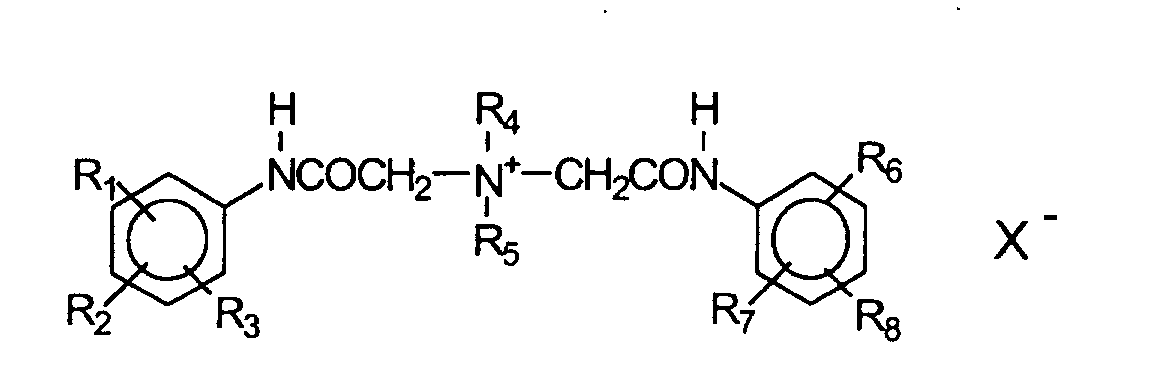
- Verwendung nach Anspruch 1, worin R1, R2, R3, R6, R7 und R8 jeweils Wasserstoff sind, R4 und R5 jeweils Methyl sind und X- ein Chloridanion ist.
- Verwendung nach Anspruch 1 oder 2, dargeboten in einer Form zur parenteralen, transdermalen, rektalen, topischen oder oralen Verabreichung.
- Verwendung nach Anspruch 1, dargeboten in einer Form zur oralen Verabreichung in einer Menge von etwa 1 bis etwa 250 mg einmalig oder bis zu viermal täglich, oder in einer Form zur parenteralen Verabreichung in einer Lösung von etwa 0,1% bis etwa 5% einmalig oder oder bis zu viermal täglich.
- Verwendung nach Anspruch 1 bis 4, worin der chronische/nicht-akute Schmerz ausgewählt ist aus der Gruppe bestehend aus dem Schmerz nach einer Gelenkoperation, Arthritis, Bursitis, Augenentzündung, Augenverletzung, Verbrennungen, Krebs, Diabetes und neurologischen Störungen.
Applications Claiming Priority (3)
| Application Number | Priority Date | Filing Date | Title |
|---|---|---|---|
| US5631297P | 1997-09-03 | 1997-09-03 | |
| US56312P | 1997-09-03 | ||
| PCT/CA1998/000842 WO1999011252A2 (en) | 1997-09-03 | 1998-09-03 | N,n-bis (phenylcarbamoylmethyl) dimethylammonium chloride and derivatives in the treatment of pain |
Publications (2)
| Publication Number | Publication Date |
|---|---|
| EP1009397A2 EP1009397A2 (de) | 2000-06-21 |
| EP1009397B1 true EP1009397B1 (de) | 2003-04-23 |
Family
ID=22003584
Family Applications (1)
| Application Number | Title | Priority Date | Filing Date |
|---|---|---|---|
| EP98941201A Expired - Lifetime EP1009397B1 (de) | 1997-09-03 | 1998-09-03 | Verwendung von n,n-bis (phenylcarbamoylmethyl) dimethylammoniumchlorid und derivaten davon zur behandlung von chronischem schmerz |
Country Status (11)
| Country | Link |
|---|---|
| EP (1) | EP1009397B1 (de) |
| JP (1) | JP2001514216A (de) |
| CN (1) | CN1276722A (de) |
| AT (1) | ATE238047T1 (de) |
| AU (1) | AU8970198A (de) |
| BR (1) | BR9812182A (de) |
| CA (1) | CA2303815A1 (de) |
| DE (1) | DE69813839T2 (de) |
| ES (1) | ES2197500T3 (de) |
| TW (1) | TW536401B (de) |
| WO (1) | WO1999011252A2 (de) |
Families Citing this family (26)
| Publication number | Priority date | Publication date | Assignee | Title |
|---|---|---|---|---|
| EP1422217A3 (de) | 1998-04-01 | 2004-06-16 | Cardiome Pharma Corp. | Aminocyclohexylverbindungen und deren Verwendung |
| BR9911094A (pt) * | 1998-06-09 | 2001-10-30 | Nortran Pharmaceuticals Inc | Composições e métodos para o tratamento detosse |
| US7507545B2 (en) | 1999-03-31 | 2009-03-24 | Cardiome Pharma Corp. | Ion channel modulating activity method |
| US7057053B2 (en) | 2000-10-06 | 2006-06-06 | Cardiome Pharma Corp. | Ion channel modulating compounds and uses thereof |
| US7524879B2 (en) | 2000-10-06 | 2009-04-28 | Cardiome Pharma Corp. | Ion channel modulating compounds and uses thereof |
| US7345086B2 (en) | 2003-05-02 | 2008-03-18 | Cardiome Pharma Corp. | Uses of ion channel modulating compounds |
| KR101059379B1 (ko) | 2003-05-02 | 2011-08-26 | 카디오메 파마 코포레이션 | 아미노사이클로헥실 에테르 화합물, 이의 제조방법 및 이를 포함하는 약제학적 조성물 |
| US7674820B2 (en) | 2003-08-07 | 2010-03-09 | Cardiome Pharma Corp. | Ion channel modulating activity I |
| US7345087B2 (en) | 2003-10-31 | 2008-03-18 | Cardiome Pharma Corp. | Aminocyclohexyl ether compounds and uses thereof |
| US7977373B2 (en) | 2004-04-01 | 2011-07-12 | Cardiome Pharma Corp. | Prodrugs of ion channel modulating compounds and uses thereof |
| US8058304B2 (en) | 2004-04-01 | 2011-11-15 | Cardiome Pharma Corp. | Merged ion channel modulating compounds and uses thereof |
| US8263638B2 (en) | 2004-11-08 | 2012-09-11 | Cardiome Pharma Corp. | Dosing regimens for ion channel modulating compounds |
| EP2101819B1 (de) | 2006-11-20 | 2013-01-09 | President and Fellows of Harvard College | Verfahren, zusammensetzungen und sets zur behandlung von schmerzen und pruritis |
| EP2995303A1 (de) | 2009-07-10 | 2016-03-16 | President and Fellows of Harvard College | Permanent geladene natrium- und calciumkanalblocker als entzündungshemmende mittel |
| WO2017024037A1 (en) | 2015-08-03 | 2017-02-09 | President And Fellows Of Harvard College | Charged ion channel blockers and methods for use |
| US10786485B1 (en) | 2019-03-11 | 2020-09-29 | Nocion Therapeutics, Inc. | Charged ion channel blockers and methods for use |
| MA55307A (fr) | 2019-03-11 | 2022-01-19 | Nocion Therapeutics Inc | Bloqueurs de canaux ioniques chargés et procédés d'utilisation |
| EP3937945A4 (de) | 2019-03-11 | 2023-01-04 | Nocion Therapeutics, Inc. | Geladene ionenkanalblocker und verfahren zur verwendung |
| US10780083B1 (en) | 2019-03-11 | 2020-09-22 | Nocion Therapeutics, Inc. | Charged ion channel blockers and methods for use |
| BR112021017809A2 (pt) | 2019-03-11 | 2021-11-23 | Nocion Therapeutics Inc | Bloqueadores de canais iônicos substituídos por éster e métodos para uso |
| WO2021091585A1 (en) | 2019-11-06 | 2021-05-14 | Nocion Therapeutics, Inc. | Charged ion channel blockers and methods for use |
| US10933055B1 (en) | 2019-11-06 | 2021-03-02 | Nocion Therapeutics, Inc. | Charged ion channel blockers and methods for use |
| JP7708777B2 (ja) | 2020-03-11 | 2025-07-15 | ノシオン セラピューティクス,インコーポレイテッド | 荷電したイオンチャンネル遮断薬および使用方法 |
| US12162851B2 (en) | 2020-03-11 | 2024-12-10 | Nocion Therapeutics, Inc. | Charged ion channel blockers and methods for use |
| WO2023100836A1 (ja) * | 2021-11-30 | 2023-06-08 | マルホ株式会社 | 医薬組成物 |
| CN118265526A (zh) * | 2021-11-30 | 2024-06-28 | 玛路弘株式会社 | 药物组合物 |
-
1998
- 1998-08-31 TW TW087114395A patent/TW536401B/zh active
- 1998-09-03 CA CA002303815A patent/CA2303815A1/en not_active Abandoned
- 1998-09-03 JP JP2000508355A patent/JP2001514216A/ja active Pending
- 1998-09-03 WO PCT/CA1998/000842 patent/WO1999011252A2/en not_active Ceased
- 1998-09-03 ES ES98941201T patent/ES2197500T3/es not_active Expired - Lifetime
- 1998-09-03 AU AU89701/98A patent/AU8970198A/en not_active Abandoned
- 1998-09-03 DE DE69813839T patent/DE69813839T2/de not_active Expired - Fee Related
- 1998-09-03 CN CN98810388A patent/CN1276722A/zh active Pending
- 1998-09-03 EP EP98941201A patent/EP1009397B1/de not_active Expired - Lifetime
- 1998-09-03 BR BR9812182-0A patent/BR9812182A/pt not_active IP Right Cessation
- 1998-09-03 AT AT98941201T patent/ATE238047T1/de not_active IP Right Cessation
Also Published As
| Publication number | Publication date |
|---|---|
| CN1276722A (zh) | 2000-12-13 |
| JP2001514216A (ja) | 2001-09-11 |
| TW536401B (en) | 2003-06-11 |
| DE69813839D1 (de) | 2003-05-28 |
| WO1999011252A2 (en) | 1999-03-11 |
| BR9812182A (pt) | 2002-01-15 |
| HK1028957A1 (en) | 2001-03-16 |
| EP1009397A2 (de) | 2000-06-21 |
| CA2303815A1 (en) | 1999-03-11 |
| AU8970198A (en) | 1999-03-22 |
| DE69813839T2 (de) | 2004-03-04 |
| ATE238047T1 (de) | 2003-05-15 |
| ES2197500T3 (es) | 2004-01-01 |
| WO1999011252A3 (en) | 1999-05-06 |
Similar Documents
| Publication | Publication Date | Title |
|---|---|---|
| EP1009397A2 (de) | N,n-bis (phenylcarbamoylmethyl) dimethylammoniumchlorid und derivate als schmerzmittel | |
| CA1241600A (en) | Pharmaceutical products providing enhanced analgesia | |
| Catterall et al. | Local anesthetics | |
| US20040248964A1 (en) | Analgesic uses of norketamine and ketamine/norketamine prodrugs | |
| JPH0255416B2 (de) | ||
| JPS6084251A (ja) | 鎮痛用新規化合物および組成物 | |
| KR20020016832A (ko) | 모르핀 글루코네이트로 이루어진 조성물 및 방법 | |
| US9199917B2 (en) | N-substituted benzenepropanamide or benzenepropenamide derivatives for use in the treatment of pain and inflammation | |
| US6703398B2 (en) | Orally administered analgesic compositions containing nalbuphine | |
| US6413987B1 (en) | Dermal anesthetic agents | |
| JPWO2002053153A1 (ja) | 神経因性疼痛治療及び予防薬 | |
| US20060110333A1 (en) | Composition for nasal absorption | |
| JPH0269417A (ja) | 精神分裂病治療用組成物 | |
| US6107330A (en) | Inhibitor for narcotic analgesic dependence/resistance acquisition | |
| HK1028957B (en) | Use of n,n-bis (phenylcarbamoylmethyl) dimethylammonium chloride and derivatives in the treatment of chronic pain | |
| JPS6348217A (ja) | 麻酔薬組成物 | |
| MXPA00002207A (en) | N,n-bis (phenylcarbamoylmethyl) dimethylammonium chloride and derivatives in the treatment of pain | |
| KR20010024768A (ko) | 혈관성 두통에 대한 국소 마취제의 신규 용도 | |
| IE853253L (en) | Antiinflamaatory compounds | |
| MXPA01001461A (es) | Metabolitos de difenhidramina no sedantes. | |
| US3594477A (en) | Optically active pyridine derivatives in pharmaceutical compositions and their use as analgesics and stimulants | |
| US12502371B2 (en) | Drug for treating and preventing dementia | |
| JP2003504396A (ja) | マクロライド化合物の新規用途 | |
| EP1658847A2 (de) | Indanderivate als dermale Anästhetika | |
| HK1079461B (en) | Analgesic uses of (s)-norketamine |
Legal Events
| Date | Code | Title | Description |
|---|---|---|---|
| PUAI | Public reference made under article 153(3) epc to a published international application that has entered the european phase |
Free format text: ORIGINAL CODE: 0009012 |
|
| 17P | Request for examination filed |
Effective date: 20000313 |
|
| AK | Designated contracting states |
Kind code of ref document: A2 Designated state(s): AT BE CH CY DE DK ES FI FR GB GR IE IT LI LU MC NL PT SE |
|
| 17Q | First examination report despatched |
Effective date: 20010504 |
|
| GRAG | Despatch of communication of intention to grant |
Free format text: ORIGINAL CODE: EPIDOS AGRA |
|
| RIC1 | Information provided on ipc code assigned before grant |
Free format text: 7A 61K 31/165 A, 7A 61P 29/00 B |
|
| RTI1 | Title (correction) |
Free format text: USE OF N,N-BIS (PHENYLCARBAMOYLMETHYL) DIMETHYLAMMONIUM CHLORIDE AND DERIVATIVES IN THE TREATMENT OF CHRONIC PAIN |
|
| RIC1 | Information provided on ipc code assigned before grant |
Free format text: 7A 61K 31/165 A, 7A 61P 29/00 B |
|
| RTI1 | Title (correction) |
Free format text: USE OF N,N-BIS (PHENYLCARBAMOYLMETHYL) DIMETHYLAMMONIUM CHLORIDE AND DERIVATIVES IN THE TREATMENT OF CHRONIC PAIN |
|
| GRAG | Despatch of communication of intention to grant |
Free format text: ORIGINAL CODE: EPIDOS AGRA |
|
| GRAG | Despatch of communication of intention to grant |
Free format text: ORIGINAL CODE: EPIDOS AGRA |
|
| GRAH | Despatch of communication of intention to grant a patent |
Free format text: ORIGINAL CODE: EPIDOS IGRA |
|
| GRAG | Despatch of communication of intention to grant |
Free format text: ORIGINAL CODE: EPIDOS AGRA |
|
| RAP1 | Party data changed (applicant data changed or rights of an application transferred) |
Owner name: CARDIOME PHARMA CORP. |
|
| GRAH | Despatch of communication of intention to grant a patent |
Free format text: ORIGINAL CODE: EPIDOS IGRA |
|
| GRAA | (expected) grant |
Free format text: ORIGINAL CODE: 0009210 |
|
| RAP1 | Party data changed (applicant data changed or rights of an application transferred) |
Owner name: UCB FARCHIM, S.A. |
|
| RAP1 | Party data changed (applicant data changed or rights of an application transferred) |
Owner name: UCB FARCHIM S.A. |
|
| AK | Designated contracting states |
Designated state(s): AT BE CH CY DE DK ES FI FR GB GR IE IT LI LU MC NL PT SE |
|
| PG25 | Lapsed in a contracting state [announced via postgrant information from national office to epo] |
Ref country code: NL Free format text: LAPSE BECAUSE OF FAILURE TO SUBMIT A TRANSLATION OF THE DESCRIPTION OR TO PAY THE FEE WITHIN THE PRESCRIBED TIME-LIMIT Effective date: 20030423 Ref country code: FI Free format text: LAPSE BECAUSE OF FAILURE TO SUBMIT A TRANSLATION OF THE DESCRIPTION OR TO PAY THE FEE WITHIN THE PRESCRIBED TIME-LIMIT Effective date: 20030423 Ref country code: BE Free format text: LAPSE BECAUSE OF FAILURE TO SUBMIT A TRANSLATION OF THE DESCRIPTION OR TO PAY THE FEE WITHIN THE PRESCRIBED TIME-LIMIT Effective date: 20030423 Ref country code: AT Free format text: LAPSE BECAUSE OF FAILURE TO SUBMIT A TRANSLATION OF THE DESCRIPTION OR TO PAY THE FEE WITHIN THE PRESCRIBED TIME-LIMIT Effective date: 20030423 |
|
| REG | Reference to a national code |
Ref country code: GB Ref legal event code: FG4D |
|
| REG | Reference to a national code |
Ref country code: CH Ref legal event code: EP |
|
| REF | Corresponds to: |
Ref document number: 69813839 Country of ref document: DE Date of ref document: 20030528 Kind code of ref document: P |
|
| REG | Reference to a national code |
Ref country code: IE Ref legal event code: FG4D |
|
| PG25 | Lapsed in a contracting state [announced via postgrant information from national office to epo] |
Ref country code: SE Free format text: LAPSE BECAUSE OF FAILURE TO SUBMIT A TRANSLATION OF THE DESCRIPTION OR TO PAY THE FEE WITHIN THE PRESCRIBED TIME-LIMIT Effective date: 20030723 Ref country code: PT Free format text: LAPSE BECAUSE OF FAILURE TO SUBMIT A TRANSLATION OF THE DESCRIPTION OR TO PAY THE FEE WITHIN THE PRESCRIBED TIME-LIMIT Effective date: 20030723 Ref country code: GR Free format text: LAPSE BECAUSE OF FAILURE TO SUBMIT A TRANSLATION OF THE DESCRIPTION OR TO PAY THE FEE WITHIN THE PRESCRIBED TIME-LIMIT Effective date: 20030723 Ref country code: DK Free format text: LAPSE BECAUSE OF FAILURE TO SUBMIT A TRANSLATION OF THE DESCRIPTION OR TO PAY THE FEE WITHIN THE PRESCRIBED TIME-LIMIT Effective date: 20030723 |
|
| REG | Reference to a national code |
Ref country code: CH Ref legal event code: NV Representative=s name: HANS ULRICH SEIFERT FELBER SEIFERT & PARTNER |
|
| PG25 | Lapsed in a contracting state [announced via postgrant information from national office to epo] |
Ref country code: LU Free format text: LAPSE BECAUSE OF NON-PAYMENT OF DUE FEES Effective date: 20030903 Ref country code: IE Free format text: LAPSE BECAUSE OF NON-PAYMENT OF DUE FEES Effective date: 20030903 Ref country code: CY Free format text: LAPSE BECAUSE OF FAILURE TO SUBMIT A TRANSLATION OF THE DESCRIPTION OR TO PAY THE FEE WITHIN THE PRESCRIBED TIME-LIMIT Effective date: 20030903 |
|
| PG25 | Lapsed in a contracting state [announced via postgrant information from national office to epo] |
Ref country code: MC Free format text: LAPSE BECAUSE OF NON-PAYMENT OF DUE FEES Effective date: 20030930 |
|
| NLV1 | Nl: lapsed or annulled due to failure to fulfill the requirements of art. 29p and 29m of the patents act | ||
| REG | Reference to a national code |
Ref country code: ES Ref legal event code: FG2A Ref document number: 2197500 Country of ref document: ES Kind code of ref document: T3 |
|
| ET | Fr: translation filed | ||
| PLBE | No opposition filed within time limit |
Free format text: ORIGINAL CODE: 0009261 |
|
| STAA | Information on the status of an ep patent application or granted ep patent |
Free format text: STATUS: NO OPPOSITION FILED WITHIN TIME LIMIT |
|
| 26N | No opposition filed |
Effective date: 20040126 |
|
| REG | Reference to a national code |
Ref country code: IE Ref legal event code: MM4A |
|
| PGFP | Annual fee paid to national office [announced via postgrant information from national office to epo] |
Ref country code: GB Payment date: 20040901 Year of fee payment: 7 |
|
| PGFP | Annual fee paid to national office [announced via postgrant information from national office to epo] |
Ref country code: DE Payment date: 20040902 Year of fee payment: 7 |
|
| PGFP | Annual fee paid to national office [announced via postgrant information from national office to epo] |
Ref country code: FR Payment date: 20040908 Year of fee payment: 7 |
|
| PGFP | Annual fee paid to national office [announced via postgrant information from national office to epo] |
Ref country code: CH Payment date: 20040915 Year of fee payment: 7 |
|
| PGFP | Annual fee paid to national office [announced via postgrant information from national office to epo] |
Ref country code: ES Payment date: 20040929 Year of fee payment: 7 |
|
| PG25 | Lapsed in a contracting state [announced via postgrant information from national office to epo] |
Ref country code: IT Free format text: LAPSE BECAUSE OF NON-PAYMENT OF DUE FEES Effective date: 20050903 Ref country code: GB Free format text: LAPSE BECAUSE OF NON-PAYMENT OF DUE FEES Effective date: 20050903 |
|
| PG25 | Lapsed in a contracting state [announced via postgrant information from national office to epo] |
Ref country code: ES Free format text: LAPSE BECAUSE OF NON-PAYMENT OF DUE FEES Effective date: 20050905 |
|
| PG25 | Lapsed in a contracting state [announced via postgrant information from national office to epo] |
Ref country code: LI Free format text: LAPSE BECAUSE OF NON-PAYMENT OF DUE FEES Effective date: 20050930 Ref country code: CH Free format text: LAPSE BECAUSE OF NON-PAYMENT OF DUE FEES Effective date: 20050930 |
|
| PG25 | Lapsed in a contracting state [announced via postgrant information from national office to epo] |
Ref country code: DE Free format text: LAPSE BECAUSE OF NON-PAYMENT OF DUE FEES Effective date: 20060401 |
|
| REG | Reference to a national code |
Ref country code: CH Ref legal event code: PL |
|
| GBPC | Gb: european patent ceased through non-payment of renewal fee |
Effective date: 20050903 |
|
| PG25 | Lapsed in a contracting state [announced via postgrant information from national office to epo] |
Ref country code: FR Free format text: LAPSE BECAUSE OF NON-PAYMENT OF DUE FEES Effective date: 20060531 |
|
| REG | Reference to a national code |
Ref country code: FR Ref legal event code: ST Effective date: 20060531 |
|
| REG | Reference to a national code |
Ref country code: ES Ref legal event code: FD2A Effective date: 20050905 |