EP0964308A2 - Belichtungsverfahren und -Apparat und Verfahren zur Herstellung einer Vorrichtung unter Verwendung derselben - Google Patents
Belichtungsverfahren und -Apparat und Verfahren zur Herstellung einer Vorrichtung unter Verwendung derselben Download PDFInfo
- Publication number
- EP0964308A2 EP0964308A2 EP99304577A EP99304577A EP0964308A2 EP 0964308 A2 EP0964308 A2 EP 0964308A2 EP 99304577 A EP99304577 A EP 99304577A EP 99304577 A EP99304577 A EP 99304577A EP 0964308 A2 EP0964308 A2 EP 0964308A2
- Authority
- EP
- European Patent Office
- Prior art keywords
- reticle
- holding member
- pattern
- holding
- alignment
- Prior art date
- Legal status (The legal status is an assumption and is not a legal conclusion. Google has not performed a legal analysis and makes no representation as to the accuracy of the status listed.)
- Withdrawn
Links
Images




Classifications
-
- G—PHYSICS
- G03—PHOTOGRAPHY; CINEMATOGRAPHY; ANALOGOUS TECHNIQUES USING WAVES OTHER THAN OPTICAL WAVES; ELECTROGRAPHY; HOLOGRAPHY
- G03F—PHOTOMECHANICAL PRODUCTION OF TEXTURED OR PATTERNED SURFACES, e.g. FOR PRINTING, FOR PROCESSING OF SEMICONDUCTOR DEVICES; MATERIALS THEREFOR; ORIGINALS THEREFOR; APPARATUS SPECIALLY ADAPTED THEREFOR
- G03F9/00—Registration or positioning of originals, masks, frames, photographic sheets or textured or patterned surfaces, e.g. automatically
- G03F9/70—Registration or positioning of originals, masks, frames, photographic sheets or textured or patterned surfaces, e.g. automatically for microlithography
- G03F9/7069—Alignment mark illumination, e.g. darkfield, dual focus
-
- H10P76/00—
-
- G—PHYSICS
- G03—PHOTOGRAPHY; CINEMATOGRAPHY; ANALOGOUS TECHNIQUES USING WAVES OTHER THAN OPTICAL WAVES; ELECTROGRAPHY; HOLOGRAPHY
- G03F—PHOTOMECHANICAL PRODUCTION OF TEXTURED OR PATTERNED SURFACES, e.g. FOR PRINTING, FOR PROCESSING OF SEMICONDUCTOR DEVICES; MATERIALS THEREFOR; ORIGINALS THEREFOR; APPARATUS SPECIALLY ADAPTED THEREFOR
- G03F7/00—Photomechanical, e.g. photolithographic, production of textured or patterned surfaces, e.g. printing surfaces; Materials therefor, e.g. comprising photoresists; Apparatus specially adapted therefor
- G03F7/70—Microphotolithographic exposure; Apparatus therefor
- G03F7/70691—Handling of masks or workpieces
- G03F7/70716—Stages
-
- G—PHYSICS
- G03—PHOTOGRAPHY; CINEMATOGRAPHY; ANALOGOUS TECHNIQUES USING WAVES OTHER THAN OPTICAL WAVES; ELECTROGRAPHY; HOLOGRAPHY
- G03F—PHOTOMECHANICAL PRODUCTION OF TEXTURED OR PATTERNED SURFACES, e.g. FOR PRINTING, FOR PROCESSING OF SEMICONDUCTOR DEVICES; MATERIALS THEREFOR; ORIGINALS THEREFOR; APPARATUS SPECIALLY ADAPTED THEREFOR
- G03F9/00—Registration or positioning of originals, masks, frames, photographic sheets or textured or patterned surfaces, e.g. automatically
- G03F9/70—Registration or positioning of originals, masks, frames, photographic sheets or textured or patterned surfaces, e.g. automatically for microlithography
- G03F9/7003—Alignment type or strategy, e.g. leveling, global alignment
- G03F9/7007—Alignment other than original with workpiece
- G03F9/7011—Pre-exposure scan; original with original holder alignment; Prealignment, i.e. workpiece with workpiece holder
-
- G—PHYSICS
- G03—PHOTOGRAPHY; CINEMATOGRAPHY; ANALOGOUS TECHNIQUES USING WAVES OTHER THAN OPTICAL WAVES; ELECTROGRAPHY; HOLOGRAPHY
- G03F—PHOTOMECHANICAL PRODUCTION OF TEXTURED OR PATTERNED SURFACES, e.g. FOR PRINTING, FOR PROCESSING OF SEMICONDUCTOR DEVICES; MATERIALS THEREFOR; ORIGINALS THEREFOR; APPARATUS SPECIALLY ADAPTED THEREFOR
- G03F9/00—Registration or positioning of originals, masks, frames, photographic sheets or textured or patterned surfaces, e.g. automatically
- G03F9/70—Registration or positioning of originals, masks, frames, photographic sheets or textured or patterned surfaces, e.g. automatically for microlithography
- G03F9/7003—Alignment type or strategy, e.g. leveling, global alignment
- G03F9/7007—Alignment other than original with workpiece
- G03F9/7015—Reference, i.e. alignment of original or workpiece with respect to a reference not on the original or workpiece
Definitions
- This invention relates to an exposure method and a device manufacturing method using the same. More particularly, the invention is concerned with an exposure apparatus or a projection exposure apparatus based on a proximity method, a step-and-repeat method or a step-and-scan method, for use in production of various devices such as IC, LSI, CCD, liquid crystal panel, or magnetic head, for example, wherein a fine electronic circuit pattern formed on a reticle (first object) is lithographically transferred to a wafer (second object) after they are relatively aligned.
- a circuit pattern of a reticle is projected and printed on a wafer (second object) through a projection lens system.
- an observing system detecting means
- positional registration alignment between the reticle and the wafer is made.
- a reticle alignment operation In conventional exposure apparatuses, once a reticle is aligned with respect to a reference mark provided in a portion of the exposure apparatus (reticle alignment operation), the reticle is held fixed until the next alignment operation. For this reason, the position of the reticle is dependent upon the holding performance (holding precision) of a holding member (generally, a reticle stage) for holding the reticle.
- a holding member generally, a reticle stage
- the reticle alignment is performed in response to reticle replacement.
- the frequency of alignment operation differs in dependence upon the user. If therefore there occurs variation in environment or vibration or acceleration in the apparatus, for example, due to the influence thereof, there may occur a change in relative position between the reticle and the holding member therefor. In that occasion, when the pattern of the reticle is projected and printed on a wafer, the exposure position may displace or a deviation may occur during the exposure process. It causes degradation of resolving power for the pattern image.
- Figure 1 is a schematic view of a main portion of an exposure apparatus according to an embodiment of the present invention.
- Figure 2 is an enlarged view of a portion of Figure 1.
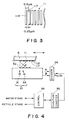
- Figure 3 is a schematic view for explaining the pattern in a portion of detecting means in Figure 2.
- Figure 4 is a schematic and diagrammatic view of a portion of Figure 2.
- Figure 5 is a flow chart for explaining semiconductor device manufacturing processes, according to an embodiment of the present invention.
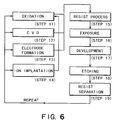
- Figure 6 is a flow chart for explaining details of a wafer process.
- Figure 7 is a perspective view of a main portion of an exposure apparatus according to another embodiment of the present invention.
- Figure 1 is a schematic view of a main portion of an exposure apparatus according to a first embodiment of the present invention.
- the invention is applied to a step-and-repeat type or step-and-scan type projection exposure apparatus for manufacture of semiconductor devices.
- Figure 2 is a schematic view for explaining a portion around a reticle 6 in Figure 1, particularly, in the case of step-and-scan method.
- the apparatus is equipped with a structure and function that, if, after relative alignment between a reticle 6 and a wafer 42 is completed, there occurs relative displacement between the reticle 6 and a reticle holding device (reticle stage) 21 therefor as a result of any influence by a change in environment or vibration or acceleration applied externally, the amount of such displacement is detected in real time by means of a linear encoder, and the position of the reticle and/or the wafer is corrected.
- the method of relative alignment between the reticle 6 and the wafer 42 will be described first.
- the relative alignment between the reticle 6 and the wafer 42 may be done in accordance with a known method, such as disclosed in Japanese Laid-Open Patent Application, Laid-Open No. 41219/1998.
- denoted at 6 is a reticle (first object) which is placed on a reticle stage 21.
- the reticle 6 can be illuminated with exposure light from illumination means 41.
- Denoted at 8a and 8b are a reticle alignment mark formed on the reticle 6 surface and another alignment mark to be used for baseline measurement.
- Denoted at 42 is a wafer (second object) having a wafer alignment mark 43 formed on its surface.
- Denoted at 44 is a projection optical system having a projection lens system, for projecting a circuit pattern, for example, formed on the reticle 6 surface onto the wafer 42 surface.
- Denoted at 50 is a ⁇ -Z stage on which the wafer 42 is placed. It serves to perform ⁇ rotation of the wafer 42 as well as focus adjustment (adjustment in Z direction) of the wafer.
- a stage reference mark 100 which is made by a Si substrate machined into a predetermined shape.
- the ⁇ -Z stage 50 is mounted on an X-Y stage 45 for performing high precision stepwise motion.
- Mounted on the X-Y stage 45 is an optical square 46 which functions to provide a reference for the stage position measurement. This optical square is monitored by a laser interferometer 47.
- the ⁇ -Z 50 and the X-Y stage 45 are components of driving means.
- the alignment procedure for the reticle 6 and the wafer 42 in this embodiment is performed indirectly, through an alignment process using a mark provided in a TTL microscope 80, to be described later.
- any relative deviation between the reference mark 64 and the reticle alignment mark 8a is detected by using a TTR (Through-The-Reticle) microscope 60 and, then, they are brought into alignment with each other.
- TTR Through-The-Reticle
- Figure 1 there is only one TTR microscope 60 illustrated, another microscope is provided on the left-hand side of the optical axis 44a of the projection optical system 44.
- rotation of the reticle 6 can be detected and, thus, further improvement of alignment precision is attainable.
- the alignment of the reticle 6 and the reference mark 64 is performed in the following manner.
- the TTR microscope 60 includes a combination of a mirror 48 and an objective lens 49a, and a mechanism (not shown) for moving them along a plane parallel to the reticle 6.
- the system from the objective lens 49a to a relay lens 69a is an afocal system.
- the mirror 48 and the objective lens 49a Prior to detection of the reference mark 64, the mirror 48 and the objective lens 49a are moved to the position for alignment of the reticle 6.
- Light from an exposure light source 41 goes through a light guide 70, and it is directed to the TTR microscope 60.
- a wavelength selecting filter 68 By means of a wavelength selecting filter 68, only a wavelength corresponding to the exposure light, in this example, is selected and directed into the TTR microscope 60.
- the wavelength selecting filter 68 By means of the wavelength selecting filter 68, only light of predetermined wavelength width is allowed to pass, and the light is collected by a condenser lens 62a and then it is reflected by a beam splitter 61.
- the light reflected by the beam splitter 61 goes via the objective lens 49a and the mirror 48, with which the reticle alignment mark 8a and the reference mark 64 are illuminated.
- the reticle alignment mark 8a of the reticle 6 and the reference mark 64 are set to be disposed with a spacing not greater than the depth of focus of the objective lens 49a.
- the light reflected by the reticle alignment mark 8a and the reference mark 64 goes back along its on-coming path, via the mirror 48 and the objective lens 49a in this order, and after passing the beam splitter 61, it is projected on a CCD 19a surface.
- mark images of these marks are formed thereon.
- a video signal as provided by photoelectric conversion through the CCD camera 19a is transmitted to an image processing device (not shown), whereby relative deviation between the reticle alignment mark 8a and the reference mark 64 is calculated.
- the reticle stage 21 is moved to bring the reticle 6 into alignment with the major assembly of the exposure apparatus.
- the alignment of a wafer 42 is performed by detecting a wafer alignment mark (mark) 43 provided on the wafer 42, by using a TTL (Through-The-Lens) microscope 80.
- a light source which comprises a white light source such as a halogen lamp, for example.
- Wavelength selecting filter 66 functions to pass therethrough only light of a predetermined wavelength width (for example, a wavelength of 633 ⁇ 20 nm and a half width of 40 nm), different from the exposure light, out of the light from the light source 63.
- the light goes through a condenser lens (illumination optical system) 62 and impinges on a polarization beam splitter 67 by which rectilinearly polarized light having a plane of polarization in a predetermined direction is reflected.
- the light reflected by the polarization beam splitter 67 is then transformed by a quarter waveplate 65 into circularly polarized light which then goes through a correcting lens 49, for correction of spherical aberration or chromatic aberration. Then, the light is reflected by a mirror M1 and enters the projection lens system 44. The light received by the projection lens system 44 is emitted thereby, to illuminate the wafer alignment mark 43 upon the wafer 42 surface.
- the position of the mark image thus formed on the CCD 19 surface is observed (measured) by using image processing means (not shown), by which the positional relation of the wafer 42 can be detected.
- image processing means not shown
- a deviation of the mark image from a reference position (reference mark) defined on the CCD 19 surface may be detected.
- the TTL microscope 80 is used to perform the wafer alignment, in the following manner.
- the X-Y stage 45 is moved to place a mark 43, of a shot with respect to which the alignment is to be performed first, below the TTL microscope 80.
- the driving coordinates for the X-Y stage 45 may be the coordinates which are set as default, or it may be the coordinates as calculated by a preceding alignment measurement operation.
- the position of the mark 43 being observed through the TTL microscope 80 is calculated.
- the X-Y stage 45 is moved toward the second alignment measurement shot position.
- alignment measurement is performed to the shots of a number being preset, and a driving grid for X-Y stage 45 in exposure operation is calculated.
- the X-Y stage 45 is then moved in accordance with the grid, and exposures of the wafer 42 are performed.
- the sampling of alignment shots within the wafer 42 may be made substantially concentric.
- baseline measurement is performed. This measurement uses a stage reference mark 100 which is provided on the X-Y stage 45.
- the alignment procedure has been described with reference to TTL off-axis alignment method using the projection optical system, the present invention is not limited to it.
- a TTL on-axis alignment method or a Non-TTL off-axis alignment method may be used similarly.
- Figure 2 is a schematic view for explaining detection of positional deviation of a reticle 6, placed on a reticle stage 21, by using a pattern (reticle mark) provided on the reticle 6.
- the laser interferometer 1 functions for measuring a position Y1
- the laser interferometer 2 functions for measuring a position Y2.
- the Y position measurement to the reticle stage 21 is made on the basis of the position Y1 and the position Y2, or of an average of the positions Y1 and Y2.
- Displacement of ⁇ is measured on the basis of a difference between positions Y1 and Y2.
- the laser interferometer 3 functions for position measurement with respect to X direction.
- Denoted at 4 and 5 are stators and movable elements, constituting a linear motor mechanism for X, Y and ⁇ drive of the reticle stage 21.
- the reticle stage 21 can be moved in Y direction, by means of the linear motor mechanism (4, 5). This enables scanning exposure.
- Denoted at 6 is a reticle
- denoted at 8a is a reticle mark (reticle alignment mark) for the reticle alignment.
- Denoted at 64 is a reticle reference mark which is provided on the reticle stage 21, for the reticle alignment.
- Denoted at 9 are reticle attracting pads for fixedly holding the reticle 6 on the reticle stage 21.
- Denoted at 10 (10a, 10b, 10c, 10d) is detecting means which constitutes a portion of linear encoder means for detecting relative displacement between the reticle 6 and the reticle stage 21. It is provided on the reticle stage 21.
- Denoted at 11 (11a, 11b, 11c, 11d) are linear encoder patterns, constituting a portion of the linear encoder for detecting relative displacement of the reticle 6 and the reticle stage 21, which are provided on the reticle side.
- Characters a, b, c and d denote linear encoder means (detecting means) each comprising a detecting device 10, a pattern 11 and a pattern 32, in this example. They are disposed at four corners of the reticle 6, in this embodiment.
- Figure 3 shows a portion of the pattern 11 for the linear encoder, which is provided on the reticle 6.
- the pattern 11 comprises a rectangular pattern having a reflective portion 11R and a nonreflective portion 11T, of linewidth 0.25 micron.
- the reticle 6 is conveyed onto the reticle stage 21 by reticle conveying means (not shown).
- the reticle 6 is then set or aligned by a reticle alignment system (not shown) and reticle alignment driving means (not shown) so that the deviation between the reticle alignment mark 8a and the reticle reference mark 64 is minimized.
- the reticle is held fixed on the reticle stage 21 by means of the reticle attracting pads 9.
- a deviation after the fixation is measured by using the reticle alignment system (not shown). The thus measured value is used as offset in position correction.
- the value of a pulse counter which is a constituent element of the linear encoder is initialized. If, thereafter, relative displacement occurs between the reticle 6 and the reticle stage 21, the amount of relative displacement is detected in real time by the linear encoder means a, b, c and d, and a corresponding signal is outputted. On the basis of a signal from the detecting means, the position of the reticle 6 and/or of the wafer 42 is corrected by using the correcting means, whereby accurate projection exposure is assured.
- Figure 4 is a schematic view of a main portion of the linear encoder means of Figure 2. It is to be noted here that the linear encoder means may be based on one of known measurement methods.
- the linear encoder produces a signal corresponding to the period of the pattern 11.
- the output signal is supplied to a phase divider 34 by which the resolution is increased.
- the reticle stage 21 and/or the wafer stage is moved to perform the position correction.
- the divider 34 operates to divide a periodic pattern of 0.5 micron into 512 elements.
- a resolving power of about 1 nm ( ⁇ 0.5 micron divided by 512) is obtained.
- the linear encoder has a high resolution with respect to a direction orthogonal to the mark, but the sensitivity decreases with respect to the remaining five axes.
- plural encoders are used.
- correction of relative displacement between the reticle and the reticle stage may be performed just before a driving signal for moving the wafer to its exposure position is applied, or it may be performed during the wafer drive. This may be selected by an operator. In a scan type projection exposure apparatus, the correction may be made during the scanning exposure.
- This embodiment is particularly effective in a step-and-scan type exposure apparatus.
- reciprocal motion of high speed and high acceleration is repeated while a reticle is being held by a reticle stage.
- the speed and acceleration of the reciprocal motion are becoming higher.
- the reticle on the other hand, the reticle and its position on the reticle stage are assured only by the holding performance of the reticle stage. Thus, there arises a problem in respect to shift between the reticle and the reticle stage.
- Figure 7 is a schematic view for explaining the structure for detecting a positional deviation of a reticle 6 placed on a reticle stage 21, by using a pattern (reticle mark) provided on the reticle 6.
- X-, Y- and ⁇ -drive actuators and stages related to these axes for the reticle stage 21.
- the reticle stage 21 can be moved in X, Y and ⁇ directions by means of corresponding actuators.
- Denoted at 6 is a reticle
- denoted at 8a is a reticle mark (reticle alignment mark) to be used for the reticle alignment.
- Denoted at 64 is a reticle reference mark which is provided at the base side of the reticle stage 21, for the reticle alignment.
- Denoted at 9 are reticle attracting pads for fixedly holding the reticle 6 on the reticle stage 21.
- Denoted at 10 (10a, 10b, 10c, 10d) is detecting means which constitutes a portion of linear encoder means for detecting relative displacement between the reticle 6 and the reticle stage 21. It is provided on the reticle stage 21.
- Denoted at 11 (11a, 11b, 11c, 11d) are linear encoder patterns, constituting a portion of the linear encoder for detecting relative displacement of the reticle 6 and the reticle stage 21, which are provided on the reticle side.
- Characters a, b, c and d denote linear encoder means (detecting means) each comprising a detecting device 10, a pattern 11 and a pattern 32, in this example. They are disposed at four corners of the reticle 6, in this embodiment.
- Figure 3 shows a portion of the pattern 11 for the linear encoder, which is provided on the reticle 6.
- the pattern 11 comprises a rectangular pattern having a reflective portion 11R and a nonreflective portion 11T, of linewidth 0.25 micron.
- the reticle 6 is conveyed onto the reticle stage 21 by reticle conveying means (not shown).
- the reticle 6 is then set or aligned by using a reticle alignment system (not shown) and the X-, Y- and ⁇ actuators shown in Figure 7, so that the deviation between the reticle alignment mark 8a and the reticle reference mark 64 is minimized.
- a deviation after the fixation is measured by using the reticle alignment system (not shown). The thus measured value is used as offset in position correction.
- the value of a pulse counter which is a constituent element of the linear encoder is initialized. If, thereafter, relative displacement occurs between the reticle 6 and the reticle stage 21, the amount of relative displacement is detected in real time by the linear encoder means a, b, c and d, and a corresponding signal is outputted. On the basis of a signal from the detecting means, the position of the reticle 6 and/or of the wafer 42 is corrected by using the correcting means, whereby accurate projection exposure is assured.
- Figure 5 is a flow chart of procedure for manufacture of microdevices such as semiconductor chips (e.g. ICs or LSIs), liquid crystal panels, or CCDs, for example.
- semiconductor chips e.g. ICs or LSIs
- liquid crystal panels e.g. LCDs
- CCDs complementary metal-oxide-semiconductors
- Step 1 is a design process for designing a circuit of a semiconductor device.
- Step 2 is a process for making a mask on the basis of the circuit pattern design.
- Step 3 is a process for preparing a wafer by using a material such as silicon.
- Step 4 is a wafer process which is called a pre-process wherein, by using the so prepared mask and wafer, circuits are practically formed on the wafer through lithography.
- Step 5 subsequent to this is an assembling step which is called a post-process wherein the wafer having been processed by step 4 is formed into semiconductor chips. This step includes assembling (dicing and bonding) process and packaging (chip sealing) process.
- Step 6 is an inspection step wherein operation check, durability check and so on for the semiconductor devices provided by step 5, are carried out. With these processes, semiconductor devices are completed and they are shipped (step 7).
- Figure 6 is a flow chart showing details of the wafer process.
- Step 11 is an oxidation process for oxidizing the surface of a wafer.
- Step 12 is a CVD process for forming an insulating film on the wafer surface.
- Step 13 is an electrode forming process for forming electrodes upon the wafer by vapor deposition.
- Step 14 is an ion implanting process for implanting ions to the wafer.
- Step 15 is a resist process for applying a resist (photosensitive material) to the wafer.
- Step 16 is an exposure process for printing, by exposure, the circuit pattern of the mask on the wafer through the exposure apparatus described above.
- Step 17 is a developing process for developing the exposed wafer.
- Step 18 is an etching process for removing portions other than the developed resist image.
- Step 19 is a resist separation process for separating the resist material remaining on the wafer after being subjected to the etching process. By repeating these processes, circuit patterns are superposedly formed on the wafer.
- a change in relative positional relationship between a reticle (first object) and a reticle stage, after completion of relative alignment between the reticle and a wafer (second object), more specifically, after completion of alignment (reticle alignment) of the reticle with respect to a reference mark provided on the major assembly of the apparatus, can be detected. Further, on the basis of the result of detection, the position of the reticle and/or the wafer can be corrected. This accomplishes an exposure apparatus and a device manufacturing method using the same, by which large integration semiconductor devices can be produced easily.
- positional information related to a holding stage for holding a first object with a transfer pattern e.g., a reticle stage
- detecting means provided on the stage. This facilitates production of large integration semiconductor devices.
Landscapes
- Physics & Mathematics (AREA)
- General Physics & Mathematics (AREA)
- Exposure And Positioning Against Photoresist Photosensitive Materials (AREA)
- Exposure Of Semiconductors, Excluding Electron Or Ion Beam Exposure (AREA)
Applications Claiming Priority (2)
| Application Number | Priority Date | Filing Date | Title |
|---|---|---|---|
| JP18169898 | 1998-06-12 | ||
| JP10181698A JP2000003855A (ja) | 1998-06-12 | 1998-06-12 | 露光装置及びそれを用いたデバイスの製造方法 |
Publications (2)
| Publication Number | Publication Date |
|---|---|
| EP0964308A2 true EP0964308A2 (de) | 1999-12-15 |
| EP0964308A3 EP0964308A3 (de) | 2001-03-14 |
Family
ID=16105308
Family Applications (1)
| Application Number | Title | Priority Date | Filing Date |
|---|---|---|---|
| EP99304577A Withdrawn EP0964308A3 (de) | 1998-06-12 | 1999-06-11 | Belichtungsverfahren und -Apparat und Verfahren zur Herstellung einer Vorrichtung unter Verwendung derselben |
Country Status (4)
| Country | Link |
|---|---|
| US (1) | US6714691B2 (de) |
| EP (1) | EP0964308A3 (de) |
| JP (1) | JP2000003855A (de) |
| KR (1) | KR100294427B1 (de) |
Cited By (3)
| Publication number | Priority date | Publication date | Assignee | Title |
|---|---|---|---|---|
| EP1308789A2 (de) | 2001-10-30 | 2003-05-07 | Canon Kabushiki Kaisha | Ausrichtvorrichtung, diese verwendender Belichtungsapparat, und Verfahren zur Herstellung von Vorrichtungen |
| EP1260871A3 (de) * | 2001-05-22 | 2006-04-12 | Canon Kabushiki Kaisha | Verfahren und Vorrichtung zur Positionsdetektion, Belichtungsapparat und Verfahren zur Herstellung einer Vorrichtung |
| CN111258183A (zh) * | 2018-11-30 | 2020-06-09 | 佳能株式会社 | 光刻设备、确定方法和制造物品的方法 |
Families Citing this family (9)
| Publication number | Priority date | Publication date | Assignee | Title |
|---|---|---|---|---|
| JP4803901B2 (ja) * | 2001-05-22 | 2011-10-26 | キヤノン株式会社 | 位置合わせ方法、露光装置、および半導体デバイス製造方法 |
| US7714981B2 (en) * | 2006-10-30 | 2010-05-11 | Asml Netherlands B.V. | Lithographic apparatus and method |
| DE102008011761A1 (de) * | 2007-03-13 | 2008-09-18 | Carl Zeiss Smt Ag | Justagevorrichtung für eine Mikrolithografie-Projektionsbelichtungsanlage, Beleuchtungssystem mit einer derartigen Justagevorrichtung sowie Projektionsbelichtungsanlage mit einem derartigen Beleuchtungssystem |
| NL1036028A1 (nl) * | 2007-10-09 | 2009-04-15 | Asml Netherlands Bv | Servo control system, lithographic apparatus and control method. |
| NL2003529A (en) * | 2008-10-24 | 2010-04-27 | Asml Netherlands Bv | Lithographic apparatus, device manufacturing method and position control method. |
| JP5832345B2 (ja) * | 2012-03-22 | 2015-12-16 | 株式会社ニューフレアテクノロジー | 検査装置および検査方法 |
| CN102743134B (zh) * | 2012-07-30 | 2014-11-05 | 苏州诚河清洁设备有限公司 | 蒸汽清洗设备 |
| JP6564138B2 (ja) * | 2015-07-31 | 2019-08-21 | エーエスエムエル ホールディング エヌ.ブイ. | アライメントシステムの光学システム |
| US11867501B2 (en) * | 2021-12-28 | 2024-01-09 | Mloptic Corp. | Integrated calibration tool for optical instrument entrance pupil 6-axis spatial allocation |
Family Cites Families (19)
| Publication number | Priority date | Publication date | Assignee | Title |
|---|---|---|---|---|
| US4780615A (en) * | 1985-02-01 | 1988-10-25 | Canon Kabushiki Kaisha | Alignment system for use in pattern transfer apparatus |
| US5231471A (en) * | 1986-03-25 | 1993-07-27 | Canon Kabushiki Kaisha | Alignment and exposure apparatus |
| JPH02292813A (ja) * | 1989-05-02 | 1990-12-04 | Canon Inc | 自動焦点合せ装置 |
| US5151749A (en) * | 1989-06-08 | 1992-09-29 | Nikon Corporation | Method of and apparatus for measuring coordinate position and positioning an object |
| JPH0513297A (ja) * | 1991-07-09 | 1993-01-22 | Nikon Corp | 位置合わせ装置 |
| US5978071A (en) * | 1993-01-07 | 1999-11-02 | Nikon Corporation | Projection exposure apparatus and method in which mask stage is moved to provide alignment with a moving wafer stage |
| JPH07226357A (ja) * | 1993-12-16 | 1995-08-22 | Nikon Corp | 位置検出装置 |
| JP3186011B2 (ja) | 1994-06-24 | 2001-07-11 | キヤノン株式会社 | 投影露光装置及びデバイス製造方法 |
| KR100246574B1 (ko) * | 1994-12-26 | 2000-03-15 | 유무성 | 레티클 정렬장치 및 방법 |
| JP3819048B2 (ja) * | 1995-03-15 | 2006-09-06 | 株式会社ニコン | 投影光学系及びそれを備えた露光装置並びに露光方法 |
| US5751404A (en) * | 1995-07-24 | 1998-05-12 | Canon Kabushiki Kaisha | Exposure apparatus and method wherein alignment is carried out by comparing marks which are incident on both reticle stage and wafer stage reference plates |
| JP3689949B2 (ja) | 1995-12-19 | 2005-08-31 | 株式会社ニコン | 投影露光装置、及び該投影露光装置を用いたパターン形成方法 |
| JPH1050604A (ja) | 1996-04-04 | 1998-02-20 | Nikon Corp | 位置管理方法及び位置合わせ方法 |
| JPH1012544A (ja) * | 1996-06-26 | 1998-01-16 | Nikon Corp | 位置計測方法及び露光方法 |
| JPH1041219A (ja) | 1996-07-17 | 1998-02-13 | Canon Inc | 投影露光装置及びそれを用いたデバイスの製造方法 |
| US5917580A (en) * | 1996-08-29 | 1999-06-29 | Canon Kabushiki Kaisha | Scan exposure method and apparatus |
| JP3531894B2 (ja) * | 1996-09-13 | 2004-05-31 | キヤノン株式会社 | 投影露光装置 |
| US6490025B1 (en) * | 1997-03-17 | 2002-12-03 | Nikon Corporation | Exposure apparatus |
| JPH11307436A (ja) * | 1998-04-27 | 1999-11-05 | Fujitsu Ltd | 投影露光装置及びレチクル及びレチクルの位置決め方法 |
-
1998
- 1998-06-12 JP JP10181698A patent/JP2000003855A/ja active Pending
-
1999
- 1999-06-09 US US09/328,797 patent/US6714691B2/en not_active Expired - Fee Related
- 1999-06-11 EP EP99304577A patent/EP0964308A3/de not_active Withdrawn
- 1999-06-12 KR KR1019990021954A patent/KR100294427B1/ko not_active Expired - Fee Related
Cited By (8)
| Publication number | Priority date | Publication date | Assignee | Title |
|---|---|---|---|---|
| EP1260871A3 (de) * | 2001-05-22 | 2006-04-12 | Canon Kabushiki Kaisha | Verfahren und Vorrichtung zur Positionsdetektion, Belichtungsapparat und Verfahren zur Herstellung einer Vorrichtung |
| US7148973B2 (en) | 2001-05-22 | 2006-12-12 | Canon Kabushiki Kaisha | Position detecting method and apparatus, exposure apparatus and device manufacturing method |
| EP1308789A2 (de) | 2001-10-30 | 2003-05-07 | Canon Kabushiki Kaisha | Ausrichtvorrichtung, diese verwendender Belichtungsapparat, und Verfahren zur Herstellung von Vorrichtungen |
| EP1308789A3 (de) * | 2001-10-30 | 2006-04-12 | Canon Kabushiki Kaisha | Ausrichtvorrichtung, diese verwendender Belichtungsapparat, und Verfahren zur Herstellung von Vorrichtungen |
| US7173716B2 (en) | 2001-10-30 | 2007-02-06 | Canon Kabushiki Kaisha | Alignment apparatus, exposure apparatus using the same, and method of manufacturing devices |
| CN111258183A (zh) * | 2018-11-30 | 2020-06-09 | 佳能株式会社 | 光刻设备、确定方法和制造物品的方法 |
| EP3667423A1 (de) * | 2018-11-30 | 2020-06-17 | Canon Kabushiki Kaisha | Lithografievorrichtung, bestimmungsverfahren und verfahren zur herstellung eines artikels |
| US11275319B2 (en) | 2018-11-30 | 2022-03-15 | Canon Kabushiki Kaisha | Lithography apparatus, determination method, and method of manufacturing an article |
Also Published As
| Publication number | Publication date |
|---|---|
| KR100294427B1 (ko) | 2001-07-12 |
| US20030048960A1 (en) | 2003-03-13 |
| EP0964308A3 (de) | 2001-03-14 |
| US6714691B2 (en) | 2004-03-30 |
| KR20000006140A (ko) | 2000-01-25 |
| JP2000003855A (ja) | 2000-01-07 |
Similar Documents
| Publication | Publication Date | Title |
|---|---|---|
| US5751404A (en) | Exposure apparatus and method wherein alignment is carried out by comparing marks which are incident on both reticle stage and wafer stage reference plates | |
| US6529625B2 (en) | Position detecting method and position detecting device for detecting relative positions of objects having position detecting marks by using separate reference member having alignment marks | |
| US20030038937A1 (en) | Projection exposure apparatus and device manufacturing method using the same | |
| US6714691B2 (en) | Exposure method and apparatus, and device manufacturing method using the same | |
| US5745242A (en) | Position detecting system and exposure apparatus having the same | |
| US20010023918A1 (en) | Alignment apparatus, alignment method, exposure apparatus and exposure method | |
| JPH09199406A (ja) | 位置検出装置及びそれを用いた半導体素子の製造方法 | |
| US6268902B1 (en) | Exposure apparatus, and manufacturing method for devices using same | |
| EP1098360A1 (de) | Positionsfeststellungsverfahren, positionssensor, belichtungverfahren, belichtungsvorrichtung und verfahren zu ihrer herstellung und vorrichtungsherstellungsverfahren | |
| US6233042B1 (en) | Projection exposure apparatus and device manufacturing method using the same | |
| US6683673B2 (en) | Alignment system and projection exposure apparatus | |
| US6069683A (en) | Scanning exposure method and apparatus | |
| JP3335126B2 (ja) | 面位置検出装置及びそれを用いた走査型投影露光装置 | |
| JP3441930B2 (ja) | 走査型露光装置およびデバイス製造方法 | |
| US5999270A (en) | Projection exposure apparatus and microdevice manufacturing method using the same | |
| US7313873B2 (en) | Surface position measuring method, exposure apparatus, and device manufacturing method | |
| JP2005175383A (ja) | 露光装置、アライメント方法、及び、デバイスの製造方法 | |
| JPH11176745A (ja) | 位置検出装置及びそれを用いた露光装置 | |
| JP2002139847A (ja) | 露光装置、露光方法及びデバイス製造方法 | |
| JPH1154416A (ja) | 投影露光装置およびデバイス製造方法 | |
| JPH11111607A (ja) | ディストーション変化量の計測方法及びそれを利用した投影露光装置並びにそれらを用いたデバイスの製造方法 | |
| JPH1050594A (ja) | 位置合わせ装置及びそれを用いた投影露光装置 | |
| JPH0992592A (ja) | 走査露光装置及びそれを用いたデバイスの製造方法 | |
| JP2002257512A (ja) | 位置計測方法及びその装置、露光方法及びその装置、並びにデバイスの製造方法 |
Legal Events
| Date | Code | Title | Description |
|---|---|---|---|
| PUAI | Public reference made under article 153(3) epc to a published international application that has entered the european phase |
Free format text: ORIGINAL CODE: 0009012 |
|
| AK | Designated contracting states |
Kind code of ref document: A2 Designated state(s): DE GB NL |
|
| AX | Request for extension of the european patent |
Free format text: AL;LT;LV;MK;RO;SI |
|
| PUAL | Search report despatched |
Free format text: ORIGINAL CODE: 0009013 |
|
| AK | Designated contracting states |
Kind code of ref document: A3 Designated state(s): AT BE CH CY DE DK ES FI FR GB GR IE IT LI LU MC NL PT SE |
|
| AX | Request for extension of the european patent |
Free format text: AL;LT;LV;MK;RO;SI |
|
| 17P | Request for examination filed |
Effective date: 20010727 |
|
| AKX | Designation fees paid |
Free format text: DE GB NL |
|
| 17Q | First examination report despatched |
Effective date: 20011105 |
|
| STAA | Information on the status of an ep patent application or granted ep patent |
Free format text: STATUS: THE APPLICATION HAS BEEN WITHDRAWN |
|
| 18W | Application withdrawn |
Effective date: 20100125 |