EP0961756B1 - Materiau polymerique inorganique a base d'oxyde de tantale, notamment a indice de refraction eleve, mecaniquement resistant a l'abrasion, son procede de fabrication, et materiau optique comprenant ce materiau - Google Patents
Materiau polymerique inorganique a base d'oxyde de tantale, notamment a indice de refraction eleve, mecaniquement resistant a l'abrasion, son procede de fabrication, et materiau optique comprenant ce materiau Download PDFInfo
- Publication number
- EP0961756B1 EP0961756B1 EP98908140A EP98908140A EP0961756B1 EP 0961756 B1 EP0961756 B1 EP 0961756B1 EP 98908140 A EP98908140 A EP 98908140A EP 98908140 A EP98908140 A EP 98908140A EP 0961756 B1 EP0961756 B1 EP 0961756B1
- Authority
- EP
- European Patent Office
- Prior art keywords
- layer
- refractive index
- solution
- oxide
- tantalum
- Prior art date
- Legal status (The legal status is an assumption and is not a legal conclusion. Google has not performed a legal analysis and makes no representation as to the accuracy of the status listed.)
- Expired - Lifetime
Links
- 239000000463 material Substances 0.000 title claims description 150
- 238000000034 method Methods 0.000 title claims description 84
- 230000003287 optical effect Effects 0.000 title claims description 50
- BPUBBGLMJRNUCC-UHFFFAOYSA-N oxygen(2-);tantalum(5+) Chemical compound [O-2].[O-2].[O-2].[O-2].[O-2].[Ta+5].[Ta+5] BPUBBGLMJRNUCC-UHFFFAOYSA-N 0.000 title claims description 40
- 238000004519 manufacturing process Methods 0.000 title description 21
- 239000010410 layer Substances 0.000 claims description 278
- LFQSCWFLJHTTHZ-UHFFFAOYSA-N Ethanol Chemical compound CCO LFQSCWFLJHTTHZ-UHFFFAOYSA-N 0.000 claims description 132
- VYPSYNLAJGMNEJ-UHFFFAOYSA-N Silicium dioxide Chemical compound O=[Si]=O VYPSYNLAJGMNEJ-UHFFFAOYSA-N 0.000 claims description 111
- 239000000758 substrate Substances 0.000 claims description 96
- GUVRBAGPIYLISA-UHFFFAOYSA-N tantalum atom Chemical compound [Ta] GUVRBAGPIYLISA-UHFFFAOYSA-N 0.000 claims description 57
- 238000010438 heat treatment Methods 0.000 claims description 54
- 238000000280 densification Methods 0.000 claims description 53
- 229910052715 tantalum Inorganic materials 0.000 claims description 48
- 238000011282 treatment Methods 0.000 claims description 48
- 239000002243 precursor Substances 0.000 claims description 44
- 239000000377 silicon dioxide Substances 0.000 claims description 44
- 238000000151 deposition Methods 0.000 claims description 41
- 229910001936 tantalum oxide Inorganic materials 0.000 claims description 39
- 238000004132 cross linking Methods 0.000 claims description 37
- 229910052751 metal Inorganic materials 0.000 claims description 34
- 239000002184 metal Substances 0.000 claims description 34
- 150000002738 metalloids Chemical class 0.000 claims description 30
- 239000000203 mixture Substances 0.000 claims description 29
- 229910052752 metalloid Inorganic materials 0.000 claims description 27
- 239000002904 solvent Substances 0.000 claims description 27
- 150000001875 compounds Chemical class 0.000 claims description 26
- -1 halide ions Chemical class 0.000 claims description 26
- 229910052814 silicon oxide Inorganic materials 0.000 claims description 25
- 239000000126 substance Substances 0.000 claims description 24
- XUIMIQQOPSSXEZ-UHFFFAOYSA-N Silicon Chemical compound [Si] XUIMIQQOPSSXEZ-UHFFFAOYSA-N 0.000 claims description 23
- 230000008021 deposition Effects 0.000 claims description 23
- 239000000084 colloidal system Substances 0.000 claims description 16
- 239000011230 binding agent Substances 0.000 claims description 15
- 229920000642 polymer Polymers 0.000 claims description 15
- 239000010703 silicon Substances 0.000 claims description 15
- QGZKDVFQNNGYKY-UHFFFAOYSA-N Ammonia Chemical compound N QGZKDVFQNNGYKY-UHFFFAOYSA-N 0.000 claims description 14
- 229910044991 metal oxide Inorganic materials 0.000 claims description 14
- 150000004706 metal oxides Chemical class 0.000 claims description 14
- KPUWHANPEXNPJT-UHFFFAOYSA-N disiloxane Chemical class [SiH3]O[SiH3] KPUWHANPEXNPJT-UHFFFAOYSA-N 0.000 claims description 12
- 229910052710 silicon Inorganic materials 0.000 claims description 12
- PBCFLUZVCVVTBY-UHFFFAOYSA-N tantalum pentoxide Inorganic materials O=[Ta](=O)O[Ta](=O)=O PBCFLUZVCVVTBY-UHFFFAOYSA-N 0.000 claims description 12
- WUKWITHWXAAZEY-UHFFFAOYSA-L calcium difluoride Chemical compound [F-].[F-].[Ca+2] WUKWITHWXAAZEY-UHFFFAOYSA-L 0.000 claims description 11
- 238000004140 cleaning Methods 0.000 claims description 11
- 230000003595 spectral effect Effects 0.000 claims description 11
- 239000010936 titanium Substances 0.000 claims description 11
- 150000004703 alkoxides Chemical class 0.000 claims description 10
- VEXZGXHMUGYJMC-UHFFFAOYSA-M Chloride anion Chemical compound [Cl-] VEXZGXHMUGYJMC-UHFFFAOYSA-M 0.000 claims description 9
- FYYHWMGAXLPEAU-UHFFFAOYSA-N Magnesium Chemical compound [Mg] FYYHWMGAXLPEAU-UHFFFAOYSA-N 0.000 claims description 9
- 238000000137 annealing Methods 0.000 claims description 9
- 238000001704 evaporation Methods 0.000 claims description 9
- 230000008020 evaporation Effects 0.000 claims description 9
- 239000000395 magnesium oxide Substances 0.000 claims description 9
- CPLXHLVBOLITMK-UHFFFAOYSA-N magnesium oxide Inorganic materials [Mg]=O CPLXHLVBOLITMK-UHFFFAOYSA-N 0.000 claims description 9
- AXZKOIWUVFPNLO-UHFFFAOYSA-N magnesium;oxygen(2-) Chemical compound [O-2].[Mg+2] AXZKOIWUVFPNLO-UHFFFAOYSA-N 0.000 claims description 9
- 150000002736 metal compounds Chemical class 0.000 claims description 9
- 230000002829 reductive effect Effects 0.000 claims description 9
- 150000004756 silanes Chemical class 0.000 claims description 8
- GWEVSGVZZGPLCZ-UHFFFAOYSA-N Titan oxide Chemical compound O=[Ti]=O GWEVSGVZZGPLCZ-UHFFFAOYSA-N 0.000 claims description 7
- 229910001634 calcium fluoride Inorganic materials 0.000 claims description 7
- ORUIBWPALBXDOA-UHFFFAOYSA-L magnesium fluoride Chemical compound [F-].[F-].[Mg+2] ORUIBWPALBXDOA-UHFFFAOYSA-L 0.000 claims description 7
- 229910052719 titanium Inorganic materials 0.000 claims description 7
- 229910021529 ammonia Inorganic materials 0.000 claims description 6
- 229910052794 bromium Inorganic materials 0.000 claims description 6
- 229910052801 chlorine Inorganic materials 0.000 claims description 6
- 229910052731 fluorine Inorganic materials 0.000 claims description 6
- 150000002737 metalloid compounds Chemical class 0.000 claims description 6
- OGIDPMRJRNCKJF-UHFFFAOYSA-N titanium oxide Inorganic materials [Ti]=O OGIDPMRJRNCKJF-UHFFFAOYSA-N 0.000 claims description 6
- 229910052681 coesite Inorganic materials 0.000 claims description 5
- 229910052906 cristobalite Inorganic materials 0.000 claims description 5
- 229910052740 iodine Inorganic materials 0.000 claims description 5
- 229910001635 magnesium fluoride Inorganic materials 0.000 claims description 5
- 239000013047 polymeric layer Substances 0.000 claims description 5
- 229910052682 stishovite Inorganic materials 0.000 claims description 5
- 229910052905 tridymite Inorganic materials 0.000 claims description 5
- PNEYBMLMFCGWSK-UHFFFAOYSA-N Alumina Chemical compound [O-2].[O-2].[O-2].[Al+3].[Al+3] PNEYBMLMFCGWSK-UHFFFAOYSA-N 0.000 claims description 4
- RTAQQCXQSZGOHL-UHFFFAOYSA-N Titanium Chemical compound [Ti] RTAQQCXQSZGOHL-UHFFFAOYSA-N 0.000 claims description 4
- MRELNEQAGSRDBK-UHFFFAOYSA-N lanthanum(3+);oxygen(2-) Chemical compound [O-2].[O-2].[O-2].[La+3].[La+3] MRELNEQAGSRDBK-UHFFFAOYSA-N 0.000 claims description 4
- 239000011777 magnesium Substances 0.000 claims description 4
- 229910052749 magnesium Inorganic materials 0.000 claims description 4
- OEIMLTQPLAGXMX-UHFFFAOYSA-I tantalum(v) chloride Chemical compound Cl[Ta](Cl)(Cl)(Cl)Cl OEIMLTQPLAGXMX-UHFFFAOYSA-I 0.000 claims description 4
- 229910052727 yttrium Inorganic materials 0.000 claims description 4
- 229910052726 zirconium Inorganic materials 0.000 claims description 4
- KUEVMRNKSBZFQV-UHFFFAOYSA-N O(O)O.[Ta] Chemical compound O(O)O.[Ta] KUEVMRNKSBZFQV-UHFFFAOYSA-N 0.000 claims description 3
- QCWXUUIWCKQGHC-UHFFFAOYSA-N Zirconium Chemical compound [Zr] QCWXUUIWCKQGHC-UHFFFAOYSA-N 0.000 claims description 3
- 125000000217 alkyl group Chemical group 0.000 claims description 3
- 150000004820 halides Chemical class 0.000 claims description 3
- 229910052758 niobium Inorganic materials 0.000 claims description 3
- 239000010955 niobium Substances 0.000 claims description 3
- VWQVUPCCIRVNHF-UHFFFAOYSA-N yttrium atom Chemical compound [Y] VWQVUPCCIRVNHF-UHFFFAOYSA-N 0.000 claims description 3
- ZSLUVFAKFWKJRC-IGMARMGPSA-N 232Th Chemical compound [232Th] ZSLUVFAKFWKJRC-IGMARMGPSA-N 0.000 claims description 2
- GRYLNZFGIOXLOG-UHFFFAOYSA-N Nitric acid Chemical compound O[N+]([O-])=O GRYLNZFGIOXLOG-UHFFFAOYSA-N 0.000 claims description 2
- 229910052776 Thorium Inorganic materials 0.000 claims description 2
- 229910052782 aluminium Inorganic materials 0.000 claims description 2
- XAGFODPZIPBFFR-UHFFFAOYSA-N aluminium Chemical compound [Al] XAGFODPZIPBFFR-UHFFFAOYSA-N 0.000 claims description 2
- 229910052735 hafnium Inorganic materials 0.000 claims description 2
- VBJZVLUMGGDVMO-UHFFFAOYSA-N hafnium atom Chemical compound [Hf] VBJZVLUMGGDVMO-UHFFFAOYSA-N 0.000 claims description 2
- 229910000449 hafnium oxide Inorganic materials 0.000 claims description 2
- WIHZLLGSGQNAGK-UHFFFAOYSA-N hafnium(4+);oxygen(2-) Chemical compound [O-2].[O-2].[Hf+4] WIHZLLGSGQNAGK-UHFFFAOYSA-N 0.000 claims description 2
- 229910052746 lanthanum Inorganic materials 0.000 claims description 2
- FZLIPJUXYLNCLC-UHFFFAOYSA-N lanthanum atom Chemical compound [La] FZLIPJUXYLNCLC-UHFFFAOYSA-N 0.000 claims description 2
- 238000002156 mixing Methods 0.000 claims description 2
- GUCVJGMIXFAOAE-UHFFFAOYSA-N niobium atom Chemical compound [Nb] GUCVJGMIXFAOAE-UHFFFAOYSA-N 0.000 claims description 2
- 229910000484 niobium oxide Inorganic materials 0.000 claims description 2
- URLJKFSTXLNXLG-UHFFFAOYSA-N niobium(5+);oxygen(2-) Chemical compound [O-2].[O-2].[O-2].[O-2].[O-2].[Nb+5].[Nb+5] URLJKFSTXLNXLG-UHFFFAOYSA-N 0.000 claims description 2
- 229910017604 nitric acid Inorganic materials 0.000 claims description 2
- 229910052706 scandium Inorganic materials 0.000 claims description 2
- SIXSYDAISGFNSX-UHFFFAOYSA-N scandium atom Chemical compound [Sc] SIXSYDAISGFNSX-UHFFFAOYSA-N 0.000 claims description 2
- HYXGAEYDKFCVMU-UHFFFAOYSA-N scandium oxide Chemical compound O=[Sc]O[Sc]=O HYXGAEYDKFCVMU-UHFFFAOYSA-N 0.000 claims description 2
- ZCUFMDLYAMJYST-UHFFFAOYSA-N thorium dioxide Chemical compound O=[Th]=O ZCUFMDLYAMJYST-UHFFFAOYSA-N 0.000 claims description 2
- 229910003452 thorium oxide Inorganic materials 0.000 claims description 2
- 238000009991 scouring Methods 0.000 claims 6
- RAIYCBAPBOTDOI-UHFFFAOYSA-N 1-chloroethanolate tantalum(5+) Chemical compound ClC([O-])C.[Ta+5].ClC([O-])C.ClC([O-])C.ClC([O-])C.ClC([O-])C RAIYCBAPBOTDOI-UHFFFAOYSA-N 0.000 claims 2
- 125000004432 carbon atom Chemical group C* 0.000 claims 2
- 238000006386 neutralization reaction Methods 0.000 claims 2
- 229910000069 nitrogen hydride Inorganic materials 0.000 claims 2
- 239000011149 active material Substances 0.000 claims 1
- 239000004411 aluminium Substances 0.000 claims 1
- 239000004922 lacquer Substances 0.000 claims 1
- SIWVEOZUMHYXCS-UHFFFAOYSA-N oxo(oxoyttriooxy)yttrium Chemical compound O=[Y]O[Y]=O SIWVEOZUMHYXCS-UHFFFAOYSA-N 0.000 claims 1
- RVTZCBVAJQQJTK-UHFFFAOYSA-N oxygen(2-);zirconium(4+) Chemical compound [O-2].[O-2].[Zr+4] RVTZCBVAJQQJTK-UHFFFAOYSA-N 0.000 claims 1
- 229910001928 zirconium oxide Inorganic materials 0.000 claims 1
- 239000000243 solution Substances 0.000 description 125
- 238000005299 abrasion Methods 0.000 description 58
- 238000000576 coating method Methods 0.000 description 45
- 229910004298 SiO 2 Inorganic materials 0.000 description 41
- 230000008569 process Effects 0.000 description 40
- 239000011248 coating agent Substances 0.000 description 36
- 239000010408 film Substances 0.000 description 27
- 230000003667 anti-reflective effect Effects 0.000 description 21
- 239000002585 base Substances 0.000 description 20
- 230000002209 hydrophobic effect Effects 0.000 description 20
- 239000000499 gel Substances 0.000 description 18
- VEXZGXHMUGYJMC-UHFFFAOYSA-N Hydrochloric acid Chemical compound Cl VEXZGXHMUGYJMC-UHFFFAOYSA-N 0.000 description 17
- XLYOFNOQVPJJNP-UHFFFAOYSA-N water Substances O XLYOFNOQVPJJNP-UHFFFAOYSA-N 0.000 description 17
- 239000004033 plastic Substances 0.000 description 14
- 229920003023 plastic Polymers 0.000 description 14
- 238000002360 preparation method Methods 0.000 description 14
- 238000010411 cooking Methods 0.000 description 13
- 238000012360 testing method Methods 0.000 description 13
- 239000003795 chemical substances by application Substances 0.000 description 12
- 239000002245 particle Substances 0.000 description 12
- QTBSBXVTEAMEQO-UHFFFAOYSA-N Acetic acid Chemical compound CC(O)=O QTBSBXVTEAMEQO-UHFFFAOYSA-N 0.000 description 11
- CSCPPACGZOOCGX-UHFFFAOYSA-N Acetone Chemical compound CC(C)=O CSCPPACGZOOCGX-UHFFFAOYSA-N 0.000 description 10
- KRHYYFGTRYWZRS-UHFFFAOYSA-N Fluorane Chemical compound F KRHYYFGTRYWZRS-UHFFFAOYSA-N 0.000 description 10
- 230000008901 benefit Effects 0.000 description 10
- HEMHJVSKTPXQMS-UHFFFAOYSA-M Sodium hydroxide Chemical compound [OH-].[Na+] HEMHJVSKTPXQMS-UHFFFAOYSA-M 0.000 description 9
- 239000000460 chlorine Substances 0.000 description 9
- 239000010409 thin film Substances 0.000 description 9
- 239000002253 acid Substances 0.000 description 7
- 230000001476 alcoholic effect Effects 0.000 description 7
- 230000015572 biosynthetic process Effects 0.000 description 7
- NLXLAEXVIDQMFP-UHFFFAOYSA-N Ammonia chloride Chemical compound [NH4+].[Cl-] NLXLAEXVIDQMFP-UHFFFAOYSA-N 0.000 description 6
- BOTDANWDWHJENH-UHFFFAOYSA-N Tetraethyl orthosilicate Chemical compound CCO[Si](OCC)(OCC)OCC BOTDANWDWHJENH-UHFFFAOYSA-N 0.000 description 6
- 239000006117 anti-reflective coating Substances 0.000 description 6
- 230000005540 biological transmission Effects 0.000 description 6
- 238000006243 chemical reaction Methods 0.000 description 6
- 238000005137 deposition process Methods 0.000 description 6
- WGTYBPLFGIVFAS-UHFFFAOYSA-M tetramethylammonium hydroxide Chemical compound [OH-].C[N+](C)(C)C WGTYBPLFGIVFAS-UHFFFAOYSA-M 0.000 description 6
- 238000009281 ultraviolet germicidal irradiation Methods 0.000 description 6
- 238000009736 wetting Methods 0.000 description 6
- 229910010413 TiO 2 Inorganic materials 0.000 description 5
- 150000007513 acids Chemical class 0.000 description 5
- 238000001035 drying Methods 0.000 description 5
- 230000003993 interaction Effects 0.000 description 5
- 239000003960 organic solvent Substances 0.000 description 5
- 239000000047 product Substances 0.000 description 5
- 238000002310 reflectometry Methods 0.000 description 5
- 238000004528 spin coating Methods 0.000 description 5
- 238000005507 spraying Methods 0.000 description 5
- 239000000725 suspension Substances 0.000 description 5
- 230000002378 acidificating effect Effects 0.000 description 4
- 230000000694 effects Effects 0.000 description 4
- 238000001914 filtration Methods 0.000 description 4
- 239000011521 glass Substances 0.000 description 4
- 229910052500 inorganic mineral Inorganic materials 0.000 description 4
- 239000011707 mineral Substances 0.000 description 4
- 239000007787 solid Substances 0.000 description 4
- 229910004537 TaCl5 Inorganic materials 0.000 description 3
- 150000001298 alcohols Chemical class 0.000 description 3
- 239000008119 colloidal silica Substances 0.000 description 3
- 238000009833 condensation Methods 0.000 description 3
- 230000007423 decrease Effects 0.000 description 3
- 238000010304 firing Methods 0.000 description 3
- 238000009472 formulation Methods 0.000 description 3
- 239000000543 intermediate Substances 0.000 description 3
- 238000005240 physical vapour deposition Methods 0.000 description 3
- 239000000344 soap Substances 0.000 description 3
- 239000002689 soil Substances 0.000 description 3
- 238000003980 solgel method Methods 0.000 description 3
- 239000011550 stock solution Substances 0.000 description 3
- 239000002966 varnish Substances 0.000 description 3
- VHUUQVKOLVNVRT-UHFFFAOYSA-N Ammonium hydroxide Chemical compound [NH4+].[OH-] VHUUQVKOLVNVRT-UHFFFAOYSA-N 0.000 description 2
- 206010019345 Heat stroke Diseases 0.000 description 2
- 101000801643 Homo sapiens Retinal-specific phospholipid-transporting ATPase ABCA4 Proteins 0.000 description 2
- PXHVJJICTQNCMI-UHFFFAOYSA-N Nickel Chemical compound [Ni] PXHVJJICTQNCMI-UHFFFAOYSA-N 0.000 description 2
- 102100033617 Retinal-specific phospholipid-transporting ATPase ABCA4 Human genes 0.000 description 2
- BLRPTPMANUNPDV-UHFFFAOYSA-N Silane Chemical compound [SiH4] BLRPTPMANUNPDV-UHFFFAOYSA-N 0.000 description 2
- 208000007180 Sunstroke Diseases 0.000 description 2
- 238000010521 absorption reaction Methods 0.000 description 2
- 230000006978 adaptation Effects 0.000 description 2
- 239000002318 adhesion promoter Substances 0.000 description 2
- 235000019270 ammonium chloride Nutrition 0.000 description 2
- 235000011114 ammonium hydroxide Nutrition 0.000 description 2
- 229910052796 boron Inorganic materials 0.000 description 2
- 229910052799 carbon Inorganic materials 0.000 description 2
- 150000004649 carbonic acid derivatives Chemical class 0.000 description 2
- 238000005119 centrifugation Methods 0.000 description 2
- 239000000919 ceramic Substances 0.000 description 2
- 150000001805 chlorine compounds Chemical class 0.000 description 2
- 239000008139 complexing agent Substances 0.000 description 2
- 239000002131 composite material Substances 0.000 description 2
- 230000005494 condensation Effects 0.000 description 2
- 239000000470 constituent Substances 0.000 description 2
- 238000001816 cooling Methods 0.000 description 2
- 230000003247 decreasing effect Effects 0.000 description 2
- 239000008367 deionised water Substances 0.000 description 2
- 229910021641 deionized water Inorganic materials 0.000 description 2
- 238000011161 development Methods 0.000 description 2
- 239000003989 dielectric material Substances 0.000 description 2
- IJKVHSBPTUYDLN-UHFFFAOYSA-N dihydroxy(oxo)silane Chemical compound O[Si](O)=O IJKVHSBPTUYDLN-UHFFFAOYSA-N 0.000 description 2
- 238000003618 dip coating Methods 0.000 description 2
- 239000000428 dust Substances 0.000 description 2
- 229940067232 ethanol 0.3 ml/ml medicated liquid soap Drugs 0.000 description 2
- 239000004744 fabric Substances 0.000 description 2
- 230000004907 flux Effects 0.000 description 2
- 230000007062 hydrolysis Effects 0.000 description 2
- 238000006460 hydrolysis reaction Methods 0.000 description 2
- 230000006872 improvement Effects 0.000 description 2
- 150000002500 ions Chemical class 0.000 description 2
- 150000002739 metals Chemical class 0.000 description 2
- 150000001282 organosilanes Chemical class 0.000 description 2
- 229920000058 polyacrylate Polymers 0.000 description 2
- 229920000515 polycarbonate Polymers 0.000 description 2
- 239000004417 polycarbonate Substances 0.000 description 2
- 239000002244 precipitate Substances 0.000 description 2
- 150000003839 salts Chemical class 0.000 description 2
- 229910000077 silane Inorganic materials 0.000 description 2
- 150000003481 tantalum Chemical class 0.000 description 2
- HSXKFDGTKKAEHL-UHFFFAOYSA-N tantalum(v) ethoxide Chemical compound [Ta+5].CC[O-].CC[O-].CC[O-].CC[O-].CC[O-] HSXKFDGTKKAEHL-UHFFFAOYSA-N 0.000 description 2
- VXUYXOFXAQZZMF-UHFFFAOYSA-N titanium(IV) isopropoxide Chemical compound CC(C)O[Ti](OC(C)C)(OC(C)C)OC(C)C VXUYXOFXAQZZMF-UHFFFAOYSA-N 0.000 description 2
- JSPLKZUTYZBBKA-UHFFFAOYSA-N trioxidane Chemical compound OOO JSPLKZUTYZBBKA-UHFFFAOYSA-N 0.000 description 2
- 238000001771 vacuum deposition Methods 0.000 description 2
- NGCRLFIYVFOUMZ-UHFFFAOYSA-N 2,3-dichloroquinoxaline-6-carbonyl chloride Chemical compound N1=C(Cl)C(Cl)=NC2=CC(C(=O)Cl)=CC=C21 NGCRLFIYVFOUMZ-UHFFFAOYSA-N 0.000 description 1
- VWVRASTUFJRTHW-UHFFFAOYSA-N 2-[3-(azetidin-3-yloxy)-4-[2-(2,3-dihydro-1H-inden-2-ylamino)pyrimidin-5-yl]pyrazol-1-yl]-1-(2,4,6,7-tetrahydrotriazolo[4,5-c]pyridin-5-yl)ethanone Chemical compound O=C(CN1C=C(C(OC2CNC2)=N1)C1=CN=C(NC2CC3=C(C2)C=CC=C3)N=C1)N1CCC2=C(C1)N=NN2 VWVRASTUFJRTHW-UHFFFAOYSA-N 0.000 description 1
- 229910018072 Al 2 O 3 Inorganic materials 0.000 description 1
- OKTJSMMVPCPJKN-UHFFFAOYSA-N Carbon Chemical compound [C] OKTJSMMVPCPJKN-UHFFFAOYSA-N 0.000 description 1
- ZAMOUSCENKQFHK-UHFFFAOYSA-N Chlorine atom Chemical compound [Cl] ZAMOUSCENKQFHK-UHFFFAOYSA-N 0.000 description 1
- 229910019142 PO4 Inorganic materials 0.000 description 1
- 239000004952 Polyamide Substances 0.000 description 1
- 229920000297 Rayon Polymers 0.000 description 1
- FAPWRFPIFSIZLT-UHFFFAOYSA-M Sodium chloride Chemical compound [Na+].[Cl-] FAPWRFPIFSIZLT-UHFFFAOYSA-M 0.000 description 1
- 229920006362 Teflon® Polymers 0.000 description 1
- HRUGWDHINCMGKA-UHFFFAOYSA-N [Ta]O[Ta] Chemical compound [Ta]O[Ta] HRUGWDHINCMGKA-UHFFFAOYSA-N 0.000 description 1
- 238000005903 acid hydrolysis reaction Methods 0.000 description 1
- 230000009471 action Effects 0.000 description 1
- 239000002390 adhesive tape Substances 0.000 description 1
- 230000016571 aggressive behavior Effects 0.000 description 1
- 238000013459 approach Methods 0.000 description 1
- 239000012298 atmosphere Substances 0.000 description 1
- ZXVOCOLRQJZVBW-UHFFFAOYSA-N azane;ethanol Chemical compound N.CCO ZXVOCOLRQJZVBW-UHFFFAOYSA-N 0.000 description 1
- 230000006399 behavior Effects 0.000 description 1
- 238000009835 boiling Methods 0.000 description 1
- 239000005388 borosilicate glass Substances 0.000 description 1
- 230000005587 bubbling Effects 0.000 description 1
- VSGNNIFQASZAOI-UHFFFAOYSA-L calcium acetate Chemical compound [Ca+2].CC([O-])=O.CC([O-])=O VSGNNIFQASZAOI-UHFFFAOYSA-L 0.000 description 1
- 239000001639 calcium acetate Substances 0.000 description 1
- 235000011092 calcium acetate Nutrition 0.000 description 1
- 229960005147 calcium acetate Drugs 0.000 description 1
- 239000003054 catalyst Substances 0.000 description 1
- 239000003153 chemical reaction reagent Substances 0.000 description 1
- 238000003776 cleavage reaction Methods 0.000 description 1
- 230000000052 comparative effect Effects 0.000 description 1
- 238000007906 compression Methods 0.000 description 1
- 230000006835 compression Effects 0.000 description 1
- 238000006482 condensation reaction Methods 0.000 description 1
- 238000011109 contamination Methods 0.000 description 1
- 238000007796 conventional method Methods 0.000 description 1
- 230000008878 coupling Effects 0.000 description 1
- 238000010168 coupling process Methods 0.000 description 1
- 238000005859 coupling reaction Methods 0.000 description 1
- 238000005336 cracking Methods 0.000 description 1
- 239000002178 crystalline material Substances 0.000 description 1
- 230000001627 detrimental effect Effects 0.000 description 1
- 238000002845 discoloration Methods 0.000 description 1
- 239000006185 dispersion Substances 0.000 description 1
- 238000004090 dissolution Methods 0.000 description 1
- 239000012153 distilled water Substances 0.000 description 1
- 238000005516 engineering process Methods 0.000 description 1
- 150000002222 fluorine compounds Chemical class 0.000 description 1
- 229920002313 fluoropolymer Polymers 0.000 description 1
- 229910052736 halogen Inorganic materials 0.000 description 1
- 150000002367 halogens Chemical class 0.000 description 1
- 239000001307 helium Substances 0.000 description 1
- 229910052734 helium Inorganic materials 0.000 description 1
- SWQJXJOGLNCZEY-UHFFFAOYSA-N helium atom Chemical compound [He] SWQJXJOGLNCZEY-UHFFFAOYSA-N 0.000 description 1
- 238000001027 hydrothermal synthesis Methods 0.000 description 1
- 125000002887 hydroxy group Chemical group [H]O* 0.000 description 1
- 229910052809 inorganic oxide Inorganic materials 0.000 description 1
- 229920000592 inorganic polymer Polymers 0.000 description 1
- 238000010849 ion bombardment Methods 0.000 description 1
- 238000010884 ion-beam technique Methods 0.000 description 1
- 125000003253 isopropoxy group Chemical group [H]C([H])([H])C([H])(O*)C([H])([H])[H] 0.000 description 1
- 230000031700 light absorption Effects 0.000 description 1
- 230000000670 limiting effect Effects 0.000 description 1
- 239000007788 liquid Substances 0.000 description 1
- 239000007791 liquid phase Substances 0.000 description 1
- CRGZYKWWYNQGEC-UHFFFAOYSA-N magnesium;methanolate Chemical compound [Mg+2].[O-]C.[O-]C CRGZYKWWYNQGEC-UHFFFAOYSA-N 0.000 description 1
- 238000003760 magnetic stirring Methods 0.000 description 1
- 238000012423 maintenance Methods 0.000 description 1
- 230000007246 mechanism Effects 0.000 description 1
- QSHDDOUJBYECFT-UHFFFAOYSA-N mercury Chemical compound [Hg] QSHDDOUJBYECFT-UHFFFAOYSA-N 0.000 description 1
- 230000004048 modification Effects 0.000 description 1
- 238000012986 modification Methods 0.000 description 1
- 125000000896 monocarboxylic acid group Chemical group 0.000 description 1
- 238000009740 moulding (composite fabrication) Methods 0.000 description 1
- 229910052759 nickel Inorganic materials 0.000 description 1
- 229910000510 noble metal Inorganic materials 0.000 description 1
- 230000006911 nucleation Effects 0.000 description 1
- 238000010899 nucleation Methods 0.000 description 1
- 239000012788 optical film Substances 0.000 description 1
- 238000000399 optical microscopy Methods 0.000 description 1
- 238000005457 optimization Methods 0.000 description 1
- 229920000620 organic polymer Polymers 0.000 description 1
- TWNQGVIAIRXVLR-UHFFFAOYSA-N oxo(oxoalumanyloxy)alumane Chemical compound O=[Al]O[Al]=O TWNQGVIAIRXVLR-UHFFFAOYSA-N 0.000 description 1
- 238000001935 peptisation Methods 0.000 description 1
- 235000021317 phosphate Nutrition 0.000 description 1
- 150000003013 phosphoric acid derivatives Chemical class 0.000 description 1
- 229920002647 polyamide Polymers 0.000 description 1
- 229920006254 polymer film Polymers 0.000 description 1
- 239000002861 polymer material Substances 0.000 description 1
- 230000001376 precipitating effect Effects 0.000 description 1
- 230000001737 promoting effect Effects 0.000 description 1
- 239000011241 protective layer Substances 0.000 description 1
- 239000002964 rayon Substances 0.000 description 1
- 230000009257 reactivity Effects 0.000 description 1
- 238000010992 reflux Methods 0.000 description 1
- 238000009877 rendering Methods 0.000 description 1
- 230000005070 ripening Effects 0.000 description 1
- 229920006395 saturated elastomer Polymers 0.000 description 1
- 230000007017 scission Effects 0.000 description 1
- 230000035945 sensitivity Effects 0.000 description 1
- 230000035939 shock Effects 0.000 description 1
- 239000005368 silicate glass Substances 0.000 description 1
- 239000002356 single layer Substances 0.000 description 1
- 239000005361 soda-lime glass Substances 0.000 description 1
- 239000011780 sodium chloride Substances 0.000 description 1
- 238000001179 sorption measurement Methods 0.000 description 1
- 239000007921 spray Substances 0.000 description 1
- 238000003892 spreading Methods 0.000 description 1
- 230000007480 spreading Effects 0.000 description 1
- 230000000087 stabilizing effect Effects 0.000 description 1
- 239000004094 surface-active agent Substances 0.000 description 1
- 238000003786 synthesis reaction Methods 0.000 description 1
- 230000002194 synthesizing effect Effects 0.000 description 1
- 238000010345 tape casting Methods 0.000 description 1
- 229910052714 tellurium Inorganic materials 0.000 description 1
- XQMTUIZTZJXUFM-UHFFFAOYSA-N tetraethoxy silicate Chemical compound CCOO[Si](OOCC)(OOCC)OOCC XQMTUIZTZJXUFM-UHFFFAOYSA-N 0.000 description 1
- LFQCEHFDDXELDD-UHFFFAOYSA-N tetramethyl orthosilicate Chemical compound CO[Si](OC)(OC)OC LFQCEHFDDXELDD-UHFFFAOYSA-N 0.000 description 1
- 238000007669 thermal treatment Methods 0.000 description 1
- PISDRBMXQBSCIP-UHFFFAOYSA-N trichloro(3,3,4,4,5,5,6,6,7,7,8,8,8-tridecafluorooctyl)silane Chemical compound FC(F)(F)C(F)(F)C(F)(F)C(F)(F)C(F)(F)C(F)(F)CC[Si](Cl)(Cl)Cl PISDRBMXQBSCIP-UHFFFAOYSA-N 0.000 description 1
- 229920002554 vinyl polymer Polymers 0.000 description 1
- 230000003313 weakening effect Effects 0.000 description 1
Images

Classifications
-
- C—CHEMISTRY; METALLURGY
- C03—GLASS; MINERAL OR SLAG WOOL
- C03C—CHEMICAL COMPOSITION OF GLASSES, GLAZES OR VITREOUS ENAMELS; SURFACE TREATMENT OF GLASS; SURFACE TREATMENT OF FIBRES OR FILAMENTS MADE FROM GLASS, MINERALS OR SLAGS; JOINING GLASS TO GLASS OR OTHER MATERIALS
- C03C17/00—Surface treatment of glass, not in the form of fibres or filaments, by coating
- C03C17/34—Surface treatment of glass, not in the form of fibres or filaments, by coating with at least two coatings having different compositions
- C03C17/3411—Surface treatment of glass, not in the form of fibres or filaments, by coating with at least two coatings having different compositions with at least two coatings of inorganic materials
- C03C17/3429—Surface treatment of glass, not in the form of fibres or filaments, by coating with at least two coatings having different compositions with at least two coatings of inorganic materials at least one of the coatings being a non-oxide coating
- C03C17/3447—Surface treatment of glass, not in the form of fibres or filaments, by coating with at least two coatings having different compositions with at least two coatings of inorganic materials at least one of the coatings being a non-oxide coating comprising a halide
- C03C17/3452—Surface treatment of glass, not in the form of fibres or filaments, by coating with at least two coatings having different compositions with at least two coatings of inorganic materials at least one of the coatings being a non-oxide coating comprising a halide comprising a fluoride
-
- C—CHEMISTRY; METALLURGY
- C01—INORGANIC CHEMISTRY
- C01G—COMPOUNDS CONTAINING METALS NOT COVERED BY SUBCLASSES C01D OR C01F
- C01G35/00—Compounds of tantalum
-
- C—CHEMISTRY; METALLURGY
- C03—GLASS; MINERAL OR SLAG WOOL
- C03C—CHEMICAL COMPOSITION OF GLASSES, GLAZES OR VITREOUS ENAMELS; SURFACE TREATMENT OF GLASS; SURFACE TREATMENT OF FIBRES OR FILAMENTS MADE FROM GLASS, MINERALS OR SLAGS; JOINING GLASS TO GLASS OR OTHER MATERIALS
- C03C17/00—Surface treatment of glass, not in the form of fibres or filaments, by coating
- C03C17/22—Surface treatment of glass, not in the form of fibres or filaments, by coating with other inorganic material
- C03C17/23—Oxides
- C03C17/25—Oxides by deposition from the liquid phase
-
- C—CHEMISTRY; METALLURGY
- C03—GLASS; MINERAL OR SLAG WOOL
- C03C—CHEMICAL COMPOSITION OF GLASSES, GLAZES OR VITREOUS ENAMELS; SURFACE TREATMENT OF GLASS; SURFACE TREATMENT OF FIBRES OR FILAMENTS MADE FROM GLASS, MINERALS OR SLAGS; JOINING GLASS TO GLASS OR OTHER MATERIALS
- C03C17/00—Surface treatment of glass, not in the form of fibres or filaments, by coating
- C03C17/34—Surface treatment of glass, not in the form of fibres or filaments, by coating with at least two coatings having different compositions
- C03C17/3411—Surface treatment of glass, not in the form of fibres or filaments, by coating with at least two coatings having different compositions with at least two coatings of inorganic materials
- C03C17/3417—Surface treatment of glass, not in the form of fibres or filaments, by coating with at least two coatings having different compositions with at least two coatings of inorganic materials all coatings being oxide coatings
-
- C—CHEMISTRY; METALLURGY
- C03—GLASS; MINERAL OR SLAG WOOL
- C03C—CHEMICAL COMPOSITION OF GLASSES, GLAZES OR VITREOUS ENAMELS; SURFACE TREATMENT OF GLASS; SURFACE TREATMENT OF FIBRES OR FILAMENTS MADE FROM GLASS, MINERALS OR SLAGS; JOINING GLASS TO GLASS OR OTHER MATERIALS
- C03C17/00—Surface treatment of glass, not in the form of fibres or filaments, by coating
- C03C17/34—Surface treatment of glass, not in the form of fibres or filaments, by coating with at least two coatings having different compositions
- C03C17/42—Surface treatment of glass, not in the form of fibres or filaments, by coating with at least two coatings having different compositions at least one coating of an organic material and at least one non-metal coating
-
- C—CHEMISTRY; METALLURGY
- C01—INORGANIC CHEMISTRY
- C01P—INDEXING SCHEME RELATING TO STRUCTURAL AND PHYSICAL ASPECTS OF SOLID INORGANIC COMPOUNDS
- C01P2002/00—Crystal-structural characteristics
- C01P2002/80—Crystal-structural characteristics defined by measured data other than those specified in group C01P2002/70
- C01P2002/84—Crystal-structural characteristics defined by measured data other than those specified in group C01P2002/70 by UV- or VIS- data
-
- C—CHEMISTRY; METALLURGY
- C01—INORGANIC CHEMISTRY
- C01P—INDEXING SCHEME RELATING TO STRUCTURAL AND PHYSICAL ASPECTS OF SOLID INORGANIC COMPOUNDS
- C01P2004/00—Particle morphology
- C01P2004/60—Particles characterised by their size
- C01P2004/61—Micrometer sized, i.e. from 1-100 micrometer
-
- C—CHEMISTRY; METALLURGY
- C01—INORGANIC CHEMISTRY
- C01P—INDEXING SCHEME RELATING TO STRUCTURAL AND PHYSICAL ASPECTS OF SOLID INORGANIC COMPOUNDS
- C01P2004/00—Particle morphology
- C01P2004/80—Particles consisting of a mixture of two or more inorganic phases
-
- C—CHEMISTRY; METALLURGY
- C01—INORGANIC CHEMISTRY
- C01P—INDEXING SCHEME RELATING TO STRUCTURAL AND PHYSICAL ASPECTS OF SOLID INORGANIC COMPOUNDS
- C01P2006/00—Physical properties of inorganic compounds
- C01P2006/60—Optical properties, e.g. expressed in CIELAB-values
-
- C—CHEMISTRY; METALLURGY
- C01—INORGANIC CHEMISTRY
- C01P—INDEXING SCHEME RELATING TO STRUCTURAL AND PHYSICAL ASPECTS OF SOLID INORGANIC COMPOUNDS
- C01P2006/00—Physical properties of inorganic compounds
- C01P2006/80—Compositional purity
-
- C—CHEMISTRY; METALLURGY
- C03—GLASS; MINERAL OR SLAG WOOL
- C03C—CHEMICAL COMPOSITION OF GLASSES, GLAZES OR VITREOUS ENAMELS; SURFACE TREATMENT OF GLASS; SURFACE TREATMENT OF FIBRES OR FILAMENTS MADE FROM GLASS, MINERALS OR SLAGS; JOINING GLASS TO GLASS OR OTHER MATERIALS
- C03C2217/00—Coatings on glass
- C03C2217/20—Materials for coating a single layer on glass
- C03C2217/21—Oxides
- C03C2217/218—V2O5, Nb2O5, Ta2O5
-
- C—CHEMISTRY; METALLURGY
- C03—GLASS; MINERAL OR SLAG WOOL
- C03C—CHEMICAL COMPOSITION OF GLASSES, GLAZES OR VITREOUS ENAMELS; SURFACE TREATMENT OF GLASS; SURFACE TREATMENT OF FIBRES OR FILAMENTS MADE FROM GLASS, MINERALS OR SLAGS; JOINING GLASS TO GLASS OR OTHER MATERIALS
- C03C2217/00—Coatings on glass
- C03C2217/70—Properties of coatings
- C03C2217/73—Anti-reflective coatings with specific characteristics
- C03C2217/734—Anti-reflective coatings with specific characteristics comprising an alternation of high and low refractive indexes
-
- C—CHEMISTRY; METALLURGY
- C03—GLASS; MINERAL OR SLAG WOOL
- C03C—CHEMICAL COMPOSITION OF GLASSES, GLAZES OR VITREOUS ENAMELS; SURFACE TREATMENT OF GLASS; SURFACE TREATMENT OF FIBRES OR FILAMENTS MADE FROM GLASS, MINERALS OR SLAGS; JOINING GLASS TO GLASS OR OTHER MATERIALS
- C03C2218/00—Methods for coating glass
- C03C2218/10—Deposition methods
- C03C2218/11—Deposition methods from solutions or suspensions
- C03C2218/113—Deposition methods from solutions or suspensions by sol-gel processes
-
- Y—GENERAL TAGGING OF NEW TECHNOLOGICAL DEVELOPMENTS; GENERAL TAGGING OF CROSS-SECTIONAL TECHNOLOGIES SPANNING OVER SEVERAL SECTIONS OF THE IPC; TECHNICAL SUBJECTS COVERED BY FORMER USPC CROSS-REFERENCE ART COLLECTIONS [XRACs] AND DIGESTS
- Y10—TECHNICAL SUBJECTS COVERED BY FORMER USPC
- Y10T—TECHNICAL SUBJECTS COVERED BY FORMER US CLASSIFICATION
- Y10T428/00—Stock material or miscellaneous articles
- Y10T428/24—Structurally defined web or sheet [e.g., overall dimension, etc.]
- Y10T428/24942—Structurally defined web or sheet [e.g., overall dimension, etc.] including components having same physical characteristic in differing degree
-
- Y—GENERAL TAGGING OF NEW TECHNOLOGICAL DEVELOPMENTS; GENERAL TAGGING OF CROSS-SECTIONAL TECHNOLOGIES SPANNING OVER SEVERAL SECTIONS OF THE IPC; TECHNICAL SUBJECTS COVERED BY FORMER USPC CROSS-REFERENCE ART COLLECTIONS [XRACs] AND DIGESTS
- Y10—TECHNICAL SUBJECTS COVERED BY FORMER USPC
- Y10T—TECHNICAL SUBJECTS COVERED BY FORMER US CLASSIFICATION
- Y10T428/00—Stock material or miscellaneous articles
- Y10T428/31504—Composite [nonstructural laminate]
- Y10T428/31652—Of asbestos
- Y10T428/31663—As siloxane, silicone or silane
Definitions
- the invention relates to a polymeric material inorganic oxide based on tantalum oxide, especially high refractive index and mechanically resistant to abrasion, its manufacturing process in particular derivatives-based precursors chlorinated tantalum, as well as optical materials such as anti-reflective materials and materials reflective made from this material.
- Anti-glare materials and materials reflective materials are composed of an organic substrate or inorganic, covered with several layers some have optical properties specific requirements. More precisely, the mirrors interferential dielectrics comprise a substrate, covered with a dielectric film that reflects one or several wavelengths desired, while having an intrinsic absorption relatively weak compared to metals conventionally used for making mirrors.
- Anti-reflective or reflective materials present a multitude of applications.
- organic or inorganic substrates that is to say in particular plastics or substrates glassy, coated with an anti-reflective film particular interest in the following areas: ophthalmic and video products or applications architectural features such as glazed panels placed outside or inside buildings.
- anti-reflective materials and dielectric mirrors interference can also be used in high energy lasers, solar applications, thermal and photovoltaic or in the integrated optical systems.
- plastics such as polycarbonates, polyacrylates, polyallyl carbonates and others, are particularly interesting, vitreous substrates are also interesting, especially in the field of general optics and in the field of screens such as viewing screens.
- the sol-gel deposition process allows the development of films arranged on substrates and having various optical properties.
- Such present process compared to conventional methods of vacuum deposition a number of advantages among which may include, in particular, a deposit usually performed at room temperature and at atmospheric pressure without resorting to a step thermal at too high temperatures, a capital reduced equipment, and a simple implementation, fast, of the process, thus allowing a great flexibility of use.
- the polymeric system consists in using as precursors, monomeric species, oligomeric or low molecular weight solution, with good molecular homogeneity and are then converted to oxide, after application on the substrate, by a cooking step.
- the liquid deposited changes the viscosity as and when measuring the evaporation of the solvent to form a gel on the substrate.
- the solid network still achieved saturated with solvent is then converted to the oxide heating the system usually at temperatures raised to 500 ° C.
- the conversion to oxide is usually accompanied by strong loss of mass of water and materials resulting in a significant decrease the thickness of the layer. This induces strong internal stresses, tensile or compressive, in the deposit that can cause the coating to crack in the case of thick mono- or multi-component films, that is, whose thickness is greater than a few ⁇ m.
- German Patents DE-A-736 411 and DE-A-937 913 mention the use of compounds hydrolyzable for the preparation of films various interferences.
- the major disadvantage of these processes lies in the indispensable treatment between 500 and 600 ° C to convert the polymeric intermediates in final ceramics dense. These high temperatures limit the choice of the nature of the substrate to be coated and make it difficult to industrial work.
- US-A-2,466,119 discloses a method of preparation of reflective and / or anti-reflective films multilayer, by hydrolysis and condensation of mixtures titanium halides and / or silicon alkoxides. The porosity of these layers is controlled by varying the temperature. However, obtaining layers with good mechanical strength requires heating at very low temperatures greater than that which the common plastics whose thermal stability is generally 150 ° C maximum.
- US Pat. No. 2,584,905 deals with the preparation of thin reflective layers from alcoholic solutions of TiCl 4 and a silicon alkoxide. Again, it is necessary to use a high temperature heat treatment step to properly densify the oxides. In this process, the problems of cracking and chipping related to the densification of materials, considerably reduce the development of high-reflection multilayer buildings.
- No. 3,460,956 discloses the preparation of TiO 2 reflective films from tetraalkyl titanate hydrolysates in an alcoholic medium.
- the latter must undergo high heating, at about 500 ° C, therefore penalizing and detrimental to any organic substrate.
- US Pat. No. 4,272,588 relates to the possibility of increasing the reflectivity of mirrors made of noble metals as well as the possibility of rendering the latter chemically passive by the deposition of dielectric layers TiO 2 and Ta 2 O 5 derived from molecular precursors.
- Such coatings are obtained by a compulsory heating around 400 ° C.
- polymeric material for optical thin films of high refractive index (for example between 1.9 and 2.1) titanium oxide (TiO 2 ).
- high refractive index for example between 1.9 and 2.1
- TiO 2 titanium oxide
- the densification must be carried out at a high temperature close to 400 ° C., which is not possible for example for plastic substrates.
- US-A-4,328,260 discloses a method and a composition for applying antireflection treatment and a grid on solar cells that includes the application of a mask on the surface of the cell, the application of a metal alkoxide paste (Ta, Ti, Nb, Y, Zr, Te) on the mask, and heating the cell at a temperature of 300 ° C to 550 ° C for decompose the alkoxide and form the metal oxide.
- a metal alkoxide paste Ti, Ti, Nb, Y, Zr, Te
- the remaining surfaces are plated with nickel to form a metal grid.
- the application both an anti-reflective coating and a grid make that the problems that arise in this document are fundamentally different from those of this demand, moreover the temperatures implemented for lead to the metal oxide are very high and incompatible with a substrate such as a substrate organic, in addition, the application of a paste on a substrate does not allow precise control of the thickness deposited.
- JP-A-55 010455 relates to the preparing an antireflection coating on a substrate of silicon by depositing a mixture of tantalum and a complexing agent such as acetic acid and heating at a temperature of 200 to 800 ° C.
- the other method or deposit system sol-gel is the process or colloidal system in which small particle dispersions are used in particular of oxides or fluorides, crystallized or amorphous substances already chemically formed in solution, with a diameter preferably of the order of a few tens of nanometers for optical applications.
- the particles are previously prepared by the process sol-gel or hydrothermal synthesis, either by favoring a germination-growth mechanism then in stabilizing the system to a desired degree of nucleation, either by precipitation-peptization in a solvent adapted, to give colloidal suspensions, these suspensions constituting what is called a "soil".
- the resulting coating is porous without internal stress and mechanically non-resistant to abrasion.
- US Patent Application 7,148,458 discloses a method of depositing antireflection film on plastic substrates, comprising synthesizing an ethanolic gel in the SiO 2 -B 2 O 3 -Al 2 O 3 -BaO system until to obtain a certain molecular complexity, then to reliquefy this gel by mechanically breaking down certain interpolymeric bridges.
- a porous film with a low refractive index (about 1.23) is produced at room temperature, which allows adaptation to plastic substrates; however, this film has only poor resistance to abrasion.
- U.S. Patents 2,432,483 and 4,271,210 disclose the possibility of using colloids silica or alumina for making coatings dielectric anti-reflective, to increase the porosity of these coatings and thus lower their refractive index. If these processes present the advantage of being able to be implemented at low temperatures, the colloidal layers obtained have a very low mechanical strength and are particularly sensitive to any physical contact.
- This article specifies that by using colloidal sol-gel suspensions and that by choosing appropriately volatile solvents to form the liquid phase of the colloidal medium, it is possible to perform treatments at room temperature, without excessive heating of the substrate. This technique therefore allows to treat thermally fragile.
- the mechanical strength can be however significantly improved by adding a binder between particles.
- This binder a true "joint" chemical interparticle can be organic in nature, inorganic or hybrid. It strengthens the cohesion mechanical system.
- At least three documents refer to a significant improvement in the mechanical strength of optical thin films based on colloidal silica (SiO 2 ).
- US Patent 2,432,484 discloses the use of of a product composed of alcohol, catalyst and tetraethylorthosilicate and as a chemical binder between the colloidal particles, so as to strengthen the cohesion of the porous building.
- This binder chemical is either applied on the silica layer colloidal already deposited, is incorporated in the medium treating (ie colloidal soil) and the whole is applied in a single treatment.
- the porosity of the Colloidal deposition may remain almost unchanged and thus preserves the optical properties.
- the mechanical strength of the film thus reinforced allows the touch and wipe.
- a heat treatment additional coating at low temperature, that is to say around 100 ° C can improve still this resistance.
- such a deposit remains vulnerable in case of strong abrasive aggression.
- French Patent FR-A-2,680,583 to CEA describes a material with properties antireflections, as well as hydrophobic and abrasion resistance.
- This material includes a substrate of organic or inorganic nature, covered successively an adhesion promoter layer made of a material chosen from silanes, an antireflection coating of coated silica colloids a siloxane binder, an antiabrasive layer of a fluorinated polymer.
- this material has a spectral transmission window typical of a monolayer coating, of the order of 100 nm only and honest abrasion resistance without being at any test.
- French patent application FR 2 682 486 of the CEA reports the preparation of mirrors dielectrics with high resistance to the laser flux, by a process carried out at room temperature, which allows an adaptation to organic substrates.
- Layers thin with the desired optical properties are prepared from colloidal suspensions, which alternatively, a material with a low index of refraction with a refractive index material high.
- the colloidal layers used are inherently porous, which translates into a low refractive index, compared to the index of a film of the same material in dense form. Therefore, with equivalent reflectivity, it is necessary to stack a larger number of layers to overcome this difference of index which implies a more long, coupled with a weakening of the optical coating.
- the purpose of the invention is therefore, among other things, to overcome the disadvantages of the cited prior art higher and to provide a material, including index of high refraction, presenting good characteristics of mechanical strength, that is to say among others a good resistance to abrasion and a satisfactory adhesion on any substrate.
- the invention also aims to prepare materials with optical properties, using the material according to the invention, in particular with a high refraction.
- Materials with optical properties are for example, materials with properties antireflection over a broad or narrow spectral band and good properties, among others, hydrophobicity and resistance to abrasion thereby implying a easy cleaning, reflective materials having abrasion resistance properties.
- This material is a material in particular with a high refractive index, and among others, mechanically resistant to abrasion.
- the material more particularly comprises a polymer inorganic form of densified tantalum oxyhydroxide or crosslinked and the residual halide ions are by example of chloride ions.
- a polymer according to the invention is obtained from a molecular compound or precursor Tantalum-based Molecule Soluble in a Solvent preferably an alcoholic solvent, which gives a film inorganic polymeric layer or layer after densification or crosslinking, for example by heat treatment and / or insolation by ultraviolet rays, or other.
- the crosslinking-densification thermal is performed at moderate temperature, little high, ie below 200 ° C, preferably less than or equal to 150 ° C, in particular from 100 to less 200 ° C, and the molecular precursor is a compound halogenated, for example chlorinated, tantalum.
- the tantalum-based molecular compound reacts with water present in the ambient humidity and forms a polymer inorganic during film formation.
- the stage of densification leads to cross-linking of this network inorganic, ie the formation of chemical bonds covalent tantalum-oxygen-tantalum.
- the material according to the invention is "based" of tantalum oxide that is to say that it can be consisting solely of tantalum oxide but it can also understand besides this oxide at least another metal oxide or metalloid preferably chosen among titanium oxide, silicon oxide, oxide yttrium, scandium oxide, hafnium oxide, thorium oxide, niobium oxide, zirconium, lanthanum oxide, aluminum oxide and magnesium oxide in a proportion for example of 1 to 99%, preferably 10 to 90%, by weight, relative to the total mass of metal oxides or metalloid.
- Such compounds make it possible to vary the properties of the tantalum oxide material, in particular particular refractive index and resistance to abrasion.
- polymeric material only consisting of tantalum oxide or with a material a polymer comprising, in addition to tantalum minus another metal oxide or metalloid selected among the metal oxides or metalloids already mentioned above, preferably with the exception of of silicon and magnesium oxide.
- tantalum oxide example at least silicon oxide and / or magnesium.
- this cross-densification is carried out by a heat treatment at a moderate, low temperature, for example, from 100 or 120 ° C to less than 200 ° C, preferably not exceeding not 150 ° C and / or by UV irradiation in particular of wavelength between 180 and 280 about, or by any other method of crosslinking to effect the desired crosslinking at room temperature or moderate temperature.
- a moderate, low temperature for example, from 100 or 120 ° C to less than 200 ° C, preferably not exceeding not 150 ° C and / or by UV irradiation in particular of wavelength between 180 and 280 about, or by any other method of crosslinking to effect the desired crosslinking at room temperature or moderate temperature.
- the crosslinking temperature polymeric material not exceeding 150 ° C, and being even the ambient temperature in the case of a UV or other insolation, the process is therefore applicable to plastic substrates or any other material that does not support high treatment.
- the process can be realized in a significantly shorter time.
- the invention also relates to a material optical, characterized in that it comprises a substrate of organic or inorganic nature covered by least one layer of polymeric material previously described on the basis of tantalum oxide, with a high, medium, or low refraction and mechanically abrasion resistant.
- the low and medium refractive index are preferably densified-crosslinked polymeric layers of preferably under the same conditions as the high refractive index.
- the invention also relates to two particular types of optical materials, namely a anti-reflective material narrow or wide band, and a dielectric mirror.
- Such a material will rather be a material anti-reflective at "narrow band” but extremely efficient and particularly suitable for applications in eyewear.
- the anti-reflective material further comprises applied on the substrate below the layer of polymeric material based on tantalum oxide with index of high refraction, a refractive index layer medium ("bottom layer”), preferably formed according to the invention of a polymeric material based on tantalum and another metal oxide or metalloid, preferably the silicon oxide, we then obtain a anti-reflective material called "broadband"; the existing bandwidth difference between on the one hand a broadband anti-reflective material and other a “narrow band” anti-reflective material is typically about 50% or more.
- a refractive index layer medium preferably formed according to the invention of a polymeric material based on tantalum and another metal oxide or metalloid, preferably the silicon oxide
- the anti-reflective material can also understand, on the low-index layer of refraction, an anti-abrasion layer, made of preferably according to the invention based on a fluoro-organosilane (fluorinated silane).
- an anti-abrasion layer made of preferably according to the invention based on a fluoro-organosilane (fluorinated silane).
- this "three-layer" material has been optimized to get an answer maximum transmission optics in a broad domain spectral, that is to say for example with a ⁇ of 300 nm and centered at 550 nm.
- the formula of refractive indices selected for to meet this criterion is therefore - starting from the substrate-: average index / high index / low index. This reduces the specular reflection of the substrates treated for example up to less than 1% between 400 and 750 nm and for example less than 0.8% at 580 nm.
- a layer antiabrasive according to the invention preferably based on fluorinated silane, allows to preserve the properties antireflections while significantly increasing the abrasion resistance.
- the fluorinated silane layer provides the deposit a non-stick and hydrophobic character particularly interesting since it facilitates cleaning the treated surface.
- the anti-glare layers thus prepared are homogeneous and free from cracks and / or internal cleavage.
- the anti-reflective film obtained is sufficiently elastic to tolerate weak twisting or distortion, when applied to a plastic substrate.
- this film is resistant to humid and saline heat atmosphere and reveals a good life, even after several dips successive stages in salted boiling water (superior or equal to 10).
- the broadband antireflection coating according to the invention for example with a bandwidth of 300 nm, centered at 550 nm prepared by the sol-gel process shows outstanding mechanical strength properties and can therefore be implemented in the context of a use mainstream such as the application to the tube screens cathodic for televisions.
- the method of preparing the antireflection material according to the invention does not particularly involve temperatures high is simple and inexpensive.
- the reflective material obtained is a mirror mono or polychroic passive dielectric, reflective wavelengths ranging from near ultraviolet to near infrared.
- the tantalum oxide material and high refractive index is particularly suitable for the realization of interference mirrors multilayers. Indeed, to obtain a reflectivity given, the number of layers required is a function of ratio of refractive indices (in the case of a reflective stack in quarter-wave layers at 2 refractive indices).
- the number of layers required will be lower if the ratio (n H / n B ) will be large.
- the spectral width is also a function of the difference between the two indices of refraction.
- the number of layers necessary to obtaining a given reflectivity is decreased by example of a factor 1.5 to 2 compared to the use of an average refractive index. This reduces the manufacturing time as well as the risks of contamination while the process of manufacture of the multilayer mirror can take place at ambient temperature or moderate temperature, less than or equal to, for example, 150 ° C.
- the reflective material can also include a substrate covered with at least one layer low refractive index already described above, and at least one refractive index layer "Average" analogous to that already described above for the antireflection material, preferably formed according to the invention of a tantalum oxide material and another oxide of metal or metalloid, preferably silicon oxide or magnesium oxide.
- the material obtained can then be more termed "semi-reflective material".
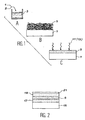
- Figures 1a to 1c illustrate the method of manufacture and deposition of polymeric material based of tantalum oxide, in particular with a refractive index high and mechanically resistant to abrasion according to the invention.
- the first step of the process consists of synthesize a solution in a solvent containing a compound-tantalum molecular precursor susceptible to form a homogeneous polymer film of oxy-hydroxide of tantalum during deposition by hydrolysis-condensation reaction with the water vapor contained in the air.
- This solvent 3 is preferably chosen from saturated aliphatic alcohols of formula ROH where R represents an alkyl group for example from 1 to 5 atoms of carbon more preferably, the solvent is absolute ethanol.
- the reaction is slightly exothermic (raising the temperature to about 50 ° C).
- the solution 1 obtained after cooling and filtration is clear, transparent and very acidic.
- the process of the present application thus differs fundamentally from the prior art in which a metal alkoxide such as a tantalum alkoxide, for example tantalum pentaethoxide Ta (OEt) 5 hydrolyzed in acidic medium HCl, is used as the precursor. CH 3 COOH.
- a metal alkoxide such as a tantalum alkoxide, for example tantalum pentaethoxide Ta (OEt) 5 hydrolyzed in acidic medium HCl
- OEt tantalum pentaethoxide Ta
- alkoxide solutions necessarily require a complexing agent and are on the other hand a much higher cost than solutions prepared for example from TaCl 5 which is a readily available product and a relatively low price. .
- Solution 1 for example tantalum chloroalcoxide in ethanol, also called TaCl 5 / EtOH solution in the rest of the description, generally has a concentration of 1 to 20%, expressed in Ta 2 O 5 mass equivalent.
- This solution is sensitive to the humidity of the air. If water is added, for example, in a H 2 O / Ta molar ratio of 10, a gel is rapidly formed, therefore such a solution should preferably be stored away from ambient humidity.
- the treatment thermal crosslinking preferably carried out according to the invention at low temperature, lower or equal for example at 150 ° C does not eliminate the layer deposited the halide ions such as chlorides excess, which make the surface of the coating relatively non-wetting and prevent a good accession of the next deposit.
- the ions halide especially chloride ions in excess in the solution or at least we limit the excess compared to the metal precursor.
- a white solid is obtained corresponding to TaCl 2 (OEt) 3
- the residue is then partially redissolved in ethanol to give a solution for example of 5 to 10%, preferably 7% by mass equivalent Ta 2 O 5 .
- the dissolution is complete after, for example, reflux for 4 hours at 80 ° C. After filtration of the mixture, a clear and transparent solution with a pH in the region of 2 is obtained.
- this solution will be called TaCl 2 (OEt) 3 / EtOH.
- the second method for removing excess chloride ions is to neutralize them, for example by precipitating them in the form of ammonium chloride (NH 4 Cl) by bubbling anhydrous gaseous ammonia (NH 3 ) in the TaCl mixture. 5 / EtOH for example from 5 to 10% by mass equivalent Ta 2 O 5 . There is the formation of a white precipitate corresponding to ammonium chloride, poorly soluble in alcoholic medium.
- this solution will be named TaCl 2 (OEt) 3 / EtOH-NH 3 .
- a third way is to reduce the proportion of chloride ions (or halides) per compared to the precursor metal precursor in the solution, by adding another metal compound or of metalloid containing no chloride ions, all keeping the optical and mechanical properties of the material after deposition, and crosslinking treatment thermal or other.
- Titanium oxide appears as an excellent candidate despite his moderate mechanical strength after heat treatment for example at 150 ° C but can be use it in formulation, tantalum oxide ensuring the abrasion resistance properties of the material.
- From 1 to 99% can be used, for example 10 at 90% by weight, expressed as oxide of the precursor compound metal containing no chloride ions and giving then for example titanium oxide, but of preferably the chosen formulation, allowing to obtain layers meeting the strength specifications abrasion and refractive index, corresponds to a final proportion of less than or equal to 50% mass expressed as titanium oxide.
- titanium tetraisopropoxide (Ti (iOPr)) 4 is added to the TaCl 5 / EtOH solution as a precursor, but another titanium alkoxide or another precursor compound may also be used.
- Ti oxide after filtration of the mixture, a clear and transparent solution (2) of pH ⁇ 2 is obtained.
- this solution will be called for example TaCl 5 -Ti (iOPr) 4 / EtOH.
- the proportion of compound, molecular precursor of tantalum is preferably 5 to 10% by mass equivalent of tantalum oxide, in the solvent, such as the alcoholic solvent.
- solution 1 in a solvent - a solution in a solvent of the same nature comprising a compound of metal or metalloid other than tantalum, this compound precursor then giving a compound based on metal or metalloid the addition being done, in a proportion ranging from 100 to 0 ⁇ % (preferably from 1 to 99%, more preferably 10 to 90%) in equivalent of metal oxide or metalloid for 0 to 100% equivalent of tantalum oxide.
- the metal or metalloid other than tantalum is preferably chosen from titanium (see above), yttrium, scandium, zirconium, hafnium, thorium, niobium, lanthanum, or aluminum if it is desired to obtain a rather high index and among silicon and magnesium, if you want to get a rather average index or low.
- the precursor compound of metal or metalloid can be selected from any suitable compound, such as a alkoxide or other.
- a solution (2) of molecular precursors example a concentration of 5 to 10% equivalent in mass of metal oxides the proportions in equivalent metal oxide / tantalum oxide variant 0/100 to 100/0.
- the solution containing the molecular precursor of tantalum, as well obtained is deposited on a support 7 to give a polymeric layer of oxy-hydroxide tantalum referenced 9.
- support 7 is referred to any organic or inorganic substrate, such as which will be described later or any layer active or promoting adhesion, deposited on said substrate.
- the substrate is a plane substrate or a substrate having a low curvature example the surface of a cathode ray tube screen for TV or a glass of glasses but the process according to the invention makes it possible to coat any substrate whatever its form.
- the deposition of the layer 9 is carried out by example by soaking-shrinking ("dip coating” in English), by spin coating ("Spin coating” in English) by laminar coating ("Laminar Flow coating "in English), using a horizontal knife (“Tape casting” in English) or by any other process for obtaining a uniform deposit and a homogeneous layer in thickness.
- Figure 1c illustrates the third step of the process of carrying out crosslinking or densification for example a heat treatment or a UV insolation, layer 9.
- the treatment 11 is carried out for example in an oven or under an infrared lamp for example to a temperature of 100 to 200 ° C preferably 120 to 200 ° C, more preferably 150 ° C for 2 to 150 minutes preferably 15 to 60 minutes, for example to 150 ° C for 30 minutes.
- Treatment 13 is carried out under a UV lamp for example a mercury vapor lamp or lamp excimer, emitting preferably in the field of UV-B and UV-C that is 180 to 280 nm in length wave.
- a UV lamp for example a mercury vapor lamp or lamp excimer, emitting preferably in the field of UV-B and UV-C that is 180 to 280 nm in length wave.
- the UV dose received by the layer must be sufficient to induce crosslinking.
- the duration of UV exposure is a function of the power of emission of the lamp in the range of lengths aforementioned wave.
- Said ultraviolet irradiation is generally carried out with an energy of 5 to 10 J / cm 2 , preferably 5 to 6 J / cm 2 , for a duration of 10 seconds to 10 minutes, preferably 30 seconds. at 5 minutes, for example 1 minute, or typically a power of 350 mW / cm 2 .
- the UV crosslinking step followed by an annealing or post-treatment step thermal at a temperature for example of 80 to 200 ° C, preferably 100 to 150 ° C for 10 to 60 minutes preferably 15 to 30 minutes.
- the crosslinking can also be carried out by any method known to those skilled in the art in this technical field and making it possible to crosslink, densifying the inorganic polymer according to the invention as irradiation by a laser beam or by a beam of electrons or ions or microwave energy.
- the densification by insolation by ultraviolet light improves the surface condition of the film and gives much more wettable layers in especially just after sunstroke.
- the densification-ultraviolet insolation crosslinking treatment also has the significant advantage, even decisive, of a much shorter duration than the heat treatment, even if it must be followed by a so-called thermal annealing step. which generally significantly improves the densification of the Ta 2 O 5 layer.
- UV insolation of a duration of a few minutes maximum, preferably equal or less than 5 minutes instead of 30 minutes in general for crosslinking-densification by treatment thermal at 150 ° C.
- the densification-crosslinking treatment by the UV is easier to put in less equipment, and avoids rise and fall times.
- the third stage of the process which consists of example in these two treatments 11 and 13, allows crosslink the polymeric oxy-hydroxide network of tantalum and so densify the layer.
- This treatment leads to a better mechanical strength of the film and a increase in the refractive index compared to an equivalent layer that has not undergone such treatment.
- the process according to the invention combines the advantages of both families of sol-gel process without the disadvantages, in this meaning that on the one hand like colloidal systems, it can be used at moderate temperatures but by giving resistant coatings and that, on the other hand, in contrast to polymeric sol-gel systems such resistance is obtained at low temperature.
- the material polymer generally comprises chloride ions residual (halides) densification by UV insolation improves wettability layers based on this material.
- the polymeric material thus prepared in the case of a refractive index polymeric material high, precisely presents a refractive index "High" for example from 1.86 to 1.95 in particular (1.93 with solution 1 in particular 1.86 with solution 2).
- solution 1 or 2 can in besides being also mixed with a compatible solution containing another metal precursor or metalloid type alkoxide or dissolved metal salt for example in a solvent or materials polymeric or colloidal at will the refractive index of the layer polymer obtained after deposition, while retaining the properties of mechanical resistance to abrasion, metal or the metalloid thus provided being preferably different from the metal (s) and / or metalloid (s) already present in solution (1) or (2); this metal or metalloid may preferably be selected from metals and metalloids already mentioned above.
- Table 1 gives, by way of comparative example, the various refractive index values after densification for some of the materials that can be used in the invention, for example when the solution 1 or 2 is mixed with the precursor.
- SiO 2 of the tetraethoxy-ortho-silicate according to the relative proportions of tantalum oxide equivalent and silicon oxide.
- TiO 2 based composite should be reserved for uses other than power lasers. Indeed, this oxide has an intrinsic absorption of light energy which limits and caps its resistance to the laser flux at low values.
- This polymeric material (Ta 2 O 5 / TiO 2 ) is, on the other hand, ideal for other applications, for example in integrated optics or for semi-reflective plastic slides, since if it is combined with colloidal silica, it forms a pair of very high refractive index ratio, for example 1.67.
- the optical material or still presenting optical properties according to the invention comprises at least a layer of polymeric material based on tantalum, especially with high refractive index or medium and mechanically resistant to abrasion such as that previously described.
- optical materials comprising not only a layer polymeric material based on tantalum oxide, especially with high or medium refractive index and mechanically resistant to abrasion but also any combination of optical layers.
- optical layers Depending on the nature of the optical layers, their thickness and their arrangement, some by in relation to others, materials will be made anti-reflective or reflective.
- the thickness of the layers is, however, 0.1 to 10 ⁇ m.
- Figure 2 illustrates an example application of a polymeric material based on tantalum oxide, high refractive index, in the manufacture of a anti-reflective material with broad spectral band, presenting good hydrophobic properties and resistance mechanical abrasion.
- the thin layers above are usually prepared from Polymeric sol-gel systems densified-cross-linked to moderate temperature, usually less than or equal to 150 ° C, and also present and surprisingly excellent mechanical strength.
- such a multicomponent coating can be prepared quickly and applied to any substrate, even plastic.
- the layers B, H, and M respectively have indices n B , n H and n M with n B ⁇ n M ⁇ n H.
- the index of the M layer intervenes mainly on the shape and width of the reflection curve.
- low, medium refractive index and high should usually be interpreted respectively as meaning that the index is less than about 1.5, ranging from 1.5 to About 1.8, and greater than about 1.8. While the substrate has for example an index between 1.45 and About 1.60.
- Organic substrate means more specifically a plastic substrate, for example one of those chosen among the polyacrylates, polycarbonates, polyallyl carbonates and polyamides. However, this list is not exhaustive and covers more general organic polymeric materials.
- inorganic substrate covers more precisely a mineral substrate, ie by example the amorphous or even crystalline materials and in particular silica, borosilicate or soda-lime glasses, fluorophosphates and phosphates.
- substrates plastics are above all cheaper, more easily scalable, lighter and less fragile to shocks.
- their use requires preferentially, the presence of an intercalated layer between the organic substrate and the first layer (17 in this case), ensuring good accounting at this interface during the step of densification and in particular an absorption of induced constraints.
- this interface layer, or varnish preferably among the organosilane polymers, charged possibly in mineral colloids.
- the average refractive index layer is, according to the invention, preferably based on tantalum and silicon as has already been mentioned higher in Table 1.
- Such a layer makes it possible to obtain a chemical network having a great continuity and thus to create strong interactions between the deposited thin layers.
- Mixed systems, Ta 2 O 5 -SiO 2 can give an average refractive index and good mechanical strength.
- the precursor of Tantalum can also be introduced in the form of Ta (OEt) 5 or TaCl 2 (OEt) 3 / EtOH-NH 3 .
- the refractive index of the oxide system Ta 2 O 5 -SiO 2 can, as already indicated above (Table I) be modulated from 1.45 to 1.93, after the crosslinking treatment such as a thermal crosslinking treatment by varying the proportion of each component with, preferably, the TaCl 5 -Si (OEt) 4 / EtOH mixture as a precursor.
- the Ta 2 O 5 -SiO 2 layer prepared from the TaCl 5 -Si (OEt) 4 / EtOH mixture is non-wetting after heat treatment, for example with 150 ° C for 30 minutes.
- this average index layer is covered by the Ta 2 O 5 layer, which is therefore of very similar chemical nature, the wettability properties of the Ta 2 O 5 -SiO 2 coating have less or less effect on the interactions. between layers, the continuity of the chemical network being ensured.
- the high refractive index layer has already described in detail above and therefore will not be described again in detail.
- the low refractive index layer is also prepared according to the sol-gel technique.
- this layer comes from a suspension monodisperse colloid, approximately 100 to 200 ⁇ diameter, preferably selected from the oxide of silicon, calcium fluoride or fluoride magnesium and coated in a polymeric siloxane binder soluble.
- the colloids and the binder are synthesized at from a molecular precursor.
- silicon oxide tetraethylorthosilicate.
- For calcium fluoride or fluoride magnesium we will use as precursors respectively calcium acetate and methoxide magnesium.
- this layer comprises by mass, from 25 to 30% of silica colloids and from about 75 to 70% of siloxane binder. It is also possible to add to this layer a surfactant nonionic such as an alkylphenoxypolyethoxyethanol. This allows to increase the wettability of said deposit.
- a surfactant nonionic such as an alkylphenoxypolyethoxyethanol. This allows to increase the wettability of said deposit.
- the layer of material low index is formed of silicon oxide or oxide of magnesium in polymeric form (polymeric silica).
- the treating solution used to obtain a thin layer of polymeric silica is preferably obtained by hydrolysis-condensation of tetraethyl orthosilicate (TEOS, Si (OEt) 4 ) in acidic medium HCl or HNO 3 . This gives rise to the formation of oligomeric species according to the reaction:
- optical, mechanical and chemical thin films of polymeric silica closely depend on these parameters physicochemical.
- the stock solution After 4 hours of magnetic stirring and about 3 to 4 weeks of temperature ripening at rest, the stock solution is diluted with pure ethanol at about 4% for example at 3.75% in mass, which helps to slow down and stabilize formation of the silicate network.
- the solution obtained is limpid and transparent. It stays stable for twelve month at least, while the stock solution gels at beyond a month.
- Thin layers of polymeric silica have a refractive index at 550 nm before and after crosslinking, for example by cooking, close to 1.40.
- Thin layers of polymeric silica have excellent abrasion resistance properties and are resistant to common organic solvents: alcohols, acetone, with weak acids and bases (except hydrofluoric acid).
- the surface of the polymeric silica layer has good water wettability properties and ethanol.
- hydrophobic agent such as Teflon® is not satisfactory because the interactions between the protective layer, and in particular a upper layer of polymeric silica, are weak, making the whole fragile to abrasion.
- Compounds fluorinated silanes have the advantage of forming a chemical bond because they contain groupings likely to react with hydroxyl groups located on the surface of the polymeric silica layer, and a long fluoridated chain ensuring the character hydrophobic and the low coefficient of friction of the deposit.
- C 6 F 13 CH 2 CH 2 -Si (OEt) 3 (Tridecafluoro-1,2,2,2-tetrahydrooctyl) -1-triethoxysilane), known under the name T2494 from in ABCR or C 6 F 13 CH 2 CH 2 -SiCl 3 ((Tridecafluoro-1,1,2,2-tetrahydrooctyl) -1-trichlorosilane, known as T2492 from ABCR.
- the polymeric silica system - "T2494" obtained is inert to strong acids and strong bases and with the usual organic solvents.
- the layer is perfectly hydrophobic and very wettable ethanol. It resists the "severe” test of the standard Military US-MIL-C-0675C and can be very easily cleaned.
- the hydrophobic layer does not disturb the optical properties of the low-index layer, by example of the polymeric silica layer.
- Such a cleaning step has a duration of example of about 5 minutes.
- the following step consists in applying to the cleaned substrate the average refractive index layer, for example, from a precursor solution giving a Ta 2 O 5 -SiO 2 layer, in particular a TaCl 5 -Si solution. (OEt) 4 / EtOH, for example, in the respective proportions 80/20 expressed as oxide.
- This layer is applied uniformly on the substrate, for example by soaking-shrinking (dip-coating), either by centrifugal coating, at a speed of about 10 cm / min at 1000 rpm. about, either by laminar coating.
- the last two methods are preferable because they only require very little treatment solution.
- This type of solution deposit has the advantage of allow the coating of surfaces relatively large, with very pure treatment solutions and low viscosity.
- This deposit is optionally followed (that is to say this step can be omitted) from a step of crosslinking-thermal densification by cooking in the conditions already mentioned above, preferably a temperature of 150 ° C and for a duration of 30 minutes.
- Cooking can be done in cost suitable apparatus, such as an oven, etc. and the mode of heating can be any heating mode suitable for such a goal: for example, by infrared, etc.
- the cleaning is then carried out, stripping in the same manner as before, and then the high refractive index layer is deposited which can be prepared from any of the solutions (1) or (2) of precursor of Ta 2 O 3 , already described above, preferably with the solution TaCl 2 (OEt) 3 / EtOH-NH 3 , then one proceeds optionally to the cooking (crosslinking-thermal densification) of this layer of the same way than previously.
- the deposition of the low refractive index layer is carried out from, for example, a solution of SiO 2 polymer or any other solution containing a suitable precursor for such a layer at a concentration, preferably from 2 to 5% SiO 2 oxide.
- the cooking is done (thermal crosslinking-densification) of the layer, for example, of polymeric silica, thus obtained in the same conditions as before.
- an agent hydrophobic preferably of fluorinated silane type, such as described above, for example, the compound "T2494".
- the hydrophobic agent is generally diluted in a perfluorinated solvent, such as GALDEN HT110® from MONTEDISON at, for example, 2% in mass and applied to hot at a temperature generally close to 100 ° C, preferably by spraying.
- the antireflection material according to the invention prepared by a low temperature treatment, surprisingly satisfies all requirements mentioned above, related to its properties optical, its mechanical and chemical resistance.
- the cleaning-stripping of this layer is carried out, as already described, and then allowed to run for a period of time, for example, from 1 to 24 hours, preferably 12 hours, before a second stripping of the Ta 2 O 5 layer and depositing the layer to low refractive index, for example, polymeric silica.
- the high refractive index layer is deposited, and after this deposition, the deposited layer is rinsed with a mixture of ammonia (for example, at 28% in the water) and ethanol, preferably 50/50 in mass proportion, for a period of 1 to 20 minutes, preferably 5 minutes, the ethanol having the role of ensuring a better wettability of the mixture, then carried out a heat treatment at a temperature of 100 to 200 ° C, preferably 150 ° C for a duration, for example, from 1 to 15 minutes, preferably 5 minutes under reduced pressure, for example from 10 -1 to 10 - 3 mbar, preferably 10 -2 mbar.
- a mixture of ammonia for example, at 28% in the water
- ethanol preferably 50/50 in mass proportion
- This rinsing and then firing treatment is preferably repeated two to 10 times, for example, twice, then an NH 4 OH / ethanol rinsing is repeated and the high index layer is finally cured. the low index layer and the other steps, as described above.
- the procedure is analogous to second variant but as for the first variant.
- a certain amount of time elapses example of 1 to 24 hours, preferably 12 hours, after the last rinse with the mixture ammonia / ethanol, before making the deposit of the low index layer and the other steps of the process.
- This third variant of the densification-crosslinking process of the high index layer based on Ta 2 O 5 namely with a heat treatment under reduced pressure and rinsing with an NH 4 OH / EtOH mixture gives the best results with respect to adhesion of the layers, and the mechanical properties of abrasion resistance of the antireflection coating.
- a coating prepared with the third process variant goes beyond the required requirements for a so-called "general public" application.
- Such densification-UV crosslinking can also be applied to the average index layer and the low index layer, for example, prepared from polymeric SiO 2 .
- the substrate is then degreased with soap optically, rinsed again with distilled water and dried ethanol, such a cleaning step has a duration, for example, about 5 minutes.
- the following step consists in applying to the cleaned substrate the average refractive index layer, for example, from a precursor solution giving a layer of Ta 2 O 5 -SiO 2 , in particular a TaCl 5 solution. If (OEt) 4 / EtOH, for example, in the proportions 80/20, expressed as oxide.
- This layer is uniformly applied to the substrate by one of the techniques already mentioned above in the context of the deposition process with a thermal crosslinking-densification treatment.
- the densification-crosslinking of this layer by irradiation with UV rays for example with UV B or C, preferably with an energy of at 10 J / cm 2 , preferably 5 to 6 J / cm 2 , for a duration, preferably 10 sec. at 10 minutes, more preferably 30 seconds to 5 minutes, for example 1 minute (ie a power of 300 to 350 mW / cm 2 ).
- one operates at full power, that is to say at 350 mW / cm 2 .
- the high-index layer based on Ta 2 O 5 is deposited, which can be prepared from any of the precursor solutions of Ta 2 O 5 (1, 2), already described above, then optionally the densification-crosslinking of this layer by ultraviolet irradiation under the same conditions only for the medium-index layer.
- the low-index layer for example, made of polymeric SiO 2
- the entire substrate and three layers applied then undergoes heat treatment or annealing treatment, at a temperature for example of 80 to 200 ° C, preferably 100 to 150 ° C for 10 to 60 minutes preferably 15 to 30 minutes, for example to 150 ° C for 30 minutes, to push to the end the densification of the three layers.
- the anti-reflective coating obtained excellent optical, mechanical and abrasion resistance.
- the total duration of the process is, for example, about an hour.
- Such a method also makes it possible to perform broadband anti-reflective coatings and resistant to abrasion, especially on tube screens cathodic, fulfilling all the requirements cited upper.
- UV densification makes it possible to lower significantly the manufacturing time of the coating tricouche by decreasing the number of treatments for example, at 150 ° C from 4 to 1, the inertia thermal of the bulky substrate virtually triplates the treatment times.
- UV densification by making wettable surfaces just after sunstroke, removes intermediate cleaning steps, ensures good interaction between the layers, and improves the mechanical resistance to abrasion of the coating, particular if the polymeric silica layer preparation type "MAEKAWA” also called “oligomeric silica”.
- the surface heating generated by the UV allows the hot deposition of the hydrophobic agent before the only final heat treatment of the tricouche and thus reinforces inexpensively the mechanical strength of the coating; this method of densification therefore appears relatively simpler to implement industrial than the heat treatment series previously proposed.
- Figure 4 illustrates a second example of optical material, namely a reflective material with broad spectral band.
- the substrate 15 and the layers 19 and 9 are identical to those described in the implementation of the anti-reflective material.
- the substrate of organic or inorganic nature is first subjected to meticulous cleaning, as described in the production of the antireflection material.
- the solvent is advantageously chosen from aliphatic alcohols.
- the layer 9 is then deposited high refractive index, and is performed again densification by UV or heat treatment.
- the whole stack is preferably subjected to baking or thermal annealing under conditions similar to those used for coating anti reflection.
- Deposit transactions are carried out in a clean environment of class 100 preferentially (US standard) and under laminar flow.
- EXAMPLE 1 Production of thin layers based of tantalum oxide with crosslinking by treatment thermal.
- Silica substrate 5 cm in diameter (refractive index 1.45) is first cleaned with 1% hydrofluoric acid solution, then rinsed thoroughly with water.
- the substrate undergoes a "Drag-wipe" to eliminate dust and last traces from the evaporation of the alcohol.
- the deposits were made by centrifugation with about 1.5 ml of treating solution.
- the average duration of the spreading is of the order of 3 to 4 seconds.
- the substrate rotating speed is between 1 000 and 2 000 rev min -1 according to the tantalum concentration in the solution and the type of precursor used. After two minutes of drying at 25 ° C., a homogeneous tantalum layer is obtained.
- the results relating to the influence of the temperature and the cooking time come from deposits made with a TaCl 5 / EtOH solution at a concentration of 7% by mass equivalent Ta 2 O 5 .
- the substrate rotating speed is set at 1 750 revolutions min -1. After two minutes of drying at 25 ° C., the deposited layer has an index of 1.63 and a thickness of 131 nm. The maximum reflection is 850 nm (quarter wave peak). The maximum value of n is 1.95 at 150 ° C.
- the refractive index n (at 550 nm) and the shrinkage coefficient ⁇ e of the thin layers obtained with the different treating solutions described above; namely: TaCl 5 / EtOH, TaCl 2 (OEt) 3 / EtOH, TaCl 2 (OEt) 3 / EtOH-NH 3 and TaCl 5 -Ti (OPr i ) 4 / EtOH (50/50) after heat treatment at 150 ° C for 30 minutes are given in Table II Refractive index n at 550 nm and necking coefficient Treatment solution Refractive index (at 550 nm) Compression coefficient ⁇ e Before cooking After cooking TaCl 5 / EtOH 1.63 1.93 52% TaCl 2 (OEt) 3 / EtOH 1.61 1.93 52% TaCl 2 (OEt) 3 / EtOH-NH 3 1.59 1.86 56% TaCl 5 -Ti (OiPr i ) 4 / EtQH (50/50) 1.67 2.01 45%
- the layers according to the invention based on Ta 2 O 5 after heat treatment are remarkable whatever the type of molecular precursor used. Indeed, they are extremely hard abrasion and so resist the "severe" test of the military standard US MIL-C-0675C that is to say 20 round trip with a pressure of 2 1/2 lbs. without damage.
- the respective weight percentages of Ta 2 O 5 and SiO 2 can also be varied as desired.
- Silica substrate 5 cm in diameter (refractive index 1.45) is first cleaned with 1% hydrofluoric acid solution, then rinsed thoroughly with water. It is then defatted at green soap, rinsed again with water distilled and dried with ethanol. Just before the deposit, the substrate undergoes a "drag-wipe" in order to eliminate dust and the last traces from evaporation of alcohol.
- the deposits were made by centrifugation with about 1.5 ml of treating solution.
- the average duration of the deposit is of the order of 3 to 4 seconds.
- the substrate rotating speed is between 1 000 and 2 000 rev min -1 according to the tantalum and silica concentration in the solution and the precursor of silica type used. After two minutes of drying at 25 ° C., a homogeneous layer based on tantalum and silica is obtained.
- the indices n , the shrinkage coefficient ⁇ e and the abrasion resistance test correspond to the properties measured after heat treatment at 150 ° C. for 30 minutes.
- EXAMPLE 3 Production of an antireflection material with crosslinking by heat treatment:
- a coating was made three-layer antireflection based on tantalum oxide and polymeric silica that has been applied on both breeds of a circular silica blade that has a average index of 1.45 in the visible.
- each optical layer is repeated on the other side of the substrate before cooking of these.
- each layer comprises a sequence cleaning, deposit, cooking at 150 ° C, duration 5 minutes, 2 minutes and 30 minutes, respectively for the deposition of the hydrophobic agent layer, anti-abrasive, where only the deposit and cooking for a period of 15 minutes.
- the total duration of treatment is approximately 2 hours and 30 minutes.
- the layer of Ta 2 O 5 -SiO 2 (80/20) was deposited by spin coating at a speed of rotation of 2700 revolutions min -1, starting from a solution TaCl 3 -Si (OEt) 4 / EtOH at 8.5% by weight of the mixed oxide equivalent.
- the layer of Ta 2 O 5 was carried out by spin coating at a rotational speed of 1100 revolutions min -1 with a solution TaCl 5 / EtOH 7% by weight of oxide.
- the SiO 2 layer polymer was deposited by spin coating at a rotational speed of 2800 revolutions min -1 with a solution at 3.75% of oxide by weight, aged 15 days.
- each layer was heat treated for 30 minutes at 150 ° C. After each baking of the Ta 2 O 5 -based layers, the coating is etched with a 1% hydrofluoric acid solution in order to remove the chloride ions on the surface and make the wetting layer for the next deposit .
- the hydrophobic agent "T2494” diluted in the GALDEN HT110® (from MONTEDISON) at 2% in mass, is deposited on the hot slide with a temperature about 100 ° C, by spraying.
- Figure 3 shows the value of the transmission (%), as a function of the wavelength ( ⁇ ) for a bare silica substrate and anti-reflective material according to the invention, prepared according to Example 3.
- Anti-reflective coating is inert to acids strengths, 12M HCl, 1% HF, pure acetic acid, at bases strong, 5 M NaOH, 28% ammonia solution, TMAOH 1 M, and organic solvents, alcohols, acetone.
- the anti-reflective coating is resistant to laboratory gum and adhesive tape. It is not damaged by the "moderate” test of US-MIL-C-0675C, that is, 50 passes with a pressure of 1 lb. On the other hand, there are scratches after 10 passes for the "severe” test (pressure of 2 1/2 lb.) and optical microscopy observations show a detachment of the layer of polymeric silica.
- EXAMPLE 4 Production of medium-index thin layers in the Ta 2 O 5 -SiO 2 (80/20) system with densification by UV irradiation.
- a medium layer index of Ta 2 O 5 -SiO 2 (80/20) is prepared by depositing with a TaCl 5 -Si (OEt) 4 / EtOH solution containing 8.75% by weight of total oxide.
- Substrate rotation speed is fixed at 2180 revolutions min -1 after two minutes of drying, the deposited layer has an index of 1.545 and a thickness of 163 nm.
- the maximum reflection is at 1005 nm before densification (quarter wave peak).
- the evolution of the refractive index n and the layer thickness e are a function of the number of passes under the UV
- the properties of abrasion resistance are slightly lower: there appears slight spills on the surface of the "severe" test layer of the military standard US-MIL-C-0576-C (40 passes).
- the UV densification has the advantage of giving a layer of Ta 2 O 5 -SiO 2 (80/20) perfectly wetting immediately after exposure, which is not the case with heat treatment.
- Substrate rotation speeds are respectively set at 1200, 1000 and 1700 revolutions min -1.
- the deposited layers After two minutes of drying, the deposited layers have a respective index of 1.601, 1.639 and 1.616 and each have a thickness of 167, 141 and 163 nm.
- the peak reflection peaks (quarter wave peak) are respectively at 1070, 925 and 1053 nm before densification.
- the abrasion resistance properties are comparable to those obtained by densification at 150 ° C for 30 minutes, since the layers are not damaged in the "severe" test of the military standard US-MIL-C-0675-C and the type of treatment solution used.
- UV densification has the advantage of giving Ta 2 O 5 layers much more wettable than with heat treatment. This UV effect does not depend on the type of treatment solution used.
- the abrasion resistance properties are maintained with the thermal anneals and the Ta 2 O 5 high index layers pass the "severe" test of the military standard US-MIL-C-0675-C regardless of the type of treatment solution .
- EXAMPLE 6 Carrying Stackings, Anti-Reflections, three-layered, with UV insolation:
- the treating solutions used are the following: TaCl 5 -Si (OEt) 4 / EtOH for the average index layer, TaCl 2 (OEt) 3 / EtOH-NH 3 for the high-index layer, SiO 2 polymeric HCl, SiO 2 polymeric HNO 3 or "oligomeric" SiO 2 for the low index layer.
- the substrate is cooled for about 3 minutes with assistance of a jet of air under pressure, and then deposited the strong layer Ta 2 index O 5 and is densified under UV under the same conditions.
- the low SiO 2 layer is then deposited and irradiated with UV irradiation of 300 mW / cm 2 .
- the entire stack undergoes a treatment heat at 150 ° C for 30 minutes, in order to perfect the densification of the three layers.
- the total duration of the method for a blade 80 mm in diameter is one time approx.
- the irradiation dose is also varied UV of each layer.
- the tests with the layers of polymeric SiO 2 in HCl or HNO 3 medium gives coatings slightly more fragile to abrasion, the mechanical properties being comparable with those obtained by the manufacturing process using only heat treatments as a means of densification.
- the precursor coupled with the action of UV, makes it possible to establish a strong interaction between the silica layer and the high Ta 2 O 5 layer, and thus to guarantee good mechanical strength. .
- the UV insolation dose seems to play an important role since when the latter decreases at the base layers of Ta 2 O 5 and SiO 2 , the abrasion resistance of the coating can be affected. Moreover, the UV passage of the hydrophobic agent layer T2494 does not improve the mechanical properties of the trilayer.
Landscapes
- Chemical & Material Sciences (AREA)
- Organic Chemistry (AREA)
- General Chemical & Material Sciences (AREA)
- Life Sciences & Earth Sciences (AREA)
- Engineering & Computer Science (AREA)
- Chemical Kinetics & Catalysis (AREA)
- Geochemistry & Mineralogy (AREA)
- Materials Engineering (AREA)
- Inorganic Chemistry (AREA)
- Surface Treatment Of Optical Elements (AREA)
- Optical Elements Other Than Lenses (AREA)
- Inorganic Compounds Of Heavy Metals (AREA)
- Silicon Compounds (AREA)
- Polymers With Sulfur, Phosphorus Or Metals In The Main Chain (AREA)
- Laminated Bodies (AREA)
Applications Claiming Priority (3)
| Application Number | Priority Date | Filing Date | Title |
|---|---|---|---|
| FR9701486A FR2759360B1 (fr) | 1997-02-10 | 1997-02-10 | Materiau polymerique inorganique a base d'oxyde de tantale notamment a indice de refraction eleve, mecaniquement resistant a l'abrasion, son procede de fabrication et materiau optique comprenant ce materiau |
| FR9701486 | 1997-02-10 | ||
| PCT/FR1998/000229 WO1998034876A1 (fr) | 1997-02-10 | 1998-02-06 | Materiau polymerique inorganique a base d'oxyde de tantale, notamment a indice de refraction eleve, mecaniquement resistant a l'abrasion, son procede de fabrication, et materiau optique comprenant ce materiau |
Publications (2)
| Publication Number | Publication Date |
|---|---|
| EP0961756A1 EP0961756A1 (fr) | 1999-12-08 |
| EP0961756B1 true EP0961756B1 (fr) | 2003-07-09 |
Family
ID=9503507
Family Applications (1)
| Application Number | Title | Priority Date | Filing Date |
|---|---|---|---|
| EP98908140A Expired - Lifetime EP0961756B1 (fr) | 1997-02-10 | 1998-02-06 | Materiau polymerique inorganique a base d'oxyde de tantale, notamment a indice de refraction eleve, mecaniquement resistant a l'abrasion, son procede de fabrication, et materiau optique comprenant ce materiau |
Country Status (11)
| Country | Link |
|---|---|
| US (1) | US6387517B1 (https=) |
| EP (1) | EP0961756B1 (https=) |
| JP (1) | JP4330661B2 (https=) |
| CN (1) | CN1191200C (https=) |
| AU (1) | AU737747B2 (https=) |
| BR (1) | BR9807197A (https=) |
| CA (1) | CA2279828C (https=) |
| DE (1) | DE69816273T2 (https=) |
| ES (1) | ES2202818T3 (https=) |
| FR (1) | FR2759360B1 (https=) |
| WO (1) | WO1998034876A1 (https=) |
Families Citing this family (27)
| Publication number | Priority date | Publication date | Assignee | Title |
|---|---|---|---|---|
| FR2775914B1 (fr) | 1998-03-13 | 2000-04-21 | Saint Gobain Vitrage | Procede de depot de couches a base d'oxyde(s) metallique(s) |
| US6444008B1 (en) * | 1998-03-19 | 2002-09-03 | Cabot Corporation | Paint and coating compositions containing tantalum and/or niobium powders |
| EP1089093B1 (en) * | 1999-09-28 | 2008-04-02 | FUJIFILM Corporation | Anti-reflection film, polarizing plate comprising the same, and image display device using the anti-reflection film or the polarizing plate |
| JP3779174B2 (ja) * | 2000-11-13 | 2006-05-24 | Hoya株式会社 | 蒸着組成物、それを利用した反射防止膜の形成方法及び光学部材 |
| DE10127225A1 (de) * | 2001-05-22 | 2002-11-28 | Zeiss Carl | Ultraviolettlicht-Abschwächungsfilter |
| US7071613B2 (en) * | 2001-10-10 | 2006-07-04 | Lg.Philips Lcd Co., Ltd. | Organic electroluminescent device |
| US7442412B2 (en) * | 2003-05-08 | 2008-10-28 | Texas Instruments Incorporated | Hydrophobic coating for oxide surfaces |
| US20050008789A1 (en) * | 2003-06-26 | 2005-01-13 | Rafac Robert J. | Method and apparatus for stabilizing optical dielectric coatings |
| WO2005044554A2 (en) * | 2003-10-28 | 2005-05-19 | Tru Vue, Inc. | Anti-reflective coating for a substrate |
| US20060065989A1 (en) * | 2004-09-29 | 2006-03-30 | Thad Druffel | Lens forming systems and methods |
| WO2006053099A2 (en) * | 2004-11-08 | 2006-05-18 | Cardinal Cg Company | Surface treating methods, compositions and articles |
| JP2007052305A (ja) * | 2005-08-19 | 2007-03-01 | Fujinon Sano Kk | 反射体、光源装置、液晶プロジェクタ及び反射膜の成膜方法 |
| JP5202819B2 (ja) * | 2006-04-26 | 2013-06-05 | 富士フイルム株式会社 | 反射防止フィルムの製造方法 |
| KR101234233B1 (ko) * | 2006-05-18 | 2013-02-18 | 삼성에스디아이 주식회사 | 포스페이트를 포함하는 반도체 전극 및 이를 채용한태양전지 |
| US8512581B2 (en) * | 2006-10-09 | 2013-08-20 | Solexel, Inc. | Methods for liquid transfer coating of three-dimensional substrates |
| US20100035069A1 (en) * | 2007-06-20 | 2010-02-11 | Zhi Chao Li | Hydrophobic lens coating |
| US8179030B2 (en) * | 2009-11-30 | 2012-05-15 | General Electric Company | Oxide multilayers for high temperature applications and lamps |
| US9470827B2 (en) * | 2010-10-27 | 2016-10-18 | Konica Minolta, Inc. | Near-infrared reflective film, method for producing same, and near-infrared reflector provided with near-infrared reflective film |
| EP2729844B1 (en) * | 2011-07-08 | 2021-07-28 | ASML Netherlands B.V. | Lithographic patterning process and resists to use therein |
| US9971065B2 (en) | 2013-03-14 | 2018-05-15 | Gaurdian Glass, LLC | Anti-reflection glass made from sol made by blending tri-alkoxysilane and tetra-alkoxysilane inclusive sols |
| US20140272125A1 (en) * | 2013-03-14 | 2014-09-18 | Guardian Industries Corp | Anti-reflection glass made from aged sol including mixture of tri-alkoxysilane and tetra-alkoxysilane |
| CN103752574A (zh) * | 2014-02-13 | 2014-04-30 | 苏州众显电子科技有限公司 | 一种利用光学清洗剂清洗液晶显示屏基板工艺 |
| FR3045672B1 (fr) * | 2015-12-18 | 2018-03-16 | Corporation De L'ecole Polytechnique De Montreal | Article comprenant une couche organique-inorganique de bas indice de refraction |
| CN106517817B (zh) * | 2016-10-27 | 2019-04-19 | 宜昌南玻显示器件有限公司 | 一种抗uv光学膜玻璃及其制备方法 |
| US10644048B2 (en) | 2017-02-01 | 2020-05-05 | Omnivision Technologies, Inc. | Anti-reflective coating with high refractive index material at air interface |
| EP3638627A4 (en) * | 2017-06-16 | 2021-01-20 | Essilor International | HIGH REFRACTIVE INDEX NANO PARTICLES |
| US12281036B2 (en) * | 2019-07-12 | 2025-04-22 | Corning Incorporated | Methods for forming glass ceramic articles |
Family Cites Families (27)
| Publication number | Priority date | Publication date | Assignee | Title |
|---|---|---|---|---|
| DE736411C (de) | 1939-05-28 | 1943-06-19 | Jenaer Glaswerk Schott & Gen | Verfahren zur AEnderung des Reflexionsvermoegens optischer Glaeser |
| DE937913C (de) | 1939-11-18 | 1956-01-19 | Leitz Ernst Gmbh | Verfahren zur Herstellung von UEberzugsschichten auf optisch wirksamen Oberflaechen,insbesondere auf Glas |
| US2432484A (en) | 1943-03-12 | 1947-12-09 | American Optical Corp | Reflection reducing coating having a gradually increasing index of refraction |
| US2466119A (en) * | 1944-11-06 | 1949-04-05 | American Optical Corp | Reflection modifying coatings and articles so coated and method of making the same |
| US2584905A (en) * | 1944-11-06 | 1952-02-05 | American Optical Corp | Surface reflection modifying solutions |
| US2432483A (en) | 1946-04-01 | 1947-12-09 | Miller Walter | Latch operated axially engaging positive clutch |
| US2710267A (en) | 1950-06-17 | 1955-06-07 | Monsanto Chemicals | Process of coating glass with a titanium polymer and article produced thereby |
| US2768909A (en) | 1953-07-28 | 1956-10-30 | Du Pont | Method of coating surface with transparent film and product resulting therefrom |
| US3460956A (en) | 1968-07-19 | 1969-08-12 | Joseph Dahle | Titanate product and method of making the same |
| US3875043A (en) * | 1973-04-19 | 1975-04-01 | Electronor Corp | Electrodes with multicomponent coatings |
| JPS5830252B2 (ja) | 1978-07-07 | 1983-06-28 | シャープ株式会社 | 酸化タンタル膜の製造方法 |
| IN152814B (https=) * | 1978-08-08 | 1984-04-14 | Westinghouse Electric Corp | |
| US4272588A (en) | 1979-08-23 | 1981-06-09 | Westinghouse Electric Corp. | Oxide protected mirror |
| US4271210A (en) * | 1979-10-25 | 1981-06-02 | Westinghouse Electric Corp. | Method of forming transmissive, porous metal oxide optical layer of a vitreous substrate |
| US4328260A (en) | 1981-01-23 | 1982-05-04 | Solarex Corporation | Method for applying antireflective coating on solar cell |
| US4595609A (en) * | 1984-11-21 | 1986-06-17 | Regents Of The University Of Minnesota | Corrosion resistant tantalum pentaoxide coatings |
| US4929278A (en) | 1988-01-26 | 1990-05-29 | United States Department Of Energy | Sol-gel antireflective coating on plastics |
| US4966812A (en) | 1988-01-26 | 1990-10-30 | The United States Of America As Represented By The Department Of Energy | Sol-gel antireflective coating on plastics |
| FR2635530A1 (fr) * | 1988-08-19 | 1990-02-23 | Central Glass Co Ltd | Procede pour la formation d'un film de revetement en oxyde contenant du titane en utilisant une solution d'alcoxyde |
| JP2831431B2 (ja) * | 1990-04-10 | 1998-12-02 | 株式会社ジャパンエナジー | 高純度金属アルコキサイドの製造方法 |
| FR2680583B1 (fr) | 1991-08-22 | 1993-10-08 | Commissariat A Energie Atomique | Materiau presentant des proprietes antireflet, hydrophobes et de resistance a l'abrasion et procede de depot d'une couche antireflet, hydrophobe et resistante a l'abrasion sur un substrat. |
| FR2682486B1 (fr) | 1991-10-15 | 1993-11-12 | Commissariat A Energie Atomique | Miroir dielectrique interferentiel et procede de fabrication d'un tel miroir. |
| JP2647796B2 (ja) * | 1992-12-09 | 1997-08-27 | 株式会社ジャパンエナジー | 酸化タンタル膜形成用材料 |
| US5698266A (en) | 1993-04-05 | 1997-12-16 | Commissariat A L'energie Atomique | Process for the production of thin coatings having optical and abrasion resistance properties |
| FR2703791B1 (fr) | 1993-04-05 | 1995-05-19 | Commissariat Energie Atomique | Procédé de fabrication de couches minces présentant des propriétés optiques et des propriétés de résistance à l'abrasion . |
| FR2707763B1 (fr) | 1993-07-16 | 1995-08-11 | Commissariat Energie Atomique | Matériau composite à indice de réfraction élevé, procédé de fabrication de ce matériau composite et matériau optiquement actif comprenant ce matériau composite. |
| FR2759464B1 (fr) * | 1997-02-10 | 1999-03-05 | Commissariat Energie Atomique | Procede de preparation d'un materiau optique multicouches avec reticulation-densification par insolation aux rayons ultraviolets et materiau optique ainsi prepare |
-
1997
- 1997-02-10 FR FR9701486A patent/FR2759360B1/fr not_active Expired - Fee Related
-
1998
- 1998-02-06 CN CN98802336.9A patent/CN1191200C/zh not_active Expired - Lifetime
- 1998-02-06 EP EP98908140A patent/EP0961756B1/fr not_active Expired - Lifetime
- 1998-02-06 AU AU66255/98A patent/AU737747B2/en not_active Expired
- 1998-02-06 CA CA2279828A patent/CA2279828C/fr not_active Expired - Lifetime
- 1998-02-06 WO PCT/FR1998/000229 patent/WO1998034876A1/fr not_active Ceased
- 1998-02-06 JP JP53388798A patent/JP4330661B2/ja not_active Expired - Lifetime
- 1998-02-06 BR BR9807197-1A patent/BR9807197A/pt not_active IP Right Cessation
- 1998-02-06 DE DE69816273T patent/DE69816273T2/de not_active Expired - Lifetime
- 1998-02-06 ES ES98908140T patent/ES2202818T3/es not_active Expired - Lifetime
- 1998-02-06 US US09/355,763 patent/US6387517B1/en not_active Expired - Lifetime
Also Published As
| Publication number | Publication date |
|---|---|
| AU6625598A (en) | 1998-08-26 |
| JP2001511107A (ja) | 2001-08-07 |
| ES2202818T3 (es) | 2004-04-01 |
| CN1248229A (zh) | 2000-03-22 |
| WO1998034876A1 (fr) | 1998-08-13 |
| FR2759360A1 (fr) | 1998-08-14 |
| AU737747B2 (en) | 2001-08-30 |
| CA2279828C (fr) | 2010-06-01 |
| DE69816273T2 (de) | 2004-05-27 |
| JP4330661B2 (ja) | 2009-09-16 |
| DE69816273D1 (de) | 2003-08-14 |
| FR2759360B1 (fr) | 1999-03-05 |
| CN1191200C (zh) | 2005-03-02 |
| US6387517B1 (en) | 2002-05-14 |
| BR9807197A (pt) | 2000-05-23 |
| CA2279828A1 (fr) | 1998-08-13 |
| EP0961756A1 (fr) | 1999-12-08 |
Similar Documents
| Publication | Publication Date | Title |
|---|---|---|
| EP0961756B1 (fr) | Materiau polymerique inorganique a base d'oxyde de tantale, notamment a indice de refraction eleve, mecaniquement resistant a l'abrasion, son procede de fabrication, et materiau optique comprenant ce materiau | |
| EP0970025B1 (fr) | Procede de preparation d'un materiau optique multicouches avec reticulation-densification par insolation aux rayons ultraviolets et materiau optique ainsi prepare | |
| EP0708929B1 (fr) | Materiau composite a indice de refraction eleve, procede de fabrication de ce materiau composite et materiau optiquement actif comprenant ce materiau composite | |
| EP0600022B1 (fr) | Materiau presentant des proprietes antireflet, hydrophobes et de resistance a l'abrasion et procede de depot d'une couche antireflet, hydrophobe et resistance a l'abrasion sur un substrat | |
| EP0927144B1 (fr) | Substrat a proprietes hydrophiles ou hydrophobes ameliorees, comportant des irregularites | |
| EP0648284B1 (fr) | Procede de fabrication de couches minces presentant des proprietes optiques | |
| JP5183066B2 (ja) | シリカ膜およびその製造方法 | |
| US6638630B2 (en) | Composition and method for a coating providing anti-reflective and anti-static properties | |
| EP1751072A2 (fr) | Substrat a revetement photocatalytique | |
| EP1789508B1 (fr) | Procede de fabrication d'un substrat revetu d'une couche mesoporeuse et son application en optique ophtalmique | |
| EP0693186B1 (fr) | Procede de fabrication de couches minces presentant des proprietes optiques et des proprietes de resistance a l'abrasion | |
| EP0608375B1 (fr) | Miroir dielectrique interferentiel et procede de fabrication d'un tel miroir | |
| CN1989427A (zh) | 具有非晶质氧化硅结合剂的MgF2光学薄膜与具备该薄膜的光学组件,及该MgF2光学薄膜的制造方法 | |
| EP1281672A1 (fr) | Elaboration par voie chimique d'une solution pour depots a effets photo-catalytiques |
Legal Events
| Date | Code | Title | Description |
|---|---|---|---|
| PUAI | Public reference made under article 153(3) epc to a published international application that has entered the european phase |
Free format text: ORIGINAL CODE: 0009012 |
|
| 17P | Request for examination filed |
Effective date: 19990802 |
|
| AK | Designated contracting states |
Kind code of ref document: A1 Designated state(s): DE ES FR GB IT NL |
|
| 17Q | First examination report despatched |
Effective date: 20000523 |
|
| GRAH | Despatch of communication of intention to grant a patent |
Free format text: ORIGINAL CODE: EPIDOS IGRA |
|
| GRAH | Despatch of communication of intention to grant a patent |
Free format text: ORIGINAL CODE: EPIDOS IGRA |
|
| GRAA | (expected) grant |
Free format text: ORIGINAL CODE: 0009210 |
|
| AK | Designated contracting states |
Designated state(s): DE ES FR GB IT NL |
|
| REG | Reference to a national code |
Ref country code: GB Ref legal event code: FG4D Free format text: NOT ENGLISH |
|
| REF | Corresponds to: |
Ref document number: 69816273 Country of ref document: DE Date of ref document: 20030814 Kind code of ref document: P |
|
| GBT | Gb: translation of ep patent filed (gb section 77(6)(a)/1977) |
Effective date: 20031025 |
|
| REG | Reference to a national code |
Ref country code: ES Ref legal event code: FG2A Ref document number: 2202818 Country of ref document: ES Kind code of ref document: T3 |
|
| PLBE | No opposition filed within time limit |
Free format text: ORIGINAL CODE: 0009261 |
|
| STAA | Information on the status of an ep patent application or granted ep patent |
Free format text: STATUS: NO OPPOSITION FILED WITHIN TIME LIMIT |
|
| 26N | No opposition filed |
Effective date: 20040414 |
|
| REG | Reference to a national code |
Ref country code: FR Ref legal event code: PLFP Year of fee payment: 19 |
|
| REG | Reference to a national code |
Ref country code: FR Ref legal event code: PLFP Year of fee payment: 20 |
|
| PGFP | Annual fee paid to national office [announced via postgrant information from national office to epo] |
Ref country code: NL Payment date: 20170112 Year of fee payment: 20 |
|
| PGFP | Annual fee paid to national office [announced via postgrant information from national office to epo] |
Ref country code: DE Payment date: 20170210 Year of fee payment: 20 Ref country code: FR Payment date: 20170228 Year of fee payment: 20 |
|
| PGFP | Annual fee paid to national office [announced via postgrant information from national office to epo] |
Ref country code: GB Payment date: 20170214 Year of fee payment: 20 |
|
| PGFP | Annual fee paid to national office [announced via postgrant information from national office to epo] |
Ref country code: IT Payment date: 20170217 Year of fee payment: 20 Ref country code: ES Payment date: 20170228 Year of fee payment: 20 |
|
| REG | Reference to a national code |
Ref country code: DE Ref legal event code: R071 Ref document number: 69816273 Country of ref document: DE |
|
| REG | Reference to a national code |
Ref country code: NL Ref legal event code: MK Effective date: 20180205 |
|
| REG | Reference to a national code |
Ref country code: GB Ref legal event code: PE20 Expiry date: 20180205 |
|
| PG25 | Lapsed in a contracting state [announced via postgrant information from national office to epo] |
Ref country code: GB Free format text: LAPSE BECAUSE OF EXPIRATION OF PROTECTION Effective date: 20180205 |
|
| REG | Reference to a national code |
Ref country code: ES Ref legal event code: FD2A Effective date: 20180525 |
|
| PG25 | Lapsed in a contracting state [announced via postgrant information from national office to epo] |
Ref country code: ES Free format text: LAPSE BECAUSE OF EXPIRATION OF PROTECTION Effective date: 20180207 |