EP0926212B1 - Method of forming image and apparatus of the same - Google Patents
Method of forming image and apparatus of the same Download PDFInfo
- Publication number
- EP0926212B1 EP0926212B1 EP98310708A EP98310708A EP0926212B1 EP 0926212 B1 EP0926212 B1 EP 0926212B1 EP 98310708 A EP98310708 A EP 98310708A EP 98310708 A EP98310708 A EP 98310708A EP 0926212 B1 EP0926212 B1 EP 0926212B1
- Authority
- EP
- European Patent Office
- Prior art keywords
- drop
- ink
- drops
- deposited
- printing medium
- Prior art date
- Legal status (The legal status is an assumption and is not a legal conclusion. Google has not performed a legal analysis and makes no representation as to the accuracy of the status listed.)
- Expired - Lifetime
Links
- 238000000034 method Methods 0.000 title claims description 35
- 238000007639 printing Methods 0.000 claims description 106
- 238000012545 processing Methods 0.000 claims description 82
- 239000000049 pigment Substances 0.000 claims description 74
- QFXZANXYUCUTQH-UHFFFAOYSA-N ethynol Chemical compound OC#C QFXZANXYUCUTQH-UHFFFAOYSA-N 0.000 claims description 44
- 239000004094 surface-active agent Substances 0.000 claims description 41
- XLYOFNOQVPJJNP-UHFFFAOYSA-N water Substances O XLYOFNOQVPJJNP-UHFFFAOYSA-N 0.000 claims description 29
- 239000007788 liquid Substances 0.000 claims description 24
- 238000000151 deposition Methods 0.000 claims description 21
- 239000000463 material Substances 0.000 claims description 21
- 230000035515 penetration Effects 0.000 claims description 21
- 239000002270 dispersing agent Substances 0.000 claims description 18
- 238000004040 coloring Methods 0.000 claims description 15
- 239000000693 micelle Substances 0.000 claims description 10
- AKTJDQZOTDDMKB-UHFFFAOYSA-N oxirane;2,4,7,9-tetramethyldec-5-yne-4,7-diol Chemical group C1CO1.CC(C)CC(C)(O)C#CC(C)(O)CC(C)C AKTJDQZOTDDMKB-UHFFFAOYSA-N 0.000 claims description 3
- 238000009877 rendering Methods 0.000 claims 2
- 239000000976 ink Substances 0.000 description 219
- 239000000243 solution Substances 0.000 description 108
- 239000000975 dye Substances 0.000 description 53
- 238000007599 discharging Methods 0.000 description 33
- 239000011259 mixed solution Substances 0.000 description 17
- PEDCQBHIVMGVHV-UHFFFAOYSA-N Glycerine Chemical group OCC(O)CO PEDCQBHIVMGVHV-UHFFFAOYSA-N 0.000 description 16
- MTHSVFCYNBDYFN-UHFFFAOYSA-N diethylene glycol Chemical compound OCCOCCO MTHSVFCYNBDYFN-UHFFFAOYSA-N 0.000 description 15
- 235000019241 carbon black Nutrition 0.000 description 14
- 239000000203 mixture Substances 0.000 description 14
- 239000006229 carbon black Substances 0.000 description 12
- 230000000694 effects Effects 0.000 description 10
- 235000011187 glycerol Nutrition 0.000 description 8
- 239000000872 buffer Substances 0.000 description 6
- 238000002474 experimental method Methods 0.000 description 5
- 239000002245 particle Substances 0.000 description 5
- 238000005516 engineering process Methods 0.000 description 4
- QTBSBXVTEAMEQO-UHFFFAOYSA-N Acetic acid Chemical compound CC(O)=O QTBSBXVTEAMEQO-UHFFFAOYSA-N 0.000 description 3
- QGZKDVFQNNGYKY-UHFFFAOYSA-O Ammonium Chemical compound [NH4+] QGZKDVFQNNGYKY-UHFFFAOYSA-O 0.000 description 3
- 238000004581 coalescence Methods 0.000 description 3
- 239000006185 dispersion Substances 0.000 description 3
- 238000010438 heat treatment Methods 0.000 description 3
- 238000007641 inkjet printing Methods 0.000 description 3
- 238000005259 measurement Methods 0.000 description 3
- 230000000149 penetrating effect Effects 0.000 description 3
- 239000000376 reactant Substances 0.000 description 3
- 239000000126 substance Substances 0.000 description 3
- LXOFYPKXCSULTL-UHFFFAOYSA-N 2,4,7,9-tetramethyldec-5-yne-4,7-diol Chemical group CC(C)CC(C)(O)C#CC(C)(O)CC(C)C LXOFYPKXCSULTL-UHFFFAOYSA-N 0.000 description 2
- IAYPIBMASNFSPL-UHFFFAOYSA-N Ethylene oxide Chemical compound C1CO1 IAYPIBMASNFSPL-UHFFFAOYSA-N 0.000 description 2
- VEXZGXHMUGYJMC-UHFFFAOYSA-N Hydrochloric acid Chemical compound Cl VEXZGXHMUGYJMC-UHFFFAOYSA-N 0.000 description 2
- 238000010521 absorption reaction Methods 0.000 description 2
- -1 acetylene glycol Chemical class 0.000 description 2
- 125000000217 alkyl group Chemical group 0.000 description 2
- 238000004458 analytical method Methods 0.000 description 2
- RWZYAGGXGHYGMB-UHFFFAOYSA-N anthranilic acid Chemical compound NC1=CC=CC=C1C(O)=O RWZYAGGXGHYGMB-UHFFFAOYSA-N 0.000 description 2
- 150000007942 carboxylates Chemical group 0.000 description 2
- 150000001875 compounds Chemical class 0.000 description 2
- 238000001514 detection method Methods 0.000 description 2
- 238000010586 diagram Methods 0.000 description 2
- 125000002887 hydroxy group Chemical group [H]O* 0.000 description 2
- 229910052751 metal Inorganic materials 0.000 description 2
- 239000002184 metal Substances 0.000 description 2
- 230000003287 optical effect Effects 0.000 description 2
- 125000001997 phenyl group Chemical group [H]C1=C([H])C([H])=C(*)C([H])=C1[H] 0.000 description 2
- LPXPTNMVRIOKMN-UHFFFAOYSA-M sodium nitrite Chemical compound [Na+].[O-]N=O LPXPTNMVRIOKMN-UHFFFAOYSA-M 0.000 description 2
- 239000007787 solid Substances 0.000 description 2
- 238000003860 storage Methods 0.000 description 2
- 125000001424 substituent group Chemical group 0.000 description 2
- ZIBGPFATKBEMQZ-UHFFFAOYSA-N triethylene glycol Chemical compound OCCOCCOCCO ZIBGPFATKBEMQZ-UHFFFAOYSA-N 0.000 description 2
- 239000000080 wetting agent Substances 0.000 description 2
- COBPKKZHLDDMTB-UHFFFAOYSA-N 2-[2-(2-butoxyethoxy)ethoxy]ethanol Chemical compound CCCCOCCOCCOCCO COBPKKZHLDDMTB-UHFFFAOYSA-N 0.000 description 1
- FHVDTGUDJYJELY-UHFFFAOYSA-N 6-{[2-carboxy-4,5-dihydroxy-6-(phosphanyloxy)oxan-3-yl]oxy}-4,5-dihydroxy-3-phosphanyloxane-2-carboxylic acid Chemical compound O1C(C(O)=O)C(P)C(O)C(O)C1OC1C(C(O)=O)OC(OP)C(O)C1O FHVDTGUDJYJELY-UHFFFAOYSA-N 0.000 description 1
- VVJKKWFAADXIJK-UHFFFAOYSA-N Allylamine Chemical compound NCC=C VVJKKWFAADXIJK-UHFFFAOYSA-N 0.000 description 1
- BJVVUENRMAKDOD-UHFFFAOYSA-N CO.CO.CO.N Chemical compound CO.CO.CO.N BJVVUENRMAKDOD-UHFFFAOYSA-N 0.000 description 1
- DGAQECJNVWCQMB-PUAWFVPOSA-M Ilexoside XXIX Chemical compound C[C@@H]1CC[C@@]2(CC[C@@]3(C(=CC[C@H]4[C@]3(CC[C@@H]5[C@@]4(CC[C@@H](C5(C)C)OS(=O)(=O)[O-])C)C)[C@@H]2[C@]1(C)O)C)C(=O)O[C@H]6[C@@H]([C@H]([C@@H]([C@H](O6)CO)O)O)O.[Na+] DGAQECJNVWCQMB-PUAWFVPOSA-M 0.000 description 1
- WHXSMMKQMYFTQS-UHFFFAOYSA-N Lithium Chemical compound [Li] WHXSMMKQMYFTQS-UHFFFAOYSA-N 0.000 description 1
- ZLMJMSJWJFRBEC-UHFFFAOYSA-N Potassium Chemical compound [K] ZLMJMSJWJFRBEC-UHFFFAOYSA-N 0.000 description 1
- 229910006074 SO2NH2 Inorganic materials 0.000 description 1
- 239000005708 Sodium hypochlorite Substances 0.000 description 1
- 241000610628 Trichoptilium incisum Species 0.000 description 1
- XSQUKJJJFZCRTK-UHFFFAOYSA-N Urea Chemical compound NC(N)=O XSQUKJJJFZCRTK-UHFFFAOYSA-N 0.000 description 1
- 230000005856 abnormality Effects 0.000 description 1
- 239000002253 acid Substances 0.000 description 1
- 238000007792 addition Methods 0.000 description 1
- 229940072056 alginate Drugs 0.000 description 1
- 235000010443 alginic acid Nutrition 0.000 description 1
- 229920000615 alginic acid Polymers 0.000 description 1
- HSFWRNGVRCDJHI-UHFFFAOYSA-N alpha-acetylene Natural products C#C HSFWRNGVRCDJHI-UHFFFAOYSA-N 0.000 description 1
- 125000000129 anionic group Chemical group 0.000 description 1
- 239000007864 aqueous solution Substances 0.000 description 1
- 230000006399 behavior Effects 0.000 description 1
- 229960000686 benzalkonium chloride Drugs 0.000 description 1
- CADWTSSKOVRVJC-UHFFFAOYSA-N benzyl(dimethyl)azanium;chloride Chemical compound [Cl-].C[NH+](C)CC1=CC=CC=C1 CADWTSSKOVRVJC-UHFFFAOYSA-N 0.000 description 1
- 239000004202 carbamide Substances 0.000 description 1
- 125000004432 carbon atom Chemical group C* 0.000 description 1
- 150000001732 carboxylic acid derivatives Chemical class 0.000 description 1
- 125000002843 carboxylic acid group Chemical group 0.000 description 1
- ZBNARPCCDMHDDV-UHFFFAOYSA-N chembl1206040 Chemical compound C1=C(S(O)(=O)=O)C=C2C=C(S(O)(=O)=O)C(N=NC3=CC=C(C=C3C)C=3C=C(C(=CC=3)N=NC=3C(=CC4=CC(=CC(N)=C4C=3O)S(O)(=O)=O)S(O)(=O)=O)C)=C(O)C2=C1N ZBNARPCCDMHDDV-UHFFFAOYSA-N 0.000 description 1
- 238000006243 chemical reaction Methods 0.000 description 1
- 239000003795 chemical substances by application Substances 0.000 description 1
- 230000001427 coherent effect Effects 0.000 description 1
- 230000008021 deposition Effects 0.000 description 1
- LYCAIKOWRPUZTN-UHFFFAOYSA-N ethylene glycol Natural products OCCO LYCAIKOWRPUZTN-UHFFFAOYSA-N 0.000 description 1
- 125000004435 hydrogen atom Chemical group [H]* 0.000 description 1
- WGCNASOHLSPBMP-UHFFFAOYSA-N hydroxyacetaldehyde Natural products OCC=O WGCNASOHLSPBMP-UHFFFAOYSA-N 0.000 description 1
- 238000003780 insertion Methods 0.000 description 1
- 230000037431 insertion Effects 0.000 description 1
- 229910052744 lithium Inorganic materials 0.000 description 1
- 238000012986 modification Methods 0.000 description 1
- 230000004048 modification Effects 0.000 description 1
- 125000001624 naphthyl group Chemical group 0.000 description 1
- 230000003647 oxidation Effects 0.000 description 1
- 238000007254 oxidation reaction Methods 0.000 description 1
- 230000007903 penetration ability Effects 0.000 description 1
- 229910052700 potassium Inorganic materials 0.000 description 1
- 239000011591 potassium Substances 0.000 description 1
- 239000008213 purified water Substances 0.000 description 1
- 238000004513 sizing Methods 0.000 description 1
- 239000002002 slurry Substances 0.000 description 1
- 229910052708 sodium Inorganic materials 0.000 description 1
- 239000011734 sodium Substances 0.000 description 1
- SUKJFIGYRHOWBL-UHFFFAOYSA-N sodium hypochlorite Chemical compound [Na+].Cl[O-] SUKJFIGYRHOWBL-UHFFFAOYSA-N 0.000 description 1
- 235000010288 sodium nitrite Nutrition 0.000 description 1
- 239000002904 solvent Substances 0.000 description 1
- 238000010186 staining Methods 0.000 description 1
- 238000003756 stirring Methods 0.000 description 1
- 125000000565 sulfonamide group Chemical group 0.000 description 1
- 238000012360 testing method Methods 0.000 description 1
- ZMANZCXQSJIPKH-UHFFFAOYSA-O triethylammonium ion Chemical compound CC[NH+](CC)CC ZMANZCXQSJIPKH-UHFFFAOYSA-O 0.000 description 1
- GETQZCLCWQTVFV-UHFFFAOYSA-N trimethylamine Chemical compound CN(C)C GETQZCLCWQTVFV-UHFFFAOYSA-N 0.000 description 1
Images


Classifications
-
- C—CHEMISTRY; METALLURGY
- C09—DYES; PAINTS; POLISHES; NATURAL RESINS; ADHESIVES; COMPOSITIONS NOT OTHERWISE PROVIDED FOR; APPLICATIONS OF MATERIALS NOT OTHERWISE PROVIDED FOR
- C09D—COATING COMPOSITIONS, e.g. PAINTS, VARNISHES OR LACQUERS; FILLING PASTES; CHEMICAL PAINT OR INK REMOVERS; INKS; CORRECTING FLUIDS; WOODSTAINS; PASTES OR SOLIDS FOR COLOURING OR PRINTING; USE OF MATERIALS THEREFOR
- C09D11/00—Inks
- C09D11/30—Inkjet printing inks
- C09D11/32—Inkjet printing inks characterised by colouring agents
-
- B—PERFORMING OPERATIONS; TRANSPORTING
- B41—PRINTING; LINING MACHINES; TYPEWRITERS; STAMPS
- B41J—TYPEWRITERS; SELECTIVE PRINTING MECHANISMS, i.e. MECHANISMS PRINTING OTHERWISE THAN FROM A FORME; CORRECTION OF TYPOGRAPHICAL ERRORS
- B41J2/00—Typewriters or selective printing mechanisms characterised by the printing or marking process for which they are designed
- B41J2/005—Typewriters or selective printing mechanisms characterised by the printing or marking process for which they are designed characterised by bringing liquid or particles selectively into contact with a printing material
- B41J2/01—Ink jet
- B41J2/21—Ink jet for multi-colour printing
- B41J2/2107—Ink jet for multi-colour printing characterised by the ink properties
- B41J2/211—Mixing of inks, solvent or air prior to paper contact
-
- C—CHEMISTRY; METALLURGY
- C09—DYES; PAINTS; POLISHES; NATURAL RESINS; ADHESIVES; COMPOSITIONS NOT OTHERWISE PROVIDED FOR; APPLICATIONS OF MATERIALS NOT OTHERWISE PROVIDED FOR
- C09D—COATING COMPOSITIONS, e.g. PAINTS, VARNISHES OR LACQUERS; FILLING PASTES; CHEMICAL PAINT OR INK REMOVERS; INKS; CORRECTING FLUIDS; WOODSTAINS; PASTES OR SOLIDS FOR COLOURING OR PRINTING; USE OF MATERIALS THEREFOR
- C09D11/00—Inks
- C09D11/30—Inkjet printing inks
- C09D11/40—Ink-sets specially adapted for multi-colour inkjet printing
Definitions
- This invention relates to a method for forming an image and an apparatus for forming the same, and for example to fixing technology in a case of forming an image by using ink and a processing solution to insolubilize the ink.
- fixation of the ink after printing is one of important subjects. If the fixation is poor, there is a fear of inconvenience in handling printed matters output from a printer or a fear of staining overlying other printed matters when they are stacked for being put into storage.
- an accelerator to evaporate solvent such as water content in the ink, etc. by using a heating means such as a heater or the like is known.
- a heating means permits an across-the-board or better improvement in fixation of ink with any penetrable speed from a high penetrability to a low penetrability.
- a total power consumption of a printer becomes relatively high.
- the higher speed printing is aimed at, the shorter time is required for fixing and the more heat quantity has to be supplied, and this results also in a specially large power consumption.
- heating by heater is performed to a printing medium during feeding or conveyance, but if the heater is arranged along the conveyance path, a printer is upsized the more and this is not always a suitable arrangement from a down-sizing point of view for the equipment.
- the embodiments of the present invention seek to solve at least one of the following problems. Namely, they are :
- EP-A-0767224 proposes an ink composition for link jet recording comprising a colourant, an alginate, a liquid wetting agent, a penetrant, and water, in which the liquid wetting agent contains at least 8% by weight of the total ink composition of glycerine.
- the penetrant may be a surface active agent, such as an alkyl substituted acetylene glycol having ethylene oxide insertions in the hydroxyl groups.
- One example is 2,4,7,9-tetramethyl-5-decyne-4,7-diol.
- the surface active agent may be present in a concentration of not less than the critical micelle concentration.
- the colourant may be a dye containing a carboxylic acid group or carboxylate group, either singly or in combination with a dye and/or pigment free of carboxylic acid or carboxylate group.
- EP-A-0583096 discloses a water based ink for ink jet recording containing a surfactant in an amount lower than the critical micelle concentration of the surfactant in the ink but higher than the critical micelle concentration of the surfactant in purified water.
- the surfactant may be 2,4,7,9-tetramethyl-5-decyne-4,7-diol with ethylene oxide additions to the hydroxyl groups (trade name: Acetylenol EH).
- the inks may contain dyes or pigments.
- the surface active agent is stated to increase the penetration ability of the ink.
- a critical micelle concentration, a surface tension, and Ka value which represent a penetrability of a droplet formed on the surface of the printing medium by the coalescing of different plural droplets such as those of ink, processing solution, etc., have predetermined values or differ therefrom in the direction of higher penetrability. Therefore, even if some of the individual droplets have a low penetrability, the penetration of the joined (coalesced) droplets is accelerated.
- the inventor of the present invention has originated a new idea of forming an image not by one droplet image forming but by different plural droplets forming a compound ink on a printing medium. Namely, this is a method of image forming in which the concentration of a surface active agent in the compound ink droplets is equal to a critical micell concentration to pure water or higher.
- the inventor of the present invention takes notice of ink in ink-jet printing technology wherein one dot is generally formed from a plurality of ink droplets and intends to positively make use of this method to control the penetrability of a mixed solution compounded and finally obtained.
- an embodiment of the present invention is to use a plurality of different kinds of solutions, to mix them on a printing medium, and to make the mixed solution have a predetermined penetrability or higher.
- each of a plurality of the above-mentioned solutions to be mixed may basically, have arbitrary penetrability and has only to reveal a predetermined penetrability or higher when they are compounded into one mixed solution.
- some kinds of the solutions to be mixed may have the above predetermined penetrability or lower one, and the other kinds of the solutions may reveal the above predetermined penetrability or higher one.
- processing solution to insolubilize an ink and its color material, pigment ink and dye ink among inks, further, ink containing dispersing agent (hereinafter called “pigment ink with dispersing agent”), and self-dispersing type ink containing no dispersing agent (hereinafter called “ink without dispersing agent”, respectively, may comprise each solution to be mixed in accordance with this embodiment.
- pigment ink with dispersing agent hereinafter called “pigment ink with dispersing agent”
- self-dispersing type ink containing no dispersing agent hereinafter called “ink without dispersing agent”
- different color inks and inks containing different components may comprise the above-mentioned solutions to be mixed, respectively.
- an ink containing pigment and less component ratio of dye, and reversely, an ink containing dye and a less component ratio of pigment may also comprise each of the above-mentioned solutions to be mixed ; respectively.
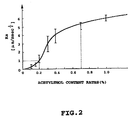
- Fig. 2 shows values of the proportional factor Ka to content ratios of acetylenol in an ink obtained by experiments.
- Ka values were measured by using a solution dynamic penetrability measuring device S (made by Toyo Seiki Seisakusho) in accordance with Bristow method.
- PB paper of Canon Co., Ltd. who is the applicant of the present invention, was used as a printing medium (recording paper).
- This PB paper is usable not only for a copier or a laser beam printer (LBP) using an electro-photographic method, but also for printing using an ink-jet recording method.
- Fig. 2 shows a curve on which Ka values are increasing (ordinate of axis) with increasing content rates (axis of abscissa).
- the proportional factor Ka is determined by the content percentage of acetylenol. Consequently, a penetration speed of ink substantially depends on a content rate of acetylenol. Further, the line segments crossing the curve and in parallel with the ordinate of axis show ranges of dispersions of the measurement results.
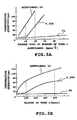
- Fig. 3 shows a characteristic curves of a relationship between penetration quantity of ink and penetration speed and shows results of the experiments on a recording paper of 64g/m 2 weight, about 80 ⁇ m thickness and about 50% percentage of voids.
- the abscissa represents square root of the lapse of time t (msec 1/2 ), and in Fig. 3B, the abscissa represents the lapse of time t (msec). Further, in both figures, the ordinate represents penetration amount ( ⁇ m), and curves are in the case of 0%, 0.35% and 1% acetylenol content, respectively.
- the ink In the case of an ink containing no acetylenol (content rate is 0%), the ink is a low or poor permeable ink. Further, in the case that acetylenol is mixed in a rate of 1% content, the ink has a property of permeating into recording paper in a short time and has property as a high permeable ink which will be specified later. And, the ink mixed with 0.35% content of acetylenol has a property of an intermediate, semi-permeable ink between the two.
- Ka value (ml/m 2 ⁇ msec 1/2 ) Acetylenol content (%) Surface tension (dyne/cm) Poor permeable ink less the 1.0 less than 0.2 40 or larger Semi-permeable ink 1.0 or more but less than 5.0 0.2 or more but less than 0.7 35 or larger but smaller than 40 High-permeable ink 5.0 or more 0.7 or more smaller than 35
- the above-mentioned table 1 shows Ka values, acetylenol contents (%), and surface tensions (dyne/cm) to "poor permeable ink", “semi-permeable ink”, and “high permeable ink” , respectively.
- Ka value the higher the penetrability of each ink to recording paper as a printing medium becomes. Namely, the smaller the surface tension is, the higher the penetrability is.
- the Ka values in Table 1 were, as described above, obtained from the measurements by using a solution dynamic penetrability test device S (made by Toyo Seiki Seisakusho) in accordance with Bristow method.
- said PB paper of Canon Co., Ltd. was used as recording paper. Further, similar results could be obtained on PPC paper of said Canon Co., Ltd.
- the ink specified as "high permeable ink” has 0.7 % or more content of acetylenol and this is in the range of penetrability in which the excellent result could be obtained as described above.
- CMC critical micell concentration
- Fig. 4 is a characteristic curve showing a relationship with surface tension when the content rate of acetylenol to water was varied. Since there is no reduction in the surface tension once micells are formed, it is apparent from the figure that the critical micell concentration of acetylenol to pure water is about 0.7%. And, comparing the CMC shown by the figure with the above Table 1, it is apparent that the "high penetrable ink" contains acetylenol at its CMC to pure water or higher.
- This embodiment is to perform printing by using an ink containing a predetermined color material such as dye or pigment, etc. and a processing solution to make this color material insoluble. Namely, by discharging the above-mentioned ink first and then discharging the processing solution onto it, a coalescent mixed solution is formed on a printing medium, and the concentration of the surface active agent in the solution is the CMC of the surface active agent to pure water or higher. Thus, a high OD value is obtained as a result of the printing, and further, a high speed fixing is achieved.
- an ink containing only dye and an ink partly containing pigment in the dye are defined as "an ink mainly with dye ", while an ink containing only pigment and an ink partly containing dye in the pigment are defined as " an ink mainly with pigment.”
- two kinds of ink such as dye ink and pigment ink are prepared, and by making them coalescent on a printing medium and then adding a processing solution thereon, a mixture of three kinds of solutions is obtained.
- the concentration of the surface active agent in this mixed solution is arranged to be the CMC of the surface active agent to water or higher.
- the inventor of the present invention has confirmed an effect that OD value becomes higher, presumably by an action, such as that the dye reactants, reacted with the processing solution, incorporate cohesive substances to become relatively large particles, and thus, more particles of pigment remain on the outer layer of the printing medium.
- any order produces the effect described above.
- an ink, containing both dye and pigment, and a processing solution are made coalescent on a printing medium, and the concentration of the surface active agent of the coalescent mixture is the CMC of the surface active agent to water or higher.
- This embodiment replaces the pigment ink in the above embodiment 2 with an ink without dispersing agent.
- the applicant of the present invention assumes that this is because the high viscosity substances of the simultaneously reacted dye absorb the above-mentioned particles to suppress the "seepage".
- This embodiment corresponds to a case wherein an ink mixed with dye and pigment beforehand does not contain dispersing agent for the pigment in the embodiment 3.
- This embodiment relates to the order of outputting ink and processing solution, and combinations of each ink and processing solution are applicable to this embodiment.
- the inks or the processing solution are output in order of dye ink, processing solution, and ink without dispersing agent, or in order of ink without dispersing agent, processing solution, and dye ink.
- the processing solution is added between the two inks, and they are mixed on the printing medium to make the concentration of the surface active agent in their mixed solution become the CMC of the surface active agent or higher.
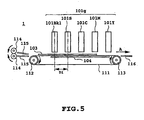
- Fig. 5 is a cross sectional view showing schematic configuration of a full line type printer relating to the example 1.
- This printer 1 adopts an ink-jet printing system to perform printing by discharging or ejecting ink or processing solution from a plurality of full line type printing heads arranged at predetermined positions along a conveying or feeding direction of a recording medium as a printing medium, and operates by being controlled by the control circuit in Fig. 6 which will be described later.
- Each of the printing heads 101Bk, 101S, 101C, 101M, and 101Y of a head group 101g has about 7200 ink discharging portions or nozzles arrayed in the width direction (perpendicular to this figure) of the recording paper conveyed in the direction of arrow A in the figure, and can operate printing on a recording paper up to the size A3.
- These heads make use of thermal energy to generate bubbles in the ink, etc. and discharge the ink or the processing solution by the pressure of the bubbles.
- the recording paper 103 is conveyed in the direction of arrow A by means of a pair of resist rollers 114 driyen by a conveyor or feed motor, and is guided by a pair of guide plates 115 and is conveyed onto a conveyor belt 111 after registration of the tip edge of the paper.
- the endless conveyor belt 111 is borne by two rollers 112, 113, and a vertical deviation on the upper part of the belt is restricted by a platen 104.
- the roller 113 is driven to rotate and the recording paper 103 is thereby conveyed.
- the recording paper 103 is held on the conveyor belt 111 by means of electrostatically.
- the roller 113 is driven to rotate in the direction of conveying the recording paper in the direction of the arrow A.
- the recording paper 103 printed thereon by the printing head group 101g is ejected onto a storage tray 116.
- Each head of the recording head group 101g comprised of the black dye ink head 101Bk, the processing solution head 101S for discharging the processing solution, each color ink head (a cyan head 101C, a magenta head 101M, and a yellow head 101Y) is arranged along the conveying direction A of the recording paper 103 as shown in the figure.
- the discharging nozzle of the black dye ink head 101Bk has a discharging amount of 30pl, and that of each of the other heads has a discharging amount of 15pl. It becomes possible to print black characters and colored images by discharging each color of ink and the processing solution from the respective printing heads.
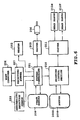
- Fig. 6 is a block diagram showing a control configuration of the full line type printer 1 illustrated in Fig. 5
- a system controller 201 has a micro processor, a ROM for storing a control program executed in this printing apparatus, a RAM used as a work area when the micro processor operates processing, etc., and executes the control of the entire printing apparatus.
- a motor 204 is controlled in the driving via a driver 202, and rotates the roller 113 shown in Fig. 5 to convey the recording paper.
- a host computer 206 transfers information to be printed to the printer 1 in accordance with this example, and controls its printing operation.
- a receiving buffer 207 temporarily stores data from the host computer 206 to keep them therein until a system controller 201 reads the data.
- a frame memory 208 is a memory for expanding printing data into image data, and has an enough size of memory for printing. This example is described assuming that the frame memory 208 has a memory capacity permitting to store data for a sheet of recording paper, however, the present invention is not to be restricted by a capacity of the frame memory.
- Buffers 209S, 209P are for temporarily storing data to be printed, and their memory capacities are variable depending on the number of the nozzles of the printing heads.
- a printing control part 210 is for properly controlling drives of the printing heads according to the instructions from the system controller 201, and controls a driving frequency, the number of printing data, etc., and also creates data for making the processing solution to be discharged.
- a driver 211 drives a head part 212S which is the printing head 101S for discharging the processing solution and a head part 212P including the printing heads 101Bk, 101C, 101M, 101Y for discharging each ink, and is controlled according to signal from the printing control part 201.
- the printing data are transferred from the host computer 206 to the receiving buffer 207 for being temporarily stored therein.
- the stored printing data are read by the system controller 201 and expanded to the buffers 209S, 209P. Further, it is possible to detect paper-jamming, ink-exhaustion, paper-out, etc. by means of each detection signal from abnormality detection sensors.
- the printing control part 210 creates data for the processing solution for discharging it, based on the image data expanded to the buffers 209S, 209P, and controls printing actions of each printing head based on the printing data in each buffer 209S, 209P and the data for the processing solution.
- a low penetration speed ink namely, poor permeable ink shown in Table 1
- each high penetration speed processing solution and ink namely, the high penetrability ink shown in Table 1 is used for each of the processing solution, cyan ink, magenta ink and yellow ink discharged from the heads 1025, 101C, 101M, 101Y.
- compositions of the processing solutions and each ink used in this example are as the following.
- the contents shown below are indicated by pts. wt.
- [processing solution] Glycerin 7 pts. wt. Diethylene glycol 5 pts. wt. Acetylenol EH 2.1 pts. wt. (made by Kawaken Fine Chemical Co., Ltd.)
- the nozzles of each printing head are arrayed at a concentration of 600dpi (dots per inch), and further, operates printing at a concentration of 600dpi in the direction of the recording paper conveyance.
- the dot concentration of an image, etc. printed in accordance with this example is 600dpi in both row and column directions.
- the discharging frequency of each head is 4 kHz
- the conveyance speed of the recording paper is about 170 mm/sec.
- a distance Di (refer to Fig. 5) between the black dye ink head 101Bk and the processing solution head 101S is 40 mm, therefore, it takes about 0.24 sec from discharging of the black dye ink on a position until discharging of the processing solution on the position.
- the above mixed solution becomes a high penetrability ink, which is fixed quickly. Further, the mixed solution has then about 5.0 (ml/m 2 ⁇ msec 1/2 ) of Ka value and about 33 dyne/cm of surface active tension.
- This example is different from the above example 1 in the point that a pigment ink Bk without dispersing agent is discharged from the head 101 Bk shown in Fig. 5.
- discharging amount per one nozzle of the head 101 Bk is 30 pl as in the above example 1, and discharging amount of the processing solution is also 15 pl as in the above.
- each acetylenol content of the Bk ink and the processing solution is 0.2 % and 1.7 %, respectively.
- the acetylenol content becomes 0.7 % when they are mixed on the recording paper, and this mixed solution shows a high penetrability and is fixed quickly.
- the above-mentioned pigment Bk ink without dispersing agent is as the following.
- a self-dispersion type pigment is used, in which at least a kind of anionic group is bonded to carbon black surface directly or via other atomic group, but for a color material, a self-dispersion type carbon black is used, to which at least a kind of hydrophilic group is bonded directly or via other atomic group.
- ionized self-dispersing type carbon black is desirable, and anionically electrified one is suitable.
- anionically electrified carbon black for example, -COOM, -SO 3 M, -PO 3 HM, -PO 3 M 2 , SO 2 NH 2 , -SO 2 NHCOR, etc.
- M in the formulae represents hydrogen atom, alkaline metal, ammonium or organic ammonium
- R represents an alkyl group with 1 to 12 carbon atoms, a phenyl group which is allowed to have substituent, or a naphthyl group which is allowed to have substituent.
- carbon black is preferably used, as is bonded with -COOM or -SO 3 M on the surface of the carbon black and is anionically electrified.
- hydrophilic groups for example, lithium, sodium, potassium, etc. can be mention as an alkaline metal, and for organic ammonium, mono-, di- or tri-methyl ammonium, mono-, di- or tri-ethyl ammonium, mono-, di- or tri-methanol ammonium, etc. can be mentioned.
- a method of obtaining anionically electrified carbon black namely, a method of introducing -COONa onto the surface of carbon black, for example, such a method can be mentioned as carbon black is treated with sodium hypochlorite by oxidation, however, it is obvious that the present invention is not to be restricted by this method.
- Pigment Bk ink has the following composition.
- Pigment dispersing solution 50 pts. wt. Glycerin 7 pts. wt. Tri-ethylene glycol 7 pts. wt. Acetylenol 0.2 pts. wt. (made by Kawaken Fine Chemical Co., Ltd.) Water Remainder
- the above-mentioned pigment dispersing solution is as follows.
- a pigment dispersing solution was obtained as expressed by the formula below, in which anionically electrified self-dispersed type carbon black bonded to hidrophilic group via phenyl group is dispersed on the surface.
- Fig. 7 is a schematic sectional view showing a printing apparatus relating to this example.
- a head 101Bk1 discharges 15 pl dye Bk ink per each nozzle
- a head 101Bk2 discharges 15 pl pigment Bk ink per each nozzle
- a processing solution head 101S discharges 15 pl processing solution per each nozzle.
- these dye Bk ink, pigment Bk ink, and processing solution contain 0 %, 0.2 %, and 1.9 % acetylenol, respectively.
- the above-mentioned dye Bk ink pigment Bk ink, and processing solution are made coalescent on the recording paper 103, and as a result, the acetylenol content of the mixed solution becomes 0.7 %, and the mixed solution becomes highly penetrative.
- the order of discharging the pigment ink and dye ink is reversed compared with the above example 3. Namely, in Fig 7, the head 101Bk1 discharges pigment ink, and the head 101BK2 discharges dye ink. In this case also, an effect similar to that from the above example 3 can be achieved.
- one head is provided for Bk ink as shown in Fig. 5, and this head discharges a mixed ink of dye Bk ink and pigment Bk ink.
- the discharging amount of this head is 30 pl containing 0.1 % acetylenol, while 15 pl processing solution is discharged as in each example described above but 1.9 % acetylenol is contained.
- acetylenol content of a mixed solution of the mixed Bk ink and the processing solution becomes 0.7 %.
- This mixed Bk ink has the following composition.
- Pigment dispersing solution 25 pts. wt. Food black 2 2 pts. wt. Glycerin 6 pts. wt. Tri-ethylene glycol 5 pts. wt. Acetylenol EH 0.1 pts. wt. ( made by Kawaken Fine Chemical Co., Ltd. ) Water Remainder
- Bk ink is provided with two heads, one of which discharges jet 15 pl dye ink per each nozzle and the other discharges 15 pl pigment ink per each nozzle, respectively, and processing solution is also provided with two heads, of which each discharges 8 pl processing solution per each nozzle.
- acetylenol contents of each solution are 0 %, 0.2 %, 0.2 %, and 3.6 % in the above discharging order, and as a result, an acetylenol content of the coalescent solution becomes 0.7 %.
- high fixation can be achieved.
- the later in the discharging order a solution is, the higher penetrability the solution has. Therefore, it is possible to coalesce the drops of the earlier discharged solution and the later discharged solution before penetration of the earlier discharged solution, and this coalescence can make the penetrability of the mixed solution higher.
- compositions of Bk ink to improve its fixation have been described as preferred embodiments of the present invention.
- application of the present invention is not to be restricted by the above.
- the present invention is applicable thereto.
- Y-ink of which an improvement in concentration is not so much desired, is made as a high permeable ink while other inks are made as poor permeable inks, and thus, it is thereby possible to provide the mixture with a predetermined acetylenol content when they are mixed.
- dye ink or pigment ink was made to be discharged 30 pl from one head per each nozzle, however, the same effect can be also obtained if two heads discharge 15 pl of the ink per nozzle respectively.
- pigment ink without dispersing agent has been described, however, it is obvious that pigment ink with dispersing agent may also be used. Further, each of the dye ink and the pigment ink may partly contain pigment and dye of less composition rate to the other, respectively.
- the configuration may be such as a high penetrative processing solution is discharged before Bk ink is further discharged.
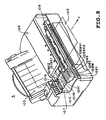
- applicability of the present invention is not to be restricted to a full line type printer as shown in each example of the above, but the invention is applicable to a serial type printer as shown in Fig. 8.
- Fig. 8 is a schematic drawing showing the constitution of a serial type printer 5 relating to an example of the present invention. Namely, it is obvious that a printing apparatus, wherein dye ink and pigment ink are mixed on a printing medium before they are reacted with a processing solution, is applicable not only to the above-described full line type but also to the serial type apparatus.
- a printing apparatus wherein dye ink and pigment ink are mixed on a printing medium before they are reacted with a processing solution, is applicable not only to the above-described full line type but also to the serial type apparatus.
- the same components as shown in Fig. 5 or Fig. 7 are marked with the same codes for omitting the detail description about them.
- two Bk ink heads are provided in the configuration shown in the figure.
- Recording paper 103 as a printing medium is inserted from a paper feeding part 105 and ejected via printing part 126.
- widely used inexpensive ordinary paper is used as recording paper 103.
- a carriage 107 is arranged to mount printing heads 101Bk1, 102Bk2, 101S, 101C, 101M, and 101Y and move back and forth along a guide rail 109 by means of a driving force of an unshown motor.
- the printing head 101Bk1 discharges black pigment ink
- the printing head 102Bk2 discharges black dye ink.
- the printing heads 101S, 101C, 101M, and 101Y discharge processing solution, cyan ink, magenta ink, yellow ink, respectively, and are driven in this order to discharge ink or processing solution on a sheet of the recording paper 103.
- the black pigment ink is an ink without dispersing agent.
- ink or processing solution is supplied from each tank 108Bk1, 108Bk2, 108S, 108C, 108M and 108Y, respectively.
- a driving signal is supplied to an electro-thermal transducer of heater disposed at each nozzle of each head, and then thermal energy acts on ink or processing solution to generate a bubble therein, thereby ink or processing solution is discharged by the pressure of the bubble.
- Each head has 64 discharging portions or nozzles arrayed at 360 dpi in the direction substantially the same as the conveying direction of the recording paper 103, that is, the nozzles are arrayed in the direction perpendicular to the scanning direction of each head.
- discharging amount per one nozzle is 23 pl.
- each head is arranged at 1/2 inch intervals, and has a printing concentration of 720 dpi in the scanning direction and a discharging frequency of 7.2 kHz.
- discharging system of each head makes use of thermal energy to discharge ink or processing solution, however, the present invention does not restrict this applicability but, for example, a system using piezo-element may be applicable.
- a discharging rate and discharging intervals of Y-ink discharged at the same time have only to be determined so that acetylenol content becomes a percentage showing the predetermined high penetrability described above to the total solution volume at the time when the succeeding ink is discharged and mixed.
- a plurality of different droplets of ink, processing solution, etc. coalesce into one droplet and its critical micell concentration, surface tension, and Ka value, which represent the penetrability of the droplet, becomes a predetermined value of high penetrability or higher, therefore, the penetration is accelerated as a droplet after coalescence even if not all the component droplets have high penetrability.
Landscapes
- Chemical & Material Sciences (AREA)
- Life Sciences & Earth Sciences (AREA)
- Engineering & Computer Science (AREA)
- Materials Engineering (AREA)
- Wood Science & Technology (AREA)
- Organic Chemistry (AREA)
- Ink Jet Recording Methods And Recording Media Thereof (AREA)
- Ink Jet (AREA)
- Inks, Pencil-Leads, Or Crayons (AREA)
Applications Claiming Priority (4)
| Application Number | Priority Date | Filing Date | Title |
|---|---|---|---|
| JP36146197 | 1997-12-26 | ||
| JP36146197 | 1997-12-26 | ||
| JP36457198 | 1998-12-22 | ||
| JP36457198A JP3658223B2 (ja) | 1997-12-26 | 1998-12-22 | 画像形成方法および画像形成装置 |
Publications (3)
| Publication Number | Publication Date |
|---|---|
| EP0926212A2 EP0926212A2 (en) | 1999-06-30 |
| EP0926212A3 EP0926212A3 (en) | 1999-09-22 |
| EP0926212B1 true EP0926212B1 (en) | 2003-09-24 |
Family
ID=26581270
Family Applications (1)
| Application Number | Title | Priority Date | Filing Date |
|---|---|---|---|
| EP98310708A Expired - Lifetime EP0926212B1 (en) | 1997-12-26 | 1998-12-23 | Method of forming image and apparatus of the same |
Country Status (5)
| Country | Link |
|---|---|
| US (1) | US6379000B1 (enExample) |
| EP (1) | EP0926212B1 (enExample) |
| JP (1) | JP3658223B2 (enExample) |
| DE (1) | DE69818413T2 (enExample) |
| ES (1) | ES2206856T3 (enExample) |
Families Citing this family (18)
| Publication number | Priority date | Publication date | Assignee | Title |
|---|---|---|---|---|
| JP4036407B2 (ja) | 1997-12-26 | 2008-01-23 | キヤノン株式会社 | インクジェットプリント装置およびその方法 |
| US6322187B1 (en) * | 2000-01-19 | 2001-11-27 | Xerox Corporation | Method for smoothing appearance of an ink jet print |
| JP4475620B2 (ja) * | 2000-03-10 | 2010-06-09 | キヤノン株式会社 | インクジェットプリント方法 |
| JP4054565B2 (ja) * | 2000-11-17 | 2008-02-27 | キヤノン株式会社 | 被記録媒体 |
| US6550882B2 (en) * | 2000-11-17 | 2003-04-22 | Canon Kabushiki Kaisha | Ink jet printing apparatus |
| US6652085B2 (en) * | 2001-10-30 | 2003-11-25 | Hewlett-Packard Development Company, L.P. | Enhancement of waterfastness using a polyamine/anionic dye mixture with an acidic fixer |
| JP4508703B2 (ja) * | 2003-04-24 | 2010-07-21 | キヤノン株式会社 | インクジェット用インク及びこれを用いたインクジェット記録方法 |
| JP2006063332A (ja) | 2004-07-29 | 2006-03-09 | Canon Inc | インクジェット用ブラックインク、インクセット、インクジェット記録方法、インクカートリッジ、記録ユニット、及びインクジェット記録装置 |
| US7478902B2 (en) * | 2004-11-04 | 2009-01-20 | Hewlett-Packard Development Company, L.P. | Inkjet compositions |
| JP4812078B2 (ja) | 2004-12-28 | 2011-11-09 | キヤノン株式会社 | インクジェット記録装置 |
| JP2006212787A (ja) | 2005-02-01 | 2006-08-17 | Canon Inc | インクジェット記録装置 |
| US20070019008A1 (en) * | 2005-07-22 | 2007-01-25 | Xerox Corporation | Systems, methods, and programs for increasing print quality |
| JP2007125855A (ja) * | 2005-11-07 | 2007-05-24 | Sony Corp | 画像形成方法 |
| JP5031410B2 (ja) * | 2006-03-09 | 2012-09-19 | キヤノン株式会社 | インクジェット記録方法 |
| DE602006010421D1 (de) * | 2006-12-21 | 2009-12-24 | Agfa Graphics Nv | Tintenstrahldruckverfahren und -tintensätze |
| JP2010184413A (ja) * | 2009-02-12 | 2010-08-26 | Fujifilm Corp | インクジェット記録方法 |
| JP2010234582A (ja) * | 2009-03-30 | 2010-10-21 | Brother Ind Ltd | インクジェット記録方法、インクジェット記録装置およびインクジェット記録用インクセット |
| US10647144B2 (en) | 2018-02-23 | 2020-05-12 | Canon Kabushiki Kaisha | Ink jet recording method |
Family Cites Families (8)
| Publication number | Priority date | Publication date | Assignee | Title |
|---|---|---|---|---|
| JP2675825B2 (ja) * | 1988-08-19 | 1997-11-12 | キヤノン株式会社 | インクジェット記録方法 |
| US5133803A (en) | 1991-07-29 | 1992-07-28 | Hewlett-Packard Company | High molecular weight colloids which control bleed |
| JP3229075B2 (ja) | 1992-07-24 | 2001-11-12 | キヤノン株式会社 | インクジェット記録装置 |
| US6007182A (en) * | 1992-07-24 | 1999-12-28 | Canon Kabushiki Kaisha | Ink-jet recording method employing inks of different characteristics and apparatus therefor |
| US5746818A (en) * | 1995-08-31 | 1998-05-05 | Seiko Epson Corporation | Pigment ink composition capable of forming image having no significant bleeding or feathering |
| JP3454024B2 (ja) | 1995-10-06 | 2003-10-06 | セイコーエプソン株式会社 | インクジェット記録用インク組成物及び記録方法 |
| JP3397605B2 (ja) * | 1996-01-19 | 2003-04-21 | キヤノン株式会社 | インクジェットプリント方法およびその装置 |
| US6036759A (en) * | 1998-04-30 | 2000-03-14 | Hewlett-Packard Company | Black to color bleed control in ink-jet printing inks |
-
1998
- 1998-12-22 US US09/217,940 patent/US6379000B1/en not_active Expired - Lifetime
- 1998-12-22 JP JP36457198A patent/JP3658223B2/ja not_active Expired - Fee Related
- 1998-12-23 ES ES98310708T patent/ES2206856T3/es not_active Expired - Lifetime
- 1998-12-23 DE DE69818413T patent/DE69818413T2/de not_active Expired - Lifetime
- 1998-12-23 EP EP98310708A patent/EP0926212B1/en not_active Expired - Lifetime
Also Published As
| Publication number | Publication date |
|---|---|
| JPH11245395A (ja) | 1999-09-14 |
| US20020039130A1 (en) | 2002-04-04 |
| EP0926212A3 (en) | 1999-09-22 |
| US6379000B1 (en) | 2002-04-30 |
| JP3658223B2 (ja) | 2005-06-08 |
| DE69818413T2 (de) | 2004-07-15 |
| DE69818413D1 (de) | 2003-10-30 |
| EP0926212A2 (en) | 1999-06-30 |
| ES2206856T3 (es) | 2004-05-16 |
Similar Documents
| Publication | Publication Date | Title |
|---|---|---|
| EP0925919B1 (en) | Ink-jet printing apparatus | |
| US6379000B1 (en) | Method of forming image and apparatus of the same | |
| US6550904B2 (en) | Ink printing method and ink printer | |
| EP1167046B1 (en) | Ink jet recording apparatus and printing method thereof | |
| JP3667160B2 (ja) | インクジェットプリント方法およびインクジェットプリント装置 | |
| JP3997019B2 (ja) | プリント方法およびプリント装置 | |
| JP2002079740A (ja) | インクジェットプリント方法 | |
| US6367923B1 (en) | Ink-jet printing method, system using an ink and a treating liquid, and ink set | |
| US6474804B2 (en) | Ink, ink set, ink-jet recording process, ink cartridge, recording unit and ink-jet recording apparatus | |
| JP3762125B2 (ja) | インクプリント方法およびインクプリント装置 | |
| EP1066968B1 (en) | Ink jet printing apparatus and ink jet printing method | |
| US6454402B1 (en) | Ink-jet printing method an ink-jet printing apparatus | |
| JP2000037890A (ja) | インクプリント方法およびインクジェットプリント装置 | |
| JPH11129461A (ja) | 記録方法 | |
| US7226157B2 (en) | Ink-jet recording process | |
| JP2001322346A (ja) | インクジェットプリント方法 | |
| JP4227267B2 (ja) | インクジェットプリント方法およびインクジェットプリント装置 | |
| JP4235331B2 (ja) | インクジェットプリント方法 | |
| JP4036463B2 (ja) | インクジェットプリント装置およびプリント方法 | |
| JP2002088288A (ja) | インクセット、該インクセットを用いたインクジェットプリント方法、記録ユニット、インクカートリッジ及びインクジェットプリント装置 |
Legal Events
| Date | Code | Title | Description |
|---|---|---|---|
| PUAI | Public reference made under article 153(3) epc to a published international application that has entered the european phase |
Free format text: ORIGINAL CODE: 0009012 |
|
| AK | Designated contracting states |
Kind code of ref document: A2 Designated state(s): DE ES FR GB IT NL |
|
| AX | Request for extension of the european patent |
Free format text: AL;LT;LV;MK;RO;SI |
|
| PUAL | Search report despatched |
Free format text: ORIGINAL CODE: 0009013 |
|
| AK | Designated contracting states |
Kind code of ref document: A3 Designated state(s): AT BE CH CY DE DK ES FI FR GB GR IE IT LI LU MC NL PT SE |
|
| AX | Request for extension of the european patent |
Free format text: AL;LT;LV;MK;RO;SI |
|
| 17P | Request for examination filed |
Effective date: 20000204 |
|
| AKX | Designation fees paid |
Free format text: DE ES FR GB IT NL |
|
| 17Q | First examination report despatched |
Effective date: 20020328 |
|
| GRAH | Despatch of communication of intention to grant a patent |
Free format text: ORIGINAL CODE: EPIDOS IGRA |
|
| GRAS | Grant fee paid |
Free format text: ORIGINAL CODE: EPIDOSNIGR3 |
|
| GRAA | (expected) grant |
Free format text: ORIGINAL CODE: 0009210 |
|
| AK | Designated contracting states |
Kind code of ref document: B1 Designated state(s): DE ES FR GB IT NL |
|
| REG | Reference to a national code |
Ref country code: GB Ref legal event code: FG4D |
|
| REF | Corresponds to: |
Ref document number: 69818413 Country of ref document: DE Date of ref document: 20031030 Kind code of ref document: P |
|
| REG | Reference to a national code |
Ref country code: ES Ref legal event code: FG2A Ref document number: 2206856 Country of ref document: ES Kind code of ref document: T3 |
|
| ET | Fr: translation filed | ||
| PLBE | No opposition filed within time limit |
Free format text: ORIGINAL CODE: 0009261 |
|
| STAA | Information on the status of an ep patent application or granted ep patent |
Free format text: STATUS: NO OPPOSITION FILED WITHIN TIME LIMIT |
|
| 26N | No opposition filed |
Effective date: 20040625 |
|
| PGFP | Annual fee paid to national office [announced via postgrant information from national office to epo] |
Ref country code: ES Payment date: 20061212 Year of fee payment: 9 |
|
| PGFP | Annual fee paid to national office [announced via postgrant information from national office to epo] |
Ref country code: NL Payment date: 20061215 Year of fee payment: 9 |
|
| PGFP | Annual fee paid to national office [announced via postgrant information from national office to epo] |
Ref country code: IT Payment date: 20061231 Year of fee payment: 9 |
|
| PGFP | Annual fee paid to national office [announced via postgrant information from national office to epo] |
Ref country code: FR Payment date: 20061218 Year of fee payment: 9 |
|
| NLV4 | Nl: lapsed or anulled due to non-payment of the annual fee |
Effective date: 20080701 |
|
| REG | Reference to a national code |
Ref country code: FR Ref legal event code: ST Effective date: 20081020 |
|
| PG25 | Lapsed in a contracting state [announced via postgrant information from national office to epo] |
Ref country code: NL Free format text: LAPSE BECAUSE OF NON-PAYMENT OF DUE FEES Effective date: 20080701 |
|
| REG | Reference to a national code |
Ref country code: ES Ref legal event code: FD2A Effective date: 20071224 |
|
| PG25 | Lapsed in a contracting state [announced via postgrant information from national office to epo] |
Ref country code: FR Free format text: LAPSE BECAUSE OF NON-PAYMENT OF DUE FEES Effective date: 20071231 Ref country code: ES Free format text: LAPSE BECAUSE OF NON-PAYMENT OF DUE FEES Effective date: 20071224 |
|
| PG25 | Lapsed in a contracting state [announced via postgrant information from national office to epo] |
Ref country code: IT Free format text: LAPSE BECAUSE OF NON-PAYMENT OF DUE FEES Effective date: 20071223 |
|
| PGFP | Annual fee paid to national office [announced via postgrant information from national office to epo] |
Ref country code: DE Payment date: 20141231 Year of fee payment: 17 Ref country code: GB Payment date: 20141222 Year of fee payment: 17 |
|
| REG | Reference to a national code |
Ref country code: DE Ref legal event code: R119 Ref document number: 69818413 Country of ref document: DE |
|
| GBPC | Gb: european patent ceased through non-payment of renewal fee |
Effective date: 20151223 |
|
| PG25 | Lapsed in a contracting state [announced via postgrant information from national office to epo] |
Ref country code: DE Free format text: LAPSE BECAUSE OF NON-PAYMENT OF DUE FEES Effective date: 20160701 Ref country code: GB Free format text: LAPSE BECAUSE OF NON-PAYMENT OF DUE FEES Effective date: 20151223 |