EP0916680A2 - Lantibiotikum verwandt mit Actagardine, Verfahren zur Herstellung und Verwendung desselben - Google Patents
Lantibiotikum verwandt mit Actagardine, Verfahren zur Herstellung und Verwendung desselben Download PDFInfo
- Publication number
- EP0916680A2 EP0916680A2 EP98119105A EP98119105A EP0916680A2 EP 0916680 A2 EP0916680 A2 EP 0916680A2 EP 98119105 A EP98119105 A EP 98119105A EP 98119105 A EP98119105 A EP 98119105A EP 0916680 A2 EP0916680 A2 EP 0916680A2
- Authority
- EP
- European Patent Office
- Prior art keywords
- compound
- ala
- actagardine
- dsm
- actinoplanes
- Prior art date
- Legal status (The legal status is an assumption and is not a legal conclusion. Google has not performed a legal analysis and makes no representation as to the accuracy of the status listed.)
- Granted
Links
Classifications
-
- C—CHEMISTRY; METALLURGY
- C07—ORGANIC CHEMISTRY
- C07K—PEPTIDES
- C07K7/00—Peptides having 5 to 20 amino acids in a fully defined sequence; Derivatives thereof
- C07K7/04—Linear peptides containing only normal peptide links
- C07K7/08—Linear peptides containing only normal peptide links having 12 to 20 amino acids
-
- A—HUMAN NECESSITIES
- A61—MEDICAL OR VETERINARY SCIENCE; HYGIENE
- A61K—PREPARATIONS FOR MEDICAL, DENTAL OR TOILETRY PURPOSES
- A61K38/00—Medicinal preparations containing peptides
- A61K38/04—Peptides having up to 20 amino acids in a fully defined sequence; Derivatives thereof
- A61K38/10—Peptides having 12 to 20 amino acids
-
- A—HUMAN NECESSITIES
- A61—MEDICAL OR VETERINARY SCIENCE; HYGIENE
- A61P—SPECIFIC THERAPEUTIC ACTIVITY OF CHEMICAL COMPOUNDS OR MEDICINAL PREPARATIONS
- A61P31/00—Antiinfectives, i.e. antibiotics, antiseptics, chemotherapeutics
-
- A—HUMAN NECESSITIES
- A61—MEDICAL OR VETERINARY SCIENCE; HYGIENE
- A61P—SPECIFIC THERAPEUTIC ACTIVITY OF CHEMICAL COMPOUNDS OR MEDICINAL PREPARATIONS
- A61P31/00—Antiinfectives, i.e. antibiotics, antiseptics, chemotherapeutics
- A61P31/04—Antibacterial agents
-
- C—CHEMISTRY; METALLURGY
- C12—BIOCHEMISTRY; BEER; SPIRITS; WINE; VINEGAR; MICROBIOLOGY; ENZYMOLOGY; MUTATION OR GENETIC ENGINEERING
- C12P—FERMENTATION OR ENZYME-USING PROCESSES TO SYNTHESISE A DESIRED CHEMICAL COMPOUND OR COMPOSITION OR TO SEPARATE OPTICAL ISOMERS FROM A RACEMIC MIXTURE
- C12P21/00—Preparation of peptides or proteins
- C12P21/02—Preparation of peptides or proteins having a known sequence of two or more amino acids, e.g. glutathione
-
- A—HUMAN NECESSITIES
- A61—MEDICAL OR VETERINARY SCIENCE; HYGIENE
- A61K—PREPARATIONS FOR MEDICAL, DENTAL OR TOILETRY PURPOSES
- A61K38/00—Medicinal preparations containing peptides
Definitions
- the present invention relates to a new lantibiotic related to actagardine, in particular a lantibiotic called Ala 0 -actagardine, a process for its preparation, chemical derivatives derived from the lantibiotic and the use of the lantibiotic as a medicament.
- Lantibiotics are polycyclic peptide antibiotics, which as a characteristic feature the Contain amino acid lanthionine or methyl lanthionine. It's microbial Obtained natural products that act as antibacterial agents in human therapy Preservatives or as enzyme inhibitors (G. Jung, Appl. Chem. Int. Ed. Engl., 1991, 30, 1051-1068.).
- the strains Actinoplanes liguriae and Actinoplanes garbadiensis are each able to form at least one new antibiotic, for example the Ala 0 actagardine, which is not only very antibacterially effective, but is also well tolerated.
- An isolate of Actinoplanes garbadiensis was deposited with the DSM according to the rules of the Budapest Treaty on September 24, 1997 under the following number: DSM 11796.
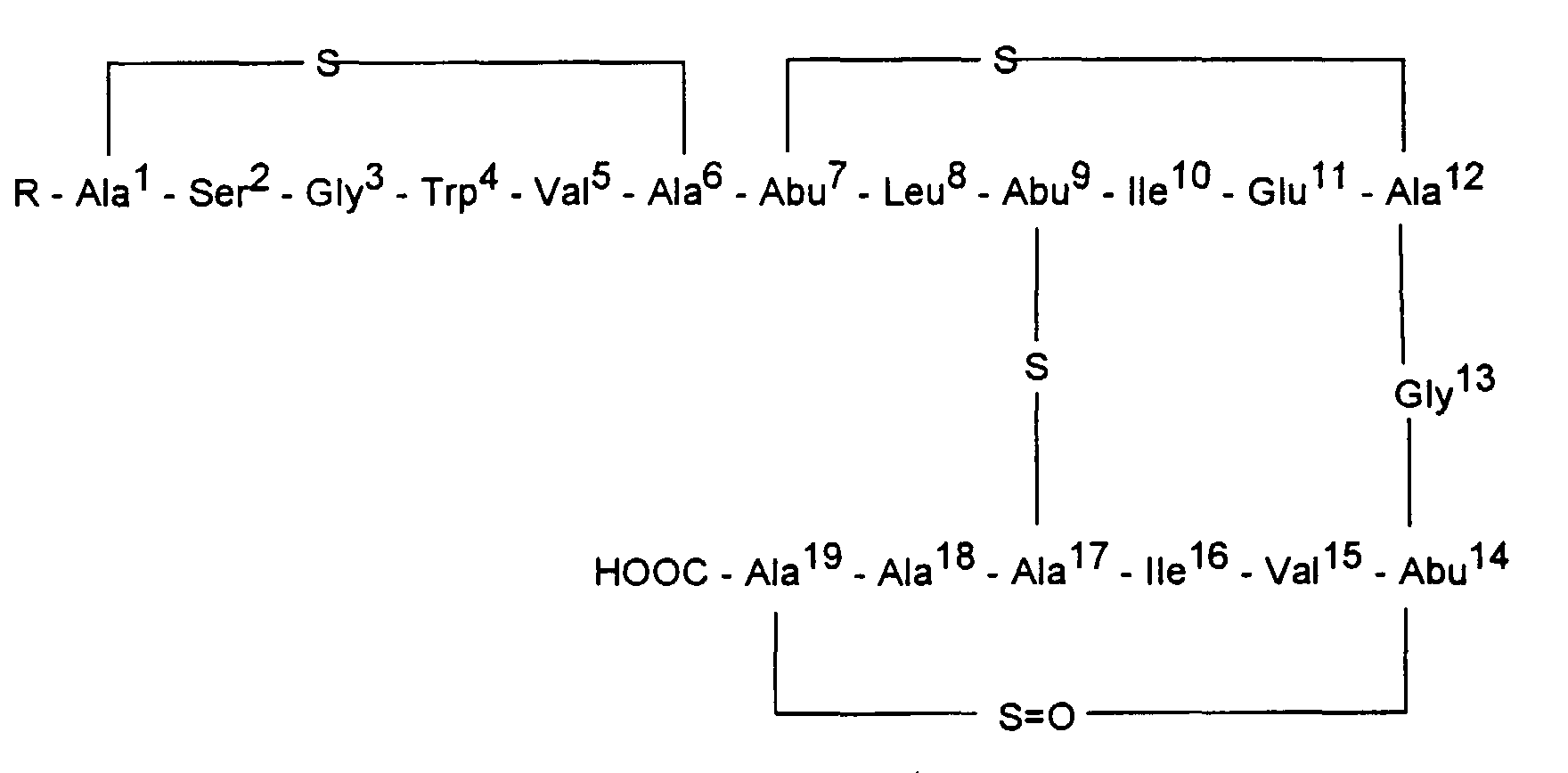
- R is the residue of an amino acid and its physiologically tolerable salts.
- R can be the residue of a substituted or unsubstituted amino acid in which the amino group is in the ⁇ - to ⁇ -position and in the D or L configuration.
- Substituted or unsubstituted ⁇ -amino acids in D or L configuration are particularly preferred.
- R the rest is preferably a natural amino acid selected from: Ala, Gly, Glu, Phe, Pro, Thr. Cys, Met, Trp, Tyr, Asn, Gln, Asp, His, Ile, Leu, Lys, Arg, Ser and Val.
- the amino acid means particularly preferably Ala, Ile, Lys, Phe, Val, Glu, Asp, His, Leu , Arg or Ser and very particularly preferably the amino acid Ala is 0 .
- R can also be a substituted or unsubstituted diaminoalkanoic acid residue mean such as B. 2,4-diaminobutyric acid (Dab).
- the invention also relates to a compound of the empirical formula: C 84 H 129 N 21 O 25 S 4 (Ala 0 -actagardine) obtainable by fermentation of Actinoplanes liguriae, DSM 11797 or Actinoplanes garbadiensis, DSM 11796 or one of its variants and / or mutants, in a culture medium until the compound Ala 0 -actagardine accumulates in the culture broth and by subsequent isolation of the compound and its pharmacologically acceptable salts.
- the invention further relates to chemical derivatives derived from a compound of the empirical formula C 84 H 129 N 21 O 25 S 4 (Ala 0 -actagardine), obtainable by fermentation of Actinoplanes liguriae , DSM 11797 or Actinoplanes garbadiensis DSM 11796 or one of their variants and / or mutants in a culture medium until the compound Ala 0 -actagardine accumulates in the culture broth and by subsequently isolating the compound and converting it into chemical derivatives and their pharmacologically acceptable salts.
- a compound of the empirical formula C 84 H 129 N 21 O 25 S 4 Ala 0 -actagardine
- Preferred chemical derivatives are: Ile 0 -, Lys 0 , Phe 0 -, Val 0 -, Glu 0 -, Asp 0 -, His 0 -, Leu 0 -, Arg 0 - and Ser 0 -actagardines.
- the conversion of Ala 0 -actagardines into the chemical derivatives mentioned can be prepared by methods known to the person skilled in the art.
- the Actinoplanes liguriae strain forms the actagardine and the by-products known from the literature on nutrient solutions containing glucose, starch or glycerol. It has surprisingly been found that the same organism on poorly digestible media containing mannitol contains the antibiotic NH 2 -R-actagardine according to the invention in very good yields, where R is the residue of a natural amino acid, especially alanine, but not the ones described Compounds, even actagardine only in traces.
- the invention therefore relates to a process for the preparation of the compound of the formula I, characterized in that the microorganism Actinoplanes liguriae, DSM 11797 or Actinoplanes garbadiensis, DSM 11796 or one of its variants or mutants is cultivated in an aqueous nutrient medium, a compound of the formula I is isolated and purified and, if appropriate, converted into its pharmacologically acceptable salts.
- Said method comprises the cultivation of Actinoplanes liguriae , DSM 11797 or Actinoplanes garbadiensis, DSM 11796 of its mutants and / or variants under aerobic conditions in a culture medium containing carbon and nitrogen, inorganic salts and trace elements.
- the cultivation is preferably carried out at a temperature between 20 and 35 ° C. and performed at a pH between 4 and 10.
- the invention also relates to a method for producing a compound of Formula 1, characterized in that the compound Actagardine with a Amino acid is implemented.
- an activated amino acid ester with the terminal amino group des Actagardines are implemented.
- the amino acid is on the amino nitrogen preferably a protecting group, e.g. tert-Butyloxy-carbonyl (Boc-) bound to prevent reactions of the activated amino acid esters with themselves.
- Activated esters are e.g. B., the N-hydroxysuccinimide esters of each Amino acids.
- the protecting group is split off and then that Reaction mixture cleaned.
- the Actinoplanes has orange substrate mycelium and no aerial mycelium. It forms the for Actinoplanes characteristic sporangia.
- the cell wall contains mesoDiaminopimelin Textre as well as glycine as characteristic amino acids and xylose and arabinose as sugar, these are characteristic features of the genus Actinoplanes.
- mutants and Variants are used insofar as they are the compounds according to the invention synthesize.
- Such mutants can be carried out in a manner known per se physical means, for example radiation, such as with ultraviolet or X-rays, or chemical mutagens, such as Ethyl methanesulfonate (EMS) 2-hydroxy-4-methoxy-benzophenone (MOB) or N-methyl-N'-nitro-N-nitrosoguanidine (MNNG) are generated.
- EMS Ethyl methanesulfonate
- MOB 2-hydroxy-4-methoxy-benzophenone
- MNNG N-methyl-N'-nitro-N-nitrosoguanidine
- the screening for mutants and variants that the inventive Antibiotic can be produced by determining the biological activity of the active ingredient accumulated in the culture broth, for example by testing the antibacterial effect.
- Nitrogen-containing nutrients come into consideration: amino acids, peptides and proteins as well as their breakdown products, such as peptones or tryptones, as well as meat extracts, ground seeds, for example of corn, wheat, beans, oats, soy or Cotton plant, distillation residues from alcohol production, meat flours or Yeast extracts, but also ammonium salts and nitrates.
- on inorganic salts can the nutrient solution for example chlorides, carbonates, sulfates or phosphates which contain alkali or alkaline earth metals, iron, zinc, cobalt and manganese.
- the formation of the Ala (0) -actagardine proceeds particularly well, e.g. B. in a nutrient solution, preferably about 0.5 to 5% mannitol, preferably 1 to 3%, 0.5 to 5% soy flour, preferably 1 to 3% and a trace element solution in a concentration of 0.1 to 0.5% Contains 0.2 to 0.3%.
- the trace element solution contains CaCl 2 , Fe III citrate, MnSO 4 , ZnCl 2 , CuSO 4 , sodium tetraborate, CoCl 2 and sodium molybdate.
- the cultivation is carried out aerobically, for example submerged with shaking or stirring in shake flasks or fermenters, if appropriate with the introduction of air or oxygen.
- the fermentation can be carried out, for example, in steep-breasted bottles or round-bottom flasks of different volumes, in glass fermenters or V 2 A steel tanks. It can be carried out in a temperature range from about 20 to 35 ° C., preferably at about 25 to 30 ° C.
- the pH should be between 4 and 10, advantageously between 5.5 and 8.5.
- the microorganism is generally cultured under these conditions for a period of 20 to 300 hours, preferably 24 to 140 hours.
- Cultivation is advantageously carried out in several stages, ie one or more precultures are first prepared in a liquid nutrient medium, which are then inoculated into the actual production medium, the main culture, for example in a volume ratio of 1:10.
- the preculture is obtained e.g. B. by inoculating a mycelium in a nutrient solution and growing for about 20 to 120 hours, preferably 24 to 72 hours.
- the mycelium can be obtained, for example, by allowing the strain to grow on a solid or liquid nutrient medium, for example yeast-malt agar or oatmeal agar, for about 1 to 40 days, preferably 3 to 10 days.
- the course of fermentation and the formation of the antibiotic according to the invention can according to methods known in the art, such.
- B. by Testing of biological activity in bioassays or by chromatographic Methods such as thin layer chromatography (DC) or High performance liquid chromatography (HPLC) can be followed.
- the antibiotic Ala (0) -actagardine can be found both in the mycelium and in the culture filtrate occur, usually the bulk is in the culture filtrate. It is therefore appropriate, the fermentation solution by filtration or centrifugation to separate.
- the filtrate is extracted with an adsorption resin as a solid phase.
- the mycelium is expediently extracted with methanol or acetone, it can but other solvents can also be used.
- the extractions can be carried out in a wide pH range, it is however expedient, preferably in a neutral or slightly acidic environment to work between pH 3 and pH 7.
- the extracts can e.g. B. in a vacuum concentrated and dried.
- One method of isolating the antibiotic according to the invention is Solution distribution in a manner known per se.
- Another method of purification is chromatography on adsorption resins such as. B. on Diaion7 HP-20 (Mitsubishi Casei Corp., Tokyo), on Amberlite7 XAD 7 (Rohm and Haas, USA), on Amberchrom7 CG, (Toso Haas, Philadelphia, USA) or the like.
- Numerous reverse phase carriers, e.g. B. RP 8 and RP 18 , such as. B. in the context of high pressure liquid chromatography (HPLC) have become generally known.
- Another cleaning option for the antibiotic according to the invention is the use of so-called normal phase chromatography supports, such as. B. silica gel or Al 2 O 3 or others in a conventional manner.
- An alternative isolation method is the use of molecular sieves, such as e.g. B. Fractogel7 TSK HW-40, Sephadex7 G-25 and others, in known per se Wise. It is also possible to use Ala (0) -actagardine from enriched material to gain by crystallization. Suitable for this are, for. B. organic Solvents and their mixtures, anhydrous or with added water.
- a additional process for the isolation and purification of the invention consist in the use of anion exchangers, preferably in pH range from 4 to 10 and cation exchangers preferably in the pH range from 2 to 5. The use of buffer solutions is particularly suitable for this. to which portions of organic solvents have been added.
- Ala (0) -actagardine the chemical derivatives thereof and the Obvious chemical equivalents thereof can be made by those skilled in the art known methods in the corresponding pharmacologically acceptable salts be transferred.
- Obvious chemical equivalents of the compounds of the invention are Compounds that have a slight chemical difference, i.e. the have the same effectiveness or get into the under mild conditions convert compounds of the invention.
- Esters, amino derivatives, complexes or adducts of or with the compounds of the invention belong e.g. Esters, amino derivatives, complexes or adducts of or with the compounds of the invention.
- Pharmacologically acceptable salts of the compounds according to the invention are understood to mean both inorganic and organic salts, as described in Remingtons Pharmaceutical Sciences (17th edition, page 1418 (1985)).
- salts come in particular alkali, ammonium, alkaline earth metal salts, salts with physiologically compatible amines and salts with inorganic or organic acids such as. B. HCl, HBr, H 2 SO 4 , maleic acid, fumaric acid in question.
- the amino acid analysis shows in addition to the amino acids of the actagardine [1 Ser, 2 Gly, 1 Trp, 2 Val, 1 Leu, 2 Ile, 1 Glu, 1 Ala, 1 Lanthionin (Ala-S-Ala) and 3 ⁇ -Methyllanthionin (Abu-S-Ala)] another Ala.
- Table 3 summarizes the minimum inhibitory concentrations (MIC) of Ala (0) -actagardines by way of example.
- MIC minimum inhibitory concentrations
- the compound of the invention not only around twice as good antibacterial effects against gram-positive germs has like the Actagardine, but at the same time with no cross resistance conventional antibiotics, such as ⁇ -lactams (penicillins, Cephalosporins), aminoglycosides (streptomycin), macrolides (erythromycin), Quinolones (ciprofloxacin), sulfonamides or glycopeptides (vancomycin) and others.
- antibiotics such as ⁇ -lactams (penicillins, Cephalosporins), aminoglycosides (streptomycin), macrolides (erythromycin), Quinolones (ciprofloxacin), sulfonamides or glycopeptides (vancomycin) and others.
- ⁇ -lactams penicillins, Cephalosporins
- aminoglycosides streptomycin
- macrolides erythromycin
- Quinolones ciprofloxacin
- the tolerance of the Ala (0) -actagardine is in the effective concentration and about it well. No cytotoxic effects or other toxicities were found observed.
- the present invention accordingly also relates to the application of Compounds according to the invention as a medicament, and the use of relevant compounds for the manufacture of medicaments for treatment and / or prophylaxis of bacterial infections.
- the present invention relates to medicaments containing the compound of the invention.
- Said drug is obtained by mixing at least one compound of the Formula I prepared with a physiological auxiliary and / or carrier and in brought a suitable dosage form.
- the pharmaceuticals according to the invention can be enterally (orally), parenterally (intramuscularly) or intravenously), rectally or locally (topically). You can get in shape of solutions, powders (tablets, capsules including microcapsules), ointments (Creams or gel), or suppositories.
- auxiliaries for Such formulations come in the usual liquid or solid form Fillers and extenders, solvents, emulsifiers, lubricants, Flavors, colorants and / or buffer substances in question.
- the appropriate dosage is 0.1-1000, preferably 0.2-100 mg / kg Body weight administered. They are useful in dosage units administered the at least the effective daily amount of the invention Connections, e.g. B. 30 - 3000, preferably 50 - 1000 mg.
- Example 1 Preparation of a mycelium suspension of the producer strain
- 100 ml nutrient solution (10 g starch, 10 g glycerol, 10 g glucose, 2.5 g corn steep, 5 g Peptone and 2 g yeast extract in 1 L tap water, pH before sterilization: 6.0) inoculate the strain in a 500 ml sterile Erlenmeyer flask and 72 Incubated for hours at 28 ° C and 140 rpm on a rotating shaker. Then 120 ml of culture liquid in a sterile 500 ml Erlenmeyer flasks with the nutrient medium oatmeal infusion, 2.0 g / L, to which an additional 15 g Agar / L was added for solidification, evenly distributed and decanted.
- the Cultures are incubated at 28 ° C for 10 to 14 days. That after that time Mycelium from a flask is cut out, immediately reused or stored at -22 ° C in 50% glycerol or in 10% dimethyl sulfoxide at -140 ° C.
- Example 2 Production of a culture or a pre-culture of the producer strain in the Erlenmeyer flask.
- a sterile 500 ml Erlenmeyer flask with 100 ml of that described in Example 1 Nutrient solution is made with a culture grown on a slant tube or with inoculated into a piece of agar and on a shaker in the dark at 140 rpm and incubated at 28 ° C.
- the maximum production of the compounds of formula I is after reached about 72 hours.
- a 72 is sufficient to inoculate 10 and 100 L fermenters Hour-old submerged culture (inoculation approx. 5%) from the same nutrient solution.
- Example 3 Preparation of the Ala (0) actagardine.
- the Foaming can be suppressed.
- the production maximum is after 48 Hours reached.
- Example 4 Isolation of the antibiotic Ala (0) -actagardines.
- Example 5 High pressure liquid chromatography (HPLC) of the Ala (0) actagardine
- the retention time of 16 min. 50 seconds was used for Ala (0) -actagardine, for Actagardine itself found 11 minutes and 20 seconds.
- Example 6 Enrichment of the Ala (0) actagardine.
- Example 7 Final cleaning of the Ala (0) actagardine.
- the fractions examined by analytical HPLC (see Example 5) are combined accordingly, concentrated in vacuo and freeze-dried. They give 185 mg of Ala (0) -actagardine in 98% purity.
- Example 8 Obtaining the Lys (0) actagardine.
- the column dimensions are height x width: 25 mm x 250 mm; Carrier: Select B7.
- 33 mg (0.015 mmol) of di-Boc-Lys (0) -actagardine are obtained.
- the Boc protective groups are completely split off with 60% TFA.
- 25 mg (0.011 mmol) of the protected derivative are dissolved in 5 ml of 60% TFA at room temperature. The split-off is complete after 90 minutes.
- the free lysyl actagardine is purified with the same gradient as described above on a preparative HPLC column (10mm x 250mm, LiChrospher7).
- Example 9 The preparation of Ile (0) -actagardine.
- Example 10 The preparation of N- ⁇ -aminobutyryl-actagardine [Abu (0) -actagardine].
- Example 11 The preparation of Gln (0) -actagardine.
- Example 12 The preparation of Phe (0) -actagardine.
- Example 13 The preparation of Phe-Ala (0) -actagardine.
- Example 14 The preparation of D-Ala (0) -actagardine.
- Tables 4 to 6 show the in vitro anti-cable activity (MIC values [Fg / ml]) of the actagardine (Acta) and the compounds according to the invention.
- faecalis 02D2HM9 > 40 40 40 > 40 > 40 E. faecalis 02D2UC5 20th 40 40 40 40 E. faecals 02D2DU18 5 5 10th 5 10th E. faecalis 02D2HT10 > 40 > 40 > 40 > 40 > 40 > 40 > 40 > 40 > 40 > 40 > 40 > 40 > 40 > 40 > 40 > 40 > 40 > 40 > 40 > 40 > 40
Landscapes
- Chemical & Material Sciences (AREA)
- Health & Medical Sciences (AREA)
- Organic Chemistry (AREA)
- Life Sciences & Earth Sciences (AREA)
- General Health & Medical Sciences (AREA)
- Medicinal Chemistry (AREA)
- Proteomics, Peptides & Aminoacids (AREA)
- Biochemistry (AREA)
- Genetics & Genomics (AREA)
- Molecular Biology (AREA)
- Public Health (AREA)
- Biophysics (AREA)
- Engineering & Computer Science (AREA)
- Chemical Kinetics & Catalysis (AREA)
- General Chemical & Material Sciences (AREA)
- Veterinary Medicine (AREA)
- Pharmacology & Pharmacy (AREA)
- Animal Behavior & Ethology (AREA)
- Wood Science & Technology (AREA)
- Zoology (AREA)
- Oncology (AREA)
- Nuclear Medicine, Radiotherapy & Molecular Imaging (AREA)
- Bioinformatics & Cheminformatics (AREA)
- Communicable Diseases (AREA)
- Gastroenterology & Hepatology (AREA)
- Microbiology (AREA)
- General Engineering & Computer Science (AREA)
- Biotechnology (AREA)
- Immunology (AREA)
- Epidemiology (AREA)
- Peptides Or Proteins (AREA)
- Medicines That Contain Protein Lipid Enzymes And Other Medicines (AREA)
- Preparation Of Compounds By Using Micro-Organisms (AREA)
- Medicines Containing Material From Animals Or Micro-Organisms (AREA)
- Pharmaceuticals Containing Other Organic And Inorganic Compounds (AREA)
- Micro-Organisms Or Cultivation Processes Thereof (AREA)
Abstract
Description
Aussehen:
farblose, in Methanol und Wasser lösliche Substanz. Stabil in neutralem und mild alkalischem Milieu, jedoch unbeständig in stark-saurer und stark-alkalischer Lösung.
- Summenformel:
- C84H129N21O25S4
- Molekulargewicht:
- 1961,21
- 1H- und 13C-NMR:
- siehe Tabelle 1 und 2
- UV-Maxima (log ε):
- 280 nm (3,71), 288 nm (Schulter)
| 1H-NMR spektroskopische Daten von Ala0-Actagardine | |||||
| Amino Säure | HN | Hα | Hβ | Hγ | Andere |
| Ala0 | 8.010 | 2.891 | 1.383 | ||
| Ala1 | 8.564 | 4.727 | 3.397 | - | |
| 2.603 | |||||
| Ser2 | 8.264 | 4.350 | 3.651 | OH: 5.102 | |
| Gly3 | 8.595 | 3.968 | - | - | |
| 3.263 | |||||
| Trp4 | 8.147 | 4.475 | 3.311 | H5: 7.144; H6: | |
| 7.554; H7: 6.983; | |||||
| H8: 7.061; H9: | |||||
| 7.333; indol: | |||||
| 10.740 | |||||
| 2.978 | |||||
| Val5 | 7.454 | 4.558 | 2.048 | 0.909 | |
| 0.856 | |||||
| Ala6 | 8.487 | 4.704 | 2.578 | ||
| 2.960 | |||||
| Abu7 | 8.324 | 4.557 | 3.596 | 1.176 | |
| Leu8 | 7.636 | 4.626 | 1.418 | 1.482 | δ 0.841 |
| 1.482 | γ-Me: 0.860 | ||||
| Abu9 | 7.604 | 4.747 | 3.570 | 1.207 | |
| Ile10 | 8.378 | 3.763 | 1.605 | 1.063 | δ-Me: 0.860 |
| β-Me: 0.879 | 1.642 | ||||
| Glu11 | 8.262 | 3.690 | 2.178 | 2.319 | |
| Ala12 | 7.325 | 4.553 | 2.559 | - | |
| 2.866 | |||||
| Gly13 | 8.140 | 3.538 | - | - | |
| 4.167 | |||||
| Abu14 | 7.860 | 4.381 | 3.336 | 1.059 | |
| Val15 | 7.778 | 4.104 | 2.042 | 0.875 | |
| 0.873 | |||||
| Ile16 | 7.589 | 3.867 | 1.875 | 1.513 | δ-Me: 0.833 |
| β-Me: 0.889 | 1.115 | ||||
| Ala17 | 7.577 | 4.488 | 2.594 | ||
| 2.878 | |||||
| Ala18 | 8.181 | 4.036 | 1.232 | ||
| Ala 19 | 8.342 | 4.447 | 2.934 | ||
| 3.069 |
| 13C-NMR spektroskopische Daten von Ala0-Actagardine | |||||
| Amino Säure | CO | Cα | Cβ | Cγ | Andere |
| Ala0 | 169.51 | 48.35 | 17.35 | ||
| Ala1 | 169.27 | 50.80 | 34.21 | - | |
| Ser2 | 170.48 | 55.04 | 61.23 | ||
| Gly3 | 168.90 | 43.44 | - | ||
| Trp4 | 54.28 | 27.62 | 110.41, 123.28, | ||
| 127.08, 111.28, | |||||
| 120.83, 136.00, | |||||
| 118.10, 118.22 | |||||
| Val5 | 171.20 | 56.73 | 31.50 | 17.76 | |
| 19.02 | |||||
| Ala6 | 170.14 | 53.47 | 32.79 | ||
| Abu7 | 57.83 | 43.95 | 19.96 | ||
| Leu8 | 171.45 | 51.01 | 41.66 | 24.03 | 22.38 |
| 22.62 | |||||
| Abu9 | 171.59 | 55.77 | 46.38 | 20.10 | |
| Ile10 | 170.96 | 60.00 | 35.71 | 24.75 | 11.59 |
| β-Me: 14.70 | |||||
| Glu11 | 55.86 | 24.49 | 30.98 | 173.75 | |
| Ala12 | 170.78 | 55.47 | 35.26 | ||
| Gly13 | 170.03 | 44.18 | |||
| Abu14 | 168.33 | 55.00 | 55.64 | 6.94 | |
| Val15 | 170.63 | 60.03 | 30.02 | 19.15 | |
| 18.564 | |||||
| Ile16 | 170.66 | 59.64 | 35.69 | 24.55 | 10.62 |
| β-Me: 15.53 | |||||
| Ala17 | 169.79 | 53.13 | 35.70 | ||
| Ala18 | 171.52 | 48.89 | 15.34 | ||
| Ala19 | 47.16 | 51.53 | |||
| unassigned | 169.01 | ||||
| 169.83 | |||||
| 170.33 | |||||
| 171.01 |
| In-Vitro Aktivität des Ala(0)-Actagardines gegen grampositive und anaerobe Bakterien im Reihenverdünnungstest. | |
| KEIM | Ala(0)-Actagardine MHK-Werte (µg/mL) |
| Staph. aureus SG 511 | 6.25 |
| Staph. aureus 285 | 6.25 |
| Staph. aureus 503 | 3.13 |
| Staph. aureus FH 1982 | 12.5 |
| Staph. aureus 701 E | 12.5 |
| Staph. aureus 707 E | 12.5 |
| Staph. aureus 9 Tüb. | 6.25 |
| Staph. aureus 8236 | 6.25 |
| S. epidermidis ZH2c | 6.25 |
| S. epidermidis 6098W | 12.5 |
| S. epidermidis 763 | 6.25 |
| S. epidermidis 5747IIW | 6.25 |
| S. epidermidis 291 | 12.5 |
| S. epidermidis 799 | 6.25 |
| E. faecium Md8B | 6.25 |
| E. faecium VR1 | 50 |
| E. faecium VR2 | 50 |
| S. pyogenes VR3 | 25 |
| S. pyogenes 308A | 6.25 |
| S. pyogenes 77A | 0.195 |
| Propionib. acnes 6919 | 1.0 |
| Propionib. acnes 6922 | 1.0 |
| Clostrid. tetani 9406 | 8.0 |
| Clostrid. perfringens 194 | 0.5 |
- Nährmedium:
- 2 % Sojamehl
2 % Mannit - Inkubationszeit:
- 24 oder 48 Stunden
- Inkubationstemperatur:
- 28°C
- Rührergeschwindigkeit:
- 200 UpM
- Belüftung:
- 5 L Luft/min.
- Säule:
- Nucleosil7 100 - 5 C18AB, 250/4.
- Mobile Phase:
- 32 % Acetonitril in 10 mM KaliumPhosphat-Puffer pH 7.
- Flußgeschwindigkeit:
- 1 mL pro Minute
Mit 60 %iger TFA werden die Boc-Schutzgruppen vollständig abgespalten. Hierzu werden 25 mg (0.011 mmol) des geschützten Derivates in 5 ml 60 %iger TFA bei Raumtemperatur gelöst. Nach 90 Minuten ist die Abspaltung beendet. Das freie Lysyl-Actagardine wird mit dem gleichen Gradienten, wie oben beschrieben, auf einer präparativen HPLC-Säule (10mm x 250mm, LiChrospher7) gereinigt. Die Gefriertrocknung des gereinigten Materials ergibt 14 mg (0.007 mmol) Lys(0)-Actagardine.
Durch Massenspektrometrie wird das Molekulargewicht des Endproduktes überprüft. Sie beträgt (M+H)+:2019, entsprechend der Summenformel C87H136O25N22S4.
Die Abspaltung der Boc-Schutzgruppe und die Endreinigung ergeben 84 mg (0.042 mmol) Ile(0)-Actagardine.
Das massenspektometrisch ermittelte Molekulargewicht beträgt (M+H)+ :2004, entsprechend der Summenformel C87H135O25N21S4.
Molekular peak (M+H)+ : 1976, entsprechend der Summenformel C85H131O25N21S4.
Molekular peak (M+H)+: 2019, entsprechend der Summenformel C86H132O26N22S4.
Molekular peak (M+H)+ : 2038, entsprechend der Summenformel C90H133O25N21S4.
Molekular peak (M+H)+ : 2109, entsprechend der Summenformel C93H138O26N22S4.
Molekular peak (M+H)+ : 1961, entsprechend der Summenformel C84H129O25N21 S4.
| Inkubationszeit: 24 h | Acta | Ala-Acta | Ile-Acta | Gln-Acta | Phe-Acta | Phe-Ala-Acta | Lys-Acta | Abu-Acta |
| S.aureus SG511 | 20 | 5 | 1.2 | 20 | 0,6 | 5 | 1.2 | 1.2 |
| S.aureus SG511 + 10 % Serum | 40 | 20 | 2.5 | 40 | 5 | 10 | 2.5 | 10 |
| S.aureus Exp54146 | >40 | 40 | 2.5 | >40 | 5 | 20 | 10 | 20 |
| S.pyogenes A561 | >40 | <=0.04 | <=0.04 | 5 | >40 | >40 | <=0.04 | >40 |
| E.faeccium M78L | 10 | 5 | 5 | 10 | >40 | 10 | 5 | >40 |
| E.Coli | >40 | >40 | >40 | >40 | >40 | >40 | >40 | >40 |
| Inkubationszeit: 24 h | Acta | Boc-Aa-Acta | Boc-Ile-Acta | Boc-Gln-Acta | Boc-Phe-Acta | Boc-Phe-Ala-Acta | Boc-Lys-Acta | Boc-Abu-Acta |
| S.aureus SG511 | 20 | 10 | 20 | 40 | 1.2 | 5 | 2.5 | 5 |
| S.aureus SG511 + 10 % Serum | 40 | 40 | 40 | >40 | 10 | 10 | 10 | 10 |
| S.aureus Exp54146 | >40 | 40 | >40 | >40 | 5 | 10 | 10 | >40 |
| S.pyogenes A561 | >40 | 0.150 | >40 | 0,3 | <=0,04 | >40 | <=0.04 | >40 |
| E.faeccium M78L | >40 | 20 | >40 | 40 | 5 | >40 | 10 | >40 |
| E.Coli | >40 | >40 | >40 | >40 | >40 | >40 | >40 | >40 |
| Inkubationszeit: 18h | Ala-Acta | Ile-Acta | Boc-Phe-Acta | Lys-Acta | Boc-Lys-Acta |
| S.aureus 011HT3 | 20 | 2.5 | 5 | 10 | 10 |
| S.aureus 011HT3+10% Serum | 20 | 2.5 | 10 | 10 | 20 |
| S.aureus 011HT3+50% Serum | 40 | 5 | 40 | 10 | 40 |
| S.aureus 011HT18 | >40 | >40 | >40 | >40 | >40 |
| S.epidermidis 012GO20 | >40 | >40 | >40 | >40 | >40 |
| S.aureus 011HT1 | 1.1 | 1.2 | 10 | 0.6 | 10 |
| S.aureus 011DU5 | 40 | 10 | 40 | 10 | 40 |
| S.aureus 011CB20 | >40 | 40 | >40 | >40 | - |
| S.aureus 0121O64 | >40 | >40 | >40 | >40 | >40 |
| S.epidermidis 012GO42 | >40 | >40 | >40 | >40 | >40 |
| Staph.coag.negativ 012HT5 | >40 | >40 | >40 | >40 | >40 |
| S.pyogenes O2A1SJ1 | <=0.04 | <=0.04 | 0.08 | <=0.04 | 0.08 |
| S.pyogenes 02A1UC1 | <=0.04 | <=0.04 | <=0.04 | <=0.04 | <=0.04 |
| S.pyogenes 02A1FI6 | <=0.04 | <=0.04 | <=0.04 | <=0.04 | <=0.04 |
| Strepto gr.G 02GOCB2 | 20 | 10 | 2.5 | 5 | 2.5 |
| S.pneumoniae 030BI2 | 2.5 | 1.2 | 1.2 | 2.5 | 1.2 |
| S.milleri 02milGR12 | 40 | >40 | 40 | 40 | 5 |
| S.mitis 02mitGR16 | 20 | 10 | 20 | 10 | 5 |
| E.faecalis 02D2HM9 | >40 | 40 | 40 | >40 | >40 |
| E.faecalis 02D2UC5 | 20 | 40 | 40 | 40 | 40 |
| E.faecals 02D2DU18 | 5 | 5 | 10 | 5 | 10 |
| E.faecalis 02D2HT10 | >40 | >40 | >40 | >40 | >40 |
Claims (16)
- Verbindung der allgemeinen Formel Iwobei R der Rest einer Aminosäure bedeutet, sowie deren physiologisch verträglichen Salze.

- Verbindung der Formel I gemäß Anspruch 1 worin R der Rest einer natürlichen Aminosäure bedeutet.
- Verbindung der Formel I gemäß Anspruch 2 worin die Aminosäure Ala, Ile, Lys, Phe oder Val bedeutet.
- Verbindung der Formel I gemäß Anspruch 1, 2 oder 3 worin die Aminosäure Ala bedeutet.
- Verbindung der Formel I gemäß einem oder mehreren der Ansprüche 1 bis 4 worin der Aminstickstoff der Aminosäure eine abspaltbare Schutzgruppe trägt.
- Verbindung der Summenformel: C84H129N21O25S4 (Ala0-Actagardine) erhältlich durch Fermentierung von Actinoplanes liguriae, DSM 11797 oder Actinoplanes garbadiensis, DSM 11796 bzw. einer ihrer Varianten und/oder Mutanten in einem Kulturmedium, bis sich die Verbindung Ala0-Actagardine in der Kulturbrühe anhäuft und durch anschließender Isolierung der Verbindung, sowie deren pharmakologisch verträglichen Salze.
- Chemische Derivate, abgeleitet aus einer Verbindung der Summenformel C84H129N21O25S4 ( Ala0-Actagardine), erhältlich durch Fermentierung von Actinoplanes liguriae, DSM 11797 oder Actinoplanes garbadiensis, DSM 11796 bzw. einer ihrer Varianten und/oder Mutanten in einem Kulturmedium, bis sich die Verbindung Ala(0)-Actagardine in der Kulturbrühe anhäuft und durch anschließende Isolierung der Verbindung und Überführung in chemische Derivate sowie deren pharmakologisch verträglichen Salze.
- Verfahren zur Herstellung einer Verbindung gemäß einem oder mehreren der Ansprüche 1 bis 5, dadurch gekennzeichnet, daß Actagardine mit einer Aminosäure umgesetz wird und gegebenenfalls in ihre pharmakologisch verträglichen Salze überführt wird.
- Verfahren zur Herstellung einer Verbindung gemäß einem oder mehreren der Ansprüche 1 bis 5, dadurch gekennzeichnet, daß der Mikroorganismus Actinoplanes liguriae, DSM 11797 oder Actinoplanes garbadiensis, DSM 11796 bzw. einer ihrer Varianten oder Mutanten in einem Kulturmedium fermentiert wird, eine Verbindung der Formel I isoliert wird und gegebenenfalls in ihre pharmakologisch verträglichen Salze überführt wird.
- Verfahren gemäß Anspruch 9, dadurch gekennzeichnet, daß man Actinoplanes liguriae, DSM 11797 oder Actinoplanes garbadiensis, DSM 11796 oder ihre Mutanten und/oder Varianten in eine Kohlenstoff- und Stickstoffquelle sowie die üblichen anorganischen Salze und Spurenelemente enthaltenden Kulturmedien unter aeroben Bedingungen fermentiert.
- Verfahren gemäß Anspruch 9 oder 10, dadurch gekennzeichnet, daß die Fermentierung in einem Nährmedium, das als Kohlenstoffquelle 0,5 bis 5 % Mannit und 0,5 bis 5 % Sojamehl enthält durchgeführt wird.
- Verfahren gemäß einem oder mehreren der Ansprüche 9 bis 11, dadurch gekennzeichnet, daß die Fermentation unter aeroben Bedingungen bei einer Temperatur zwischen 20 und 35°C und bei einem pH zwischen 4 und 10 durchgeführt wird.
- Verbindung gemäß einem oder meheren der Ansprüche 1 bis 7 zur Anwendung als Arzneimittel.
- Verwendung einer Verbindung gemäß einem oder mehreren der Ansprüche 1 bis 7 zur Herstellung eines Arzneimittels zur Behandlung und Prophylaxe von bakteriellen Infektionskrankheiten.
- Arzneimittel mit einem Gehalt an mindestens einer Verbindung gemäß einem oder mehreren der Ansprüche 1 bis 7 und einer oder mehrere physiologisch annehmbare Träger sowie gegebenenfalls geeignete Hilfsstoffe.
- Verfahren zur Herstellung eines Arzneimittels gemäß Anspruch 15, dadurch gekennzeichnet, daß man mindestens eine Verbindung gemäß einem oder mehreren der Ansprüche 1 bis 7 mit einem physiologischen Hilfs- und/oder Trägerstoff in eine geeignete Darreichungsform bringt.
Applications Claiming Priority (2)
| Application Number | Priority Date | Filing Date | Title |
|---|---|---|---|
| DE19745583A DE19745583A1 (de) | 1997-10-15 | 1997-10-15 | Neues Lantibiotikum verwandt mit Actagardine, Verfahren zur Herstellung und Verwendung derselben |
| DE19745583 | 1997-10-15 |
Publications (3)
| Publication Number | Publication Date |
|---|---|
| EP0916680A2 true EP0916680A2 (de) | 1999-05-19 |
| EP0916680A3 EP0916680A3 (de) | 2001-10-17 |
| EP0916680B1 EP0916680B1 (de) | 2004-01-28 |
Family
ID=7845627
Family Applications (1)
| Application Number | Title | Priority Date | Filing Date |
|---|---|---|---|
| EP98119105A Expired - Lifetime EP0916680B1 (de) | 1997-10-15 | 1998-10-09 | Lantibiotikum verwandt mit Actagardine, Verfahren zur Herstellung und Verwendung desselben |
Country Status (14)
| Country | Link |
|---|---|
| US (1) | US6022851A (de) |
| EP (1) | EP0916680B1 (de) |
| JP (1) | JP3684432B2 (de) |
| KR (1) | KR100482402B1 (de) |
| CN (1) | CN1165547C (de) |
| AR (1) | AR015962A1 (de) |
| AT (1) | ATE258558T1 (de) |
| AU (1) | AU739516C (de) |
| BR (1) | BRPI9803914B1 (de) |
| CA (1) | CA2250630C (de) |
| DE (2) | DE19745583A1 (de) |
| DK (1) | DK0916680T3 (de) |
| ES (1) | ES2213862T3 (de) |
| PT (1) | PT916680E (de) |
Families Citing this family (13)
| Publication number | Priority date | Publication date | Assignee | Title |
|---|---|---|---|---|
| US6861236B2 (en) * | 2002-05-24 | 2005-03-01 | Applied Nanosystems B.V. | Export and modification of (poly)peptides in the lantibiotic way |
| GB0600928D0 (en) * | 2006-01-17 | 2006-02-22 | Novacta Biosystems Ltd | Improvements relating to lantibiotics |
| EP1908774A1 (de) * | 2006-10-06 | 2008-04-09 | sanofi-aventis | Antibakterielle und antivirale Peptide aus Actinomadura namibiensis |
| GB0714030D0 (en) | 2007-07-18 | 2007-08-29 | Novacta Biosystems Ltd | The use of type-B lantibiotic-based compounds having antimicrobial activity |
| GB0714029D0 (en) * | 2007-07-18 | 2007-08-29 | Novacta Biosystems Ltd | Lantibiotic-based compounds having antimicrobial activity |
| AU2008364202A1 (en) * | 2008-11-24 | 2011-07-07 | Sentinella Pharmaceuticals, Inc. ("Sentinella") | Lantibiotic carboxyamide derivatives with enhanced antibacterial activity |
| GB0900599D0 (en) * | 2009-01-14 | 2009-02-18 | Novacta Biosystems Ltd | Treatment |
| DK2387580T3 (da) | 2009-01-14 | 2014-10-13 | Novacta Biosystems Ltd | Deoxyactagardinderivater |
| EA020733B1 (ru) | 2009-02-04 | 2015-01-30 | Новакта Биосистемс Лимитед | Производные актагардина |
| GB201001688D0 (en) | 2010-02-02 | 2010-03-17 | Novacta Biosystems Ltd | Compounds |
| GB201013513D0 (en) | 2010-08-11 | 2010-09-22 | Novacta Biosystems Ltd | Formulations |
| US20140094402A1 (en) * | 2011-03-30 | 2014-04-03 | Sentinella Pharmaceuticals, Inc. | Lantibiotic NAI-802, Pharmaceutically Acceptable Salts, Compositions and Uses Thereof |
| DK3122764T3 (en) * | 2014-03-25 | 2019-04-15 | Lanthiopep Bv | CYCLIC APELINE ANALOGS |
Family Cites Families (3)
| Publication number | Priority date | Publication date | Assignee | Title |
|---|---|---|---|---|
| GB1470407A (en) * | 1974-07-27 | 1977-04-14 | Lepetit Spa | Antibiotic substances |
| GB8507528D0 (en) * | 1985-03-22 | 1985-05-01 | Lepetit Spa | Basis monocarboxyamide derivatives |
| US5512269A (en) * | 1993-06-09 | 1996-04-30 | Burroughs Wellcome, Co. | Method of treating retained pulmonary secretions |
-
1997
- 1997-10-15 DE DE19745583A patent/DE19745583A1/de not_active Withdrawn
-
1998
- 1998-10-09 PT PT98119105T patent/PT916680E/pt unknown
- 1998-10-09 DK DK98119105T patent/DK0916680T3/da active
- 1998-10-09 AT AT98119105T patent/ATE258558T1/de active
- 1998-10-09 ES ES98119105T patent/ES2213862T3/es not_active Expired - Lifetime
- 1998-10-09 EP EP98119105A patent/EP0916680B1/de not_active Expired - Lifetime
- 1998-10-09 DE DE59810658T patent/DE59810658D1/de not_active Expired - Lifetime
- 1998-10-13 AU AU89261/98A patent/AU739516C/en not_active Ceased
- 1998-10-13 AR ARP980105093A patent/AR015962A1/es active IP Right Grant
- 1998-10-13 CA CA002250630A patent/CA2250630C/en not_active Expired - Fee Related
- 1998-10-14 JP JP29202498A patent/JP3684432B2/ja not_active Expired - Fee Related
- 1998-10-14 US US09/172,042 patent/US6022851A/en not_active Expired - Lifetime
- 1998-10-15 BR BRPI9803914A patent/BRPI9803914B1/pt not_active IP Right Cessation
- 1998-10-15 CN CNB981241085A patent/CN1165547C/zh not_active Expired - Fee Related
- 1998-10-15 KR KR10-1998-0043572A patent/KR100482402B1/ko not_active Expired - Fee Related
Also Published As
| Publication number | Publication date |
|---|---|
| DE59810658D1 (de) | 2004-03-04 |
| KR19990037179A (ko) | 1999-05-25 |
| PT916680E (pt) | 2004-06-30 |
| CN1165547C (zh) | 2004-09-08 |
| DE19745583A1 (de) | 1999-04-22 |
| ATE258558T1 (de) | 2004-02-15 |
| CA2250630A1 (en) | 1999-04-15 |
| BR9803914A (pt) | 2000-03-28 |
| JP3684432B2 (ja) | 2005-08-17 |
| CN1221752A (zh) | 1999-07-07 |
| AR015962A1 (es) | 2001-05-30 |
| DK0916680T3 (da) | 2004-05-24 |
| EP0916680A3 (de) | 2001-10-17 |
| CA2250630C (en) | 2008-07-15 |
| HK1020739A1 (en) | 2000-05-19 |
| AU8926198A (en) | 1999-05-06 |
| AU739516C (en) | 2002-05-02 |
| JPH11193299A (ja) | 1999-07-21 |
| US6022851A (en) | 2000-02-08 |
| BRPI9803914B1 (pt) | 2016-11-01 |
| ES2213862T3 (es) | 2004-09-01 |
| EP0916680B1 (de) | 2004-01-28 |
| AU739516B2 (en) | 2001-10-11 |
| KR100482402B1 (ko) | 2005-08-31 |
Similar Documents
| Publication | Publication Date | Title |
|---|---|---|
| DE68905119T2 (de) | Methode zur kontrolle von pneumocystis carinii. | |
| EP0864584B1 (de) | Lipopeptide aus Actinoplanes sp. mit pharmakologischer Wirkung, Verfahren zu ihrer Herstellung und Verwendung derselben | |
| EP0916680B1 (de) | Lantibiotikum verwandt mit Actagardine, Verfahren zur Herstellung und Verwendung desselben | |
| DE69011006T2 (de) | Antibiotische Mittel. | |
| DE3886001T2 (de) | Fungizides Fermentationsprodukt. | |
| EP0362520B1 (de) | Ein neues Antibiotikum, Mersacidin, ein Verfahren zur seiner Herstellung und seine Verwendung als Arzneimittel | |
| DE68921128T2 (de) | Pipocolinsäure enthaltende cyclische Peptolide, ihre Herstellung und sie enthaltende Zusammensetzungen. | |
| DE69108972T2 (de) | Antibiotika GE 2270 Faktoren B1, B2, C1, D1, D2, E und T. | |
| DE69224497T2 (de) | Faktor C2a des Antibiotikums CE 2270 | |
| DE69104022T2 (de) | Antibiotisches zyklisches Hexapeptid. | |
| EP0829487B1 (de) | Neue Polyenantibiotika 3874 H1 bis H6, Verfahren zu ihrer Herstellung und Verwendung | |
| EP1341758B1 (de) | Coniosetin und derivate davon, verfahren zur herstellung und verwendung derselben | |
| DE69317058T2 (de) | Die antibiotika ge 37468 a, b und c | |
| DD210258A5 (de) | Verfahren zur herstellung von a-21978c-cyclopeptidderivaten | |
| EP1689731B1 (de) | 2-phenyl-benzofuran-derivate, verfahren zur ihrer herstellung und ihre verwendung | |
| EP0848064B1 (de) | Neues Antibiotikum, Feglymycin, Verfahren zu seiner Herstellung und Verwendung | |
| DE69837111T2 (de) | Antibiotikum tkr2999, verfahren zur herstellung desselben sowie mikrobe | |
| DE3887292T2 (de) | Antibiotische Verbindungen, genannt A/16686-Faktoren A'1,A'2 und A'3. | |
| DE69913369T2 (de) | Mikrobielle transformationsprodukte | |
| DE60021109T2 (de) | Amycomycin, verfahren zu dessen herstellung und seine verwendung als arzneimittel | |
| DE69107083T2 (de) | Antibiotikum ge1655-komplex und seine faktoren a,b und c. | |
| EP0891376B1 (de) | Antifungische peptide aus scleroderma texense | |
| EP1519909B1 (de) | Polyencarbonsäure-derivate, verfahren zu ihrer herstellung und ihre verwendung | |
| DE19948644A1 (de) | Neue Peptaibole mit neuroleptischer Wirkung | |
| DE19943460A1 (de) | Neue Lipopeptide und deren Verwendung als Arzneimittel |
Legal Events
| Date | Code | Title | Description |
|---|---|---|---|
| PUAI | Public reference made under article 153(3) epc to a published international application that has entered the european phase |
Free format text: ORIGINAL CODE: 0009012 |
|
| AK | Designated contracting states |
Kind code of ref document: A2 Designated state(s): AT BE CH CY DE DK ES FI FR GB GR IE IT LI LU MC NL PT SE Kind code of ref document: A2 Designated state(s): AT BE CH CY DE DK ES FI FR GB GR IE IT LI LU NL PT SE |
|
| AX | Request for extension of the european patent |
Free format text: AL;LT;LV;MK;RO;SI |
|
| RAP1 | Party data changed (applicant data changed or rights of an application transferred) |
Owner name: AVENTIS PHARMA DEUTSCHLAND GMBH |
|
| PUAL | Search report despatched |
Free format text: ORIGINAL CODE: 0009013 |
|
| AK | Designated contracting states |
Kind code of ref document: A3 Designated state(s): AT BE CH CY DE DK ES FI FR GB GR IE IT LI LU MC NL PT SE |
|
| AX | Request for extension of the european patent |
Free format text: AL;LT;LV;MK;RO;SI |
|
| 17P | Request for examination filed |
Effective date: 20020417 |
|
| AKX | Designation fees paid |
Free format text: AT BE CH CY DE DK ES FI FR GB GR IE IT LI LU NL PT SE |
|
| GRAP | Despatch of communication of intention to grant a patent |
Free format text: ORIGINAL CODE: EPIDOSNIGR1 |
|
| GRAS | Grant fee paid |
Free format text: ORIGINAL CODE: EPIDOSNIGR3 |
|
| GRAA | (expected) grant |
Free format text: ORIGINAL CODE: 0009210 |
|
| AK | Designated contracting states |
Kind code of ref document: B1 Designated state(s): AT BE CH CY DE DK ES FI FR GB GR IE IT LI LU NL PT SE |
|
| REG | Reference to a national code |
Ref country code: GB Ref legal event code: FG4D Free format text: NOT ENGLISH |
|
| REG | Reference to a national code |
Ref country code: CH Ref legal event code: EP |
|
| REG | Reference to a national code |
Ref country code: IE Ref legal event code: FG4D Free format text: GERMAN |
|
| REF | Corresponds to: |
Ref document number: 59810658 Country of ref document: DE Date of ref document: 20040304 Kind code of ref document: P |
|
| GBT | Gb: translation of ep patent filed (gb section 77(6)(a)/1977) |
Effective date: 20040408 |
|
| REG | Reference to a national code |
Ref country code: SE Ref legal event code: TRGR |
|
| REG | Reference to a national code |
Ref country code: DK Ref legal event code: T3 Ref country code: GR Ref legal event code: EP Ref document number: 20040401250 Country of ref document: GR |
|
| REG | Reference to a national code |
Ref country code: PT Ref legal event code: SC4A Free format text: AVAILABILITY OF NATIONAL TRANSLATION Effective date: 20040428 |
|
| REG | Reference to a national code |
Ref country code: ES Ref legal event code: FG2A Ref document number: 2213862 Country of ref document: ES Kind code of ref document: T3 |
|
| ET | Fr: translation filed | ||
| PLBE | No opposition filed within time limit |
Free format text: ORIGINAL CODE: 0009261 |
|
| STAA | Information on the status of an ep patent application or granted ep patent |
Free format text: STATUS: NO OPPOSITION FILED WITHIN TIME LIMIT |
|
| 26N | No opposition filed |
Effective date: 20041029 |
|
| REG | Reference to a national code |
Ref country code: CH Ref legal event code: PFA Owner name: SANOFI-AVENTIS DEUTSCHLAND GMBH Free format text: AVENTIS PHARMA DEUTSCHLAND GMBH#BRUENINGSTRASSE 50#65929 FRANKFURT AM MAIN (DE) -TRANSFER TO- SANOFI-AVENTIS DEUTSCHLAND GMBH##65926 FRANKFURT AM MAIN (DE) |
|
| NLT1 | Nl: modifications of names registered in virtue of documents presented to the patent office pursuant to art. 16 a, paragraph 1 |
Owner name: SANOFI-AVENTIS DEUTSCHLAND GMBH |
|
| REG | Reference to a national code |
Ref country code: FR Ref legal event code: CD |
|
| REG | Reference to a national code |
Ref country code: FR Ref legal event code: PLFP Year of fee payment: 19 |
|
| PGFP | Annual fee paid to national office [announced via postgrant information from national office to epo] |
Ref country code: GR Payment date: 20160926 Year of fee payment: 19 Ref country code: FR Payment date: 20160919 Year of fee payment: 19 |
|
| PGFP | Annual fee paid to national office [announced via postgrant information from national office to epo] |
Ref country code: ES Payment date: 20160915 Year of fee payment: 19 Ref country code: LU Payment date: 20161005 Year of fee payment: 19 Ref country code: BE Payment date: 20160913 Year of fee payment: 19 |
|
| PGFP | Annual fee paid to national office [announced via postgrant information from national office to epo] |
Ref country code: IE Payment date: 20161010 Year of fee payment: 19 Ref country code: NL Payment date: 20161010 Year of fee payment: 19 Ref country code: DE Payment date: 20161004 Year of fee payment: 19 Ref country code: DK Payment date: 20161012 Year of fee payment: 19 Ref country code: FI Payment date: 20161010 Year of fee payment: 19 Ref country code: CY Payment date: 20160921 Year of fee payment: 19 Ref country code: GB Payment date: 20161005 Year of fee payment: 19 Ref country code: CH Payment date: 20161013 Year of fee payment: 19 |
|
| PGFP | Annual fee paid to national office [announced via postgrant information from national office to epo] |
Ref country code: IT Payment date: 20161024 Year of fee payment: 19 Ref country code: PT Payment date: 20161004 Year of fee payment: 19 Ref country code: AT Payment date: 20160928 Year of fee payment: 19 Ref country code: SE Payment date: 20161011 Year of fee payment: 19 |
|
| REG | Reference to a national code |
Ref country code: DE Ref legal event code: R119 Ref document number: 59810658 Country of ref document: DE |
|
| REG | Reference to a national code |
Ref country code: DK Ref legal event code: EBP Effective date: 20171031 |
|
| REG | Reference to a national code |
Ref country code: SE Ref legal event code: EUG |
|
| REG | Reference to a national code |
Ref country code: CH Ref legal event code: PL |
|
| REG | Reference to a national code |
Ref country code: NL Ref legal event code: MM Effective date: 20171101 |
|
| REG | Reference to a national code |
Ref country code: AT Ref legal event code: MM01 Ref document number: 258558 Country of ref document: AT Kind code of ref document: T Effective date: 20171009 |
|
| GBPC | Gb: european patent ceased through non-payment of renewal fee |
Effective date: 20171009 |
|
| REG | Reference to a national code |
Ref country code: IE Ref legal event code: MM4A |
|
| REG | Reference to a national code |
Ref country code: FR Ref legal event code: ST Effective date: 20180629 |
|
| PG25 | Lapsed in a contracting state [announced via postgrant information from national office to epo] |
Ref country code: NL Free format text: LAPSE BECAUSE OF NON-PAYMENT OF DUE FEES Effective date: 20171101 Ref country code: CH Free format text: LAPSE BECAUSE OF NON-PAYMENT OF DUE FEES Effective date: 20171031 Ref country code: LI Free format text: LAPSE BECAUSE OF NON-PAYMENT OF DUE FEES Effective date: 20171031 Ref country code: LU Free format text: LAPSE BECAUSE OF NON-PAYMENT OF DUE FEES Effective date: 20171009 Ref country code: PT Free format text: LAPSE BECAUSE OF NON-PAYMENT OF DUE FEES Effective date: 20180409 Ref country code: DE Free format text: LAPSE BECAUSE OF NON-PAYMENT OF DUE FEES Effective date: 20180501 Ref country code: FI Free format text: LAPSE BECAUSE OF NON-PAYMENT OF DUE FEES Effective date: 20171009 Ref country code: GB Free format text: LAPSE BECAUSE OF NON-PAYMENT OF DUE FEES Effective date: 20171009 |
|
| REG | Reference to a national code |
Ref country code: BE Ref legal event code: MM Effective date: 20171031 |
|
| PG25 | Lapsed in a contracting state [announced via postgrant information from national office to epo] |
Ref country code: GR Free format text: LAPSE BECAUSE OF NON-PAYMENT OF DUE FEES Effective date: 20180504 Ref country code: BE Free format text: LAPSE BECAUSE OF NON-PAYMENT OF DUE FEES Effective date: 20171031 Ref country code: FR Free format text: LAPSE BECAUSE OF NON-PAYMENT OF DUE FEES Effective date: 20171031 Ref country code: SE Free format text: LAPSE BECAUSE OF NON-PAYMENT OF DUE FEES Effective date: 20171010 Ref country code: AT Free format text: LAPSE BECAUSE OF NON-PAYMENT OF DUE FEES Effective date: 20171009 |
|
| PG25 | Lapsed in a contracting state [announced via postgrant information from national office to epo] |
Ref country code: IT Free format text: LAPSE BECAUSE OF NON-PAYMENT OF DUE FEES Effective date: 20171009 Ref country code: CY Free format text: LAPSE BECAUSE OF NON-PAYMENT OF DUE FEES Effective date: 20171009 Ref country code: IE Free format text: LAPSE BECAUSE OF NON-PAYMENT OF DUE FEES Effective date: 20171009 |
|
| PG25 | Lapsed in a contracting state [announced via postgrant information from national office to epo] |
Ref country code: DK Free format text: LAPSE BECAUSE OF NON-PAYMENT OF DUE FEES Effective date: 20171031 |
|
| REG | Reference to a national code |
Ref country code: ES Ref legal event code: FD2A Effective date: 20181220 |
|
| PG25 | Lapsed in a contracting state [announced via postgrant information from national office to epo] |
Ref country code: PT Free format text: LAPSE BECAUSE OF EXPIRATION OF PROTECTION Effective date: 20181017 |
|
| PG25 | Lapsed in a contracting state [announced via postgrant information from national office to epo] |
Ref country code: ES Free format text: LAPSE BECAUSE OF NON-PAYMENT OF DUE FEES Effective date: 20171010 |