EP0909795B1 - Verfahren zur Überführung von halogenierten Kupferphthalocyanin-Rohpigmenten in eine für die Anwendung geeignete Pigmentform - Google Patents
Verfahren zur Überführung von halogenierten Kupferphthalocyanin-Rohpigmenten in eine für die Anwendung geeignete Pigmentform Download PDFInfo
- Publication number
- EP0909795B1 EP0909795B1 EP98118849A EP98118849A EP0909795B1 EP 0909795 B1 EP0909795 B1 EP 0909795B1 EP 98118849 A EP98118849 A EP 98118849A EP 98118849 A EP98118849 A EP 98118849A EP 0909795 B1 EP0909795 B1 EP 0909795B1
- Authority
- EP
- European Patent Office
- Prior art keywords
- alkyl
- hydrogen
- independently
- copper phthalocyanine
- substituted
- Prior art date
- Legal status (The legal status is an assumption and is not a legal conclusion. Google has not performed a legal analysis and makes no representation as to the accuracy of the status listed.)
- Revoked
Links
Classifications
-
- C—CHEMISTRY; METALLURGY
- C09—DYES; PAINTS; POLISHES; NATURAL RESINS; ADHESIVES; COMPOSITIONS NOT OTHERWISE PROVIDED FOR; APPLICATIONS OF MATERIALS NOT OTHERWISE PROVIDED FOR
- C09B—ORGANIC DYES OR CLOSELY-RELATED COMPOUNDS FOR PRODUCING DYES, e.g. PIGMENTS; MORDANTS; LAKES
- C09B67/00—Influencing the physical, e.g. the dyeing or printing properties of dyestuffs without chemical reactions, e.g. by treating with solvents grinding or grinding assistants, coating of pigments or dyes; Process features in the making of dyestuff preparations; Dyestuff preparations of a special physical nature, e.g. tablets, films
- C09B67/0001—Post-treatment of organic pigments or dyes
- C09B67/0014—Influencing the physical properties by treatment with a liquid, e.g. solvents
- C09B67/0016—Influencing the physical properties by treatment with a liquid, e.g. solvents of phthalocyanines
-
- C—CHEMISTRY; METALLURGY
- C09—DYES; PAINTS; POLISHES; NATURAL RESINS; ADHESIVES; COMPOSITIONS NOT OTHERWISE PROVIDED FOR; APPLICATIONS OF MATERIALS NOT OTHERWISE PROVIDED FOR
- C09B—ORGANIC DYES OR CLOSELY-RELATED COMPOUNDS FOR PRODUCING DYES, e.g. PIGMENTS; MORDANTS; LAKES
- C09B67/00—Influencing the physical, e.g. the dyeing or printing properties of dyestuffs without chemical reactions, e.g. by treating with solvents grinding or grinding assistants, coating of pigments or dyes; Process features in the making of dyestuff preparations; Dyestuff preparations of a special physical nature, e.g. tablets, films
- C09B67/0001—Post-treatment of organic pigments or dyes
- C09B67/0017—Influencing the physical properties by treatment with an acid, H2SO4
- C09B67/0019—Influencing the physical properties by treatment with an acid, H2SO4 of phthalocyanines
-
- C—CHEMISTRY; METALLURGY
- C09—DYES; PAINTS; POLISHES; NATURAL RESINS; ADHESIVES; COMPOSITIONS NOT OTHERWISE PROVIDED FOR; APPLICATIONS OF MATERIALS NOT OTHERWISE PROVIDED FOR
- C09B—ORGANIC DYES OR CLOSELY-RELATED COMPOUNDS FOR PRODUCING DYES, e.g. PIGMENTS; MORDANTS; LAKES
- C09B67/00—Influencing the physical, e.g. the dyeing or printing properties of dyestuffs without chemical reactions, e.g. by treating with solvents grinding or grinding assistants, coating of pigments or dyes; Process features in the making of dyestuff preparations; Dyestuff preparations of a special physical nature, e.g. tablets, films
- C09B67/0033—Blends of pigments; Mixtured crystals; Solid solutions
- C09B67/0034—Mixtures of two or more pigments or dyes of the same type
- C09B67/0035—Mixtures of phthalocyanines
Definitions
- the present invention relates to a new method of transfer of halogenated copper phthalocyanine raw pigments with a chlorine content of 4 to 50.3% by weight in one for the application suitable pigment form.
- polyhalogenated copper phthalocyanines are mainly xylene (DE-A-20 13 818), trichlorobenzene, Chloronaphthalene or nitrobenzene (DE-A-24 49 231), 2-nitrophenol (DE-A-12 42 180), naphthol (GB-A-1 088 736), Benzoic acid and / or alkylbenzoic acids (EP-A-58 888) or aliphatic ketones (DE-A 36 36 428) in the presence or absence used by water.
- JP-A 336 556/1994 a process described in which polyhalogenated copper phthalocyanines in the presence of copper phthalocyanine derivatives in Mixtures of water and aromatic solvents are heated, However, acidic solvents are not used here.
- the invention was therefore based on the object of a method provide with the not only polyhalogenated, but above all also partially halogenated (i.e. e.g. a chlorine content of ⁇ 38.5% by weight) copper phthalocyanine crude pigments in a technically simple, economical way in coloristically high-quality pigment forms can be transferred and that the production for the respective application optimally adapted pigments.
- partially halogenated i.e. e.g. a chlorine content of ⁇ 38.5% by weight
- a process for converting halogenated crude copper phthalocyanine pigments with a chlorine content of 4 to 50.3% by weight into a pigment form suitable for the application is characterized in that the crude pigment is obtained by heat in the presence of a copper phthalocyanine derivative the group of copper phthalocyaninesulphonic acids and carboxylic acids and their alkali metal, ammonium and alkylammonium salts, the amino-substituted and aminomethylated copper phthalocyanines and their reaction products with alkylating agents, sulphonic acids, sulphonic acid chlorides and carboxylic acid chlorides, the imidomethylene-substituted cyanohydrocyanine and amidomethylene phthalocyanine-substituted copper phthalocyanines, the imidomethylene and cyanophthalocyanine-substituted copper phthalocyanines, the arylocyanine-substituted, and cyanophthalocyanine-substituted copper
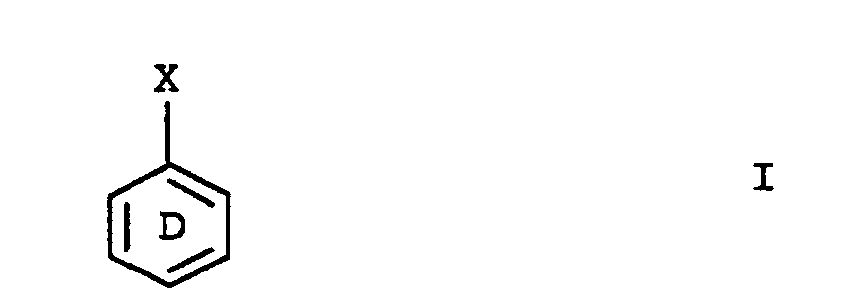
- the benzene ring D is preferably substituted or particularly preferably unsubstituted by an additional C 1 -C 4 , in particular C 1 -C 2, alkyl group.
- X is hydroxy (phenolic "solvents")
- carries the benzene ring D preferably also has one of the above Substituents; if the benzene ring D is benzene-fused, then it bears he does not prefer any other substituent.
- the compound I should be at room temperature not to be soluble in water and at working temperature are in liquid form.
- the melting point of the compounds I. should therefore generally be 200 ° C, preferably 150 ° C.
- Suitable acidic aromatic organic compounds I are: Benzoic acid, 2-, 3- and 4-methylbenzoic acid, 2-, 3- and 4-ethylbenzoic acid, Phenol, 2-, 3- and 4-nitrophenol, 2-, 3- and 4-methylphenol (cresol), 2-, 3- and 4-ethylphenol, 2-allylphenol, 2-, 3- and 4-bromophenol, 2,4-dibromophenol, 2,4-dichlorophenol, 2-chloro-6-nitrophenol, 2-chloro-4-nitrophenol, 2,4-dinitrophenol, 3-methyl-4-nitrophenol, 1- and 2-naphthol and 1-Bromo-2-naphthol and mixtures thereof, with 3- and 4-nitrophenol and 1- and 2-naphthol are preferred and 2-nitrophenol is particularly preferred.
- the pigment treatment according to the invention can be used both in Abals even in the presence of water. That means you can do it halogenated copper phthalocyanine crude pigment in dried form or advantageously also directly in the form of the halogenation obtained, water-moist (usually 50 to 90 wt .-% water containing) filter press cake.
- the amount of water is in the pigment treatment of the present invention not critical, but too large amounts of water should be used be avoided in order not to unnecessarily increase the space / time yields reduce.
- the pigment treatment according to the invention is in the presence of a the copper phthalocyanine derivatives mentioned at the outset carried out, mixtures of these derivatives are of course also used can be.
- the copper phthalocyanine derivatives serve both to control the Crystal growth during recrystallization as well as for surface modification of the resulting pigment. Your choice depends on the degree of chlorination of the crude pigment, the desired Property profile of the recrystallized pigment and the later application medium.
- radicals A and B contained in formula II or for their substituents may be mentioned in detail: straight-chain or branched C 1 -C 20 -alkyl radicals such as methyl, ethyl, propyl, isopropyl, butyl, isobutyl, tert-butyl, pentyl, isopentyl, neopentyl, tert-pentyl, hexyl, 2-methylpentyl, heptyl, 1-ethylpentyl , Octyl, 2-ethylhexyl, isooctyl, nonyl, isononyl, decyl, isodecyl, undecyl, dodecyl, tridecyl, isotridecyl, tetradecyl, pentadecyl, hexadecyl, heptadecyl, octadecyl, non
- the phthalocyanine derivatives II are known per se or according to known ones Methods to produce (e.g. EP-A-535 774, DE-A-25 16 054, EP-A-538 784 and DE-A-29 05 114).
- 0.1 to 1 is used in the process according to the invention 20% by weight, preferably 1 to 10% by weight, copper phthalocyanine derivative II, each based on the copper phthalocyanine crude pigment, a.
- Suitable working temperatures are generally 80 to 200 ° C, preferably 80 to 120 ° C, the temperature in the individual case also on the melting point of the acidic aromatic organic Connection I is to be coordinated.
- the pigment treatment according to the invention is carried out preferably at temperatures> 100 ° C under autogenous pressure made in the closed reactor.
- the pigment treatment takes 2 to 10 hours, especially 2 to 5 hours to complete.
- a mixture of halogenated copper phthalocyanine raw pigment, which is preferably in the form of a water-moist filter cake, Copper phthalocyanine derivative and acidic aromatic organic compound I is heated to the desired temperature and 2 to Stirred for 10 h at this temperature.
- an aqueous base e.g. 2 to 60% strength by weight Alkali metal lye
- the pigment is then filtered off, washed with water and dried.
- the acidic aromatic organic compound I can be acidified the alkali metal salt solution with mineral acid and cooling Reprecipitated at room temperature and again for pigment treatment can be used.
Landscapes
- Chemical & Material Sciences (AREA)
- Chemical Kinetics & Catalysis (AREA)
- Organic Chemistry (AREA)
- Nitrogen Condensed Heterocyclic Rings (AREA)
- Inks, Pencil-Leads, Or Crayons (AREA)
Description
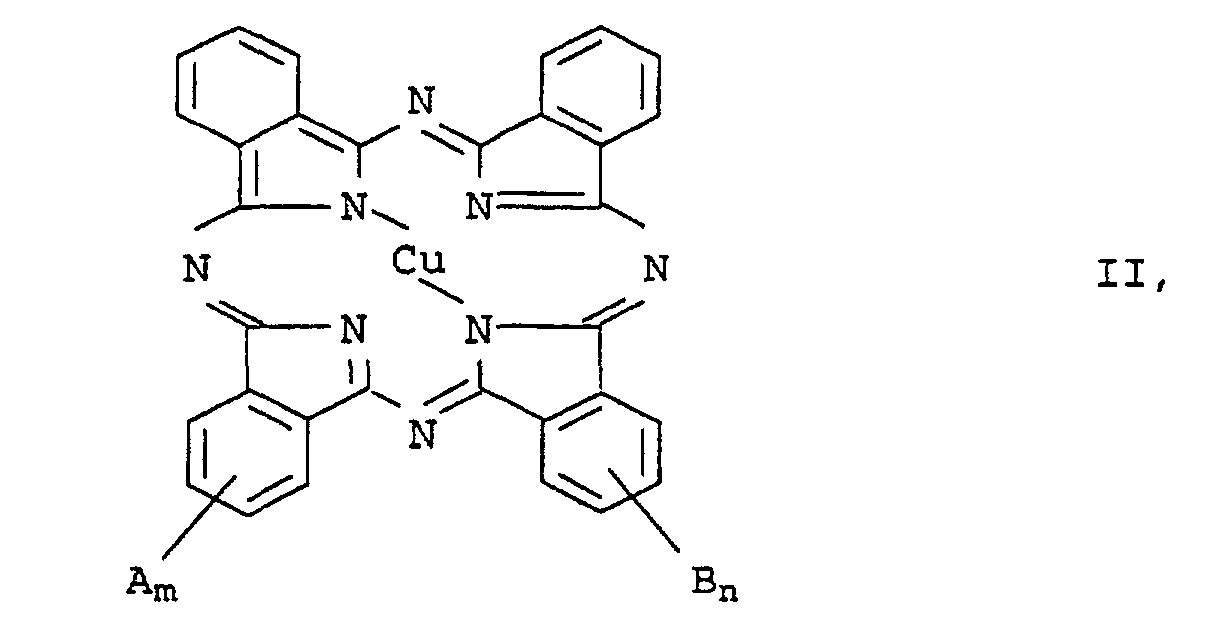
- A und B
- unabhängig voneinander folgende Substituenten:
-SO3M, -CO2M, -SO3H·HNR1R2, -CH2NR3R4, -NR3R4,
-CH2NR3R4·HO3SR5, -NR3R4·HO3SR5, -NHCOR1, -CH2NHCOR1,
-NHSO2R1, -CH2NHSO2R1, -SO2NHR1, -CONHR1, C1-C6-Alkyl, Aryl, Cyano oder -OR6, wobei- R1 und R2
- unabhängig voneinander Wasserstoff oder C2-C20-Alkenyl oder C1-C20-Alkyl bedeuten, das durch -NR7R8 substituiert sein kann, wobei R7 und R8 unabhängig voneinander für C1-C20-Alkyl, C5-C8-Cycloalkyl, das ein oder mehrere Heteroatome enthalten kann, oder Wasserstoff stehen,
- R3 und R4
- unabhängig voneinander Wasserstoff, C1-C20-Alkyl, C2 - C20 -Alkenyl oder Aryl bedeuten oder unter Ausbildung eines das Stickstoffatom sowie gegebenenfalls weitere Heteroatome oder Carbonyl- oder Sulfonylgruppen enthaltenden, 5- oder 6-gliedrigen Rings, der benzanelliert sein kann, miteinander verbunden sind,
- R5
- für p-(C10-C20-Alkyl)phenyl oder C2-C20-Alkenyl steht;
- R6
- Wasserstoff oder C1-C6-Alkyl bedeutet und
- M
- für Wasserstoff oder ein Alkalimetall steht;
- m
- eine ganze oder gebrochene Zahl > 0 bis 4,0;
- n
- eine ganze oder gebrochene Zahl von 0 bis 4,0.
- A und B
- unabhängig voneinander folgende Substituenten:
-SO3M, -SO3H·HNR1R2, -CH2NR3R4, -CH2NR3R4·HO3SR5 oder
-SO2NHR1, wobei
- R1 und R2
- unabhängig voneinander für C1-C20-Alkyl oder Wasserstoff stehen,
- R3 und R4
- unabhängig voneinander C1-C6-Alkyl oder Wasserstoff bedeuten oder unter Ausbildung eines das Stickstoffatom sowie Carbonyl- oder Sulfonylgruppen enthaltenden benzannelierten, 5-gliedrigen Rings miteinander verbunden sind;
- R5
- für p-(C10-C20-Alkyl)phenyl steht;
- m
- eine ganze oder gebrochene Zahl > 0 bis 4;
- n
- eine ganze oder gebrochene Zahl von 0 bis 4, wobei die Summe m + n einen Wert von 0,1 bis 4, insbesondere 1,0 bis 3,5, annimmt.
geradkettige oder verzweigte C1-C20-Alkylreste wie Methyl, Ethyl, Propyl, Isopropyl, Butyl, Isobutyl, tert.-Butyl, Pentyl, Isopentyl, Neopentyl, tert.-Pentyl, Hexyl, 2-Methylpentyl, Heptyl, 1-Ethylpentyl, Octyl, 2-Ethylhexyl, Isooctyl, Nonyl, Isononyl, Decyl, Isodecyl, Undecyl, Dodecyl, Tridecyl, Isotridecyl, Tetradecyl, Pentadecyl, Hexadecyl, Heptadecyl, Octadecyl, Nonadecyl und Eicosyl (die Bezeichnungen Isooctyl, Isononyl, Isodecyl und Isotridecyl sind Trivialbezeichnungen und stammen von den nach der Oxosynthese erhaltenen Alkoholen - vgl. dazu Ullmanns Encyklopädie der technischen Chemie, 4. Auflage, Band 7, Seiten 215 bis 217, sowie Band 11, Seiten 435 und 436);
geradkettige oder verzweigte C2-C20-Alkenylreste wie Ethenyl, Propenyl, Isopropenyl, Butenyl, Isobutenol, Pentenyl, Hexenyl, Heptenyl, Octenyl, Nonenyl, Decenyl, Undecenyl, Dodecenyl, Tridecenyl, Tetradecenyl, Pentadecenyl, Hexadecenyl, Heptadecenyl, Octadecenyl, Nonadecenyl und Eicosenyl;
geradkettige oder verzweigte C1-C6-Alkoxyreste wie Methoxy, Ethoxy, Propoxy, Isopropoxy, Butoxy, Isobutoxy, tert.-Butoxy, Pentoxy, Isopentoxy, Neopentoxy, tert.-Pentoxy und Hexoxy;
C5-C8-Cycloalkylreste, die Heteroatome wie Sauerstoff und/oder Stickstoff als Ersatz für ein oder mehrere Kohlenstoffatome enthalten können, aber nicht über diese gebunden sind, wie Cyclopentyl, Cyclohexyl, Cycloheptyl, Cyclooctyl, Tetrahydrofuryl, Pyrrolidyl, Piperidyl, Piperazyl und Morpholinyl;
Arylreste wie Naphthyl und insbesondere Phenyl;
p-(C10-C20-Alkyl)phenylreste wie p-Decyl-, p-Undecyl-, vor allem p-Dodecyl-, auch p-Tridecyl-, p-Tetradecyl-, p-Pentadecyl-, p-Hexadecyl-, p-Heptadecyl-, p-Octadecyl-, p-Nonadecyl- und p-Eicosylphenyl;
Carboxy, bevorzugt Sulfo und Mono-(C10-C20-alkyl)ammoniumsulfonatreste wie Monodecyl-, Monoundecyl-, Monododecyl-, Monotridecyl-, Monotetradecyl-, Monopentadecyl-, vor allem Monohexadecyl-, auch Monoheptadecyl-, Monooctadecyl-, Monononadecyl- und Monoeicosylammoniumsulfonatreste;
Mono- und Di-(C1-C6-alkyl)aminoreste wie Mono- und Dimethylamino, Mono- und vor allem Diethylamino, Mono- und Dipropylamino, Monound Diisopropylamino, Mono- und Dibutylamino, Mono- und Diisobutylamino, Mono- und Dipentylamino und Mono- und Dihexylamino sowie vor allem Mono- und bevorzugt Di-(C1-C6-alkyl)aminomethylreste, in denen die genannten Aminoreste über eine Methylengruppe an das Phthalocyaningerüst gebunden sind;
Umsetzungsprodukte der Mono- und Di-(C1-C6-alkyl)aminoreste und bevorzugt der entsprechenden Aminomethylreste mit C10-C20-Alkylphenylsulfonsäuren wie p-Decyl-, p-Undecyl-, vor allem p-Dodecyl-, auch p-Tridecyl-, p-Tetradecyl-, p-Pentadecyl-, p-Hexadecyl-, p-Heptadecyl-, p-Octadecyl-, p-Nonadecyl- und p-Eicosylphenylsulfonsäuren, wobei die Alkylreste in o-, m- oder vorzugsweise p-Stellung zur Sulfonsäuregruppierung stehen, z.B. -CH2-N(C2H5)2·HO3S-Ph-4-C12H25 und -CH2-NH(C2H5)·HO3S-Ph-4-C12H25;
das Aminstickstoffatom enthaltende und darüber gebundene Heterocycloalkyl- und Heteroarylreste wie 4-Morpholinyl, Pyrrolidyl, Piperidyl, Piperazyl, Pyrazolyl, Pyrryl, Pyrazyl, Imidazyl, vor allem N-Phthalimidyl und N-Saccharinyl sowie bevorzugt die entsprechenden, über -CH2- an das Phthalocyaningerüst gebundenen Reste;
Mono- (C1-C20-alkylcarbonyl)aminoreste wie Monomethyl-, Monoethyl-, Monopropyl-, Monoisopropyl-, Monobutyl-, Monoisobutyl-, tert.-Monobutyl-, Monopentyl-, Monoisopentyl-, Mononeopentyl-, tert.-Monopentyl-, Monohexyl-, 2-Monomethylpentyl-, Monoheptyl-, 1-Monoethylpentyl-, Monooctyl-, 2-Monoethylhexyl-, Monoisooctyl-, Monononyl-, Monoisononyl-, Monodecyl-, Monoundecyl-, Monododecyl-, Monotridecyl-, Monotetradecyl-, Monopentadecyl-, vor allem Monohexadecyl-, auch Monoheptadecyl-, Monooctadecyl-, Monononadecyl- und Monoeicosylcarbonylamino sowie die entsprechenden über -CH2- an das Phthalocyaningerüst gebundenen Aminoreste;
Mono-(C1-C20-alkylsulfonyl)aminoreste wie Monomethyl-, Monoethyl-, Monopropyl-, Monoisopropyl-, Monobutyl-, Monoisobutyl-, tert.-Monobutyl-, Monopentyl-, Monoisopentyl-, Mononeopentyl-, tert.-Monopentyl-, Monohexyl-, 2-Monomethylpentyl-, Monoheptyl-, 1-Monoethylpentyl-, Monooctyl-, 2-Monoethylhexyl-, Monoisooctyl-, Monononyl-, Monoisononyl-, Monodecyl-, Monoundecyl-, Monododecyl-, Monotridecyl-, Monotetradecyl-, Monopentadecyl-, vor allem Monohexadecyl-, auch Monoheptadecyl-, Monooctadecyl-, Monononadecyl- und Monoeicosylsulfonylamino sowie die entsprechenden über -CH2- an das Phthalocyaningerüst gebundenen Aminoreste;
Mono-(C1-C20-alkylamino)sulfonylreste wie Monomethyl-, Monoethyl-, Monopropyl-, Monoisopropyl-, Monobutyl-, Monoisobutyl-, tert.-Monobutyl-, Monopentyl-, Monoisopentyl-, Mononeopentyl-, tert.-Monopentyl-, Monohexyl-, 2-Monomethylpentyl-, Monoheptyl-, 1-Monoethylpentyl-, Monooctyl-, 2-Monoethylhexyl-, Monoisooctyl-, Monononyl-, Monoisononyl-, Monodecyl-, Monoundecyl-, Monododecyl-, Monotridecyl-, Monotetradecyl-, Monopentadecyl-, vor allem Monohexadecyl-, auch Monoheptadecyl-, Monooctadecyl-, Monononadecyl- und Monoeicosylaminosulfonyl, wobei die Alkylreste eine endständige Amino-, Mono- oder Di(C1-C6-alkyl)aminogruppe tragen können;
Mono-(C1-C20-alkylamino)carbonylreste wie Monomethyl-, Monoethyl-, Monopropyl-, Monoisopropyl-, Monobutyl-, Monoisobutyl-, tert.-Monobutyl-, Monopentyl-, Monoisopentyl-, Mononeopentyl-, tert.-Monopentyl-, Monohexyl-, 2-Monomethylpentyl-, Monoheptyl-, 1-Monoethylpentyl-, Monooctyl-, 2-Monoethylhexyl-, Monoisooctyl-, Monononyl-, Monoisononyl-, Monodecyl-, Monoundecyl-, Monododecyl-, Monotridecyl-, Monotetradecyl-, Monopentadecyl-, vor allem Monohexadecyl-, auch Monoheptadecyl-, Monooctadecyl-, Monononadecyl- und Monoeicosylaminocarbonyl, wobei die Alkylreste eine endständige Amino-, Mono- oder Di(C1-C6-alkyl)aminogruppe tragen können.


Claims (5)
- Verfahren zur Überführung von halogenierten Kupferphthalocyanin-Rohpigmenten mit einem Chlorgehalt von 4 bis 50,3 Gew.-% in eine für die Anwendung geeignete Pigmentform, dadurch gekennzeichnet, daß man das Rohpigment in der Wärme in Gegenwart eines Kupferphthalocyaninderivats aus der Gruppe der Kupferphthalocyaninsulfonsäuren und -carbonsäuren und deren Alkalimetall-, Ammonium- und Alkylammoniumsalzen, der aminosubstituierten und aminomethylierten Kupferphthalocyanine und deren Umsetzungsprodukten mit Alkylierungsmitteln, Sulfonsäuren, Sulfonsäurechloriden und Carbonsäurechloriden, der imidomethylen- und amidomethylensubstituierten Kupferphthalocyanine, der alkyl-, aryl- und cyanosubstituierten Kupferphthalocyanine und der hydroxy- und alkoxysubstituierten Kupferphthalocyanine, gewünschtenfalls in Anwesenheit von Wasser, mit einer bei Arbeitstemperatur in flüssiger Form vorliegenden, aciden aromatischen organischen Verbindung der allgemeinen Formel Iin welcher X Hydroxy oder Carboxy bedeutet und der Benzolring D zusätzlich bis zu zwei gleiche oder verschiedene Substituenten aus der Gruppe Nitro, C1-C4-Alkyl, C2-C4-Alkenyl, Chlor und Brom tragen kann und benzoanneliert sein kann, behandelt.

- Verfahren nach Anspruch 1, dadurch gekennzeichnet, daß man als acide aromatische organische Verbindung der Formel I 2-Nitrophenol, 3-Nitrophenol, 4-Nitrophenol, 1-Naphthol oder 2-Naphthol einsetzt.
- Verfahren nach Anspruch 1 oder 2, dadurch gekennzeichnet, daß man ein Kupferphthalocyaninderivat der allgemeinen Formel IIeinsetzt, in welcher die Variablen folgende Bedeutung haben:
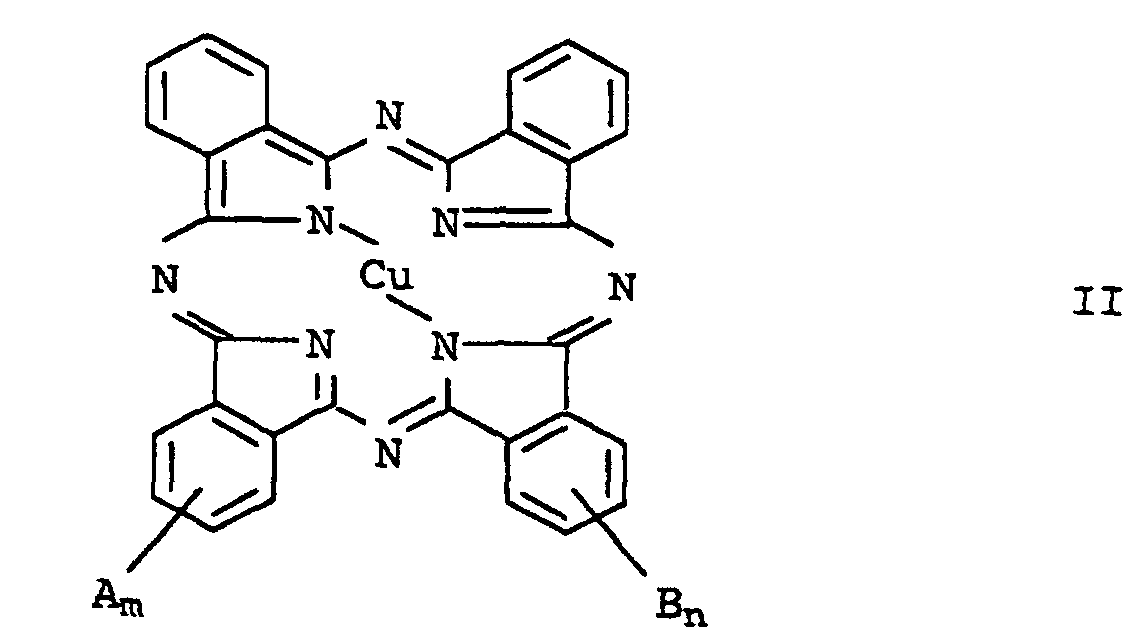
- A und B
- unabhängig voneinander folgende Substituenten:
-SO3M, -CO2M, -SO3H·HNR1R2, -CH2NR3R4, -NR3R4,
-CH2NR3R4·HO3SR5, -NR3R4·HO3SR5, -NHCOR1, -CH2NHCOR1,
-NHSO2R1, -CH2NHSO2R1, -SO2NHR1, -CONHR1, C1-C6-Alkyl,
Aryl, Cyano oder -OR6, wobei
- R1 und R2
- unabhängig voneinander Wasserstoff oder C2-C20-Alkenyl oder C1-C20-Alkyl bedeuten, das durch -NR7R8 substituiert sein kann, wobei R7 und R8 unabhängig voneinander für C1-C20-Alkyl, C5-C8-Cycloalkyl, das ein oder mehrere Heteroatome enthalten kann, oder Wasserstoff stehen,
- R3 und R4
- unabhängig voneinander Wasserstoff, C1-C20-Alkyl, C2-C20-Alkenyl oder Aryl bedeuten oder unter Ausbildung eines das Stickstoffatom sowie gegebenenfalls weitere Heteroatome oder Carbonyl- oder Sulfonylgruppen enthaltenden, 5-oder 6-gliedrigen Rings, der benzanelliert sein kann, miteinander verbunden sind,
- R5
- für p-(C10-C20-Alkyl)phenyl oder C2-C20-Alkenyl steht;
- R6
- Wasserstoff oder C1-C6-Alkyl bedeutet und
- M
- für Wasserstoff oder ein Alkalimetall steht;
- m
- eine ganze oder gebrochene Zahl > 0 bis 4,0;
- n
- eine ganze oder gebrochene Zahl von 0 bis 4,0.
- Verfahren nach den Ansprüchen 1 bis 3, dadurch gekennzeichnet, daß man ein Kupferphthalocyaninderivat der Formel II einsetzt, in welcher die Variablen folgende Bedeutung haben:
- A und B
- unabhängig voneinander folgende Substituenten:
-SO3M, -SO3H·HNR1R2, -CH2NR3R4, -CH2NR3R4·HO3SR5 oder
-SO2NHR1, wobei
- R1 und R2
- unabhängig voneinander für C1-C20-Alkyl oder Wasserstoff stehen,
- R3 und R4
- unabhängig voneinander C1-C6-Alkyl oder Wasserstoff bedeuten oder unter Ausbildung eines das Stickstoffatom sowie Carbonyl- oder Sulfonylgruppen enthaltenden benzannelierten, 5-gliedrigen Rings miteinander verbunden sind;
- R5
- für p-(C10-C20-Alkyl)phenyl steht;
- m
- eine ganze oder gebrochene Zahl > 0 bis 4;
- n
- eine ganze oder gebrochene Zahl von 0 bis 4, wobei die Summe m + n einen Wert von 0,1 bis 4 annimmt.
- Verfahren nach den Ansprüchen 1 bis 4, dadurch gekennzeichnet, daß man 0,1 bis 20 Gew.-% des Kupferphthalocyaninderivats der Formel II, bezogen auf das Rohpigment, einsetzt.
Applications Claiming Priority (2)
| Application Number | Priority Date | Filing Date | Title |
|---|---|---|---|
| DE19745922 | 1997-10-17 | ||
| DE19745922A DE19745922A1 (de) | 1997-10-17 | 1997-10-17 | Verfahren zur Überführung von halogenierten Kupferphtalocyanin-Rohpigmenten in eine für die Anwendung geeignete Pigmentform |
Publications (2)
| Publication Number | Publication Date |
|---|---|
| EP0909795A1 EP0909795A1 (de) | 1999-04-21 |
| EP0909795B1 true EP0909795B1 (de) | 2001-08-16 |
Family
ID=7845840
Family Applications (1)
| Application Number | Title | Priority Date | Filing Date |
|---|---|---|---|
| EP98118849A Revoked EP0909795B1 (de) | 1997-10-17 | 1998-10-06 | Verfahren zur Überführung von halogenierten Kupferphthalocyanin-Rohpigmenten in eine für die Anwendung geeignete Pigmentform |
Country Status (6)
| Country | Link |
|---|---|
| US (1) | US5944887A (de) |
| EP (1) | EP0909795B1 (de) |
| JP (1) | JP4427112B2 (de) |
| KR (1) | KR100544448B1 (de) |
| CN (1) | CN1085232C (de) |
| DE (2) | DE19745922A1 (de) |
Families Citing this family (6)
| Publication number | Priority date | Publication date | Assignee | Title |
|---|---|---|---|---|
| US6132911A (en) * | 1998-07-27 | 2000-10-17 | Ricoh Company, Ltd. | Method for manufacturing pigment, electrophotographic photoconductor using the pigment and electrophotographic image forming method and apparatus using the photoconductor |
| DE10016993A1 (de) * | 2000-04-07 | 2001-10-11 | Basf Ag | Anchlorierte Kupferphthalocyaninpigmente |
| DE10257498A1 (de) * | 2002-12-10 | 2004-07-01 | Clariant Gmbh | Verfahren zur Herstellung von Phthalocyaninpigmentzubereitungen |
| KR100694106B1 (ko) * | 2005-04-27 | 2007-03-12 | 삼성전자주식회사 | 착색제 유사 첨가제를 함유한 잉크 조성물, 이를 포함한잉크젯 프린터 카트리지 및 잉크 젯트 기록 장치 |
| JP6410081B2 (ja) * | 2014-07-18 | 2018-10-24 | Dic株式会社 | プラスチック着色用顔料組成物 |
| JP6662912B2 (ja) | 2015-06-04 | 2020-03-11 | サン ケミカル コーポレイション | 塩素化銅フタロシアニン顔料 |
Family Cites Families (21)
| Publication number | Priority date | Publication date | Assignee | Title |
|---|---|---|---|---|
| US2930796A (en) * | 1957-02-11 | 1960-03-29 | Gen Aniline & Film Corp | Conditioning of crude polychloro copper phthalocyanines |
| DE1242180B (de) * | 1964-07-18 | 1967-06-15 | Basf Ag | Verfahren zur Herstellung von farbstarken und kornweichen polyhalogenierten Kupferphthalocyaninen |
| DE1569639C3 (de) * | 1965-08-18 | 1974-08-29 | Basf Ag, 6700 Ludwigshafen | Verfahren zur Herstellung von farbstarken Polyhalogenkupferphthalocy aninen |
| DE2013818C3 (de) * | 1970-03-23 | 1978-12-14 | Basf Ag, 6700 Ludwigshafen | Verfahren zur Herstellung und Isolierung von leicht dispergierbaren Polychlor- und Polybrompolychlorkupferphthalocyaninen |
| DE2449231A1 (de) * | 1974-10-16 | 1976-04-29 | Bayer Ag | Formierung von perhalogen-kupferphthalocyaninen |
| DK140901C (da) * | 1975-04-12 | 1980-05-19 | Basf Ag | Phthalocyaninpigmentpraeparater stabiliseret mod rekrystallisation og modifikationsomdannelse |
| DE2516054C3 (de) * | 1975-04-12 | 1979-05-10 | Basf Ag, 6700 Ludwigshafen | Gegen Rekristallisation und Modifikationsumwandlung stabilisierte Phthalocyaninzubereitungen und deren Verwendung |
| DE2519753C3 (de) * | 1975-05-02 | 1978-06-22 | Basf Ag, 6700 Ludwigshafen | Gegen Rekristallisation und Modifikationsumwandlung stabilisierte Pigmentzubereitungen und deren Verwendung |
| GB1546950A (en) * | 1976-12-01 | 1979-05-31 | Ciba Geigy Ag | Pigment compositions |
| DE2905114C2 (de) * | 1979-02-10 | 1981-03-19 | Basf Ag, 6700 Ludwigshafen | Pigmentzubereitungen |
| EP0058888A3 (de) * | 1981-02-23 | 1982-10-06 | Mobay Chemical Corporation | Konditionierung von Phthalocyaninverbindungen |
| DE3442118A1 (de) * | 1984-11-17 | 1986-05-22 | Basf Ag, 6700 Ludwigshafen | Verfahren zur herstellung von farbstarken polyhalogenkupferphthalocyaninen |
| GB8515600D0 (en) * | 1985-06-20 | 1985-07-24 | Ciba Geigy Ag | Pigmentary copper phthalocyanine |
| DE3636428A1 (de) * | 1986-10-25 | 1988-05-05 | Basf Ag | Verfahren zur herstellung von farbstarken polyhalogenkupferphthalocyaninpigmenten |
| JP3013900B2 (ja) * | 1990-10-22 | 2000-02-28 | 東洋インキ製造株式会社 | 印刷インキ用ポリハロゲン化フタロシアニン、その製造方法およびその用途 |
| JP2836320B2 (ja) * | 1991-10-04 | 1998-12-14 | 東洋インキ製造株式会社 | 塗料組成物 |
| DE59206108D1 (de) * | 1991-10-23 | 1996-05-30 | Hoechst Ag | Pigmentzubereitungen |
| JPH06336556A (ja) * | 1993-05-28 | 1994-12-06 | Toyo Ink Mfg Co Ltd | ポリハロゲン化銅フタロシアニン顔料の製造方法 |
| GB9517565D0 (en) * | 1995-08-26 | 1995-10-25 | Ciba Geigy Ag | Pigment compositions |
| JPH09291223A (ja) * | 1996-04-26 | 1997-11-11 | Toyo Ink Mfg Co Ltd | β型銅フタロシアニン顔料の製造方法 |
| US5759254A (en) * | 1996-07-18 | 1998-06-02 | Ciba Specialty Chemicals Corporation | Substituted phthalocyanines |
-
1997
- 1997-10-17 DE DE19745922A patent/DE19745922A1/de not_active Withdrawn
-
1998
- 1998-10-06 EP EP98118849A patent/EP0909795B1/de not_active Revoked
- 1998-10-06 DE DE59801211T patent/DE59801211D1/de not_active Revoked
- 1998-10-13 US US09/169,988 patent/US5944887A/en not_active Expired - Lifetime
- 1998-10-16 KR KR1019980043288A patent/KR100544448B1/ko not_active Expired - Fee Related
- 1998-10-16 JP JP29530798A patent/JP4427112B2/ja not_active Expired - Fee Related
- 1998-10-17 CN CN98124676A patent/CN1085232C/zh not_active Expired - Fee Related
Also Published As
| Publication number | Publication date |
|---|---|
| CN1219558A (zh) | 1999-06-16 |
| DE59801211D1 (de) | 2001-09-20 |
| JP4427112B2 (ja) | 2010-03-03 |
| EP0909795A1 (de) | 1999-04-21 |
| CN1085232C (zh) | 2002-05-22 |
| KR100544448B1 (ko) | 2006-03-28 |
| US5944887A (en) | 1999-08-31 |
| JPH11189731A (ja) | 1999-07-13 |
| KR19990037151A (ko) | 1999-05-25 |
| DE19745922A1 (de) | 1999-04-22 |
Similar Documents
| Publication | Publication Date | Title |
|---|---|---|
| DE3106906C2 (de) | ||
| EP2146230B1 (de) | Binäre Diketopyrrolopyrrol-Pigmentzusammensetzung zur Verwendung in Colorfiltern | |
| CH417815A (de) | Chinacridonpigment und Verfahren zu seiner Herstellung | |
| WO2009049736A2 (de) | Diketopyrrolopyrrol-pigmentzusammensetzung zur verwendung in colorfiltern | |
| DE2148866C3 (de) | Chinacridonpigmentgemische und Verfahren zu ihrer Herstellung | |
| EP0909795A1 (de) | Verfahren zur Überführung von halogenierten Kupferphthalocyanin-Rohpigmenten in eine für die Anwendung geeignete Pigmentform | |
| EP1991621B1 (de) | Diketopyrrolopyrrol-pigmente mit erhöhten echtheiten und verfahren zu deren herstellung | |
| DE929805C (de) | Verfahren zur Herstellung von Nickel- oder Kobalttetra-aza-porphinen bzw. ihren alkyl- und cycloalkylsubstituierten Derivaten | |
| EP0632108A1 (de) | Pigmentzubereitungen mit Anthrachinonderivaten als Dispergiermittel | |
| EP0206281A2 (de) | Verfahren zum überführen von rohen Isoindolinpigmenten in eine Pigmentform | |
| EP0717080B1 (de) | Verfahren zur Herstellung von Triphenylmethanfarbmitteln | |
| DE69613427T2 (de) | Verfahren zur Herstellung eines Phthalocyaninpigments | |
| DE1058178B (de) | Verfahren zur Herstellung von Phthalocyaninpigmenten | |
| EP0035956B1 (de) | Verfahren zur Herstellung von Sulfatoäthylsulfonyl-Verbindungen | |
| EP0056868B1 (de) | Verfahren zur Herstellung von farbstarken 4,4',7,7'-Tetrachlorthioindigopigmenten | |
| EP0036555A1 (de) | Neue Zinkchloridkomplexverbindungen, Verfahren zu ihrer Herstellung sowie ihre Verwendung und Verfahren zur Herstellung von Phenoxazinverbindungen | |
| EP0534314B1 (de) | Verfahren zur Herstellung von Nitrobenzophenonen sowie färbestabile Modifikation eines Benzophenonazopyridonfarbstoffs | |
| DE2006663B2 (de) | ||
| DE1114462B (de) | Verfahren zum Umwandeln von Polychlor-Kupferphthalocyanin in Pigmentform | |
| EP0848040B1 (de) | Verfahren zur Herstellung von metallfreiem Phthalocyanin unter Steuerung der gebildeten Modifikation | |
| DE102006007622A1 (de) | Hochechte Diketopyrrolopyrrol-Pigmente | |
| CH343044A (de) | Verfahren zur Herstellung von Azopigmenten | |
| DD207920A1 (de) | Verfahren zur herstellung eines monoazofarbstoffes | |
| DE102004001883A1 (de) | Triphendioxazinpigmente | |
| DE1272475B (de) | Verfahren zur Herstellung von Azopigmenten |
Legal Events
| Date | Code | Title | Description |
|---|---|---|---|
| PUAI | Public reference made under article 153(3) epc to a published international application that has entered the european phase |
Free format text: ORIGINAL CODE: 0009012 |
|
| 17P | Request for examination filed |
Effective date: 19990209 |
|
| AK | Designated contracting states |
Kind code of ref document: A1 Designated state(s): CH DE ES FR GB LI |
|
| AX | Request for extension of the european patent |
Free format text: AL;LT;LV;MK;RO;SI |
|
| AKX | Designation fees paid |
Free format text: CH DE ES FR GB LI |
|
| 17Q | First examination report despatched |
Effective date: 20000530 |
|
| GRAG | Despatch of communication of intention to grant |
Free format text: ORIGINAL CODE: EPIDOS AGRA |
|
| GRAG | Despatch of communication of intention to grant |
Free format text: ORIGINAL CODE: EPIDOS AGRA |
|
| GRAH | Despatch of communication of intention to grant a patent |
Free format text: ORIGINAL CODE: EPIDOS IGRA |
|
| GRAH | Despatch of communication of intention to grant a patent |
Free format text: ORIGINAL CODE: EPIDOS IGRA |
|
| GRAA | (expected) grant |
Free format text: ORIGINAL CODE: 0009210 |
|
| AK | Designated contracting states |
Kind code of ref document: B1 Designated state(s): CH DE ES FR GB LI |
|
| REG | Reference to a national code |
Ref country code: CH Ref legal event code: EP |
|
| REF | Corresponds to: |
Ref document number: 59801211 Country of ref document: DE Date of ref document: 20010920 |
|
| GBT | Gb: translation of ep patent filed (gb section 77(6)(a)/1977) |
Effective date: 20011005 |
|
| REG | Reference to a national code |
Ref country code: GB Ref legal event code: IF02 |
|
| ET | Fr: translation filed | ||
| PG25 | Lapsed in a contracting state [announced via postgrant information from national office to epo] |
Ref country code: ES Free format text: LAPSE BECAUSE OF FAILURE TO SUBMIT A TRANSLATION OF THE DESCRIPTION OR TO PAY THE FEE WITHIN THE PRESCRIBED TIME-LIMIT Effective date: 20020228 |
|
| PLBQ | Unpublished change to opponent data |
Free format text: ORIGINAL CODE: EPIDOS OPPO |
|
| PLBI | Opposition filed |
Free format text: ORIGINAL CODE: 0009260 |
|
| PLBF | Reply of patent proprietor to notice(s) of opposition |
Free format text: ORIGINAL CODE: EPIDOS OBSO |
|
| 26 | Opposition filed |
Opponent name: CLARIANT GMBH Effective date: 20020426 |
|
| PG25 | Lapsed in a contracting state [announced via postgrant information from national office to epo] |
Ref country code: LI Free format text: LAPSE BECAUSE OF NON-PAYMENT OF DUE FEES Effective date: 20021031 Ref country code: CH Free format text: LAPSE BECAUSE OF NON-PAYMENT OF DUE FEES Effective date: 20021031 |
|
| PLBF | Reply of patent proprietor to notice(s) of opposition |
Free format text: ORIGINAL CODE: EPIDOS OBSO |
|
| REG | Reference to a national code |
Ref country code: CH Ref legal event code: PL |
|
| RDAF | Communication despatched that patent is revoked |
Free format text: ORIGINAL CODE: EPIDOSNREV1 |
|
| APBP | Date of receipt of notice of appeal recorded |
Free format text: ORIGINAL CODE: EPIDOSNNOA2O |
|
| APBQ | Date of receipt of statement of grounds of appeal recorded |
Free format text: ORIGINAL CODE: EPIDOSNNOA3O |
|
| APAA | Appeal reference recorded |
Free format text: ORIGINAL CODE: EPIDOS REFN |
|
| APAH | Appeal reference modified |
Free format text: ORIGINAL CODE: EPIDOSCREFNO |
|
| PGFP | Annual fee paid to national office [announced via postgrant information from national office to epo] |
Ref country code: GB Payment date: 20051005 Year of fee payment: 8 |
|
| PLAB | Opposition data, opponent's data or that of the opponent's representative modified |
Free format text: ORIGINAL CODE: 0009299OPPO |
|
| PLAB | Opposition data, opponent's data or that of the opponent's representative modified |
Free format text: ORIGINAL CODE: 0009299OPPO |
|
| R26 | Opposition filed (corrected) |
Opponent name: CLARIANT VERWALTUNGSGESELLSCHAFT MBH Effective date: 20020426 |
|
| PGFP | Annual fee paid to national office [announced via postgrant information from national office to epo] |
Ref country code: DE Payment date: 20060928 Year of fee payment: 9 |
|
| APBU | Appeal procedure closed |
Free format text: ORIGINAL CODE: EPIDOSNNOA9O |
|
| GBPC | Gb: european patent ceased through non-payment of renewal fee |
Effective date: 20061006 |
|
| RDAG | Patent revoked |
Free format text: ORIGINAL CODE: 0009271 |
|
| STAA | Information on the status of an ep patent application or granted ep patent |
Free format text: STATUS: PATENT REVOKED |
|
| 27W | Patent revoked |
Effective date: 20070419 |
|
| PG25 | Lapsed in a contracting state [announced via postgrant information from national office to epo] |
Ref country code: GB Free format text: LAPSE BECAUSE OF NON-PAYMENT OF DUE FEES Effective date: 20061006 |
|
| PGFP | Annual fee paid to national office [announced via postgrant information from national office to epo] |
Ref country code: FR Payment date: 20061010 Year of fee payment: 9 |