EP0909795B1 - Process to transfer crude halogenated copper-phthalocyanine pigments into a pigment form suitable for use - Google Patents
Process to transfer crude halogenated copper-phthalocyanine pigments into a pigment form suitable for use Download PDFInfo
- Publication number
- EP0909795B1 EP0909795B1 EP98118849A EP98118849A EP0909795B1 EP 0909795 B1 EP0909795 B1 EP 0909795B1 EP 98118849 A EP98118849 A EP 98118849A EP 98118849 A EP98118849 A EP 98118849A EP 0909795 B1 EP0909795 B1 EP 0909795B1
- Authority
- EP
- European Patent Office
- Prior art keywords
- alkyl
- hydrogen
- independently
- copper phthalocyanine
- substituted
- Prior art date
- Legal status (The legal status is an assumption and is not a legal conclusion. Google has not performed a legal analysis and makes no representation as to the accuracy of the status listed.)
- Revoked
Links
Classifications
-
- C—CHEMISTRY; METALLURGY
- C09—DYES; PAINTS; POLISHES; NATURAL RESINS; ADHESIVES; COMPOSITIONS NOT OTHERWISE PROVIDED FOR; APPLICATIONS OF MATERIALS NOT OTHERWISE PROVIDED FOR
- C09B—ORGANIC DYES OR CLOSELY-RELATED COMPOUNDS FOR PRODUCING DYES, e.g. PIGMENTS; MORDANTS; LAKES
- C09B67/00—Influencing the physical, e.g. the dyeing or printing properties of dyestuffs without chemical reactions, e.g. by treating with solvents grinding or grinding assistants, coating of pigments or dyes; Process features in the making of dyestuff preparations; Dyestuff preparations of a special physical nature, e.g. tablets, films
- C09B67/0001—Post-treatment of organic pigments or dyes
- C09B67/0014—Influencing the physical properties by treatment with a liquid, e.g. solvents
- C09B67/0016—Influencing the physical properties by treatment with a liquid, e.g. solvents of phthalocyanines
-
- C—CHEMISTRY; METALLURGY
- C09—DYES; PAINTS; POLISHES; NATURAL RESINS; ADHESIVES; COMPOSITIONS NOT OTHERWISE PROVIDED FOR; APPLICATIONS OF MATERIALS NOT OTHERWISE PROVIDED FOR
- C09B—ORGANIC DYES OR CLOSELY-RELATED COMPOUNDS FOR PRODUCING DYES, e.g. PIGMENTS; MORDANTS; LAKES
- C09B67/00—Influencing the physical, e.g. the dyeing or printing properties of dyestuffs without chemical reactions, e.g. by treating with solvents grinding or grinding assistants, coating of pigments or dyes; Process features in the making of dyestuff preparations; Dyestuff preparations of a special physical nature, e.g. tablets, films
- C09B67/0001—Post-treatment of organic pigments or dyes
- C09B67/0017—Influencing the physical properties by treatment with an acid, H2SO4
- C09B67/0019—Influencing the physical properties by treatment with an acid, H2SO4 of phthalocyanines
-
- C—CHEMISTRY; METALLURGY
- C09—DYES; PAINTS; POLISHES; NATURAL RESINS; ADHESIVES; COMPOSITIONS NOT OTHERWISE PROVIDED FOR; APPLICATIONS OF MATERIALS NOT OTHERWISE PROVIDED FOR
- C09B—ORGANIC DYES OR CLOSELY-RELATED COMPOUNDS FOR PRODUCING DYES, e.g. PIGMENTS; MORDANTS; LAKES
- C09B67/00—Influencing the physical, e.g. the dyeing or printing properties of dyestuffs without chemical reactions, e.g. by treating with solvents grinding or grinding assistants, coating of pigments or dyes; Process features in the making of dyestuff preparations; Dyestuff preparations of a special physical nature, e.g. tablets, films
- C09B67/0033—Blends of pigments; Mixtured crystals; Solid solutions
- C09B67/0034—Mixtures of two or more pigments or dyes of the same type
- C09B67/0035—Mixtures of phthalocyanines
Definitions
- the present invention relates to a new method of transfer of halogenated copper phthalocyanine raw pigments with a chlorine content of 4 to 50.3% by weight in one for the application suitable pigment form.
- polyhalogenated copper phthalocyanines are mainly xylene (DE-A-20 13 818), trichlorobenzene, Chloronaphthalene or nitrobenzene (DE-A-24 49 231), 2-nitrophenol (DE-A-12 42 180), naphthol (GB-A-1 088 736), Benzoic acid and / or alkylbenzoic acids (EP-A-58 888) or aliphatic ketones (DE-A 36 36 428) in the presence or absence used by water.
- JP-A 336 556/1994 a process described in which polyhalogenated copper phthalocyanines in the presence of copper phthalocyanine derivatives in Mixtures of water and aromatic solvents are heated, However, acidic solvents are not used here.
- the invention was therefore based on the object of a method provide with the not only polyhalogenated, but above all also partially halogenated (i.e. e.g. a chlorine content of ⁇ 38.5% by weight) copper phthalocyanine crude pigments in a technically simple, economical way in coloristically high-quality pigment forms can be transferred and that the production for the respective application optimally adapted pigments.
- partially halogenated i.e. e.g. a chlorine content of ⁇ 38.5% by weight
- a process for converting halogenated crude copper phthalocyanine pigments with a chlorine content of 4 to 50.3% by weight into a pigment form suitable for the application is characterized in that the crude pigment is obtained by heat in the presence of a copper phthalocyanine derivative the group of copper phthalocyaninesulphonic acids and carboxylic acids and their alkali metal, ammonium and alkylammonium salts, the amino-substituted and aminomethylated copper phthalocyanines and their reaction products with alkylating agents, sulphonic acids, sulphonic acid chlorides and carboxylic acid chlorides, the imidomethylene-substituted cyanohydrocyanine and amidomethylene phthalocyanine-substituted copper phthalocyanines, the imidomethylene and cyanophthalocyanine-substituted copper phthalocyanines, the arylocyanine-substituted, and cyanophthalocyanine-substituted copper
- the benzene ring D is preferably substituted or particularly preferably unsubstituted by an additional C 1 -C 4 , in particular C 1 -C 2, alkyl group.
- X is hydroxy (phenolic "solvents")
- carries the benzene ring D preferably also has one of the above Substituents; if the benzene ring D is benzene-fused, then it bears he does not prefer any other substituent.
- the compound I should be at room temperature not to be soluble in water and at working temperature are in liquid form.
- the melting point of the compounds I. should therefore generally be 200 ° C, preferably 150 ° C.
- Suitable acidic aromatic organic compounds I are: Benzoic acid, 2-, 3- and 4-methylbenzoic acid, 2-, 3- and 4-ethylbenzoic acid, Phenol, 2-, 3- and 4-nitrophenol, 2-, 3- and 4-methylphenol (cresol), 2-, 3- and 4-ethylphenol, 2-allylphenol, 2-, 3- and 4-bromophenol, 2,4-dibromophenol, 2,4-dichlorophenol, 2-chloro-6-nitrophenol, 2-chloro-4-nitrophenol, 2,4-dinitrophenol, 3-methyl-4-nitrophenol, 1- and 2-naphthol and 1-Bromo-2-naphthol and mixtures thereof, with 3- and 4-nitrophenol and 1- and 2-naphthol are preferred and 2-nitrophenol is particularly preferred.
- the pigment treatment according to the invention can be used both in Abals even in the presence of water. That means you can do it halogenated copper phthalocyanine crude pigment in dried form or advantageously also directly in the form of the halogenation obtained, water-moist (usually 50 to 90 wt .-% water containing) filter press cake.
- the amount of water is in the pigment treatment of the present invention not critical, but too large amounts of water should be used be avoided in order not to unnecessarily increase the space / time yields reduce.
- the pigment treatment according to the invention is in the presence of a the copper phthalocyanine derivatives mentioned at the outset carried out, mixtures of these derivatives are of course also used can be.
- the copper phthalocyanine derivatives serve both to control the Crystal growth during recrystallization as well as for surface modification of the resulting pigment. Your choice depends on the degree of chlorination of the crude pigment, the desired Property profile of the recrystallized pigment and the later application medium.
- radicals A and B contained in formula II or for their substituents may be mentioned in detail: straight-chain or branched C 1 -C 20 -alkyl radicals such as methyl, ethyl, propyl, isopropyl, butyl, isobutyl, tert-butyl, pentyl, isopentyl, neopentyl, tert-pentyl, hexyl, 2-methylpentyl, heptyl, 1-ethylpentyl , Octyl, 2-ethylhexyl, isooctyl, nonyl, isononyl, decyl, isodecyl, undecyl, dodecyl, tridecyl, isotridecyl, tetradecyl, pentadecyl, hexadecyl, heptadecyl, octadecyl, non
- the phthalocyanine derivatives II are known per se or according to known ones Methods to produce (e.g. EP-A-535 774, DE-A-25 16 054, EP-A-538 784 and DE-A-29 05 114).
- 0.1 to 1 is used in the process according to the invention 20% by weight, preferably 1 to 10% by weight, copper phthalocyanine derivative II, each based on the copper phthalocyanine crude pigment, a.
- Suitable working temperatures are generally 80 to 200 ° C, preferably 80 to 120 ° C, the temperature in the individual case also on the melting point of the acidic aromatic organic Connection I is to be coordinated.
- the pigment treatment according to the invention is carried out preferably at temperatures> 100 ° C under autogenous pressure made in the closed reactor.
- the pigment treatment takes 2 to 10 hours, especially 2 to 5 hours to complete.
- a mixture of halogenated copper phthalocyanine raw pigment, which is preferably in the form of a water-moist filter cake, Copper phthalocyanine derivative and acidic aromatic organic compound I is heated to the desired temperature and 2 to Stirred for 10 h at this temperature.
- an aqueous base e.g. 2 to 60% strength by weight Alkali metal lye
- the pigment is then filtered off, washed with water and dried.
- the acidic aromatic organic compound I can be acidified the alkali metal salt solution with mineral acid and cooling Reprecipitated at room temperature and again for pigment treatment can be used.
Landscapes
- Chemical & Material Sciences (AREA)
- Chemical Kinetics & Catalysis (AREA)
- Organic Chemistry (AREA)
- Nitrogen Condensed Heterocyclic Rings (AREA)
- Inks, Pencil-Leads, Or Crayons (AREA)
Description
Die vorliegende Erfindung betrifft ein neues Verfahren zur Überführung von halogenierten Kupferphthalocyanin-Rohpigmenten mit einem Chlorgehalt von 4 bis 50,3 Gew.-% in eine für die Anwendung geeignete Pigmentform.The present invention relates to a new method of transfer of halogenated copper phthalocyanine raw pigments with a chlorine content of 4 to 50.3% by weight in one for the application suitable pigment form.
Bei der Halogenierung von Kupferphthalocyanin werden üblicherweise amorphe bis mikrokristalline Produkte erhalten, die aufgrund ihrer hohen Neigung zur Agglomeration für die Anwendung als Pigment ungeeignet sind.In the halogenation of copper phthalocyanine are usually amorphous to microcrystalline products obtained due to their high tendency to agglomerate for use are unsuitable as a pigment.
Es sind verschiedene prinzipielle Methoden bekannt, um die Rohpigmente in eine geeignete Pigmentform zu überführen, z.B. mechanische Teilchenverkleinerung oder Behandlung mit konzentrierter Schwefelsäure oder mit organischen Lösungsmitteln in der Wärme.There are various principle methods known to the To convert crude pigments into a suitable pigment form, e.g. mechanical particle reduction or treatment with concentrated Sulfuric acid or with organic solvents in the warmth.
Für die Lösungsmittelbehandlung von polyhalogenierten Kupferphthalocyaninen werden hauptsächlich Xylol (DE-A-20 13 818), Trichlorbenzol, Chlornaphthalin oder Nitrobenzol (DE-A-24 49 231), 2-Nitrophenol (DE-A-12 42 180), Naphthol (GB-A-1 088 736), Benzoesäure und/oder Alkylbenzoesäuren (EP-A-58 888) oder aliphatische Ketone (DE-A 36 36 428) in Gegenwart oder in Abwesenheit von Wasser verwendet. In der JP-A 336 556/1994 wird ein Verfahren beschrieben, bei dem polyhalogenierte Kupferphthalocyanine in Gegenwart von Kupferphthalocyaninderivaten in Gemischen aus Wasser und aromatischen Lösungsmitteln erhitzt werden, acide Lösungsmittel werden hierbei jedoch nicht eingesetzt.For the solvent treatment of polyhalogenated copper phthalocyanines are mainly xylene (DE-A-20 13 818), trichlorobenzene, Chloronaphthalene or nitrobenzene (DE-A-24 49 231), 2-nitrophenol (DE-A-12 42 180), naphthol (GB-A-1 088 736), Benzoic acid and / or alkylbenzoic acids (EP-A-58 888) or aliphatic ketones (DE-A 36 36 428) in the presence or absence used by water. In JP-A 336 556/1994 a process described in which polyhalogenated copper phthalocyanines in the presence of copper phthalocyanine derivatives in Mixtures of water and aromatic solvents are heated, However, acidic solvents are not used here.
Diese bekannten Verfahren liefern oft nur unbefriedigende Ergebnisse und sind zudem nur auf Kupferphthalocyanine mit hohem Halogenierungsgrad (Chlorgehalt ≥ 38,5 Gew.-%, d.h., mindestens 10 Chloratome am CuPc-Gerüst) beschränkt.These known methods often only give unsatisfactory results and are also only on copper phthalocyanines with high Degree of halogenation (chlorine content ≥ 38.5% by weight, i.e. at least 10 chlorine atoms on the CuPc framework).
Der Erfindung lag daher die Aufgabe zugrunde, ein Verfahren bereitzustellen, mit dem nicht nur polyhalogenierte, sondern vor allem auch anhalogenierte (d.h. z.B. einen Chlorgehalt von < 38,5 Gew.-% aufweisende) Kupferphthalocyanin-Rohpigmente auf verfahrenstechnisch einfache, wirtschaftliche Weise in koloristisch hochwertige Pigmentformen überführt werden können und das die Herstellung für den jeweiligen Anwendungszweck optimal angepaßter Pigmente ermöglicht.The invention was therefore based on the object of a method provide with the not only polyhalogenated, but above all also partially halogenated (i.e. e.g. a chlorine content of <38.5% by weight) copper phthalocyanine crude pigments in a technically simple, economical way in coloristically high-quality pigment forms can be transferred and that the production for the respective application optimally adapted pigments.
Demgemäß wurde ein Verfahren zur Überführung von halogenierten
Kupferphthalocyanin-Rohpigmenten mit einem Chlorgehalt von 4 bis
50,3 Gew.-% in eine für die Anwendung geeignete Pigmentform
gefunden, welches dadurch gekennzeichnet ist, daß man das Rohpigment
in der Wärme in Gegenwart eines Kupferphthalocyaninderivats
aus der Gruppe der Kupferphthalocyaninsulfonsäuren
und -carbonsäuren und deren Alkalimetall-, Ammonium- und Alkylammoniumsalzen,
der aminosubstituierten und aminomethylierten
Kupferphthalocyanine und deren Umsetzungsprodukten mit Alkylierungsmitteln,
Sulfonsäuren, Sulfonsäurechloriden und Carbonsäurechloriden,
der imidomethylen- und amidomethylensubstituierten
Kupferphthalocyanine, der alkyl-, aryl- und cyanosubstituierten
Kupferphthalocyanine und der hydroxy- und alkoxysubstituierten
Kupferphthalocyanine, gewünschtenfalls in Anwesenheit von Wasser,
mit einer bei Arbeitstemperatur in flüssiger Form vorliegenden,
aciden aromatischen organischen Verbindung der allgemeinen Formel
I
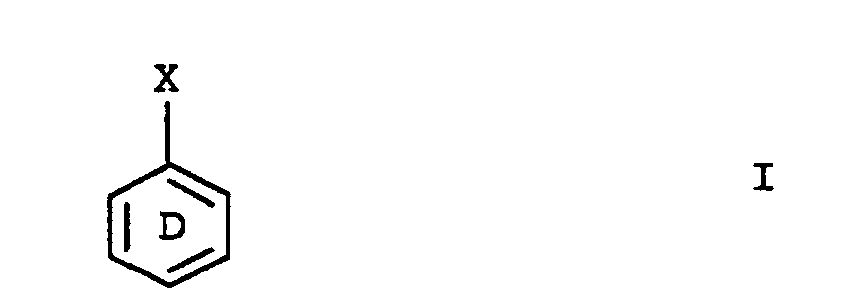
Wenn X Carboxy bedeutet ("Lösungsmittel" auf der Basis von Benzoesäure), ist der Benzolring D bevorzugt durch eine zusätzliche C1-C4-, insbesondere C1-C2-Alkylgruppe substituiert oder besonders bevorzugt unsubstituiert.If X is carboxy ("solvent" based on benzoic acid), the benzene ring D is preferably substituted or particularly preferably unsubstituted by an additional C 1 -C 4 , in particular C 1 -C 2, alkyl group.
Wenn X für Hydroxy steht (phenolische "Lösungsmittel"), trägt der Benzolring D vorzugsweise zusätzlich einen der genannten Substituenten; ist der Benzolring D benzanneliert, dann trägt er bevorzugt keinen weiteren Substituenten. When X is hydroxy (phenolic "solvents"), carries the benzene ring D preferably also has one of the above Substituents; if the benzene ring D is benzene-fused, then it bears he does not prefer any other substituent.
Die Verbindung I sollte bei Raumtemperatur nicht bis wenig in Wasser löslich sein und bei Arbeitstemperatur in flüssiger Form vorliegen. Der Schmelzpunkt der Verbindungen I sollte daher in der Regel ≤ 200°C, bevorzugt ≤ 150°C, sein.The compound I should be at room temperature not to be soluble in water and at working temperature are in liquid form. The melting point of the compounds I. should therefore generally be 200 ° C, preferably 150 ° C.
Als acide aromatische organische Verbindung I sind z.B. geeignet: Benzoesäure, 2-, 3- und 4-Methylbenzoesäure, 2-, 3- und 4-Ethylbenzoesäure, Phenol, 2-, 3- und 4-Nitrophenol, 2-, 3- und 4-Methylphenol (-Kresol), 2-, 3- und 4-Ethylphenol, 2-Allylphenol, 2-, 3- und 4-Bromphenol, 2,4-Dibromphenol, 2,4-Dichlorphenol, 2-Chlor-6-nitrophenol, 2-Chlor-4-nitrophenol, 2,4-Dinitrophenol, 3-Methyl-4-nitrophenol, 1- und 2-Naphthol und 1-Brom-2-naphthol und deren Mischungen, wobei 3- und 4-Nitrophenol und 1- und 2-Naphthol bevorzugt sind und 2-Nitrophenol besonders bevorzugt ist.Examples of suitable acidic aromatic organic compounds I are: Benzoic acid, 2-, 3- and 4-methylbenzoic acid, 2-, 3- and 4-ethylbenzoic acid, Phenol, 2-, 3- and 4-nitrophenol, 2-, 3- and 4-methylphenol (cresol), 2-, 3- and 4-ethylphenol, 2-allylphenol, 2-, 3- and 4-bromophenol, 2,4-dibromophenol, 2,4-dichlorophenol, 2-chloro-6-nitrophenol, 2-chloro-4-nitrophenol, 2,4-dinitrophenol, 3-methyl-4-nitrophenol, 1- and 2-naphthol and 1-Bromo-2-naphthol and mixtures thereof, with 3- and 4-nitrophenol and 1- and 2-naphthol are preferred and 2-nitrophenol is particularly preferred.
In der Regel werden 1 bis 20 g, vorzugsweise 1 bis 6 g Verbindung I je g Kupferphthalocyanin-Rohpigment eingesetzt.As a rule, 1 to 20 g, preferably 1 to 6 g, of the compound I used per g of crude copper phthalocyanine pigment.
Man kann die erfindungsgemäße Pigmentbehandlung sowohl in Abals auch in Anwesenheit von Wasser vornehmen. D.h., man kann das halogenierte Kupferphthalocyanin-Rohpigment in getrockneter Form oder vorteilhaft auch direkt in Form des bei der Halogenierung erhaltenen, wasserfeuchten (üblicherweise 50 bis 90 Gew.-% Wasser enthaltenden) Filterpreßkuchens einsetzen.The pigment treatment according to the invention can be used both in Abals even in the presence of water. That means you can do it halogenated copper phthalocyanine crude pigment in dried form or advantageously also directly in the form of the halogenation obtained, water-moist (usually 50 to 90 wt .-% water containing) filter press cake.
Die Menge an Wasser ist bei der erfindungsgemäßen Pigmentbehandlung nicht kritisch, jedoch sollten zu große Wassermengen vermieden werden, um die Raum/Zeit-Ausbeuten nicht unnötig zu senken.The amount of water is in the pigment treatment of the present invention not critical, but too large amounts of water should be used be avoided in order not to unnecessarily increase the space / time yields reduce.
Die erfindungsgemäße Pigmentbehandlung wird in Gegenwart eines der eingangs genannten Kupferphthalocyaninderivate durchgeführt, wobei selbstverständlich auch Mischungen dieser Derivate eingesetzt werden können.The pigment treatment according to the invention is in the presence of a the copper phthalocyanine derivatives mentioned at the outset carried out, mixtures of these derivatives are of course also used can be.
Die Kupferphthalocyaninderivate dienen sowohl zur Steuerung des Kristallwachstums bei der Rekristallisation als auch zur Oberflächenmodifizierung des resultierenden Pigments. Ihre Auswahl richtet sich nach dem Chlorierungsgrad des Rohpigments, dem gewünschten Eigenschaftsprofil des rekristallisierten Pigments und dem späteren Anwendungsmedium. The copper phthalocyanine derivatives serve both to control the Crystal growth during recrystallization as well as for surface modification of the resulting pigment. Your choice depends on the degree of chlorination of the crude pigment, the desired Property profile of the recrystallized pigment and the later application medium.
Bevorzugt sind Kupferphthalocyaninderivate der allgemeinen
Formel II
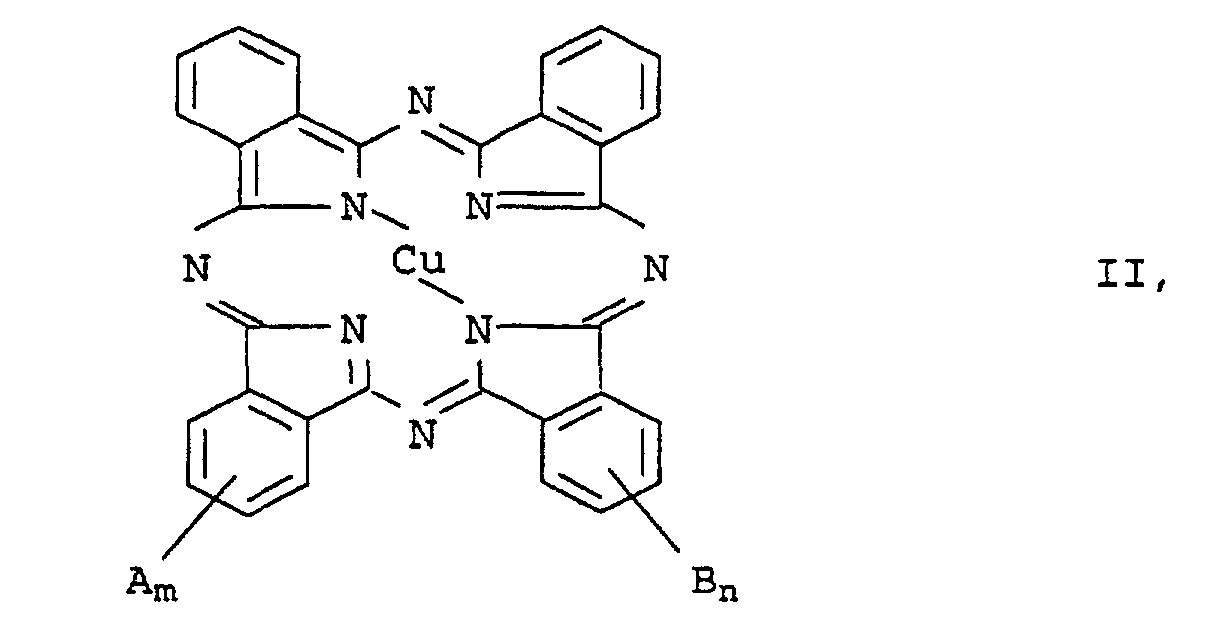
- A und B
- unabhängig voneinander folgende Substituenten:
-SO3M, -CO2M, -SO3H·HNR1R2, -CH2NR3R4, -NR3R4,
-CH2NR3R4·HO3SR5, -NR3R4·HO3SR5, -NHCOR1, -CH2NHCOR1,
-NHSO2R1, -CH2NHSO2R1, -SO2NHR1, -CONHR1, C1-C6-Alkyl, Aryl, Cyano oder -OR6, wobei- R1 und R2
- unabhängig voneinander Wasserstoff oder C2-C20-Alkenyl oder C1-C20-Alkyl bedeuten, das durch -NR7R8 substituiert sein kann, wobei R7 und R8 unabhängig voneinander für C1-C20-Alkyl, C5-C8-Cycloalkyl, das ein oder mehrere Heteroatome enthalten kann, oder Wasserstoff stehen,
- R3 und R4
- unabhängig voneinander Wasserstoff, C1-C20-Alkyl, C2 - C20 -Alkenyl oder Aryl bedeuten oder unter Ausbildung eines das Stickstoffatom sowie gegebenenfalls weitere Heteroatome oder Carbonyl- oder Sulfonylgruppen enthaltenden, 5- oder 6-gliedrigen Rings, der benzanelliert sein kann, miteinander verbunden sind,
- R5
- für p-(C10-C20-Alkyl)phenyl oder C2-C20-Alkenyl steht;
- R6
- Wasserstoff oder C1-C6-Alkyl bedeutet und
- M
- für Wasserstoff oder ein Alkalimetall steht;
- m
- eine ganze oder gebrochene Zahl > 0 bis 4,0;
- n
- eine ganze oder gebrochene Zahl von 0 bis 4,0.
- A and B
- independently of one another the following substituents: -SO 3 M, -CO 2 M, -SO 3 H · HNR 1 R 2 , -CH 2 NR 3 R 4 , -NR 3 R 4 ,
-CH 2 NR 3 R 4 · HO 3 SR 5 , -NR 3 R 4 · HO 3 SR 5 , -NHCOR 1 , -CH 2 NHCOR 1 ,
-NHSO 2 R 1 , -CH 2 NHSO 2 R 1 , -SO 2 NHR 1 , -CONHR 1 , C 1 -C 6 -alkyl, aryl, cyano or -OR 6 , where- R1 and R2
- independently of one another are hydrogen or C 2 -C 20 -alkenyl or C 1 -C 20 -alkyl, which can be substituted by -NR 7 R 8 , where R 7 and R 8 independently of one another are C 1 -C 20 -alkyl, C 5 -C 8 -cycloalkyl, which may contain one or more heteroatoms, or are hydrogen,
- R3 and R4
- are independently hydrogen, C 1 -C 20 alkyl, C 2 - C 20 alkenyl signify be benzo-fused or aryl, or to form a nitrogen atom and optionally further heteroatoms or carbonyl or sulfonyl-containing, 5- or 6-membered ring, can, are connected to each other,
- R5
- is p- (C 10 -C 20 -alkyl) phenyl or C 2 -C 20 -alkenyl;
- R6
- Is hydrogen or C 1 -C 6 -alkyl and
- M.
- represents hydrogen or an alkali metal;
- m
- an integer or fractional number> 0 to 4.0;
- n
- an integer or fraction from 0 to 4.0.
Besonders bevorzugt sind Kupferphthalocyaninderivate der Formel II, in welcher die Variablen diese Bedeutung haben:
- A und B
- unabhängig voneinander folgende Substituenten:
-SO3M, -SO3H·HNR1R2, -CH2NR3R4, -CH2NR3R4·HO3SR5 oder
-SO2NHR1, wobei
- R1 und R2
- unabhängig voneinander für C1-C20-Alkyl oder Wasserstoff stehen,
- R3 und R4
- unabhängig voneinander C1-C6-Alkyl oder Wasserstoff bedeuten oder unter Ausbildung eines das Stickstoffatom sowie Carbonyl- oder Sulfonylgruppen enthaltenden benzannelierten, 5-gliedrigen Rings miteinander verbunden sind;
- R5
- für p-(C10-C20-Alkyl)phenyl steht;
- m
- eine ganze oder gebrochene Zahl > 0 bis 4;
- n
- eine ganze oder gebrochene Zahl von 0 bis 4, wobei die Summe m + n einen Wert von 0,1 bis 4, insbesondere 1,0 bis 3,5, annimmt.
- A and B
- independently of one another the following substituents: -SO 3 M, -SO 3 H · HNR 1 R 2 , -CH 2 NR 3 R 4, -CH 2 NR 3 R 4 · HO 3 SR 5 or -SO 2 NHR 1 , where
- R1 and R2
- independently of one another represent C 1 -C 20 -alkyl or hydrogen,
- R3 and R4
- independently of one another are C 1 -C 6 -alkyl or hydrogen or are bonded to one another with formation of a benzannelated, 5-membered ring containing the nitrogen atom and carbonyl or sulfonyl groups;
- R5
- is p- (C 10 -C 20 -alkyl) phenyl;
- m
- an integer or fractional number> 0 to 4;
- n
- a whole or fractional number from 0 to 4, the sum m + n assuming a value from 0.1 to 4, in particular 1.0 to 3.5.
Als Beispiele für die in Formel II enthaltenen Reste A und B bzw.
für deren Substituenten seien im einzelnen genannt:
geradkettige oder verzweigte C1-C20-Alkylreste wie Methyl, Ethyl,
Propyl, Isopropyl, Butyl, Isobutyl, tert.-Butyl, Pentyl, Isopentyl,
Neopentyl, tert.-Pentyl, Hexyl, 2-Methylpentyl, Heptyl,
1-Ethylpentyl, Octyl, 2-Ethylhexyl, Isooctyl, Nonyl, Isononyl,
Decyl, Isodecyl, Undecyl, Dodecyl, Tridecyl, Isotridecyl, Tetradecyl,
Pentadecyl, Hexadecyl, Heptadecyl, Octadecyl, Nonadecyl
und Eicosyl (die Bezeichnungen Isooctyl, Isononyl, Isodecyl und
Isotridecyl sind Trivialbezeichnungen und stammen von den nach
der Oxosynthese erhaltenen Alkoholen - vgl. dazu Ullmanns
Encyklopädie der technischen Chemie, 4. Auflage, Band 7,
Seiten 215 bis 217, sowie Band 11, Seiten 435 und 436);
geradkettige oder verzweigte C2-C20-Alkenylreste wie Ethenyl,
Propenyl, Isopropenyl, Butenyl, Isobutenol, Pentenyl, Hexenyl,
Heptenyl, Octenyl, Nonenyl, Decenyl, Undecenyl, Dodecenyl, Tridecenyl,
Tetradecenyl, Pentadecenyl, Hexadecenyl, Heptadecenyl,
Octadecenyl, Nonadecenyl und Eicosenyl;
geradkettige oder verzweigte C1-C6-Alkoxyreste wie Methoxy,
Ethoxy, Propoxy, Isopropoxy, Butoxy, Isobutoxy, tert.-Butoxy,
Pentoxy, Isopentoxy, Neopentoxy, tert.-Pentoxy und Hexoxy;
C5-C8-Cycloalkylreste, die Heteroatome wie Sauerstoff und/oder
Stickstoff als Ersatz für ein oder mehrere Kohlenstoffatome enthalten
können, aber nicht über diese gebunden sind, wie Cyclopentyl,
Cyclohexyl, Cycloheptyl, Cyclooctyl, Tetrahydrofuryl,
Pyrrolidyl, Piperidyl, Piperazyl und Morpholinyl;
Arylreste wie Naphthyl und insbesondere Phenyl;
p-(C10-C20-Alkyl)phenylreste wie p-Decyl-, p-Undecyl-, vor allem
p-Dodecyl-, auch p-Tridecyl-, p-Tetradecyl-, p-Pentadecyl-,
p-Hexadecyl-, p-Heptadecyl-, p-Octadecyl-, p-Nonadecyl- und
p-Eicosylphenyl;
Carboxy, bevorzugt Sulfo und Mono-(C10-C20-alkyl)ammoniumsulfonatreste
wie Monodecyl-, Monoundecyl-, Monododecyl-, Monotridecyl-,
Monotetradecyl-, Monopentadecyl-, vor allem Monohexadecyl-, auch
Monoheptadecyl-, Monooctadecyl-, Monononadecyl- und Monoeicosylammoniumsulfonatreste;
Mono- und Di-(C1-C6-alkyl)aminoreste wie Mono- und Dimethylamino,
Mono- und vor allem Diethylamino, Mono- und Dipropylamino, Monound
Diisopropylamino, Mono- und Dibutylamino, Mono- und Diisobutylamino,
Mono- und Dipentylamino und Mono- und Dihexylamino
sowie vor allem Mono- und bevorzugt Di-(C1-C6-alkyl)aminomethylreste,
in denen die genannten Aminoreste über eine Methylengruppe
an das Phthalocyaningerüst gebunden sind;
Umsetzungsprodukte der Mono- und Di-(C1-C6-alkyl)aminoreste und
bevorzugt der entsprechenden Aminomethylreste mit C10-C20-Alkylphenylsulfonsäuren
wie p-Decyl-, p-Undecyl-, vor allem p-Dodecyl-,
auch p-Tridecyl-, p-Tetradecyl-, p-Pentadecyl-, p-Hexadecyl-,
p-Heptadecyl-, p-Octadecyl-, p-Nonadecyl- und p-Eicosylphenylsulfonsäuren,
wobei die Alkylreste in o-, m- oder vorzugsweise
p-Stellung zur Sulfonsäuregruppierung stehen,
z.B. -CH2-N(C2H5)2·HO3S-Ph-4-C12H25 und
-CH2-NH(C2H5)·HO3S-Ph-4-C12H25;
das Aminstickstoffatom enthaltende und darüber gebundene Heterocycloalkyl-
und Heteroarylreste wie 4-Morpholinyl, Pyrrolidyl,
Piperidyl, Piperazyl, Pyrazolyl, Pyrryl, Pyrazyl, Imidazyl, vor
allem N-Phthalimidyl und N-Saccharinyl sowie bevorzugt die entsprechenden,
über -CH2- an das Phthalocyaningerüst gebundenen
Reste;
Mono- (C1-C20-alkylcarbonyl)aminoreste wie Monomethyl-, Monoethyl-,
Monopropyl-, Monoisopropyl-, Monobutyl-, Monoisobutyl-, tert.-Monobutyl-,
Monopentyl-, Monoisopentyl-, Mononeopentyl-, tert.-Monopentyl-,
Monohexyl-, 2-Monomethylpentyl-, Monoheptyl-,
1-Monoethylpentyl-, Monooctyl-, 2-Monoethylhexyl-, Monoisooctyl-,
Monononyl-, Monoisononyl-, Monodecyl-, Monoundecyl-, Monododecyl-,
Monotridecyl-, Monotetradecyl-, Monopentadecyl-, vor allem
Monohexadecyl-, auch Monoheptadecyl-, Monooctadecyl-, Monononadecyl-
und Monoeicosylcarbonylamino sowie die entsprechenden über
-CH2- an das Phthalocyaningerüst gebundenen Aminoreste;
Mono-(C1-C20-alkylsulfonyl)aminoreste wie Monomethyl-, Monoethyl-,
Monopropyl-, Monoisopropyl-, Monobutyl-, Monoisobutyl-, tert.-Monobutyl-,
Monopentyl-, Monoisopentyl-, Mononeopentyl-, tert.-Monopentyl-,
Monohexyl-, 2-Monomethylpentyl-, Monoheptyl-,
1-Monoethylpentyl-, Monooctyl-, 2-Monoethylhexyl-, Monoisooctyl-,
Monononyl-, Monoisononyl-, Monodecyl-, Monoundecyl-, Monododecyl-,
Monotridecyl-, Monotetradecyl-, Monopentadecyl-, vor allem
Monohexadecyl-, auch Monoheptadecyl-, Monooctadecyl-, Monononadecyl-
und Monoeicosylsulfonylamino sowie die entsprechenden über
-CH2- an das Phthalocyaningerüst gebundenen Aminoreste;
Mono-(C1-C20-alkylamino)sulfonylreste wie Monomethyl-, Monoethyl-,
Monopropyl-, Monoisopropyl-, Monobutyl-, Monoisobutyl-, tert.-Monobutyl-,
Monopentyl-, Monoisopentyl-, Mononeopentyl-, tert.-Monopentyl-,
Monohexyl-, 2-Monomethylpentyl-, Monoheptyl-,
1-Monoethylpentyl-, Monooctyl-, 2-Monoethylhexyl-, Monoisooctyl-,
Monononyl-, Monoisononyl-, Monodecyl-, Monoundecyl-, Monododecyl-,
Monotridecyl-, Monotetradecyl-, Monopentadecyl-, vor allem
Monohexadecyl-, auch Monoheptadecyl-, Monooctadecyl-, Monononadecyl-
und Monoeicosylaminosulfonyl, wobei die Alkylreste eine
endständige Amino-, Mono- oder Di(C1-C6-alkyl)aminogruppe tragen
können;
Mono-(C1-C20-alkylamino)carbonylreste wie Monomethyl-, Monoethyl-,
Monopropyl-, Monoisopropyl-, Monobutyl-, Monoisobutyl-, tert.-Monobutyl-,
Monopentyl-, Monoisopentyl-, Mononeopentyl-, tert.-Monopentyl-,
Monohexyl-, 2-Monomethylpentyl-, Monoheptyl-,
1-Monoethylpentyl-, Monooctyl-, 2-Monoethylhexyl-, Monoisooctyl-,
Monononyl-, Monoisononyl-, Monodecyl-, Monoundecyl-, Monododecyl-,
Monotridecyl-, Monotetradecyl-, Monopentadecyl-, vor allem
Monohexadecyl-, auch Monoheptadecyl-, Monooctadecyl-, Monononadecyl-
und Monoeicosylaminocarbonyl, wobei die Alkylreste eine
endständige Amino-, Mono- oder Di(C1-C6-alkyl)aminogruppe tragen
können. Examples of the radicals A and B contained in formula II or for their substituents may be mentioned in detail:
straight-chain or branched C 1 -C 20 -alkyl radicals such as methyl, ethyl, propyl, isopropyl, butyl, isobutyl, tert-butyl, pentyl, isopentyl, neopentyl, tert-pentyl, hexyl, 2-methylpentyl, heptyl, 1-ethylpentyl , Octyl, 2-ethylhexyl, isooctyl, nonyl, isononyl, decyl, isodecyl, undecyl, dodecyl, tridecyl, isotridecyl, tetradecyl, pentadecyl, hexadecyl, heptadecyl, octadecyl, nonadecyl and eicosyl (the names is and come from the alcohols obtained after the oxo synthesis - see Ullmanns Encyklopadie der technischen Chemie, 4th edition, volume 7, pages 215 to 217, and volume 11, pages 435 and 436);
straight-chain or branched C 2 -C 20 -alkenyl radicals such as ethenyl, propenyl, isopropenyl, butenyl, isobutenol, pentenyl, hexenyl, heptenyl, octenyl, nonenyl, decenyl, undecenyl, dodecenyl, tridecenyl, tetradecenyl, nonadecenyl, hexadecenyl, hexadecenyl, hexadecenyl, and eicosenyl;
straight-chain or branched C 1 -C 6 alkoxy radicals such as methoxy, ethoxy, propoxy, isopropoxy, butoxy, isobutoxy, tert-butoxy, pentoxy, isopentoxy, neopentoxy, tert-pentoxy and hexoxy;
C 5 -C 8 cycloalkyl radicals which may contain heteroatoms such as oxygen and / or nitrogen as a replacement for one or more carbon atoms, but are not bound via these, such as cyclopentyl, cyclohexyl, cycloheptyl, cyclooctyl, tetrahydrofuryl, pyrrolidyl, piperidyl, piperazyl and Morpholinyl;
Aryl radicals such as naphthyl and especially phenyl;
p- (C 10 -C 20 -alkyl) phenyl radicals such as p-decyl, p-undecyl, especially p-dodecyl, also p-tridecyl, p-tetradecyl, p-pentadecyl, p-hexadecyl , p-heptadecyl, p-octadecyl, p-nonadecyl, and p-eicosylphenyl;
Carboxy, preferably sulfo and mono- (C 10 -C 20 -alkyl) ammonium sulfonate such as monodecyl, monoundecyl, monododecyl, monotridecyl, monotetradecyl, monopentadecyl, especially monohexadecyl, also monoheptadecyl, monooctadecyl, monone and monoeicosylammonium sulfonate residues;
Mono- and di- (C 1 -C 6 -alkyl) amino radicals such as mono- and dimethylamino, mono- and especially diethylamino, mono- and dipropylamino, mono- and diisopropylamino, mono- and dibutylamino, mono- and diisobutylamino, mono- and dipentylamino and mono- and dihexylamino and, above all, mono- and preferably di- (C 1 -C 6 -alkyl) aminomethyl radicals in which the said amino radicals are bonded to the phthalocyanine structure via a methylene group;
Reaction products of the mono- and di- (C 1 -C 6 -alkyl) amino radicals and preferably the corresponding aminomethyl radicals with C 10 -C 20 -alkylphenylsulfonic acids, such as p-decyl, p-undecyl, especially p-dodecyl, also p Tridecyl, p-tetradecyl, p-pentadecyl, p-hexadecyl, p-heptadecyl, p-octadecyl, p-nonadecyl and p-eicosylphenylsulfonic acids, the alkyl radicals in o-, m- or, preferably, p -Position to the sulfonic acid group, for example -CH 2 -N (C 2 H 5 ) 2 · HO 3 S-Ph-4-C 12 H 25 and -CH 2 -NH (C 2 H 5 ) · HO 3 S-Ph -4-C 12 H 25 ;
the amine nitrogen atom containing and attached through it heterocycloalkyl and heteroaryl radicals such as 4-morpholinyl, pyrrolidyl, piperidyl, piperazyl, pyrazolyl, pyrryl, pyrazyl, imidazyl, especially N-phthalimidyl and N-saccharinyl and preferably the corresponding, via -CH 2 - to the Phthalocyanine-bonded radicals;
Mono- (C 1 -C 20 -alkylcarbonyl) amino radicals such as monomethyl, monoethyl, monopropyl, monoisopropyl, monobutyl, monoisobutyl, tert-monobutyl, monopentyl, monoisopentyl, mononeopentyl, tert-monopentyl -, monohexyl, 2-monomethylpentyl, monoheptyl, 1-monoethylpentyl, monooctyl, 2-monoethylhexyl, monoisooctyl, monononyl, monoisononyl, monodecyl, monoundecyl, monododecyl, monotridecyl, monotetradecyl, Monopentadecyl, especially monohexadecyl, also monoheptadecyl, monooctadecyl, monononadecyl and monoeicosylcarbonylamino and the corresponding amino radicals bonded to the phthalocyanine structure via -CH 2 -;
Mono- (C 1 -C 20 -alkylsulfonyl) amino radicals such as monomethyl, monoethyl, monopropyl, monoisopropyl, monobutyl, monoisobutyl, tert-monobutyl, monopentyl, monoisopentyl, mononeopentyl, tert-monopentyl -, monohexyl, 2-monomethylpentyl, monoheptyl, 1-monoethylpentyl, monooctyl, 2-monoethylhexyl, monoisooctyl, monononyl, monoisononyl, monodecyl, monoundecyl, monododecyl, monotridecyl, monotetradecyl, Monopentadecyl, especially monohexadecyl, also monoheptadecyl, monooctadecyl, monononadecyl and monoeicosylsulfonylamino and the corresponding amino radicals bonded to the phthalocyanine structure via -CH 2 -;
Mono- (C 1 -C 20 -alkylamino) sulfonyl radicals such as monomethyl, monoethyl, monopropyl, monoisopropyl, monobutyl, monoisobutyl, tert-monobutyl, monopentyl, monoisopentyl, mononeopentyl, tert-monopentyl -, monohexyl, 2-monomethylpentyl, monoheptyl, 1-monoethylpentyl, monooctyl, 2-monoethylhexyl, monoisooctyl, monononyl, monoisononyl, monodecyl, monoundecyl, monododecyl, monotridecyl, monotetradecyl, Monopentadecyl, especially monohexadecyl, also monoheptadecyl, monooctadecyl, monononadecyl and monoeicosylaminosulfonyl, it being possible for the alkyl radicals to carry a terminal amino, mono- or di (C 1 -C 6 -alkyl) amino group;
Mono- (C 1 -C 20 -alkylamino) carbonyl radicals such as monomethyl, monoethyl, monopropyl, monoisopropyl, monobutyl, monoisobutyl, tert-monobutyl, monopentyl, monoisopentyl, mononeopentyl, tert-monopentyl -, monohexyl, 2-monomethylpentyl, monoheptyl, 1-monoethylpentyl, monooctyl, 2-monoethylhexyl, monoisooctyl, monononyl, monoisononyl, monodecyl, monoundecyl, monododecyl, monotridecyl, monotetradecyl, Monopentadecyl, especially monohexadecyl, also monoheptadecyl, monooctadecyl, monononadecyl and monoeicosylaminocarbonyl, it being possible for the alkyl radicals to carry a terminal amino, mono- or di (C 1 -C 6 -alkyl) amino group.
Die Phthalocyaninderivate II sind an sich bekannt bzw. nach bekannten Methoden herzustellen (z.B. EP-A-535 774, DE-A-25 16 054, EP-A-538 784 und DE-A-29 05 114).The phthalocyanine derivatives II are known per se or according to known ones Methods to produce (e.g. EP-A-535 774, DE-A-25 16 054, EP-A-538 784 and DE-A-29 05 114).
In der Regel setzt man beim erfindungsgemäßen Verfahren 0,1 bis 20 Gew.-%, bevorzugt 1 bis 10 Gew.-%, Kupferphthalocyaninderivat II, jeweils bezogen auf das Kupferphthalocyanin-Rohpigment, ein.As a rule, 0.1 to 1 is used in the process according to the invention 20% by weight, preferably 1 to 10% by weight, copper phthalocyanine derivative II, each based on the copper phthalocyanine crude pigment, a.
Geeignete Arbeitstemperaturen betragen im allgemeinen 80 bis 200°C, vorzugsweise 80 bis 120°C, wobei die Temperatur im Einzelfall auch auf den Schmelzpunkt der aciden aromatischen organischen Verbindung I abzustimmen ist.Suitable working temperatures are generally 80 to 200 ° C, preferably 80 to 120 ° C, the temperature in the individual case also on the melting point of the acidic aromatic organic Connection I is to be coordinated.
Bei Anwesenheit von Wasser wird die erfindungsgemäße Pigmentbehandlung vorzugsweise bei Temperaturen > 100°C unter Eigendruck im geschlossenen Reaktor vorgenommen.In the presence of water, the pigment treatment according to the invention is carried out preferably at temperatures> 100 ° C under autogenous pressure made in the closed reactor.
Üblicherweise nimmt die Pigmentbehandlung 2 bis 10 h, insbesondere 2 bis 5 h, in Anspruch. Je höher die gewählte Temperatur ist, um so schneller erfolgt die Rekristallisation.Usually the pigment treatment takes 2 to 10 hours, especially 2 to 5 hours to complete. The higher the chosen Temperature, the faster the recrystallization takes place.
Verfahrenstechnisch geht man beim erfindungsgemäßen Verfahren zweckmäßigerweise wie folgt vor:In terms of process engineering, one goes with the process according to the invention expediently as follows:
Eine Mischung von halogeniertem Kupferphthalocyanin-Rohpigment, das vorzugsweise als wasserfeuchter Filterkuchen vorliegt, Kupferphthalocyaninderivat und acide aromatische organische Verbindung I wird auf die gewünschte Temperatur erhitzt und 2 bis 10 h bei dieser Temperatur gerührt. Zur Isolierung des Pigments wird dann bei 50 bis 100°C wäßrige Base (z.B. 2 bis 60 gew.-%ige Alkalimetallauge) in mindestens der Menge zugegeben, die zur Überführung der Verbindung I in ihr wasserlösliches Alkalimetallsalz stöchiometrisch erforderlich ist. Das Pigment wird anschließend abfiltriert, mit Wasser gewaschen und getrocknet.A mixture of halogenated copper phthalocyanine raw pigment, which is preferably in the form of a water-moist filter cake, Copper phthalocyanine derivative and acidic aromatic organic compound I is heated to the desired temperature and 2 to Stirred for 10 h at this temperature. To isolate the pigment then an aqueous base (e.g. 2 to 60% strength by weight Alkali metal lye) added in at least the amount required for Conversion of the compound I into its water-soluble alkali metal salt stoichiometrically required. The pigment is then filtered off, washed with water and dried.
Die acide aromatische organische Verbindung I kann durch Ansäuern der Alkalimetallsalzlösung mit Mineralsäure und Abkühlen auf Raumtemperatur wieder ausgefällt und erneut für eine Pigmentbehandlung eingesetzt werden.The acidic aromatic organic compound I can be acidified the alkali metal salt solution with mineral acid and cooling Reprecipitated at room temperature and again for pigment treatment can be used.
Mit Hilfe des erfindungsgemäßen Verfahrens können brillante, transparente und farbstarke halogenierte (sowohl anhalogenierte als auch polyhalogenierte) Kupferphthalocyaninpigmente mit hervorragenden rheologischen Eigenschaften, die sowohl für den Einsatz in konventionellen als auch in Wasserbasis-Lacksystemen geeignet sind, vorteilhaft erhalten werden.With the help of the method according to the invention, brilliant, transparent and strongly colored halogenated (both partially halogenated as well as polyhalogenated) copper phthalocyanine pigments with excellent rheological properties common to both use in conventional as well as in water-based paint systems are suitable, are advantageously obtained.
Ein Gemisch aus 50 g (ber. 100 %) eines halogenierten Kupferphthalocyanin-Rohpigments
mit einem Chlorgehalt von x1 Gew.-%
(eingesetzt in Form eines wäßrigen Preßkuchens mit einem Wassergehalt
von x2 Gew.-%), 2,5 g des Kupferphthalocyaninderivats II'

Nach Abkühlen auf 80°C wurden 290 g 31 gew.-%ige Natronlauge zugegeben. Das Pigment wurde abfiltriert, mit Wasser gewaschen und bei 100°C getrocknet.After cooling to 80 ° C., 290 g of 31% strength by weight sodium hydroxide solution were added. The pigment was filtered off, washed with water and dried at 100 ° C.
Weitere Einzelheiten zu diesen Versuchen sowie deren Ergebnisse
sind in der folgenden Tabelle zusammengestellt:

Claims (5)
- A process for transforming crude halogenated copper phthalocyanine pigments having a chlorine content of from 4 to 50.3% by weight into a useful pigmentary state, which comprises treating the crude pigment at elevated temperature with an acidic aromatic organic compound that is liquid at the process temperature and has the general formula Iwhere X is hydroxyl or carboxyl and the benzene ring D may additionally bear up to two identical or different substituents selected from the group consisting of nitro, C1-C4-alkyl, C2-C4-alkenyl, chlorine and bromine and may be benzofused,

in the presence of a copper phthalocyanine derivative selected from the group consisting of the copper phthalocyanine-sulfonic and -carboxylic acids and their alkali metal, ammonium and alkylammonium salts, the amino-substituted and aminomethylated copper phthalocyanines and their reaction products with alkylating agents, sulfonic acids, sulfonyl chlorides and carbonyl chlorides, the imidomethylene- and amidomethylene-substituted copper phthalocyanines, the alkyl-, aryl- and cyano-substituted copper phthalocyanines and the hydroxyl- and alkoxy-substituted copper phthalocyanines, if desired in the presence of water. - A process as claimed in claim 1, wherein the acidic aromatic organic compound of the formula I is 2-nitrophenol, 3-nitrophenol, 4-nitrophenol, 1-naphthol or 2-naphthol.
- A process as claimed in claim 1 or 2, wherein the copper phthalocyanine derivative used has the general formula IIwhere:

- A and B
- are independently of each other the following
substituents:
-SO3M, -CO2M, -SO3H·HNR1R2, -CH2NR3R4, -NR3R4, -CH2NR3R4·HO3SR5, -NR3R4·HO3SR5, -NHCOR1, -CH2NHCOR1, -NHSO2R1, -CH2NHSO2R1, -SO2NHR1, -CONHR1, C1-C6-alkyl, aryl, cyano or -OR6, where- R1 and R2
- are each independently of the other hydrogen or C2-C20-alkenyl or C1-C20-alkyl which may be substituted by -NR7R8, where R7 and R8 are each independently of the other C1-C20-alkyl, C5-C8-cycloalkyl, which may contain one or more hetero atoms, or hydrogen,
- R3 and R4
- are each independently of the other hydrogen, C1-C20-alkyl, C2-C20-alkenyl or aryl or combine with the nitrogen atom to form a 5- or 6-membered ring which optionally contains further hetero atoms or carbonyl or sulfonyl groups and may be benzofused,
- R5
- is p-(C10-C20-alkyl)phenyl or C2-C20-alkenyl,
- R6
- is hydrogen or C1-C6-alkyl, and
- M
- is hydrogen or an alkali metal,
- m
- is an integer or fraction > 0 to 4.0,
- n
- is an integer or fraction from 0 to 4.0.
- A process as claimed in any of claims 1 to 3, wherein the copper phthalocyanine derivative used has the formula II where the variables have the following meanings:
- A and B
- are independently of each other the following
substituents:
-SO3M, -SO3H·HNR1R2, -CH2NR3R4, -CH2NR3R4·HO3SR5 or -SO2NHR1, where- R1 and R2
- are each independently of the other C1-C20-alkyl or hydrogen,
- R3 and R4
- are each independently of the other C1-C6-alkyl or hydrogen or combine with the nitrogen atom to form a carbonyl- or sulfonyl-containing benzofused 5-membered ring,
- R5
- is p-(C10-C20-alkyl)phenyl,
- m
- is an integer or fraction > 0 to 4,
- n
- is an integer or fraction from 0 to 4, subject to the proviso that the sum m + n is from 0.1 to 4.
- A process as claimed in any of claims 1 to 4, wherein from 0.1 to 20% by weight of the copper phthalocyanine derivative of the formula II is used, based on the crude pigment.
Applications Claiming Priority (2)
| Application Number | Priority Date | Filing Date | Title |
|---|---|---|---|
| DE19745922 | 1997-10-17 | ||
| DE19745922A DE19745922A1 (en) | 1997-10-17 | 1997-10-17 | Process for converting halogenated copper phthalocyanine raw pigments into a pigment form suitable for the application |
Publications (2)
| Publication Number | Publication Date |
|---|---|
| EP0909795A1 EP0909795A1 (en) | 1999-04-21 |
| EP0909795B1 true EP0909795B1 (en) | 2001-08-16 |
Family
ID=7845840
Family Applications (1)
| Application Number | Title | Priority Date | Filing Date |
|---|---|---|---|
| EP98118849A Revoked EP0909795B1 (en) | 1997-10-17 | 1998-10-06 | Process to transfer crude halogenated copper-phthalocyanine pigments into a pigment form suitable for use |
Country Status (6)
| Country | Link |
|---|---|
| US (1) | US5944887A (en) |
| EP (1) | EP0909795B1 (en) |
| JP (1) | JP4427112B2 (en) |
| KR (1) | KR100544448B1 (en) |
| CN (1) | CN1085232C (en) |
| DE (2) | DE19745922A1 (en) |
Families Citing this family (6)
| Publication number | Priority date | Publication date | Assignee | Title |
|---|---|---|---|---|
| US6132911A (en) * | 1998-07-27 | 2000-10-17 | Ricoh Company, Ltd. | Method for manufacturing pigment, electrophotographic photoconductor using the pigment and electrophotographic image forming method and apparatus using the photoconductor |
| DE10016993A1 (en) | 2000-04-07 | 2001-10-11 | Basf Ag | Chlorinated copper phthalocyanine pigments, used for coloring polyolefin, e.g. polyethylene, polypropylene, or polyamide, are obtained by heating crude pigment with acid aromatic organic medium in closed system |
| DE10257498A1 (en) * | 2002-12-10 | 2004-07-01 | Clariant Gmbh | Process for the preparation of phthalocyanine pigment preparations |
| KR100694106B1 (en) * | 2005-04-27 | 2007-03-12 | 삼성전자주식회사 | Ink compositions containing colorant-like additives, inkjet printer cartridges and ink jet recording apparatus comprising the same |
| JP6410081B2 (en) * | 2014-07-18 | 2018-10-24 | Dic株式会社 | Pigment composition for plastic coloring |
| CN107922750B (en) * | 2015-06-04 | 2020-07-10 | 太阳化学公司 | Copper Chloride Phthalocyanine Pigment |
Family Cites Families (21)
| Publication number | Priority date | Publication date | Assignee | Title |
|---|---|---|---|---|
| US2930796A (en) * | 1957-02-11 | 1960-03-29 | Gen Aniline & Film Corp | Conditioning of crude polychloro copper phthalocyanines |
| DE1242180B (en) * | 1964-07-18 | 1967-06-15 | Basf Ag | Process for the preparation of strongly colored and grain-soft polyhalogenated copper phthalocyanines |
| DE1569639C3 (en) * | 1965-08-18 | 1974-08-29 | Basf Ag, 6700 Ludwigshafen | Process for the preparation of strongly colored polyhalogen copper phthalocyanines |
| DE2013818C3 (en) * | 1970-03-23 | 1978-12-14 | Basf Ag, 6700 Ludwigshafen | Process for the preparation and isolation of easily dispersible polychloro- and polybromopolychlorocopper phthalocyanines |
| DE2449231A1 (en) * | 1974-10-16 | 1976-04-29 | Bayer Ag | FORMING OF PERHALOGEN-COPPER PHTHALOCYANINES |
| DK140901C (en) * | 1975-04-12 | 1980-05-19 | Basf Ag | PHTHALOCYAN INPIGMENT PREPARATIONS STABILIZED AGAINST RECYCLING AND MODIFICATION CONVERSION |
| DE2516054C3 (en) * | 1975-04-12 | 1979-05-10 | Basf Ag, 6700 Ludwigshafen | Phthalocyanine preparations stabilized against recrystallization and modification conversion and their use |
| DE2519753C3 (en) * | 1975-05-02 | 1978-06-22 | Basf Ag, 6700 Ludwigshafen | Pigment preparations stabilized against recrystallization and modification conversion and their use |
| GB1546950A (en) * | 1976-12-01 | 1979-05-31 | Ciba Geigy Ag | Pigment compositions |
| DE2905114C2 (en) * | 1979-02-10 | 1981-03-19 | Basf Ag, 6700 Ludwigshafen | Pigment preparations |
| EP0058888A3 (en) * | 1981-02-23 | 1982-10-06 | Mobay Chemical Corporation | Conditioning of phthalocyanine compounds |
| DE3442118A1 (en) * | 1984-11-17 | 1986-05-22 | Basf Ag, 6700 Ludwigshafen | METHOD FOR PRODUCING COLORED POLYHALOGEN COPPER PHTHALOCYANINES |
| GB8515600D0 (en) * | 1985-06-20 | 1985-07-24 | Ciba Geigy Ag | Pigmentary copper phthalocyanine |
| DE3636428A1 (en) * | 1986-10-25 | 1988-05-05 | Basf Ag | METHOD FOR THE PRODUCTION OF COLORED POLYHALOGENAL COPPER PHTHALOCYANINE PIGMENTS |
| JP3013900B2 (en) * | 1990-10-22 | 2000-02-28 | 東洋インキ製造株式会社 | Polyhalogenated phthalocyanine for printing ink, its production method and its use |
| JP2836320B2 (en) * | 1991-10-04 | 1998-12-14 | 東洋インキ製造株式会社 | Paint composition |
| DE59206108D1 (en) * | 1991-10-23 | 1996-05-30 | Hoechst Ag | Pigment preparations |
| JPH06336556A (en) * | 1993-05-28 | 1994-12-06 | Toyo Ink Mfg Co Ltd | Production of polyhalogenated copper phthalocyanine pigment |
| GB9517565D0 (en) * | 1995-08-26 | 1995-10-25 | Ciba Geigy Ag | Pigment compositions |
| JPH09291223A (en) * | 1996-04-26 | 1997-11-11 | Toyo Ink Mfg Co Ltd | Method for producing β-type copper phthalocyanine pigment |
| US5759254A (en) * | 1996-07-18 | 1998-06-02 | Ciba Specialty Chemicals Corporation | Substituted phthalocyanines |
-
1997
- 1997-10-17 DE DE19745922A patent/DE19745922A1/en not_active Withdrawn
-
1998
- 1998-10-06 EP EP98118849A patent/EP0909795B1/en not_active Revoked
- 1998-10-06 DE DE59801211T patent/DE59801211D1/en not_active Revoked
- 1998-10-13 US US09/169,988 patent/US5944887A/en not_active Expired - Lifetime
- 1998-10-16 KR KR1019980043288A patent/KR100544448B1/en not_active Expired - Fee Related
- 1998-10-16 JP JP29530798A patent/JP4427112B2/en not_active Expired - Fee Related
- 1998-10-17 CN CN98124676A patent/CN1085232C/en not_active Expired - Fee Related
Also Published As
| Publication number | Publication date |
|---|---|
| JPH11189731A (en) | 1999-07-13 |
| US5944887A (en) | 1999-08-31 |
| KR19990037151A (en) | 1999-05-25 |
| DE59801211D1 (en) | 2001-09-20 |
| CN1219558A (en) | 1999-06-16 |
| DE19745922A1 (en) | 1999-04-22 |
| EP0909795A1 (en) | 1999-04-21 |
| JP4427112B2 (en) | 2010-03-03 |
| CN1085232C (en) | 2002-05-22 |
| KR100544448B1 (en) | 2006-03-28 |
Similar Documents
| Publication | Publication Date | Title |
|---|---|---|
| EP2146230B1 (en) | Binary diketopyrrolopyrrole pigment compound for use in colour filters | |
| CH417815A (en) | Quinacridone pigment and process for its preparation | |
| DE3106906A1 (en) | PIGMENT COMPOSITIONS | |
| EP2205682A2 (en) | Diketopyrrolopyrrole pigment composition for use in color filters | |
| EP0909795B1 (en) | Process to transfer crude halogenated copper-phthalocyanine pigments into a pigment form suitable for use | |
| DE2148866C3 (en) | Quinacridone pigment mixtures and processes for their preparation | |
| EP0319452B1 (en) | Monoazo pigments, process to manufacture them and their use | |
| EP1991621B1 (en) | Diketopyrrolopyrrole pigments having heightened fastnesses and processes for preparing them | |
| DE929805C (en) | Process for the production of nickel or cobalt tetra-aza-porphines or their alkyl- and cycloalkyl-substituted derivatives | |
| EP0632108A1 (en) | Pigment preparations with anthraquinone derivatives as dispersing agents | |
| EP0206281A2 (en) | Process for converting crude isoindoline pigments into a pigmentary form | |
| EP0717080B1 (en) | Method for the preparation of triphenylmethan colorants | |
| DE69613427T2 (en) | Process for the preparation of a phthalocyanine pigment | |
| DE1058178B (en) | Process for the production of phthalocyanine pigments | |
| EP0035956B1 (en) | Process for the preparation of sulfatoethylsulfonyl compounds | |
| EP0056868B1 (en) | Process for the preparation of deeply colored 4,4',7,7'-tetrachloro thioindigo pigments | |
| EP0036555A1 (en) | Zinc chloride complex derivatives, preparation and use thereof, and process for the preparation of phenoxazine derivatives | |
| DE2346047A1 (en) | BLUE ANTHRACHINOID DISPERSION DYES, THEIR PRODUCTION AND USE | |
| EP0534314B1 (en) | Process for the preparation of nitrobenzophenones and also the colour-fast modification of a benzophenoneazopyridone dye | |
| DE2006663B2 (en) | ||
| DE1114462B (en) | Process for converting polychloro-copper phthalocyanine into pigment form | |
| DE19652241A1 (en) | Process for the production of metal-free phthalocyanine under control of the modification formed | |
| DE102006007622A1 (en) | True diketopyrrolopyrrole pigments | |
| CH343044A (en) | Process for the production of azo pigments | |
| DD207920A1 (en) | METHOD FOR THE PRODUCTION OF A MONOAZO DYE |
Legal Events
| Date | Code | Title | Description |
|---|---|---|---|
| PUAI | Public reference made under article 153(3) epc to a published international application that has entered the european phase |
Free format text: ORIGINAL CODE: 0009012 |
|
| 17P | Request for examination filed |
Effective date: 19990209 |
|
| AK | Designated contracting states |
Kind code of ref document: A1 Designated state(s): CH DE ES FR GB LI |
|
| AX | Request for extension of the european patent |
Free format text: AL;LT;LV;MK;RO;SI |
|
| AKX | Designation fees paid |
Free format text: CH DE ES FR GB LI |
|
| 17Q | First examination report despatched |
Effective date: 20000530 |
|
| GRAG | Despatch of communication of intention to grant |
Free format text: ORIGINAL CODE: EPIDOS AGRA |
|
| GRAG | Despatch of communication of intention to grant |
Free format text: ORIGINAL CODE: EPIDOS AGRA |
|
| GRAH | Despatch of communication of intention to grant a patent |
Free format text: ORIGINAL CODE: EPIDOS IGRA |
|
| GRAH | Despatch of communication of intention to grant a patent |
Free format text: ORIGINAL CODE: EPIDOS IGRA |
|
| GRAA | (expected) grant |
Free format text: ORIGINAL CODE: 0009210 |
|
| AK | Designated contracting states |
Kind code of ref document: B1 Designated state(s): CH DE ES FR GB LI |
|
| REG | Reference to a national code |
Ref country code: CH Ref legal event code: EP |
|
| REF | Corresponds to: |
Ref document number: 59801211 Country of ref document: DE Date of ref document: 20010920 |
|
| GBT | Gb: translation of ep patent filed (gb section 77(6)(a)/1977) |
Effective date: 20011005 |
|
| REG | Reference to a national code |
Ref country code: GB Ref legal event code: IF02 |
|
| ET | Fr: translation filed | ||
| PG25 | Lapsed in a contracting state [announced via postgrant information from national office to epo] |
Ref country code: ES Free format text: LAPSE BECAUSE OF FAILURE TO SUBMIT A TRANSLATION OF THE DESCRIPTION OR TO PAY THE FEE WITHIN THE PRESCRIBED TIME-LIMIT Effective date: 20020228 |
|
| PLBQ | Unpublished change to opponent data |
Free format text: ORIGINAL CODE: EPIDOS OPPO |
|
| PLBI | Opposition filed |
Free format text: ORIGINAL CODE: 0009260 |
|
| PLBF | Reply of patent proprietor to notice(s) of opposition |
Free format text: ORIGINAL CODE: EPIDOS OBSO |
|
| 26 | Opposition filed |
Opponent name: CLARIANT GMBH Effective date: 20020426 |
|
| PG25 | Lapsed in a contracting state [announced via postgrant information from national office to epo] |
Ref country code: LI Free format text: LAPSE BECAUSE OF NON-PAYMENT OF DUE FEES Effective date: 20021031 Ref country code: CH Free format text: LAPSE BECAUSE OF NON-PAYMENT OF DUE FEES Effective date: 20021031 |
|
| PLBF | Reply of patent proprietor to notice(s) of opposition |
Free format text: ORIGINAL CODE: EPIDOS OBSO |
|
| REG | Reference to a national code |
Ref country code: CH Ref legal event code: PL |
|
| RDAF | Communication despatched that patent is revoked |
Free format text: ORIGINAL CODE: EPIDOSNREV1 |
|
| APBP | Date of receipt of notice of appeal recorded |
Free format text: ORIGINAL CODE: EPIDOSNNOA2O |
|
| APBQ | Date of receipt of statement of grounds of appeal recorded |
Free format text: ORIGINAL CODE: EPIDOSNNOA3O |
|
| APAA | Appeal reference recorded |
Free format text: ORIGINAL CODE: EPIDOS REFN |
|
| APAH | Appeal reference modified |
Free format text: ORIGINAL CODE: EPIDOSCREFNO |
|
| PGFP | Annual fee paid to national office [announced via postgrant information from national office to epo] |
Ref country code: GB Payment date: 20051005 Year of fee payment: 8 |
|
| PLAB | Opposition data, opponent's data or that of the opponent's representative modified |
Free format text: ORIGINAL CODE: 0009299OPPO |
|
| PLAB | Opposition data, opponent's data or that of the opponent's representative modified |
Free format text: ORIGINAL CODE: 0009299OPPO |
|
| R26 | Opposition filed (corrected) |
Opponent name: CLARIANT VERWALTUNGSGESELLSCHAFT MBH Effective date: 20020426 |
|
| PGFP | Annual fee paid to national office [announced via postgrant information from national office to epo] |
Ref country code: DE Payment date: 20060928 Year of fee payment: 9 |
|
| APBU | Appeal procedure closed |
Free format text: ORIGINAL CODE: EPIDOSNNOA9O |
|
| GBPC | Gb: european patent ceased through non-payment of renewal fee |
Effective date: 20061006 |
|
| RDAG | Patent revoked |
Free format text: ORIGINAL CODE: 0009271 |
|
| STAA | Information on the status of an ep patent application or granted ep patent |
Free format text: STATUS: PATENT REVOKED |
|
| 27W | Patent revoked |
Effective date: 20070419 |
|
| PG25 | Lapsed in a contracting state [announced via postgrant information from national office to epo] |
Ref country code: GB Free format text: LAPSE BECAUSE OF NON-PAYMENT OF DUE FEES Effective date: 20061006 |
|
| PGFP | Annual fee paid to national office [announced via postgrant information from national office to epo] |
Ref country code: FR Payment date: 20061010 Year of fee payment: 9 |