EP0906572B1 - Masquage de la fluorescence et de la luminescence d'arriere plan lors de l'analyse optique d'essais biomedicaux - Google Patents
Masquage de la fluorescence et de la luminescence d'arriere plan lors de l'analyse optique d'essais biomedicaux Download PDFInfo
- Publication number
- EP0906572B1 EP0906572B1 EP97927032A EP97927032A EP0906572B1 EP 0906572 B1 EP0906572 B1 EP 0906572B1 EP 97927032 A EP97927032 A EP 97927032A EP 97927032 A EP97927032 A EP 97927032A EP 0906572 B1 EP0906572 B1 EP 0906572B1
- Authority
- EP
- European Patent Office
- Prior art keywords
- solution
- dye
- layer
- fluorescence
- fluorescent
- Prior art date
- Legal status (The legal status is an assumption and is not a legal conclusion. Google has not performed a legal analysis and makes no representation as to the accuracy of the status listed.)
- Expired - Lifetime
Links
- 230000000873 masking effect Effects 0.000 title claims abstract description 34
- 230000003287 optical effect Effects 0.000 title claims abstract description 17
- 238000004458 analytical method Methods 0.000 title claims abstract description 11
- 238000004020 luminiscence type Methods 0.000 title description 23
- 238000003556 assay Methods 0.000 title description 4
- 239000003446 ligand Substances 0.000 claims abstract description 36
- 239000007850 fluorescent dye Substances 0.000 claims abstract description 30
- 238000000034 method Methods 0.000 claims abstract description 30
- 238000006243 chemical reaction Methods 0.000 claims abstract description 26
- 230000008569 process Effects 0.000 claims abstract description 13
- 230000005855 radiation Effects 0.000 claims abstract description 12
- 239000000975 dye Substances 0.000 claims description 40
- 239000006228 supernatant Substances 0.000 claims description 22
- 230000005284 excitation Effects 0.000 claims description 17
- 230000000694 effects Effects 0.000 claims description 8
- 239000011324 bead Substances 0.000 claims description 6
- 239000004816 latex Substances 0.000 claims description 6
- 229920000126 latex Polymers 0.000 claims description 6
- XLYOFNOQVPJJNP-UHFFFAOYSA-N water Substances O XLYOFNOQVPJJNP-UHFFFAOYSA-N 0.000 claims description 5
- 230000001427 coherent effect Effects 0.000 claims description 4
- 231100000433 cytotoxic Toxicity 0.000 claims 1
- 230000001472 cytotoxic effect Effects 0.000 claims 1
- 230000035945 sensitivity Effects 0.000 abstract description 9
- 230000002452 interceptive effect Effects 0.000 abstract 1
- 210000004027 cell Anatomy 0.000 description 49
- 102000005962 receptors Human genes 0.000 description 16
- 108020003175 receptors Proteins 0.000 description 16
- 238000005259 measurement Methods 0.000 description 11
- 238000010521 absorption reaction Methods 0.000 description 8
- 238000003271 compound fluorescence assay Methods 0.000 description 7
- 230000003595 spectral effect Effects 0.000 description 6
- 238000000926 separation method Methods 0.000 description 5
- 230000001629 suppression Effects 0.000 description 5
- 230000008901 benefit Effects 0.000 description 4
- 230000003993 interaction Effects 0.000 description 4
- 238000000576 coating method Methods 0.000 description 3
- 239000002245 particle Substances 0.000 description 3
- 244000185942 pu fu xie ye rong Species 0.000 description 3
- 239000000376 reactant Substances 0.000 description 3
- 238000010998 test method Methods 0.000 description 3
- 229920000459 Nitrile rubber Polymers 0.000 description 2
- 239000004793 Polystyrene Substances 0.000 description 2
- 238000013459 approach Methods 0.000 description 2
- HQMRIBYCTLBDAK-UHFFFAOYSA-M bis(2-methylpropyl)alumanylium;chloride Chemical compound CC(C)C[Al](Cl)CC(C)C HQMRIBYCTLBDAK-UHFFFAOYSA-M 0.000 description 2
- NTXGQCSETZTARF-UHFFFAOYSA-N buta-1,3-diene;prop-2-enenitrile Chemical compound C=CC=C.C=CC#N NTXGQCSETZTARF-UHFFFAOYSA-N 0.000 description 2
- 210000000170 cell membrane Anatomy 0.000 description 2
- 230000008859 change Effects 0.000 description 2
- 230000006378 damage Effects 0.000 description 2
- 230000001419 dependent effect Effects 0.000 description 2
- 239000010419 fine particle Substances 0.000 description 2
- 238000013537 high throughput screening Methods 0.000 description 2
- 238000007422 luminescence assay Methods 0.000 description 2
- 239000012528 membrane Substances 0.000 description 2
- DZNKOAWEHDKBEP-UHFFFAOYSA-N methyl 2-[6-[bis(2-methoxy-2-oxoethyl)amino]-5-[2-[2-[bis(2-methoxy-2-oxoethyl)amino]-5-methylphenoxy]ethoxy]-1-benzofuran-2-yl]-1,3-oxazole-5-carboxylate Chemical compound COC(=O)CN(CC(=O)OC)C1=CC=C(C)C=C1OCCOC(C(=C1)N(CC(=O)OC)CC(=O)OC)=CC2=C1OC(C=1OC(=CN=1)C(=O)OC)=C2 DZNKOAWEHDKBEP-UHFFFAOYSA-N 0.000 description 2
- 239000011859 microparticle Substances 0.000 description 2
- 230000035699 permeability Effects 0.000 description 2
- 239000000049 pigment Substances 0.000 description 2
- 229920000642 polymer Polymers 0.000 description 2
- 229920002223 polystyrene Polymers 0.000 description 2
- 229920002635 polyurethane Polymers 0.000 description 2
- 239000004814 polyurethane Substances 0.000 description 2
- 238000010186 staining Methods 0.000 description 2
- GMMAPXRGRVJYJY-UHFFFAOYSA-J tetrasodium 4-acetamido-5-hydroxy-6-[[7-sulfonato-4-[(4-sulfonatophenyl)diazenyl]naphthalen-1-yl]diazenyl]naphthalene-1,7-disulfonate Chemical compound [Na+].[Na+].[Na+].[Na+].OC1=C2C(NC(=O)C)=CC=C(S([O-])(=O)=O)C2=CC(S([O-])(=O)=O)=C1N=NC(C1=CC(=CC=C11)S([O-])(=O)=O)=CC=C1N=NC1=CC=C(S([O-])(=O)=O)C=C1 GMMAPXRGRVJYJY-UHFFFAOYSA-J 0.000 description 2
- 231100000331 toxic Toxicity 0.000 description 2
- 230000002588 toxic effect Effects 0.000 description 2
- PGGFJIYMMRZEKG-UHFFFAOYSA-N 1,3-dibutyl-1,3-diazinane-2,4,6-trione Chemical compound CCCCN1C(=O)CC(=O)N(CCCC)C1=O PGGFJIYMMRZEKG-UHFFFAOYSA-N 0.000 description 1
- 229910010413 TiO 2 Inorganic materials 0.000 description 1
- 238000000862 absorption spectrum Methods 0.000 description 1
- 238000009825 accumulation Methods 0.000 description 1
- 230000009471 action Effects 0.000 description 1
- 230000002411 adverse Effects 0.000 description 1
- 230000003321 amplification Effects 0.000 description 1
- 238000004166 bioassay Methods 0.000 description 1
- 239000012472 biological sample Substances 0.000 description 1
- 230000005540 biological transmission Effects 0.000 description 1
- 235000012709 brilliant black BN Nutrition 0.000 description 1
- 238000000423 cell based assay Methods 0.000 description 1
- 230000005779 cell damage Effects 0.000 description 1
- 208000037887 cell injury Diseases 0.000 description 1
- 230000001413 cellular effect Effects 0.000 description 1
- 230000007541 cellular toxicity Effects 0.000 description 1
- 239000011248 coating agent Substances 0.000 description 1
- 238000010276 construction Methods 0.000 description 1
- 230000002596 correlated effect Effects 0.000 description 1
- 230000000875 corresponding effect Effects 0.000 description 1
- 231100000263 cytotoxicity test Toxicity 0.000 description 1
- 238000001514 detection method Methods 0.000 description 1
- 238000011161 development Methods 0.000 description 1
- 238000010586 diagram Methods 0.000 description 1
- 238000010494 dissociation reaction Methods 0.000 description 1
- 230000005593 dissociations Effects 0.000 description 1
- 239000003814 drug Substances 0.000 description 1
- 238000011156 evaluation Methods 0.000 description 1
- 238000003384 imaging method Methods 0.000 description 1
- 230000006872 improvement Effects 0.000 description 1
- 238000011534 incubation Methods 0.000 description 1
- 239000010954 inorganic particle Substances 0.000 description 1
- 238000011835 investigation Methods 0.000 description 1
- 239000007788 liquid Substances 0.000 description 1
- 238000000691 measurement method Methods 0.000 description 1
- 239000000203 mixture Substances 0.000 description 1
- 238000003199 nucleic acid amplification method Methods 0.000 description 1
- 230000000144 pharmacologic effect Effects 0.000 description 1
- 230000035479 physiological effects, processes and functions Effects 0.000 description 1
- 239000000523 sample Substances 0.000 description 1
- 238000012216 screening Methods 0.000 description 1
- 238000004062 sedimentation Methods 0.000 description 1
- 239000002904 solvent Substances 0.000 description 1
- 238000012360 testing method Methods 0.000 description 1
- 238000005406 washing Methods 0.000 description 1
- 239000012463 white pigment Substances 0.000 description 1
Images



Classifications
-
- G—PHYSICS
- G01—MEASURING; TESTING
- G01N—INVESTIGATING OR ANALYSING MATERIALS BY DETERMINING THEIR CHEMICAL OR PHYSICAL PROPERTIES
- G01N33/00—Investigating or analysing materials by specific methods not covered by groups G01N1/00 - G01N31/00
- G01N33/48—Biological material, e.g. blood, urine; Haemocytometers
- G01N33/50—Chemical analysis of biological material, e.g. blood, urine; Testing involving biospecific ligand binding methods; Immunological testing
- G01N33/53—Immunoassay; Biospecific binding assay; Materials therefor
- G01N33/536—Immunoassay; Biospecific binding assay; Materials therefor with immune complex formed in liquid phase
- G01N33/542—Immunoassay; Biospecific binding assay; Materials therefor with immune complex formed in liquid phase with steric inhibition or signal modification, e.g. fluorescent quenching
-
- G—PHYSICS
- G01—MEASURING; TESTING
- G01N—INVESTIGATING OR ANALYSING MATERIALS BY DETERMINING THEIR CHEMICAL OR PHYSICAL PROPERTIES
- G01N33/00—Investigating or analysing materials by specific methods not covered by groups G01N1/00 - G01N31/00
- G01N33/48—Biological material, e.g. blood, urine; Haemocytometers
- G01N33/50—Chemical analysis of biological material, e.g. blood, urine; Testing involving biospecific ligand binding methods; Immunological testing
- G01N33/5005—Chemical analysis of biological material, e.g. blood, urine; Testing involving biospecific ligand binding methods; Immunological testing involving human or animal cells
-
- G—PHYSICS
- G01—MEASURING; TESTING
- G01N—INVESTIGATING OR ANALYSING MATERIALS BY DETERMINING THEIR CHEMICAL OR PHYSICAL PROPERTIES
- G01N33/00—Investigating or analysing materials by specific methods not covered by groups G01N1/00 - G01N31/00
- G01N33/48—Biological material, e.g. blood, urine; Haemocytometers
- G01N33/50—Chemical analysis of biological material, e.g. blood, urine; Testing involving biospecific ligand binding methods; Immunological testing
- G01N33/53—Immunoassay; Biospecific binding assay; Materials therefor
- G01N33/5306—Improving reaction conditions, e.g. reduction of non-specific binding, promotion of specific binding
-
- G—PHYSICS
- G01—MEASURING; TESTING
- G01N—INVESTIGATING OR ANALYSING MATERIALS BY DETERMINING THEIR CHEMICAL OR PHYSICAL PROPERTIES
- G01N33/00—Investigating or analysing materials by specific methods not covered by groups G01N1/00 - G01N31/00
- G01N33/48—Biological material, e.g. blood, urine; Haemocytometers
- G01N33/50—Chemical analysis of biological material, e.g. blood, urine; Testing involving biospecific ligand binding methods; Immunological testing
- G01N33/53—Immunoassay; Biospecific binding assay; Materials therefor
- G01N33/543—Immunoassay; Biospecific binding assay; Materials therefor with an insoluble carrier for immobilising immunochemicals
- G01N33/54393—Improving reaction conditions or stability, e.g. by coating or irradiation of surface, by reduction of non-specific binding, by promotion of specific binding
-
- Y—GENERAL TAGGING OF NEW TECHNOLOGICAL DEVELOPMENTS; GENERAL TAGGING OF CROSS-SECTIONAL TECHNOLOGIES SPANNING OVER SEVERAL SECTIONS OF THE IPC; TECHNICAL SUBJECTS COVERED BY FORMER USPC CROSS-REFERENCE ART COLLECTIONS [XRACs] AND DIGESTS
- Y10—TECHNICAL SUBJECTS COVERED BY FORMER USPC
- Y10S—TECHNICAL SUBJECTS COVERED BY FORMER USPC CROSS-REFERENCE ART COLLECTIONS [XRACs] AND DIGESTS
- Y10S436/00—Chemistry: analytical and immunological testing
- Y10S436/80—Fluorescent dyes, e.g. rhodamine
-
- Y—GENERAL TAGGING OF NEW TECHNOLOGICAL DEVELOPMENTS; GENERAL TAGGING OF CROSS-SECTIONAL TECHNOLOGIES SPANNING OVER SEVERAL SECTIONS OF THE IPC; TECHNICAL SUBJECTS COVERED BY FORMER USPC CROSS-REFERENCE ART COLLECTIONS [XRACs] AND DIGESTS
- Y10—TECHNICAL SUBJECTS COVERED BY FORMER USPC
- Y10S—TECHNICAL SUBJECTS COVERED BY FORMER USPC CROSS-REFERENCE ART COLLECTIONS [XRACs] AND DIGESTS
- Y10S436/00—Chemistry: analytical and immunological testing
- Y10S436/805—Optical property
-
- Y—GENERAL TAGGING OF NEW TECHNOLOGICAL DEVELOPMENTS; GENERAL TAGGING OF CROSS-SECTIONAL TECHNOLOGIES SPANNING OVER SEVERAL SECTIONS OF THE IPC; TECHNICAL SUBJECTS COVERED BY FORMER USPC CROSS-REFERENCE ART COLLECTIONS [XRACs] AND DIGESTS
- Y10—TECHNICAL SUBJECTS COVERED BY FORMER USPC
- Y10S—TECHNICAL SUBJECTS COVERED BY FORMER USPC CROSS-REFERENCE ART COLLECTIONS [XRACs] AND DIGESTS
- Y10S436/00—Chemistry: analytical and immunological testing
- Y10S436/823—Immunogenic carrier or carrier per se
-
- Y—GENERAL TAGGING OF NEW TECHNOLOGICAL DEVELOPMENTS; GENERAL TAGGING OF CROSS-SECTIONAL TECHNOLOGIES SPANNING OVER SEVERAL SECTIONS OF THE IPC; TECHNICAL SUBJECTS COVERED BY FORMER USPC CROSS-REFERENCE ART COLLECTIONS [XRACs] AND DIGESTS
- Y10—TECHNICAL SUBJECTS COVERED BY FORMER USPC
- Y10T—TECHNICAL SUBJECTS COVERED BY FORMER US CLASSIFICATION
- Y10T436/00—Chemistry: analytical and immunological testing
- Y10T436/13—Tracers or tags
Definitions
- the invention is based on a method for quantitative optical analysis of fluorescence-labeled biological cells with a Fluorescent dye solution are in contact or from luminescent cells that are in Form of a coherent cell layer on a transparent support Bottom of a reaction vessel are applied, or of fluorescence or Luminescence-labeled reactants in a solution in which a fluorescent or luminescent ligand is dissolved, the solution with a for this ligand specific, on the transparent support at the bottom of the reaction vessel located receptor layer is in contact, for the receptor ligands Binding characteristic fluorescence or luminescence radiation through the transparent floor is captured and evaluated.
- the invention has for its object the sensitivity of the optical analysis fluorescent-labeled or luminescent cells in a cellular assay improve z.
- B. the smallest possible changes in membrane potential on the basis to be able to measure changes in the fluorescence of potential-sensitive dyes.
- the sensitivity of the measuring system should be so high that there are changes in potential below 5 mV have at least qualitative evidence.
- luminescent Cells are said to achieve an increase in the detection of the luminescence signal.
- the method is also said to be suitable for screening with high sample throughput his.
- the invention is based on the object of receptor binding studies the basis of fluorescence or luminescence-labeled ligands or receptors to simplify and continuously measure the receptor-binding interaction To enable (kinetics). By reducing the number of process steps required This method is particularly intended for high throughput screening and be suitable for diagnostic applications.
- the required high resolution with small changes in membrane potential could only be achieved be achieved after the cause of the disturbing overlay of the non-specific Background and specific fluorescence of the cells can be eliminated could.
- the inventive method developed for this is based on the fundamentally new idea, the excitation energy and not the biological one To mask object-derived fluorescence.
- Another dye is added, which is the excitation light of the fluorescent dye and / or its emission light is completely absorbed without the fluorescence to influence the cells. This absorption ensures that masked non-specific background signal and the cell useful signal with a previously not possible resolution can be detected.
- Cell layer is applied to the solution permeable separating layer that the Excitation light for the fluorescent dye and / or its emission light is absorbed and / or reflected without adversely affecting the cell properties. Doing so the thickness of the separating layer is chosen so that in the solution with the fluorescent dye but no fluorescence is detectable without the cells.
- Another variant of the invention is that the method of the invention Separating layer also to increase sensitivity in the quantitative optical analysis of luminescent (self-luminous) biological cells used which is in the form of a coherent cell layer on a transparent Carrier are applied.
- the optical properties of the for the solution permeable separating layer chosen so that it contains the luminescent light reflected as strongly as possible without negatively influencing the cell properties. On in this way the luminescence intensity and thus the measuring effect can be considerable increase.
- the method according to the invention can be used in a completely analogous manner to the quantitative optical analysis of fluorescence or luminescence-labeled reactants in a reaction vessel filled with a solution, the fluorescent or luminescent ligand is in solution and the solution with a specific one for this ligand, on a transparent support at the bottom of the reaction vessel applied or deposited thereon in Is in contact, the fluorescence characteristic of the receptor-ligand binding or luminescence radiation is detected through the transparent base and is evaluated.
- the solution according to the invention is based on the above described task that the supernatant, i.e.
- the invention therefore relates to receptor studies in analogy to the above described method, a process variant in which the solution is a masking dye added and / or on the receptor layer one for the solution permeable separating layer is applied, the optical properties of the Masking dye and / or the separating layer are chosen so that the excitation light for the fluorescent dye of the ligand present in the solution and / or its emission light or its luminescent light from the solution or the Separating layer is absorbed or reflected on the separating layer.
- the thickness of the separating layer is chosen so that in the solution with the fluorescent dye, but without the receptor layer, fluorescence is no longer detectable.
- the separating layer preferably consists of polymeric latex beads (e.g. polystyrene, Polyurethane, butadiene acrylonitrile).
- the latex beads can also be used be colored with a masking dye, which in this case is sufficiently large Must have polymer dyeability.
- the masking dye should be as good as possible in the solution, which also contains the fluorescent dye in dissolved form. Since the solvent is usually water, it is advisable to use a masking dye used, which has good water solubility (> 2g / ml) and no cell toxic Has side effects.
- the new method described is not tied to a specific measuring system, but, because it is not a specific technical solution, can be used by many commercially available devices. This includes practically all fluorescence readers that illuminate and also measure transparent reaction vessels, eg microtiter plates, from the bottom. With very little effort (minimal additional costs only for the special absorption dyes), this makes it possible for the first time to penetrate a resolution range, for example when measuring potential changes in cell membranes by measuring the change in fluorescence of potential-sensitive fluorescent dyes, which was previously unattainable.
- the advantage essential to the invention is that it due to the masking of the non-specific fluorescence or luminescence it is no longer necessary to remove the unbound portion of the ligands. This considerably simplifies the test procedures, damage and destruction sensitive coatings or biological objects such as Cells, avoided and the sensitivity and thus the accuracy of the Measurement improved.
- the usable Surface for coating fluorescence or luminescence-labeled ligands be significantly enlarged.
- suitable measures e.g. higher specific Density or the use of magnetizable particles. can be achieved be that the microparticles settle on the transparent carrier and accumulate. In this case too, the fluorescence or luminescence of the unbound, im Supernatant ligands effectively suppressed by the masking.
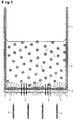
- Fig. 1 is a reaction vessel 1 for a fluorescence assay with a transparent Floor 2 shown.
- a fluorescent dye solution in the reaction vessel 1 3, in which the fluorescent dye molecules 4 are indicated schematically.
- the Solution 3 is also called supernatant.
- On the transparent floor 2 are the biological cells to be examined are arranged on a transparent support.
- Light (excitation light) 6 is radiated through the base 2 to the cells 5 to stimulate fluorescence.
- the fluorescent light 7 emitted by the cells 5 a background fluorescence radiation 8 is superimposed, which is also excited by the Fluorescent dye molecules 4 originate in the supernatant 3.
- For the bioanalytical Examination and evaluation of the cells 5 is only the fluorescent light 7 decisive. But since with all known fluorescence analyzers Background fluorescence 8 is detected, there are small differences in fluorescence Cells 5 in front of the strong background fluorescence 8 below, resulting in a clear Loss of sensitivity leads.
- This disadvantage can be caused by the inventive method according to FIG. 2 avoid background fluorescence from a masking dye is suppressed in the supernatant 3.
- the background fluorescence 8 present in FIG. 1 is acc. Fig. 2 completely absorbed in the supernatant.
- Masking dye (shown schematically at 9) can either be in solution Form or in finely divided disperse phase (color pigmented systems).
- soluble dyes are preferably used because the addition here can be done particularly easily with the help of a pipette and because in contrast to a pigment system the physical influences of the particle size distribution and sedimentation processes and layer thickness irregularities are not taken into account Need to become.
- a solubility of> 2 mg / ml is considered to be good water solubility.
- Cell toxicity can be determined using known test methods (eg cytotoxicity test).
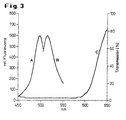
- 3 shows the optical (spectral) properties of a fluorescent and a masking dye in a diagram.
- Curve A shows the spectral distribution of the excitation light
- curve B shows the spectral distribution of the emitted fluorescent light for the commercially available distribution fluorescent dye bis- (1,3-dibutylbarbituricacid) trimethaneoxonol (Dibac 4 (3))
- curve C shows the spectral transmission ( Absorption spectrum) of the masking dye used (Brilliant Black BN, CI 28440, Food Black 1, eg Sigma B-8384). It can be seen that the masking dye absorbs almost completely in the wavelength range of the excitation and emission of the fluorescent dye.
- FIGS. 4 and 5 The improvement in contrast or sensitivity increase can be better understood with reference to FIGS. 4 and 5.
- two video recordings were made of the same image section before and after adding 100 mg / ml of the soluble masking dye Brilliant Black in the presence of the potential-sensitive fluorescent dye Dibac 4 (3) (5 mM). Both times, the same video line was evaluated analytically and the two fluorescence intensity profiles were shown over the identical sections in the reaction vessel.
- the area Z corresponds to the area in which the cell layer, ie the biological sample, is located, while the fluorescence signal from the supernatant is measured for the most part in the zone U to the right.
- the measuring range of the recording system (8 bit) is between 0 (black) and 255 (white).
- a contrast ratio of approx. 1: 3.6 results for unmasked recording and a contrast ratio of approx. 1: 14.4 in the case of masked recording. This corresponds to an increase in contrast by a factor of 4.
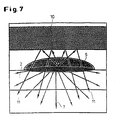
- An alternative way of improving the ratio of useful signal to background signal, according to FIG. 6, is to overlay the cell layer with a fine-particle optical separation layer 10.
- the separation layer 10 suitably consists of a fine-particle inorganic white pigment, such as TiO 2 or Al 2 O. 3rd This not only shields the background fluorescence radiation from the supernatant 3, but also increases the measurable size of the cell fluorescence by reflection on the inorganic particles.
- the separation layer can be made of polymeric latex beads with a diameter preferably exist in the range of 200 nm to 5 mm.
- Suitable polymers are e.g. Polystyrene, polyurethane, butadiene acrylonitrile.
- the latex beads can also be stained with a suitable masking dye for which the same Criteria apply, such as for the absorption dye added to the solution (see above).
- a suitable class of dyes are e.g. ®Resoline.
- luminescence assays self-luminous cells
- the luminescence signal of the biological cells are amplified.
- radiation components 11 of the non-directional luminescent light in Direction of the detector reflects and thus increase the specific measurement signal.
- the fluorescent dye after staining remove the cells from the supernatant by changing the solution.
- the fluorescent dye FURA2-AM is e.g. after entering the cell into the free dye split and lose their cell membrane permeability. Because of that comes there is an accumulation of the impermeable fluorescent dye in the cell.
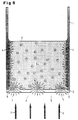
- the fluorescent supernatant 3 can be replaced by a fluorescent dye-free one Solution 3a can be exchanged without changing the specific cell fluorescence. The non-specific background fluorescence of the supernatant is determined in this way away.
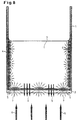
- FURA2-AM stains reaction vessels sustainably (wall fluorescence) and generates another non-specific fluorescence signal, that of the background fluorescence of distribution dyes is comparable. This fact is shown in Fig. 8 shown.
- the background fluorescence radiation 8 goes on fluorescent dye molecules 4 adhering to the vessel walls. By contribution of masking dyes in the fluorescent dye-free supernatant 3a this unspecific fluorescence signal can also be completely suppressed.
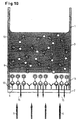
- FIG. 10 additionally shows an exemplary embodiment analogous to FIG. 2, at which is applied to a transparent support at the bottom 2 of the reaction vessel 1 biological layer consists of receptors 12 with those in the supernatant (Solution) 3 existing, fluorescence or luminescence-labeled ligands 13 form a specific bond.
- the bound ligands are designated 14 here.
- the primary light 6 radiated through the floor 2 does not excite in the case of the masked solution the fluorescence-labeled ligands 13 and 14 for fluorescence on.
- the primary light 6 is omitted 2
- the solution 3 is again a masking dye attached, which ensures that the starting from the unbound ligand 13 Fluorescence or luminescence radiation is completely absorbed in the solution.
- the fluorescence or luminescence radiation 15, i.e. the measuring effect therefore predominantly relates to the ligands bound to the receptors 12 14 back and is not bound by the background radiation of the unbound Ligand 13 adulterated in solution 3.
- the measurement signal is therefore a direct measure of the strength of ligand-receptor binding.
- the layer thickness of the receptor layer lies here in the nm range, while the dimensions of the supernatant above it is on the order of several mm.
- the separation layer 10 which is permeable to the solution, can be made entirely analogously when examining ligand-receptor bonds for masking or suppression of background fluorescence or luminescence used become.
- the disruptive background fluorescence or luminescence shielded by the separating layer 10 and in the case of luminescent ligands Radiation components 11 of the luminescent light originating from bound ligands reflected towards the detector and thus amplifies the useful signal.
Landscapes
- Health & Medical Sciences (AREA)
- Life Sciences & Earth Sciences (AREA)
- Immunology (AREA)
- Engineering & Computer Science (AREA)
- Chemical & Material Sciences (AREA)
- Molecular Biology (AREA)
- Biomedical Technology (AREA)
- Hematology (AREA)
- Urology & Nephrology (AREA)
- Food Science & Technology (AREA)
- General Physics & Mathematics (AREA)
- Cell Biology (AREA)
- Biotechnology (AREA)
- Medicinal Chemistry (AREA)
- Physics & Mathematics (AREA)
- Analytical Chemistry (AREA)
- Biochemistry (AREA)
- General Health & Medical Sciences (AREA)
- Microbiology (AREA)
- Pathology (AREA)
- Chemical Kinetics & Catalysis (AREA)
- Tropical Medicine & Parasitology (AREA)
- Investigating Or Analysing Materials By The Use Of Chemical Reactions (AREA)
- Investigating Or Analysing Biological Materials (AREA)
- Investigating, Analyzing Materials By Fluorescence Or Luminescence (AREA)
- Measuring Or Testing Involving Enzymes Or Micro-Organisms (AREA)
Claims (7)
- Méthode d'analyse optique quantitative de cellules biologiques (5) marquées par la fluorescence, qui sont déposées sous forme d'une couche cellulaire cohérente sur un support transparent au fond (2) d'un récipient de réaction (1) et qui sont en contact avec une solution (3) contenant le colorant fluorescent (4), caractérisée en ce qu'on ajoute à la solution (3) en plus du colorant fluorescent (4) déjà présent un colorant de masquage (9) qui absorbe la lumière d'excitation (6) pour le colorant fluorescent (4) et/ou sa lumière d'émission (7) et/ou en ce qu'une couche de séparation (10) perméable à la solution, qui absorbe et/ou réfléchit la lumière d'excitation (6) pour le colorant fluorescent (4) et/ou sa lumière d'émission (7), est disposée sur la couche cellulaire.
- Méthode d'analyse optique quantitative de cellules biologiques luminescentes sous forme d'une couche cellulaire cohérente se trouvant sur le support transparent, caractérisée en ce qu'une couche de séparation (10) qui réfléchit la lumière produite par luminescence est disposée sur la couche cellulaire.
- Méthode d'analyse optique quantitative de partenaires réactionnels marqués par la fluorescence ou la luminescence dans un récipient de réaction (1) rempli d'une solution (3) dans laquelle est dissous un ligand fluorescent ou luminescent (13) et la solution (3) est en contact avec une couche réceptrice (12) spécifique de ce ligand (13), disposée ou se déposant sur un support transparent au fond (2) du récipient de réaction (1), dont le rayonnement fluorescent ou luminescent (7, 15) caractéristique de la liaison récepteur-ligand est perçu à travers le fond transparent (2) et est évalué, caractérisée en ce qu'un colorant de masquage (9) est ajouté à la solution (3) et/ou une couche de séparation (10) perméable à la solution (3) est disposée sur la couche réceptrice (12), les propriétés optiques du colorant de masquage (9) et/ou de la couche de séparation (10) étant choisies de manière que la lumière d'excitation (6) pour le colorant fluorescent (4) du ligand (13) présent dans la solution (3) et/ou sa lumière fluorescente (8) ou sa lumière luminescente soient absorbées par la solution (3) ou la couche de séparation (10) ou soient réfléchies sur la couche de séparation (10).
- Méthode suivant les revendications 1 à 3, caractérisée en ce qu'on utilise comme couche de séparation (10) une couche formée de petites billes de latex polymère.
- Méthode suivant la revendication 4, caractérisée en ce que les petites billes de latex polymère sont colorées avec un colorant de masquage.
- Méthode suivant la revendication 1 ou 3, caractérisée en ce qu'on utilise un colorant de masquage qui présente une bonne solubilité dans l'eau et qui ne produit pas d'effets secondaires toxiques pour les cellules.
- Méthode suivant les revendications 1 et 2, caractérisée en ce qu'un colorant de masquage qui supprime la fluorescence non spécifique provenant de la paroi teintée du récipient de réaction est ajouté en cas de remplacement du liquide surnageant (3) contenant un colorant fluorescent (4) par une solution (3a) ne contenant pas de colorant fluorescent.
Applications Claiming Priority (3)
| Application Number | Priority Date | Filing Date | Title |
|---|---|---|---|
| DE19621312A DE19621312A1 (de) | 1996-05-28 | 1996-05-28 | Maskierung der Hintergrundfluoreszenz und Signalverstärkung bei der optischen Analyse biologisch medizinischer Assays |
| DE19621312 | 1996-05-28 | ||
| PCT/EP1997/002662 WO1997045739A1 (fr) | 1996-05-28 | 1997-05-23 | Masquage de la fluorescence et de la luminescence d'arriere plan lors de l'analyse optique d'essais biomedicaux |
Publications (2)
| Publication Number | Publication Date |
|---|---|
| EP0906572A1 EP0906572A1 (fr) | 1999-04-07 |
| EP0906572B1 true EP0906572B1 (fr) | 2002-04-03 |
Family
ID=7795451
Family Applications (1)
| Application Number | Title | Priority Date | Filing Date |
|---|---|---|---|
| EP97927032A Expired - Lifetime EP0906572B1 (fr) | 1996-05-28 | 1997-05-23 | Masquage de la fluorescence et de la luminescence d'arriere plan lors de l'analyse optique d'essais biomedicaux |
Country Status (9)
| Country | Link |
|---|---|
| US (5) | US6420183B1 (fr) |
| EP (1) | EP0906572B1 (fr) |
| JP (1) | JP3452068B2 (fr) |
| AT (1) | ATE215698T1 (fr) |
| CA (1) | CA2256629C (fr) |
| DE (2) | DE19621312A1 (fr) |
| DK (1) | DK0906572T3 (fr) |
| ES (1) | ES2175416T3 (fr) |
| WO (1) | WO1997045739A1 (fr) |
Families Citing this family (40)
| Publication number | Priority date | Publication date | Assignee | Title |
|---|---|---|---|---|
| DE19621312A1 (de) | 1996-05-28 | 1997-12-04 | Bayer Ag | Maskierung der Hintergrundfluoreszenz und Signalverstärkung bei der optischen Analyse biologisch medizinischer Assays |
| US6221612B1 (en) | 1997-08-01 | 2001-04-24 | Aurora Biosciences Corporation | Photon reducing agents for use in fluorescence assays |
| US7070921B2 (en) | 2000-04-28 | 2006-07-04 | Molecular Devices Corporation | Molecular modification assays |
| US7632651B2 (en) | 1997-09-15 | 2009-12-15 | Mds Analytical Technologies (Us) Inc. | Molecular modification assays |
| US6982431B2 (en) | 1998-08-31 | 2006-01-03 | Molecular Devices Corporation | Sample analysis systems |
| DE19927051C2 (de) | 1999-06-14 | 2002-11-07 | November Ag Molekulare Medizin | Verfahren und Vorrichtung zur Identifizierung einer Nukleotidsequenz |
| US6181413B1 (en) * | 1999-09-03 | 2001-01-30 | Biometric Imaging, Inc. | Displacing volume in field of view |
| DE10006309A1 (de) * | 2000-02-12 | 2001-08-23 | Aventis Pharma Gmbh | Verfahren zur Identifizierung von Substanzen, die die Aktivität von hyperpolarisationsaktivierten Kationen-kanälen modulieren |
| WO2002000342A2 (fr) * | 2000-06-23 | 2002-01-03 | Irm, Llc | Procede et appareil de realisation d'un dosage |
| US6552794B2 (en) * | 2001-04-04 | 2003-04-22 | Applied Spectral Imaging Ltd. | Optical detection method for improved sensitivity |
| US7400753B2 (en) * | 2001-07-03 | 2008-07-15 | Hitachi, Ltd. | Biological sample optical measuring method and biological sample optical measuring apparatus |
| WO2004077117A1 (fr) * | 2003-02-26 | 2004-09-10 | Fujitsu Limited | Dispositif de multiplexage/demultiplexage en longueurs d'ondes comprenant un reseau de guides d'ondes |
| US6972184B2 (en) * | 2003-12-23 | 2005-12-06 | Millipore Corporation | Cell motility assay |
| EP1734358A4 (fr) * | 2004-03-30 | 2008-03-26 | Hamamatsu Photonics Kk | Élément de masquage, méthode de mesure de la lumière, kit de mesure de la lumière et conteneur de mesure de la lumière |
| DE102004016361B4 (de) * | 2004-04-01 | 2006-07-06 | Cybio Ag | Optisches Analysenmessgerät für Fluoreszenzmessungen an Multiprobenträgern |
| US7371534B2 (en) * | 2004-05-25 | 2008-05-13 | Discoverx Corporation | Sensitive intracellular calcium assay |
| FR2873445A1 (fr) * | 2004-07-26 | 2006-01-27 | Genewave Soc Par Actions Simpl | Dispositif de detection de la fluorescence emise par des elements chromophores dans des puits d'une plaque a puits multiples |
| US8396731B2 (en) * | 2005-12-30 | 2013-03-12 | Sap Ag | Architectural design for service procurement application software |
| CA2641360A1 (fr) * | 2006-02-21 | 2007-08-30 | Harri Haermae | Procede de dosage sans separation |
| US9279817B2 (en) | 2007-04-13 | 2016-03-08 | Aat Bioquest, Inc. | Carbofluorescein lactone ion indicators and their applications |
| US20080254498A1 (en) | 2007-04-13 | 2008-10-16 | Abd Bioquest, Inc. | Fluorescent ion indicators and their applications |
| US9097730B2 (en) | 2007-04-13 | 2015-08-04 | Aat Bioquest, Inc. | Fluorescein lactone ion indicators and their applications |
| WO2009105583A1 (fr) * | 2008-02-19 | 2009-08-27 | Anstron Technologies Company | Dosage de liaison par transfert d'énergie par résonance de fluorescence à partir d'une surface |
| US7994485B2 (en) * | 2008-04-08 | 2011-08-09 | Carestream Health, Inc. | Apparatus and method for fluorescence measurements using spatially structured illumination |
| WO2009131958A2 (fr) * | 2008-04-21 | 2009-10-29 | Institute For Oneworld Health | Composés, compositions et procédés à base de dérivés de triazine |
| EP2278879B1 (fr) | 2008-04-21 | 2016-06-15 | PATH Drug Solutions | Composés, compositions et traitements comprenant des dérivés d'oxydiazoles |
| US20090270398A1 (en) * | 2008-04-21 | 2009-10-29 | Institute For Oneworld Health | Compounds, Compositions and Methods Comprising Pyridazine Derivatives |
| US8236838B2 (en) * | 2008-04-21 | 2012-08-07 | Institute For Oneworld Health | Compounds, compositions and methods comprising isoxazole derivatives |
| JP2012503005A (ja) * | 2008-09-19 | 2012-02-02 | インスティテュート フォア ワンワールド ヘルス | イミダゾール誘導体およびトリアゾール誘導体を含む、化合物、組成物ならびに方法。 |
| US8511216B2 (en) * | 2009-03-30 | 2013-08-20 | Kanzaki Kokyukoki Mfg. Co., Ltd. | Hydraulic actuator unit |
| US8343976B2 (en) * | 2009-04-20 | 2013-01-01 | Institute For Oneworld Health | Compounds, compositions and methods comprising pyrazole derivatives |
| EP2577311A1 (fr) * | 2010-05-31 | 2013-04-10 | Boehringer Ingelheim Microparts GmbH | Procédé et dispositif d'examen optique |
| WO2012027331A1 (fr) | 2010-08-27 | 2012-03-01 | Ironwood Pharmaceuticals, Inc. | Compositions et procédés pour traiter ou prévenir un syndrome métabolique et des maladies et troubles associés |
| JP6285915B2 (ja) | 2012-05-02 | 2018-02-28 | チャールズ リバー ラボラトリーズ, インコーポレイテッド | 生死判別染色法 |
| US10324036B2 (en) | 2012-05-02 | 2019-06-18 | Charles River Laboratories, Inc. | Porous planar cell capture system |
| CN104755931B (zh) | 2012-05-02 | 2016-08-31 | 查尔斯河实验室公司 | 用于检测细胞样品中的活细胞的方法 |
| FR3019900B1 (fr) | 2014-04-09 | 2017-12-22 | Bio-Rad Innovations | Utilisation de particules absorbantes pour ameliorer la detection du signal dans un procede d'analyse |
| US9810700B1 (en) | 2017-05-31 | 2017-11-07 | Aat Bioquest, Inc. | Fluorogenic calcium ion indicators and methods of using the same |
| JP7806660B2 (ja) * | 2022-11-11 | 2026-01-27 | コニカミノルタ株式会社 | 検出方法 |
| CN122341890A (zh) * | 2023-12-01 | 2026-07-03 | 美国西门子医学诊断股份有限公司 | 增加免疫测定试剂的光稳定性 |
Family Cites Families (32)
| Publication number | Priority date | Publication date | Assignee | Title |
|---|---|---|---|---|
| US3506827A (en) * | 1968-01-22 | 1970-04-14 | James R Alburger | Method of masking fluorescence in fluorescent dye tracer inspection process materials |
| US3785735A (en) * | 1972-01-19 | 1974-01-15 | Bio Physics Systems Inc | Photoanalysis method |
| US4476231A (en) * | 1981-07-22 | 1984-10-09 | International Remote Imaging Systems, Inc. | Method of analyzing the distribution of a reagent between particles and liquid in a suspension |
| DE3213183A1 (de) * | 1982-04-08 | 1983-10-20 | Max Planck Gesellschaft zur Förderung der Wissenschaften e.V., 3400 Göttingen | Anordnung zur optischen messung physikalischer groessen |
| JPS5934154A (ja) * | 1982-08-19 | 1984-02-24 | Konishiroku Photo Ind Co Ltd | 免疫分析素子測定法 |
| US5082768A (en) * | 1984-06-15 | 1992-01-21 | Mast Immunosystems, Inc. | Attenuator to suppress extraneous light in luminescent specific-binding assays |
| US4639421A (en) * | 1984-10-01 | 1987-01-27 | Becton, Dickinson And Company | Fluorescent gram stain |
| US4665024A (en) * | 1984-10-01 | 1987-05-12 | Becton, Dickinson And Company | Fluorescent gram stain |
| US4716121A (en) * | 1985-09-09 | 1987-12-29 | Ord, Inc. | Fluorescent assays, including immunoassays, with feature of flowing sample |
| CA1291031C (fr) * | 1985-12-23 | 1991-10-22 | Nikolaas C.J. De Jaeger | Methode pour la detection de liants specifiques et des substances liables par ceux-ci |
| US4891324A (en) * | 1987-01-07 | 1990-01-02 | Syntex (U.S.A.) Inc. | Particle with luminescer for assays |
| US5326692B1 (en) * | 1992-05-13 | 1996-04-30 | Molecular Probes Inc | Fluorescent microparticles with controllable enhanced stokes shift |
| US5830766A (en) * | 1990-05-23 | 1998-11-03 | Ares-Serono Research & Development Ltd. Partnership | Enhanced signal-to-noise ratio and sensitivity optical immunoassay |
| US5164301A (en) * | 1990-06-22 | 1992-11-17 | Difco Laboratories | Process and kit for detecting microbial metabolism |
| US5264565A (en) * | 1991-01-22 | 1993-11-23 | Affymax Technologies, N.V. | Nucleic acid encoding the D2 /Ml chimeric receptor |
| FI913443A0 (fi) * | 1991-07-17 | 1991-07-17 | Rolf Kroneld | Metod, apparat och indikator foer att indikera flyktiga kolvaeten eller miljoegifter i vatten och vaetskor. |
| ATE184399T1 (de) * | 1991-12-13 | 1999-09-15 | Bion Diagnostic Sciences Inc | Agglutierungsassays und kolloide farbstoffe verwendende testsätze |
| EP0662151A1 (fr) | 1992-07-17 | 1995-07-12 | Aprogenex, Inc. | Composes reducteurs de fond pour essais fluorimetriques in-situ a mediation par sonde |
| WO1994017388A1 (fr) * | 1993-01-26 | 1994-08-04 | Fci-Fiberchem, Inc. | Fluorodetecteur selecteur d'ions base sur l'effet de filtre interne |
| US5556764A (en) * | 1993-02-17 | 1996-09-17 | Biometric Imaging, Inc. | Method and apparatus for cell counting and cell classification |
| US5545535A (en) * | 1993-04-13 | 1996-08-13 | Molecular Probes, Inc. | Fluorescent assay for bacterial gram reaction |
| JP3326708B2 (ja) * | 1993-08-31 | 2002-09-24 | 日水製薬株式会社 | 光学的測定装置およびその方法 |
| JP2909216B2 (ja) * | 1994-04-29 | 1999-06-23 | パーキン‐エルマー コーポレイション | 核酸増幅生成物のリアルタイム検出装置 |
| WO1995031481A1 (fr) * | 1994-05-18 | 1995-11-23 | The Research And Development Institute, Inc. | Procede simple et rapide de detection, d'identification et de numeration de microorganismes specifiques viables |
| WO1996010420A1 (fr) | 1994-10-04 | 1996-04-11 | Sotomayor, Tevic, Emar | Composition et traitement d'hyperimmunisation a l'aide de bacteries non tuees thermiquement |
| ES2156927T3 (es) * | 1994-10-20 | 2001-08-01 | Sysmex Corp | Reactivo y metodo para analizar componentes solidos en orina. |
| DE19621312A1 (de) | 1996-05-28 | 1997-12-04 | Bayer Ag | Maskierung der Hintergrundfluoreszenz und Signalverstärkung bei der optischen Analyse biologisch medizinischer Assays |
| US5772999A (en) | 1996-07-30 | 1998-06-30 | Dcv Biologics, L.P. | Method of preventing, countering, or reducing NSAID-induced gastrointestinal damage by administering milk or egg products from hyperimmunized animals |
| US6214563B1 (en) | 1997-08-01 | 2001-04-10 | Aurora Biosciences Corporation | Photon reducing agents for reducing undesired light emission in assays |
| US6221612B1 (en) | 1997-08-01 | 2001-04-24 | Aurora Biosciences Corporation | Photon reducing agents for use in fluorescence assays |
| US6200762B1 (en) | 1997-08-01 | 2001-03-13 | Aurora Biosciences Corporation | Photon reducing agents and compositions for fluorescence assays |
| US6210910B1 (en) * | 1998-03-02 | 2001-04-03 | Trustees Of Tufts College | Optical fiber biosensor array comprising cell populations confined to microcavities |
-
1996
- 1996-05-28 DE DE19621312A patent/DE19621312A1/de not_active Withdrawn
-
1997
- 1997-05-23 AT AT97927032T patent/ATE215698T1/de active
- 1997-05-23 JP JP54157897A patent/JP3452068B2/ja not_active Expired - Lifetime
- 1997-05-23 DE DE59706875T patent/DE59706875D1/de not_active Expired - Lifetime
- 1997-05-23 WO PCT/EP1997/002662 patent/WO1997045739A1/fr not_active Ceased
- 1997-05-23 US US09/194,099 patent/US6420183B1/en not_active Expired - Lifetime
- 1997-05-23 EP EP97927032A patent/EP0906572B1/fr not_active Expired - Lifetime
- 1997-05-23 CA CA002256629A patent/CA2256629C/fr not_active Expired - Lifetime
- 1997-05-23 DK DK97927032T patent/DK0906572T3/da active
- 1997-05-23 ES ES97927032T patent/ES2175416T3/es not_active Expired - Lifetime
-
2001
- 2001-09-28 US US09/966,522 patent/US8178359B2/en not_active Expired - Fee Related
- 2001-09-28 US US09/966,137 patent/US7063952B2/en not_active Expired - Lifetime
-
2002
- 2002-10-03 US US10/263,607 patent/US7138280B2/en not_active Expired - Fee Related
-
2008
- 2008-08-27 US US12/199,317 patent/US7615376B2/en not_active Expired - Fee Related
Also Published As
| Publication number | Publication date |
|---|---|
| US6420183B1 (en) | 2002-07-16 |
| DK0906572T3 (da) | 2002-07-08 |
| US20080318270A1 (en) | 2008-12-25 |
| US20030092081A1 (en) | 2003-05-15 |
| DE59706875D1 (de) | 2002-05-08 |
| US7138280B2 (en) | 2006-11-21 |
| ES2175416T3 (es) | 2002-11-16 |
| DE19621312A1 (de) | 1997-12-04 |
| JP2000512746A (ja) | 2000-09-26 |
| US7063952B2 (en) | 2006-06-20 |
| EP0906572A1 (fr) | 1999-04-07 |
| US20020022274A1 (en) | 2002-02-21 |
| CA2256629C (fr) | 2003-07-22 |
| US8178359B2 (en) | 2012-05-15 |
| CA2256629A1 (fr) | 1997-12-04 |
| JP3452068B2 (ja) | 2003-09-29 |
| US20020015969A1 (en) | 2002-02-07 |
| ATE215698T1 (de) | 2002-04-15 |
| WO1997045739A1 (fr) | 1997-12-04 |
| US7615376B2 (en) | 2009-11-10 |
| US20020009754A1 (en) | 2002-01-24 |
Similar Documents
| Publication | Publication Date | Title |
|---|---|---|
| EP0906572A1 (fr) | Masquage de la fluorescence et de la luminescence d'arriere plan lors de l'analyse optique d'essais biomedicaux | |
| DE69615818T2 (de) | Ein biospezifisches multiparametrisches testverfahren | |
| DE69626803T2 (de) | Ein biospezifisches testverfahren | |
| DE69722800T2 (de) | Probenanalyseverfahren mittels bestimmung einer funktion der spezifischen helligkeit | |
| DE69230420T2 (de) | Referenzsystem mit Mehrfachsignalausgabe für einen Sensor für evaneszente Wellen | |
| EP1000345B1 (fr) | Procede et dispositif pour referencer des signaux d'intensite de fluorescence | |
| DE69819916T2 (de) | Vorrichtung und verfahren zur abbildung von mit lichtstreuendem stoff markierten proben | |
| DE19649048C1 (de) | Verfahren zur Unterscheidung oder Erfassung von Partikeln in einer Probe durch Identifizierung von Signalabschnitten zeitaufgelöster, optischer Rohsignale aus der Probe auf Basis von Einzelphotonendetektion | |
| DE60034315T2 (de) | Chemisches und biochemisches nachweisverfahren und vorrichtung | |
| DE3322373C2 (de) | Testmittel und Verfahren zum Nachweis von Antigenen und/oder Antikörpern | |
| DE69807089T2 (de) | Gerät zur durchführung von photometrischen untersuchungen | |
| DE69403663T2 (de) | Fluoreszenzlatex, enthaltend mindestens zwei fluorochrome, herstellungsverfahren und anwendung | |
| DE69804612T2 (de) | Verfahren zur charakterisierung von proben unter verwendung statistischer zwischendaten | |
| DE69401717T2 (de) | Verfahren zur Aktivierung von polyanionischen,fluoreszierenden Farbstoffen in schwach dielektrischen Medien mit quaternären Oniumverbindungen | |
| DE2628158B2 (de) | Verfahren zur Fluoreszenzspektroskopie einer Targetsubstanz | |
| DE10223438B4 (de) | Fluoreszenz-Mess-System | |
| DE2421501A1 (de) | Verfahren und vorrichtung zur analyse von leukozyten und aehnlichen zellen | |
| DE4210970C2 (de) | Verfahren zur simultanen optischen qualitativen und quantitativen Erfassung von verschiedenen mit Fluorochromen oder Fluorogenen markierten Molekülen eines Gemisches mittels Laserspektroskopie | |
| EP1461600A1 (fr) | Procede et/ou systeme pour identifier des substances fluorescentes, luminescentes et/ou absorbantes sur et/ou dans des supports d'echantillons | |
| DE19903576A1 (de) | Quantitative Bestimmung von Analyten in einem heterogenen System | |
| DE19822452C2 (de) | Verfahren zur Bestimmung der Dichte lumineszierender Moleküle an einer Oberfläche, Verwendung des Verfahrens zur Bestimmung von Adsorptions- und Bindungskinetiken und Gleichgewichts- und Bindungskonstanten von Molekülen an einer Oberfläche durch Lumineszenz-Messungen und Vorrichtung zur Durchführung des Verfahrens | |
| DE19943704C1 (de) | Affinitätssensor zum Nachweis biologischer und/oder chemischer Spezies und dessen Verwendung | |
| EP1511992A1 (fr) | Procede et dispositif de detection d'au moins une matiere luminescente | |
| DE102004051830B4 (de) | Multifunktionales Referenzsystem bei Analytbestimmungen durch Fluoreszenz | |
| DE4036288A1 (de) | Verfahren und vorrichtung fuer immunologische tests unter nutzung messbarer teilchen |
Legal Events
| Date | Code | Title | Description |
|---|---|---|---|
| PUAI | Public reference made under article 153(3) epc to a published international application that has entered the european phase |
Free format text: ORIGINAL CODE: 0009012 |
|
| 17P | Request for examination filed |
Effective date: 19981228 |
|
| AK | Designated contracting states |
Kind code of ref document: A1 Designated state(s): AT BE CH DE DK ES FI FR GB IT LI NL SE |
|
| 17Q | First examination report despatched |
Effective date: 20001219 |
|
| GRAG | Despatch of communication of intention to grant |
Free format text: ORIGINAL CODE: EPIDOS AGRA |
|
| GRAG | Despatch of communication of intention to grant |
Free format text: ORIGINAL CODE: EPIDOS AGRA |
|
| GRAH | Despatch of communication of intention to grant a patent |
Free format text: ORIGINAL CODE: EPIDOS IGRA |
|
| REG | Reference to a national code |
Ref country code: GB Ref legal event code: IF02 |
|
| GRAH | Despatch of communication of intention to grant a patent |
Free format text: ORIGINAL CODE: EPIDOS IGRA |
|
| GRAA | (expected) grant |
Free format text: ORIGINAL CODE: 0009210 |
|
| AK | Designated contracting states |
Kind code of ref document: B1 Designated state(s): AT BE CH DE DK ES FI FR GB IT LI NL SE |
|
| REF | Corresponds to: |
Ref document number: 215698 Country of ref document: AT Date of ref document: 20020415 Kind code of ref document: T |
|
| REG | Reference to a national code |
Ref country code: CH Ref legal event code: NV Representative=s name: E. BLUM & CO. PATENTANWAELTE Ref country code: CH Ref legal event code: EP |
|
| REF | Corresponds to: |
Ref document number: 59706875 Country of ref document: DE Date of ref document: 20020508 |
|
| REG | Reference to a national code |
Ref country code: DK Ref legal event code: T3 |
|
| ET | Fr: translation filed | ||
| GBT | Gb: translation of ep patent filed (gb section 77(6)(a)/1977) |
Effective date: 20020625 |
|
| REG | Reference to a national code |
Ref country code: ES Ref legal event code: FG2A Ref document number: 2175416 Country of ref document: ES Kind code of ref document: T3 |
|
| PLBE | No opposition filed within time limit |
Free format text: ORIGINAL CODE: 0009261 |
|
| STAA | Information on the status of an ep patent application or granted ep patent |
Free format text: STATUS: NO OPPOSITION FILED WITHIN TIME LIMIT |
|
| 26N | No opposition filed |
Effective date: 20030106 |
|
| REG | Reference to a national code |
Ref country code: CH Ref legal event code: PUE Owner name: BAYER HEALTHCARE AG Free format text: BAYER AG##51368 LEVERKUSEN (DE) -TRANSFER TO- BAYER HEALTHCARE AG##51368 LEVERKUSEN (DE) |
|
| REG | Reference to a national code |
Ref country code: GB Ref legal event code: 732E |
|
| NLS | Nl: assignments of ep-patents |
Owner name: BAYER HEALTHCARE AG |
|
| REG | Reference to a national code |
Ref country code: FR Ref legal event code: TP |
|
| REG | Reference to a national code |
Ref country code: CH Ref legal event code: PFA Owner name: BAYER HEALTHCARE AG Free format text: BAYER HEALTHCARE AG# #51368 LEVERKUSEN (DE) -TRANSFER TO- BAYER HEALTHCARE AG# #51368 LEVERKUSEN (DE) |
|
| REG | Reference to a national code |
Ref country code: CH Ref legal event code: PUE Owner name: BAYER SCHERING PHARMA AKTIENGESELLSCHAFT Free format text: BAYER HEALTHCARE AG# #51368 LEVERKUSEN (DE) -TRANSFER TO- BAYER SCHERING PHARMA AKTIENGESELLSCHAFT#MUELLERSTRASSE 178#13353 BERLIN (DE) |
|
| NLS | Nl: assignments of ep-patents |
Owner name: BAYER SCHERING PHARMA AKTIENGESELLSCHAFT Effective date: 20090918 |
|
| REG | Reference to a national code |
Ref country code: FR Ref legal event code: TP |
|
| REG | Reference to a national code |
Ref country code: DE Ref legal event code: R081 Ref document number: 59706875 Country of ref document: DE Owner name: BAYER INTELLECTUAL PROPERTY GMBH, DE Free format text: FORMER OWNER: BAYER SCHERING PHARMA AKTIENGESELLSCHAFT, 13353 BERLIN, DE Effective date: 20120612 |
|
| REG | Reference to a national code |
Ref country code: CH Ref legal event code: PUE Owner name: BAYER INTELLECTUAL PROPERTY GMBH, DE Free format text: FORMER OWNER: BAYER SCHERING PHARMA AKTIENGESELLSCHAFT, DE |
|
| BECH | Be: change of holder |
Owner name: BAYER INTELLECTUAL PROPERTY G.M.B.H. Effective date: 20130211 |
|
| REG | Reference to a national code |
Ref country code: FR Ref legal event code: TP Owner name: BAYER INTELLECTUAL PROPERTY GMBH, DE Effective date: 20130130 Ref country code: FR Ref legal event code: CD Owner name: BAYER INTELLECTUAL PROPERTY GMBH, DE Effective date: 20130130 |
|
| REG | Reference to a national code |
Ref country code: ES Ref legal event code: PC2A Owner name: BAYER INTELLECTUAL PROPERTY GMBH Effective date: 20130319 |
|
| REG | Reference to a national code |
Ref country code: DE Ref legal event code: R081 Ref document number: 59706875 Country of ref document: DE Owner name: BAYER INTELLECTUAL PROPERTY GMBH, DE Free format text: FORMER OWNER: BAYER PHARMA AKTIENGESELLSCHAFT, 13353 BERLIN, DE Effective date: 20130410 |
|
| REG | Reference to a national code |
Ref country code: NL Ref legal event code: TD Effective date: 20130625 Ref country code: NL Ref legal event code: SD Effective date: 20130625 |
|
| REG | Reference to a national code |
Ref country code: GB Ref legal event code: 732E Free format text: REGISTERED BETWEEN 20131212 AND 20131218 |
|
| REG | Reference to a national code |
Ref country code: AT Ref legal event code: PC Ref document number: 215698 Country of ref document: AT Kind code of ref document: T Owner name: BAYER INTELLECTUAL PROPERTY GMBH, DE Effective date: 20131218 |
|
| REG | Reference to a national code |
Ref country code: FR Ref legal event code: PLFP Year of fee payment: 20 |
|
| PGFP | Annual fee paid to national office [announced via postgrant information from national office to epo] |
Ref country code: NL Payment date: 20160426 Year of fee payment: 20 |
|
| PGFP | Annual fee paid to national office [announced via postgrant information from national office to epo] |
Ref country code: FI Payment date: 20160509 Year of fee payment: 20 Ref country code: GB Payment date: 20160518 Year of fee payment: 20 Ref country code: DE Payment date: 20160518 Year of fee payment: 20 Ref country code: CH Payment date: 20160511 Year of fee payment: 20 Ref country code: ES Payment date: 20160427 Year of fee payment: 20 |
|
| PGFP | Annual fee paid to national office [announced via postgrant information from national office to epo] |
Ref country code: BE Payment date: 20160425 Year of fee payment: 20 Ref country code: IT Payment date: 20160524 Year of fee payment: 20 Ref country code: FR Payment date: 20160426 Year of fee payment: 20 Ref country code: SE Payment date: 20160511 Year of fee payment: 20 Ref country code: AT Payment date: 20160425 Year of fee payment: 20 Ref country code: DK Payment date: 20160510 Year of fee payment: 20 |
|
| REG | Reference to a national code |
Ref country code: DE Ref legal event code: R071 Ref document number: 59706875 Country of ref document: DE |
|
| REG | Reference to a national code |
Ref country code: NL Ref legal event code: MK Effective date: 20170522 |
|
| REG | Reference to a national code |
Ref country code: DK Ref legal event code: EUP Effective date: 20170523 |
|
| REG | Reference to a national code |
Ref country code: CH Ref legal event code: PL |
|
| REG | Reference to a national code |
Ref country code: GB Ref legal event code: PE20 Expiry date: 20170522 |
|
| REG | Reference to a national code |
Ref country code: SE Ref legal event code: EUG |
|
| REG | Reference to a national code |
Ref country code: AT Ref legal event code: MK07 Ref document number: 215698 Country of ref document: AT Kind code of ref document: T Effective date: 20170523 |
|
| PG25 | Lapsed in a contracting state [announced via postgrant information from national office to epo] |
Ref country code: GB Free format text: LAPSE BECAUSE OF EXPIRATION OF PROTECTION Effective date: 20170522 |
|
| REG | Reference to a national code |
Ref country code: ES Ref legal event code: FD2A Effective date: 20170830 |
|
| PG25 | Lapsed in a contracting state [announced via postgrant information from national office to epo] |
Ref country code: ES Free format text: LAPSE BECAUSE OF EXPIRATION OF PROTECTION Effective date: 20170524 |