EP0889741B2 - Trägerkörper zur geregelten abgabe flüchtiger substanzen - Google Patents
Trägerkörper zur geregelten abgabe flüchtiger substanzen Download PDFInfo
- Publication number
- EP0889741B2 EP0889741B2 EP97915431A EP97915431A EP0889741B2 EP 0889741 B2 EP0889741 B2 EP 0889741B2 EP 97915431 A EP97915431 A EP 97915431A EP 97915431 A EP97915431 A EP 97915431A EP 0889741 B2 EP0889741 B2 EP 0889741B2
- Authority
- EP
- European Patent Office
- Prior art keywords
- support body
- body according
- recesses
- volatile substances
- constructed
- Prior art date
- Legal status (The legal status is an assumption and is not a legal conclusion. Google has not performed a legal analysis and makes no representation as to the accuracy of the status listed.)
- Expired - Lifetime
Links
- 239000000126 substance Substances 0.000 title claims abstract description 84
- 238000013270 controlled release Methods 0.000 title claims abstract description 28
- 239000000758 substrate Substances 0.000 title abstract description 12
- 239000000463 material Substances 0.000 claims abstract description 18
- 239000004744 fabric Substances 0.000 claims abstract description 4
- 239000002904 solvent Substances 0.000 claims abstract description 3
- 229910001092 metal group alloy Inorganic materials 0.000 claims description 6
- 238000006073 displacement reaction Methods 0.000 claims description 5
- 239000010935 stainless steel Substances 0.000 claims description 4
- 229910001220 stainless steel Inorganic materials 0.000 claims description 4
- 239000000834 fixative Substances 0.000 claims description 3
- 239000002184 metal Substances 0.000 claims description 3
- 230000003647 oxidation Effects 0.000 claims description 3
- 238000007254 oxidation reaction Methods 0.000 claims description 3
- 238000010276 construction Methods 0.000 claims 1
- 239000003205 fragrance Substances 0.000 description 33
- 239000004480 active ingredient Substances 0.000 description 22
- 230000000694 effects Effects 0.000 description 13
- 239000012876 carrier material Substances 0.000 description 11
- 239000000443 aerosol Substances 0.000 description 9
- 230000008020 evaporation Effects 0.000 description 9
- 238000001704 evaporation Methods 0.000 description 9
- 239000007788 liquid Substances 0.000 description 8
- 239000011148 porous material Substances 0.000 description 8
- 239000013543 active substance Substances 0.000 description 7
- 239000003814 drug Substances 0.000 description 7
- 229940079593 drug Drugs 0.000 description 7
- 239000000203 mixture Substances 0.000 description 7
- 230000008786 sensory perception of smell Effects 0.000 description 6
- 239000007921 spray Substances 0.000 description 6
- 229920002678 cellulose Polymers 0.000 description 5
- 239000001913 cellulose Substances 0.000 description 5
- 238000000859 sublimation Methods 0.000 description 5
- 230000008022 sublimation Effects 0.000 description 5
- 239000004698 Polyethylene Substances 0.000 description 4
- 239000012528 membrane Substances 0.000 description 4
- 229920000573 polyethylene Polymers 0.000 description 4
- 238000005507 spraying Methods 0.000 description 4
- 239000002250 absorbent Substances 0.000 description 3
- 230000002745 absorbent Effects 0.000 description 3
- 239000011111 cardboard Substances 0.000 description 3
- 239000012530 fluid Substances 0.000 description 3
- 230000001681 protective effect Effects 0.000 description 3
- 229920003043 Cellulose fiber Polymers 0.000 description 2
- UFWIBTONFRDIAS-UHFFFAOYSA-N Naphthalene Chemical compound C1=CC=CC2=CC=CC=C21 UFWIBTONFRDIAS-UHFFFAOYSA-N 0.000 description 2
- 239000002386 air freshener Substances 0.000 description 2
- 238000009835 boiling Methods 0.000 description 2
- 239000000969 carrier Substances 0.000 description 2
- 239000000919 ceramic Substances 0.000 description 2
- 230000008859 change Effects 0.000 description 2
- 239000011248 coating agent Substances 0.000 description 2
- 238000000576 coating method Methods 0.000 description 2
- 230000001877 deodorizing effect Effects 0.000 description 2
- 230000000249 desinfective effect Effects 0.000 description 2
- 238000002474 experimental method Methods 0.000 description 2
- 230000006870 function Effects 0.000 description 2
- 230000009965 odorless effect Effects 0.000 description 2
- 239000003921 oil Substances 0.000 description 2
- 230000008447 perception Effects 0.000 description 2
- -1 polyethylene Polymers 0.000 description 2
- 230000001105 regulatory effect Effects 0.000 description 2
- 239000007787 solid Substances 0.000 description 2
- 230000002459 sustained effect Effects 0.000 description 2
- 230000007704 transition Effects 0.000 description 2
- 230000000007 visual effect Effects 0.000 description 2
- XLYOFNOQVPJJNP-UHFFFAOYSA-N water Substances O XLYOFNOQVPJJNP-UHFFFAOYSA-N 0.000 description 2
- 235000006040 Prunus persica var persica Nutrition 0.000 description 1
- 240000006413 Prunus persica var. persica Species 0.000 description 1
- 229910000831 Steel Inorganic materials 0.000 description 1
- 230000009471 action Effects 0.000 description 1
- 125000003118 aryl group Chemical group 0.000 description 1
- 239000004927 clay Substances 0.000 description 1
- 230000006378 damage Effects 0.000 description 1
- 230000006735 deficit Effects 0.000 description 1
- 238000004332 deodorization Methods 0.000 description 1
- 239000000645 desinfectant Substances 0.000 description 1
- 230000002542 deteriorative effect Effects 0.000 description 1
- 238000002845 discoloration Methods 0.000 description 1
- 230000007613 environmental effect Effects 0.000 description 1
- 239000000835 fiber Substances 0.000 description 1
- 239000011521 glass Substances 0.000 description 1
- 125000002887 hydroxy group Chemical group [H]O* 0.000 description 1
- 230000001771 impaired effect Effects 0.000 description 1
- 230000006872 improvement Effects 0.000 description 1
- 229910052500 inorganic mineral Inorganic materials 0.000 description 1
- 230000000749 insecticidal effect Effects 0.000 description 1
- 239000002917 insecticide Substances 0.000 description 1
- 230000003993 interaction Effects 0.000 description 1
- 230000001788 irregular Effects 0.000 description 1
- 230000002045 lasting effect Effects 0.000 description 1
- 238000000034 method Methods 0.000 description 1
- 239000011707 mineral Substances 0.000 description 1
- 239000006199 nebulizer Substances 0.000 description 1
- 238000004806 packaging method and process Methods 0.000 description 1
- 239000011087 paperboard Substances 0.000 description 1
- 239000002304 perfume Substances 0.000 description 1
- 239000004033 plastic Substances 0.000 description 1
- 229920003023 plastic Polymers 0.000 description 1
- 239000003380 propellant Substances 0.000 description 1
- 230000000717 retained effect Effects 0.000 description 1
- 239000010959 steel Substances 0.000 description 1
- 238000004659 sterilization and disinfection Methods 0.000 description 1
- 230000002311 subsequent effect Effects 0.000 description 1
- 230000003319 supportive effect Effects 0.000 description 1
- 239000003039 volatile agent Substances 0.000 description 1
- 239000000341 volatile oil Substances 0.000 description 1
Images


Classifications
-
- A—HUMAN NECESSITIES
- A01—AGRICULTURE; FORESTRY; ANIMAL HUSBANDRY; HUNTING; TRAPPING; FISHING
- A01M—CATCHING, TRAPPING OR SCARING OF ANIMALS; APPARATUS FOR THE DESTRUCTION OF NOXIOUS ANIMALS OR NOXIOUS PLANTS
- A01M1/00—Stationary means for catching or killing insects
- A01M1/20—Poisoning, narcotising, or burning insects
- A01M1/2022—Poisoning or narcotising insects by vaporising an insecticide
- A01M1/2027—Poisoning or narcotising insects by vaporising an insecticide without heating
- A01M1/2055—Holders or dispensers for solid, gelified or impregnated insecticide, e.g. volatile blocks or impregnated pads
-
- A—HUMAN NECESSITIES
- A61—MEDICAL OR VETERINARY SCIENCE; HYGIENE
- A61L—METHODS OR APPARATUS FOR STERILISING MATERIALS OR OBJECTS IN GENERAL; DISINFECTION, STERILISATION OR DEODORISATION OF AIR; CHEMICAL ASPECTS OF BANDAGES, DRESSINGS, ABSORBENT PADS OR SURGICAL ARTICLES; MATERIALS FOR BANDAGES, DRESSINGS, ABSORBENT PADS OR SURGICAL ARTICLES
- A61L9/00—Disinfection, sterilisation or deodorisation of air
- A61L9/015—Disinfection, sterilisation or deodorisation of air using gaseous or vaporous substances, e.g. ozone
- A61L9/04—Disinfection, sterilisation or deodorisation of air using gaseous or vaporous substances, e.g. ozone using substances evaporated in the air without heating
- A61L9/042—Disinfection, sterilisation or deodorisation of air using gaseous or vaporous substances, e.g. ozone using substances evaporated in the air without heating with the help of a macromolecular compound as a carrier or diluent
-
- A—HUMAN NECESSITIES
- A61—MEDICAL OR VETERINARY SCIENCE; HYGIENE
- A61L—METHODS OR APPARATUS FOR STERILISING MATERIALS OR OBJECTS IN GENERAL; DISINFECTION, STERILISATION OR DEODORISATION OF AIR; CHEMICAL ASPECTS OF BANDAGES, DRESSINGS, ABSORBENT PADS OR SURGICAL ARTICLES; MATERIALS FOR BANDAGES, DRESSINGS, ABSORBENT PADS OR SURGICAL ARTICLES
- A61L9/00—Disinfection, sterilisation or deodorisation of air
- A61L9/015—Disinfection, sterilisation or deodorisation of air using gaseous or vaporous substances, e.g. ozone
- A61L9/04—Disinfection, sterilisation or deodorisation of air using gaseous or vaporous substances, e.g. ozone using substances evaporated in the air without heating
- A61L9/046—Disinfection, sterilisation or deodorisation of air using gaseous or vaporous substances, e.g. ozone using substances evaporated in the air without heating with the help of a non-organic compound
-
- A—HUMAN NECESSITIES
- A61—MEDICAL OR VETERINARY SCIENCE; HYGIENE
- A61L—METHODS OR APPARATUS FOR STERILISING MATERIALS OR OBJECTS IN GENERAL; DISINFECTION, STERILISATION OR DEODORISATION OF AIR; CHEMICAL ASPECTS OF BANDAGES, DRESSINGS, ABSORBENT PADS OR SURGICAL ARTICLES; MATERIALS FOR BANDAGES, DRESSINGS, ABSORBENT PADS OR SURGICAL ARTICLES
- A61L9/00—Disinfection, sterilisation or deodorisation of air
- A61L9/015—Disinfection, sterilisation or deodorisation of air using gaseous or vaporous substances, e.g. ozone
- A61L9/04—Disinfection, sterilisation or deodorisation of air using gaseous or vaporous substances, e.g. ozone using substances evaporated in the air without heating
- A61L9/12—Apparatus, e.g. holders, therefor
Definitions
- the invention relates to a carrier body for the controlled release of volatile substances, which are used for the disinfection or deodorization of rooms or for similar purposes, which generally serve the room air freshening or improving.
- Fragrance or drug donors which are assigned to the so-called “slow-release” systems or the so-called “controlled-release” systems depending on their mode of operation and essentially to the controlled release of a reservoir of fragrances or active ingredients by using different physical or chemical properties are based, find today not only in the domestic and especially in the sanitary sector or in the interior of vehicles, but increasingly in industry and in agriculture and forestry wide application fields.
- they are used for storage and delivery of volatile substances with deodorizing function, resulting in a refreshment or improvement of the room air result.
- Previously used carrier materials have proved to be disadvantageous insofar as the stored substances are released by them normally too fast or too slow.
- the fragrance or active ingredient is introduced into a plastic container which is closed with a cellulose membrane.
- This membrane has no defined pore structure, so that the substance delivery is difficult to control. In fluctuating air movements, the membrane can dry out very quickly; the supply of stored material then stagnates.
- An aged membrane also has an undesirable selective effect, so that no longer the entire fragrance or active substance range is released, that is, the composition of the fragrances or active ingredients changes over time.
- Carrier bodies made of ceramic have only low pore volumes of up to 40% and have only a small proportion of open pores.
- the substances to be vaporized can be stored here predominantly on the outer surface, so that only small amounts of substrate per unit of space can be applied.
- the minerals unavoidably contained in ceramics can lead to a selective fixation of flavorings.
- the German patent DE 44 17 739 describes in a similar context the use of a porous body made of open-pored sintered glass for the storage and controlled release of vaporizable substances.
- the body preferably has a pore volume of 30% to 85% and an average pore size of 10 ⁇ m to 350 ⁇ m.
- slow-release systems have several disadvantages and shortcomings. So they are generally inert, that is, in closed rooms passes due to the slow release of the active ingredients some time until the desired drug concentration is reached. However, this is in clear contradiction to the aim, for example, of scenting residential or business premises, to perceive the fragrance immediately after use. Even with the use of insecticides in enclosed spaces, it is desirable to achieve the necessary insecticidal concentration as quickly as possible in order to use no more active ingredient than absolutely necessary. Subsequently, the drug concentration should be maintained over a period of time.
- the "slow-release” systems further a certain inefficiency can not be denied, as they permanently evaporate the active ingredients, that is to release even in times when there is no need in this regard.
- the known "slow-release” systems even today, the ever-increasing demands for environmental protection in any way taken into account, since the "slow-release” systems require a high packaging cost and are not refillable in most cases.
- a portion of the fragrance or active substance can be released immediately if required by application to one or more sides of the carrier, so that metering devices As a rule, they are characterized by an immediate effect, which so far, however, often only lasted for a relatively short period of time.
- a technique often used here for the purpose of continuously dispensing fragrances or active substances consists of dispensing from an atomizer a certain amount of fragrance or active substance and spraying it into a carrier material, cellulosic cardboard, felt being the carrier material according to the state of the art or fleece were proposed. These materials are commonly used in "slow-release” systems and absorb the fragrance or drug almost completely.
- an aerosol container actuation cap which, when applied to the aerosol container in place of the normal removable cap, permits easy actuation of the fluid release valve to spray the fluid, with the user's hand against contact with the fluid and wherein the spraying is carried out in such a way that a portion of the sprayed liquid is radiated freely into the air in the usual way, while the rest of the liquid impregnates an absorbent material from which it can evaporate, in this way both a To get fast as well as a supportive action for chemicals of the liquid.
- the in the DE 23 31 981 disclosed actuator cap for aerosol containers is in this case intended in particular for use in aerosol containers, which have a valve which emits the liquid content in the axial direction and can be actuated by finger pressure.
- a volatile substance delivery device in particular an air freshener, which comprises an aerosol pressure vessel containing the substances to be delivered together with a propellant.
- the actuation of the dispensing valve of the container is effected by a hollow push-button, which has at least one openwork wall portion and which cooperates in the longitudinal direction with the dispensing head, which is connected to the movable part of the dispensing valve.
- the push button houses at least one absorbing element which is impregnated with the substances discharged from the pressure vessel through at least one outlet opening in the dispensing head and which are thrown into the interior of the push button and against a baffle and then fall onto the absorbent element ,
- cellulose bodies Another disadvantage of cellulose bodies is their swellability. At higher humidity, the cellulosic body can break up in layers, whereby the subsequent excessive access of air shortens the duration of action and changes the desired active substance concentration in the room air. Thus, it can lead to deformations and discoloration in the cellulose bodies, which affects the aesthetic impression and thus of course the saleability of products with such carriers sustainable.
- the publication GB 286,862 discloses a volatile deodorizing or disinfecting block externally provided with surface depressions, such as grooves, so that the surface is substantially increased in proportion to the volume. From the publication GB 286,862 However, it does not explicitly state that the volatile substances can be metered onto the carrier body, since, for example, a disinfectant block of solid naphthalene is described. Furthermore, goes out of the document GB 286,862 does not explicitly state that the carrier material must be chemically inert.
- a support body for dosing devices such as sprays, spray systems, dropper bottles or possibly also brush bottles, especially for use in rooms, for receiving, storage and controlled release of portions of volatile substances (fragrance or active ingredients), so that on the one hand an immediate fragrance effect is ensured with good and uniform dosing, on the other hand, however, over a long period of time allows.
- the present invention aims at a carrier body which absorbs the fragrance or active ingredients to be applied only when needed and in one portion, without absorbing them.
- the active ingredient combination should be controlled by the carrier body as a function of the temperature at a constantly high rate, controlled and completely released.
- a further object of the invention is to provide a carrier body which guarantees this continuous evaporation or sublimation of the stored substances in unchanged composition.
- the material of the carrier body is metal or a metal alloy with a thermal conductivity in the range of at least 10 1 W ⁇ m -1 ⁇ K -1 to at most 40 ⁇ 10 1 W ⁇ m -1 ⁇ K -1 , wherein it is preferably in the metal alloy is stainless steel with a thermal conductivity in the range of 1.5 ⁇ 10 1 W ⁇ m -1 ⁇ K -1 . Accordingly, in a surprisingly simple and yet extremely effective manner, one benefits from the fact that a higher the thermal conductivity of the material constituting the carrier body, the longer a certain amount of volatile substances can be perceived at room temperature. With respect to the present invention, this means that the more volatile the substances, the higher the thermal conductivity of the carrier material should be, in order to achieve an extension of the scent perception in comparison with a direct application into the air.
- the carrier body according to the invention in the form of at least one support plate is formed with the largest possible surface.
- the support body is formed in the form of two or more support plates which are arranged parallel to each other.
- the carrier body can also be designed in the form of two or more carrier plates, which are arranged in lateral offset and / or in angular offset from one another.
- the support plate may be formed in a curved shape, in particular in the form of a cylinder wall, a conical shell or a spherical shell.
- Preferred embodiments of the carrier body according to the invention include that the carrier plate has a surface area in the range of at least 2 cm 2 to at most 500 cm 2 and a thickness in the range of at least 0.1 mm to at most 2 mm.
- the recesses are at least partially formed as openings, wherein the ratio of surface area to volume of the carrier body is expediently at most 500 ⁇ 10 2 m -1 .
- the recesses or openings are arranged at regular intervals.
- the recesses or openings in this case formed so that the carrier body has the shape of a gauze, a fabric, a grid, a net or a screen, or the recesses or openings are in the form of grooves of any width, so is an additional Extension of the scent perception achieved.
- the carrier body is designed in the form of at least one carrier plate with the largest possible surface area, the depth of the depressions or openings in the carrier plate is at most equal to the thickness of the carrier plate in a particularly preferred development of the carrier body according to the invention.
- the diameter of the recesses or openings advantageously moves in the range of at least 0.2 mm to at most 1 mm, while the center distance between adjacent recesses or openings in the range of at least 0.2 mm to at most 60 mm moves.
- the recesses or openings arranged in the carrier body are at most completely filled with the volatile substances (fragrances or active substances) in accordance with the above-mentioned dimensioning, convection which is desirable in the present field of application of the carrier body according to the invention is sufficiently ensured, the volatile substances are vaporizable in all directions.
- the carrier body according to the invention As can already be seen from the above statements, its physical structure is of particular importance for a successful use of the carrier body according to the invention. For this reason, the areas of the surface of the support plate having recesses or perforations occupy at most 60% of the entire surface of the support plate.
- An extension of the scent perception is also achieved by at least sectionally or locally coating the carrier body with at least one medium which increases the adhesion of the volatile substances in a suitable manner.
- the medium is preferably light and / or oxidation resistant and advantageously odorless.
- the medium can be, for example, a fixator which is applied to the carrier body, for example by an atomizer, or oil.
- the carrier body when applying the volatile substances from a metering device on the carrier body expediently a distance of at most 20 cm from the metering device.
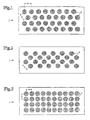
- Fig. 1 to 12 represent schematic views of ten embodiments of a carrier body according to the invention for receiving, storing and regulated delivery of volatile substances (scents or active ingredients), which are metered onto the carrier body can be applied.
- the carrier body enables an immediate odor effect with simultaneous meterability over a long period of time, which guarantees continuous evaporation or sublimation of the stored substances in unchanged composition over a long period of time compared to a direct application of a dose into the air.
- the fragrance impression thus remains on the carrier body for a large period of time without experiencing an undesirable change.
- the medium is light and oxidation resistant and odorless.
- the medium can be, for example, a fixator which is applied to the carrier body, for example by an atomizer, or oil.
- fixatives are substances which are able to give the scent of the volatile substances increased stability and to slow down and harmonize the evaporation of the individual scent components in such a way that the scent character remains reasonably constant during the evaporation period.
- the fixatives themselves are usually low volatility and high-boiling and can be fragrant or fragrance-free.
- each of the carrier body shown has recesses or openings 2 for receiving and storing the volatile substances.
- its physical structure is of particular importance for a successful use of the carrier body according to the invention.
- those in the Fig. 1 to 12 formed carrier body according to the invention, so that the ratio of surface area to volume in these carrier bodies is at least 1 ⁇ 10 2 m -1 .
- the upper limit for the ratio of surface area to volume in these carrier bodies is 500 ⁇ 10 2 m -1 .
- the surface to volume ratio preferably ranges from 5 ⁇ 10 2 m -1 to 100 ⁇ 10 2 m -1 .
- the areas of the surface (s) of the carrier body, which have recesses or perforations 2 take in the Fig. 1 to 12 at most 60% of the total surface of the carrier body.
- the carrier body in this case has a surface in the range of at least 2 cm 2 to at most 500 cm 2 and a thickness (D) in the range of at least 0.1 mm to at most 2 mm.
- the carrier body according to the invention consist of a material which is chemically inert to the volatile substances and / or their solvents.
- This material comprises metal or a metal alloy having a thermal conductivity in the range of at least 10 1 W ⁇ m -1 ⁇ K -1 to at most 40 ⁇ 10 1 W ⁇ m -1 ⁇ K -1 , wherein the metal alloy is stainless steel a thermal conductivity in the range of 1.5 ⁇ 10 1 W ⁇ m -1 ⁇ K -1 can act.
- the support body according to the invention is in each case formed in the form of a support plate 1 with the largest possible outer surface.
- the recesses or openings 2 in the support plate 1 are each configured at regular intervals in the form of circular holes, the diameter of which varies in the range of at least 0.2 mm to at most 1 mm, while their center distance A in the range of at least 0th , 2 mm to a maximum of 60 mm.
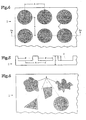
- FIG. 4 an enlarged section of the in Fig. 3 illustrated schematic plan view of the third embodiment of a carrier body according to the invention.
- Fig. 5 shows a side sectional view of the in Fig. 4 illustrated enlarged section of the schematic plan view of the third embodiment of a carrier body according to the invention along the section line S4-S4 Fig. 4 , where in Fig. 5 the depth T of the depressions or openings 2 is equal to half the thickness D of the support plate 1.
- each selected dimensions as a carrier material for example polyethylene (PE) having a thermal conductivity in the range of 1.2 ⁇ 10 -1 W ⁇ m -1 ⁇ K -1 , not according to the invention as shown by the arrangement of the holes shown an extension of the scent perception of half Hour to nine hours, that is by a factor of 18 observed.
- PE polyethylene
- the diameter ⁇ of the holes arranged in the support plate 1 also depends on the type of application of the volatile substance: If the volatile substances are applied, for example from a spray can to the support plate 1, the holes should have a diameter ⁇ have on the order of about 0.2 mm, while for the application with mechanical atomizers hole diameter ⁇ in the range of about 0.6 mm cause convincing results. In any case, the upper limit for the hole diameter ⁇ is given by the proportion of passing droplets. Although as many droplets as possible should adhere to the carrier plate 1, they should not form a closed film. In this case, the holes arranged in the support plate 1 should not be completely filled with the volatile substances in accordance with the dimensions listed above, so that sufficient convection is provided for the convection desired in the present field of application of the support body according to the invention.
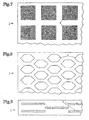
- Fig. 6 shows a schematic plan view of a fourth embodiment of a carrier body according to the invention for the controlled release of volatile substances, are arranged in the irregularly shaped depressions or openings 2 in the support plate 1 at irregular intervals.
- the recesses or openings 2 in the support plate 1 can also be formed so that the support plate 1 has the shape of a gauze, a fabric, a grid, a net or a screen.
- the recesses or openings 2 are formed so that the support plate 1 in the form of a grid with square structure ( Fig. 7 ) or with honeycomb structure ( Fig. 8 ) having.
- Fig. 9 shows a schematic plan view of a seventh embodiment of a carrier body according to the invention for the controlled release of volatile substances, wherein the recesses or openings 2 are formed in the form of grooves through which, as through the square recesses of Fig. 7 and the honeycomb openings of the Fig. 8 , an additional extension of the scent perception is achieved.
- Fig. 10 shows a schematic view of an eighth embodiment of a carrier body according to the invention for the controlled release of volatile substances.
- This support body is in the form of four support plates 1, which are arranged parallel to each other and not only connected to each other by connecting means 5, but also stabilized in this position and supported by the connecting means 5.
- FIG. 11 shown schematic view of a ninth embodiment of a carrier body according to the invention for the controlled release of volatile substances.
- This support body is in the form of three support plates 1, which are arranged in lateral offset from one another and not only connected to each other by connecting means 5, but also stabilized in this position and supported by the connecting means 5.
- Fig. 12 shows a schematic plan view of a tenth embodiment of a carrier body according to the invention for the controlled release of volatile substances.
- This carrier body is in the form of two of the Fig. 1 formed support plates 1, which in angular displacement, in the example shown the Fig. 12 are arranged at right angles in angular displacement, to each other and not only connected to each other by angular connection means 5, but also stabilized in this position and are supported by the connecting means 5. It goes without saying that the angular displacement can also take any value other than 90 °.
- Fig. 13 shows a room freshener with an eleventh embodiment of a carrier body according to the invention for the controlled release of volatile substances.
- An essentially arbitrarily configurable vessel 3 is filled with liquid fragrances or active ingredients, the dosage of the liquid fragrances or active substances being effected by a metering device 4 such as an atomizer.
- the carrier plate 1 according to the invention which is intended for receiving and evaporation of the active ingredient portion, formed in a curved shape; It is made of stainless steel, is broken through and is mounted concentrically around the metering device 4 in the form of a cylinder wall, wherein the carrier plate 1 has a distance of at most 20 cm from the metering device 4 when applying the volatile substances.
- the support plate 1 could of course also be in the form of, for example, a conical shell or a spherical shell.
Landscapes
- Life Sciences & Earth Sciences (AREA)
- Health & Medical Sciences (AREA)
- General Health & Medical Sciences (AREA)
- Pest Control & Pesticides (AREA)
- Epidemiology (AREA)
- Animal Behavior & Ethology (AREA)
- Public Health (AREA)
- Veterinary Medicine (AREA)
- Toxicology (AREA)
- Engineering & Computer Science (AREA)
- Insects & Arthropods (AREA)
- Wood Science & Technology (AREA)
- Zoology (AREA)
- Environmental Sciences (AREA)
- Disinfection, Sterilisation Or Deodorisation Of Air (AREA)
- Agricultural Chemicals And Associated Chemicals (AREA)
Applications Claiming Priority (3)
| Application Number | Priority Date | Filing Date | Title |
|---|---|---|---|
| DE19611993A DE19611993C1 (de) | 1996-03-26 | 1996-03-26 | Trägerkörper zur geregelten Abgabe flüchtiger Substanzen |
| DE19611993 | 1996-03-26 | ||
| PCT/EP1997/001515 WO1997035626A1 (de) | 1996-03-26 | 1997-03-25 | Trägerkörper zur geregelten abgabe flüchtiger substanzen |
Publications (3)
| Publication Number | Publication Date |
|---|---|
| EP0889741A1 EP0889741A1 (de) | 1999-01-13 |
| EP0889741B1 EP0889741B1 (de) | 2002-12-18 |
| EP0889741B2 true EP0889741B2 (de) | 2010-06-02 |
Family
ID=7789504
Family Applications (1)
| Application Number | Title | Priority Date | Filing Date |
|---|---|---|---|
| EP97915431A Expired - Lifetime EP0889741B2 (de) | 1996-03-26 | 1997-03-25 | Trägerkörper zur geregelten abgabe flüchtiger substanzen |
Country Status (6)
| Country | Link |
|---|---|
| EP (1) | EP0889741B2 (enExample) |
| JP (1) | JP2000507135A (enExample) |
| AT (1) | ATE229822T1 (enExample) |
| CA (1) | CA2250227A1 (enExample) |
| DE (2) | DE19611993C1 (enExample) |
| WO (1) | WO1997035626A1 (enExample) |
Families Citing this family (8)
| Publication number | Priority date | Publication date | Assignee | Title |
|---|---|---|---|---|
| US6631852B1 (en) * | 1998-10-22 | 2003-10-14 | Reckitt Benckiser (Uk) Limited | Vapor dispensing device |
| DE19932385A1 (de) * | 1999-01-22 | 2000-08-10 | Steinel Gmbh & Co Kg | Vorrichtung zum Verdampfen eines Wirkstoffes und Trägerelement für einen solchen Wirkstoff |
| GB0009577D0 (en) | 2000-04-19 | 2000-06-07 | Reckitt & Colmann Prod Ltd | Improvements in or relating to organic compositions |
| US6551560B1 (en) * | 2000-08-31 | 2003-04-22 | S. C. Johnson & Son, Inc. | Two-stage dispensing mat |
| JP2004329160A (ja) | 2003-05-12 | 2004-11-25 | Sumitomo Chem Co Ltd | 殺虫器 |
| IT1396922B1 (it) * | 2009-11-12 | 2012-12-20 | Pagani | Dispositivo deodorante. |
| US20210154349A1 (en) * | 2018-04-12 | 2021-05-27 | Zobele Holding, S.P.A. | Device for diffusing volatile substances and method for its manufacturing |
| EP4091444A1 (de) * | 2021-05-21 | 2022-11-23 | Bayer AG | Fangschale für pflanzenschädlinge |
Citations (4)
| Publication number | Priority date | Publication date | Assignee | Title |
|---|---|---|---|---|
| US4411855A (en) † | 1981-08-31 | 1983-10-25 | Alberto-Culver Company | Method for making perfume-release plastic decorations |
| US4476171A (en) † | 1982-02-22 | 1984-10-09 | Hakugen Co., Ltd. | Fragrance releasing articles |
| US4567613A (en) † | 1984-05-08 | 1986-02-04 | Frank Meehan | Method and article for neutralizing offensive odors |
| GB2177602A (en) † | 1985-07-19 | 1987-01-28 | Bradco Chemicals Limited | Improved vapour emitter |
Family Cites Families (7)
| Publication number | Priority date | Publication date | Assignee | Title |
|---|---|---|---|---|
| FR350406A (fr) * | 1904-12-17 | 1906-02-01 | Henri Marechal | Appareil sanitaire pour l'assainissement ou la désinfection de locaux quelconques |
| GB286862A (en) * | 1927-02-19 | 1928-03-15 | Bernard Lipton | Improvements in or relating to volatile deodorizing or disinfecting blocks |
| FR2088119A7 (en) * | 1970-05-21 | 1972-01-07 | Pepro | Volatile chemical dispenser - comprising an impregnated (pvc) block drilled to adjust the surface/valume ratio for releasing chemic |
| US4445641A (en) * | 1982-01-08 | 1984-05-01 | Bend Research, Inc. | Controlled-release dispenser |
| US4802626A (en) * | 1986-12-22 | 1989-02-07 | Hunter's Specialties, Inc. | Molded scent impregnated devices |
| FR2611985B1 (fr) * | 1987-02-26 | 1989-06-30 | Reckitt Colman | Materiau-support perfectionne pour substance volatile applicable aux blocs desodorisants ou parfumants |
| DE9318043U1 (de) * | 1993-11-25 | 1994-06-30 | Knöpfle, Irmgard, 86343 Königsbrunn | Duftstein |
-
1996
- 1996-03-26 DE DE19611993A patent/DE19611993C1/de not_active Expired - Lifetime
-
1997
- 1997-03-25 JP JP9533825A patent/JP2000507135A/ja active Pending
- 1997-03-25 AT AT97915431T patent/ATE229822T1/de active
- 1997-03-25 CA CA002250227A patent/CA2250227A1/en not_active Abandoned
- 1997-03-25 EP EP97915431A patent/EP0889741B2/de not_active Expired - Lifetime
- 1997-03-25 DE DE59709013T patent/DE59709013D1/de not_active Expired - Lifetime
- 1997-03-25 WO PCT/EP1997/001515 patent/WO1997035626A1/de not_active Ceased
Patent Citations (4)
| Publication number | Priority date | Publication date | Assignee | Title |
|---|---|---|---|---|
| US4411855A (en) † | 1981-08-31 | 1983-10-25 | Alberto-Culver Company | Method for making perfume-release plastic decorations |
| US4476171A (en) † | 1982-02-22 | 1984-10-09 | Hakugen Co., Ltd. | Fragrance releasing articles |
| US4567613A (en) † | 1984-05-08 | 1986-02-04 | Frank Meehan | Method and article for neutralizing offensive odors |
| GB2177602A (en) † | 1985-07-19 | 1987-01-28 | Bradco Chemicals Limited | Improved vapour emitter |
Also Published As
| Publication number | Publication date |
|---|---|
| DE19611993C1 (de) | 1997-04-17 |
| EP0889741A1 (de) | 1999-01-13 |
| WO1997035626A1 (de) | 1997-10-02 |
| DE59709013D1 (de) | 2003-01-30 |
| CA2250227A1 (en) | 1997-10-02 |
| JP2000507135A (ja) | 2000-06-13 |
| ATE229822T1 (de) | 2003-01-15 |
| EP0889741B1 (de) | 2002-12-18 |
Similar Documents
| Publication | Publication Date | Title |
|---|---|---|
| DE60103168T2 (de) | Matte zur zweistufigen duftstoffabgabe | |
| DE60035297T2 (de) | Bifunktionaler Spender | |
| DE60120177T2 (de) | Verfahren und vorrichtung zur ausgabe von flüssigkeiten in form eines aerosols mit minimierten leckagen | |
| DE69917309T2 (de) | Gelförmige dampfeinrichtung | |
| DE69908796T2 (de) | Dampffreisetzender gegenstand | |
| DE60117830T2 (de) | Spendergerät | |
| DE602004010614T2 (de) | Verfahren zur aktiven Abgabe flüchtiger Substanzen aus einem Spender | |
| EP0093251B1 (de) | Raumodorant | |
| DE602005002331T2 (de) | Dochtanordnung | |
| DE1642020B2 (de) | Abgabevorrichtung fuer wirkstoffe | |
| DE10062630A1 (de) | Beduftungsverfahren | |
| DE4417739C1 (de) | Verwendung von offenporigem Sinterglas zur Speicherung und geregelten Abgabe von verdampfenden Substanzen (Duftspender) | |
| EP0889741B1 (de) | Trägerkörper zur geregelten abgabe flüchtiger substanzen | |
| DE4000920A1 (de) | Wirkstoff-impraegniertes tuch | |
| DE60213067T2 (de) | Behälter für eine sprühbare Substanz | |
| DE602005000099T2 (de) | Mehrstufige abgabematte | |
| DE3535523A1 (de) | Matte zur kontrollierten entweichung von substanzen und verfahren zu ihrer herstellung | |
| DE10258272A1 (de) | Vorrichtung zum Ausbringen von Desinfektions- und Reinigungsmitteln insbesondere für Hände | |
| DE60317939T2 (de) | Matte zur zweistufigen duftstoffabgabe | |
| WO2024235386A1 (de) | Beduftungssystem zur beduftung eines innenraums eines fahrzeugs | |
| DE1014779B (de) | Vorrichtung zum Bilden, Verdampfen und Verspruehen von Aerosolen aus insektiziden, bakteriziden oder aehnlichen Wirkstoffen | |
| EP1868729A1 (de) | Verfahren, düse zur vorrichtung zur zerstäubung von in einer flüssigkeit enthaltenen wirkstoffen | |
| EP0511224B1 (de) | Wirkstoff-imprägniertes tuch | |
| EP3978037B1 (de) | System zum beduften von räumen | |
| DE19909218A1 (de) | Ausbringung von Flüssigkeiten in Raumluft durch Verdunstung in einen Luftstrom |
Legal Events
| Date | Code | Title | Description |
|---|---|---|---|
| PUAI | Public reference made under article 153(3) epc to a published international application that has entered the european phase |
Free format text: ORIGINAL CODE: 0009012 |
|
| 17P | Request for examination filed |
Effective date: 19981002 |
|
| AK | Designated contracting states |
Kind code of ref document: A1 Designated state(s): AT BE CH DE DK ES FR GB GR IT LI NL PT SE |
|
| RAP1 | Party data changed (applicant data changed or rights of an application transferred) |
Owner name: RUECKLEBEN, MAREN |
|
| GRAH | Despatch of communication of intention to grant a patent |
Free format text: ORIGINAL CODE: EPIDOS IGRA |
|
| GRAG | Despatch of communication of intention to grant |
Free format text: ORIGINAL CODE: EPIDOS AGRA |
|
| GRAH | Despatch of communication of intention to grant a patent |
Free format text: ORIGINAL CODE: EPIDOS IGRA |
|
| 17Q | First examination report despatched |
Effective date: 20020301 |
|
| GRAH | Despatch of communication of intention to grant a patent |
Free format text: ORIGINAL CODE: EPIDOS IGRA |
|
| GRAA | (expected) grant |
Free format text: ORIGINAL CODE: 0009210 |
|
| AK | Designated contracting states |
Kind code of ref document: B1 Designated state(s): AT BE CH DE DK ES FR GB GR IT LI NL PT SE |
|
| PG25 | Lapsed in a contracting state [announced via postgrant information from national office to epo] |
Ref country code: NL Free format text: LAPSE BECAUSE OF FAILURE TO SUBMIT A TRANSLATION OF THE DESCRIPTION OR TO PAY THE FEE WITHIN THE PRESCRIBED TIME-LIMIT Effective date: 20021218 Ref country code: IT Free format text: LAPSE BECAUSE OF FAILURE TO SUBMIT A TRANSLATION OF THE DESCRIPTION OR TO PAY THE FEE WITHIN THE PRESCRIBED TIME-LIMIT;WARNING: LAPSES OF ITALIAN PATENTS WITH EFFECTIVE DATE BEFORE 2007 MAY HAVE OCCURRED AT ANY TIME BEFORE 2007. THE CORRECT EFFECTIVE DATE MAY BE DIFFERENT FROM THE ONE RECORDED. Effective date: 20021218 Ref country code: GR Free format text: LAPSE BECAUSE OF FAILURE TO SUBMIT A TRANSLATION OF THE DESCRIPTION OR TO PAY THE FEE WITHIN THE PRESCRIBED TIME-LIMIT Effective date: 20021218 |
|
| REF | Corresponds to: |
Ref document number: 229822 Country of ref document: AT Date of ref document: 20030115 Kind code of ref document: T |
|
| REG | Reference to a national code |
Ref country code: GB Ref legal event code: FG4D Free format text: NOT ENGLISH |
|
| REG | Reference to a national code |
Ref country code: CH Ref legal event code: EP |
|
| REF | Corresponds to: |
Ref document number: 59709013 Country of ref document: DE Date of ref document: 20030130 Kind code of ref document: P Ref document number: 59709013 Country of ref document: DE Date of ref document: 20030130 |
|
| PG25 | Lapsed in a contracting state [announced via postgrant information from national office to epo] |
Ref country code: SE Free format text: LAPSE BECAUSE OF FAILURE TO SUBMIT A TRANSLATION OF THE DESCRIPTION OR TO PAY THE FEE WITHIN THE PRESCRIBED TIME-LIMIT Effective date: 20030318 Ref country code: PT Free format text: LAPSE BECAUSE OF FAILURE TO SUBMIT A TRANSLATION OF THE DESCRIPTION OR TO PAY THE FEE WITHIN THE PRESCRIBED TIME-LIMIT Effective date: 20030318 Ref country code: DK Free format text: LAPSE BECAUSE OF FAILURE TO SUBMIT A TRANSLATION OF THE DESCRIPTION OR TO PAY THE FEE WITHIN THE PRESCRIBED TIME-LIMIT Effective date: 20030318 |
|
| REG | Reference to a national code |
Ref country code: CH Ref legal event code: NV Representative=s name: KELLER & PARTNER PATENTANWAELTE AG |
|
| GBT | Gb: translation of ep patent filed (gb section 77(6)(a)/1977) |
Effective date: 20030428 |
|
| PG25 | Lapsed in a contracting state [announced via postgrant information from national office to epo] |
Ref country code: ES Free format text: LAPSE BECAUSE OF FAILURE TO SUBMIT A TRANSLATION OF THE DESCRIPTION OR TO PAY THE FEE WITHIN THE PRESCRIBED TIME-LIMIT Effective date: 20030627 |
|
| ET | Fr: translation filed | ||
| PLBQ | Unpublished change to opponent data |
Free format text: ORIGINAL CODE: EPIDOS OPPO |
|
| PLBI | Opposition filed |
Free format text: ORIGINAL CODE: 0009260 |
|
| PLAX | Notice of opposition and request to file observation + time limit sent |
Free format text: ORIGINAL CODE: EPIDOSNOBS2 |
|
| 26 | Opposition filed |
Opponent name: THE PROCTER & GAMBLE COMPANY Effective date: 20030916 |
|
| PLAX | Notice of opposition and request to file observation + time limit sent |
Free format text: ORIGINAL CODE: EPIDOSNOBS2 |
|
| PLAX | Notice of opposition and request to file observation + time limit sent |
Free format text: ORIGINAL CODE: EPIDOSNOBS2 |
|
| PLAX | Notice of opposition and request to file observation + time limit sent |
Free format text: ORIGINAL CODE: EPIDOSNOBS2 |
|
| PLBB | Reply of patent proprietor to notice(s) of opposition received |
Free format text: ORIGINAL CODE: EPIDOSNOBS3 |
|
| PLAY | Examination report in opposition despatched + time limit |
Free format text: ORIGINAL CODE: EPIDOSNORE2 |
|
| PLBC | Reply to examination report in opposition received |
Free format text: ORIGINAL CODE: EPIDOSNORE3 |
|
| APBP | Date of receipt of notice of appeal recorded |
Free format text: ORIGINAL CODE: EPIDOSNNOA2O |
|
| APAH | Appeal reference modified |
Free format text: ORIGINAL CODE: EPIDOSCREFNO |
|
| APAL | Date of receipt of statement of grounds of an appeal modified |
Free format text: ORIGINAL CODE: EPIDOSCNOA3O |
|
| APBQ | Date of receipt of statement of grounds of appeal recorded |
Free format text: ORIGINAL CODE: EPIDOSNNOA3O |
|
| PLAB | Opposition data, opponent's data or that of the opponent's representative modified |
Free format text: ORIGINAL CODE: 0009299OPPO |
|
| R26 | Opposition filed (corrected) |
Opponent name: THE PROCTER & GAMBLE COMPANY Effective date: 20030916 |
|
| PLAB | Opposition data, opponent's data or that of the opponent's representative modified |
Free format text: ORIGINAL CODE: 0009299OPPO |
|
| R26 | Opposition filed (corrected) |
Opponent name: THE PROCTER & GAMBLE COMPANY Effective date: 20030916 |
|
| APBU | Appeal procedure closed |
Free format text: ORIGINAL CODE: EPIDOSNNOA9O |
|
| PLAB | Opposition data, opponent's data or that of the opponent's representative modified |
Free format text: ORIGINAL CODE: 0009299OPPO |
|
| R26 | Opposition filed (corrected) |
Opponent name: THE PROCTER & GAMBLE COMPANY Effective date: 20030916 |
|
| PUAH | Patent maintained in amended form |
Free format text: ORIGINAL CODE: 0009272 |
|
| STAA | Information on the status of an ep patent application or granted ep patent |
Free format text: STATUS: PATENT MAINTAINED AS AMENDED |
|
| 27A | Patent maintained in amended form |
Effective date: 20100602 |
|
| AK | Designated contracting states |
Kind code of ref document: B2 Designated state(s): AT BE CH DE DK ES FR GB GR IT LI NL PT SE |
|
| REG | Reference to a national code |
Ref country code: CH Ref legal event code: AEN Free format text: AUFRECHTERHALTUNG DES PATENTES IN GEAENDERTER FORM |
|
| REG | Reference to a national code |
Ref country code: ES Ref legal event code: FD2A Effective date: 20030326 |
|
| REG | Reference to a national code |
Ref country code: CH Ref legal event code: PCAR Free format text: NEW ADDRESS: EIGERSTRASSE 2 POSTFACH, 3000 BERN 14 (CH) |
|
| REG | Reference to a national code |
Ref country code: FR Ref legal event code: PLFP Year of fee payment: 20 |
|
| PGFP | Annual fee paid to national office [announced via postgrant information from national office to epo] |
Ref country code: CH Payment date: 20160324 Year of fee payment: 20 |
|
| PGFP | Annual fee paid to national office [announced via postgrant information from national office to epo] |
Ref country code: AT Payment date: 20160329 Year of fee payment: 20 Ref country code: GB Payment date: 20160323 Year of fee payment: 20 Ref country code: FR Payment date: 20160330 Year of fee payment: 20 Ref country code: BE Payment date: 20160324 Year of fee payment: 20 |
|
| PGFP | Annual fee paid to national office [announced via postgrant information from national office to epo] |
Ref country code: DE Payment date: 20160330 Year of fee payment: 20 |
|
| REG | Reference to a national code |
Ref country code: DE Ref legal event code: R071 Ref document number: 59709013 Country of ref document: DE |
|
| REG | Reference to a national code |
Ref country code: CH Ref legal event code: PL |
|
| REG | Reference to a national code |
Ref country code: GB Ref legal event code: PE20 Expiry date: 20170324 |
|
| REG | Reference to a national code |
Ref country code: AT Ref legal event code: MK07 Ref document number: 229822 Country of ref document: AT Kind code of ref document: T Effective date: 20170325 |
|
| PG25 | Lapsed in a contracting state [announced via postgrant information from national office to epo] |
Ref country code: GB Free format text: LAPSE BECAUSE OF EXPIRATION OF PROTECTION Effective date: 20170324 |