EP0877053B1 - Kautschukzusammensetzung für ein Förderband - Google Patents
Kautschukzusammensetzung für ein Förderband Download PDFInfo
- Publication number
- EP0877053B1 EP0877053B1 EP98303561A EP98303561A EP0877053B1 EP 0877053 B1 EP0877053 B1 EP 0877053B1 EP 98303561 A EP98303561 A EP 98303561A EP 98303561 A EP98303561 A EP 98303561A EP 0877053 B1 EP0877053 B1 EP 0877053B1
- Authority
- EP
- European Patent Office
- Prior art keywords
- weight
- parts
- norbornene
- conveyor belt
- crosslinking
- Prior art date
- Legal status (The legal status is an assumption and is not a legal conclusion. Google has not performed a legal analysis and makes no representation as to the accuracy of the status listed.)
- Expired - Lifetime
Links
- 0 *C(C1CC2CC1)C2=C Chemical compound *C(C1CC2CC1)C2=C 0.000 description 2
Classifications
-
- C—CHEMISTRY; METALLURGY
- C08—ORGANIC MACROMOLECULAR COMPOUNDS; THEIR PREPARATION OR CHEMICAL WORKING-UP; COMPOSITIONS BASED THEREON
- C08K—Use of inorganic or non-macromolecular organic substances as compounding ingredients
- C08K5/00—Use of organic ingredients
- C08K5/01—Hydrocarbons
-
- B—PERFORMING OPERATIONS; TRANSPORTING
- B65—CONVEYING; PACKING; STORING; HANDLING THIN OR FILAMENTARY MATERIAL
- B65G—TRANSPORT OR STORAGE DEVICES, e.g. CONVEYORS FOR LOADING OR TIPPING, SHOP CONVEYOR SYSTEMS OR PNEUMATIC TUBE CONVEYORS
- B65G15/00—Conveyors having endless load-conveying surfaces, i.e. belts and like continuous members, to which tractive effort is transmitted by means other than endless driving elements of similar configuration
- B65G15/30—Belts or like endless load-carriers
- B65G15/32—Belts or like endless load-carriers made of rubber or plastics
-
- C—CHEMISTRY; METALLURGY
- C08—ORGANIC MACROMOLECULAR COMPOUNDS; THEIR PREPARATION OR CHEMICAL WORKING-UP; COMPOSITIONS BASED THEREON
- C08J—WORKING-UP; GENERAL PROCESSES OF COMPOUNDING; AFTER-TREATMENT NOT COVERED BY SUBCLASSES C08B, C08C, C08F, C08G or C08H
- C08J3/00—Processes of treating or compounding macromolecular substances
- C08J3/24—Crosslinking, e.g. vulcanising, of macromolecules
- C08J3/242—Applying crosslinking or accelerating agent onto compounding ingredients such as fillers, reinforcements
-
- C—CHEMISTRY; METALLURGY
- C08—ORGANIC MACROMOLECULAR COMPOUNDS; THEIR PREPARATION OR CHEMICAL WORKING-UP; COMPOSITIONS BASED THEREON
- C08K—Use of inorganic or non-macromolecular organic substances as compounding ingredients
- C08K3/00—Use of inorganic substances as compounding ingredients
- C08K3/02—Elements
- C08K3/04—Carbon
-
- C—CHEMISTRY; METALLURGY
- C08—ORGANIC MACROMOLECULAR COMPOUNDS; THEIR PREPARATION OR CHEMICAL WORKING-UP; COMPOSITIONS BASED THEREON
- C08K—Use of inorganic or non-macromolecular organic substances as compounding ingredients
- C08K5/00—Use of organic ingredients
- C08K5/04—Oxygen-containing compounds
- C08K5/14—Peroxides
-
- C—CHEMISTRY; METALLURGY
- C08—ORGANIC MACROMOLECULAR COMPOUNDS; THEIR PREPARATION OR CHEMICAL WORKING-UP; COMPOSITIONS BASED THEREON
- C08L—COMPOSITIONS OF MACROMOLECULAR COMPOUNDS
- C08L23/00—Compositions of homopolymers or copolymers of unsaturated aliphatic hydrocarbons having only one carbon-to-carbon double bond; Compositions of derivatives of such polymers
- C08L23/02—Compositions of homopolymers or copolymers of unsaturated aliphatic hydrocarbons having only one carbon-to-carbon double bond; Compositions of derivatives of such polymers not modified by chemical after-treatment
- C08L23/04—Homopolymers or copolymers of ethene
- C08L23/08—Copolymers of ethene
- C08L23/0807—Copolymers of ethene with unsaturated hydrocarbons only containing four or more carbon atoms
- C08L23/0815—Copolymers of ethene with unsaturated hydrocarbons only containing four or more carbon atoms with aliphatic 1-olefins containing one carbon-to-carbon double bond
-
- C—CHEMISTRY; METALLURGY
- C08—ORGANIC MACROMOLECULAR COMPOUNDS; THEIR PREPARATION OR CHEMICAL WORKING-UP; COMPOSITIONS BASED THEREON
- C08L—COMPOSITIONS OF MACROMOLECULAR COMPOUNDS
- C08L23/00—Compositions of homopolymers or copolymers of unsaturated aliphatic hydrocarbons having only one carbon-to-carbon double bond; Compositions of derivatives of such polymers
- C08L23/02—Compositions of homopolymers or copolymers of unsaturated aliphatic hydrocarbons having only one carbon-to-carbon double bond; Compositions of derivatives of such polymers not modified by chemical after-treatment
- C08L23/16—Ethylene-propylene or ethylene-propylene-diene copolymers
-
- C—CHEMISTRY; METALLURGY
- C08—ORGANIC MACROMOLECULAR COMPOUNDS; THEIR PREPARATION OR CHEMICAL WORKING-UP; COMPOSITIONS BASED THEREON
- C08L—COMPOSITIONS OF MACROMOLECULAR COMPOUNDS
- C08L2201/00—Properties
- C08L2201/02—Flame or fire retardant/resistant
-
- C—CHEMISTRY; METALLURGY
- C08—ORGANIC MACROMOLECULAR COMPOUNDS; THEIR PREPARATION OR CHEMICAL WORKING-UP; COMPOSITIONS BASED THEREON
- C08L—COMPOSITIONS OF MACROMOLECULAR COMPOUNDS
- C08L91/00—Compositions of oils, fats or waxes; Compositions of derivatives thereof
Definitions
- the present invention relates to a rubber composition for a heat-resistant belt having excellent mechanical strength, heat resistance (including heat aging resistance), abrasion resistance, and roll processability, and more specifically to a conveyor belt having heat resistance and abrasion resistance for conveying a sintered product, a coke, a cement, a clinker, a quicklime, etc.
- EPM ethylene/propylene copolymer rubber
- EPDM ethylene/propylene/diene copolymer rubber
- EPM and EPDM change their heat resistance (heat aging resistance) according to their compositions. It is known that as the ethylene content becomes higher, roll processability and low temperature flexibility become poorer. If the diene content is small, it is known that the amount of the vulcanizer shoud be increased, but obtained rubbers have excellent heat resistance (heat aging property).
- the conveyor belt for conveying a high temperature product such as a sintered product, a coke, a cement, a clinker, a quicklime, etc. should withstand the load of the conveyed product or the heat emitted from the conveyed product for long periods of time. Especially, the above conveyor belt should have heat resistance and abrasion resistance.
- the heat-resistant belt obtained by crosslinking the conventional rubber composition for a heat-resistant belt has insufficient heat resistance (heat aging resistance) in conveying such high temperature product. Furthermore, since the conventional rubber composition for a heat-resistant belt contains EPM as a base, it is still unsatisfactory because a large amount of a vulcanizer is required to obtain a high crossliking density.
- the object of the present invention is to solve the problem belonging to the conventional art, and to provide a rubber composition for a conveyor belt which belt is suitable for conveying a high temperature product and has excellent heat resistance and abrasion resistance.
- Another object of the present invention is to provide a cross linked product having a high crosslinking density and excellent heat resistance by using a smaller amount of a crossliking agent, especially a conveyor belt.
- a conveyor belt obtainable by cross linking a rubber composition
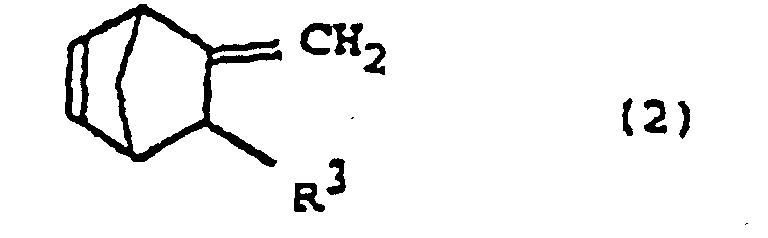
- a rubber composition comprising (A) 100 parts by weight of an ethylene/an ⁇ -olefin containing 4 to 20 carbon atoms/a conjugated polyene copolymer rubber having a diene unit derived from a non-conjugated diene of general formula (1) wherein n is an integer of 0 to 10, R 1 represents a hydrogen atom or an alkyl group containing 1 to 10 carbon atoms, and R 2 represents a hydrogen atom or an alkyl group containing 1 to 5 carbon atoms, or a non-conjugated diene of general formula (2)
- R 3 represents a hydrogen atom or an alkyl group containing 1 to 10 carbon atoms, (B) 0.5 to 15 parts by weight of an organic peroxide, (C) 30 to 80 parts by weight of carbon black and (D) 5 to 25 parts by weight of a softening agent.
- the rubber composition of the present invention for a conveyor belt is characterized by comprising (A) 100 parts by weight of an ethylene/ ⁇ -olefin containing 4 to 20 carbon atoms/non-conjugated polyene containing a diene unit derived from the non-conjugated diene of the above general formula (1) or (2), (B) 0.5 to 15 parts by weight of an organic peroxide, (C) 30 to 80 parts by weight of carbon black and (D) 5 to 25 parts by weight of a softening agent.
- the non-conjugated diene in the copolymer rubber (A) used in the present invention is limited to that comprising a norbornene compound having a chemical structure of the above general formula (1) or (2) for the following reasons.
- Cyclic non-conjugated polyenes include various types, for example, a type having a norbornene skeleton and a type having a dicyclopentadiene skeleton. If 5-ethylidene-2-norbornene (ENB) or dicyclopentadiene (DCPD) is used, when the non-conjugated polyene content of the copolymers is within the range of the present invention, it is difficult to increase the heat resistance (heat aging resistance) of the resulting crosslinked product.
- ENB 5-ethylidene-2-norbornene
- DCPD dicyclopentadiene
- VNB 5-vinyl-2-norbornene
- BNB 5-(1-butenyl)-2-norbornene
- the copolymer rubber (A) of the present invention uses a cyclic non-conjugated diene represented by the general formula (1) or (2), the unsaturated bond which did not participate in the polymerization reaction but remained in the copolymer existed outside of the main chain, and after crosslinking of the coplymer rubber (A), the unsaturated bond still existed outside the main chain. Accordingly, the copolymer rubber (A) is considered to have excellent heat resistance (heat aging resistance).
- the other components of the present invention namely the organic peroxide (B), the carbon black (C) and the softening agent (D), are necessary components for obtaining the crosslinked product as a conveyor belt.
- the rubber composition of the present invention can be subjected to a crosslinking reaction effectively in comparison with the amount of the organic peroxide to achieve a high crosslinking density.
- the carbon black performs a wide function and effect as a filler, a heat resistance imparting agent, and a coloring agent etc.
- the softening agent can increase the moldability of the rubber composition and can give a molded product having complex shapes.
- Preferred embodiments of the present invention are especially said 1 and 2.
- the preferred embodiment 1 defines the composition ratio of ethylene/ ⁇ -olefin having 4 to 20 carbon atoms in the copolymer. If the composition ratio is within the above range, it is possible to give an excellent rubber composition which has excellent heat resistance and abrasion resistance as well as excellent processability, rubbery characteristics and weatherability.
- Item (i) of the preferred embodiment 2 defines the content of the non-conjugated polyene unit in the copolymer. If this value defined by (i) is too low as compared with the defined value, the heat resistance (heat aging resistance) is lowered, the elongation becomes too large and the permanent set tends to increase. Furthermore, if the value too large, the environmental deterioration property tends to be lowered, and the cost becomes high disadvantageously. Hence, the content of the non-conjugated polyene outside the defined range is not preferrred.
- Item (ii) of the preferred embodiment 2 defines the molecular weight of the copolymer. If the intrinsic viscosity ( ⁇ ) is lower than the defined range, properties such as mechanical properties of the copolymer tend to be lowered. If the intrinsic viscosity is higher than the defined range, processability tends to be lowered.
- the mole ratio (a/b) of ethylene (a) to the ⁇ -olefin (b) containing 4 to 20, preferably 4 to 12, more preferably 4 to 8 carbon atoms may be from 60/40 to 82/18, preferably from 65/35 to 78/22, especially preferably from 65/35 to 73/27.
- Examples of the ⁇ -olefin (b) having 4 to 20 carbon atoms specifically include butene-1, pentene-1, hexene-1, heptene-1, octene-1, nonene-1, decene-1, undecene-1, dodecene-1, 9-methyl-dodecene-1, and 11-methyl-dodecene-1.
- the above ⁇ -olefins may be used singly or as a mixture of at least two monomers.
- butene-1, hexene-1, octene-1, and decene-1 are preferably used.
- butene-1 and octene-1 are preferably used.
- the non-conjugated polyene (c) used in the present invention comprises a diene having a norbornene structure, namely the norbornene structure represented by the general formula (1) or (2).
- Examples of the alkyl group having 1 to 10 carbon atoms as R 1 in the general formula (1) include a methyl group, an ethyl group, a propyl group, an isopropyl group, an n-butyl group, an isobutyl group. a sec-butyl group, a t-butyl group, an n-pentyl group, an isopentyl group, a t-pentyl group, a neopentyl group, a heptyl group, an octyl group, an isooctyl group, a nonyl group and a decyl group.
- alkyl group having 1 to 5 carbon atoms as R 2 in the general formula (1) may be the same aLkyl groups as mentioned with regard to the alkyl groups R 1 in the general formula (1).
- alkyl group having 1 to 10 carbon atoms as R 3 in the general formula (2) may be the same alkyl group as mentioned with regard to the alkyl groups R 1 in the general formula (1).
- norbornene compounds represented by the general formula (1) or (2) include 5-methylene-2-norbornene, 5-vinyl-2-norbornene, 5-(1-propenyl) -2-norbornene, 5-(isopropenyl)-2-norbornene, 5-(2-ethyl-vinyl)-2-norbornene, 5-(1-butenyl)-2-norbornene, 5-(2-methyl-1-propenyl)-2-norbornene, 5-(1-pentenyl)-2-norbornene, 5-(2-methyl-1-butenyl)-2-norbornene, 5-(1-hexenyl)-2-norbornene, 5-(2-methyl-1-pentenyl)-2-norbornene, 5-(2,3-dimethyl-1-butenyl)-2-norbornene, 5-(2-ethyl-1-butenyl)-2-norbornene, 5-(1-hexeny
- Preferred examples are 5-methylene-2-norbornene, 5-vinyl-2-norbornene, 5-(1-propenyl)-2-norbornene, 5-(1-butenyl)-2-norbornene, 5-(1-pentenyl)-2-norbornene, 5-(1-hexenyl)-2-norbornene, 5-(1-heptenyl)-2-norbornene and 5-(1-octenyl)-2-norbornene.
- non-conjugated polyenes may be used as a mixture with the above non-conjugated dienes so long as the intended properties may not be impaired.
- non-conjugated polyenes include chain-like non-conjugated dienes such as 1,4-hexadiene, 3-methyl-1,4-hexadiene, 4-methyl-1,4-hexadiene, 5-methyl-1,4-hexadiene, 4,5-dimethyl-1,4-hexadiene and 7-methyl-1,6-octadiene, cyclic non-conjugated dienes such as methyltetrahydroindene, 5-ethylidene-2-norbornene, 5-isopropylidene-2-norbornene and 6-chloromethyl-5-isopropenyl-2-norbornene, and trienes such as 2,3-diisopropylidene-5-norbornene, 2-ethylidene-3-isopropylidene-5-norbornene, 2-propenyl2,2-norbornadiene, and 5-vinylidene-2-nor
- the content of the non-conjugated polyene is preferably 0.2 to 4 % by weight in the copolymer rubber (A) of the present invention.
- the norbornene compounds represented by the general formula (1) or (2) may preferably be used so that the iodine value (g/100 g) of the resulting copolymer rubber (A) may become 0.5 to 50, especially 0.8 to 30, more especially 1 to 20, most especially 1.5 to 15. If the iodine value is smaller than the above range, the crosslinking efficiency of the resulting composition tends to be lowered. If the iodine value of the resulting composition is larger than the above range, the environmental degradability resistance tends to be lowered and the cost of the composition tends to become disadvantageous.
- these norbornene compound may be copolymerized in an amount of 0.5 to 10 % by weight, especially 1 to 5 % by weight, per the whole monomer component.
- non-conjugated polyenes than the norbornene compound represented by the general formula (1) or (2) can also be used preferably, when the above range of the iodine value is kept.
- said other non-conjugated polyenes may be copolymerized in an amount of not larger than 5 % by weight, preferably not larger than 3 % by weight, per the whole monomer component.
- the copolymer rubber (A) of the present invention may have an intrinsic viscosity ( ⁇ ), measured in decalin, of usually 1.5 to 3 dl/g, more preferably 1.8 to 2.7 dl/g, most preferably 2 to 2.7 dl/g.
- ⁇ intrinsic viscosity
- the copolymer rubber (A) of the present invention can be produced by known methods.
- the copolymer rubber (A) can be obtained by copolymerizing (a) ethylene, (b) an ⁇ -olfein containing 4 to 20 carbon atoms, and (c) a non-conjugated polyene in the presence of a Ziegler catalyst using hydrogen as a molecular weight adjusting agent.
- organic peroxide (B) used in the present invention examples include dialkyl peroxides such as dicumyl peroxide, di-t-butyl peroxide, di-t-butyl peroxy-3,3, 5-trimethylcyclohexane, t-butyl cumyl peroxide, di-t-amyl peroxide, t-butyl hydroperoxide, 2,5-dimethyl-2,5-di(t-butylperoxy)hexyne-3, 2, 5-dimethyl-2, 5-di(benzoylperoxy) hexane, 2,5-dimethyl-2, 5-mono(t-butylperoxy)hexane and ⁇ , ⁇ '-bis(t-butylperoxy-m-isopropyl)benzene; peroxy esters such as t-butylperoxyacetate, t-butylperoxyisobutyrate, t-butylperoxypivalate, t-butyl
- organic peroxides in which the temperature which gives a half-value period of 1 minute is in a range of 130°C to 200°C is preferred.
- the organic peroxide is used in an amount of 0.5 to 15 parts by weight, preferably 1 to 10 parts by weight, per 100 parts by weight of the copolymer (A) of the present invention. It is desirable to determine the most preferred amount from the above range according to the required physical value.
- carbon black is an essential component.
- the processability of the composition can be increased to give a rubber composition for a conveyor belt having increased mechanical properties such as tensile strength, tear strength and abrasion resistance.
- the amount of the carbon black used is 30 to 80 parts by wieght, preferably 30 to 70 parts by weight, most preferably 40 to 70 parts by weight, per 100 parts by weight of the copolymer rubber (A). If the carbon black is compounded in an amount larger than the above ranges, it is inconvenient that the dynamic ratio (dynamic modulus of elasticity/static modulus of elasticity) increases. If the amount of the carbon black is smaller than the specified range, the processability and mechanical properties will be lowered.
- carbon black examples include SRF, GPF, FEF, MAF, HAF, ISAF, SAF, FT and MT, which are widely known themselves. These carbon blacks may be used singly or in combination with each other. Or they may be surface coated with silane coupling agents.
- a softening agent is an essential component.
- the processability of the composition can be increased, and it is possible to mold complex shapes.
- the softening agent is added in an amount of 5 to 25 parts by weight, preferably 5 to 20 parts by weight, most preferably 5 to 15 parts by weight, per 100 parts by weight of the copolymer rubber (A). If the softening agent is compounded in a larger amount than the above range, the softening agent bleeds out, and therefore, the properties of the surface of a molded product are lowered and the cost becomes disadvantageous. If the amount of the plasticizer is smaller than the above range, the processability will be lowered.
- softening agent examples include paraffinic, naphthenic and aromatic mineral oils. Particularly preferred plasticizers may be paraffinic oils.
- the softening agent examples include petroleum-type softening agents such as process oils, lubricant oils, paraffins, liquid paraffins, petroleum asphalt and vaseline, coal tar-type softening agents such as coal tar and coal tar pitch, fatty acid oiltype softening agents such as castor oil, linseed oil, rape oil and coconut oil, waxes such as tall oil, factice, bees wax, carnauba wax and lanolin.
- petroleum type softening agents are preferably used.
- process oils are preferably used.
- the rubber composition of the present invention contains the components (A) to (D) as essential components. So long as the object of the present invention is not impaired, conventionally known rubber compounding agents, such as crosslinking aids, fillers, plasticizers, tackifiers, aging preventing agents, processing aids and foaming agents may be properly compounded with the above components.
- conventionally known rubber compounding agents such as crosslinking aids, fillers, plasticizers, tackifiers, aging preventing agents, processing aids and foaming agents may be properly compounded with the above components.
- crosslinking aids examples include so called polyfunctional monomers, for example sulfur, quinonedixime compounds such as p-quinonedioxime, (meth)acrylate compounds such as trimethylolpropane triacrylate, ethyleneglycol dimethacrylate and polyethylene glycol dimethacrylate, allyl compounds such as diallyl phthalate and triallyl cyanurate, maleimide compounds such as m-phenylene bismaleimide, and divinylbenzene.
- polyfunctional monomers for example sulfur, quinonedixime compounds such as p-quinonedioxime, (meth)acrylate compounds such as trimethylolpropane triacrylate, ethyleneglycol dimethacrylate and polyethylene glycol dimethacrylate, allyl compounds such as diallyl phthalate and triallyl cyanurate, maleimide compounds such as m-phenylene bismaleimide, and divinylbenzene.
- crosslinking aids may be used in an amount of 0.5 to 2 moles, preferably in an equimolar amount, per 1 mole of the organic peroxide.
- inorganic fillers such as silica, calcium carbonate, talc, finely divided silicate salts, and clay may be used conjointly with the carbon black.
- the total amount of the filler including the carbon black should not exceed the below-mentioned range, and the compounded amount of the carbon black should be within the aforesaid range.
- the fillers have an effect of increasing mechanical properties of the crosslinked rubber, for example, tensile strength, tearing strength and abrasion resistance.
- the fillers are used to increase the hardness of the rubber product or lowering the cost without so much affecting the properties of the rubber products.
- Examples of such fillers include, more preferably, light calcium carbonate, heavy calcium carbonate, talc and clay.
- the type and the compounded amount of the fillers may be properly selected in accordance with the uses.
- the compounded amount is usually at most 200 parts by weight, preferably at most 100 parts by weight, most preferably at most 50 parts by weight, per 100 parts by weight of the ethylene/ ⁇ -olefin/polyene copolymer rubber (A).
- plasticizer examples include glycols; fatty acids, fatty acid ester and fatty acid salts such as stearic acid, ricinoleic acid, palmitic acid, barium stearate, calcium stearate and zinc laurate.
- the type and the compounded amount of the plasticizers may be properly selected in accordance with the uses.
- the compounded amount is usually, not larger than 10 parts by weight per 100 parts by weight of the ethylene/ ⁇ -olefin/polyene copolymer rubber (A).
- Tackifier :
- tackifiers examples include rosin-type tackifiers; synthetic polymeric substances such as petroleum resins, atactic polypropylene and coumarone indene resins.
- the type and the compounded amount of the tackifiers may be properly selected in accordance with the uses.
- the compounded amount is usually, not larger than 10 parts by weight per 100 parts by weight of the ethylene/ ⁇ -olefin/polyene copolymer rubber (A).
- the rubber composition of the present invention shows excellent heat resistance and durability even if an aging preventing agent is not used. But if an aging preventing agent is used, the life of the product can be prolonged usually in the same way as in usual rubbers.
- the aging preventing agents used in this case may include amine-type aging preventing agents, phenolic aging preventing agents, and sulfur-type aging preventing agents.
- amine-type aging preventing agents examples include nathylamine-type aging preventing agents such as phenyl- ⁇ -naphthylamine and phenyl- ⁇ -naphthylamine; diphenylamine-type aging preventing agents such as p-(p-toluene sulfonylamide)-diphenylamine, 4,4-( ⁇ , ⁇ -dimethylbenzyl)diphenylamine, 4,4'-dioctyl diphenylamine, a high temperature reaction product of diphenylamine and acetone, a low temperature reaction product of diphenylamine and acetone, a low temperature reaction product of diphenylamine, aniline and acetone, a reaction product of diphenylamine and diisobutylene, octylated diphenylamine, dioctylated diphenylamine, p,p'-dioctyl-diphen
- phenolic aging preventing agents include styrenated phenol, 2, 6-di-t-butyl-4-methylphenol, 2,6-di-t-butyl-p-ethylphenol, 2, 4,6-tri-t-butylphenol, butylhydroxyanisole, 1-hydroxy-3-methyl-4-isopropylbenzene, mono-t-butyl-p-cresol, mono-t-butyl-m-cresol, 2,4-dimethyl-6-t-butylphenol, butylated bisphenol A, 2,2'-methylene-bis-(4-methyl-6-t-butylphenol), 2,2'-methylene-bis-(4-ethyl-6-t-butylphenol), 2,2'-methylene-bis(4-methyl-6-t-nonylphenol), 2,2'-isobutylidene-bis-(4,6-dimethylphenol), 4, 4'-butylidene-bis-(3-methyl-6-t-but
- sulfur-type aging preventing agents include 2-mercaptobenzimidazole, a zinc salt of 2-mercaptobenzimidazole, 2-mercaptomethylbenzoimidazole, a zinc salt of 2-mercaptomethybenzoimidazole, a zinc salt of 2-mercaptomethylimidazole, dimyristylthiodipropionate, dilaurylthiodipropionate, distearylthiodipropionate, ditridecylthiodipropionate, and pentaerythritoltetrakis-( ⁇ -lauryl-thiopropionate).
- These aging preventing agents may be used singly or as mixtures of at least two types.
- the compounded amount of the aging preventing agent may usually be 0.1 to 10 parts by weight, preferably 0.5 to 5 parts by weight, per 100 parts by weight of the ethylene/ ⁇ -olefin/non-conjugated polyene copolymer (A).
- the rubber composition of the present invention can be formed with foaming, when it comprises such compounds making a foaming system as foaming agents, foaming assistants, etc.
- the foaming agents those are normally used for forming rubbers with foaming, can be used.
- the foaming agents includes inorganic foaming agents such as sodium bicarbonate, sodium carbonate, ammonium bicarbonate, ammonium carbonate, ammonium nitrite; nitroso compounds such as N,N'-dimethyl-N,N'-dinitrosoterephthalamide, N,N'-dinitrosopentamethylenetetramine; azo compounds such as azodicarbon amide, azobisisobutyronitrile, azocyclohexylnitrile, azodiaminobenzene, barium azodicarboxylate; sulfonyl hydrazido compounds such as benzene sulfonyl hydrazido, toluene sulfonyl hydrazido, p,p'-oxybis(benzene sulfonyl hydrazido), diphenyl
- nitroso compounds, azo compounds and azido compounds are preferred.
- the foaming agents can be used in an amount of from 0.5 to 30 parts by weight, preferably from 1 to 20 parts by weight, per 100 parts by weight of the ethylene/ ⁇ -olefin/polyene copolymer rubber (A). From the rubber compounds comprising the foaming agents in such an amount, a foamed article having an apparent specific gravity of 0.03 to 0.8 g/cm 3 can be produced.
- a foaming assistant is also used with the foaming agent.
- the foaming assistant When the foaming assistant is used, effects such as decreasing of decomposing temperature of the foaming agent, promoting of decomposing, uniforming of foams, can be obtained.
- the foaming assistants include organic acids such as salicylic acid, phthalic acid, stearic acid and oxalic acid; urea or its derivatives.
- the foaming assistant can be used in an amount of from 0.01 to 10 parts by weight, preferably from 0.1 to 5 parts by weight, per 100 parts by weight of the ethylene/ ⁇ -olefin/non-conjugated polyene copolymer rubber (A).
- an noncrosslinked rubber composition is prepared as in usual crosslinking of a general rubber, and thereafter, the rubber composition is molded in an intended shape and thereafter the molded product may be crosslinked.
- the rubber composition of the present invention contains the above-mentioned crosslinking agent, the rubber composition is heated.
- the crosslinkable rubber composition of the present invention for example, can be produced by the following method.
- the components (A) to (D) and other additives may be kneaded by internal mixers such as a Bumbury's mixer, a kneader or an intermixer at a temperature of 80 to 170'C for 3 to 10 minutes. Then, by using a roll such as an open roll or a kneader, and as required, a crosslinking promotor or a crosslinking aid, may be added to the kneaded mixture. The resulting mixture was then kneaded at a roll temperature of 40 to 80°C for 5 to 30 minutes, and then sheeted. When the kneading temperature at the internal mixer was low, the crosslinking promotor may be kneaded simultaneously.
- internal mixers such as a Bumbury's mixer, a kneader or an intermixer at a temperature of 80 to 170'C for 3 to 10 minutes.
- a roll such as an open roll or a kneader, and as required
- the crosslinkable rubber composition prepared as above may be molded into an intended shape by a molding method such as an extruding molding machine or a calender roll. Simultaneously with the molding, or the molded product is introduced into a crosslinking tank, and can be crosslinked.
- the crosslinking reaction may be performed by heating at a temperature of 120 to 270°C for a time of 1 to 40 minutes.
- the step of this crosslinking may be carried out by using a mold, or the crosslinking may be performed without using a mold. When a mold is not used, a step of crosslinking is performed usually continuously.
- the method of heating in the crosslinking tank may be carried out by using a heating tank such as hot air, a glass bead flowing floor, UMF (ultrashort electromagnetic waves), steam or LCM (heat melt salt tank).
- Ethylene/ ⁇ -olefin/non-conjugated polyene copolymer rubber (A) used in the Examples are shown in Table 1.
- Copolymer 1 Copolymer 2
- Copolymer 3 Copolymer 4
- Ethylene/ ⁇ -olefin (mole ratio) 60/40 70/30 58/42 62/38 [ ⁇ ] , dl/g 2.3 2.4 2.3 2.4
- the copolymer 2, zinc flower, stearic acid, HAF carbon black, process oil and aging preventing agent were kneaded in 1.7 liter Bumbery's mixer for 5 minutes.
- dicumyl peroxide and ethylene glycol dimethacrylate were kneaded with the resulting kneaded mixture, and the final kneaded mixture was sheeted to form a compounded rubber sheet having a thickness of 2 mm.
- the surface temperatures of the rolls were 50 °C at both a front roll and a rear roll.
- the front roll had a rotation number of 16 rpm and the rear roll had a rotation number of 18 rpm.
- the compounded rubber sheet obtained in the above manner was press-crosslinked at 170°C for 10 minutes to obtain a crosslinked rubber sheet.
- the crosslinked rubber sheet was puched out to prepare a No.3-type dumb-bell test specimen described in JIS K6301. According to the method defined in JIS K6301, No. 3, the tensile test was carried out under the conditions at a tensile speed of 500 mm/min. to measure a 300% modulus (M300), a tensile breaking stress (TB) and a tensile breaking elongation (EB).
- M300 modulus
- TB tensile breaking stress
- EB tensile breaking elongation
- the hardness test was carried out in accordance with JIS K6301 by measuring a spring hardness Hs (JIS A) hardness.
- An air heating aging test was carried out at 175°C for 240 hours to measure a retention ratio AR (TB) and an elogation retention ratio AR (EB) of the above properties before the aging.
- TB retention ratio AR
- EB elogation retention ratio AR
- the abrasion resistance test was carried out according to JIS K6301 to perform a taper abrasion Specifically, the amount of abrasion was measured after 1000 rotations at a load of 0.25 Kgf.
- the bending crack growth test was carried out in accordance with JIS K6301 by performing a bending test. Specifically, the number of bendings was measured until the cracks grew from 2 mm to 17 mm.
- Example 1 The same procedure as in Example 1 was repeated except that instead of the copolymer 2 described in Example 1, the copolymer 1 shown in Table 1was used.
- Example 1 was repeated except that instead of the copolymer 2 in Example 1, the copolymer 3 shown in Table 1 was used.
- Comparative Example 2 was repeated except that 2.8 parts of dicumyl peroxide and 4 parts of diethylene glycol dimethacrylate were used.
- Example 1 was repeated except that instead of the copolymer 2 in Example 1, the copolymer 4 shown in Table 1 was used.
- the ethylene/ ⁇ -olefin/non-conjugated polyene copolymer (A) having the specified component is combined with an organic peroxide (B), carbon black (C) and softening agent (D) to form a rubber composition for a conveyor belt.
- a rubber composition for a conveyor belt and its crosslinked product having excellent heat resistance (heat aging resistance) and excellent abrasion resistance.
- This rubber composition is especially suitable for a usage of conveying a sintered product, a coke, a cement, a clinker, a quicklime, etc., since it has excellent mechanical strength, heat resistance (including heat aging resistance), abrasion resistance, additionally, roll processability.
Landscapes
- Chemical & Material Sciences (AREA)
- Health & Medical Sciences (AREA)
- Chemical Kinetics & Catalysis (AREA)
- Medicinal Chemistry (AREA)
- Polymers & Plastics (AREA)
- Organic Chemistry (AREA)
- Engineering & Computer Science (AREA)
- Mechanical Engineering (AREA)
- Compositions Of Macromolecular Compounds (AREA)
Claims (4)
- Förderband, erhältlich durch das Vernetzen einer Kautschukzusammensetzung, umfassend (A) 100 Gewichtsteile eines Ethylen/α-Olefin mit 4 bis 20 Kohlenstoffatomen/-nicht-konjugiertes Polyen-Copolymerkautschuks mit einer Dieneinheit, die sich von einem nicht-konjugierten Dien der Formel (1) oder der Formel (2) ableitetworin n eine ganze Zahl von 0 bis 10 ist, R' Wasserstoff oder Alkyl mit 1 bis 10 Kohlenstoffatomen ist und R2 Wasserstoff oder Alkyl mit 1 bis 5 Kohlenstoffatomen ist
 worin R3 Wasserstoff oder Alkyl mit 1 bis 10 Kohlenstoffatomen ist,
 (B) 0,5 bis 15 Gewichtsteile eines organischen Peroxids,(C) 30 bis 80 Gewichtsteile von Kohleschwarz und(D) 5 bis 25 Gewichtsteile eines Weichmachermittels.
 - Förderband gemäß Anspruch 1, wobei bei der Komponente (A) das Molverhältnis von Ethylen/α-Olefin zwischen 60/40 und 82/18 liegt.
- Förderband gemäß Anspruch 1 oder Anspruch 2, wobei bei der Komponente (A) (i) der Gehalt des nicht-konjugierten Polyens im Bereich von 0,2 bis 4 Gew.-% liegt und (ii) die Grenzviskosität (η), gemessen in Decalin bei 135°C, im Bereich von 1,5 bis 3 dl/g liegt.
- Verfahren zur Herstellung eines Förderbandes gemäß Anspruch 1, welches das Kneten oder Mischen der Komponenten (A) bis (D) bei einer Temperatur von 80 bis 170°C während 3 bis 10 Minuten, anschließend das wahlfreie Zugeben eines Vernetzungsbeschleunigers oder Vernetzungshilfsstoffes und das Kneten der resultierenden Mischung bei einer Walzentemperatur von 40 bis 80°C während 5 bis 30 Minuten umfasst.
Applications Claiming Priority (3)
| Application Number | Priority Date | Filing Date | Title |
|---|---|---|---|
| JP11724097 | 1997-05-07 | ||
| JP117240/97 | 1997-05-07 | ||
| JP11724097 | 1997-05-07 |
Publications (3)
| Publication Number | Publication Date |
|---|---|
| EP0877053A2 EP0877053A2 (de) | 1998-11-11 |
| EP0877053A3 EP0877053A3 (de) | 1999-08-18 |
| EP0877053B1 true EP0877053B1 (de) | 2001-11-14 |
Family
ID=14706865
Family Applications (1)
| Application Number | Title | Priority Date | Filing Date |
|---|---|---|---|
| EP98303561A Expired - Lifetime EP0877053B1 (de) | 1997-05-07 | 1998-05-07 | Kautschukzusammensetzung für ein Förderband |
Country Status (7)
| Country | Link |
|---|---|
| US (1) | US6569936B1 (de) |
| EP (1) | EP0877053B1 (de) |
| KR (1) | KR100498846B1 (de) |
| CN (1) | CN1150263C (de) |
| CA (1) | CA2236991A1 (de) |
| DE (1) | DE69802461T2 (de) |
| TW (1) | TW400362B (de) |
Families Citing this family (13)
| Publication number | Priority date | Publication date | Assignee | Title |
|---|---|---|---|---|
| JP4414673B2 (ja) * | 2003-04-25 | 2010-02-10 | バンドー化学株式会社 | 摩擦伝動ベルト |
| JP4497545B2 (ja) * | 2005-11-17 | 2010-07-07 | バンドー化学株式会社 | 歯付ベルト |
| CN101250305B (zh) * | 2008-04-07 | 2011-04-27 | 北京化工大学 | 一种高耐热输送带覆盖层用橡胶复合材料 |
| CA2882515C (en) | 2012-08-31 | 2016-10-18 | Soucy Techno Inc. | Rubber compositions reinforced with fibers and nanometric filamentary structures, and uses thereof |
| KR101297391B1 (ko) * | 2013-03-08 | 2013-08-19 | (주)서원인텍 | 이동통신단말기에 적용되는 고무의 제조공정 |
| US9840611B2 (en) | 2013-10-18 | 2017-12-12 | Soucy Techno Inc. | Rubber compositions and uses thereof |
| US9663640B2 (en) | 2013-12-19 | 2017-05-30 | Soucy Techno Inc. | Rubber compositions and uses thereof |
| JP6435710B2 (ja) * | 2014-08-21 | 2018-12-12 | 横浜ゴム株式会社 | 接着方法およびコンベヤベルト |
| CN108699413B (zh) * | 2016-02-24 | 2020-07-24 | 横滨橡胶株式会社 | 粘接剂用橡胶组合物、橡胶的粘接方法以及传送带 |
| DE102017121303A1 (de) * | 2017-09-14 | 2019-03-14 | Arntz Beteiligungs Gmbh & Co. Kg | Gummiertes Textilmaterial für eine Riemenlage, zugehörige Kautschukmischung und Riemen |
| FR3123654B1 (fr) * | 2021-06-07 | 2023-04-28 | Michelin & Cie | Composition de caoutchouc base d’élastomère fortement saturé et de compolymère de butadiene-styrene |
| FR3123655B1 (fr) * | 2021-06-07 | 2023-04-28 | Michelin & Cie | Bande transporteuse comprenant une composition à base d’élastomère fortement saturé |
| US12030724B2 (en) | 2022-06-28 | 2024-07-09 | Contitech Transportbandsysteme Gmbh | High temperature resistant conveyor belt |
Family Cites Families (4)
| Publication number | Priority date | Publication date | Assignee | Title |
|---|---|---|---|---|
| DE68920444T2 (de) * | 1988-10-26 | 1995-05-24 | Allied Signal Inc | Kurzfasern und elastomere, verstärkte zusammensetzung mit kurzfasern. |
| TW257725B (de) * | 1992-10-21 | 1995-09-21 | Sumitomo Chemical Co | |
| TW300246B (de) | 1995-04-11 | 1997-03-11 | Mitsui Petroleum Chemicals Ind | |
| JP3604498B2 (ja) * | 1995-04-11 | 2004-12-22 | 三井化学株式会社 | 流動性に優れた耐熱ゴム組成物 |
-
1998
- 1998-05-06 TW TW087106968A patent/TW400362B/zh not_active IP Right Cessation
- 1998-05-06 CA CA002236991A patent/CA2236991A1/en not_active Abandoned
- 1998-05-07 CN CNB981097537A patent/CN1150263C/zh not_active Expired - Lifetime
- 1998-05-07 EP EP98303561A patent/EP0877053B1/de not_active Expired - Lifetime
- 1998-05-07 DE DE69802461T patent/DE69802461T2/de not_active Expired - Lifetime
- 1998-05-07 KR KR10-1998-0016341A patent/KR100498846B1/ko not_active Expired - Lifetime
-
2000
- 2000-11-22 US US09/717,275 patent/US6569936B1/en not_active Expired - Lifetime
Also Published As
| Publication number | Publication date |
|---|---|
| DE69802461D1 (de) | 2001-12-20 |
| KR19980086836A (ko) | 1998-12-05 |
| US6569936B1 (en) | 2003-05-27 |
| TW400362B (en) | 2000-08-01 |
| KR100498846B1 (ko) | 2005-11-03 |
| EP0877053A2 (de) | 1998-11-11 |
| CA2236991A1 (en) | 1998-11-07 |
| CN1150263C (zh) | 2004-05-19 |
| DE69802461T2 (de) | 2002-05-23 |
| EP0877053A3 (de) | 1999-08-18 |
| CN1203243A (zh) | 1998-12-30 |
Similar Documents
| Publication | Publication Date | Title |
|---|---|---|
| EP0877053B1 (de) | Kautschukzusammensetzung für ein Förderband | |
| JP3711146B2 (ja) | 耐熱ゴム組成物 | |
| JPWO1996032442A1 (ja) | 耐熱ゴム組成物 | |
| EP1245623A1 (de) | Gummimischung und deren Verwendung | |
| JP3743170B2 (ja) | 加硫可能なゴム組成物 | |
| JP3571030B2 (ja) | ゴム組成物及びその用途 | |
| JP4059988B2 (ja) | 伝動ベルト用ゴム組成物 | |
| JP4742724B2 (ja) | 防振材 | |
| JP3604498B2 (ja) | 流動性に優れた耐熱ゴム組成物 | |
| JP3803173B2 (ja) | シールパッキン用ゴム組成物ならびに該組成物からなるシールパッキンおよびコンデンサー封口シール | |
| JP3929083B2 (ja) | 耐熱ゴム組成物 | |
| JP4059974B2 (ja) | 搬送ベルト用ゴム組成物 | |
| JPH11349716A (ja) | 注入スポンジ用ゴム組成物及びその加硫ゴム発泡成形体 | |
| JP3741522B2 (ja) | エチレン系ランダム共重合体及びその製造法 | |
| JP3911707B2 (ja) | シール用パッキン | |
| JPH01108240A (ja) | 耐熱ゴム組成物 | |
| JPH01108239A (ja) | 変性ポリシロキサン含有耐熱ゴム組成物 | |
| JP3750962B2 (ja) | 液圧シリンダーシール用ゴム組成物 | |
| JPS6295337A (ja) | 加硫ゴム組成物 | |
| JPH01108238A (ja) | 表面処理シリカ含有耐熱ゴム組成物 | |
| JP3851335B2 (ja) | 耐熱ゴム組成物 | |
| JPH0676526B2 (ja) | 加硫性ゴム組成物 | |
| JP3779469B2 (ja) | ロール用ゴム組成物 | |
| JP2007083405A (ja) | 加硫ゴムの製造方法及び加硫ゴム | |
| JPH01108248A (ja) | 変性ゴム組成物 |
Legal Events
| Date | Code | Title | Description |
|---|---|---|---|
| PUAI | Public reference made under article 153(3) epc to a published international application that has entered the european phase |
Free format text: ORIGINAL CODE: 0009012 |
|
| AK | Designated contracting states |
Kind code of ref document: A2 Designated state(s): DE FR GB IT |
|
| AX | Request for extension of the european patent |
Free format text: AL;LT;LV;MK;RO;SI |
|
| PUAL | Search report despatched |
Free format text: ORIGINAL CODE: 0009013 |
|
| AK | Designated contracting states |
Kind code of ref document: A3 Designated state(s): AT BE CH CY DE DK ES FI FR GB GR IE IT LI LU MC NL PT SE |
|
| AX | Request for extension of the european patent |
Free format text: AL;LT;LV;MK;RO;SI |
|
| RIC1 | Information provided on ipc code assigned before grant |
Free format text: 6C 08F 210/18 A |
|
| 17P | Request for examination filed |
Effective date: 20000202 |
|
| AKX | Designation fees paid |
Free format text: DE FR GB IT |
|
| 17Q | First examination report despatched |
Effective date: 20000407 |
|
| GRAG | Despatch of communication of intention to grant |
Free format text: ORIGINAL CODE: EPIDOS AGRA |
|
| GRAG | Despatch of communication of intention to grant |
Free format text: ORIGINAL CODE: EPIDOS AGRA |
|
| GRAH | Despatch of communication of intention to grant a patent |
Free format text: ORIGINAL CODE: EPIDOS IGRA |
|
| GRAH | Despatch of communication of intention to grant a patent |
Free format text: ORIGINAL CODE: EPIDOS IGRA |
|
| GRAA | (expected) grant |
Free format text: ORIGINAL CODE: 0009210 |
|
| AK | Designated contracting states |
Kind code of ref document: B1 Designated state(s): DE FR GB IT |
|
| REF | Corresponds to: |
Ref document number: 69802461 Country of ref document: DE Date of ref document: 20011220 |
|
| REG | Reference to a national code |
Ref country code: GB Ref legal event code: IF02 |
|
| ET | Fr: translation filed | ||
| PGFP | Annual fee paid to national office [announced via postgrant information from national office to epo] |
Ref country code: GB Payment date: 20020501 Year of fee payment: 5 |
|
| PLBE | No opposition filed within time limit |
Free format text: ORIGINAL CODE: 0009261 |
|
| STAA | Information on the status of an ep patent application or granted ep patent |
Free format text: STATUS: NO OPPOSITION FILED WITHIN TIME LIMIT |
|
| 26N | No opposition filed | ||
| PG25 | Lapsed in a contracting state [announced via postgrant information from national office to epo] |
Ref country code: GB Free format text: LAPSE BECAUSE OF NON-PAYMENT OF DUE FEES Effective date: 20030507 |
|
| GBPC | Gb: european patent ceased through non-payment of renewal fee |
Effective date: 20030507 |
|
| PG25 | Lapsed in a contracting state [announced via postgrant information from national office to epo] |
Ref country code: IT Free format text: LAPSE BECAUSE OF NON-PAYMENT OF DUE FEES Effective date: 20050507 |
|
| REG | Reference to a national code |
Ref country code: FR Ref legal event code: ST Effective date: 20100129 |
|
| PG25 | Lapsed in a contracting state [announced via postgrant information from national office to epo] |
Ref country code: FR Free format text: LAPSE BECAUSE OF NON-PAYMENT OF DUE FEES Effective date: 20090602 |
|
| PGFP | Annual fee paid to national office [announced via postgrant information from national office to epo] |
Ref country code: FR Payment date: 20080514 Year of fee payment: 11 |
|
| PGFP | Annual fee paid to national office [announced via postgrant information from national office to epo] |
Ref country code: DE Payment date: 20170523 Year of fee payment: 20 |
|
| REG | Reference to a national code |
Ref country code: DE Ref legal event code: R071 Ref document number: 69802461 Country of ref document: DE |