EP0870754B1 - Ethylvanillinisobutyrat - Google Patents
Ethylvanillinisobutyrat Download PDFInfo
- Publication number
- EP0870754B1 EP0870754B1 EP98105722A EP98105722A EP0870754B1 EP 0870754 B1 EP0870754 B1 EP 0870754B1 EP 98105722 A EP98105722 A EP 98105722A EP 98105722 A EP98105722 A EP 98105722A EP 0870754 B1 EP0870754 B1 EP 0870754B1
- Authority
- EP
- European Patent Office
- Prior art keywords
- isobutyrate
- ethyl vanillin
- vanillin
- ethylvanillin
- vanillin isobutyrate
- Prior art date
- Legal status (The legal status is an assumption and is not a legal conclusion. Google has not performed a legal analysis and makes no representation as to the accuracy of the status listed.)
- Expired - Lifetime
Links
Classifications
-
- C—CHEMISTRY; METALLURGY
- C07—ORGANIC CHEMISTRY
- C07C—ACYCLIC OR CARBOCYCLIC COMPOUNDS
- C07C69/00—Esters of carboxylic acids; Esters of carbonic or haloformic acids
- C07C69/017—Esters of hydroxy compounds having the esterified hydroxy group bound to a carbon atom of a six-membered aromatic ring
-
- C—CHEMISTRY; METALLURGY
- C11—ANIMAL OR VEGETABLE OILS, FATS, FATTY SUBSTANCES OR WAXES; FATTY ACIDS THEREFROM; DETERGENTS; CANDLES
- C11B—PRODUCING, e.g. BY PRESSING RAW MATERIALS OR BY EXTRACTION FROM WASTE MATERIALS, REFINING OR PRESERVING FATS, FATTY SUBSTANCES, e.g. LANOLIN, FATTY OILS OR WAXES; ESSENTIAL OILS; PERFUMES
- C11B9/00—Essential oils; Perfumes
- C11B9/0061—Essential oils; Perfumes compounds containing a six-membered aromatic ring not condensed with another ring
Definitions
- Vanillin (4-hydroxy-3-methoxybenzaldehyde) and ethyl vanillin (3-ethoxy-4-hydroxybenzaldehyde) are used to a large extent for the composition of perfume oils used. They give perfumes a uniquely rich, strong sweetness. Both connections but have the disadvantage that they are in alcoholic solution in daylight noticeably decompose and lead to disturbing brown-violet discolouration.
- Vanillin derivatives that are either commercially available, such as vanillin isobutyrate, or are described in the literature, such as ethylvanillin propionate (US Pat. No. 5,358,930), by far do not achieve the smell and taste of natural vanillin, and their solutions also have - at least in part - a disruptive tendency to decompose on daylight therefore there was a need for a product that had the disadvantages of the prior art overcomes.
- ethylvanillin isobutyrate is organoleptic in terms of its Properties of the previously known vanillin and ethylvanillin derivatives of both clearly superior to the strength as well as the type of organoleptic impression. It shows a sweet, natural, vanilla-like smell and taste that very pronounced of the precious extract of the real vanilla bean, combined with a very appetizing, buttery-creamy chocolate note.
- the compound according to the invention is therefore also particularly suitable for perfume oils Foods such as Ice cream or desserts to flavor.
- the ethylvanillin isobutyrate according to the invention also impresses with its greater adhesive strength, as a result of which the temporal effect of corresponding perfume oils, for example when applied to the skin, is significantly extended, and by its greater strength and Abundance (Tab. 1), which make it possible to develop perfume oils of a comparatively higher olfactory strength or to achieve comparable effects in perfume oils with considerably lower dosages.
- the ethylvanillin propionate shows a photostability comparable to the ethylvanillin isobutyrate under these conditions. However, if the compounds are exposed to daylight for a longer period of time, this shows the clear superiority of ethylvanillin isobutyrate in terms of light stability.
- the invention thus relates to 3-ethoxy-4-isobutyryloxy-benzaldehyde.
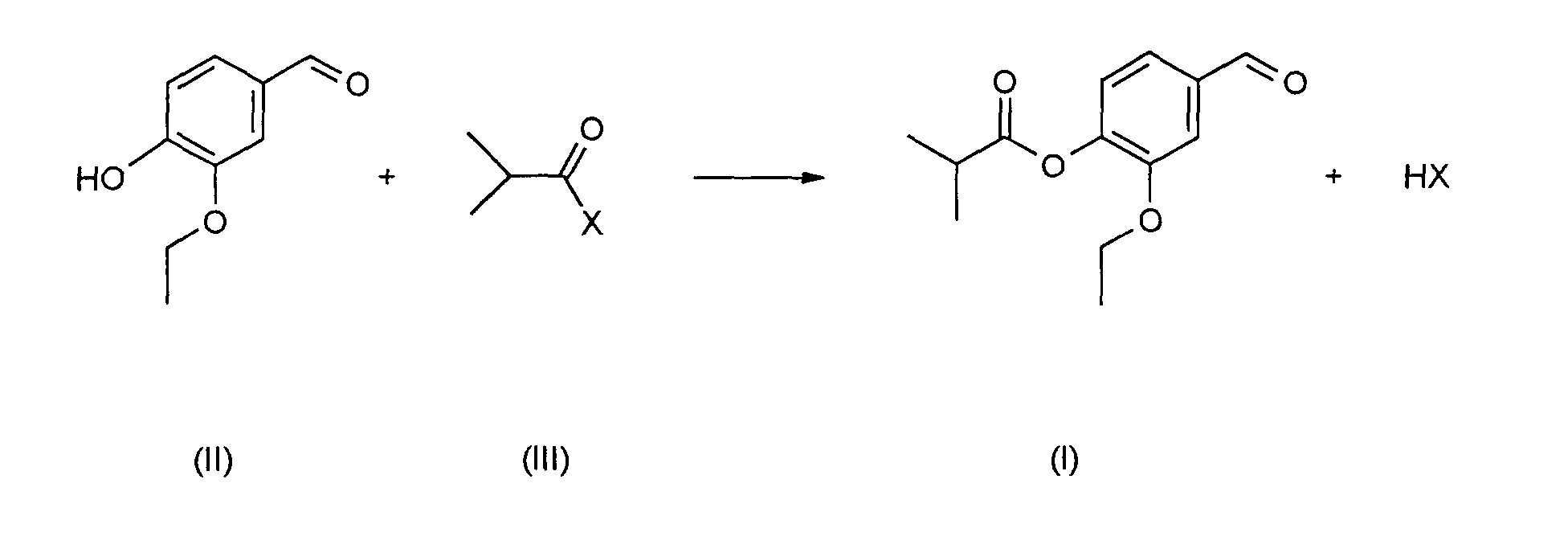
- Ethyl vanillin isobutyrate I is easily accessible in a manner known per se by reacting ethyl vanillin II with isobutyric acid chloride or isobutyric anhydride I.
- X Cl or -O-CO-CH (CH 3 ) 2 .
- the molar ratio III / II can generally 1 to 3, preferably 1.1 to 2, in particular 1.1 to 1.5.
- isobutyric acid chloride As the acylating agent, it is advantageous in Presence of an organic base, e.g. Pyridine, alkyl substituted pyridines, Quinolines, tertiary amines such as N, N-dimethylbenzylamine, triethylamine, tributylamine etc. to work to trap the released hydrochloric acid.
- an organic base e.g. Pyridine, alkyl substituted pyridines, Quinolines, tertiary amines such as N, N-dimethylbenzylamine, triethylamine, tributylamine etc.
- the amount of base is at least one equivalent, based on the amount used Isobutyric acid chloride.
- the reaction can take place in the presence or absence of an under reaction conditions inert organic solvent.
- solvents include for example aromatics such as benzene, toluene, xylenes, linear, branched and cyclic aliphatics such as gasoline and cyclohexane, ethers such as e.g. Diethyl ether, Ethylene glycol dimethyl ether, diethylene glycol dimethyl ether, tetrahydrofuran, dioxane and butyl methyl ether as well as linear and cyclic acid amides, e.g. Dimethylformamide and N-methylpyrrolidone.
- the reaction temperature can be 0 to 180, preferably 20 to 140 ° C.
- the reaction can be progressed by conventional methods, for example by means of Thin layer chromatography. At the end of the reaction you can Distill off excess amounts III, if appropriate with a base such as Neutralize sodium hydroxide solution, aqueous solutions of sodium carbonate or bicarbonate, if necessary, dry the organic phase and pass the reaction product through Clean distillation or recrystallization.
- a base such as Neutralize sodium hydroxide solution, aqueous solutions of sodium carbonate or bicarbonate
- Another object of the invention is a method for producing ethylvanillin isobutyrate by reacting ethylvanillin with a reactive Isobutyric acid derivative.
- Ethyl vanillin isobutyrate is suitable because of its outstanding organoleptic Excellent properties for use in perfume and aroma compositions. It can be very well combined with other fragrances and flavors in different different proportions to novel perfume and aroma compositions combine.
- the amount used in perfume compositions is 0.1 to 20, preferably 0.5 to 10 wt .-%, based on the entire composition.
- perfume compositions can be used not only in alcoholic solution Fine perfumes are used, but also for perfuming cosmetics, e.g. Creams, lotions, aerosols, toilet soaps etc., household products such as cleaning and detergents, fabric softeners, disinfectants and textile treatment agents and other technical products are used, the amount of perfume composition 0.1 to 40, preferably 0.5 to 20 wt .-%, based on the whole Product.
- the amount used is that of the invention Compound 0.1 to 50, preferably 2 to 10 wt .-%, based on the total Composition.
- Such flavor compositions can be found throughout the food and luxury area can be used. In particular, they are suitable for the Flavoring of fat masses, baked goods, yoghurt, ice cream, confectionery, alcoholic and non-alcoholic beverages, tobacco and substances for the Manufacture of tobacco products can be used.
- the dosage of such Aroma compositions is 0.0005 to 0.05, preferably 0.001 to 0.01% by weight, based on the finished food or luxury food.
- the dosage in tobacco is the compound according to the invention 0.005 to 0.5, preferably 0.01 to 0.1% by weight, related to tobacco.
- Another object of the invention is the use of ethylvanillin isobutyrate as a fragrance and aroma.
- Vertocitral H&R 2 g Isoananate H&R 5 g Bergamot oil dest. color. 100 g Mandarin oil 50 g ⁇ -octalactone 5 g Profarnesol H&R 10 g Linalool 150 g Phenoxanol® IFF 50 g Rosaphen H&R 100 g Hedion® Firmenich 200 g cis-3-hexenyl salicylate, 13 g Coumarin 10 g Hexahydroiraldein H&R 20 g Boisanol H&R 100 g Sandolen H&R 30 g Indole, 10% in dipropylene glycol 5 g
- the mixture is either 10 g vanillin in 140 g dipropylene glycol or 50 g of ethyl vanillin isobutyrate in 100 g of dipropylene glycol.
Landscapes
- Chemical & Material Sciences (AREA)
- Organic Chemistry (AREA)
- Life Sciences & Earth Sciences (AREA)
- Engineering & Computer Science (AREA)
- Chemical Kinetics & Catalysis (AREA)
- Oil, Petroleum & Natural Gas (AREA)
- Wood Science & Technology (AREA)
- Fats And Perfumes (AREA)
- Seasonings (AREA)
- Cosmetics (AREA)
- Organic Low-Molecular-Weight Compounds And Preparation Thereof (AREA)
Description
| Geruchliche Ausgiebigkeit von Vanillin- und Ethylvanillinisobutyrat bzw. Ethyl- vanillinpropionat | |||
| Es wird getestet, welche Konzentrationen in Diethylphthalat bei Auftragen auf einen Teststreifen aus Papier ("Riechstreifen") geruchlich noch deutlich wahrnehmbar sind: | |||
| Verdünnung | 1 Gew.-% | 0,1 Gew.-% | 0,01 Gew.-% |
| Vanillinisobutyrat | + | + | --- |
| Ethylvanillinisobutyrat | + | + | + |
| Ethylvanillinpropionat | + | + | --- |
| Ermittlung der Photostabilität von Vanillin- und Ethylvanillinisobutyrat bzw. Ethylvanillinpropionat bei UV-Licht-Bestrahlung [Angaben in % der Ausgangskonzentration] | ||||||
| 0 | 2h | 4h | 8h | 24h | unbestrahlt (54h) | |
| Vanillinisobutyrat | 100 | 97 | 93 | 85 | 56 | 97 |
| Ethylvanillinisobutyrat | 100 | 100 | 98 | 91 | 71 | 100 |
| Ethylvanillinpropionat | 100 | 99 | 98 | 91 | 72 | 91 |
| Ermittlung der Lichtstabilität von Vanillin- und Ethylvanillinisobutyrat bzw. Ethylvanillinpropionat bei Bestrahlung mit Tageslicht [Angaben in % der Ausgangskonzentration] | ||||
| 0 | 30d | 90d | unbestrahlt (90d) | |
| Vanillinisobutyrat | 100 | 80 | 30 | 95 |
| Ethylvanillinisobutyrat | 100 | 98 | 61 | 100 |
| Ethylvanillinpropionat | 100 | 88 | 31 | 97 |
MS: M+= 236 (9); m/e = 166 (90), 138 (50), 137 (61), 109 (13), 81 (20), 71 (36), 51 (15), 43 (100), 41 (24), 27 (25).
1H-NMR (200 MHz, CDCl3): 1.34 (d, J = 7.0 Hz, 6H), 1.41 (t, J = 7.0 Hz, 3H), 2.86 (sep, J = 7.0 Hz, 1H), 4.12 (q, J = 7.0 Hz, 2H), 7.1 - 8.0 (m, 3H), 9,94 (s, 1H) δ ppm.
13C-NMR (90 MHz, CDCl3): 15, 19, 34, 64, 111, 123, 125, 135, 145, 151, 175, 191 δ ppm.
| Furaneol 0,15% in Isopropylmyristat | 7 g |
| Damascon beta 1% in Benzylalkohol | 0,6 g |
| Damascon alpha 1% in Benzylalkohol | 0,4 g |
| Guajakol 10% in Isopropylmyristat | 3 g |
| Perubalsamöl | 3 g |
| Tolu Resin 50% in Benzylbenzoat | 15 g |
| Benzoe Resin 50% in Benzylbenzoat | 7 g |
| Baummoos-Absolue 50% in Triethylcitrat | 40 g |
| Vanillin | 440 g |
| Benzylalkohol | 984 g |
| Vertocitral H&R | 2 g |
| Isoananat H&R | 5 g |
| Bergamotteöl dest. farbl. | 100 g |
| Mandarinenöl | 50 g |
| γ-Octalacton | 5 g |
| Profarnesol H&R | 10 g |
| Linalool | 150 g |
| Phenoxanol® IFF | 50 g |
| Rosaphen H&R | 100 g |
| Hedion® Firmenich | 200 g |
| cis-3-Hexenylsalicylat, | 13 g |
| Cumarin | 10 g |
| Hexahydroiraldein H&R | 20 g |
| Boisanol H&R | 100 g |
| Sandolen H&R | 30 g |
| Indol, 10 %ig in Dipropylenglykol | 5 g |
| Dihydrocumarin | 1 |
| Decalacton, delta- | 1 |
| Diacetyl, 10-%ig in Propylenglykol | 1 |
| Guajakol | 1 |
| Heliotropin | 10 |
| Ethylvanillin | 50 |
| Vanillin | 200 |
| Propylenglykol | 736 |
| 1000 |
Claims (5)
- 3 -Ethoxy-4-isobutyryloxy-benzaldehyd.
- Verfahren zur Herstellung von 3-Ethoxy-4-isobutyryloxy-benzaldehyd durch Umsetzung von 3-Ethoxy-4-hydroxy-benzaldehyd mit einem reaktiven Isobuttersäurederivat.
- Verwendung von 3-Ethoxy-4-isobutyryloxy-benzaldehyd als Riech- und Aromatstoff.
- Parfumöle mit einem Gehalt an 3-Ethoxy-4-isobutyryloxy-benzaldehyd.
- Aromakompositionen mit einem Gehalt an 3-Ethoxy-4-isobutyryloxy-benzaldehyd.
Applications Claiming Priority (2)
| Application Number | Priority Date | Filing Date | Title |
|---|---|---|---|
| DE19714826A DE19714826A1 (de) | 1997-04-10 | 1997-04-10 | Ethylvanillinisobutyrat |
| DE19714826 | 1997-04-10 |
Publications (2)
| Publication Number | Publication Date |
|---|---|
| EP0870754A1 EP0870754A1 (de) | 1998-10-14 |
| EP0870754B1 true EP0870754B1 (de) | 2001-10-31 |
Family
ID=7826020
Family Applications (1)
| Application Number | Title | Priority Date | Filing Date |
|---|---|---|---|
| EP98105722A Expired - Lifetime EP0870754B1 (de) | 1997-04-10 | 1998-03-30 | Ethylvanillinisobutyrat |
Country Status (8)
| Country | Link |
|---|---|
| US (1) | US5874398A (de) |
| EP (1) | EP0870754B1 (de) |
| JP (1) | JP3574744B2 (de) |
| KR (1) | KR19980081225A (de) |
| CN (1) | CN1080255C (de) |
| AR (1) | AR012361A1 (de) |
| BR (1) | BR9801404A (de) |
| DE (2) | DE19714826A1 (de) |
Families Citing this family (8)
| Publication number | Priority date | Publication date | Assignee | Title |
|---|---|---|---|---|
| US6117835A (en) * | 1998-04-23 | 2000-09-12 | International Flavors & Fragrances Inc | Process for preparing saturated lactones, products produced therefrom and organoleptic uses of said products |
| DE102004038154A1 (de) * | 2004-08-06 | 2006-03-16 | Maxens Gmbh | Technologisch hergestelltes Dihydrocoumarin |
| DE102005058792A1 (de) * | 2005-12-09 | 2007-06-14 | Symrise Gmbh & Co. Kg | 2-Methoxymethylphenol als Riech- und Aromastoff |
| US8700449B2 (en) * | 2006-10-30 | 2014-04-15 | Maxlinear, Inc. | Targeted advertisement in the digital television environment |
| EP2237683B1 (de) * | 2008-01-22 | 2015-11-11 | Givaudan SA | Aromatisierungsverfahren |
| CN103140209B (zh) * | 2010-10-01 | 2017-10-13 | 宝洁公司 | 具有改善的风味的口腔护理组合物 |
| CN102757343A (zh) * | 2012-07-31 | 2012-10-31 | 中国人民解放军第三军医大学 | 香兰素异丁酸酯的制备方法 |
| EP3728532B1 (de) | 2017-12-20 | 2021-11-10 | S H Kelkar and Company Limited | Riechende acetale von ethylvanillin und ethylvanillinderivaten |
Family Cites Families (3)
| Publication number | Priority date | Publication date | Assignee | Title |
|---|---|---|---|---|
| US5120368A (en) * | 1990-08-10 | 1992-06-09 | Philip Morris Incorporated | Vanillin 5-hydroxyesters and smoking compositions containing a vanillin-release additive |
| US5358930A (en) * | 1993-12-17 | 1994-10-25 | International Flavors & Fragrances Inc. | 2-ethoxy-4-formyl phenyl ester of propionic acid and use in augmenting or enhancing the aroma of perfume compositions, colognes and perfumed articles |
| US5486502A (en) * | 1994-12-15 | 1996-01-23 | International Flavors & Fragrances Inc. | 2-methoxy-4-formyl phenyl ester of propionic acid and use in augmenting or enhancing the aroma of perfume compositions, colognes and perfumed articles |
-
1997
- 1997-04-10 DE DE19714826A patent/DE19714826A1/de not_active Withdrawn
-
1998
- 1998-03-30 EP EP98105722A patent/EP0870754B1/de not_active Expired - Lifetime
- 1998-03-30 DE DE59801914T patent/DE59801914D1/de not_active Expired - Lifetime
- 1998-04-03 JP JP10714198A patent/JP3574744B2/ja not_active Expired - Fee Related
- 1998-04-07 AR ARP980101596A patent/AR012361A1/es not_active Application Discontinuation
- 1998-04-08 BR BR9801404A patent/BR9801404A/pt not_active IP Right Cessation
- 1998-04-09 KR KR1019980012549A patent/KR19980081225A/ko not_active Abandoned
- 1998-04-09 US US09/058,439 patent/US5874398A/en not_active Expired - Lifetime
- 1998-04-10 CN CN98109782A patent/CN1080255C/zh not_active Expired - Fee Related
Also Published As
| Publication number | Publication date |
|---|---|
| JP3574744B2 (ja) | 2004-10-06 |
| CN1203222A (zh) | 1998-12-30 |
| JPH10287619A (ja) | 1998-10-27 |
| BR9801404A (pt) | 1999-05-18 |
| EP0870754A1 (de) | 1998-10-14 |
| CN1080255C (zh) | 2002-03-06 |
| US5874398A (en) | 1999-02-23 |
| DE19714826A1 (de) | 1998-10-15 |
| AR012361A1 (es) | 2000-10-18 |
| KR19980081225A (ko) | 1998-11-25 |
| DE59801914D1 (de) | 2001-12-06 |
Similar Documents
| Publication | Publication Date | Title |
|---|---|---|
| DE3307869A1 (de) | Methylsubstituierte 1-((3-methylthio)-1-oxo-butyl)-cyclohex-2-ene, verfahren zu deren herstellung und deren verwendung als riech- und aromastoffe | |
| DE60006448T2 (de) | Mercaptoalkohol-Verbindungen als als Geschmackstoffe | |
| DE69835339T2 (de) | Komponente mit scharfem Geschmack | |
| CH524581A (de) | Verfahren zur Herstellung eines mercapto-substituierten Terpenoids | |
| EP0870754A1 (de) | Ethylvanillinisobutyrat | |
| DE69030346T2 (de) | Schwefel enthaltende acyclische Terpene | |
| DE69112316T2 (de) | Verwendung von Pyridinen als Parfüm- oder Aromazutaten. | |
| DE2840823C2 (de) | Trans, trans- δ -Damascon, dessen Gemische mit mehr als 50% trans, trans- δ -Damascon und cis, trans- δ -Damascon sowie deren Verwendung als Würzstoffe | |
| DE2159924C3 (de) | Jonon- und Ironderivate, Verfahren zu ihrer Herstellung und Riech- und/oder Geschmackstoffkompositionen | |
| US5057158A (en) | Ethyl campholenates and dihydro derivatives thereof as flavorants and odorants | |
| DE2721002C3 (de) | Cyclopentanonderivate und diese enthaltende Riechstoff- und Geschmacksstoffkompositionen | |
| DE2927090A1 (de) | Alpha , beta - ungesaettigte aldehyde und deren verwendung als aromabestandteile | |
| DE2065324C3 (de) | 2,6,6-Trimethyl-Miydroxy-lcrotonoyl-cyclohexen-Q), seine Verwendung als Riech- und Geschmacksstoff und Verfahren zu seiner Herstellung | |
| DE1517018B2 (de) | Verwendung von bestimmten aliphatischen Aldehyden in Aromatisierungsmitteln bzw. Duftstoffpräparaten | |
| DE2446826C2 (de) | Verwendung eines Isomerengemisches mit mehr als 50 % cis-2-Methyl-3-pentensäure als Duft- oder Aromastoff für Parfüm, parfümierte Gegenstände, Nahrungsmittelaroma- oder Duftmassen, Nahrungsmittel oder Tabak und Verfahren zur Herstellung des Isomerengemisches | |
| US4547315A (en) | Alkyl alpha-campholenates and dihydro derivatives thereof as odorants and flavorants | |
| DE2530227C3 (de) | 2-Methylsubstituierte Pentensäureester, 2-Methyl-cis-3-pentensäure, sowie deren Säure- und Estergemische, deren Herstellungsverfahren und Verwendung | |
| US5164364A (en) | Ethyl campholenates and dihydro derivatives thereof as flavorants and odorants | |
| DE1921560C3 (de) | 2-Phenyl-2-alkenale, deren Herstellung und Verwendung | |
| DE2455975A1 (de) | Verwendung von neuen acetalen als riech- und geschmacksstoffe | |
| US5030467A (en) | Flavoring with alkyl α-campholenates and dihydro derivatives thereof | |
| EP0982296B1 (de) | Duft- und Aromastoff | |
| DE2901119C2 (de) | Verwendung von cis-10,10-Dimethyl-tricyclo[7.1.1.0↑2↑]undec-2-en-4-on als Parfüm- und Aromabestandteil | |
| DE2418335C2 (de) | Neue Cyclohexen-keto-Derivate und deren Verwendung zur Geruchs- und Aromamodifizierung | |
| US4590953A (en) | Alkyl α-campholenates and dihydro derivatives thereof as tobacco flavorants |
Legal Events
| Date | Code | Title | Description |
|---|---|---|---|
| PUAI | Public reference made under article 153(3) epc to a published international application that has entered the european phase |
Free format text: ORIGINAL CODE: 0009012 |
|
| AK | Designated contracting states |
Kind code of ref document: A1 Designated state(s): CH DE FR GB IT LI NL |
|
| AX | Request for extension of the european patent |
Free format text: AL;LT;LV;MK;RO;SI |
|
| 17P | Request for examination filed |
Effective date: 19990414 |
|
| AKX | Designation fees paid |
Free format text: CH DE FR GB IT LI NL |
|
| GRAG | Despatch of communication of intention to grant |
Free format text: ORIGINAL CODE: EPIDOS AGRA |
|
| GRAG | Despatch of communication of intention to grant |
Free format text: ORIGINAL CODE: EPIDOS AGRA |
|
| GRAH | Despatch of communication of intention to grant a patent |
Free format text: ORIGINAL CODE: EPIDOS IGRA |
|
| 17Q | First examination report despatched |
Effective date: 20010123 |
|
| GRAH | Despatch of communication of intention to grant a patent |
Free format text: ORIGINAL CODE: EPIDOS IGRA |
|
| GRAA | (expected) grant |
Free format text: ORIGINAL CODE: 0009210 |
|
| AK | Designated contracting states |
Kind code of ref document: B1 Designated state(s): CH DE FR GB IT LI NL |
|
| REG | Reference to a national code |
Ref country code: CH Ref legal event code: EP |
|
| REG | Reference to a national code |
Ref country code: CH Ref legal event code: NV Representative=s name: E. BLUM & CO. PATENTANWAELTE |
|
| REF | Corresponds to: |
Ref document number: 59801914 Country of ref document: DE Date of ref document: 20011206 |
|
| REG | Reference to a national code |
Ref country code: GB Ref legal event code: IF02 |
|
| GBT | Gb: translation of ep patent filed (gb section 77(6)(a)/1977) |
Effective date: 20020107 |
|
| ET | Fr: translation filed | ||
| PLBE | No opposition filed within time limit |
Free format text: ORIGINAL CODE: 0009261 |
|
| STAA | Information on the status of an ep patent application or granted ep patent |
Free format text: STATUS: NO OPPOSITION FILED WITHIN TIME LIMIT |
|
| 26N | No opposition filed | ||
| REG | Reference to a national code |
Ref country code: CH Ref legal event code: PFA Owner name: SYMRISE GMBH & CO. KG Free format text: HAARMANN & REIMER GMBH#POSTFACH 12 53#D-37601 HOLZMINDEN (DE) -TRANSFER TO- SYMRISE GMBH & CO. KG#MUEHLENFELDSTRASSE 1#37603 HOLZMINDEN (DE) |
|
| REG | Reference to a national code |
Ref country code: GB Ref legal event code: 732E |
|
| NLS | Nl: assignments of ep-patents |
Owner name: SYMRISE GMBH & CO. KG Owner name: DRAGOCO GERBERDING & CO AKTIENGESELLSCHAFT |
|
| REG | Reference to a national code |
Ref country code: FR Ref legal event code: TP Ref country code: FR Ref legal event code: CJ Ref country code: FR Ref legal event code: CD Ref country code: FR Ref legal event code: CA |
|
| PGFP | Annual fee paid to national office [announced via postgrant information from national office to epo] |
Ref country code: NL Payment date: 20070319 Year of fee payment: 10 |
|
| PGFP | Annual fee paid to national office [announced via postgrant information from national office to epo] |
Ref country code: CH Payment date: 20070329 Year of fee payment: 10 |
|
| REG | Reference to a national code |
Ref country code: CH Ref legal event code: PFA Owner name: SYMRISE GMBH & CO. KG Free format text: SYMRISE GMBH & CO. KG#MUEHLENFELDSTRASSE 1#37603 HOLZMINDEN (DE) -TRANSFER TO- SYMRISE GMBH & CO. KG#MUEHLENFELDSTRASSE 1#37603 HOLZMINDEN (DE) |
|
| PGFP | Annual fee paid to national office [announced via postgrant information from national office to epo] |
Ref country code: IT Payment date: 20070605 Year of fee payment: 10 |
|
| REG | Reference to a national code |
Ref country code: CH Ref legal event code: PL |
|
| PG25 | Lapsed in a contracting state [announced via postgrant information from national office to epo] |
Ref country code: NL Free format text: LAPSE BECAUSE OF NON-PAYMENT OF DUE FEES Effective date: 20081001 |
|
| NLV4 | Nl: lapsed or anulled due to non-payment of the annual fee |
Effective date: 20081001 |
|
| PG25 | Lapsed in a contracting state [announced via postgrant information from national office to epo] |
Ref country code: LI Free format text: LAPSE BECAUSE OF NON-PAYMENT OF DUE FEES Effective date: 20080331 Ref country code: CH Free format text: LAPSE BECAUSE OF NON-PAYMENT OF DUE FEES Effective date: 20080331 |
|
| PG25 | Lapsed in a contracting state [announced via postgrant information from national office to epo] |
Ref country code: IT Free format text: LAPSE BECAUSE OF NON-PAYMENT OF DUE FEES Effective date: 20080330 |
|
| REG | Reference to a national code |
Ref country code: FR Ref legal event code: TP Owner name: SYMRISE AG, DE Effective date: 20131022 |
|
| REG | Reference to a national code |
Ref country code: FR Ref legal event code: PLFP Year of fee payment: 19 |
|
| REG | Reference to a national code |
Ref country code: FR Ref legal event code: PLFP Year of fee payment: 20 |
|
| PGFP | Annual fee paid to national office [announced via postgrant information from national office to epo] |
Ref country code: DE Payment date: 20170327 Year of fee payment: 20 Ref country code: FR Payment date: 20170323 Year of fee payment: 20 |
|
| PGFP | Annual fee paid to national office [announced via postgrant information from national office to epo] |
Ref country code: GB Payment date: 20170327 Year of fee payment: 20 |
|
| REG | Reference to a national code |
Ref country code: DE Ref legal event code: R071 Ref document number: 59801914 Country of ref document: DE |
|
| REG | Reference to a national code |
Ref country code: GB Ref legal event code: PE20 Expiry date: 20180329 |
|
| PG25 | Lapsed in a contracting state [announced via postgrant information from national office to epo] |
Ref country code: GB Free format text: LAPSE BECAUSE OF EXPIRATION OF PROTECTION Effective date: 20180329 |