EP0834260B1 - Process for producing edible material from soybeans - Google Patents
Process for producing edible material from soybeans Download PDFInfo
- Publication number
- EP0834260B1 EP0834260B1 EP97307495A EP97307495A EP0834260B1 EP 0834260 B1 EP0834260 B1 EP 0834260B1 EP 97307495 A EP97307495 A EP 97307495A EP 97307495 A EP97307495 A EP 97307495A EP 0834260 B1 EP0834260 B1 EP 0834260B1
- Authority
- EP
- European Patent Office
- Prior art keywords
- soybean
- soybeans
- edible material
- process according
- crushed product
- Prior art date
- Legal status (The legal status is an assumption and is not a legal conclusion. Google has not performed a legal analysis and makes no representation as to the accuracy of the status listed.)
- Expired - Lifetime
Links
Images

Classifications
-
- A—HUMAN NECESSITIES
- A01—AGRICULTURE; FORESTRY; ANIMAL HUSBANDRY; HUNTING; TRAPPING; FISHING
- A01N—PRESERVATION OF BODIES OF HUMANS OR ANIMALS OR PLANTS OR PARTS THEREOF; BIOCIDES, e.g. AS DISINFECTANTS, AS PESTICIDES OR AS HERBICIDES; PEST REPELLANTS OR ATTRACTANTS; PLANT GROWTH REGULATORS
- A01N37/00—Biocides, pest repellants or attractants, or plant growth regulators containing organic compounds containing a carbon atom having three bonds to hetero atoms with at the most two bonds to halogen, e.g. carboxylic acids
- A01N37/12—Biocides, pest repellants or attractants, or plant growth regulators containing organic compounds containing a carbon atom having three bonds to hetero atoms with at the most two bonds to halogen, e.g. carboxylic acids containing the group, wherein Cn means a carbon skeleton not containing a ring; Thio analogues thereof
-
- A—HUMAN NECESSITIES
- A01—AGRICULTURE; FORESTRY; ANIMAL HUSBANDRY; HUNTING; TRAPPING; FISHING
- A01N—PRESERVATION OF BODIES OF HUMANS OR ANIMALS OR PLANTS OR PARTS THEREOF; BIOCIDES, e.g. AS DISINFECTANTS, AS PESTICIDES OR AS HERBICIDES; PEST REPELLANTS OR ATTRACTANTS; PLANT GROWTH REGULATORS
- A01N37/00—Biocides, pest repellants or attractants, or plant growth regulators containing organic compounds containing a carbon atom having three bonds to hetero atoms with at the most two bonds to halogen, e.g. carboxylic acids
- A01N37/10—Aromatic or araliphatic carboxylic acids, or thio analogues thereof; Derivatives thereof
-
- A—HUMAN NECESSITIES
- A23—FOODS OR FOODSTUFFS; TREATMENT THEREOF, NOT COVERED BY OTHER CLASSES
- A23L—FOODS, FOODSTUFFS OR NON-ALCOHOLIC BEVERAGES, NOT OTHERWISE PROVIDED FOR; PREPARATION OR TREATMENT THEREOF
- A23L11/00—Pulses, i.e. fruits of leguminous plants, for production of food; Products from legumes; Preparation or treatment thereof
- A23L11/05—Mashed or comminuted pulses or legumes; Products made therefrom
- A23L11/07—Soya beans, e.g. oil-extracted soya bean flakes
-
- A—HUMAN NECESSITIES
- A23—FOODS OR FOODSTUFFS; TREATMENT THEREOF, NOT COVERED BY OTHER CLASSES
- A23L—FOODS, FOODSTUFFS OR NON-ALCOHOLIC BEVERAGES, NOT OTHERWISE PROVIDED FOR; PREPARATION OR TREATMENT THEREOF
- A23L11/00—Pulses, i.e. fruits of leguminous plants, for production of food; Products from legumes; Preparation or treatment thereof
- A23L11/30—Removing undesirable substances, e.g. bitter substances
- A23L11/34—Removing undesirable substances, e.g. bitter substances using chemical treatment, adsorption or absorption
- A23L11/35—Removing undesirable substances, e.g. bitter substances using chemical treatment, adsorption or absorption combined with heat treatment
Definitions
- the present invention relates to a process for producing an edible material, i.e. a material to be used as an ingredient of foodstuffs, from soybeans. More specifically, it relates to a process for producing an edible material containing soybean cell walls, which has good taste and mouthfeel and which can be used for the same use as that for example of bean jam, mashed potato and hard-boiled egg yolk or can be used for gelation.
- a bean jam is an edible material having a granular or particulate appearance with low crumbly property and, usually, it is made from red beans ("adzuki" beans) by conversion of starch particles enveloped in the cell membranes of red beans to ⁇ -starch and penetration of sugar into the beans to delay retrogradation of the ⁇ -starch to ⁇ -starch.
- Mashed potato is a food or an ingredient of foodstuffs in which starch is enveloped in cells and which has a particulate appearance or cream-like mouthfeel.
- an egg yolk of a hard-boiled egg has a unique mouthfeel such that it is crumbled into particles upon pressing it in the mouth, and is different from an egg yolk obtained by opening an egg, breaking the egg yolk membrane and heat-coagulating it, because the latter egg yolk has an elastic rubber-like mouthfeel.
- the main object of the present invention is to develop an edible material containing soybean cell walls, which has good taste and mouthfeel and which can be used for the same uses as that for example of bean jam, mashed potato and hard-boiled egg yolk or can be used for gelation.
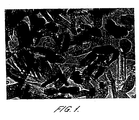
- Fig. 1 is a microphotograph (x 100) of the edible material from soybeans obtained in Example 1, hereinafter.
- Fig. 2 is a microphotograph (x 100) of the ground product of soybeans obtained in Comparative Example 2, hereinafter.
- Dehulling and removal of hypocotyls can be carried out by a known method.
- JP-A 62-198364 discloses a preferred method, wherein whole soybeans are dried with heating at a temperature of 60°C or higher and then treated with a grinder.
- any other method can be employed.
- dehulled and hypocotyl-removed whole soybeans are not used as the raw material, it is difficult to obtain a product of satisfactory quality in respect of both taste and mouthfeel.
- dehulling and removal of hypocotyls are carried out with minimal breaking and pressing to squeeze the soybeans, i.e., maintaining the soybean cells as much as possible without undergoing breaking. Since enzymes such as lipoxygenase are still alive in the cells of soybeans which are merely subjected to dehulling and removal of hypocotyls, though they are in an inactive state, they are apt to be activated by breaking soybean cells so as to form bad taste or flavor components. Then, dehulled and hypocotyl-removed soybeans are desirably split soybeans such as those split into halves to four pieces which have not undergone destruction.
- defatted soybeans in which cells are broken by pressing to squeeze out the oil or soybean flour are different from the above-described dehulled and hypocotyl-removed soybeans and they are not suitable as the raw material of the present invention which is to be soaked in hot water.
- the soybean raw material which is substantially free from swelling by water absorption is added to hot water, and soaking and heating is carried out under the conditions that the value of Log(Hr) + 0.0333 Temp is 2.4 or higher.
- this value is referred to as the heating value.
- the heating value is preferably 2.6 to 3.5, more preferably, 2.7 to 3.0. If this value is too small, the improvement of taste and flavor is insufficient.
- the value is 2.4 or larger but smaller than 2.6, the cell walls per se apt to be broken in the subsequent crushing step. It is possible that this is due to insufficient decomposition of the intercellular material, pectin ( ⁇ -elimination) or insufficient denaturation of the protein in the soybean cells.
- the soaking temperature, Temp is 80°C or higher, preferably, 85°C or higher.
- the heating time varies depending upon the temperature. For example, the heating is carried out for about 10 minutes or longer, preferably about 16 to 130 minutes, more preferably about 20 to 41 minutes in the case of a temperature of 95°C.
- soybeans which do not have any substantial swollen appearance are included in such a definition and, for example, soybeans merely washed with water to remove dust, etc., and having a moisture content of about 20% are also included as being in such a state.
- swollen soybeans the dormant state of soybean seeds is changed toward an activated state and a bad taste is caused due to activation of the enzymes in the seeds, etc.
- enzymes which cause a bad taste are quickly inactivated and it is possible to minimize formation of a bad taste.
- an alkali preferably, a bicarbonate such as sodium bicarbonate is added to hot water, normally, in a concentration of 0.01 to 4% by weight.
- This addition of an alkali can inhibit the activity of ⁇ -glucosidase which has relatively higher thermal resistance.
- pectin which is an intercellular material is promoted by making the hot water basic with addition of the alkali, cells are easy to separate into pieces without being broken upon crushing.
- the soybeans thus soaked and heated in hot water are subjected to crushing. At this stage, cooling of the soybeans is not required. Rather, if the soybeans are soaked and heated at the heating value of 2.4 to less than 2.6 are cooled, fluidity of the intercellular material, pectin, is decreased and there is a possibility that it causes breaking of soybean cell walls per se upon crushing. That is, desirably, the crushing is carried out after making the intercellular material fragile by increasing the heating value to 2.6 or higher by soaking and heating, or is carried out after heating at the heating value of 2.4 to less than 2.6 and before it is cooled.
- the crushing is carried out at least to such a degree that individually separated cell walls are predominantly observed.
- the crushing is insufficient, that is, when the cell walls are not separated individually and aggregates of plural cells are still predominantly observed, the edible material obtained has an inferior mouthfeel such as a rough mouthfeel.
- the term "predominantly observed” used herein means "remarkably observed”.
- the crushing is stopped at a degree such that the contents of the soybean cells surrounded by cell walls are predominantly observed, thereby providing an excellent granular or particulate mouthfeel to the resulting edible material more effectively.
- the contents of soybean cells are increasingly observed outside of the cells, the granular or particulate mouthfeel of the resulting edible material is reduced and creamy mouthfeel is increased together with soybean protein properties.
- Such edible material can be used for gelation.
- a wide variety of crushing apparatus such as from a home mixer to stone or ceramic rolls or a homogenizer can be used.
- such crushing can be simply and readily carried out by treatment with stone or ceramic rolls with little pressure between the rolls (to adjust the gap between the rolls so as to bring one roll into contact with the other roll is sufficient).
- treatment with stone or ceramic rolls is carried out by applying pressure to the gap between rolls, the edible material in which the contents of soybean cells are outside of cell walls can be readily prepared. Even for this crushing to remove the contents out of the cell walls, such vigorous crushing conditions as treating with a homogenizer to break many soybean cell walls are not required.
- the crushing can be carried out by pulverizing soybeans with a sharp edge rather than homogenizing.
- the resulting edible material has a more creamy mouthfeel with less problems regarding taste.
- the degree of crushing can be adjusted by using UHT treatment accompanied by steam blowing and pressure release.
- Fig.1 is a microphotograph, wherein the soybean particles are in the state that individually separated cell walls are predominantly observed and that the contents of soybean cells surrounded by cell walls which are not broken are predominantly observed.
- the particle size after crushing is in the range of from 50 to 500 ⁇ m when obtaining the edible material having a particulate appearance.
- the crushed material obtained above is subjected for example to UHT treatment, dehydration, drying if necessary, and it can be used as an edible material having excellent taste and mouthfeel.
- the edible material whose crushing has been carried out to a degree such that the contents of soybean cells surrounded by cell walls which are not broken are predominantly observed has good particulate mouthfeel and can be used in the same way as for example that of a bean jam, mashed potato or an egg yolk of hard-boiled egg.
- the edible material whose crushing has been carried out vigorously so that the contents of soybean cells are outside of the cells can be used for gelation, for example, as a binder of a hamburger, an ingredient of "gammodoki (fried bean curd mixed with pieces of vegetables and seaweed)" or an ingredient of "tofu (bean curd)" -like food.
- the edible material can be flavored for example with various seasoning and spices.
- a sweetener such as sugar or maltose
- the resultant edible material has the same taste as that of a conventional red bean jam and it can be used for various Japanese cakes according in same manner as that of a conventional red bean jam.
- a sweetener is used in an amount smaller than the above, the resultant edible material can be used in the same manner as conventional mashed potato, i.e., addition for example to salad to improve the taste and nutritive value.
- the edible material is flavored with a seasoning such as ketchup, mayonnaise or mustard the resultant edible material can be used for example for various daily dishes and fillings.
- a unique mouthfeel such as an egg yolk of a hard-boiled egg can be improved by further subjecting the crushed product to the following step. That is, after the above crushing step, a binder can be added to the resultant crushed product to provide binding properties or, preferably, the moisture content of the crushed product may be adjusted to about 30 to 70% so as to provide plasticity.
- the proportion of the crushed product and the binder is such that the amount of the crushed product (weight of the product without drying) is about 25 to 90 wt%, preferably about 40 to 80 wt% and more preferably about 50 to 80 wt% based on the total weight of the crushed product and the binder.
- the binder include heat coagulable proteins such as soybean protein and meat proteins of poultry, animal, fish and shellfish, and cold coagulable protein such as gelatin.
- heat coagulable protein for example, heating is carried out at about 80 to 100°C for about 5 to 60 minutes.
- cold coagulable protein for example, coagulation is carried out by cooling in water or a refrigerator after molding.
- the binder to be used herein is one which does not produce too strong a binding power.
- hydrous soybean protein obtained by adding water thereto in an amount 3 times or more, preferably 4 to 8 times as much as the dried soybean protein.
- the crushed product is dried and then water is added thereto.
- the dried crushed product is mixed with the crushed product which is not dried.
- the edible material having a good taste with little undesired bad bean taste can be obtained.
- various confections and food can be produced by using the edible material produced by the process of the present invention.
- soybeans were soaked in hot water and water was drained from the soybeans. Then, the swollen soybeans together with twice the volume of the boiled water were crushed with a home mixer and then dehydrated to obtain the desired soybean edible material. When the resultant material was observed with a microscope, particulate soybean cells surrounded by cell walls separated into pieces without breaking were predominantly observed. The material had a good taste.
- soybeans were soaked in hot water. Then, the soybeans were crushed with a home mixer without draining and cooling and dehydrated to obtain the desired soybean edible material. When the resultant material was observed with a microscope, particulate soybean cells surrounded by cell walls separated into pieces without breaking were predominantly observed. The material had a good taste.
- the desired soybean edible material was obtained except that the heating was carried out at 85°C for 60 minutes (heating value: 2.83).
- heating value 2.83
- particulate soybean cells surrounded by cell walls separated into pieces without breaking were predominantly observed.
- the material had a good taste.
- the desired soybean edible material was obtained except that the heating was carried out at 120°C for 5 minutes (heating value: 2.92).
- heating value 120°C for 5 minutes
- particulate soybean cells surrounded by cell walls separated into pieces without breaking were predominantly observed.
- the material had a good taste.
- Example 1 According to the same manner as described in Example 1, a soybean edible material was obtained except that the heating was carried out at 80°C for 30 minutes (heating value: 2.36). However, the resultant product had inferior mouthfeel and taste in comparison with the edible product of Example 1.
- Example 1 Refined sugar (60%), starch syrup (11%), salt (0.5%) and an appropriate amount of water were added to the edible material (100%) of Example 1 in the form of a crushed material and kneaded over a high flame. When a suitable moisture content was obtained by kneading, the fire was put out so as to obtain soybean jam similar to the non-sweetened bean jam made from adzuki. The resultant product had good taste and mouthfeel.
- Tomato ketchup (7%) and salt (1%) were added to the soybean edible material obtained in Example 1 and the mixture was thoroughly mixed to obtain a filling having a tomato ketchup taste.
- Minced beef (5%) which had been heated, finely chopped onion (5%), salt (1%), synthetic seasoning (0.5%) and appropriate amounts of pepper and nutmeg were added to the soybean edible material obtained in Example 1.
- the mixture was uniformly mixed, crumbed and fried to obtain a nourishing croquette-like food containing soybeans.
- Example 1 The soybean edible material obtained in Example 1 was added to a salad, instead of mashed potato, in an amount of 20% to obtain a nourishing salad containing soybeans.
- Agar powder (2 g), granulated sugar (50 g) and salt (1 g) were added to water (400 ml) and the mixture was boiled. Then, the soybean jam obtained in Example 6 (300 g) was added thereto. The mixture was boiled down to 650 g and placed in a mold to obtain a soft Japanese bean jelly-like food.
- Example 2 The crushed soybean edible material obtained in Example 1 (30 g) and water (3 g) was added to fluid egg yolk (20 g) and the mixture was mixed to obtain a paste. This was poured on powder paper placed in 3 petri dishes 9 cm in diameter, steamed for 30 minutes and cooled to obtain a food having the mouthfeel of egg yolk of a hard-boiled egg.
- a binder was prepared by mixing isolated soybean protein (FUJIPRO-SE (RTM) manufactured by Fuji Oil Co., Ltd., 40 g), water (200 g), soybean refined oil (40 g) and salt (4.2 g) with a food cutter. To this binder (240 g) were added the crushed soybean edible material obtained in Example 1 (360 g) and egg white (31. 2 g) and they were mixed to obtain a paste. The paste was deaerated and each 200 g portion thereof was stuffed and sealed in a synthetic casing tube of 35 mm folding diameter. They were heated in a hot bath at 80°C for 30 minutes and cooled to obtain a stuffed egg yolk-like food.
- the desired soybean edible material was obtained except that the crushing was carried out with ceramic rolls (pressure between rolls: 5 kg/cm 2 ).
- pressure between rolls: 5 kg/cm 2 pressure between rolls: 5 kg/cm 2 .
- Minced beef 400 g
- one finely chopped onion and an egg were added to the soybean edible material obtained in Example 13.
- the taste was controlled with salt.
- the mixture was mixed, molded and fried to a obtain hamburger having good taste.
Landscapes
- Life Sciences & Earth Sciences (AREA)
- Health & Medical Sciences (AREA)
- Agronomy & Crop Science (AREA)
- Engineering & Computer Science (AREA)
- Wood Science & Technology (AREA)
- Nutrition Science (AREA)
- Dentistry (AREA)
- General Health & Medical Sciences (AREA)
- Pest Control & Pesticides (AREA)
- Zoology (AREA)
- Environmental Sciences (AREA)
- Polymers & Plastics (AREA)
- Food Science & Technology (AREA)
- Botany (AREA)
- Plant Pathology (AREA)
- Chemical & Material Sciences (AREA)
- Thermal Sciences (AREA)
- Physics & Mathematics (AREA)
- Beans For Foods Or Fodder (AREA)
Applications Claiming Priority (4)
| Application Number | Priority Date | Filing Date | Title |
|---|---|---|---|
| JP8258732A JPH1099037A (ja) | 1996-09-30 | 1996-09-30 | 大豆食品素材の製造法 |
| JP258732/96 | 1996-09-30 | ||
| JP25873296 | 1996-09-30 | ||
| US08/938,744 US5866192A (en) | 1996-09-30 | 1997-09-26 | Process for producing edible material from soybeans |
Publications (2)
| Publication Number | Publication Date |
|---|---|
| EP0834260A1 EP0834260A1 (en) | 1998-04-08 |
| EP0834260B1 true EP0834260B1 (en) | 2002-03-27 |
Family
ID=26543807
Family Applications (1)
| Application Number | Title | Priority Date | Filing Date |
|---|---|---|---|
| EP97307495A Expired - Lifetime EP0834260B1 (en) | 1996-09-30 | 1997-09-25 | Process for producing edible material from soybeans |
Country Status (4)
| Country | Link |
|---|---|
| US (1) | US5866192A (enExample) |
| EP (1) | EP0834260B1 (enExample) |
| JP (1) | JPH1099037A (enExample) |
| CN (1) | CN1090002C (enExample) |
Families Citing this family (24)
| Publication number | Priority date | Publication date | Assignee | Title |
|---|---|---|---|---|
| US6485775B1 (en) * | 1998-10-16 | 2002-11-26 | Basic American, Inc. | Starchy food-based fine particle fat substitute |
| JP3256534B2 (ja) | 1999-08-06 | 2002-02-12 | 徹 赤澤 | 酵素を使用した大豆の加工方法、および同方法により得られる加工大豆、および同加工大豆を含む食品 |
| EP1233988B1 (en) * | 1999-11-22 | 2007-03-28 | Philip G. Crandall | Isolation of pectin from soybeans |
| JP5002105B2 (ja) * | 1999-12-28 | 2012-08-15 | リボノミックス, インコーポレイテッド | 内因性のmRNAタンパク質(mRNP)複合体の単離および特徴付けの方法 |
| JP4564229B2 (ja) * | 2000-11-09 | 2010-10-20 | カーギル,インコーポレーテッド | ダイズ処理方法 |
| JP2002306102A (ja) * | 2001-04-17 | 2002-10-22 | Toru Akazawa | 無臭大豆ピューレ |
| DE60111400D1 (de) * | 2001-08-22 | 2005-07-14 | Solae Llc | Fettarmes sojamehl mit einem reduzierten gehalt an wasserlöslichem zucker, verfahren zu seiner herstellung und seiner verwendung |
| US6833152B2 (en) * | 2001-10-31 | 2004-12-21 | Yugenkaisha Sakai | Soybean jam |
| JP2004000041A (ja) * | 2002-05-31 | 2004-01-08 | Isyokudougensya Co Ltd | 豆類ペースト及びその製造方法、並びに当該豆類ペーストを用いた加工食品 |
| US7105196B2 (en) * | 2003-03-06 | 2006-09-12 | Microsoy Corporation | Soybean cereal and method for making same from soybean flakes |
| US7335390B2 (en) * | 2003-03-06 | 2008-02-26 | Microsoy Corporation | Composition containing soybean flakes and potato flakes, method for making a food product therefrom, and said food product |
| US8025913B2 (en) | 2003-07-17 | 2011-09-27 | Conopco Inc. | Process for the preparation of an edible dispersion comprising oil and structuring agent |
| JP2005095156A (ja) * | 2003-08-21 | 2005-04-14 | Showa Sangyo Co Ltd | 大豆抽出物、その製造方法およびその用途 |
| JPWO2005051099A1 (ja) * | 2003-11-28 | 2007-12-06 | 株式会社医食同源社 | 豆類食材及びその製造方法、並びに当該豆類食材を用いた加工食品 |
| EP1750983A4 (en) * | 2004-01-26 | 2008-10-29 | Renessen Llc | High protein soybean meal |
| CA2597478A1 (en) | 2005-02-17 | 2006-08-24 | Chiara Garbolino | Granules comprising sterol |
| KR20080052558A (ko) * | 2005-07-08 | 2008-06-11 | 레네센 엘엘씨 | 트립토판 고함유 대두 가루 |
| US20080268098A1 (en) * | 2005-11-07 | 2008-10-30 | Sang Kyun Cho | High-Fiber Soybean Products and Process for the Preparation Thereof |
| CA2658416C (en) * | 2006-07-19 | 2012-04-17 | Grain Foods Crc Ltd | A spreadable food product and a manufacturing process therefor |
| BR112012030147A2 (pt) | 2010-06-22 | 2015-09-08 | Unilever Nv | "pó de gordura comestível, utilização do pó de gordura e processo para a preparação de um pó de gordura cometível |
| MX337914B (es) | 2010-12-17 | 2016-03-28 | Unilever Nv | Proceso para compactar polvo de grasa microporosa y polvo de grasa compactado asi obtenido. |
| AU2011348012B2 (en) * | 2010-12-22 | 2014-12-04 | Upfield Europe B.V. | Water-in-oil emulsion comprising omega-3 fatty acids and process for the manufacture thereof |
| GB201801909D0 (en) | 2018-02-06 | 2018-03-21 | New Food Innovation Ltd | Medium/low glycaemic index products and methods |
| CA3231449A1 (en) | 2023-03-10 | 2025-05-08 | Benson Hill, Inc. | Compositions and methods comprising plants with increased seed amino acid content |
Family Cites Families (7)
| Publication number | Priority date | Publication date | Assignee | Title |
|---|---|---|---|---|
| GB1453438A (en) * | 1972-11-14 | 1976-10-20 | British Arkady Co Ltd | Edible composition derived from soya beans |
| CH579130A5 (enExample) * | 1973-05-16 | 1976-08-31 | Ciba Geigy Ag | |
| US4041187A (en) * | 1973-07-06 | 1977-08-09 | The University Of Illinois Foundation | Soybean beverage and process |
| JPS60214855A (ja) * | 1984-04-06 | 1985-10-28 | Tatsuhiko Narabe | 破砕した乾燥大豆原料 |
| JPS62198364A (ja) * | 1986-02-25 | 1987-09-02 | Fuji Oil Co Ltd | 大豆処理方法 |
| JPS6384455A (ja) * | 1986-09-27 | 1988-04-15 | Meiji Seika Kaisha Ltd | 無菌充填豆腐の製造法 |
| NL8701014A (nl) * | 1987-04-29 | 1988-11-16 | Solnuts Bv | Werkwijze voor het bereiden van een op gerooste noten gelijkend produkt. |
-
1996
- 1996-09-30 JP JP8258732A patent/JPH1099037A/ja active Pending
-
1997
- 1997-09-25 EP EP97307495A patent/EP0834260B1/en not_active Expired - Lifetime
- 1997-09-26 US US08/938,744 patent/US5866192A/en not_active Expired - Fee Related
- 1997-09-29 CN CN97121453A patent/CN1090002C/zh not_active Expired - Fee Related
Also Published As
| Publication number | Publication date |
|---|---|
| JPH1099037A (ja) | 1998-04-21 |
| CN1090002C (zh) | 2002-09-04 |
| CN1181201A (zh) | 1998-05-13 |
| US5866192A (en) | 1999-02-02 |
| EP0834260A1 (en) | 1998-04-08 |
Similar Documents
| Publication | Publication Date | Title |
|---|---|---|
| US5866192A (en) | Process for producing edible material from soybeans | |
| US4113889A (en) | Process for making hydrated peanut products and products made thereby | |
| CA2342929C (en) | Method for processing soybean by using enzyme, processed soybean thus obtained and foods containing the thus processed soybean | |
| US5700512A (en) | Preparation of food extrudate which floats during rehydration | |
| US4204005A (en) | Process for producing fibrous food materials | |
| JPWO2001010242A1 (ja) | 酵素を使用した大豆の加工方法、および同方法により得られる加工大豆、および同加工大豆を含む食品 | |
| JPH084471B2 (ja) | おから加工品及びその製造方法 | |
| US4117174A (en) | Method for producing tofu-like food | |
| JP3630443B2 (ja) | 加工食品用品質改良剤 | |
| US6770309B2 (en) | Method of processing soybean by use of an enzyme, processed soybean obtained by the same method, and food containing the processed soybean | |
| JP2006109801A (ja) | 加工豆類およびその製造方法 | |
| JPH0499453A (ja) | こんにゃくクラッシュ、こんにゃくペーストおよびこんにゃくパウダーの製造方法 | |
| JP3437539B2 (ja) | ケールの乾燥粉末の製造方法 | |
| JPS6320505B2 (enExample) | ||
| JP3623866B2 (ja) | 油揚げ付き豆腐こんにゃく及びその製造法 | |
| JPH034770A (ja) | 改良された性質を有する味付きひき肉、その製造方法およびその製造に使用するための感熱性酵素含有物質 | |
| DE69711310T2 (de) | Verfahren zur Herstellung von Nahrungsmitteln aus Sojabohnen | |
| JP3152888B2 (ja) | 大豆蛋白膨化食品およびその製造法 | |
| JPH04281764A (ja) | 飲食品の製造法 | |
| JPS59232051A (ja) | 餡類似品の製造法 | |
| RU2287961C1 (ru) | Способ приготовления сушеного осьминога | |
| JPH0488966A (ja) | 蝦風味を有する加工食品及びその製造法 | |
| JPH03172152A (ja) | 調理用固形食品の製造方法 | |
| AU469072B2 (en) | Process for the treatment of coconut and food products resulting therefor | |
| JPH09238622A (ja) | 湯葉風味揚げこんにゃくの製造法 |
Legal Events
| Date | Code | Title | Description |
|---|---|---|---|
| PUAI | Public reference made under article 153(3) epc to a published international application that has entered the european phase |
Free format text: ORIGINAL CODE: 0009012 |
|
| AK | Designated contracting states |
Kind code of ref document: A1 Designated state(s): BE DE ES FR GB |
|
| 17P | Request for examination filed |
Effective date: 19980821 |
|
| AKX | Designation fees paid |
Free format text: BE DE ES FR GB |
|
| RBV | Designated contracting states (corrected) |
Designated state(s): BE DE ES FR GB |
|
| 17Q | First examination report despatched |
Effective date: 20001106 |
|
| GRAG | Despatch of communication of intention to grant |
Free format text: ORIGINAL CODE: EPIDOS AGRA |
|
| GRAG | Despatch of communication of intention to grant |
Free format text: ORIGINAL CODE: EPIDOS AGRA |
|
| GRAH | Despatch of communication of intention to grant a patent |
Free format text: ORIGINAL CODE: EPIDOS IGRA |
|
| GRAH | Despatch of communication of intention to grant a patent |
Free format text: ORIGINAL CODE: EPIDOS IGRA |
|
| REG | Reference to a national code |
Ref country code: GB Ref legal event code: IF02 |
|
| GRAA | (expected) grant |
Free format text: ORIGINAL CODE: 0009210 |
|
| AK | Designated contracting states |
Kind code of ref document: B1 Designated state(s): BE DE ES FR GB |
|
| PG25 | Lapsed in a contracting state [announced via postgrant information from national office to epo] |
Ref country code: FR Free format text: LAPSE BECAUSE OF FAILURE TO SUBMIT A TRANSLATION OF THE DESCRIPTION OR TO PAY THE FEE WITHIN THE PRESCRIBED TIME-LIMIT Effective date: 20020327 Ref country code: BE Free format text: LAPSE BECAUSE OF FAILURE TO SUBMIT A TRANSLATION OF THE DESCRIPTION OR TO PAY THE FEE WITHIN THE PRESCRIBED TIME-LIMIT Effective date: 20020327 |
|
| REF | Corresponds to: |
Ref document number: 69711310 Country of ref document: DE Date of ref document: 20020502 |
|
| PG25 | Lapsed in a contracting state [announced via postgrant information from national office to epo] |
Ref country code: ES Free format text: LAPSE BECAUSE OF FAILURE TO SUBMIT A TRANSLATION OF THE DESCRIPTION OR TO PAY THE FEE WITHIN THE PRESCRIBED TIME-LIMIT Effective date: 20020925 |
|
| EN | Fr: translation not filed | ||
| PLBE | No opposition filed within time limit |
Free format text: ORIGINAL CODE: 0009261 |
|
| STAA | Information on the status of an ep patent application or granted ep patent |
Free format text: STATUS: NO OPPOSITION FILED WITHIN TIME LIMIT |
|
| 26N | No opposition filed |
Effective date: 20021230 |
|
| PGFP | Annual fee paid to national office [announced via postgrant information from national office to epo] |
Ref country code: GB Payment date: 20100921 Year of fee payment: 14 |
|
| PGFP | Annual fee paid to national office [announced via postgrant information from national office to epo] |
Ref country code: DE Payment date: 20100922 Year of fee payment: 14 |
|
| GBPC | Gb: european patent ceased through non-payment of renewal fee |
Effective date: 20110925 |
|
| REG | Reference to a national code |
Ref country code: DE Ref legal event code: R119 Ref document number: 69711310 Country of ref document: DE Effective date: 20120403 |
|
| PG25 | Lapsed in a contracting state [announced via postgrant information from national office to epo] |
Ref country code: DE Free format text: LAPSE BECAUSE OF NON-PAYMENT OF DUE FEES Effective date: 20120403 |
|
| PG25 | Lapsed in a contracting state [announced via postgrant information from national office to epo] |
Ref country code: GB Free format text: LAPSE BECAUSE OF NON-PAYMENT OF DUE FEES Effective date: 20110925 |