EP0826784A2 - Mit Antrahydrochinon und Metall versehener Kohleträger zur Entfernung von Edelmetallkomplexionen aus wässrigen Lösungen - Google Patents
Mit Antrahydrochinon und Metall versehener Kohleträger zur Entfernung von Edelmetallkomplexionen aus wässrigen Lösungen Download PDFInfo
- Publication number
- EP0826784A2 EP0826784A2 EP97114118A EP97114118A EP0826784A2 EP 0826784 A2 EP0826784 A2 EP 0826784A2 EP 97114118 A EP97114118 A EP 97114118A EP 97114118 A EP97114118 A EP 97114118A EP 0826784 A2 EP0826784 A2 EP 0826784A2
- Authority
- EP
- European Patent Office
- Prior art keywords
- metal
- complex ions
- ions
- treating agent
- metal ion
- Prior art date
- Legal status (The legal status is an assumption and is not a legal conclusion. Google has not performed a legal analysis and makes no representation as to the accuracy of the status listed.)
- Granted
Links
Images
Classifications
-
- C—CHEMISTRY; METALLURGY
- C22—METALLURGY; FERROUS OR NON-FERROUS ALLOYS; TREATMENT OF ALLOYS OR NON-FERROUS METALS
- C22B—PRODUCTION AND REFINING OF METALS; PRETREATMENT OF RAW MATERIALS
- C22B11/00—Obtaining noble metals
- C22B11/04—Obtaining noble metals by wet processes
- C22B11/042—Recovery of noble metals from waste materials
- C22B11/046—Recovery of noble metals from waste materials from manufactured products, e.g. from printed circuit boards, from photographic films, paper or baths
-
- C—CHEMISTRY; METALLURGY
- C22—METALLURGY; FERROUS OR NON-FERROUS ALLOYS; TREATMENT OF ALLOYS OR NON-FERROUS METALS
- C22B—PRODUCTION AND REFINING OF METALS; PRETREATMENT OF RAW MATERIALS
- C22B3/00—Extraction of metal compounds from ores or concentrates by wet processes
- C22B3/20—Treatment or purification of solutions, e.g. obtained by leaching
- C22B3/22—Treatment or purification of solutions, e.g. obtained by leaching by physical processes, e.g. by filtration, by magnetic means, or by thermal decomposition
- C22B3/24—Treatment or purification of solutions, e.g. obtained by leaching by physical processes, e.g. by filtration, by magnetic means, or by thermal decomposition by adsorption on solid substances, e.g. by extraction with solid resins
-
- Y—GENERAL TAGGING OF NEW TECHNOLOGICAL DEVELOPMENTS; GENERAL TAGGING OF CROSS-SECTIONAL TECHNOLOGIES SPANNING OVER SEVERAL SECTIONS OF THE IPC; TECHNICAL SUBJECTS COVERED BY FORMER USPC CROSS-REFERENCE ART COLLECTIONS [XRACs] AND DIGESTS
- Y02—TECHNOLOGIES OR APPLICATIONS FOR MITIGATION OR ADAPTATION AGAINST CLIMATE CHANGE
- Y02P—CLIMATE CHANGE MITIGATION TECHNOLOGIES IN THE PRODUCTION OR PROCESSING OF GOODS
- Y02P10/00—Technologies related to metal processing
- Y02P10/20—Recycling
Definitions
- the present invention relates to an agent for treating metal ions and a method for treating noble metal complex ions to recover noble metals which are valuable from the viewpoint of both resources and economy, from an aqueous solution containing noble metal complex ions, such as a waste water from cyan type gold plating or a waste water from palladium-nickel alloy plating.
- Noble metal plating such as gold or palladium plating is excellent in the ornamental property, corrosion resistance and solderability and has a characteristic such as low electrical resistance. Accordingly, it has been widely used for ornaments, electronic parts or the like.
- a plating solution containing dicyano aurate(I) complex ions, tetraammine palladium or the like is employed and to recover noble metals from waste waters discharged from various steps during plating treatment is not only economically significant but also socially important from the viewpoint of the influence to the environment.
- a method for selectively and efficiently recover metal ions, particularly noble metal ions, in an aqueous solution a method has been proposed in which a supported product having a redox reaction reagent represented by a compound having a hydroquinone structure such as an anthrahydroquinone compound, adsorbed and fixed on a porous carrier (this supported product will hereinafter be referred to simply as a metal ion-treating agent) is packed in e.g. a column, and an aqueous solution containing noble metal ions such as gold ions (inclusive of complex ions) is passed therethrough for treatment, so that the noble metal ions are reduced and captured as zerovalent metal on said metal ion-treating agent (U.S. Patent 5,474,593).
- a supported product having a redox reaction reagent represented by a compound having a hydroquinone structure such as an anthrahydroquinone compound
- the present inventors have conducted an extensive research for a method whereby the reduction reaction of noble metal complex ions will smoothly proceed on the metal ion-treating agent and as a result, have reached a concept that transfer of electrons on the metal ion-treating agent is hindered by some factors, whereby the reduction rate of the noble metal complex ions tends to be low. Accordingly, they have studied a method for improving the reduction rate, and as a result have reached an idea that the transfer rate of electrons can be improved by having a metal preliminarily supported on the metal ion-treating agent.
- an aqueous solution containing noble metal complex ions has been treated by means of a metal ion-treating agent having a metal such as copper supported on a carbonaceous carrier, whereby it has been found that the recovery rate of the noble metal can remarkably be improved.
- the present invention has been accomplished on the basis of this discovery.
- the present invention provides an agent for treating metal ions in an aqueous solution, which comprises an anthrahydroquinone compound and a metal supported on a carbonaceous carrier, and a method for treating noble metal complex ions, which comprises reducing noble metal complex ions in an aqueous solution by means of such a metal ion-treating agent and recovering them in the form of metal.
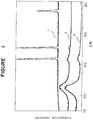
- Figure 1 is a powder X-ray diffraction pattern of the metal ion-treating agent of Example 2.
- the aqueous solution to be treated may be any solution so long as it is an aqueous solution containing gold cyano complex ions or palladium complex ions.
- it may be a plating waste water from a plating process of ornaments or electronic parts, a washing water from a washing process after plating treatment or from a stain stripping process, a waste water such as a stripping water, a recovery solution having a noble metal recovered from a waste of e.g. semiconductors or printed circuit boards by means of an aqueous cyanide solution, or an extract solution of gold obtained by treatment of a gold ore with an aqueous cyanide solution.
- the gold cyano complex ions may, for example, be dicyano aurate(I) complex ions, tricyano aurate(I) complex ions, tetracyano aurate(I) complex ions or tetracyano aurate(III) complex ions, as shown by the following chemical formulas.
- dicyano aurate(I) complex ions or tetracyano aurate(III) complex ions are considered to be the main component.
- Dicyano aurate(I) complex ions [Au(CN) 2 ] - Tricyano aurate(I) complex ions: [Au(CN) 3 ] 2- Tetracyano aurate(I) complex ions: [Au(CN) 4 ] 3- Tetracyano aurate(III) complex ions: [Au(CN) 4 ] -
- the palladium complex ions may, for example, be tetraammine palladium complex ions, as shown by the following chemical formula: Tetraammine palladium complex ions: [Pd(NH 3 ) 4 ] 2+
- the anthrahydroquinone compound may, for example, be anthrahydroquinone (9,10-dihydroxyanthracene), its hydride compounds and their substitution products.
- the substituents in the substitution products of the anthrahydroquinone compound may, for example, be relatively hydrophobic substituents such as an alkyl group, an alkenyl group, an alkoxyl group, a phenyl group, an alkylamino group and a halogen atom.
- the carbon number in the alkyl group, the alkenyl group and the alkoxyl group is usually from 1 to 60, practically at most 24, and the alkyl group may be straight chain or branched.
- Compounds having such substituents include, for example, an alkylated anthrahydroquinone compound such as 2-methylanthrahydroquinone or 2-ethylanthrahydroquinone, and an alkenyl-substituted anthrahydroquinone compound such as 2-(4-methyl-pentenyl)anthrahydroquinone.
- the hydride compounds of the hydroquinone compound may, for example, be 1,4-dihydro-9,10-dihydroxyanthracene and 1,2,3,4-tetrahydro-9,10-dihydroxyanthracene.
- the carbonaceous carrier may, for example, be active carbon or active carbon fibers. Particularly preferred is active carbon, since it is inexpensive and readily available.
- the pore size is at least 5 ⁇ , preferably at least 10 ⁇ , and the specific surface area is at a level of about 1000 m 2 per gram.
- Such a carbonaceous carrier may be used in any form such as a powder form, a pelletized form, a spherical form or a pulverized form.
- the particle size of the pelletized form, the spherical form or the pulverized form of such a porous carrier may, for example, be from 0.3 to 2.5 mm in the case of active carbon, since the smaller the particle size, the better the contact efficiency with the aqueous solution, but the larger the flow resistance in a case where it is packed in a column and an aqueous solution containing metal ions is treated.
- the metal to be supported on the carrier may, for example, be at least one metal selected from metals belonging to iron-group, platinum-group, copper-group, zinc-group and carbon-group. Specifically, it is preferably at least one metal selected from the group consisting of iron, cobalt, nickel, palladium, platinum, rhodium, copper, silver, gold, zinc and tin. It is particularly effective and preferred to use copper or silver for the treatment of gold cyano complex ions, and to use nickel or cobalt for the treatment of palladium complex ions.
- a method for supporting such a metal on the metal ion-treating agent may, for example, be any one of a method of preliminarily supporting the metal on a carrier such as active carbon to be used for the metal ion-treating agent, a method of supporting it during the preparation of the metal ion-treating agent and a method of supporting it after preparation of the metal ion-treating agent.
- a method may be employed wherein a water-soluble compound of the metal to be supported is added to a medium such as water in which the metal ion-treating agent is dispersed, and in a case of a metal compound having a high oxidation reduction potential such as copper or silver, the metal compound is reduced to metal by the reducing power of the metal ion-treating agent and thereby supported, or in a case of a metal compound having a low oxidation reduction potential such as nickel or cobalt, a reducing agent is added to the medium wherein the metal ion-treating agent is dispersed, thereby to support the metal on the metal ion-treating agent.
- the amount of the metal may usually be from 0.1 to 100g, preferably from 1 to 50g, per litter of the wet volume of the metal ion-treating agent.
- Supporting of the anthrahydroquinone compound is carried out by impregnating an organic solvent having an oxide corresponding to the anthrahydroquinone compound (the anthraquinone compound) dissolved therein to a carbonaceous carrier or a carbonaceous carrier having the above metal supported thereon, then removing the organic solvent and subjecting the supported anthraquinone compound to reduction treatment with sodium dithionate (sodium hydrosulfite).
- a method may be mentioned wherein a water-soluble salt of the anthrahydroquinone compound is adsorbed on a carbonaceous carrier or a carbonaceous carrier having the above metal supported thereon, followed by acid washing for fixing, and this method has an advantage over the above method in that no reduction treatment is required.
- an aqueous solution of a disodium salt of 1,4-dihydro-9,10-dihydroxyanthracene compound may, for example, be employed, which is obtainable by reacting a 1,4,4a,9a-tetrahydroanthraquinone compound obtainable by a Diels Alder reaction of naphthoquinone with the corresponding 1,3-butadiene compound, with at least an equivalent amount (at least two mols per mol of the quinone compound) of an aqueous solution of an alkali metal hydroxide.
- the amount of the anthrahydroquinone compound supported on the resulting metal ion-treating agent varies depending upon the type of the anthrahydroquinone compound or the type of the solid porous carrier. However, it may, for example, be from 0.3 to 1.0 mol/l-carrier in a case where a disodium salt of 1,4-dihydro-9,10-dihydroxyanthracene and granular active carbon are used.
- a batch type treating method may be employed wherein the above mentioned metal-supported metal ion-treating agent is added to the aqueous solution, followed by stirring treatment, and then the treating agent is separated by decantation or filtration.
- the above mentioned metal ion-treating agent is packed in a column (tower), and the aqueous solution is treated by passing therethrough.
- the pH of the aqueous solution containing noble metal complex ions is not particularly limited so long as the noble metal complex ions are present stably in the aqueous solution. However, it is usually not desirable that the pH is higher than 12, since the anthrahydroquinone compound supported on the metal ion-treating agent is thereby likely to dissolve.
- anions in the aqueous solution anions of an inorganic acid or an organic acid may be present, so long as the target noble metal complex ions will not thereby precipitate.
- concentration of the noble metal complex ions in the aqueous solution is not particularly limited so long as they are present as dissolved. However, it is usually from 1 to 50000 ppm, preferably from 1 to 5000 ppm.
- the treating temperature is usually from 10 to 70°C, and the treatment is usually carried out at room temperature. However, in general, the higher the temperature, the higher the recovery ability.
- cyano complex ions such as gold cyano complex ions
- metal ion-treating agent having the above metal supported thereon
- the aldehyde may be any aldehyde so long as it has a substantial water-solubility in the aqueous solution containing gold cyano complex ions.
- the aldehyde may be the one having a solubility of at least about a few hundreds ppm and having the effects of the present invention.
- an aliphatic aldehyde is usually preferred. Particularly preferred is a lower aliphatic aldehyde. It may, for example, be a monovalent or polyvalent aldehyde such as formaldehyde, paraformaldehyde, acetoaldehyde, propionaldehyde, butylaldehyde, crotonaldehyde or glyoxal, or a saccharide such as glucose.
- the amount of such an aldehyde may usually be at least an equivalent amount (in a case of a monovalent aldehyde, at least equimolar to the total cyanide ions) so that one cyanide ion corresponds to one aldehyde group against the total cyanide ions contained in free cyanide ions and gold cyano complex ions present in the aqueous solution containing the gold cyano complex ions. If the amount is less than one equivalent, the effects tend to be correspondingly low. If the amount is too much, such is not desirable from the viewpoint of the economy or a problem of the subsequent waste water treatment. Therefore, the amount is at most 500 equivalents, practically from 1 to 100 equivalents, preferably from 1.2 to 50 equivalents.
- a metal compound which is capable of forming a cyano complex with the cyanide ions may be used.
- a metal compound a compound of a metal element belonging to copper-group, zinc-group or iron-group may be mentioned.
- a compound of copper belonging to the copper-group, zinc or cadmium belonging to the zinc-group, or iron, cobalt or nickel belonging to the iron-group may be mentioned.
- a particularly effective metal compound a compound of zinc, nickel or cobalt may be mentioned.
- These compounds may be used alone or in combination as a mixture of two or more of them. Namely, at least one such a metal compound may be present.
- Such a metal compound may be the one which is substantially water-soluble under the treating condition of the present invention, and it may be a water-soluble inorganic salt such as a sulfate, a nitrate or a chloride of such a metal, or an organic salt such as an acetate. It may also be in the form of a complex such as an ammine complex of such a metal salt. Further, so long as it is soluble under the treating conditions, it may be in the form of a hydroxide or a zincate.
- the ligand which coordinates to metal ions when such a metal compound is dissolved in water is limited to the one having a bonding force to the metal ions which is weaker than the cyanide ions.
- such a metal compound may, for example, be a nickel salt such as nickel(II) sulfate, nickel(II) nitrate or nickel(II) chloride, a cobalt salt such as cobalt(II) sulfate, cobalt(II) nitrate or cobalt(II) chloride, or a zinc salt such as zinc(II) sulfate, zinc(II) nitrate or zinc(II) chloride.
- nickel salt such as nickel(II) sulfate, nickel(II) nitrate or nickel(II) chloride
- cobalt salt such as cobalt(II) sulfate, cobalt(II) nitrate or cobalt(II) chloride
- a zinc salt such as zinc(II) sulfate, zinc(II) nitrate or zinc(II) chloride.
- a method for incorporating such a metal compound to the aqueous solution containing gold cyano complex ions to be treated may usually be a method wherein an aqueous solution of such a metal compound is added to the aqueous solution containing the gold cyano complex ions.
- an ammine complex of a salt such as a chloride of such a metal may, for example, be mentioned in which an aqueous solution obtained by dissolving a chloride of such a metal in excess aqueous ammonia, is added.
- a metal compound may already be included prior to the treatment by the process of the present invention. In such a case, the present invention can be carried out as it is or after adding the metal compound partially.
- the amount of such a metal compound may be at least one equivalent (for example, in the case of nickel or cobalt, 1/4 mol time of the total cyano groups) corresponding to formation of its cyano complex compound or complex ions, against total cyano groups contained in free cyanide ions and gold cyano complex ions present in the aqueous solution containing the gold cyano complex ions. If the amount is less than 1 equivalent, the effects tend to be correspondingly low. If it is too much, such is undesirable from the viewpoint of the economy and the problem of the subsequent waste water treatment. Therefore, it is at most 200 equivalents, practically from 1 to 50 equivalents, preferably from 1.2 to 20 equivalents.
- the complex ions are reduced to metal on the treating agent and thereby selectively captured, so that they will not be substantially detected in the treated water.
- the treating agent having the noble metal captured thereon was analyzed by powder X-ray refraction method, whereby it was confirmed that the noble metal complex ions were captured in the form of metal.
- Nickel chloride was dissolved in deionized water, 25% aqueous ammonia was added thereto to prepare an aqueous solution containing 1000 ppm as nickel of tetraammine nickel.
- the metal ion-treating agent in the step (a) was sampled in a wet volume of 20 ml, and 100 ml of deionized water was added thereto. Then, 1g of sodium hydrosulfite was added thereto. To this mixture, the above nickel ion aqueous solution was added in an amount of 40 ml, and 0.5g of sodium hydrosulfite was further added.
- the mixture was thoroughly shaked, whereby it was observed that nickel metal precipitated by reduction on the surface of the metal ion-treating agent and was laminated in a white color.
- the reaction mixture was left to stand still for about one hour, whereupon the supernatant was measured by an ICP atomic emission spectroscopic analysis (hereinafter referred to as ICP-AES), whereby no nickel ion was detected in the liquid, and 2g of nickel was supported per 1l in the wet volume of the metal ion-treating agent.
- ICP-AES ICP atomic emission spectroscopic analysis
- the recovery rate of palladium up to 800 ml treatment was at least 90%.
- the recovered amount of palladium at that time was 99g per 1l of the metal ion-treating agent.
- Example 1 The palladium-nickel alloy plating waste water in Example 1 was treated in the same manner as in Example 1 using the metal ion-treating agent having no metal supported, as prepared in Example 1(a), and the results are shown in Table 1.
- the palladium complex ions were reduced and recovered from the waste water in the form of metal palladium at a not too bad recovery rate such that the palladium ion concentration was at most 100 ppm.
- the palladium complex ions gradually started to leak, and the removal rate of palladium decreased.
- the recovered amount of palladium metal was 46g per 1l of the metal ion-treating agent.
- the metal ion-treating agent of Example 1(a) was taken in a wet volume of 300 ml, and 100 ml of deionized water was added thereto. Then, the above aqueous copper tetraammine solution was gradually added with stirring, whereby copper metal was precipitated by reduction on the surface of the metal ion-treating agent, and a color change to a reddish copper color was observed. After about one hour, the supernatant was measured by ICP-AES, whereby no copper ions were detected, and 12.5g of copper was supported per 1l in the wet volume of the metal ion-treating agent.
- FIG. 1 A part of the copper-supported metal ion-treating agent was pulverized and analyzed by powder X-ray diffraction analysis, whereby a weak diffraction peak attributable to copper metal was confirmed, as shown in Figure 1.
- reference numeral 1 indicates a diffraction pattern of copper powder
- numeral 2 a diffraction pattern of the copper-supported metal ion-treating agent
- numeral 3 a diffraction pattern of the metal ion-treating agent having no copper supported thereon.
- Silver nitrate was dissolved in deionized water to obtain an aqueous silver nitrate solution containing 1000 ppm of silver ions.
- the metal ion-treating agent of Example 1(a) was sampled in a wet volume of 20 ml, and 100 ml of deionized water was added thereto. Then, the above aqueous silver nitrate solution was added in an amount of 40 ml thereto, and the mixture was thoroughly shaked and left to stand for one hour to let silver precipitate by reduction over the entire surface of the metal ion-treating agent. The supernatant was measured by ICP-AES, whereby no silver ions were detected therein, and the amount of silver supported per 1l in the wet volume of the metal ion-treating agent was 2g.
- platinum was permitted to precipitate by reduction on the metal ion-treating agent by means of an aqueous sodium chloroplatinate solution (containing 1000 ppm of platinum ions) to obtain a platinum-supported metal ion-treating agent.
- Example 1(a) 20 ml of an aqueous copper sulfate solution containing 1000 ppm of copper ions and 5 ml of an aqueous palladium chloride solution (containing hydrochloric acid) containing 1000 ppm of palladium ions, were mixed to obtain a copper-palladium mixed solution.
- the metal ion-treating agent of Example 1(a) was taken in a wet volume of 10 ml, and 100 ml of deionized water was added thereto. Then, the above copper-palladium mixed solution was added thereto, and the mixture was thoroughly shaked and left to stand for one hour to let copper-palladium precipitate by reduction over the entire surface of the metal ion-treating agent. The supernatant was measured by ICP-AES, whereby no copper and palladium ions were detected therein, and the amount of metals supported per 1l in a wet volume of the metal ion-treating agent was 2.5g in total.
- a cyan type gold plating waste water containing dicyano aurate(I) complex ions as the main component (containing 3300 ppm as gold, and the pH was 6.8) was diluted ten times, and 4g of paraformaldehyde per liter was added thereto. Then, the pH of the aqueous solution was adjusted to from 10.3 to 10.8 by means of an aqueous KOH solution and citric acid.
- Example 1(c) Using the metal-supported metal ion-treating agents prepared in the above steps (a), (b) and (c) and in Example 1(c), the above plating waste waters were treated in the same manner as in Example 1 at a space velocity of 3 hr -1 , and the results are shown in Table 2.
- the recovery rate of gold was at least 90% until 7l of the cyan type gold plating waste water was treated.
- the recovery rate of the gold at that time, was at least 232g of per 1l of the metal ion-treating agent.
- copper-supported active carbon 200g of granular active carbon was added to 500 ml of an aqueous copper nitrate solution containing 800 ppm as copper and the mixture was stirred for one hour. Then, the pH was adjusted to 10 with an aqueous sodium hydroxide solution to let the hydroxide precipitate on the active carbon, followed by washing with water and drying. Further, the product was reduced in a hydrogen stream to obtain a copper-supported active carbon. In the same manner, a nickel-supported active carbon was prepared. The supported amount of each metal was determined by baking a sample, and then the metal was dissolved by an aqua regia, and measured by ICP-AES.
- Example 1 100 ml of each of the above metal-supported active carbons was sampled into a 300 ml eggplant type flask, and DDA was supported in the same manner as in Example 1 (a) using 200g of an aqueous solution containing 16% of DDAN.
- the supported amount of DDA per 1l of each metal-supported active carbon was shown in Table 3. Supported metal Supported amount of DDA (mol) 0.2% Ni 0.79 0.2% Cu 0.79 0.2% Pd 0.76
- Example 2(d) Using the metal ion-treating agents prepared by using active carbons having various metals supported thereon, the same cyan type gold plating waste water as used in Example 2(d) was treated in the same manner with an addition of paraformaldehyde, and the results are shown in Table 4.
- the recovery rate of gold was at least 90% until 5l of the cyan type gold plating waste water was treated, and the recovered amount of gold at that time was at least 160g per 1l of the metal ion-treating agent.
- Example 2(d) Using the metal ion-treating agent prepared in Example 1(a), the waste water of Example 2(d) was treated in the same manner as in Example 2 with an addition of paraformaldehyde, and the gold ion concentration in the treated water is shown in Table 5.
- a solution having nickel nitrate dissolved in aqueous ammonia 0.5g of nickel nitrate hexahydrate was dissolved in 10 ml of 25% aqueous ammonia was added.
- the pH of the cyan type gold plating waste water became 10.8.
- the concentration of nickel ions in the cyan type gold plating waste water was 1.7 mM (100 ppm as nickel ions), which was in an excess of about 2 equivalents on an assumption that the nickel ions and cyanide ions liberated by reduction of dicyano aurate(I) complex ions in the waste water, would form tetracyano niccolate(II) complex ions.
- Example 6 Using 10 ml of the copper-supported metal ion-treating agent prepared in Example 2, the cyan type gold plating waste water prepared in the above step (a) was treated at a space velocity of 10 hr -1 in the same manner as in Example 2, and the concentration of gold ions during the treatment is shown in Table 6. Until 7l of the cyan type gold plating waste water was treated, the recovery rate of gold was at least 90%, and the recovered amount of gold was 231g per 1l of the metal ion-treating agent.
- a cyan type gold plating waste water containing dicyano aurate(I) complex ions as the main component (containing 500 ppm as gold, and the pH was 7.0) was adjusted to pH 4 with citric acid.
Landscapes
- Engineering & Computer Science (AREA)
- Chemical & Material Sciences (AREA)
- Mechanical Engineering (AREA)
- Manufacturing & Machinery (AREA)
- Materials Engineering (AREA)
- Metallurgy (AREA)
- Organic Chemistry (AREA)
- Geochemistry & Mineralogy (AREA)
- Geology (AREA)
- General Life Sciences & Earth Sciences (AREA)
- Environmental & Geological Engineering (AREA)
- Life Sciences & Earth Sciences (AREA)
- Removal Of Specific Substances (AREA)
- Manufacture And Refinement Of Metals (AREA)
- Treatment Of Water By Oxidation Or Reduction (AREA)
Applications Claiming Priority (6)
| Application Number | Priority Date | Filing Date | Title |
|---|---|---|---|
| JP223535/96 | 1996-08-26 | ||
| JP22353596 | 1996-08-26 | ||
| JP22353596 | 1996-08-26 | ||
| JP22353496 | 1996-08-26 | ||
| JP22353496 | 1996-08-26 | ||
| JP223534/96 | 1996-08-26 |
Publications (3)
| Publication Number | Publication Date |
|---|---|
| EP0826784A2 true EP0826784A2 (de) | 1998-03-04 |
| EP0826784A3 EP0826784A3 (de) | 1998-03-25 |
| EP0826784B1 EP0826784B1 (de) | 2000-07-12 |
Family
ID=26525533
Family Applications (1)
| Application Number | Title | Priority Date | Filing Date |
|---|---|---|---|
| EP19970114118 Expired - Lifetime EP0826784B1 (de) | 1996-08-26 | 1997-08-14 | Mit Antrahydrochinon und Metall versehener Kohleträger zur Entfernung von Edelmetallkomplexionen aus wässrigen Lösungen |
Country Status (4)
| Country | Link |
|---|---|
| US (1) | US6106589A (de) |
| EP (1) | EP0826784B1 (de) |
| AU (1) | AU721563B2 (de) |
| DE (1) | DE69702484T2 (de) |
Cited By (1)
| Publication number | Priority date | Publication date | Assignee | Title |
|---|---|---|---|---|
| WO2021062549A1 (en) | 2019-10-04 | 2021-04-08 | Kasis Environmental Ltd. | Redox active materials, processes and uses thereof |
Families Citing this family (4)
| Publication number | Priority date | Publication date | Assignee | Title |
|---|---|---|---|---|
| WO2002061156A1 (fr) * | 2001-02-01 | 2002-08-08 | Kawasaki Kasei Chemicals Ltd. | Procede pour separer, enrichir et recuperer du palladium |
| AUPS074902A0 (en) * | 2002-02-25 | 2002-03-21 | Umatilla Resources Pty. Ltd. | Device and process for solvent extraction |
| FR2843745B1 (fr) * | 2002-08-23 | 2006-02-17 | Centre Nat Rech Scient | Elimination des ions metalliques des effluents aqueux |
| SG11201408253WA (en) | 2012-06-22 | 2015-01-29 | Kuraray Chemical Kk | Activated carbon for noble metal adsorption, noble metal adsorption filter, and method for recovering noble metals |
Family Cites Families (7)
| Publication number | Priority date | Publication date | Assignee | Title |
|---|---|---|---|---|
| US3969244A (en) * | 1970-06-09 | 1976-07-13 | Hokuetsu Carbon Industry Co., Ltd | Method of adsorbing heavy metals |
| JPS5129877A (de) * | 1974-09-06 | 1976-03-13 | Fuji Photo Film Co Ltd | |
| US4952514A (en) * | 1988-03-28 | 1990-08-28 | Uniresearch Limited | Analysis of gold, platinum or palladium |
| DE69415463T2 (de) * | 1993-09-08 | 1999-05-12 | Kawasaki Kasei Chemicals Ltd., Tokio/Tokyo | Mittel zur Behandlung von Metallionen in wässriger Lösung, Verfahren zu seiner Herstellung und Verfahren zur Behandlung von Metallionen in wässriger Lösung |
| JP2980190B2 (ja) * | 1993-11-17 | 1999-11-22 | 川崎化成工業株式会社 | 水溶液中の金属イオン処理剤及び水溶液中の金属イオンの処理方法 |
| JP3493752B2 (ja) * | 1994-10-14 | 2004-02-03 | 川崎化成工業株式会社 | ヒドロキノン骨格を有する化合物を多孔質担体に担持した担持物の製造方法 |
| JPH08238488A (ja) * | 1995-03-06 | 1996-09-17 | Kawasaki Kasei Chem Ltd | 水溶液中のチオ硫酸銀錯イオンの処理方法 |
-
1997
- 1997-08-12 US US08/909,882 patent/US6106589A/en not_active Expired - Fee Related
- 1997-08-14 EP EP19970114118 patent/EP0826784B1/de not_active Expired - Lifetime
- 1997-08-14 DE DE69702484T patent/DE69702484T2/de not_active Expired - Fee Related
- 1997-08-18 AU AU34206/97A patent/AU721563B2/en not_active Ceased
Cited By (4)
| Publication number | Priority date | Publication date | Assignee | Title |
|---|---|---|---|---|
| WO2021062549A1 (en) | 2019-10-04 | 2021-04-08 | Kasis Environmental Ltd. | Redox active materials, processes and uses thereof |
| EP4038073A4 (de) * | 2019-10-04 | 2022-11-23 | Kasis Environmental Ltd. | Redox-aktive materialien, verfahren und ihre verwendungen |
| AU2020358146B2 (en) * | 2019-10-04 | 2025-03-27 | Kasis Environmental Ltd. | Redox active materials, processes and uses thereof |
| US12351589B2 (en) | 2019-10-04 | 2025-07-08 | Kasis Environmental Ltd. | Redox active materials, processes and uses thereof |
Also Published As
| Publication number | Publication date |
|---|---|
| US6106589A (en) | 2000-08-22 |
| EP0826784B1 (de) | 2000-07-12 |
| AU721563B2 (en) | 2000-07-06 |
| DE69702484T2 (de) | 2001-03-08 |
| AU3420697A (en) | 1998-03-05 |
| DE69702484D1 (de) | 2000-08-17 |
| EP0826784A3 (de) | 1998-03-25 |
Similar Documents
| Publication | Publication Date | Title |
|---|---|---|
| Jeon et al. | Interference of coexisting copper and aluminum on the ammonium thiosulfate leaching of gold from printed circuit boards of waste mobile phones | |
| CN1043247C (zh) | 回收贵金属 | |
| EP0363552B1 (de) | Verfahren zur Herstellung von Metallpulver | |
| US20140264191A1 (en) | Multi Shell Metal Particles and Uses Thereof | |
| EP0826784B1 (de) | Mit Antrahydrochinon und Metall versehener Kohleträger zur Entfernung von Edelmetallkomplexionen aus wässrigen Lösungen | |
| CN102676836B (zh) | 用于从官能化的、含贵金属的吸附材料回收贵金属的方法 | |
| US4758413A (en) | Reactive resins useful for precious metal recovery | |
| JP6083077B2 (ja) | 金属イオンの吸着材 | |
| JP2006057137A (ja) | 1価銅電解採取プロセスにおける電解液の浄液方法 | |
| US4039327A (en) | Stepwise process for recovering precious metals from solution | |
| JPH10121156A (ja) | 金属イオン処理剤及び貴金属錯イオンの処理方法 | |
| US3666447A (en) | Removal and recovery of copper from substantially cyanide-free alkaline waste solutions | |
| CN1312393A (zh) | 不纯卤化银转化为超纯金属银 | |
| JPH10121158A (ja) | 貴金属の回収方法 | |
| JP3493752B2 (ja) | ヒドロキノン骨格を有する化合物を多孔質担体に担持した担持物の製造方法 | |
| JP2980190B2 (ja) | 水溶液中の金属イオン処理剤及び水溶液中の金属イオンの処理方法 | |
| JP2500936B2 (ja) | 粉末のめつき方法 | |
| Eskandari et al. | Design and catalytic application of Ag–Au nanoprisms: enhancing A 3 coupling efficiency with minimal gold concentration | |
| US7309675B1 (en) | Method for regenerating platinum catalysts | |
| JPH08150396A (ja) | 水溶液中の金属イオンの処理方法 | |
| JP2001131646A (ja) | パラジウムの回収方法 | |
| JPH06299363A (ja) | 錫めっき方法 | |
| US4167240A (en) | Method of treating an electroplating solution comprising ions of gold and cyanide prior to electroplating and thermocompression bonding | |
| US20220056591A1 (en) | Electroless plating solution and electroless plating method for recovering precious metal adsorbed on porous porphyrin polymer | |
| JP2000157984A (ja) | パラジウムの回収方法およびパラジウムの回収装置 |
Legal Events
| Date | Code | Title | Description |
|---|---|---|---|
| PUAI | Public reference made under article 153(3) epc to a published international application that has entered the european phase |
Free format text: ORIGINAL CODE: 0009012 |
|
| PUAL | Search report despatched |
Free format text: ORIGINAL CODE: 0009013 |
|
| AK | Designated contracting states |
Kind code of ref document: A2 Designated state(s): DE FR GB IT |
|
| AK | Designated contracting states |
Kind code of ref document: A3 Designated state(s): AT BE CH DE DK ES FI FR GB GR IE IT LI LU MC NL PT SE |
|
| RIN1 | Information on inventor provided before grant (corrected) |
Inventor name: FUJIWARA, KIKUO Inventor name: NAKAMURA, HIROSHI Inventor name: KUSABE, KOJI Inventor name: HIRATA, SUEHIDE |
|
| 17P | Request for examination filed |
Effective date: 19980526 |
|
| AKX | Designation fees paid |
Free format text: DE FR GB IT |
|
| RBV | Designated contracting states (corrected) |
Designated state(s): DE FR GB IT |
|
| 17Q | First examination report despatched |
Effective date: 19990503 |
|
| GRAG | Despatch of communication of intention to grant |
Free format text: ORIGINAL CODE: EPIDOS AGRA |
|
| GRAG | Despatch of communication of intention to grant |
Free format text: ORIGINAL CODE: EPIDOS AGRA |
|
| GRAH | Despatch of communication of intention to grant a patent |
Free format text: ORIGINAL CODE: EPIDOS IGRA |
|
| GRAH | Despatch of communication of intention to grant a patent |
Free format text: ORIGINAL CODE: EPIDOS IGRA |
|
| GRAA | (expected) grant |
Free format text: ORIGINAL CODE: 0009210 |
|
| AK | Designated contracting states |
Kind code of ref document: B1 Designated state(s): DE FR GB IT |
|
| REF | Corresponds to: |
Ref document number: 69702484 Country of ref document: DE Date of ref document: 20000817 |
|
| ITF | It: translation for a ep patent filed | ||
| ET | Fr: translation filed | ||
| RAP2 | Party data changed (patent owner data changed or rights of a patent transferred) |
Owner name: KAWASAKI KASEI CHEMICALS LTD. |
|
| PLBE | No opposition filed within time limit |
Free format text: ORIGINAL CODE: 0009261 |
|
| STAA | Information on the status of an ep patent application or granted ep patent |
Free format text: STATUS: NO OPPOSITION FILED WITHIN TIME LIMIT |
|
| 26N | No opposition filed | ||
| REG | Reference to a national code |
Ref country code: GB Ref legal event code: 732E |
|
| REG | Reference to a national code |
Ref country code: FR Ref legal event code: TP |
|
| REG | Reference to a national code |
Ref country code: GB Ref legal event code: IF02 |
|
| PGFP | Annual fee paid to national office [announced via postgrant information from national office to epo] |
Ref country code: DE Payment date: 20080829 Year of fee payment: 12 |
|
| PGFP | Annual fee paid to national office [announced via postgrant information from national office to epo] |
Ref country code: IT Payment date: 20080828 Year of fee payment: 12 Ref country code: FR Payment date: 20080818 Year of fee payment: 12 |
|
| PGFP | Annual fee paid to national office [announced via postgrant information from national office to epo] |
Ref country code: GB Payment date: 20080827 Year of fee payment: 12 |
|
| GBPC | Gb: european patent ceased through non-payment of renewal fee |
Effective date: 20090814 |
|
| REG | Reference to a national code |
Ref country code: FR Ref legal event code: ST Effective date: 20100430 |
|
| PG25 | Lapsed in a contracting state [announced via postgrant information from national office to epo] |
Ref country code: FR Free format text: LAPSE BECAUSE OF NON-PAYMENT OF DUE FEES Effective date: 20090831 Ref country code: DE Free format text: LAPSE BECAUSE OF NON-PAYMENT OF DUE FEES Effective date: 20100302 |
|
| PG25 | Lapsed in a contracting state [announced via postgrant information from national office to epo] |
Ref country code: GB Free format text: LAPSE BECAUSE OF NON-PAYMENT OF DUE FEES Effective date: 20090814 |
|
| PG25 | Lapsed in a contracting state [announced via postgrant information from national office to epo] |
Ref country code: IT Free format text: LAPSE BECAUSE OF NON-PAYMENT OF DUE FEES Effective date: 20090814 |