EP0825639A2 - Silizium-Wafer und dessen Herstellungsmethode - Google Patents
Silizium-Wafer und dessen Herstellungsmethode Download PDFInfo
- Publication number
- EP0825639A2 EP0825639A2 EP97306225A EP97306225A EP0825639A2 EP 0825639 A2 EP0825639 A2 EP 0825639A2 EP 97306225 A EP97306225 A EP 97306225A EP 97306225 A EP97306225 A EP 97306225A EP 0825639 A2 EP0825639 A2 EP 0825639A2
- Authority
- EP
- European Patent Office
- Prior art keywords
- silicon wafer
- film
- silicon
- cvd film
- layer
- Prior art date
- Legal status (The legal status is an assumption and is not a legal conclusion. Google has not performed a legal analysis and makes no representation as to the accuracy of the status listed.)
- Withdrawn
Links
Images

Classifications
-
- H10P14/6336—
-
- H10P14/69215—
-
- H10P14/6927—
-
- H10P32/15—
-
- H10P36/03—
-
- H10P14/6682—
-
- H10P14/69433—
-
- Y—GENERAL TAGGING OF NEW TECHNOLOGICAL DEVELOPMENTS; GENERAL TAGGING OF CROSS-SECTIONAL TECHNOLOGIES SPANNING OVER SEVERAL SECTIONS OF THE IPC; TECHNICAL SUBJECTS COVERED BY FORMER USPC CROSS-REFERENCE ART COLLECTIONS [XRACs] AND DIGESTS
- Y10—TECHNICAL SUBJECTS COVERED BY FORMER USPC
- Y10S—TECHNICAL SUBJECTS COVERED BY FORMER USPC CROSS-REFERENCE ART COLLECTIONS [XRACs] AND DIGESTS
- Y10S148/00—Metal treatment
- Y10S148/024—Defect control-gettering and annealing
-
- Y—GENERAL TAGGING OF NEW TECHNOLOGICAL DEVELOPMENTS; GENERAL TAGGING OF CROSS-SECTIONAL TECHNOLOGIES SPANNING OVER SEVERAL SECTIONS OF THE IPC; TECHNICAL SUBJECTS COVERED BY FORMER USPC CROSS-REFERENCE ART COLLECTIONS [XRACs] AND DIGESTS
- Y10—TECHNICAL SUBJECTS COVERED BY FORMER USPC
- Y10S—TECHNICAL SUBJECTS COVERED BY FORMER USPC CROSS-REFERENCE ART COLLECTIONS [XRACs] AND DIGESTS
- Y10S148/00—Metal treatment
- Y10S148/06—Gettering
Definitions
- the present invention relates to a silicon wafer and a method of manufacturing the silicon wafer, and more particularly a silicon wafer which has a film formed by chemical vapor deposition (a CVD film), particularly a film formed by plasma chemical vapor deposition (a plasma CVD film), serving as both a gettering layer and a protective film for preventing autodoping. Further, the present invention relates to a silicon epitaxial wafer produced from the silicon wafer.
- a CVD film chemical vapor deposition
- a plasma CVD film plasma chemical vapor deposition
- a device is fabricated on one main face (hereinafter referred to as a "front surface") of the silicon wafer.
- the technique of forming a thin film on the other main face (hereinafter referred to as a "back surface") of the silicon wafer has two principal objects.
- One object is to utilize the thin film as a layer for gettering impurities such as heavy metals, and the other object is to utilize the thin film as a protective film for preventing autodoping that would otherwise occur when a layer is epitaxially grown on the silicon wafer.
- Gettering is the technique of collecting impurities, such as heavy metals, produced during the course of manufacture of a silicon electronic device on the silicon wafer outside the regions in the vicinity of the front surface of the silicon wafer where devices are fabricated.
- impurities such as heavy metals
- one representative gettering technique is the technique of forming a gettering layer by depositing polycrystalline silicon on the back surface of the silicon wafer through use of low-pressure chemical vapor deposition (the low-pressure CVD method).
- the low-pressure CVD method low-pressure chemical vapor deposition
- a method of depositing amorphous silicon in place of the polycrystalline silicon see Japanese Patent Application Laid-open No. 4-2133.
- Autodoping is a phenomenon in which a dopant evaporates principally from the back surface of the silicon wafer into the gas phase to be used for epitaxial growth when a silicon epitaxial wafer is manufactured, and the thus-evaporated dopant is incorporated into the epitaxial layer.
- a transition width i.e., the width of an area where the concentration of dopants changes in the vicinity of the interface between an epitaxial layer and the silicon wafer
- the device fails to exhibit its originally-designed characteristics, thereby rendering the device defective.
- a protective film for the purpose of preventing autodoping is formed on the back surface of a silicon wafer in order to prevent the autodoping in a case where the silicon wafer having a high concentration of dopants is subjected to epitaxial growth.
- An atmospheric-pressure silicon oxide film (an atmospheric-pressure CVD oxide film) grown in an atmospheric-pressure chemical vapor deposition apparatus (an atmospheric-pressure CVD system) is primarily used as the protective film.
- the gettering layer is formed by depositing the polycrystalline silicon or amorphous silicon, there are only a limited number of elements which can be expected to be removed by gettering. For this reason, there is a limit to the gettering capability of the gettering layer.
- the silicon wafer receives heat during the fabrication of the device, transformation of the polycrystalline silicon or amorphous silicon into monocrystalline silicon proceeds, thereby resulting in deterioration of the gettering capability.
- a silicon monocrystal is epitaxially grown on the front surface of the silicon wafer having a gettering layer of polycrystalline or amorphous silicon on the back surface
- dopants easily penetrate through the polycrystalline or amorphous silicon.
- the silicon wafer to be subjected to epitaxial growth contains a high concentration of dopants
- polycrystalline or amorphous silicon is deposited on the back surface of the silicon wafer, and an atmospheric-pressure CVD oxide film is further deposited on the polycrystalline or amorphous silicon, thereby preventing autodoping.
- an object of the present invention is to provide a silicon wafer having a thin film provided on the back surface, which thin film has an excellent and persistent gettering capability that can remove a greater variety of types of elements, and can prevent autodoping.
- the present inventors have discovered that this object can be accomplished by formation of a CVD film whose components and/or composition change in the thicknesswise direction of the film through use of the chemical vapor deposition (CVD) method.
- the CVD method by the CVD method, the CVD film whose components and/or composition change in the thicknesswise direction of the film can be formed through one process step or in a consecutive manner. Consequently, a CVD film consisting of many types of layers of differing components, or a CVD film whose composition continuously changes in the thicknesswise direction of the film can be inexpensively formed.
- Such a CVD film whose components and/or composition change in the thicknesswise direction of the film can remove a greater variety of types of elements in comparison with the conventional CVD film, and has improved persistent gettering capability. Further, the CVD film can prevent autodoping.
- the CVD film whose components and/or composition change in the thicknesswise direction of the film possesses high gettering capability even if the thickness of the film is comparatively small.
- a silicon wafer having a CVD film formed on one main face (the back surface) and having the other main face mirror-polished (the front surface), wherein the components and/or composition of the CVD film change in the thicknesswise direction of the film.
- the components and/or composition of the CVD film change within any one of the ranges 0 ⁇ suffix x ⁇ 2 for SiO x , 0 ⁇ suffix z ⁇ 1.34 for SiN z , or 0 ⁇ suffix x ⁇ 2, 0 ⁇ suffix y ⁇ 1.34 for SiO x N y . If the components and/or composition of the CVD film change within this range, the gettering capability and the autodoping prevention capability of the silicon wafer become superior. Further, with these conditions, it is easy to obtain materials to be used for formation of such a CVD film.
- the components and/or composition of the CVD film changes in the thicknesswise direction of the film within the range of 0 ⁇ suffix x ⁇ 2 for SiO x .
- a CVD film is realized by comprising: e.g.,
- the CVD film comprising the amorphous silicon layer and the SiO x layer whose composition changes [corresponding to iii)] and the CVD film comprising the amorphous silicon layer, the SiN y layer whose composition changes, and one SiO x layer [corresponding to v]] are particularly preferable.
- These CVD films are capable of removing a greater variety of types of elements by gettering and possess particularly superior gettering capability. Further, in these CVD films, it takes considerably long for the amorphous silicon layer to become monocrystalline, and therefore the CVD films are particularly superior in terms of persistency of the gettering capability.
- a layer which contains O or N in as high proportions as possible should preferably be provided as the outermost stacked layer of the CVD film in order to ensure prevention of the autodoping effect.
- a plasma CVD film formed by plasma CVD is particularly preferable.
- the reason for this is that the plasma CVD permits comparatively easy manufacture of a plasma CVD film only in one process step.
- a method of manufacturing the foregoing silicon wafer wherein a CVD film is formed on one main face of the silicon wafer in one process step or in a consecutive manner by CVD in such a way that the components and/or composition of the CVD film change in the thicknesswise direction of the film.
- the CVD film whose components and/or composition change in the thicknesswise direction of the film can be formed in a single process step or in a consecutive manner.
- the CVD film in such a way that the components and/or composition of the film change in the thicknesswise direction, there is obtained a silicon wafer which has an excellent and persistent superior gettering capability and prevents the autodoping effect.
- a common silicon-wafer manufacturing method comprises the steps of: slicing a silicon monocrystal rod into silicon wafers; and chamfering, lapping, chemical etching, and mirror-polishing the thus-obtained wafers.
- the CVD film is formed after the wafer has been subjected to chemical etching or after one side or both sides of the wafer have been mirror-polished.
- the CVD film is formed on the back surface of the wafer so as to be prevented from going around to the main face. As a result, a step to mirror-polish the main face can be omitted.
- the CVD film can be formed in one process step or in a consecutive manner such that the components and/or composition of the film change in its thicknesswise direction by changing conditions for growing the CVD film, such as a deposition temperature, a deposition pressure, the type of reaction gas, and the flow rate of the gas, in accordance with the application of the silicon wafer.
- the silicon wafer is a silicon epitaxial wafer in which a silicon monocrystalline thin-film is epitaxially grown on the mirror-polished main face of the silicon wafer.
- a transition area is narrow, and the resistivity of the epitaxial layer is controlled superiorly.
- a silicon device fabricated through use of such a silicon epitaxial wafer exhibits the characteristics as designed.
- the present invention makes it possible to inexpensively provide a silicon wafer having an excellent and persistent gettering layer which has gettering capability with respect to a greater variety of types of elements and autodoping-prevention capability. Further, an epitaxial wafer having a narrow transition width can be provided as a result of use of such a silicon wafer.
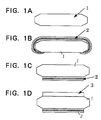
- a silicon wafer 1 is first prepared by a known manufacturing method (FIG. 1A).
- a chemically-etched wafer before it is mirror-polished is commonly used as this silicon wafer 1
- a mirror-polished wafer which is mirror-polished at one or both sides may be also employed.
- a CVD film 2 is deposited on the back surface of the silicon wafer through use of a CVD apparatus (FIG. 1B).
- the components and composition of a CVD film to be deposited are changed in the thicknesswise direction of the film.
- component x, y, or z in one film is changed in the thicknesswise direction of the CVD film.
- Such a CVD film is provided with superior gettering and autodoping-prevention capability, and source gases of such a CVD film are easy to obtain.
- the components and composition of the CVD film can be changed in the thicknesswise direction of a CVD film to be deposited by programming the CVD apparatus with regard to the deposition temperature, the deposition pressure, the deposition time, the type of reactive gas, or the flow rate in accordance with the application of the silicon wafer. Accordingly, the CVD film whose components and composition change in the thicknesswise direction thereof can be deposited on a silicon wafer in one process step or in a consecutive manner. In this event, the thickness of a CVD film to be deposited is preferably within the range of 50 to 500 nm. Further, the deposition temperature and pressure are preferably within the range of 100 to 450 °C and 0.1 to 10 torr, respectively.
- the front surface and the edge of the silicon wafer are mirror-polished (FIG. 1C).
- the CVD film deposited on the front surface of the silicon wafer to be mirror-polished can be finished at a very high speed, whereby the CVD film can be easily removed without impairing the flatness of the silicon wafer by polishing.
- a CVD film is deposited on the back surface of the silicon wafer so as not to pass around to the mirror-polished surface, whereby a step to mirror polish the front surface after the deposition of the CVD film can be omitted.
- a silicon monocrystalline rod produced by the Czochralski method [the silicon monocrystal has a (100) main face, a p-type conductivity, and a resistivity of 0.01 ⁇ ⁇ cm] was sliced to obtain four wafers (CZ wafers), which were then subjected to chamfering, lapping, and chemical etching processes.
- a silicon monocrystalline rod produced by the floating zone method [the silicon monocrystal has a (100) main face, an n-type conductivity, and a resistivity of 20 ⁇ ⁇ cm] was sliced to obtain eight wafers (FZ wafers), which were then subjected to chamfering, lapping, and chemical etching processes.
- a plasma CVD film which was comprised of a component Si and O and was grown through use of a plasma CVD apparatus: Growth Conditions:
- a plasma CVD film which was comprised of components Si, O, N and was grown through use of the plasma CVD apparatus: Growth Conditions:
- a polycrystalline silicon film grown through use of a low-pressure CVD apparatus Growth Conditions:
- a solution containing a plurality of heavy metal ions (iron, copper, chrome, and nickel ions) was applied to each front surface of the four types of wafers, so that the wafers were intentionally contaminated. Subsequently, they undergone heat treatment at 1000 °C for 1 hr, whereby the heavy metal ions were diffused into the wafer. Subsequently, after they had been subjected to heat treatment at 650 °C for 10 hrs., the concentration of heavy metals in each silicon wafer with the exception of its gettering layer was measured through use of the DLTS method (Deep Level Transient Spectroscopy) and the ICP-MS method (Inductively-coupled Plasma Mass Spectrometer). While the concentration of each heavy metal contained in the wafer without the gettering layer was used as a standard, the proportion of each heavy metal captured in each gettering layer was calculated from the resultant measurement of the concentration of each heavy metal.
- the concentration of each heavy metal contained in the wafer without the gettering layer was
- Table 2 shows the results of such calculation. Capability of gettering various heavy metals Iron Copper Chromium Nickel Example 1 99% 89% 85% 75% Example 2 99% 87% 85% 77% Comparative example 1 93% 72% 35% 25% Comparative example 2 0% 0% 0% 0% 0%
- Table 2 shows that the plasma CVD film in accordance with the present invention exhibits a sufficient gettering effect with respect to chromium and nickel in comparison with the polycrystalline silicon film of the comparative example 1 which exhibits an insufficient gettering effect. Accordingly, it is acknowledged that the plasma CVD film in accordance with the present invention possesses superior gettering capability than that of the polycrystalline silicon film.
- Table 3 shows the results of such calculation. Gettering capability Example 1 90% Example 2 90% Comparative example 1 70% Comparative example 2 0%
- Table 3 shows that the plasma CVD film in accordance with the present invention retains superior gettering capability after having undergone heat treatment in comparison with the polycrystalline silicon film of Comparative example 1; namely, the plasma CVD film is superior in the persistency of gettering capability.
- An epitaxial layer was grown on each of the four types of wafers under the following conditions through use of an epitaxial growth apparatus.
- Example 1 Example 2 Comparative example 1 Comparative example 2 Transition width 1.4 ⁇ m 1.4 ⁇ m 1.6 ⁇ m 2.5 ⁇ m
- Table 4 shows that the silicon wafer having the plasma CVD film in accordance with the present invention has a narrower transition width than that of the silicon wafer having the polycrystalline silicon film. It is acknowledged that the plasma CVD film in accordance with the present invention has superior autodoping-prevention capability at the time of epitaxial growth as well as superior gettering capability.
Landscapes
- Chemical Vapour Deposition (AREA)
- Mechanical Treatment Of Semiconductor (AREA)
Applications Claiming Priority (2)
| Application Number | Priority Date | Filing Date | Title |
|---|---|---|---|
| JP23587096A JP3454033B2 (ja) | 1996-08-19 | 1996-08-19 | シリコンウェーハおよびその製造方法 |
| JP235870/96 | 1996-08-19 |
Publications (2)
| Publication Number | Publication Date |
|---|---|
| EP0825639A2 true EP0825639A2 (de) | 1998-02-25 |
| EP0825639A3 EP0825639A3 (de) | 1999-05-26 |
Family
ID=16992475
Family Applications (1)
| Application Number | Title | Priority Date | Filing Date |
|---|---|---|---|
| EP97306225A Withdrawn EP0825639A3 (de) | 1996-08-19 | 1997-08-15 | Silizium-Wafer und dessen Herstellungsmethode |
Country Status (4)
| Country | Link |
|---|---|
| US (1) | US5998283A (de) |
| EP (1) | EP0825639A3 (de) |
| JP (1) | JP3454033B2 (de) |
| TW (1) | TW346653B (de) |
Cited By (1)
| Publication number | Priority date | Publication date | Assignee | Title |
|---|---|---|---|---|
| WO2004030060A1 (en) * | 2002-09-25 | 2004-04-08 | Siltronic Ag | Two layer lto temperature oxide backside seal for a wafer |
Families Citing this family (14)
| Publication number | Priority date | Publication date | Assignee | Title |
|---|---|---|---|---|
| US6376335B1 (en) * | 2000-02-17 | 2002-04-23 | Memc Electronic Materials, Inc. | Semiconductor wafer manufacturing process |
| JP4270713B2 (ja) * | 2000-05-09 | 2009-06-03 | 信越半導体株式会社 | シリコンエピタキシャルウェーハの製造方法 |
| US6715497B2 (en) * | 2001-01-02 | 2004-04-06 | International Business Machines Corporation | Treatment to eliminate polysilicon defects induced by metallic contaminants |
| US6576501B1 (en) | 2002-05-31 | 2003-06-10 | Seh America, Inc. | Double side polished wafers having external gettering sites, and method of producing same |
| JP2004327489A (ja) * | 2003-04-21 | 2004-11-18 | Shin Etsu Handotai Co Ltd | シリコン単結晶ウェーハ及びその製造方法 |
| US7250358B2 (en) * | 2004-08-06 | 2007-07-31 | Globitech Incorporated | Wafer for preventing the formation of silicon nodules and method for preventing the formation of silicon nodules |
| JP5347791B2 (ja) * | 2009-07-16 | 2013-11-20 | 信越半導体株式会社 | 半導体エピタキシャルウエーハの製造方法 |
| JP5795461B2 (ja) * | 2009-08-19 | 2015-10-14 | 株式会社Sumco | エピタキシャルシリコンウェーハの製造方法 |
| CN109216155A (zh) * | 2017-07-04 | 2019-01-15 | 上海新昇半导体科技有限公司 | 一种晶片背面密封的方法 |
| CN109216212A (zh) * | 2017-07-04 | 2019-01-15 | 上海新昇半导体科技有限公司 | 背面密封晶片的方法 |
| CN109216156B (zh) * | 2017-07-04 | 2020-12-15 | 上海新昇半导体科技有限公司 | 一种背面密封晶片的方法 |
| CN109216157A (zh) * | 2017-07-04 | 2019-01-15 | 上海新昇半导体科技有限公司 | 晶片背面密封的方法 |
| CN109904070B (zh) * | 2017-12-11 | 2021-04-20 | 有研半导体材料有限公司 | 一种大直径晶圆的衬底边缘处理方法 |
| CN113496871A (zh) * | 2020-04-03 | 2021-10-12 | 重庆超硅半导体有限公司 | 一种外延基底用硅晶片之背面膜层及制造方法 |
Family Cites Families (15)
| Publication number | Priority date | Publication date | Assignee | Title |
|---|---|---|---|---|
| US3663319A (en) * | 1968-11-20 | 1972-05-16 | Gen Motors Corp | Masking to prevent autodoping of epitaxial deposits |
| JPS4929099B1 (de) * | 1970-03-27 | 1974-08-01 | ||
| KR870000315B1 (ko) * | 1983-02-14 | 1987-02-26 | 몬산토 캄파니 | 반도체 기판재료 및 전자디바이스의 제조방법 |
| JPS59186331A (ja) * | 1983-04-04 | 1984-10-23 | モンサント・コンパニ− | 半導体基質及び製法 |
| US4608096A (en) * | 1983-04-04 | 1986-08-26 | Monsanto Company | Gettering |
| US4662956A (en) * | 1985-04-01 | 1987-05-05 | Motorola, Inc. | Method for prevention of autodoping of epitaxial layers |
| DE3717440A1 (de) * | 1987-05-23 | 1988-12-01 | Osaka Titanium | Halbleiter-plaettchen und verfahren zu seiner herstellung |
| US4925809A (en) * | 1987-05-23 | 1990-05-15 | Osaka Titanium Co., Ltd. | Semiconductor wafer and epitaxial growth on the semiconductor wafer with autodoping control and manufacturing method therefor |
| JPH042133A (ja) * | 1990-04-18 | 1992-01-07 | Mitsubishi Electric Corp | 結晶板 |
| DK170189B1 (da) * | 1990-05-30 | 1995-06-06 | Yakov Safir | Fremgangsmåde til fremstilling af halvlederkomponenter, samt solcelle fremstillet deraf |
| US5296385A (en) * | 1991-12-31 | 1994-03-22 | Texas Instruments Incorporated | Conditioning of semiconductor wafers for uniform and repeatable rapid thermal processing |
| DE4304849C2 (de) * | 1992-02-21 | 2000-01-27 | Mitsubishi Electric Corp | Halbleitervorrichtung und Verfahren zur Herstellung einer Halbleitervorrichtung |
| JPH06104268A (ja) * | 1992-09-21 | 1994-04-15 | Mitsubishi Electric Corp | ゲッタリング効果を持たせた半導体基板およびその製造方法 |
| JP2908150B2 (ja) * | 1992-11-27 | 1999-06-21 | 日本電気株式会社 | Soi基板構造及びその製造方法 |
| JP2827885B2 (ja) * | 1994-02-12 | 1998-11-25 | 信越半導体株式会社 | 半導体単結晶基板およびその製造方法 |
-
1996
- 1996-08-19 JP JP23587096A patent/JP3454033B2/ja not_active Expired - Fee Related
-
1997
- 1997-08-11 US US08/907,884 patent/US5998283A/en not_active Expired - Fee Related
- 1997-08-12 TW TW086111530A patent/TW346653B/zh active
- 1997-08-15 EP EP97306225A patent/EP0825639A3/de not_active Withdrawn
Cited By (4)
| Publication number | Priority date | Publication date | Assignee | Title |
|---|---|---|---|---|
| WO2004030060A1 (en) * | 2002-09-25 | 2004-04-08 | Siltronic Ag | Two layer lto temperature oxide backside seal for a wafer |
| KR100713112B1 (ko) * | 2002-09-25 | 2007-05-02 | 실트로닉 아게 | 2층 배면 실-포함 웨이퍼 및, 웨이퍼 상의 2층 lto 배면 실 형성 방법 |
| CN100409407C (zh) * | 2002-09-25 | 2008-08-06 | 硅电子股份公司 | 用于晶圆的两层lto背面密封 |
| US8007914B2 (en) | 2002-09-25 | 2011-08-30 | Siltronic Ag | Two layer LTO temperature oxide backside seal for a wafer |
Also Published As
| Publication number | Publication date |
|---|---|
| JP3454033B2 (ja) | 2003-10-06 |
| US5998283A (en) | 1999-12-07 |
| TW346653B (en) | 1998-12-01 |
| EP0825639A3 (de) | 1999-05-26 |
| JPH1064917A (ja) | 1998-03-06 |
Similar Documents
| Publication | Publication Date | Title |
|---|---|---|
| US5998283A (en) | Silicon wafer having plasma CVD gettering layer with components/composition changing in depth-wise direction and method of manufacturing the silicon wafer | |
| EP0635879B1 (de) | Verfahren zur Herstellung von Silizium-Halbleiterplättchen | |
| US5834363A (en) | Method of manufacturing semiconductor wafer, semiconductor wafer manufactured by the same, semiconductor epitaxial wafer, and method of manufacturing the semiconductor epitaxial wafer | |
| KR100460308B1 (ko) | 에피택셜성장 반도체웨이퍼의 제조방법 | |
| US5486237A (en) | Polysilicon thin film and method of preparing polysilicon thin film and photovoltaic element containing same | |
| US8241423B2 (en) | Silicon single crystal substrate and manufacture thereof | |
| Wong et al. | The poly‐single crystalline silicon interface | |
| KR20020062225A (ko) | 단결정 SiC, SiC 반도체 소자 및 SiC 복합 재료및 그 제조 방법 | |
| JP2003505317A (ja) | 改良された結晶特性を有するエピタキシャル半導体材料の成長方法 | |
| KR100808930B1 (ko) | 에피택셜 방식으로 코팅된 실리콘 웨이퍼의 제조 방법 | |
| US5882990A (en) | Manufacturing method for wafer slice starting material to optimize extrinsic gettering during semiconductor fabrication | |
| TW200525053A (en) | Process for producing highly doped semiconductor wafers, and dislocation-free, highly doped semiconductor wafers | |
| EP1533402B1 (de) | Epitaktischer wafer und herstellungsverfahren dafür | |
| EP3112504B1 (de) | Verfahren zur herstellung eines epitaktischen siliciumcarbidwafers | |
| EP0702401B1 (de) | Verfahren zur Herstellung eines für IGBT geeigneten Halbleiterplättchens | |
| US5653803A (en) | Method of manufacturing a substrate for manufacturing silicon semiconductor elements | |
| US5634973A (en) | Low temperature selective growth of silicon or silicon alloys | |
| JP3344205B2 (ja) | シリコンウェーハの製造方法及びシリコンウェーハ | |
| US8329532B2 (en) | Process for the simultaneous deposition of crystalline and amorphous layers with doping | |
| EP0798771A2 (de) | Silizium-Wafer mit einer amorphen Siliziumschicht und Verfahren zur Herstellung derselben durch plasma-aktivierte chemische Dampfabscheidung (PECVD) | |
| JP7322408B2 (ja) | 炭化珪素多結晶基板、炭化珪素多結晶膜の製造方法および炭化珪素多結晶基板の製造方法 | |
| EP0496382B1 (de) | Eigengetterung für ein epitaxiales Halbleiterplättchen | |
| Watts | The preparation and properties of elemental semiconductor thin films | |
| US20040124445A1 (en) | Semiconductor substrate and method of manufacture thereof | |
| EP0709878B1 (de) | Verfahren zur Herstellung von Einzelsubstraten aus einem Silizium-Halbleiterwafer |
Legal Events
| Date | Code | Title | Description |
|---|---|---|---|
| PUAI | Public reference made under article 153(3) epc to a published international application that has entered the european phase |
Free format text: ORIGINAL CODE: 0009012 |
|
| AK | Designated contracting states |
Kind code of ref document: A2 Designated state(s): DE FR GB IT |
|
| AX | Request for extension of the european patent |
Free format text: AL;LT;LV;RO;SI |
|
| PUAL | Search report despatched |
Free format text: ORIGINAL CODE: 0009013 |
|
| AK | Designated contracting states |
Kind code of ref document: A3 Designated state(s): AT BE CH DE DK ES FI FR GB GR IE IT LI LU MC NL PT SE |
|
| AX | Request for extension of the european patent |
Free format text: AL;LT;LV;RO;SI |
|
| 17P | Request for examination filed |
Effective date: 19991008 |
|
| AKX | Designation fees paid |
Free format text: DE FR GB IT |
|
| STAA | Information on the status of an ep patent application or granted ep patent |
Free format text: STATUS: THE APPLICATION IS DEEMED TO BE WITHDRAWN |
|
| 18D | Application deemed to be withdrawn |
Effective date: 20030301 |