EP0820159B1 - Satelliten-Kommunikationsanordnung mit paralleler concatenierter Kodierung - Google Patents
Satelliten-Kommunikationsanordnung mit paralleler concatenierter Kodierung Download PDFInfo
- Publication number
- EP0820159B1 EP0820159B1 EP97305229A EP97305229A EP0820159B1 EP 0820159 B1 EP0820159 B1 EP 0820159B1 EP 97305229 A EP97305229 A EP 97305229A EP 97305229 A EP97305229 A EP 97305229A EP 0820159 B1 EP0820159 B1 EP 0820159B1
- Authority
- EP
- European Patent Office
- Prior art keywords
- decoder
- code
- parallel concatenated
- communications system
- encoder
- Prior art date
- Legal status (The legal status is an assumption and is not a legal conclusion. Google has not performed a legal analysis and makes no representation as to the accuracy of the status listed.)
- Expired - Lifetime
Links
- 238000004891 communication Methods 0.000 title claims description 39
- 239000002131 composite material Substances 0.000 claims description 24
- 230000007480 spreading Effects 0.000 claims description 19
- 230000005540 biological transmission Effects 0.000 claims description 18
- 238000001228 spectrum Methods 0.000 claims description 17
- 230000009897 systematic effect Effects 0.000 claims description 11
- 230000007935 neutral effect Effects 0.000 claims description 2
- 238000000034 method Methods 0.000 description 20
- 239000013598 vector Substances 0.000 description 13
- 230000006870 function Effects 0.000 description 10
- 238000004422 calculation algorithm Methods 0.000 description 9
- 238000010586 diagram Methods 0.000 description 9
- 238000009826 distribution Methods 0.000 description 5
- 239000011159 matrix material Substances 0.000 description 5
- 230000008569 process Effects 0.000 description 5
- 238000012545 processing Methods 0.000 description 5
- 238000012937 correction Methods 0.000 description 4
- 230000033228 biological regulation Effects 0.000 description 3
- 230000003247 decreasing effect Effects 0.000 description 3
- 230000011664 signaling Effects 0.000 description 3
- 235000008694 Humulus lupulus Nutrition 0.000 description 2
- 230000003595 spectral effect Effects 0.000 description 2
- 230000007704 transition Effects 0.000 description 2
- 238000013459 approach Methods 0.000 description 1
- 230000015572 biosynthetic process Effects 0.000 description 1
- 238000004364 calculation method Methods 0.000 description 1
- 238000005094 computer simulation Methods 0.000 description 1
- 238000001514 detection method Methods 0.000 description 1
- 238000002474 experimental method Methods 0.000 description 1
- 230000004907 flux Effects 0.000 description 1
- 230000002452 interceptive effect Effects 0.000 description 1
- 229940050561 matrix product Drugs 0.000 description 1
- 230000009467 reduction Effects 0.000 description 1
- 238000005070 sampling Methods 0.000 description 1
- 238000003786 synthesis reaction Methods 0.000 description 1
Images


Classifications
-
- H—ELECTRICITY
- H04—ELECTRIC COMMUNICATION TECHNIQUE
- H04B—TRANSMISSION
- H04B7/00—Radio transmission systems, i.e. using radiation field
- H04B7/14—Relay systems
- H04B7/15—Active relay systems
- H04B7/185—Space-based or airborne stations; Stations for satellite systems
- H04B7/18528—Satellite systems for providing two-way communications service to a network of fixed stations, i.e. fixed satellite service or very small aperture terminal [VSAT] system
-
- H—ELECTRICITY
- H04—ELECTRIC COMMUNICATION TECHNIQUE
- H04L—TRANSMISSION OF DIGITAL INFORMATION, e.g. TELEGRAPHIC COMMUNICATION
- H04L1/00—Arrangements for detecting or preventing errors in the information received
- H04L1/004—Arrangements for detecting or preventing errors in the information received by using forward error control
- H04L1/0056—Systems characterized by the type of code used
- H04L1/0064—Concatenated codes
- H04L1/0065—Serial concatenated codes
-
- H—ELECTRICITY
- H03—ELECTRONIC CIRCUITRY
- H03M—CODING; DECODING; CODE CONVERSION IN GENERAL
- H03M13/00—Coding, decoding or code conversion, for error detection or error correction; Coding theory basic assumptions; Coding bounds; Error probability evaluation methods; Channel models; Simulation or testing of codes
- H03M13/29—Coding, decoding or code conversion, for error detection or error correction; Coding theory basic assumptions; Coding bounds; Error probability evaluation methods; Channel models; Simulation or testing of codes combining two or more codes or code structures, e.g. product codes, generalised product codes, concatenated codes, inner and outer codes
- H03M13/2957—Turbo codes and decoding
- H03M13/2996—Tail biting
-
- H—ELECTRICITY
- H04—ELECTRIC COMMUNICATION TECHNIQUE
- H04B—TRANSMISSION
- H04B7/00—Radio transmission systems, i.e. using radiation field
- H04B7/14—Relay systems
- H04B7/15—Active relay systems
- H04B7/185—Space-based or airborne stations; Stations for satellite systems
- H04B7/18578—Satellite systems for providing broadband data service to individual earth stations
- H04B7/1858—Arrangements for data transmission on the physical system, i.e. for data bit transmission between network components
-
- H—ELECTRICITY
- H04—ELECTRIC COMMUNICATION TECHNIQUE
- H04L—TRANSMISSION OF DIGITAL INFORMATION, e.g. TELEGRAPHIC COMMUNICATION
- H04L1/00—Arrangements for detecting or preventing errors in the information received
- H04L1/004—Arrangements for detecting or preventing errors in the information received by using forward error control
- H04L1/0056—Systems characterized by the type of code used
- H04L1/0064—Concatenated codes
- H04L1/0066—Parallel concatenated codes
-
- H—ELECTRICITY
- H04—ELECTRIC COMMUNICATION TECHNIQUE
- H04L—TRANSMISSION OF DIGITAL INFORMATION, e.g. TELEGRAPHIC COMMUNICATION
- H04L1/00—Arrangements for detecting or preventing errors in the information received
- H04L1/004—Arrangements for detecting or preventing errors in the information received by using forward error control
- H04L1/0056—Systems characterized by the type of code used
- H04L1/0067—Rate matching
- H04L1/0068—Rate matching by puncturing
-
- H—ELECTRICITY
- H03—ELECTRONIC CIRCUITRY
- H03M—CODING; DECODING; CODE CONVERSION IN GENERAL
- H03M13/00—Coding, decoding or code conversion, for error detection or error correction; Coding theory basic assumptions; Coding bounds; Error probability evaluation methods; Channel models; Simulation or testing of codes
- H03M13/29—Coding, decoding or code conversion, for error detection or error correction; Coding theory basic assumptions; Coding bounds; Error probability evaluation methods; Channel models; Simulation or testing of codes combining two or more codes or code structures, e.g. product codes, generalised product codes, concatenated codes, inner and outer codes
- H03M13/2957—Turbo codes and decoding
- H03M13/296—Particular turbo code structure
- H03M13/2966—Turbo codes concatenated with another code, e.g. an outer block code
Definitions
- the present invention relates generally to satellite communications systems and, more particularly, to a very small aperture terminal satellite communications system employing parallel concatenated coding on its inbound or outbound links, or both.
- VSAT very small aperture terminals
- Advantages of utilizing a smaller antenna than is currently the general practice in the industry today include a reduced reflector cost, lower shipping costs, reduced mounting hardware and labor, and greater customer acceptance due to a less obtrusive appearance.
- the use of a smaller-aperture dish antenna can cause an undesirable reduction in network capacity. This is due to several causes related to the reduced antenna size: (1) decreased received and transmitted signal power caused by the associated decrease in antenna gain; and (2) Federal Communications Commission (FCC) regulations limiting the power transmitted by a VSAT utilizing an antenna smaller than a specified size in order to limit the interfering power flux density at adjacent satellite orbital slots.
- FCC Federal Communications Commission
- the use of a VSAT power amplifier with the same or less power output in order to reduce VSAT cost further contributes to the decrease in network capacity due to power limitations.
- V et al (“Channel coding for VSAT systems", lEE Proceedings: Communications, Vol 142, No 5, pages 333 to 339, October 1995) discloses a satellite communications system which uses concatenated coding, and specifically the use of trellis-coded modulation (TCM) and Reed-Solomon (RS) codes in combination.
- TCM trellis-coded modulation
- RS Reed-Solomon
- EP-A-0650270 discloses a satellite communications system which uses concatenated coding for the transmission of digital data.
- US-A-5446747 discloses a satellite communications system which uses parallel concatenated coding for the transmission of digital data.
- a VSAT satellite communications network utilizes parallel concatenated coding on its inbound or outbound links, or both.
- nonrecursive systematic tail-biting convolutional codes are used as the component codes in such a parallel concatenated coding scheme.
- the VSAT and network's hub terminal utilize recursive systematic convolutional codes.
- the aforementioned parallel concatenated coding techniques are used in conjunction with spread-spectrum modulation, resulting in a system which meets FCC regulations on the total power spectral density of transmitted signals and mitigates interference from adjacent satellites.
- the present invention provides a VSAT communications system for communication via a satellite, comprising: a plurality of VSAT terminals, each comprising: a parallel concatenated encoder comprising a plurality of component encoders which are connected in a parallel concatenation and apply a parallel concatenated convolutional code to a block of data bits received from a source and generate component codewords therefrom, wherein the parallel concatenated convolutional code comprises tail-biting nonrecursive systematic codes, and a codeword formatter for formatting the bits of the component codewords to provide a composite codeword; a packet formatter for assembling data packets for transmission, each data packet comprising bits from at least one composite codeword; a modulator for receiving the data packets and providing modulated signals therefrom; an up-converter for translating modulated signals to a carrier frequency; an interface for connecting each respective VSAT terminal to an antenna for transmitting modulated signals to the satellite and receiving modulated signals from the satellite; a down-converter for translating each received
- the present invention provides a VSAT communications system for communication via a satellite, comprising: a plurality of VSAT terminals, each comprising: a parallel concatenated encoder comprising a plurality of component encoders which are connected in a parallel concatenation and apply a parallel concatenated convolutional code to a block of data bits received from a source and generate component codewords therefrom, wherein the parallel concatenated convolutional code comprises recursive systematic codes, and a codeword formatter for formatting the bits of the component codewords to provide a composite codeword; a packet formatter for assembling data packets for transmission, each data packet comprising bits from at least one composite codeword; a modulator for receiving the data packets and providing modulated signals therefrom; an up-converter for translating modulated signals to a carrier frequency, an interface for connecting each respective VSAT terminal to an antenna for transmitting modulated signals to the satellite and receiving modulated signals from the satellite; a down-converter for translating each received signal from the carrier
- the invention described herein is a VSAT satellite communications system utilizing parallel concatenated coding techniques involving, for example, parallel concatenated tail-biting convolutional codes and parallel concatenated recursive systematic convolutional codes (i.e., so-called "turbo codes"), and their respective decoders.
- a decoder comprising circular MAP decoding is employed, such as described in commonly assigned, copending U.S. Pat. Application No. 08/636,742 of Stephen M. Hladik and John B. Anderson, filed April 19, 1996 (US-A-5 721 746)
- Parallel concatenated coding is used on the inbound-link transmissions (VSAT-to-hub) or outbound-link transmissions (hub-to-VSAT) or both links of a VSAT satellite communications network.
- parallel concatenated coding can be utilized to provide error correction/detection coding for direct peer-to-peer (VSAT-to-VSAT) transmissions.
- nonrecursive systematic tail-biting convolutional codes are used as the component codes in a parallel concatenated coding scheme.
- parallel concatenated coding comprising recursive systematic convolutional codes is utilized by the VSATs and the network's hub terminal.
- the use of these parallel concatenated coding techniques in conjunction with spread-spectrum modulation provides a very effective solution to facilitate compliance with the aforementioned FCC regulations on adjacent satellite interference by decreasing the required effective radiated power (ERP) and the power spectral density of the transmitted signal.
- ERP effective radiated power
- this combination mitigates interference from adjacent satellites.
- FIG. 1 is a block diagram of a VSAT satellite communications system that employs parallel concatenated coding in accordance with the present invention.
- This system fundamencally comprises a number of VSAT terminals 10, a satellite 12 with a communications transponder, and possibly a hub terminal 14.
- Communication within the VSAT network may be either one-way or two-way and may travel in a variety of paths: (1) VSAT-to-VSAT directly (i.e., mesh connectivity) and (2) VSAT-to-hub-terminal and/or hub-terminal-to-VSAT (i.e., star connectivity).
- a VSAT terminal 10 comprises transmitter signal processing 20, receiver signal processing 22 and an antenna 24.
- the VSATs transmitter signal processing comprises the following: an input port 25 for accepting data from an information source 26; an encoder 28 that applies a parallel concatenated code to blocks of data bits received from the source; a packet formatter 30 for generating a data packet (comprising one or more codewords from encoder 28), a synchronization bit pattern and control signaling bits; a modulator 32; an up-converter 34 for translating the modulated signal to the carrier frequency; a power amplifier 36; and connection to antenna 24 via an appropriate interface (e.g., a switch or filter duplexer).
- an appropriate interface e.g., a switch or filter duplexer
- the VSAT's receiver signal processing comprises: a low-noise amplifier 40, a down-converter 42 for translating the received signal from the carrier frequency to an intermediate frequency, a demodulator 44 for synchronization and demodulation, a packet-to-codeword - formatter 46, a decoder 48 suitable for the parallel concatenated code utilized by the transmitter, and an output port 49 for transferring received messages (i.e., blocks of data bits) to an information sink 50.
- a low-noise amplifier 40 for translating the received signal from the carrier frequency to an intermediate frequency
- a demodulator 44 for synchronization and demodulation
- a packet-to-codeword - formatter 46 for synchronization and demodulation
- a decoder 48 suitable for the parallel concatenated code utilized by the transmitter
- an output port 49 for transferring received messages (i.e., blocks of data bits) to an information sink 50.
- received messages i.e., blocks of data bits
- the synchronization functions performed by demodulator 44 include carrier frequency synchronization, frame synchronization, symbol synchronization, and, if needed, carrier phase synchronization.
- Symbol synchronization is the process of estimating the best sampling time (i.e., the symbol epoch) for the demodulator output in order to minimize the probability of a symbol decision error.
- Frame synchronization is the process of estimating the symbol epoch for the first symbol in a received data frame (for continuous transmissions) or packet (for discontinuous transmissions).
- the VSAT modulator shown in FIG. 1 includes the spreading function; and the VSAT demodulator shown in FIG. 1 includes the despreading function.
- Spread spectrum techniques increase the signal bandwidth relative to the bandwidth of the modulated data signal by imposing a spreading signal comprising chips (in the case of direct sequence spread spectrum) or hops (in the case of frequency hopping spread spectrum) that are pseudorandom and independent of the data signal.
- chips in the case of direct sequence spread spectrum
- hops in the case of frequency hopping spread spectrum
- the data signal is multiplied by a signal that corresponds to a pseudorandom sequence of chips having the values of +1 or -1.
- the duration of the chip pulses is less than the symbol interval of the modulated data signal; hence, the resulting signal's bandwidth is greater than that of the original modulated signal.
- frequency hopping spread spectrum the carrier frequency of the modulated signal is changed periodically according to a pseudorandom pattern. Again, the bandwidth of the spread signal is greater than that of the original modulated signal.
- Despreading in the demodulator is the process of removing the spreading from the received signal.
- the demodulator correlates the received signal with a replica of the spreading waveform to despread a direct sequence spread spectrum signal, while in a frequency hopping spread spectrum system, it hops the frequency of an oscillator in the receiver's down converter using the same pattern employed by the transmitting terminal to despread a frequency hopped spread spectrum signal.
- a filter is applied to the received signal after despreading to attenuate wide-band noise and interference components in the recovered signal.
- FIG. 2 A block diagram of the hub terminal is presented in FIG. 2.
- it comprises: input ports 51 for accepting data from one or more information sources 52; output ports 53 for transferring received messages (i.e., blocks of data bits) to one or more information sinks 54; a bank of transmitter channel processors 56; a bank of receiver channel processors 58; a switch 60 for connecting each active source to a transmitter channel processor and for connecting each active receiver channel processor to the appropriate information sink or a transmitter channel processor, a memory 62; a controller 64 for controlling the flow of data through the switch; a combiner 66 for combining the signals generated by each transmitter channel processor into one signal; an up-converter 68 for translating the combined signals to the carrier frequency; a power amplifier 70 connected to the antenna via an appropriate interface (e.g., a switch or filter duplexer); an antenna 72; a low-noise amplifier 74 that is coupled to the antenna via the aforementioned interface; a down-converter 76 for translating the received signal from the carrier
- the transmitter channel processor shown in FIG. 2 comprises: an encoder 80 that applies a parallel concatenated code to blocks of data bits received from a source; a packet formatter 82 for generating a data packet (comprising one or more codewords from encoder 80), a synchronization bit pattern and control signaling bits; and a modulator 84.
- the hub's modulators include the spreading function for the case in which spread spectrum signals are transmitted by the hub.
- the hub 2 comprises a demodulator 86, a packet-to-codeword converter 88 for selecting samples from the demodulator output to form the received codewords that are inputted to a decoder for parallel concatenated codes, and a decoder 90 suitable for the parallel concatenated code utilized by the transmitter.
- the hub's demodulators include several functions: synchronization, demodulation, and, for the case in which the hub receives spread spectrum signals, despreading.
- the hub's memory One function of the hub's memory is to temporarily store data received from the information sources or receiver channel processors in the event that all transmitter channel processors or output ports are busy when a message arrives at switch 60.
- the memory also stores necessary network configuration parameters and operational data.
- an outer code is used in series concatenation with the (inner) parallel concatenated code (PCC); an associated outer decoder is also connected in series concatenation with the decoder for the inner PCC.
- PCC parallel concatenated code
- VSAT and hub equipment may be utilized by the VSAT and hub equipment for implementing several options:
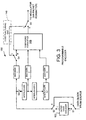
- FIG. 3 illustrates a block diagram of a flexible, programmable encoder that implements these four coding options.
- the flexible, programmable encoder comprises an encoder 100 for parallel concatenated codes, an encoder 102 for an outer code, and five switches S1-S5.
- Encoder 100 for parallel concatenated codes comprises N encoders. N-1 interleavers, and a codeword formatter 106. Table I as follows summarizes the switch positions for various modes of encoder operation.
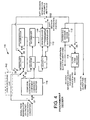
- FIG. 4 is a block diagram of a flexible, programmable decoder that implements the decoders for the four encoder modes presented hereinabove.
- This programmable composite decoder comprises a decoder 110 for parallel concatenated codes, a threshold decision device 112 for implementing a decision rule, a decoder 114 for an outer code, and six switches S1-S6.
- an exemplary decision rule is: If the output is greater than 1/2, then decide that the decoded bit is zero; if less than 1/2, then assign the value one; if equal to 1/2, then arbitrarily assign a value.
- Decoder 110 for parallel concatenated codes further comprises a composite codeword to component codeword converter 116, N component decoders, N-1 interleavers and two identical deinterleavers 118.
- Each deinterleaver has a reordering function that returns a sequence of data elements that have been permuted by the N-1 interleavers connected in series to their original order.
- Table II as follows summarizes the switch positions for various modes of decoder operation.
- the VSATs utilize different codes (e.g., PCCC, tail-biting PCCC, recursive systematic convolutional, nonrecursive systematic convolutional, block codes) in different combinations (e.g., modes 1, 2, 3, and 4), depending on the communication application and required transmission rates.
- codes e.g., PCCC, tail-biting PCCC, recursive systematic convolutional, nonrecursive systematic convolutional, block codes
- the programmable encoder of FIG. 3 may also include puncturing via a known pattern to increase the rate of the resulting code, and the programmable decoder of FIG. 4 may also include the associated depuncturing function.
- the codeword formatter of FIG. 3 deletes code bits from the component codewords according to the desired puncturing patterns.
- the PCC decoder's composite codeword to component codeword converter inserts neutral values for the punctured bits in the component codewords that it outputs to the component decoders.
- FIGs. 3 and 4 show puncturing unit 140 and depuncturing unit 142, respectively, in phantom for implementing these puncturing and depuncturing functions, respectively, when a punctured convolutional code is used in Mode 3 or Mode 4.
- convolutional codes are used as the component codes in an inner parallel concatenated code, and a block code (e.g., a Reed-Solomon code or BCH code) is used as an outer code in serial concatenation.
- a block code e.g., a Reed-Solomon code or BCH code
- a random channel access protocol such as ALOHA is used in conjunction with code division multiple access.
- the hub receiver utilizes a number of demodulators for each spreading code in order to receive time-overlapping signals that udlize time-delayed versions of the same spreading sequence.
- Each demodulator for a given spreading sequence demodulates a signal using a different time shift of that spreading sequence.
- one or more spreading sequences are reserved for use by VSAT's over specified periods of time on an assigned basis in order to provide higher-quality channels with greater throughput. Reservation requests from the VSATs and assignments are processed by a network controller that is connected to a hub terminal.
- the system associates a given spreading sequence with a particular error correcting code to allow different signals to utilize different error correcting codes simultaneously. Since each detected signal's spreading sequence is identified by a corresponding demodulator, the receiver can appropriately configure the programmable decoder for each detected signal. This mode of network operation is useful for simultaneously supporting several applications having different error correction coding requirements without the need for additional control signaling.
- a circular MAP decoder useful as the component decoders in FIG. 4 is described in commonly assigned, copending U.S. Patent Application No. 08/636,742.
- the circular MAP decoder can deliver both an estimate of the encoded data block and reliability information to a data sink, e.g., a speech synthesis signal processor for use in transmission error concealment or protocol processor for packet data as a measure of block error probability for use in repeat request decisions.
- a data sink e.g., a speech synthesis signal processor for use in transmission error concealment or protocol processor for packet data as a measure of block error probability for use in repeat request decisions.
- the circular MAP decoder is useful for decoding tail-biting convolutional codes, particularly when they are used as component codes in a parallel concatenated coding scheme.
- a circular MAP decoder for error-correcting trellis codes that employ tail biting according to U.S. Patent Application No. 08/636,742 produces soft-decision outputs.
- the circular MAP decoder provides an estimate of the probabilities of the states in the first stage of the trellis, which probabilities replace the a priori knowledge of the starting state in a conventional MAP decoder.
- the circular MAP decoder provides the initial state probability distribution in either of two ways. The first involves a solution to an eigenvalue problem for which the resulting eigenvector is the desired initial state probability distribution; with knowledge of the starting state, the circular MAP decoder performs the rest of the decoding according to the conventional MAP decoding algorithm.
- the second is based on a recursion for which the iterations converge to a starting state distribution.
- a state on the circular sequence of states is known with high probability, and the circular MAP decoder performs the rest of the decoding according to the conventional MAP decoding algorithm which is set forth in "Optimal Decoding of Linear Codes for Minimizing Symbol Error Rate," by Bahl, Cocke, Jelinek and Raviv, IEEE Transactions on Information Theory, pp. 284-287. March 1974.
- the objective of the conventional MAP decoding algorithm is to find the condidonal probabilities: P ⁇ state m at time t / receive channel outputs y l , ... , y L ⁇ .
- L in this expression represents the length of the data block in units of the number of encoder symbols.
- the encoder for an (n, k) code operates on k-bit input symbols to generate n -bit output symbols.
- the term y t is the channel output (symbol) at time t.
- the matrix ⁇ l is calculated as a function of the channel transition probability R(Y t , X), the probability p t (m / m') that the encoder makes a transition from state m' to m at time t , and the probability q t (X / m',m) that the encoder's output.
- symbol is X given that the previous encoder state is m' and the present encoder state is m.
- the MAP decoder calculates L of these matrices, one for each trellis stage. They are formed from the received channel output symbols and the nature of the trellis branches for a given code.
- Y 1 L ⁇ to the following decision rule: P ⁇ d t j 0
- Y 1 L ⁇ ⁇ 1 2 , then d ⁇ t j 1 ; otherwise, arbitrarily assign d t j the value 0 or 1.
- One embodiment of the circular MAP decoder determines the initial state probability distribution by solving an eigenvalue problem as follows. Let ⁇ t , ⁇ t , ⁇ t and ⁇ t be as before, but take the initial ⁇ 0 and ⁇ L as follows:
- this formula expresses a relationship among probabilities, the product of ⁇ t matrices on the right has largest eigenvalue equal to P ⁇ Y 1 L ⁇ , and that the corresponding eigenvector must be a probability vector.
- An alternative embodiment of the circular MAP decoder determines the state probability distributions by a recursion method.
- the recursion continues until decoder convergence is detected.
- steps (ii) and (iii) of the eigenvector method described hereinabove are replaced as follows:
- the recursion method is modified so that the decoder only needs to process a predetermined, fixed number of trellis stages for a second time, that is, a predetermined wrap depth. This is advantageous for implementation purposes because the number of computations required for decoding is the same for every encoded message block. Consequently, hardware and software complexities are reduced.
- One way to estimate the required wrap depth for MAP decoding of a tail-biting convolutional code is to determine it from hardware or software experimentation, requiring that a circular MAP decoder with a variable wrap depth be implemented and experiments be conducted to measure the decoded bit error rate versus E b /N o for successively increasing wrap depths.
- the minimum decoder wrap depth that provides the minimum probability of decoded bit error for a specified E b /N o is found when further increases in wrap depth do not decrease the error probability.
- wrap depth search described hereinabove may simply be terminated when the desired average probability of bit error is obtained.
- correct path refers to the sequence of states or a path through the trellis that results from encoding a block of data bits.
- corrected subset of a node refers to the set of all incorrect (trellis) branches out of a correct path node and their descendants. Both the decision depths defined below depend on the convolutional encoder.
- the decision depths are defined as follows:
- the significance of LU(e) for soft-decision circular MAP decoding is that the probability of identifying a state on the actual transmitted path is high after the decoder processes LU(e) trellis stages. Therefore, the minimum wrap depth for circular MAP decoding is LU(e). Calculations of the depth LU(e) show that it is always larger than LF(e) but that it obeys the same approximate law. This implies that the minimum wrap depth can be estimated as the forward decision depth LF(e) if the unmerged decision depth of a code is not known.
- a preferred embodiment of the circular MAP decoder algorithm based on recursion comprises the following steps:
- step (v) set forth hereinabove with respect to the eigenvector method to produce the soft-decisions and decoded bits output by the circular MAP decoder.
Landscapes
- Engineering & Computer Science (AREA)
- Computer Networks & Wireless Communication (AREA)
- Signal Processing (AREA)
- Physics & Mathematics (AREA)
- Astronomy & Astrophysics (AREA)
- Aviation & Aerospace Engineering (AREA)
- General Physics & Mathematics (AREA)
- Probability & Statistics with Applications (AREA)
- Theoretical Computer Science (AREA)
- Error Detection And Correction (AREA)
- Radio Relay Systems (AREA)
Claims (10)
- VSAT-Kommunikationssystem zur Kommunikation über einen Satelliten (12), mit:mehreren VSAT-Endgeräten (10), von denen jedes aufweist:- einen parallel verketteten Codierer (28, 100), mit mehreren Komponentenkodierern, die in einer parallelen Verkettung miteinander verschaltet sind und einen parallel verketteten Faltungscode auf einen Block Datenbits anwenden, der von einer Quelle (26) empfangen wurde, und daraus Komponentencodewörter erzeugen, wobei der parallel verkettete Faltungscode nicht rekursive systematische Tailbiting-Codes enthält, und einem Codewortformatierer (106) zum Formatieren der Bits der Komponentencodewörter zum Liefern eines zusammengesetzten Codeworts;- einen Paketformatierer (30) zum Zusammensetzen von Datenpaketen zur Übertragung, wobei jedes Datenpaket Bits aus mindestens einem zusammengesetzten Codewort enthält;- einen Modulator (32) zum Empfangen der Datenpakete und zum Liefern modulierter Signale aus diesen;- einen Aufwärtsmischer (34) zum Umsetzen modulierter Signale in eine Trägerfrequenz;- eine Schnittstelle zum Verbinden jedes entsprechenden VSAT-Endgeräts (10) mit einer Antenne (24) zum Senden modulierter Signale an den Satelliten (12) und zum Empfangen modulierter Signale vom Satelliten (12);- einen Abwärtsmischer (42) zum Umsetzen jedes empfangenen Signals von der Trägerfrequenz in eine Zwischenfrequenz;- einen Demodulator (44) zum Synchronisieren mit den empfangenen Signalen und zum Demodulieren der empfangenen Signale;- einen Paket-zu-Codewort-Formatierer (46) zum Bilden empfangener zusammengesetzter Codewörter aus den demodulierten Signalen; und- einen zusammengesetzten Decodierer (48, 110) mit mehreren Komponentendecodierern zum Decodieren der empfangenen zusammengesetzten Codewörter.
- Kommunikationssystem nach Anspruch 1, wobei die Komponentendecodierer zirkuläre MAP-Decodierer umfassen.
- VSAT-Kommunikationssystem zur Kommunikation über einen Satelliten (12), mit:mehreren VSAT-Endgeräten (10), von denen jedes aufweist:- einen parallel verketteten Kodierer (28, 100), mit mehreren Komponentenkodierern, die in einer parallelen Verkettung miteinander verschaltet sind und einen parallel verketteten Faltungscode auf einen Block Datenbits anwenden, der von einer Quelle (26) empfangen wurde, und daraus Komponentencodewörter erzeugen, wobei der parallel verkettete Faltungscode rekursive systematische Codes enthält, und einem Codewortformatierer (106) zum Formatieren der Bits der Komponentencodewörter zum Liefern eines zusammengesetzten Codeworts;- einen Paketformatierer (30) zum Zusammensetzen von Datenpaketen zur Übertragung, wobei jedes Datenpaket Bits aus mindestens einem zusammengesetzten Codewort enthält;- einen Modulator (32) zum Empfangen der Datenpakete und zum Liefern modulierter Signale aus diesen;- einen Aufwärtsmischer (34) zum Umsetzen modulierter Signale in eine Trägerfrequenz;- eine Schnittstelle zum Verbinden jedes entsprechenden VSAT-Endgeräts (10) mit einer Antenne (24) zum Senden modulierter Signale an den Satelliten (12) und zum Empfangen modulierter Signale vom Satelliten (12);- einen Abwärtsmischer (42) zum Umsetzen jedes empfangenen Signals von der Trägerfrequenz in eine Zwischenfrequenz;- einen Demodulator (44) zum Synchronisieren mit den empfangenen Signalen und zum Demodulieren der empfangenen Signale;- einen Paket-zu-Codewort-Formatierer (46) zum Bilden empfangener zusammengesetzter Codewörter aus den demodulierten Signalen; und- einen zusammengesetzten Decodierer (48, 110) mit mehreren Komponentendecodierern zum Decodieren der empfangenen zusammengesetzten Codewörter.
- Kommunikationssystem nach Anspruch 1 oder 3, wobei der Modulator (32) einen Spreizspektrumsmodulator umfasst und der Demodulator (44) einen Entspreizungsdemodulator umfasst.
- Kommunikationssystem nach Anspruch 1 oder 3, wobei der parallel verkettete Code einen inneren parallel verketteten Code umfasst, der in einer seriellen Verkettung mit einem äußeren Code verbunden ist, und der Decodierer (48, 110) einen inneren Decodierer (110), der dem inneren parallel verketteten Code zugeordnet ist, und einen äußeren Decodierer (114), der dem äußeren seriell verketteten Code zugeordnet ist, umfasst.
- Kommunikationssystem nach Anspruch 1 oder 3, wobei der Codierer (28, 100) und der Decodierer (48, 110) ein programmierbares Codierer-Decodierer-System umfassen, das mehrere Codierungsoptionen aufweist, die über Schalter (S1-S5, S1-S6) auswählbar sind.
- Kommunikationssystem nach Anspruch 6, wobei die Schalter (S1-S5, S1-S6) eingestellt werden, um eine von vier Codierungs- bzw. Dekodierungs-Optionen auszuwählen:(1) parallel verkettete Codierung;(2) ein äußerer Code, der seriell mit einem inneren parallel verketteten Code verkettet ist;(3) seriell verkettete Codierung mit einem äußeren Codierer und einem inneren Einzelkomponentencodierer; und(4) ein Einzelcode, so dass nur ein Komponentencodierer verwendet wird.
- Kommunikationssystem nach Anspruch 6, wobei der Modulator (32) eines jeden VSAT-Endgeräts (10) einen Spreizspektrumsmodulator zum Anwenden einer aus mehreren Spreizsequenzen auf jedes zu übertragende Datenpaket, wobei die Spreizsequenzen in Sätze gruppiert werden, wobei jeder Satz mindestens eine Spreizsequenz umfasst und jeder Satz von Spreizsequenzen einer der Codierungsoptionen zugeordnet ist, und ferner aufweist:mindestens eine Zentralstation (14) mit:wobei die Zentralstation (14) zum Demodulieren und Decodieren von Signalen betrieben wird, die von dem Satelliten (12) empfangen werden, die in sich zeitlich überlagernden Intervallen übertragen werden und jeweils eine der Codierungsoptionen und eine der ihnen zugeordneten Spreizsequenzen einsetzen, wobei die Decodierer (90) auf der Grundlage der vom Entspreizungs-Demodulator (84) identifizierten Spreizsequenz für jedes empfangene Signal konfiguriert sind.- mindestens einem Entspreizungsdemodulator (84) für jede Spreizsequenz; und- mehreren Decodierern (90);
- Kommunikationssystem nach Anspruch 1 oder 3, ferner mit:mindestens einer Zentralstation (14) zum Vorsehen einer Sternverbindungsmöglichkeit.
- Kommunikationssystem nach Anspruch 1 oder 3, wobei der parallel verkettete Codierer (28, 100) ferner eine Punktierungsfunktion (140) zum Löschen von Codebits aus den Komponentencodewörtern gemäß einem vorbestimmten Punktierungsmuster aufweist und der zusammengesetzte Decodierer (110) eine Entpunktierungsfunktion (142) zum Einsetzen von neutralen Werten für die punktierten Bits in den Komponentencodewörtern aufweist.
Applications Claiming Priority (2)
| Application Number | Priority Date | Filing Date | Title |
|---|---|---|---|
| US08/684,276 US5734962A (en) | 1996-07-17 | 1996-07-17 | Satellite communications system utilizing parallel concatenated coding |
| US684276 | 1996-07-17 |
Publications (3)
| Publication Number | Publication Date |
|---|---|
| EP0820159A2 EP0820159A2 (de) | 1998-01-21 |
| EP0820159A3 EP0820159A3 (de) | 2003-07-09 |
| EP0820159B1 true EP0820159B1 (de) | 2006-05-31 |
Family
ID=24747407
Family Applications (1)
| Application Number | Title | Priority Date | Filing Date |
|---|---|---|---|
| EP97305229A Expired - Lifetime EP0820159B1 (de) | 1996-07-17 | 1997-07-15 | Satelliten-Kommunikationsanordnung mit paralleler concatenierter Kodierung |
Country Status (21)
| Country | Link |
|---|---|
| US (1) | US5734962A (de) |
| EP (1) | EP0820159B1 (de) |
| JP (1) | JP3833783B2 (de) |
| KR (1) | KR100496232B1 (de) |
| CN (1) | CN1113486C (de) |
| AR (1) | AR008403A1 (de) |
| AU (1) | AU718266B2 (de) |
| BR (1) | BR9704012A (de) |
| CA (1) | CA2208413C (de) |
| CZ (1) | CZ290425B6 (de) |
| DE (1) | DE69735979T2 (de) |
| ES (1) | ES2264153T3 (de) |
| HU (1) | HUP9701215A3 (de) |
| ID (1) | ID17541A (de) |
| IL (1) | IL121232A (de) |
| MX (1) | MX9705401A (de) |
| NO (1) | NO320121B1 (de) |
| PL (1) | PL184615B1 (de) |
| RU (1) | RU2191471C2 (de) |
| UA (1) | UA44752C2 (de) |
| ZA (1) | ZA975952B (de) |
Families Citing this family (129)
| Publication number | Priority date | Publication date | Assignee | Title |
|---|---|---|---|---|
| US6023783A (en) * | 1996-05-15 | 2000-02-08 | California Institute Of Technology | Hybrid concatenated codes and iterative decoding |
| US6189123B1 (en) * | 1997-03-26 | 2001-02-13 | Telefonaktiebolaget Lm Ericsson | Method and apparatus for communicating a block of digital information between a sending and a receiving station |
| US5983384A (en) * | 1997-04-21 | 1999-11-09 | General Electric Company | Turbo-coding with staged data transmission and processing |
| CA2262894C (en) * | 1997-06-19 | 2004-08-03 | Kabushiki Kaisha Toshiba | Information data multiplexing transmission system, multiplexer and demultiplexer used therefor, and error correcting encoder and decoder |
| KR19990003242A (ko) | 1997-06-25 | 1999-01-15 | 윤종용 | 구조적 펀처드 길쌈부호 부호와 및 복호기 |
| KR100387078B1 (ko) * | 1997-07-30 | 2003-10-22 | 삼성전자주식회사 | 대역확산통신시스템의심볼천공및복구장치및방법 |
| US6192503B1 (en) * | 1997-08-14 | 2001-02-20 | Ericsson Inc. | Communications system and methods employing selective recursive decording |
| JP4033245B2 (ja) * | 1997-09-02 | 2008-01-16 | ソニー株式会社 | ターボ符号化装置およびターボ符号化方法 |
| US6031874A (en) * | 1997-09-26 | 2000-02-29 | Ericsson Inc. | Unequal error protection in coded modulation schemes |
| US6157642A (en) * | 1997-10-14 | 2000-12-05 | Teledesic Llc | Coding system and method for low-earth orbit satellite data communication |
| US6000054A (en) * | 1997-11-03 | 1999-12-07 | Motorola, Inc. | Method and apparatus for encoding and decoding binary information using restricted coded modulation and parallel concatenated convolution codes |
| US6643331B1 (en) * | 1997-12-24 | 2003-11-04 | Inmarsat Ltd. | Coding method and apparatus |
| US6263466B1 (en) | 1998-03-05 | 2001-07-17 | Teledesic Llc | System and method of separately coding the header and payload of a data packet for use in satellite data communication |
| KR100557177B1 (ko) * | 1998-04-04 | 2006-07-21 | 삼성전자주식회사 | 적응 채널 부호/복호화 방법 및 그 부호/복호 장치 |
| CA2234006C (en) * | 1998-04-06 | 2004-10-19 | Wen Tong | Encoding and decoding methods and apparatus |
| FR2778040B1 (fr) * | 1998-04-28 | 2000-05-26 | Alsthom Cge Alcatel | Procede et dispositif de codage correcteur d'erreur pour des transmissions de donnees numeriques a debit eleve, et procede et dispositif de decodage correspondant |
| US6324159B1 (en) * | 1998-05-06 | 2001-11-27 | Sirius Communications N.V. | Method and apparatus for code division multiple access communication with increased capacity through self-noise reduction |
| CA2273608C (en) * | 1998-06-01 | 2007-08-07 | Stewart N. Crozier | Reduced-complexity max-log app decoders and related turbo decoders |
| AU4981499A (en) * | 1998-07-09 | 2000-02-01 | Act Wireless | Satellite network terminal |
| WO2000007323A1 (en) * | 1998-07-30 | 2000-02-10 | Vocal Technologies, Ltd. | Forward error correcting system with encoders configured in parallel and/or series |
| US6043788A (en) * | 1998-07-31 | 2000-03-28 | Seavey; John M. | Low earth orbit earth station antenna |
| JP2000068863A (ja) | 1998-08-19 | 2000-03-03 | Fujitsu Ltd | 符号化装置及びその方法 |
| JP2000068862A (ja) | 1998-08-19 | 2000-03-03 | Fujitsu Ltd | 誤り訂正符号化装置 |
| US6223319B1 (en) | 1998-08-20 | 2001-04-24 | General Electric Company | Turbo code decoder with controlled probability estimate feedback |
| US6192501B1 (en) | 1998-08-20 | 2001-02-20 | General Electric Company | High data rate maximum a posteriori decoder for segmented trellis code words |
| US6128765A (en) * | 1998-08-20 | 2000-10-03 | General Electric Company | Maximum A posterior estimator with fast sigma calculator |
| US6263467B1 (en) | 1998-08-20 | 2001-07-17 | General Electric Company | Turbo code decoder with modified systematic symbol transition probabilities |
| KR100377939B1 (ko) * | 1998-09-01 | 2003-06-12 | 삼성전자주식회사 | 이동통신시스템에서서브프레임전송을위한프레임구성장치및방법 |
| US6279132B1 (en) * | 1998-09-28 | 2001-08-21 | Trw Inc. | Concatenated error control method and system for a processing satellite uplink |
| US6292918B1 (en) * | 1998-11-05 | 2001-09-18 | Qualcomm Incorporated | Efficient iterative decoding |
| IL143049A0 (en) | 1998-11-24 | 2002-04-21 | Niksun Inc | Apparatus and method for collecting and analyzing communications data |
| US6247158B1 (en) * | 1998-11-30 | 2001-06-12 | Itt Manufacturing Enterprises, Inc. | Digital broadcasting system and method |
| US6175940B1 (en) * | 1998-12-03 | 2001-01-16 | Trw Inc. | In-flight programmable spacecraft error correction encoder |
| US6233709B1 (en) | 1998-12-07 | 2001-05-15 | Nokia Mobile Phones Ltd. | Dynamic iterative decoding for balancing quality of service parameters |
| US6374382B1 (en) * | 1998-12-15 | 2002-04-16 | Hughes Electronics Corporation | Short block code for concatenated coding system |
| US6584102B1 (en) * | 1998-12-21 | 2003-06-24 | At&T Corp. | Communication network apparatus and method |
| EP1017176B1 (de) * | 1998-12-30 | 2011-02-16 | Canon Kabushiki Kaisha | Kodierungsvorrichtung und Verfahren, Dekodierungsvorrichtung und Verfahren und dazugehörige Systeme |
| US6484283B2 (en) * | 1998-12-30 | 2002-11-19 | International Business Machines Corporation | Method and apparatus for encoding and decoding a turbo code in an integrated modem system |
| KR100321978B1 (ko) | 1998-12-31 | 2002-07-02 | 윤종용 | 통신시스템에서반복복호장치및방법 |
| KR100315708B1 (ko) * | 1998-12-31 | 2002-02-28 | 윤종용 | 이동통신시스템에서터보인코더의펑처링장치및방법 |
| WO2000042767A1 (en) * | 1999-01-12 | 2000-07-20 | Sony Corporation | Signal processing device and signal processing method |
| US6947500B1 (en) * | 1999-01-29 | 2005-09-20 | Northrop Grumman Corporation | Buffering and sequencing of soft decisions of multiple channels into a single shared biorthogonal decoder |
| FR2789824B1 (fr) | 1999-02-12 | 2001-05-11 | Canon Kk | Procede de correction d'erreurs residuelles a la sortie d'un turbo-decodeur |
| US6304996B1 (en) * | 1999-03-08 | 2001-10-16 | General Electric Company | High-speed turbo decoder |
| US20020196843A1 (en) * | 1999-03-23 | 2002-12-26 | Itzik Ben-Bassat | Satellite communication card |
| FR2792476B1 (fr) * | 1999-04-13 | 2001-06-08 | Canon Kk | Procede de type arq pour procede de transmission utilisant des turbo-codes, et dispositif associe |
| US6715120B1 (en) | 1999-04-30 | 2004-03-30 | General Electric Company | Turbo decoder with modified input for increased code word length and data rate |
| US6594792B1 (en) | 1999-04-30 | 2003-07-15 | General Electric Company | Modular turbo decoder for expanded code word length |
| EP1175734A1 (de) * | 1999-05-10 | 2002-01-30 | Sirius Communications N.V. | Verfahren und vorrichtung für hochgeschwindigkeits-cdma-kommunikation, die mittels software rekonfigurierbar ist |
| US7372888B1 (en) | 1999-05-10 | 2008-05-13 | Agilent Technologies Inc. | Method and apparatus for software reconfigurable communication transmission/reception and navigation signal reception |
| DE19924211A1 (de) * | 1999-05-27 | 2000-12-21 | Siemens Ag | Verfahren und Vorrichtung zur flexiblen Kanalkodierung |
| US7327779B1 (en) | 1999-07-23 | 2008-02-05 | Agilent Technologies, Inc. | Method and apparatus for high-speed software reconfigurable code division multiple access communication |
| DE19946721A1 (de) | 1999-09-29 | 2001-05-03 | Siemens Ag | Verfahren und Vorrichtung zur Kanalkodierung in einem Nachrichtenübertragungssystem |
| US6466569B1 (en) * | 1999-09-29 | 2002-10-15 | Trw Inc. | Uplink transmission and reception techniques for a processing satelliteation satellite |
| EP1098451A3 (de) * | 1999-11-02 | 2003-02-19 | Sirius Communications N.V. | Nichtsynchrones Zugriffsverfahren unter Verwendung von CDMA und Turbo-Kodierung |
| US6400290B1 (en) | 1999-11-29 | 2002-06-04 | Altera Corporation | Normalization implementation for a logmap decoder |
| EP1254544B1 (de) * | 1999-12-03 | 2015-04-29 | Broadcom Corporation | Eingebettete trainingssequenzen für frequenzerfassung und -verfolgung |
| AU4515801A (en) * | 1999-12-03 | 2001-06-18 | Broadcom Corporation | Viterbi slicer for turbo codes |
| JP3587110B2 (ja) * | 1999-12-07 | 2004-11-10 | 日本電気株式会社 | Vsat局 |
| US20020080885A1 (en) * | 1999-12-08 | 2002-06-27 | Digital Cinema Systems Corporation | Combined turbo coding and trellis coded modulation |
| AU3076301A (en) * | 1999-12-24 | 2001-07-09 | Ensemble Communications, Inc. | Method and apparatus for concatenated channel coding |
| FR2804260B1 (fr) * | 2000-01-21 | 2002-10-18 | Mitsubishi Electric Inf Tech | Procede de transmission numerique de type a codage correcteur d'erreurs |
| US6606724B1 (en) * | 2000-01-28 | 2003-08-12 | Conexant Systems, Inc. | Method and apparatus for decoding of a serially concatenated block and convolutional code |
| US6810502B2 (en) | 2000-01-28 | 2004-10-26 | Conexant Systems, Inc. | Iteractive decoder employing multiple external code error checks to lower the error floor |
| US6516437B1 (en) | 2000-03-07 | 2003-02-04 | General Electric Company | Turbo decoder control for use with a programmable interleaver, variable block length, and multiple code rates |
| GB2360858B (en) * | 2000-03-20 | 2004-08-18 | Motorola Inc | High-speed maximum a posteriori (MAP) architecture with optimized memory size and power consumption |
| US6606725B1 (en) | 2000-04-25 | 2003-08-12 | Mitsubishi Electric Research Laboratories, Inc. | MAP decoding for turbo codes by parallel matrix processing |
| EP2018018B1 (de) | 2000-05-12 | 2011-02-09 | Niksun, Inc. | Sicherheitskamera für ein Netzwerk |
| US6542559B1 (en) * | 2000-05-15 | 2003-04-01 | Qualcomm, Incorporated | Decoding method and apparatus |
| US6738942B1 (en) * | 2000-06-02 | 2004-05-18 | Vitesse Semiconductor Corporation | Product code based forward error correction system |
| DE60141982D1 (de) * | 2000-09-01 | 2010-06-10 | Broadcom Corp | Satellitenempfänger und entsprechendes verfahren |
| EP1329025A1 (de) * | 2000-09-05 | 2003-07-23 | Broadcom Corporation | Quasi-fehlerfreie kommunikation unter verwendung von turbokoden |
| US7242726B2 (en) * | 2000-09-12 | 2007-07-10 | Broadcom Corporation | Parallel concatenated code with soft-in soft-out interactive turbo decoder |
| US20020058477A1 (en) * | 2000-09-28 | 2002-05-16 | Chapelle Michael De La | Return link design for PSD limited mobile satellite communication systems |
| US7054593B2 (en) * | 2000-09-28 | 2006-05-30 | The Boeing Company | Return link design for PSD limited mobile satellite communication systems |
| US6604220B1 (en) * | 2000-09-28 | 2003-08-05 | Western Digital Technologies, Inc. | Disk drive comprising a multiple-input sequence detector selectively biased by bits of a decoded ECC codedword |
| US6518892B2 (en) * | 2000-11-06 | 2003-02-11 | Broadcom Corporation | Stopping criteria for iterative decoding |
| US7072971B2 (en) | 2000-11-13 | 2006-07-04 | Digital Foundation, Inc. | Scheduling of multiple files for serving on a server |
| EP1410513A4 (de) | 2000-12-29 | 2005-06-29 | Infineon Technologies Ag | Kanal-codec-prozessor, der für mehrere drahtlose kommunikationsstandards konfigurierbar ist |
| US6990624B2 (en) * | 2001-10-12 | 2006-01-24 | Agere Systems Inc. | High speed syndrome-based FEC encoder and decoder and system using same |
| JP2003203435A (ja) * | 2002-01-09 | 2003-07-18 | Fujitsu Ltd | データ再生装置 |
| JP3735579B2 (ja) * | 2002-02-26 | 2006-01-18 | 株式会社東芝 | ディスク記憶装置及びデータ記録再生方法 |
| US7177658B2 (en) | 2002-05-06 | 2007-02-13 | Qualcomm, Incorporated | Multi-media broadcast and multicast service (MBMS) in a wireless communications system |
| JP3898574B2 (ja) * | 2002-06-05 | 2007-03-28 | 富士通株式会社 | ターボ復号方法及びターボ復号装置 |
| US7020109B2 (en) * | 2002-08-21 | 2006-03-28 | Qualcomm Incorporated | Method and system for communicating content on a broadcast services communication system |
| US7016327B2 (en) * | 2002-08-21 | 2006-03-21 | Qualcomm Incorporated | Method and system for communicating content on a broadcast services communication system |
| EP2442592A3 (de) * | 2002-08-21 | 2014-01-22 | Qualcomm Incorporated | Verfahren und System zur Kommunikation von Inhalt auf einem Rundfunkdienstkommunikationssystem |
| US7346833B2 (en) * | 2002-11-05 | 2008-03-18 | Analog Devices, Inc. | Reduced complexity turbo decoding scheme |
| EP1618730A4 (de) * | 2003-05-01 | 2010-08-25 | Atc Tech Llc | Aggregatstrahlungsleistungsregelung für mehrband-/multimodus-satellitenfunkfernsprechkommunikationssysteme und -verfahren |
| US8694869B2 (en) | 2003-08-21 | 2014-04-08 | QUALCIMM Incorporated | Methods for forward error correction coding above a radio link control layer and related apparatus |
| US8804761B2 (en) * | 2003-08-21 | 2014-08-12 | Qualcomm Incorporated | Methods for seamless delivery of broadcast and multicast content across cell borders and/or between different transmission schemes and related apparatus |
| US7318187B2 (en) * | 2003-08-21 | 2008-01-08 | Qualcomm Incorporated | Outer coding methods for broadcast/multicast content and related apparatus |
| FR2880219B1 (fr) * | 2004-12-23 | 2007-02-23 | Thales Sa | Procede et systeme de radiocommunication numerique, notamment pour les stations sol mobiles |
| US7970345B2 (en) * | 2005-06-22 | 2011-06-28 | Atc Technologies, Llc | Systems and methods of waveform and/or information splitting for wireless transmission of information to one or more radioterminals over a plurality of transmission paths and/or system elements |
| US7499490B2 (en) * | 2005-06-24 | 2009-03-03 | California Institute Of Technology | Encoders for block-circulant LDPC codes |
| US7343539B2 (en) * | 2005-06-24 | 2008-03-11 | The United States Of America As Represented By The United States National Aeronautics And Space Administration | ARA type protograph codes |
| US7797615B2 (en) * | 2005-07-07 | 2010-09-14 | Acer Incorporated | Utilizing variable-length inputs in an inter-sequence permutation turbo code system |
| US20070011557A1 (en) * | 2005-07-07 | 2007-01-11 | Highdimension Ltd. | Inter-sequence permutation turbo code system and operation methods thereof |
| US7856579B2 (en) | 2006-04-28 | 2010-12-21 | Industrial Technology Research Institute | Network for permutation or de-permutation utilized by channel coding algorithm |
| KR100740209B1 (ko) * | 2005-10-21 | 2007-07-18 | 삼성전자주식회사 | 디지털 방송 수신 시스템 및 그 신호 처리 방법 |
| US7831894B2 (en) * | 2006-10-10 | 2010-11-09 | Broadcom Corporation | Address generation for contention-free memory mappings of turbo codes with ARP (almost regular permutation) interleaves |
| US7827473B2 (en) * | 2006-10-10 | 2010-11-02 | Broadcom Corporation | Turbo decoder employing ARP (almost regular permutation) interleave and arbitrary number of decoding processors |
| US8117523B2 (en) * | 2007-05-23 | 2012-02-14 | California Institute Of Technology | Rate-compatible protograph LDPC code families with linear minimum distance |
| GB0712376D0 (en) * | 2007-06-26 | 2007-08-01 | Nxp Bv | Processing of satellite navigation system signals |
| US8719670B1 (en) * | 2008-05-07 | 2014-05-06 | Sk Hynix Memory Solutions Inc. | Coding architecture for multi-level NAND flash memory with stuck cells |
| US8035537B2 (en) * | 2008-06-13 | 2011-10-11 | Lsi Corporation | Methods and apparatus for programmable decoding of a plurality of code types |
| CN101803206B (zh) * | 2008-08-15 | 2013-09-04 | Lsi公司 | 近码字的rom列表解码 |
| US8254304B2 (en) * | 2008-12-14 | 2012-08-28 | Qualcomm Incorporated | Channel capacity adaptive repeater |
| US10022468B2 (en) * | 2009-02-02 | 2018-07-17 | Kimberly-Clark Worldwide, Inc. | Absorbent articles containing a multifunctional gel |
| EP2307960B1 (de) | 2009-04-21 | 2018-01-10 | Avago Technologies General IP (Singapore) Pte. Ltd. | Error-floor-senkung von codes mit schreibverifikation |
| US8924811B1 (en) * | 2010-01-12 | 2014-12-30 | Lockheed Martin Corporation | Fast, efficient architectures for inner and outer decoders for serial concatenated convolutional codes |
| CN102195760A (zh) * | 2010-03-16 | 2011-09-21 | 松下电器产业株式会社 | 无线通信系统、基站、终端及码本生成方法 |
| US8464142B2 (en) | 2010-04-23 | 2013-06-11 | Lsi Corporation | Error-correction decoder employing extrinsic message averaging |
| US8499226B2 (en) * | 2010-06-29 | 2013-07-30 | Lsi Corporation | Multi-mode layered decoding |
| US8458555B2 (en) | 2010-06-30 | 2013-06-04 | Lsi Corporation | Breaking trapping sets using targeted bit adjustment |
| US8504900B2 (en) | 2010-07-02 | 2013-08-06 | Lsi Corporation | On-line discovery and filtering of trapping sets |
| US9116826B2 (en) * | 2010-09-10 | 2015-08-25 | Trellis Phase Communications, Lp | Encoding and decoding using constrained interleaving |
| US8737925B2 (en) * | 2011-03-10 | 2014-05-27 | Comtech Ef Data Corp. | Method for the control of a wireless communications link for mitigating adjacent satellite interference |
| US9184958B2 (en) | 2011-11-07 | 2015-11-10 | Blackberry Limited | System and method of encoding and transmitting codewords |
| EP2777196B1 (de) * | 2011-11-07 | 2018-04-18 | BlackBerry Limited | System und verfahren zur kodierung und übertragung von codewörtern |
| US8768990B2 (en) | 2011-11-11 | 2014-07-01 | Lsi Corporation | Reconfigurable cyclic shifter arrangement |
| US9047203B1 (en) * | 2011-12-21 | 2015-06-02 | Altera Corporation | Systems and methods for encoding and decoding data |
| RU2012146685A (ru) | 2012-11-01 | 2014-05-10 | ЭлЭсАй Корпорейшн | База данных наборов-ловушек для декодера на основе разреженного контроля четности |
| CN105262558B (zh) * | 2014-06-26 | 2019-07-09 | 深圳市中兴微电子技术有限公司 | 一种多级编码装置及其实现方法 |
| US10320481B2 (en) * | 2016-07-13 | 2019-06-11 | Space Systems/Loral, Llc | Flexible high throughput satellite system using optical gateways |
| WO2018092132A1 (en) * | 2016-11-17 | 2018-05-24 | Satixfy Israel Ltd. | A method and system for satellite communication |
| US10944432B2 (en) * | 2018-09-18 | 2021-03-09 | Avago Technologies International Sales Pte. Limited | Methods and systems for transcoder, FEC and interleaver optimization |
| CN109450534B (zh) * | 2018-09-29 | 2021-05-25 | 吉林大学 | 基于图像传感器的可见光无线局域网 |
| CN110278055B (zh) * | 2019-06-03 | 2021-11-23 | 京信网络系统股份有限公司 | 咬尾卷积编码处理方法、装置和通信设备 |
Citations (1)
| Publication number | Priority date | Publication date | Assignee | Title |
|---|---|---|---|---|
| EP0650270A2 (de) * | 1993-10-21 | 1995-04-26 | Hughes Aircraft Company | Satellitenkommunikationsanordnung mit hoher Datenrate |
Family Cites Families (15)
| Publication number | Priority date | Publication date | Assignee | Title |
|---|---|---|---|---|
| US4032886A (en) * | 1975-12-01 | 1977-06-28 | Motorola, Inc. | Concatenation technique for burst-error correction and synchronization |
| USRE32905F1 (en) * | 1980-10-20 | 1992-11-10 | Satellite communications system and apparatus | |
| JPH01106639A (ja) * | 1987-10-20 | 1989-04-24 | Nec Corp | 衛星通信地球局用送受装置 |
| US5081703A (en) * | 1990-06-27 | 1992-01-14 | Pactel Corporation | Satellite mobile communication system for rural service areas |
| JP2702303B2 (ja) * | 1991-03-20 | 1998-01-21 | 日本電気株式会社 | データ通信方式 |
| US5134407A (en) * | 1991-04-10 | 1992-07-28 | Ashtech Telesis, Inc. | Global positioning system receiver digital processing technique |
| FR2675971B1 (fr) * | 1991-04-23 | 1993-08-06 | France Telecom | Procede de codage correcteur d'erreurs a au moins deux codages convolutifs systematiques en parallele, procede de decodage iteratif, module de decodage et decodeur correspondants. |
| US5148179A (en) * | 1991-06-27 | 1992-09-15 | Trimble Navigation | Differential position determination using satellites |
| US5416804A (en) * | 1991-08-21 | 1995-05-16 | U.S. Philips Corporation | Digital signal decoder using concatenated codes |
| KR100200801B1 (ko) * | 1991-08-31 | 1999-06-15 | 윤종용 | 오류정정장치 |
| US5511079A (en) * | 1993-05-26 | 1996-04-23 | Hughes Aircraft Company | Apparatus and method for controlling forward error correction encoding in a very small aperture terminal |
| KR960015852B1 (ko) * | 1993-12-27 | 1996-11-22 | 현대전자산업 주식회사 | 피트 신호 추출에 의한 초소형 단말 지구국 동기 검출방법 |
| KR960014677B1 (ko) * | 1993-12-29 | 1996-10-19 | 양승택 | 위성통신용 저속 데이타 전용 지구국(vsat)의 링크설계방법 |
| KR950022253A (ko) * | 1993-12-29 | 1995-07-28 | 정장호 | 위성통신 시스템의 초소형 지구국(vsat)및 데이타 전송방법 |
| US5675628A (en) * | 1994-08-01 | 1997-10-07 | Nokia Telecommunications Oy | Method and apparatus for enabling roaming of subscriber among plural mobile radio systems, using mobile equipment accepting removable subscriber identity module |
-
1996
- 1996-07-17 US US08/684,276 patent/US5734962A/en not_active Expired - Fee Related
-
1997
- 1997-06-20 CA CA002208413A patent/CA2208413C/en not_active Expired - Fee Related
- 1997-06-27 UA UA97063380A patent/UA44752C2/uk unknown
- 1997-06-30 KR KR1019970029015A patent/KR100496232B1/ko not_active Expired - Fee Related
- 1997-07-03 ZA ZA9705952A patent/ZA975952B/xx unknown
- 1997-07-04 IL IL12123297A patent/IL121232A/xx not_active IP Right Cessation
- 1997-07-08 PL PL97321011A patent/PL184615B1/pl not_active IP Right Cessation
- 1997-07-09 AU AU28544/97A patent/AU718266B2/en not_active Ceased
- 1997-07-10 CZ CZ19972197A patent/CZ290425B6/cs not_active IP Right Cessation
- 1997-07-14 ID IDP972436A patent/ID17541A/id unknown
- 1997-07-15 DE DE69735979T patent/DE69735979T2/de not_active Expired - Fee Related
- 1997-07-15 EP EP97305229A patent/EP0820159B1/de not_active Expired - Lifetime
- 1997-07-15 JP JP18883697A patent/JP3833783B2/ja not_active Expired - Fee Related
- 1997-07-15 ES ES97305229T patent/ES2264153T3/es not_active Expired - Lifetime
- 1997-07-16 MX MX9705401A patent/MX9705401A/es not_active IP Right Cessation
- 1997-07-16 RU RU97112743/09A patent/RU2191471C2/ru not_active IP Right Cessation
- 1997-07-16 NO NO19973289A patent/NO320121B1/no unknown
- 1997-07-16 HU HU9701215A patent/HUP9701215A3/hu unknown
- 1997-07-17 CN CN97114592A patent/CN1113486C/zh not_active Expired - Fee Related
- 1997-07-17 BR BR9704012A patent/BR9704012A/pt not_active Application Discontinuation
- 1997-07-17 AR ARP970103212A patent/AR008403A1/es active IP Right Grant
Patent Citations (1)
| Publication number | Priority date | Publication date | Assignee | Title |
|---|---|---|---|---|
| EP0650270A2 (de) * | 1993-10-21 | 1995-04-26 | Hughes Aircraft Company | Satellitenkommunikationsanordnung mit hoher Datenrate |
Also Published As
| Publication number | Publication date |
|---|---|
| JPH10135888A (ja) | 1998-05-22 |
| AU2854497A (en) | 1998-01-29 |
| JP3833783B2 (ja) | 2006-10-18 |
| CZ219797A3 (cs) | 1998-02-18 |
| NO320121B1 (no) | 2005-10-31 |
| HU9701215D0 (en) | 1997-08-28 |
| MX9705401A (es) | 1998-04-30 |
| EP0820159A3 (de) | 2003-07-09 |
| ID17541A (id) | 1998-01-08 |
| HUP9701215A2 (hu) | 1998-03-30 |
| AR008403A1 (es) | 2000-01-19 |
| KR980013022A (ko) | 1998-04-30 |
| CN1113486C (zh) | 2003-07-02 |
| IL121232A (en) | 2000-07-16 |
| ZA975952B (en) | 1998-01-30 |
| PL184615B1 (pl) | 2002-11-29 |
| AU718266B2 (en) | 2000-04-13 |
| DE69735979D1 (de) | 2006-07-06 |
| RU2191471C2 (ru) | 2002-10-20 |
| NO973289L (no) | 1998-01-19 |
| CA2208413A1 (en) | 1998-01-17 |
| ES2264153T3 (es) | 2006-12-16 |
| UA44752C2 (uk) | 2002-03-15 |
| US5734962A (en) | 1998-03-31 |
| EP0820159A2 (de) | 1998-01-21 |
| IL121232A0 (en) | 1998-01-04 |
| NO973289D0 (no) | 1997-07-16 |
| KR100496232B1 (ko) | 2005-09-30 |
| PL321011A1 (en) | 1998-01-19 |
| HUP9701215A3 (en) | 2002-09-30 |
| CN1173085A (zh) | 1998-02-11 |
| BR9704012A (pt) | 1998-11-10 |
| DE69735979T2 (de) | 2007-01-04 |
| CZ290425B6 (cs) | 2002-07-17 |
| CA2208413C (en) | 2006-11-14 |
Similar Documents
| Publication | Publication Date | Title |
|---|---|---|
| EP0820159B1 (de) | Satelliten-Kommunikationsanordnung mit paralleler concatenierter Kodierung | |
| US5933462A (en) | Soft decision output decoder for decoding convolutionally encoded codewords | |
| JP4194015B2 (ja) | 通信システムおよび方法 | |
| MXPA97005401A (en) | Satellite communications system that uses concatenated paral use | |
| US6119264A (en) | Data block convolutional coding device and method, and corresponding decoding method and device | |
| KR100625477B1 (ko) | 연접 코드 데이터를 송신하고 수신하기 위한 방법 및 장치 | |
| US6038695A (en) | Data transmission method and equipment for encoding a signal | |
| KR101576816B1 (ko) | 적어도 하나의 릴레이를 이용하여 적어도 2개의 송신기와 적어도 하나의 수신기 사이에서 디지털 신호를 전송하는 방법 및 대응하는 프로그램 제품과 릴레이 장치 | |
| US6865712B2 (en) | Optimized turbo decoder | |
| US7225392B2 (en) | Error correction trellis coding with periodically inserted known symbols | |
| Brusin et al. | Turbo codes in satellite modems | |
| Kang et al. | TURBO CODES FOR COHERENT FH-SS VVITH PARTIAL E3AND INTERFERENCE | |
| Rudolph et al. | Forward error correction techniques for mobile satellite communications | |
| JP2001326577A (ja) | 直接連接畳込み符号器、及び、直接連接畳込み符号化方法 |
Legal Events
| Date | Code | Title | Description |
|---|---|---|---|
| PUAI | Public reference made under article 153(3) epc to a published international application that has entered the european phase |
Free format text: ORIGINAL CODE: 0009012 |
|
| AK | Designated contracting states |
Kind code of ref document: A2 Designated state(s): AT BE CH DE DK ES FI FR GB GR IE IT LI LU MC NL PT SE |
|
| PUAL | Search report despatched |
Free format text: ORIGINAL CODE: 0009013 |
|
| AK | Designated contracting states |
Designated state(s): AT BE CH DE DK ES FI FR GB GR IE IT LI LU MC NL PT SE |
|
| 17P | Request for examination filed |
Effective date: 20031219 |
|
| AKX | Designation fees paid |
Designated state(s): DE ES FR GB IT LU |
|
| RAP1 | Party data changed (applicant data changed or rights of an application transferred) |
Owner name: SES AMERICOM, INC |
|
| 17Q | First examination report despatched |
Effective date: 20041014 |
|
| GRAP | Despatch of communication of intention to grant a patent |
Free format text: ORIGINAL CODE: EPIDOSNIGR1 |
|
| GRAS | Grant fee paid |
Free format text: ORIGINAL CODE: EPIDOSNIGR3 |
|
| GRAA | (expected) grant |
Free format text: ORIGINAL CODE: 0009210 |
|
| GRAF | Information related to payment of grant fee modified |
Free format text: ORIGINAL CODE: EPIDOSCIGR3 |
|
| AK | Designated contracting states |
Kind code of ref document: B1 Designated state(s): DE ES FR GB IT LU |
|
| REG | Reference to a national code |
Ref country code: GB Ref legal event code: FG4D |
|
| REF | Corresponds to: |
Ref document number: 69735979 Country of ref document: DE Date of ref document: 20060706 Kind code of ref document: P |
|
| PGFP | Annual fee paid to national office [announced via postgrant information from national office to epo] |
Ref country code: FR Payment date: 20060717 Year of fee payment: 10 |
|
| PGFP | Annual fee paid to national office [announced via postgrant information from national office to epo] |
Ref country code: GB Payment date: 20060726 Year of fee payment: 10 Ref country code: ES Payment date: 20060726 Year of fee payment: 10 |
|
| PGFP | Annual fee paid to national office [announced via postgrant information from national office to epo] |
Ref country code: IT Payment date: 20060731 Year of fee payment: 10 |
|
| PGFP | Annual fee paid to national office [announced via postgrant information from national office to epo] |
Ref country code: LU Payment date: 20060804 Year of fee payment: 10 |
|
| PGFP | Annual fee paid to national office [announced via postgrant information from national office to epo] |
Ref country code: DE Payment date: 20060831 Year of fee payment: 10 |
|
| REG | Reference to a national code |
Ref country code: ES Ref legal event code: FG2A Ref document number: 2264153 Country of ref document: ES Kind code of ref document: T3 |
|
| ET | Fr: translation filed | ||
| PLBE | No opposition filed within time limit |
Free format text: ORIGINAL CODE: 0009261 |
|
| STAA | Information on the status of an ep patent application or granted ep patent |
Free format text: STATUS: NO OPPOSITION FILED WITHIN TIME LIMIT |
|
| 26N | No opposition filed |
Effective date: 20070301 |
|
| GBPC | Gb: european patent ceased through non-payment of renewal fee |
Effective date: 20070715 |
|
| PG25 | Lapsed in a contracting state [announced via postgrant information from national office to epo] |
Ref country code: DE Free format text: LAPSE BECAUSE OF NON-PAYMENT OF DUE FEES Effective date: 20080201 |
|
| PG25 | Lapsed in a contracting state [announced via postgrant information from national office to epo] |
Ref country code: GB Free format text: LAPSE BECAUSE OF NON-PAYMENT OF DUE FEES Effective date: 20070715 |
|
| REG | Reference to a national code |
Ref country code: FR Ref legal event code: ST Effective date: 20080331 |
|
| PG25 | Lapsed in a contracting state [announced via postgrant information from national office to epo] |
Ref country code: FR Free format text: LAPSE BECAUSE OF NON-PAYMENT OF DUE FEES Effective date: 20070731 |
|
| REG | Reference to a national code |
Ref country code: ES Ref legal event code: FD2A Effective date: 20070716 |
|
| PG25 | Lapsed in a contracting state [announced via postgrant information from national office to epo] |
Ref country code: ES Free format text: LAPSE BECAUSE OF NON-PAYMENT OF DUE FEES Effective date: 20070716 |
|
| PG25 | Lapsed in a contracting state [announced via postgrant information from national office to epo] |
Ref country code: LU Free format text: LAPSE BECAUSE OF NON-PAYMENT OF DUE FEES Effective date: 20070715 |
|
| PG25 | Lapsed in a contracting state [announced via postgrant information from national office to epo] |
Ref country code: IT Free format text: LAPSE BECAUSE OF NON-PAYMENT OF DUE FEES Effective date: 20070715 |