EP0812866B1 - Lagerstabile, feuchtigkeitshärtende Klebstoffmasse - Google Patents
Lagerstabile, feuchtigkeitshärtende Klebstoffmasse Download PDFInfo
- Publication number
- EP0812866B1 EP0812866B1 EP97109341A EP97109341A EP0812866B1 EP 0812866 B1 EP0812866 B1 EP 0812866B1 EP 97109341 A EP97109341 A EP 97109341A EP 97109341 A EP97109341 A EP 97109341A EP 0812866 B1 EP0812866 B1 EP 0812866B1
- Authority
- EP
- European Patent Office
- Prior art keywords
- catalyst
- groups
- catalysts
- hydrogen
- und
- Prior art date
- Legal status (The legal status is an assumption and is not a legal conclusion. Google has not performed a legal analysis and makes no representation as to the accuracy of the status listed.)
- Expired - Lifetime
Links
- 239000000203 mixture Substances 0.000 title claims abstract description 25
- 238000003860 storage Methods 0.000 title description 11
- 239000004839 Moisture curing adhesive Substances 0.000 title 1
- 239000003054 catalyst Substances 0.000 claims abstract description 53
- 239000004814 polyurethane Substances 0.000 claims abstract description 35
- 229920002635 polyurethane Polymers 0.000 claims abstract description 33
- 125000002496 methyl group Chemical group [H]C([H])([H])* 0.000 claims abstract description 11
- YNAVUWVOSKDBBP-UHFFFAOYSA-N Morpholine Chemical group C1COCCN1 YNAVUWVOSKDBBP-UHFFFAOYSA-N 0.000 claims abstract description 10
- -1 aliphatic isocyanates Chemical class 0.000 claims abstract description 8
- 239000012948 isocyanate Substances 0.000 claims abstract description 7
- 125000000217 alkyl group Chemical group 0.000 claims abstract description 5
- 125000003118 aryl group Chemical group 0.000 claims abstract description 4
- 125000001495 ethyl group Chemical group [H]C([H])([H])C([H])([H])* 0.000 claims abstract description 4
- XLYOFNOQVPJJNP-UHFFFAOYSA-N water Substances O XLYOFNOQVPJJNP-UHFFFAOYSA-N 0.000 claims description 26
- IQPQWNKOIGAROB-UHFFFAOYSA-N isocyanate group Chemical group [N-]=C=O IQPQWNKOIGAROB-UHFFFAOYSA-N 0.000 claims description 18
- UFHFLCQGNIYNRP-UHFFFAOYSA-N Hydrogen Chemical compound [H][H] UFHFLCQGNIYNRP-UHFFFAOYSA-N 0.000 claims description 15
- 239000000853 adhesive Substances 0.000 claims description 15
- 230000001070 adhesive effect Effects 0.000 claims description 15
- 239000001257 hydrogen Substances 0.000 claims description 11
- 229910052739 hydrogen Inorganic materials 0.000 claims description 11
- 238000009472 formulation Methods 0.000 claims description 10
- 238000000576 coating method Methods 0.000 claims description 7
- 229920005862 polyol Polymers 0.000 claims description 7
- 239000011248 coating agent Substances 0.000 claims description 6
- 239000000463 material Substances 0.000 claims description 6
- 150000003077 polyols Chemical class 0.000 claims description 6
- 239000000126 substance Substances 0.000 claims description 5
- 239000007795 chemical reaction product Substances 0.000 claims description 3
- 239000000565 sealant Substances 0.000 claims description 3
- 229920001281 polyalkylene Polymers 0.000 claims description 2
- YMWUJEATGCHHMB-UHFFFAOYSA-N Dichloromethane Chemical compound ClCCl YMWUJEATGCHHMB-UHFFFAOYSA-N 0.000 description 12
- ZMSQJSMSLXVTKN-UHFFFAOYSA-N 4-[2-(2-morpholin-4-ylethoxy)ethyl]morpholine Chemical compound C1COCCN1CCOCCN1CCOCC1 ZMSQJSMSLXVTKN-UHFFFAOYSA-N 0.000 description 10
- RTZKZFJDLAIYFH-UHFFFAOYSA-N Diethyl ether Chemical compound CCOCC RTZKZFJDLAIYFH-UHFFFAOYSA-N 0.000 description 9
- 238000005304 joining Methods 0.000 description 9
- 230000015572 biosynthetic process Effects 0.000 description 8
- 239000011521 glass Substances 0.000 description 7
- HEMHJVSKTPXQMS-UHFFFAOYSA-M Sodium hydroxide Chemical compound [OH-].[Na+] HEMHJVSKTPXQMS-UHFFFAOYSA-M 0.000 description 6
- 238000006243 chemical reaction Methods 0.000 description 6
- 150000001875 compounds Chemical class 0.000 description 6
- 238000001723 curing Methods 0.000 description 6
- 238000004519 manufacturing process Methods 0.000 description 6
- 239000000178 monomer Substances 0.000 description 6
- 239000000654 additive Substances 0.000 description 5
- IJGRMHOSHXDMSA-UHFFFAOYSA-N Atomic nitrogen Chemical compound N#N IJGRMHOSHXDMSA-UHFFFAOYSA-N 0.000 description 4
- CURLTUGMZLYLDI-UHFFFAOYSA-N Carbon dioxide Chemical compound O=C=O CURLTUGMZLYLDI-UHFFFAOYSA-N 0.000 description 4
- 238000011161 development Methods 0.000 description 4
- 230000018109 developmental process Effects 0.000 description 4
- 150000002513 isocyanates Chemical class 0.000 description 4
- 229910052751 metal Inorganic materials 0.000 description 4
- 239000002184 metal Substances 0.000 description 4
- 238000007789 sealing Methods 0.000 description 4
- 239000000758 substrate Substances 0.000 description 4
- KFZMGEQAYNKOFK-UHFFFAOYSA-N Isopropanol Chemical compound CC(C)O KFZMGEQAYNKOFK-UHFFFAOYSA-N 0.000 description 3
- 229920001730 Moisture cure polyurethane Polymers 0.000 description 3
- 229920003171 Poly (ethylene oxide) Polymers 0.000 description 3
- ZMANZCXQSJIPKH-UHFFFAOYSA-N Triethylamine Chemical compound CCN(CC)CC ZMANZCXQSJIPKH-UHFFFAOYSA-N 0.000 description 3
- 239000000919 ceramic Substances 0.000 description 3
- 238000001125 extrusion Methods 0.000 description 3
- 150000002739 metals Chemical class 0.000 description 3
- 238000013008 moisture curing Methods 0.000 description 3
- 150000002780 morpholines Chemical class 0.000 description 3
- 230000000399 orthopedic effect Effects 0.000 description 3
- 229920003023 plastic Polymers 0.000 description 3
- 239000004033 plastic Substances 0.000 description 3
- 230000009257 reactivity Effects 0.000 description 3
- 150000003512 tertiary amines Chemical class 0.000 description 3
- 238000012360 testing method Methods 0.000 description 3
- ODINCKMPIJJUCX-UHFFFAOYSA-N Calcium oxide Chemical compound [Ca]=O ODINCKMPIJJUCX-UHFFFAOYSA-N 0.000 description 2
- LYCAIKOWRPUZTN-UHFFFAOYSA-N Ethylene glycol Chemical compound OCCO LYCAIKOWRPUZTN-UHFFFAOYSA-N 0.000 description 2
- ATJFFYVFTNAWJD-UHFFFAOYSA-N Tin Chemical compound [Sn] ATJFFYVFTNAWJD-UHFFFAOYSA-N 0.000 description 2
- 239000002250 absorbent Substances 0.000 description 2
- 230000002745 absorbent Effects 0.000 description 2
- 230000009471 action Effects 0.000 description 2
- 230000000996 additive effect Effects 0.000 description 2
- 125000001931 aliphatic group Chemical group 0.000 description 2
- 239000001569 carbon dioxide Substances 0.000 description 2
- 229910002092 carbon dioxide Inorganic materials 0.000 description 2
- 238000004132 cross linking Methods 0.000 description 2
- 230000003111 delayed effect Effects 0.000 description 2
- 229920001971 elastomer Polymers 0.000 description 2
- 239000000806 elastomer Substances 0.000 description 2
- 238000011156 evaluation Methods 0.000 description 2
- 239000000706 filtrate Substances 0.000 description 2
- RRAMGCGOFNQTLD-UHFFFAOYSA-N hexamethylene diisocyanate Chemical compound O=C=NCCCCCCN=C=O RRAMGCGOFNQTLD-UHFFFAOYSA-N 0.000 description 2
- 238000005259 measurement Methods 0.000 description 2
- 229910052757 nitrogen Inorganic materials 0.000 description 2
- 125000002524 organometallic group Chemical group 0.000 description 2
- 229920001610 polycaprolactone Polymers 0.000 description 2
- 229920000515 polycarbonate Polymers 0.000 description 2
- 239000004417 polycarbonate Substances 0.000 description 2
- 229920000728 polyester Polymers 0.000 description 2
- BWHMMNNQKKPAPP-UHFFFAOYSA-L potassium carbonate Chemical compound [K+].[K+].[O-]C([O-])=O BWHMMNNQKKPAPP-UHFFFAOYSA-L 0.000 description 2
- 239000002244 precipitate Substances 0.000 description 2
- 238000002360 preparation method Methods 0.000 description 2
- 239000000047 product Substances 0.000 description 2
- 239000011541 reaction mixture Substances 0.000 description 2
- 238000010992 reflux Methods 0.000 description 2
- 239000002023 wood Substances 0.000 description 2
- SMNOVRZDAZZQTI-UHFFFAOYSA-N 1-[dibutyl(dodecanoyl)stannyl]dodecan-1-one Chemical compound CCCCCCCCCCCC(=O)[Sn](CCCC)(CCCC)C(=O)CCCCCCCCCCC SMNOVRZDAZZQTI-UHFFFAOYSA-N 0.000 description 1
- GTEXIOINCJRBIO-UHFFFAOYSA-N 2-[2-(dimethylamino)ethoxy]-n,n-dimethylethanamine Chemical compound CN(C)CCOCCN(C)C GTEXIOINCJRBIO-UHFFFAOYSA-N 0.000 description 1
- UPMLOUAZCHDJJD-UHFFFAOYSA-N 4,4'-Diphenylmethane Diisocyanate Chemical compound C1=CC(N=C=O)=CC=C1CC1=CC=C(N=C=O)C=C1 UPMLOUAZCHDJJD-UHFFFAOYSA-N 0.000 description 1
- IOKQZZRZTWRWFF-UHFFFAOYSA-N 4-[1-(1-ethoxy-2-morpholin-4-ylethoxy)ethyl]morpholine Chemical compound O1CCN(CC1)C(C)OC(CN1CCOCC1)OCC IOKQZZRZTWRWFF-UHFFFAOYSA-N 0.000 description 1
- 241001136792 Alle Species 0.000 description 1
- 0 CCC*C(C(*)OC(CN)C=*)I Chemical compound CCC*C(C(*)OC(CN)C=*)I 0.000 description 1
- 239000005057 Hexamethylene diisocyanate Substances 0.000 description 1
- 239000004831 Hot glue Substances 0.000 description 1
- OWIKHYCFFJSOEH-UHFFFAOYSA-N Isocyanic acid Chemical compound N=C=O OWIKHYCFFJSOEH-UHFFFAOYSA-N 0.000 description 1
- 239000005058 Isophorone diisocyanate Substances 0.000 description 1
- 238000003109 Karl Fischer titration Methods 0.000 description 1
- 239000012359 Methanesulfonyl chloride Substances 0.000 description 1
- RLAHWVDQYNDAGG-UHFFFAOYSA-N Methanetriol Chemical class OC(O)O RLAHWVDQYNDAGG-UHFFFAOYSA-N 0.000 description 1
- 229920000604 Polyethylene Glycol 200 Polymers 0.000 description 1
- 239000004721 Polyphenylene oxide Substances 0.000 description 1
- CDBYLPFSWZWCQE-UHFFFAOYSA-L Sodium Carbonate Chemical compound [Na+].[Na+].[O-]C([O-])=O CDBYLPFSWZWCQE-UHFFFAOYSA-L 0.000 description 1
- RTAQQCXQSZGOHL-UHFFFAOYSA-N Titanium Chemical compound [Ti] RTAQQCXQSZGOHL-UHFFFAOYSA-N 0.000 description 1
- UKLDJPRMSDWDSL-UHFFFAOYSA-L [dibutyl(dodecanoyloxy)stannyl] dodecanoate Chemical compound CCCCCCCCCCCC(=O)O[Sn](CCCC)(CCCC)OC(=O)CCCCCCCCCCC UKLDJPRMSDWDSL-UHFFFAOYSA-L 0.000 description 1
- 239000013543 active substance Substances 0.000 description 1
- 239000012790 adhesive layer Substances 0.000 description 1
- 230000032683 aging Effects 0.000 description 1
- 150000005215 alkyl ethers Chemical class 0.000 description 1
- 150000001408 amides Chemical class 0.000 description 1
- 150000001412 amines Chemical class 0.000 description 1
- 125000003277 amino group Chemical class 0.000 description 1
- 239000003963 antioxidant agent Substances 0.000 description 1
- 230000008901 benefit Effects 0.000 description 1
- 239000011230 binding agent Substances 0.000 description 1
- 239000004305 biphenyl Substances 0.000 description 1
- BRPQOXSCLDDYGP-UHFFFAOYSA-N calcium oxide Chemical compound [O-2].[Ca+2] BRPQOXSCLDDYGP-UHFFFAOYSA-N 0.000 description 1
- 239000000292 calcium oxide Substances 0.000 description 1
- KXDHJXZQYSOELW-UHFFFAOYSA-N carbamic acid group Chemical group C(N)(O)=O KXDHJXZQYSOELW-UHFFFAOYSA-N 0.000 description 1
- 239000006229 carbon black Substances 0.000 description 1
- 230000003197 catalytic effect Effects 0.000 description 1
- 239000004568 cement Substances 0.000 description 1
- 230000008859 change Effects 0.000 description 1
- 238000004140 cleaning Methods 0.000 description 1
- 239000004567 concrete Substances 0.000 description 1
- 238000010276 construction Methods 0.000 description 1
- 238000001816 cooling Methods 0.000 description 1
- 150000003983 crown ethers Chemical class 0.000 description 1
- 239000012975 dibutyltin dilaurate Substances 0.000 description 1
- 238000009792 diffusion process Methods 0.000 description 1
- 239000000975 dye Substances 0.000 description 1
- 230000000694 effects Effects 0.000 description 1
- JROGBPMEKVAPEH-GXGBFOEMSA-N emetine dihydrochloride Chemical compound Cl.Cl.N1CCC2=CC(OC)=C(OC)C=C2[C@H]1C[C@H]1C[C@H]2C3=CC(OC)=C(OC)C=C3CCN2C[C@@H]1CC JROGBPMEKVAPEH-GXGBFOEMSA-N 0.000 description 1
- 238000005516 engineering process Methods 0.000 description 1
- 230000007717 exclusion Effects 0.000 description 1
- 238000000605 extraction Methods 0.000 description 1
- 239000004744 fabric Substances 0.000 description 1
- 230000002349 favourable effect Effects 0.000 description 1
- 239000000835 fiber Substances 0.000 description 1
- 239000000945 filler Substances 0.000 description 1
- 239000003063 flame retardant Substances 0.000 description 1
- WGCNASOHLSPBMP-UHFFFAOYSA-N hydroxyacetaldehyde Natural products OCC=O WGCNASOHLSPBMP-UHFFFAOYSA-N 0.000 description 1
- 239000005457 ice water Substances 0.000 description 1
- 230000001771 impaired effect Effects 0.000 description 1
- 239000013067 intermediate product Substances 0.000 description 1
- 238000011835 investigation Methods 0.000 description 1
- HLJDOURGTRAFHE-UHFFFAOYSA-N isocyanic acid;3,5,5-trimethylcyclohex-2-en-1-one Chemical compound N=C=O.N=C=O.CC1=CC(=O)CC(C)(C)C1 HLJDOURGTRAFHE-UHFFFAOYSA-N 0.000 description 1
- COPLXRFZXQINJM-UHFFFAOYSA-N isocyanic acid;hydrate Chemical compound O.N=C=O COPLXRFZXQINJM-UHFFFAOYSA-N 0.000 description 1
- NIMLQBUJDJZYEJ-UHFFFAOYSA-N isophorone diisocyanate Chemical compound CC1(C)CC(N=C=O)CC(C)(CN=C=O)C1 NIMLQBUJDJZYEJ-UHFFFAOYSA-N 0.000 description 1
- 239000004849 latent hardener Substances 0.000 description 1
- 239000010410 layer Substances 0.000 description 1
- 150000002611 lead compounds Chemical class 0.000 description 1
- 239000011159 matrix material Substances 0.000 description 1
- QARBMVPHQWIHKH-UHFFFAOYSA-N methanesulfonyl chloride Chemical compound CS(Cl)(=O)=O QARBMVPHQWIHKH-UHFFFAOYSA-N 0.000 description 1
- 239000002808 molecular sieve Substances 0.000 description 1
- 125000004573 morpholin-4-yl group Chemical group N1(CCOCC1)* 0.000 description 1
- 230000006855 networking Effects 0.000 description 1
- 150000002902 organometallic compounds Chemical class 0.000 description 1
- 239000000049 pigment Substances 0.000 description 1
- 239000004014 plasticizer Substances 0.000 description 1
- 229920000768 polyamine Polymers 0.000 description 1
- 229920001748 polybutylene Polymers 0.000 description 1
- 239000004632 polycaprolactone Substances 0.000 description 1
- 229920000570 polyether Polymers 0.000 description 1
- 229940113115 polyethylene glycol 200 Drugs 0.000 description 1
- 239000004848 polyfunctional curative Substances 0.000 description 1
- 239000005056 polyisocyanate Substances 0.000 description 1
- 229920001228 polyisocyanate Polymers 0.000 description 1
- 229920001451 polypropylene glycol Polymers 0.000 description 1
- 229920000909 polytetrahydrofuran Polymers 0.000 description 1
- 229910000027 potassium carbonate Inorganic materials 0.000 description 1
- 238000001556 precipitation Methods 0.000 description 1
- 230000001105 regulatory effect Effects 0.000 description 1
- URGAHOPLAPQHLN-UHFFFAOYSA-N sodium aluminosilicate Chemical compound [Na+].[Al+3].[O-][Si]([O-])=O.[O-][Si]([O-])=O URGAHOPLAPQHLN-UHFFFAOYSA-N 0.000 description 1
- 239000007787 solid Substances 0.000 description 1
- 239000002904 solvent Substances 0.000 description 1
- 239000003381 stabilizer Substances 0.000 description 1
- 238000003756 stirring Methods 0.000 description 1
- 238000010998 test method Methods 0.000 description 1
- 239000010936 titanium Substances 0.000 description 1
- 229910052719 titanium Inorganic materials 0.000 description 1
- DVKJHBMWWAPEIU-UHFFFAOYSA-N toluene 2,4-diisocyanate Chemical compound CC1=CC=C(N=C=O)C=C1N=C=O DVKJHBMWWAPEIU-UHFFFAOYSA-N 0.000 description 1
- 238000012546 transfer Methods 0.000 description 1
- XSQUKJJJFZCRTK-UHFFFAOYSA-N urea group Chemical group NC(=O)N XSQUKJJJFZCRTK-UHFFFAOYSA-N 0.000 description 1
- 238000009736 wetting Methods 0.000 description 1
Classifications
-
- C—CHEMISTRY; METALLURGY
- C07—ORGANIC CHEMISTRY
- C07D—HETEROCYCLIC COMPOUNDS
- C07D295/00—Heterocyclic compounds containing polymethylene-imine rings with at least five ring members, 3-azabicyclo [3.2.2] nonane, piperazine, morpholine or thiomorpholine rings, having only hydrogen atoms directly attached to the ring carbon atoms
- C07D295/04—Heterocyclic compounds containing polymethylene-imine rings with at least five ring members, 3-azabicyclo [3.2.2] nonane, piperazine, morpholine or thiomorpholine rings, having only hydrogen atoms directly attached to the ring carbon atoms with substituted hydrocarbon radicals attached to ring nitrogen atoms
- C07D295/08—Heterocyclic compounds containing polymethylene-imine rings with at least five ring members, 3-azabicyclo [3.2.2] nonane, piperazine, morpholine or thiomorpholine rings, having only hydrogen atoms directly attached to the ring carbon atoms with substituted hydrocarbon radicals attached to ring nitrogen atoms substituted by singly bound oxygen or sulfur atoms
- C07D295/084—Heterocyclic compounds containing polymethylene-imine rings with at least five ring members, 3-azabicyclo [3.2.2] nonane, piperazine, morpholine or thiomorpholine rings, having only hydrogen atoms directly attached to the ring carbon atoms with substituted hydrocarbon radicals attached to ring nitrogen atoms substituted by singly bound oxygen or sulfur atoms with the ring nitrogen atoms and the oxygen or sulfur atoms attached to the same carbon chain, which is not interrupted by carbocyclic rings
- C07D295/088—Heterocyclic compounds containing polymethylene-imine rings with at least five ring members, 3-azabicyclo [3.2.2] nonane, piperazine, morpholine or thiomorpholine rings, having only hydrogen atoms directly attached to the ring carbon atoms with substituted hydrocarbon radicals attached to ring nitrogen atoms substituted by singly bound oxygen or sulfur atoms with the ring nitrogen atoms and the oxygen or sulfur atoms attached to the same carbon chain, which is not interrupted by carbocyclic rings to an acyclic saturated chain
-
- C—CHEMISTRY; METALLURGY
- C08—ORGANIC MACROMOLECULAR COMPOUNDS; THEIR PREPARATION OR CHEMICAL WORKING-UP; COMPOSITIONS BASED THEREON
- C08G—MACROMOLECULAR COMPOUNDS OBTAINED OTHERWISE THAN BY REACTIONS ONLY INVOLVING UNSATURATED CARBON-TO-CARBON BONDS
- C08G18/00—Polymeric products of isocyanates or isothiocyanates
- C08G18/06—Polymeric products of isocyanates or isothiocyanates with compounds having active hydrogen
- C08G18/08—Processes
- C08G18/088—Removal of water or carbon dioxide from the reaction mixture or reaction components
- C08G18/0885—Removal of water or carbon dioxide from the reaction mixture or reaction components using additives, e.g. absorbing agents
-
- C—CHEMISTRY; METALLURGY
- C08—ORGANIC MACROMOLECULAR COMPOUNDS; THEIR PREPARATION OR CHEMICAL WORKING-UP; COMPOSITIONS BASED THEREON
- C08G—MACROMOLECULAR COMPOUNDS OBTAINED OTHERWISE THAN BY REACTIONS ONLY INVOLVING UNSATURATED CARBON-TO-CARBON BONDS
- C08G18/00—Polymeric products of isocyanates or isothiocyanates
- C08G18/06—Polymeric products of isocyanates or isothiocyanates with compounds having active hydrogen
- C08G18/08—Processes
- C08G18/10—Prepolymer processes involving reaction of isocyanates or isothiocyanates with compounds having active hydrogen in a first reaction step
-
- C—CHEMISTRY; METALLURGY
- C08—ORGANIC MACROMOLECULAR COMPOUNDS; THEIR PREPARATION OR CHEMICAL WORKING-UP; COMPOSITIONS BASED THEREON
- C08G—MACROMOLECULAR COMPOUNDS OBTAINED OTHERWISE THAN BY REACTIONS ONLY INVOLVING UNSATURATED CARBON-TO-CARBON BONDS
- C08G18/00—Polymeric products of isocyanates or isothiocyanates
- C08G18/06—Polymeric products of isocyanates or isothiocyanates with compounds having active hydrogen
- C08G18/08—Processes
- C08G18/16—Catalysts
- C08G18/18—Catalysts containing secondary or tertiary amines or salts thereof
- C08G18/20—Heterocyclic amines; Salts thereof
- C08G18/2081—Heterocyclic amines; Salts thereof containing at least two non-condensed heterocyclic rings
-
- C—CHEMISTRY; METALLURGY
- C09—DYES; PAINTS; POLISHES; NATURAL RESINS; ADHESIVES; COMPOSITIONS NOT OTHERWISE PROVIDED FOR; APPLICATIONS OF MATERIALS NOT OTHERWISE PROVIDED FOR
- C09J—ADHESIVES; NON-MECHANICAL ASPECTS OF ADHESIVE PROCESSES IN GENERAL; ADHESIVE PROCESSES NOT PROVIDED FOR ELSEWHERE; USE OF MATERIALS AS ADHESIVES
- C09J175/00—Adhesives based on polyureas or polyurethanes; Adhesives based on derivatives of such polymers
-
- C—CHEMISTRY; METALLURGY
- C08—ORGANIC MACROMOLECULAR COMPOUNDS; THEIR PREPARATION OR CHEMICAL WORKING-UP; COMPOSITIONS BASED THEREON
- C08G—MACROMOLECULAR COMPOUNDS OBTAINED OTHERWISE THAN BY REACTIONS ONLY INVOLVING UNSATURATED CARBON-TO-CARBON BONDS
- C08G2170/00—Compositions for adhesives
- C08G2170/20—Compositions for hot melt adhesives
-
- C—CHEMISTRY; METALLURGY
- C08—ORGANIC MACROMOLECULAR COMPOUNDS; THEIR PREPARATION OR CHEMICAL WORKING-UP; COMPOSITIONS BASED THEREON
- C08G—MACROMOLECULAR COMPOUNDS OBTAINED OTHERWISE THAN BY REACTIONS ONLY INVOLVING UNSATURATED CARBON-TO-CARBON BONDS
- C08G2190/00—Compositions for sealing or packing joints
Definitions
- the present invention relates to a catalyst especially for use in polyurethane (PU) systems and especially for use with moisture-reactive polyurethanes (PU), its manufacture and its use.
- the invention relates a catalyst that is suitable for use in with moisture-free storage-stable adhesive, sealing, Coatings and primers on the base suitable for moisture-reactive polyurethanes (PU), which harden quickly in the presence of moisture.
- Adhesives, sealants, coating compounds and Primers based on polyurethane prepolymers, that harden under the influence of moisture are known and are widely used for coating, joining and sealing of materials, for example Plastic, glass, ceramics, painted sheets, metals, Wood, concrete and other substrates.
- compositions are advantageously low in solvents or -free and contain isocyanate groups containing prepolymers, which thereby in a known manner be made that two or more functional Polyols with an excess of di- or polyisocyanate be implemented, with the monomer content in the overall formulation is as low as possible, i.e. less than 1% in particular less than 0.5%.
- the reaction can be carried out by adding catalysts Water with isocyanate groups can be accelerated.
- Known Catalysts are titanates, organometallic compounds such as. Tin or lead compounds, which too with other catalysts, especially with tertiary amines can be combined. In general, the Catalysts in amounts of up to 2% based on the Overall formulation used.
- DMDEE dimorpholinodiethyl ether
- GB Patent Application No. 2231879 shows that the use of 0.2 to 2% tetramethyl-DMDEE also a storage-stable PU system enables the Strength build-up at low temperatures and humidity, i.e. at 5 ° C and 50% rel. Moisture compared to DMDEE-catalyzed PU systems take place more quickly.
- DE 43 27 498 describes an orthopedic dressing material discloses a polyurethane prepolymer and a mixed catalyst of ⁇ -morpholinoethoxy-ethoxy- ⁇ -morpholino-ethane and contains anhydrous potassium carbonate, and US 5,195,946 disclose morpholino groups Catalysts for use in water activated Polyurethane bandages for use as an orthopedic Mold described.
- US 5,195,946 describes water-activated polyurethane bandages described, which is a glass or synthetic Contain fiber fabric, which with a water-activated Polyurethane prepolymer are covered, wherein this prepolymer is an aromatic isocyanate, a Contain polyhydroxy compound and a catalyst.
- the catalyst used here is ⁇ - (morpholinopolyethoxy) - ⁇ -morpholinoethane or a mixture of them with bis- (2-dimethylaminoethyl) ether.
- U.S. Patent No. 4705840 discloses 2,2'-dimorpholinyl alkyl ethers shown which in comparison to DMDEE at half concentration, i.e. at 5 mol% same early strength, i.e. 7.5 minutes after creating one orthopedic bandage, at 24 ° C and 55% rel. Show moisture.
- the use of the catalysts mentioned above for the formulation of fast curing PU systems with rapid strength build-up has the disadvantage that the Joining time is reduced to less than 8 to 10 minutes.
- the Joining time which is also referred to as open lay time can be called the time between the application and the joining defined, with which a good adhesion guarantees is.
- Experience has shown that the skin formation time less than or equal to the joining time and represents for a approximate determination of the joining time an efficient test method (see examples).
- the present invention has for its object dedicated to morpholine-based catalysts for the production of fast, storable PU systems to provide which at low temperatures and low humidity (e.g. 5 ° C and 80% rel. Humidity or 23 ° C and 20% rel. Moisture) a quick Strength build with compared to the state of the Technology of extended joining time, i.e. more than 10 minutes, have, and on the other hand good temperature stability exhibit.
- low temperatures and low humidity e.g. 5 ° C and 80% rel. Humidity or 23 ° C and 20% rel. Moisture
- n + m is between 2 and 10 and R 1 , R 2 , R 3 , R 4 , R 5 , R 6 , R 7 , R 8 , R 9 , R 10 , R 11 , R 12 , R 13 , R 14 each independently represent hydrogen or an alkyl group, in particular a methyl group or an ethyl group.
- the catalysts according to the invention primarily increase the reactivity of the isocyanate groups and are therefore both for 1-component (1K) and 2-component (2K) systems which cure with water or hardeners based on, for example, reactive OH or NH 2 groups , suitable. They can be used alone or in combination with one another or in combination with known catalysts, for example based on organometallic tin and / or titanium catalysts (see above).
- the catalysts according to the invention are especially for moisture-curing 1K systems well suited.
- the hydrophilicity of the morpholine derivative is increased and this is done by incorporating a polyethylene oxide between reached two morpholine groups.
- the water absorbent Character of the inventive catalysts and thus the diffusion gradient of the PU system is such that the water from the ambient moisture into the PU mass arrives before it is present on the surface Isocyanate groups is trapped. This will make the skin formation time somewhat delayed, and the joining time is with rapid development of strength extended. This combination of properties is for the user of great advantage.
- the on the Traces of water present on the substrate due to the hygroscopic character of the PU mass from the intermediate layer Adhesive to the surface, transported away. Thereby no immediate networking is achieved, which leads to an optimal wetting to the substrate and thus to leads to better adhesion properties.
- the PU masses according to the invention, with the Catalysts according to the invention can be catalyzed because of their excellent stability at elevated temperatures, i.e. up to 95 ° C, can be processed and made possible hence the production of storable, moisture-reactive Hot melt adhesives, which of all one-component curing systems due to cooling viscosity increase after application and the moisture-curing binder system offer the greatest strength build.
- the PU compositions according to the invention are particularly suitable as adhesives, sealants, Coating materials or primers. You point a comparison in the case of rapid strength building delayed skin formation time on and to the prior art thus open an extended joining time. You are for application on metal, glass, ceramic, wood, cement eyelets and plastic substrates.
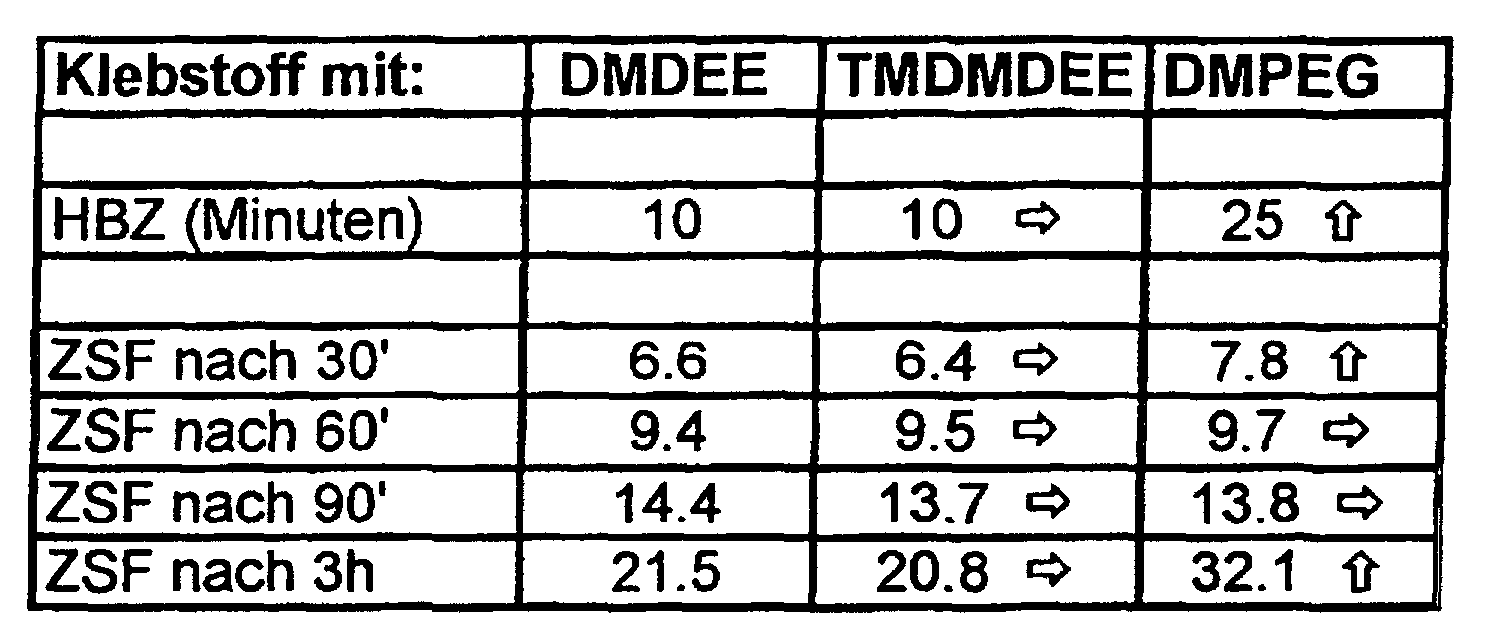
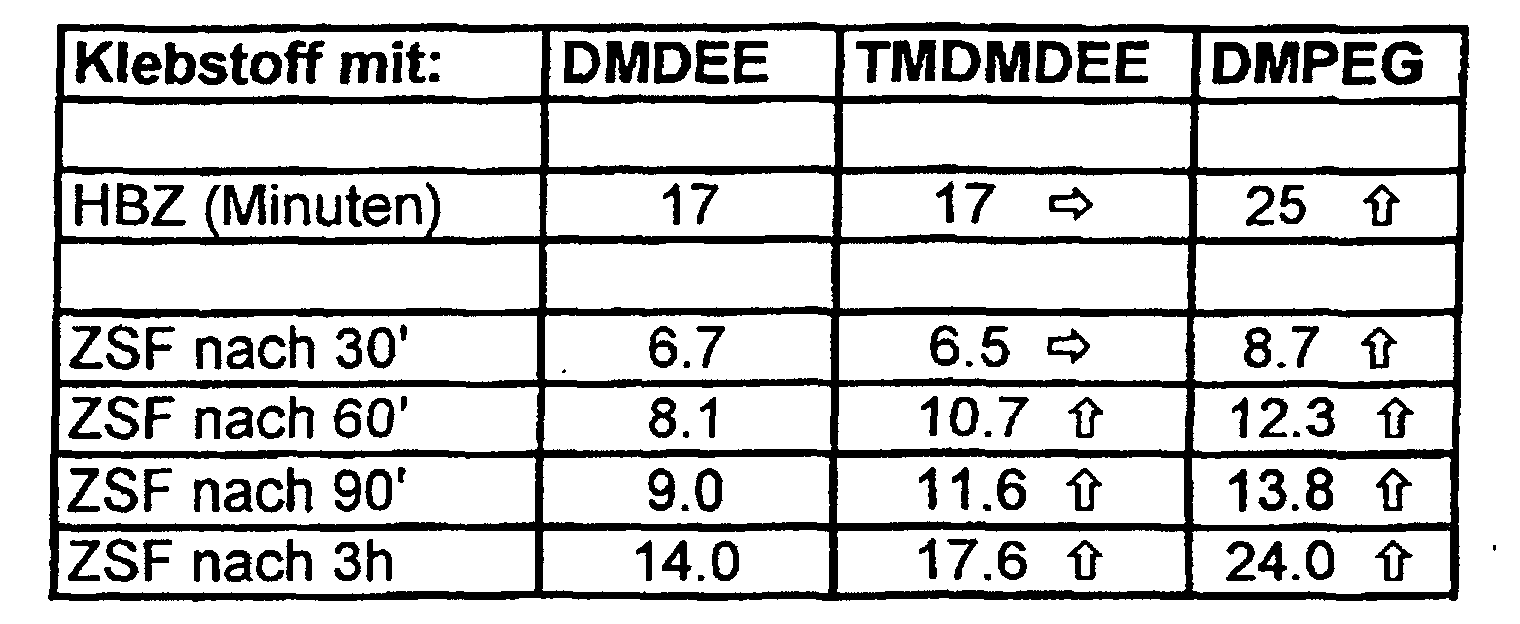
- the skin formation time is the time after Application until non-sticky.
- the development of the strength structure was determined using a tensile shear test specimen consisting of two glass plates according to DIN 53504 (tensile speed: 200 mm / min, adhesive layer thickness: 5 mm) after storage of the specimen under the two climatic conditions defined above, the measurement after 30 min., 60 min., 90 min. Or 3 hours.
- the value of tensile shear strength (ZSF) is given in N / cm 2 .
- the operation of the catalysts was in a standard formulation examined, this, in addition to Carbon black and chalk, on a prepolymer consisting of a trifunctional polyether polyol with a molecular weight of approximately 4500 and an aromatic isocyanate group containing monomer, MDI (methylene-4,4'-diphenyl diisocyanate), is constructed.
- MDI methylene-4,4'-diphenyl diisocyanate
- the amount of catalyst was calculated so that the morpholine content was 0.4 equivalence percent scam. For DMDEE this corresponds to about 0.5, for TMDMDEE about 0.6 and for the catalyst according to the invention DMPEG200 about 0.8 weight percent based on the Overall formulation of the adhesive mass.
- the dropping funnel is added dropwise with 20 ml of methylene chloride rinsed, which is dropped into the reaction mixture.
- the mixture becomes Room temperature stirred for 1.5 hours and then with a concentrated sodium hydroxide solution (5.1 g NaOH (Fluka 71691) in 20 ml water) carefully neutralized.
- the precipitation dissolves and one yellow phase results.
- another one Stirred at RT for one hour and then the phase on a water jet vacuum concentrated [this is the water bath temperature slowly heated to 70 ° C (you should use the collecting flask Cool with water / ice to recycle the dichloromethane to be able to feed)], where again a yellow precipitate fails.
- Another cleaning of this Intermediate was not made. The so obtained The intermediate product was immediately used for further implementation used.
- the milky residue of the intermediate is diluted with 20 ml of methylene chloride and with 15.87g Morpholine, 112 ml isopropyl alcohol and 20.1 g anhydrous Sodium carbonate (Fluka puriss F71350) (over in the oven Dried overnight at 130 ° C) added.
- the reaction mixture is now heated to reflux (bath temp. ⁇ 85 ° C) and kept at this temperature for about 5 hours.
- the reaction product is over a glass frit (Porosity 4) filtered off and freed from the white residue, from which there are still smaller amounts of the product isolated by extraction with ether.
- the slightly yellowish filtrate is at the water jet pump concentrated and then heated to 80 ° C bath temperature and left like this for an hour. Here a small one falls Amount of solid matter again. This backlog will now for 3 hours on the rotary pump vacuum from volatile parts.
Landscapes
- Chemical & Material Sciences (AREA)
- Organic Chemistry (AREA)
- Health & Medical Sciences (AREA)
- Chemical Kinetics & Catalysis (AREA)
- Medicinal Chemistry (AREA)
- Polymers & Plastics (AREA)
- Adhesives Or Adhesive Processes (AREA)
- Polyurethanes Or Polyureas (AREA)
- Paints Or Removers (AREA)
- Compositions Of Macromolecular Compounds (AREA)
- Dental Preparations (AREA)
- Macromonomer-Based Addition Polymer (AREA)
Description

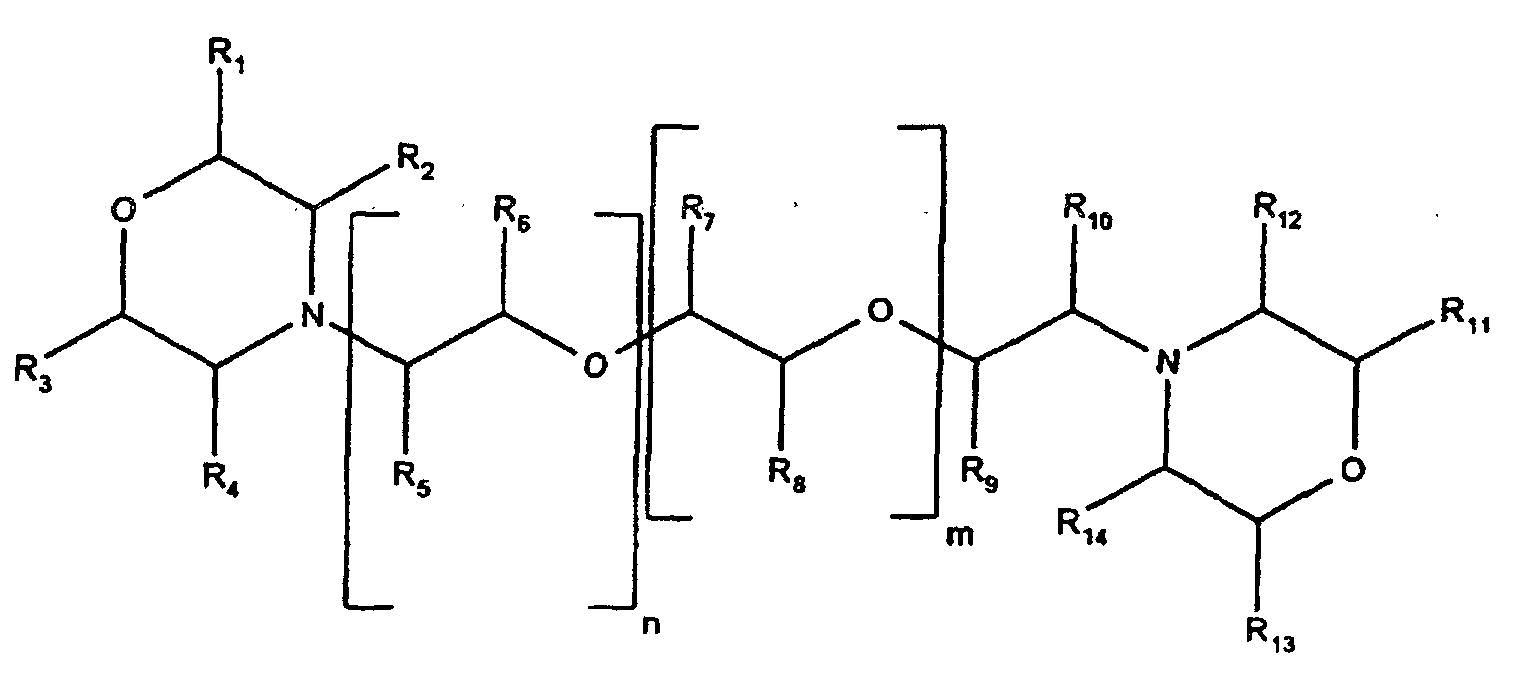
- R1 bis R14 = Wasserstoff
- R1 bis R4 und R9 bis R14 = Wasserstoff und R5 oder R6 und/oder R7 oder R8 = Methylgruppen, wobei jene R5, R6, R7 und R8, die keine Methylgruppe sind, Wasserstoff bedeuten.
- R1, R3, R11 und R13 = Methylgruppen und R2, R4 bis R10, R12 und R14 = Wasserstoff. Die erfindungsgemässen Katalysatoren können beispielsweise gemäss der kanadischen Patentanmeldung CA 2103730 von Miles Inc., USA (1992) hergestellt werden.Sie eignen sich insbesonders für die Verwendung in Isocyanatgruppen enthaltenden 1-Komponenten (1K)-und 2-Komponenten (2K)-PU-Systemen. Insbesonders eignen sich die erfindungsgemässen Katalysatoren sehr gut für die Verwendung in 1K-Systemen.Die Isocyanatgruppen enthaltenden PU-Prepolymere, die in den erfindungsgemässen Systemen als die Hauptkomponente vorliegen, sind Reaktionsprodukte von Isocyanatgruppen enthaltenden Substanzen mit irgendeiner mit Isocyanatgruppen reaktiven Verbindung, wie z.B. aliphatische oder aromatische Polyol-, Polyamin- oder Polymercaptogruppen enthaltende Verbindungen, wobei die Umsetzung in bekannter Weise bei Temperaturen um 80 °C und gegebenenfalls in Gegenwart eines Katalysators, z.B. Dibutylzinndilaurat meistens stöchiometrisch, d.h. pro H-aktive Gruppe ein mindestens 2 Isocyanatgruppen enthaltendes Monomer, erfolgt.Üblicherweise werden Polyole mit einer Funktionalität zwischen 1.5 und 3 sowie einem Molekulargewicht zwischen 400 und 10000, vorzugsweise im Bereich von etwa 1000 und 6000 verwendet. Solche Polyole sind z.B. Polyalkylenpolyole (z.B. Polyethylenoxide, Polypropylenoxide, Polybutylenoxide, Polytetrahydrofurane), Polycarbonate, Polycaprolactone, Polyester,etc.. Die Isocyanatgruppen enthaltenden Monomere können aliphatisch, cycloaliphatisch oder aromatisch sein, wie z.B. 4,4'-Diphenylmethandiisocyanat, 2,4-Toluoldiisocyanat, Hexamethylendiisocyanat, Isophorondiisocyanat, Perhydro-2,4'-diphenylmethandiisocyanat etc.Die oben beschriebenen PU-Prepolymere haben bevorzugt einen freien Isocyanatgehalt im Bereich von 1 bis 3 % und liegen normalerweise zwischen 20 bis 60 %, insbesondere zwischen 20 und 50 %, bezogen auf die Gesamtformulierung vor.Die PU-Systeme der vorliegenden Erfindung bestehen aus mindestens einem PU-Prepolymer und dem erfindungsgemässen Härtungskatalysator und können gegebenenfalls zusätzlich übliche Additive und Hilfstoffe enthalten, beispielsweise Weichmacher, Füllstoffe, latente Härter, Haftungsverbesserer, Farbstoffe, Pigmente, UV-Absorptionsmittel, Stabilisatoren, Antioxidantien, oberflächenaktive Additive, Flammhemmer, fungistatisch aktive Substanzen etc. Die Art und Menge dieser Zusatzstoffe richtet sich nach dem Verwendungszweck der erfindungsgemässen Massen.Die Menge der erfindungsgemässen Isocyanat / Wasser-Härtungskatalysatoren sollte im allgemeinen 0.1 bis 2 % (Gewichtsprozent), insbesondere 0.4 bis 1 %, bezogen auf die Gesamtformulierung betragen. Während bei einer Menge unterhalb von 0.1 % der gewünschte Härtungseffekt nicht erzielt wird, wird bei einer Menge oberhalb von 2 % die Lagerstabilität des PU-Systems beeinträchtigt.Wenn notwendig, können die erfindungsgemässen Katalysatoren mit andern konventionellen Katalysatoren, z.B. Organometall- oder tertiäre Amin-Katalysatoren kombiniert werden.Bei der Herstellung erfindungsgemässer 1K-Massen ist dafür zu sorgen, dass keine Feuchtigkeit eingebracht wird. Alle verwendeten Komponenten sollten möglichst frei von Wasser sein, und es ist zweckmässig den PU-Systemen wasserbindende oder mit Wasser reagierende Stoffe zu zumischen, wie z.B. Calciumoxid, Molekularsieb, monofunktionelle Isocyanatgruppen enthaltende Verbindungen, Orthoameisensäureester etc.. Die Konfektionierung erfolgt unter Feuchtigkeitsausschluss in bekannter Weise z.B. in Kartuschen, Fass etc..Die erfindungsgemässen PU-Systeme können je nach Anforderung für das Verbinden, Abdichten oder Beschichten verwendet werden und finden im Baubereich sowie in der Industrie z.B. im Bereich der Fahrzeugherstellung, Marine etc. zahlreiche Einsatzmöglichkeiten, wobei auf verschiedensten Materialien, wie z.B. Glas, Keramik, Kunststoffe, PU-Elastomer, Metalle, lackierte Metalle, appliziert wird. Gegebenenfalls muss eine Vorbehandlung mit einem Primervoranstrich durchgeführt werden, um eine optimale Haftung zu erlangen.Die folgenden Ausführungen am Beispiel 1K Klebstoffe sollen die Erfindung weiter veranschaulichen. Diese sind in keiner Weise als den Umfang der Erfindung in irgendeiner Form beschränkend anzusehen.


- Die Bewertung erfolgte durch Angabe der prozentualen Aenderung zum ursprünglichen Wert. Der mit DMDEE-katalysierten PU-Klebstoff weist aufgrund Praxiserfahrung eine zufriedenstellende Lagerungsstabilität auf.
| Klebstoff mit: | DMDEE | TMDMDEE | DMPEG |
| 1 Mt bei RT | < 20 % | < 20 % | < 20 % |
| 3 Mt bei RT | < 40 % | < 40 % | < 40 % |
| Klebstoff mit: | DMDEE | TMDMDEE | DMPEG |
| 1 Mt bei RT | < 10 % | < 10 % | < 10 % |
| 3 Mt bei RT | < 10 % | < 10 % | < 10 % |
Claims (9)
- Verwendung einer Ein-Komponenten-Polyurethan-Zusammensetzung enthaltend oder bestehend aus mindestens einem Prepolymer auf Basis aromatischen oder aliphatischen Isocyanats und mindestens einem morpholingruppen enthaltenden Katalysator der allgemeinen Formelworin die Summe von n+m zwischen 2 und 10 liegt und R1, R2, R3, R4, R5, R6, R7, R8, R9, R10, R11, R12, R13, R14 unabhängig voneinander je Wasserstoff oder eine Alkylgruppe bedeuten, als durch Wasser aus der Umgebungsfeuchte auszuhärtender Klebstoff, Dichtstoff, Beschichtungsmaterial und/oder Voranstrich.

- Verwendung gemäss Anspruch 1, dadurch gekennzeichnet, dass im Katalysator die Summe von n+m zwischen 2 und 5 liegt.
- Verwendung gemäss Anspruch 1 oder 2, dadurch gekennzeichnet, dass im Katalysator R1 bis R14 Wasserstoff sind.
- Verwendung gemäss Anspruch 1 oder 2, dadurch gekennzeichnet, dass die R1 bis R14, die eine Alkylgruppe bedeuten, Methyl- oder Ethylgruppen sind.
- Verwendung gemäss Anspruch 4, dadurch gekennzeichnet, dass im Katalysator R1, R2, R3, R4, R9, R10, R11, R12, R13 und R14 Wasserstoff und R5 oder R6 und/oder R7 oder R8 Methylgruppen sind, wobei die R5, R6, R7 und R8, die nicht eine Methylgruppe sind, Wasserstoff bedeuten.
- Verwendung gemäss Anspruch 4, dadurch gekennzeichnet, dass im Katalysator R1, R3, R11 und R13 Methylgruppen und R2, R4, R5, R6, R7, R8, R9, R10, R12 und R14 Wasserstoff sind.
- Verwendung gemäss einem der Ansprüche 1 bis 6, dadurch gekennzeichnet, dass im Katalysator die Summe von n+m ca. 3 beträgt.
- Verwendung gemäss einem der Ansprüche 1 bis 7, dadurch gekennzeichnet, dass das Prepolymer das Reaktionsprodukt von Isocyanatgruppen enthaltenden Substanzen mit Polyalkylenpolyolen einer Funktionalität zwischen 1.5 und 3 und einem Molekulargewicht zwischen 400 und 10'000 ist.
- Verwendung gemäss einem der Ansprüche 1 bis 8, dadurch gekennzeichnet, dass der Katalysator in der Polyurethan-Zusammensetzung in einer Menge von 0,1 bis 2 Gew.-% bezogen auf die Gesamtformulierung vorliegt.
Applications Claiming Priority (3)
| Application Number | Priority Date | Filing Date | Title |
|---|---|---|---|
| CH146496 | 1996-06-12 | ||
| CH146496 | 1996-06-12 | ||
| CH1464/96 | 1996-06-12 |
Publications (2)
| Publication Number | Publication Date |
|---|---|
| EP0812866A1 EP0812866A1 (de) | 1997-12-17 |
| EP0812866B1 true EP0812866B1 (de) | 2003-10-15 |
Family
ID=4211088
Family Applications (1)
| Application Number | Title | Priority Date | Filing Date |
|---|---|---|---|
| EP97109341A Expired - Lifetime EP0812866B1 (de) | 1996-06-12 | 1997-06-10 | Lagerstabile, feuchtigkeitshärtende Klebstoffmasse |
Country Status (8)
| Country | Link |
|---|---|
| US (1) | US6025029A (de) |
| EP (1) | EP0812866B1 (de) |
| AT (1) | ATE252118T1 (de) |
| CA (1) | CA2207476A1 (de) |
| DE (1) | DE59710850D1 (de) |
| DK (1) | DK0812866T3 (de) |
| ES (1) | ES2208784T3 (de) |
| PT (1) | PT812866E (de) |
Families Citing this family (8)
| Publication number | Priority date | Publication date | Assignee | Title |
|---|---|---|---|---|
| DE19742720A1 (de) * | 1997-09-26 | 1999-04-01 | Performance Chemicals Handels | Bis(alkylamino)alkylether-Verbindungen und ihre Verwendung |
| SG73647A1 (en) * | 1998-06-09 | 2000-06-20 | Nat Starch Chem Invest | Uv / moisture cure adhesive |
| DE10047485A1 (de) * | 2000-09-26 | 2002-04-11 | Bayer Ag | Lagerstabile latente Katalysatoren enthaltende Isocyanat-Bindemittel |
| EP1602479B1 (de) * | 2003-02-17 | 2019-04-10 | Tokuyama Corporation | Beschichtetes produkt, optischer teil, herstellungsverfahren und überzugsflüssigkeit |
| JP4552181B2 (ja) * | 2004-05-31 | 2010-09-29 | 日本ポリウレタン工業株式会社 | 湿気硬化型ポリウレタン樹脂組成物 |
| CN101735763B (zh) * | 2010-01-05 | 2013-07-24 | 四川大学 | 室温固化的低粘度聚氨酯泡沫粘接剂及其制备方法 |
| CN103102859B (zh) * | 2013-03-05 | 2014-04-02 | 河南省科学院化学研究所有限公司 | 一种含低挥发性催化剂的聚氨酯密封胶 |
| CN103102863A (zh) * | 2013-03-05 | 2013-05-15 | 河南省科学院化学研究所有限公司 | 含有双吗啉聚烷氧基醚催化剂的湿固化聚氨酯热熔胶粘剂 |
Citations (1)
| Publication number | Priority date | Publication date | Assignee | Title |
|---|---|---|---|---|
| US5195946A (en) * | 1990-09-15 | 1993-03-23 | Zhejiang Province Science & Technology Development Corp. | Stable catalytic and aqua-activated polyurethane casting bandage |
Family Cites Families (6)
| Publication number | Priority date | Publication date | Assignee | Title |
|---|---|---|---|---|
| DE2624016C2 (de) * | 1975-06-02 | 1987-04-23 | Texaco Development Corp., White Plains, N.Y. | Verfahren zur Herstellung von Bis-(morpholino-N-alkyl)äthern |
| US4705840A (en) * | 1985-10-04 | 1987-11-10 | Minnesota Mining And Manufacturing Company | Catalysts for the curing of a water-curable isocyanate-functional prepolymer |
| US4758648A (en) * | 1986-10-20 | 1988-07-19 | Essex Specialty Products, Inc. | High speed cure sealant |
| JPH078982B2 (ja) * | 1989-05-25 | 1995-02-01 | サンスター技研株式会社 | 湿気硬化性シーリング材組成物 |
| CN1051717C (zh) * | 1992-08-14 | 2000-04-26 | 李海晟 | 聚氨酯矫形绷带材料 |
| US5525663A (en) * | 1994-08-18 | 1996-06-11 | Minnesota Mining And Manufacturing Company | Reactive hot-melt adhesive and/or sealing composition and method of using same |
-
1997
- 1997-06-10 ES ES97109341T patent/ES2208784T3/es not_active Expired - Lifetime
- 1997-06-10 AT AT97109341T patent/ATE252118T1/de not_active IP Right Cessation
- 1997-06-10 EP EP97109341A patent/EP0812866B1/de not_active Expired - Lifetime
- 1997-06-10 DK DK97109341T patent/DK0812866T3/da active
- 1997-06-10 PT PT97109341T patent/PT812866E/pt unknown
- 1997-06-10 DE DE59710850T patent/DE59710850D1/de not_active Expired - Fee Related
- 1997-06-11 CA CA002207476A patent/CA2207476A1/en not_active Abandoned
- 1997-06-11 US US08/873,128 patent/US6025029A/en not_active Expired - Fee Related
Patent Citations (1)
| Publication number | Priority date | Publication date | Assignee | Title |
|---|---|---|---|---|
| US5195946A (en) * | 1990-09-15 | 1993-03-23 | Zhejiang Province Science & Technology Development Corp. | Stable catalytic and aqua-activated polyurethane casting bandage |
Also Published As
| Publication number | Publication date |
|---|---|
| PT812866E (pt) | 2004-03-31 |
| CA2207476A1 (en) | 1997-12-12 |
| ATE252118T1 (de) | 2003-11-15 |
| JP3636862B2 (ja) | 2005-04-06 |
| JPH1067930A (ja) | 1998-03-10 |
| ES2208784T3 (es) | 2004-06-16 |
| DE59710850D1 (de) | 2003-11-20 |
| EP0812866A1 (de) | 1997-12-17 |
| US6025029A (en) | 2000-02-15 |
| DK0812866T3 (da) | 2004-02-23 |
Similar Documents
| Publication | Publication Date | Title |
|---|---|---|
| EP0153456B1 (de) | Chemisch härtende Zweikomponentenmasse auf der Basis von Polyurethan-Präpolymeren, Verfahren zur Herstellung eines Polyurethan und Verwendung der Zweikomponentenmasse | |
| EP1470173B1 (de) | Zweikomponentige polyurethanzusammensetzung mit hoher fr hfe stigkeit | |
| DE69204022T2 (de) | Feuchtigkeitshärtende auf Urethan basierende Dichtungsmasse. | |
| EP0170865B1 (de) | Verfahren zur Herstellung von unter Feuchtigkeitsausschluss lagerstabilen Kunstharzmassen und deren Verwendung | |
| DE69207808T2 (de) | Feuchtigkeitshartbare Polyurethanzusammensetzung | |
| DE2637115C3 (de) | Verfahren zur Herstellung von Polyurethanharnstoffen | |
| EP1996635B1 (de) | Feuchtigkeitshärtende polyurethanzusammensetzung mit gutem tieftemperaturverhalten | |
| EP2791156B1 (de) | Metall-komplexverbindungen als katalysatoren für polyurethan-zusammensetzungen | |
| EP2220034B1 (de) | Aromatische aldimine und aldimin enthaltende polyurethanzusammensetzungen | |
| DE68911047T2 (de) | Aus Mischungen von Polypropylenoxid-Polyolen und von auf organischen Silicon-Blockcopolymeren basierenden Polyol-Zwischenprodukten hergestellte Polyurethane. | |
| DE2131299C3 (de) | Durch Hitzeeinwirkung härtbare Gemische und Verfahren zur Herstellung von Formkörpern aus diesen Gemischen | |
| DE2453173A1 (de) | Polymerisate mit endstaendigen mercaptangruppen und verfahren zu ihrer herstellung | |
| DD269155A5 (de) | Feuchtigkeitshaertende dichtungs- und klebemittel | |
| EP1674546A1 (de) | Feuchthärtende Zusammensetzung und Schmelzklebstoff | |
| DE2152606A1 (de) | Elastifizierte kunststoffe | |
| DE1694237B2 (de) | Verfahren zur Herstellung von vernetzten Kunststoffen, einschließlich Flächengebilden, nach dem Isocyanatpolyadditionsverfahren | |
| DE3876828T2 (de) | Eine katalytisch schnell aushaertende polyurethan-dichtungszusammensetzung. | |
| DE68911035T2 (de) | Polyurethan-Prepolymere hergestellt aus Mischungen von Polypropylenoxidpolyolenund Polybutylenoxidpolyolen und Dichtungmassen daraus. | |
| DE2436872A1 (de) | 1-(bis-aethoxycarbonyl)-acetylamino3-methyl-3(bis-aethoxycarbonyl)-acetylaminomethyl-5-dimethyl-cyclohexan | |
| EP0066167B1 (de) | Verfahren zur Herstellung von Mercaptogruppen aufweisenden Oligourethanen, sowie ihre Verwendung als Bindemittel für oxidativ härtbare Beschichtungs- und Dichtungsmassen bzw. als Zusatzmittel für Epoxidharze | |
| EP0812866A1 (de) | Lagerstabile, feuchtigkeitshärtende Klebstoffmasse | |
| EP2016109B1 (de) | Feuchtigkeitshärtende kleb- und dichtstoffe | |
| DE1719121C3 (de) | Verfahren zum Abdichten und Ausfüllen von Fugen | |
| DE68918407T2 (de) | Bei Feuchtigkeit schnell aushärtende Polyurethan-Dichtungen. | |
| DE1914365C3 (de) | Verwendung von Isocyanatgruppen aufweisenden Polyurethanen als Fugenvergußmassen |
Legal Events
| Date | Code | Title | Description |
|---|---|---|---|
| PUAI | Public reference made under article 153(3) epc to a published international application that has entered the european phase |
Free format text: ORIGINAL CODE: 0009012 |
|
| AK | Designated contracting states |
Kind code of ref document: A1 Designated state(s): AT BE CH DE DK ES FI FR GB IE IT LI NL PT SE |
|
| 17P | Request for examination filed |
Effective date: 19980209 |
|
| AKX | Designation fees paid |
Free format text: AT BE CH DE DK ES FI FR GB IE IT LI NL PT SE |
|
| RBV | Designated contracting states (corrected) |
Designated state(s): AT BE CH DE DK ES FI FR GB IE IT LI NL PT SE |
|
| EUG | Se: european patent has lapsed | ||
| 17Q | First examination report despatched |
Effective date: 20020910 |
|
| RAP1 | Party data changed (applicant data changed or rights of an application transferred) |
Owner name: SIKA SCHWEIZ AG |
|
| GRAH | Despatch of communication of intention to grant a patent |
Free format text: ORIGINAL CODE: EPIDOS IGRA |
|
| GRAS | Grant fee paid |
Free format text: ORIGINAL CODE: EPIDOSNIGR3 |
|
| GRAA | (expected) grant |
Free format text: ORIGINAL CODE: 0009210 |
|
| RIN1 | Information on inventor provided before grant (corrected) |
Inventor name: GRICHTING, DIDIER Inventor name: DUX, ROLAND, DR. Inventor name: MERZ, PETER W.,DR. |
|
| AK | Designated contracting states |
Kind code of ref document: B1 Designated state(s): AT BE CH DE DK ES FI FR GB IE IT LI NL PT SE |
|
| PG25 | Lapsed in a contracting state [announced via postgrant information from national office to epo] |
Ref country code: FI Free format text: LAPSE BECAUSE OF FAILURE TO SUBMIT A TRANSLATION OF THE DESCRIPTION OR TO PAY THE FEE WITHIN THE PRESCRIBED TIME-LIMIT Effective date: 20031015 |
|
| REG | Reference to a national code |
Ref country code: GB Ref legal event code: FG4D Free format text: NOT ENGLISH Ref country code: CH Ref legal event code: EP |
|
| REG | Reference to a national code |
Ref country code: IE Ref legal event code: FG4D Free format text: GERMAN |
|
| REF | Corresponds to: |
Ref document number: 59710850 Country of ref document: DE Date of ref document: 20031120 Kind code of ref document: P |
|
| REG | Reference to a national code |
Ref country code: SE Ref legal event code: TRGR |
|
| REG | Reference to a national code |
Ref country code: CH Ref legal event code: NV Representative=s name: SIKA TECHNOLOGY AG |
|
| GBT | Gb: translation of ep patent filed (gb section 77(6)(a)/1977) |
Effective date: 20040126 |
|
| REG | Reference to a national code |
Ref country code: DK Ref legal event code: T3 |
|
| REG | Reference to a national code |
Ref country code: PT Ref legal event code: SC4A Free format text: AVAILABILITY OF NATIONAL TRANSLATION Effective date: 20040114 |
|
| REG | Reference to a national code |
Ref country code: ES Ref legal event code: FG2A Ref document number: 2208784 Country of ref document: ES Kind code of ref document: T3 |
|
| ET | Fr: translation filed | ||
| PLBE | No opposition filed within time limit |
Free format text: ORIGINAL CODE: 0009261 |
|
| STAA | Information on the status of an ep patent application or granted ep patent |
Free format text: STATUS: NO OPPOSITION FILED WITHIN TIME LIMIT |
|
| 26N | No opposition filed |
Effective date: 20040716 |
|
| PGFP | Annual fee paid to national office [announced via postgrant information from national office to epo] |
Ref country code: AT Payment date: 20060519 Year of fee payment: 10 |
|
| PGFP | Annual fee paid to national office [announced via postgrant information from national office to epo] |
Ref country code: PT Payment date: 20060522 Year of fee payment: 10 |
|
| PGFP | Annual fee paid to national office [announced via postgrant information from national office to epo] |
Ref country code: FR Payment date: 20060620 Year of fee payment: 10 |
|
| PGFP | Annual fee paid to national office [announced via postgrant information from national office to epo] |
Ref country code: NL Payment date: 20060624 Year of fee payment: 10 |
|
| PGFP | Annual fee paid to national office [announced via postgrant information from national office to epo] |
Ref country code: GB Payment date: 20060626 Year of fee payment: 10 Ref country code: ES Payment date: 20060626 Year of fee payment: 10 |
|
| PGFP | Annual fee paid to national office [announced via postgrant information from national office to epo] |
Ref country code: IE Payment date: 20060627 Year of fee payment: 10 |
|
| PGFP | Annual fee paid to national office [announced via postgrant information from national office to epo] |
Ref country code: IT Payment date: 20060630 Year of fee payment: 10 Ref country code: CH Payment date: 20060630 Year of fee payment: 10 |
|
| PGFP | Annual fee paid to national office [announced via postgrant information from national office to epo] |
Ref country code: BE Payment date: 20060714 Year of fee payment: 10 |
|
| PGFP | Annual fee paid to national office [announced via postgrant information from national office to epo] |
Ref country code: DE Payment date: 20060731 Year of fee payment: 10 |
|
| REG | Reference to a national code |
Ref country code: PT Ref legal event code: MM4A Free format text: LAPSE DUE TO NON-PAYMENT OF FEES Effective date: 20071210 |
|
| BERE | Be: lapsed |
Owner name: *SIKA SCHWEIZ A.G. Effective date: 20070630 |
|
| PG25 | Lapsed in a contracting state [announced via postgrant information from national office to epo] |
Ref country code: PT Free format text: LAPSE BECAUSE OF NON-PAYMENT OF DUE FEES Effective date: 20071210 |
|
| REG | Reference to a national code |
Ref country code: CH Ref legal event code: PL |
|
| REG | Reference to a national code |
Ref country code: DK Ref legal event code: EBP |
|
| EUG | Se: european patent has lapsed | ||
| GBPC | Gb: european patent ceased through non-payment of renewal fee |
Effective date: 20070610 |
|
| PG25 | Lapsed in a contracting state [announced via postgrant information from national office to epo] |
Ref country code: AT Free format text: LAPSE BECAUSE OF NON-PAYMENT OF DUE FEES Effective date: 20070610 |
|
| NLV4 | Nl: lapsed or anulled due to non-payment of the annual fee |
Effective date: 20080101 |
|
| REG | Reference to a national code |
Ref country code: IE Ref legal event code: MM4A |
|
| PG25 | Lapsed in a contracting state [announced via postgrant information from national office to epo] |
Ref country code: BE Free format text: LAPSE BECAUSE OF NON-PAYMENT OF DUE FEES Effective date: 20070630 |
|
| REG | Reference to a national code |
Ref country code: FR Ref legal event code: ST Effective date: 20080229 |
|
| PG25 | Lapsed in a contracting state [announced via postgrant information from national office to epo] |
Ref country code: NL Free format text: LAPSE BECAUSE OF NON-PAYMENT OF DUE FEES Effective date: 20080101 Ref country code: LI Free format text: LAPSE BECAUSE OF NON-PAYMENT OF DUE FEES Effective date: 20070630 Ref country code: DE Free format text: LAPSE BECAUSE OF NON-PAYMENT OF DUE FEES Effective date: 20080101 Ref country code: CH Free format text: LAPSE BECAUSE OF NON-PAYMENT OF DUE FEES Effective date: 20070630 |
|
| PGFP | Annual fee paid to national office [announced via postgrant information from national office to epo] |
Ref country code: DK Payment date: 20060630 Year of fee payment: 10 |
|
| PG25 | Lapsed in a contracting state [announced via postgrant information from national office to epo] |
Ref country code: IE Free format text: LAPSE BECAUSE OF NON-PAYMENT OF DUE FEES Effective date: 20070611 Ref country code: GB Free format text: LAPSE BECAUSE OF NON-PAYMENT OF DUE FEES Effective date: 20070610 |
|
| PG25 | Lapsed in a contracting state [announced via postgrant information from national office to epo] |
Ref country code: SE Free format text: LAPSE BECAUSE OF NON-PAYMENT OF DUE FEES Effective date: 20070611 |
|
| PGFP | Annual fee paid to national office [announced via postgrant information from national office to epo] |
Ref country code: SE Payment date: 20060628 Year of fee payment: 10 |
|
| PG25 | Lapsed in a contracting state [announced via postgrant information from national office to epo] |
Ref country code: DK Free format text: LAPSE BECAUSE OF NON-PAYMENT OF DUE FEES Effective date: 20070702 |
|
| REG | Reference to a national code |
Ref country code: ES Ref legal event code: FD2A Effective date: 20070611 |
|
| PG25 | Lapsed in a contracting state [announced via postgrant information from national office to epo] |
Ref country code: FR Free format text: LAPSE BECAUSE OF NON-PAYMENT OF DUE FEES Effective date: 20070702 |
|
| PG25 | Lapsed in a contracting state [announced via postgrant information from national office to epo] |
Ref country code: ES Free format text: LAPSE BECAUSE OF NON-PAYMENT OF DUE FEES Effective date: 20070611 |
|
| PG25 | Lapsed in a contracting state [announced via postgrant information from national office to epo] |
Ref country code: IT Free format text: LAPSE BECAUSE OF NON-PAYMENT OF DUE FEES Effective date: 20070610 |