EP0804246B1 - Agents d'administration de medicaments comprenant de la mitomycine - Google Patents
Agents d'administration de medicaments comprenant de la mitomycine Download PDFInfo
- Publication number
- EP0804246B1 EP0804246B1 EP94923825A EP94923825A EP0804246B1 EP 0804246 B1 EP0804246 B1 EP 0804246B1 EP 94923825 A EP94923825 A EP 94923825A EP 94923825 A EP94923825 A EP 94923825A EP 0804246 B1 EP0804246 B1 EP 0804246B1
- Authority
- EP
- European Patent Office
- Prior art keywords
- mitomycin
- group
- derivative
- reactive
- polymer
- Prior art date
- Legal status (The legal status is an assumption and is not a legal conclusion. Google has not performed a legal analysis and makes no representation as to the accuracy of the status listed.)
- Expired - Lifetime
Links
- 0 CCC(C)N(C)*O*N Chemical compound CCC(C)N(C)*O*N 0.000 description 2
Classifications
-
- A—HUMAN NECESSITIES
- A61—MEDICAL OR VETERINARY SCIENCE; HYGIENE
- A61K—PREPARATIONS FOR MEDICAL, DENTAL OR TOILETRY PURPOSES
- A61K47/00—Medicinal preparations characterised by the non-active ingredients used, e.g. carriers or inert additives; Targeting or modifying agents chemically bound to the active ingredient
- A61K47/50—Medicinal preparations characterised by the non-active ingredients used, e.g. carriers or inert additives; Targeting or modifying agents chemically bound to the active ingredient the non-active ingredient being chemically bound to the active ingredient, e.g. polymer-drug conjugates
- A61K47/51—Medicinal preparations characterised by the non-active ingredients used, e.g. carriers or inert additives; Targeting or modifying agents chemically bound to the active ingredient the non-active ingredient being chemically bound to the active ingredient, e.g. polymer-drug conjugates the non-active ingredient being a modifying agent
- A61K47/56—Medicinal preparations characterised by the non-active ingredients used, e.g. carriers or inert additives; Targeting or modifying agents chemically bound to the active ingredient the non-active ingredient being chemically bound to the active ingredient, e.g. polymer-drug conjugates the non-active ingredient being a modifying agent the modifying agent being an organic macromolecular compound, e.g. an oligomeric, polymeric or dendrimeric molecule
- A61K47/61—Medicinal preparations characterised by the non-active ingredients used, e.g. carriers or inert additives; Targeting or modifying agents chemically bound to the active ingredient the non-active ingredient being chemically bound to the active ingredient, e.g. polymer-drug conjugates the non-active ingredient being a modifying agent the modifying agent being an organic macromolecular compound, e.g. an oligomeric, polymeric or dendrimeric molecule the organic macromolecular compound being a polysaccharide or a derivative thereof
-
- A—HUMAN NECESSITIES
- A61—MEDICAL OR VETERINARY SCIENCE; HYGIENE
- A61K—PREPARATIONS FOR MEDICAL, DENTAL OR TOILETRY PURPOSES
- A61K47/00—Medicinal preparations characterised by the non-active ingredients used, e.g. carriers or inert additives; Targeting or modifying agents chemically bound to the active ingredient
- A61K47/50—Medicinal preparations characterised by the non-active ingredients used, e.g. carriers or inert additives; Targeting or modifying agents chemically bound to the active ingredient the non-active ingredient being chemically bound to the active ingredient, e.g. polymer-drug conjugates
- A61K47/51—Medicinal preparations characterised by the non-active ingredients used, e.g. carriers or inert additives; Targeting or modifying agents chemically bound to the active ingredient the non-active ingredient being chemically bound to the active ingredient, e.g. polymer-drug conjugates the non-active ingredient being a modifying agent
- A61K47/62—Medicinal preparations characterised by the non-active ingredients used, e.g. carriers or inert additives; Targeting or modifying agents chemically bound to the active ingredient the non-active ingredient being chemically bound to the active ingredient, e.g. polymer-drug conjugates the non-active ingredient being a modifying agent the modifying agent being a protein, peptide or polyamino acid
- A61K47/65—Peptidic linkers, binders or spacers, e.g. peptidic enzyme-labile linkers
Definitions
- the present invention relates to the field of pharmaceutical products for use in chemotherapy, especially cancer chemotherapy. More particularly, the invention is concerned with providing drug-delivery agents in the form of polymer/drug conjugates comprising aziridine ring containing mitomycin compounds, such as the anti-neoplastic drug mitomycin-C (abbreviated MMC), covalently coupled through linking spacer groups to macromolecules that can serve as relatively inert polymeric drug carriers in biological systems.
- mitomycin compounds such as the anti-neoplastic drug mitomycin-C (abbreviated MMC)
- MMC anti-neoplastic drug mitomycin-C
- Mitomycin-C which has the structure shown below, has been known for some time as a promising antitumour drug, being a cytotoxic agent that appears to be effective against a number of human cancers.
- cytotoxic agent that appears to be effective against a number of human cancers.
- its clinical application has been severely limited due to unacceptable levels of general toxicity and side effects when administered as the free drug. In consequence, it has generally been used clinically only in low doses and in combination with other drugs.
- targeting moieties or determinants residues or molecular entities, termed targeting moieties or determinants, that are capable of recognising and interacting with specific sites or cell surface receptors whereby the polymer drug carrier may be more specifically "targeted" to those tissues or cells where the drug is required to act.
- targeting moieties or determinants which can include molecular entities such as hormones, antibodies or antibody fragments, and other proteins, can permit site-specific drug delivery.
- drug release may then take place by biodegradation or cleavage of the bonds linking or coupling the bioactive drug molecules to the polymer carriers, e.g. by hydrolytic cleavage promoted by intracellular enzyme systems, especially lysosomal enzyme systems, following pinocytic uptake of the carrier/drug conjugate.
- macromolecular drug carrier systems in theory afford a possibility of restricting the distribution and of controlling the release of drugs within the body, thereby improving their therapeutic index, for successful practical applications it is generally essential to be able reliably to prepare in a reproducible manner well-defined or well-characterised macromolecular polymer conjugates containing an adequate payload of drug molecules with suitable drug/polymer linkages capable of undergoing controlled biodegradation in the desired target areas.
- intermediate linking units or spacers containing for example a number of degradable bonds such as hydrolysable peptide bonds, between the drug molecules and the main polymer chain.
- the size and nature of such linking units or spacers can be very important for obtaining satisfactory drug release characteristics.
- An object of the present invention is accordingly to provide an improved process for synthesising macromolecular polymer carrier conjugates of mitomycin compounds such as mitomycin-C which can give well-characterised chemical structures better suited for clinical use as drug delivery agents.
- a process for synthesising a polymer/drug conjugate composed of polymer carrier in the form of a biologically inert macromolecule covalently coupled through linking spacer units to molecules of mitomycin-C or other therapeutically active mitomycin compound containing an >NH group in the aziridine ring thereof is characterised by a first step of
- this derivative or a preceding intermediate derivative of the mitomycin compound in which the terminal amino group of the side chain is temporarily protected by a removable protective group, will generally be isolated, purified and well characterised before the final coupling reaction with the polymer.
- the polymer carrier will contain amino reactive side groups and will be reacted with the reactive mitomycin derivative that includes the side chain which terminates in a reactive amino group -NH 2 , whereby coupling takes place and a covalent linkage is established between the polymer carrier and the mitomycin molecule so that the said side chain does in fact provide a said linking unit or spacer.
- the primary amine terminal amino group of the side chain in the reactive mitomycin derivative is generally much more reactive than the aziridine secondary amine imino group of the unmodified mitomycin molecule.
- the covalent bonding between the polymer carrier and the mitomycin molecule will generally comprise biodegradable bonds, susceptible for example to enzymatic or hydrolytic cleavage, thereby enabling active mitomycin drug molecules to be released at their target location within the body during the course of therapeutic treatment.
- mitomycin-C which is the mitomycin compound that has been the subject of especial study. Accordingly, the invention will hereinafter be further described with specific reference to mitomycin-C, but it will be understood that in general, unless otherwise stated, the description is equally applicable to other mitomycin compounds that may also be bioactive and the scope of the invention as specified in the claims is not to be regarded as being necessarily limited to mitomycin-C.
- the side chain is coupled by way of a urethane (-0-CO-) bond, an amide (-CO-) bond, or a urea (-NH-CO-) bond with the aziridine >NH group of the MMC molecule.
- a urethane (-0-CO-) bond an amide (-CO-) bond, or a urea (-NH-CO-) bond with the aziridine >NH group of the MMC molecule.
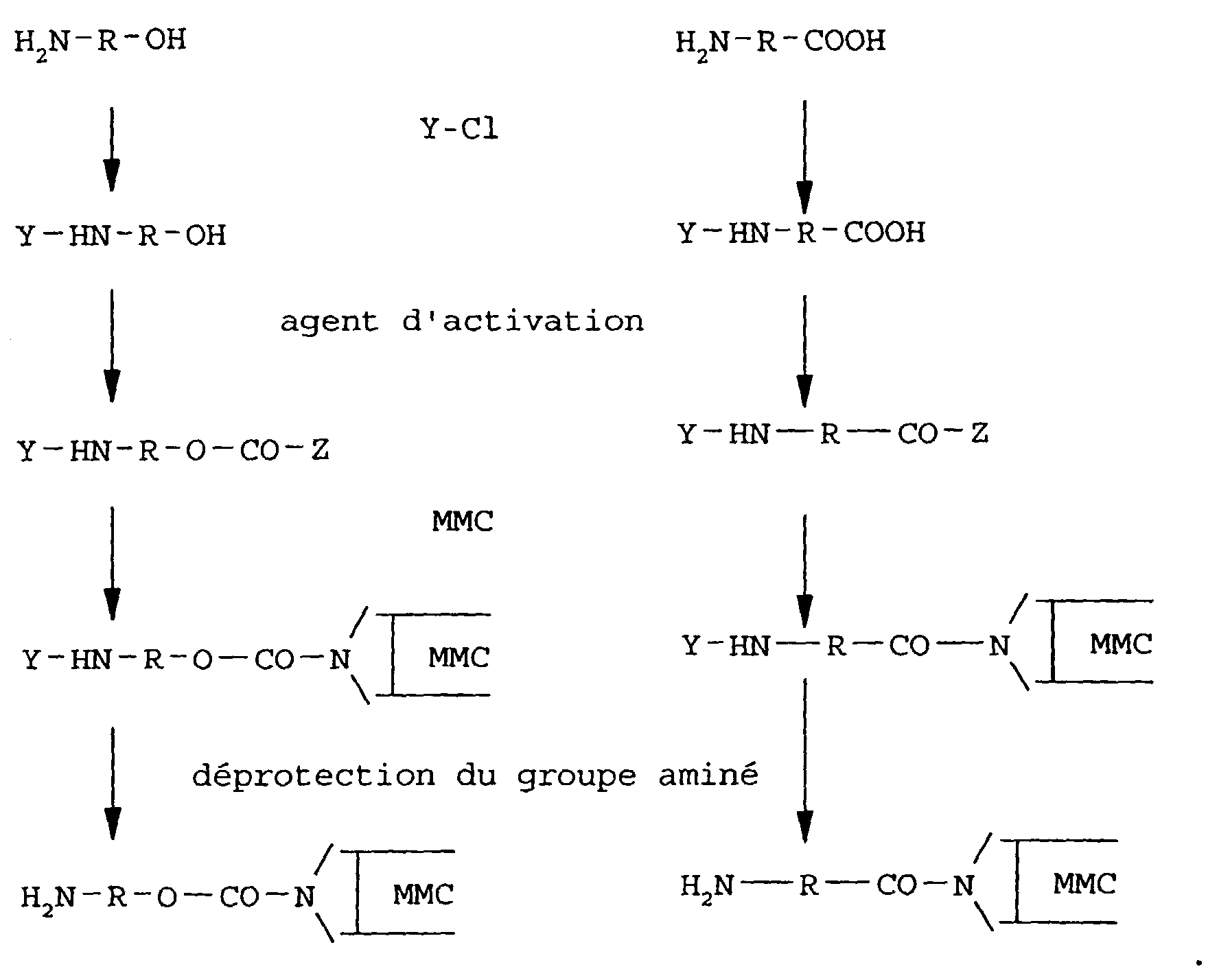
- These derivatives may conveniently be prepared using hydroxyamines, H 2 N-R-OH, or amino acids, H 2 N-R-COOH, as starting materials. These compounds may be coupled to the MMC molecules after first activating the hydroxyl or carboxyl group to convert it into a more reactive form suitable for coupling to the MMC aziridine >NH group.
- An important feature of the present invention in relation to the preparation of these particular derivatives from such starting materials is the fact that before activating the hydroxyl or carboxyl group thereof and coupling of the side chain or spacer to the mitomycin-C, the terminal amino group is protected with a suitable protective group that can subsequently be removed without damage to or degradation of the MMC molecule.
- a preferred amino protective group is fluorenyl methyloxycarbonyl (Fmoc) which can be removed by treatment with a base, e.g. a trialkyl or tertiary amine such as triethylamine, under mild conditions, i.e. at about or below room temperature.
- a base e.g. a trialkyl or tertiary amine such as triethylamine
- allyloxycarbonyl group CH 2 CH-CH 2 -O-CO- which can also be removed under mild conditions by treatment with tetrakis(triphenylphosphine)-palladium(0) using dimedone (5,5-dimethyl-1,3-cyclohexane dione) as an allyl scavenger.
- activation agents may be used which produce derivatives that react well with amino groups of aliphatic amines.
- a typical example is carbonyl di-imidazole (CDI), in which case Z will be a reactive imidazolide group.
- CDI will often be a preferred activating agent, but, alternatively, hydroxyl groups can be activated by reaction with chloroformates such as 4-nitrophenyl chloroformate, pentafluorophenyl chloroformate, succinimidyl chloroformate, etc.
- chloroformates such as 4-nitrophenyl chloroformate, pentafluorophenyl chloroformate, succinimidyl chloroformate, etc.
- COOH groups other methods well known in peptide chemistry can be used to convert the acid to a reactive derivative. Such methods include for instance the formation of reactive esters (e.g. 4-nitrophenyl ester, succinimide ester, etc.) or mixed anhydrides (e.g. isobuty
- the above procedure is preferably modified by first treating the MMC with CDI or other activating agent to provide the MMC molecule with a reactive imidazolide group, or other amino reactive group, linked to the aziridine NH group. This is then reacted with an excess of a diamine compound H 2 N-R-NH 2 to form the structure (c). In this case, no amino protective group is needed.
- the invention also includes mitomycin derivatives such as are herein disclosed having a side chain terminated with an amino or protected amino group, of general formula
- the portion H 2 N-R- may include any of the following:
- peptide spacers will be preferred for the linkages between the polymer carrier and the mitomycin molecules, but the number of peptide units and the amino acid composition thereof in the spacer groups may have an important influence on the stability and release characteristics of the drug molecules in vivo, as already indicated. This has been shown most clearly by some experiments carried out on polymer/drug conjugates composed of mitomycin-C molecules coupled through various tripeptide or tetrapeptide spacers to poly[N-(2-hydroxyethyl)-L-glutamine] (PHEG) as the polymeric carrier. These conjugates were prepared in accordance with the invention by first coupling the peptide spacer groups with MMC to provide reactive derivatives of the latter.
- tetrapeptide spacers especially spacers with amino acid sequences gly-phe-leu-gly, gly-phe-ala-leu or ala-leu-ala-leu, can provide a better substrate for lysosomal enzymes than tripeptide spacers and can be very rapidly degraded by lysosomal proteases to release the free drug.
- the polymer carrier chosen will generally be a non-toxic polymer containing functional hydroxyl or carboxyl side groups and may be a natural polymer, a synthetic polymer or a semi-synthetic polymer. In some cases it may be possible to couple carboxyl groups of the polymer directly to the amino-terminated reactive MMC derivative, e.g. in the presence of a suitable catalyst such as a carbodiimide. Usually, however, in preferred embodiments of the invention the polymer will first be converted into a more reactive derivative by activating the hydroxyl or carboxyl functional groups to convert them into a form that reacts readily with primary aliphatic amine amino groups.
- This may be accomplished, as already indicated in relation to the activation step used in preparing the reactive MMC derivatives, by using activating agents such as carbonyl diimidazole (CDI) to form a reactive imidazolide group or p-nitrophenyl chloroformate to form a reactive p-nitrophenol group, or by using one of various other known methods commonly used in peptide chemistry.
- activating agents such as carbonyl diimidazole (CDI) to form a reactive imidazolide group or p-nitrophenyl chloroformate to form a reactive p-nitrophenol group
- the polymer carriers may be either biostable or biodegradable.
- Suitable hydroxyl containing polymers include polysaccharides such as dextran and pullulan for example, poly[N-hydroxyalkyl acrylamide] and poly[N-hydroxyalkyl methacrylamide], poly(N-hydroxyalkylglutamine)s, e.g. poly[N-(2-hydroxyethyl)-L-glutamine] (PHEG), poly[N-hydroxyethyl)-aspartamide], poly(amidoamines)s with hydroxyl terminated side chains or side groups, and poly(phosphazene) derivatives, e.g. poly[N-(2-hydroxyethyl)phosphazene].
- polysaccharides such as dextran and pullulan for example, poly[N-hydroxyalkyl acrylamide] and poly[N-hydroxyalkyl methacrylamide], poly(N-hydroxyalkylglutamine)s, e.g. poly[N-(
- Suitable carboxyl containing polymers include poly(amidoamine) derivatives with -COOH side groups, poly(glutamic acid), succinylated polylysine, copolymers of vinyl pyrrolidone and maleic anhydride, succinylated hydroxyl containing polymers, etc.
- a typical conjugate based on PHEG as the polymer carrier may be represented as shown below, where the ratio x:y may vary between 0 and 3 for example.
- the polymers may have a wide variety of molecular weights, ranging on average for example from several hundred to tens or hundreds of thousands of daltons. For use in biological systems, however, it will usually be preferred that they be water soluble polymers.
- the number of amino reactive groups formed along the polymer chain will generally be controllable by the relative amount or quantity of activating reagent used and by the reaction conditions.
- targeting moieties or determinants such as antibodies or antibody binding fragments or oligopeptides that are effective in recognising specific cell membrane receptors of tumour cells, thus enabling specific tumour-targeted MMC conjugates to be synthesised.
- poly(amidoamine)s in which tertiary amino and amido groups are regularly arranged along the polymer main chain (see for example Ferruti et al , " Advances in Polymer Science “ (1984), 58 , 57) can be especially useful.
- Such poly(amidoamine) polymers which may include block copolymers and which may have advantageous pH-dependent conformational characteristics, can generally be prepared in a well-characterised form with pendant side chains terminating in -OH or -COOH groups that can be activated by the methods herein described (e.g. treatment with carbonyl diimidazole). These can then be coupled directly to a reactive MMC derivative, prepared as herein described, to provide satisfactory conjugates.
- the reactive mitomycin derivative is produced by treating MMC directly with an activating agent such as carbonyl diimidiazole (CDI), if desired a spacer group or unit provided by a diamine compound may be incorporated in a side chain of the polymer to modify the latter (after suitable activation of a hydroxyl or carboxyl group thereof), instead of being included as a side chain of the MMC molecule.
- an activating agent such as carbonyl diimidiazole (CDI)
- CDI carbonyl diimidiazole
- a spacer group or unit provided by a diamine compound may be incorporated in a side chain of the polymer to modify the latter (after suitable activation of a hydroxyl or carboxyl group thereof), instead of being included as a side chain of the MMC molecule.
- CDI carbonyl diimidiazole
- the invention also includes pharmaceutical formulations or compositions comprising polymer/MMC conjugate compounds produced as herein disclosed, especially conjugate compounds in which the carrier polymer contains both mitomycin-C drug molecules and a "targeting" moiety, made up for administration in any suitable manner, for example parenterally (including intravenously, intramuscularly and subcutaneously) or orally.
- Such formulations containing for example therapeutically effective amounts or dosages of the polymer/MMC conjugate together possibly with at least one other ingredient providing a compatible pharmaceutically acceptable additive, diluent or excipient, may be prepared by any of the methods well known in the art of pharmacy.
- the invention also includes all novel and inventive features and aspects herein disclosed, either explicitly or implicitly and either singly or in combination with one another, and the scope of the invention is not to be construed as being limited by the illustrative examples or by the terms and expressions used herein merely in a descriptive or explanatory sense.
- a 6-N-[fluorenylmethyloxycarbonyl]amino hexanoyl derivative of mitomycin-C has been prepared by reacting an activated derivative of N-protected 6-aminohexanoic acid with mitomycin-C.
- an activated derivative of the carboxylic acid including 4-nitrophenyl-ester, pentafluorophenylester etc.
- an imidazolide derivative prepared by reacting the said acid with carbonyl diimidazole, was used.
- the reaction scheme was as follows:
- the yield of the desired MMC derivative was 45% based on MMC added.
- the structure was confirmed by 1 H NMR.
- the MMC content in the polymer conjugate was analysed by UV spectroscopy.
- the degree of substitution (DS) was found to be 3mol percent.
- MMC derivatives having other ⁇ , ⁇ amino carboxylic acids substituted on the aziridine ring N-atom can be prepared as described above.
- All peptide-MMC derivatives were prepared using the same strategy. As an example is given the synthesis of gly-phe-gly-MMC.
- gly-phe-gly (0.0725 mmol) was dissolved in 5ml of a 10% solution of Na 2 CO 3 in water/dioxane mixture (vol. ratio 2/1) and cooled in an ice bath. Then 0.182g of Fmoc-C1 (0.7025 mmol), dissolved in 1ml dioxane, was added. The reaction mixture was stirred for 2 hours at room temperature and added to 50ml of water. After extraction with ether (20ml) the aqueous layer was acidified with concentrated HCl. The white precipitate was extracted with ethylacetate. The combined ethylacetate fractions were dried on magnesium sulphate.
- PHEG can be prepared by aminolysis of poly-gamma-benzyl-L-glutamate (PBLG) with 2-amino-1-ethanol.
- PBLG poly-gamma-benzyl-L-glutamate
- N-carboxyanhydride (NCA) of gamma-benzyl-L-glutamate was prepared by the method of Daly.
- the NCA was polymerized at room temperature in dioxane in the presence of triethylamine as the initiator. After polymerization for 3 days, PBLG was precipitated in excess ether, filtered and dried. Aminolysis of PBLG with 2-hydroxypyridine as a catalyst (20 mol%), was carried out in DMF as a solvent. The reaction mixture was stirred at room temperature for 48 hours.
- PHEG was precipitated in excess ether, filtered and dialyzed against water for 2 days. After freeze-drying pure PHEG was obtained as a white powder.
- PHEG/MMC conjugates prepared as described above confirmed that the oligopeptide spacers were degradable by lysosomal proteases, and also by collagenase IV (a tumour associated enzyme), to release free MMC, this enzymic degradation and controlled release being particularly efficient in acidic solution (e.g. about pH 5.5) for tetrapeptide spacers having a hydrophobic terminal amino acid. Also, it has been shown that these PHEG/MMC conjugates were far less toxic towards bone marrow than MMC itself. In addition, from in vivo tests using BALB/c mice it has been established that these PHEG-MMC conjugates are particularly effective as cytotoxic agents against solid tumours resulting from implanted C26 colorectal carcinoma cells.
- PAA polyamidoamine
- MMC-PAA MMC-polyamidoamine
- the MMC loading in the MMC-PAA adduct or conjugate was evaluated by means of a U.V. calibration curve based on MMC absorbance at 362 nm. No free MMC could be detected by usual analytical techniques (H.P.L.C., G.P.C., T.L.C.)
Landscapes
- Health & Medical Sciences (AREA)
- Life Sciences & Earth Sciences (AREA)
- Epidemiology (AREA)
- Animal Behavior & Ethology (AREA)
- Engineering & Computer Science (AREA)
- Chemical & Material Sciences (AREA)
- Medicinal Chemistry (AREA)
- Pharmacology & Pharmacy (AREA)
- Veterinary Medicine (AREA)
- Bioinformatics & Cheminformatics (AREA)
- General Health & Medical Sciences (AREA)
- Public Health (AREA)
- Proteomics, Peptides & Aminoacids (AREA)
- Pharmaceuticals Containing Other Organic And Inorganic Compounds (AREA)
- Medicinal Preparation (AREA)
- Nitrogen Condensed Heterocyclic Rings (AREA)
- Acyclic And Carbocyclic Compounds In Medicinal Compositions (AREA)
- Peptides Or Proteins (AREA)
Claims (26)
- Procédé de synthèse d'un système conjugué de polymère et de médicament composé d'un vecteur polymère sous forme d'une macromolécule biologiquement inerte couplée de façon covalente par des motifs de liaison intercalés à des molécules de mitomycine-C ou autre composé de mitomycine thérapeutiquement actif contenant un groupe >NH dans le cycle aziridine de celle-ci, ledit procédé étant caractérisé par une première étape consistant à :(a) modifier ledit composé de mitomycine pour obtenir un dérivé réactif de celui-ci, soit paret ensuite, dans une étape distincte ultérieure,(i) réaction dudit composé de mitomycine avec un agent d'activation de façon à transformer le groupe >NH du cycle aziridine de la mitomycine en un groupe activé capable de réagir avec des amines aliphatiques,
ou par(ii) couplage du groupe >NH du cycle aziridine de la mitomycine par une liaison covalente à une chaíne latérale qui peut donner ledit motif intercalé et qui se termine en un groupe amine primaire réactif -NH2;(b) une seconde étape de réaction dudit dérivé de mitomycine avec ledit vecteur polymère qui se présente sous une forme contenant au moins un groupe réactif, pour établir ainsi un couplage par une liaison covalente entre ledit groupe réactif du vecteur polymère et ledit dérivé réactif de mitomycine, soit par ledit groupe >NH du cycle aziridine de la mitomycine activé soit par un groupe terminal amine primaire réactif de ladite chaíne latérale du composé de mitomycine, et donnant ainsi ledit système conjugué de polymère et de médicament. - Procédé selon la revendication 1 dans lequel le groupe >NH du cycle aziridine de la mitomycine dans le système conjugué de polymère et de médicament est couplé à son motif de liaison intercalé associé au moyen d'une liaison uréthane, d'une liaison amide ou d'une liaison urée.
- Procédé selon la revendication 2 dans lequel le dérivé réactif du composé de mitomycine a une structure représentée par l'une des suivantes :dans laquelle R comprend un fragment aromatique ou aliphatique qui donne ledit motif de liaison intercalé.

- Procédé selon la revendication 3 dans lequel le dérivé réactif du composé de mitomycine est représenté par la structure :et est préparé par traitement soit d'une hydroxylamine H2N-R-OH soit d'un acide aminé H2N-R-COOH (après protection du groupe aminé terminal par un groupe protecteur) avec un agent d'activation de façon à activer le groupe hydroxyle ou carboxyle de celui-ci et à le transformer en une forme plus réactive appropriée au couplage avec le groupe imino aziridine du composé de mitomycine, puis par réaction de l'hydroxylamine ou de l'acide aminé protégé activé avec ledit composé de mitomycine pour donner un dérivé intermédiaire dans lequel ladite hydroxylamine ou ledit acide aminé protégé est couplé de façon covalente à la mitomycine via ledit groupe hydroxyle ou carboxyle activé, suivi par l'isolement et la purification dudit dérivé intermédiaire puis du traitement d'un tel dérivé intermédiaire pour éliminer le groupe protecteur d'amine (Y) et former le dérivé réactif de mitomycine prêt pour l'étape (b) de la revendication 1.

- Procédé selon la revendication 1, dans lequel le dérivé réactif du composé de mitomycine est préparé sensiblement selon l'un des schémas réactionnels suivants, dans lesquels R est un fragment aromatique ou aliphatique qui donne ledit motif de liaison intercalé, Y représente un groupe protecteur d'amine et Z représente un groupe activé :
- Procédé selon la revendication 4 ou 5, dans lequel le groupe protecteur d'amine (Y) est le fluorenyl méthyloxycarbonyl (Fmoc) ou un groupe allyloxycarbonyle CH2=CH-CH2-O-CO- .
- Procédé selon l'une quelconque des revendications 4 à 6, dans lequel(a) l'agent d'activation utilisé pour préparer le dérivé réactif de mitomycine est le carbonyl diimidazole (CDI)
ou, d'une autre façon,(b) dans le cas de la préparation du dérivé à partir d'hydroxylamine, l'activation du groupe -OH est effectuée par traitement avec un chloroformate ou,(c) dans le cas de la préparation du dérivé à partir d'un acide carboxylique aminé, l'activation du groupe carboxyle est effectuée par formation d'un ester réactif ou d'un anhydride mixte. - Procédé selon la revendication 3 dans lequel le dérivé réactif du composé de mitomycine est représenté par la structure (c) de la revendication 3 et est préparé par traitement du composé de mitomycine avec un agent d'activation pour donner un groupe aminé réactif lié au groupe >NH du cycle aziridine, et ensuite par réaction de ce produit avec un excès d'un composé diaminé H2N-R-NH2.
- Procédé selon l'une quelconque des revendications 3 à 8 dans lequel le groupe H2N-R- est choisi parmi :H2N-(CH2)n-H2N-(CH2)n-CO-NH-H2N-Ph-CO-NH-(CH2)n-
dans lesquels n est un entier compris entre 1 et 20 ou représenteH2N-Ph-
ou représente un acide aminé ou une séquence d' oligopeptide. - Procédé selon l'une quelconque des revendications 3 à 8 dans lequel R est un tripeptide ou un tétrapeptide.
- Procédé selon la revendication 10 dans lequel R est un tétrapeptide choisi entre gly-phe-leu-gly, gly-phe-ala-leu et ala-leu-ala-ley.
- Procédé selon la revendication 10 ou 11 dans lequel R comprend un acide aminé terminal hydrophobe.
- Procédé selon l'une quelconque des revendications précédentes dans lequel le vecteur polymère est constitué par un polymère non toxique contenant des groupes hydroxyle ou carboxyle fonctionnels qui sont activés par traitement avec un agent d'activation, par exemple du carbonyl diimidazole ou du chloroformate de p-nitrophényle, de façon à réagir plus facilement avec des groupes aliphatiques amine primaire.
- Procédé selon la revendication 13 dans lequel le vecteur polymère est un polymère contenant un groupe hydroxyle choisi parmi les polysaccharides, les poly (N-hydroxyalkylglutamine)s, les poly(amidoamine)s ayant des groupes hydroxyle latéraux, et les dérivés de poly (phosphazène).
- Procédé selon la revendication 13 dans lequel le vecteur polymère est un polymère contenant le groupe carboxyle choisi parmi les dérivés de poly(amidoamine) ayant des groupes latéraux -COOH, le poly(acide glutamique), la polylysine succinylée, les copolymères de vinyl pyrrolidone et d'anhydride maléique, et les polymères contenant des groupes hydroxyle succinylés.
- Procédé de synthèse d'un système conjugué de polymère et de médicament comprenant de la mitomycine-C ou autre composé de mitomycine anticancéreux contenant un groupe >NH dans le cycle aziridine, ledit procédé consistant en les étapes de :(a) préparer un dérivé d'une hydroxylamine H2N-R-OH ou d'un acide aminé H2N-R-COOH dans lequel le groupe aminé terminal est muni d'un groupe protecteur,(b) traiter ledit dérivé à groupe aminé protégé de l'étape (a) avec un agent d'activation pour activer le groupe hydroxyle ou carboxyle de celui-ci,(c) faire réagir le produit de l'étape (b) avec le composé de mitomycine ce par quoi le groupe >NH du cycle aziridine de la mitomycine est couplé de façon covalente audit groupe hydroxyle ou carboxyle activé pour donner une chaíne latérale,(d) isoler et purifier le produit de l'étape (c),(e) traiter le produit de l'étape (d) pour éliminer le groupe protecteur d'amine sans endommager ou dégrader la molécule de mitomycine,(f) faire réagir le dérivé de mitomycine produit dans l'étape (e) avec un vecteur polymère contenant au moins un groupe aminé réactif qui réagit pour former une liaison covalente avec ledit dérivé de mitomycine via le groupe aminé terminal déprotégé de ladite chaíne latérale, ladite chaíne latérale formant ensuite un motif intercalé entre le polymère et le composé de mitomycine, et(g) recueillir le produit de l'étape (f) qui constitue le système conjugué de polymère et de médicament.
- Procédé de synthèse d'un système conjugué de polymère et de médicament comprenant de la mitomycine-C ou autre composé de mitomycine anticancéreux contenant un groupe >NH dans le cycle aziridine, ledit procédé consistant en les étapes de :(a) traiter le composé de mitomycine avec un agent d'activation pour activer le groupe >NH du cycle aziridine de la mitomycine,(b) faire réagir le composé de mitomycine activé de l'étape (a) avec un excès d'un composé diaminé H2N-R-NH2 pour coupler ainsi de façon covalente ce dernier comme chaíne latérale du composé de mitomycine,,(c) isoler et purifier le produit de l'étape (b),(d) faire réagir le dérivé de mitomycine produit dans l'étape (c) avec un vecteur polymère contenant au moins un groupe aminé réactif qui réagit pour former une liaison covalente avec ledit dérivé de mitomycine via le groupe aminé terminal de ladite chaíne latérale, ladite chaíne latérale formant ensuite un motif intercalé entre le polymère et le composé de mitomycine, et(e) recueillir le produit de l'étape (d) qui constitue le système conjugué de polymère et de médicament.
- Procédé pour préparer un composé conjugué d'une molécule vecteur polymère sous forme d'une macromolécule biologiquement inerte et de molécules de médicament mitomycine (MMC) contenant un groupe >NH dans leur cycle aziridine, dans lequel les molécules de MMC sont liées de façon covalente à la molécule vecteur polymère par des groupes intercalés biodégradables, ledit procédé étant caractérisé en ce qu'il comprend les étapes de couplage desdits groupes intercalés sous forme d'oligopeptides avec des molécules de MMC via les groupes imino aziridine de ces dernières, de purification du dérivé d'oligopeptide ainsi formé, et ensuite de couplage du dérivé d'oligopeptide purifié au vecteur polymère via les groupes réactifs de ce dernier et les groupes aminés terminaux réactifs des motifs intercalés oligopeptides.
- Procédé de préparation de promédicaments polymériques de mitomycine-C (MMC) dans lequel les molécules de MMC sont couplés via des groupes intercalés oligopeptides biodégradables à un vecteur polymère macromoléculaire, ledit procédé étant caractérisé par le fait que les dérivés oligopeptide-MMC dans lesquels les molécules de MMC sont liées de façon covalente aux groupes oligopeptide intercalés sont tout d'abord préparés en faisant réagir la MMC avec un oligopeptide à terminaison N protégée, suivi par l'étape d'élimination du groupe N-protecteur et ensuite par l'étape de couplage des dérivés oligopeptide intercalé-MMC avec les groupes activés du vecteur polymère.
- Procédé selon la revendication 19, dans lequel les groupes aminés terminaux des oligopeptides ayant réagi initialement avec la MMC sont protégés par des groupes protecteurs Fmoc et sont activés sous forme d'ester de pentafluorophényle, et dans lequel le vecteur polymère est du poly[(N-hydroxyéthyl)-L-glutamine] (PHEG) qui est couplé via des groupes chloroformate de 4-nitrophényle activés aux groupes aminés réactifs terminaux des oligopeptides intercalés déprotégés liés aux molécules de MMC.
- Procédé selon la revendication 1 dans lequel le composé de mitomycine est modifié dans ladite première étape pour donner un dérivé réactif en faisant réagir ledit composé de mitomycine avec un agent d'activation de façon à transformer le groupe >NH du cycle aziridine de la mitomycine en un groupe activé capable de réagir avec des amines aliphatiques, caractérisé en ce que dans ladite seconde étape le vecteur polymère avec lequel ledit dérivé réactif de mitomycine réagit est un polymère de poly(amidoamine) ayant des chaínes latérales portant lesdits motifs intercalés, lesdites chaínes latérales se terminant en groupe amine réactif qui se couple de façon covalente avec ledit groupe >NH du cycle aziridine de la mitomycine pour former le système conjugué de polymère et de médicament.
- Procédé selon la revendication 21 qui comprend une étape préliminaire de modification d'un polymère de poly(amidoamine) ayant des chaínes latérales se terminant par des groupes hydroxyle ou carboxyle par traitement avec un carbonyl diimidazole (CDI)ou autre agent d'activation et un composé diaminé pour préparer ledit polymère de poly(amidoamine) avec lequel ledit dérivé réactif de mitomycine réagit.
- Système conjugué de polymère et de médicament préparé par un procédé selon l'une quelconque des revendications 1 à 20 dans lequel le vecteur polymère est de la poly[N-(2-hydroxyéthyl)-L-glutamine] (PHEG) ou un sel de celle-ci couplé à des molécules de MMC par des groupes intercalés tripeptide ou tétrapeptide qui comprennent un acide aminé terminal hydrophobe et qui sont efficacement dégradables en solution acide par des enzymes lysosomales et aussi par l'enzyme collagénase IV, ledit système conjugué étant sensiblement moins toxique vis-à-vis de la moelle des os que la MMC.
- Dérivé de mitomycine ayant une chaíne latérale terminée par un groupe amine ou amine protégé à utiliser comme composé intermédiaire dans la synthèse de systèmes conjugués avec un vecteur polymère selon un procédé selon l'une ou plusieurs des revendications 1 à 20, ledit dérivé ayant une formule générale :dans laquelle
 X est une liaison -CO-, -CO-O- ou -CO-NH-Y est H ou un groupe amine protégé,
et R est choisi parmiou est un acide aminé ou une séquence oligopeptide.-(CH2)n-,- (CH2)n-CO-NH-,-Ph-CO-NH-(CH2)n-où n est un entier compris entre 1 et 20,-Ph-, - Dérivé réactif de mitomycine, obtenu par traitement d'un composé de mitomycine contenant un groupe >NH dans le cycle aziridine de celle-ci avec du carbonyl diimidazole et isolement du produit, à utiliser comme composé intermédiaire pour réaliser le procédé selon l'une ou plusieurs des revendications 1, 8 et 17.
- Formulation pharmaceutique contenant un vecteur polymère et un composé conjugué de mitomycine-C dans laquelle ledit composé conjugué est préparé par un procédé selon l'une quelconque des revendications 1 à 22.
Applications Claiming Priority (3)
| Application Number | Priority Date | Filing Date | Title |
|---|---|---|---|
| GB9317213 | 1993-08-18 | ||
| GB9317213A GB2282384B8 (en) | 1993-08-18 | 1993-08-18 | Drug delivery agents incorporating mitomycin |
| PCT/IB1994/000259 WO1995005200A1 (fr) | 1993-08-18 | 1994-08-17 | Agents d'administration de medicaments comprenant de la mitomycine |
Publications (2)
| Publication Number | Publication Date |
|---|---|
| EP0804246A1 EP0804246A1 (fr) | 1997-11-05 |
| EP0804246B1 true EP0804246B1 (fr) | 2000-05-17 |
Family
ID=10740702
Family Applications (1)
| Application Number | Title | Priority Date | Filing Date |
|---|---|---|---|
| EP94923825A Expired - Lifetime EP0804246B1 (fr) | 1993-08-18 | 1994-08-17 | Agents d'administration de medicaments comprenant de la mitomycine |
Country Status (12)
| Country | Link |
|---|---|
| US (1) | US5738864A (fr) |
| EP (1) | EP0804246B1 (fr) |
| JP (1) | JPH09501674A (fr) |
| AT (1) | ATE192933T1 (fr) |
| CA (1) | CA2168007C (fr) |
| DE (1) | DE69424577T2 (fr) |
| DK (1) | DK0804246T3 (fr) |
| ES (1) | ES2145832T3 (fr) |
| GB (1) | GB2282384B8 (fr) |
| GR (1) | GR3034174T3 (fr) |
| PT (1) | PT804246E (fr) |
| WO (1) | WO1995005200A1 (fr) |
Families Citing this family (21)
| Publication number | Priority date | Publication date | Assignee | Title |
|---|---|---|---|---|
| US5850855A (en) * | 1990-01-09 | 1998-12-22 | Ems-Inventa Ag | Flexible coolant conduit and method of making same |
| IL131162A0 (en) * | 1997-02-26 | 2001-01-28 | Lilly Co Eli | Selective epoxidation process for preparing pharmaceutical compounds |
| US6251866B1 (en) * | 1997-08-05 | 2001-06-26 | Watson Laboratories, Inc. | Conjugates targeted to the interleukin-2 receptor |
| US6958148B1 (en) | 1998-01-20 | 2005-10-25 | Pericor Science, Inc. | Linkage of agents to body tissue using microparticles and transglutaminase |
| US6919076B1 (en) | 1998-01-20 | 2005-07-19 | Pericor Science, Inc. | Conjugates of agents and transglutaminase substrate linking molecules |
| MXPA01004239A (es) * | 1998-10-30 | 2002-06-04 | Daiichi Seiyaku Co | Compuesto dds y metodo para la medicion del mismo. |
| WO2002020663A2 (fr) | 2000-09-06 | 2002-03-14 | Ap Pharma, Inc. | Polymeres degradables de polyacetal |
| AU2002332637A1 (en) * | 2001-08-22 | 2003-03-10 | Watson Pharmaceuticals, Inc. | Conjugates targeted to target receptors |
| JP4898431B2 (ja) * | 2003-04-29 | 2012-03-14 | ザ ジェネラル ホスピタル コーポレイション | 複数薬物の持続放出のための方法およびデバイス |
| WO2006020719A2 (fr) | 2004-08-11 | 2006-02-23 | Arqule, Inc. | Compositions de promedicaments a base de quinone et methodes d'utilisation |
| US8614228B2 (en) | 2004-08-11 | 2013-12-24 | Arqule, Inc. | Quinone prodrug compositions and methods of use |
| JP5237821B2 (ja) | 2005-12-05 | 2013-07-17 | 日東電工株式会社 | ポリグルタミン酸−アミノ酸結合体および方法 |
| US20080181852A1 (en) * | 2007-01-29 | 2008-07-31 | Nitto Denko Corporation | Multi-functional Drug Carriers |
| JP5286822B2 (ja) * | 2007-02-22 | 2013-09-11 | Jsr株式会社 | ポリアミノ酸またはポリアミノ酸系共重合体の製造方法 |
| EP2144631A2 (fr) * | 2007-04-10 | 2010-01-20 | Nitto Denko Corporation | Supports de médicaments multifonctionnels à base de polyglutamate |
| BRPI0810717A2 (pt) | 2007-04-30 | 2016-05-24 | Arqule Inc | sulfonato hidroxi de composto de quinona e seus usos |
| DK2155255T3 (da) * | 2007-05-09 | 2013-09-02 | Nitto Denko Corp | Sammensætninger der omfatter en hydrofob forbindelse og et polyaminosyrekonjugat |
| JP2010528122A (ja) * | 2007-05-09 | 2010-08-19 | 日東電工株式会社 | 白金薬剤と結合されたポリマー |
| EP2155253A2 (fr) * | 2007-05-09 | 2010-02-24 | Nitto Denko Corporation | Conjugués de polyglutamate et conjugués de polyglutamate-amino acide contenant une pluralité de médicaments |
| KR20100122510A (ko) * | 2008-03-06 | 2010-11-22 | 닛토덴코 가부시키가이샤 | 중합체 파클리탁셀 접합체 및 암 치료 방법 |
| WO2019016208A1 (fr) * | 2017-07-17 | 2019-01-24 | Technische Universiteit Eindhoven | Composition chimique applicable comprenant un agent conjugué à une partie hydrophobe ainsi qu'un support |
Family Cites Families (5)
| Publication number | Priority date | Publication date | Assignee | Title |
|---|---|---|---|---|
| GB1541436A (en) * | 1976-02-02 | 1979-02-28 | Searle & Co | Immunological materials |
| JP2528477B2 (ja) * | 1987-09-07 | 1996-08-28 | 三共株式会社 | 高分子制癌剤の増強剤 |
| AU628846B2 (en) * | 1988-08-23 | 1992-09-24 | Georgetown University | Mitomycin derivatives having reduced bone marrow toxicity, processes for their preparation, and the uses thereof |
| JPH0762049B2 (ja) * | 1991-03-18 | 1995-07-05 | 工業技術院長 | 高分子マイトマイシンc誘導体及びその製造方法 |
| JPH05252673A (ja) * | 1992-03-05 | 1993-09-28 | Honda Motor Co Ltd | 電源装置 |
-
1993
- 1993-08-18 GB GB9317213A patent/GB2282384B8/en not_active Expired - Fee Related
-
1994
- 1994-08-17 JP JP7506852A patent/JPH09501674A/ja active Pending
- 1994-08-17 DE DE69424577T patent/DE69424577T2/de not_active Expired - Fee Related
- 1994-08-17 US US08/602,733 patent/US5738864A/en not_active Expired - Fee Related
- 1994-08-17 AT AT94923825T patent/ATE192933T1/de not_active IP Right Cessation
- 1994-08-17 EP EP94923825A patent/EP0804246B1/fr not_active Expired - Lifetime
- 1994-08-17 DK DK94923825T patent/DK0804246T3/da active
- 1994-08-17 ES ES94923825T patent/ES2145832T3/es not_active Expired - Lifetime
- 1994-08-17 WO PCT/IB1994/000259 patent/WO1995005200A1/fr not_active Ceased
- 1994-08-17 CA CA002168007A patent/CA2168007C/fr not_active Expired - Fee Related
- 1994-08-17 PT PT94923825T patent/PT804246E/pt unknown
-
2000
- 2000-08-10 GR GR20000401869T patent/GR3034174T3/el not_active IP Right Cessation
Also Published As
| Publication number | Publication date |
|---|---|
| GR3034174T3 (en) | 2000-11-30 |
| CA2168007A1 (fr) | 1995-02-23 |
| WO1995005200A1 (fr) | 1995-02-23 |
| US5738864A (en) | 1998-04-14 |
| ATE192933T1 (de) | 2000-06-15 |
| GB2282384B (en) | 1997-09-03 |
| EP0804246A1 (fr) | 1997-11-05 |
| ES2145832T3 (es) | 2000-07-16 |
| PT804246E (pt) | 2000-08-31 |
| DK0804246T3 (da) | 2000-11-13 |
| GB2282384A (en) | 1995-04-05 |
| DE69424577T2 (de) | 2001-02-22 |
| CA2168007C (fr) | 2001-06-12 |
| GB2282384B8 (en) | 1997-09-04 |
| DE69424577D1 (de) | 2000-06-21 |
| JPH09501674A (ja) | 1997-02-18 |
| GB9317213D0 (en) | 1993-10-06 |
Similar Documents
| Publication | Publication Date | Title |
|---|---|---|
| US5738864A (en) | Drug delivery agents incorporating mitomycin | |
| AU764144B2 (en) | Polyamide chains of precise length, methods to manufacture them and their conjugates | |
| Yokoyama et al. | Molecular design for missile drug: Synthesis of adriamycin conjugated with immunoglobulin G using poly (ethylene glycol)‐block‐poly (aspartic acid) as intermediate carrier | |
| AU723442B2 (en) | Method for preparing drug complex | |
| AU781729B2 (en) | Method for the preparation of 1-benzotriazolyl carbonate esters of poly(ethylene glycol) | |
| US9289510B2 (en) | Polymeric drug delivery conjugates and methods of making and using thereof | |
| ES2404685T3 (es) | Derivados heterobifuncionales de poli(etilenglicol) y métodos para su preparación | |
| HUT64022A (en) | Process for producing active polyalkileneoxide carbonates for the modification of polypeptides | |
| JP4877225B2 (ja) | ポリオキシアルキレン誘導体 | |
| US20020072573A1 (en) | Heterobifunctional poly(ethylene glycol) derivatives and methods for their preparation | |
| JP3181276B2 (ja) | 樹枝状分岐構造を持つ両親媒性化合物 | |
| Ulbrich et al. | Poly (ethylene glycol) s containing enzymatically degradable bonds | |
| Hoes et al. | Biological properties of adriamycin bound to biodegradable polymeric carriers | |
| WO2006091894A2 (fr) | Nouveaux materiaux polymeres et leurs procedes | |
| EA003790B1 (ru) | Соединение сдлс и способ его измерения | |
| CN114423776A (zh) | 非对称支链型分解性聚乙二醇衍生物 | |
| AU772167B2 (en) | Polypeptide dendrimers as unimolecular carriers of diagnostic imaging contrast agents, bioactive substances and drugs | |
| De Marre et al. | Synthesis of macromolecular Mitomycin C derivatives | |
| GB2244491A (en) | Conjugate compounds of polymers with other organic molecular entities. | |
| WO2018205286A1 (fr) | Conjugué et copolymère séquencé contenant un chromophore fluorescent, son procédé de préparation et son utilisation | |
| EP0536343B1 (fr) | Conjugues polymeres cibles de cyclosporine et procede de preparation | |
| Hoes et al. | Design of soluble conjugates of biodegradable polymeric carriers and adriamycin | |
| Pechar et al. | Synthesis of poly (ethylene glycol) block copolymers as potential water-soluble drug carriers | |
| EP1400551B1 (fr) | Procédé de fabrication de chaines polyamides de longueur définie et leur conjugués avec des protéines | |
| Ulbrich et al. | Hydrophilic polymers for drug delivery |
Legal Events
| Date | Code | Title | Description |
|---|---|---|---|
| PUAI | Public reference made under article 153(3) epc to a published international application that has entered the european phase |
Free format text: ORIGINAL CODE: 0009012 |
|
| 17P | Request for examination filed |
Effective date: 19960309 |
|
| AK | Designated contracting states |
Kind code of ref document: A1 Designated state(s): AT BE CH DE DK ES FR GB GR IE IT LI LU MC NL PT SE |
|
| RAP1 | Party data changed (applicant data changed or rights of an application transferred) |
Owner name: EUROPEAN COMMUNITY |
|
| RTI1 | Title (correction) |
Free format text: DRUG DELIVERY AGENTS INCORPORATING MITOMYCIN |
|
| GRAG | Despatch of communication of intention to grant |
Free format text: ORIGINAL CODE: EPIDOS AGRA |
|
| 17Q | First examination report despatched |
Effective date: 19990818 |
|
| GRAG | Despatch of communication of intention to grant |
Free format text: ORIGINAL CODE: EPIDOS AGRA |
|
| GRAH | Despatch of communication of intention to grant a patent |
Free format text: ORIGINAL CODE: EPIDOS IGRA |
|
| GRAH | Despatch of communication of intention to grant a patent |
Free format text: ORIGINAL CODE: EPIDOS IGRA |
|
| GRAA | (expected) grant |
Free format text: ORIGINAL CODE: 0009210 |
|
| AK | Designated contracting states |
Kind code of ref document: B1 Designated state(s): AT BE CH DE DK ES FR GB GR IE IT LI LU MC NL PT SE |
|
| REF | Corresponds to: |
Ref document number: 192933 Country of ref document: AT Date of ref document: 20000615 Kind code of ref document: T |
|
| REG | Reference to a national code |
Ref country code: IE Ref legal event code: FG4D Ref country code: CH Ref legal event code: EP |
|
| ITF | It: translation for a ep patent filed | ||
| REG | Reference to a national code |
Ref country code: CH Ref legal event code: NV Representative=s name: E. BLUM & CO. PATENTANWAELTE |
|
| REF | Corresponds to: |
Ref document number: 69424577 Country of ref document: DE Date of ref document: 20000621 |
|
| ET | Fr: translation filed | ||
| REG | Reference to a national code |
Ref country code: ES Ref legal event code: FG2A Ref document number: 2145832 Country of ref document: ES Kind code of ref document: T3 |
|
| REG | Reference to a national code |
Ref country code: PT Ref legal event code: SC4A Free format text: AVAILABILITY OF NATIONAL TRANSLATION Effective date: 20000606 |
|
| REG | Reference to a national code |
Ref country code: DK Ref legal event code: T3 |
|
| PLBE | No opposition filed within time limit |
Free format text: ORIGINAL CODE: 0009261 |
|
| STAA | Information on the status of an ep patent application or granted ep patent |
Free format text: STATUS: NO OPPOSITION FILED WITHIN TIME LIMIT |
|
| 26N | No opposition filed | ||
| REG | Reference to a national code |
Ref country code: GB Ref legal event code: IF02 |
|
| PGFP | Annual fee paid to national office [announced via postgrant information from national office to epo] |
Ref country code: MC Payment date: 20040722 Year of fee payment: 11 |
|
| PGFP | Annual fee paid to national office [announced via postgrant information from national office to epo] |
Ref country code: NL Payment date: 20040723 Year of fee payment: 11 Ref country code: DE Payment date: 20040723 Year of fee payment: 11 Ref country code: BE Payment date: 20040723 Year of fee payment: 11 |
|
| PGFP | Annual fee paid to national office [announced via postgrant information from national office to epo] |
Ref country code: SE Payment date: 20040726 Year of fee payment: 11 Ref country code: DK Payment date: 20040726 Year of fee payment: 11 |
|
| PGFP | Annual fee paid to national office [announced via postgrant information from national office to epo] |
Ref country code: PT Payment date: 20040727 Year of fee payment: 11 Ref country code: IE Payment date: 20040727 Year of fee payment: 11 Ref country code: GR Payment date: 20040727 Year of fee payment: 11 Ref country code: CH Payment date: 20040727 Year of fee payment: 11 |
|
| PGFP | Annual fee paid to national office [announced via postgrant information from national office to epo] |
Ref country code: GB Payment date: 20040728 Year of fee payment: 11 |
|
| PGFP | Annual fee paid to national office [announced via postgrant information from national office to epo] |
Ref country code: LU Payment date: 20040730 Year of fee payment: 11 |
|
| PGFP | Annual fee paid to national office [announced via postgrant information from national office to epo] |
Ref country code: ES Payment date: 20040809 Year of fee payment: 11 |
|
| PGFP | Annual fee paid to national office [announced via postgrant information from national office to epo] |
Ref country code: FR Payment date: 20040826 Year of fee payment: 11 |
|
| PG25 | Lapsed in a contracting state [announced via postgrant information from national office to epo] |
Ref country code: LU Free format text: LAPSE BECAUSE OF NON-PAYMENT OF DUE FEES Effective date: 20050817 Ref country code: IT Free format text: LAPSE BECAUSE OF NON-PAYMENT OF DUE FEES;WARNING: LAPSES OF ITALIAN PATENTS WITH EFFECTIVE DATE BEFORE 2007 MAY HAVE OCCURRED AT ANY TIME BEFORE 2007. THE CORRECT EFFECTIVE DATE MAY BE DIFFERENT FROM THE ONE RECORDED. Effective date: 20050817 Ref country code: IE Free format text: LAPSE BECAUSE OF NON-PAYMENT OF DUE FEES Effective date: 20050817 Ref country code: GB Free format text: LAPSE BECAUSE OF NON-PAYMENT OF DUE FEES Effective date: 20050817 |
|
| PG25 | Lapsed in a contracting state [announced via postgrant information from national office to epo] |
Ref country code: SE Free format text: LAPSE BECAUSE OF NON-PAYMENT OF DUE FEES Effective date: 20050818 Ref country code: ES Free format text: LAPSE BECAUSE OF NON-PAYMENT OF DUE FEES Effective date: 20050818 |
|
| PG25 | Lapsed in a contracting state [announced via postgrant information from national office to epo] |
Ref country code: MC Free format text: LAPSE BECAUSE OF NON-PAYMENT OF DUE FEES Effective date: 20050831 Ref country code: LI Free format text: LAPSE BECAUSE OF NON-PAYMENT OF DUE FEES Effective date: 20050831 Ref country code: DK Free format text: LAPSE BECAUSE OF NON-PAYMENT OF DUE FEES Effective date: 20050831 Ref country code: CH Free format text: LAPSE BECAUSE OF NON-PAYMENT OF DUE FEES Effective date: 20050831 Ref country code: BE Free format text: LAPSE BECAUSE OF NON-PAYMENT OF DUE FEES Effective date: 20050831 |
|
| PG25 | Lapsed in a contracting state [announced via postgrant information from national office to epo] |
Ref country code: PT Free format text: LAPSE BECAUSE OF NON-PAYMENT OF DUE FEES Effective date: 20060217 |
|
| PGFP | Annual fee paid to national office [announced via postgrant information from national office to epo] |
Ref country code: AT Payment date: 20060228 Year of fee payment: 12 |
|
| PG25 | Lapsed in a contracting state [announced via postgrant information from national office to epo] |
Ref country code: NL Free format text: LAPSE BECAUSE OF NON-PAYMENT OF DUE FEES Effective date: 20060301 Ref country code: DE Free format text: LAPSE BECAUSE OF NON-PAYMENT OF DUE FEES Effective date: 20060301 |
|
| PG25 | Lapsed in a contracting state [announced via postgrant information from national office to epo] |
Ref country code: GR Free format text: LAPSE BECAUSE OF NON-PAYMENT OF DUE FEES Effective date: 20060302 |
|
| REG | Reference to a national code |
Ref country code: CH Ref legal event code: PL |
|
| REG | Reference to a national code |
Ref country code: DK Ref legal event code: EBP |
|
| EUG | Se: european patent has lapsed | ||
| GBPC | Gb: european patent ceased through non-payment of renewal fee |
Effective date: 20050817 |
|
| PG25 | Lapsed in a contracting state [announced via postgrant information from national office to epo] |
Ref country code: FR Free format text: LAPSE BECAUSE OF NON-PAYMENT OF DUE FEES Effective date: 20060428 |
|
| NLV4 | Nl: lapsed or anulled due to non-payment of the annual fee |
Effective date: 20060301 |
|
| REG | Reference to a national code |
Ref country code: IE Ref legal event code: MM4A |
|
| REG | Reference to a national code |
Ref country code: FR Ref legal event code: ST Effective date: 20060428 |
|
| PG25 | Lapsed in a contracting state [announced via postgrant information from national office to epo] |
Ref country code: AT Free format text: LAPSE BECAUSE OF NON-PAYMENT OF DUE FEES Effective date: 20060817 |
|
| REG | Reference to a national code |
Ref country code: ES Ref legal event code: FD2A Effective date: 20050818 |
|
| BERE | Be: lapsed |
Owner name: *EUROPEAN COMMUNITY Effective date: 20050831 |