EP0803531B1 - Wasserdichtes Material und Verfahren zu seiner Anwendung - Google Patents
Wasserdichtes Material und Verfahren zu seiner Anwendung Download PDFInfo
- Publication number
- EP0803531B1 EP0803531B1 EP97302746A EP97302746A EP0803531B1 EP 0803531 B1 EP0803531 B1 EP 0803531B1 EP 97302746 A EP97302746 A EP 97302746A EP 97302746 A EP97302746 A EP 97302746A EP 0803531 B1 EP0803531 B1 EP 0803531B1
- Authority
- EP
- European Patent Office
- Prior art keywords
- layer
- waterproof
- sheet
- waterproof material
- resin composition
- Prior art date
- Legal status (The legal status is an assumption and is not a legal conclusion. Google has not performed a legal analysis and makes no representation as to the accuracy of the status listed.)
- Expired - Lifetime
Links
Images
Classifications
-
- B—PERFORMING OPERATIONS; TRANSPORTING
- B32—LAYERED PRODUCTS
- B32B—LAYERED PRODUCTS, i.e. PRODUCTS BUILT-UP OF STRATA OF FLAT OR NON-FLAT, e.g. CELLULAR OR HONEYCOMB, FORM
- B32B7/00—Layered products characterised by the relation between layers; Layered products characterised by the relative orientation of features between layers, or by the relative values of a measurable parameter between layers, i.e. products comprising layers having different physical, chemical or physicochemical properties; Layered products characterised by the interconnection of layers
- B32B7/02—Physical, chemical or physicochemical properties
- B32B7/022—Mechanical properties
-
- B—PERFORMING OPERATIONS; TRANSPORTING
- B29—WORKING OF PLASTICS; WORKING OF SUBSTANCES IN A PLASTIC STATE IN GENERAL
- B29C—SHAPING OR JOINING OF PLASTICS; SHAPING OF MATERIAL IN A PLASTIC STATE, NOT OTHERWISE PROVIDED FOR; AFTER-TREATMENT OF THE SHAPED PRODUCTS, e.g. REPAIRING
- B29C70/00—Shaping composites, i.e. plastics material comprising reinforcements, fillers or preformed parts, e.g. inserts
- B29C70/04—Shaping composites, i.e. plastics material comprising reinforcements, fillers or preformed parts, e.g. inserts comprising reinforcements only, e.g. self-reinforcing plastics
- B29C70/28—Shaping operations therefor
- B29C70/40—Shaping or impregnating by compression not applied
- B29C70/50—Shaping or impregnating by compression not applied for producing articles of indefinite length, e.g. prepregs, sheet moulding compounds [SMC] or cross moulding compounds [XMC]
- B29C70/504—Shaping or impregnating by compression not applied for producing articles of indefinite length, e.g. prepregs, sheet moulding compounds [SMC] or cross moulding compounds [XMC] using rollers or pressure bands
- B29C70/508—Shaping or impregnating by compression not applied for producing articles of indefinite length, e.g. prepregs, sheet moulding compounds [SMC] or cross moulding compounds [XMC] using rollers or pressure bands and first forming a mat composed of short fibres
-
- B—PERFORMING OPERATIONS; TRANSPORTING
- B32—LAYERED PRODUCTS
- B32B—LAYERED PRODUCTS, i.e. PRODUCTS BUILT-UP OF STRATA OF FLAT OR NON-FLAT, e.g. CELLULAR OR HONEYCOMB, FORM
- B32B27/00—Layered products comprising a layer of synthetic resin
- B32B27/04—Layered products comprising a layer of synthetic resin as impregnant, bonding, or embedding substance
-
- B—PERFORMING OPERATIONS; TRANSPORTING
- B32—LAYERED PRODUCTS
- B32B—LAYERED PRODUCTS, i.e. PRODUCTS BUILT-UP OF STRATA OF FLAT OR NON-FLAT, e.g. CELLULAR OR HONEYCOMB, FORM
- B32B27/00—Layered products comprising a layer of synthetic resin
- B32B27/06—Layered products comprising a layer of synthetic resin as the main or only constituent of a layer, which is next to another layer of the same or of a different material
- B32B27/08—Layered products comprising a layer of synthetic resin as the main or only constituent of a layer, which is next to another layer of the same or of a different material of synthetic resin
-
- B—PERFORMING OPERATIONS; TRANSPORTING
- B32—LAYERED PRODUCTS
- B32B—LAYERED PRODUCTS, i.e. PRODUCTS BUILT-UP OF STRATA OF FLAT OR NON-FLAT, e.g. CELLULAR OR HONEYCOMB, FORM
- B32B27/00—Layered products comprising a layer of synthetic resin
- B32B27/18—Layered products comprising a layer of synthetic resin characterised by the use of special additives
- B32B27/20—Layered products comprising a layer of synthetic resin characterised by the use of special additives using fillers, pigments, thixotroping agents
-
- B—PERFORMING OPERATIONS; TRANSPORTING
- B32—LAYERED PRODUCTS
- B32B—LAYERED PRODUCTS, i.e. PRODUCTS BUILT-UP OF STRATA OF FLAT OR NON-FLAT, e.g. CELLULAR OR HONEYCOMB, FORM
- B32B27/00—Layered products comprising a layer of synthetic resin
- B32B27/36—Layered products comprising a layer of synthetic resin comprising polyesters
-
- B—PERFORMING OPERATIONS; TRANSPORTING
- B32—LAYERED PRODUCTS
- B32B—LAYERED PRODUCTS, i.e. PRODUCTS BUILT-UP OF STRATA OF FLAT OR NON-FLAT, e.g. CELLULAR OR HONEYCOMB, FORM
- B32B27/00—Layered products comprising a layer of synthetic resin
- B32B27/40—Layered products comprising a layer of synthetic resin comprising polyurethanes
-
- E—FIXED CONSTRUCTIONS
- E04—BUILDING
- E04D—ROOF COVERINGS; SKY-LIGHTS; GUTTERS; ROOF-WORKING TOOLS
- E04D5/00—Roof covering by making use of flexible material, e.g. supplied in roll form
- E04D5/10—Roof covering by making use of flexible material, e.g. supplied in roll form by making use of compounded or laminated materials, e.g. metal foils or plastic films coated with bitumen
-
- B—PERFORMING OPERATIONS; TRANSPORTING
- B32—LAYERED PRODUCTS
- B32B—LAYERED PRODUCTS, i.e. PRODUCTS BUILT-UP OF STRATA OF FLAT OR NON-FLAT, e.g. CELLULAR OR HONEYCOMB, FORM
- B32B2307/00—Properties of the layers or laminate
- B32B2307/70—Other properties
- B32B2307/726—Permeability to liquids, absorption
- B32B2307/7265—Non-permeable
-
- B—PERFORMING OPERATIONS; TRANSPORTING
- B32—LAYERED PRODUCTS
- B32B—LAYERED PRODUCTS, i.e. PRODUCTS BUILT-UP OF STRATA OF FLAT OR NON-FLAT, e.g. CELLULAR OR HONEYCOMB, FORM
- B32B2309/00—Parameters for the laminating or treatment process; Apparatus details
- B32B2309/08—Dimensions, e.g. volume
- B32B2309/10—Dimensions, e.g. volume linear, e.g. length, distance, width
- B32B2309/105—Thickness
-
- Y—GENERAL TAGGING OF NEW TECHNOLOGICAL DEVELOPMENTS; GENERAL TAGGING OF CROSS-SECTIONAL TECHNOLOGIES SPANNING OVER SEVERAL SECTIONS OF THE IPC; TECHNICAL SUBJECTS COVERED BY FORMER USPC CROSS-REFERENCE ART COLLECTIONS [XRACs] AND DIGESTS
- Y10—TECHNICAL SUBJECTS COVERED BY FORMER USPC
- Y10T—TECHNICAL SUBJECTS COVERED BY FORMER US CLASSIFICATION
- Y10T428/00—Stock material or miscellaneous articles
- Y10T428/24—Structurally defined web or sheet [e.g., overall dimension, etc.]
- Y10T428/24058—Structurally defined web or sheet [e.g., overall dimension, etc.] including grain, strips, or filamentary elements in respective layers or components in angular relation
- Y10T428/24124—Fibers
-
- Y—GENERAL TAGGING OF NEW TECHNOLOGICAL DEVELOPMENTS; GENERAL TAGGING OF CROSS-SECTIONAL TECHNOLOGIES SPANNING OVER SEVERAL SECTIONS OF THE IPC; TECHNICAL SUBJECTS COVERED BY FORMER USPC CROSS-REFERENCE ART COLLECTIONS [XRACs] AND DIGESTS
- Y10—TECHNICAL SUBJECTS COVERED BY FORMER USPC
- Y10T—TECHNICAL SUBJECTS COVERED BY FORMER US CLASSIFICATION
- Y10T428/00—Stock material or miscellaneous articles
- Y10T428/24—Structurally defined web or sheet [e.g., overall dimension, etc.]
- Y10T428/24355—Continuous and nonuniform or irregular surface on layer or component [e.g., roofing, etc.]
-
- Y—GENERAL TAGGING OF NEW TECHNOLOGICAL DEVELOPMENTS; GENERAL TAGGING OF CROSS-SECTIONAL TECHNOLOGIES SPANNING OVER SEVERAL SECTIONS OF THE IPC; TECHNICAL SUBJECTS COVERED BY FORMER USPC CROSS-REFERENCE ART COLLECTIONS [XRACs] AND DIGESTS
- Y10—TECHNICAL SUBJECTS COVERED BY FORMER USPC
- Y10T—TECHNICAL SUBJECTS COVERED BY FORMER US CLASSIFICATION
- Y10T428/00—Stock material or miscellaneous articles
- Y10T428/29—Coated or structually defined flake, particle, cell, strand, strand portion, rod, filament, macroscopic fiber or mass thereof
- Y10T428/2913—Rod, strand, filament or fiber
Definitions
- the present invention relates to a novel waterproof material for civil engineering works and buildings, and a method for applying a waterproof layer.
- Preferred embodiments provide a method for forming a waterproof layer in a short period of time by a simple spread operation and light irradiation, and a waterproof material which can control environmental pollution such as the emission of a polymerizable monomer and the scattering of chips of a fibrous reinforcing material during the operation.
- waterproof construction has been carried out by the use of waterproof materials described in Japanese Architectural Standard Specification JASS8 Waterproofing and Sealing (published by Architectural Institute of Japan), for example, a bitumen waterproof material a synthetic polymer sheet waterproof material and liquid-applied compounds for waterproofing membrane coating typified by a polyurethane resin for the purpose of preventing the leak of water.
- the above various waterproof materials have excellent waterproof performances, but the waterproof materials and waterproof layers are required to have various performances such as not only waterproof properties but also walking properties, anticorrosion, heat insulating properties, sound insulating properties, applicability, aesthetic properties and economy. Therefore, these waterproof materials have been selectively used in compliance with a purpose and a use.
- the bitumen waterproof material is widely used because of reliability based on its thickness and a low cost. However, this material is not suitable for walking on when it is used as the exposed waterproof material, and it is necessary to form a hard protective layer by a covering mortar or the like, which requires a prolonged application period and a high cost. Additionally, as a load of protection layer is about 120 kg/m 2 the building structure has to posses high strength.
- the liquid-applied compounds for waterproofing membrane coating is excellent in aesthetic properties and compatibility with the substrate, and the walking resistance strength, the surface hardness and adhesive properties of the material can be ensured by selecting a suitable kind of material, even in the case that it is used for the exposed waterproofing.
- the polyurethane resin waterproof material has been most widely used, but in recent years, an FRP waterproof material having the higher walking properties has been spread which comprises an unsaturated polyester resin and a glass fiber reinforced material.
- This FRP waterproof material is excellent in water resistance and anticorrosion and has the high adhesive properties to the substrate and the high surface hardness, and for these reasons, the FRP waterproof material is suitable for the formation of the waterproof layer for walking (Japanese Patent Application Laid-open No. 142323/1992).
- the liquid-applied compounds for waterproofing membrane coating is a field reaction type, and so the reaction is affected by atmospheric temperature, which makes it difficult to control the curing reaction. Hence it is difficult to ensure the uniform thickness of the waterproof layer.
- a step of laminating the resin and the fiber reinforced material on each other in the atmosphere is repeated plural times, and the resin is then cured to form the waterproof layer.
- there are some problems of environmental pollution for example, the generation of an odor of a volatile solvent and a monomer contained in a primer or the like, and the scattering of chips of a fiber reinforced material.
- follow-up properties to cracks of the substrate are poor, and breaks occur in the waterproof layer by zero span tension generated at the cracks, so that the trouble of the water leakage is liable to take place.
- Japanese Patent Application Laid-open No. 186744/1988 has disclosed a photo-setting resin reinforcing plastic prepreg sheet, and it has also described the application of the plastic prepreg sheet to a waterproof use.
- This prepreg sheet scarcely gives rise to environmental problems such as the scattering of chips of the fiber reinforced material and the generation of the monomer odor, and it has a prompt and simple applicability.
- the prepreg sheet has the drawback of the FRP waterproof material that the follow-up properties to cracks of the substrate are poor, so that the breaks occur in the waterproof layer.
- Japanese Patent Application Laid-open No. 219242/1989 has disclosed a composite method of an FRP layer and a polyurethane resin layer.
- This is an excellent waterproof method having the combined features of both the waterproof materials, but in the composite method, the problems of the difficulty of the curing reaction control and the thickness nonuniformity of the waterproof layer which the conventional liquid-applied compounds for waterproofing membrane coating has are not solved, and what is worse, the composite method has a drawback that an application period is long owing to the double layers.
- a theme of the present invention is to provide a waterproof material which sufficiently holds performances such as water resistance, weathering resistance, substrate adhesion, strength and follow-up properties to cracks of the substrate required for the waterproof material and which further possesses applicability, walking properties, improved operation environment and aesthetic properties, and another theme of the present invention is to provide a method for applying the waterproof material.
- the present inventors have intensively investigated to solve or ameliorate the above problems, and it has been found that a two-layer photo-setting sheet-like waterproof material is effective which comprises a photo-setting resin composition and a fiber reinforced material and which have different hardnesses when cured. As a result of further investigation by the present inventors, it has also been found that a waterproof material constituted of a surface layer comprising a hard layer and a back surface layer comprising a relatively soft layer is particularly effective.
- these waterproof materials comprising the plural layers have a high strength, surface hardness, substrate adhesion and aesthetic properties which are the features of an FRP waterproof material as well as the thickness reliability of the waterproof layer which is the feature of a synthetic polymer sheet waterproof material, and they also have high follow-up properties to cracks of the substrate and permit application thereof in a short period of time by photosetting.
- the present invention has now been attained.
- the above two-layer photo-setting sheet-like waterproof material of the present invention which is constituted of the surface layer comprising the hard layer and the back surface layer comprising the soft layer is based on the following technical conceptions.
- the first aspect of the present invention is directed to a sheet-like waterproof material which is obtainable by dispersing a fiber reinforced material (B) in either layer of two photo-setting type thermosetting resin compositions A 1 and A 2 having the substantially same or different viscosities to form two layers having different hardnesses.
- the second aspect of the present invention is directed to a sheet-like waterproof material which is obtainable by integrally laminating a hard photo-setting type fiber reinforced thermosetting resin composition (C) and a soft synthetic polymer sheet layer (D) on each other.
- the third aspect of the present invention is directed to a sheet-like waterproof material which is obtainable by imparting the density distribution of a fiber reinforced material (B) to the thickness direction of a sheet formed by a kind of photo-setting type thermosetting resin composition.
- the photo-setting type sheet-like waterproof materials of the present invention can usually be obtained by the above methods, and the waterproof materials obtained by a combination of these formation methods are also included in the scope of the present invention.
- a photo-setting type sheet-like waterproof material which is formed by dispersing a fiber reinforced material (B) in a resin composition (A) containing a thermosetting resin composition, a photopolymerization initiator and a thickener so that a surface layer and a back surface layer may be different in hardness when cured.
- the surface of the waterproof material which adheres to a substrate to be applied and is then cured is the soft layer, and the back surface opposite to the surface is the hard layer.
- a relation between a thickness (T 1 ) of the soft layer and a thickness (T 2 ) of the hard layer meets the relation 10% ⁇ (T 2 )/[(T 1 )+(T 2 )] ⁇ 85%.
- thermosetting resin is selected from the group consisting of unsaturated polyester resins, vinyl ester resins and vinylurethane resins.
- the above resin composition (A) preferably comprises a resin composition (A 1 ) having a viscosity ( ⁇ 1 ) of 10 2 to 10 5 Pa ⁇ s (25°C) which forms the soft layer, and a resin composition (A 2 ) having a viscosity ( ⁇ 2 ) of 10 3 to 10 6 Pa ⁇ s (25°C) which forms the hard layer.
- a photo-setting type sheet-like waterproof material which is obtainable by dispersing a fiber reinforced material (B) in a resin composition (A) containing a thermosetting resin composition, a photopolymerization initiator and a thickener to form a surface layer, and then integrally laminating a synthetic polymer sheet (D) as a soft layer.
- the above synthetic polymer sheet layer (D) is a vulcanized rubber sheet, a non-vulcanizing rubber sheet, a vinyl chloride resin sheet, an ethylene vinyl acetate resin sheet or a urethane rubber sheet.
- the above synthetic polymer sheet (D) is a sheet having holes, and the area of the holes is in the range of 2 to 80% based on the whole area.
- a photo-setting type sheet-like waterproof material which is obtainable by densely dispersing a fiber reinforced material (B) in a surface layer of a resin composition (A) containing a thermosetting resin, a photopolymerization initiator and a thickener to form a hard layer, and loosely dispersing the fiber reinforced material (B) in a back surface layer of the resin composition (A) to form a soft layer.
- a method for applying a waterproof layer which comprises the steps of dispersing a fiber reinforced material (B) in a resin composition (A) containing a thermosetting resin, a photopolymerization initiator and a thickener so that a surface layer and a back surface layer may be different in hardness when cured, whereby a photo-setting type sheet-like waterproof material is formed, spreading and rotatively pressing the sheet-like waterproof material in such a state that the soft surface of the waterproof material may adhere to a substrate to be applied, and then photo-setting the waterproof material in the adhesive state to simultaneously form a hard layer which functions as a fiber reinforced waterproof layer and a soft layer which functions as a buffer layer.
- the waterproof layer having high performances can be formed on the surface of a civil engineering works or a building in a short time of about 30 minutes by a few steps without polluting a working environment.
- the waterproof layer needless to say, has performances originally required for itself, i.e., water resistance, weathering resistance, substrate adhesion and aesthetic properties, and it further has a high surface hardness and so walking on the waterproof layer is possible after its application. Moreover, it is also excellent in high follow-up properties to cracks of an substrate.
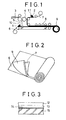
- Fig. 1 is a schematic process view showing a preparation method (using an SMC impregnating machine) of a typical waterproof material according to the present invention.
- Fig. 2 is a perspective view showing the waterproof material of the present invention according to the preparation method of Fig. 1.
- Fig. 3 is a sectional view showing one embodiment of a structure to which the waterproof material of the present invention has been applied.
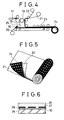
- Fig. 4 is a schematic process view showing a preparation method (using the SMC impregnating machine) of another typical waterproof material according to the present invention.
- Fig. 5 is a perspective view showing the waterproof material of the present invention according to the preparation method of Fig. 4.
- Fig. 6 is a sectional view showing one embodiment of another structure to which the waterproof material of the present invention has been applied.
- (meth)acrylic acid, (meth)acrylate and (meth)acrylonitrile mean methacrylic acid and/or acrylic acid; methacrylate and/or acrylate; and methacrylonitrile and/or acrylonitrile, respectively.
- the resin composition (A) contains a thermosetting resin (a), a photopolymerization initiator (b) and a thickener (c).
- thermosetting resin (a) a radical polymerizable resin is preferable from the viewpoint of a curing rate and physical properties of a formed waterproof layer, and examples of the radical polymerizable resin include an unsaturated polyester resin, a vinyl ester resin and a vinylurethane resin.
- styrene is usually used.
- These polymerizable monomers may be used singly or in the form of a mixture of two or more thereof.
- the fiber reinforced material (B) examples include glass fibers; organic fibers such as amides, aramids, vinylons, polyesters and phenols; carbon fibers, metallic fibers, ceramic fibers and combinations thereof. In view of applicability and economy, the glass fiber or the organic fiber is preferable.
- the form of the fiber in the fiber reinforced material (B) may be a plain weave, a satin weave, a nonwoven fabric, a mat or the like, but above all, the mat is preferable from the viewpoints of applicability, the retention of thickness and the like. Furthermore, chopped strands obtained by cutting glass rovings into a length of 20 to 100 mm can also be used. In addition, the mat and the chopped strands can be used together.
- a known polymerization diluent, a filler and the like can be used as needed, in addition to the above resin composition (A) and fiber reinforced material (B).
- the waterproof material is preferably a sheet having a total thickness of 0.5 to 5.0 mm, preferably 1.0 to 5.0 mm made from a photo-setting fiber reinforced thermosetting resin composition (C) [hereinafter abbreviated to "the resin composition (C)" on occasion) obtained by blending 50 to 97 parts by weight of a resin composition (A) containing the thermosetting resin (a), the photopolymerization initiator (b) and the thickener (c) with 50 to 3 parts by weight of the fiber reinforced material (B).
- the resin composition (C) hereinafter abbreviated to "the resin composition (C)” on occasion
- the amount of the fiber reinforced material (B) is less than 3 parts by weight based on 100 parts of the thermosetting resin (a)
- the cure shrinkage of the obtained waterproof material is large, so that cracks are liable to occur in the waterproof layer.
- the amount is more than 50 parts by weight, a glassy phase appears on the surface of the waterproof layer, which is not preferable from the viewpoint of its appearance.
- the total thickness of the sheet is less than 0.5 mm, a desired strength which withstands walking thereon can scarcely be obtained, and if it is more than 5.0 mm, the curing by light irradiation is insufficient, so that the under part of the sheet is not completely cured. In addition, the sheet itself warps owing to the cure shrinkage inconveniently.
- the waterproof material of the present invention is required to possess two contrary properties of softness and hardness which are directly concerned with adhesive properties with a waterproof substrate, i.e., a substrate and a mounting workability.
- the mounting workability means a performance of the waterproof material which does not give rise to an appearance defect such as the print of a footmark on the surface of the waterproof material and the transfer of a shape of a rolling tool such as a roller, when a worker directly mounts on the uncured waterproof material to spread and roll the waterproof material on the substrate.
- One typical waterproof material of the present invention is constituted of two layers comprising two kinds of resin composition (A 1 ) and resin composition (A 2 ) which are the same or different in viscosity as follows. That is to say, it is preferred that a viscosity ( ⁇ 1 ) of a resin composition (A 1 ) constituting a soft layer which comes in contact with the substrate is in the range of 10 2 to 10 5 Pa ⁇ s (25°C), and a viscosity ( ⁇ 2 ) of a resin composition (A 2 ) constituting a hard layer which is exposed to the atmosphere is in the range of 10 3 to 10 6 Pa ⁇ s (25°C).
- both of the viscosity ( ⁇ 1 ) of the resin composition (A 1 ) and the viscosity ( ⁇ 2 ) of the resin composition (A 2 ) are preferably in the range of 10 3 to 10 5 Pa ⁇ s (25°C) (however ⁇ 1 ⁇ 2 ).
- An occupation ratio of the hard layer in the thickness direction of this waterproof material is preferably 10% ⁇ the hard layer/(the soft layer+the hard layer) ⁇ 85%.
- the viscosity ( ⁇ 1 ) of the resin composition (A 1 ) is less than 10 2 Pa ⁇ s, the peeling properties of a light shielding film noticeably decline, and if it is more than 10 5 Pa ⁇ s, the adhesive properties between the waterproof material and the substrate noticeably deteriorate.
- the viscosity ( ⁇ 2 ) of the resin composition (A 2 ) is less than 10 3 Pa ⁇ s, the mounting workability at the waterproof application is poor, and if it is more than 10 6 Pa ⁇ s, a rolling pressure at the rolling operation does not reach a portion between the waterproof material and the substrate, so that an insufficient adhesive state is liable to occur.
- the waterproof application surface of the substrate is poor in smoothness, the waterproof material cannot follow the rough surface of the substrate, so that unadhesive portions tend to be present between the waterproof material and the substrate.
- ⁇ 1 and ⁇ 2 are in the range of 10 3 to 10 5 Pa ⁇ s, in the case of ⁇ 1 > ⁇ 2 , wrinkles easily appear on the surface of the cured resin composition, which is not preferable from the viewpoint of appearance.
- a typical preparation method of the waterproof material according to the present invention utilizes a sheet molding compound (hereinafter abbreviated to "SMC") impregnating machine, and an example of this method will be described with reference to Figs. 1 and 2.
- SMC sheet molding compound
- resin composition (A 1 ) 1 and resin composition (A 2 ) 2 having predetermined viscosities, respectively, are previously prepared.
- resin composition (A 1 ) 1 and resin composition (A 2 ) 2 and a fiber reinforced material (B), i.e., chopped strands 5 obtained by cutting glass rovings 3 with a chopper 4 are fed in a predetermined ratio between a lower light shielding film 6 and an upper light shielding film 7 which are continuously wound up.
- the chopped strands 5 are impregnated with the resin composition (A 1 ) 1 and the resin composition (A 2 ) 2 to obtain a waterproof material 9 of a two-layer structure having a predetermined thickness.
- the total thickness of the waterproof material 9, i.e., the thickness of the soft layer [comprising the resin composition (A 1 )] and the hard layer [comprising the resin composition (A 2 )] can be regulated by a doctor blade 10 and a doctor blade 11, respectively.
- the thus obtained waterproof material of the present invention has the form of a two-layer sheet, and both the surfaces of the waterproof material are preferably with the light shielding films 6, 7.
- a waterproof application method using the above waterproof material will be described with reference to Figs. 2 and 3. That is to say, the light shielding film 6 alone on the soft layer (which will come in contact with the substrate) of the waterproof material is peeled therefrom, and the waterproof material is spread on the substrate 15 directly or via a primer layer 14 so that the soft layer may come in contact with the substrate 15. Afterward, the waterproof material is pressed by a roller or the like. Next, the light shielding film 7 on the hard layer (which will be exposed to the atmosphere) of the waterproof material is peeled therefrom, and then cured with the sunlight or the like to form a waterproof layer on the substrate.
- the primer layer 14 there can be used a known primer such as a one-pack type moisture-setting urethane resin, a two-pack type urethane resin, an epoxy resin or an unsaturated polyester resin.
- a structure formed by the waterproof application is constituted of a buffer layer 13 comprising the soft layer via the primer layer 14 and a waterproof layer 12 comprising the hard layer.
- the sheet layer of the resin composition (C) can be cured by a known light irradiation technique, for example, by the use of the sunlight, an ultraviolet light of 200 to 800 nm, a visible light or the like at the time of the waterproof application.
- the waterproof material can be cured in a short time of about 30 minutes to form the waterproof layer.
- the curing is scarcely affected by the temperature and the weather (irradiation dose), and for example, within the temperature range of about 10 to 30°C, the waterproof material can be completely cured to its under part in a similar time even by the use of the sunlight having an irradiation dose of about 10 watt/m 2 (a cloudy sky).
- its curing time is largely affected by the temperature, because the FRP waterproof material is a thermosetting type.
- the curing rate changes about 10 times.
- it is preferable that both the surfaces of the waterproof material are protected with the light shielding films so as to control the start of the photopolymerization reaction until the waterproof application.
- the volatilization of the solvent and the polymerizable monomer in the waterproof material can be remarkably restrained by the remaining light shielding film exposed to the atmosphere, and even after the light shielding film is peeled, the volatilization of the polymerizable monomer can be sufficiently controlled, because the curing is promptly done from the surface layer of the waterproof material.
- another film which can transmit the sunlight or the like may be arranged between the waterproof material and the light shielding film exposed to the atmosphere, and the light transmittable film may be kept up at the time of the curing with the sunlight or the like, and after the curing, the film may be peeled.
- the fiber reinforced material is previously contained in the waterproof material of the present invention, there is, needless to say, no problem that the chips of the fiber reinforced material are scattered during the waterproof application, in contrast to a usual waterproof application in which the fiber reinforced material is cut and then laminated on the resin layer in succession.
- the present invention is also excellent in aesthetic properties.
- the resin composition (C) about the same composition as the resin composition (A 2 ) in the above waterproof material can usually be employed, and the resin composition (C) corresponds to the hard layer of the photo-setting sheet-like waterproof material comprising the resin composition (A) and the fiber reinforced material (B) which is formed by, for example, the same method as described with reference to Fig. 1 except that the resin composition (A 1 ) is omitted.
- a material of the above synthetic polymer sheet layer (D) is preferably a homogeneous sheet and a composite sheet which can meet JIS-A-6008 (synthetic polymer roofing sheets), but the thickness of the sheet is not particularly limited.
- the sheets of vulcanized rubbers such as butyl rubber, ethylenepropylene rubber and chlorosulfonated polyethylene; vinyl chloride resins such as vinyl chloride resin and vinyl chloride copolymer; and an ethylene-vinyl acetate resin such as ethylene-vinyl acetate copolymer.
- urethane sheets are also preferable, and the urethane sheets having a tensile elongation of more than 100% can be used.
- the synthetic polymer sheet layer (D) has holes.
- the area of these holes is in the range of 2 to 80%, preferably 10 to 50% based on the whole area of the synthetic polymer sheet layer (D). If the area of the holes is less than 2%, an adhesive force to the substrate is poor, so that the waterproof layer is liable to be peeled off by wind pressure, and if it is more than 80%, follow-up properties to cracks of the substrate tend to be insufficient.
- the holes each having an area of 10 -4 to 10 -1 of all the holes are regularly present in a unit area of the sheet.
- each hole is less than 10 -4 , a rolling pressure is scarcely transmitted to an interface between the sheet layer (D) and the substrate, so that the adhesive force to the substrate is poor and the sheet layer (D) is liable to be peeled off, and if it is more than 10-1, the waterproof layer tends to locally break to the cracks of the substrate.
- the above regular arrangement of the holes can usually exert an excellent vent effect, but even if the holes are irregularly arranged, this effect is not lost.
- the thickness of the synthetic polymer sheet layer (D) is in the range of 0.1 to 5.0 mm, preferably 0.5 to 2.5 mm. If this thickness is less than 0.1 mm, the sheet layer (D) is liable to break by a tensile load at the waterproof application and a scratch caused by a protrusion of the substrate, and if it is more than 5.0 mm, the sheet layer (D) can not follow the rough surface of the substrate, so that wrinkles appear on the waterproof layer inconveniently.
- a typical preparation method of this waterproof material utilizes an SMC impregnating machine, and an example of this method will be described with reference to Figs. 4 and 5.
- the previously prepared resin composition (A 2 ) 16 and chopped strands 19 obtained by cutting glass rovings 17 with a chopper 18 are fed in a predetermined ratio between a lower light shielding film 20 and an upper light shielding film 21 laminated on a synthetic sheet 22 which are continuously wound up.
- the chopped strands are impregnated with the resin composition (A 2 ) by a compression roller 23 to obtain a waterproof material 24 of a two-layer structure having a predetermined thickness.
- the total thickness of the waterproof material can be regulated by the thickness of the synthetic polymer sheet and a doctor blade 25.
- the thus obtained waterproof material of the present invention has the form of a two-layer sheet, and both the surfaces of the waterproof material are protected with the light shielding films.
- the waterproof material can also be obtained by integrally sticking the sheet layer of the previously prepared photo-setting fiber reinforced thermosetting resin composition (C) on the synthetic polymer sheet layer (D).
- Both the surfaces of the waterproof material obtained at this time are required to be protected with the light shielding films so as to control the start of the photopolymerization reaction until the step of the waterproof application.
- the light shielding film 21 on the side of the synthetic polymer sheet layer (D) is peeled, and the waterproof material is spread on the waterproof substrate (substrate) 30 directly or via a primer layer so that the synthetic polymer sheet layer (D) may come in contact with the substrate 30.
- the light shielding film 20 is peeled and the photopolymerization reaction is then started, whereby a waterproof layer can be formed in a short period of time.
- the primer layer there can be used a known primer such as a one-pack type moisture-setting urethane resin, a two-pack type urethane resin, an epoxy resin or an unsaturated polyester resin.
- a structure formed by the waterproof application is constituted of an aeration layer 28 and a buffer layer 27 comprising the synthetic polymer sheet layer on the substrate 30, and a waterproof layer 26 comprising the hard layer on the buffer layer 27.
- the formed waterproof layer has performances peculiar to the waterproof layer such as water resistance, anticorrosion, weathering resistance, adhesive properties to the substrate and follow-up properties to substrate cracks, and the surface hardness of the waterproof layer is so high that a worker can walk thereon.
- the waterproof layer can be provided with a deaeration function. That is to say, a deaeration tower can be installed at a certain position of the waterproof layer by utilizing unadhesive portions as ventilation space between the synthetic polymer sheet layer (D) and the surface of the substrate, whereby water vapor generated from the substrate can be removed.
- a photo-setting sheet-like waterproof material which is obtainable by densely dispersing a fiber reinforced material (B) in a surface layer of a resin composition (A) containing a thermosetting resin, a photopolymerization initiator and a thickener to form a hard layer, and loosely dispersing the fiber reinforced material (B) in a back surface layer of the resin composition (A) to form a soft layer.
- an easily practicable method comprises forming a photo-setting fiber reinforced thermosetting resin sheets having different contents of the fiber reinforced material (B), and then integrally laminating them in a suitable number of the layers so that the sheet in which the fiber reinforced material (B) is densely dispersed may be a surface layer and so that the sheet in which the fiber reinforced material (B) is loosely dispersed may be a back surface layer.
- the sheet-like waterproof material comprising at least two layers in which the photo-setting fiber reinforced thermosetting resin composition layer (C) having different contents of the fiber reinforced material (B) are laminated, a difference of physical properties between the hard layer and the soft layer tends to be small, and follow-up properties to substrate cracks of the waterproof layer after the waterproof application are scarcely constant.
- the preferable waterproof materials are (1) a sheet-like waterproof material constituted of 2 layers comprising two kinds of photo-setting fiber reinforced thermosetting resin compositions (A 1 and A 2 ) which are the same or different in viscosity and the fiber reinforced material (B), and (2) a sheet-like waterproof material obtained by integrally laminating the photo-setting fiber reinforced thermosetting resin composition layer (C) and the synthetic polymer sheet layer (D) on each other.
- part(s) means “part(s) by weight”, unless otherwise specified.
- both the layers were planed so that the thickness of each layer might be 1/2, and a hardness H S2 of the soft layer and a hardness H H2 of the hard layer were then measured.
- unsaturated polyester resin trade name Ester WP260, made by Mitsui Toatsu Chemicals, Inc.
- 1.0 part of a mixture of 2-hydroxy-2-methyl-1-phenylpropane-1-one and bisacrylphosphine oxide [a photopolymerization initiator, trade name Irgacure 1700, made by Novartis AG (Japan)] and 0.5 part of a thickener (magnesium oxide) were uniformly stirred by a disper, thereby preparing a resin composition (A-1).
- Table 1 shows a composition of components and a measured viscosity [Pa ⁇ s (25°C)] of the resin composition.
- Table 1 shows measured viscosities [Pa ⁇ s (25°C)] of the resin compositions.
- Composition unit part(s) Resin Composition A-1 A-2 A-3 A-4 A-5 A-6 Unsaturated polyester resin 100 100 100 100 100 100 100 100 100 100 Photopolymerization initiator 1.0 1.0 1.0 1.0 1.0 1.0 Magnesium oxide 0.5 0.8 1.0 1.0 2.0 3.0 Aluminum hydroxide - - - 100 100 100 200 Viscosity (Pa ⁇ s) 8x10 4x10 2 5x10 3 7x10 4 8x10 5 2x10 6
- the thickness of a soft layer comprising (A-3) was 0.5 mm
- that of a hard layer comprising (A-4) was 1.0 mm
- a total thickness 1.5 mm.
- both the surfaces of the waterproof material were protected with the light shielding films. Afterward, the waterproof material was allowed to stand and age in a thermostatic chamber (40°C) for 24 hours.
- the light shielding film on the side of the soft layer of the waterproof material was peeled off, and the waterproof material was spread on a substrate (a concrete plate or a asbestos cement slate) so that the exposed soft layer might come in contact with the substrate, and then pressed by a roller.
- the light shielding film on the side of the hard layer of the waterproof material was peeled off, and the waterproof material was then cured with the sunlight to obtain a test piece in which a waterproof layer was formed on the substrate.
- Example 2 The same procedure as in Example 1 was conducted except that a viscosity and a thickness of a soft layer and a hard layer of each resin composition obtained in the above preference examples and an amount of a fiber reinforced material were altered in predetermined ranges as shown in Table 2, thereby obtaining waterproof materials and test pieces, and they were then tested.
- Example 2 The same procedure as in Example 1 was conducted except that a soft layer and a hard layer of each resin composition obtained in the above preference examples were set to predetermined viscosities, respectively, and the thickness of the soft layer was set to a predetermined thickness, and the thickness of the hard layer was set to a thickness of 7.0 mm which was thicker than a predetermined value as shown in Table 3, thereby obtaining a waterproof material and a test piece, and they were then tested.
- the thickness of the hard layer was 7.0 mm which was thicker than the predetermined value, curing with the sunlight was insufficient, so that the inside of the sheet was not completely cured. Hence, curing shrinkage occurred, and wrinkles appeared on the surface of the sheet, and warp also took place. In consequence, the waterproof layer broke at a step 1 (movement 0.5 ⁇ 1.0 mm), so that a performance as the waterproof layer could not be obtained.
- Example 2 The same procedure as in Example 1 was conducted except that a material having a viscosity lower than a predetermined value was used for a soft layer of a resin composition obtained in the above reference example, the viscosity of a hard layer was set to the predetermined value, and thickness and the amount of a fiber reinforced material were set to predetermined ranges as shown in Table 3, obtaining a waterproof material and a test piece, and they were then tested.
- Example 2 The same procedure as in Example 1 was conducted except that a soft layer and a hard layer of a resin composition obtained in the above preference example were each set to a predetermined viscosity, the soft layer was set to a predetermined thickness, and the thickness of the hard layer was set to 0.1 mm which was thinner than the predetermined value as shown in Table 3, thereby obtaining a waterproof material and a test piece, and they were then tested.
- Example 2 The same procedure as in Example 1 was conducted except that for a soft layer of a resin composition obtained in the above preparation example, a material having a predetermined viscosity was used, and for a hard layer, a material having a viscosity higher than the predetermined value was used, and thickness and the amount of a fiber reinforced material were set to predetermined ranges as shown in Table 3, obtaining a waterproof material and a test piece, and they were then tested.
- Example 2 The same procedure as in Example 1 was conducted except that a soft layer of a resin composition obtained in the above preparation example was set to a predetermined viscosity, and for a hard layer, a material having a viscosity lower than the predetermined value was used, and thickness and the amount of a fiber reinforced material were set to predetermined ranges as shown in Table 3, obtaining a waterproof material and a test piece, and they were then tested.
- Example 2 The same procedure as in Example 1 was conducted except that a soft layer and a hard layer of a resin composition obtained in the above preparation example were each set to a predetermined viscosity and thickness, and the resin composition/a fiber reinforced material (a weight ratio) was 92/8 which was outside a predetermined range as shown in Table 4, thereby obtaining a waterproof material and a test piece, and they were tested.
- the resin composition/the fiber reinforced material (a weight ratio) was 92/8, and therefore the amount of the fiber reinforced material was less than 3 parts by weight of a predetermined value. In consequence, curing shrinkage occurred, and wrinkles appeared on the surface of the sheet.
- Example 2 The same procedure as in Example 1 was conducted except that a soft layer and a hard layer of a resin composition obtained in the above preparation example were each set to a predetermined viscosity and thickness, and the resin composition/a fiber reinforced material (a weight ratio) was 45/55 which was outside a predetermined range as shown in Table 4, thereby obtaining a waterproof material and a test piece, and they were tested.
- the resin composition/the fiber reinforced material (a weight ratio) was 45/55, and therefore the amount of the fiber reinforced material was more than 50 parts by weight of a predetermined value.
- fiber glass appeared on the surface of the waterproof layer, which was not preferable from the viewpoint of an appearance.
- test piece having an FRP waterproof material was prepared by a Rimaster-RB-1 method (made by Mitsui Toatsu Chemicals, Inc.), and it was then tested.
- test piece having a vinyl chloride sheet waterproof material was prepared, and it was then tested.
- an adhesive force to a substrate was 10 kgf/cm 2 which was much lower as compared with Examples 1 to 5, and a surface hardness was also as low as 15 Shore D. Therefore, the test piece was good for nonwalking, but it could not be used for walking.
- Example 1 2 3 4 5 6 Resin composition: Soft layer A-3 A-2 A-3 A-2 A-3 A-3 Hard layer A-4 A-5 A-5 A-3 A-4 A-3 Thickness (nm): Soft layer 0.5 0.5 5.0 2.0 0.5 1.0 Hard layer 1.0 1.5 1.0 1.0 1.0 1.0 (67%) (75%) (17%) (33%) (67%) (50%) Total 1.5 2.0 6.0 3.0 1.5 2.0 Viscosity of soft layer (Pa ⁇ s) 5x10 3 4x10 2 5x10 3 4x10 2 5x10 3 5x10 3 Viscosity of hard layer (Pa ⁇ s) 7x10 4 8x10 5 8x10 5 5x10 3 7x10 4 5x10 3 Resin composition/fiber reinforced material (wt ratio) 85/15 80/20 95/ 5 55/45 85/15 80/20 Primer layer Absent Absent Absent Absent Present Absent Adhesive force (kgf/cm 2 ) 21 25 21 25 21 21 21 Fatigue test (fatigue) A2 A2 A2 A2 A2 A2 Surface
- the sheet thickness of a resin composition (C) was 1.5 mm, and the total thickness of the waterproof sheet was 2.5 mm.
- both the sides of the waterproof sheet were covered with light shielding films (polyester laminate aluminum foils, made by Hosokawa Youkou Co., Ltd.).
- the light shielding film on the side of a vinyl chloride resin sheet (D) in the waterproof sheet was peeled off, and the waterproof material was spread on a substrate (a concrete plate or a asbestos cement plates) so that the vinyl chloride resin sheet (D) might come in contact with the substrate, and then pressed by a roller.
- the other upper light shielding film was peeled off, and the waterproof material was then cured with the sunlight to obtain a test piece in which a waterproof layer was formed on the substrate, and the test piece was then tested.
- the waterproof layer could be obtained in which a waterproof application could be accomplished in a short period of time; a surface hardness was high; and an adhesive force to an substrate, a blister resistance, a fatigue test, an substrate crack resistance and a surface appearance were good.
- a waterproof layer could be obtained in which a waterproof application could be accomplished in a short period of time; a surface hardness was high; and an adhesive force to an substrate, a blister resistance, a fatigue test, an substrate crack resistance and a surface appearance were good.
- Example 2 The same procedure as in Example 1 was conducted except that the thickness of a sheet layer of a resin composition (C) was changed from 1.5 to 3.0 mm in the middle step of Example 7, thereby obtaining a test piece, and it was then tested.
- a waterproof layer could be obtained in which a waterproof application could be accomplished in a short period of time; a surface hardness was high; and an adhesive force to an substrate, a blister resistance, a fatigue test, an substrate crack resistance and a surface appearance were good.
- Example 2 The same procedure as in Example 1 was conducted except that the hole area of a vinyl chloride resin sheet was changed from 20% to 50% in the middle step of Example 7, thereby obtaining a test piece, and it was then tested.
- a waterproof layer could be obtained in which a waterproof application could be accomplished in a short period of time; a surface hardness was high; and an adhesive force to an substrate, a blister resistance, a fatigue test, an substrate crack resistance and a surface appearance were good.
- Example 2 The same procedure as in Example 1 was conducted except that a primer (trade name Sun PC-F, a one-pack type moisture-setting urethane resin, made by Mitsui Toatsu Chemicals, Inc.) was applied onto a substrate at 0.3 kg/m 2 and then cured in the latter part of Example 7, thereby obtaining a test piece, and it was then tested.
- a primer trade name Sun PC-F, a one-pack type moisture-setting urethane resin, made by Mitsui Toatsu Chemicals, Inc.
- a waterproof layer could be obtained in which a waterproof application could be accomplished in a short period of time; a surface hardness was high; and an adhesive force to an substrate, a blister resistance, a fatigue test, an substrate crack resistance and a surface appearance were good.
- Example 2 The same procedure as in Example 1 was conducted except that the thickness of a sheet layer of a resin composition (C) was changed from 1.5 mm to 5.5 mm in the middle step of Example 7, thereby obtaining a test piece, and it was then tested.
- a waterproof Layer could be obtained in which a waterproof application could be accomplished in a short period of time; a surface hardness was high; an adhesive force to an substrate, a blister resistance, a fatigue test and an substrate crack resistance were good; but wrinkles appeared on the surface. Therefore, such a layer was undesirable as the waterproof layer.
- Example 2 The same procedure as in Example 1 was conducted except that a hole area of a vinyl chloride resin sheet was changed from 20% to 90% in the middle step of Example 7, thereby obtaining a test piece, and it was then tested.
- a waterproof layer could be obtained in which a waterproof application could be accomplished in a short period of time; a surface hardness was high; an adhesive force to an substrate and a blister resistance were good; but the results of a fatigue test were bad, i.e., A2. Thus, break occurred during an substrate crack resistance test, which meant that such a layer was undesirable as the waterproof layer.
- test piece having a urethane coating waterproof material was prepared by Sunsiral B-1 method (made by Mitsui Toatsu Chemicals, Inc.), and it was then tested.
- test piece having an FRP waterproof material was prepared by a Rimaster-RB-1 method (made by Mitsui Toatsu Chemicals, Inc.), and it was then tested.
- a surface hardness was high, and an adhesive force to an substrate and a blister resistance were good.
- a waterproof application time was as long as 4 hours, and the results of a fatigue test were evaluated to be A1.
- break occurred during an substrate crack resistance test which meant that such a layer was undesirable as a waterproof layer. Consequently, in points of the application time, the fatigue properties and the crack resistance, the waterproof material had room for improvement.
- test piece having a vinyl chloride sheet waterproof material was prepared, and it was then tested.
- Example 7 8 9 10 11 Sheet layer (C) (Hard layer) Thickness (nm) 1.5 1.5 3.0 1.5 1.5 Sheet layer (D) (Soft Layer) Material Vinyl chloride Vulcanized rubber Vinyl chloride Vinyl chloride Vinyl chloride Thickness (nm) 1.0 1.5 1.0 1.0 Hole area(%) 20 20 20 50 20 Primer layer absent absent absent absent absent Adhesive force (kgf/cm 2 ) 15 15 15 21 20 Undercoat crack resistance Elongation (%) 20 25 20 18 20 Strength (kgf) 215 198 236 228 206 Peel width (nm) 82 78 103 122 88 Fatigue test (fatigue) A4 A4 A4 A4 A4 Blister resistance (blister) 4 4 4 4 4 4 Surface hardness (Shore D) 87 87 87 87 87 87 87 87 87 87 87 87
Landscapes
- Engineering & Computer Science (AREA)
- Mechanical Engineering (AREA)
- Architecture (AREA)
- Civil Engineering (AREA)
- Structural Engineering (AREA)
- Chemical & Material Sciences (AREA)
- Composite Materials (AREA)
- Laminated Bodies (AREA)
- Application Of Or Painting With Fluid Materials (AREA)
Claims (10)
- Lichthärtbare Folie aus wasserdichtem Material, welche durch Verteilung eines faserförmigen Verstärkungsmaterials (B) in einer Harzzusammensetzung (A) gebildet wird, umfassend einen Duroplasten, einen Fotopolymerisationsinitiator und ein Verdickungsmittel zur Bildung einer Folie mit einer vorderseitigen Oberflächenschicht und einer rückseitigen Oberflächenschicht, die wenn gehärtet verschieden in ihrer Härte sind, worin die genannte vordere Oberflächenschicht zur Haftung an ein Substrat bestimmt ist und zu einer relativ weichen Schicht härtbar ist und die genannte rückseitige Oberflächenschicht zu einer relativ harten Schicht härtbar ist.
- Wasserdichtes Material nach Anspruch 1, worin jeweilige Lichtschutzfilme auf die vorderseitige und rückseitige Oberflächenschicht beschichtet sind.
- Wasserdichtes Material nach Anspruch 1 oder 2, worin die Dicke (T1) der vorderseitigen Oberflächenschicht und die Dicke (T2) der rückseitigen Oberflächenschicht der Gleichung
- Wasserdichtes Material nach Anspruch 1, 2 oder 3, worin der Duroplast ausgewählt ist aus den ungesättigten Polyesterharzen, Vinylesterharzen und Vinylurethanharzen.
- Wasserdichtes Material nach einem der vorhergehenden Ansprüche, worin die Harzzusammensetzung (A) eine Harzzusammensetzung (A1) mit einer Viskosität (η1) von 102 bis 105 Pa.s (25°C) umfasst, welche die weiche Schicht bildet, und eine Harzzusammensetzung (A2) mit einer Viskosität (η2) von 103 bus 106 Pa.s (25°C), welche die harte Schicht bildet und worin η1 ≤ η2 ist.
- Lichthärtbare Folie aus wasserdichtem Material, welche durch Verteilung eines faserförmigen Verstärkungsmaterials (B) in einer Harzzusammensetzung (A) erhalten wird, umfassend einen Duroplasten, einen Fotopolymerisationsinitiator und ein Verdickungsmittel, um eine zu einer relativ harten Schicht härtbare Oberflächenschicht zu bilden und anschließend eine synthetische Polymerfolie (D) als eine relativ weiche Schicht vollständig zu beschichten.
- Wasserdichtes Material nach Anspruch 6, worin die synthetische Polymerfolienschicht (D) eine vulkanisierte Kautschukfolie, eine nicht vulkanisierte Kautschukfolie, eine Vinylchloridharzfolie, eine Ethylenvinylacetatharzfolie oder eine Urethankautschukfolie ist.
- Wasserdichtes Material nach Anspruch 6 oder 7, worin die synthetische Polymerfolie (D) eine Folie mit Löchern ist und die Fläche der Löcher im Bereich von 2 bis 80 %, basierend auf der Gesamtfläche, ist.
- Lichthärtbare Folie aus wasserdichtem Material, welche erhältlich ist durch Verteilung eines faserförmigen Verstärkungsmaterials (B) in relativ hoher Dichte in einer vorderseitigen Oberflächenschicht einer Harzzusammensetzung (A), enthaltend einen Duroplasten, einen Fotopolymerisationsinitiator und ein Verdickungsmittel zur Bildung einer zu einer relativ harten Schicht härtbaren vorderseitigen Oberflächenschicht und Verteilung des faserförmigen Verstärkungsmaterials (B) in relativ geringer Dichte in einer rückseitigen Oberflächenschicht der Harzzusammensetzung (A) zur Bildung einer Schicht, die zur Haftung an einem Substrat bestimmt ist und zu einer relativ weichen Schicht härtbar ist.
- Verfahren zur Aufbringung einer wasserdichten Schicht, welches die Schritte umfasst der Bildung einer lichthärtbaren Folie aus wasserdichtem Material durch Verteilung eines faserförmigen Verstärkungsmaterials (B) in einer Harzzusammensetzung (A), enthaltend einen Duroplasten, einen Fotopolymerisationsinitiator und ein Verdickungsmittel zur Bildung einer Folie mit einer vorderseitigen Oberflächenschicht und einer rückseitigen Oberflächenschicht, welche jeweils zur Bildung einer relativ weichen Schicht und einer relativ harten Schicht härtbar sind, der Auftragung und des rotierenden Pressens der Folie aus wasserdichtem Material derart, dass die genannte vorderseitige Oberflächenschicht an dem Substrat haftet und der anschließenden Lichthärtung des wasserdichten Materials, um gleichzeitig die genannte harte Schicht, welche als eine faserverstärkte wasserdichte Schicht wirkt, und die genannte weiche Schicht, welche als eine Pufferschicht wirkt, zu bilden.
Applications Claiming Priority (6)
| Application Number | Priority Date | Filing Date | Title |
|---|---|---|---|
| JP102213/96 | 1996-04-24 | ||
| JP10221396 | 1996-04-24 | ||
| JP10221396 | 1996-04-24 | ||
| JP173288/96 | 1996-07-03 | ||
| JP17328896 | 1996-07-03 | ||
| JP17328896 | 1996-07-03 |
Publications (3)
| Publication Number | Publication Date |
|---|---|
| EP0803531A2 EP0803531A2 (de) | 1997-10-29 |
| EP0803531A3 EP0803531A3 (de) | 2000-04-19 |
| EP0803531B1 true EP0803531B1 (de) | 2003-03-19 |
Family
ID=26442948
Family Applications (1)
| Application Number | Title | Priority Date | Filing Date |
|---|---|---|---|
| EP97302746A Expired - Lifetime EP0803531B1 (de) | 1996-04-24 | 1997-04-22 | Wasserdichtes Material und Verfahren zu seiner Anwendung |
Country Status (3)
| Country | Link |
|---|---|
| US (1) | US5935683A (de) |
| EP (1) | EP0803531B1 (de) |
| DE (1) | DE69719836D1 (de) |
Families Citing this family (22)
| Publication number | Priority date | Publication date | Assignee | Title |
|---|---|---|---|---|
| US5778915A (en) * | 1996-12-26 | 1998-07-14 | Patent Category Corporation | Collapsible structures |
| US7703228B2 (en) * | 1996-12-26 | 2010-04-27 | Patent Category Corp. | Collapsible structures |
| US6021524A (en) * | 1997-12-31 | 2000-02-08 | The University Of Akron | Cut resistant polymeric films |
| IT1304092B1 (it) * | 1998-12-10 | 2001-03-07 | Sibelon Srl | Metodo per l'impermeabilizzazione di giunti e/o di fessurazioni inopere idrauliche e strutture in calcestruzzo e/o in muratura |
| CA2317285C (en) * | 1999-08-31 | 2008-01-15 | Dainippon Ink And Chemicals, Inc. | Photocurable resin compound and method of curing the same |
| US6691422B1 (en) * | 2000-01-29 | 2004-02-17 | Guy Aroch | Photographic cropping method and device |
| KR20030018229A (ko) * | 2001-08-27 | 2003-03-06 | 극동크리트 주식회사 | 접착성을 강화한 재생 폴리염화비닐 방수용 시트 및 이를이용한 복합방수공법 |
| US7169462B1 (en) | 2004-03-01 | 2007-01-30 | Laticrete International, Inc. | Waterproofing membrane |
| US7601282B2 (en) * | 2005-10-24 | 2009-10-13 | Johns Manville | Processes for forming a fiber-reinforced product |
| US7316605B1 (en) | 2006-07-03 | 2008-01-08 | San Fang Chemical Industry Co., Ltd. | Sheet for mounting polishing workpiece and method for making the same |
| US7789738B2 (en) * | 2006-07-03 | 2010-09-07 | San Fang Chemical Industry Co., Ltd. | Sheet for mounting polishing workpiece and method for making the same |
| US20080064310A1 (en) * | 2006-09-08 | 2008-03-13 | Chung-Chih Feng | Polishing pad having hollow fibers and the method for making the same |
| US20090252876A1 (en) * | 2007-05-07 | 2009-10-08 | San Fang Chemical Industry Co., Ltd. | Sheet for mounting polishing workpiece and method for making the same |
| US10156767B2 (en) * | 2008-08-19 | 2018-12-18 | Hitachi Chemical Company, Ltd. | Light control film |
| JP5152334B2 (ja) * | 2008-08-19 | 2013-02-27 | 日立化成工業株式会社 | 調光フィルム |
| US10175551B2 (en) | 2009-02-13 | 2019-01-08 | Hitachi Chemical Company, Ltd. | Light control film |
| US8687263B2 (en) | 2009-02-13 | 2014-04-01 | Hitachi Chemical Company, Ltd. | Light control film |
| AU2009340370C1 (en) * | 2009-02-23 | 2017-02-02 | Hydrawall Pty Ltd | Surface composition and method of application |
| GB2475352B8 (en) * | 2009-12-14 | 2012-10-03 | Gurit Ltd | Repair of composite materials. |
| US10036131B2 (en) * | 2016-11-04 | 2018-07-31 | Russell Pascetta | Method for waterproofing a bridge expansion joint |
| CN115030330B (zh) * | 2022-06-14 | 2022-12-09 | 潍坊市宇虹防水材料(集团)有限公司 | 一种sbs弹性体改性沥青防水卷材及其制备方法 |
| CN118721945B (zh) * | 2024-07-29 | 2025-03-14 | 云南欣城防水科技有限公司 | 无胎基防水材料生产装置 |
Family Cites Families (9)
| Publication number | Priority date | Publication date | Assignee | Title |
|---|---|---|---|---|
| US4506060A (en) * | 1980-06-17 | 1985-03-19 | Reichhold Chemicals Incorporated | Water soluble one-component polymeric resin binder system for fiberglass mats |
| JPS63186744A (ja) * | 1987-01-28 | 1988-08-02 | Showa Highpolymer Co Ltd | 光硬化性繊維強化プラスチックプリプレグシート積層体 |
| JPH0813951B2 (ja) * | 1987-01-29 | 1996-02-14 | 三菱レイヨン株式会社 | アクリル系被覆用樹脂組成物 |
| JPH01219242A (ja) * | 1988-02-26 | 1989-09-01 | Dainippon Ink & Chem Inc | 複合被覆構造体及び施工法 |
| JP2570898B2 (ja) * | 1990-10-03 | 1997-01-16 | 大日本インキ化学工業株式会社 | 防水材組成物、それを用いる防水被覆構造体及び防水被覆工法 |
| JP2546468B2 (ja) * | 1992-04-01 | 1996-10-23 | 株式会社イナックス | 人造大理石シート、その製造方法及び人造大理石成形品 |
| JPH0716850A (ja) * | 1993-06-29 | 1995-01-20 | Aica Kogyo Co Ltd | 人工石化粧パネルの製法 |
| JP2762039B2 (ja) * | 1994-07-12 | 1998-06-04 | クレハエラストマー株式会社 | 遮水シートの接合方法 |
| JP3644608B2 (ja) * | 1995-09-14 | 2005-05-11 | 昭和高分子株式会社 | 光硬化性複合材料組成物 |
-
1997
- 1997-04-17 US US08/838,261 patent/US5935683A/en not_active Expired - Fee Related
- 1997-04-22 EP EP97302746A patent/EP0803531B1/de not_active Expired - Lifetime
- 1997-04-22 DE DE69719836T patent/DE69719836D1/de not_active Expired - Lifetime
Also Published As
| Publication number | Publication date |
|---|---|
| EP0803531A3 (de) | 2000-04-19 |
| EP0803531A2 (de) | 1997-10-29 |
| DE69719836D1 (de) | 2003-04-24 |
| US5935683A (en) | 1999-08-10 |
Similar Documents
| Publication | Publication Date | Title |
|---|---|---|
| US5935683A (en) | Waterproof material and method for applying it | |
| US8993462B2 (en) | Surface sealed reinforced building element | |
| US20080124576A1 (en) | Polymer composites | |
| JP2002059525A (ja) | 通気性防水被覆構造体、およびその施工方法 | |
| EP3533809A1 (de) | Radikale-polymerisierbare harzzusammensetzung | |
| JPH1071661A (ja) | 防水材および防水層の施工方法 | |
| JPH04253717A (ja) | 不飽和ポリエステル樹脂組成物、防水材組成物、それを用いる防水被覆構造体及び防水被覆工法 | |
| US5702991A (en) | Interpenetrating network compositions and structures | |
| JP2002114971A (ja) | 防水材組成物及び防水構造体 | |
| JP2006045404A (ja) | 硬化性樹脂組成物、プリプレグおよびその製造方法 | |
| JPH08311805A (ja) | 床版防水材料、床版防水舗装構造体及び床版施工方法 | |
| JP2002088176A (ja) | 光硬化性プリプレグ及び防水材 | |
| JP2000218722A (ja) | 複層構造をもつプリプレグ | |
| JP2570898B2 (ja) | 防水材組成物、それを用いる防水被覆構造体及び防水被覆工法 | |
| JP2580829B2 (ja) | 複合被覆構造体、土木建築物及び複合被覆構造体施工法 | |
| JP3278001B2 (ja) | 接着剤組成物およびそれを用いる接着工法 | |
| JP2001089266A (ja) | コンクリート部体に対する防水層急速施工体およびその施工方法 | |
| KR101498998B1 (ko) | 구조물 보강용 고강도 복합섬유패널 및 이를 이용한 구조물 보강공법 | |
| JP2001342228A (ja) | Frp防水用不飽和ポリエステル樹脂およびその用途 | |
| JP3868059B2 (ja) | 光硬化性プリプレグシートを用いた防水工法 | |
| JP2002292769A (ja) | 複合構造体及びその製造方法 | |
| JP2938211B2 (ja) | 陸屋根の通気性防水工法 | |
| JP3855031B2 (ja) | 複合防水構造体及びその施工方法 | |
| JP4374872B2 (ja) | コンクリート構造体の施工方法 | |
| JP2001193230A (ja) | 複合防水工法およびそれによって得られる複合防水構造体 |
Legal Events
| Date | Code | Title | Description |
|---|---|---|---|
| PUAI | Public reference made under article 153(3) epc to a published international application that has entered the european phase |
Free format text: ORIGINAL CODE: 0009012 |
|
| 17P | Request for examination filed |
Effective date: 19970512 |
|
| AK | Designated contracting states |
Kind code of ref document: A2 Designated state(s): CH DE FR GB IT LI NL Kind code of ref document: A2 Designated state(s): DE FR GB NL |
|
| RAP1 | Party data changed (applicant data changed or rights of an application transferred) |
Owner name: MITSUI CHEMICALS, INC. |
|
| PUAL | Search report despatched |
Free format text: ORIGINAL CODE: 0009013 |
|
| AK | Designated contracting states |
Kind code of ref document: A3 Designated state(s): CH DE FR GB IT LI NL |
|
| RIC1 | Information provided on ipc code assigned before grant |
Free format text: 7C 08J 5/10 A, 7B 32B 5/14 B, 7B 32B 27/04 B, 7C 08F 263/00 B |
|
| 17Q | First examination report despatched |
Effective date: 20001228 |
|
| GRAG | Despatch of communication of intention to grant |
Free format text: ORIGINAL CODE: EPIDOS AGRA |
|
| GRAG | Despatch of communication of intention to grant |
Free format text: ORIGINAL CODE: EPIDOS AGRA |
|
| GRAH | Despatch of communication of intention to grant a patent |
Free format text: ORIGINAL CODE: EPIDOS IGRA |
|
| GRAH | Despatch of communication of intention to grant a patent |
Free format text: ORIGINAL CODE: EPIDOS IGRA |
|
| RBV | Designated contracting states (corrected) |
Designated state(s): DE FR GB NL |
|
| GRAA | (expected) grant |
Free format text: ORIGINAL CODE: 0009210 |
|
| AK | Designated contracting states |
Designated state(s): DE FR GB NL |
|
| PG25 | Lapsed in a contracting state [announced via postgrant information from national office to epo] |
Ref country code: NL Free format text: LAPSE BECAUSE OF FAILURE TO SUBMIT A TRANSLATION OF THE DESCRIPTION OR TO PAY THE FEE WITHIN THE PRESCRIBED TIME-LIMIT Effective date: 20030319 Ref country code: FR Free format text: LAPSE BECAUSE OF FAILURE TO SUBMIT A TRANSLATION OF THE DESCRIPTION OR TO PAY THE FEE WITHIN THE PRESCRIBED TIME-LIMIT Effective date: 20030319 |
|
| REG | Reference to a national code |
Ref country code: GB Ref legal event code: FG4D |
|
| REF | Corresponds to: |
Ref document number: 69719836 Country of ref document: DE Date of ref document: 20030424 Kind code of ref document: P |
|
| PG25 | Lapsed in a contracting state [announced via postgrant information from national office to epo] |
Ref country code: GB Free format text: LAPSE BECAUSE OF NON-PAYMENT OF DUE FEES Effective date: 20030619 |
|
| PG25 | Lapsed in a contracting state [announced via postgrant information from national office to epo] |
Ref country code: DE Free format text: LAPSE BECAUSE OF FAILURE TO SUBMIT A TRANSLATION OF THE DESCRIPTION OR TO PAY THE FEE WITHIN THE PRESCRIBED TIME-LIMIT Effective date: 20030621 |
|
| NLV1 | Nl: lapsed or annulled due to failure to fulfill the requirements of art. 29p and 29m of the patents act | ||
| PLBE | No opposition filed within time limit |
Free format text: ORIGINAL CODE: 0009261 |
|
| STAA | Information on the status of an ep patent application or granted ep patent |
Free format text: STATUS: NO OPPOSITION FILED WITHIN TIME LIMIT |
|
| GBPC | Gb: european patent ceased through non-payment of renewal fee |
Effective date: 20030619 |
|
| EN | Fr: translation not filed | ||
| 26N | No opposition filed |
Effective date: 20031222 |