EP0803492A1 - Verfahren zur trennung und reinigung von hydroxynaphthalincarbonsäuren - Google Patents
Verfahren zur trennung und reinigung von hydroxynaphthalincarbonsäuren Download PDFInfo
- Publication number
- EP0803492A1 EP0803492A1 EP96937560A EP96937560A EP0803492A1 EP 0803492 A1 EP0803492 A1 EP 0803492A1 EP 96937560 A EP96937560 A EP 96937560A EP 96937560 A EP96937560 A EP 96937560A EP 0803492 A1 EP0803492 A1 EP 0803492A1
- Authority
- EP
- European Patent Office
- Prior art keywords
- bon3
- bon6
- ratio
- fraction
- methanol
- Prior art date
- Legal status (The legal status is an assumption and is not a legal conclusion. Google has not performed a legal analysis and makes no representation as to the accuracy of the status listed.)
- Granted
Links
Images



Classifications
-
- C—CHEMISTRY; METALLURGY
- C07—ORGANIC CHEMISTRY
- C07C—ACYCLIC OR CARBOCYCLIC COMPOUNDS
- C07C65/00—Compounds having carboxyl groups bound to carbon atoms of six—membered aromatic rings and containing any of the groups OH, O—metal, —CHO, keto, ether, groups, groups, or groups
- C07C65/01—Compounds having carboxyl groups bound to carbon atoms of six—membered aromatic rings and containing any of the groups OH, O—metal, —CHO, keto, ether, groups, groups, or groups containing hydroxy or O-metal groups
- C07C65/105—Compounds having carboxyl groups bound to carbon atoms of six—membered aromatic rings and containing any of the groups OH, O—metal, —CHO, keto, ether, groups, groups, or groups containing hydroxy or O-metal groups polycyclic
- C07C65/11—Compounds having carboxyl groups bound to carbon atoms of six—membered aromatic rings and containing any of the groups OH, O—metal, —CHO, keto, ether, groups, groups, or groups containing hydroxy or O-metal groups polycyclic with carboxyl groups on a condensed ring system containing two rings
-
- C—CHEMISTRY; METALLURGY
- C07—ORGANIC CHEMISTRY
- C07C—ACYCLIC OR CARBOCYCLIC COMPOUNDS
- C07C51/00—Preparation of carboxylic acids or their salts, halides or anhydrides
- C07C51/42—Separation; Purification; Stabilisation; Use of additives
- C07C51/47—Separation; Purification; Stabilisation; Use of additives by solid-liquid treatment; by chemisorption
Definitions
- the present invention relates to a method of separation and purification of hydroxynaphthalenecarboxylic acids.
- Hydroxynaphthalenecarboxylic acids such as 2-hydroxynaphthalene-6-carboxylic acid are important raw materials of aromatic polyesters, and indispensable especially to the production of liquid crystalline polymers excellent in workability and fluidity, and resins or fibers having a high elasticity and a high heat resistance. Further, 2-hydroxynaphthalene-3-carboxylic acid and 2-hydroxynaphthalene-3,6-dicarboxylic acid are useful as raw materials for azo type pigments or dyes.
- 2-hydroxynaphthalene-6-carboxylic acid referred to as “BON6” hereinafter
- 2-hydroxynaphthalene-3-carboxylic acid referred to as “BON3” hereinafter
- the reaction mixtures obtained according to the above reaction contain isomers such as BON3, BON6 and other impurities in addition to objective products.
- BON3,6 2-hydroxynaphthalene-3,6-dicarboxylic acid
- the present invention relates to a method of separation and purification of hydroxynaphthalenecarboxylic acids, which comprises treating a solution containing a mixture of various kinds of hydroxynaphthalenecarboxylic acids with a nonionic porous synthetic adsorbent having as a basic structure aromatic copolymers mainly composed of styrene and divinylbenzene or methacrylic copolymers mainly composed of monomethacrylates and dimethacrylates, and separating into each hydroxynaphthalenecarboxylic acid.
- treatment with adsorbents means a process including a previous dissolution of hydroxynaphthalenecarboxylic acids in a solvent, an adsorption of the solution obtained, and a selective extraction with a solvent or an elution through a column packed with an adsorbent.
- hydroxynaphthalenecarboxylic acids include not only hydroxynaphthalene monocarboxylic acids but also polycarboxylic acids such as dicarboxylic acids, tricarboxylic acids, tetracarboxylic acids and the like.
- nonionic porous synthetic adsorbents having as the basic structure aromatic copolymers mainly composed of styrene and divinylbenzene or methacrylic copolymers mainly composed of monomethacrylates and dimethacrylates usable in the present invention are known.
- nonionic porous synthetic adsorbents having as a basic structure aromatic copolymers mainly composed of styrene and divinylbenzene include DIAION (trade name; available from Mitsubishi Kagaku K.K.) HP10, HP20, HP21, HP30, HP40, HP50, SP850 and SP205, AMBERLITE (trade name; available from Rohm & Haas Co.) XAD2 and XAD4, and the like
- nonionic porous synthetic adsorbents having as a basic structure methacrylic copolymers mainly composed of monomethacrylates and dimethacrylates as main monomers include DIAION HP2MG, AMBERLITE XAD7 and XAD8, and the like.
- the nonionic porous synthetic adsorbents usable in the present invention are porous crosslinked polymers, and have a specific surface area and a pore volume in significant quantities.
- the adsorbents have suitably a specific surface area of not less than 100 m 2 /g, preferably not less than 400 m 2 /g, and a pore volume of not less than 0.1 ml/g, preferably 1.0 ml/g or more.
- the adsorbing amount is influenced and the separating ability tends to become worse.
- BON6 is prepared according to Kolbe-Schmitt reaction, in which BON3 is produced as a by-product.
- the amount of BON3 as by-product depends on the process of production of BON6, but the BON3 itself is a useful compound as a raw material of pigments or dyes. Accordingly one of the purpose of the present invention is to separate BON6 and BON3, by which can be also achieved the purification of BON6 containing other impurities or by-products.
- BON3 is more strongly adsorbed by the above adsorbents than BON6, and other impurities are also adsorbed. Therefore, when the solution containing BON6 with the impurities and the by-products such as BON3 is treated with the above adsorbents, these impurities and by-products are adsorbed so as to eliminate them from the solution containing BON6.
- a mixture of hydroxynaphthalenecarboxylic acids containing BON3 as main products can be also prepared according to Kolbe-Schmitt reaction.
- BON6 is produced as a by-product
- BON6 is firstly eluted
- BON3 is secondly eluted with the same or other solvent.
- BON3,6 is also produced as a by-product.
- BON6 is firstly eluted, and then it may be recovered with the same or other solvent as set forth hereinafter.
- BON3,6 is useful as a raw material for azo type pigments or dyes, and as aforementioned, a reaction mixture for production of BON3,6 contains BON3 and BON6. It has been found that BON3,6 has an almost intermediate adsorptivity to the nonionic porous synthetic adsorbent between that of BON3 and BON6. Accordingly it can be also separated or purified by a similar manner. For example, when the mixture of BON3, BON6 and BON3,6 is eluted through a column with the nonionic porous synthetic adsorbent, BON6, BON3,6 and BON3 are recovered in this order. In case of the mixture of BON6 and BON3,6, the BON6 is firstly eluted, and in case of the mixture of BON3 and BON3,6, the BON3,6 is firstly eluted.
- the separation and recovery of hydroxynaphthalenecarboxylic acids adsorbed may be achieved by a solvent which can dissolve objective hydroxynaphthalenecarboxylic acids.
- solvents there are exemplified polar solvents, for example, alcohols such as methanol, n-propanol and the like; ketones such as acetone, methyl ethyl ketone and the like; ethers such as diethyl ether, tetrahydrofuran and the like; amides such as dimethylformamide and the like; sulfur compounds such as dimethylsulfoxide and the like; aliphatic hydrocarbons such as hexane, heptane and the like; aromatic hydrocarbons such as benzene, toluene and the like; organic acids such as acetic acid and the like; organic acids esters such as ethyl acetate and the like; and water.
- solvents may be selected according to the kinds of adsorbents
- BON3, BON3,6 and BON6 may be separated and purified depended on the difference of adsorptivity to an adsorbent using a single solvent which can dissolve them, or recovered by selective extraction using a solvent which can specifically dissolve the objective compound, or successively eluted using solvents having a different solubility to each compound.
- the treatment by the nonionic porous synthetic adsorbents may be carried out by a batch process or a continuous process, and any method of an adsorbing separation process by a batchwise operation or an elution using a column.
- any solvent which can dissolve BON6, BON3, and BON3,6 may be used.
- solvents there are concretely exemplified alcohols such as methanol, n-propanol and the like; ketones such as acetone, methyl ethyl ketone and the like; ethers such as diethyl ether, tetrahydrofuran and the like; amides such as dimethylformamide and the like; sulfur compounds such as dimethylsulfoxide and the like; aliphatic hydrocarbons such as hexane, heptane and the like; aromatic hydrocarbons such as benzene, toluene and the like; organic acids such as acetic acid and the like; organic acid esters such as ethyl acetate and the like; and water.
- alcohols such as methanol, n-propanol and the like
- ketones such as acetone, methyl ethyl ketone and the like
- ethers such as dieth
- solvents can be selected according to the kinds of adsorbents.
- Preferable solvents are alcohols, especially methanol.
- Two or more kinds of solvents can be used as mixed if desired.
- the separation ability can be improved by controlling the ratio of the mixture.
- the development may be carried out by successive alternation of the solvents.
- the present invention may be also used to increase the ratio of objective hydroxynaphthalenecarboxylic acids by repeating the treatment of the invention.
- concentration and ratio of the objective hydroxynaphthalenecarboxylic acids may be increased using an artificial moving bed and the like as described in Japanese Patent Application KOKAI Hei 2-49159.
- the hydroxynaphthalenecarboxylic acids can be purified to a sufficient level for industrial practical use, but when a higher purity is still required, known purification methods such as recrystallization may be used.
- the present invention is illustrated using BON6, BON3, and BON3,6, but it is not restricted to these hydroxynaphthalenecarboxylic acids.
- Fig. 1 is a graph illustrating the recovering ratios of each of BON6 and BON3 to the outflow cumulative volumetric ratio, and the change of ratio of BON6 in Example 1.
- Fig. 2 is a graph illustrating the recovering ratios of each of BON6 and BON3 to the outflow cumulative volumetric ratio, and the change of ratio of BON6 in Example 2.
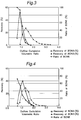
- Fig. 3 is a graph illustrating the recovering ratios of each of BON6 and BON3 to the outflow cumulative volumetric ratio, and the change of ratio of BON6 in Example 3.
- Fig. 4 is a graph illustrating the recovering ratios of each of BON6 and BON3 to the outflow cumulative volumetric ratio, and the change of ratio of BON6 in Example 4.
- Fig. 5 is a graph illustrating the recovering ratios of each of BON6 and BON3 to the outflow cumulative volumetric ratio, and the change of ratio of BON6 in Comparative Example 1.
- Fig. 6 is a graph illustrating the recovering ratios of each of BON6 and BON3 to the outflow cumulative volumetric ratio, and the change of ratio of BON6 in Comparative Example 2.
- Fig. 7 is a graph illustrating the recovering ratios of each of BON6 and BON3 to the outflow cumulative volumetric ratio, and the change of ratio of BON6 in Comparative Example 3.
- Fig. 8 is a graph illustrating the change of recovering ratios of each of BON6 and BON3 to the outflow cumulative volumetric ratio in Example 5.
- Fig. 9 is a graph illustrating the change of ratio of BON6 to the outflow cumulative volumetric ratio and that of BON3 respectively in Example 5.
- Fig. 10 is a graph illustrating the change of recovering ratios of each of BON6 and BON3 to the outflow cumulative volumetric ratio in Example 6.
- Fig. 11 is a graph illustrating the change of ratio of BON6 to the outflow cumulative volumetric ratio and that of BON3 respectively in Example 6.
- Fig. 12 is a graph illustrating the change of recovering ratios of each of BON6, BON3 and BON3,6 to the outflow cumulative volumetric ratio in Example 7.
- Fig. 13 is a graph illustrating the change of ratio of BON6 to the outflow cumulative volumetric ratio and those of BON3 and BON3,6 respectively in Example 7.
- a glass column As a column for separation and purification, a glass column (inner diameter of 28 mm and length of 400 mm) is packed with 200 ml of a nonionic porous synthetic adsorbent containing as a basic structure aromatic copolymers mainly composed of styrene and divinylbenzene (DIAION HP20, available from Mitsubishi Kagaku K.K., specific surface area: 605 m 2 /g, pore volume (mercury porosimetry): 1.18 ml/g) as suspended in methanol.
- DIAION HP20 nonionic porous synthetic adsorbent containing as a basic structure aromatic copolymers mainly composed of styrene and divinylbenzene
- BON6 available from Ueno Seiyaku K.K.
- BON3 available from Ueno Seiyaku K.K. 11.0 g were dissolved in methanol to prepare a solution 100 g.
- the solution 5.0 g was weighed to put into the upper portion of the synthetic adsorbent layer in the column packed, and then developed as eluting methanol at a rate of 6.2 ml/minute at room temperature.
- the methanol solution eluted from the outlet of the column was fractionated about every 15 ml up to about 400 ml in total.
- each fraction was weighed, and then the concentrations of each of BON6 and BON 3 therein were determined by a high speed liquid chromatography (600 E type pump, 441 type UV detector, made by Waters Corp.).
- the amount of the eluted methanol is converted to the volumetric ratio of the packed adsorbent (referred to as outflow cumulative volumetric ratio hereinafter) and recorded on the abscissa.
- the recoveries of each of BON6 and BON3, and the ratio of BON6 in each fraction was calculated, which was showed in Fig. 1.
- Recovery of BON6 (%) weight of BON6 in fraction weight of BON6 in 5 g of solution x 100
- Recovery of BON3 (%) weight of BON3 in fraction weight of BON3 in 5 g of solution x 100
- Ratio of BON6 (%) weight of BON6 in fraction weight of BON6 and BON3 in fracton x 100
- BON6 was eluted in the fractions of the outflow cumulative volumetric ratio of 0.6 - 1.4, and BON3 eluted in the each fraction of 0.8 to 2.4, and the both could be separated. Further, BON6 could be recovered in a ratio of not less than 93% and a recovery of 71.4 % in the outflow cumulative volumetric ratio of 0.5 - 1.0. The ratio of BON3 was not less than 98% and the recovery was 78.5 %.
- the methanol was developed according to the same manner as Example 1 except to use DIAION SP850 (specific surface area: 995 m 2 /g, pore volume (nitrogen porosimetry): 1.20 ml/g, available from Mitsubishi Kagaku K.K.) was used; the amount of BON6 in the solution was 2.8 g and the amount of BON3 was 11.4 g, and the methanol solution eluted from the outlet of the column was fractionated every about 30 ml.
- DIAION SP850 specific surface area: 995 m 2 /g, pore volume (nitrogen porosimetry): 1.20 ml/g, available from Mitsubishi Kagaku K.K.
- each fraction was weighed, the concentrations of BON6 and BON3 in each fractionated solution were determined, and the recovery of each of BON6 and BON3 in each fraction, and the ratio of BON6 were calculated. The results were shown in Fig. 2.
- BON6 was eluted in the fractions of the outflow cumulative volumetric ratio of 0.8 - 2.0, and BON3 was eluted in the fractions of 1.3 - 3.8, so that the both could be separated. Further, BON6 could be recovered at the ratio of not less than 99 % and the recovery of 79.2 % in the outflow cumulative volumetric ratio of 0.9 - 1.1. The ratio and the recovery of BON3 were not less than 96 % and 96.4 % respectively.
- DIAION SP205 specific surface area: 507 m 2 /g, pore volume (mercury porosimetry): 1.04 ml/g, available from Mitsubishi Kagaku K.K.
- DIAION SP205 specific surface area: 507 m 2 /g, pore volume (mercury porosimetry): 1.04 ml/g, available from Mitsubishi Kagaku K.K.
- each fraction was weighed, the concentrations of BON6 and BON3 in each fractionated solution were determined, and the recovery of each of BON6 and BON3 in each fraction and the ratio of BON6 were calculated. The results were shown in Fig. 3.
- BON6 was eluted in the fractions of the outflow cumulative volumetric ratio of 0.6 - 1.8, and BON3 was eluted in the fractions of 0.9 - 3.4, so that the both could be separated. Further, BON6 could be recovered at a ratio of not less than 92 % and a recovery of 63.0 % in the outflow cumulative volumetric ratio of 0.7 - 0.9. The ratio and the recovery of BON3 were not less than 92 % and 81.5 % respectively.
- DIAION HP2MG nonionic porous synthetic adsorbent having as a main structure methacrylic type copolymers mainly composed of monomethacrylates and dimethacrylates; specific surface area: 473 m 2 /g, pore volume (mercury porosimetry): 1.15 ml/g, available from Mitsubishi Kagaku K.K.
- DIAION HP2MG nonionic porous synthetic adsorbent having as a main structure methacrylic type copolymers mainly composed of monomethacrylates and dimethacrylates; specific surface area: 473 m 2 /g, pore volume (mercury porosimetry): 1.15 ml/g, available from Mitsubishi Kagaku K.K.
- each fraction was weighed, the concentrations of BON6 and BON3 in each fractionated solution were determined, and the recovery of each of BON6 and BON3 in each fraction and the ratio of BON6 were calculated. The results were shown in Fig. 4.
- BON6 was eluted in the fractions of the outflow cumulative volumetric ratio of 0.6 - 2.0, and BON3 was eluted in the fractions of 0.9 - 2.9, so that the both can be separated. Further, BON6 could be recovered at the ratio of not less than 52 % and a recovery of 32.8 % in the outflow cumulative volumetric ratio of 0.7 - 0.9. The ratio and the recovery of BON3 were not less than 91 % and 33.2 % respectively.
- the methanol development was carried out according to the same manner to Example 2 except that a cationic ion exchange resin (DIAION PK216H, available from Mitsubishi Kagaku K.K.) was used as an adsorbent.
- a cationic ion exchange resin (DIAION PK216H, available from Mitsubishi Kagaku K.K.) was used as an adsorbent.
- each fraction was weighed, the concentrations of BON6 and BON3 in each fractionated solution were determined, and the recovery of each of BON6 and BON3 in each fraction and the ratio of BON6 were calculated. The results were shown in Fig. 5.
- Each fraction (0.3 - 2.8) in which BON6 was eluted contains BON3 in the amount of not less than 76% together with BON 6, so that BON6 could not be separated.
- the methanol development was carried out according to the same manner to Example 2 except that a cationic ion exchange resin (DIAION SK204H, available from Mitsubishi Kagaku K.K.) was used as an adsorbent.
- a cationic ion exchange resin (DIAION SK204H, available from Mitsubishi Kagaku K.K.) was used as an adsorbent.
- each fraction was weighed, the concentrations of BON6 and BON3 in each fractionated solution were determined, and the recoveries of each of BON6 and BON3 in each fraction and the ratio of BON6 were calculated. The results were shown in Fig. 6.
- Each fraction (0.4 - 2.6) in which BON6 was eluted contains BON3 in the amount of not less than 66% together with BON 6, which means that BON6 could not be separated.
- the methanol development was carried out according to the same manner as Example 2 except that polyamides (Polyamide C-100, available from Wako Junyaku K.K.) was used as an adsorbent.
- polyamides Polyamide C-100, available from Wako Junyaku K.K.
- each fraction was weighed, the concentrations of BON6 and BON3 in each fractionated solution were determined, and the recovery of each of BON6 and BON3 in each fraction and the ratio of BON6 were calculated.
- the results were shown in Fig. 7.
- Each fraction (0.4 - 1.4) in which BON6 was eluted contains BON3 in the amount of not less than 65% together with BON 6, so that BON6 could not be separated.
- Example 2 The methanol developments were carried out according to the same manner as Example 2 except that an anionic ion exchange resin (DIAION WA10: available from Mitsubishi Kagaku K.K.), an anionic ion exchange resin (DIAION WA20: available from Mitsubishi Kagaku K.K.), and activated carbon for chromatography (available from Wako Junyaku K.K.) were used as adsorbents respectively.
- an anionic ion exchange resin DIAION WA10: available from Mitsubishi Kagaku K.K.
- DIAION WA20 available from Mitsubishi Kagaku K.K.
- activated carbon for chromatography available from Wako Junyaku K.K.
- each fraction was weighed, the concentrations of BON6 and BON3 in each fractionated solution were determined, but BON6 and BON3 were not detected in any fractions, which were retained in the adsorbents respectively.
- the methanol development was carried out according to the same manner as Example 2 except that a silica gel (Wakogel C-200: available from Wako Junyaku K.K.) was used as an adsorbent.
- a silica gel (Wakogel C-200: available from Wako Junyaku K.K.) was used as an adsorbent.
- each fraction was weighed, the concentrations of BON6 and BON3 in each fractionated solution were determined, but BON6 and BON3 were detected in every fraction as they were before this treatment, which flowed out without adsorption.
- the methanol development was carried out according to the same manner as Example 1 except that the methanol solution 100 g were prepared by dissolving BON6 (18.3 g) and BON3 (2.0 g) in methanol.
- each fraction was weighed, the concentrations of BON6 and BON3 in each fraction were determined, and the recoveries of each of BON6 and BON3 in each fraction (Fig. 8) and the ratios thereof (Fig. 9) were calculated respectively.
- BON 6 were recovered in the ratio of not less than 99% and the recovery of 91.7%, and BON3 was recovered in the ratio of not less than 99% and the recovery of 60.0%.
- the methanol development was carried out according to the same manner as Example 2 except that the methanol solution 100 g were prepared by dissolving BON6 (18.3 g) and BON3 (2.0 g) in methanol.
- each fraction was weighed, the concentrations of BON6 and BON3 in each fraction were determined, and the recoveries of each of BON6 and BON3 in each fraction (Fig. 10) and the ratios thereof (Fig. 11) were calculated respectively.
- BON 6 was recovered in the ratio of not less than 99% and the recovery of 96.4%, and BON3 was recovered in the ratio of not less than 99% and the recovery of 71.0%.
- the methanol development was carried out according to the same manner as Example 2 except that the methanol solution 100 g were prepared by dissolving BON6 (0.25 g), BON3 (0.24 g) and BON3,6 (0.72 g) in methanol.
- each fraction was weighed, the concentrations of BON6, BON3 and BON3,6 in each fraction were determined, and the recoveries of each of BON6, BON3 and BON3,6 in each fraction (Fig. 12) and the ratios thereof (Fig. 13) were calculated respectively.
- BON 6 was recovered in the ratio of not less than 66% and the recovery of 62.1%
- BON3 was recovered in the ratio of not less than 91% and the recovery of 44.0%
- BON3,6 was recovered in the ratio of not less than 93% and the recovery of 64.8%.
- the methanol development was carried out according to the same manner as Example 7 except that activated carbons for chromatography (available from Wako Junyaku K.K.) was used as an adsorbent.
- each fraction was weighed, the concentrations of BON6, BON3 and BON3,6 in each fractionated solution were determined, but BON6, BON3 and BON3,6 were not detected in any fraction, which were retained as adsorbed.
- the methanol development was carried out according to the same manner as Example 7 except that a silica gel (Wakogel C-200: available from Wako Junyaku K.K.) was used as an adsorbent.
- a silica gel (Wakogel C-200: available from Wako Junyaku K.K.) was used as an adsorbent.
- each fraction was weighed, the concentrations of BON6, BON3 and BON3,6 in each fractionated solution were determined, but BON6, BON3 and BON3,6 were detected as they were in every fraction, which were not adsorbed and flowed out.
- hydroxynaphthalene-carboxylic acids such as BON3, BON6, BON3,6 and the like can be separated and purified using a nonionic porous synthetic adsorbent having as a basic structure aromatic copolymers mainly composed of styrene and divinylbenzene or methacryl copolymers mainly composed of monomethacrylates and dimethacrylates.
Landscapes
- Chemical & Material Sciences (AREA)
- Organic Chemistry (AREA)
- Engineering & Computer Science (AREA)
- Oil, Petroleum & Natural Gas (AREA)
- Organic Low-Molecular-Weight Compounds And Preparation Thereof (AREA)
- Treatment Of Liquids With Adsorbents In General (AREA)
- Solid-Sorbent Or Filter-Aiding Compositions (AREA)
Applications Claiming Priority (4)
| Application Number | Priority Date | Filing Date | Title |
|---|---|---|---|
| JP29433595 | 1995-11-13 | ||
| JP294335/95 | 1995-11-13 | ||
| JP29433595 | 1995-11-13 | ||
| PCT/JP1996/003314 WO1997018182A1 (en) | 1995-11-13 | 1996-11-12 | Method for separating and purifying hydroxynaphthalenecarboxylic acids |
Publications (3)
| Publication Number | Publication Date |
|---|---|
| EP0803492A1 true EP0803492A1 (de) | 1997-10-29 |
| EP0803492A4 EP0803492A4 (de) | 1999-06-23 |
| EP0803492B1 EP0803492B1 (de) | 2002-02-06 |
Family
ID=17806378
Family Applications (1)
| Application Number | Title | Priority Date | Filing Date |
|---|---|---|---|
| EP96937560A Expired - Lifetime EP0803492B1 (de) | 1995-11-13 | 1996-11-12 | Verfahren zur trennung und reinigung von hydroxynaphthalincarbonsäuren |
Country Status (10)
| Country | Link |
|---|---|
| US (1) | US5770766A (de) |
| EP (1) | EP0803492B1 (de) |
| JP (1) | JP3204984B2 (de) |
| KR (1) | KR100450484B1 (de) |
| CN (1) | CN1064668C (de) |
| AT (1) | ATE212972T1 (de) |
| CA (1) | CA2209992C (de) |
| DE (1) | DE69619100T2 (de) |
| TW (1) | TW355706B (de) |
| WO (1) | WO1997018182A1 (de) |
Families Citing this family (7)
| Publication number | Priority date | Publication date | Assignee | Title |
|---|---|---|---|---|
| JPH10120624A (ja) * | 1996-10-18 | 1998-05-12 | Sugai Kagaku Kogyo Kk | 2−ヒドロキシナフタレン−6−カルボン酸の精製方法 |
| EP0889022B1 (de) * | 1996-10-21 | 2003-04-02 | Kabushiki Kaisha Ueno Seiyaku Oyo Kenkyujo | Verfahren zur herstellung von 2-hydroxynaphtalin-3,6-dicarbonsaure |
| JPH10265434A (ja) * | 1997-03-21 | 1998-10-06 | Ueno Seiyaku Oyo Kenkyusho:Kk | ヒドロキシナフタレンカルボン酸類のアルカリ金属塩の分離精製法 |
| JP5036106B2 (ja) * | 2001-06-15 | 2012-09-26 | 上野製薬株式会社 | サーモトロピック液晶ポリマー |
| CN101249610B (zh) * | 2008-04-14 | 2010-06-09 | 电子科技大学 | 一种片式瓷介电容器自动装配焊接联动机 |
| CA3218886A1 (en) * | 2021-05-19 | 2022-11-24 | Qi JIANG | Processes for purifying glycol ethers |
| CN113880709A (zh) * | 2021-11-15 | 2022-01-04 | 宁夏清研高分子新材料有限公司 | 一种高纯度2-羟基-6-萘甲酸的制备方法 |
Family Cites Families (7)
| Publication number | Priority date | Publication date | Assignee | Title |
|---|---|---|---|---|
| JPS5970637A (ja) * | 1982-10-12 | 1984-04-21 | ユ−オ−ピ−・インコ−ポレイテツド | 脂肪酸の分離法 |
| JPS61291540A (ja) * | 1985-06-19 | 1986-12-22 | Tama Seikagaku Kk | 長鎖高度不飽和脂肪酸またはその低級アルキルエステルの分離精製方法 |
| JPS63233959A (ja) * | 1987-03-23 | 1988-09-29 | Res Assoc Util Of Light Oil | 芳香族アミノ酸の濃縮方法 |
| DE3800989A1 (de) * | 1988-01-15 | 1989-07-27 | Hoechst Ag | Verfahren zur reinigung von 2-hydroxy-naphthalin-6-carbonsaeure |
| DE3815929A1 (de) * | 1988-05-10 | 1989-11-23 | Hoechst Ag | Dioxan-addukt der 2-hydroxy-naphthalin-6-carbonsaeure und verfahren zu seiner herstellung |
| JP2513530B2 (ja) * | 1990-10-12 | 1996-07-03 | 日本鋼管株式会社 | テトラカルボン酸の分離・精製法 |
| JPH06306007A (ja) * | 1993-04-22 | 1994-11-01 | Kemipuro Kasei Kk | 2,6−ナフタレンジカルボン酸の分離方法 |
-
1996
- 1996-11-12 EP EP96937560A patent/EP0803492B1/de not_active Expired - Lifetime
- 1996-11-12 CA CA002209992A patent/CA2209992C/en not_active Expired - Fee Related
- 1996-11-12 US US08/860,803 patent/US5770766A/en not_active Expired - Fee Related
- 1996-11-12 DE DE69619100T patent/DE69619100T2/de not_active Expired - Fee Related
- 1996-11-12 CN CN96192329A patent/CN1064668C/zh not_active Expired - Fee Related
- 1996-11-12 JP JP51873497A patent/JP3204984B2/ja not_active Expired - Fee Related
- 1996-11-12 WO PCT/JP1996/003314 patent/WO1997018182A1/ja not_active Ceased
- 1996-11-12 AT AT96937560T patent/ATE212972T1/de not_active IP Right Cessation
- 1996-11-12 KR KR1019970704776A patent/KR100450484B1/ko not_active Expired - Fee Related
- 1996-11-14 TW TW085113921A patent/TW355706B/zh active
Also Published As
| Publication number | Publication date |
|---|---|
| TW355706B (en) | 1999-04-11 |
| CA2209992A1 (en) | 1997-05-22 |
| JP3204984B2 (ja) | 2001-09-04 |
| CN1064668C (zh) | 2001-04-18 |
| DE69619100T2 (de) | 2002-11-14 |
| KR19980701387A (ko) | 1998-05-15 |
| ATE212972T1 (de) | 2002-02-15 |
| CA2209992C (en) | 2004-09-28 |
| DE69619100D1 (de) | 2002-03-21 |
| CN1177341A (zh) | 1998-03-25 |
| US5770766A (en) | 1998-06-23 |
| KR100450484B1 (ko) | 2004-11-16 |
| WO1997018182A1 (en) | 1997-05-22 |
| EP0803492B1 (de) | 2002-02-06 |
| EP0803492A4 (de) | 1999-06-23 |
Similar Documents
| Publication | Publication Date | Title |
|---|---|---|
| US5068418A (en) | Separation of lactic acid from fermentation broth with an anionic polymeric absorbent | |
| US5068419A (en) | Separation of an organic acid from a fermentation broth with an anionic polymeric adsorbent | |
| US4833269A (en) | Method for purifying terephthalic acid recycle streams | |
| US5770766A (en) | Method for separating and purifying hydroxynaphtalenecarboxylic acids | |
| JPWO1997018182A1 (ja) | ヒドロキシナフタレンカルボン酸類の分離精製法 | |
| US4879412A (en) | Purification process of methacrylic acid | |
| EP0147974B1 (de) | Verfahren zur Raffinierung von Phenylalanin | |
| JP3266719B2 (ja) | アスタキサンチンの精製法 | |
| US4975155A (en) | Removal of iodine or iodide impurities | |
| US4309341A (en) | Method for purifying α- L-aspartyl-L-phenylalanine lower alkyl ester | |
| US4638081A (en) | Process for preparing α-aspartyl-L-phenylalanine methyl ester | |
| KR100507423B1 (ko) | 히드록시나프탈렌카르복실산류의알칼리금속염의분리 | |
| JPS6075294A (ja) | 補酵素qの製造法 | |
| US6194608B1 (en) | Process for separating and purifying alkali metal salts of hydroxynaphthalenecarboxylic acids | |
| JPH1045654A (ja) | フルオレン誘導体の精製方法 | |
| JPH0566379B2 (de) | ||
| CA1303061C (en) | Separation of citric acid from fermentation broth with a non-zeolite polymeric adsorbent | |
| KR100437562B1 (ko) | 테레프탈산제조공정에서발생되는폐기물로부터안식향산을회수하는방법 | |
| JPH06345684A (ja) | 3,5−ジメチル安息香酸の精製法 | |
| JPH02243652A (ja) | ナフタレンジカルボン酸塩の精製法 | |
| JPH058189B2 (de) | ||
| JPH10182503A (ja) | 有機化合物の分離方法 | |
| JP2000297059A (ja) | 2,6−ナフタレンジカルボン酸の製造方法 | |
| JPH058188B2 (de) | ||
| JPS6052753B2 (ja) | 7−アミノセフエム化合物の精製法 |
Legal Events
| Date | Code | Title | Description |
|---|---|---|---|
| PUAI | Public reference made under article 153(3) epc to a published international application that has entered the european phase |
Free format text: ORIGINAL CODE: 0009012 |
|
| AK | Designated contracting states |
Kind code of ref document: A1 Designated state(s): AT BE CH DE DK ES FI FR GB GR IE IT LI LU MC NL PT SE |
|
| 17P | Request for examination filed |
Effective date: 19971021 |
|
| A4 | Supplementary search report drawn up and despatched |
Effective date: 19990512 |
|
| AK | Designated contracting states |
Kind code of ref document: A4 Designated state(s): AT BE CH DE DK ES FI FR GB GR IE IT LI LU MC NL PT SE |
|
| 17Q | First examination report despatched |
Effective date: 20000221 |
|
| GRAG | Despatch of communication of intention to grant |
Free format text: ORIGINAL CODE: EPIDOS AGRA |
|
| GRAG | Despatch of communication of intention to grant |
Free format text: ORIGINAL CODE: EPIDOS AGRA |
|
| GRAH | Despatch of communication of intention to grant a patent |
Free format text: ORIGINAL CODE: EPIDOS IGRA |
|
| GRAH | Despatch of communication of intention to grant a patent |
Free format text: ORIGINAL CODE: EPIDOS IGRA |
|
| GRAA | (expected) grant |
Free format text: ORIGINAL CODE: 0009210 |
|
| REG | Reference to a national code |
Ref country code: GB Ref legal event code: IF02 |
|
| AK | Designated contracting states |
Kind code of ref document: B1 Designated state(s): AT BE CH DE DK ES FI FR GB GR IE IT LI LU MC NL PT SE |
|
| PG25 | Lapsed in a contracting state [announced via postgrant information from national office to epo] |
Ref country code: NL Free format text: LAPSE BECAUSE OF FAILURE TO SUBMIT A TRANSLATION OF THE DESCRIPTION OR TO PAY THE FEE WITHIN THE PRESCRIBED TIME-LIMIT Effective date: 20020206 Ref country code: GR Free format text: LAPSE BECAUSE OF FAILURE TO SUBMIT A TRANSLATION OF THE DESCRIPTION OR TO PAY THE FEE WITHIN THE PRESCRIBED TIME-LIMIT Effective date: 20020206 Ref country code: FI Free format text: LAPSE BECAUSE OF FAILURE TO SUBMIT A TRANSLATION OF THE DESCRIPTION OR TO PAY THE FEE WITHIN THE PRESCRIBED TIME-LIMIT Effective date: 20020206 Ref country code: BE Free format text: LAPSE BECAUSE OF FAILURE TO SUBMIT A TRANSLATION OF THE DESCRIPTION OR TO PAY THE FEE WITHIN THE PRESCRIBED TIME-LIMIT Effective date: 20020206 Ref country code: AT Free format text: LAPSE BECAUSE OF FAILURE TO SUBMIT A TRANSLATION OF THE DESCRIPTION OR TO PAY THE FEE WITHIN THE PRESCRIBED TIME-LIMIT Effective date: 20020206 |
|
| REF | Corresponds to: |
Ref document number: 212972 Country of ref document: AT Date of ref document: 20020215 Kind code of ref document: T |
|
| REG | Reference to a national code |
Ref country code: CH Ref legal event code: EP |
|
| REG | Reference to a national code |
Ref country code: CH Ref legal event code: NV Representative=s name: A. BRAUN, BRAUN, HERITIER, ESCHMANN AG PATENTANWAE |
|
| REF | Corresponds to: |
Ref document number: 69619100 Country of ref document: DE Date of ref document: 20020321 |
|
| PG25 | Lapsed in a contracting state [announced via postgrant information from national office to epo] |
Ref country code: SE Free format text: LAPSE BECAUSE OF FAILURE TO SUBMIT A TRANSLATION OF THE DESCRIPTION OR TO PAY THE FEE WITHIN THE PRESCRIBED TIME-LIMIT Effective date: 20020506 Ref country code: PT Free format text: LAPSE BECAUSE OF FAILURE TO SUBMIT A TRANSLATION OF THE DESCRIPTION OR TO PAY THE FEE WITHIN THE PRESCRIBED TIME-LIMIT Effective date: 20020506 Ref country code: DK Free format text: LAPSE BECAUSE OF FAILURE TO SUBMIT A TRANSLATION OF THE DESCRIPTION OR TO PAY THE FEE WITHIN THE PRESCRIBED TIME-LIMIT Effective date: 20020506 |
|
| ET | Fr: translation filed | ||
| NLV1 | Nl: lapsed or annulled due to failure to fulfill the requirements of art. 29p and 29m of the patents act | ||
| PG25 | Lapsed in a contracting state [announced via postgrant information from national office to epo] |
Ref country code: ES Free format text: LAPSE BECAUSE OF FAILURE TO SUBMIT A TRANSLATION OF THE DESCRIPTION OR TO PAY THE FEE WITHIN THE PRESCRIBED TIME-LIMIT Effective date: 20020829 |
|
| PG25 | Lapsed in a contracting state [announced via postgrant information from national office to epo] |
Ref country code: LU Free format text: LAPSE BECAUSE OF NON-PAYMENT OF DUE FEES Effective date: 20021112 Ref country code: IE Free format text: LAPSE BECAUSE OF NON-PAYMENT OF DUE FEES Effective date: 20021112 |
|
| PLBE | No opposition filed within time limit |
Free format text: ORIGINAL CODE: 0009261 |
|
| STAA | Information on the status of an ep patent application or granted ep patent |
Free format text: STATUS: NO OPPOSITION FILED WITHIN TIME LIMIT |
|
| 26N | No opposition filed |
Effective date: 20021107 |
|
| PG25 | Lapsed in a contracting state [announced via postgrant information from national office to epo] |
Ref country code: MC Free format text: LAPSE BECAUSE OF NON-PAYMENT OF DUE FEES Effective date: 20030601 |
|
| REG | Reference to a national code |
Ref country code: IE Ref legal event code: MM4A |
|
| PGFP | Annual fee paid to national office [announced via postgrant information from national office to epo] |
Ref country code: FR Payment date: 20051013 Year of fee payment: 10 |
|
| PGFP | Annual fee paid to national office [announced via postgrant information from national office to epo] |
Ref country code: GB Payment date: 20051109 Year of fee payment: 10 |
|
| PGFP | Annual fee paid to national office [announced via postgrant information from national office to epo] |
Ref country code: DE Payment date: 20051110 Year of fee payment: 10 |
|
| PGFP | Annual fee paid to national office [announced via postgrant information from national office to epo] |
Ref country code: CH Payment date: 20051129 Year of fee payment: 10 |
|
| PG25 | Lapsed in a contracting state [announced via postgrant information from national office to epo] |
Ref country code: LI Free format text: LAPSE BECAUSE OF NON-PAYMENT OF DUE FEES Effective date: 20061130 Ref country code: CH Free format text: LAPSE BECAUSE OF NON-PAYMENT OF DUE FEES Effective date: 20061130 |
|
| PGFP | Annual fee paid to national office [announced via postgrant information from national office to epo] |
Ref country code: IT Payment date: 20061130 Year of fee payment: 11 |
|
| PG25 | Lapsed in a contracting state [announced via postgrant information from national office to epo] |
Ref country code: DE Free format text: LAPSE BECAUSE OF NON-PAYMENT OF DUE FEES Effective date: 20070601 |
|
| REG | Reference to a national code |
Ref country code: CH Ref legal event code: PL |
|
| GBPC | Gb: european patent ceased through non-payment of renewal fee |
Effective date: 20061112 |
|
| REG | Reference to a national code |
Ref country code: FR Ref legal event code: ST Effective date: 20070731 |
|
| PG25 | Lapsed in a contracting state [announced via postgrant information from national office to epo] |
Ref country code: GB Free format text: LAPSE BECAUSE OF NON-PAYMENT OF DUE FEES Effective date: 20061112 |
|
| PG25 | Lapsed in a contracting state [announced via postgrant information from national office to epo] |
Ref country code: FR Free format text: LAPSE BECAUSE OF NON-PAYMENT OF DUE FEES Effective date: 20061130 |
|
| PG25 | Lapsed in a contracting state [announced via postgrant information from national office to epo] |
Ref country code: IT Free format text: LAPSE BECAUSE OF NON-PAYMENT OF DUE FEES Effective date: 20071112 |