EP0802933B1 - Catalyseurs de polyolefine a composantes multiples - Google Patents
Catalyseurs de polyolefine a composantes multiples Download PDFInfo
- Publication number
- EP0802933B1 EP0802933B1 EP95943970A EP95943970A EP0802933B1 EP 0802933 B1 EP0802933 B1 EP 0802933B1 EP 95943970 A EP95943970 A EP 95943970A EP 95943970 A EP95943970 A EP 95943970A EP 0802933 B1 EP0802933 B1 EP 0802933B1
- Authority
- EP
- European Patent Office
- Prior art keywords
- catalyst
- components
- component
- particle
- slurry
- Prior art date
- Legal status (The legal status is an assumption and is not a legal conclusion. Google has not performed a legal analysis and makes no representation as to the accuracy of the status listed.)
- Expired - Lifetime
Links
- 239000003054 catalyst Substances 0.000 title claims abstract description 93
- 229920000098 polyolefin Polymers 0.000 title claims abstract description 15
- 239000002245 particle Substances 0.000 claims abstract description 37
- 238000000034 method Methods 0.000 claims abstract description 34
- 239000002131 composite material Substances 0.000 claims abstract description 16
- 239000000155 melt Substances 0.000 claims abstract description 10
- 238000006243 chemical reaction Methods 0.000 claims abstract description 6
- VYPSYNLAJGMNEJ-UHFFFAOYSA-N silicon dioxide Inorganic materials O=[Si]=O VYPSYNLAJGMNEJ-UHFFFAOYSA-N 0.000 claims description 88
- 239000002002 slurry Substances 0.000 claims description 59
- 239000000377 silicon dioxide Substances 0.000 claims description 46
- GWEVSGVZZGPLCZ-UHFFFAOYSA-N titanium dioxide Inorganic materials O=[Ti]=O GWEVSGVZZGPLCZ-UHFFFAOYSA-N 0.000 claims description 27
- 239000000203 mixture Substances 0.000 claims description 25
- 229920000642 polymer Polymers 0.000 claims description 16
- 238000006116 polymerization reaction Methods 0.000 claims description 15
- 239000002904 solvent Substances 0.000 claims description 13
- 230000008569 process Effects 0.000 claims description 11
- 230000003197 catalytic effect Effects 0.000 claims description 7
- 238000001694 spray drying Methods 0.000 claims description 7
- 238000004513 sizing Methods 0.000 claims description 4
- 230000015572 biosynthetic process Effects 0.000 claims description 2
- 239000011246 composite particle Substances 0.000 claims description 2
- 230000000379 polymerizing effect Effects 0.000 claims 2
- 239000011347 resin Substances 0.000 abstract description 12
- 229920005989 resin Polymers 0.000 abstract description 12
- 239000011651 chromium Substances 0.000 description 45
- 229910052804 chromium Inorganic materials 0.000 description 16
- 239000000017 hydrogel Substances 0.000 description 15
- 238000009826 distribution Methods 0.000 description 14
- 239000007787 solid Substances 0.000 description 14
- 229910052681 coesite Inorganic materials 0.000 description 11
- 229910052906 cristobalite Inorganic materials 0.000 description 11
- -1 cyclic olefins Chemical class 0.000 description 11
- 239000000463 material Substances 0.000 description 11
- 239000007921 spray Substances 0.000 description 11
- 229910052682 stishovite Inorganic materials 0.000 description 11
- 239000010936 titanium Substances 0.000 description 11
- 229910052905 tridymite Inorganic materials 0.000 description 11
- 239000011148 porous material Substances 0.000 description 10
- QTBSBXVTEAMEQO-UHFFFAOYSA-M Acetate Chemical compound CC([O-])=O QTBSBXVTEAMEQO-UHFFFAOYSA-M 0.000 description 8
- QGZKDVFQNNGYKY-UHFFFAOYSA-N Ammonia Chemical compound N QGZKDVFQNNGYKY-UHFFFAOYSA-N 0.000 description 8
- IJGRMHOSHXDMSA-UHFFFAOYSA-N Atomic nitrogen Chemical compound N#N IJGRMHOSHXDMSA-UHFFFAOYSA-N 0.000 description 8
- NNPPMTNAJDCUHE-UHFFFAOYSA-N isobutane Chemical compound CC(C)C NNPPMTNAJDCUHE-UHFFFAOYSA-N 0.000 description 8
- 239000000047 product Substances 0.000 description 8
- XLYOFNOQVPJJNP-UHFFFAOYSA-N water Substances O XLYOFNOQVPJJNP-UHFFFAOYSA-N 0.000 description 8
- PNEYBMLMFCGWSK-UHFFFAOYSA-N aluminium oxide Inorganic materials [O-2].[O-2].[O-2].[Al+3].[Al+3] PNEYBMLMFCGWSK-UHFFFAOYSA-N 0.000 description 7
- VYZAMTAEIAYCRO-UHFFFAOYSA-N Chromium Chemical compound [Cr] VYZAMTAEIAYCRO-UHFFFAOYSA-N 0.000 description 6
- CPLXHLVBOLITMK-UHFFFAOYSA-N Magnesium oxide Chemical compound [Mg]=O CPLXHLVBOLITMK-UHFFFAOYSA-N 0.000 description 6
- OKTJSMMVPCPJKN-UHFFFAOYSA-N Carbon Chemical group [C] OKTJSMMVPCPJKN-UHFFFAOYSA-N 0.000 description 5
- KFZMGEQAYNKOFK-UHFFFAOYSA-N Isopropanol Chemical compound CC(C)O KFZMGEQAYNKOFK-UHFFFAOYSA-N 0.000 description 5
- 239000008186 active pharmaceutical agent Substances 0.000 description 5
- 238000002156 mixing Methods 0.000 description 5
- VGGSQFUCUMXWEO-UHFFFAOYSA-N Ethene Chemical compound C=C VGGSQFUCUMXWEO-UHFFFAOYSA-N 0.000 description 4
- 239000005977 Ethylene Substances 0.000 description 4
- 230000000694 effects Effects 0.000 description 4
- 239000001282 iso-butane Substances 0.000 description 4
- 239000000395 magnesium oxide Substances 0.000 description 4
- 238000004519 manufacturing process Methods 0.000 description 4
- 238000003801 milling Methods 0.000 description 4
- 229910052757 nitrogen Inorganic materials 0.000 description 4
- 229910052723 transition metal Inorganic materials 0.000 description 4
- 150000003624 transition metals Chemical class 0.000 description 4
- UHOVQNZJYSORNB-UHFFFAOYSA-N Benzene Chemical compound C1=CC=CC=C1 UHOVQNZJYSORNB-UHFFFAOYSA-N 0.000 description 3
- OKKJLVBELUTLKV-UHFFFAOYSA-N Methanol Chemical compound OC OKKJLVBELUTLKV-UHFFFAOYSA-N 0.000 description 3
- 239000004698 Polyethylene Substances 0.000 description 3
- YXFVVABEGXRONW-UHFFFAOYSA-N Toluene Chemical compound CC1=CC=CC=C1 YXFVVABEGXRONW-UHFFFAOYSA-N 0.000 description 3
- 150000001336 alkenes Chemical class 0.000 description 3
- 238000004458 analytical method Methods 0.000 description 3
- ZSWFCLXCOIISFI-UHFFFAOYSA-N cyclopentadiene Chemical compound C1C=CC=C1 ZSWFCLXCOIISFI-UHFFFAOYSA-N 0.000 description 3
- 239000007788 liquid Substances 0.000 description 3
- 229910001507 metal halide Inorganic materials 0.000 description 3
- 150000005309 metal halides Chemical class 0.000 description 3
- 239000000178 monomer Substances 0.000 description 3
- 229910000069 nitrogen hydride Inorganic materials 0.000 description 3
- 229920000573 polyethylene Polymers 0.000 description 3
- 238000002360 preparation method Methods 0.000 description 3
- 229910052761 rare earth metal Inorganic materials 0.000 description 3
- 150000002910 rare earth metals Chemical class 0.000 description 3
- 235000012239 silicon dioxide Nutrition 0.000 description 3
- 238000003756 stirring Methods 0.000 description 3
- LIKMAJRDDDTEIG-UHFFFAOYSA-N 1-hexene Chemical compound CCCCC=C LIKMAJRDDDTEIG-UHFFFAOYSA-N 0.000 description 2
- 239000004215 Carbon black (E152) Substances 0.000 description 2
- LFQSCWFLJHTTHZ-UHFFFAOYSA-N Ethanol Chemical compound CCO LFQSCWFLJHTTHZ-UHFFFAOYSA-N 0.000 description 2
- TWRXJAOTZQYOKJ-UHFFFAOYSA-L Magnesium chloride Chemical compound [Mg+2].[Cl-].[Cl-] TWRXJAOTZQYOKJ-UHFFFAOYSA-L 0.000 description 2
- GRYLNZFGIOXLOG-UHFFFAOYSA-N Nitric acid Chemical compound O[N+]([O-])=O GRYLNZFGIOXLOG-UHFFFAOYSA-N 0.000 description 2
- MCMNRKCIXSYSNV-UHFFFAOYSA-N Zirconium dioxide Chemical compound O=[Zr]=O MCMNRKCIXSYSNV-UHFFFAOYSA-N 0.000 description 2
- 159000000021 acetate salts Chemical class 0.000 description 2
- ILRRQNADMUWWFW-UHFFFAOYSA-K aluminium phosphate Chemical compound O1[Al]2OP1(=O)O2 ILRRQNADMUWWFW-UHFFFAOYSA-K 0.000 description 2
- 229910021529 ammonia Inorganic materials 0.000 description 2
- QVGXLLKOCUKJST-UHFFFAOYSA-N atomic oxygen Chemical compound [O] QVGXLLKOCUKJST-UHFFFAOYSA-N 0.000 description 2
- 238000001035 drying Methods 0.000 description 2
- 238000001704 evaporation Methods 0.000 description 2
- 230000008020 evaporation Effects 0.000 description 2
- 239000012065 filter cake Substances 0.000 description 2
- 239000007789 gas Substances 0.000 description 2
- 239000000499 gel Substances 0.000 description 2
- 229910052735 hafnium Inorganic materials 0.000 description 2
- 229930195733 hydrocarbon Natural products 0.000 description 2
- 150000002430 hydrocarbons Chemical class 0.000 description 2
- 239000011872 intimate mixture Substances 0.000 description 2
- 230000004048 modification Effects 0.000 description 2
- 238000012986 modification Methods 0.000 description 2
- 229910017604 nitric acid Inorganic materials 0.000 description 2
- 229910052760 oxygen Inorganic materials 0.000 description 2
- 239000001301 oxygen Substances 0.000 description 2
- 230000000737 periodic effect Effects 0.000 description 2
- 239000004033 plastic Substances 0.000 description 2
- 229920003023 plastic Polymers 0.000 description 2
- 239000010453 quartz Substances 0.000 description 2
- 150000003839 salts Chemical class 0.000 description 2
- 229910052719 titanium Inorganic materials 0.000 description 2
- 229910052726 zirconium Inorganic materials 0.000 description 2
- WAADRLKGQPOVGL-UHFFFAOYSA-N 1-[1-(1h-inden-1-yl)ethyl]-1h-indene Chemical compound C1=CC2=CC=CC=C2C1C(C)C1C2=CC=CC=C2C=C1 WAADRLKGQPOVGL-UHFFFAOYSA-N 0.000 description 1
- YBYIRNPNPLQARY-UHFFFAOYSA-N 1H-indene Natural products C1=CC=C2CC=CC2=C1 YBYIRNPNPLQARY-UHFFFAOYSA-N 0.000 description 1
- 229910052779 Neodymium Inorganic materials 0.000 description 1
- CTQNGGLPUBDAKN-UHFFFAOYSA-N O-Xylene Chemical compound CC1=CC=CC=C1C CTQNGGLPUBDAKN-UHFFFAOYSA-N 0.000 description 1
- HFBFHSZJGYITHA-UHFFFAOYSA-N O=P(=O)C1=CC=CC1 Chemical class O=P(=O)C1=CC=CC1 HFBFHSZJGYITHA-UHFFFAOYSA-N 0.000 description 1
- OAICVXFJPJFONN-UHFFFAOYSA-N Phosphorus Chemical compound [P] OAICVXFJPJFONN-UHFFFAOYSA-N 0.000 description 1
- 239000004793 Polystyrene Substances 0.000 description 1
- 229910052772 Samarium Inorganic materials 0.000 description 1
- 229910020489 SiO3 Inorganic materials 0.000 description 1
- XUIMIQQOPSSXEZ-UHFFFAOYSA-N Silicon Chemical compound [Si] XUIMIQQOPSSXEZ-UHFFFAOYSA-N 0.000 description 1
- NINIDFKCEFEMDL-UHFFFAOYSA-N Sulfur Chemical compound [S] NINIDFKCEFEMDL-UHFFFAOYSA-N 0.000 description 1
- 229910003074 TiCl4 Inorganic materials 0.000 description 1
- RTAQQCXQSZGOHL-UHFFFAOYSA-N Titanium Chemical compound [Ti] RTAQQCXQSZGOHL-UHFFFAOYSA-N 0.000 description 1
- 239000011954 Ziegler–Natta catalyst Substances 0.000 description 1
- QCWXUUIWCKQGHC-UHFFFAOYSA-N Zirconium Chemical compound [Zr] QCWXUUIWCKQGHC-UHFFFAOYSA-N 0.000 description 1
- 239000002253 acid Substances 0.000 description 1
- 229910052768 actinide Inorganic materials 0.000 description 1
- 150000001255 actinides Chemical class 0.000 description 1
- 238000005054 agglomeration Methods 0.000 description 1
- 230000002776 aggregation Effects 0.000 description 1
- 125000003158 alcohol group Chemical group 0.000 description 1
- 150000001298 alcohols Chemical class 0.000 description 1
- 150000001338 aliphatic hydrocarbons Chemical class 0.000 description 1
- 125000003545 alkoxy group Chemical group 0.000 description 1
- 125000000217 alkyl group Chemical group 0.000 description 1
- 150000004945 aromatic hydrocarbons Chemical class 0.000 description 1
- 125000003118 aryl group Chemical group 0.000 description 1
- 230000002902 bimodal effect Effects 0.000 description 1
- 239000011230 binding agent Substances 0.000 description 1
- 238000009835 boiling Methods 0.000 description 1
- 238000001354 calcination Methods 0.000 description 1
- 229910052799 carbon Inorganic materials 0.000 description 1
- 230000008859 change Effects 0.000 description 1
- 238000007334 copolymerization reaction Methods 0.000 description 1
- 125000004122 cyclic group Chemical group 0.000 description 1
- 125000000058 cyclopentadienyl group Chemical group C1(=CC=CC1)* 0.000 description 1
- 150000001993 dienes Chemical class 0.000 description 1
- 230000006353 environmental stress Effects 0.000 description 1
- 125000000816 ethylene group Chemical group [H]C([H])([*:1])C([H])([H])[*:2] 0.000 description 1
- 238000011156 evaluation Methods 0.000 description 1
- 238000001125 extrusion Methods 0.000 description 1
- 238000001914 filtration Methods 0.000 description 1
- 239000010419 fine particle Substances 0.000 description 1
- 125000003983 fluorenyl group Chemical group C1(=CC=CC=2C3=CC=CC=C3CC12)* 0.000 description 1
- 238000010528 free radical solution polymerization reaction Methods 0.000 description 1
- 238000012685 gas phase polymerization Methods 0.000 description 1
- 229910052732 germanium Inorganic materials 0.000 description 1
- GNPVGFCGXDBREM-UHFFFAOYSA-N germanium atom Chemical compound [Ge] GNPVGFCGXDBREM-UHFFFAOYSA-N 0.000 description 1
- 239000011521 glass Substances 0.000 description 1
- VBJZVLUMGGDVMO-UHFFFAOYSA-N hafnium atom Chemical compound [Hf] VBJZVLUMGGDVMO-UHFFFAOYSA-N 0.000 description 1
- 150000004820 halides Chemical class 0.000 description 1
- 239000008241 heterogeneous mixture Substances 0.000 description 1
- 125000003454 indenyl group Chemical group C1(C=CC2=CC=CC=C12)* 0.000 description 1
- 239000003701 inert diluent Substances 0.000 description 1
- 229910052809 inorganic oxide Inorganic materials 0.000 description 1
- 230000001788 irregular Effects 0.000 description 1
- 238000002955 isolation Methods 0.000 description 1
- 125000000654 isopropylidene group Chemical group C(C)(C)=* 0.000 description 1
- 229910052747 lanthanoid Inorganic materials 0.000 description 1
- 150000002602 lanthanoids Chemical class 0.000 description 1
- 239000003446 ligand Substances 0.000 description 1
- 229910001629 magnesium chloride Inorganic materials 0.000 description 1
- 238000005259 measurement Methods 0.000 description 1
- 238000002844 melting Methods 0.000 description 1
- 230000008018 melting Effects 0.000 description 1
- 229910052751 metal Inorganic materials 0.000 description 1
- 239000002184 metal Substances 0.000 description 1
- 229910044991 metal oxide Inorganic materials 0.000 description 1
- 150000004706 metal oxides Chemical class 0.000 description 1
- 239000012968 metallocene catalyst Substances 0.000 description 1
- 150000002739 metals Chemical class 0.000 description 1
- 239000004570 mortar (masonry) Substances 0.000 description 1
- QEFYFXOXNSNQGX-UHFFFAOYSA-N neodymium atom Chemical compound [Nd] QEFYFXOXNSNQGX-UHFFFAOYSA-N 0.000 description 1
- JRZJOMJEPLMPRA-UHFFFAOYSA-N olefin Natural products CCCCCCCC=C JRZJOMJEPLMPRA-UHFFFAOYSA-N 0.000 description 1
- 150000002902 organometallic compounds Chemical class 0.000 description 1
- 238000010979 pH adjustment Methods 0.000 description 1
- 229910052698 phosphorus Inorganic materials 0.000 description 1
- 239000011574 phosphorus Substances 0.000 description 1
- 238000002464 physical blending Methods 0.000 description 1
- 239000002861 polymer material Substances 0.000 description 1
- 239000002685 polymerization catalyst Substances 0.000 description 1
- 229920002223 polystyrene Polymers 0.000 description 1
- 239000002244 precipitate Substances 0.000 description 1
- 239000012429 reaction media Substances 0.000 description 1
- 239000012260 resinous material Substances 0.000 description 1
- KZUNJOHGWZRPMI-UHFFFAOYSA-N samarium atom Chemical compound [Sm] KZUNJOHGWZRPMI-UHFFFAOYSA-N 0.000 description 1
- 229920006395 saturated elastomer Polymers 0.000 description 1
- 238000004062 sedimentation Methods 0.000 description 1
- RMAQACBXLXPBSY-UHFFFAOYSA-N silicic acid Chemical compound O[Si](O)(O)O RMAQACBXLXPBSY-UHFFFAOYSA-N 0.000 description 1
- 239000010703 silicon Substances 0.000 description 1
- 229910052710 silicon Inorganic materials 0.000 description 1
- 150000003967 siloles Chemical class 0.000 description 1
- 238000003860 storage Methods 0.000 description 1
- 239000011593 sulfur Substances 0.000 description 1
- 229910052717 sulfur Inorganic materials 0.000 description 1
- 239000000454 talc Substances 0.000 description 1
- 229910052623 talc Inorganic materials 0.000 description 1
- 238000012360 testing method Methods 0.000 description 1
- XJDNKRIXUMDJCW-UHFFFAOYSA-J titanium tetrachloride Chemical group Cl[Ti](Cl)(Cl)Cl XJDNKRIXUMDJCW-UHFFFAOYSA-J 0.000 description 1
- 230000007704 transition Effects 0.000 description 1
- VOITXYVAKOUIBA-UHFFFAOYSA-N triethylaluminium Chemical compound CC[Al](CC)CC VOITXYVAKOUIBA-UHFFFAOYSA-N 0.000 description 1
- VIPCDVWYAADTGR-UHFFFAOYSA-N trimethyl(methylsilyl)silane Chemical compound C[SiH2][Si](C)(C)C VIPCDVWYAADTGR-UHFFFAOYSA-N 0.000 description 1
- 229910052720 vanadium Inorganic materials 0.000 description 1
- GPPXJZIENCGNKB-UHFFFAOYSA-N vanadium Chemical compound [V]#[V] GPPXJZIENCGNKB-UHFFFAOYSA-N 0.000 description 1
- 238000013022 venting Methods 0.000 description 1
- 239000011800 void material Substances 0.000 description 1
- 239000008096 xylene Substances 0.000 description 1
- 239000011592 zinc chloride Substances 0.000 description 1
- JIAARYAFYJHUJI-UHFFFAOYSA-L zinc dichloride Chemical compound [Cl-].[Cl-].[Zn+2] JIAARYAFYJHUJI-UHFFFAOYSA-L 0.000 description 1
- 239000004711 α-olefin Substances 0.000 description 1
Images
Classifications
-
- C—CHEMISTRY; METALLURGY
- C08—ORGANIC MACROMOLECULAR COMPOUNDS; THEIR PREPARATION OR CHEMICAL WORKING-UP; COMPOSITIONS BASED THEREON
- C08F—MACROMOLECULAR COMPOUNDS OBTAINED BY REACTIONS ONLY INVOLVING CARBON-TO-CARBON UNSATURATED BONDS
- C08F210/00—Copolymers of unsaturated aliphatic hydrocarbons having only one carbon-to-carbon double bond
- C08F210/16—Copolymers of ethene with alpha-alkenes, e.g. EP rubbers
-
- C—CHEMISTRY; METALLURGY
- C08—ORGANIC MACROMOLECULAR COMPOUNDS; THEIR PREPARATION OR CHEMICAL WORKING-UP; COMPOSITIONS BASED THEREON
- C08F—MACROMOLECULAR COMPOUNDS OBTAINED BY REACTIONS ONLY INVOLVING CARBON-TO-CARBON UNSATURATED BONDS
- C08F10/00—Homopolymers and copolymers of unsaturated aliphatic hydrocarbons having only one carbon-to-carbon double bond
Definitions
- European Patent Application 416,786 discloses a one component catalyst prepared by impregnating two kinds of catalysts components onto one support.
- U.S. Patent 5,231,066 discusses the merits of very broad molecular weight distribution plastics and discloses a silica catalyst support having bimodal pore size distribution used in an attempt to obtain broader molecular weight distribution polymers.
- these teachings do not address the problems that arise from using different pore radii supports in that smaller pores have much higher surface area than the larger ones and thus will be much more active and produce the majority of its respective resin.
- the two modes cannot be matched with respect to activity due to the large differences in surface area.
- the melt index (which varies inversely with the molecular weight average) between the two resins produced by the two modes is not large enough to broaden the molecular weight distribution significantly.
- the difference in the melt index of the polymer produced will be much less than a factor of 10, and the resulting molecular weight broadening will be small.
- the present invention overcomes these shortcomings in that the present invention does not depend in any manner on the pore structure of the support. In fact, the present invention will succeed in the event when all components have the same pore size distributions (including same surface area, average pore radii, and pore volume).
- the present invention is useful for combining many catalyst systems including, chromium silica, Ziegler-Natta and metallocene catalyst systems.
- European Patent Application 188,658 describes catalytic particles comprising at least two catalysts which produce polymers having differing melt indices. Those catalyst particles are prepared by acid agglomeration techniques. The dough-like material produced by those techniques is dried, broken up into pea shaped nodules and subsequently screened to a desired catalyst particle size.
- the objective of the present invention is to provide a polyolefin catalyst composition that overcomes the above mentioned problems and that is capable of producing resins having widely varying molecular weight distributions and having differing melt index values under the same polymerization conditions.
- the invention provides monolithic composite catalyst particles capable of achieving broadened molecular weight distribution polyolefins in a single polymerization step.
- the invention further provides methods for making monolithic composite catalyst particles.
- the monolithic multi-component composite composition according to--the present invention is a catalyst particle comprising a composite of at least two catalyst components, wherein each catalyst components is capable of producing a resin with widely different molecular weight distributions ("MWD") and having different melt index values under the same polymerization conditions.
- MWD molecular weight distributions
- the resulting polymer material will be an intimate blend of resins in a single reactor, potentially having a widely variable MWD, which will form a homogenous plastic under normal extrusion conditions.
- composition of the present invention has a high catalytic activity and produces resins under commercially practical conditions which have reduced Die Swell (“DS") without sacrificing Environmental Stress Crack Resistance (“ESCR”), High Load Melt Index/Melt Index ratio or flexular modulus.
- the invention encompasses a multi-component composite polyolefin catalyst particle comprising at least two distinct supported catalysts components selected from the group consisting of chrome-silica, chrome-titania silicas, chrome-silica titania tergels, Ziegler-Nattas, metallocenes and mixtures thereof wherein the melt index potential of each supported catalyst component differs from the melt index potential of at least one other supported catalyst component of the particle whereby each distinct component of said composite particle is capable of simultaneously catalyzing the formation of polymers of different melt index under constant reaction conditions in a single polymerization reactor, obtainable by the method described below.
- Tthe method comprises:
- Isolation can be accomplished by a number of means, including but not limited to spray drying and solvent exchange followed by drying. It is preferable to isolate the particles by spray drying.
- Steps b) and c) may optionally be performed in reverse order.
- the resulting multcomponent catalyst must be calcined, preferably in air, preferably above approximately 1000°F (532°C), and preferably in the range of about 1200°-1600°F (642°C to 862°C) prior to polymerization.
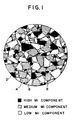
- FIG. 1 is an illustration of the spherical embodiment of the present invention illustrating a three component particle made up of high, medium and low melt index catalyst components.
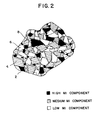
- FIG. 2 is an illustration of a non-spherical, irregularly shaped embodiment of the present invention illustrating a three component particle made up of high, medium and low melt index catalyst components.
- the composite is shown to have three discrete components where 2 represents the high melt index component, 4 represents a medium melt index component, and 6 represents the low melt index component and 8 represents the space between the components.
- Space 8 can be void, or filled with air or binder materials such as silica sol, alumina sol, polymeric materials and the like. While these illustrations show embodiments of this invention having three discrete catalytic regions, these illustrations are not meant to be limiting the invention to the use of three components.
- the present invention encompasses a monolithic multi-component composite polyolefin catalyst particle comprising at least two distinct supported catalyst components wherein each catalyst component is capable of producing a resin having a melt index different from at least one other catalyst component under constant reaction conditions.
- the monolithic multi-component composite can have a spherical or irregular shape and a rough or smooth surface.
- the distinct components of the composite are selected from the group consisting of chrome-silicas, chrome-titania silicas, chrome-silica titania tergels, Ziegler-Natta compositions, metallocenes and mixtures thereof.
- the weight fraction of each supported catalyst in the particle in the multicomponent composite is inversely proportional to the relative activity of each supported catalyst.
- the multi-component composite preferentially has average size in the range of about 20 - 300 ⁇ m and said distinct components preferentially are about 2 - 20 ⁇ m in size.
- composition of the present invention does not depend in any manner on the pore structure of the support.
- the only requirement is that the individual components have different melt index potentials, i.e., be capable of producing resins having widely different melt indices, and that have approximately the same activity.
- the melt index of the polymers capable of being produced by the components have a ratio of (from highest to lowest) of at least of 10, and preferably more than 50.
- polymerization includes copolymerization and terpolymeriztion and the terms olefins and olefinic monomer includes olefins, alphaolefins, diolefins, styrenic monomers, acetylenically unsaturated monomers, cyclic olefins and mixtures thereof.
- “Support” or “carrier” are interchangeable and shall mean any sufficiently porous material like talc, inorganic oxides such as Group IIA, IIIA, IVA or IVB metal oxides (such as silica, alumina, silica-alumina, magnesia, silica-magnesia, silica-alumina-titania, titania, silica-titania, zirconia); multi-component porous materials (e.g., co-gels, tergels, quadragels, co-precipitates, co-crystalized materials and the like etc.); aluminum phosphate; metal halides; chemically surface modified materials such as calcined silica, silanized silica, aryloxylated silica, alkoxylated silica, metal halide treated silica and the like; and resinous materials (such as finely divided polyethylene or polystyrene) and mixtures of all of the foregoing materials; preferably si
- Metallocene is defined as organometallic compounds having a transition metal, including rare earth metals, in coordination with members of at least one five-member carbon ring, heterosubstituted five-member carbon ring, or a bridged (ansa) ligand defined as two cyclic moieties capable of coordinating to the transition or rare earth metals.
- ansa bridge B can be carbon, silicon, phosphorus, sulfur, oxygen, nitrogen, germanium, species such as CH 2 CH 2 (ethylene), Me 2 Si (dimethylsilyl), Ph 2 Si (diphenylsilyl) Me 2 C (isopropylidene), Ph 2 P (diphenylphosphoryl) Me 2 SiSiMe 2 (tetramethyldisilane) and the like.
- preferred metallocenes are derivatives of a cyclopentadiene (Cp), including cyclopentadienyl, indenyl, fluorenyl, tetrahydroindenyl, and 1,1-disubstituted silacyclopentadienes, phosphocyclopentadienes, l-metallocyclopenta-2,4-dienes, bis(indenyl)ethane and mixtures thereof.
- Cp cyclopentadiene
- the transition metal component of the metallocene is selected from Groups IIIB through Group VIII of the Periodic Table and mixtures thereof, preferably Group IIIB, IVB, VB, VIB and rare earth (i.e. , lanthanides and actinides) metals, and most preferably titanium, zirconium, hafnium, chromium, vanadium, samarium and neodymium. Of these Ti, Zr, and Hf are most preferable.
- ZN Ziegler-Natta
- ZN is defined as a transition metal (Group IIIB through VIIIB) halide, alkyl, aryl, or alkoxy compounds and mixtures thereof in combination with a Group I through III elements of the Periodic Table.
- a typical example is TiCl 4 and AlEt 3 .
- the present invention can be used to produce polymers using solution polymerization, slurry polymerization or gas phase polymerization techniques. Method and apparatus for effecting such polymerization reactions are well known.
- the catalyst according to the present invention can be used in similar amounts and under similar conditions to known olefin polymerization catalysts.
- the temperature is from approximately 0 degrees C to just below the temperature at which the polymer becomes soluble in the polymerization medium.
- the temperature is from approximately 0 degrees C to just below the melting point of the polymer.
- the temperature is typically the temperature from which the polymer is soluble in the reaction medium up to approximately 275 degrees C.
- the pressure used can be selected from a relatively wide range of suitable pressures, e.g., from subatmospheric to about 350 Mpa.
- the pressure is from atmospheric to about 6.9 Mpa, or 0.05-10 MPa, especially 0.14-5.5 Mpa.
- the process is suitably performed with a liquid inert diluent such as a saturated aliphatic hydrocarbon.
- the hydrocarbon is a C 4 to C 10 hydrocarbon, e.g., isobutane or an aromatic hydrocarbon liquid such as benzene, toluene or xylene.
- the polymer is recovered directly from the gas phase process or by filtration or evaporation from the slurry process or evaporation from the solution process.
- the catalyst of the present invention are particularly suited for the slurry process.
- the above support materials are silicas or titania/silicas. They are sized and slurried in water, then sandmilled to fine particles (less than 10 microns), and mixed in proper proportions.
- the catalyst component is made by adding soluble Cr salt to this multi-component silica slurry to a level of about 1.0% Cr on total solids basis, and the mixture is then spray dried to produce spherical catalyst particles with average particle size of about 40 ⁇ m. Each particle contains an intimate mixture of the three components, each having different MI potentials.
- Another modification of the above involves mixing the three slurries prior to final milling, and feeding the mix into the sandmill, milling all three components simultaneously (referred herein as "termilling"). Thus all three components undergo final comminution at the same time. Still another modification involves adding Cr salt prior to sandmilling.
- Cr can be added separately to each slurry prior to mixing.
- Each slurry can then be treated independently to change the nature of Cr species in water prior to mixing and spray drying.
- the final sandmilled slurry was filtered at a rate to prevent fast sedimentation, then washed with a low molecular weight alcohol, followed by complete exchange with this alcohol and drying under vacuum. Sizing of the dried mix produced particles that were intimate mixtures of the three components, and thus function as an multicomponent ("MC") catalyst.
- MC multicomponent
- An alternate way is to reslurry the solvent exchanged cake in its own solvent and spray dry under oxygen free conditions to produce spherical catalyst particles.
- An alternate composition had only two components: #1 and #3.
- a dried silica/titania cogel pre-sized through a 325 mesh is added to a slurry of #1. Chromium was added; the slurry was filtered; and the filter cake under went solvent exchange with alcohol and dried. An alternate to this is solvent spray drying.
- Example 1 is the control, which was made from pure component #2. This preparation is used as reference to show the Die Swell advantages of Examples 3- 13. The latter have very little of component #2.
- the sole component of this catalyst preparation is the coarse milled hydrogel.
- the hydrogel was coarse ground to about a 1/8 inch (3.2 mm) size and slurried with diionized (“DI”) water to about 15% solids and this slurry is ground to about 100 microns.
- DI diionized
- the ground slurry was pumped to a sandmill and finely ground.
- the collected product was passed once more through the sandmill to achieve an average particle size ("APS") of about 6.5 ⁇ and a solids content of about 14.6 % by Ohaus moisture balance.
- Cr(NP 3 ) 3 *9H 2 O was added to the sandmilled slurry to give 1.0% Cr and the pH was adjusted to 4.14 with ammonia.
- This example is for an MC catalyst containing the three supports described above.
- the components used were:
- the three component slurries were individually pumped to a sandmill and held separately until they were combined to the above concentration.
- the ground hydrogel was passed twice through the sandmill, the other two only once.
- the combined slurry had a 7.3 ⁇ m average particle size. Solids concentration was 14.8% by Ohaus.
- the slurry was then spray dried.
- the collected product was screened through 100 mesh and on 325 mesh.
- the ground hydrogel was milled sandmill and held.
- the silica cake and cogel slurries were combined and mixed with the sandmilled hydrogel and Cr acetate salt was added to the mix sufficient to give 1.0% Cr on the catalyst.
- the slurry, at 17% solids, was milled in a sandmill.
- the combined milling of the three slurries is noted as termilling.
- the termilled slurry was stirred overnight and spray dried the next morning.
- the collected product was screened through 100 mesh and on 325 mesh. The properties of this catalyst are given in Table
- This example involves termilling of three catalytic supports, each support being individually impregnated with a chrome salt prior to mixing together and termilling in a horizontal mill.
- the three components are:
- the third component was 918g SiO 2 /Ti cogel at 2.0% TV(900g SiO 2 /Ti). This was slurried in 4.224g of DI H 2 O and 19.09g of chrome acetate was added. It was allowed to stir for one hour. This component is calculated to give 0.44% Cr.
- This catalyst was prepared the same as in Example 4 except the Cr target for the cake silica component was 1.0% instead of 0.55%. Thus Cr(NP 3 ) 3 *9H 2 O was added to slurried silica cake and stirred for one hour. The slurry was NH 3 stabilized similar to Example 4.
- the coarse ground and sandmilled hydrogel slurry was combined with Cr acetate salt to give 0.45% Cr and mixed for one hour.
- the pH was adjusted as in Example 4 and the slurry stirred another hour.
- the catalyst of this example had the same component composition of the catalysts in Examples 3, 4 & 5.
- the coarse ground hydrogel component was sandmilled once and combined with slurries of the silica cake and SiO 2 /Ti cogel to give 16.5% solids consisting of 43% Sylox, 14% hydrogel and 43% cogel. This slurry was then milled in a sandmill.
- the slurry pH was adjusted to 3.73 with 10% HNO 3 .
- the target Cr level for this catalyst was 0.60% Cr.
- Sufficient Cr acetate was added to the slurry and stirred overnight.
- the slurry was spray dried in the same manner as in previous examples. Properties for the portion of collected product screened through 100 mesh and on 325 mesh are given in Table 1.
- the catalyst of this example was similar to that of Example 6 except the target Cr level was 0.45% Cr.
- the three components were termilled in the same manner as for Example 6 and Cr acetate added after the sandmilled slurry's pH was adjusted.
- the slurry was spray dried and the properties of a screened (through 100 mesh and on 325 mesh) portion of collected product are given in Table 1.
- the catalyst of this example was prepared the same as those in Examples 6 and 7 except the target Cr level was 0.30% Cr. After termilling the three components, adding Cr acetate and spray drying, a screened fraction (through 100 mesh and on 325 mesh) was obtained. The properties are given in Table 1.
- the catalyst of this example is a two component MC catalyst using 50% Si02/Ti cogel and 50% lab washed silica cake. These two components were combined with sufficient DI water to give 17.8% solids as a slurry. Sufficient Cr acetate was added to this slurry and stirred overnight. The Cr target for this catalyst was 1.0% Cr. The slurry was sandmilled as in previous examples and a portion of the sandmilled slurry was saved for another catalyst described in Example 12. The bulk of the sandmilled slurry was spray dried as in previous examples. The screened portion, through 100 mesh and on 325 mesh, was analyzed and properties given in Table 1.
- the catalyst in this example was prepared from a portion of the Cr containing sandmilled slurry of the catalyst in Example 7. This portion was filtered on a glass-fritted Buchner funnel and the resulting cake was solvent exchanged with isopropanol. The cake was then dried in a vacuum for 48 hours.
- the catalyst in this example is a two component catalyst using 50% silica hydrogel catalyst fines (through 325 mesh) and 50% lab washed silica cake.
- 150g of hydrogel fines was added to 641g DI water and 146.5g isopropyl alcohol and slurried.
- Table 1 The properties of this catalyst are given in Table 1.
- This catalyst utilizes a portion of Cr containing sandmilled slurry of Example 9.
- the slurry was filtered on a Buchner filter, dried in a vacuum oven and sized to through 100 mesh and on 325 mesh.
- the properties of this catalyst are given in Table 1.
- This MC catalyst is a three component catalyst using 60% lab washed DB cake silica, 20% coarse ground hydrogel DB and 20% SiO 2 /Ti cogel DB. Each component was slurried in DI water to approximately 13% solids and separately pumped a sandmill with the hydrogel component being given a second pass through the sandmill. Portions of the three slurries were combined to give the above concentrations as follows:
- a total of 116.4g Cr(NP 3 ) 3 *9H 2 O was added to the slurry and stirred for 1 hour. The pH was stabilized to 4.31. After stirring overnight the pH fell to 3.48 where it was adjusted up to 4.17 using the NH 3 .
- This slurry was spray dried as in previous examples. Properties of a screened (through 100 mesh and on 325 mesh) portion of the collected product are given in Table 1.
- each catalyst were fluidized in a special quartz tube (4.8 cm O.D.) which had a sintered frit to support the sample.
- the fluidizing medium was very dry air, passed through beds containing activated alumina so that the moisture content corresponded to Dew Point of less than -100°F (-73°C).
- This fluidized bed was heated at the rate of 400°C/hr to final temperature of 1500°F (807°C)or 1300°F (697°C), where it was kept constant for 5.0 hrs.
- the quartz tube with the sample was cooled to ambient temperature and the activated catalyst was transferred to a glass container for storage. All handling of the activated material was done under nitrogen.
- the Melt Index of the final resin was determined using ASTM Proc. D1238-79, Cond. E, Procedure A; High Load Melt Index by ASTM Proc. D1238-79, Cond. F, Procedure B; and Density using ASTM D1505.
- ESCR was determined by ASTM D1693-70, Cond. B. Die Swell measurements were done by methods described in the art.
Landscapes
- Chemical & Material Sciences (AREA)
- Health & Medical Sciences (AREA)
- Chemical Kinetics & Catalysis (AREA)
- Medicinal Chemistry (AREA)
- Polymers & Plastics (AREA)
- Organic Chemistry (AREA)
- Transition And Organic Metals Composition Catalysts For Addition Polymerization (AREA)
Claims (7)
- Méthode de formation d'une particule de catalyseur pour polyoléfine composite multicomposant comprenant au moins deux catalyseurs supportés distincts choisis dans l'ensemble constitué de chrome-silice, chrome-oxyde de titane silices, tergels de chrome-silice-oxyde de titane, catalyseurs de Ziegler-Natta, métallocènes et mélanges de ceux-ci, ladite méthode comprenant les étapes consistant :a) à choisir au moins deux composants de catalyseurs, chaque composant étant capable de polymériser une polyoléfine ayant des indices de fluidité à l'état fondu différents ;b) à calibrer les composants catalytiques supportés pour choisir des composants ayant une dimension comprise dans l'intervalle d'environ 2-20 µm, suffisante pour permettre aux composants de se lier les uns aux autres ;c) à disperser lesdits composants dans un solvant non réactif pour former une suspension épaisse ; etd) à isoler la particule de catalyseur obtenue du solvant.
- Méthode selon la revendication 1, dans laquelle l'ordre des étapes b) et c) est inversée.
- Méthode de formation d'une particule de catalyseur composite multicomposant pour polyoléfines selon la revendication 1 ou 2, dans laquelle la méthode comprend en outre l'isolement de la particule de catalyseur du solvant par des techniques de séchage par pulvérisation.
- Méthode de la revendication 1, dans laquelle au moins deux composants catalytiques supportés de a) sont calibrés en b) par un procédé de co-broyage.
- Particules de catalyseur composite pour polyoléfines comprenant au moins deux composants de catalyseurs supportés distincts choisis dans l'ensemble constitué de chrome-silice, chrome-oxyde de titane-silices, tergels de chrome-silice-oxyde de titane, catalyseurs de Ziegler-Natta, métallocènes et mélanges de ceux-ci, dans laquelle le potentiel d'indice de fluidité à l'état fondu de chacun des composants de catalyseur supportés diffère du potentiel d'indice de fluidité à l'état fondu d'au moins un composant de catalyseur supporté de la particule, chaque composant distinct de ladite particule composite étant capable de catalyser simultanément la formation de polymères d'indices de fluidité à l'état fondu différents dans des conditions réactionnelles constantes dans un seul réacteur de polymérisation, pouvant être obtenue par la méthode comprenant les étapes consistant :a) à choisir au moins deux composants catalytiques supportés, chaque composant étant capable de polymériser une polyoléfine ayant des indices de fluidité à l'état fondu différents ;b) à calibrer les composants de catalyseurs pour choisir des composants ayant une dimension comprise dans l'intervalle d'environ 2-20 µm, suffisante pour permettre aux composants de se lier les uns aux autres ;c) à disperser lesdits composants dans un solvant non réactif pour former une suspension épaisse ; etd) à isoler la particule de catalyseur obtenue du solvant.
- Particule de la revendication 5, dans laquelle les étapes b) et c) sont inversées.
- Particule de la revendication 5 ou 6, dans laquelle la particule de catalyseur dans l'étape d) est isolée par des techniques de séchage par pulvérisation.
Applications Claiming Priority (3)
| Application Number | Priority Date | Filing Date | Title |
|---|---|---|---|
| US370045 | 1995-01-09 | ||
| US08/370,045 US5714424A (en) | 1995-01-09 | 1995-01-09 | Multi-component polyolefin catalysts |
| PCT/US1995/016820 WO1996021684A1 (fr) | 1995-01-09 | 1995-12-04 | Catalyseurs de polyolefine a composantes multiples |
Publications (2)
| Publication Number | Publication Date |
|---|---|
| EP0802933A1 EP0802933A1 (fr) | 1997-10-29 |
| EP0802933B1 true EP0802933B1 (fr) | 1999-05-06 |
Family
ID=23457999
Family Applications (1)
| Application Number | Title | Priority Date | Filing Date |
|---|---|---|---|
| EP95943970A Expired - Lifetime EP0802933B1 (fr) | 1995-01-09 | 1995-12-04 | Catalyseurs de polyolefine a composantes multiples |
Country Status (7)
| Country | Link |
|---|---|
| US (1) | US5714424A (fr) |
| EP (1) | EP0802933B1 (fr) |
| AT (1) | ATE179719T1 (fr) |
| AU (1) | AU4529296A (fr) |
| DE (1) | DE69509559T2 (fr) |
| WO (1) | WO1996021684A1 (fr) |
| ZA (1) | ZA9510544B (fr) |
Families Citing this family (59)
| Publication number | Priority date | Publication date | Assignee | Title |
|---|---|---|---|---|
| DE59606391D1 (de) * | 1995-08-22 | 2001-03-01 | Basf Ag | Polymerisate des ethylens mit hoher spannungsrissbeständigkeit und katalysatorsystem für deren herstellung |
| AU3599297A (en) | 1996-06-21 | 1998-01-07 | W.R. Grace & Co.-Conn. | Aggregate supports and olefin polymerization catalysts supported thereon |
| US6313061B1 (en) | 1998-12-22 | 2001-11-06 | W. R. Grace & Co.-Conn. | Method of making frangible spray dried agglomerated supports and olefin polymerization catalysts supported thereon |
| US6538077B1 (en) | 1999-11-04 | 2003-03-25 | Phillips Petroleum Company | Polymerization catalyst systems, methods of making and uses therefor |
| US6548442B1 (en) * | 1999-12-03 | 2003-04-15 | Phillips Petroleum Company | Organometal compound catalyst |
| DE60016176T2 (de) * | 2000-05-10 | 2005-12-01 | Repsol Quimica S.A. | Verfahren zur Herstellung von bimodalem Polyethylen |
| DE60236653D1 (de) | 2001-04-30 | 2010-07-22 | Grace W R & Co | Verfahren zur herstellung von geträgerten übergangsmetallpolymerisationskatalysatoren und daraus gebildete zusammensetzungen |
| US6943224B2 (en) | 2001-04-30 | 2005-09-13 | W. R. Grace & Co.-Conn. | Process for preparing supported transition metal catalyst systems and catalyst systems prepared thereby |
| US6946420B2 (en) | 2001-04-30 | 2005-09-20 | W. R. Grace & Co.-Conn | Coordination catalyst systems employing chromium support-agglomerate and method of their preparation |
| EP1401887A1 (fr) | 2001-04-30 | 2004-03-31 | W.R. Grace & Co.-Conn. | Catalyseurs au chrome heterogenes et procedes de polymerisation d'olefines dans lesquels ils sont utilises |
| EP1399491B1 (fr) | 2001-04-30 | 2006-08-23 | W.R. Grace & Co.-Conn. | Systemes supportes de catalyseurs doubles a base de metal de transition |
| US7365039B2 (en) | 2003-03-21 | 2008-04-29 | Dow Global Technologies Inc. | Morphology controlled olefin polymerization process |
| US6953764B2 (en) | 2003-05-02 | 2005-10-11 | Dow Global Technologies Inc. | High activity olefin polymerization catalyst and process |
| US6982304B2 (en) | 2003-12-22 | 2006-01-03 | Union Carbide Chemicals & Plastics Technology Corporation | Blow molding resins with improved ESCR |
| DE102004006104A1 (de) * | 2004-02-06 | 2005-08-25 | Basell Polyolefine Gmbh | Verfahren zur Herstellung von geträgerten Katalysatoren für die Polymerisation |
| US6977235B2 (en) * | 2004-04-22 | 2005-12-20 | Chevron Phillips Chemical Company, Lp | Catalyst systems comprising a calcined chromium catalyst and a non-transition metal cyclopentadienyl cocatalyst |
| US7307133B2 (en) * | 2004-04-22 | 2007-12-11 | Chevron Phillips Chemical Company Lp | Polymers having broad molecular weight distributions and methods of making the same |
| EP1803747A1 (fr) | 2005-12-30 | 2007-07-04 | Borealis Technology Oy | Catalyseur de polymérisation à surface modifiée pour réduire la formation de gels dans des films |
| RU2008147906A (ru) | 2006-05-05 | 2010-06-10 | Дау Глобал Текнолоджиз Инк. (Us) | Комплексы гафния с замещенными карбазолилом имидазольными лигандами |
| TW200932762A (en) | 2007-10-22 | 2009-08-01 | Univation Tech Llc | Polyethylene compositions having improved properties |
| TW200936619A (en) | 2007-11-15 | 2009-09-01 | Univation Tech Llc | Polymerization catalysts, methods of making, methods of using, and polyolefin products made therefrom |
| KR101698618B1 (ko) | 2009-01-08 | 2017-01-20 | 유니베이션 테크놀로지즈, 엘엘씨 | 폴리올레핀 중합 방법을 위한 첨가제 |
| WO2010080871A1 (fr) | 2009-01-08 | 2010-07-15 | Univation Technologies, Llc | Additif pour procédés de polymérisation en phase gazeuse |
| CN102482372B (zh) | 2009-07-23 | 2013-09-04 | 尤尼威蒂恩技术有限公司 | 聚合反应系统 |
| RU2554881C2 (ru) | 2010-02-18 | 2015-06-27 | Юнивейшн Текнолоджиз, Ллк | Способы управления работой реактора для полимеризации |
| AU2011217940B2 (en) | 2010-02-22 | 2013-10-03 | Univation Technologies, Llc | Catalyst systems and methods for using same to produce polyolefin products |
| BR112012025925B1 (pt) | 2010-04-13 | 2020-03-17 | Univation Technologies, Llc | Mistura polimérica e filme |
| RU2564301C2 (ru) | 2010-07-16 | 2015-09-27 | Юнивейшн Текнолоджиз, Ллк | Системы и способы измерения накопления частиц на поверхностях реактора |
| WO2012009215A1 (fr) | 2010-07-16 | 2012-01-19 | Univation Technologies, Llc | Systèmes et procédés pour mesurer la charge statique portée par des particules |
| WO2012015898A1 (fr) | 2010-07-28 | 2012-02-02 | Univation Technologies, Llc | Systèmes et procédés pour mesurer la vitesse d'un mélange particule/fluide |
| US20120108769A1 (en) * | 2010-10-28 | 2012-05-03 | Fina Technology, Inc. | Multi-component catalyst systems including chromium based catalysts and polymerization processes for forming polyolefins |
| US9181361B2 (en) | 2010-12-17 | 2015-11-10 | Univation Technologies, Llc | Systems and methods for recovering hydrocarbons from a polyolefin purge gas product |
| CN103347905B (zh) | 2010-12-22 | 2015-12-16 | 尤尼威蒂恩技术有限责任公司 | 用于聚烯烃聚合方法的添加剂 |
| WO2013028283A1 (fr) | 2011-08-19 | 2013-02-28 | Univation Technologies, Llc | Systèmes de catalyseur et leurs procédés d'utilisation pour la production de produits de polyoléfine |
| WO2013070602A1 (fr) | 2011-11-08 | 2013-05-16 | Univation Technologies, Llc | Procédés pour la production de polyoléfines avec des systèmes de catalyseur |
| EP2800766B1 (fr) | 2012-03-05 | 2019-09-04 | Univation Technologies, LLC | Méthode de préparation d'un catalyseur et les polymères resultants de son utilisation |
| CA2800056A1 (fr) | 2012-12-24 | 2014-06-24 | Nova Chemicals Corporation | Compositions de melange de polyethylene |
| ES2918582T3 (es) | 2012-12-28 | 2022-07-19 | Univation Tech Llc | Catalizador soportado con fluidez mejorada |
| US9540460B2 (en) | 2013-02-07 | 2017-01-10 | Univation Technologies, Llc | Preparation of polyolefin |
| CN105143281B (zh) | 2013-03-15 | 2018-06-01 | 尤尼威蒂恩技术有限责任公司 | 用于烯烃聚合催化剂的三齿氮类配体 |
| EP2970526B1 (fr) | 2013-03-15 | 2017-08-09 | Univation Technologies, LLC | Ligands pour catalyseurs |
| EP3287473B1 (fr) | 2013-06-05 | 2019-10-16 | Univation Technologies, LLC | Protection de groupes phénol |
| BR112017003314A2 (pt) | 2014-08-19 | 2018-01-23 | Univation Tech Llc | suportes de catalisador fluorados e sistemas de catalisador |
| CN106714967B (zh) | 2014-08-19 | 2020-07-17 | 尤尼威蒂恩技术有限责任公司 | 氟化催化剂载体和催化剂系统 |
| SG11201701260WA (en) | 2014-08-19 | 2017-03-30 | Univation Tech Llc | Fluorinated catalyst supports and catalyst systems |
| WO2016118599A1 (fr) | 2015-01-21 | 2016-07-28 | Univation Technologies, Llc | Procédés de commande d'une scission de chaînes polymères |
| WO2016118566A1 (fr) | 2015-01-21 | 2016-07-28 | Univation Technologies, Llc | Procédés de réduction de la teneur en gel des polyoléfines |
| US10377841B2 (en) | 2015-05-08 | 2019-08-13 | Exxonmobil Chemical Patents Inc. | Polymerization process |
| WO2018031157A1 (fr) | 2016-08-10 | 2018-02-15 | Exxonmobil Chemical Patents Inc. | Procédés d'alimentation en catalyseurs solides d'un réacteur de polymérisation en solution |
| US10544246B2 (en) | 2016-08-10 | 2020-01-28 | Exxonmobil Chemical Patents Inc. | Methods for supplying solid catalysts to a solution polymerization reactor |
| CN109983039B (zh) | 2016-09-27 | 2022-02-18 | 尤尼威蒂恩技术有限责任公司 | 用于聚乙烯生产中长链支化控制的方法 |
| WO2018063764A1 (fr) | 2016-09-27 | 2018-04-05 | Exxonmobil Chemical Patents Inc. | Procédé de polymérisation |
| WO2018063767A1 (fr) | 2016-09-27 | 2018-04-05 | Exxonmobil Chemical Patents Inc. | Processus de polymérisation |
| WO2018063765A1 (fr) | 2016-09-27 | 2018-04-05 | Exxonmobil Chemical Patents Inc. | Procédé de polymérisation |
| WO2018118155A1 (fr) | 2016-12-20 | 2018-06-28 | Exxonmobil Chemical Patents Inc. | Procédé de polymérisation |
| WO2019118073A1 (fr) | 2017-12-13 | 2019-06-20 | Exxonmobil Chemical Patents Inc. | Procédés de désactivation pour composants actifs à partir d'un procédé de polymérisation de polyoléfine en phase gazeuse |
| WO2019173030A1 (fr) | 2018-03-08 | 2019-09-12 | Exxonmobil Chemical Patents Inc. | Procédés de préparation et de surveillance d'un lit de germination pour le démarrage d'un réacteur de polymérisation |
| CN112055719B (zh) | 2018-05-02 | 2022-11-25 | 埃克森美孚化学专利公司 | 从中试装置放大到较大生产设施的方法 |
| US11459408B2 (en) | 2018-05-02 | 2022-10-04 | Exxonmobil Chemical Patents Inc. | Methods for scale-up from a pilot plant to a larger production facility |
Family Cites Families (20)
| Publication number | Priority date | Publication date | Assignee | Title |
|---|---|---|---|---|
| US3798202A (en) * | 1971-10-12 | 1974-03-19 | Phillips Petroleum Co | Polyolefin production |
| BE789870A (fr) * | 1972-10-09 | 1973-04-09 | Nat Petro Chem | Systeme catalytique mixte et procede pour produire des polymeres d'olefines. |
| JPS5610506A (en) * | 1979-07-09 | 1981-02-03 | Mitsui Petrochem Ind Ltd | Production of ethylene polymer composition |
| US4263422A (en) * | 1979-12-31 | 1981-04-21 | The Dow Chemical Company | Polymerization of olefins with dual, independently supported catalysts |
| US4391736A (en) * | 1981-06-05 | 1983-07-05 | Phillips Petroleum Company | Alpha-olefin polymerization |
| US4659690A (en) * | 1983-12-23 | 1987-04-21 | Phillips Petroleum Company | Acid agglomeration of refractory gel in polar organic diluent |
| US4560733A (en) * | 1984-10-01 | 1985-12-24 | Phillips Petroleum Company | Polymerization and catalyst |
| US4540757A (en) * | 1984-10-01 | 1985-09-10 | Phillips Petroleum Company | Polymerization and catalyst |
| US5198400A (en) * | 1987-05-20 | 1993-03-30 | Quantum Chemical Corporation | Mixed chromium catalysts and polymerizations utilizing same |
| CA1307619C (fr) * | 1987-05-20 | 1992-09-15 | Louis J. Rekers | Compositions catalytiques de chrome et polymerisation a l'aide de celles-ci |
| US5330950A (en) * | 1987-12-29 | 1994-07-19 | Mobil Oil Corporation | Mixed Ziegler and chromium catalyst and process for preparing a broad molecular weight distribution HDPE |
| US5408015A (en) * | 1987-12-29 | 1995-04-18 | Mobil Oil Corporation | Mixed chromium catalyst,and alkene and alkyl aluminum hydride-modified ziegler catalyst for multimodal HDPE |
| GB8919924D0 (en) * | 1989-09-04 | 1989-10-18 | Bp Chem Int Ltd | Chromium-containing complex polymerisation catalyst |
| US5034364A (en) * | 1989-11-09 | 1991-07-23 | Mobil Oil Corporation | Multiple chromium compound-containing catalyst composition and olefin polymerization therewith |
| FR2659337B1 (fr) * | 1990-03-12 | 1992-06-05 | Bp Chemicals Snc | Procede de preparation d'un catalyseur a base de zirconium, de titane et/ou de vanadium supporte sur du chlorure de magnesium, et utilisation du catalyseur dans la polymerisation des olefines. |
| US5237025A (en) * | 1990-10-09 | 1993-08-17 | Phillips Petroleum Company | Process for making bimodal polyolefins using two independent particulate catalysts |
| US5231066A (en) * | 1991-09-11 | 1993-07-27 | Quantum Chemical Corporation | Bimodal silica gel, its preparation and use as a catalyst support |
| US5486584A (en) * | 1992-10-08 | 1996-01-23 | Phillips Petroleum Company | Chromium catalyst compositions |
| US5248643A (en) * | 1992-11-23 | 1993-09-28 | Corning Incorporated | Mixed zeolites and method for producing same |
| US5508362A (en) * | 1993-10-08 | 1996-04-16 | Phillips Petroleum Company | Chromium catalyst compositions and polymerization processes therewith |
-
1995
- 1995-01-09 US US08/370,045 patent/US5714424A/en not_active Expired - Lifetime
- 1995-12-04 WO PCT/US1995/016820 patent/WO1996021684A1/fr not_active Ceased
- 1995-12-04 EP EP95943970A patent/EP0802933B1/fr not_active Expired - Lifetime
- 1995-12-04 AU AU45292/96A patent/AU4529296A/en not_active Abandoned
- 1995-12-04 AT AT95943970T patent/ATE179719T1/de not_active IP Right Cessation
- 1995-12-04 DE DE69509559T patent/DE69509559T2/de not_active Expired - Lifetime
- 1995-12-12 ZA ZA9510544A patent/ZA9510544B/xx unknown
Also Published As
| Publication number | Publication date |
|---|---|
| DE69509559D1 (de) | 1999-06-10 |
| AU4529296A (en) | 1996-07-31 |
| DE69509559T2 (de) | 2000-01-20 |
| ATE179719T1 (de) | 1999-05-15 |
| US5714424A (en) | 1998-02-03 |
| WO1996021684A1 (fr) | 1996-07-18 |
| ZA9510544B (en) | 1996-06-19 |
| EP0802933A1 (fr) | 1997-10-29 |
Similar Documents
| Publication | Publication Date | Title |
|---|---|---|
| EP0802933B1 (fr) | Catalyseurs de polyolefine a composantes multiples | |
| EP0906349B1 (fr) | Supports d'agregats portant des catalyseurs de polymerisation d'olefines | |
| KR100346932B1 (ko) | 고활성폴리에틸렌촉매 | |
| KR100531509B1 (ko) | 올레핀 중합 촉매 성분, 그의 제조 방법 및 용도 | |
| JP4298794B2 (ja) | 高活性メタロセン重合法 | |
| US7829495B2 (en) | Olefin polymerization process with alkyl-substituted metallocenes | |
| JPH09506912A (ja) | バイモーダル分子量分布の改良された現場ブレンド | |
| EP1090043B1 (fr) | Catalyseur a base de chrome modifie au titane et supporte sur silice-aluminophosphate | |
| US5292837A (en) | Process for the preparation of ethylene (co)polymers | |
| US20080009407A1 (en) | Multimodal polyethylene obtained with multilayer chromium catalyst | |
| JPH10506138A (ja) | 単一反応器内で製造される広い/2モード樹脂の分子量分布の制御方法 | |
| EP0882740A1 (fr) | Catalyseurs à base de chrome modifiés par titanation pour la production de polyéthylène présentant une plus grande résistance à la fissuration sous contrainte | |
| KR20140107236A (ko) | 올레핀 중합 촉매를 제조하는 방법, 상기 촉매 및 상기 촉매를 이용하여 수득된 에틸렌 중합체 및 공중합체 | |
| JPH09505236A (ja) | エチレンの重合および共重合用触媒組成物 | |
| Harrison et al. | Olefin polymerization using supported metallocene catalysts: development of high activity catalysts for use in slurry and gas phase ethylene polymerizations | |
| EP0998503B1 (fr) | Catalyseurs de polyethylene a forte activite | |
| AU628297B2 (en) | Modified chronium-containing catalyst composition for polymerizing alpha-olefins | |
| EP0180338B1 (fr) | Procédé de préparation d'un catalyseur pour la polymérisation d'alpha-oléfines | |
| EP2004705B1 (fr) | Réduction de la charge électrostatique dans un procédé de polymérisation | |
| AU715831B2 (en) | High activity catalysts for the preparation of polyethylene with an intermediate molecular weight distribution | |
| CN1109052C (zh) | 具有受控的颗粒尺寸及形态的聚乙烯聚合物或共聚物的旋转模塑方法 | |
| US20060252636A1 (en) | Silica supported ziegler-natta catalysts useful for preparing polyolefins | |
| KR100242209B1 (ko) | 올레핀 중합용 지글러-나타와 메탈로센의 공담지촉매 조성물을 이용한 폴리프로필렌의 제조방법 |
Legal Events
| Date | Code | Title | Description |
|---|---|---|---|
| PUAI | Public reference made under article 153(3) epc to a published international application that has entered the european phase |
Free format text: ORIGINAL CODE: 0009012 |
|
| 17P | Request for examination filed |
Effective date: 19970724 |
|
| AK | Designated contracting states |
Kind code of ref document: A1 Designated state(s): AT BE CH DE DK ES FR GB GR IE IT LI LU MC NL PT SE |
|
| GRAG | Despatch of communication of intention to grant |
Free format text: ORIGINAL CODE: EPIDOS AGRA |
|
| 17Q | First examination report despatched |
Effective date: 19980828 |
|
| GRAG | Despatch of communication of intention to grant |
Free format text: ORIGINAL CODE: EPIDOS AGRA |
|
| GRAH | Despatch of communication of intention to grant a patent |
Free format text: ORIGINAL CODE: EPIDOS IGRA |
|
| GRAH | Despatch of communication of intention to grant a patent |
Free format text: ORIGINAL CODE: EPIDOS IGRA |
|
| GRAA | (expected) grant |
Free format text: ORIGINAL CODE: 0009210 |
|
| AK | Designated contracting states |
Kind code of ref document: B1 Designated state(s): AT BE CH DE DK ES FR GB GR IE IT LI LU MC NL PT SE |
|
| PG25 | Lapsed in a contracting state [announced via postgrant information from national office to epo] |
Ref country code: SE Free format text: THE PATENT HAS BEEN ANNULLED BY A DECISION OF A NATIONAL AUTHORITY Effective date: 19990506 Ref country code: LI Free format text: LAPSE BECAUSE OF FAILURE TO SUBMIT A TRANSLATION OF THE DESCRIPTION OR TO PAY THE FEE WITHIN THE PRESCRIBED TIME-LIMIT Effective date: 19990506 Ref country code: GR Free format text: LAPSE BECAUSE OF NON-PAYMENT OF DUE FEES Effective date: 19990506 Ref country code: ES Free format text: THE PATENT HAS BEEN ANNULLED BY A DECISION OF A NATIONAL AUTHORITY Effective date: 19990506 Ref country code: CH Free format text: LAPSE BECAUSE OF FAILURE TO SUBMIT A TRANSLATION OF THE DESCRIPTION OR TO PAY THE FEE WITHIN THE PRESCRIBED TIME-LIMIT Effective date: 19990506 Ref country code: BE Free format text: LAPSE BECAUSE OF FAILURE TO SUBMIT A TRANSLATION OF THE DESCRIPTION OR TO PAY THE FEE WITHIN THE PRESCRIBED TIME-LIMIT Effective date: 19990506 Ref country code: AT Free format text: LAPSE BECAUSE OF FAILURE TO SUBMIT A TRANSLATION OF THE DESCRIPTION OR TO PAY THE FEE WITHIN THE PRESCRIBED TIME-LIMIT Effective date: 19990506 |
|
| REF | Corresponds to: |
Ref document number: 179719 Country of ref document: AT Date of ref document: 19990515 Kind code of ref document: T |
|
| REG | Reference to a national code |
Ref country code: CH Ref legal event code: EP |
|
| REF | Corresponds to: |
Ref document number: 69509559 Country of ref document: DE Date of ref document: 19990610 |
|
| REG | Reference to a national code |
Ref country code: IE Ref legal event code: FG4D |
|
| PG25 | Lapsed in a contracting state [announced via postgrant information from national office to epo] |
Ref country code: PT Free format text: LAPSE BECAUSE OF FAILURE TO SUBMIT A TRANSLATION OF THE DESCRIPTION OR TO PAY THE FEE WITHIN THE PRESCRIBED TIME-LIMIT Effective date: 19990806 Ref country code: DK Free format text: LAPSE BECAUSE OF FAILURE TO SUBMIT A TRANSLATION OF THE DESCRIPTION OR TO PAY THE FEE WITHIN THE PRESCRIBED TIME-LIMIT Effective date: 19990806 |
|
| ET | Fr: translation filed | ||
| REG | Reference to a national code |
Ref country code: CH Ref legal event code: PL |
|
| PG25 | Lapsed in a contracting state [announced via postgrant information from national office to epo] |
Ref country code: LU Free format text: LAPSE BECAUSE OF NON-PAYMENT OF DUE FEES Effective date: 19991204 Ref country code: IE Free format text: LAPSE BECAUSE OF NON-PAYMENT OF DUE FEES Effective date: 19991204 |
|
| PLBE | No opposition filed within time limit |
Free format text: ORIGINAL CODE: 0009261 |
|
| STAA | Information on the status of an ep patent application or granted ep patent |
Free format text: STATUS: NO OPPOSITION FILED WITHIN TIME LIMIT |
|
| 26N | No opposition filed | ||
| PG25 | Lapsed in a contracting state [announced via postgrant information from national office to epo] |
Ref country code: MC Free format text: LAPSE BECAUSE OF NON-PAYMENT OF DUE FEES Effective date: 20000630 |
|
| REG | Reference to a national code |
Ref country code: IE Ref legal event code: MM4A |
|
| REG | Reference to a national code |
Ref country code: GB Ref legal event code: IF02 |
|
| PGFP | Annual fee paid to national office [announced via postgrant information from national office to epo] |
Ref country code: NL Payment date: 20091224 Year of fee payment: 15 |
|
| PGFP | Annual fee paid to national office [announced via postgrant information from national office to epo] |
Ref country code: GB Payment date: 20091229 Year of fee payment: 15 Ref country code: FR Payment date: 20100106 Year of fee payment: 15 |
|
| PGFP | Annual fee paid to national office [announced via postgrant information from national office to epo] |
Ref country code: IT Payment date: 20091230 Year of fee payment: 15 |
|
| PGFP | Annual fee paid to national office [announced via postgrant information from national office to epo] |
Ref country code: DE Payment date: 20091230 Year of fee payment: 15 |
|
| REG | Reference to a national code |
Ref country code: NL Ref legal event code: V1 Effective date: 20110701 |
|
| GBPC | Gb: european patent ceased through non-payment of renewal fee |
Effective date: 20101204 |
|
| REG | Reference to a national code |
Ref country code: FR Ref legal event code: ST Effective date: 20110831 |
|
| PG25 | Lapsed in a contracting state [announced via postgrant information from national office to epo] |
Ref country code: FR Free format text: LAPSE BECAUSE OF NON-PAYMENT OF DUE FEES Effective date: 20110103 |
|
| REG | Reference to a national code |
Ref country code: DE Ref legal event code: R119 Ref document number: 69509559 Country of ref document: DE Effective date: 20110701 |
|
| PG25 | Lapsed in a contracting state [announced via postgrant information from national office to epo] |
Ref country code: GB Free format text: LAPSE BECAUSE OF NON-PAYMENT OF DUE FEES Effective date: 20101204 Ref country code: DE Free format text: LAPSE BECAUSE OF NON-PAYMENT OF DUE FEES Effective date: 20110701 |
|
| PG25 | Lapsed in a contracting state [announced via postgrant information from national office to epo] |
Ref country code: NL Free format text: LAPSE BECAUSE OF NON-PAYMENT OF DUE FEES Effective date: 20110701 Ref country code: IT Free format text: LAPSE BECAUSE OF NON-PAYMENT OF DUE FEES Effective date: 20101204 |