EP0798796A2 - Seltenerdelement-haltige Wasserstoffspeicherlegierung, Verfahren zu seiner Herstellung, negatives Elektrode aus solcher Legierung und alkalischer Akkumulator aus solches Elektrode - Google Patents
Seltenerdelement-haltige Wasserstoffspeicherlegierung, Verfahren zu seiner Herstellung, negatives Elektrode aus solcher Legierung und alkalischer Akkumulator aus solches Elektrode Download PDFInfo
- Publication number
- EP0798796A2 EP0798796A2 EP97302097A EP97302097A EP0798796A2 EP 0798796 A2 EP0798796 A2 EP 0798796A2 EP 97302097 A EP97302097 A EP 97302097A EP 97302097 A EP97302097 A EP 97302097A EP 0798796 A2 EP0798796 A2 EP 0798796A2
- Authority
- EP
- European Patent Office
- Prior art keywords
- hydrogen storage
- rare earth
- storage alloy
- earth element
- containing hydrogen
- Prior art date
- Legal status (The legal status is an assumption and is not a legal conclusion. Google has not performed a legal analysis and makes no representation as to the accuracy of the status listed.)
- Ceased
Links
Images


Classifications
-
- C—CHEMISTRY; METALLURGY
- C01—INORGANIC CHEMISTRY
- C01B—NON-METALLIC ELEMENTS; COMPOUNDS THEREOF; METALLOIDS OR COMPOUNDS THEREOF NOT COVERED BY SUBCLASS C01C
- C01B3/00—Hydrogen; Gaseous mixtures containing hydrogen; Separation of hydrogen from mixtures containing it; Purification of hydrogen; Reversible storage of hydrogen
- C01B3/0005—Reversible storage of hydrogen, e.g. by hydrogen getters or electrodes
- C01B3/001—Reversible storage of hydrogen, e.g. by hydrogen getters or electrodes characterised by the uptaking media; Treatment thereof
- C01B3/0018—Inorganic elements or compounds, e.g. oxides, nitrides, borohydrides or zeolites; Solutions thereof
- C01B3/0031—Intermetallic compounds; Metal alloys
- C01B3/0047—Intermetallic compounds; Metal alloys containing a rare earth metal
- C01B3/0057—Intermetallic compounds; Metal alloys containing a rare earth metal and nickel
-
- C—CHEMISTRY; METALLURGY
- C01—INORGANIC CHEMISTRY
- C01B—NON-METALLIC ELEMENTS; COMPOUNDS THEREOF; METALLOIDS OR COMPOUNDS THEREOF NOT COVERED BY SUBCLASS C01C
- C01B3/00—Hydrogen; Gaseous mixtures containing hydrogen; Separation of hydrogen from mixtures containing it; Purification of hydrogen; Reversible storage of hydrogen
- C01B3/0005—Reversible storage of hydrogen, e.g. by hydrogen getters or electrodes
- C01B3/001—Reversible storage of hydrogen, e.g. by hydrogen getters or electrodes characterised by the uptaking media; Treatment thereof
- C01B3/0018—Inorganic elements or compounds, e.g. oxides, nitrides, borohydrides or zeolites; Solutions thereof
- C01B3/0031—Intermetallic compounds; Metal alloys
- C01B3/0047—Intermetallic compounds; Metal alloys containing a rare earth metal
-
- H—ELECTRICITY
- H01—ELECTRIC ELEMENTS
- H01M—PROCESSES OR MEANS, e.g. BATTERIES, FOR THE DIRECT CONVERSION OF CHEMICAL ENERGY INTO ELECTRICAL ENERGY
- H01M4/00—Electrodes
- H01M4/02—Electrodes composed of, or comprising, active material
- H01M4/36—Selection of substances as active materials, active masses, active liquids
- H01M4/38—Selection of substances as active materials, active masses, active liquids of elements or alloys
- H01M4/383—Hydrogen absorbing alloys
-
- Y—GENERAL TAGGING OF NEW TECHNOLOGICAL DEVELOPMENTS; GENERAL TAGGING OF CROSS-SECTIONAL TECHNOLOGIES SPANNING OVER SEVERAL SECTIONS OF THE IPC; TECHNICAL SUBJECTS COVERED BY FORMER USPC CROSS-REFERENCE ART COLLECTIONS [XRACs] AND DIGESTS
- Y02—TECHNOLOGIES OR APPLICATIONS FOR MITIGATION OR ADAPTATION AGAINST CLIMATE CHANGE
- Y02E—REDUCTION OF GREENHOUSE GAS [GHG] EMISSIONS, RELATED TO ENERGY GENERATION, TRANSMISSION OR DISTRIBUTION
- Y02E60/00—Enabling technologies; Technologies with a potential or indirect contribution to GHG emissions mitigation
- Y02E60/10—Energy storage using batteries
-
- Y—GENERAL TAGGING OF NEW TECHNOLOGICAL DEVELOPMENTS; GENERAL TAGGING OF CROSS-SECTIONAL TECHNOLOGIES SPANNING OVER SEVERAL SECTIONS OF THE IPC; TECHNICAL SUBJECTS COVERED BY FORMER USPC CROSS-REFERENCE ART COLLECTIONS [XRACs] AND DIGESTS
- Y02—TECHNOLOGIES OR APPLICATIONS FOR MITIGATION OR ADAPTATION AGAINST CLIMATE CHANGE
- Y02E—REDUCTION OF GREENHOUSE GAS [GHG] EMISSIONS, RELATED TO ENERGY GENERATION, TRANSMISSION OR DISTRIBUTION
- Y02E60/00—Enabling technologies; Technologies with a potential or indirect contribution to GHG emissions mitigation
- Y02E60/30—Hydrogen technology
- Y02E60/32—Hydrogen storage
Definitions
- the present invention related to a hydrogen storage alloy, particularly to a hydrogen storage alloy suitable for an electrode used in an alkaline rechargeable battery, and to a production method thereof, and further to a negative electrode and an alkaline rechargeable battery wherein the aforesaid alloy is used.
- Those hydrogen-storage rare earth alloys have the basic composition of LaNi 5 , and they have undergone improvements in characteristics for the purpose of practical use, e.g., so as to have an enhanced charge-and-discharge capacity and an increased number of charge and discharge cycles (a lengthened life) under practical conditions.
- multi-component alloys have been developed by replacing a part of La by one or more of a light rare earth element, such as Co, Pr or Nd, and further a part of Ni by one or more of a metal element such as Co, Mn, Al, Cu or Fe.
- the batteries using those multi-component alloys as active material for the negative electrode have low discharge capacity in a low temperature range (-20°C - 0°C). This temperature range is included in the environmental conditions to be met by the batteries used as electric source of portable electronic appliances. Therefore, a great improvement in the discharge capacity of an active material for negative electrode under low temperatures has been desired.
- a rare earth element-containing hydrogen storage alloy powder has been produced by mixing many metal elemants to constitute the alloy (e.g., La, Ce, Pr, Nd, Co, Ni, Mn, Al, etc.) in individually desired amounts, melting the mixture in a high frequency induction furnace, forming the molten matter into an ingot, subjecting the ingot to an annealing treatment, and then grinding the annealed ingot into a powder.
- metal elemants e.g., La, Ce, Pr, Nd, Co, Ni, Mn, Al, etc.
- Japanese Tokkai Hei 6-29007 (The term “Tokkai” as used herein means an "unexamined published patent application") proposed the method of using a plasma arc discharge technique in place of the foregoing high frequency induced heating to effectively prevent an ingot from being contaminated with impurities. Although this method is successful in effecting improvements upon some of electrode characteristics, the improvement brought about thereby in a low-temperature characteristic is still insufficient.
- the present inventors have studied deeply into hydrogen storage alloys suitable for the negative electrode of an alkaline rechargeable battery from the viewpoint of minimizing the content of impurities therein. As a result thereof, it has been found that, when hydrogen-storage rare earth alloys are produced using a plasma melting technique under a specified condition, the alloys produced can be markedly reduced in content of impurities to provide an electrode having excellent characteristics, including a satisfactory low-temperature characteristic in the use for battery electrode, thereby achieving the present invention.
- a first object of the present invention is to provide a rare earth element-containing hydrogen storage alloy wherein the content of impurities, such as Mg, Cl and Pb, is markedly decreased.
- a second object of the present invention is to provide a method of producing a rare earth element-containing hydrogen storage alloy suitable for a negative electrode used in an alkaline rechargeable battery which ensures an effective decrease in the content of impurities and/or high hardness in the alloy produced.
- a third object of the present invention is to provide a negative electrode for use in alkaline rechargeable batteries which has high initial activity and ensures a high-efficiency discharge characteristic and an excellent low-temperature characteristic in the batteries.
- a fourth object of the present invention is to provide an alkaline rechargeable battery having a high-efficiency discharge characteristic, an excellent initial charge-and-discharge characteristic and a satisfactory low-temperature characteristic.
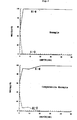
- Fig. 1 shows graphically the oxygen-concentration distribution in the depth direction of each of the hydrogen storage alloys produced in Example 1 (solid line) and Comparative Example 1 (dotted line). These data were determined by X-ray photoelectron spectroscopy (XPS).
- Fig. 2 shows graphically the oxidized state of Ni in the depth direction of each of the hydrogen storage alloys produced in Example 1 (dotted line) and comparative Example 1. These data were also determined by XPS.
- the present rare earth element-containing hydrogen storage alloy that the content of Cl be not higher than 10 ppm.
- the total nonmetal elements as impurities it is desirable for the content thereof to be not higher than 1,200 ppm, particularly not higher than 1,000 ppm.
- the nonmetal elements which become a problem in the present invention are nonmetal elements with which the present alloy is contaminated due to the presence in the starting materials used and in the course of the production thereof, which are comprised mainly of C, O, S, N, B, F and Cl.
- the sulfur content be not higher than 10 ppm
- the oxygen content be not higher than 400 ppm
- the carbon content be not higher than 500 ppm
- the nitrogen content be not higher than 50 ppm
- the boron content be not higher than 10 ppm
- the fluorine content be not higher than 10 ppm.
- the hydrogen storage alloy produced in accordance with the present invention is characterized in that the content of Mg can be reduced to 80 ppm or below. From the viewpoint of using the present hydrogen storage alloy as negative electrode of an alkaline rechargeable battery, it is favorable to reduce the content of total alkaline earth metals to 100 ppm or below, or to reduce the alkali metal content to 10 ppm or below, or to reduce the Pb content to 100 ppm or below.
- the present rare earth element-containing hydrogen storage alloy has a ccmposition represented by the formula Mm(NiCOM) x .
- Mm represents one rare earth element selected from the group consisting of Ce, La, Pr and Nd or a mixture of these rare earth elements (a Misch metal)
- M represents at least one element selected from the group consisting of Mn, Al, Cu and Fe
- x is within the range of 4.0 to 6.0, preferably 4.5 to 5.5.
- At least a part of starting materials for the formation or a rare earth element-containing hydrogen storage alloy of multi-component type is molten with a plasma melting method.
- a part or all of the starting materials may be molten in advance with a conventional high-frequency induced melting method, or all the starting materials which have been molten with the plasma melting method may further be molten with a conventional high-frequency induced melting method.
- the characteristics of the present alloy can be further improved by repeating the plasma melting method two or more times.
- the plasma melting method employed in the present invention it is desirable that the plasma be generated in an atmosphere of argon, helium or a mixture thereof.
- the plasma generation in an atmosphere of helium is preferred.
- the plasma temperature employable in the present production method is higher than, e.g., 10,000 °C. It is desirable to choose a higher plasma temperature, because a melt can be formed in the shorter time and the temperature thereof can be heightened.
- the plasma generation be carried out setting the positive electrode on the torch side and the negative electrode on the melt side.
- Such a setting can be easily attained by using a water-cooled metallic hearth as the hearth to accommodate the melt.
- a water-cooled hearth made of copper from the viewpoint of preventing the contamination with extra impurities.
- melt be agitated by the high-frequency magnetic field induced by arranging high-frequency coils around the hearth and sending high-frequency electricity thereto.
- the hearth structure so that not only the hearth has a cylindrical crucible-form space provided with segments arranged symmetrically with respect to the vertical axis but also the high-frequency electric current is made to flow so as to surround the hearth.
- the high-frequency magnetic field is induced inside the hearth to make it possible to maintain the melt in a floating condition.
- the alloy produced has a high density and excellent surface characteristics, including desirable heat of wetting and zeta potential.
- the thermal behavior of the present rare earth element-containing hydrogen storage alloy is characteristic upon fusion and solidification in the course of the production according to the present method.
- the present hydrogen storage alloy in large in the size of crystal lattice and small in the ratio of the lattice constant of c-axis to that of a-axis (c/a ratio), compared with conventional ones.
- the alloy produced in accordance with the present invention has the aforementioned various characteristics in the massive state, such as an ingot having a polished or chemically treated surface, and can retain those characteristics even after the massive alloy is formed into a powder by undergoing heating and grinding treatments, e.g., in using it for the negative electrode of an alkaline rechargeable battery.
- the present negative electrode for an alkaline rechargeable battery can be easily obtained as follow: A powder prepared by properly annealing and grinding the massive alloy (such as ingot) produced in the present process as mentioned above is kneaded together with a small amount of binder to be made into a paste, and the paste is coated on a conductive support and then dried, or the paste is formed into a sheet and then applied to a conductive support under pressure.
- the present alkaline rechargeable battery can be made with ease.
- the method of producing a hydrogen storage alloy according to the present invention comprises placing at least a part of starting materials in a metallic water-cooled hearth and melting it with plasma generated by setting the torch side as the positive electrode and the alloy side as the negative electrode in an atmosphere of helium, and further melting all the starting materials using a proper melting method optionally combined with a high-frequency melting method.
- the thus produced hydrogen storage alloy has reduced contents of impurities including alkaline earth elements, so that the alkaline rechargeable battery using the present alloy as negative electrode can be superior to conventional ones in various characteristics, including low-temperature, cycle life and high-efficianoy discharge characteristics.
- the alloy represented by Mm(Ni, Co, Mn, Al) x was produced using a conventional high-frequency induced melting method. Therein, x was 5.0.
- helium gas was admitted into the plasma generating apparatus equipped with a water-cooled copper hearth as the positive electrode and a plasma torch as the negative electrode so as to adjust the inner pressure to 800 Torr.
- the foregoing alloy was continuously fed into the water-cooled copper hearth from the feeder attached to the plasma generating apparatus, and the fed alloy was molten by exposure to the plasma flow.
- the liquid of plasma-molten alloy was made to overflow the water-cooled copper hearth, and poured into a cylindrical copper mold to be solidified. Thus, a hydrogen storage alloy was obtained.
- the Vickers hardness of the alloy was found to be 630 kg/mm 2 , and it was confirmed by the XPS measurement of the oxygen distribution in the depth direction of the alloy (Fig. 1) that the oxygen concentration showed a sharp decrease from the alloy surface towards the inner part in the surface layer covering from the surface to a depth of 20 mn. In this surface layer, the average oxygen concentration was below 6.9 weight %. Further, as shown in Fig. 2, it was also confirmed that the oxygen-combined Ni atom decreased drastically in number from the alloy surface towards the inner part. In addition, the proportion of the oxygen-combined Ni atoms to the total Ni atoms was 2.9 weight % on the average in the surface layer covering from the surface to a depth of 20 nm.
- the melt obtained was poured into a water-cooled iron mold (of a tabular form), and solidified by cooling.
- the impurities of the thus obtained alloy were analyzed by the same method as employed in Example 1. The results of the analysis are also shown in Table 1. Further, as the results of the examinations of the other characteristics, which were carried out in the same procedures as in Example 1, it was found that the alloy had Vickers hardness of 577 kg/mm 2 and the average oxygen concentration of no higher than 11 weight % in the surface layer covering from the surface to a depth of 20 nm (Fig. 1), and further that the alloy showed a rapid decrease in oxygen-combined Ni atom concentration in the neighborhood of the alloy surface (Fig. 2) and the proportion of the oxygen-combined Ni atoms to the total Ni atoms was 6.7 weight % on the average in the surface layer covering from the surface to a depth of 20 nm.
- Example 1 The data set forth in Table 1 indicate that the impurities, including nonmetal elements, in the present hydrogen storage alloy were less than those in the conventional one. Further, the examination results in Example 1 and Comparative Example 1 have proved that the present alloy was high in the surface hardness and low in the oxygen content, compared with the conventional alloy.
- the hydrogen storage alloy powder obtained in Example 1 (size: 75 ⁇ m or below) in an amount of 1.0 g was mixed with 0.25 g of a 3 weight % polyvinyl alcohol solution to prepare a paste. This paste was filled into a sheet of fibrous Ni, and dried to form into a negative electrode.
- a positive electrode made of sintered Ni was arranged on each side of the thus formed negative electrode via a nonwoven fabric of polypropylene, and placed in a 30 % water solution of KOH, thereby making an open alkaline rechargeable battery.
- each battery was examined for high-efficiency discharge characteristic by measuring discharge capacities at 20°C under the conditions that the discharge currents of 900 mA/g and 60 mA/g were made to flow, respectively.
- the results obtained are shown in Table 4.
- the letter "C” in Table 4 (and also in Tables 8, 12, 16 and 19 shown below) signifies the hour rate defined according to JIS C-8705. In determining the hour rate, the rated capacity was taken as 300 mAh/g in the present invention. Accordingly, the expression “the discharge condition of 0.2C” means a condition such that it takes 5 hours to complete the discharge, and the expression “the discharge condition of 3C” means a condition such that it takes 20 minutes to complete the discharge.
- Hydrogen storage alloy powders were produced in the same process as in Example 1, except that the alloys used as starting material were different in contents of impurities from that used in Example 1 as shown in Table 5; while a hydrogen storage alloy powder for comparison was produced in the same process as in Comparative Example 1, except that the alloy used as starting material was the same as used in Example 3.
- the Mg contents, the total alkaline earth metal contents and the Vickers hardness values of the thus produced powders are shown in Table 5.
- Table 5 Alkaline earth metal (ppm) Mg (ppm) Vickers hardness
- Example 3 96 87 796 (130) (120)
- Example 4 70 59 858 (127) (98)
- Figures in parentheses are contents of impurities present in the alloy used as starting material in each Example.
- Example 4 Example 5 Compar.Ex.2 1 184 227 230 161 2 229 252 250 201 3 251 266 263 238 Table 7 Discharge Capacity (mAh/g) Example 3 Example 4 Example 5 Compar.Ex. 2 A:Discharge Capacity at 20°C 282 300 300 291 B:Discharge Capacity at -10°C 194 233 224 141 B/A 69% 78% 75% 48% Table 8 Discharge Condition Discharge Capacity (mAh/g) Example 3 Example 4 Example 5 Compar. Ex. 2 a: 0.2C 293 303 309 297 b: 3.0C 233 268 260 183 b/a 80% 88% 84% 62%
- the data set forth above demonstrate that the hydrogen storage alloys containing Mg as an impurity in a content of no higher than 80 ppm are superior in initial activity, low-temperature characteristic and high-efficiency discharge characteristic.
- the reduction to 80 ppm or below in the content of Mg has greater contribution to improvement in characteristics of a hydrogen storage alloy than the reduction to 100 ppm or below in the content of total alkaline earth metals.
- the alloys show a tendency to have higher hardness the lower they are in content of the total alkaline earth metals, and in content of Mg as well.
- Hydrogen storage alloy powders were produced in the same process as in Example 1, except that the alloys used as starting material were different in contents of impurities from that used in Example 1 as shown in Table 9; while a hydrogen storage alloy powder for comparison was produced in the same process as in Comparative Example 1, except that the alloy used as starting material was the same as used in Example 7.
- the total nonmetal element contents, the total alkaline earth metal contents and the Vickers hardness values of the thus produced powders are shown in Table 9.
- Table 9 Nonmetal element (ppm) Mg (ppm) Vickers hardness
- Example 6 1083 170 781 (1300) (220)
- Figures in parentheses are contents of impurities present in the alloy used as starting material in each Example.
- Example 6 Example 7 Example 8 Compar.Ex.3 1 212 236 210 175 2 233 253 237 209 3 253 270 259 233 Table 11 Discharge Capacity (mAh/g) Example 6
- Example 7 Example 8 Compar.Ex.3 A:Discharge Capacity at 20°C 290 290 303 288 B:Discharge Capacity at -10°C 205 206 226 142 B/A 71% 71% 75% 49%
- Table 12 Discharge Condition Discharge Capacity (mAh/g)
- Example 6 Example 7 Example 8 Compar.Ex.3 a: 0.2C 305 308 314 295 b: 3.0C 228 248 261 203 b/a 75% 80% 83% 69%
- the data set forth above demonstrate that reducing the total content of alkaline earth metals present as impurities in the hydrogen storage alloy to 100 ppm or below is important for the achievement of high initial activity, satisfactory low-temperature characteristic and excellent high-efficiency discharge characteristic. Further, it is confirmed by the above data that the initial activity, the low-temperature characteristic and the high-efficiency discharge characteristic of hydrogen storage alloys are improved by reducing the total content of nonmetal elements as impurities to 1,200 ppm or below even when the total content of alkaline earth elements as impurities is above 100 ppm.
- Bydrogen storage alloy powders were produced in the same process as in Example 1, except that the alloys used as starting material were different in contents of impurities from that used in Example 1 as shown in Table 13; while a hydrogen storage alloy powder for comparison was produced in the same process as in Comparative Example 1, except that the alloy ured as starting material was the same as used in Example 9.
- the total nonmetal element contents, the total alkaline earth metal contents and the Vickers hardness values of the thus produced powders are shown in Table 13.
- Table 13 Alkaline earth metal Pb Vickers hardness (ppm) (ppm)
- Example 9 54 104 859 (127) (129)
- Figures in parentheses are contents of impurities present in the alloy used an starting material in each Example.
- Example 10 Example 11 Compar.Ex.4 1 217 230 204 172 2 250 254 234 200 3 262 266 258 228 Table 15 Discharge Capacity (mAh/g) Example 9
- Example 10 Example 11 Compar.Ex.4 A:Discharge Capacity at 20°C 291 300 276 301 B:Discharge Capacity at -10°C 221 224 185 149 B/A 76% 75% 67% 49% Table 16 Discharge Condition Discharge Capacity (mAh/g)
- Example 10 Example 11 Compar.Ex.4 a: 0.2C 309 309 304 299 b: 3.0C 251 260 234 182 b/a 81% 84% 77% 61%
- the above data prove that the hardness of alloys can be considerably heightened when the total content of alkaline earth metals is reduced to 100 ppm or below, and further that the reduction in the content of Pb is also effective in heightening the hardness of alloys.
- Hydrogen storage alloy powders were produced in the same processes as in Example 1 and Comparative Example 1, respectively, except that the alloy used as starting material was different from that used in those Examples.
- the alloy power produced in accordance with the process of Example 1 had a chlorine content of 4.7 ppm, while the alloy powder produced in accordance with the process of Comparative Example 1 had a chlorine content of 11.0 ppm.
- These alloy powders each were evaluated by the same method as adopted in Example 2. The results obtained are shown in Tables 17 to 19.
Landscapes
- Chemical & Material Sciences (AREA)
- Organic Chemistry (AREA)
- Chemical Kinetics & Catalysis (AREA)
- Geology (AREA)
- Life Sciences & Earth Sciences (AREA)
- General Life Sciences & Earth Sciences (AREA)
- Engineering & Computer Science (AREA)
- Combustion & Propulsion (AREA)
- Inorganic Chemistry (AREA)
- Environmental & Geological Engineering (AREA)
- Electrochemistry (AREA)
- General Chemical & Material Sciences (AREA)
- Battery Electrode And Active Subsutance (AREA)
- Secondary Cells (AREA)
Applications Claiming Priority (4)
| Application Number | Priority Date | Filing Date | Title |
|---|---|---|---|
| JP104115/96 | 1996-03-28 | ||
| JP10411596 | 1996-03-28 | ||
| JP9091430A JPH1025529A (ja) | 1996-03-28 | 1997-03-25 | 希土類元素含有水素吸蔵合金、その製造方法およびそれを用いたアルカリ蓄電池用負電極並びにアルカリ蓄電池 |
| JP91430/97 | 1997-03-25 |
Publications (2)
| Publication Number | Publication Date |
|---|---|
| EP0798796A2 true EP0798796A2 (de) | 1997-10-01 |
| EP0798796A3 EP0798796A3 (de) | 1997-10-08 |
Family
ID=26432870
Family Applications (1)
| Application Number | Title | Priority Date | Filing Date |
|---|---|---|---|
| EP97302097A Ceased EP0798796A3 (de) | 1996-03-28 | 1997-03-26 | Seltenerdelement-haltige Wasserstoffspeicherlegierung, Verfahren zu seiner Herstellung, negatives Elektrode aus solcher Legierung und alkalischer Akkumulator aus solches Elektrode |
Country Status (3)
| Country | Link |
|---|---|
| US (1) | US20010015243A1 (de) |
| EP (1) | EP0798796A3 (de) |
| JP (1) | JPH1025529A (de) |
Families Citing this family (9)
| Publication number | Priority date | Publication date | Assignee | Title |
|---|---|---|---|---|
| JP2002063896A (ja) * | 2000-08-22 | 2002-02-28 | Matsushita Electric Ind Co Ltd | 水素吸蔵合金電極とそれを用いたアルカリ蓄電池 |
| JP4808384B2 (ja) * | 2004-03-24 | 2011-11-02 | Jx日鉱日石金属株式会社 | 水素吸蔵合金 |
| JP4634256B2 (ja) * | 2005-08-24 | 2011-02-16 | 日本重化学工業株式会社 | 水素吸蔵合金とその製造方法ならびにニッケル水素二次電池 |
| JP3992075B1 (ja) | 2007-01-30 | 2007-10-17 | 中央電気工業株式会社 | 水素吸蔵合金およびニッケル−水素電池用電極 |
| JP5354970B2 (ja) * | 2008-06-17 | 2013-11-27 | 三洋電機株式会社 | 水素吸蔵合金およびアルカリ蓄電池 |
| WO2010110134A1 (ja) * | 2009-03-27 | 2010-09-30 | 日鉱金属株式会社 | スパッタリング用ランタンターゲット |
| JP5456763B2 (ja) | 2009-03-31 | 2014-04-02 | Jx日鉱日石金属株式会社 | スパッタリング用ランタンターゲット |
| JP5329498B2 (ja) * | 2010-09-01 | 2013-10-30 | Jx日鉱日石金属株式会社 | 水素吸蔵合金 |
| JP5892048B2 (ja) * | 2012-11-20 | 2016-03-23 | 住友金属鉱山株式会社 | アルカリ二次電池正極活物質用被覆水酸化ニッケル粉末及びその製造方法 |
Family Cites Families (5)
| Publication number | Priority date | Publication date | Assignee | Title |
|---|---|---|---|---|
| JPS56166355A (en) * | 1980-05-27 | 1981-12-21 | Toyota Central Res & Dev Lab Inc | Hydrogen storing material |
| JP2980371B2 (ja) * | 1990-11-30 | 1999-11-22 | 株式会社東芝 | 二次電池用水素吸蔵合金 |
| JP3184609B2 (ja) * | 1992-04-14 | 2001-07-09 | 東芝電池株式会社 | 金属酸化物・水素電池及びその製造方法 |
| JPH0790435A (ja) * | 1993-09-20 | 1995-04-04 | Shin Etsu Chem Co Ltd | 水素吸蔵合金、その製造方法及びそれを用いた電極 |
| JP3343417B2 (ja) * | 1993-11-25 | 2002-11-11 | 東芝電池株式会社 | 金属酸化物・水素二次電池 |
-
1997
- 1997-03-25 JP JP9091430A patent/JPH1025529A/ja active Pending
- 1997-03-26 EP EP97302097A patent/EP0798796A3/de not_active Ceased
-
1999
- 1999-05-18 US US09/313,657 patent/US20010015243A1/en not_active Abandoned
Also Published As
| Publication number | Publication date |
|---|---|
| EP0798796A3 (de) | 1997-10-08 |
| US20010015243A1 (en) | 2001-08-23 |
| JPH1025529A (ja) | 1998-01-27 |
Similar Documents
| Publication | Publication Date | Title |
|---|---|---|
| KR100239742B1 (ko) | 희토류금속-니켈계 수소흡장합금 및 그 제조법, 및 니켈수소 2차전지용 음극 | |
| US9219277B2 (en) | Low Co hydrogen storage alloy | |
| US8277582B2 (en) | Hydrogen absorbing alloy, hydrogen absorbing alloy electrode, secondary battery, and production method of hydrogen absorbing alloy | |
| JP5856056B2 (ja) | 希土類−Mg−Ni系水素吸蔵合金の製造方法 | |
| EP0609609A2 (de) | Wasserstoffabsorbierende Legierung für negative Elektrode und Verfahren zur Herstellung | |
| EP0798796A2 (de) | Seltenerdelement-haltige Wasserstoffspeicherlegierung, Verfahren zu seiner Herstellung, negatives Elektrode aus solcher Legierung und alkalischer Akkumulator aus solches Elektrode | |
| JPWO2013118806A1 (ja) | 水素吸蔵合金粉末、負極およびニッケル水素二次電池 | |
| Yuexiang et al. | Characteristics of a low-cobalt AB5-type hydrogen storage alloy obtained by a gas-atomization processing | |
| US6083327A (en) | Hydrogen occluding alloy | |
| JP3493516B2 (ja) | 水素吸蔵合金及びその製造方法 | |
| JP3697996B2 (ja) | 高率初期活性化処理で少ない充放電回数での高放電容量化並びに低温高率放電容量の向上を可能とする電池負極用水素吸蔵合金 | |
| JP6934097B1 (ja) | 水素吸蔵合金 | |
| JP2005133193A (ja) | 低Co水素吸蔵合金 | |
| JPH11269501A (ja) | 水素吸蔵合金粉末の製造方法及び水素吸蔵合金電極 | |
| US6329100B1 (en) | Hydrogen absorbing alloy electrode and process for producing same | |
| JP3301792B2 (ja) | 水素吸蔵合金電極 | |
| EP1173627A1 (de) | Seltene erden, intermetallische zusammensetzungen des ab 5? typs für die negativen elektroden aufladbarer batterien | |
| Zhang et al. | Effects of cooling rate during casting on performance of metal hydride electrodes and nickel–metal hydride batteries | |
| JP3306154B2 (ja) | 水素吸蔵合金及びその製造方法 | |
| JP4462909B2 (ja) | 水素吸蔵合金 | |
| CN114941058A (zh) | 一种高纯度Pr5Co19型La-Y-Ni超点阵合金及其制备方法 | |
| JP3360916B2 (ja) | 水素吸蔵合金の製造方法 | |
| Patrikeev et al. | The synthesis of alloys for nickel-metal hydride batteries | |
| JPH07320730A (ja) | 金属−水素化物アルカリ蓄電池用の水素吸蔵合金電極 | |
| JP2000038630A (ja) | 水素吸蔵合金及びその製造方法 |
Legal Events
| Date | Code | Title | Description |
|---|---|---|---|
| PUAI | Public reference made under article 153(3) epc to a published international application that has entered the european phase |
Free format text: ORIGINAL CODE: 0009012 |
|
| PUAL | Search report despatched |
Free format text: ORIGINAL CODE: 0009013 |
|
| AK | Designated contracting states |
Kind code of ref document: A2 Designated state(s): DE FR GB |
|
| AK | Designated contracting states |
Kind code of ref document: A3 Designated state(s): DE FR GB |
|
| 17P | Request for examination filed |
Effective date: 19980330 |
|
| 17Q | First examination report despatched |
Effective date: 20000211 |
|
| RTI1 | Title (correction) |
Free format text: RARE EARTH ELEMENT-CONTAINING HYDROGEN STORAGE ALLOY, METHOD OF PRODUCING THE SAME, NEGATIVE ELECTRODE USING SAID ALLOY, AND ALKALINE RECHARGEABLE BATTERY USING SAID ELECTRODE |
|
| GRAG | Despatch of communication of intention to grant |
Free format text: ORIGINAL CODE: EPIDOS AGRA |
|
| STAA | Information on the status of an ep patent application or granted ep patent |
Free format text: STATUS: THE APPLICATION HAS BEEN REFUSED |
|
| 18R | Application refused |
Effective date: 20020407 |