EP0795896A2 - Trocken-Ätzverfahren - Google Patents
Trocken-Ätzverfahren Download PDFInfo
- Publication number
- EP0795896A2 EP0795896A2 EP97400562A EP97400562A EP0795896A2 EP 0795896 A2 EP0795896 A2 EP 0795896A2 EP 97400562 A EP97400562 A EP 97400562A EP 97400562 A EP97400562 A EP 97400562A EP 0795896 A2 EP0795896 A2 EP 0795896A2
- Authority
- EP
- European Patent Office
- Prior art keywords
- dry etching
- film forming
- film
- group
- gaseous
- Prior art date
- Legal status (The legal status is an assumption and is not a legal conclusion. Google has not performed a legal analysis and makes no representation as to the accuracy of the status listed.)
- Withdrawn
Links
Images
Classifications
-
- H—ELECTRICITY
- H10—SEMICONDUCTOR DEVICES; ELECTRIC SOLID-STATE DEVICES NOT OTHERWISE PROVIDED FOR
- H10D—INORGANIC ELECTRIC SEMICONDUCTOR DEVICES
- H10D1/00—Resistors, capacitors or inductors
- H10D1/60—Capacitors
- H10D1/68—Capacitors having no potential barriers
- H10D1/682—Capacitors having no potential barriers having dielectrics comprising perovskite structures
-
- C—CHEMISTRY; METALLURGY
- C04—CEMENTS; CONCRETE; ARTIFICIAL STONE; CERAMICS; REFRACTORIES
- C04B—LIME, MAGNESIA; SLAG; CEMENTS; COMPOSITIONS THEREOF, e.g. MORTARS, CONCRETE OR LIKE BUILDING MATERIALS; ARTIFICIAL STONE; CERAMICS; REFRACTORIES; TREATMENT OF NATURAL STONE
- C04B41/00—After-treatment of mortars, concrete, artificial stone or ceramics; Treatment of natural stone
- C04B41/53—After-treatment of mortars, concrete, artificial stone or ceramics; Treatment of natural stone involving the removal of at least part of the materials of the treated article, e.g. etching, drying of hardened concrete
- C04B41/5338—Etching
- C04B41/5346—Dry etching
-
- H—ELECTRICITY
- H10—SEMICONDUCTOR DEVICES; ELECTRIC SOLID-STATE DEVICES NOT OTHERWISE PROVIDED FOR
- H10P—GENERIC PROCESSES OR APPARATUS FOR THE MANUFACTURE OR TREATMENT OF DEVICES COVERED BY CLASS H10
- H10P50/00—Etching of wafers, substrates or parts of devices
- H10P50/20—Dry etching; Plasma etching; Reactive-ion etching
- H10P50/26—Dry etching; Plasma etching; Reactive-ion etching of conductive or resistive materials
- H10P50/264—Dry etching; Plasma etching; Reactive-ion etching of conductive or resistive materials by chemical means
- H10P50/266—Dry etching; Plasma etching; Reactive-ion etching of conductive or resistive materials by chemical means by vapour etching only
- H10P50/267—Dry etching; Plasma etching; Reactive-ion etching of conductive or resistive materials by chemical means by vapour etching only using plasmas
-
- H—ELECTRICITY
- H10—SEMICONDUCTOR DEVICES; ELECTRIC SOLID-STATE DEVICES NOT OTHERWISE PROVIDED FOR
- H10P—GENERIC PROCESSES OR APPARATUS FOR THE MANUFACTURE OR TREATMENT OF DEVICES COVERED BY CLASS H10
- H10P50/00—Etching of wafers, substrates or parts of devices
- H10P50/20—Dry etching; Plasma etching; Reactive-ion etching
- H10P50/28—Dry etching; Plasma etching; Reactive-ion etching of insulating materials
- H10P50/282—Dry etching; Plasma etching; Reactive-ion etching of insulating materials of inorganic materials
- H10P50/283—Dry etching; Plasma etching; Reactive-ion etching of insulating materials of inorganic materials by chemical means
- H10P50/285—Dry etching; Plasma etching; Reactive-ion etching of insulating materials of inorganic materials by chemical means of materials not containing Si, e.g. PZT or Al2O3
Definitions
- the present invention relates to a method for dry etching of various film structures used for making memory devices, in particular, floating-gate ferroelectric RAMs.
- film structures include ferroelectric materials such as lead zirco-titanate, strontium- or bismuth-based films, and electrode materials such as iridium or platinum/titanium group materials in a monolayer or laminated structure.
- ferroelectric RAM which is a type of non-volatile memory.
- Ferroelectric RAM owes its non-volatility to the use of memory devices made of a strongly dielectric material.
- flash memory devices which are ROM (Read Only Memory)
- ferroelectric memory devices are RAM (Random Access Memory), that is, ferroelectric RAM offers advantages such as its ability to freely access each bit and superior response speed.
- the ferroelectric RAM using floating gate is configured as a single transistor memory cell having a core structure of lead zirco-titanate (Pb(Zr x ⁇ Ti 1-x )O 3 , (abbreviated to PZT hereinbelow) sandwiched between electrodes of iridium/iridium dioxide film (abbreviated to Ir/IrO 2 hereinbelow). Adopting this construction has enabled to prevent diffusion and reaction of lead in PZT to lead to degradation of strong dielectric properties, thereby achieving a quantum increase in its rewriting capacity.
- PZT lead zirco-titanate
- Ir/IrO 2 iridium/iridium dioxide film
- This type of devices may also be made from, for example, strontium (Sr) based films such as SrTiO 3 , bismuth (Bi) based films such as Y1 (oxide mixture of Sr, Bi, Ta) for ferroelectric devices, and from platinum/titanium based films (referred to as Pt/Ti hereinbelow) for electrode structure.
- strontium (Sr) based films such as SrTiO 3
- bismuth (Bi) based films such as Y1 (oxide mixture of Sr, Bi, Ta) for ferroelectric devices
- Pt/Ti platinum/titanium based films
- the gaseous etchant is either chloride-based gases such as BCl 3 /Cl 2 or SiCl 4 , fluoride-based gases such as CF 4 , C 2 F 6 , a mixture of chloride-based and fluoride-based gases such as BCl 3 , Cl 2 and SF 6 , or bromide-based gases such as HBr.
- chloride-based gases such as BCl 3 /Cl 2 or SiCl 4
- fluoride-based gases such as CF 4 , C 2 F 6
- a mixture of chloride-based and fluoride-based gases such as BCl 3 , Cl 2 and SF 6
- bromide-based gases such as HBr.
- the method enables dry etching of a monolayer film structure or a laminated film structure made of a combination of materials typically represented by lead zirco-titanate based material, strontium-based material, bismuth-based material, which exhibit ferroelectric properties, and by iridium group and a platinum/titanium group materials suitable for forming electrodes.
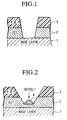
- Figure 1 is a schematic cross sectional view of a PZT film fabricated with a first embodiment of the dry etching method of the present invention.
- Figure 2 is a schematic cross sectional view of another PZT film fabricated with a conventional dry etching method.
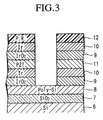
- Figure 3 is a schematic cross sectional view of a laminated PZT fabricated with a second embodiment of the dry etching method of the present invention.
- the first embodiment relates to a method of etching of a monolayer film structure of PZT.
- This is an example of a structure fabricated using photoresist masking in a reactive ion etching (referred to as RIE) apparatus of a parallel plate type.
- RIE reactive ion etching
- Figures 1 and 2 contrast the shapes of the fabricated cavities produced by the present method and by the conventional method, respectively.
- the film structure produced by the present process, shown in Figure 1 is comprised of a base layer 1, a PZT film 2, and a photoresist film 3.
- the conventional process using a mixture of gases SF6 and CHF3, produced deposit particles 4 on the PZT film 2, caused by the sulphur constituents in the etchant, as illustrated in Figure 2.
- the reaction products produced in the present process are PbCl 4 , ZrCl 4 and TiCl 4 as shown in equation (1), and, because all of the reaction products have relatively high vapor pressures, no unwanted deposit particles were formed on the etched surface as illustrated in Figure 1.
- etching gases other than BCl 3 , and Cl 2 can also be used successfully, for example, a mixture of chloride group gases such as SiCl 4 , fluoride group gases such as C 2 F 6 and bromide group gases such as HBr.
- HBr gas for instance, a volatile reaction product PbBr is again formed as in the case represented by equation (1).
- a second embodiment will be presented next. This is an example of dry etching a laminated film structure represented by Ir/IrO 2 /PZT/Ir/IrO 2 .
- Figure 3 is a schematic drawing of an example of a cavity fabricated in a laminated film structure.
- the laminated film structure comprises successive layers of: a SiO 2 film 7 serving as gate oxide layer formed on a silicon substrate base 6; followed by a polysilicon film 8 serving as a floating gate layer; followed by successive layers of IrO 2 film 9/Ir film 10 (electrodes)/ PZT film 11 (ferroelectric layer)/IrO 2 film 9/Ir film 10 (control gates).
- Etching process was carried out in the parallel plates RIE apparatus using a gaseous mixture of BCl 3 and Cl 2 and continuously etching the laminated film structure (i.e. Ir/IrO 2 /PZT/Ir/IrO 2 ) through a photoresist masking 12, as shown in Figure 3.
- the conditions for dry etching were the same as those in the first embodiment.
- This embodiment relates to dry etching of a structure comprising Ir/IrO 2 films.
- Etching trials using a photoresist making on Ir/IrO 2 films were carried out using the parallel plates RIE apparatus in two kinds of gaseous mixtures.
- First mixture contained Cl 2 and BCl 3 while the second mixture contained a suitable amount of SF 6 added to the Cl 2 /BCl 3 mixture.
- the conditions for dry etching were the same as those in the first embodiment.
- Etching trials using the second gas mixture demonstrated that a reaction product IrF 6 is produced during the dry etching process, because of the presence of SF 6 in the second gas mixture.
- the volatile IrF 6 does not adhere to the photoresist masking, therefore it is possible to perform dry etching while preventing the problem of rabbit ear formation.
- the masking film was etched away rapidly because the fluoride group gases readily attacked the photoresist material, and the difference in the etching rates on masking film and on the device structure resulted in a cavity having a slanted wall profile.
- the film structures which can be dry etched using the procedure disclosed are not limited to the materials and film structures mentioned in the foregoing embodiments.
- Other possibilities include monolayer or laminated film structures of single material or a combination of ferroelectric materials, such as PZT-based films including doped PZT, for example, PLZT ((Pb, La)(Zr, Ti)O 3 ), other lead oxide-based materials such as PTO (PbTiO 3 ), strontium-based materials such as SrTiO 3 , bismuth-based materials, electrode films such as Pt/Ti group films.
- PZT-based films including doped PZT, for example, PLZT ((Pb, La)(Zr, Ti)O 3 ), other lead oxide-based materials such as PTO (PbTiO 3 ), strontium-based materials such as SrTiO 3 , bismuth-based materials, electrode films such as Pt/Ti group films.
- a circle indicates a combination of etching film and etching gases which is practical
- a triangle indicates a combination of etching film and etching gases which is possible but presents some problems in practice (for example, etching rate is slow, formation of deposits etc.)
- a cross indicates a combination which is not workable.
- the present invention has demonstrated by experimental trials that a judicious choice of film material and etching gases enables dry etching to be carried out on many useful film materials as indicated partially in Table 1. It is important to recognize the basic principle that partial pressures of the reaction products constitute an important consideration in selecting a type of gas to be used in dry etching processes.
Landscapes
- Chemical & Material Sciences (AREA)
- Engineering & Computer Science (AREA)
- Ceramic Engineering (AREA)
- Materials Engineering (AREA)
- Structural Engineering (AREA)
- Organic Chemistry (AREA)
- Drying Of Semiconductors (AREA)
- Semiconductor Memories (AREA)
- Non-Volatile Memory (AREA)
- Crystals, And After-Treatments Of Crystals (AREA)
- ing And Chemical Polishing (AREA)
Applications Claiming Priority (2)
| Application Number | Priority Date | Filing Date | Title |
|---|---|---|---|
| JP8059696A JPH09251983A (ja) | 1996-03-15 | 1996-03-15 | ドライエッチング方法 |
| JP59696/96 | 1996-03-15 |
Publications (2)
| Publication Number | Publication Date |
|---|---|
| EP0795896A2 true EP0795896A2 (de) | 1997-09-17 |
| EP0795896A3 EP0795896A3 (de) | 1999-06-02 |
Family
ID=13120640
Family Applications (1)
| Application Number | Title | Priority Date | Filing Date |
|---|---|---|---|
| EP97400562A Withdrawn EP0795896A3 (de) | 1996-03-15 | 1997-03-13 | Trocken-Ätzverfahren |
Country Status (4)
| Country | Link |
|---|---|
| EP (1) | EP0795896A3 (de) |
| JP (1) | JPH09251983A (de) |
| KR (1) | KR970067689A (de) |
| CA (1) | CA2199878A1 (de) |
Cited By (12)
| Publication number | Priority date | Publication date | Assignee | Title |
|---|---|---|---|---|
| FR2777114A1 (fr) * | 1998-04-03 | 1999-10-08 | United Microelectronics Corp | Procede d'attaque d'une couche d'oxyde de tantale |
| NL1009201C2 (nl) * | 1998-05-06 | 1999-11-22 | United Microelectronics Corp | Werkwijze voor het etsen van een tantaaloxide-laag. |
| US6037264A (en) * | 1997-03-13 | 2000-03-14 | Applied Materials, Inc. | Method for removing redeposited veils from etched platinum |
| US6265318B1 (en) | 1998-01-13 | 2001-07-24 | Applied Materials, Inc. | Iridium etchant methods for anisotropic profile |
| US6323132B1 (en) | 1998-01-13 | 2001-11-27 | Applied Materials, Inc. | Etching methods for anisotropic platinum profile |
| WO2001082344A3 (en) * | 2000-04-21 | 2002-02-28 | Applied Materials Inc | Method of patterning lead zirconium titanate and barium strontium titanate |
| US6482745B1 (en) | 1998-01-13 | 2002-11-19 | Applied Materials, Inc. | Etching methods for anisotropic platinum profile |
| US6485988B2 (en) * | 1999-12-22 | 2002-11-26 | Texas Instruments Incorporated | Hydrogen-free contact etch for ferroelectric capacitor formation |
| US6642567B1 (en) | 2000-08-31 | 2003-11-04 | Micron Technology, Inc. | Devices containing zirconium-platinum-containing materials and methods for preparing such materials and devices |
| WO2005022612A1 (en) * | 2003-09-03 | 2005-03-10 | Infineon Technologies Ag | Fence-free etching of iridium barrier having a steep taper angle |
| US6919168B2 (en) | 1998-01-13 | 2005-07-19 | Applied Materials, Inc. | Masking methods and etching sequences for patterning electrodes of high density RAM capacitors |
| CN100505177C (zh) * | 2003-05-30 | 2009-06-24 | 东京毅力科创株式会社 | 用于刻蚀高k介电材料的方法和系统 |
Families Citing this family (6)
| Publication number | Priority date | Publication date | Assignee | Title |
|---|---|---|---|---|
| KR100321703B1 (ko) * | 1998-12-24 | 2002-03-08 | 박종섭 | 반도체 소자의 강유전체 캐패시터 제조방법 |
| KR100321695B1 (ko) * | 1998-12-30 | 2002-06-27 | 박종섭 | 반도체 소자의 강유전체 캐패시터 제조방법 |
| KR100495913B1 (ko) * | 2000-12-30 | 2005-06-17 | 주식회사 하이닉스반도체 | 반도체소자 제조 방법 |
| JP4551725B2 (ja) | 2004-09-13 | 2010-09-29 | Okiセミコンダクタ株式会社 | 半導体装置の製造方法 |
| JP5076890B2 (ja) | 2005-06-17 | 2012-11-21 | 富士通セミコンダクター株式会社 | 半導体装置及びその製造方法 |
| JP4999185B2 (ja) * | 2008-03-04 | 2012-08-15 | 富士フイルム株式会社 | ドライエッチング方法及びドライエッチング装置 |
Family Cites Families (5)
| Publication number | Priority date | Publication date | Assignee | Title |
|---|---|---|---|---|
| JPS6292323A (ja) * | 1985-10-17 | 1987-04-27 | Nec Corp | ドライエツチング方法 |
| US5254217A (en) * | 1992-07-27 | 1993-10-19 | Motorola, Inc. | Method for fabricating a semiconductor device having a conductive metal oxide |
| US5368687A (en) * | 1993-03-15 | 1994-11-29 | Micron Technology, Inc. | Semiconductor processing method of etching insulating inorganic metal oxide materials and method of cleaning metals from the surface of semiconductor wafers |
| US5443688A (en) * | 1993-12-02 | 1995-08-22 | Raytheon Company | Method of manufacturing a ferroelectric device using a plasma etching process |
| JP2953974B2 (ja) * | 1995-02-03 | 1999-09-27 | 松下電子工業株式会社 | 半導体装置の製造方法 |
-
1996
- 1996-03-15 JP JP8059696A patent/JPH09251983A/ja active Pending
-
1997
- 1997-03-13 CA CA002199878A patent/CA2199878A1/en not_active Abandoned
- 1997-03-13 EP EP97400562A patent/EP0795896A3/de not_active Withdrawn
- 1997-03-14 KR KR1019970008770A patent/KR970067689A/ko not_active Ceased
Cited By (20)
| Publication number | Priority date | Publication date | Assignee | Title |
|---|---|---|---|---|
| US6037264A (en) * | 1997-03-13 | 2000-03-14 | Applied Materials, Inc. | Method for removing redeposited veils from etched platinum |
| US6277762B1 (en) | 1997-03-13 | 2001-08-21 | Applied Materials, Inc. | Method for removing redeposited veils from etched platinum |
| US6087265A (en) * | 1997-03-13 | 2000-07-11 | Applied Materials, Inc. | Method for removing redeposited veils from etched platinum |
| US6482745B1 (en) | 1998-01-13 | 2002-11-19 | Applied Materials, Inc. | Etching methods for anisotropic platinum profile |
| US6749770B2 (en) | 1998-01-13 | 2004-06-15 | Jeng H. Hwang | Method of etching an anisotropic profile in platinum |
| US6265318B1 (en) | 1998-01-13 | 2001-07-24 | Applied Materials, Inc. | Iridium etchant methods for anisotropic profile |
| US6323132B1 (en) | 1998-01-13 | 2001-11-27 | Applied Materials, Inc. | Etching methods for anisotropic platinum profile |
| US6919168B2 (en) | 1998-01-13 | 2005-07-19 | Applied Materials, Inc. | Masking methods and etching sequences for patterning electrodes of high density RAM capacitors |
| US6777342B2 (en) | 1998-01-13 | 2004-08-17 | Jeng H. Hwang | Method of plasma etching platinum |
| US6001742A (en) * | 1998-04-03 | 1999-12-14 | United Microelectronics Corp. | Method for etching tantalum oxide layer |
| FR2777114A1 (fr) * | 1998-04-03 | 1999-10-08 | United Microelectronics Corp | Procede d'attaque d'une couche d'oxyde de tantale |
| NL1009201C2 (nl) * | 1998-05-06 | 1999-11-22 | United Microelectronics Corp | Werkwijze voor het etsen van een tantaaloxide-laag. |
| US6485988B2 (en) * | 1999-12-22 | 2002-11-26 | Texas Instruments Incorporated | Hydrogen-free contact etch for ferroelectric capacitor formation |
| WO2001082344A3 (en) * | 2000-04-21 | 2002-02-28 | Applied Materials Inc | Method of patterning lead zirconium titanate and barium strontium titanate |
| US6436838B1 (en) | 2000-04-21 | 2002-08-20 | Applied Materials, Inc. | Method of patterning lead zirconium titanate and barium strontium titanate |
| US6642567B1 (en) | 2000-08-31 | 2003-11-04 | Micron Technology, Inc. | Devices containing zirconium-platinum-containing materials and methods for preparing such materials and devices |
| US6946395B2 (en) | 2000-08-31 | 2005-09-20 | Micron Technology, Inc. | Devices containing zirconium-platinum-containing materials and methods for preparing such materials and devices |
| CN100505177C (zh) * | 2003-05-30 | 2009-06-24 | 东京毅力科创株式会社 | 用于刻蚀高k介电材料的方法和系统 |
| WO2005022612A1 (en) * | 2003-09-03 | 2005-03-10 | Infineon Technologies Ag | Fence-free etching of iridium barrier having a steep taper angle |
| US7015049B2 (en) | 2003-09-03 | 2006-03-21 | Infineon Technologies Ag | Fence-free etching of iridium barrier having a steep taper angle |
Also Published As
| Publication number | Publication date |
|---|---|
| JPH09251983A (ja) | 1997-09-22 |
| EP0795896A3 (de) | 1999-06-02 |
| KR970067689A (ko) | 1997-10-13 |
| CA2199878A1 (en) | 1997-09-15 |
Similar Documents
| Publication | Publication Date | Title |
|---|---|---|
| EP0795896A2 (de) | Trocken-Ätzverfahren | |
| US5256245A (en) | Use of a clean up step to form more vertical profiles of polycrystalline silicon sidewalls during the manufacture of a semiconductor device | |
| US6436838B1 (en) | Method of patterning lead zirconium titanate and barium strontium titanate | |
| EP0786805A2 (de) | Verfahren zum Plasma-Ätzen einer Schicht aus ferroelektrischem Material oder ein Material mit hoher dielektrischer Kontante oder aus Platin | |
| EP1195803B1 (de) | Verfahren zur Reinigung nach einer Ätzung | |
| US6296777B1 (en) | Structuring process | |
| DE19733391C2 (de) | Strukturierungsverfahren | |
| JP3088178B2 (ja) | ポリシリコン膜のエッチング方法 | |
| US7618894B2 (en) | Multi-step selective etching for cross-point memory | |
| KR19990006752A (ko) | 전자 재료 박막의 식각 방법 | |
| JP3166746B2 (ja) | キャパシタ及びその製造方法 | |
| KR100338808B1 (ko) | 이리듐(Ir) 전극의 건식 식각방법 | |
| US7045070B1 (en) | Method of producing an electrode configuration and method of electrically contacting the electrode configuration | |
| JP2000223666A (ja) | 半導体メモリ素子の製造方法 | |
| US6277760B1 (en) | Method for fabricating ferroelectric capacitor | |
| KR100289389B1 (ko) | 반도체소자의캐패시터제조방법 | |
| KR20000067642A (ko) | 강유전체 캐패시터 구조체의 건식식각 방법 | |
| JP2003224207A (ja) | 半導体装置およびその製造方法 | |
| US7015049B2 (en) | Fence-free etching of iridium barrier having a steep taper angle | |
| US20020119669A1 (en) | Method of fabricating semiconductor device | |
| DE112004000192T5 (de) | Hartmaske mit hoher Selektivität für IR-Sperrschichten zur Herstellung eines ferroelektrischen Kondensators | |
| DE19929307C1 (de) | Verfahren zur Herstellung einer strukturierten Schicht und dadurch hergestellte Elektrode | |
| US5292402A (en) | Masking material for applications in plasma etching | |
| KR100468698B1 (ko) | 강유전체막용식각가스및이를이용한강유전체커패시터의제조방법 | |
| KR19980082854A (ko) | 강유전체막를 이용한 커패시터 제조 방법 |
Legal Events
| Date | Code | Title | Description |
|---|---|---|---|
| PUAI | Public reference made under article 153(3) epc to a published international application that has entered the european phase |
Free format text: ORIGINAL CODE: 0009012 |
|
| 17P | Request for examination filed |
Effective date: 19970318 |
|
| AK | Designated contracting states |
Kind code of ref document: A2 Designated state(s): DE FR GB |
|
| PUAL | Search report despatched |
Free format text: ORIGINAL CODE: 0009013 |
|
| AK | Designated contracting states |
Kind code of ref document: A3 Designated state(s): DE FR GB |
|
| STAA | Information on the status of an ep patent application or granted ep patent |
Free format text: STATUS: THE APPLICATION IS DEEMED TO BE WITHDRAWN |
|
| 18D | Application deemed to be withdrawn |
Effective date: 19991001 |